

- Market Size (2026)
- USD 326.6 Mn
- Forecast (2036)
- USD 766.1 Mn
- CAGR (2026 to 2036)
- 8.9%
How big is Root Moisture Polymers Market in 2026?
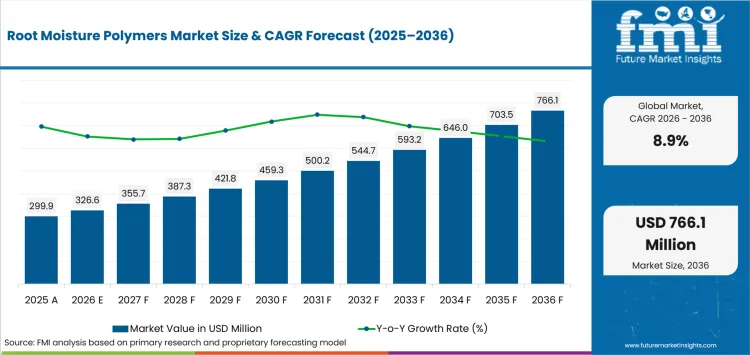
USD 326.6 million in 2026 and USD 766.1 million by 2036 at an 8.9% CAGR.
Demand for root moisture polymers is projected to expand at 8.9% CAGR between 2026 and 2036, increasing valuation from USD 326.6 million in 2026 to USD 766.1 million by 2036. Growers pay for formulations that improve water movement or crop-input delivery without changing irrigation or spray equipment. USDA ERS documented 54.9 million acres of irrigated crop and pastureland nationally in January 2026. That operating base gives agricultural adjuvants a recurring use case once field response justifies the added treated-acre cost.
The UK is projected to rise at 7.6% CAGR while Japan is forecast at 6.8%, reflecting different water-management pressure. In August 2026 the Environment Agency reported that 71.3% of England was in drought after a record-dry July. Farms using micro irrigation systems still need products that match installed equipment and local water allocation. Japan’s adoption path depends more on equipment fit and crop-specific protocols, so uptake is steadier despite the same water-efficiency need.
Key Takeaways of Root Moisture Polymers Market
- Growers are paying for products that improve root-zone water movement or crop-input delivery without requiring a separate field operation.
- Based on product type, surfactant-based products are projected to account for 45.3% in 2026 due to one chemistry family serving soil-wetting and foliar application tasks.
- In 2026, efficacy enhancement is expected to lead function with 50.8% share because farm programs judge adjuvants against pesticide and nutrient programs plus irrigation performance.
- Cereals & grains are set to lead the crop type category with 42.9% share in 2026 due to large treated acreage and repeated field applications.
- Local registration rules and field compatibility slow switching since a poor fit can erase the economic benefit of an additional formulation.
- Some of the key players in this market include Precision Laboratories, WinField United (Land O'Lakes), Brandt, Loveland Products (Nutrien), Oro Agri (Rovensa), Clariant, Croda, and Stepan Company.
Analyst Perspective
"Root moisture polymers earn their place if one formulation improves water movement or spray delivery without forcing another field pass. Commercial value depends on repeatable response under local water conditions plus clear dosing and compatibility guidance from the distributor."
- Nikhil Kaitwade, Principal Consultant, Future Market Insights
How is the Root Moisture Polymers Market segmented?
The root moisture polymers market is segmented by product type, function, crop type, application method and sales channel.
Product type covers surfactant-based, oil-based, polymer-based, mineral / carrier-based and other formulations while function covers efficacy enhancement, loss & drift reduction, handling & compatibility and others. Crop type covers cereals & grains, fruits & vegetables, oilseeds & pulses, turf & ornamentals and others while application method covers foliar tank-mix, granule / dry blend, fertigation and others. Sales channels include agri-input distributors, cooperatives, agri-retail chains, online / direct-to-farm and other routes used for commercial farm purchases.
Why does foliar tank-mix lead the Application Method category?
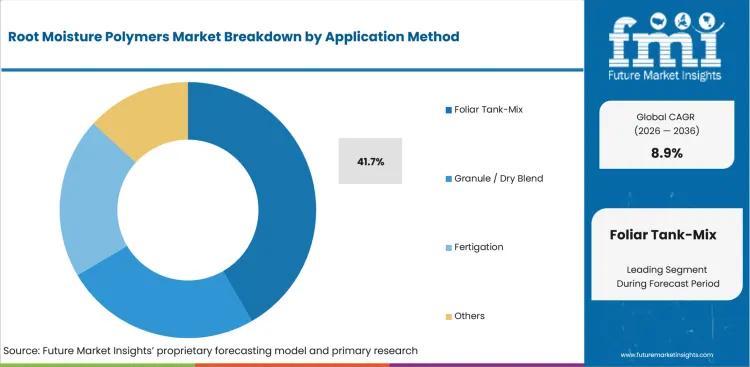
Foliar tank-mix products enter an operation already used for crop protection or nutrition. Japan’s agriculture ministry reported in October 2025 that drone pesticide spraying reduced operation hours by 61% on average versus conventional pest control.
- Foliar tank-mix is set to lead the application method category with 41.7% share in 2026 due to its fit with established spray passes.
- Wetting agents matter during short spray windows since applicators need controlled spreading and deposition. Field evidence must also show that label-compatible use improves performance without adding another handling step.
Why do surfactant-based products lead the Product Type category?
Surfactant-based formulations change how water or spray contacts soil and plant surfaces, allowing one chemistry family to serve root-zone and foliar programs. Clariant introduced Synergen Soil in March 2025 to improve vertical and lateral water movement in soil.
- Based on product type, surfactant-based products are projected to account for 45.3% in 2026 due to agricultural surfactants serving soil wetting and application conditioning.
- Formulators also select silicone surfactants for applications needing rapid spreading under the stated protocol. Functional coverage reduces the need to qualify separate aids for each field task under local crop and water conditions.
Why does efficacy enhancement lead the Function category?
Efficacy enhancement is purchased against pesticide or nutrient performance instead of an isolated chemistry feature. EPA evidence published in April 2025 assigns a 30% ecological spray-drift buffer reduction to qualifying oil-emulsion adjuvants used with medium droplets.
- By function, efficacy enhancement is estimated to hold 50.8% in 2026 owing to measurable deposition or uptake improvement protecting higher-value crop-input spending.
- Activator adjuvants earn repeat use once agronomists can link the additional dose to better target coverage under labeled conditions. The purchase case weakens quickly if field response varies between spray partners and routine use lacks a defensible benefit.
Why do cereals & grains lead the Crop Type category?
Cereals and grains create volume through large treated acreage and standardized field equipment. USDA ERS reported in January 2026 that corn grown for grain occupied more than 11 million irrigated acres in the United States.
- In 2026, cereals & grains are expected to lead crop type with 42.9% share as large row-crop acreage brings repeated irrigation and crop-protection decisions.
- Growers compare treated blocks over several seasons, so a wetting or conditioning product must show a clear cost-per-acre gain under existing equipment settings. Repeat use depends on consistent response within those familiar field operating settings.
What are the drivers, restraints and opportunities in the Root Moisture Polymers Market?
Water and spray efficiency support demand, qualification can delay switching and multifunctional formulations offer the clearest route to higher-value use.
- Driver: Variable water availability increases the cost of unreliable irrigation and crop-input delivery during time-sensitive field operations.
- Restraint: Local approval conditions and compatibility testing can delay adoption even with technically simple underlying chemistry.
- Opportunity: Formulators can pair root-zone wetting with drift and compatibility plus efficacy functions if one protocol proves each claimed benefit.
Water Efficiency Raises Demand for Repeatable Field Performance
Water availability is becoming a direct operating constraint for intensive crop systems that depend on reliable irrigation timing. Germany’s Umweltbundesamt reported in June 2026 that agricultural water withdrawals had more than doubled compared with 2010, raising the cost of inefficient irrigation. Farms using smart agriculture solutions therefore have a stronger reason to test whether wetting formulations improve distribution under existing schedules and earn repeat orders.
Qualification and Water Constraints Slow Switching
Field demand does not remove the commercial cost of qualifying a new formulation for routine agricultural use. DEFRA reported in July 2026 that UK field vegetable production reached 2.4 million tonnes in 2025, while dry conditions made irrigation access increasingly important. Low-drift adjuvants must still fit labels and water chemistry plus tank partners before an applicator can avoid crop injury or respray expense.
Multifunctional Formulations Offer a Higher-Value Revenue Route
A single field pass can justify a higher-value formulation if it solves two verified application problems. Rovensa Next announced the FAUVE collaboration with UTC in January 2026 and cited early trials showing up to 57% lower wind drift, giving formulators a concrete spray-efficiency benchmark. The revenue route is strongest if each claimed function fits recirculating irrigation pumps or other installed water routes under one local operating protocol.
Which country CAGRs are profiled in the Root Moisture Polymers Market?
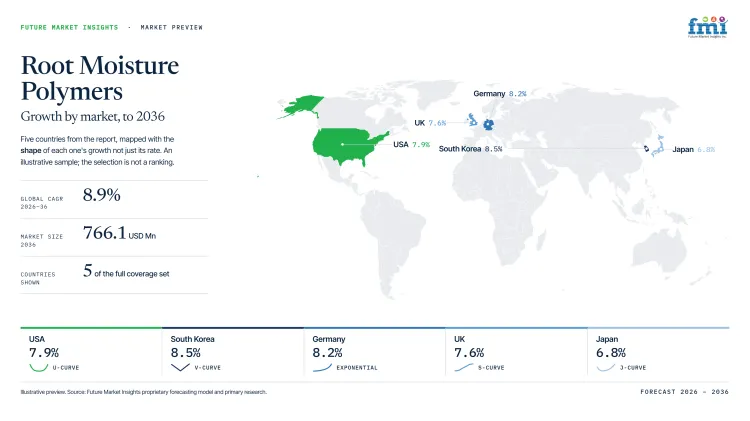
| Country | CAGR |
|---|---|
| South Korea | 8.5% |
| Germany | 8.2% |
| USA | 7.9% |
| UK | 7.6% |
| Japan | 6.8% |
How do country-level CAGRs compare in the Root Moisture Polymers Market?
The country spread is narrow at 1.7 percentage points, separating three commercial groups rather than five distinct growth stories. South Korea and Germany form the upper band as water investment supports adoption. The USA and UK occupy the middle range through mature farm channels. Japan expands more gradually because new inputs must fit established local irrigation routines.
- South Korea is witnessing adoption as pumping upgrades strengthen agricultural water reliability.
- Germany follows despite approval requirements that increase adjuvant qualification costs.
- The USA pairs irrigated acreage with retailer networks for field evaluation.
- UK growth reflects drought exposure plus formal product-list conditions for adjuvants.
- Japan expands steadily as irrigation technology still needs crop-specific application protocols.
Comparable CAGRs mask different qualification costs and channel conditions that determine commercial timing. The full report provides country-level CAGR analysis across North America, Latin America, Europe, East Asia, South Asia, Oceania and the Middle East and Africa.
Country-wise Analysis
- South Korea’s irrigation districts are upgrading intake and pumping capacity at sites where low-flow periods can interrupt farm water delivery and expose weaknesses in field-level distribution during dry operating periods. The root moisture polymers market in South Korea is projected to grow at 8.5% CAGR through 2036, aided by infrastructure investment that gives local distributors a clearer route for moisture-management products. In April 2026 MAFRA documented work at 171 intake and pumping sites with 156 projects still in progress, but local trials must separate chemical gains from improvements already delivered by upgraded pumps under local crop conditions and equipment settings.
- German growers entered 2026 with a moisture deficit that increased attention to irrigation scheduling and soil-water performance under national adjuvant approval rules that already make product qualification demanding during seasonal field programs locally. The German root moisture polymers market is projected to record 8.2% CAGR through 2036, owing to agronomic pressure that intensified after Umweltbundesamt documented 2025 precipitation at 17% below both long-term reference periods in August 2026. Local registration support improves entry prospects for formulators, although environmental documentation can delay rollout until German field trials show wetting gains that remain useful under existing irrigation schedules and crop programs.
- United States retailers and crop advisers remain central to adjuvant selection as they match water quality and application timing to individual field programs while state registration can delay national launches. USDA data published in January 2026 show California accounted for 8.2 million irrigated acres and 14.9% of the national irrigated total, giving manufacturers substantial capacity for regional trials and distributor training. The root moisture polymers market in the USA is forecast to rise at 7.9% CAGR through 2036, reflecting retailer-led evaluation that can turn local performance data into repeat orders once agronomists receive clear application instructions through local channels.
- UK adjuvant purchases depend heavily on agronomist advice and official use conditions within intensive crop programs and regional horticulture supply chains where DEFRA recorded 103 thousand hectares of vegetables and salad crops in December 2025. The root moisture polymers market in the UK is forecast to expand at 7.6% CAGR through 2036, tied to repeated demand for soil-moisture and spray performance within those high-value production areas. HSE listing conditions raise qualification costs for formulations used with plant-protection products, so commercial entry is strongest where local advisers can match approved use instructions with visible field gains and practical dosing guidance.
- Japanese farms favor inputs that fit established rice or horticulture equipment without increasing labor during compressed field schedules since fragmented holdings make additional passes especially costly for many growers. Japan’s agriculture ministry documented in October 2025 that automated water-management systems reduced operation hours by 80% on average in demonstration projects, strengthening the case for chemistry that fits managed irrigation without extra labor. Root moisture polymer demand in Japan is anticipated to advance at 6.8% CAGR through 2036, because regional crop practices require manufacturers to prove dosing reliability with equipment-specific protocols before distributors widen routine commercial adoption in field programs.
Who are the notable companies in the Root Moisture Polymers Market?
Precision Laboratories, WinField United (Land O'Lakes), Brandt, Loveland Products (Nutrien), Oro Agri (Rovensa), Clariant, Croda, and Stepan Company are the notable companies serving this market.
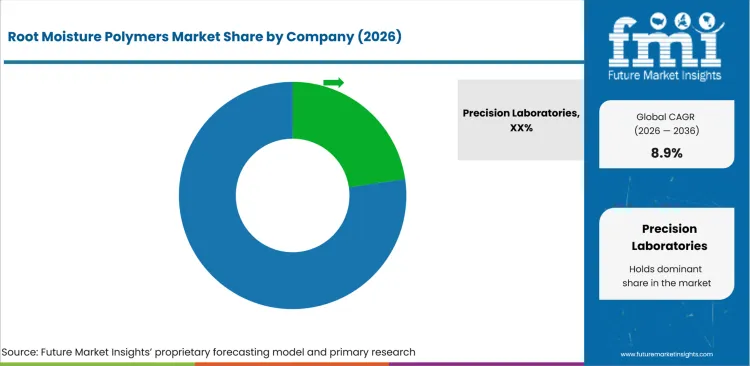
Competition splits between farm-facing adjuvant companies and chemistry groups that sell formulation technology. Precision Laboratories and WinField United influence farm selection through agronomic channels alongside Brandt and Loveland Products. Oro Agri and Clariant hold stronger water-use or specialty-adjuvant positions within crop formulation programs. Croda and Stepan serve formulators with specialty surfactants plus technical formulation support for crop-input development. Entry barriers therefore depend on field proof, channel access and current qualification records more than corporate scale alone.
- Precision Laboratories and WinField United compete near the farm alongside Brandt and Loveland Products through adjuvant portfolios with application support.
- Oro Agri and Clariant cover water-management functions that span soil and foliar application programs in commercial agriculture.
- Croda and Stepan Company supply formulation ingredients and technical development support to crop-input manufacturers worldwide.
Competitive Benchmarking: Root Moisture Polymers Market
| Company | Root-Zone Wetting & Moisture Tools | Spray Performance & Drift Control | Formulation & Channel Integration | Geographic Reach |
|---|---|---|---|---|
| Precision Laboratories | High | High | High | North America and selected international markets |
| WinField United (Land O'Lakes) | Medium | High | High | United States and Canada |
| Brandt | Medium | High | High | Americas and Europe |
| Loveland Products (Nutrien) | Medium | High | High | North America and international distribution |
| Oro Agri (Rovensa) | High | High | High | Americas, Europe and Asia-Pacific |
| Clariant | High | High | High | Global |
| Croda | Low | High | High | Global |
| Stepan Company | Low | Medium | High | Americas, Europe and Asia-Pacific |
Scoring basis: High root-zone capability requires documented water-management products plus multiple relevant formulation routes. Medium requires one dedicated route while Low marks a narrower adjacent role. High spray capability requires drift or deposition plus wetting or compatibility functions. High integration requires in-house formulation plus documented field support or a commercial channel. Medium requires one supported partner route while Low marks a narrower ingredient role.
Key Developments in the Root Moisture Polymers Market
- In July 2026, Suntory Holdings and EF Polymer formed a strategic partnership and launched a pilot program using superabsorbent polymers to improve soil water retention and stabilize crop yield and quality.
- In 2025, research on superabsorbent polymer hydrogels highlighted their application in soil-water conservation, with polymer networks designed to retain substantial quantities of water and improve moisture availability in the root zone.
Key Players in the Root Moisture Polymers Market
Farm-Facing Adjuvant and Moisture Management Specialists
- Precision Laboratories
- WinField United (Land O'Lakes)
- Brandt
- Loveland Products (Nutrien)
Biological and Specialty Adjuvant Platforms
- Oro Agri (Rovensa)
- Clariant
Formulation Ingredient and Technology Suppliers
- Croda
- Stepan Company
Root Moisture Polymers Market - Report Scope
| Coverage field | Report scope |
|---|---|
| Market breakdown | By product type, function, crop type, application method, sales channel and region. |
| Quantitative Units | USD Million. |
| Market Definition | Commercial specialty agricultural formulations that manage root-zone moisture, wetting, application conditioning, drift or related efficacy within the stated taxonomy. Irrigation hardware and stand-alone pesticide or fertilizer actives are excluded. |
| Regions Covered | North America, Latin America, Western Europe, Eastern Europe, East Asia, South Asia and Pacific and Middle East and Africa. |
| Countries Covered | South Korea, Germany, USA, UK, Japan, and 20+ countries included in the full report. |
| Key Companies Profiled | Precision Laboratories, WinField United (Land O'Lakes), Brandt, Loveland Products (Nutrien), Oro Agri (Rovensa), Clariant, Croda, Stepan Company. |
| Forecast Period | 2026 to 2036. |
| Approach | Primary and secondary research with market triangulation. |
Root Moisture Polymers Market - Research Methodology
| Method | Approach |
|---|---|
| Primary Research | FMI analysts gathered input from manufacturers, service providers, technology developers, distributors, end users, procurement teams, and subject-matter experts. Interviews examined purchasing decisions, product or service evaluation, adoption barriers, approval requirements, pricing considerations, and expectations for technical or commercial support. Respondents were also asked what evidence is required before a trial, pilot, or initial order develops into regular purchasing. |
| Desk Research | Desk research covered government statistics, regulatory publications, trade data, industry associations, technical literature, standards, company filings, product information, and official corporate announcements. Sources were reviewed for relevance, publication date, geographic coverage, and consistency with the defined market scope. Claims relating to performance, applications, approvals, capacity, investment, and commercial activity were retained only when supported by credible public evidence. |
| Market Sizing and Forecasting | The market model combined the baseline value with historical performance, segment structure, pricing and volume indicators, adoption levels, company participation, and country-level demand conditions. Forecast assumptions considered economic activity, investment trends, regulatory developments, technology adoption, purchasing cycles, supply availability, and barriers to wider market use. Segment and regional estimates were reconciled before the final market total was calculated. |
| Data Validation | Estimates were checked against multiple independent indicators, including public data, company activity, trade patterns, industry developments, and findings from primary interviews. Validation also tested whether products, services, applications, and company revenues fell within the defined market boundaries. Adjacent categories, unsupported claims, overlapping revenues, and activities without direct market relevance were excluded to reduce double counting and maintain consistency across segments and countries. |
Root Moisture Polymers Market by Segments
Root Moisture Polymers Market segmented by Product Type:
- Surfactant-Based
- Oil-Based
- Polymer-Based
- Mineral / Carrier-Based
- Others
Root Moisture Polymers Market segmented by Function:
- Efficacy Enhancement
- Loss & Drift Reduction
- Handling & Compatibility
- Others
Root Moisture Polymers Market segmented by Crop Type:
- Cereals & Grains
- Fruits & Vegetables
- Oilseeds & Pulses
- Turf & Ornamentals
- Others
Root Moisture Polymers Market segmented by Application Method:
- Foliar Tank-Mix
- Granule / Dry Blend
- Fertigation
- Others
Root Moisture Polymers Market segmented by Sales Channel:
- Agri-Input Distributors
- Cooperatives
- Agri-Retail Chains
- Online / Direct-to-Farm
- Others
Root Moisture Polymers Market by Region:
- North America
- United States
- Canada
- Latin America
- Brazil
- Mexico
- Chile
- Rest of Latin America
- Western Europe
- Germany
- United Kingdom
- Italy
- Spain
- France
- Nordics
- Benelux
- Rest of Western Europe
- Eastern Europe
- Russia
- Poland
- Hungary
- Balkan and Baltic States
- Rest of Eastern Europe
- East Asia
- China
- Japan
- South Korea
- South Asia and Pacific
- India
- ASEAN
- Australia and New Zealand
- Rest of South Asia and Pacific
- Middle East and Africa
- Kingdom of Saudi Arabia
- Other GCC Countries
- Türkiye
- South Africa
- Other African Union Countries
- Rest of Middle East and Africa
Research Sources and Bibliography
- USA Department of Agriculture, Economic Research Service (2026, January 27). Irrigation & Water Use.
- Environment Agency and Department for Environment, Food & Rural Affairs (2026, August 10). More areas in England declared in drought after record dry July.
- Clariant (2025, March 13). Clariant’s novel solutions for enhancing crop health and biological formulations at CAC 2025: Synergen Soil and Synergen Guard 100.
- USA Environmental Protection Agency (2025, April). Ecological Mitigation Support Document, Version 2.1.
- Ministry of Agriculture, Forestry and Fisheries of Japan (2025, October 1). Promotion of Smart Agriculture.
- German Environment Agency (2026, June 30). Wasserressourcen und ihre Nutzung.
- Department for Environment, Food & Rural Affairs (2026, July 29). Chapter 7: Crops.
- Rovensa Next (2026, January 27). FAUVE Project: Rovensa Next and UTC collaborate on innovative drone spraying for water savings and agricultural efficiency.
- Ministry of Agriculture, Food and Rural Affairs of the Republic of Korea (2026, April 30). Intake and pumping station improvement project: Inter-ministerial cooperation to accelerate implementation and reduce costs.
- German Environment Agency (2026, August 5). Trockenheit in Deutschland - Fragen und Antworten.
- Department for Environment, Food & Rural Affairs (2025, December 17). Agricultural Land Use in United Kingdom at 1 June 2025.
- Stepan Company (2025, August 28). Stepan Company Expands Advanced Formulation Services Through Strategic Partnership with SynTech Research Group in North America.
- Brandt (2025, May 20). How Adjuvants Improve Foliar Herbicide Performance.
- Precision Laboratories (2025, January 20). The Mix Tank App Expands Functionality To Streamline Spraying Practices.
- Precision Laboratories (2026, February 13). SeedZone IF Sees Broadcast Application Success, Touts Best Results Yet in 2025 PROVE Trials.
- WinField United (2025). 2025 Agronomic Insights from the Innovation Center.
- Nutrien Ag Solutions (2024, June 26). Advancing Technology with Loveland Products.
- Rovensa Next (2026, March 17). VINTRE Named Most Widely Applied Adjuvant in California in 2025.
- Croda International Plc (2025). Life Sciences sustainability review.
- Nouryon (2025, April 7). Nouryon launches Adsee® Flex 960, an advanced tank mix adjuvant for enhanced crop performance.
- Momentive (2025, November 10). 2025 CDP Corporate Questionnaire.
- Rovensa Next (2026, June 11). Rovensa Next to Distribute Novonesis’ Biosolutions for Plant Health in the United States.
- WinField United (2025). Introducing a Simplified Way to Boost Herbicide Performance.
- Brandt (2025, April 15). BRANDT Grows Product Management Team.
- BASF Agricultural Solutions (2026, April 1). BASF Agricultural Solutions completes acquisition of AgBiTech, expanding its biological insect control portfolio.
- ADAMA (2025, February 19). Three new fungicide co-formulations approved and launched in the UK.
- Lamberti S.p.A. (2025, June 12). Lamberti Opens New Branch in Australia.
- Croda International Plc (2026, March 19). Croda opens new manufacturing facility in Dahej, India to support growth and sustainable innovation.
This bibliography is provided for reader reference and is not exhaustive. The full report contains the complete reference list and detailed citations.
This Report Answers
- What is the root moisture polymers market size in 2026 and what value is forecast for 2036?
- Which water and spray-performance conditions create repeat demand for root moisture polymers?
- Why do surfactant-based formulations hold the largest product-type share in 2026?
- Why does efficacy enhancement account for the largest functional share in 2026?
- Why do cereals & grains represent the largest crop-type share in 2026?
- Why does foliar tank-mix lead the application-method category in 2026?
- How do the five profiled country CAGRs differ between South Korea and Japan?
- Which companies compete through farm-facing adjuvants, water-management products or formulation technology?
Frequently Asked Questions
How big is the root moisture polymers market in 2026?
The root moisture polymers market is valued at USD 326.6 million in 2026 and is projected to reach USD 766.1 million by 2036. Growth comes from more reliable root-zone water movement and crop-input delivery during constrained application windows.
What is the CAGR of the root moisture polymers market from 2026 to 2036?
The root moisture polymers market is projected to grow at a CAGR of 8.9% between 2026 and 2036. Expansion depends on water-management needs and more consistent spray performance within existing farm application routines.
Which product type leads the root moisture polymers market?
The surfactant-based segment is expected to hold 45.3% of the root moisture polymers market in 2026, supported by soil-wetting and foliar application use. Its functional range reduces separate qualification work for moisture-management and spray-conditioning tasks.
Which countries are projected to record the highest growth in the root moisture polymers market?
South Korea is projected to grow at 8.5% CAGR, followed by Germany at 8.2% and the USA at 7.9% through 2036. Growth differs with water infrastructure investment and the readiness of local farm channels to support field validation.
Which companies are active in the root moisture polymers market?
Key companies operating in the root moisture polymers market include Precision Laboratories, WinField United (Land O'Lakes), Brandt, Loveland Products (Nutrien), Oro Agri (Rovensa), Clariant, Croda, and Stepan Company. Their field support and formulation expertise help successful trials become repeat farm use.
Preview the report firsthand - request a free sample
Get SampleGet the brochure for pricing and purchase details.
Get PDFTable of Content
- Key Takeaways
- Market Size and CAGR
- Top Growth Driver
- Fastest Growing Segment
- Leading Region
- Key Companies
- Emerging Opportunities
- Executive Summary
- Global Market Outlook
- Demand-side Trends
- Supply-side Trends
- Technology Roadmap Analysis
- Analysis and Recommendations
- Analyst Perspective (What is happening? Why now? What should investors know?)
- Key Questions Answered
- How large is the market?
- What is the CAGR?
- What are key trends?
- Which region dominates?
- Who are the leaders?
- Market Overview
- Market Coverage / Taxonomy
- Market Definition / Scope / Limitations
- Research Methodology
- Chapter Orientation
- Analytical Lens and Working Hypotheses
- Market Structure, Signals, and Trend Drivers
- Benchmarking and Cross-market Comparability
- Market Sizing, Forecasting, and Opportunity Mapping
- Research Design and Evidence Framework
- Desk Research Programme (Secondary Evidence)
- Expert Input and Fieldwork (Primary Evidence)
- Tooling, Models, and Reference Databases
- Data Engineering and Model Build
- Quality Assurance and Audit Trail
- Market Background
- Market Dynamics (Drivers, Restraints, Opportunity, Trends)
- Scenario Forecast (Optimistic, Likely, Conservative)
- Impact Analysis
- AI Impact
- Sustainability Impact
- Regulatory Impact
- Technology Impact
- Consumer / Buyer Analysis
- Purchase Drivers
- Adoption Barriers
- Buyer Journey
- Opportunity Map Analysis
- Product Life Cycle Analysis
- Supply Chain Analysis
- Investment Feasibility Matrix
- Value Chain Analysis
- PESTLE and Porter's Analysis
- Regulatory Landscape
- Regional Parent Market Outlook
- Production and Consumption Statistics
- Import and Export Statistics
- Global Market Analysis and Forecast, 2021 to 2036
- Historical Market Size Value (USD Million) Analysis, 2021 to 2025
- Current and Future Market Size Value (USD Million) Projections, 2026 to 2036
- Y-o-Y Growth Trend Analysis
- Absolute $ Opportunity Analysis
- Global Market Pricing Analysis, 2021 to 2036
- Global Market Analysis and Forecast, By Product Type, 2021 to 2036
- Introduction / Key Findings
- Historical Market Size Value (USD Million) Analysis By Product Type, 2021 to 2025
- Current and Future Market Size Value (USD Million) Analysis and Forecast By Product Type, 2026 to 2036
- Surfactant-Based
- Oil-Based
- Polymer-Based
- Mineral / Carrier-Based
- Others
- Surfactant-Based
- Y-o-Y Growth Trend Analysis By Product Type, 2021 to 2025
- Absolute $ Opportunity Analysis By Product Type, 2026 to 2036
- Global Market Analysis and Forecast, By Function, 2021 to 2036
- Introduction / Key Findings
- Historical Market Size Value (USD Million) Analysis By Function, 2021 to 2025
- Current and Future Market Size Value (USD Million) Analysis and Forecast By Function, 2026 to 2036
- Efficacy Enhancement
- Loss & Drift Reduction
- Handling & Compatibility
- Others
- Efficacy Enhancement
- Y-o-Y Growth Trend Analysis By Function, 2021 to 2025
- Absolute $ Opportunity Analysis By Function, 2026 to 2036
- Global Market Analysis and Forecast, By Crop Type, 2021 to 2036
- Introduction / Key Findings
- Historical Market Size Value (USD Million) Analysis By Crop Type, 2021 to 2025
- Current and Future Market Size Value (USD Million) Analysis and Forecast By Crop Type, 2026 to 2036
- Cereals & Grains
- Fruits & Vegetables
- Oilseeds & Pulses
- Turf & Ornamentals
- Others
- Cereals & Grains
- Y-o-Y Growth Trend Analysis By Crop Type, 2021 to 2025
- Absolute $ Opportunity Analysis By Crop Type, 2026 to 2036
- Global Market Analysis and Forecast, By Application Method, 2021 to 2036
- Introduction / Key Findings
- Historical Market Size Value (USD Million) Analysis By Application Method, 2021 to 2025
- Current and Future Market Size Value (USD Million) Analysis and Forecast By Application Method, 2026 to 2036
- Foliar Tank-Mix
- Granule / Dry Blend
- Fertigation
- Others
- Foliar Tank-Mix
- Y-o-Y Growth Trend Analysis By Application Method, 2021 to 2025
- Absolute $ Opportunity Analysis By Application Method, 2026 to 2036
- Global Market Analysis and Forecast, By Sales Channel, 2021 to 2036
- Introduction / Key Findings
- Historical Market Size Value (USD Million) Analysis By Sales Channel, 2021 to 2025
- Current and Future Market Size Value (USD Million) Analysis and Forecast By Sales Channel, 2026 to 2036
- Agri-Input Distributors
- Cooperatives
- Agri-Retail Chains
- Online / Direct-to-Farm
- Others
- Agri-Input Distributors
- Y-o-Y Growth Trend Analysis By Sales Channel, 2021 to 2025
- Absolute $ Opportunity Analysis By Sales Channel, 2026 to 2036
- Global Market Analysis and Forecast, By Region, 2021 to 2036
- Introduction
- Historical Market Size Value (USD Million) Analysis By Region, 2021 to 2025
- Current Market Size Value (USD Million) Analysis and Forecast By Region, 2026 to 2036
- North America
- Latin America
- Western Europe
- Eastern Europe
- East Asia
- South Asia and Pacific
- Middle East & Africa
- Market Attractiveness Analysis By Region
- North America Market Analysis and Forecast, By Country, 2021 to 2036
- Historical Market Size Value (USD Million) Trend Analysis By Market Taxonomy, 2021 to 2025
- Market Size Value (USD Million) Forecast By Market Taxonomy, 2026 to 2036
- By Country
- USA
- Canada
- By Product Type
- By Function
- By Crop Type
- By Application Method
- By Sales Channel
- By Country
- Market Attractiveness Analysis
- By Country
- By Product Type
- By Function
- By Crop Type
- By Application Method
- By Sales Channel
- Key Takeaways
- Latin America Market Analysis and Forecast, By Country
- Historical Market Size Value (USD Million) Trend Analysis By Market Taxonomy, 2021 to 2025
- Market Size Value (USD Million) Forecast By Market Taxonomy, 2026 to 2036
- By Country
- Brazil
- Mexico
- Chile
- Rest of Latin America
- By Product Type
- By Function
- By Crop Type
- By Application Method
- By Sales Channel
- By Country
- Market Attractiveness Analysis
- By Country
- By Product Type
- By Function
- By Crop Type
- By Application Method
- By Sales Channel
- Key Takeaways
- Western Europe Market Analysis and Forecast, By Country
- Historical Market Size Value (USD Million) Trend Analysis By Market Taxonomy, 2021 to 2025
- Market Size Value (USD Million) Forecast By Market Taxonomy, 2026 to 2036
- By Country
- Germany
- UK
- Italy
- Spain
- France
- Nordic
- BENELUX
- Rest of Western Europe
- By Product Type
- By Function
- By Crop Type
- By Application Method
- By Sales Channel
- By Country
- Market Attractiveness Analysis
- By Country
- By Product Type
- By Function
- By Crop Type
- By Application Method
- By Sales Channel
- Key Takeaways
- Eastern Europe Market Analysis and Forecast, By Country
- Historical Market Size Value (USD Million) Trend Analysis By Market Taxonomy, 2021 to 2025
- Market Size Value (USD Million) Forecast By Market Taxonomy, 2026 to 2036
- By Country
- Russia
- Poland
- Hungary
- Balkan & Baltic
- Rest of Eastern Europe
- By Product Type
- By Function
- By Crop Type
- By Application Method
- By Sales Channel
- By Country
- Market Attractiveness Analysis
- By Country
- By Product Type
- By Function
- By Crop Type
- By Application Method
- By Sales Channel
- Key Takeaways
- East Asia Market Analysis and Forecast, By Country
- Historical Market Size Value (USD Million) Trend Analysis By Market Taxonomy, 2021 to 2025
- Market Size Value (USD Million) Forecast By Market Taxonomy, 2026 to 2036
- By Country
- China
- Japan
- South Korea
- By Product Type
- By Function
- By Crop Type
- By Application Method
- By Sales Channel
- By Country
- Market Attractiveness Analysis
- By Country
- By Product Type
- By Function
- By Crop Type
- By Application Method
- By Sales Channel
- Key Takeaways
- South Asia and Pacific Market Analysis and Forecast, By Country
- Historical Market Size Value (USD Million) Trend Analysis By Market Taxonomy, 2021 to 2025
- Market Size Value (USD Million) Forecast By Market Taxonomy, 2026 to 2036
- By Country
- India
- ASEAN
- Australia & New Zealand
- Rest of South Asia and Pacific
- By Product Type
- By Function
- By Crop Type
- By Application Method
- By Sales Channel
- By Country
- Market Attractiveness Analysis
- By Country
- By Product Type
- By Function
- By Crop Type
- By Application Method
- By Sales Channel
- Key Takeaways
- Middle East & Africa Market Analysis and Forecast, By Country
- Historical Market Size Value (USD Million) Trend Analysis By Market Taxonomy, 2021 to 2025
- Market Size Value (USD Million) Forecast By Market Taxonomy, 2026 to 2036
- By Country
- Kingdom of Saudi Arabia
- Other GCC Countries
- Türkiye
- South Africa
- Other African Union
- Rest of Middle East & Africa
- By Product Type
- By Function
- By Crop Type
- By Application Method
- By Sales Channel
- By Country
- Market Attractiveness Analysis
- By Country
- By Product Type
- By Function
- By Crop Type
- By Application Method
- By Sales Channel
- Key Takeaways
- Key Countries Market Analysis
- USA
- Pricing Analysis
- Market Share Analysis, 2025
- By Product Type
- By Function
- By Crop Type
- By Application Method
- By Sales Channel
- Canada
- Pricing Analysis
- Market Share Analysis, 2025
- By Product Type
- By Function
- By Crop Type
- By Application Method
- By Sales Channel
- Mexico
- Pricing Analysis
- Market Share Analysis, 2025
- By Product Type
- By Function
- By Crop Type
- By Application Method
- By Sales Channel
- Brazil
- Pricing Analysis
- Market Share Analysis, 2025
- By Product Type
- By Function
- By Crop Type
- By Application Method
- By Sales Channel
- Chile
- Pricing Analysis
- Market Share Analysis, 2025
- By Product Type
- By Function
- By Crop Type
- By Application Method
- By Sales Channel
- Germany
- Pricing Analysis
- Market Share Analysis, 2025
- By Product Type
- By Function
- By Crop Type
- By Application Method
- By Sales Channel
- UK
- Pricing Analysis
- Market Share Analysis, 2025
- By Product Type
- By Function
- By Crop Type
- By Application Method
- By Sales Channel
- Italy
- Pricing Analysis
- Market Share Analysis, 2025
- By Product Type
- By Function
- By Crop Type
- By Application Method
- By Sales Channel
- Spain
- Pricing Analysis
- Market Share Analysis, 2025
- By Product Type
- By Function
- By Crop Type
- By Application Method
- By Sales Channel
- France
- Pricing Analysis
- Market Share Analysis, 2025
- By Product Type
- By Function
- By Crop Type
- By Application Method
- By Sales Channel
- India
- Pricing Analysis
- Market Share Analysis, 2025
- By Product Type
- By Function
- By Crop Type
- By Application Method
- By Sales Channel
- ASEAN
- Pricing Analysis
- Market Share Analysis, 2025
- By Product Type
- By Function
- By Crop Type
- By Application Method
- By Sales Channel
- Australia & New Zealand
- Pricing Analysis
- Market Share Analysis, 2025
- By Product Type
- By Function
- By Crop Type
- By Application Method
- By Sales Channel
- China
- Pricing Analysis
- Market Share Analysis, 2025
- By Product Type
- By Function
- By Crop Type
- By Application Method
- By Sales Channel
- Japan
- Pricing Analysis
- Market Share Analysis, 2025
- By Product Type
- By Function
- By Crop Type
- By Application Method
- By Sales Channel
- South Korea
- Pricing Analysis
- Market Share Analysis, 2025
- By Product Type
- By Function
- By Crop Type
- By Application Method
- By Sales Channel
- Russia
- Pricing Analysis
- Market Share Analysis, 2025
- By Product Type
- By Function
- By Crop Type
- By Application Method
- By Sales Channel
- Poland
- Pricing Analysis
- Market Share Analysis, 2025
- By Product Type
- By Function
- By Crop Type
- By Application Method
- By Sales Channel
- Hungary
- Pricing Analysis
- Market Share Analysis, 2025
- By Product Type
- By Function
- By Crop Type
- By Application Method
- By Sales Channel
- Kingdom of Saudi Arabia
- Pricing Analysis
- Market Share Analysis, 2025
- By Product Type
- By Function
- By Crop Type
- By Application Method
- By Sales Channel
- Türkiye
- Pricing Analysis
- Market Share Analysis, 2025
- By Product Type
- By Function
- By Crop Type
- By Application Method
- By Sales Channel
- South Africa
- Pricing Analysis
- Market Share Analysis, 2025
- By Product Type
- By Function
- By Crop Type
- By Application Method
- By Sales Channel
- USA
- Market Structure Analysis
- Competition Dashboard
- Competition Benchmarking
- Market Share Analysis of Top Players
- By Regional
- By Product Type
- By Function
- By Crop Type
- By Application Method
- By Sales Channel
- Emerging Startups
- Innovation Benchmarking
- Competition Analysis
- Competition Deep Dive
- Precision Laboratories
- Overview
- Product Portfolio
- Profitability by Market Segments
- Sales Footprint
- Strategy Overview
- Marketing Strategy
- Product Strategy
- Channel Strategy
- WinField United (Land O'Lakes)
- Brandt
- Loveland Products (Nutrien)
- Oro Agri (Rovensa)
- Croda
- Clariant
- Stepan Company
- Precision Laboratories
- Case Studies
- Success Stories
- Recent Developments
- Competition Deep Dive
- Assumptions & Acronyms Used


