

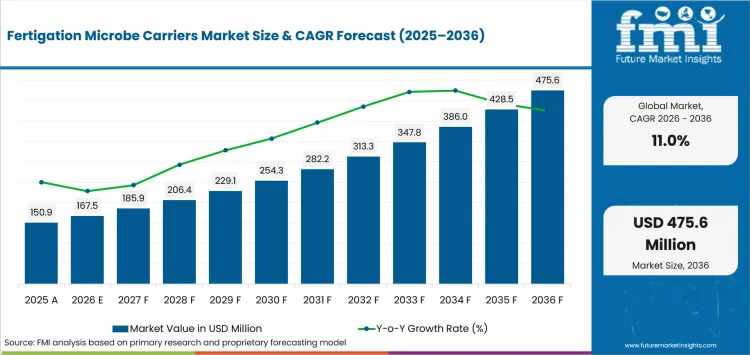
- Market Size (2026)
- USD 167.5 Mn
- Forecast (2036)
- USD 475.6 Mn
- CAGR (2026 to 2036)
- 11.0%
How big is Fertigation Microbe Carriers Market in 2026?
USD 167.5 million in 2026 and USD 475.6 million by 2036 at an 11.0% CAGR.
Fertigation microbe carriers are projected to rise from USD 167.5 million in 2026 to USD 475.6 million by 2036 at an 11.0% CAGR. Protected controlled-environment agriculture generates repeat demand as nutrient and biological inputs move through root-zone dosing equipment during each crop cycle. In June 2026, the UK Department for Environment, Food & Rural Affairs recorded 866 hectares of protected vegetables for 2025. That protected-crop base gives soluble carrier programs an installed route to market, yet every formulation must remain stable in stock tanks and injection lines.
Country conversion depends on installed dosing automation and local agronomy that can validate a new formulation against source water. In January 2025, South Korea's Ministry of Agriculture, Food and Rural Affairs set a 2029 goal to convert 35% of roughly 55,000 hectares of greenhouses to smart agriculture systems. Programmable controls reduce training friction by letting new operators repeat the same validated fertigation recipe. Japan and Germany already operate mature protected-production systems, so new carriers face a different hurdle: proving compatibility without disrupting established sanitation and crop protocols.
Key Takeaways
- Repeated nutrient dosing in greenhouses and hydroponic facilities makes solubility, source-water fit, and biological timing central to replenishment decisions during each crop program.
- By product type, complete A/B nutrient systems are estimated to hold 38.8% in 2026 owing to separated concentrates that reduce precipitation before dilution.
- In 2026, leafy greens and herbs are expected to lead crop demand with 47.5% share as short cycles require frequent nutrient checks and rapid recipe correction.
- Drip substrate systems are projected to hold 47.8% of system revenue in 2026 attributable to repeated root-zone injection in cocopeat and rockwool production.
- Adoption slows if source water, sanitation practice, or concentrate chemistry force repeated compatibility testing until a grower can standardize the program.
- Some of the key players in this market include Yara International, ICL Group, Haifa Group, COMPO EXPERT, SQM, Netafim (Orbia), Syngenta Biologicals, and Koppert.
Analyst Perspective
"Greenhouse adoption turns on whether a carrier can enter an existing stock-tank sequence without changing emitter performance or sanitation timing. Companies that document water-specific mixing limits and biological dosing order can shorten greenhouse trials and protect repeat nutrient revenue."
- Nandini Roy Choudhury, Principal Consultant, Future Market Insights
How is the fertigation microbe carriers market segmented?
The market is segmented by product type, crop, system, grower type, sales channel and region.
Product type covers complete A/B nutrients, single-element/chelated micronutrients, microbe/biostimulant add-ons, pH/compatibility aids, and others. Crop includes leafy greens and herbs, vine crops, berries/soft fruit, seedlings/nursery crops, and others. System includes drip substrate, NFT/DWC recirculating, aeroponics, and others. Grower type includes commercial greenhouses, vertical farms, small commercial/hobby operations, and others. Sales channels include greenhouse suppliers, hydro specialty retail, online/direct sales, distributors, and others.
Why do leafy greens and herbs lead the crop category?
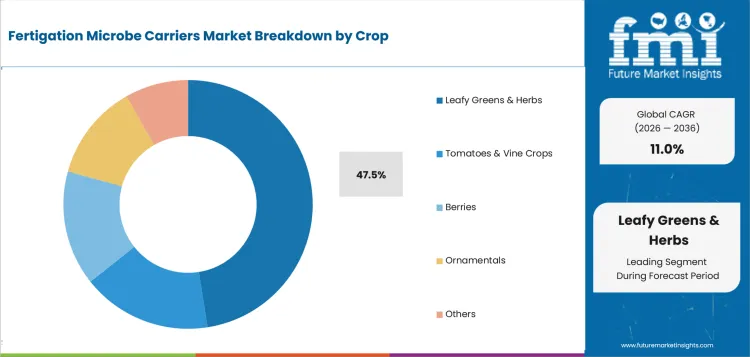
Leafy greens and herbs turn quickly, so dosing errors can reduce saleable output within a full crop cycle. USDA NASS recorded 710,127 cwt of hydroponic lettuce production in its February 2026 horticulture census, giving carrier companies a sizeable operating base for dosing consistency in commercial facilities.
- In 2026, leafy greens and herbs are expected to lead the crop category with 47.5% share since short cycles require frequent nutrient checks and rapid recipe correction.
- Greenhouse teams can revise a carrier program between plantings without replacing pumps or tanks, reducing the practical cost of recipe refinement.
Why do complete A/B nutrient systems lead the product type category?
Two-part nutrient programs keep calcium-rich concentrate separate from phosphate or sulfate sources until dilution, reducing precipitation upstream of irrigation lines. In February 2025, Haifa North West Europe launched two water-soluble fertilizer formulas for fertigation, confirming that concentrate chemistry remains a commercial formulation and stocking constraint in greenhouse programs.
- By product type, complete A/B nutrient systems are estimated to hold 38.8% in 2026 owing to separated concentrates that protect solubility inside stock tanks until final dilution.
- Growers use the two-part format to standardize tank preparation and introduce biological inputs after concentrated salts reach the intended working strength.
How does drip substrate lead the system category?
Drip substrate systems place each formulation into a defined root volume, making poor solubility or injector performance visible quickly in crop uniformity. Orbia Netafim launched Dosing 5G in February 2026 with automated precision fertigation equipment using EC and pH control, raising carrier qualification expectations for digital injection systems.
- Drip substrate systems are projected to hold 47.8% of system revenue in 2026 attributable to repeated nutrient injection in cocopeat and rockwool production.
- Carrier companies need solubility evidence for injection equipment and proof that biological dosing preserves EC and pH control during routine commercial operation prior to switching.
Why do commercial greenhouses lead the grower type category?
Commercial greenhouses concentrate crop value, dosing equipment, and technical staff in one site, making documented nutrient recipes economically important. Destatis recorded 1,250 hectares of vegetables under high protective covers in Germany during 2025, confirming a commercial base in which formulation changes affect large crop blocks.
- The commercial greenhouses segment is likely to capture 45.5% share in 2026 due to larger facilities standardizing nutrient preparation against tested crop recipes at scale.
- Scale also raises switching cost, so greenhouse managers require water-specific compatibility evidence and responsive troubleshooting to replace a nutrition program that already performs reliably during commercial crop cycles.
What are the drivers, restraints and opportunities in the Fertigation Microbe Carriers Market?
Protected-crop production raises repeat dosing demand, water handling increases qualification cost, and biological research provides a route to higher-value integrated programs.
- Driver: Hydroponic food production increases the number of root-zone programs that repeatedly consume soluble nutrients and compatible biological inputs.
- Restraint: Source-water quality and sanitation practice can require extra validation for microbial inputs entering concentrated nutrient programs.
- Opportunity: Joint nutrient and biological research can produce documented dosing programs with clear mixing order and crop-specific guidance.
Protected production raises the frequency of dosing decisions
Each crop cycle applies a scheduled root-zone recipe from transplant to harvest, so protected facilities consume soluble inputs repeatedly. USDA NASS counted 3,442,159 cwt of hydroponic food-crop production in the 2024 horticulture census released in February 2026. That production base gives carrier formulations repeated exposure to stock tanks and irrigation lines, making solubility failures a direct operating cost in indoor farming.
Water reuse and sanitation narrow the operating window
Water reuse changes the chemistry a microbial carrier encounters on its route to the root zone. Japan's March 2025 facility survey found 89% of responding artificial-light facilities lacked equipment to return condensate to nutrient tanks, citing cost, hygiene, and retrofit difficulty. Formulators therefore need water limits and sanitation timing that fit each facility's reuse practice to judge biological performance consistently.
Biological research brings qualification into nutrient formulation
Biological inputs are easier to qualify once nutrient chemistry and microbial formulation are tested under one technical program for protected crops. In March 2026, Yara expanded its Hanninghof Research Centre with laboratories for microbial cultivation, formulation, and biomolecular analytics. Testing biology beside crop nutrition gives greenhouse channels stronger evidence for qualifying crop biostimulants and advancing successful trials into regular orders.
Which country CAGRs are profiled in the Fertigation Microbe Carriers Market?
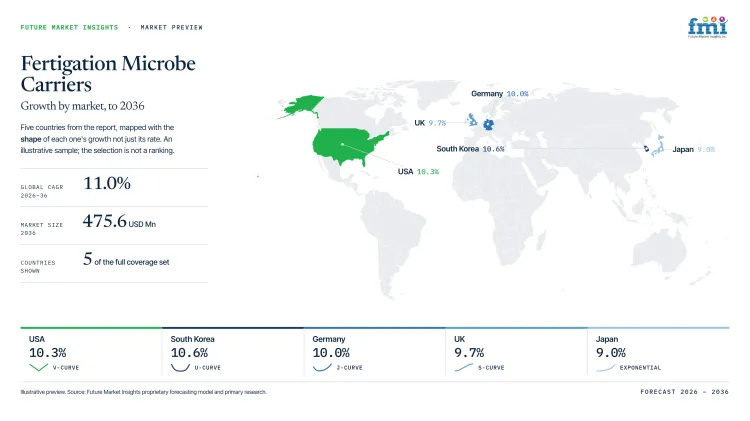
| Country | CAGR |
|---|---|
| South Korea | 10.6% |
| USA | 10.3% |
| Germany | 10.0% |
| UK | 9.7% |
| Japan | 9.0% |
How do country-level CAGRs compare in the Fertigation Microbe Carriers Market?
A 1.6 percentage-point range separates South Korea at 10.6% CAGR from Japan at 9.0%, placing all five countries in one compact band. South Korea, the USA, and Germany form the 10.0% or faster group, followed by the UK at 9.7%. Japan's lower rate matches a mature fertigation base with a higher threshold for replacement claims.
- South Korea expands the commercial grower base with coordinated protected-farming investment.
- US crop diversity requires more formulation recipes across controlled-environment facilities.
- Germany's dense greenhouse clusters put greater weight on formulation consistency.
- UK glasshouses concentrate crop value, making switching mistakes more expensive.
- Japan's technical channels demand documented advantages over established programs.
Facility structure, crop economics, and technical service needs make comparable CAGRs produce different entry conditions.
The full report provides country-level CAGR analysis across North America, Latin America, Western Europe, Eastern Europe, East Asia, South Asia and Pacific, and Middle East and Africa.
Country-wise Analysis
- South Korean greenhouse startups enter smart-farm districts with public training, rental facilities, and digital controls that standardize basic crop and nutrient routines. In July 2026, MAFRA selected 208 trainees from 731 applicants for a 20-month smart-farm course that feeds new operators into commercial production. South Korea is estimated to post 10.6% CAGR over the forecast period, aided by repeatable dosing controls that shorten instruction for new fertigation programs. Those controls give formulation companies a practical channel for structured demonstrations as growers select a recurring nutrient program. Local agronomic support remains necessary: microbial additions and stock-tank sequences still require crop-specific adjustment once formal training ends.
- US controlled-environment production spans large commercial greenhouses and smaller specialty facilities, forcing formulation companies to handle different tank sizes, crop mixes, and source-water profiles. By 2036, the USA is projected to grow at 10.3% CAGR, tied to repeat nutrient purchasing in facilities that dose root-zone programs during successive crop cycles. USDA NASS counted 3,731 operations growing food crops under protection in its February 2026 horticulture census, confirming a broad installed base for regional technical service. The same geographic spread raises support costs, so companies with local greenhouse expertise can resolve compatibility problems faster than brands relying on remote formulation guidance alone.
- Crop managers in Germany's mature protected-vegetable sector already control EC, pH, and sanitation to evaluate a new dosing sequence used in high-throughput crop programs. Destatis recorded 219,200 tonnes of vegetables grown under high protective covers in 2025, giving new formulations meaningful commercial throughput in high-value crop programs once a trial passes. Precipitation, emitter clogging, or biological instability can disrupt repeatable schedules over large crop blocks, making formulation switches harder in these facilities. Germany's fertigation microbe carrier sector is projected to record 10.0% CAGR during the assessment period, given dense protected crop production and the value placed on proven compatibility.
- A compact UK glasshouse base concentrates output per site during peak production, making water use and cleaning time part of every formulation decision. DEFRA recorded 258 thousand tonnes of protected vegetable production in 2025 and identified water availability as a horticultural concern, which raises the penalty for extra flushing. Fertigation microbe carrier sales in the UK are forecast to expand at 9.7% CAGR by 2036, supported by concentrated protected production and repeat nutrient dosing. Growth does not remove the operating constraint: commercial conversion depends on proving that new carriers fit existing water-management routines without increasing cleaning time or crop-loss exposure.
- Japanese protected-horticulture operators already use nutrient-solution control at a high rate, so new microbial carriers enter facilities with experienced crop managers and established dosing routines. Adoption of fertigation microbe carriers in Japan is estimated to expand at 9.0% CAGR through 2036, attributable to continued demand for tighter root-zone control in mature systems. A March 2025 national survey found nutrient-solution cultivation in 81% of responding solar-type large facilities, confirming that first-time access to fertigation equipment is not the main hurdle. Competition therefore turns on compatibility with existing drip, sanitation, and recirculation practices, which gives technically documented programs an advantage over offers that require extensive retraining.
Who are the notable companies in the Fertigation Microbe Carriers Market?
Yara International, ICL Group, Haifa Group, COMPO EXPERT, SQM, Netafim (Orbia), Syngenta Biologicals and Koppert are the notable companies serving this market.
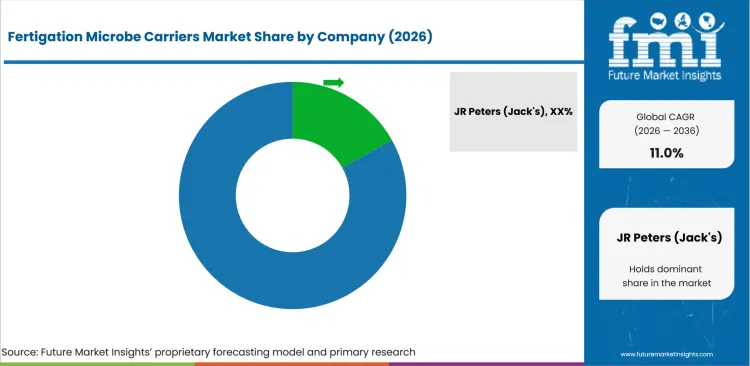
Competition divides among crop-nutrition groups, biological specialists, and fertigation-control companies serving different greenhouse qualification steps. Yara International, ICL Group, Haifa Group, COMPO EXPERT, and SQM supply specialty fertilizers, whereas Syngenta Biologicals and Koppert provide agricultural microbials. Netafim (Orbia) supplies dosing equipment that controls injection accuracy in automated root-zone programs. Entry depends on compatibility evidence, local agronomy, and troubleshooting support if greenhouses are to replace proven programs.
- Integrated crop-nutrition platforms: Yara International, ICL Group, Haifa Group and COMPO EXPERT supply soluble fertilizers and selected biological programs.
- Specialty soluble nutrition: SQM supplies water-soluble mineral nutrition for fertigation and hydroponics with agronomic teams in about 100 countries.
- Biological and delivery specialists: Syngenta Biologicals and Koppert supply biological inputs, whereas Netafim (Orbia) provides dosing controls for fertigation injection.
Competitive Benchmarking: Fertigation Microbe Carriers Market
Scoring basis: High nutrient-program depth requires several fertigation-specific soluble classes, Medium indicates narrower coverage, and Low identifies documented biology or irrigation roles. High biological integration requires dedicated research or broad biostimulant platforms, Medium indicates narrower activity, and Low identifies mineral-nutrition or irrigation portfolios. High delivery integration requires dosing controls, Medium indicates application guidance without dedicated hardware, and Low identifies an input-only documented role.
| Company | Fertigation Nutrient Program Depth | Biological Integration | Delivery System Integration | Geographic Reach |
|---|---|---|---|---|
| Yara International | High | High | Medium | Global |
| ICL Group | High | High | Medium | Global |
| Haifa Group | High | Medium | Medium | 100+ countries |
| COMPO EXPERT | High | Medium | Medium | International |
| SQM | High | Low | Medium | About 100 countries |
| Netafim (Orbia) | Low | Low | High | Global |
| Syngenta Biologicals | Low | High | Low | 100+ countries |
| Koppert | Low | High | Low | Global |
Key Developments in the Fertigation Microbe Carriers Market
- In March 2026, ICL Group opened an Indian specialty fertilizer facility with local water-soluble fertilizer production, increasing regional capacity for soluble crop-nutrition formulations sold via technical distribution channels.
- In March 2025, Koppert transferred management of its biostimulant and fertilizer portfolio to REKA and retained distribution via Koppert subsidiaries, separating portfolio management from the biological sales network reaching growers.
- In February 2025, Syngenta and Ceres Biotics signed a global agreement for VIXERAN, an Azotobacter-based biostimulant intended to complement standard nitrogen fertilizer programs in multiple markets.
Key Players in the Fertigation Microbe Carriers Market
Integrated Crop Nutrition Platforms
- Yara International
- ICL Group
- Haifa Group
- COMPO EXPERT
Specialty Soluble Nutrition
- SQM
Fertigation Delivery Systems
- Netafim (Orbia)
Biological Input Specialists
- Syngenta Biologicals
- Koppert
Fertigation Microbe Carriers Market - Report Scope
| Coverage field | Report scope |
|---|---|
| Market breakdown | By product type, crop, system, grower type, sales channel and region. |
| Quantitative Units | USD million. |
| Market Definition | Revenue includes soluble nutrient programs, microbe-compatible carrier inputs and compatibility aids sold for fertigation use within controlled-environment or precision root-zone delivery systems. |
| Regions Covered | North America, Latin America, Western Europe, Eastern Europe, East Asia, South Asia and Pacific, and Middle East and Africa. |
| Countries Covered | South Korea, USA, Germany, UK, Japan, and 20+ countries included in the full report. |
| Key Companies Profiled | Yara International, ICL Group, Haifa Group, COMPO EXPERT, SQM, Netafim (Orbia), Syngenta Biologicals, Koppert. |
| Forecast Period | 2026 to 2036. |
| Approach | Primary and secondary research with market triangulation. |
Fertigation Microbe Carriers Market - Research Methodology
| Method | Approach |
|---|---|
| Primary Research | FMI analysts gathered input from manufacturers, service providers, technology developers, distributors, end users, procurement teams, and subject-matter experts. Interviews examined purchasing decisions, product or service evaluation, adoption barriers, approval requirements, pricing considerations, and expectations for technical or commercial support. Respondents were also asked what evidence is required before a trial, pilot, or initial order develops into regular purchasing. |
| Desk Research | Desk research covered government statistics, regulatory publications, trade data, industry associations, technical literature, standards, company filings, product information, and official corporate announcements. Sources were reviewed for relevance, publication date, geographic coverage, and consistency with the defined market scope. Claims relating to performance, applications, approvals, capacity, investment, and commercial activity were retained only when supported by credible public evidence. |
| Market Sizing and Forecasting | The market model combined the baseline value with historical performance, segment structure, pricing and volume indicators, adoption levels, company participation, and country-level demand conditions. Forecast assumptions considered economic activity, investment trends, regulatory developments, technology adoption, purchasing cycles, supply availability, and barriers to wider market use. Segment and regional estimates were reconciled before the final market total was calculated. |
| Data Validation | Estimates were checked against multiple independent indicators, including public data, company activity, trade patterns, industry developments, and findings from primary interviews. Validation also tested whether products, services, applications, and company revenues fell within the defined market boundaries. Adjacent categories, unsupported claims, overlapping revenues, and activities without direct market relevance were excluded to reduce double counting and maintain consistency across segments and countries. |
Fertigation Microbe Carriers Market by Segments
Fertigation Microbe Carriers Market segmented by Product Type:
- Complete A/B Nutrient Systems
- Single-Element & Chelated Micronutrients
- Beneficial Microbes / Biostimulant Add-ons
- pH / EC Management & Compatibility Aids
- Others
Fertigation Microbe Carriers Market segmented by Crop:
- Leafy Greens & Herbs
- Vine Crops (Tomato / Cucumber / Pepper)
- Berries & Soft Fruit
- Seedlings / Nursery Crops
- Others
Fertigation Microbe Carriers Market segmented by System:
- Drip Substrate (Cocopeat / Rockwool)
- NFT / DWC Recirculating
- Aeroponics
- Others
Fertigation Microbe Carriers Market segmented by Grower Type:
- Commercial Greenhouses
- Vertical Farms
- Small Commercial & Hobby
- Others
Fertigation Microbe Carriers Market segmented by Sales Channel:
- Greenhouse Suppliers
- Hydro Specialty Retail
- Online / Direct
- Distributors
- Others
Fertigation Microbe Carriers Market by Region:
- North America
- United States
- Canada
- Latin America
- Brazil
- Mexico
- Argentina
- Chile
- Western Europe
- Germany
- France
- United Kingdom
- Italy
- Spain
- Benelux
- Nordics
- Eastern Europe
- Poland
- Czech Republic
- Romania
- Hungary
- East Asia
- China
- Japan
- South Korea
- South Asia and Pacific
- India
- ASEAN
- Australia and New Zealand
- Middle East and Africa
- GCC Countries
- South Africa
- Türkiye
- Israel
Research Sources and Bibliography
- Department for Environment, Food & Rural Affairs. (2026, June 25). Horticulture statistics 2025
- Ministry of Agriculture, Food and Rural Affairs, Republic of Korea. (2025, January 21).
- Ministry of Agriculture, Food and Rural Affairs, Republic of Korea. (2026, July 16).
- USA Department of Agriculture, National Agricultural Statistics Service. (2026, February 26). 2024 Census of Horticultural Specialties
- Ministry of Agriculture, Forestry and Fisheries of Japan / Japan Greenhouse Horticulture Association. (2025, March).
- Statistisches Bundesamt (Destatis). (2026, February 26). Gemüseernte erreicht 2025 neuen Höchststand
- Haifa Group. (2025, February 17). Haifa North West Europe launches innovative water-soluble fertilizer Haifa Soluble DUO
- Orbia Netafim. (2026, February 17). Orbia Netafim supercharges precision fertigation with AI-powered Dosing 5G product range
- Yara International. (2026, March 23). Yara expands research capabilities in biological crop solutions
- ICL Group. (2026, March 18). ICL Group opens specialty fertilizer manufacturing facility in India, strengthening supply security and advancing its growth strategy
- Koppert. (2025, March 19). Koppert transfers its biostimulant and fertilizer portfolio to REKA
- Syngenta. (2025, February 20). Sustainability in agriculture gets a boost with global biologicals partnership
- Orbia Netafim. (2025, April 15). Orbia Netafim expands digital farming capabilities with Treetoscope’s plant sensing technology
- Koppert. (2025, January 27). Acadian Plant Health and Koppert expand partnership to drive sustainable agriculture
- Orbia Netafim. (2026, August 13). Orbia Netafim launches GrowSphere FLEX to scale digital farming for smallholders and mid-sized farmers
- Syngenta. (2026, March 17). Syngenta builds world-leading research center for agricultural bioscience - powered by advanced technology and AI
- COMPO EXPERT. (2025, March 30). Our substrate fertilizers and production sites are RHP certified
- Yara International. (2026, March 20). Yara publishes 2025 Annual Report
- ICL Group. (2026, March 11). ICL files 2025 Annual Report on Form 20-F
- Haifa Group. (2026, April 2). Haifa Group joins the European Biostimulants Industry Council
- Sociedad Química y Minera de Chile S.A. (2026, April 21). Annual Report on Form 20-F for the fiscal year ended December 31, 2025
- Orbia Netafim. (2026, June 4). Orbia Netafim expands Americas footprint with new manufacturing plant in Mexico
- Syngenta. (2026, July 14). Syngenta and Groundwork BioAg enter partnership to bring innovation in biologicals and soil carbon solutions to farmers
- Koppert. (2025, July 23). Koppert invests in Amoéba to strengthen strategic collaboration
- COMPO EXPERT. (2025, June 10). Next low-carbon raw material
This bibliography is provided for reader reference and is not exhaustive. The full report contains the complete reference list and detailed citations.
This Report Answers
- What are the 2026 and 2036 values?
- Why do complete A/B systems lead?
- Why do leafy greens and herbs lead?
- How does drip substrate affect qualification?
- How do five country CAGRs compare?
- Which companies cover nutrition, biology and dosing?
- Which water and chemistry conditions slow adoption?
- What should greenhouse operators verify before switching?
Frequently Asked Questions
How big is the fertigation microbe carriers market in 2026?
The fertigation microbe carriers market is valued at USD 167.5 million in 2026 and is projected to reach USD 475.6 million by 2036. Protected facilities reorder soluble and biological inputs as root-zone recipes move through irrigation equipment each crop cycle.
What is the CAGR of the fertigation microbe carriers market from 2026 to 2036?
The fertigation microbe carriers market is projected to grow at a CAGR of 11.0% between 2026 and 2036. Expansion follows more controlled-environment production and integration of soluble nutrition with biological crop inputs.
Which product type leads the fertigation microbe carriers market?
The complete A/B nutrient systems segment is expected to hold 38.8% of the fertigation microbe carriers market in 2026, driven by concentrate separation during dilution. The two-part format also fits repeatable tank-preparation routines used in commercial greenhouses.
Which crop segment leads the fertigation microbe carriers market?
The leafy greens and herbs segment is expected to hold 47.5% of the fertigation microbe carriers market in 2026, supported by frequent nutrient checks during short crop cycles. Faster recipe correction limits the production exposure from dosing errors during the preharvest cycle.
Which countries are projected to record the highest growth in the fertigation microbe carriers market?
South Korea is projected to grow at 10.6% CAGR, followed by the USA at 10.3% and Germany at 10.0% through 2036. Growth differs with smart-farm adoption, protected-crop depth, and technical work required to qualify formulations.
Which companies are active in the fertigation microbe carriers market?
Key companies operating in the fertigation microbe carriers market include Yara International, ICL Group, Haifa Group, COMPO EXPERT, SQM, Netafim (Orbia), Syngenta Biologicals, and Koppert. Their roles span soluble nutrition, biological inputs, agronomic support, and fertigation dosing control.
Preview the report firsthand - request a free sample
Get SampleGet the brochure for pricing and purchase details.
Get PDFTable of Content
- Key Takeaways
- Market Size and CAGR
- Top Growth Driver
- Fastest Growing Segment
- Leading Region
- Key Companies
- Emerging Opportunities
- Executive Summary
- Global Market Outlook
- Demand-side Trends
- Supply-side Trends
- Technology Roadmap Analysis
- Analysis and Recommendations
- Analyst Perspective (What is happening? Why now? What should investors know?)
- Key Questions Answered
- How large is the market?
- What is the CAGR?
- What are key trends?
- Which region dominates?
- Who are the leaders?
- Market Overview
- Market Coverage / Taxonomy
- Market Definition / Scope / Limitations
- Research Methodology
- Chapter Orientation
- Analytical Lens and Working Hypotheses
- Market Structure, Signals, and Trend Drivers
- Benchmarking and Cross-market Comparability
- Market Sizing, Forecasting, and Opportunity Mapping
- Research Design and Evidence Framework
- Desk Research Programme (Secondary Evidence)
- Expert Input and Fieldwork (Primary Evidence)
- Tooling, Models, and Reference Databases
- Data Engineering and Model Build
- Quality Assurance and Audit Trail
- Market Background
- Market Dynamics (Drivers, Restraints, Opportunity, Trends)
- Scenario Forecast (Optimistic, Likely, Conservative)
- Impact Analysis
- AI Impact
- Sustainability Impact
- Regulatory Impact
- Technology Impact
- Consumer / Buyer Analysis
- Purchase Drivers
- Adoption Barriers
- Buyer Journey
- Opportunity Map Analysis
- Product Life Cycle Analysis
- Supply Chain Analysis
- Investment Feasibility Matrix
- Value Chain Analysis
- PESTLE and Porter's Analysis
- Regulatory Landscape
- Regional Parent Market Outlook
- Production and Consumption Statistics
- Import and Export Statistics
- Global Market Analysis and Forecast, 2021 to 2036
- Historical Market Size Value (USD Million) Analysis, 2021 to 2025
- Current and Future Market Size Value (USD Million) Projections, 2026 to 2036
- Y-o-Y Growth Trend Analysis
- Absolute $ Opportunity Analysis
- Global Market Pricing Analysis, 2021 to 2036
- Global Market Analysis and Forecast, By Product Type, 2021 to 2036
- Introduction / Key Findings
- Historical Market Size Value (USD Million) Analysis By Product Type, 2021 to 2025
- Current and Future Market Size Value (USD Million) Analysis and Forecast By Product Type, 2026 to 2036
- Complete A/B Nutrient Systems
- Single-Element Additives
- Biological Additives
- pH & Compatibility Aids
- Others
- Complete A/B Nutrient Systems
- Y-o-Y Growth Trend Analysis By Product Type, 2021 to 2025
- Absolute $ Opportunity Analysis By Product Type, 2026 to 2036
- Global Market Analysis and Forecast, By Crop, 2021 to 2036
- Introduction / Key Findings
- Historical Market Size Value (USD Million) Analysis By Crop, 2021 to 2025
- Current and Future Market Size Value (USD Million) Analysis and Forecast By Crop, 2026 to 2036
- Leafy Greens & Herbs
- Tomatoes & Vine Crops
- Berries
- Ornamentals
- Others
- Leafy Greens & Herbs
- Y-o-Y Growth Trend Analysis By Crop, 2021 to 2025
- Absolute $ Opportunity Analysis By Crop, 2026 to 2036
- Global Market Analysis and Forecast, By System, 2021 to 2036
- Introduction / Key Findings
- Historical Market Size Value (USD Million) Analysis By System, 2021 to 2025
- Current and Future Market Size Value (USD Million) Analysis and Forecast By System, 2026 to 2036
- Drip Substrate (Cocopeat / Rockwool)
- NFT / DWC Recirculating
- Aeroponics
- Others
- Drip Substrate (Cocopeat / Rockwool)
- Y-o-Y Growth Trend Analysis By System, 2021 to 2025
- Absolute $ Opportunity Analysis By System, 2026 to 2036
- Global Market Analysis and Forecast, By Grower Type, 2021 to 2036
- Introduction / Key Findings
- Historical Market Size Value (USD Million) Analysis By Grower Type, 2021 to 2025
- Current and Future Market Size Value (USD Million) Analysis and Forecast By Grower Type, 2026 to 2036
- Commercial Greenhouses
- Vertical Farms
- Small Commercial & Hobby
- Others
- Commercial Greenhouses
- Y-o-Y Growth Trend Analysis By Grower Type, 2021 to 2025
- Absolute $ Opportunity Analysis By Grower Type, 2026 to 2036
- Global Market Analysis and Forecast, By Sales Channel, 2021 to 2036
- Introduction / Key Findings
- Historical Market Size Value (USD Million) Analysis By Sales Channel, 2021 to 2025
- Current and Future Market Size Value (USD Million) Analysis and Forecast By Sales Channel, 2026 to 2036
- Greenhouse Suppliers
- Hydro Specialty Retail
- Online / Direct
- Distributors
- Others
- Greenhouse Suppliers
- Y-o-Y Growth Trend Analysis By Sales Channel, 2021 to 2025
- Absolute $ Opportunity Analysis By Sales Channel, 2026 to 2036
- Global Market Analysis and Forecast, By Region, 2021 to 2036
- Introduction
- Historical Market Size Value (USD Million) Analysis By Region, 2021 to 2025
- Current Market Size Value (USD Million) Analysis and Forecast By Region, 2026 to 2036
- North America
- Latin America
- Western Europe
- Eastern Europe
- East Asia
- South Asia and Pacific
- Middle East & Africa
- Market Attractiveness Analysis By Region
- North America Market Analysis and Forecast, By Country, 2021 to 2036
- Historical Market Size Value (USD Million) Trend Analysis By Market Taxonomy, 2021 to 2025
- Market Size Value (USD Million) Forecast By Market Taxonomy, 2026 to 2036
- By Country
- USA
- Canada
- By Product Type
- By Crop
- By System
- By Grower Type
- By Sales Channel
- By Country
- Market Attractiveness Analysis
- By Country
- By Product Type
- By Crop
- By System
- By Grower Type
- By Sales Channel
- Key Takeaways
- Latin America Market Analysis and Forecast, By Country
- Historical Market Size Value (USD Million) Trend Analysis By Market Taxonomy, 2021 to 2025
- Market Size Value (USD Million) Forecast By Market Taxonomy, 2026 to 2036
- By Country
- Brazil
- Mexico
- Chile
- Rest of Latin America
- By Product Type
- By Crop
- By System
- By Grower Type
- By Sales Channel
- By Country
- Market Attractiveness Analysis
- By Country
- By Product Type
- By Crop
- By System
- By Grower Type
- By Sales Channel
- Key Takeaways
- Western Europe Market Analysis and Forecast, By Country
- Historical Market Size Value (USD Million) Trend Analysis By Market Taxonomy, 2021 to 2025
- Market Size Value (USD Million) Forecast By Market Taxonomy, 2026 to 2036
- By Country
- Germany
- UK
- Italy
- Spain
- France
- Nordic
- BENELUX
- Rest of Western Europe
- By Product Type
- By Crop
- By System
- By Grower Type
- By Sales Channel
- By Country
- Market Attractiveness Analysis
- By Country
- By Product Type
- By Crop
- By System
- By Grower Type
- By Sales Channel
- Key Takeaways
- Eastern Europe Market Analysis and Forecast, By Country
- Historical Market Size Value (USD Million) Trend Analysis By Market Taxonomy, 2021 to 2025
- Market Size Value (USD Million) Forecast By Market Taxonomy, 2026 to 2036
- By Country
- Russia
- Poland
- Hungary
- Balkan & Baltic
- Rest of Eastern Europe
- By Product Type
- By Crop
- By System
- By Grower Type
- By Sales Channel
- By Country
- Market Attractiveness Analysis
- By Country
- By Product Type
- By Crop
- By System
- By Grower Type
- By Sales Channel
- Key Takeaways
- East Asia Market Analysis and Forecast, By Country
- Historical Market Size Value (USD Million) Trend Analysis By Market Taxonomy, 2021 to 2025
- Market Size Value (USD Million) Forecast By Market Taxonomy, 2026 to 2036
- By Country
- China
- Japan
- South Korea
- By Product Type
- By Crop
- By System
- By Grower Type
- By Sales Channel
- By Country
- Market Attractiveness Analysis
- By Country
- By Product Type
- By Crop
- By System
- By Grower Type
- By Sales Channel
- Key Takeaways
- South Asia and Pacific Market Analysis and Forecast, By Country
- Historical Market Size Value (USD Million) Trend Analysis By Market Taxonomy, 2021 to 2025
- Market Size Value (USD Million) Forecast By Market Taxonomy, 2026 to 2036
- By Country
- India
- ASEAN
- Australia & New Zealand
- Rest of South Asia and Pacific
- By Product Type
- By Crop
- By System
- By Grower Type
- By Sales Channel
- By Country
- Market Attractiveness Analysis
- By Country
- By Product Type
- By Crop
- By System
- By Grower Type
- By Sales Channel
- Key Takeaways
- Middle East & Africa Market Analysis and Forecast, By Country
- Historical Market Size Value (USD Million) Trend Analysis By Market Taxonomy, 2021 to 2025
- Market Size Value (USD Million) Forecast By Market Taxonomy, 2026 to 2036
- By Country
- Kingdom of Saudi Arabia
- Other GCC Countries
- Türkiye
- South Africa
- Other African Union
- Rest of Middle East & Africa
- By Product Type
- By Crop
- By System
- By Grower Type
- By Sales Channel
- By Country
- Market Attractiveness Analysis
- By Country
- By Product Type
- By Crop
- By System
- By Grower Type
- By Sales Channel
- Key Takeaways
- Key Countries Market Analysis
- USA
- Pricing Analysis
- Market Share Analysis, 2025
- By Product Type
- By Crop
- By System
- By Grower Type
- By Sales Channel
- Canada
- Pricing Analysis
- Market Share Analysis, 2025
- By Product Type
- By Crop
- By System
- By Grower Type
- By Sales Channel
- Mexico
- Pricing Analysis
- Market Share Analysis, 2025
- By Product Type
- By Crop
- By System
- By Grower Type
- By Sales Channel
- Brazil
- Pricing Analysis
- Market Share Analysis, 2025
- By Product Type
- By Crop
- By System
- By Grower Type
- By Sales Channel
- Chile
- Pricing Analysis
- Market Share Analysis, 2025
- By Product Type
- By Crop
- By System
- By Grower Type
- By Sales Channel
- Germany
- Pricing Analysis
- Market Share Analysis, 2025
- By Product Type
- By Crop
- By System
- By Grower Type
- By Sales Channel
- UK
- Pricing Analysis
- Market Share Analysis, 2025
- By Product Type
- By Crop
- By System
- By Grower Type
- By Sales Channel
- Italy
- Pricing Analysis
- Market Share Analysis, 2025
- By Product Type
- By Crop
- By System
- By Grower Type
- By Sales Channel
- Spain
- Pricing Analysis
- Market Share Analysis, 2025
- By Product Type
- By Crop
- By System
- By Grower Type
- By Sales Channel
- France
- Pricing Analysis
- Market Share Analysis, 2025
- By Product Type
- By Crop
- By System
- By Grower Type
- By Sales Channel
- India
- Pricing Analysis
- Market Share Analysis, 2025
- By Product Type
- By Crop
- By System
- By Grower Type
- By Sales Channel
- ASEAN
- Pricing Analysis
- Market Share Analysis, 2025
- By Product Type
- By Crop
- By System
- By Grower Type
- By Sales Channel
- Australia & New Zealand
- Pricing Analysis
- Market Share Analysis, 2025
- By Product Type
- By Crop
- By System
- By Grower Type
- By Sales Channel
- China
- Pricing Analysis
- Market Share Analysis, 2025
- By Product Type
- By Crop
- By System
- By Grower Type
- By Sales Channel
- Japan
- Pricing Analysis
- Market Share Analysis, 2025
- By Product Type
- By Crop
- By System
- By Grower Type
- By Sales Channel
- South Korea
- Pricing Analysis
- Market Share Analysis, 2025
- By Product Type
- By Crop
- By System
- By Grower Type
- By Sales Channel
- Russia
- Pricing Analysis
- Market Share Analysis, 2025
- By Product Type
- By Crop
- By System
- By Grower Type
- By Sales Channel
- Poland
- Pricing Analysis
- Market Share Analysis, 2025
- By Product Type
- By Crop
- By System
- By Grower Type
- By Sales Channel
- Hungary
- Pricing Analysis
- Market Share Analysis, 2025
- By Product Type
- By Crop
- By System
- By Grower Type
- By Sales Channel
- Kingdom of Saudi Arabia
- Pricing Analysis
- Market Share Analysis, 2025
- By Product Type
- By Crop
- By System
- By Grower Type
- By Sales Channel
- Türkiye
- Pricing Analysis
- Market Share Analysis, 2025
- By Product Type
- By Crop
- By System
- By Grower Type
- By Sales Channel
- South Africa
- Pricing Analysis
- Market Share Analysis, 2025
- By Product Type
- By Crop
- By System
- By Grower Type
- By Sales Channel
- USA
- Market Structure Analysis
- Competition Dashboard
- Competition Benchmarking
- Market Share Analysis of Top Players
- By Regional
- By Product Type
- By Crop
- By System
- By Grower Type
- By Sales Channel
- Emerging Startups
- Innovation Benchmarking
- Competition Analysis
- Competition Deep Dive
- JR Peters (Jack's)
- Overview
- Product Portfolio
- Profitability by Market Segments
- Sales Footprint
- Strategy Overview
- Marketing Strategy
- Product Strategy
- Channel Strategy
- Masterblend
- Netafim (Orbia)
- Compo Expert
- Haifa Group
- Yara International
- ICL Group
- SQM
- JR Peters (Jack's)
- Case Studies
- Success Stories
- Recent Developments
- Competition Deep Dive
- Assumptions & Acronyms Used


