

- Market Size (2026)
- USD 160.5 Mn
- Forecast (2036)
- USD 439.5 Mn
- CAGR (2026 to 2036)
- 10.6%
How big is Microbial Seed Primers Market in 2026?
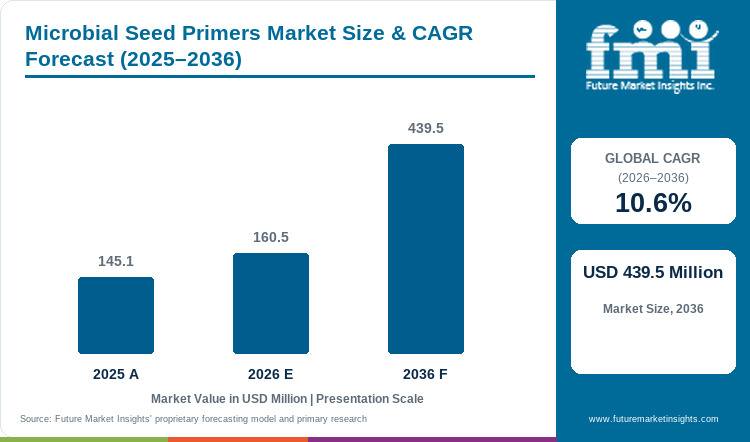
USD 160.5 Million in 2026 and USD 439.5 Million by 2036 at a 10.6% CAGR.
The Microbial Seed Primers market stood at USD 145.1 Million in 2025, is estimated at USD 160.5 Million in 2026, and is forecast to reach USD 439.5 Million by 2036 at a 10.6% CAGR from 2026 to 2036.
Demand is moving toward seed-applied systems that protect establishment while placing biological or nutritional functionality at the point of germination. The scale of row-crop planting gives suppliers a large recurring treatment base.
USDA NASS reported on June 30, 2026 that US farmers planted 95.3 million acres of corn and 85.4 million acres of soybeans. That planting intensity raises the value of consistent coating, priming and inoculant performance because a weak treatment can affect emergence across large acreage.
Seed companies therefore evaluate microbial compatibility alongside seed flow and dry-down. They also test adhesion and planter performance. Revenue expands when a primer can be integrated into established treating lines without forcing buyers to sacrifice throughput or seed handling quality.
The commercial purchasing test is not biological novelty alone. It is repeatable field performance delivered through a process that fits existing seed operations.
Country conditions shape how quickly that value proposition converts into orders. US buyers operate across very large corn and soybean acreages, which rewards scalable in-plant treatment.
UK buyers face a stricter treated-seed authorization environment, highlighted by the January 2025 decision not to grant emergency use of Cruiser SB for sugar beet in England. Germany places strong emphasis on qualified treatment facilities and dust-reduction controls.
Japan is clarifying buyer expectations for biostimulants through Ministry of Agriculture guidance issued in May 2025. These differences affect buyer documentation and labeling. They also influence application equipment and channel support.
Suppliers convert technical interest into purchase when they can document compatibility, efficacy, and stewardship under the local rules that govern seed treatment and biological claims.
Key Takeaways
- The market is estimated at USD 160.5 Million in 2026 and is forecast to reach USD 439.5 Million by 2036 at a 10.6% CAGR.
- Polymer-Based Systems lead the Product Type category in 2026. Corn & Cereals lead the Crop Type category in 2026.
- In-Plant (Seed Companies) lead the Treatment Point category in 2026. Liquid Slurries lead the Formulation category in 2026. Agri-Input Distributors lead the Sales Channel category in 2026.
- Driver: Seed companies and growers are seeking more value from the seed treatment step through protection, nutrient access, and establishment support.
- Restraint: Microbial viability, recipe compatibility, regulatory claims and treatment-line qualification can delay commercialization.
- Opportunity: Stable microbial formulations that fit industrial seed finishing can expand biological use without adding a new field operation. South Korea has the highest profiled country CAGR at 10.1%, compared with Japan at 8.3%.
Analyst Perspective
The strongest commercial position will come from solutions that remain biologically effective after industrial treatment and storage. High-throughput compatibility is essential for in-plant adoption.
- Nikhil Kaitwade, Principal Consultant, Future Market Insights
How is the Microbial Seed Primers Market segmented?
The market is segmented by Product Type, Crop Type, Treatment Point, Formulation, and Sales Channel.
Product Type distinguishes the delivery architecture used to bind, carry, or activate seed-applied functionality. Crop Type reflects different acreage scales, seed values, and establishment risks. Treatment Point separates factory-level treatment from commercial treating and farm application.
Formulation captures the handling behavior of liquids and powders. It also distinguishes film and encrusting systems. Sales Channel reflects how technical support and inventory move from manufacturers to seed companies, commercial treaters, and growers.
These axes interact because a microbial primer must survive both the chemistry of the treatment recipe and the mechanics of application. Buyers therefore evaluate the complete treatment system rather than a biological ingredient in isolation.
What makes Polymer-Based Systems central to the Product Type category?
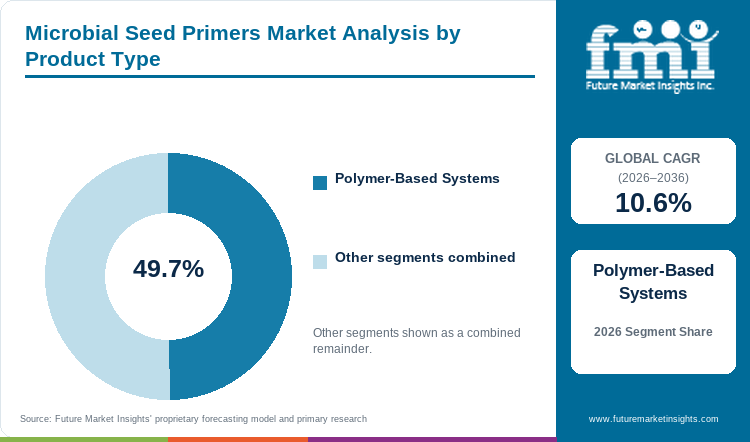
Polymer-Based Systems lead because the coating matrix determines whether active materials stay on the seed during treatment and storage. The same matrix must retain them through transport and planting.
In microbial seed primers this function becomes more demanding because live organisms can be affected by moisture and solvents. Sensitive biological components can also be damaged by drying conditions or incompatible co-applied actives.
A polymer system that controls adhesion and dust while preserving seed flow can reduce operational risk for seed companies. Industrial buyers also value predictable appearance and dosing because treated seed must run consistently through packaging and planting equipment.
This makes polymer selection a process-control decision as much as a formulation choice.
- Polymer-Based Systems account for 49.7% of the Product Type category in 2026, reflecting their role in binding treatment components to seed and supporting consistent handling.
- Corteva Agriscience stated in January 2025 that seed-treatment recipes can combine inoculants and colorants with polymers and biologicals. Biostimulants add another compatibility requirement.
Why does Corn & Cereals lead the Crop Type category?
Corn and cereal programs favor seed-applied treatment because acreage is large and early stand establishment has direct economic value. The application point is also highly standardized compared with many specialty crops.
That allows seed companies to qualify treatment recipes across large commercial volumes and repeat them season after season. Microbial primers can fit this workflow when they provide a measurable establishment or nutrient-use function without reducing plantability.
The category also benefits from established commercial treatment infrastructure. Suppliers that can demonstrate compatibility across seed sizes, hybrids, and common chemical treatment packages can address more of the planted base without adding operational complexity.
- Corn & Cereals hold a 42.4% share of the Crop Type category in 2026, supported by large treated-seed volumes and established industrial treatment practices.
- USDA NASS reported on June 30, 2026 that 95.3 million acres of corn were planted in the United States, showing the scale over which consistent seed-applied performance matters.
How do In-Plant (Seed Companies) treatments shape the Treatment Point category?
In-plant treatment places formulation control with seed companies before products move through distribution. That position favors systems that can be metered precisely and monitored within standardized equipment. It also reduces variability compared with treatments mixed at the farm gate. Related seed coating materials must remain compatible with living organisms through storage and planting.
For microbial primers, industrial application can improve lot traceability and create a controlled window for drying and handling. The constraint is that the biology must tolerate the seed company process and storage period.
Suppliers therefore need recipes that remain viable after exposure to companion products and equipment. In-plant adoption is strongest when quality assurance can be built into routine seed finishing rather than added as a separate step.
- In-Plant (Seed Companies) accounts for 47.2% of the Treatment Point category in 2026 because centralized treatment offers tighter dosing and quality control.
- US EPA seed-treatment guidance distinguishes large commercial facilities from on-farm treating and notes that commercial facilities can process very large seed volumes, reinforcing the scale advantage of centralized application.
What supports Liquid Slurries in the Formulation category?
Liquid slurries lead because they can disperse multiple treatment components through metered equipment and support uniform coverage on large seed lots. The format is familiar to commercial seed treaters and can be adjusted for different recipe loads.
For microbial systems, however, the liquid phase also creates a formulation challenge. Water activity and shear can affect organism survival. Mixing time and contact with chemical actives can do the same. The winning formulations therefore balance pumpability and coating uniformity with biological stability.
Buyers value slurries that dry quickly and leave acceptable seed flow because excess moisture or tack can create bottlenecks at bagging and planting.
- Liquid Slurries represent 38.4% of the Formulation category in 2026, reflecting their fit with metered commercial treatment equipment and multi-component recipes.
- US EPA Policy 14.1, issued in January 2022, identifies slurries and liquids among common seed-treatment application forms used across major crop seeds.
What drives Agri-Input Distributors in the Sales Channel category?
Agri-input distributors lead because microbial primers often need local inventory management and agronomic explanation before a grower or treater commits to use. The distributor can coordinate ordering with seed, crop protection, and nutrition programs.
This matters when product performance depends on storage conditions or on compatibility with other treatments. Distributors also reduce the number of direct commercial relationships a manufacturer must manage across fragmented farming regions.
The channel is less effective when products require complex biological handling that local staff cannot support. Suppliers therefore need clear application instructions and crop-specific evidence that distributors can translate into a practical recommendation.
- Agri-Input Distributors hold a 36.6% share of the Sales Channel category in 2026 because local technical selling and seasonal inventory remain important for seed-applied inputs.
- Verdesian Life Sciences lists seed treatments and biological crop solutions alongside broader nutrient-use products, illustrating how microbial and nutritional seed inputs are positioned within multi-product agronomic selling programs.
What are the drivers, restraints, and opportunities in the Microbial Seed Primers Market?
Large-scale early-season crop protection and establishment needs support demand, while biological formulation and qualification requirements slow adoption and create an opening for industrially stable seed-applied biological systems.
- Driver: Seed companies and growers are seeking more value from the seed treatment step through protection, nutrient access, and establishment support.
- Restraint: Microbial viability, recipe compatibility, regulatory claims and treatment-line qualification can delay commercialization.
- Opportunity: Stable microbial formulations that fit industrial seed finishing can expand biological use without adding a new field operation.
The principal demand mechanism is the concentration of risk at crop establishment. Seed represents a high-value input. Treatment is applied before the crop faces early disease or pest pressure and before nutrient or stress problems emerge. Large planted areas make that decision repeatable at scale.
USDA NASS reported 95.3 million US corn acres and 85.4 million soybean acres for 2026. That base supports demand for treatment recipes that can deliver multiple functions in one pass.
Microbial primers add value when the biological component improves nutrient access or early vigor without compromising the protection package. The purchase response is strongest when the product fits an existing treatment recipe rather than requiring growers to add labor after planting.
The main restraint appears during formulation and qualification. Living organisms can lose performance through exposure to moisture or incompatible chemistry. Temperature and storage time can create further losses.
Seed companies also need evidence that treated seed will remain safe to handle and will flow through equipment. Regulatory review can add another gate when claims move toward pest control or plant-protection effects. UK authorities illustrate the importance of treatment-specific risk and efficacy assessment.
Germany also requires quality controls for certain professional seed-treatment facilities. These conditions do not remove demand. They extend development cycles and narrow the number of products that can move from promising biology into reliable industrial treatment.
The opportunity is to make biological seed application behave like a standard industrial input. Bayer SeedGrowth announced in April 2025 that new biological seed treatments would expand its on-seed portfolio.
Syngenta also said in July 2024 that endophyte formulations developed with Intrinsyx Bio would be offered as seed treatments in key crops. These actions point to a broader commercial model in which biology is integrated into established seed-care programs.
Formulators that improve shelf life, compatibility, and dry-down can make microbial products easier for seed companies to approve. Specialist coating and priming firms can also capture value by providing delivery technology to biological developers that lack seed-process expertise.
Which country CAGRs are profiled in the Microbial Seed Primers Market?
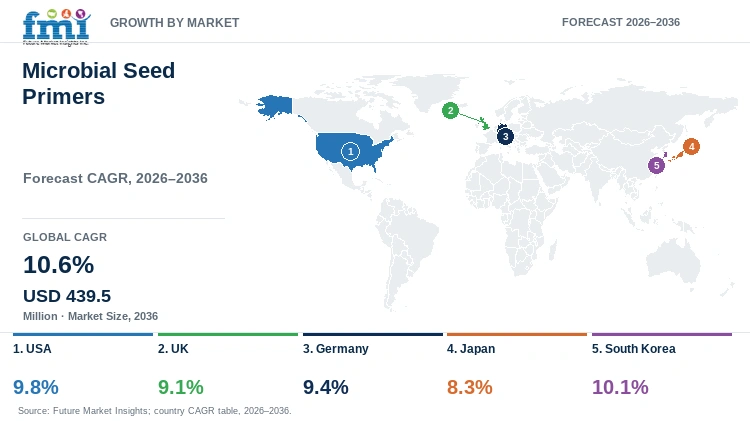
| Country | CAGR |
|---|---|
| USA | 9.8% |
| UK | 9.1% |
| Germany | 9.4% |
| Japan | 8.3% |
| South Korea | 10.1% |
How do country-level CAGRs compare in the Microbial Seed Primers Market?
The five profiled countries span a 1.8 percentage-point range from South Korea at 10.1% CAGR to Japan at 8.3% CAGR from 2026 to 2036. South Korea and the USA form the upper growth band. Germany and the UK sit in a middle band, separated by only 0.3 percentage points.
Japan grows more slowly than the other four but still remains on a positive expansion path. The differences indicate variation in adoption pace rather than absolute market size. Suppliers should therefore compare the growth rate with crop acreage and seed-industry structure.
Biological-product rules and local qualification costs also shape commercial potential.
- South Korea at 10.1% is 0.3 percentage points above the USA at 9.8%. The gap favors earlier channel investment where microbial crop-input adoption can be translated into seed-applied formats.
- The USA at 9.8% is 0.4 percentage points above Germany at 9.4%. Large row-crop acreage supports scale in the USA, while Germany places more emphasis on professional treatment controls and stewardship.
- Germany at 9.4% is 0.3 percentage points above the UK at 9.1%. Both markets reward strong treatment evidence, but national authorization and facility rules shape the timing of adoption.
- The UK at 9.1% is 0.8 percentage points above Japan at 8.3%. Japan offers a more deliberate pathway as buyers adapt to clearer guidance for biostimulant claims and substantiation.
CAGR alone does not establish revenue potential. A faster rate can start from a smaller base or reflect an earlier adoption stage. Commercial planning should also consider planted crop area and seed-company concentration. Distributor reach and application capacity matter as well.
Regulatory costs must be weighed against the ability to maintain microbial performance through storage. The broader report framework therefore treats country growth as one decision variable rather than a stand-alone ranking.
Country-wise Analysis
- US seed companies operate across large commercial corn and soybean programs where treatment throughput and plantability matter. Demand for Microbial Seed Primers in the USA is forecast to expand at 9.8% CAGR from 2026 to 2036. USDA NASS reported on June 30, 2026 that farmers planted 95.3 million acres of corn and 85.4 million acres of soybeans. The principal friction is qualifying a biological within recipes that may already contain several seed-applied actives. Suppliers need strong compatibility data and industrial treatment support so a microbial primer can be adopted without slowing high-volume seed finishing.
- UK purchasing is shaped by seed-company specifications and by a strict authorization framework for treated seed. Demand for Microbial Seed Primers in the UK is forecast to rise at 9.1% CAGR from 2026 to 2036. On January 23, 2025, HSE and Defra published the emergency registration review for Cruiser SB and the government later declined the 2025 emergency authorization for sugar beet. The local friction is the evidence burden around efficacy and environmental risk for plant-protection claims. Suppliers can compete by separating biostimulant claims from pesticidal claims where appropriate and by providing clear treatment-rate and stewardship documentation.
- German adoption favors professional treatment processes with documented control of dust and treated-seed handling. Demand for Microbial Seed Primers in Germany is forecast to expand at 9.4% CAGR from 2026 to 2036. An official German administrative service approved in July 2024 describes inspection requirements for professional seed-treatment facilities where certain products are used. Syngenta had already opened a biological seed-treatment service center in Maintal in October 2023. The friction is qualification against technical and environmental controls. Suppliers need coating systems that minimize abrasion and can be validated in professional treatment centers before broad commercial rollout.
- Japanese buyers are likely to place growing emphasis on documented product claims as biological inputs become more visible. Demand for Microbial Seed Primers in Japan is forecast to grow at 8.3% CAGR from 2026 to 2036. Japan's Ministry of Agriculture, Forestry and Fisheries published biostimulant labeling guidelines on 30 May 2025 to help users evaluate efficacy and product-use information. It also addresses evidence and safety. The friction is that newer biological categories still require buyer education and claim clarity. Suppliers can improve conversion with Japanese-language support documentation that connects microbial function to seed treatment. That documentation should also relate local crop conditions to measurable establishment outcomes.
- South Korean agriculture has an active public research pathway for microbial inputs that can support confidence in biological crop technologies. Demand for Microbial Seed Primers in South Korea is forecast to expand at 10.1% CAGR from 2026 to 2036. On 19 September 2024 the Rural Development Administration reported farm trials where stage-specific microbial treatments improved watermelon size and reduced aphid damage. That evidence is not seed-primer specific, but it demonstrates institutional testing of microbial crop inputs. The friction is converting field-level microbial use into stable seed-applied products. Suppliers need local trials that prove storage survival, emergence benefits and compatibility with Korean seed-treatment practices.
Who are the notable companies in the Microbial Seed Primers Market?
Verdesian Life Sciences and Bayer SeedGrowth are profiled. Syngenta and Corteva Agriscience are also covered. BASF and Germains Seed Technology are also covered. Incotec (Croda) and Centor Group complete the notable-company set.
Competition reflects three different routes to seed-level value. Integrated crop-input companies combine seed treatment chemistry, biologicals, and application support across multiple crops.
Specialist seed-technology companies focus on coating and priming processes that determine whether active ingredients can be delivered consistently. Pelleting and treatment-process expertise extend that capability.
Nutrient and biological specialists bring microbial or nutrient-use technologies that can be adapted to seed application. The boundary between these positions is narrowing as biological products move into industrial seed-care programs. Competitive advantage therefore depends on more than owning an active ingredient.
Suppliers also need formulation compatibility and access to seed-company qualification programs. Regional application support matters too. Buyers also need evidence that a treated seed lot will remain stable through commercial storage and planting.
- Integrated seed-care portfolios: Bayer SeedGrowth, Syngenta, Corteva Agriscience and BASF combine broad crop-input resources with seed treatment development and application infrastructure.
- Seed-enhancement specialists: Germains Seed Technology and Incotec (Croda) compete alongside Centor Group. Their coating and priming expertise supports treatment-process design and seed-company relationships.
- Nutrient and biological specialization: Verdesian Life Sciences brings nutrient-use efficiency, inoculant, and seed-treatment products that can be positioned inside broader agronomic programs.
Competitive Benchmarking: Microbial Seed Primers Market
| Company | Biological / Microbial Delivery Integration | Industrial Coating & Priming Capability | Seed Treatment Application Support | Geographic Reach |
|---|---|---|---|---|
| Verdesian Life Sciences | High | Medium | Medium | North America with selected international markets |
| Bayer SeedGrowth | High | High | High | Global |
| Syngenta | High | High | High | Global |
| Corteva Agriscience | High | High | High | Global |
| BASF | High | High | High | Global |
| Germains Seed Technology | High | High | High | Europe and North America with broader seed-industry reach |
| Incotec (Croda) | High | High | High | Europe, Americas, and Asia-Pacific |
| Centor Group | Medium | High | High | Europe and Australia are covered. Coverage extends to USA and distributor-supported markets. |
Scoring basis: Biological / Microbial Delivery Integration measures documented use of biological actives or biological-compatible seed delivery. Industrial Coating & Priming Capability measures evidence of coating and priming know-how at commercial scale. It also covers film, encrusting and formulation capability.
Seed Treatment Application Support measures documented facilities and process support. It also covers machinery or technical services that help customers apply treatments. High indicates broad or deep documented capability. Medium indicates credible but narrower coverage. Low is reserved for a documented limitation.
Unavailable public information would be left low rather than treated as Low.
Key Developments in the Microbial Seed Primers Market
- During April 2025 Bayer SeedGrowth announced Ibisio, Yoalo and Susteed as new biological seed-treatment solutions. Yoalo contains Bacillus velezensis and is positioned as a crop stimulant while Susteed uses Bacillus amyloliquefaciens QST713 in a concentrated formulation. The program shows biological functions being integrated into established on-seed portfolios. It also raises the competitive threshold for smaller suppliers because microbial performance must fit broader seed-care packages.
- In July 2024, Syngenta announced a collaboration with Intrinsyx Bio to commercialize naturally occurring endophyte formulations. Syngenta stated that formulations would be offered as seed treatment and foliar application in key crops. The agreement expands the route through which nutrient-use microbes can reach industrial seed programs. It also illustrates how large seed-care suppliers can use partnerships to add biological technologies without relying only on internal discovery.
- In March 2024, BASF broke ground on a fermentation plant in Ludwigshafen for biological and biotechnology-based crop protection products. BASF stated that the plant would manufacture biological fungicides and biological seed-treatment products. Fermentation capacity is a material competitive input because microbial products require controlled manufacturing before formulation and application. The investment improves BASF's ability to link biological production with its existing seed-treatment development and commercial infrastructure.
Key Players in the Microbial Seed Primers Market
Integrated Seed-Care and Crop-Input Platforms
- Bayer SeedGrowth
- Syngenta
- Corteva Agriscience
- BASF
Seed Enhancement and Treatment Process Specialists
- Germains Seed Technology
- Incotec (Croda)
- Centor Group
Nutrient and Biological Seed-Input Specialists
- Verdesian Life Sciences
Microbial Seed Primers Market - Report Scope
| Coverage field | Report scope |
|---|---|
| Market breakdown | Product Type, Crop Type, Treatment Point, Formulation, and Sales Channel |
| Quantitative Units | USD Million |
| Market Definition | Revenue includes microbial seed primer products and the seed-applied delivery systems represented by the defined segmentation universe. It covers polymer-based, biological or microbial, nutrient-loaded, and other primer systems sold for seed treatment. It excludes untreated seed revenue, crop genetics, downstream crop revenue, and adjacent foliar or soil products sold outside the seed-treatment use case. |
| Regions Covered | North America, Latin America, Western Europe, Eastern Europe, East Asia, South Asia and Pacific, Middle East and Africa |
| Countries Covered | USA, UK, Germany, Japan, South Korea, and more than twenty-five additional countries in the full report |
| Key Companies Profiled | Verdesian Life Sciences, Bayer SeedGrowth, Syngenta, Corteva Agriscience, BASF, Germains Seed Technology, Incotec (Croda), Centor Group |
| Forecast Period | 2026 to 2036 |
| Approach | FMI applies a hybrid bottom-up and top-down sizing approach that reconciles supplier activity, seed-treatment adoption, crop and application patterns, channel structure, and country-level operating conditions within the defined revenue boundary. |
Microbial Seed Primers Market - Research Methodology
| Method | Approach |
|---|---|
| Primary Research | FMI consults biological-input suppliers and commercial seed treaters. Seed companies and agronomists explain formulation compatibility. The research tests purchase criteria and adoption barriers. |
| Desk Research | FMI reviews agricultural statistics and treated-seed rules. Company materials support the seed-primer boundary. Sources are retained when they support the defined market boundary. |
| Market Sizing and Forecasting | FMI reconciles supplier activity with crop treatment intensity and formulation mix. Forecasts reflect infrastructure and product commercialization. Country conditions and channel structure are checked against the revenue boundary. |
| Data Validation | Findings are checked against independent evidence. The estimate excludes downstream crop value and adjacent foliar or soil biologicals. Duplicate component value and unsupported company shares are removed. |
Microbial Seed Primers Market by Segments
Microbial Seed Primers Market segmented by Product Type:
- Polymer-Based Systems
- Biological / Microbial Systems
- Nutrient-Loaded Systems
- Others
Microbial Seed Primers Market segmented by Crop Type:
- Corn & Cereals
- Soybean & Pulses
- Vegetables
- Cotton & Others
Microbial Seed Primers Market segmented by Treatment Point:
- In-Plant (Seed Companies)
- Commercial Seed Treaters
- On-Farm Treatment
- Others
Microbial Seed Primers Market segmented by Formulation:
- Liquid Slurries
- Dry Powders
- Film Coats & Encrusting
- Others
Microbial Seed Primers Market segmented by Sales Channel:
- Agri-Input Distributors
- Cooperatives
- Agri-Retail Chains
- Online / Direct-to-Farm
- Others
Microbial Seed Primers Market by Region:
- North America
- United States
- Canada
- Latin America
- Brazil
- Mexico
- Argentina
- Chile
- Western Europe
- Germany
- France
- United Kingdom
- Italy
- Spain
- Benelux
- Nordics
- Eastern Europe
- Poland
- Czech Republic
- Romania
- Hungary
- East Asia
- China
- Japan
- South Korea
- South Asia and Pacific
- India
- ASEAN
- Australia and New Zealand
- Middle East and Africa
- GCC Countries
- South Africa
- Türkiye
- Israel
Research Sources and Bibliography
- US Department of Agriculture, National Agricultural Statistics Service (2026, June 30). Corn planted acreage down 3% from 2025, soybean acreage up 5% from last year.
- US Environmental Protection Agency (2022, January). Standard Operating Procedures for Seed Treatment, Policy Number 14.1.
- Health and Safety Executive and Department for Environment, Food & Rural Affairs (2025, January 23). Cruiser SB HSE emergency registration report 2025.
- Federal Ministry of Food and Agriculture / Hessian Portal for Administrative Services (2024, July 8). List of Seed Treatment Facilities with Quality Assurance Systems for Dust Reduction: Apply for Inclusion of a Seed Treatment Facility.
- Ministry of Agriculture, Forestry and Fisheries of Japan (2025, May 30). Guidelines for Labeling and Other Matters Concerning Biostimulants.
- Rural Development Administration, Republic of Korea (2024, September 19). Stage-specific microbial treatment reduces pest damage and improves marketability.
- Bayer SeedGrowth (2025, April 15). SeedGrowth portfolio takes a step up with biological seed treatments Ibisio, Yoalo and Susteed.
- Syngenta (2023, October 16). Syngenta sharpens biologicals focus with launch of first biologicals service center for seed treatment.
- Syngenta (2024, July 8). Syngenta and Intrinsyx Bio to offer new biological solution to boost crops nutrient use efficiency.
- BASF (2024, March 20). Groundbreaking ceremony in Ludwigshafen: New fermentation plant for crop protection products.
- Germains Seed Technology (2025, August 19). New Xbeet enrich 400 delivers 2% yield uplift.
- Corteva Agriscience (2025, January). Building a Better Seed Treatment: Perfecting the recipe for field-ready success.
- Incotec, part of Croda International (2026, September 1 accessed). Whitepaper: Formulating Biologicals for Agriculture.
- Verdesian Life Sciences (2026, September 1 accessed). Biological Crop Solutions.
- Centor Group (2026, September 1 accessed). Product Innovation and Seed Improvement Technologies.
This bibliography is provided for reader reference and is not exhaustive. The full report contains the complete reference list and detailed citations.
This Report Answers
- What is the Microbial Seed Primers Market size in 2026 and what value is forecast for 2036?
- What crop-establishment and seed-treatment pressures support demand for microbial seed primers?
- Why do Polymer-Based Systems hold the leading position in Product Type?
- How does the Corn & Cereals segment influence downstream demand for microbial seed primers?
- Why does In-Plant (Seed Companies) hold the leading position in Treatment Point?
- How do the profiled country growth rates compare for the Microbial Seed Primers market?
- Which companies provide integrated seed-care, seed-enhancement, and biological seed-input capabilities?
- What formulation, compatibility, and regulatory factors limit adoption?
Frequently Asked Questions
What is driving growth in the Microbial Seed Primers Market?
Growth is driven by demand for stronger crop establishment and by the ability to place biological or nutritional functions directly on seed. Adoption rises when these functions fit existing treatment recipes without reducing seed safety, flow, or treatment-line throughput.
Who are the key players in the Microbial Seed Primers Market?
The profiled company set comprises eight firms: Verdesian Life Sciences and Bayer SeedGrowth; Syngenta and Corteva Agriscience; BASF and Germains Seed Technology; plus Incotec (Croda) and Centor Group. They compete through different combinations of biological inputs and coating technology while formulation capability, treatment support and channel access further separate their offers.
What notable restraint affects the Microbial Seed Primers Market?
The main restraint is preserving microbial performance during formulation and application because storage and co-treatment with other seed-applied products create further risk. Qualification also takes time because buyers must confirm efficacy and plantability while stewardship requirements and the regulatory status of product claims add further checks.
Why should executives track the Microbial Seed Primers Market?
The market sits at the intersection of biological crop inputs and industrial seed treatment, where a small formulation change can influence very large planted acreages. Executives should track which products can move from biological promise into repeatable high-throughput seed-company adoption.
What business problem does the Microbial Seed Primers Market address?
Microbial seed primers aim to improve the condition of seed and seedlings during the vulnerable establishment phase while simplifying how crop-support functions are delivered. The commercial problem is to add biological value at planting without creating a separate field operation or compromising seed handling.
What should seed-company and commercial-treatment decision-makers evaluate in the Microbial Seed Primers Market?
Buyers should evaluate microbial viability and companion-active compatibility; coating uniformity and dry-down; storage stability; plantability; and field evidence. They should also confirm whether the product claims trigger plant-protection rules or fit a biostimulant or nutritional framework in the target country.
What limits return on investment in the Microbial Seed Primers Market?
Return can be reduced by failed treatment batches or low microbial survival, while qualification work and poor seed flow can add cost. Inconsistent field response can further weaken economics, and a low acquisition price does not compensate for treatment-line disruption or lost performance during storage and planting.
What supports long-term commercial confidence in the Microbial Seed Primers Market?
Long-term confidence comes from recurring seed-treatment demand and expanding biological portfolios, reinforced by investment in fermentation and microbial delivery technology. The strongest signal is continued integration of biological products into established seed-care systems rather than isolated one-season trials.
Preview the report firsthand - request a free sample
Get SampleGet the brochure for pricing and purchase details.
Get PDFTable of Content
- Key Takeaways
- Market Size and CAGR
- Top Growth Driver
- Fastest Growing Segment
- Leading Region
- Key Companies
- Emerging Opportunities
- Executive Summary
- Global Market Outlook
- Demand-side Trends
- Supply-side Trends
- Technology Roadmap Analysis
- Analysis and Recommendations
- Analyst Perspective (What is happening? Why now? What should investors know?)
- Key Questions Answered
- How large is the market?
- What is the CAGR?
- What are key trends?
- Which region dominates?
- Who are the leaders?
- Market Overview
- Market Coverage / Taxonomy
- Market Definition / Scope / Limitations
- Research Methodology
- Chapter Orientation
- Analytical Lens and Working Hypotheses
- Market Structure, Signals, and Trend Drivers
- Benchmarking and Cross-market Comparability
- Market Sizing, Forecasting, and Opportunity Mapping
- Research Design and Evidence Framework
- Desk Research Programme (Secondary Evidence)
- Expert Input and Fieldwork (Primary Evidence)
- Tooling, Models, and Reference Databases
- Data Engineering and Model Build
- Quality Assurance and Audit Trail
- Market Background
- Market Dynamics (Drivers, Restraints, Opportunity, Trends)
- Scenario Forecast (Optimistic, Likely, Conservative)
- Impact Analysis
- AI Impact
- Sustainability Impact
- Regulatory Impact
- Technology Impact
- Consumer / Buyer Analysis
- Purchase Drivers
- Adoption Barriers
- Buyer Journey
- Opportunity Map Analysis
- Product Life Cycle Analysis
- Supply Chain Analysis
- Investment Feasibility Matrix
- Value Chain Analysis
- PESTLE and Porter's Analysis
- Regulatory Landscape
- Regional Parent Market Outlook
- Production and Consumption Statistics
- Import and Export Statistics
- Global Market Analysis and Forecast, 2021 to 2036
- Historical Market Size Value (USD Million) Analysis, 2021 to 2025
- Current and Future Market Size Value (USD Million) Projections, 2026 to 2036
- Y-o-Y Growth Trend Analysis
- Absolute $ Opportunity Analysis
- Global Market Pricing Analysis, 2021 to 2036
- Global Market Analysis and Forecast, By Product Type, 2021 to 2036
- Introduction / Key Findings
- Historical Market Size Value (USD Million) Analysis By Product Type, 2021 to 2025
- Current and Future Market Size Value (USD Million) Analysis and Forecast By Product Type, 2026 to 2036
- Polymer-Based Systems
- Biological / Microbial Systems
- Nutrient-Loaded Systems
- Others
- Y-o-Y Growth Trend Analysis By Product Type, 2021 to 2025
- Absolute $ Opportunity Analysis By Product Type, 2026 to 2036
- Global Market Analysis and Forecast, By Crop Type, 2021 to 2036
- Introduction / Key Findings
- Historical Market Size Value (USD Million) Analysis By Crop Type, 2021 to 2025
- Current and Future Market Size Value (USD Million) Analysis and Forecast By Crop Type, 2026 to 2036
- Corn & Cereals
- Soybean & Pulses
- Vegetables
- Cotton & Others
- Y-o-Y Growth Trend Analysis By Crop Type, 2021 to 2025
- Absolute $ Opportunity Analysis By Crop Type, 2026 to 2036
- Global Market Analysis and Forecast, By Treatment Point, 2021 to 2036
- Introduction / Key Findings
- Historical Market Size Value (USD Million) Analysis By Treatment Point, 2021 to 2025
- Current and Future Market Size Value (USD Million) Analysis and Forecast By Treatment Point, 2026 to 2036
- In-Plant (Seed Companies)
- Commercial Seed Treaters
- On-Farm Treatment
- Others
- Y-o-Y Growth Trend Analysis By Treatment Point, 2021 to 2025
- Absolute $ Opportunity Analysis By Treatment Point, 2026 to 2036
- Global Market Analysis and Forecast, By Formulation, 2021 to 2036
- Introduction / Key Findings
- Historical Market Size Value (USD Million) Analysis By Formulation, 2021 to 2025
- Current and Future Market Size Value (USD Million) Analysis and Forecast By Formulation, 2026 to 2036
- Liquid Slurries
- Dry Powders
- Film Coats & Encrusting
- Others
- Y-o-Y Growth Trend Analysis By Formulation, 2021 to 2025
- Absolute $ Opportunity Analysis By Formulation, 2026 to 2036
- Global Market Analysis and Forecast, By Sales Channel, 2021 to 2036
- Introduction / Key Findings
- Historical Market Size Value (USD Million) Analysis By Sales Channel, 2021 to 2025
- Current and Future Market Size Value (USD Million) Analysis and Forecast By Sales Channel, 2026 to 2036
- Agri-Input Distributors
- Cooperatives
- Agri-Retail Chains
- Online / Direct-to-Farm
- Others
- Y-o-Y Growth Trend Analysis By Sales Channel, 2021 to 2025
- Absolute $ Opportunity Analysis By Sales Channel, 2026 to 2036
- Global Market Analysis and Forecast, By Region, 2021 to 2036
- Introduction
- Historical Market Size Value (USD Million) Analysis By Region, 2021 to 2025
- Current Market Size Value (USD Million) Analysis and Forecast By Region, 2026 to 2036
- North America
- Latin America
- Western Europe
- Eastern Europe
- East Asia
- South Asia and Pacific
- Middle East and Africa
- Market Attractiveness Analysis By Region
- North America Market Analysis and Forecast, By Country, 2021 to 2036
- Historical Market Size Value (USD Million) Trend Analysis By Market Taxonomy, 2021 to 2025
- Market Size Value (USD Million) Forecast By Market Taxonomy, 2026 to 2036
- By Country
- United States
- Canada
- By Product Type
- By Crop Type
- By Treatment Point
- By Formulation
- By Sales Channel
- By Country
- Market Attractiveness Analysis
- By Country
- By Product Type
- By Crop Type
- By Treatment Point
- By Formulation
- By Sales Channel
- Key Takeaways
- Latin America Market Analysis and Forecast, By Country
- Historical Market Size Value (USD Million) Trend Analysis By Market Taxonomy, 2021 to 2025
- Market Size Value (USD Million) Forecast By Market Taxonomy, 2026 to 2036
- By Country
- Brazil
- Mexico
- Argentina
- Chile
- By Product Type
- By Crop Type
- By Treatment Point
- By Formulation
- By Sales Channel
- By Country
- Market Attractiveness Analysis
- By Country
- By Product Type
- By Crop Type
- By Treatment Point
- By Formulation
- By Sales Channel
- Key Takeaways
- Western Europe Market Analysis and Forecast, By Country
- Historical Market Size Value (USD Million) Trend Analysis By Market Taxonomy, 2021 to 2025
- Market Size Value (USD Million) Forecast By Market Taxonomy, 2026 to 2036
- By Country
- Germany
- France
- United Kingdom
- Italy
- Spain
- Benelux
- Nordics
- By Product Type
- By Crop Type
- By Treatment Point
- By Formulation
- By Sales Channel
- By Country
- Market Attractiveness Analysis
- By Country
- By Product Type
- By Crop Type
- By Treatment Point
- By Formulation
- By Sales Channel
- Key Takeaways
- Eastern Europe Market Analysis and Forecast, By Country
- Historical Market Size Value (USD Million) Trend Analysis By Market Taxonomy, 2021 to 2025
- Market Size Value (USD Million) Forecast By Market Taxonomy, 2026 to 2036
- By Country
- Poland
- Czech Republic
- Romania
- Hungary
- By Product Type
- By Crop Type
- By Treatment Point
- By Formulation
- By Sales Channel
- By Country
- Market Attractiveness Analysis
- By Country
- By Product Type
- By Crop Type
- By Treatment Point
- By Formulation
- By Sales Channel
- Key Takeaways
- East Asia Market Analysis and Forecast, By Country
- Historical Market Size Value (USD Million) Trend Analysis By Market Taxonomy, 2021 to 2025
- Market Size Value (USD Million) Forecast By Market Taxonomy, 2026 to 2036
- By Country
- China
- Japan
- South Korea
- By Product Type
- By Crop Type
- By Treatment Point
- By Formulation
- By Sales Channel
- By Country
- Market Attractiveness Analysis
- By Country
- By Product Type
- By Crop Type
- By Treatment Point
- By Formulation
- By Sales Channel
- Key Takeaways
- South Asia and Pacific Market Analysis and Forecast, By Country
- Historical Market Size Value (USD Million) Trend Analysis By Market Taxonomy, 2021 to 2025
- Market Size Value (USD Million) Forecast By Market Taxonomy, 2026 to 2036
- By Country
- India
- ASEAN
- Australia and New Zealand
- By Product Type
- By Crop Type
- By Treatment Point
- By Formulation
- By Sales Channel
- By Country
- Market Attractiveness Analysis
- By Country
- By Product Type
- By Crop Type
- By Treatment Point
- By Formulation
- By Sales Channel
- Key Takeaways
- Middle East and Africa Market Analysis and Forecast, By Country
- Historical Market Size Value (USD Million) Trend Analysis By Market Taxonomy, 2021 to 2025
- Market Size Value (USD Million) Forecast By Market Taxonomy, 2026 to 2036
- By Country
- GCC Countries
- South Africa
- Türkiye
- Israel
- By Product Type
- By Crop Type
- By Treatment Point
- By Formulation
- By Sales Channel
- By Country
- Market Attractiveness Analysis
- By Country
- By Product Type
- By Crop Type
- By Treatment Point
- By Formulation
- By Sales Channel
- Key Takeaways
- Key Countries Market Analysis
- United States
- Pricing Analysis
- Market Share Analysis, 2025
- By Product Type
- By Crop Type
- By Treatment Point
- By Formulation
- By Sales Channel
- Canada
- Pricing Analysis
- Market Share Analysis, 2025
- By Product Type
- By Crop Type
- By Treatment Point
- By Formulation
- By Sales Channel
- Mexico
- Pricing Analysis
- Market Share Analysis, 2025
- By Product Type
- By Crop Type
- By Treatment Point
- By Formulation
- By Sales Channel
- Brazil
- Pricing Analysis
- Market Share Analysis, 2025
- By Product Type
- By Crop Type
- By Treatment Point
- By Formulation
- By Sales Channel
- Chile
- Pricing Analysis
- Market Share Analysis, 2025
- By Product Type
- By Crop Type
- By Treatment Point
- By Formulation
- By Sales Channel
- Germany
- Pricing Analysis
- Market Share Analysis, 2025
- By Product Type
- By Crop Type
- By Treatment Point
- By Formulation
- By Sales Channel
- United Kingdom
- Pricing Analysis
- Market Share Analysis, 2025
- By Product Type
- By Crop Type
- By Treatment Point
- By Formulation
- By Sales Channel
- Italy
- Pricing Analysis
- Market Share Analysis, 2025
- By Product Type
- By Crop Type
- By Treatment Point
- By Formulation
- By Sales Channel
- Spain
- Pricing Analysis
- Market Share Analysis, 2025
- By Product Type
- By Crop Type
- By Treatment Point
- By Formulation
- By Sales Channel
- France
- Pricing Analysis
- Market Share Analysis, 2025
- By Product Type
- By Crop Type
- By Treatment Point
- By Formulation
- By Sales Channel
- India
- Pricing Analysis
- Market Share Analysis, 2025
- By Product Type
- By Crop Type
- By Treatment Point
- By Formulation
- By Sales Channel
- ASEAN
- Pricing Analysis
- Market Share Analysis, 2025
- By Product Type
- By Crop Type
- By Treatment Point
- By Formulation
- By Sales Channel
- Australia and New Zealand
- Pricing Analysis
- Market Share Analysis, 2025
- By Product Type
- By Crop Type
- By Treatment Point
- By Formulation
- By Sales Channel
- China
- Pricing Analysis
- Market Share Analysis, 2025
- By Product Type
- By Crop Type
- By Treatment Point
- By Formulation
- By Sales Channel
- Japan
- Pricing Analysis
- Market Share Analysis, 2025
- By Product Type
- By Crop Type
- By Treatment Point
- By Formulation
- By Sales Channel
- South Korea
- Pricing Analysis
- Market Share Analysis, 2025
- By Product Type
- By Crop Type
- By Treatment Point
- By Formulation
- By Sales Channel
- Poland
- Pricing Analysis
- Market Share Analysis, 2025
- By Product Type
- By Crop Type
- By Treatment Point
- By Formulation
- By Sales Channel
- Hungary
- Pricing Analysis
- Market Share Analysis, 2025
- By Product Type
- By Crop Type
- By Treatment Point
- By Formulation
- By Sales Channel
- Türkiye
- Pricing Analysis
- Market Share Analysis, 2025
- By Product Type
- By Crop Type
- By Treatment Point
- By Formulation
- By Sales Channel
- South Africa
- Pricing Analysis
- Market Share Analysis, 2025
- By Product Type
- By Crop Type
- By Treatment Point
- By Formulation
- By Sales Channel
- United States
- Market Structure Analysis
- Competition Dashboard
- Competition Benchmarking
- Market Share Analysis of Top Players
- By Regional
- By Product Type
- By Crop Type
- By Treatment Point
- By Formulation
- By Sales Channel
- Emerging Startups
- Innovation Benchmarking
- Competition Analysis
- Competition Deep Dive
- Verdesian Life Sciences
- Overview
- Product Portfolio
- Profitability by Market Segments
- Sales Footprint
- Strategy Overview
- Marketing Strategy
- Product Strategy
- Channel Strategy
- Bayer SeedGrowth
- Syngenta
- Corteva Agriscience
- BASF
- Germains Seed Technology
- Incotec (Croda)
- Centor Group
- Verdesian Life Sciences
- Case Studies
- Success Stories
- Recent Developments
- Competition Deep Dive
- Assumptions & Acronyms Used


