

- Market Size (2026)
- USD 212.2 Mn
- Forecast (2036)
- USD 659.2 Mn
- CAGR (2026 to 2036)
- 12.0%
How big is Seed Nutrient Carriers Market in 2026?
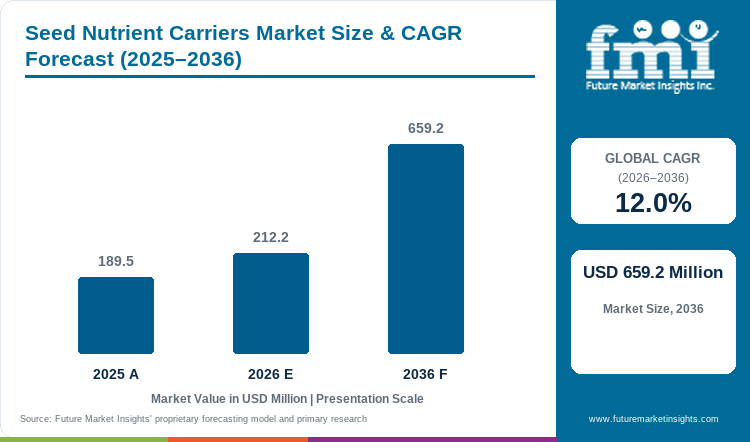
USD 212.2 million in 2026 and USD 659.2 million by 2036 at a 12.0% CAGR.
Demand for seed nutrient carriers is projected to expand at 12.0% CAGR from 2026 to 2036. Valuation rises from USD 189.5 million in 2025 to USD 212.2 million in 2026, reaching USD 659.2 million by 2036. Seed treaters use carriers to keep nutrients and microbes attached through treatment and planting preparation. Groundwork BioAg released Rootella Forte powder in February 2025 for commercial crop use. The company said one pack could treat twice the acreage under its stated application plan. Buyers test seed coating materials to confirm that the intended dose remains attached during normal handling.
Crop scale and local rules determine whether seed carriers move from trials into routine commercial programs. UK demand is projected to expand at 10.5% CAGR through 2036. Japan is anticipated to grow at 9.9% CAGR over the same assessment period. In January 2026, Defra reported 1.7 million hectares of UK wheat and a 12 million tonne harvest for 2025. Large crop volumes keep seed treatment materials relevant across seasonal treatment runs. UK firms require documented proof before carriers enter standard seed lots and regular plant schedules. Japanese approvals also require evidence for biological claims and nutrient-use claims before broader commercial use. Local records and line tests help treatment teams decide when a carrier is ready for routine programs.
Key Takeaways
- Seed companies use carriers to place nutrients or microbes on seed before planting and maintain a controlled dose.
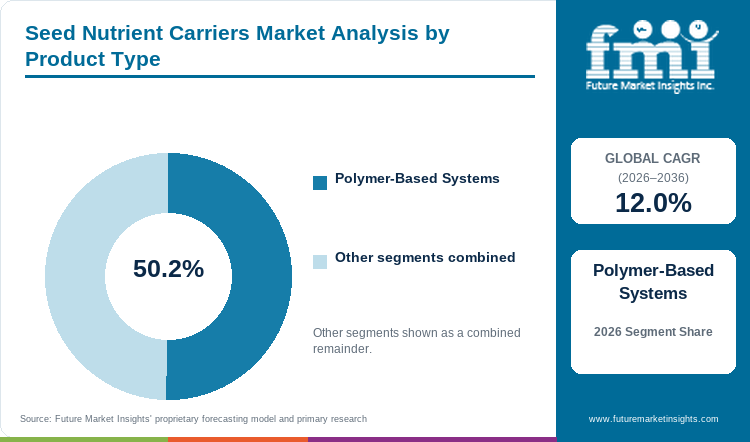
- Reliable coat grip and dose control support polymer-based systems at an estimated 50.2% of product type revenue in 2026.
- Large seasonal treatment volumes are expected to keep corn & cereals at 40.7% of crop type revenue in 2026.
- Plant-level dosing is expected to keep in-plant treatment at 43.8% of treatment point revenue in 2026.
- Mix compatibility tests and dose-stability checks can delay approval before carriers enter routine commercial programs.
- Key participants include Germains Seed Technology, Incotec (Croda), Centor Group, Precision Laboratories, Novonesis, Pivot Bio, Groundwork BioAg, and Verdesian Life Sciences.
Analyst Perspective
"Seed carriers earn repeat use when they hold nutrients or microbes on seed without slowing established treatment lines. Wider adoption depends on proving dose stability and crop performance across normal handling and routine seed lots."
- Nandini Roy Choudhury, Principal Consultant, Future Market Insights
How is the seed nutrient carriers market segmented?
The seed nutrient carriers market is segmented by Product Type, Crop Type, Treatment Point, Formulation, Sales Channel, and Region.
The seed nutrient carriers market is segmented by product type, crop type, treatment point, formulation, sales channel, and region. Product type includes polymer-based systems, biological - microbial systems, nutrient-loaded systems, and others. Crop type includes corn & cereals, soybean & pulses, vegetables, and cotton & others. Treatment point includes in-plant, commercial seed treaters, on-farm treatment, and others. Formulation includes liquid slurries, dry powders, film coats & encrusting, and others. Sales channel includes agri-input distributors, cooperatives, agri-retail chains, online - direct-to-farm, and others.
How do polymer-based systems shape product type decisions?
Film coats and binders keep active material attached during treatment and normal handling. Uneven coverage can change the dose across seed lots, so seed firms test coat grip and dust. Weak films can raise dust or leave some seeds with too little active material. Layered seed encapsulation materials face similar checks before they enter routine treatment programs.
- Polymer-based systems are estimated to hold 50.2% of product type revenue in 2026, aided by reliable coat grip and dose control.
- The European Commission updated guidance on synthetic polymer microparticles in July 2025. The revised restriction requires closer formula review for polymer carriers covered by the rule.
Why do corn & cereals lead the crop type category?
Corn and cereal programs process large seed volumes during each planting season. Treatment teams need steady dosing as lot size and schedules change. Large runs can also use biofertilizers through seed or planter-box programs. Consistent dosing lets one carrier perform across several lots without repeated setup changes during a busy treatment window.
- Large seasonal treatment volumes are projected to keep corn & cereals at 40.7% of crop type revenue in 2026.
- USDA NASS projected 95.3 million planted corn acres for the 2026 season in March 2026. That acreage creates large seasonal treatment volumes across commercial corn seed programs.
How does in-plant treatment shape treatment point selection?
Seed firms control mixing and drying conditions inside treatment plants. Staff check coat weight and product mix with dose-control tools across each seed lot. Poor process control can lower live cell counts during microbial seed treatment. Plant teams can adjust recipes before treated seed moves into packing or distribution.
- In-plant treatment is forecast to represent 43.8% of treatment point revenue in 2026, with plant-level dose control improving consistency.
- Incotec put its expanded Argentina film-coating unit into operation in August 2025. The site now has five times the production capacity of the earlier unit.
What supports liquid slurries within the formulation category?
Liquid slurries work with pumps and meters used on many seed lines. Treatment teams can change the active mix without replacing the dosing system. The same equipment can handle biostimulant formulations used on seed or near planting. Familiar pump setups reduce recipe-change work and simplify routine line preparation.
- Liquid slurries are expected to lead formulation with 50.1% share in 2026 as pump dosing makes recipe changes easier.
- Pivot Bio launched RETAIN Dry for sorghum in March 2026 as a direct-to-seed planter-box option. The dry format reduces mixing work and handling steps during application.
Why do agri-input distributors lead the sales channel category?
Agri-input distributors keep seed products near treatment plants and local service sites. Local inventory shortens refill times during narrow seasonal treatment windows. Technical staff can answer dose and mix questions when recipes change. The same channel role applies to specialty fertilizers that need local seasonal availability.
- Local stock and technical help are expected to keep agri-input distributors at 44.0% of sales channel revenue in 2026.
- Groundwork BioAg and ADAMA announced an exclusive Rootella inoculant agreement for China in January 2025. ADAMA planned commercial sales for the 2025 growing season under that distribution arrangement.
What are the drivers, restraints and opportunities in the Seed Nutrient Carriers Market?
At-plant delivery supports repeat demand, qualification work slows adoption, and new biological revenue routes broaden carrier value.
- Driver: Seed-applied carriers place nutrients or helpful microbes on seed during the same planting step growers already use.
- Restraint: Compatibility tests and regulatory checks can delay carrier approval before routine commercial use.
- Opportunity: Biological carriers can gain added value from services that measure crop results or soil carbon.
Seed-applied delivery places a nutrient or microbial dose near the young root during the same planting step. Carriers and seed binders keep that dose attached through treatment and normal handling. Storage performance also matters before treated seed reaches the planting stage. Pivot Bio launched PROVEN G3 for corn in March 2025 with gene-edited nitrogen-fixing microbes that support nutrient uptake. The format brings live microbes into a planting routine growers already use. Seed firms can gain repeat orders when the treatment remains easy to dose and store. Growers can also avoid a separate inoculant pass by keeping delivery within the planting step. Using the existing planting step makes repeat use more practical across routine seed programs.
Carrier approval becomes harder when a formula changes seed flow or reacts with another treatment. Similar compatibility checks apply to agricultural adjuvants during combined use with crop inputs in seasonal treatment programs. In May 2026, the Animal and Plant Health Agency stated that regulated seed processors need a seed industry licence for commercial sale. The rule covers businesses that clean or treat seed for another party under controlled processing requirements. The licence does not measure carrier demand, but it confirms that commercial treatment follows a defined process. Commercial scale-up requires carriers that fit those controlled treatment steps. Live microbe formats also need storage and survival tests before routine approval across commercial seed lots.
Biological carriers can create value beyond one treatment sale through measured crop or soil services tied to routine use. Groundwork BioAg and Anew Climate announced a plan in September 2025 for about 500,000 tons of durable carbon-removal credits. The program links Rootella mycorrhizal products with measured soil carbon results. Product performance remains the first requirement for continued commercial use. The service cannot replace nutrient or biological performance in the field. When the input performs within existing planting routines, measured outcomes can strengthen retention across growers and distributors. Microbial products can also work alongside water-soluble fertilizers within the same crop plan. Combining microbial products with existing fertilizer plans broadens value without adding another seed-treatment step.
Which country CAGRs are profiled in the Seed Nutrient Carriers Market?
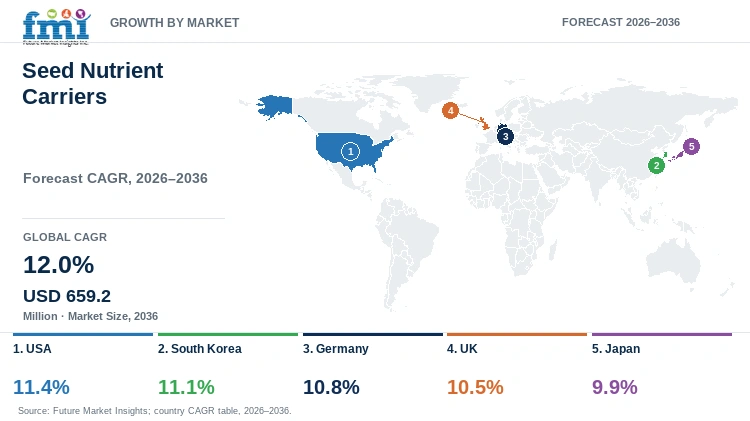
| Country | CAGR |
|---|---|
| USA | 11.4% |
| South Korea | 11.1% |
| Germany | 10.8% |
| UK | 10.5% |
| Japan | 9.9% |
How do country-level CAGRs compare in the Seed Nutrient Carriers Market?
The country forecasts remain within a 1.5 percentage-point range across the assessment period. Crop scale and national qualification requirements still create different order patterns across the five countries.
- Large corn and soybean acreage creates recurring treatment volumes across both plant and planter-box seed programs in the USA.
- South Korea uses registration and composition records that make accurate labeling and lot control central to fertilizer and carrier sales.
- Germany combines large cereal acreage with EU polymer rules that require coating formulas and line settings to pass fresh reviews.
- UK seed processing uses licensed treatment routes that make treatment rates and mix data important for reliable batch records.
- Japan requires documented support for biological and nutrient-use claims, so crop-specific directions become important before products enter routine sales.
The full report provides country-level CAGR analysis across North America, Latin America, Western Europe, Eastern Europe, East Asia, South Asia and Pacific, and the Middle East and Africa.
Country-wise Analysis
- USA seed treatment supports large corn and soybean programs through plant and planter-box application routes. The USA seed carrier sector is projected to record 11.4% CAGR through 2036, supported by row-crop treatment volumes. USDA NASS reported 95.3 million planted corn acres and 85.4 million soybean acres nationwide in June 2026. Those acres create seasonal runs that require consistent carrier doses across many seed lots. Treatment stacks can create mix problems when coatings and live microbes share changing line conditions. Planter-box formats provide another delivery route for farms using direct application. Clear dose instructions reduce changeover risk across different seed lots. Field proof and reliable handling help seed firms keep treatment performance consistent through routine commercial programs.
- South Korea tightened fertilizer sales controls when the Fertilizer Management Act took effect in October 2025. Carrier demand is estimated to expand at 11.1% CAGR through 2036 under product-record rules that shape routine commercial use. Article 14 requires product names and guaranteed component amounts for covered fertilizer products. Carrier mixes must match approved records before dealers can handle them consistently. Live microbe formats also need storage controls that protect the stated dose through distribution. Accurate labels help dealers match shipped grades with approved files. Consistent lot records reduce avoidable filing work across regional sales channels. Strong record control makes product checks easier and supports repeat local orders.
- Carrier sales in Germany are forecast to expand at 10.8% CAGR through 2036. EU polymer rules now influence coating choices and require closer review of replacement formulas. Destatis reported 6.03 million hectares of grain area for the 2026 harvest in May 2026. That national acreage sustains substantial treatment volumes across cereal seed programs. Seed coaters must control dust and wet flow when materials or polymer systems change. New polymers can require revised line settings and compatibility tests before routine adoption. Microplastic-free coatings provide another compliant route under current polymer rules. Successful line tests determine whether replacement materials can move into regular cereal treatment programs.
- UK seed firms operate within a licensed treatment and certification system that shapes routine processing decisions. Carrier demand in the UK is forecast to rise at 10.5% CAGR through 2036. Defra reported 3.0 million hectares of UK cereal crops for 2025 in September 2026. That crop area keeps carrier demand tied to large seasonal treatment runs. New carriers can lengthen qualification when drying time or treatment rates change. Revised lot records can add another review step before routine production. Treaters need clear mix data before a revised recipe enters routine production. Handoff records help plants keep each batch consistent through processing. Reliable setup procedures reduce avoidable variation across seasonal seed lots and routine production runs.
- Japan published national biostimulant labeling guidance in May 2025 with requirements for product proof and safety checks. Seed nutrient carriers in Japan are estimated to expand at 9.9% CAGR through 2036. National claim guidance continues to shape routine commercial adoption decisions. Japanese buyers review supporting evidence before biological or nutrient-use claims enter routine commercial programs. Carrier firms must separate nutrient claims from pesticide claims when both appear in treatment programs. Crop-specific directions help technical teams match each claim with the approved use. Clear use terms can reduce review work across detailed product files. At the point of sale, dealers use complete technical records to confirm approved applications. Routine adoption becomes easier when strong documentation meets national claim controls.
Who are the notable companies in the Seed Nutrient Carriers Market?
Germains Seed Technology, Incotec (Croda), Centor Group, Precision Laboratories, Novonesis, Pivot Bio, Groundwork BioAg, and Verdesian Life Sciences are active within the defined seed nutrient carriers boundary.
Seed-coating specialists and live nutrient developers compete through different operating requirements within the defined market. Coating firms focus on grip and dust control while maintaining reliable flow through installed treatment equipment. Live nutrient developers must protect microbes during storage and planting while maintaining the intended dose. Poor survival or uneven coverage can weaken crop performance, so both groups compete on delivery consistency. Routine commercial use depends on systems that work across normal seed lots without repeated process changes.
- Seed coating and treatment platforms: Germains Seed Technology, Incotec (Croda), and Centor Group.
- Biological nutrient delivery group: Novonesis, Pivot Bio, and Groundwork BioAg.
- Seed-applied chemistry and nutrient formulation: Precision Laboratories and Verdesian Life Sciences.
Competitive Benchmarking: Seed Nutrient Carriers Market
| Company | Carrier & Coating Integration | Biological / Nutrient Delivery | Treatment-Point Flexibility | Geographic Reach |
|---|---|---|---|---|
| Germains Seed Technology | High | High | Medium | North America and Europe |
| Incotec (Croda) | High | High | Medium | Global seed enhancement network |
| Centor Group | High | Medium | High | Europe, North America, Asia-Pacific, Middle East and Africa |
| Precision Laboratories | High | High | High | United States |
| Novonesis | Medium | High | High | Global with plant-health operations in major crop regions |
| Pivot Bio | Medium | High | High | North America with planned international expansion |
| Groundwork BioAg | Medium | High | High | North America, Europe, Latin America and Asia |
| Verdesian Life Sciences | Medium | High | High | North America with wider nutrient-use channels |
The scoring framework uses public evidence for each named competitive capability. High indicates strong proof within the stated area, while Medium indicates partial public proof. Low applies when the public record provides only limited evidence for that criterion. Coating integration covers film coats and binders used during seed treatment. The same criterion includes powders used directly in seed-treatment systems. Biological delivery requires a nutrient or live payload applied on seed or during planting. Treatment-point flexibility covers plant treatment and commercial seed treatment routes. Documented farm-use routes also count when the public record supports them.
Key Developments in the Seed Nutrient Carriers Market
- Groundwork BioAg and Syngenta partnered in July 2026 to sell mycorrhizal products across Latin America and Europe.
- Pivot Bio launched PROVEN G3 Dry for corn and CERT-N Dry for cotton in November 2025 with micronutrient dry carriers.
- Verdesian Life Sciences announced Certified Biostimulant status for Primacy Alpha in June 2025 under TFI standards.
Key Players in the Seed Nutrient Carriers Market
Seed coating and treatment platforms
- Germains Seed Technology
- Incotec (Croda)
- Centor Group
Biological nutrient delivery
- Novonesis
- Pivot Bio
- Groundwork BioAg
Seed-applied chemistry and nutrient formulation
- Precision Laboratories
- Verdesian Life Sciences
Seed Nutrient Carriers Market - Report Scope
| Coverage field | Report scope |
|---|---|
| Market breakdown | By product type, crop type, treatment point, formulation, sales channel, and region. |
| Quantitative Units | USD million. |
| Market Definition | Revenue includes seed-applied carriers for nutrients, nutrient-use agents, or beneficial microorganisms. It excludes treated-seed revenue, stand-alone crop protection, treatment machinery, and unrelated soil or foliar fertilizers. |
| Regions Covered | North America, Latin America, Western Europe, Eastern Europe, East Asia, South Asia and Pacific, and Middle East and Africa. |
| Countries Covered | USA, UK, Germany, Japan, South Korea, and 30+ countries included in the full report. |
| Key Companies Profiled | Germains Seed Technology, Incotec (Croda), Centor Group, Precision Laboratories, Novonesis, Pivot Bio, Groundwork BioAg, Verdesian Life Sciences. |
| Forecast Period | 2026 to 2036. |
| Approach | Primary and secondary research with market triangulation. |
Seed Nutrient Carriers Market - Research Methodology
| Method | Approach |
|---|---|
| Primary Research | FMI analysts gathered input from manufacturers, service providers, technology developers, distributors, end users, procurement teams, and subject-matter experts. Interviews examined purchasing decisions, product or service evaluation, adoption barriers, approval requirements, pricing considerations, and expectations for technical or commercial support. Respondents were also asked what evidence is required before a trial, pilot, or initial order develops into regular purchasing. |
| Desk Research | Desk research covered government statistics, regulatory publications, trade data, industry associations, technical literature, standards, company filings, product information, and official corporate announcements. Sources were reviewed for relevance, publication date, geographic coverage, and consistency with the defined market scope. Claims relating to performance, applications, approvals, capacity, investment, and commercial activity were retained only when supported by credible public evidence. |
| Market Sizing and Forecasting | The market model combined the baseline value with historical performance, segment structure, pricing and volume indicators, adoption levels, company participation, and country-level demand conditions. Forecast assumptions considered economic activity, investment trends, regulatory developments, technology adoption, purchasing cycles, supply availability, and barriers to wider market use. Segment and regional estimates were reconciled before the final market total was calculated. |
| Data Validation | Estimates were checked against multiple independent indicators, including public data, company activity, trade patterns, industry developments, and findings from primary interviews. Validation also tested whether products, services, applications, and company revenues fell within the defined market boundaries. Adjacent categories, unsupported claims, overlapping revenues, and activities without direct market relevance were excluded to reduce double counting and maintain consistency across segments and countries. |
Seed Nutrient Carriers Market by Segments
Seed Nutrient Carriers Market segmented by Product Type:
- Polymer-Based Systems
- Biological - Microbial Systems
- Nutrient-Loaded Systems
- Others
Seed Nutrient Carriers Market segmented by Crop Type:
- Corn & Cereals
- Soybean & Pulses
- Vegetables
- Cotton & Others
Seed Nutrient Carriers Market segmented by Treatment Point:
- In-Plant (Seed Companies)
- Commercial Seed Treaters
- On-Farm Treatment
- Others
Seed Nutrient Carriers Market segmented by Formulation:
- Liquid Slurries
- Dry Powders
- Film Coats & Encrusting
- Others
Seed Nutrient Carriers Market segmented by Sales Channel:
- Agri-Input Distributors
- Cooperatives
- Agri-Retail Chains
- Online - Direct-to-Farm
- Others
Seed Nutrient Carriers Market by Region:
- North America
- United States
- Canada
- Latin America
- Brazil
- Mexico
- Chile
- Rest of Latin America
- Western Europe
- Germany
- United Kingdom
- Italy
- Spain
- France
- Nordics
- Benelux
- Rest of Western Europe
- Eastern Europe
- Russia
- Poland
- Hungary
- Balkan and Baltic States
- Rest of Eastern Europe
- East Asia
- China
- Japan
- South Korea
- South Asia and Pacific
- India
- ASEAN
- Australia and New Zealand
- Rest of South Asia and Pacific
- Middle East and Africa
- Kingdom of Saudi Arabia
- Other GCC Countries
- Türkiye
- South Africa
- Other African Union Countries
- Rest of Middle East and Africa
Research Sources and Bibliography
- Groundwork BioAg. (2025, February 25). Mycorrhizal inoculant leader Groundwork BioAg expands Rootella portfolio and Rootella Carbon program at Commodity Classic 2025.
- Department for Environment, Food & Rural Affairs. (2026, January 20). Cereal and oilseed production in the United Kingdom 2025.
- European Commission. (2025, July 18). Restriction of microplastics intentionally added to products.
- U.S. Department of Agriculture, National Agricultural Statistics Service. (2026, March 31). Prospective Plantings.
- Incotec. (2025, August 25). Upgraded facility in Argentina fully operational.
- Pivot Bio. (2026, March 11). Pivot Bio launches RETAIN Dry, expanding application options for sorghum growers.
- Groundwork BioAg. (2025, January 6). Groundwork BioAg and ADAMA partner to offer Rootella inoculants in China.
- Pivot Bio. (2025, March 13). Pivot Bio unveils PROVEN G3 with new modes of action and gene-editing technology.
- Animal and Plant Health Agency. (2026, May 8). Apply to have seeds certified for marketing in England and Wales.
- Groundwork BioAg. (2025, September 22). Groundwork BioAg and Anew Climate announce collaboration to commercialize durable soil carbon removal credits.
- U.S. Department of Agriculture, National Agricultural Statistics Service. (2026, June 30). Corn planted acreage down 3% from 2025, soybean acreage up 5% from last year.
- Department for Environment, Food & Rural Affairs. (2026, September 3). Agriculture in the United Kingdom 2025: Summary.
- Federal Statistical Office of Germany (Destatis). (2026, May 19). Expected grain harvest 2026: Cultivated area rises by 2.6% to 6.03 million hectares.
- Ministry of Agriculture, Forestry and Fisheries, Japan. (2025, May 30). Guidelines on labeling of biostimulants.
- Korea National Law Information Center. (2025, October 1). Fertilizer Management Act, Article 14: Guarantee labeling and sales management.
- Groundwork BioAg. (2026, July 14). Syngenta and Groundwork BioAg enter partnership to bring biologicals and soil carbon solutions to farmers.
- Pivot Bio. (2025, November 13). Pivot Bio expands weatherproof nitrogen portfolio with new dry planter-box treatments for corn and cotton.
- Verdesian Life Sciences. (2025, June 27). Primacy Alpha earns Certified Biostimulant label from The Fertilizer Institute.
- Germains Seed Technology. (2025, August 19). New Xbeet enrich 400 delivers 2% yield uplift.
- Incotec. (2026, April 8). New high-performing microplastic-free seed coating for cereal.
- Aginnovation. (2025, July 15). Aginnovation acquires Centor Europe to strengthen seed-enhancement portfolio across Europe.
- Precision Laboratories. (2026, February 13). SeedZone IF sees broadcast application success and reports 2025 PROVE trial results.
- Novonesis. (2026, June 11). Rovensa Next to distribute Novonesis biosolutions for plant health in the United States.
- Pivot Bio. (2026, March 31). Pivot Bio silage data show tonnage and milk gains with PROVEN 40 and PROVEN G3.
- Groundwork BioAg. (2025, September 10). Groundwork BioAg and Beck's partner to expand access to Rootella inoculants.
- Verdesian Life Sciences. (2026, May 5). Take Off LS earns industry biostimulant certification from The Fertilizer Institute.
- Pivot Bio. (2025, January 16). Pivot Bio expands retail network with Logan Agri-Service.
- Incotec. (2026, September 8). Renewed labs in Brazil - hub for customer collaboration.
- Syngenta Canada. (2026, September 11). Syngenta Canada adds Atuva Chickpea to the Atuva family of pulse and soybean inoculants.
- Protealis. (2026, March 11). Protealis announces regulatory approval of its first biological solution MagNfix and launch of five new soybean varieties.
- Rovensa Next. (2026, March 9). Otimais Duo synergistic inoculant for nutrient efficiency is launched in Brazil.
- Bioceres Crop Solutions. (2025, May 21). Bioceres Crop Solutions reports fiscal third quarter 2025 financial and operational results.
This bibliography is provided for reader reference and does not represent the complete evidence base. The full report contains the complete reference list and detailed citations.
This Report Answers
- What are the 2026 and 2036 values for seed nutrient carriers?
- Which operating conditions support regular demand for seed nutrient carriers?
- Why do polymer-based systems hold the 50.2% product type share?
- How do crop type and treatment point affect carrier choice?
- Which formulation and sales channel hold the 50.1% and 44.0% shares?
- How do the profiled country CAGRs compare through the 2036 forecast?
- Which qualification issues can slow adoption of new seed carrier systems?
- Which companies supply seed coatings and biological or nutrient-delivery carrier systems?
- Which company developments are changing product access and carrier formats?
Frequently Asked Questions
How big is the seed nutrient carriers market in 2026?
The seed nutrient carriers market is valued at USD 212.2 million in 2026. It is projected to reach USD 659.2 million by 2036. Carriers place nutrients or microbes on seed during treatment and routine planting to keep delivery close to the crop.
What is the CAGR of the seed nutrient carriers market from 2026 to 2036?
The seed nutrient carriers market is projected to grow at 12.0% CAGR from 2026 through 2036. Routine planting demand supports this path by keeping nutrient or microbial delivery within the same field pass.
Which product type leads the seed nutrient carriers market in 2026?
Polymer-based systems are estimated to hold 50.2% of product type revenue in 2026. Seed companies select binders and film coats that improve dose retention and limit dust during handling.
Which crop type leads the seed nutrient carriers market in 2026?
Corn & cereals are projected to hold 40.7% of crop type revenue in 2026. Large planted areas create recurring treatment runs that need consistent carrier dosing across many seed lots.
Which countries form the upper CAGR group in the seed nutrient carriers market?
USA demand is projected to expand at 11.4% CAGR through 2036, while South Korea is expected to reach 11.1%. Large row-crop volumes shape USA demand, whereas product records and label rules influence routine carrier use in South Korea.
Which companies are active in the seed nutrient carriers market?
Key companies include Germains Seed Technology, Incotec (Croda), Centor Group, and Precision Laboratories. Novonesis, Pivot Bio, Groundwork BioAg, and Verdesian Life Sciences also operate within the defined scope. Their documented roles cover seed coatings, microbial delivery, nutrient formulations, and treatment support.
Preview the report firsthand - request a free sample
Get SampleGet the brochure for pricing and purchase details.
Get PDFTable of Content
- Key Takeaways
- Market Size and CAGR
- Top Growth Driver
- Fastest Growing Segment
- Leading Region
- Key Companies
- Emerging Opportunities
- Executive Summary
- Global Market Outlook
- Demand-side Trends
- Supply-side Trends
- Technology Roadmap Analysis
- Analysis and Recommendations
- Analyst Perspective (What is happening? Why now? What should investors know?)
- Key Questions Answered
- How large is the market?
- What is the CAGR?
- What are key trends?
- Which region dominates?
- Who are the leaders?
- Market Overview
- Market Coverage / Taxonomy
- Market Definition / Scope / Limitations
- Research Methodology
- Chapter Orientation
- Analytical Lens and Working Hypotheses
- Market Structure, Signals, and Trend Drivers
- Benchmarking and Cross-market Comparability
- Market Sizing, Forecasting, and Opportunity Mapping
- Research Design and Evidence Framework
- Desk Research Programme (Secondary Evidence)
- Expert Input and Fieldwork (Primary Evidence)
- Tooling, Models, and Reference Databases
- Data Engineering and Model Build
- Quality Assurance and Audit Trail
- Market Background
- Market Dynamics (Drivers, Restraints, Opportunity, Trends)
- Scenario Forecast (Optimistic, Likely, Conservative)
- Impact Analysis
- AI Impact
- Sustainability Impact
- Regulatory Impact
- Technology Impact
- Consumer / Buyer Analysis
- Purchase Drivers
- Adoption Barriers
- Buyer Journey
- Opportunity Map Analysis
- Product Life Cycle Analysis
- Supply Chain Analysis
- Investment Feasibility Matrix
- Value Chain Analysis
- PESTLE and Porter's Analysis
- Regulatory Landscape
- Regional Parent Market Outlook
- Production and Consumption Statistics
- Import and Export Statistics
- Global Market Analysis and Forecast, 2021 to 2036
- Historical Market Size Value (USD Million) Analysis, 2021 to 2025
- Current and Future Market Size Value (USD Million) Projections, 2026 to 2036
- Y-o-Y Growth Trend Analysis
- Absolute $ Opportunity Analysis
- Global Market Pricing Analysis, 2021 to 2036
- Global Market Analysis and Forecast, By Product Type, 2021 to 2036
- Introduction / Key Findings
- Historical Market Size Value (USD Million) Analysis By Product Type, 2021 to 2025
- Current and Future Market Size Value (USD Million) Analysis and Forecast By Product Type, 2026 to 2036
- Polymer-Based Systems
- Biological - Microbial Systems
- Nutrient-Loaded Systems
- Others
- Y-o-Y Growth Trend Analysis By Product Type, 2021 to 2025
- Absolute $ Opportunity Analysis By Product Type, 2026 to 2036
- Global Market Analysis and Forecast, By Crop Type, 2021 to 2036
- Introduction / Key Findings
- Historical Market Size Value (USD Million) Analysis By Crop Type, 2021 to 2025
- Current and Future Market Size Value (USD Million) Analysis and Forecast By Crop Type, 2026 to 2036
- Corn & Cereals
- Soybean & Pulses
- Vegetables
- Cotton & Others
- Y-o-Y Growth Trend Analysis By Crop Type, 2021 to 2025
- Absolute $ Opportunity Analysis By Crop Type, 2026 to 2036
- Global Market Analysis and Forecast, By Treatment Point, 2021 to 2036
- Introduction / Key Findings
- Historical Market Size Value (USD Million) Analysis By Treatment Point, 2021 to 2025
- Current and Future Market Size Value (USD Million) Analysis and Forecast By Treatment Point, 2026 to 2036
- In-Plant (Seed Companies)
- Commercial Seed Treaters
- On-Farm Treatment
- Others
- Y-o-Y Growth Trend Analysis By Treatment Point, 2021 to 2025
- Absolute $ Opportunity Analysis By Treatment Point, 2026 to 2036
- Global Market Analysis and Forecast, By Formulation, 2021 to 2036
- Introduction / Key Findings
- Historical Market Size Value (USD Million) Analysis By Formulation, 2021 to 2025
- Current and Future Market Size Value (USD Million) Analysis and Forecast By Formulation, 2026 to 2036
- Liquid Slurries
- Dry Powders
- Film Coats & Encrusting
- Others
- Y-o-Y Growth Trend Analysis By Formulation, 2021 to 2025
- Absolute $ Opportunity Analysis By Formulation, 2026 to 2036
- Global Market Analysis and Forecast, By Sales Channel, 2021 to 2036
- Introduction / Key Findings
- Historical Market Size Value (USD Million) Analysis By Sales Channel, 2021 to 2025
- Current and Future Market Size Value (USD Million) Analysis and Forecast By Sales Channel, 2026 to 2036
- Agri-Input Distributors
- Cooperatives
- Agri-Retail Chains
- Online - Direct-to-Farm
- Others
- Y-o-Y Growth Trend Analysis By Sales Channel, 2021 to 2025
- Absolute $ Opportunity Analysis By Sales Channel, 2026 to 2036
- Global Market Analysis and Forecast, By Region, 2021 to 2036
- Introduction
- Historical Market Size Value (USD Million) Analysis By Region, 2021 to 2025
- Current Market Size Value (USD Million) Analysis and Forecast By Region, 2026 to 2036
- North America
- Latin America
- Western Europe
- Eastern Europe
- East Asia
- South Asia and Pacific
- Middle East and Africa
- Market Attractiveness Analysis By Region
- North America Market Analysis and Forecast, By Country, 2021 to 2036
- Historical Market Size Value (USD Million) Trend Analysis By Market Taxonomy, 2021 to 2025
- Market Size Value (USD Million) Forecast By Market Taxonomy, 2026 to 2036
- By Country
- United States
- Canada
- By Product Type
- By Crop Type
- By Treatment Point
- By Formulation
- By Sales Channel
- By Country
- Market Attractiveness Analysis
- By Country
- By Product Type
- By Crop Type
- By Treatment Point
- By Formulation
- By Sales Channel
- Key Takeaways
- Latin America Market Analysis and Forecast, By Country
- Historical Market Size Value (USD Million) Trend Analysis By Market Taxonomy, 2021 to 2025
- Market Size Value (USD Million) Forecast By Market Taxonomy, 2026 to 2036
- By Country
- Brazil
- Mexico
- Chile
- Rest of Latin America
- By Product Type
- By Crop Type
- By Treatment Point
- By Formulation
- By Sales Channel
- By Country
- Market Attractiveness Analysis
- By Country
- By Product Type
- By Crop Type
- By Treatment Point
- By Formulation
- By Sales Channel
- Key Takeaways
- Western Europe Market Analysis and Forecast, By Country
- Historical Market Size Value (USD Million) Trend Analysis By Market Taxonomy, 2021 to 2025
- Market Size Value (USD Million) Forecast By Market Taxonomy, 2026 to 2036
- By Country
- Germany
- United Kingdom
- Italy
- Spain
- France
- Nordics
- Benelux
- Rest of Western Europe
- By Product Type
- By Crop Type
- By Treatment Point
- By Formulation
- By Sales Channel
- By Country
- Market Attractiveness Analysis
- By Country
- By Product Type
- By Crop Type
- By Treatment Point
- By Formulation
- By Sales Channel
- Key Takeaways
- Eastern Europe Market Analysis and Forecast, By Country
- Historical Market Size Value (USD Million) Trend Analysis By Market Taxonomy, 2021 to 2025
- Market Size Value (USD Million) Forecast By Market Taxonomy, 2026 to 2036
- By Country
- Russia
- Poland
- Hungary
- Balkan and Baltic States
- Rest of Eastern Europe
- By Product Type
- By Crop Type
- By Treatment Point
- By Formulation
- By Sales Channel
- By Country
- Market Attractiveness Analysis
- By Country
- By Product Type
- By Crop Type
- By Treatment Point
- By Formulation
- By Sales Channel
- Key Takeaways
- East Asia Market Analysis and Forecast, By Country
- Historical Market Size Value (USD Million) Trend Analysis By Market Taxonomy, 2021 to 2025
- Market Size Value (USD Million) Forecast By Market Taxonomy, 2026 to 2036
- By Country
- China
- Japan
- South Korea
- By Product Type
- By Crop Type
- By Treatment Point
- By Formulation
- By Sales Channel
- By Country
- Market Attractiveness Analysis
- By Country
- By Product Type
- By Crop Type
- By Treatment Point
- By Formulation
- By Sales Channel
- Key Takeaways
- South Asia and Pacific Market Analysis and Forecast, By Country
- Historical Market Size Value (USD Million) Trend Analysis By Market Taxonomy, 2021 to 2025
- Market Size Value (USD Million) Forecast By Market Taxonomy, 2026 to 2036
- By Country
- India
- ASEAN
- Australia and New Zealand
- Rest of South Asia and Pacific
- By Product Type
- By Crop Type
- By Treatment Point
- By Formulation
- By Sales Channel
- By Country
- Market Attractiveness Analysis
- By Country
- By Product Type
- By Crop Type
- By Treatment Point
- By Formulation
- By Sales Channel
- Key Takeaways
- Middle East and Africa Market Analysis and Forecast, By Country
- Historical Market Size Value (USD Million) Trend Analysis By Market Taxonomy, 2021 to 2025
- Market Size Value (USD Million) Forecast By Market Taxonomy, 2026 to 2036
- By Country
- Kingdom of Saudi Arabia
- Other GCC Countries
- Türkiye
- South Africa
- Other African Union Countries
- Rest of Middle East and Africa
- By Product Type
- By Crop Type
- By Treatment Point
- By Formulation
- By Sales Channel
- By Country
- Market Attractiveness Analysis
- By Country
- By Product Type
- By Crop Type
- By Treatment Point
- By Formulation
- By Sales Channel
- Key Takeaways
- Key Countries Market Analysis
- United States
- Pricing Analysis
- Market Share Analysis, 2025
- By Product Type
- By Crop Type
- By Treatment Point
- By Formulation
- By Sales Channel
- Canada
- Pricing Analysis
- Market Share Analysis, 2025
- By Product Type
- By Crop Type
- By Treatment Point
- By Formulation
- By Sales Channel
- Mexico
- Pricing Analysis
- Market Share Analysis, 2025
- By Product Type
- By Crop Type
- By Treatment Point
- By Formulation
- By Sales Channel
- Brazil
- Pricing Analysis
- Market Share Analysis, 2025
- By Product Type
- By Crop Type
- By Treatment Point
- By Formulation
- By Sales Channel
- Chile
- Pricing Analysis
- Market Share Analysis, 2025
- By Product Type
- By Crop Type
- By Treatment Point
- By Formulation
- By Sales Channel
- Germany
- Pricing Analysis
- Market Share Analysis, 2025
- By Product Type
- By Crop Type
- By Treatment Point
- By Formulation
- By Sales Channel
- United Kingdom
- Pricing Analysis
- Market Share Analysis, 2025
- By Product Type
- By Crop Type
- By Treatment Point
- By Formulation
- By Sales Channel
- Italy
- Pricing Analysis
- Market Share Analysis, 2025
- By Product Type
- By Crop Type
- By Treatment Point
- By Formulation
- By Sales Channel
- Spain
- Pricing Analysis
- Market Share Analysis, 2025
- By Product Type
- By Crop Type
- By Treatment Point
- By Formulation
- By Sales Channel
- France
- Pricing Analysis
- Market Share Analysis, 2025
- By Product Type
- By Crop Type
- By Treatment Point
- By Formulation
- By Sales Channel
- India
- Pricing Analysis
- Market Share Analysis, 2025
- By Product Type
- By Crop Type
- By Treatment Point
- By Formulation
- By Sales Channel
- ASEAN
- Pricing Analysis
- Market Share Analysis, 2025
- By Product Type
- By Crop Type
- By Treatment Point
- By Formulation
- By Sales Channel
- Australia and New Zealand
- Pricing Analysis
- Market Share Analysis, 2025
- By Product Type
- By Crop Type
- By Treatment Point
- By Formulation
- By Sales Channel
- China
- Pricing Analysis
- Market Share Analysis, 2025
- By Product Type
- By Crop Type
- By Treatment Point
- By Formulation
- By Sales Channel
- Japan
- Pricing Analysis
- Market Share Analysis, 2025
- By Product Type
- By Crop Type
- By Treatment Point
- By Formulation
- By Sales Channel
- South Korea
- Pricing Analysis
- Market Share Analysis, 2025
- By Product Type
- By Crop Type
- By Treatment Point
- By Formulation
- By Sales Channel
- Russia
- Pricing Analysis
- Market Share Analysis, 2025
- By Product Type
- By Crop Type
- By Treatment Point
- By Formulation
- By Sales Channel
- Poland
- Pricing Analysis
- Market Share Analysis, 2025
- By Product Type
- By Crop Type
- By Treatment Point
- By Formulation
- By Sales Channel
- Hungary
- Pricing Analysis
- Market Share Analysis, 2025
- By Product Type
- By Crop Type
- By Treatment Point
- By Formulation
- By Sales Channel
- Kingdom of Saudi Arabia
- Pricing Analysis
- Market Share Analysis, 2025
- By Product Type
- By Crop Type
- By Treatment Point
- By Formulation
- By Sales Channel
- Türkiye
- Pricing Analysis
- Market Share Analysis, 2025
- By Product Type
- By Crop Type
- By Treatment Point
- By Formulation
- By Sales Channel
- South Africa
- Pricing Analysis
- Market Share Analysis, 2025
- By Product Type
- By Crop Type
- By Treatment Point
- By Formulation
- By Sales Channel
- United States
- Market Structure Analysis
- Competition Dashboard
- Competition Benchmarking
- Market Share Analysis of Top Players
- By Regional
- By Product Type
- By Crop Type
- By Treatment Point
- By Formulation
- By Sales Channel
- Emerging Startups
- Innovation Benchmarking
- Competition Analysis
- Competition Deep Dive
- Germains Seed Technology
- Overview
- Product Portfolio
- Profitability by Market Segments
- Sales Footprint
- Strategy Overview
- Marketing Strategy
- Product Strategy
- Channel Strategy
- Incotec (Croda)
- Centor Group
- Precision Laboratories
- Novonesis
- Pivot Bio
- Groundwork BioAg
- Verdesian Life Sciences
- Germains Seed Technology
- Case Studies
- Success Stories
- Recent Developments
- Competition Deep Dive
- Assumptions & Acronyms Used


