

- Market Size (2026)
- USD 302.4 Mn
- Forecast (2036)
- USD 947.8 Mn
- CAGR (2026 to 2036)
- 12.1%
How big is Heat Recovery Biologics Market in 2026?
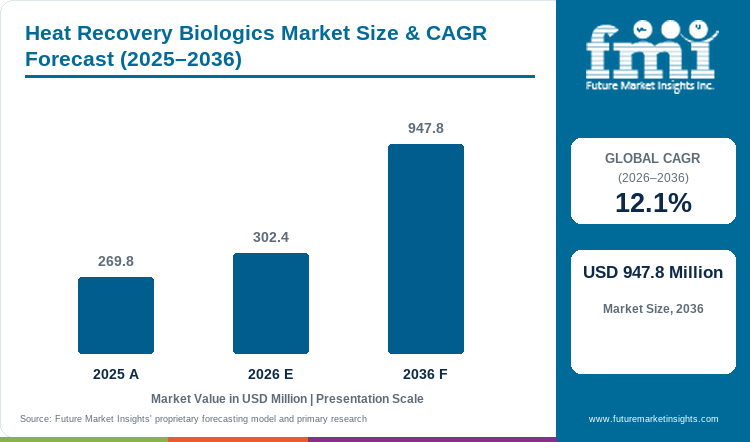
USD 302.4 million in 2026 and USD 947.8 million by 2036, expanding at 12.1% CAGR.
Demand for heat recovery biologics is projected to expand at 12.1% CAGR from 2026 to 2036. Valuation grows from USD 269.8 million in 2025 to USD 302.4 million in 2026 and reaches USD 947.8 million by 2036. Growers use these products as heat threatens flowering or grain fill and crop losses can develop quickly. In March 2026, WMO reported that 2015 through 2025 were the eleven warmest years on record. The sustained heat record increases interest in preventive crop programs that align with existing field schedules. Farms gain more value from biostimulant programs when each treatment matches a planned field pass and defined crop stage.
Farm systems affect how quickly heat risk becomes a purchase decision across agricultural regions. South Korean protected farms use daily weather checks to adjust irrigation and crop-care timing. In September 2026, South Korea's agriculture ministry reported 5,887.8 hectares of heat and drought damage nationwide. US farms require clear per-acre returns before expanding a stress-treatment program. European buyers expect local trials and claims that match applicable product rules. Japanese growers require crop-specific evidence before changing established treatment programs. Regional operating differences shape qualification work and field-trial design across each market. They also change distributor stock needs and the evidence required for repeat orders.
Key Takeaways
- Heat forecasts near flowering and grain fill move selected stress treatments into planned crop programs.
- Osmoprotectant blends are projected at 43.2% of product type revenue in 2026, with direct cellular stress protection supporting planned use.
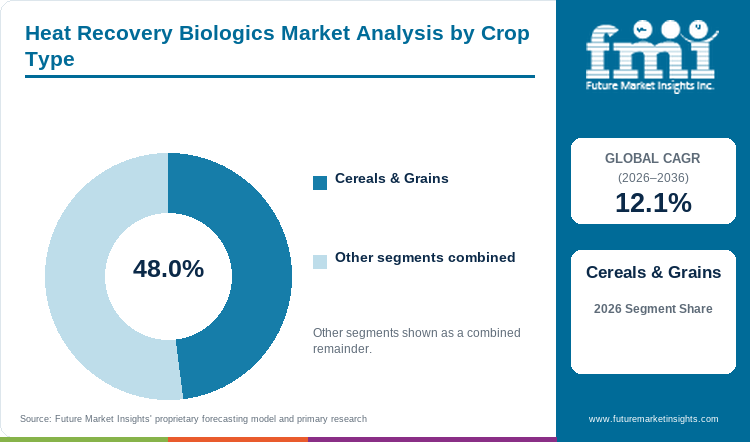
- Cereals & grains are estimated at 48.0% of crop type revenue in 2026, reflecting broad acreage and heat-sensitive growth stages.
- Soil application is forecast at 49.6% of application-method revenue in 2026, as early root-zone treatment aligns with planned application timing.
- Field results vary with crop stage and water status, which can slow regular purchases across different growing seasons.
- Key players include Brandt, Biolchim, Syngenta Biologicals (Valagro), UPL Corp (NPP), Rovensa Next (Tradecorp), Acadian Plant Health, BioAtlantis, and Hello Nature.
Analyst Perspective
"Heat-recovery biologics gain practical adoption when weather alerts translate into tested treatments within existing field passes. Wider use depends on local evidence that retained yield or crop quality can justify treatment cost across another season."
- Nandini Roy Choudhury, Principal Consultant, Future Market Insights
How is the heat recovery biologics market segmented?
The heat recovery biologics market is segmented by Product Type, Crop Type, Application Method, Farm Type, Sales Channel, and Region.
The heat recovery biologics market is segmented by product type, crop type, application method, farm type, sales channel, and region. Product type includes osmoprotectant blends, seaweed formulations, amino acid blends, anti-transpirant combinations, and other products. Crop type includes cereals and grains, fruits and vegetables, oilseeds and pulses, turf and ornamentals, and other crops. Application method includes soil application, foliar application, fertigation, seed application, and other routes. Farm type separates large commercial farms from mid-size farms, smallholders, greenhouses and nurseries, and other operations. Sales channel covers agri-input distributors, cooperatives, agri-retail chains, online direct-to-farm routes, and other channels.
What makes osmoprotectant blends central to the product type category?
Osmoprotectant blends help plant cells manage water during short periods of heat stress. Glycine betaine and proline can act without requiring a long root-colonization period. Growers compare these blends with seaweed extracts through local dose and timing trials. Recurring programs depend on field evidence that confirms performance under familiar crop conditions.
- Osmoprotectant blends are expected to lead product type with 43.2% share in 2026, supported by direct cellular stress protection.
- In July 2025, Biolchim described Bio-Help Plus for preventive summer use in hazelnut. The formulation combines glycine betaine with trehalose to support stress-focused crop care.
Why do cereals & grains lead the crop type category?
Cereal farms expose large crop areas to heat during short reproductive stages that can affect yield quickly. Wheat and maize already receive planned spray and nutrition passes throughout the season. Barley and rice also use scheduled field passes that can carry supporting inputs. Cereal programs can combine crop micronutrients with existing field passes when timing permits. Clear per-acre returns remain important before farms expand routine use across larger areas.
- Cereals & grains are estimated to hold 48.0% of crop type revenue in 2026, influenced by broad acreage and heat-sensitive stages.
- The June 2026 review linked cereal response to water uptake and photosynthesis as well as plant defense and application method.
How does soil application support the application method category?
Soil application places stress-support products near active roots before visible canopy damage develops. Growers can combine root-zone treatments with planting or irrigation without adding another field operation. Clear water-volume guidance and crop-stage timing help farms apply treatments consistently across fields.
- Soil application is projected to hold 49.6% of application-method revenue in 2026, linked to early root-zone treatment planning.
- In July 2026, Syngenta and Groundwork BioAg announced mycorrhizal products designed to support nutrient and water uptake. These products follow the root-zone decision already used in biofertilizer programs.
What supports large commercial farms in the farm type category?
Large farms can spread trial costs and crop monitoring across more acres before committing to broader use. Treated and untreated blocks give farm teams a practical comparison before expected heat reaches sensitive crop stages. Larger operating scale enables structured testing across broader farm areas. Crop response can still vary between fields and seasons despite that testing advantage.
- Large commercial farms are likely to capture 50.6% of farm type revenue in 2026, reinforced by planned field checks and treatment timing.
- In July 2026, BRANDT used its Delmarva Agronomy Day to review field trials and application practices. Large farms also use farm management software to schedule field work and record treatment outcomes.
What drives agri-input distributors in the sales channel category?
Agri-input distributors keep stock near farms and convert label directions into practical field advice. Short heat periods make delivery speed important because effective treatment windows can close quickly. Distributors can position stress products beside specialty fertilizers within established purchasing channels. Clear dose and tank-mix guidance helps local availability translate into more consistent repeat orders.
- Agri-input distributors are set to lead the sales channel category with 42.3% share in 2026, enabled by local stock and agronomy support.
- In April 2026, Rovensa Next said its support platform used data from more than 4,000 trials. The platform gives distributors and field teams crop-specific information for product selection.
What are the drivers, restraints and opportunities in the Heat Recovery Biologics Market?
Heat exposure expands planned use, variable field response slows qualification, and weather-linked agronomy can improve application timing.
- Driver: Heat during sensitive crop stages raises the value of treatments that farms can schedule before damage.
- Restraint: Results can vary by season, so farms want local trials before they expand regular use.
- Opportunity: Weather-linked plans can connect a forecast alert with a tested dose and clear application window.
Farm managers watch heat risk closely as forecasts approach flowering or fruit set. Severe heat during these stages can reduce yield or crop grade within a short period. In June 2025, Biolchim described an orange program used during severe water shortage in Sicily. The farm paired amino acid and seaweed products with its nutrition plan near flowering and fruit set. Field teams use precision agriculture to identify blocks with rising heat risk before damage becomes visible. Treatments gain practical value when farms combine them with an existing field pass. Separate trips add labor and fuel costs to preventive programs. Teams compare retained yield with treatment cost before approving another planned application.
Heat level and water status can change biological product performance between seasons. Crop stage and soil fertility create additional variation across fields. Variable results can slow wider approval across commercial crop programs. Buyers want local evidence that remains credible across seasons and field conditions. A European Commission document updated in December 2025 defines the boundary between biostimulant and plant-protection claims. Claims outside that boundary can require a different approval route before commercial use. Farms use agricultural adjuvants to improve spray coverage but cannot remove biological response risk. Small trials compare treated and untreated blocks before routine spending expands. Suppliers need evidence that connects heat exposure with measurable crop outcomes. Repeat orders rely on results that remain credible during another season.
Weather-linked service can turn a stress product into a specific field instruction for the next treatment window. Each plan needs a crop stage and tested dose that match available application timing. In March 2025, Syngenta renewed its Planet partnership for near-daily satellite images of agricultural fields. Better field visibility helps agronomists identify blocks that need attention before heat risk becomes severe. Farms already time controlled release fertilizers to match crop demand across planned field programs. Heat-recovery products can use the same planning approach when crop-stage evidence supports treatment. A distributor can pair an alert with dose guidance and a tank-mix check. Clear field records reduce guesswork and support follow-up before the next heat period.
Which country CAGRs are profiled in the Heat Recovery Biologics Market?
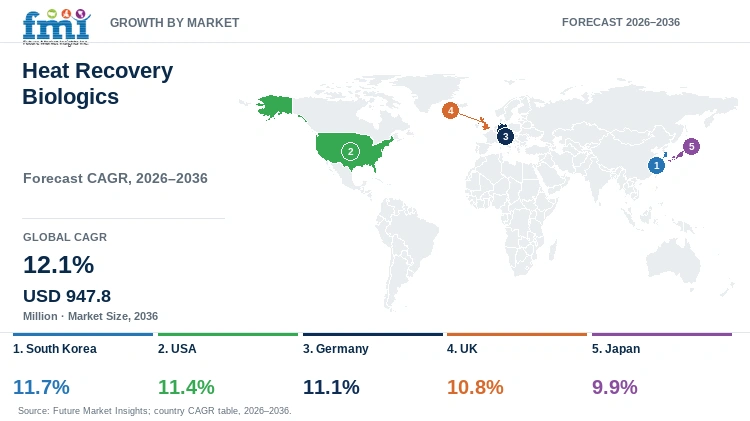
| Country | CAGR |
|---|---|
| South Korea | 11.7% |
| USA | 11.4% |
| Germany | 11.1% |
| UK | 10.8% |
| Japan | 9.9% |
How do country-level CAGRs compare in the Heat Recovery Biologics Market?
The country CAGRs span 1.8 percentage points across the 2026 to 2036 forecast period. South Korea and the USA form the faster-growth group within this comparison. Germany and the UK occupy the middle range while Japan records the slowest profiled rate. The spread compares forecast speed rather than each country's revenue size. Country crop systems and qualification conditions create different purchasing patterns at similar growth rates.
- South Korea combines protected farming with weather monitoring and distributor support to move heat-stress biologics from field trials into planned crop programs.
- US broad-acre farming supports regional trials that compare heat-stress treatments against established fertility programs and measurable per-acre returns.
- Germany's structured agronomy channels favor precise product claims and local field evidence within established specialty-fertilizer programs.
- UK arable and horticultural farms rely on agronomist-led spray planning, making local timing evidence and reliable distributor stock commercially important.
- Japan's crop-quality focus and technical distribution model favor crop-specific proof with clear dose guidance inside familiar farm routines.
The full report provides country-level CAGR analysis across North America, Latin America, Western Europe, Eastern Europe, East Asia, South Asia and Pacific, and the Middle East and Africa.
Country-wise Analysis
- South Korean protected farms use weather alerts and controlled systems to plan heat response across crop stages. Heat recovery biologics demand is estimated to expand at 11.7% CAGR through 2036 as farms strengthen preventive crop care. In August 2025, the agriculture ministry reported a nationwide June-to-July average daily high of 30.0°C. The ministry also counted 15 heat-wave days by July 29 across the country. Greenhouse crews can adjust irrigation and crop care quickly during these heat periods. Open-field programs need separate dose and timing proof across more variable production conditions. Farm management software connects weather alerts with field records and treatment outcomes. Clear protocols for protected and open-field crops can shorten product checks before recurring orders.
- US heat recovery biologics demand is forecast to rise at 11.4% CAGR from 2026 to 2036 across farms seeking measurable returns. Broad-acre operations use crop advisers and local distributors to test stress products before routine orders. In August 2025, NOAA reported that moderate to exceptional drought covered 27.7% of the United States and Puerto Rico. The drought figure records water stress rather than direct heat-recovery product demand. Regional crop and weather differences can make treatment results difficult to reproduce across locations. Suppliers need trials that compare biological programs with humic acid inputs and established fertility passes. Avoiding an extra field trip gives farms a clearer reason to reorder after successful trials.
- German farms use structured agronomy channels and expect precise claims before expanding biological programs. Heat recovery biologics sales are projected to grow at 11.1% CAGR through 2036 as farms assess warmer-season risk. In December 2025, Deutscher Wetterdienst reported that 2025 ranked among Germany's ten warmest years since 1881. Farms separate broad biostimulant claims from specific heat-response uses before approving wider application. Regional crop differences can limit repeat orders when one trial does not represent another production area. German-language instructions and specialty-fertilizer compatibility data make field qualification easier. Local trials must connect heat exposure with measurable yield or quality outcomes. Clear proof can move a product from limited testing into recurring crop programs.
- UK heat recovery biologics adoption is forecast to expand at 10.8% CAGR through 2036 under warmer conditions and water constraints. Arable and horticultural farms use agronomists to choose spray windows and stress treatments. In July 2026, the Met Office reported that 2025 was the warmest UK year in records beginning in 1884. The report recorded very low river flows from March through August. Farm budgets can limit preventive use when expected yield or quality benefits remain uncertain. Suppliers need local crop trials that explain treatment timing and likely field value. Products that share an existing spray pass can reduce labor demands. Reliable local stock matters during short windows as late delivery can miss crop stages and reduce treatment value.
- Japanese growers value product consistency and crop quality before changing established crop programs. Heat recovery biologics demand is forecast to rise at 9.9% CAGR through 2036 alongside more extreme summer conditions. In September 2025, the Japan Meteorological Agency reported summer temperatures 2.36°C above the 1991-to-2020 baseline. The agency identified that season as Japan's warmest summer since records began in 1898. Small farms and established routines can lengthen product checks before wider adoption. Suppliers need local timing proof for rice and high-value horticultural crops. Clear dose guidance and quality measures can simplify technical distributor training. Local evidence supports repeat orders without forcing growers to redesign familiar farm routines.
Who are the notable companies in the Heat Recovery Biologics Market?
Brandt, Biolchim, Syngenta Biologicals (Valagro), UPL Corp (NPP), Rovensa Next (Tradecorp), Acadian Plant Health, BioAtlantis, and Hello Nature are active within the defined heat recovery biologics supply boundary.
The market includes large crop-input groups and specialist firms that compete through different product and evidence strategies. Large groups combine stress products with crop nutrition or crop protection across established commercial channels. Formulation specialists emphasize osmoprotectants and crop-stage guidance for targeted heat-response programs. Marine-focused companies build stress programs around seaweed research and field studies. Local trials and reliable stock influence whether farms place repeat orders. Short heat periods can end before delayed shipments reach farms. Reliable timing guides help farms use available products before those treatment windows close.
- Large crop-input groups include Syngenta Biologicals (Valagro), UPL Corp (NPP), and Rovensa Next (Tradecorp).
- Product specialists include Brandt, Biolchim, and Hello Nature with crop nutrition and field support programs.
- Acadian Plant Health and BioAtlantis focus on seaweed products and crop-stress research.
Competitive Benchmarking: Heat Recovery Biologics Market
| Company | Heat-Stress Formulation Depth | Seaweed and Osmoprotectant Coverage | Agronomy and Channel Enablement | Geographic Reach |
|---|---|---|---|---|
| Brandt | High | High | High | North America and selected international crop regions |
| Biolchim | High | Medium | High | Europe with wider access through Huber AgroSolutions |
| Syngenta Biologicals (Valagro) | High | High | High | Global through Syngenta commercial channels |
| UPL Corp (NPP) | High | High | High | Global across major agricultural regions |
| Rovensa Next (Tradecorp) | High | High | High | Europe, the Americas, and selected global regions |
| Acadian Plant Health | High | High | High | North America, Europe, Latin America, and partner regions |
| BioAtlantis | High | High | Medium | Europe and international specialty-crop regions |
| Hello Nature | Medium | High | High | Europe, North America, Latin America, and Asia |
High product depth requires several heat-stress products or action types backed by public evidence. Medium product depth identifies a smaller verified formulation range within the defined market. Active coverage receives a high rating when several verified seaweed or osmoprotectant classes appear across the portfolio. Field support receives a high rating when use guides and distributor evidence are both available. Medium ratings apply to narrower verified coverage, while low ratings indicate limited public evidence for the assessed capability.
Key Developments in the Heat Recovery Biologics Market
- In May 2026, Rovensa Next launched Luxyva in Mexico for crops under high solar radiation with support from field and controlled tests.
- In December 2025, UPL Corp launched HYCOXA seaweed technology for abiotic stress and nitrogen use.
- In February 2025, Acadian Plant Health introduced its Abiotic Stress Management portfolio for specialty and broad-acre crops with supporting field trials.
Key Players in the Heat Recovery Biologics Market
Broad Biological Platforms
- Syngenta Biologicals (Valagro)
- UPL Corp (NPP)
- Rovensa Next (Tradecorp)
Formulation and Agronomy Specialists
- Brandt
- Biolchim
- Hello Nature
Marine-Derived Stress Management Specialists
- Acadian Plant Health
- BioAtlantis
Heat Recovery Biologics Market - Report Scope
| Coverage field | Report scope |
|---|---|
| Market breakdown | By product type, crop type, application method, farm type, sales channel and region. |
| Quantitative Units | USD million. |
| Market Definition | Commercial biological crop inputs used before or after heat stress to protect plant function or support recovery within managed crop programs. |
| Regions Covered | North America, Latin America, Western Europe, Eastern Europe, East Asia, South Asia and Pacific, and Middle East and Africa. |
| Countries Covered | South Korea, USA, Germany, UK, Japan, and 20+ countries included in the full report. |
| Key Companies Profiled | Brandt, Biolchim, Syngenta Biologicals (Valagro), UPL Corp (NPP), Rovensa Next (Tradecorp), Acadian Plant Health, BioAtlantis, and Hello Nature. |
| Forecast Period | 2026 to 2036. |
| Approach | Primary and secondary research with market triangulation. |
Heat Recovery Biologics Market - Research Methodology
| Method | Approach |
|---|---|
| Primary Research | FMI analysts gathered input from manufacturers, service providers, technology developers, distributors, end users, procurement teams, and subject-matter experts. Interviews examined purchasing decisions, product or service evaluation, adoption barriers, approval requirements, pricing considerations, and expectations for technical or commercial support. Respondents were also asked what evidence is required before a trial, pilot, or initial order develops into regular purchasing. |
| Desk Research | Desk research covered government statistics, regulatory publications, trade data, industry associations, technical literature, standards, company filings, product information, and official corporate announcements. Sources were reviewed for relevance, publication date, geographic coverage, and consistency with the defined market scope. Claims relating to performance, applications, approvals, capacity, investment, and commercial activity were retained only when supported by credible public evidence. |
| Market Sizing and Forecasting | The market model combined the baseline value with historical performance, segment structure, pricing and volume indicators, adoption levels, company participation, and country-level demand conditions. Forecast assumptions considered economic activity, investment trends, regulatory developments, technology adoption, purchasing cycles, supply availability, and barriers to wider market use. Segment and regional estimates were reconciled before the final market total was calculated. |
| Data Validation | Estimates were checked against multiple independent indicators, including public data, company activity, trade patterns, industry developments, and findings from primary interviews. Validation also tested whether products, services, applications, and company revenues fell within the defined market boundaries. Adjacent categories, unsupported claims, overlapping revenues, and activities without direct market relevance were excluded to reduce double counting and maintain consistency across segments and countries. |
Heat Recovery Biologics Market by Segments
Heat Recovery Biologics Market segmented by Product Type:
- Osmoprotectant Blends (Glycine Betaine / Proline)
- Seaweed-Based Formulations
- Amino Acid Blends
- Anti-Transpirant Combos
- Others
Heat Recovery Biologics Market segmented by Crop Type:
- Cereals & Grains
- Fruits & Vegetables
- Oilseeds & Pulses
- Turf & Ornamentals
- Others
Heat Recovery Biologics Market segmented by Application Method:
- Soil Application
- Foliar Application
- Fertigation - Drip
- Seed Application
- Others
Heat Recovery Biologics Market segmented by Farm Type:
- Large Commercial Farms
- Mid-Size Farms
- Smallholders
- Greenhouses & Nurseries
- Others
Heat Recovery Biologics Market segmented by Sales Channel:
- Agri-Input Distributors
- Cooperatives
- Agri-Retail Chains
- Online - Direct-to-Farm
- Others
Heat Recovery Biologics Market by Region:
- North America
- United States
- Canada
- Latin America
- Brazil
- Mexico
- Chile
- Rest of Latin America
- Western Europe
- Germany
- United Kingdom
- Italy
- Spain
- France
- Nordics
- Benelux
- Rest of Western Europe
- Eastern Europe
- Russia
- Poland
- Hungary
- Balkan and Baltic States
- Rest of Eastern Europe
- East Asia
- China
- Japan
- South Korea
- South Asia and Pacific
- India
- ASEAN
- Australia and New Zealand
- Rest of South Asia and Pacific
- Middle East and Africa
- Kingdom of Saudi Arabia
- Other GCC Countries
- Türkiye
- South Africa
- Other African Union Countries
- Rest of Middle East and Africa
Research Sources and Bibliography
- World Meteorological Organization. (2026, March 23). State of the Global Climate 2025.
- Ministry of Agriculture, Food and Rural Affairs, Republic of Korea. (2026, September 20). Recovery support for farms affected by summer heat, drought, hail, and strong winds.
- Biolchim. (2025, July 22). Hazelnut, stronger plants to withstand stress.
- Gavelienė, V., & Jurkonienė, S. (2026, June 1). Biostimulants and their role in increasing cereal crops' resistance to drought stress. Frontiers in Plant Science, 17, 1837848.
- Syngenta. (2026, July 14). Syngenta and Groundwork BioAg enter partnership to bring innovation in biologicals and soil carbon solutions to farmers.
- Brandt. (2026, July 16). 2026 BRANDT Delmarva Agronomy Day.
- Rovensa Next. (2026, April 15). Rovensa Next strengthens biosolutions support for distribution partners and growers through global training and AI.
- Biolchim. (2025, June 4). Orange: Excellence despite drought. Here's how.
- European Commission. (2025, December). Working document SANCO/6621/99 rev. 77: Scope and borderline cases under Regulation (EC) No 1107/2009.
- Syngenta. (2025, March 11). New level of precision agriculture thanks to renewed partnership between Syngenta and Planet.
- Ministry of Agriculture, Food and Rural Affairs, Republic of Korea. (2025, August 1). Full response to prevent agricultural damage during continuing heat waves.
- NOAA National Centers for Environmental Information. (2025, August 28). U.S. drought: Monthly changes and impacts for August 2025.
- Deutscher Wetterdienst. (2025, December 30). 2025: A year full of sunshine, unusually warm and with a dry spring.
- Met Office. (2026, July 15). State of the UK Climate 2025.
- Japan Meteorological Agency. (2025, September 1). Record high temperatures during Japan's summer from June through August 2025.
- Rovensa Next. (2026, May 27). Rovensa Next launches Luxyva in Mexico, a biosolution to strengthen crop performance under high solar radiation.
- UPL Corp. (2025, December 1). UPL launches new seaweed-based biostimulant to combat abiotic stress and enhance nitrogen uptake.
- Acadian Plant Health. (2025, February 19). Acadian Plant Health unveils new Abiotic Stress Management portfolio.
- Acadian Plant Health. (2025, August 13). Acadian expands CE-marked biostimulant portfolio across Europe.
- Syngenta. (2025, February 26). Syngenta strengthens global leadership in agricultural biologicals.
- Rovensa Next. (2026, January 27). FAUVE project: Rovensa Next and UTC collaborate on innovative drone spraying for water savings and agricultural efficiency.
- Syngenta. (2025, January 9). Artificial intelligence is speeding up the development of the next generation of biostimulants.
- UPL France. (2025, December 8). UPL supports field crops toward lower-carbon agriculture.
- Brandt. (2026, July 29). 2026 BRANDT Mid-Atlantic Agronomy Day.
- Biolchim. (2025, May 6). Strengthening the vineyard: Nutrition to support productivity.
- UPL France. (2026, February 16). UPL and PowerBoost: A partnership to advance biosolutions.
- Rovensa Next. (2026, February 2). Rovensa Next strengthens global innovation capabilities with new pilot fermentation plant in Brazil.
- Acadian Plant Health. (2026, August 25). Acadian Plant Health secures CE Mark for Ready for Stress, its first registered Abiotic Stress Management product in the EU.
- Staykov, N., Kanojia, A., Lyall, R., Ivanova, V., Alseekh, S., Petrov, V., & Gechev, T. (2025, September 8). Sustainable agriculture through seaweed biostimulants: A two-year study demonstrates yield enhancement in pepper and eggplant. Frontiers in Plant Science, 16, 1655340.
- Hello Nature. (2025, June 26). Hello Nature announces major expansion of Italian biostimulant production facility.
This bibliography is provided for reader reference and is not exhaustive. The full report contains the complete reference list and detailed citations.
This Report Answers
- How large is the heat recovery biologics market in 2026 and 2036?
- Which heat and water-stress conditions support planned biological treatment use?
- Why do osmoprotectant blends hold 43.2% of product type revenue?
- Why do cereals & grains hold 48.0% of crop type revenue?
- Why does soil application hold 49.6% of application-method revenue?
- How do growth rates differ across the five profiled countries?
- Which validation and claim requirements can delay regular farm purchases?
- Which companies supply broad platforms or specialist and marine-derived products?
- How can weather-linked agronomy improve treatment timing and regular use?
Frequently Asked Questions
How big is the heat recovery biologics market in 2026?
Heat recovery biologics are valued at USD 302.4 million in 2026 and are projected to reach USD 947.8 million by 2036. Growers plan treatments near flowering and grain fill to protect crop output during damaging heat periods.
What is the CAGR of the heat recovery biologics market from 2026 to 2036?
The heat recovery biologics market is projected to grow at 12.1% CAGR between 2026 and 2036. Correct crop timing and local field proof determine whether farms expand routine use.
Which product type leads the heat recovery biologics market in 2026?
The osmoprotectant blends segment is expected to hold 43.2% of product type revenue in the heat recovery biologics market in 2026. Glycine betaine and proline help plant cells manage water during short heat stress.
Which crop type holds the largest current share in the heat recovery biologics market?
The cereals & grains segment is estimated to hold 48.0% of crop type revenue in the heat recovery biologics market in 2026. Broad acreage and sensitive crop stages make clear per-acre trial results important for wider use.
Which countries show the faster profiled growth rates in the heat recovery biologics market?
South Korea is projected at 11.7% CAGR through 2036, followed by the USA at 11.4% and Germany at 11.1%. Crop systems and product checks shape each country's buying conditions.
Which companies are active in the heat recovery biologics market?
Active companies include Brandt, Biolchim, Syngenta Biologicals (Valagro), UPL Corp (NPP), and Rovensa Next (Tradecorp). Acadian Plant Health, BioAtlantis, and Hello Nature also compete through stress formulations, field evidence, and crop-input channels.
What can slow regular purchases in the heat recovery biologics market?
Regular purchases can slow when crop stage and heat duration alter field performance between seasons. Water status and soil fertility add another source of variation across locations. Local trials help farms compare treated and untreated blocks before they commit to recurring spending.
What should farm input teams check before approving a heat-recovery product?
Farm input teams should first check mode of action and crop-stage timing for the expected heat period. Reviewers then confirm dose and placement requirements before checking tank-mix compatibility. Local field proof and distributor stock help determine whether the product can support a planned treatment program.
Preview the report firsthand - request a free sample
Get SampleGet the brochure for pricing and purchase details.
Get PDFTable of Content
- Key Takeaways
- Market Size and CAGR
- Top Growth Driver
- Fastest Growing Segment
- Leading Region
- Key Companies
- Emerging Opportunities
- Executive Summary
- Global Market Outlook
- Demand-side Trends
- Supply-side Trends
- Technology Roadmap Analysis
- Analysis and Recommendations
- Analyst Perspective (What is happening? Why now? What should investors know?)
- Key Questions Answered
- How large is the market?
- What is the CAGR?
- What are key trends?
- Which region dominates?
- Who are the leaders?
- Market Overview
- Market Coverage / Taxonomy
- Market Definition / Scope / Limitations
- Research Methodology
- Chapter Orientation
- Analytical Lens and Working Hypotheses
- Market Structure, Signals, and Trend Drivers
- Benchmarking and Cross-market Comparability
- Market Sizing, Forecasting, and Opportunity Mapping
- Research Design and Evidence Framework
- Desk Research Programme (Secondary Evidence)
- Expert Input and Fieldwork (Primary Evidence)
- Tooling, Models, and Reference Databases
- Data Engineering and Model Build
- Quality Assurance and Audit Trail
- Market Background
- Market Dynamics (Drivers, Restraints, Opportunity, Trends)
- Scenario Forecast (Optimistic, Likely, Conservative)
- Impact Analysis
- AI Impact
- Sustainability Impact
- Regulatory Impact
- Technology Impact
- Consumer / Buyer Analysis
- Purchase Drivers
- Adoption Barriers
- Buyer Journey
- Opportunity Map Analysis
- Product Life Cycle Analysis
- Supply Chain Analysis
- Investment Feasibility Matrix
- Value Chain Analysis
- PESTLE and Porter's Analysis
- Regulatory Landscape
- Regional Parent Market Outlook
- Production and Consumption Statistics
- Import and Export Statistics
- Global Market Analysis and Forecast, 2021 to 2036
- Historical Market Size Value (USD Million) Analysis, 2021 to 2025
- Current and Future Market Size Value (USD Million) Projections, 2026 to 2036
- Y-o-Y Growth Trend Analysis
- Absolute $ Opportunity Analysis
- Global Market Pricing Analysis, 2021 to 2036
- Global Market Analysis and Forecast, By Product Type, 2021 to 2036
- Introduction / Key Findings
- Historical Market Size Value (USD Million) Analysis By Product Type, 2021 to 2025
- Current and Future Market Size Value (USD Million) Analysis and Forecast By Product Type, 2026 to 2036
- Osmoprotectant Blends (Glycine Betaine / Proline)
- Seaweed-Based Formulations
- Amino Acid Blends
- Anti-Transpirant Combos
- Others
- Y-o-Y Growth Trend Analysis By Product Type, 2021 to 2025
- Absolute $ Opportunity Analysis By Product Type, 2026 to 2036
- Global Market Analysis and Forecast, By Crop Type, 2021 to 2036
- Introduction / Key Findings
- Historical Market Size Value (USD Million) Analysis By Crop Type, 2021 to 2025
- Current and Future Market Size Value (USD Million) Analysis and Forecast By Crop Type, 2026 to 2036
- Cereals & Grains
- Fruits & Vegetables
- Oilseeds & Pulses
- Turf & Ornamentals
- Others
- Y-o-Y Growth Trend Analysis By Crop Type, 2021 to 2025
- Absolute $ Opportunity Analysis By Crop Type, 2026 to 2036
- Global Market Analysis and Forecast, By Application Method, 2021 to 2036
- Introduction / Key Findings
- Historical Market Size Value (USD Million) Analysis By Application Method, 2021 to 2025
- Current and Future Market Size Value (USD Million) Analysis and Forecast By Application Method, 2026 to 2036
- Soil Application
- Foliar Application
- Fertigation - Drip
- Seed Application
- Others
- Y-o-Y Growth Trend Analysis By Application Method, 2021 to 2025
- Absolute $ Opportunity Analysis By Application Method, 2026 to 2036
- Global Market Analysis and Forecast, By Farm Type, 2021 to 2036
- Introduction / Key Findings
- Historical Market Size Value (USD Million) Analysis By Farm Type, 2021 to 2025
- Current and Future Market Size Value (USD Million) Analysis and Forecast By Farm Type, 2026 to 2036
- Large Commercial Farms
- Mid-Size Farms
- Smallholders
- Greenhouses & Nurseries
- Others
- Y-o-Y Growth Trend Analysis By Farm Type, 2021 to 2025
- Absolute $ Opportunity Analysis By Farm Type, 2026 to 2036
- Global Market Analysis and Forecast, By Sales Channel, 2021 to 2036
- Introduction / Key Findings
- Historical Market Size Value (USD Million) Analysis By Sales Channel, 2021 to 2025
- Current and Future Market Size Value (USD Million) Analysis and Forecast By Sales Channel, 2026 to 2036
- Agri-Input Distributors
- Cooperatives
- Agri-Retail Chains
- Online - Direct-to-Farm
- Others
- Y-o-Y Growth Trend Analysis By Sales Channel, 2021 to 2025
- Absolute $ Opportunity Analysis By Sales Channel, 2026 to 2036
- Global Market Analysis and Forecast, By Region, 2021 to 2036
- Introduction
- Historical Market Size Value (USD Million) Analysis By Region, 2021 to 2025
- Current Market Size Value (USD Million) Analysis and Forecast By Region, 2026 to 2036
- North America
- Latin America
- Western Europe
- Eastern Europe
- East Asia
- South Asia and Pacific
- Middle East and Africa
- Market Attractiveness Analysis By Region
- North America Market Analysis and Forecast, By Country, 2021 to 2036
- Historical Market Size Value (USD Million) Trend Analysis By Market Taxonomy, 2021 to 2025
- Market Size Value (USD Million) Forecast By Market Taxonomy, 2026 to 2036
- By Country
- United States
- Canada
- By Product Type
- By Crop Type
- By Application Method
- By Farm Type
- By Sales Channel
- By Country
- Market Attractiveness Analysis
- By Country
- By Product Type
- By Crop Type
- By Application Method
- By Farm Type
- By Sales Channel
- Key Takeaways
- Latin America Market Analysis and Forecast, By Country
- Historical Market Size Value (USD Million) Trend Analysis By Market Taxonomy, 2021 to 2025
- Market Size Value (USD Million) Forecast By Market Taxonomy, 2026 to 2036
- By Country
- Brazil
- Mexico
- Chile
- Rest of Latin America
- By Product Type
- By Crop Type
- By Application Method
- By Farm Type
- By Sales Channel
- By Country
- Market Attractiveness Analysis
- By Country
- By Product Type
- By Crop Type
- By Application Method
- By Farm Type
- By Sales Channel
- Key Takeaways
- Western Europe Market Analysis and Forecast, By Country
- Historical Market Size Value (USD Million) Trend Analysis By Market Taxonomy, 2021 to 2025
- Market Size Value (USD Million) Forecast By Market Taxonomy, 2026 to 2036
- By Country
- Germany
- United Kingdom
- Italy
- Spain
- France
- Nordics
- Benelux
- Rest of Western Europe
- By Product Type
- By Crop Type
- By Application Method
- By Farm Type
- By Sales Channel
- By Country
- Market Attractiveness Analysis
- By Country
- By Product Type
- By Crop Type
- By Application Method
- By Farm Type
- By Sales Channel
- Key Takeaways
- Eastern Europe Market Analysis and Forecast, By Country
- Historical Market Size Value (USD Million) Trend Analysis By Market Taxonomy, 2021 to 2025
- Market Size Value (USD Million) Forecast By Market Taxonomy, 2026 to 2036
- By Country
- Russia
- Poland
- Hungary
- Balkan and Baltic States
- Rest of Eastern Europe
- By Product Type
- By Crop Type
- By Application Method
- By Farm Type
- By Sales Channel
- By Country
- Market Attractiveness Analysis
- By Country
- By Product Type
- By Crop Type
- By Application Method
- By Farm Type
- By Sales Channel
- Key Takeaways
- East Asia Market Analysis and Forecast, By Country
- Historical Market Size Value (USD Million) Trend Analysis By Market Taxonomy, 2021 to 2025
- Market Size Value (USD Million) Forecast By Market Taxonomy, 2026 to 2036
- By Country
- China
- Japan
- South Korea
- By Product Type
- By Crop Type
- By Application Method
- By Farm Type
- By Sales Channel
- By Country
- Market Attractiveness Analysis
- By Country
- By Product Type
- By Crop Type
- By Application Method
- By Farm Type
- By Sales Channel
- Key Takeaways
- South Asia and Pacific Market Analysis and Forecast, By Country
- Historical Market Size Value (USD Million) Trend Analysis By Market Taxonomy, 2021 to 2025
- Market Size Value (USD Million) Forecast By Market Taxonomy, 2026 to 2036
- By Country
- India
- ASEAN
- Australia and New Zealand
- Rest of South Asia and Pacific
- By Product Type
- By Crop Type
- By Application Method
- By Farm Type
- By Sales Channel
- By Country
- Market Attractiveness Analysis
- By Country
- By Product Type
- By Crop Type
- By Application Method
- By Farm Type
- By Sales Channel
- Key Takeaways
- Middle East and Africa Market Analysis and Forecast, By Country
- Historical Market Size Value (USD Million) Trend Analysis By Market Taxonomy, 2021 to 2025
- Market Size Value (USD Million) Forecast By Market Taxonomy, 2026 to 2036
- By Country
- Kingdom of Saudi Arabia
- Other GCC Countries
- Türkiye
- South Africa
- Other African Union Countries
- Rest of Middle East and Africa
- By Product Type
- By Crop Type
- By Application Method
- By Farm Type
- By Sales Channel
- By Country
- Market Attractiveness Analysis
- By Country
- By Product Type
- By Crop Type
- By Application Method
- By Farm Type
- By Sales Channel
- Key Takeaways
- Key Countries Market Analysis
- United States
- Pricing Analysis
- Market Share Analysis, 2025
- By Product Type
- By Crop Type
- By Application Method
- By Farm Type
- By Sales Channel
- Canada
- Pricing Analysis
- Market Share Analysis, 2025
- By Product Type
- By Crop Type
- By Application Method
- By Farm Type
- By Sales Channel
- Mexico
- Pricing Analysis
- Market Share Analysis, 2025
- By Product Type
- By Crop Type
- By Application Method
- By Farm Type
- By Sales Channel
- Brazil
- Pricing Analysis
- Market Share Analysis, 2025
- By Product Type
- By Crop Type
- By Application Method
- By Farm Type
- By Sales Channel
- Chile
- Pricing Analysis
- Market Share Analysis, 2025
- By Product Type
- By Crop Type
- By Application Method
- By Farm Type
- By Sales Channel
- Germany
- Pricing Analysis
- Market Share Analysis, 2025
- By Product Type
- By Crop Type
- By Application Method
- By Farm Type
- By Sales Channel
- United Kingdom
- Pricing Analysis
- Market Share Analysis, 2025
- By Product Type
- By Crop Type
- By Application Method
- By Farm Type
- By Sales Channel
- Italy
- Pricing Analysis
- Market Share Analysis, 2025
- By Product Type
- By Crop Type
- By Application Method
- By Farm Type
- By Sales Channel
- Spain
- Pricing Analysis
- Market Share Analysis, 2025
- By Product Type
- By Crop Type
- By Application Method
- By Farm Type
- By Sales Channel
- France
- Pricing Analysis
- Market Share Analysis, 2025
- By Product Type
- By Crop Type
- By Application Method
- By Farm Type
- By Sales Channel
- India
- Pricing Analysis
- Market Share Analysis, 2025
- By Product Type
- By Crop Type
- By Application Method
- By Farm Type
- By Sales Channel
- ASEAN
- Pricing Analysis
- Market Share Analysis, 2025
- By Product Type
- By Crop Type
- By Application Method
- By Farm Type
- By Sales Channel
- Australia and New Zealand
- Pricing Analysis
- Market Share Analysis, 2025
- By Product Type
- By Crop Type
- By Application Method
- By Farm Type
- By Sales Channel
- China
- Pricing Analysis
- Market Share Analysis, 2025
- By Product Type
- By Crop Type
- By Application Method
- By Farm Type
- By Sales Channel
- Japan
- Pricing Analysis
- Market Share Analysis, 2025
- By Product Type
- By Crop Type
- By Application Method
- By Farm Type
- By Sales Channel
- South Korea
- Pricing Analysis
- Market Share Analysis, 2025
- By Product Type
- By Crop Type
- By Application Method
- By Farm Type
- By Sales Channel
- Russia
- Pricing Analysis
- Market Share Analysis, 2025
- By Product Type
- By Crop Type
- By Application Method
- By Farm Type
- By Sales Channel
- Poland
- Pricing Analysis
- Market Share Analysis, 2025
- By Product Type
- By Crop Type
- By Application Method
- By Farm Type
- By Sales Channel
- Hungary
- Pricing Analysis
- Market Share Analysis, 2025
- By Product Type
- By Crop Type
- By Application Method
- By Farm Type
- By Sales Channel
- Kingdom of Saudi Arabia
- Pricing Analysis
- Market Share Analysis, 2025
- By Product Type
- By Crop Type
- By Application Method
- By Farm Type
- By Sales Channel
- Türkiye
- Pricing Analysis
- Market Share Analysis, 2025
- By Product Type
- By Crop Type
- By Application Method
- By Farm Type
- By Sales Channel
- South Africa
- Pricing Analysis
- Market Share Analysis, 2025
- By Product Type
- By Crop Type
- By Application Method
- By Farm Type
- By Sales Channel
- United States
- Market Structure Analysis
- Competition Dashboard
- Competition Benchmarking
- Market Share Analysis of Top Players
- By Regional
- By Product Type
- By Crop Type
- By Application Method
- By Farm Type
- By Sales Channel
- Emerging Startups
- Innovation Benchmarking
- Competition Analysis
- Competition Deep Dive
- Brandt
- Overview
- Product Portfolio
- Profitability by Market Segments
- Sales Footprint
- Strategy Overview
- Marketing Strategy
- Product Strategy
- Channel Strategy
- Biolchim
- Syngenta Biologicals (Valagro)
- UPL Corp (NPP)
- Rovensa Next (Tradecorp)
- Acadian Plant Health
- BioAtlantis
- Hello Nature
- Brandt
- Case Studies
- Success Stories
- Recent Developments
- Competition Deep Dive
- Assumptions & Acronyms Used


