

- Market Size (2026)
- USD 980.9 Mn
- Forecast (2036)
- USD 1966.0 Mn
- CAGR (2026 to 2036)
- 7.2%
How big is Heat-Sealable Food Papers Market in 2026?
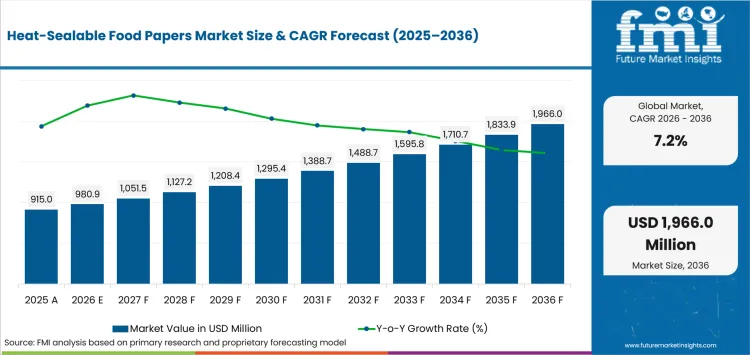
USD 980.9 million in 2026 and USD 1966.0 million by 2036 at a 7.2% CAGR.
Heat-sealable food paper demand is projected to expand at a 7.2% CAGR between 2026 and 2036, increasing valuation from USD 980.9 million in 2026 to USD 1966.0 million by 2036. Regulatory and recovery requirements are accelerating the shift toward alternative food-contact packaging materials across retail and foodservice applications. The Confederation of European Paper Industries published version 3 of its Recyclability Laboratory Test Method in March 2025, giving fibre-based packaging developers a current laboratory route for assessing recyclability through pulping, screening and sheet-formation behavior. Compliance efforts are increasing scrutiny of coating formulations, recyclability evidence and material specifications throughout the paper packaging supply chain. Manufacturers must therefore demonstrate both regulatory conformity and stable sealing performance on installed packaging lines before new grades can secure large-scale commercial adoption.
National conversion routes require different proof from regulators and production teams across major food packaging markets. The United States Food and Drug Administration made 35 PFAS-related food-contact notifications ineffective in January 2025. The FDA action changes coating selection for paper and paperboard used in food packaging across the United States. Germany emphasizes pack-level recyclability evidence, and Japan uses staged material reviews that extend qualification for unfamiliar papers. The United Kingdom links paper choices with recycling obligations, whereas Brazil applies reverse-logistics duties to plastic packaging but excludes mixed packs containing paper or paperboard.
Key Takeaways of Heat-Sealable Food Papers Market
- Food processors are expanding heat-sealable paper trials that preserve product protection and dependable output on established packaging equipment.
- Based on product type, heat-seal coated kraft papers are projected to account for 30.0% in 2026 due to their practical strength and coating range.
- Aqueous dispersion coatings are estimated to capture 36.0% in 2026 as thin functional layers provide adjustable seal and barrier performance.
- The 40-60 GSM range is anticipated to represent 42.0% in 2026 because packaging lines balance web strength with material yield.
- Commercial qualification remains the central restraint as laboratory sealability does not guarantee stable hot tack or reel handling at production speed.
- Sappi, Mondi, UPM Specialty Papers, Delfort, Koehler Paper, Ahlstrom, Nippon Paper Industries and Lecta are some key players in the industry.
Analyst Perspective
“Heat-sealable food papers earn repeat orders once the printed pack protects its contents across the approved line speed and sealing range. Commercial value comes from controlling coat weight and reel consistency with trial support that prevents failed production runs.”
- Nandini Roy Choudhury, Principal Consultant, Future Market Insights
How is the Heat-Sealable Food Papers Market segmented?
The heat-sealable food papers market is segmented by product type, coating chemistry, basis weight, application, end use, sales channel and region.
Product type covers coated kraft, flexible packaging papers, barrier papers, sachet and pouch papers, and other formats. Coating chemistry includes aqueous dispersion, biopolymer, hot-melt, extrusion, and other systems. Basis weights cover 40-60 GSM, above 60 GSM, and below 40 GSM. Applications include confectionery, dry foods, bakery paper bags, frozen foods, beverage sticks, and other uses. End uses cover food processing, foodservice, retail private label, and other organizations. Sales channels include direct converter supply, packaging distributors, online commerce, and other routes.
What makes Heat-Seal Coated Kraft Papers central to the product type category?
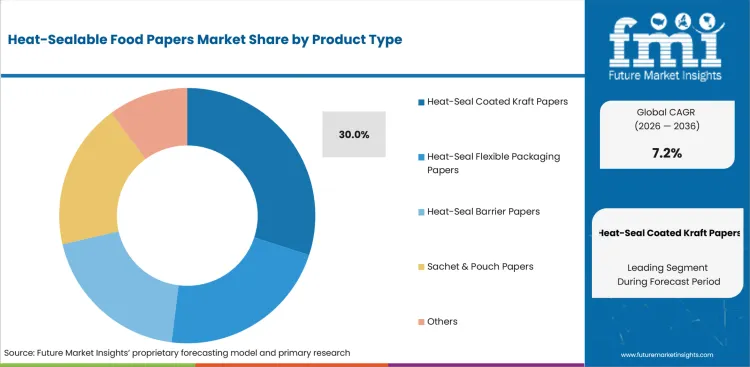
Coated kraft papers combine tensile strength with a surface that accepts seal and barrier treatments during conversion. Ahlstrom launched LamiBak Flex in March 2025 for pouches and flow packs, and the release confirms that specialty paper must tolerate further coating without losing converting stability.
- Based on product type, heat-seal coated kraft papers are projected to account for 30.0% in 2026 due to their practical strength-to-cost balance.
- Food brands use coated kraft for wraps needing dependable closure and moderate barrier protection, and oxygen-sensitive products require stronger layers plus longer shelf-life validation on commercial lines.
Why do Aqueous Dispersion Coatings lead the coating chemistry category?
Aqueous dispersions tune seal and barrier response with thin layers, and UPM Specialty Papers with Michelman reported three coatings that delivered oxygen and moisture barriers with heat-sealability in October 2024. Drying conditions control barrier coatings and their uniformity across repeated commercial production runs and printed food formats.
- By coating chemistry, aqueous dispersion coatings are estimated to hold 36.0% in 2026 owing to adjustable functions with limited added material.
- Packaging developers select aqueous systems for adjustable seal response and grease control, and final approval requires blocking tests plus recyclability evidence for the completed pack.
How does 40-60 GSM support leadership in the basis weight category?
The 40-60 GSM range provides web strength for tension control without excessive fiber use during conversion. The middle band accepts sealing layers without producing a rigid structure, and barrier packaging trials focus on tear strength plus coating uniformity across repeated reels.
- In 2026, the 40-60 GSM range is expected to lead the basis weight category with 42.0% share because it balances runnability and reel yield.
- Packaging engineers use this middle range as a practical trial point, and lighter papers demand tighter tear control as heavier grades reduce packs per reel.
What supports Confectionery & Snack Wrapping in the application category?
Confectionery lines use short sealing cycles at high unit counts, and Koehler Paper reported NexPlus Advanced at 600 chocolate bars per minute on horizontal equipment in March 2024. Fresh food packaging lines use similar cycle controls but require moisture profiles that differ from confectionery wraps.
- The application category is forecast to be led by confectionery and snack wrapping at 28.0% share in 2026 due to stable high-speed sealing demand.
- Chocolate and snack producers compare aroma retention with grease protection, and qualification measures hot tack plus product-oil resistance across repeated commercial runs on installed packaging equipment.
What are the drivers, restraints and opportunities in the Heat-Sealable Food Papers Market?
Plastic and PFAS substitution supports demand. Commercial line qualification remains the primary restraint. Higher barrier performance extends use across sensitive food formats.
- Driver: Food brands need paper structures that reduce plastic content without weakening seal integrity or food protection during distribution.
- Restraint: A narrow sealing window raises trial cost and delays approval across high-speed packaging equipment used for several food formats.
- Opportunity: Coating systems that pair stronger barriers with paper recovery evidence extend commercial use into moisture-sensitive and aroma-sensitive foods.
Packaging Rules Increase the Need for Qualified Paper Structures
Material substitution becomes commercially relevant once a finished pack clears food-contact review and machine trials. Regulatory limits now change the chemistry accepted for grease-resistant paper structures across several food applications. Mills serving food-grade packaging gain orders by documenting migration control and stable sealing performance instead of relying on general fiber claims.
Production Trials Limit the Conversion Rate
Industrial qualification tests jaw temperature and dwell time under normal production speed across installed packaging lines. Secure seals must form without blocking or web damage across repeated reels and product formats. Laboratory performance does not preserve approval if production trials reveal unstable sealing or reel handling. Application data and plant support reduce wasted machine time and delayed purchase decisions during qualification programs.
High-Barrier Food Formats Provide a Defined Expansion Route
Higher-barrier papers must protect aroma-sensitive foods without narrowing the sealing range on installed packaging equipment. Nippon Paper Industries documented SHIELDPLUS adoption for Zenno Pearl Rice's Uonuma Koshihikari rice packaging in April 2026. The pack combined oxygen barrier and aroma retention with paper-based construction for a moisture-sensitive food product during distribution. Comparable grades earn recurring volume once processors validate shelf-life performance and seal strength on the intended production line.
Which country CAGRs are profiled in the Heat-Sealable Food Papers Market?
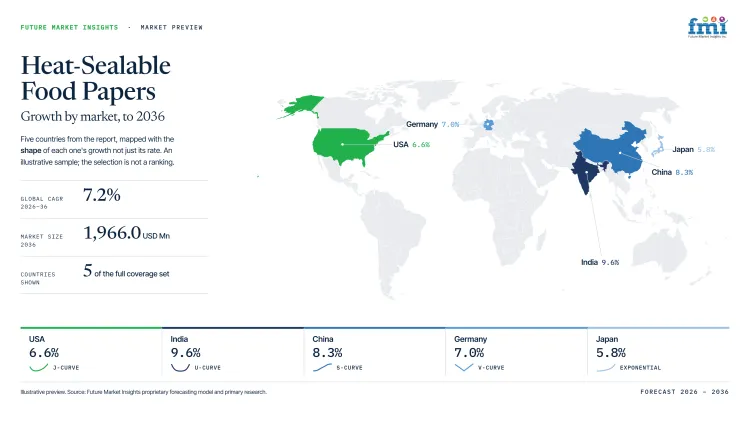
| Country | CAGR |
|---|---|
| Brazil | 7.6% |
| UK | 7.1% |
| Germany | 7.0% |
| USA | 6.6% |
| Japan | 5.8% |
How do country-level CAGRs compare in the Heat-Sealable Food Papers Market?
The five forecasts span 1.8 percentage points and describe forecast pace instead of current revenue. The narrow range places greater weight on coating access and local qualification routes than small differences between headline rates.
- Brazil sees added demand from food supply chains requiring reliable moisture resistance.
- The UK continues to adapt to increasingly stringent packaging sustainability standards.
- Germany benefits from a well-established circular packaging ecosystem.
- The United States is navigating large-scale reformulation of food-contact packaging materials.
- Japan places strong emphasis on testing and certification before new sealing substrates reach commercial scale.
Comparable CAGRs produce materially different entry conditions across national packaging systems and commercial qualification routes. The full report provides country-level analysis across North America, Latin America, Europe, East Asia, South Asia and Pacific, and the Middle East and Africa.
Country-wise Analysis
- Brazilian food processors test paper packs against tropical humidity and long distribution routes that expose snacks and shelf-stable foods to moisture loss plus weakened seals across regional retail networks. Heat-sealable food paper sales in Brazil are forecast to expand at 7.6% CAGR by 2036, supported by demand for paper-led formats and established food processing activity. Federal Decree No. 12,688 established reverse logistics for plastic packaging in October 2025 but excluded mixed packs containing paper or paperboard, so commercial entry depends on local coating access and tropical-condition trials instead of relying on the decree alone.
- UK food companies report packaging data and obtain recycling evidence for materials placed on the national market while contract packers test papers across several sealing machines and product formats. Government guidance updated in April 2026 set a 77% business recycling target for paper and board plus fiber-based composite packaging during 2026. The UK heat-sealable food papers sector is projected to record 7.1% CAGR during the assessment period, supported by a defined recovery route but constrained by variable machine settings and the need for pack-specific cost comparisons before national brand programs approve recurring volumes.
- German pack developers use mature collection systems that reward measurable recyclability across complete printed food structures and provide established sorting channels for national confectionery plus dry-food programs. The German Environment Agency reported in January 2026 that dual systems recycled about 5.5 million tonnes of packaging during 2024. Germany is estimated to post 7.0% CAGR over the forecast period, supported by recovery infrastructure but constrained by coatings and food residues that change sorting behavior or fiber yield and require application-specific testing before processors approve repeat contracts.
- United States food processors operate large wrapping networks with established quality systems that test replacement coatings at commercial speed across multiple plants and branded snack programs. Heat-sealable food paper demand in the United States is forecast to rise at 6.6% CAGR over the forecast period, supported by experienced packaging teams and broad processing capacity. The Food and Drug Administration announced in February 2024 that PFAS grease-proofing substances were no longer sold for food-contact paper and paperboard, so manufacturers must reproduce grease control and hot tack across plants while maintaining reel supply and documented change control.
- Japanese food companies use staged material reviews that examine appearance consistency and barrier retention across sensitive snack formats served by established domestic laboratories and regional production sites. The Ministry of Agriculture, Forestry and Fisheries opened a food-sector plastic packaging task force in October 2025 and held nine meetings through June 2026. Adoption of heat-sealable food papers in Japan is estimated to expand at 5.8% CAGR through 2036, reinforced by formal review capacity but constrained by long approval cycles and strict small-lot quality requirements that demand local technical support plus complete change records.
Who are the notable companies in the Heat-Sealable Food Papers Market?
Sappi, Mondi, UPM Specialty Papers, Delfort, Koehler Paper, Ahlstrom, Nippon Paper Industries and Lecta are the notable companies serving this market.
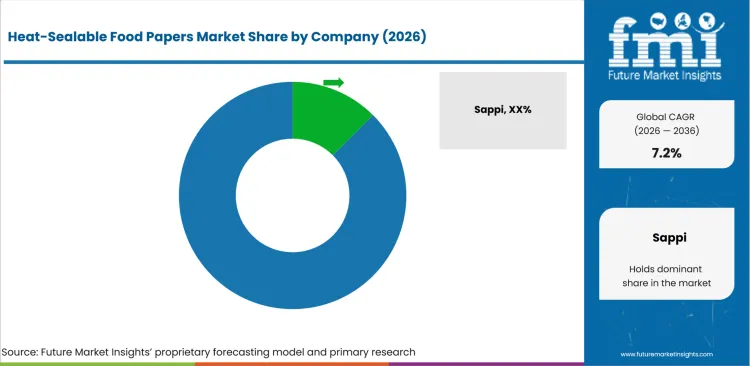
The field is moderately concentrated among integrated paper groups, specialist mills and one Japanese barrier-material developer. Market entry requires coating access plus food-contact evidence and successful machine-scale trials on intended commercial lines. Smaller producers compete in defined applications, but a broad paperboard packaging position does not establish food capability without current pack evidence.
- Sappi, Mondi and UPM Specialty Papers combine coated paper production with technical support for demanding flexible food formats.
- Delfort and Koehler Paper compete with application-tested grades used for frozen-food or confectionery packs on existing equipment.
- Ahlstrom and Nippon Paper Industries add food-contact base papers and barrier materials for flexible food formats. Lecta contributes metallized heat-seal paper with documented compatibility across horizontal and vertical form-fill-seal equipment.
Competitive Benchmarking: Heat-Sealable Food Papers Market
| Company | Portfolio Breadth | Food Barrier Proof | Trial Readiness | Geographic Reach |
|---|---|---|---|---|
| Sappi | High | High | Medium | Global sales |
| Mondi | Low | High | High | Europe and international sales |
| UPM Specialty Papers | High | High | Medium | Global sales |
| Delfort | Medium | Medium | High | Europe, USA and China |
| Koehler Paper | High | High | High | Europe and international sales |
| Ahlstrom | Medium | Medium | Medium | Europe and North America |
| Nippon Paper Industries | Low | Medium | High | Japan and selected exports |
| Lecta | Low | High | Low | Europe and international sales |
Key Developments in the Heat-Sealable Food Papers Market
- In January 2026, Sappi expanded its Seal family across 44-110 GSM for primary and secondary packaging. Six named grades covered several finishes plus pillow bags, sachets, stick packs and confectionery multipacks. The wider range gives packaging teams more options for matching seal response and appearance without selecting a complex laminate during initial production qualification.
- In October 2025, Delfort and Rieusset Gerosa introduced ice-lolly packaging made with thinbarrier 201 for frozen food distribution. The format entered German retail and began rolling out across Europe on existing converting equipment. CEPI-tested recyclability and moisture protection address frozen distribution by limiting drying and flavor loss during the conversion from launch volumes to repeat retail orders.
- In August 2025, Mondi ramped FunctionalBarrier Paper Ultimate at its Solec plant following a EUR 16 million technology investment. The paper records oxygen and water-vapor transmission below 0.5 in the stated test units. Horizontal and vertical form-fill-seal compatibility extends use across coffee, tea, seasonings, cereal bars and bouillon on commercial lines.
Key Players in the Heat-Sealable Food Papers Market
Integrated Functional-Paper Platforms
- Sappi
- Mondi
- UPM Specialty Papers
Application-Tested Seal and Barrier Papers
- Delfort
- Koehler Paper
Food-Contact Base and Barrier Materials
- Ahlstrom
- Nippon Paper Industries
- Lecta
Heat-Sealable Food Papers Market - Report Scope
| Coverage field | Report scope |
|---|---|
| Market breakdown | By product type, coating chemistry, basis weight, application, end use, sales channel and region. |
| Quantitative Units | Revenue in USD million and CAGR in %. |
| Market Definition | Revenue includes heat-sealable paper sold in reels, sheets or converted stock for food packaging within the stated taxonomy. It excludes finished food products, finished-pack revenue, packaging machinery, standalone coating chemicals, plastic films and adjacent non-heat-sealable papers. |
| Regions Covered | North America, Latin America, Western Europe, Eastern Europe, East Asia, South Asia and Pacific and Middle East and Africa. |
| Countries Covered | Brazil, UK, Germany, USA, Japan and 20+ countries included in the full report. |
| Key Companies Profiled | Sappi, Mondi, UPM Specialty Papers, Delfort, Koehler Paper, Ahlstrom, Nippon Paper Industries and Lecta. |
| Forecast Period | 2026 to 2036. |
| Approach | Primary and secondary research with market triangulation. |
Heat-Sealable Food Papers Market - Research Methodology
| Method | Approach |
|---|---|
| Primary Research | FMI analysts gathered input from manufacturers, service providers, technology developers, distributors, end users, procurement teams, and subject-matter experts. Interviews examined purchasing decisions, product or service evaluation, adoption barriers, approval requirements, pricing considerations, and expectations for technical or commercial support. Respondents were also asked what evidence is required before a trial, pilot, or initial order develops into regular purchasing. |
| Desk Research | Desk research covered government statistics, regulatory publications, trade data, industry associations, technical literature, standards, company filings, product information, and official corporate announcements. Sources were reviewed for relevance, publication date, geographic coverage, and consistency with the defined market scope. Claims relating to performance, applications, approvals, capacity, investment, and commercial activity were retained only when supported by credible public evidence. |
| Market Sizing and Forecasting | The market model combined the baseline value with historical performance, segment structure, pricing and volume indicators, adoption levels, company participation, and country-level demand conditions. Forecast assumptions considered economic activity, investment trends, regulatory developments, technology adoption, purchasing cycles, supply availability, and barriers to wider market use. Segment and regional estimates were reconciled before the final market total was calculated. |
| Data Validation | Estimates were checked against multiple independent indicators, including public data, company activity, trade patterns, industry developments, and findings from primary interviews. Validation also tested whether products, services, applications, and company revenues fell within the defined market boundaries. Adjacent categories, unsupported claims, overlapping revenues, and activities without direct market relevance were excluded to reduce double counting and maintain consistency across segments and countries. |
Heat-Sealable Food Papers Market by Segments
Heat-Sealable Food Papers Market segmented by Product Type:
- Heat-Seal Coated Kraft Papers
- Heat-Seal Flexible Packaging Papers
- Heat-Seal Barrier Papers
- Sachet & Pouch Papers
- Others
Heat-Sealable Food Papers Market segmented by Coating Chemistry:
- Aqueous Dispersion Coatings
- Biopolymer (PLA - PHA) Coatings
- Hot-Melt Coatings
- Extrusion Coatings
- Others
Heat-Sealable Food Papers Market segmented by Basis Weight:
- 40-60 GSM
- Above 60 GSM
- Below 40 GSM
Heat-Sealable Food Papers Market segmented by Application:
- Confectionery & Snack Wrapping
- Dry Food Sachets
- Bakery Bags & Wraps
- Frozen Food
- Beverage Stick Packs
- Others
Heat-Sealable Food Papers Market segmented by End Use:
- Food Processing
- Foodservice
- Retail Private Label
- Others
Heat-Sealable Food Papers Market segmented by Sales Channel:
- Direct - Converter Supply
- Packaging Distributors
- Online - E-commerce
- Others
Heat-Sealable Food Papers Market by Region:
- North America
- United States
- Canada
- Latin America
- Brazil
- Mexico
- Argentina
- Chile
- Western Europe
- Germany
- France
- United Kingdom
- Italy
- Spain
- Benelux
- Nordics
- Eastern Europe
- Poland
- Czech Republic
- Romania
- Hungary
- East Asia
- China
- Japan
- South Korea
- South Asia and Pacific
- India
- ASEAN
- Australia and New Zealand
- Middle East and Africa
- GCC Countries
- South Africa
- Türkiye
- Israel
Research Sources and Bibliography
- European Parliament and Council. (2025, January 22). Regulation (EU) 2025/40 of the European Parliament and of the Council of 19 December 2024 on packaging and packaging waste, amending Regulation (EU) 2019/1020 and Directive (EU) 2019/904, and repealing Directive 94/62/EC (Text with EEA relevance).
- USA Food and Drug Administration. (2025, January 3). FDA Determines Authorization for 35 Food Contact Notifications Related to PFAS Are No Longer Effective.
- Confederation of European Paper Industries. (2025, March 13). Cepi Recyclability Test Method Version 3.
- Ahlstrom. (2025, March 17). Ahlstrom expands LamiBak™ portfolio with a new base paper for flexible food packaging.
- UPM Specialty Papers. (2024, October 24). UPM Specialty Papers and Michelman introduce a new generation of structures for high performance, recyclable paper packaging.
- Koehler Paper. (2024, March 22). First Chocolate Bars in Germany with 100% Paper Packaging: nucao and Koehler Paper Continue Their Successful Partnership.
- Nippon Paper Industries Co., Ltd. (2026, April 30). Environmentally Friendly Paper Barrier Material "SHIELDPLUS®" is Adopted in the Packaging of Zenno Pearl Rice Uonuma Koshihikari.
- Presidency of the Republic of Brazil. (2025, October 21). Decreto Nº 12.688, de 21 de outubro de 2025.
- Department for Environment, Food & Rural Affairs and Environment Agency. (2026, April 7). Extended producer responsibility for packaging: recycling obligations and waste disposal fees.
- German Environment Agency. (2026, January 27). Facts against myths: Packaging waste recycling in Germany is working.
- USA Food and Drug Administration. (2024, February 28). FDA Announces PFAS Used in Grease-Proofing Agents for Food Packaging No Longer Being Sold in the USA
- Ministry of Agriculture, Forestry and Fisheries. (2025, October 16). Food-Sector Plastic Packaging Resource-Circulation Task Force.
- Lecta. (2025, July 23). Lecta expands its range of innovative barrier papers with the launch of Metalvac Seal Oxygen Barrier.
- Sappi. (2026, January 15). Sappi introduces the market’s widest portfolio of heat-sealable papers for recyclable packaging.
- Delfort. (2025, October 13). paper packaging for ice lollies: delfort and Rieusset Gerosa Group join forces.
- Mondi. (2025, August 14). Mondi ramps up FunctionalBarrier Paper Ultimate to meet growing demand for sustainable high-barrier paper-based packaging.
- UPM. (2026, March 24). UPM and Paramelt introduce bio-based food packaging concept.
- Koehler Paper. (2026, April 20). RUF Lebensmittelwerk KG Chooses Koehler Paper Barrier Paper for Its Porridge Packaging.
- Delfort. (2025, September 15). see what’s inside: transparent and heat-sealable paper for food and non-food.
- UPM Specialty Papers. (2025, March 18). UPM packaging papers achieve recyclability certifications in Europe and the USA
- Ahlstrom. (2025, April 7). Ahlstrom receives home compostable certification in Australia and New Zealand for Sulpack® Flexible packaging.
This bibliography is provided for reader reference and is not exhaustive. The full report contains the complete reference list and detailed citations.
This Report Answers
- How large is the Heat-Sealable Food Papers Market in 2026 and 2036?
- Which regulatory changes alter coating qualification for heat-sealable food paper?
- Why do Heat-Seal Coated Kraft Papers account for 30.0% of product type demand?
- How do aqueous dispersion coatings affect barrier and recycling evaluation?
- Why does the 40-60 GSM range represent 42.0% of basis weight demand?
- How do commercial entry conditions differ across the five profiled countries?
- Which companies combine heat-seal papers with food barrier evidence?
- What operating conditions delay conversion from plastic-rich packaging structures?
- Which food applications provide expansion routes for higher barrier papers?
Frequently Asked Questions
How big is the Heat-Sealable Food Papers Market in 2026?
The heat-sealable food papers market is estimated at USD 980.9 million in 2026. Growth is supported by increasing demand for paper-based packaging solutions that reduce plastic use while maintaining seal integrity and food protection.
What is the CAGR of the Heat-Sealable Food Papers Market from 2026 to 2036?
The heat-sealable food papers market is projected to grow at a CAGR of 7.2% between 2026 and 2036. Expansion is driven by PFAS replacement initiatives and wider adoption of coated paper materials in food packaging applications.
Which product type segment leads the Heat-Sealable Food Papers Market?
Heat-seal coated kraft papers are projected to account for 30.0% of the market in 2026. Their leading position is supported by strong durability, sealing performance, and suitability for wraps, pouches, and other food packaging formats.
How much incremental opportunity does the Heat-Sealable Food Papers Market add by 2036?
The heat-sealable food papers market is expected to create an incremental opportunity of USD 985.1 million between 2026 and 2036. Growth reflects increasing use across confectionery, dry food, and selected frozen food packaging applications.
Which companies are active in the Heat-Sealable Food Papers Market?
Key companies operating in the market include Sappi, Mondi, UPM Specialty Papers, Delfort, Koehler Paper, Ahlstrom, Nippon Paper Industries, and Lecta. These companies focus on developing heat-sealable paper solutions with enhanced barrier properties and food packaging performance.
Preview the report firsthand - request a free sample
Get SampleGet the brochure for pricing and purchase details.
Get PDFTable of Content
- Key Takeaways
- Market Size and CAGR
- Top Growth Driver
- Fastest Growing Segment
- Leading Region
- Key Companies
- Emerging Opportunities
- Executive Summary
- Global Market Outlook
- Demand-side Trends
- Supply-side Trends
- Technology Roadmap Analysis
- Analysis and Recommendations
- Analyst Perspective (What is happening? Why now? What should investors know?)
- Key Questions Answered
- How large is the market?
- What is the CAGR?
- What are key trends?
- Which region dominates?
- Who are the leaders?
- Market Overview
- Market Coverage / Taxonomy
- Market Definition / Scope / Limitations
- Research Methodology
- Chapter Orientation
- Analytical Lens and Working Hypotheses
- Market Structure, Signals, and Trend Drivers
- Benchmarking and Cross-market Comparability
- Market Sizing, Forecasting, and Opportunity Mapping
- Research Design and Evidence Framework
- Desk Research Programme (Secondary Evidence)
- Expert Input and Fieldwork (Primary Evidence)
- Tooling, Models, and Reference Databases
- Data Engineering and Model Build
- Quality Assurance and Audit Trail
- Market Background
- Market Dynamics (Drivers, Restraints, Opportunity, Trends)
- Scenario Forecast (Optimistic, Likely, Conservative)
- Impact Analysis
- AI Impact
- Sustainability Impact
- Regulatory Impact
- Technology Impact
- Consumer / Buyer Analysis
- Purchase Drivers
- Adoption Barriers
- Buyer Journey
- Opportunity Map Analysis
- Product Life Cycle Analysis
- Supply Chain Analysis
- Investment Feasibility Matrix
- Value Chain Analysis
- PESTLE and Porter's Analysis
- Regulatory Landscape
- Regional Parent Market Outlook
- Production and Consumption Statistics
- Import and Export Statistics
- Global Market Analysis and Forecast, 2021 to 2036
- Historical Market Size Value (USD Million) Analysis, 2021 to 2025
- Current and Future Market Size Value (USD Million) Projections, 2026 to 2036
- Y-o-Y Growth Trend Analysis
- Absolute $ Opportunity Analysis
- Global Market Pricing Analysis, 2021 to 2036
- Global Market Analysis and Forecast, By Product Type, 2021 to 2036
- Introduction / Key Findings
- Historical Market Size Value (USD Million) Analysis By Product Type, 2021 to 2025
- Current and Future Market Size Value (USD Million) Analysis and Forecast By Product Type, 2026 to 2036
- Heat-Seal Coated Kraft Papers
- Heat-Seal Flexible Packaging Papers
- Heat-Seal Barrier Papers
- Sachet & Pouch Papers
- Others
- Heat-Seal Coated Kraft Papers
- Y-o-Y Growth Trend Analysis By Product Type, 2021 to 2025
- Absolute $ Opportunity Analysis By Product Type, 2026 to 2036
- Global Market Analysis and Forecast, By Coating Chemistry, 2021 to 2036
- Introduction / Key Findings
- Historical Market Size Value (USD Million) Analysis By Coating Chemistry, 2021 to 2025
- Current and Future Market Size Value (USD Million) Analysis and Forecast By Coating Chemistry, 2026 to 2036
- Aqueous Dispersion Coatings
- Biopolymer (PLA - PHA) Coatings
- Hot-Melt Coatings
- Extrusion Coatings
- Others
- Aqueous Dispersion Coatings
- Y-o-Y Growth Trend Analysis By Coating Chemistry, 2021 to 2025
- Absolute $ Opportunity Analysis By Coating Chemistry, 2026 to 2036
- Global Market Analysis and Forecast, By Basis Weight, 2021 to 2036
- Introduction / Key Findings
- Historical Market Size Value (USD Million) Analysis By Basis Weight, 2021 to 2025
- Current and Future Market Size Value (USD Million) Analysis and Forecast By Basis Weight, 2026 to 2036
- 40-60 GSM
- Above 60 GSM
- Below 40 GSM
- 40-60 GSM
- Y-o-Y Growth Trend Analysis By Basis Weight, 2021 to 2025
- Absolute $ Opportunity Analysis By Basis Weight, 2026 to 2036
- Global Market Analysis and Forecast, By Application, 2021 to 2036
- Introduction / Key Findings
- Historical Market Size Value (USD Million) Analysis By Application, 2021 to 2025
- Current and Future Market Size Value (USD Million) Analysis and Forecast By Application, 2026 to 2036
- Confectionery & Snack Wrapping
- Dry Food Sachets
- Bakery Bags & Wraps
- Frozen Food
- Beverage Stick Packs
- Others
- Confectionery & Snack Wrapping
- Y-o-Y Growth Trend Analysis By Application, 2021 to 2025
- Absolute $ Opportunity Analysis By Application, 2026 to 2036
- Global Market Analysis and Forecast, By End Use, 2021 to 2036
- Introduction / Key Findings
- Historical Market Size Value (USD Million) Analysis By End Use, 2021 to 2025
- Current and Future Market Size Value (USD Million) Analysis and Forecast By End Use, 2026 to 2036
- Food Processing
- Foodservice
- Retail Private Label
- Others
- Food Processing
- Y-o-Y Growth Trend Analysis By End Use, 2021 to 2025
- Absolute $ Opportunity Analysis By End Use, 2026 to 2036
- Global Market Analysis and Forecast, By Sales Channel
- Introduction / Key Findings
- Historical Market Size Value (USD Million) Analysis By Sales Channel, 2021 to 2025
- Current and Future Market Size Value (USD Million) Analysis and Forecast By Sales Channel, 2026 to 2036
- Direct - Converter Supply
- Packaging Distributors
- Online - E-commerce
- Others
- Direct - Converter Supply
- Y-o-Y Growth Trend Analysis By Sales Channel, 2021 to 2025
- Absolute $ Opportunity Analysis By Sales Channel, 2026 to 2036
- Global Market Analysis and Forecast, By Region, 2021 to 2036
- Introduction
- Historical Market Size Value (USD Million) Analysis By Region, 2021 to 2025
- Current Market Size Value (USD Million) Analysis and Forecast By Region, 2026 to 2036
- North America
- Latin America
- Western Europe
- Eastern Europe
- East Asia
- South Asia and Pacific
- Middle East & Africa
- Market Attractiveness Analysis By Region
- North America Market Analysis and Forecast, By Country, 2021 to 2036
- Historical Market Size Value (USD Million) Trend Analysis By Market Taxonomy, 2021 to 2025
- Market Size Value (USD Million) Forecast By Market Taxonomy, 2026 to 2036
- By Country
- USA
- Canada
- By Product Type
- By Coating Chemistry
- By Basis Weight
- By Application
- By End Use
- By Sales Channel
- By Country
- Market Attractiveness Analysis
- By Country
- By Product Type
- By Coating Chemistry
- By Basis Weight
- By Application
- By End Use
- By Sales Channel
- Key Takeaways
- Latin America Market Analysis and Forecast, By Country
- Historical Market Size Value (USD Million) Trend Analysis By Market Taxonomy, 2021 to 2025
- Market Size Value (USD Million) Forecast By Market Taxonomy, 2026 to 2036
- By Country
- Brazil
- Mexico
- Chile
- Rest of Latin America
- By Product Type
- By Coating Chemistry
- By Basis Weight
- By Application
- By End Use
- By Sales Channel
- By Country
- Market Attractiveness Analysis
- By Country
- By Product Type
- By Coating Chemistry
- By Basis Weight
- By Application
- By End Use
- By Sales Channel
- Key Takeaways
- Western Europe Market Analysis and Forecast, By Country
- Historical Market Size Value (USD Million) Trend Analysis By Market Taxonomy, 2021 to 2025
- Market Size Value (USD Million) Forecast By Market Taxonomy, 2026 to 2036
- By Country
- Germany
- UK
- Italy
- Spain
- France
- Nordic
- BENELUX
- Rest of Western Europe
- By Product Type
- By Coating Chemistry
- By Basis Weight
- By Application
- By End Use
- By Sales Channel
- By Country
- Market Attractiveness Analysis
- By Country
- By Product Type
- By Coating Chemistry
- By Basis Weight
- By Application
- By End Use
- By Sales Channel
- Key Takeaways
- Eastern Europe Market Analysis and Forecast, By Country
- Historical Market Size Value (USD Million) Trend Analysis By Market Taxonomy, 2021 to 2025
- Market Size Value (USD Million) Forecast By Market Taxonomy, 2026 to 2036
- By Country
- Russia
- Poland
- Hungary
- Balkan & Baltic
- Rest of Eastern Europe
- By Product Type
- By Coating Chemistry
- By Basis Weight
- By Application
- By End Use
- By Sales Channel
- By Country
- Market Attractiveness Analysis
- By Country
- By Product Type
- By Coating Chemistry
- By Basis Weight
- By Application
- By End Use
- By Sales Channel
- Key Takeaways
- East Asia Market Analysis and Forecast, By Country
- Historical Market Size Value (USD Million) Trend Analysis By Market Taxonomy, 2021 to 2025
- Market Size Value (USD Million) Forecast By Market Taxonomy, 2026 to 2036
- By Country
- China
- Japan
- South Korea
- By Product Type
- By Coating Chemistry
- By Basis Weight
- By Application
- By End Use
- By Sales Channel
- By Country
- Market Attractiveness Analysis
- By Country
- By Product Type
- By Coating Chemistry
- By Basis Weight
- By Application
- By End Use
- By Sales Channel
- Key Takeaways
- South Asia and Pacific Market Analysis and Forecast, By Country
- Historical Market Size Value (USD Million) Trend Analysis By Market Taxonomy, 2021 to 2025
- Market Size Value (USD Million) Forecast By Market Taxonomy, 2026 to 2036
- By Country
- India
- ASEAN
- Australia & New Zealand
- Rest of South Asia and Pacific
- By Product Type
- By Coating Chemistry
- By Basis Weight
- By Application
- By End Use
- By Sales Channel
- By Country
- Market Attractiveness Analysis
- By Country
- By Product Type
- By Coating Chemistry
- By Basis Weight
- By Application
- By End Use
- By Sales Channel
- Key Takeaways
- Middle East & Africa Market Analysis and Forecast, By Country
- Historical Market Size Value (USD Million) Trend Analysis By Market Taxonomy, 2021 to 2025
- Market Size Value (USD Million) Forecast By Market Taxonomy, 2026 to 2036
- By Country
- Kingdom of Saudi Arabia
- Other GCC Countries
- Türkiye
- South Africa
- Other African Union
- Rest of Middle East & Africa
- By Product Type
- By Coating Chemistry
- By Basis Weight
- By Application
- By End Use
- By Sales Channel
- By Country
- Market Attractiveness Analysis
- By Country
- By Product Type
- By Coating Chemistry
- By Basis Weight
- By Application
- By End Use
- By Sales Channel
- Key Takeaways
- Key Countries Market Analysis
- USA
- Pricing Analysis
- Market Share Analysis, 2025
- By Product Type
- By Coating Chemistry
- By Basis Weight
- By Application
- By End Use
- By Sales Channel
- Canada
- Pricing Analysis
- Market Share Analysis, 2025
- By Product Type
- By Coating Chemistry
- By Basis Weight
- By Application
- By End Use
- By Sales Channel
- Mexico
- Pricing Analysis
- Market Share Analysis, 2025
- By Product Type
- By Coating Chemistry
- By Basis Weight
- By Application
- By End Use
- By Sales Channel
- Brazil
- Pricing Analysis
- Market Share Analysis, 2025
- By Product Type
- By Coating Chemistry
- By Basis Weight
- By Application
- By End Use
- By Sales Channel
- Chile
- Pricing Analysis
- Market Share Analysis, 2025
- By Product Type
- By Coating Chemistry
- By Basis Weight
- By Application
- By End Use
- By Sales Channel
- Germany
- Pricing Analysis
- Market Share Analysis, 2025
- By Product Type
- By Coating Chemistry
- By Basis Weight
- By Application
- By End Use
- By Sales Channel
- UK
- Pricing Analysis
- Market Share Analysis, 2025
- By Product Type
- By Coating Chemistry
- By Basis Weight
- By Application
- By End Use
- By Sales Channel
- Italy
- Pricing Analysis
- Market Share Analysis, 2025
- By Product Type
- By Coating Chemistry
- By Basis Weight
- By Application
- By End Use
- By Sales Channel
- Spain
- Pricing Analysis
- Market Share Analysis, 2025
- By Product Type
- By Coating Chemistry
- By Basis Weight
- By Application
- By End Use
- By Sales Channel
- France
- Pricing Analysis
- Market Share Analysis, 2025
- By Product Type
- By Coating Chemistry
- By Basis Weight
- By Application
- By End Use
- By Sales Channel
- India
- Pricing Analysis
- Market Share Analysis, 2025
- By Product Type
- By Coating Chemistry
- By Basis Weight
- By Application
- By End Use
- By Sales Channel
- ASEAN
- Pricing Analysis
- Market Share Analysis, 2025
- By Product Type
- By Coating Chemistry
- By Basis Weight
- By Application
- By End Use
- By Sales Channel
- Australia & New Zealand
- Pricing Analysis
- Market Share Analysis, 2025
- By Product Type
- By Coating Chemistry
- By Basis Weight
- By Application
- By End Use
- By Sales Channel
- China
- Pricing Analysis
- Market Share Analysis, 2025
- By Product Type
- By Coating Chemistry
- By Basis Weight
- By Application
- By End Use
- By Sales Channel
- Japan
- Pricing Analysis
- Market Share Analysis, 2025
- By Product Type
- By Coating Chemistry
- By Basis Weight
- By Application
- By End Use
- By Sales Channel
- South Korea
- Pricing Analysis
- Market Share Analysis, 2025
- By Product Type
- By Coating Chemistry
- By Basis Weight
- By Application
- By End Use
- By Sales Channel
- Russia
- Pricing Analysis
- Market Share Analysis, 2025
- By Product Type
- By Coating Chemistry
- By Basis Weight
- By Application
- By End Use
- By Sales Channel
- Poland
- Pricing Analysis
- Market Share Analysis, 2025
- By Product Type
- By Coating Chemistry
- By Basis Weight
- By Application
- By End Use
- By Sales Channel
- Hungary
- Pricing Analysis
- Market Share Analysis, 2025
- By Product Type
- By Coating Chemistry
- By Basis Weight
- By Application
- By End Use
- By Sales Channel
- Kingdom of Saudi Arabia
- Pricing Analysis
- Market Share Analysis, 2025
- By Product Type
- By Coating Chemistry
- By Basis Weight
- By Application
- By End Use
- By Sales Channel
- Türkiye
- Pricing Analysis
- Market Share Analysis, 2025
- By Product Type
- By Coating Chemistry
- By Basis Weight
- By Application
- By End Use
- By Sales Channel
- South Africa
- Pricing Analysis
- Market Share Analysis, 2025
- By Product Type
- By Coating Chemistry
- By Basis Weight
- By Application
- By End Use
- By Sales Channel
- USA
- Market Structure Analysis
- Competition Dashboard
- Competition Benchmarking
- Market Share Analysis of Top Players
- By Regional
- By Product Type
- By Coating Chemistry
- By Basis Weight
- By Application
- By End Use
- By Sales Channel
- Emerging Startups
- Innovation Benchmarking
- Competition Analysis
- Competition Deep Dive
- Sappi
- Overview
- Product Portfolio
- Profitability by Market Segments
- Sales Footprint
- Strategy Overview
- Marketing Strategy
- Product Strategy
- Channel Strategy
- Mondi
- UPM Specialty Papers
- Delfort
- Koehler Paper
- Billerud
- Ahlstrom
- Oji Holdings
- Nippon Paper
- Smurfit Westrock
- Sappi
- Case Studies
- Success Stories
- Recent Developments
- Competition Deep Dive
- Assumptions & Acronyms Used


