

- Market Size (2026)
- USD 214.9 Mn
- Forecast (2036)
- USD 562.5 Mn
- CAGR (2026 to 2036)
- 10.1%
How big is Biological Seed Carriers Market in 2026?
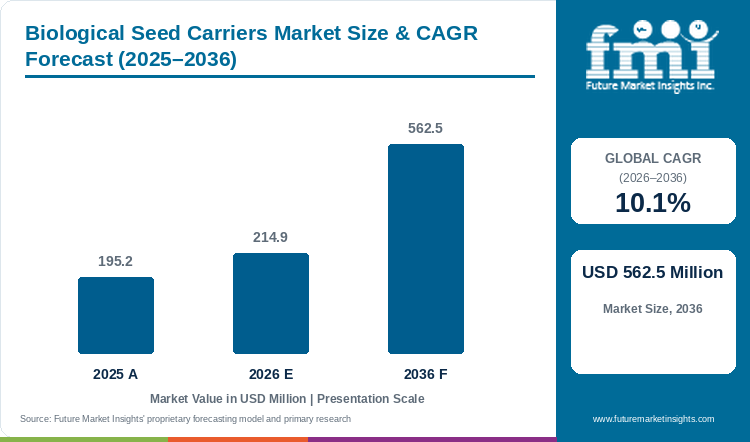
Demand for biological seed carriers is projected to expand at 10.1% CAGR between 2026 and 2036. Industry value grows from USD 195.2 million in 2025 to USD 214.9 million in 2026 and is projected to reach USD 562.5 million by 2036.
The biological seed carriers market is expected to achive a 10.1% CAGR between 2026 and 2036. As per FMI analysis, market was valued at USD 195.2 million in 2025 and is around USD 214.9 million in 2026, with projection estimated to reach USD 562.5 million by 2036. Biological seed carriers holds microorganisms, nutrients and crop-protection materials on seed, due to which the product is increasingly used in commercial treatment. Application has moved from single-input dressing towards microbial placement, nutrition and crop protection on one seed surface. In September 2025, Ashland launched Agrimer eco-coat for grain, vegetable, fruit and flower seed applications, with active retention and dust-control properties at lower use levels[12]. FMI finds that increasing development of microplastic-free seed coating materials is also creating demand for carriers which can retain applied inputs without affecting treated-seed handling.
Regional demand differs depending on crop area, treatment practices and biological product evaluation. United States biological seed carrier demand is projected to grow at 9.6% CAGR, whereas South Korea is estimated to expand at 9.3% CAGR through 2036. USDA estimated 95.3 million acres of corn and 85.4 million acres of soybean in the United States during 2026[2]. Large crop programs requires carriers that can run through centralized treatment lines at high seasonal volume. South Korea is increasing agriculture and bio research around microbiome and new biomaterials, due to which locally tested microbial delivery is expected to gain use. However, seed safety, viable counts, equipment fit and storage records remains the final commercial filter, which is expected to create different buying conditions across the regional market.
Key Takeaways
- Increasing commercial seed treatment is boosting carrier demand as multi-input recipes requires stable adhesion, dosing and seed flow.
- Based on product type, polymer-based systems are projected to account for 50.4% in 2026, owing to its film-forming and active-retention properties.
- By crop type, corn and cereals are estimated to hold 47.5% in 2026, attributed to large seasonal seed volumes and repeatable treatment programs.
- In 2026, in-plant treatment is expected to lead treatment point demand with 41.6% share, due to centralized recipe and lot control.
- The USA is projected at 9.6% CAGR, whereas South Korea is estimated at 9.3% CAGR through 2036 under different crop and treatment conditions.
- Some of the prominent players in Biological Seed Carriers Market include BASF, Germains Seed Technology, Incotec, Centor Group, Precision Laboratories, Novonesis, Pivot Bio and Groundwork BioAg.
Analyst Perspective
“Commercial demand will move toward carriers that keep biologicals stable through storage. Suppliers proving line performance and seed safety will capture repeat treatment programs.”
- Nandini Roy Choudhury, Principal Consultant, Future Market Insights.
How is the biological seed carriers market segmented?
Biological Seed Carriers Market is segmented on the basis of product type, crop type, treatment point, formulation, sales channel and region. Polymer-based systems, corn and cereals, in-plant treatment, liquid slurries and agri-input distributors are estimated to hold 50.4%, 47.5%, 41.6%, 49.7% and 43.0% shares in 2026, respectively.
Product type includes polymer-based systems; biological / microbial systems; nutrient-loaded systems; Others.
Crop type includes corn and cereals; soybean and pulses; Vegetables; Cotton & Others.
Treatment point includes in-plant (seed companies); commercial seed treaters; on-farm treatment; Others.
Formulation includes liquid slurries; dry powders; film coats and encrusting; Others.
Sales channel includes agri-input distributors; Cooperatives; agri-retail chains; online / direct-to-farm; Others.
Region includes North America; Latin America; Western Europe; Eastern Europe; East Asia; South Asia and Pacific; Middle East and Africa.
Why do polymer-based systems retain product type relevance today?
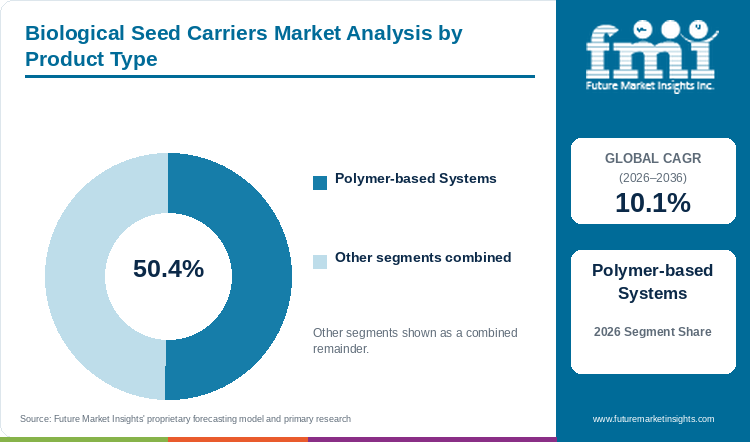
Based on product type, polymer-based systems are projected to hold 50.4% of product type revenue in 2026
Polymer-based systems forms a thin layer on seed and helps in retaining biological, nutrient and crop-protection materials during handling. The carriers also reduces rub-off and supports uniform coating across commercial seed lots. Rising use of seed treatment materials is increasing the number of biological and nutrient inputs applied through the same equipment, due to which the polymer must support coating, drying and seed flow together. In 2026, Albaugh reported that its BIOST biological seed treatment platform had been evaluated in more than 1,000 trials [14]. Increasing demand for film formation and active retention is anticipated to support the segment growth.
- Polymer-based systems retain 50.4% share because commercial treatment lines requires uniform coating coverage and predictable drying.
- Polymer carriers can run with existing treatment equipment and supports repeatable coating across large commercial seed lots.
What supports corn and cereals as a preferred crop category?
By crop type, corn and cereals are estimated to hold 47.5% in 2026, attributed to large seasonal seed volumes and repeatable treatment programs.
Corn and cereals are treated in high volume within a shorter planting period. Large seed programs uses standard treatment recipes, due to which carriers with repeatable application and seed flow are increasingly preferred. Growing application of seed nutrient coatings is adding micronutrients and biological inputs to the same commercial recipe without requiring a separate field application. The carrier cost can be spread across larger treated volume, which supports commercial use in broad-acre crops. Expansion of seed treatment in corn and cereals is expected to drive the segment growth.
- Corn and cereals hold 47.5% of crop demand owing to large seed volume and repeatable treatment recipes.
- In June 2025, BASF reported that InVigor Gold produced 8% higher yield than traditional canola across 23 trials conducted from 2022 to 2024[13]. Higher use of treated commercial seed is expected to support carrier demand in broad-acre crop programs.
How does in-plant treatment meet changing application needs today?
In-plant treatment is set to lead treatment point demand with 41.6% in 2026, enabled by centralized recipe control.
In-plant treatment allows seed companies to control mixing order, application rate, drying and lot release before seed is packed. In January 2026, the proposed Seed Act introduced nationwide seed traceability and mandatory registration of seed companies[20]. Increasing lot records and company registration supports in-plant treatment where recipe and release information can be retained. Centralized lines also makes it easier to check coating coverage and biological compatibility across larger seed volume, which is anticipated to support the segment growth.
- In-plant treatment reaches 41.6% share because seed companies can check recipe and lot performance before commercial release.
- Centralized treatment reduces recipe variation and allows seed companies to release larger lots with consistent coating performance.
Why are buyers selecting liquid slurries for commercial formulation?
Liquid slurries are forecast to represent 49.7% of formulation revenue in 2026, due to controlled pumpable dosing.
Liquid slurries can be pumped into commercial seed treaters and allows changes in dose without changing the complete coating format. The formulation provides uniform mixing and application, although excessive seed wetness can affect handling. Increasing use of metered treatment equipment is expected to drive demand for liquid biological seed carriers.
- Liquid slurries account for 49.7% because pumpable dosing supports repeatable application through commercial treatment equipment.
- In October 2025, Indigo Agriculture introduced biotrinsic Nemora FP as a flowable-powder microbial soybean seed treatment and reported an average 68% reduction in egg hatch[21]. Availability of measurable biological formulations is expected to support carrier selection for commercial seed treatment.
Which conditions keep agri-input distributors relevant in carrier sales?
Agri-input distributors are projected to hold 43.0% of sales channel revenue in 2026, supported by local technical coverage.
Agri-input distributors connects carrier products with seasonal crop programs and local treatment equipment. Distributors also provides application support when mixing, drying or seed-flow problem occurs near planting period. Novonesis supplies agricultural biosolutions through regional commercial and technical-support networks[9]. Presence of local inventory and technical service is expected to retain distributor demand in the biological seed carriers market.
- Agri-input distributors hold 43.0% because local support helps in matching carrier products with crop and treatment equipment.
- Local inventory and application support helps distributors serve short planting windows and crop-specific treatment requirements.
What are the drivers, restraints, and opportunities in the biological seed carriers market?
The key driver is increasing use of multi-input seed treatment, whereas loss of microbial survival remains a major restraint. Development of microplastic-free formulations is expected to create new growth opportunities.
- Driver: Seed companies requires carriers that retain chemical, biological and nutrient inputs during treatment and planting.
- Restraint: Living microorganisms can lose viability during coating, drying, storage and contact with other treatment components.
- Opportunity: Microplastic-free carriers are expected to gain replacement demand as European transition dates approaches.
Treatment Stacks Need Better Retention
Seed treatment recipes increasingly combines crop protection, nutrition and biological functions on one seed surface. Growing use of biocontrol agents is adding microorganisms and other biological materials to these recipes, which increases the need for a carrier that can hold different inputs together. In June 2026, ICAR-IIOR reported nearly 30% yield improvement for coated groundnut and soybean in farmer-field demonstrations [19]. The carrier must retain the applied materials without affecting germination and commercial line performance. These factors are expected to drive biological seed carrier demand.
Storage Can Reduce Microbial Viability
Living microorganisms can lose viability during coating, drying and storage. A 2025 Biological Control study identified storage survival as a major implementation problem for seed-coated microbial inocula[1]. A carrier may provide suitable seed handling but still fail when viable counts declines before planting. Requirement for product-specific viability and storage testing may hamper the growth of biological seed carriers market.
Polymer Rules Create Replacement Work
Restriction on synthetic polymer microparticles is creating replacement demand for seed coating manufacturers. The European Commission published its explanatory guide for the REACH restriction of synthetic polymer microparticles in 2025[7]. In April 2026, Incotec launched Disco Red L-1140 as a microplastic-free cereal film coat with low dust-off and treatment compatibility[8]. Development of compliant film coats that runs on existing treatment equipment is expected to create new avenues for biological seed carrier suppliers.
Which country CAGRs are profiled in the biological seed carriers market?
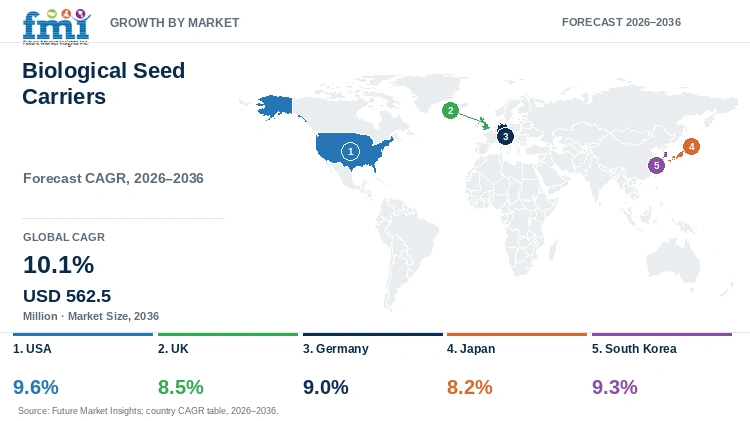
| Country | CAGR |
|---|---|
| USA | 9.6% |
| UK | 8.5% |
| Germany | 9.0% |
| Japan | 8.2% |
| South Korea | 9.3% |
How do country-level outlooks compare in biological seed carriers?
Country demand varies depending on seed throughput, treatment centralization and evidence required for biological or polymer products. The profiled countries are expected to expand through different crop programs and local product evaluation instead of one common adoption pattern.
- USA uses high-volume corn and soybean programs that requires carrier consistency during centralized seed treatment.
- UK demand follows cereal treatment and preparation for changing polymer requirements.
- Germany combines large cereal processing with formal dust, coating and seed-handling expectations.
- Japan requires crop-specific records and local product evaluation before wider biological use.
- South Korea uses public research programs for testing microbial seed-coating performance in selected crops.
Full report country CAGRs cover: North America; Latin America; Western Europe; Eastern Europe; East Asia; South Asia and Pacific; Middle East and Africa.
Country-wise Analysis
- Future Market Insights estimates United States biological seed carrier demand to expand at 9.6% CAGR through 2036. In February 2026, USDA projected combined corn, wheat and soybean planted area at 224.0 million acres for 2026[22]. The large crop base keeps centralized treatment lines active during a short seasonal period. Biological seed carriers are therefore required to provide uniform coverage and seed flow when microorganisms, nutrients and crop-protection products are used in one recipe. Expansion of high-volume seed treatment is expected to support the United States market growth.
- Biological seed carrier demand in the UK is forecast to rise at 8.5% CAGR through 2036. Defra reported in December 2025 that cereals covered 3.0 million hectares and accounted for 74% of UK arable crop area[3]. The large cereal area supports film coating, while development in seed encapsulation materials is widening the use of protective layers for carrying biological inputs on seed. UK seed companies are also preparing for changing microplastic requirements, due to which replacement carriers must retain dust control and seed flow on existing equipment.
- Germany is projected to record 9.0% CAGR in biological seed carriers through 2036. Destatis estimated 6.03 million hectares of cereals for the 2026 harvest, increasing by 1.8% from 2025, while winter wheat accounted for 48% of the area[4]. Large cereal lots favors centralized treatment where coating coverage and dust performance can be checked before release. Demand for microplastic-free products that runs on existing treatment lines is expected to propel biological seed carrier sales in Germany.
- Japan biological seed carrier demand is anticipated to advance at 8.2% CAGR through 2036. The Ministry of Agriculture, Forestry and Fisheries reported its 2025 planted area and production results for wheat and barley in November 2025[5]. The crop base requires carrier products matching local seed and biological evaluation. Increasing use of crop-specific formulations and smaller commercial lots is likely to support the Japan biological seed carriers market.
- South Korea is estimated to post 9.3% CAGR in biological seed carrier demand through 2036. In March 2025, the Rural Development Administration reported commercialization work for eco-friendly microbial control of cucumber diseases and pests[6]. Increasing development of agricultural microbials is creating need for carrier materials which can keep living inputs stable through coating and storage. Conversion of local research into stable commercial formulations is expected to create growth opportunities in South Korea.
Who are the notable companies in the biological seed carriers market?
BASF, Germains Seed Technology, Incotec (Croda), Centor Group, Precision Laboratories, Novonesis, Pivot Bio, and Groundwork BioAg are notable companies in this market.
Biological Seed Carriers Market is moderately fragmented with presence of coating specialists, carrier suppliers and biological developers. BASF, Germains Seed Technology and Incotec compete through coating chemistry and seed-treatment support. Novonesis, Pivot Bio and Groundwork BioAg focuses on microbial products and seed-applied delivery. Some of the prominent players are expanding product portfolio, regional supply and technical testing in order to cater the growing demand from commercial seed companies.
- Biological Seed Carriers Market is moderately fragmented with presence of coating specialists, carrier suppliers and biological developers. BASF, Germains Seed Technology and Incotec compete through coating chemistry and seed-treatment support. Novonesis, Pivot Bio and Groundwork BioAg are focusing on biofertilizers and other microbial products applied on or near seed. Some of the prominent players are expanding product portfolio, regional supply and technical testing in order to cater the growing demand from commercial seed companies.
- Carrier materials and treater support: Centor Group and Precision Laboratories focuses on retention, dust control and equipment fit.
- Seed-applied biological systems: Novonesis, Pivot Bio and Groundwork BioAg provides microbial products for treatment or planting delivery.
Competitive Benchmarking: Biological Seed Carriers Market
| Company | Carrier engineering | Biological compatibility | Treater integration | Geographic reach |
|---|---|---|---|---|
| BASF | High | Medium | High | High |
| Germains Seed Technology | High | Medium | High | Medium |
| Incotec (Croda) | High | Medium | High | High |
| Centor Group | High | Medium | High | Medium |
| Precision Laboratories | High | Low | High | Low |
| Novonesis | Medium | High | High | High |
| Pivot Bio | Low | High | Medium | Medium |
| Groundwork BioAg | Medium | High | Medium | High |
Scoring basis: High indicates broad current evidence across the rated area. Medium indicates a narrower documented position. Low indicates limited public evidence. The ratings do not indicate product quality, market share or company rank.
Key Developments in the Biological Seed Carriers Market
- In April 2026, Incotec launched Disco Red L-1140 as a microplastic-free film coat for cereal seed. The product was developed to help seed companies comply with upcoming European microplastic regulations effective from 2028 while delivering premium application quality, low dust-off performance, and compatibility with leading plant protection products (PPPs).
- In March 2025, Pivot Bio announced PROVEN G3 for corn with commercial availability planned for 2026 after state registrations[11]. The development expands seed-applied microbial nitrogen options for corn growers.
Key Players in the Biological Seed Carriers Market
Integrated Seed Coating Platforms
- BASF
- Germains Seed Technology
- Incotec (Croda)
Carrier Materials and Treater Support
- Centor Group
- Precision Laboratories
Seed-Applied Biological Systems
- Novonesis
- Pivot Bio
- Groundwork BioAg
What does the Biological Seed Carriers Market - Report scope
| Coverage field | Report scope |
|---|---|
| Market breakdown | Product type; crop type; treatment point; formulation; sales channel; region |
| Quantitative units | USD million |
| Market definition | Carrier, binder, coating, slurry, powder, and formulated biological delivery systems sold for seed application. |
| Exclusions | Treated seed revenue, treatment equipment, standalone adjacent inputs, and downstream crop revenue. |
| Regions | North America; Latin America; Western Europe; Eastern Europe; East Asia; South Asia and Pacific; Middle East and Africa |
| Countries profiled | USA; UK; Germany; Japan; South Korea; additional countries in the full report |
| Forecast period | 2026 to 2036 |
Biological Seed Carriers Market - Research Methodology
| Method | Approach |
|---|---|
| Primary Research | The research study includes primary interviews with manufacturers, biological developers, distributors, seed companies, commercial treaters, end users and industry experts. Interviews covers purchasing decision, product evaluation, price, adoption barrier, approval requirement and technical support. Respondents were also asked about evidence required before a trial develops into regular commercial purchasing. |
| Desk Research | Desk research covers government statistics, regulatory publications, technical literature, industry associations, standards, company information and official developments. Sources were checked for relevance, date, geography and relation with the defined biological seed carrier market. Performance, application, certification and company claims were retained only when supported by public evidence. |
| Market Sizing and Forecasting | Market sizing combines the baseline value with historical performance, segment structure, price and volume indicators, adoption level, company participation and country demand. Forecast assumptions includes crop area, biological adoption, regulation, supply availability and barriers affecting commercial seed treatment. Segment and regional estimates were reconciled with the final market value. |
| Data Validation | Market estimates were checked against government data, company activity, industry development and primary interviews. Validation also confirms whether products, applications and company revenue falls within the market definition. Treated-seed revenue, unrelated crop inputs, treatment equipment and downstream crop value were excluded to avoid double counting. |
Biological Seed Carriers Market by Segments
Biological Seed Carriers Market segmented by Product Type:
- Polymer-based Systems
- Biological / Microbial Systems
- Nutrient-loaded Systems
- Others
Biological Seed Carriers Market segmented by Crop Type:
- Corn And Cereals
- Soybean And Pulses
- Vegetables
- Cotton & Others
Biological Seed Carriers Market segmented by Treatment Point:
- In-plant (Seed Companies)
- Commercial Seed Treaters
- On-farm Treatment
- Others
Biological Seed Carriers Market segmented by Formulation:
- Liquid Slurries
- Dry Powders
- Film Coats And Encrusting
- Others
Biological Seed Carriers Market segmented by Sales Channel:
- Agri-input Distributors
- Cooperatives
- Agri-retail Chains
- Online / Direct-to-farm
- Others
Biological Seed Carriers Market by Region
- North America
- United States
- Canada
- Latin America
- Brazil
- Mexico
- Argentina
- Chile
- Western Europe
- Germany
- France
- United Kingdom
- Italy
- Spain
- Benelux
- Nordics
- Eastern Europe
- Poland
- Czech Republic
- Romania
- Hungary
- East Asia
- China
- Japan
- South Korea
- South Asia and Pacific
- India
- ASEAN
- Australia and New Zealand
- Middle East and Africa
- GCC Countries
- South Africa
- Türkiye
- Israel
Research Sources and Bibliography
- [1] Köhl, J., et al. (2025, August). Survival of seed-coated microbial biocontrol agents during seed storage. Biological Control.
- [2] U.S. Department of Agriculture, National Agricultural Statistics Service. (2026, June 30). Corn planted acreage down 3% from 2025, soybean acreage up 5% from last year.
- [3] Department for Environment, Food & Rural Affairs. (2025, December 17). Agricultural land use in the United Kingdom at 1 June 2025.
- [4] German Federal Statistical Office. (2026, May 19). Getreideanbaufläche 2026 hat sich nach Tiefststand von 2024 weiter stabilisiert.
- [5] Ministry of Agriculture, Forestry and Fisheries of Japan. (2025, November 28). 2025 planted area and production of wheat and barley.
- [6] Rural Development Administration, Republic of Korea. (2025, March 19). Commercialization of eco-friendly microbial control for cucumber diseases and pests.
- [7] European Commission. (2025). REACH restriction of synthetic polymer microparticles: Explanatory guide, version 1.
- [8] Incotec. (2026, April 8). New microplastic-free seed coating for cereal.
- [9] Novonesis. (2026, June 11). Rovensa Next to distribute Novonesis biosolutions for Plant Health in the United States.
- [10] Groundwork BioAg. (2026, July 14). Syngenta and Groundwork BioAg enter partnership to bring innovation in biologicals and soil carbon solutions to farmers.
- [11] Pivot Bio. (2025, March 13). Pivot Bio unveils PROVEN G3, with powerful new modes of action and patent-protected gene-editing technology.
- [12] Ashland Inc. (2025, September 15). Ashland commercializes advanced, sustainable seed coating polymer for crop care made from innovative Transformed Vegetable Oil technology platform.
- [13] BASF. (2025, June 25). BASF introduces InVigor Gold, a breakthrough innovation in canola seed.
- [14] Albaugh LLC. (2026). Seed treatment solutions.
- [15] Novonesis. (2026). Biosolutions for a healthy planet.
- [16] Incotec. (2026, September 15). Incotec completes upgrade of Tianjin facility.
- [17] Incotec. (2026, September 8). Renewed laboratory facilities in Holambra strengthen customer collaboration.
- [18] Croda International Plc. (2026, September 28). Croda brings industry leaders together to explore AI’s role in agricultural innovation.
- [19] Press Information Bureau. (2026, June 18). ICAR-IIOR’s smart seed coating technology strengthens climate-resilient agriculture through enhanced seed quality and crop establishment.
- [20] Press Information Bureau. (2026, January 16). Historic reforms for farmers: Union Agriculture Minister shares details of new Seed Act.
- [21] Indigo Agriculture. (2025, October 7). Indigo Ag introduces biotrinsic Nemora FP.
- [22] U.S. Department of Agriculture. (2026, February 19). Grains and oilseeds outlook for 2026.
This bibliography is provided for reader reference. The full report contains the complete reference list and detailed citations.
Frequently Asked Questions
How large is the Biological Seed Carriers Market expected to be in 2026?
Future Market Insights estimates that the biological seed carriers market will reach USD 214.9 million in 2026. The market is projected to expand further and reach USD 562.5 million by 2036.
What CAGR is forecast for the Biological Seed Carriers Market through 2036?
As per FMI, the biological seed carriers market is projected to grow at a 10.1% CAGR from 2026 to 2036. Growth is supported by increasing commercial seed treatment and demand for carriers that retain multiple inputs.
Which product type holds a notable biological seed carriers demand share in 2026?
Future Market Insights projects polymer-based systems to hold 50.4% of product type revenue in 2026. The segment benefits from film formation and active retention in commercial treatment lines.
Which crop category holds a notable biological seed carriers share in 2026?
FMI finds that corn and cereals will hold 47.5% of crop type revenue in 2026. Demand is supported by large seasonal seed volumes and repeatable treatment programs.
Which country has a notable biological seed carriers expansion outlook during the forecast period?
Future Market Insights predicts the USA to expand at a 9.6% CAGR during the 2026 to 2036 assessment period. Growth is supported by high-volume corn and soybean treatment programs.
Which companies are active in the Biological Seed Carriers Market during 2026?
As per FMI analysis, notable companies include BASF, Germains Seed Technology, Incotec (Croda), Centor Group, Precision Laboratories, Novonesis, Pivot Bio, and Groundwork BioAg. These companies are focusing on seed coating, carrier materials, biological delivery, and treatment support capabilities.
Preview the report firsthand - request a free sample
Get SampleGet the brochure for pricing and purchase details.
Get PDFTable of Content
- Key Takeaways
- Market Size and CAGR
- Top Growth Driver
- Fastest Growing Segment
- Leading Region
- Key Companies
- Emerging Opportunities
- Executive Summary
- Global Market Outlook
- Demand-side Trends
- Supply-side Trends
- Technology Roadmap Analysis
- Analysis and Recommendations
- Analyst Perspective (What is happening? Why now? What should investors know?)
- Key Questions Answered
- How large is the market?
- What is the CAGR?
- What are key trends?
- Which region dominates?
- Who are the leaders?
- Market Overview
- Market Coverage / Taxonomy
- Market Definition / Scope / Limitations
- Research Methodology
- Chapter Orientation
- Analytical Lens and Working Hypotheses
- Market Structure, Signals, and Trend Drivers
- Benchmarking and Cross-market Comparability
- Market Sizing, Forecasting, and Opportunity Mapping
- Research Design and Evidence Framework
- Desk Research Programme (Secondary Evidence)
- Expert Input and Fieldwork (Primary Evidence)
- Tooling, Models, and Reference Databases
- Data Engineering and Model Build
- Quality Assurance and Audit Trail
- Market Background
- Market Dynamics (Drivers, Restraints, Opportunity, Trends)
- Scenario Forecast (Optimistic, Likely, Conservative)
- Impact Analysis
- AI Impact
- Sustainability Impact
- Regulatory Impact
- Technology Impact
- Consumer / Buyer Analysis
- Purchase Drivers
- Adoption Barriers
- Buyer Journey
- Opportunity Map Analysis
- Product Life Cycle Analysis
- Supply Chain Analysis
- Investment Feasibility Matrix
- Value Chain Analysis
- PESTLE and Porter's Analysis
- Regulatory Landscape
- Regional Parent Market Outlook
- Production and Consumption Statistics
- Import and Export Statistics
- Global Market Analysis and Forecast, 2021 to 2036
- Historical Market Size Value (USD Million) Analysis, 2021 to 2025
- Current and Future Market Size Value (USD Million) Projections, 2026 to 2036
- Y-o-Y Growth Trend Analysis
- Absolute $ Opportunity Analysis
- Global Market Pricing Analysis, 2021 to 2036
- Global Market Analysis and Forecast, By Product Type, 2021 to 2036
- Introduction / Key Findings
- Historical Market Size Value (USD Million) Analysis By Product Type, 2021 to 2025
- Current and Future Market Size Value (USD Million) Analysis and Forecast By Product Type, 2026 to 2036
- Polymer-based Systems
- Biological / Microbial Systems
- Nutrient-loaded Systems
- Others
- Y-o-Y Growth Trend Analysis By Product Type, 2021 to 2025
- Absolute $ Opportunity Analysis By Product Type, 2026 to 2036
- Global Market Analysis and Forecast, By Crop Type, 2021 to 2036
- Introduction / Key Findings
- Historical Market Size Value (USD Million) Analysis By Crop Type, 2021 to 2025
- Current and Future Market Size Value (USD Million) Analysis and Forecast By Crop Type, 2026 to 2036
- Corn And Cereals
- Soybean And Pulses
- Vegetables
- Cotton & Others
- Y-o-Y Growth Trend Analysis By Crop Type, 2021 to 2025
- Absolute $ Opportunity Analysis By Crop Type, 2026 to 2036
- Global Market Analysis and Forecast, By Treatment Point, 2021 to 2036
- Introduction / Key Findings
- Historical Market Size Value (USD Million) Analysis By Treatment Point, 2021 to 2025
- Current and Future Market Size Value (USD Million) Analysis and Forecast By Treatment Point, 2026 to 2036
- In-plant (Seed Companies)
- Commercial Seed Treaters
- On-farm Treatment
- Others
- Y-o-Y Growth Trend Analysis By Treatment Point, 2021 to 2025
- Absolute $ Opportunity Analysis By Treatment Point, 2026 to 2036
- Global Market Analysis and Forecast, By Formulation, 2021 to 2036
- Introduction / Key Findings
- Historical Market Size Value (USD Million) Analysis By Formulation, 2021 to 2025
- Current and Future Market Size Value (USD Million) Analysis and Forecast By Formulation, 2026 to 2036
- Liquid Slurries
- Dry Powders
- Film Coats And Encrusting
- Others
- Y-o-Y Growth Trend Analysis By Formulation, 2021 to 2025
- Absolute $ Opportunity Analysis By Formulation, 2026 to 2036
- Global Market Analysis and Forecast, By Sales Channel, 2021 to 2036
- Introduction / Key Findings
- Historical Market Size Value (USD Million) Analysis By Sales Channel, 2021 to 2025
- Current and Future Market Size Value (USD Million) Analysis and Forecast By Sales Channel, 2026 to 2036
- Agri-input Distributors
- Cooperatives
- Agri-retail Chains
- Online / Direct-to-farm
- Others
- Y-o-Y Growth Trend Analysis By Sales Channel, 2021 to 2025
- Absolute $ Opportunity Analysis By Sales Channel, 2026 to 2036
- Global Market Analysis and Forecast, By Region, 2021 to 2036
- Introduction
- Historical Market Size Value (USD Million) Analysis By Region, 2021 to 2025
- Current Market Size Value (USD Million) Analysis and Forecast By Region, 2026 to 2036
- North America
- Latin America
- Western Europe
- Eastern Europe
- East Asia
- South Asia and Pacific
- Middle East and Africa
- Market Attractiveness Analysis By Region
- North America Market Analysis and Forecast, By Country, 2021 to 2036
- Historical Market Size Value (USD Million) Trend Analysis By Market Taxonomy, 2021 to 2025
- Market Size Value (USD Million) Forecast By Market Taxonomy, 2026 to 2036
- By Country
- United States
- Canada
- By Product Type
- By Crop Type
- By Treatment Point
- By Formulation
- By Sales Channel
- By Country
- Market Attractiveness Analysis
- By Country
- By Product Type
- By Crop Type
- By Treatment Point
- By Formulation
- By Sales Channel
- Key Takeaways
- Latin America Market Analysis and Forecast, By Country
- Historical Market Size Value (USD Million) Trend Analysis By Market Taxonomy, 2021 to 2025
- Market Size Value (USD Million) Forecast By Market Taxonomy, 2026 to 2036
- By Country
- Brazil
- Mexico
- Argentina
- Chile
- By Product Type
- By Crop Type
- By Treatment Point
- By Formulation
- By Sales Channel
- By Country
- Market Attractiveness Analysis
- By Country
- By Product Type
- By Crop Type
- By Treatment Point
- By Formulation
- By Sales Channel
- Key Takeaways
- Western Europe Market Analysis and Forecast, By Country
- Historical Market Size Value (USD Million) Trend Analysis By Market Taxonomy, 2021 to 2025
- Market Size Value (USD Million) Forecast By Market Taxonomy, 2026 to 2036
- By Country
- Germany
- France
- United Kingdom
- Italy
- Spain
- Benelux
- Nordics
- By Product Type
- By Crop Type
- By Treatment Point
- By Formulation
- By Sales Channel
- By Country
- Market Attractiveness Analysis
- By Country
- By Product Type
- By Crop Type
- By Treatment Point
- By Formulation
- By Sales Channel
- Key Takeaways
- Eastern Europe Market Analysis and Forecast, By Country
- Historical Market Size Value (USD Million) Trend Analysis By Market Taxonomy, 2021 to 2025
- Market Size Value (USD Million) Forecast By Market Taxonomy, 2026 to 2036
- By Country
- Poland
- Czech Republic
- Romania
- Hungary
- By Product Type
- By Crop Type
- By Treatment Point
- By Formulation
- By Sales Channel
- By Country
- Market Attractiveness Analysis
- By Country
- By Product Type
- By Crop Type
- By Treatment Point
- By Formulation
- By Sales Channel
- Key Takeaways
- East Asia Market Analysis and Forecast, By Country
- Historical Market Size Value (USD Million) Trend Analysis By Market Taxonomy, 2021 to 2025
- Market Size Value (USD Million) Forecast By Market Taxonomy, 2026 to 2036
- By Country
- China
- Japan
- South Korea
- By Product Type
- By Crop Type
- By Treatment Point
- By Formulation
- By Sales Channel
- By Country
- Market Attractiveness Analysis
- By Country
- By Product Type
- By Crop Type
- By Treatment Point
- By Formulation
- By Sales Channel
- Key Takeaways
- South Asia and Pacific Market Analysis and Forecast, By Country
- Historical Market Size Value (USD Million) Trend Analysis By Market Taxonomy, 2021 to 2025
- Market Size Value (USD Million) Forecast By Market Taxonomy, 2026 to 2036
- By Country
- India
- ASEAN
- Australia and New Zealand
- By Product Type
- By Crop Type
- By Treatment Point
- By Formulation
- By Sales Channel
- By Country
- Market Attractiveness Analysis
- By Country
- By Product Type
- By Crop Type
- By Treatment Point
- By Formulation
- By Sales Channel
- Key Takeaways
- Middle East and Africa Market Analysis and Forecast, By Country
- Historical Market Size Value (USD Million) Trend Analysis By Market Taxonomy, 2021 to 2025
- Market Size Value (USD Million) Forecast By Market Taxonomy, 2026 to 2036
- By Country
- GCC Countries
- South Africa
- Türkiye
- Israel
- By Product Type
- By Crop Type
- By Treatment Point
- By Formulation
- By Sales Channel
- By Country
- Market Attractiveness Analysis
- By Country
- By Product Type
- By Crop Type
- By Treatment Point
- By Formulation
- By Sales Channel
- Key Takeaways
- Key Countries Market Analysis
- United States
- Pricing Analysis
- Market Share Analysis, 2025
- By Product Type
- By Crop Type
- By Treatment Point
- By Formulation
- By Sales Channel
- Canada
- Pricing Analysis
- Market Share Analysis, 2025
- By Product Type
- By Crop Type
- By Treatment Point
- By Formulation
- By Sales Channel
- Mexico
- Pricing Analysis
- Market Share Analysis, 2025
- By Product Type
- By Crop Type
- By Treatment Point
- By Formulation
- By Sales Channel
- Brazil
- Pricing Analysis
- Market Share Analysis, 2025
- By Product Type
- By Crop Type
- By Treatment Point
- By Formulation
- By Sales Channel
- Chile
- Pricing Analysis
- Market Share Analysis, 2025
- By Product Type
- By Crop Type
- By Treatment Point
- By Formulation
- By Sales Channel
- Germany
- Pricing Analysis
- Market Share Analysis, 2025
- By Product Type
- By Crop Type
- By Treatment Point
- By Formulation
- By Sales Channel
- United Kingdom
- Pricing Analysis
- Market Share Analysis, 2025
- By Product Type
- By Crop Type
- By Treatment Point
- By Formulation
- By Sales Channel
- Italy
- Pricing Analysis
- Market Share Analysis, 2025
- By Product Type
- By Crop Type
- By Treatment Point
- By Formulation
- By Sales Channel
- Spain
- Pricing Analysis
- Market Share Analysis, 2025
- By Product Type
- By Crop Type
- By Treatment Point
- By Formulation
- By Sales Channel
- France
- Pricing Analysis
- Market Share Analysis, 2025
- By Product Type
- By Crop Type
- By Treatment Point
- By Formulation
- By Sales Channel
- India
- Pricing Analysis
- Market Share Analysis, 2025
- By Product Type
- By Crop Type
- By Treatment Point
- By Formulation
- By Sales Channel
- ASEAN
- Pricing Analysis
- Market Share Analysis, 2025
- By Product Type
- By Crop Type
- By Treatment Point
- By Formulation
- By Sales Channel
- Australia and New Zealand
- Pricing Analysis
- Market Share Analysis, 2025
- By Product Type
- By Crop Type
- By Treatment Point
- By Formulation
- By Sales Channel
- China
- Pricing Analysis
- Market Share Analysis, 2025
- By Product Type
- By Crop Type
- By Treatment Point
- By Formulation
- By Sales Channel
- Japan
- Pricing Analysis
- Market Share Analysis, 2025
- By Product Type
- By Crop Type
- By Treatment Point
- By Formulation
- By Sales Channel
- South Korea
- Pricing Analysis
- Market Share Analysis, 2025
- By Product Type
- By Crop Type
- By Treatment Point
- By Formulation
- By Sales Channel
- Poland
- Pricing Analysis
- Market Share Analysis, 2025
- By Product Type
- By Crop Type
- By Treatment Point
- By Formulation
- By Sales Channel
- Hungary
- Pricing Analysis
- Market Share Analysis, 2025
- By Product Type
- By Crop Type
- By Treatment Point
- By Formulation
- By Sales Channel
- Türkiye
- Pricing Analysis
- Market Share Analysis, 2025
- By Product Type
- By Crop Type
- By Treatment Point
- By Formulation
- By Sales Channel
- South Africa
- Pricing Analysis
- Market Share Analysis, 2025
- By Product Type
- By Crop Type
- By Treatment Point
- By Formulation
- By Sales Channel
- United States
- Market Structure Analysis
- Competition Dashboard
- Competition Benchmarking
- Market Share Analysis of Top Players
- By Regional
- By Product Type
- By Crop Type
- By Treatment Point
- By Formulation
- By Sales Channel
- Emerging Startups
- Innovation Benchmarking
- Competition Analysis
- Competition Deep Dive
- BASF
- Overview
- Product Portfolio
- Profitability by Market Segments
- Sales Footprint
- Strategy Overview
- Marketing Strategy
- Product Strategy
- Channel Strategy
- Germains Seed Technology
- Incotec (Croda)
- Centor Group
- Precision Laboratories
- Novonesis
- Pivot Bio
- Groundwork BioAg
- BASF
- Case Studies
- Success Stories
- Recent Developments
- Competition Deep Dive
- Assumptions & Acronyms Used


