

- Market Size (2026)
- USD 138.3 Mn
- Forecast (2036)
- USD 378.6 Mn
- CAGR (2026 to 2036)
- 10.6%
How big is Frost Recovery Additives Market in 2026?
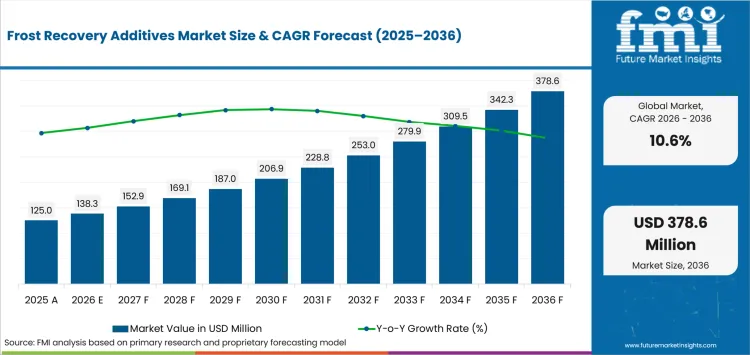
USD 138.3 million in 2026 and USD 378.6 million by 2036 at a 10.6% CAGR.
Demand for frost recovery additives is projected to expand at 10.6% CAGR between 2026 and 2036, increasing valuation from USD 138.3 million in 2026 to USD 378.6 million by 2036. Capacity for biological inputs and specialty fertilizers matters because frost alerts compress ordering into days instead of normal replenishment cycles. Syngenta reported in May 2025 that its South Carolina biologicals facility was built for 16,000 tons of annual biostimulant production. That capacity gives regional channels more headroom to position stress products ahead of short weather-driven buying windows.
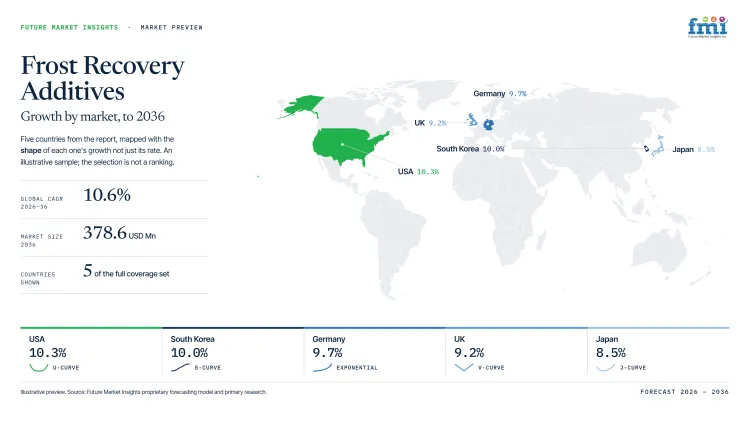
National growth paths differ even where farms can access similar biological-input portfolios through established distribution channels. The United States is forecast at 10.3% CAGR versus 9.2% for the United Kingdom as damaging freezes trigger sharper emergency orders in exposed specialty crops. The Met Office reported in January 2026 that 2025 was the UK's warmest year on record at a 10.09°C mean temperature. A warmer annual average does not remove isolated frost risk, so UK ordering remains dependent on local alerts and crop stage.
Key Takeaways of Frost Recovery Additives Market
- Frost events compress purchasing windows, so commercial demand depends on local agronomy support and product availability before tissue damage becomes irreversible.
- By product type, osmoprotectant blends are estimated to hold 40.9% in 2026 owing to their fit with osmotic adjustment during recoverable cold stress.
- In 2026, cereals and grains are expected to lead crop type with 49.3% share driven by broad-acre protocols that control treatment cost per hectare.
- Soil application is projected to hold 51.7% share in 2026 supported by root-zone programs that fit planned establishment and nutrition work.
- Severe freeze injury limits repeat use because no additive can restore dead tissue, which raises the value of clear claim boundaries and crop-stage guidance.
- Some of the key players in this market include Syngenta, Acadian Plant Health, Koppert, Hello Nature, Rovensa Next, ICL Group, UPL Ltd., and Corteva Agriscience.
Analyst Perspective
"Frost recovery additives earn repeat orders only when field teams know whether treatment belongs before cold exposure or after recoverable injury. Companies pairing crop-stage evidence with nearby inventory have a better chance of converting a weather alert into a defensible treatment decision."
- Nikhil Kaitwade, Principal Consultant, Future Market Insights
How is the Frost Recovery Additives Market segmented?
Segmented by product type, crop type, application method, farm type, sales channel and region.
Product type includes osmoprotectant blends, seaweed-based formulations, amino acid blends, anti-transpirant combos and others. Crop type includes cereals and grains, fruits and vegetables, oilseeds and pulses, turf and ornamentals and others. Application method includes soil, foliar, fertigation or drip, seed and other delivery routes used in current crop programs. Farm type includes large commercial farms, mid-size farms, smallholders, greenhouses and nurseries and others. Sales channel includes agri-input distributors, cooperatives, agri-retail chains, online or direct-to-farm and others.
How does soil application support the application method category?
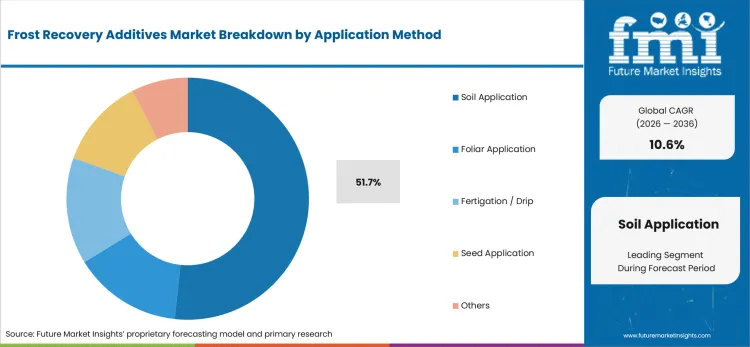
Soil application lets agronomists schedule stress inputs beside seed biostimulants or fertility work before frost risk turns field operations into an emergency spray decision. Syngenta and Ceres Biotics signed a global VIXERAN agreement in February 2025 for a biostimulant designed to access nitrogen through leaves and roots.
- By application method, soil application is forecast to represent 51.7% in 2026 supported by establishment and fertility programs that already reach the root zone.
- Root-compatible programs give agronomists a scheduled route for stress support while foliar options remain available as warning time narrows close to exposure in commercial fields.
What makes osmoprotectant blends central to the product type category?
Osmoprotectant blends target exposed plant tissue that remains capable of recovery after cold stress. Agronomists compare glycine betaine or proline formulations with injury severity and treatment timing. Plant growth regulators can share the field program without replacing stress-specific osmoprotectant chemistry.
- Based on product type, osmoprotectant blends are projected to account for 40.9% in 2026 owing to their direct fit with osmotic adjustment and cellular stress management.
- Acadian Plant Health launched its Abiotic Stress Management portfolio in February 2025 with positioning around crop growth and stress tolerance. That launch gives distributors a current biostimulant structure for cold-risk discussions without claiming that stress products reverse dead tissue.
Why do cereals and grains lead the crop type category?
Cereal programs require frost inputs to fit broad-acre spray and nutrition schedules without pushing treatment cost beyond the yield protected across large fields. Koppert launched Stingray 25 in France in February 2025 as an Ascophyllum nodosum biostimulant positioned for root development and stress tolerance.
- In 2026, cereals and grains are expected to lead crop type with 49.3% share driven by repeatable field protocols across large commercial acreage.
- Broad-acre farms favor formulations that fit existing passes and can be deployed consistently across large fields without adding a separate application program during short cold-risk periods at scale.
What drives agri-input distributors within the sales channel category?
Frost additives lose commercial value if stock arrives after the treatment window closes. Regional distributors place inventory near farms and coordinate product choice with crop advisers. Many also stock agricultural adjuvants and agrochemical additives beside stress products, so local assortment depth matters during warning periods.
- Agri-input distributors are set to lead the sales channel with 47.0% share in 2026 due to local stock and technical support during short response windows.
- Hello Nature announced in June 2025 that its Italian biostimulant facility expansion would double site production capacity and support more distributors. Greater manufacturing headroom improves replenishment where weather events compress ordering into short periods.
What are the drivers, restraints and opportunities in the Frost Recovery Additives Market?
Frost exposure shortens treatment windows, proof and claim discipline restrict repeat use, and forecast-linked agronomy brings weather alerts closer to planned field decisions.
- Driver: Weather-linked frost exposure compresses preventive and recovery purchase windows for crops that retain responsive tissue.
- Restraint: Efficacy proof and crop-stage timing restrict repeat use when claims exceed what viable plant tissue can recover.
- Opportunity: Forecast-linked agronomy lets distributors stage inventory and issue treatment guidance before local cold risk becomes an emergency order.
Frost Exposure Converts Weather Risk into Immediate Field Decisions
Cold risk converts into additive demand once a farm has a usable treatment window and evidence that surviving tissue can respond. The USDA Risk Management Agency reported in May 2026 that a late-April freeze caused catastrophic perennial-crop damage across thirteen states and required emergency loss procedures. Losses at that scale force commercial farms to compare preventive inputs and recoverable post-event treatments with physical protection and insurance.
Claim Boundaries Limit Repeat Use after Severe Injury
Repeat purchasing depends on evidence that matches the crop stage and the claim printed for commercial use. Defra opened a UK fertiliser reform consultation in March 2026 that proposed technical requirements and conformity assessment for newer fertilising products. The same qualification discipline affects humic biostimulants and other stress inputs, discouraging claims that imply additives can restore tissue already killed by freezing.
Digital Warnings Bring Sales Decisions Forward
Forecast-linked agronomy gives field teams more time to stage product and separate preventive guidance from recovery instructions. South Korea's agriculture ministry added farm-level meteorological disaster warnings to Agriculture e in February 2025 for 110 localities and 13 fruit crops. Smart agriculture systems and farm management software can carry those alerts into distributor planning without assuming that every forecast produces treatable damage.
Which country CAGRs are profiled in the Frost Recovery Additives Market?
| Country | CAGR |
|---|---|
| USA | 10.3% |
| South Korea | 10.0% |
| Germany | 9.7% |
| UK | 9.2% |
| Japan | 8.5% |
How do country-level CAGRs compare in the Frost Recovery Additives Market?
The five profiled countries span 1.8 percentage points from the United States at 10.3% to Japan at 8.5%. The United States and South Korea form the upper group, while Germany remains close behind. The spacing alone does not measure current market size and puts more weight on channel readiness or claim compliance.
- United States uses formal loss assessment and responsive input channels after damaging freezes.
- South Korea uses parcel-level warnings and extension teams for earlier preventive decisions.
- Germany pairs mature distribution with EU-aligned evidence requirements for commercial crop-stress products.
- United Kingdom faces tight farm economics and fertiliser rules that penalize documentation.
- Japan rewards crop-stage timing because frost advisories track local orchard and cereal development.
Comparable CAGRs conceal different entry requirements for inventory, evidence and local agronomy. The full report provides country-level CAGR analysis across North America, Latin America, Europe, East Asia, South Asia, Oceania and the Middle East and Africa.
Country-wise Analysis
- USA: Commercial farms and specialty-crop operators in the United States often place frost losses inside formal insurance and agronomy workflows, which makes documented injury assessment an operating condition before recovery inputs receive additional budget. The United States frost recovery additives market is projected to record 10.3% CAGR during the assessment period, while USDA's June 2026 Crop Production report said April freezes caused extensive specialty-crop damage and May frost locally aggravated those losses. Regional distributors can respond quickly because agricultural input channels are dense, but companies still need crop-specific evidence showing where preventive or recovery treatment improves surviving-crop performance beside insurance coverage and physical frost-control methods.
- South Korea: Fruit-growing districts in South Korea rely on coordinated extension support and installed frost-control equipment, so additive programs enter a field plan that already includes physical preventive measures. The Rural Development Administration reported in April 2026 that a freeze-protection treatment was being tested at 23 major fruit sites and remained effective for about seven days after application two to three days before cold exposure. South Korea is estimated to post 10.0% CAGR over the forecast period as local warning networks give distributors an earlier trigger for advice, but companies must avoid implying that additives can reverse severe tissue injury.
- Germany: German crop-input channels are mature, and specialty-crop suppliers face uneven frost exposure because vineyard and orchard regions can experience sharply different seasonal losses. Germany's frost recovery additives outlook is anticipated to advance at 9.7% CAGR over the assessment period, while the German Wine Institute reported in April 2026 that several eastern wine regions recorded triple-digit 2025 volume gains after extreme late-frost losses in 2024. Distribution access is strong across major farming regions, but event-driven demand can swing sharply between seasons and forces companies to use locally timed programs with EU-aligned evidence instead of planning revenue around one damaging frost year.
- UK: United Kingdom growers compare biological stress inputs against tight per-hectare economics, so a frost additive must fit existing spray passes and show a credible return beside routine nutrition and crop-protection spending. The Met Office reported in June 2026 that spring mean temperature reached 10.41°C in England and 9.73°C in Wales after an unusually warm season across the country. Frost recovery additive demand in the United Kingdom is forecast to rise at 9.2% CAGR through 2036 as established distributors support local access across major farming districts, but changing fertiliser rules increase documentation work for repeat commercial orders nationally.
- Japan: Japanese orchard and cereal programs rely on frost advisories tied to local crop development, so treatment decisions can change quickly as budding or heading dates advance under warmer spring conditions. Frost recovery additive sales in Japan are forecast to expand at 8.5% CAGR by 2036, and the Matsuyama meteorological office explained in March 2026 that frost-advisory timing is coordinated with agricultural agencies and normally issued before the risk morning. Local agronomic service gives companies a precise route to timed application, but suppliers need Japanese crop-specific evidence and nearby inventory because a late advisory leaves little room for rapid replenishment.
Who are the notable companies in the Frost Recovery Additives Market?
Syngenta, Acadian Plant Health, Koppert, Hello Nature, Rovensa Next, ICL Group, UPL Ltd., and Corteva Agriscience are the notable companies profiled in this market.
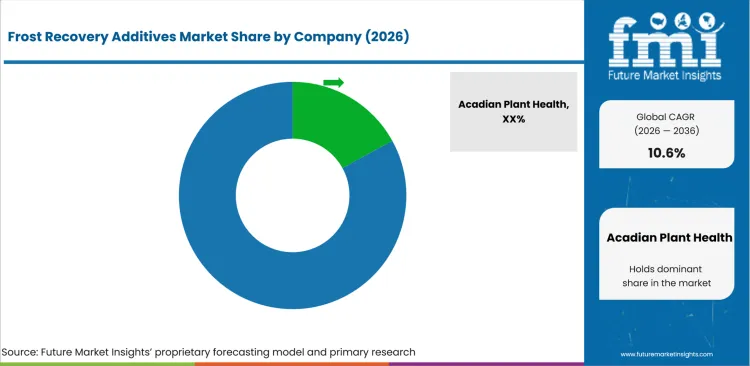
Competition spans global crop-input groups, specialist biostimulant developers and biological platforms with distinct stress-management routes. Entry barriers come from crop-stage evidence, claim scope and distribution readiness rather than company size. Strong portfolios give agronomists a defined preventive or recovery role and maintain local stock during short warning periods.
- Global biological crop-input platforms: Syngenta, ICL Group, UPL Ltd. and Corteva Agriscience place stress products inside established agronomy programs.
- Specialist biostimulant companies: Acadian Plant Health and Hello Nature focus on seaweed or peptide portfolios sold across multiple agricultural crop groups.
- Biological portfolio specialists: Koppert and Rovensa Next pair crop-response products with broader biological programs and international distribution relationships.
Competitive Benchmarking: Frost Recovery Additives Market
| Company | Stress / Recovery Positioning | 2025+ Commercial Action | Public Validation Depth | Geographic Reach |
|---|---|---|---|---|
| Syngenta | Medium | High | Medium | Global |
| Acadian Plant Health | Medium | High | High | North America, Europe and international markets |
| Koppert | Medium | High | Medium | Europe and international markets |
| Hello Nature | Medium | Medium | Medium | 80-country commercial presence |
| Rovensa Next | Medium | Medium | High | Europe, Americas and international markets |
| ICL Group | Medium | Medium | Medium | Global |
| UPL Ltd. | Medium | Medium | Medium | Global |
| Corteva Agriscience | High | Medium | Medium | Global |
Key Developments in the Frost Recovery Additives Market
- In March 2026, Corteva Agriscience introduced Harbest in its Biological Update 2026 alongside BlueN and Kinsidro Grow+ for cereal programs.
- In February 2026, Rovensa Next opened a pilot fermentation plant in Brazil to expand biological development and improve scale-up from research to field-ready production.
- In January 2025, Acadian Plant Health and Koppert expanded their partnership to bring seaweed-based crop technologies into a wider set of agricultural programs.
Key Players in the Frost Recovery Additives Market
Global Crop-Input Biological Platform
- Syngenta
Specialist Biological and Biostimulant Platforms
- Acadian Plant Health
- Koppert
- Hello Nature
- Rovensa Next
Global Biological and Nutrition Platforms
- ICL Group
- UPL Ltd.
- Corteva Agriscience
Frost Recovery Additives Market - Report Scope
| Coverage field | Report scope |
|---|---|
| Market breakdown | By product type, crop type, application method, farm type, sales channel and region. |
| Quantitative Units | Revenue in USD million and CAGR in %. |
| Market Definition | Commercial additives positioned to support crop tolerance or recovery around frost and cold-stress events while viable tissue remains responsive. |
| Regions Covered | North America, Latin America, Western Europe, Eastern Europe, East Asia, South Asia and Pacific and Middle East and Africa. |
| Countries Covered | United States, South Korea, Germany, United Kingdom, Japan, and 20+ countries included in the full report. |
| Key Companies Profiled | Syngenta, Acadian Plant Health, Koppert, Hello Nature, Rovensa Next, ICL Group, UPL Ltd., and Corteva Agriscience. |
| Forecast Period | 2026 to 2036. |
| Approach | Primary and secondary research with market triangulation. |
Frost Recovery Additives Market - Research Methodology
| Method | Approach |
|---|---|
| Primary Research | FMI analysts gathered input from manufacturers, service providers, technology developers, distributors, end users, procurement teams, and subject-matter experts. Interviews examined purchasing decisions, product or service evaluation, adoption barriers, approval requirements, pricing considerations, and expectations for technical or commercial support. Respondents were also asked what evidence is required before a trial, pilot, or initial order develops into regular purchasing. |
| Desk Research | Desk research covered government statistics, regulatory publications, trade data, industry associations, technical literature, standards, company filings, product information, and official corporate announcements. Sources were reviewed for relevance, publication date, geographic coverage, and consistency with the defined market scope. Claims relating to performance, applications, approvals, capacity, investment, and commercial activity were retained only when supported by credible public evidence. |
| Market Sizing and Forecasting | The market model combined the baseline value with historical performance, segment structure, pricing and volume indicators, adoption levels, company participation, and country-level demand conditions. Forecast assumptions considered economic activity, investment trends, regulatory developments, technology adoption, purchasing cycles, supply availability, and barriers to wider market use. Segment and regional estimates were reconciled before the final market total was calculated. |
| Data Validation | Estimates were checked against multiple independent indicators, including public data, company activity, trade patterns, industry developments, and findings from primary interviews. Validation also tested whether products, services, applications, and company revenues fell within the defined market boundaries. Adjacent categories, unsupported claims, overlapping revenues, and activities without direct market relevance were excluded to reduce double counting and maintain consistency across segments and countries. |
Frost Recovery Additives Market by Segments
Frost Recovery Additives Market segmented by Product Type:
- Osmoprotectant Blends (Glycine Betaine / Proline)
- Seaweed-Based Formulations
- Amino Acid Blends
- Anti-Transpirant Combos
- Others
Frost Recovery Additives Market segmented by Crop Type:
- Cereals & Grains
- Fruits & Vegetables
- Oilseeds & Pulses
- Turf & Ornamentals
- Others
Frost Recovery Additives Market segmented by Application Method:
- Soil Application
- Foliar Application
- Fertigation / Drip
- Seed Application
- Others
Frost Recovery Additives Market segmented by Farm Type:
- Large Commercial Farms
- Mid-Size Farms
- Smallholders
- Greenhouses & Nurseries
- Others
Frost Recovery Additives Market segmented by Sales Channel:
- Agri-Input Distributors
- Cooperatives
- Agri-Retail Chains
- Online / Direct-to-Farm
- Others
Frost Recovery Additives Market by Region:
- North America
- United States
- Canada
- Latin America
- Brazil
- Mexico
- Argentina
- Chile
- Western Europe
- Germany
- France
- United Kingdom
- Italy
- Spain
- Benelux
- Nordics
- Eastern Europe
- Poland
- Czech Republic
- Romania
- Hungary
- East Asia
- China
- Japan
- South Korea
- South Asia and Pacific
- India
- ASEAN
- Australia and New Zealand
- Middle East and Africa
- GCC Countries
- South Africa
- Türkiye
- Israel
Research Sources and Bibliography
- Syngenta. (2025, June 30). Syngenta to become global leader in biologicals; expanding nature inspired solutions for farmers.
- Met Office. (2026, January 2). 2025 is double record-breaker: UK's warmest and sunniest year on record.
- Acadian Plant Health. (2025, February 18). Acadian Plant Health™ sets new standard for crop resilience with Abiotic Stress Management portfolio.
- Koppert. (2025, February 20). Koppert launches Stingray 25 in France, a booster of crop growth and productivity.
- Syngenta. (2025, February 20). Sustainability in agriculture gets a boost from global biologicals partnership.
- Hello Nature. (2025, June 26). Hello Nature announces major expansion of Italian biostimulant production facility.
- USA Department of Agriculture, Risk Management Agency. (2026, May 8). MGR-26-006: Emergency procedures for crops damaged by freeze in April 2026.
- Department for Environment, Food & Rural Affairs. (2026, March 19). UK fertilisers: regulatory reform.
- Republic of Korea Ministry of Agriculture, Food and Rural Affairs. (2025, February 20). Agricultural meteorological disaster information now available easily through Agriculture e.
- USA Department of Agriculture, National Agricultural Statistics Service. (2026, June 11). Crop Production.
- Rural Development Administration, Republic of Korea. (2026, April 9). Freeze-protection material field testing for major fruit crops.
- Deutsches Weininstitut. (2026, April 20). Weinmosternte 2025 größer als geschätzt.
- Met Office. (2026, June 1). Warmest spring on record for England and Wales - third warmest for UK.
- Japan Meteorological Agency, Matsuyama Local Meteorological Observatory. (2026, March). Weather and meteorological terms: Frost advisory.
- Corteva Agriscience. (2026, March 5). Biologicals Update 2026.
- Rovensa Next. (2026, February 2). Rovensa Next strengthens global innovation capabilities with new pilot fermentation plant in Brazil.
- Koppert. (2025, January 27). Acadian Plant Health and Koppert expand partnership to drive sustainable agriculture.
- ICL Group. (2025, November 12). Climate-resilient agriculture: Data and biologicals.
- UPL Ltd. (2026, July 16). Annual Report 2025-26.
- Syngenta. (2026, July 14). Syngenta and Groundwork BioAg enter partnership to bring innovation to growers.
- Rovensa Next. (2026, March 9). Otimais Duo, Rovensa Next’s high-performance synergistic inoculant for maximizing nutrient efficiency, is launched in Brazil.
- Syngenta. (2025, January 9). Artificial intelligence is speeding up the development of the next generation of biostimulants.
- Rovensa Next. (2026, May 27). Rovensa Next launches Luxyva® in Mexico, a biosolution to strengthen crop performance under high solar radiation.
- ICL Group. (2025, July 23). Key Milestones in ICL’s 2024 ESG Journey.
- Syngenta. (2025, February 26). Syngenta strengthens global leadership in agricultural biologicals.
- Acadian Plant Health. (2025, August 13). Acadian expands CE-marked biostimulant portfolio.
- Koppert. (2025, March 19). Koppert transfers its biostimulant and fertilizer portfolio to REKA.
- Rovensa Next. (2025, December 9). Rovensa Next launches Myndra, a new synergistic biostimulant to elevate fruit quality in woody perennials in Europe.
- ICL Group. (2026, May 13). ICL Reports First Quarter 2026 Results.
- Corteva Agriscience. (2025, October 13). Corteva presented its 2026 spring portfolio in Hungary.
- Novonesis. (2026, June 11). Rovensa Next to distribute Novonesis' biosolutions for Plant Health in the United States.
This bibliography is provided for reader reference and is not exhaustive. The full report contains the complete reference list and detailed citations.
This Report Answers
- How large is the frost recovery additives market in 2026 and by 2036?
- Which agronomic conditions convert frost exposure into a time-sensitive commercial decision for crop-input programs?
- Why do osmoprotectant blends hold the leading product type share in the frost recovery additives market?
- Why do cereals and grains account for the largest crop type share in the current forecast?
- How does soil application fit preventive stress-management programs before forecast cold events reach vulnerable crops?
- How do growth rates and operating conditions differ across the five profiled countries?
- Which companies currently compete across global crop-input platforms and specialist biostimulant technologies?
- What evidence, timing and claim constraints limit repeat purchasing after severe freeze injury occurs?
Frequently Asked Questions
How big is the Frost Recovery Additives Market in 2026?
The frost recovery additives market is estimated at USD 138.3 million in 2026 and is projected to reach USD 378.6 million by 2036. Commercial demand depends on frost timing, local inventory and crop-stage instructions that distinguish preventive use from recoverable post-event stress.
What is the CAGR of the Frost Recovery Additives Market from 2026 to 2036?
The frost recovery additives market is projected to grow at 10.6% CAGR between 2026 and 2036. Growth reflects weather-linked stress management spending where growers retain a usable preventive or recovery treatment window.
Which product type leads the Frost Recovery Additives Market?
The osmoprotectant blends segment is expected to hold 40.9% of the frost recovery additives market in 2026, supported by its fit with osmotic adjustment and cellular stress management. Commercial use still depends on crop-stage evidence because severe freeze injury cannot be restored by additives.
Which sales channel leads the Frost Recovery Additives Market?
The agri-input distributors segment is expected to hold 47.0% of the frost recovery additives market in 2026, supported by local inventory and agronomy guidance. Its position reflects the short interval between a frost warning and field application across commercial farms.
Which companies are active in the Frost Recovery Additives Market?
The frost recovery additives market includes Syngenta, Acadian Plant Health, Koppert, Hello Nature, Rovensa Next, ICL Group, UPL Ltd. and Corteva Agriscience. Their roles span global biological platforms and specialist biostimulant portfolios serving crop-stress programs across several agricultural regions.
Preview the report firsthand - request a free sample
Get SampleGet the brochure for pricing and purchase details.
Get PDFTable of Content
- Key Takeaways
- Market Size and CAGR
- Top Growth Driver
- Fastest Growing Segment
- Leading Region
- Key Companies
- Emerging Opportunities
- Executive Summary
- Global Market Outlook
- Demand-side Trends
- Supply-side Trends
- Technology Roadmap Analysis
- Analysis and Recommendations
- Analyst Perspective (What is happening? Why now? What should investors know?)
- Key Questions Answered
- How large is the market?
- What is the CAGR?
- What are key trends?
- Which region dominates?
- Who are the leaders?
- Market Overview
- Market Coverage / Taxonomy
- Market Definition / Scope / Limitations
- Research Methodology
- Chapter Orientation
- Analytical Lens and Working Hypotheses
- Market Structure, Signals, and Trend Drivers
- Benchmarking and Cross-market Comparability
- Market Sizing, Forecasting, and Opportunity Mapping
- Research Design and Evidence Framework
- Desk Research Programme (Secondary Evidence)
- Expert Input and Fieldwork (Primary Evidence)
- Tooling, Models, and Reference Databases
- Data Engineering and Model Build
- Quality Assurance and Audit Trail
- Market Background
- Market Dynamics (Drivers, Restraints, Opportunity, Trends)
- Scenario Forecast (Optimistic, Likely, Conservative)
- Impact Analysis
- AI Impact
- Sustainability Impact
- Regulatory Impact
- Technology Impact
- Consumer / Buyer Analysis
- Purchase Drivers
- Adoption Barriers
- Buyer Journey
- Opportunity Map Analysis
- Product Life Cycle Analysis
- Supply Chain Analysis
- Investment Feasibility Matrix
- Value Chain Analysis
- PESTLE and Porter's Analysis
- Regulatory Landscape
- Regional Parent Market Outlook
- Production and Consumption Statistics
- Import and Export Statistics
- Global Market Analysis and Forecast, 2021 to 2036
- Historical Market Size Value (USD Million) Analysis, 2021 to 2025
- Current and Future Market Size Value (USD Million) Projections, 2026 to 2036
- Y-o-Y Growth Trend Analysis
- Absolute $ Opportunity Analysis
- Global Market Pricing Analysis, 2021 to 2036
- Global Market Analysis and Forecast, By Product Type, 2021 to 2036
- Introduction / Key Findings
- Historical Market Size Value (USD Million) Analysis By Product Type, 2021 to 2025
- Current and Future Market Size Value (USD Million) Analysis and Forecast By Product Type, 2026 to 2036
- Osmoprotectant Blends (Glycine Betaine / Proline)
- Seaweed-Based Formulations
- Amino Acid Blends
- Anti-Transpirant Combos
- Others
- Osmoprotectant Blends (Glycine Betaine / Proline)
- Y-o-Y Growth Trend Analysis By Product Type, 2021 to 2025
- Absolute $ Opportunity Analysis By Product Type, 2026 to 2036
- Global Market Analysis and Forecast, By Crop Type, 2021 to 2036
- Introduction / Key Findings
- Historical Market Size Value (USD Million) Analysis By Crop Type, 2021 to 2025
- Current and Future Market Size Value (USD Million) Analysis and Forecast By Crop Type, 2026 to 2036
- Cereals & Grains
- Fruits & Vegetables
- Oilseeds & Pulses
- Turf & Ornamentals
- Others
- Cereals & Grains
- Y-o-Y Growth Trend Analysis By Crop Type, 2021 to 2025
- Absolute $ Opportunity Analysis By Crop Type, 2026 to 2036
- Global Market Analysis and Forecast, By Application Method, 2021 to 2036
- Introduction / Key Findings
- Historical Market Size Value (USD Million) Analysis By Application Method, 2021 to 2025
- Current and Future Market Size Value (USD Million) Analysis and Forecast By Application Method, 2026 to 2036
- Soil Application
- Foliar Application
- Fertigation / Drip
- Seed Application
- Others
- Soil Application
- Y-o-Y Growth Trend Analysis By Application Method, 2021 to 2025
- Absolute $ Opportunity Analysis By Application Method, 2026 to 2036
- Global Market Analysis and Forecast, By Farm Type, 2021 to 2036
- Introduction / Key Findings
- Historical Market Size Value (USD Million) Analysis By Farm Type, 2021 to 2025
- Current and Future Market Size Value (USD Million) Analysis and Forecast By Farm Type, 2026 to 2036
- Large Commercial Farms
- Mid-Size Farms
- Smallholders
- Greenhouses & Nurseries
- Others
- Large Commercial Farms
- Y-o-Y Growth Trend Analysis By Farm Type, 2021 to 2025
- Absolute $ Opportunity Analysis By Farm Type, 2026 to 2036
- Global Market Analysis and Forecast, By Sales Channel, 2021 to 2036
- Introduction / Key Findings
- Historical Market Size Value (USD Million) Analysis By Sales Channel, 2021 to 2025
- Current and Future Market Size Value (USD Million) Analysis and Forecast By Sales Channel, 2026 to 2036
- Agri-Input Distributors
- Cooperatives
- Agri-Retail Chains
- Online / Direct-to-Farm
- Others
- Agri-Input Distributors
- Y-o-Y Growth Trend Analysis By Sales Channel, 2021 to 2025
- Absolute $ Opportunity Analysis By Sales Channel, 2026 to 2036
- Global Market Analysis and Forecast, By Region, 2021 to 2036
- Introduction
- Historical Market Size Value (USD Million) Analysis By Region, 2021 to 2025
- Current Market Size Value (USD Million) Analysis and Forecast By Region, 2026 to 2036
- North America
- Latin America
- Western Europe
- Eastern Europe
- East Asia
- South Asia and Pacific
- Middle East & Africa
- Market Attractiveness Analysis By Region
- North America Market Analysis and Forecast, By Country, 2021 to 2036
- Historical Market Size Value (USD Million) Trend Analysis By Market Taxonomy, 2021 to 2025
- Market Size Value (USD Million) Forecast By Market Taxonomy, 2026 to 2036
- By Country
- USA
- Canada
- By Product Type
- By Crop Type
- By Application Method
- By Farm Type
- By Sales Channel
- By Country
- Market Attractiveness Analysis
- By Country
- By Product Type
- By Crop Type
- By Application Method
- By Farm Type
- By Sales Channel
- Key Takeaways
- Latin America Market Analysis and Forecast, By Country
- Historical Market Size Value (USD Million) Trend Analysis By Market Taxonomy, 2021 to 2025
- Market Size Value (USD Million) Forecast By Market Taxonomy, 2026 to 2036
- By Country
- Brazil
- Mexico
- Chile
- Rest of Latin America
- By Product Type
- By Crop Type
- By Application Method
- By Farm Type
- By Sales Channel
- By Country
- Market Attractiveness Analysis
- By Country
- By Product Type
- By Crop Type
- By Application Method
- By Farm Type
- By Sales Channel
- Key Takeaways
- Western Europe Market Analysis and Forecast, By Country
- Historical Market Size Value (USD Million) Trend Analysis By Market Taxonomy, 2021 to 2025
- Market Size Value (USD Million) Forecast By Market Taxonomy, 2026 to 2036
- By Country
- Germany
- UK
- Italy
- Spain
- France
- Nordic
- BENELUX
- Rest of Western Europe
- By Product Type
- By Crop Type
- By Application Method
- By Farm Type
- By Sales Channel
- By Country
- Market Attractiveness Analysis
- By Country
- By Product Type
- By Crop Type
- By Application Method
- By Farm Type
- By Sales Channel
- Key Takeaways
- Eastern Europe Market Analysis and Forecast, By Country
- Historical Market Size Value (USD Million) Trend Analysis By Market Taxonomy, 2021 to 2025
- Market Size Value (USD Million) Forecast By Market Taxonomy, 2026 to 2036
- By Country
- Russia
- Poland
- Hungary
- Balkan & Baltic
- Rest of Eastern Europe
- By Product Type
- By Crop Type
- By Application Method
- By Farm Type
- By Sales Channel
- By Country
- Market Attractiveness Analysis
- By Country
- By Product Type
- By Crop Type
- By Application Method
- By Farm Type
- By Sales Channel
- Key Takeaways
- East Asia Market Analysis and Forecast, By Country
- Historical Market Size Value (USD Million) Trend Analysis By Market Taxonomy, 2021 to 2025
- Market Size Value (USD Million) Forecast By Market Taxonomy, 2026 to 2036
- By Country
- China
- Japan
- South Korea
- By Product Type
- By Crop Type
- By Application Method
- By Farm Type
- By Sales Channel
- By Country
- Market Attractiveness Analysis
- By Country
- By Product Type
- By Crop Type
- By Application Method
- By Farm Type
- By Sales Channel
- Key Takeaways
- South Asia and Pacific Market Analysis and Forecast, By Country
- Historical Market Size Value (USD Million) Trend Analysis By Market Taxonomy, 2021 to 2025
- Market Size Value (USD Million) Forecast By Market Taxonomy, 2026 to 2036
- By Country
- India
- ASEAN
- Australia & New Zealand
- Rest of South Asia and Pacific
- By Product Type
- By Crop Type
- By Application Method
- By Farm Type
- By Sales Channel
- By Country
- Market Attractiveness Analysis
- By Country
- By Product Type
- By Crop Type
- By Application Method
- By Farm Type
- By Sales Channel
- Key Takeaways
- Middle East & Africa Market Analysis and Forecast, By Country
- Historical Market Size Value (USD Million) Trend Analysis By Market Taxonomy, 2021 to 2025
- Market Size Value (USD Million) Forecast By Market Taxonomy, 2026 to 2036
- By Country
- Kingdom of Saudi Arabia
- Other GCC Countries
- Türkiye
- South Africa
- Other African Union
- Rest of Middle East & Africa
- By Product Type
- By Crop Type
- By Application Method
- By Farm Type
- By Sales Channel
- By Country
- Market Attractiveness Analysis
- By Country
- By Product Type
- By Crop Type
- By Application Method
- By Farm Type
- By Sales Channel
- Key Takeaways
- Key Countries Market Analysis
- USA
- Pricing Analysis
- Market Share Analysis, 2025
- By Product Type
- By Crop Type
- By Application Method
- By Farm Type
- By Sales Channel
- Canada
- Pricing Analysis
- Market Share Analysis, 2025
- By Product Type
- By Crop Type
- By Application Method
- By Farm Type
- By Sales Channel
- Mexico
- Pricing Analysis
- Market Share Analysis, 2025
- By Product Type
- By Crop Type
- By Application Method
- By Farm Type
- By Sales Channel
- Brazil
- Pricing Analysis
- Market Share Analysis, 2025
- By Product Type
- By Crop Type
- By Application Method
- By Farm Type
- By Sales Channel
- Chile
- Pricing Analysis
- Market Share Analysis, 2025
- By Product Type
- By Crop Type
- By Application Method
- By Farm Type
- By Sales Channel
- Germany
- Pricing Analysis
- Market Share Analysis, 2025
- By Product Type
- By Crop Type
- By Application Method
- By Farm Type
- By Sales Channel
- UK
- Pricing Analysis
- Market Share Analysis, 2025
- By Product Type
- By Crop Type
- By Application Method
- By Farm Type
- By Sales Channel
- Italy
- Pricing Analysis
- Market Share Analysis, 2025
- By Product Type
- By Crop Type
- By Application Method
- By Farm Type
- By Sales Channel
- Spain
- Pricing Analysis
- Market Share Analysis, 2025
- By Product Type
- By Crop Type
- By Application Method
- By Farm Type
- By Sales Channel
- France
- Pricing Analysis
- Market Share Analysis, 2025
- By Product Type
- By Crop Type
- By Application Method
- By Farm Type
- By Sales Channel
- India
- Pricing Analysis
- Market Share Analysis, 2025
- By Product Type
- By Crop Type
- By Application Method
- By Farm Type
- By Sales Channel
- ASEAN
- Pricing Analysis
- Market Share Analysis, 2025
- By Product Type
- By Crop Type
- By Application Method
- By Farm Type
- By Sales Channel
- Australia & New Zealand
- Pricing Analysis
- Market Share Analysis, 2025
- By Product Type
- By Crop Type
- By Application Method
- By Farm Type
- By Sales Channel
- China
- Pricing Analysis
- Market Share Analysis, 2025
- By Product Type
- By Crop Type
- By Application Method
- By Farm Type
- By Sales Channel
- Japan
- Pricing Analysis
- Market Share Analysis, 2025
- By Product Type
- By Crop Type
- By Application Method
- By Farm Type
- By Sales Channel
- South Korea
- Pricing Analysis
- Market Share Analysis, 2025
- By Product Type
- By Crop Type
- By Application Method
- By Farm Type
- By Sales Channel
- Russia
- Pricing Analysis
- Market Share Analysis, 2025
- By Product Type
- By Crop Type
- By Application Method
- By Farm Type
- By Sales Channel
- Poland
- Pricing Analysis
- Market Share Analysis, 2025
- By Product Type
- By Crop Type
- By Application Method
- By Farm Type
- By Sales Channel
- Hungary
- Pricing Analysis
- Market Share Analysis, 2025
- By Product Type
- By Crop Type
- By Application Method
- By Farm Type
- By Sales Channel
- Kingdom of Saudi Arabia
- Pricing Analysis
- Market Share Analysis, 2025
- By Product Type
- By Crop Type
- By Application Method
- By Farm Type
- By Sales Channel
- Türkiye
- Pricing Analysis
- Market Share Analysis, 2025
- By Product Type
- By Crop Type
- By Application Method
- By Farm Type
- By Sales Channel
- South Africa
- Pricing Analysis
- Market Share Analysis, 2025
- By Product Type
- By Crop Type
- By Application Method
- By Farm Type
- By Sales Channel
- USA
- Market Structure Analysis
- Competition Dashboard
- Competition Benchmarking
- Market Share Analysis of Top Players
- By Regional
- By Product Type
- By Crop Type
- By Application Method
- By Farm Type
- By Sales Channel
- Emerging Startups
- Innovation Benchmarking
- Competition Analysis
- Competition Deep Dive
- Acadian Plant Health
- Overview
- Product Portfolio
- Profitability by Market Segments
- Sales Footprint
- Strategy Overview
- Marketing Strategy
- Product Strategy
- Channel Strategy
- BioAtlantis
- Hello Nature (Italpollina)
- Atlantica Agricola
- Seipasa
- Kimitec
- Plant Health Care
- Brandt
- Acadian Plant Health
- Case Studies
- Success Stories
- Recent Developments
- Competition Deep Dive
- Assumptions & Acronyms Used


