

- Market Size (2026)
- USD 151.2 Mn
- Forecast (2036)
- USD 469.6 Mn
- CAGR (2026 to 2036)
- 12.0%
How big is Yield Stabilizer Biologics Market in 2026?
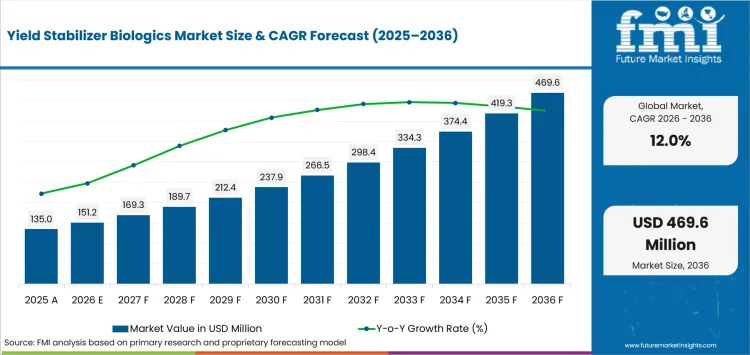
USD 151.2 Million in 2026 and USD 469.6 Million by 2036 at a 12.0% CAGR.
Demand for yield stabilizer biologics is projected to lift revenue from USD 151.2 million in 2026 to USD 469.6 million by 2036 at 12.0% CAGR. Growers justify another per-hectare input when biological crop inputs protect yield or improve nutrient efficiency within an existing program. Syngenta and Ceres Biotics signed a global agreement in February 2025 to expand access to VIXERAN for nitrogen-use efficiency. The commercialization route makes yield stabilization more purchasable because the treatment complements established fertilizer practice without requiring a separate production system.
Qualification determines how quickly technical interest converts into recurring orders across large agricultural markets. The USA Environmental Protection Agency updated draft guidance in November 2025 to clarify which biostimulants and associated claims can fall under FIFRA plant-regulator rules. Manufacturers entering the United States therefore need disciplined claim language before field evidence reaches agri-input channels. Related biofertilizer programs face local registration and agronomic proof requirements that affect launch timing even when the nutrient-use proposition remains clear.
Key Takeaways
- Demand increases as growers compare added input cost with expected yield protection under drought or heat and weak nutrient capture.
- Amino acid & peptide-based products are projected to account for 40.7% of product type revenue in 2026, supported by flexible formulation and direct plant-response positioning.
- Cereals & grains are estimated at 40.5% of crop type revenue in 2026, reflecting broadacre acreage and strict per-hectare economics.
- Soil application is forecast to capture 46.4% share in 2026, supported by root-zone placement within existing nutrient programs.
- Variable field response and claim qualification can delay repeat purchase when local trials do not establish a dependable economic return.
- Key players in the yield stabilizer biologics market include Rovensa Next, Syngenta Biologicals, Acadian Plant Health, Bayer Crop Science, Corteva Agriscience, Seipasa, UPL, and Fyteko.
Analyst Perspective
"Manufacturers should price these products against the yield risk they address instead of treating fertilizer cost as the only benchmark. Commercial value is earned when local trials define crop timing and distributors translate that evidence into a repeatable field recommendation."
- Nikhil Kaitwade, Principal Consultant, Future Market Insights
How is the Yield Stabilizer Biologics Market segmented?
The market is analyzed by Product Type, Crop Type, Application Method, Farm Type, and Sales Channel.
The yield stabilizer biologics market is segmented by product type, crop type, application method, farm type, and sales channel. Product types include amino acid & peptide-based, seaweed & botanical-based, humic / fulvic-based, microbial-enhanced blends, and others. Crop types cover cereals & grains, fruits & vegetables, oilseeds & pulses, turf & ornamentals, and others. Application methods include soil, foliar, fertigation / drip, seed, and others. Farm types cover large commercial farms, mid-size farms, smallholders, greenhouses & nurseries, and others. Sales channels include agri-input distributors, cooperatives, agri-retail chains, online / direct-to-farm, and others.
Why do Amino Acid & Peptide-Based products lead the Product Type category?
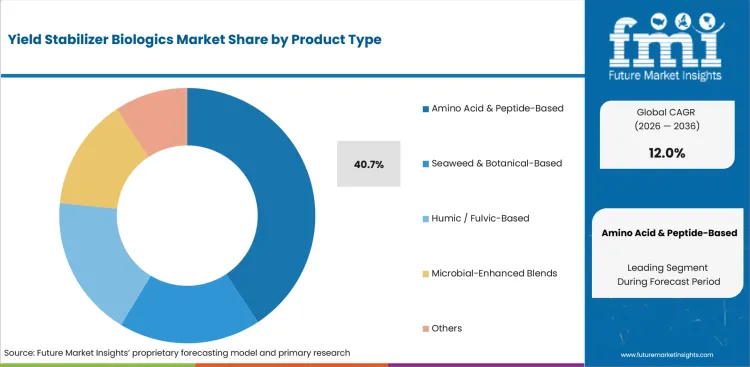
Amino acid and peptide formulations fit crop programs that need a nonliving input with predictable storage and mixing. Agronomists place them beside specialty fertilizer programs to address a defined stress or nutrient-use problem without managing microbial viability during distribution.
- By product type, amino acid & peptide-based products are estimated to hold 40.7% in 2026 owing to flexible placement and a direct plant-response proposition.
- Japan’s agriculture ministry gave that mechanism a public operating example in March 2026 when Ajinomoto presented an amino-acid biostimulant that improves nutrient-use efficiency and environmental-stress tolerance within soil-focused regenerative programs.
Why do Cereals & Grains lead the Crop Type category?
Cereals and grains impose a strict per-hectare threshold because small yield changes scale across large treated acreage. Seed biostimulants and foliar programs must fit standard broadacre operations while producing enough economic response to survive a seasonal purchasing review.
- By crop type, cereals & grains are estimated to represent 40.5% of 2026 revenue because broadacre acreage rewards small but repeatable economic gains.
- Corteva Agriscience placed BlueN, Kinsidro Grow+ and Ympact in its Cereals 2026 field program in March 2026. The company positioned these biologicals around nutrient efficiency, crop resilience and seed-applied establishment.
Why does Soil Application lead the Application Method category?
Soil placement aligns yield-stabilizing biologics with root establishment and rhizosphere activity where nutrient availability can be influenced early in the crop cycle. The treatment can also ride with starter fertilizer programs or irrigation instead of requiring another foliar pass.
- Soil application accounts for a 46.4% share in 2026 because root-zone placement fits nutrient-availability and establishment functions within existing field operations.
- Brazilian deployment shows why that operating fit matters. Fyteko announced an Agrilife partnership in March 2026 to commercialize in-furrow VacStress for soybean and corn with nationwide technical support.
Why do Large Commercial Farms lead the Farm Type category?
Large commercial farms can test biological inputs across replicated strips and calculate incremental return against a known per-hectare cost. Their scale supports comparisons between foliar treatments and microbial seed treatments across repeated field blocks before standardization.
- Large commercial farms hold 47.5% of 2026 farm-type revenue because acreage supports controlled trials and standardized decisions across recurring crop programs.
- USDA Economic Research Service reported in February 2026 that large-scale family farms represented about 5% of USA farms but 50% of production value during 2024. That concentration supports structured trials and centralized input decisions.
What are the drivers, restraints and opportunities in the Yield Stabilizer Biologics Market?
Yield risk and nutrient-efficiency pressure support demand while variable field response limits repeat purchase and crop-specific channel programs provide the clearest scale-up route.
- Driver: Drought and heat exposure increase the value of biologics that preserve plant function before yield loss becomes irreversible.
- Restraint: Variable crop response and evidence requirements can prevent technical interest from converting into recurring farm orders.
- Opportunity: Crop-specific protocols paired with agronomic distribution can turn field evidence into repeatable application decisions across local production systems.
Abiotic Stress Raises the Value of Yield Protection
Yield stabilizer biologics earn a place in crop budgets when stress threatens revenue before corrective agronomy can recover lost output. USDA Agricultural Research Service published a May 2026 soybean study where the tested biostimulant raised yield by 13.0% under no-till and 19.6% under tilled conditions. Plant growth regulators and stress-management inputs therefore become commercially relevant only when field response remains measurable under the intended production system.
Variable Field Response Slows Repeat Purchase
Response variability makes the added treatment difficult to price when crop species or application practice changes the result. Defra opened a fertiliser regulatory reform consultation in March 2026 after its evidence review identified limited quality and compositional requirements for plant biostimulants. That uncertainty slows repeat purchase because agronomists need local proof before another input enters the crop program.
Crop-Specific Channel Programs Improve Conversion
Manufacturers can reduce adoption friction by pairing crop-specific rate guidance with distributors that already manage seasonal input decisions. Fyteko announced a Point Group partnership in May 2025 across Peru, Ecuador and Colombia to commercialize biological products for abiotic stress conditions. That channel model supports organic fertilizer inputs and biological programs because local teams translate claims into crop-specific field timing.
Which country CAGRs are profiled in the Yield Stabilizer Biologics Market?
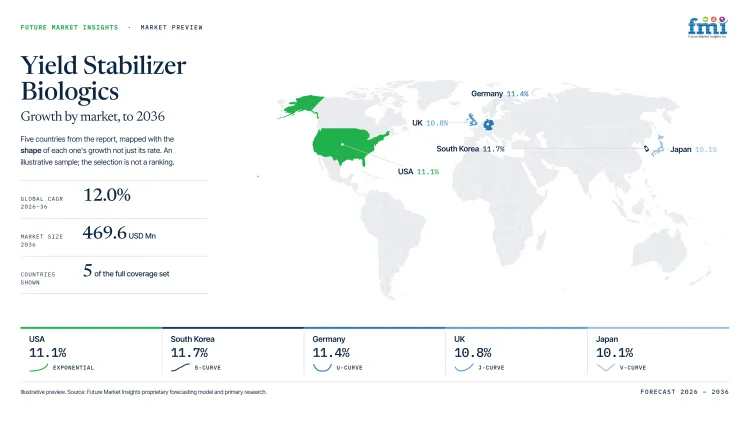
| Country | CAGR |
|---|---|
| South Korea | 11.7% |
| Germany | 11.4% |
| United States | 11.1% |
| United Kingdom | 10.8% |
| Japan | 10.1% |
How do country-level CAGRs compare in the Yield Stabilizer Biologics Market?
The profiled forecasts span 1.6 percentage points, creating a narrow growth band rather than separate high- and low-growth tiers. South Korea and Germany form the upper group while the United States and United Kingdom occupy the middle. Japan remains lower at 10.1% CAGR, so entry decisions depend more on local qualification and crop exposure than minor rate differences across sustainable agriculture programs.
- South Korea ties fertilizer decisions closely to measured soil conditions and compliance checks across commercial production areas.
- Germany rewards nutrient-efficiency claims that complement increasingly disciplined national nitrogen management within established crop programs.
- United States scale supports broadacre trials across unusually large corn and soybean acreage with strong retailer agronomy networks.
- United Kingdom programs face a higher local evidence burden for newer biostimulant claims under changing fertiliser rules.
- Japan now asks manufacturers to document efficacy and safety before broader technical positioning enters agricultural channels.
Comparable CAGRs can therefore produce different order-conversion conditions for the same biological input across otherwise similar agricultural markets. The full report provides country-level CAGR analysis across North America, Latin America, Europe, East Asia, South Asia, Oceania and the Middle East and Africa.
Country-wise Analysis
- South Korean crop programs increasingly pair fertilizer recommendations with measured soil conditions because Rural Development Administration guidance issued in February 2026 set compliance checks across about 91,000 parcels for chemical fertilizer use across major farming districts nationwide. Yield stabilizer biologics demand in South Korea is forecast to expand at 11.7% CAGR through 2036 as distributors align root-zone products with soil-test recommendations and fertigation practice. The commercial friction is proof of fit within an already measured nutrient program, so manufacturers need Korean field protocols that tie treatment timing to test results and avoid redundant input cost across repeated farm applications.
- German growers already operate under stricter nutrient-accounting expectations, and the German Environment Agency reported in March 2026 that the 2026-2030 national nitrogen-surplus target is 70 kilograms per hectare after the target was first achieved in 2023. That backdrop favors products with a defensible nutrient-efficiency function because local agronomists can place them beside an established fertilizer plan, yet it also raises the burden for proving that another input improves farm economics. Germany is estimated to post 11.4% CAGR over the forecast period, supported by strong agronomic channels but limited by EU-compliant claims and crop-specific trials that separate biological response from disciplined base fertility.
- United States commercialization starts with broadacre economics because USDA National Agricultural Statistics Service estimated 95.3 million corn acres and 85.4 million soybean acres planted in June 2026 across major field crops with established seasonal input channels nationwide across major production regions in commercial farming. Yield stabilizer biologics demand in the United States is forecast to rise at 11.1% CAGR over the forecast period as large acreage supports replicated strip trials and retailer-led agronomy. Scale does not remove field-response uncertainty, so manufacturers need disciplined labeling plus USA-relevant yield evidence before crop advisers can justify another per-acre treatment across a commercial program.
- United Kingdom arable programs place unusual weight on local efficacy proof because crop advisers must justify another seasonal input against established fertilizer and crop-protection budgets across cereals and horticulture in major arable production regions nationwide overall. The October 2025 Carbon Budget and Growth Delivery Plan kept plant biostimulants in an evidence-building route while Defra research develops proof for novel fertilising products under domestic growing conditions. Yield stabilizer biologics sales in the United Kingdom are forecast to expand at 10.8% CAGR by 2036, but manufacturers need independent local trials and distributor training before broad claims can convert into repeat seasonal orders.
- Japan now gives biostimulant claim discipline a clearer operating role because the Ministry of Agriculture published national guidelines in May 2025 covering product definition plus efficacy labeling with supporting-evidence and safety checks. Adoption of yield stabilizer biologics in Japan is estimated to expand at 10.1% CAGR through 2036 as clear evidence expectations give reputable manufacturers a defined route for technical positioning. The remaining friction is translating national guidance into crop-specific commercial proof, so companies with Japanese field trials and trained local channels are better placed to win repeat orders than brands relying on broad biological claims across diverse farm systems.
Who are the notable companies in the Yield Stabilizer Biologics Market?
Rovensa Next, Syngenta Biologicals, Acadian Plant Health, Bayer Crop Science, Corteva Agriscience, Seipasa, UPL, and Fyteko are the notable companies profiled in this market.
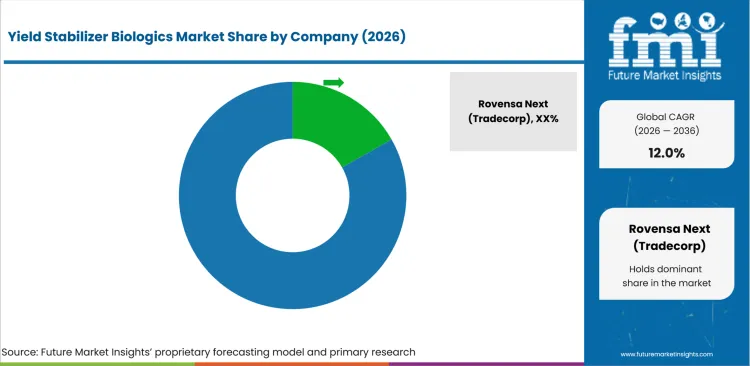
Competition is fragmented between global crop-input groups and specialist biological developers. Entry barriers come from field-evidence depth, regulatory claim discipline and the ability to support agronomists after the first trial. Global groups can scale manufacturing and distribution while specialists differentiate with stress-specific science or focused formulation platforms. Several platforms also sell adjacent biocontrol solutions, which gives agronomy teams a wider biological toolkit without proving yield-stabilizer performance. Buyers compare crop fit and agronomic support before treating portfolio breadth as a deciding factor.
- Global biological platforms: Rovensa Next, Syngenta Biologicals, Bayer Crop Science, Corteva Agriscience, and UPL pair international distribution with multi-crop biological development.
- Stress-management specialists: Acadian Plant Health and Fyteko focus on abiotic-stress response with field programs across broadacre and specialty crops.
- Formulation and commercialization specialist: Seipasa uses biological formulation expertise with partner-led market access in the United States and other regions.
Competitive Benchmarking: Yield Stabilizer Biologics Market
| Company | Stress-Response Evidence | Broadacre Crop Evidence | Scale-Up Infrastructure | Geographic Reach |
|---|---|---|---|---|
| Rovensa Next | High | High | High | Global; 90+ countries |
| Syngenta Biologicals | High | High | High | Global |
| Acadian Plant Health | High | High | Medium | Global specialty and broad-acre crops |
| Bayer Crop Science | Medium | High | Medium | Global |
| Corteva Agriscience | Medium | High | Medium | Global |
| Seipasa | Medium | Low | Medium | Europe and USA partner channels |
| UPL | High | High | High | Global |
| Fyteko | High | High | Medium | Europe and Latin America partner channels |
High stress-response evidence requires documented abiotic-stress programs across multiple crops or stress modes while Medium reflects a narrower resilience route and Low identifies one verified route. High broadacre evidence requires current corn, soybean, cereal or comparable row-crop activity while Medium covers mixed broadacre and specialty use and Low reflects mainly specialty crops. High scale-up infrastructure requires owned research or production capacity plus broad commercialization while Medium relies on regional or partner-led scale-up and Low reflects a narrower commercial route.
Key Developments in the Yield Stabilizer Biologics Market
- In November 2025, Seipasa named Valent BioSciences its exclusive USA commercialization partner for novel biostimulant products including Sweetsei.
- In September 2025, Bayer Crop Science introduced Susteed as a biological seed treatment that combines disease protection with root-growth and nutrient-uptake functions.
- In August 2025, Acadian Plant Health expanded its European CE-marked biostimulant portfolio with a fifth certified product under the EU Fertilising Products Regulation.
Key Players in the Yield Stabilizer Biologics Market
Global Biological Crop-Input Platforms
- Rovensa Next
- Syngenta Biologicals
- Bayer Crop Science
- Corteva Agriscience
- UPL
Specialist Stress-Management Platforms
- Acadian Plant Health
- Fyteko
Biological Formulation and Commercialization Specialist
- Seipasa
Yield Stabilizer Biologics Market - Report Scope
| Coverage field | Report scope |
|---|---|
| Market breakdown | By product type, crop type, application method, farm type, sales channel and region. |
| Quantitative Units | USD Million. |
| Market Definition | Commercial biological crop inputs positioned to preserve yield by improving nutrient use, crop establishment, root function or tolerance to abiotic stress. |
| Regions Covered | North America, Latin America, Europe, East Asia, South Asia and Pacific and Middle East and Africa. |
| Countries Covered | South Korea, Germany, United States, United Kingdom, Japan, and 20+ countries included in the full report. |
| Key Companies Profiled | Rovensa Next, Syngenta Biologicals, Acadian Plant Health, Bayer Crop Science, Corteva Agriscience, Seipasa, UPL, and Fyteko. |
| Forecast Period | 2026 to 2036. |
| Approach | Primary and secondary research with market triangulation. |
Yield Stabilizer Biologics Market - Research Methodology
| Method | Approach |
|---|---|
| Primary Research | FMI analysts gathered input from manufacturers, service providers, technology developers, distributors, end users, procurement teams, and subject-matter experts. Interviews examined purchasing decisions, product or service evaluation, adoption barriers, approval requirements, pricing considerations, and expectations for technical or commercial support. Respondents were also asked what evidence is required before a trial, pilot, or initial order develops into regular purchasing. |
| Desk Research | Desk research covered government statistics, regulatory publications, trade data, industry associations, technical literature, standards, company filings, product information, and official corporate announcements. Sources were reviewed for relevance, publication date, geographic coverage, and consistency with the defined market scope. Claims relating to performance, applications, approvals, capacity, investment, and commercial activity were retained only when supported by credible public evidence. |
| Market Sizing and Forecasting | The market model combined the baseline value with historical performance, segment structure, pricing and volume indicators, adoption levels, company participation, and country-level demand conditions. Forecast assumptions considered economic activity, investment trends, regulatory developments, technology adoption, purchasing cycles, supply availability, and barriers to wider market use. Segment and regional estimates were reconciled before the final market total was calculated. |
| Data Validation | Estimates were checked against multiple independent indicators, including public data, company activity, trade patterns, industry developments, and findings from primary interviews. Validation also tested whether products, services, applications, and company revenues fell within the defined market boundaries. Adjacent categories, unsupported claims, overlapping revenues, and activities without direct market relevance were excluded to reduce double counting and maintain consistency across segments and countries. |
Yield Stabilizer Biologics Market by Segments
Yield Stabilizer Biologics Market segmented by Product Type:
- Amino Acid & Peptide-Based
- Seaweed & Botanical-Based
- Humic / Fulvic-Based
- Microbial-Enhanced Blends
- Others
Yield Stabilizer Biologics Market segmented by Crop Type:
- Cereals & Grains
- Fruits & Vegetables
- Oilseeds & Pulses
- Turf & Ornamentals
- Others
Yield Stabilizer Biologics Market segmented by Application Method:
- Soil Application
- Foliar Application
- Fertigation / Drip
- Seed Application
- Others
Yield Stabilizer Biologics Market segmented by Farm Type:
- Large Commercial Farms
- Mid-Size Farms
- Smallholders
- Greenhouses & Nurseries
- Others
Yield Stabilizer Biologics Market segmented by Sales Channel:
- Agri-Input Distributors
- Cooperatives
- Agri-Retail Chains
- Online / Direct-to-Farm
- Others
Yield Stabilizer Biologics Market by Region:
- North America
- United States
- Canada
- Latin America
- Brazil
- Mexico
- Argentina
- Chile
- Western Europe
- Germany
- France
- United Kingdom
- Italy
- Spain
- Benelux
- Nordics
- Eastern Europe
- Poland
- Czech Republic
- Romania
- Hungary
- East Asia
- China
- Japan
- South Korea
- South Asia and Pacific
- India
- ASEAN
- Australia and New Zealand
- Middle East and Africa
- GCC Countries
- South Africa
- Türkiye
- Israel
Research Sources and Bibliography
- Syngenta. (2025, February 20). Sustainability in agriculture gets a boost with global biologicals partnership.
- USA Environmental Protection Agency. (2025, November 4). Draft guidance for plant regulators and claims, including plant biostimulants.
- Ministry of Agriculture, Forestry and Fisheries of Japan. (2026, March 27). Workshop held on innovative Japanese technologies and approaches contributing to regenerative agriculture and sustainable soil conservation.
- Corteva Agriscience. (2026, March 17). From pipeline to field: Corteva showcases continued innovation to support UK growers at Cereals 2026.
- Fyteko. (2026, March). Fyteko and Agrilife accelerate biostimulant innovation in Brazil.
- USA Department of Agriculture, Economic Research Service. (2026, February 5). Farming and farm income.
- USA Department of Agriculture, Agricultural Research Service. (2026, May 12). Effect of foliar biostimulants on soybean growth and yield across different tillage systems.
- Department for Energy Security and Net Zero. (2025, October 29). Carbon budget and growth delivery plan (Section 14 Report) (accessible webpage).
- Department for Environment, Food and Rural Affairs. (2026, March 19). UK fertilisers: regulatory reform.
- Fyteko. (2025, September 2). Point Americas partnership.
- Rural Development Administration, Republic of Korea. (2026, February 13). 농촌진흥청, ‘화학비료 사용기준 준수 이행점검 세부 지침’ 시행.
- German Environment Agency. (2026, March 5). Indicator: Agricultural nitrogen surplus.
- USA Department of Agriculture, National Agricultural Statistics Service. (2026, June 30). Corn planted acreage down 3% from 2025, soybean acreage up 5% from last year.
- Ministry of Agriculture, Forestry and Fisheries of Japan. (2025, May 30). 「バイオスティミュラントの表示等に係るガイドライン」を策定しました.
- Seipasa. (2025, November 18). Seipasa and Valent BioSciences form strategic partnership in the US.
- Bayer Crop Science. (2025, September 29). Susteed® brings together the best of biologicals and seed treatments.
- Acadian Plant Health. (2025, August 13). Acadian expands CE-marked biostimulant portfolio across Europe.
- Rovensa Next. (2026, February 2). Rovensa Next strengthens global innovation capabilities with new pilot fermentation plant in Brazil.
- Rovensa Next. (2026, March 9). Otimais Duo, Rovensa Next’s high-performance synergistic inoculant for maximizing nutrient efficiency, is launched in Brazil.
- Syngenta. (2025, June 30). Syngenta to become global leader in biologicals by expanding nature-inspired solutions for farmers.
- Acadian Plant Health. (2025, February 19). Acadian Plant Health™ sets new standard for crop resilience with Abiotic Stress Management portfolio.
- Bayer Crop Science. (2025, April 15). SeedGrowth portfolio takes a step up with biological seed treatments Ibisio®, Yoalo® and Susteed®.
- Corteva Agriscience. (2025, May 7). Corteva delivers strong 1Q 2025, reaffirms 2025 outlook.
- Seipasa. (2025, November 7). Seipasa subsidized by IVACE for the development of new biostimulation and biocontrol tools.
- UPL Limited. (2026, May 11). UPL Limited Q4 and FY26 Capital Markets Day 2026.
- Fyteko. (2025, July 23). Kwizda Agro Hungary Kft partnership.
- Bayer Crop Science. (2025, August 11). Introducing Bayer’s biostimulant Yoalo®, which gives plant performance a biological boost.
- Syngenta. (2026, July 14). Syngenta and Groundwork BioAg enter partnership to bring innovation in biologicals and soil carbon solutions to farmers.
- Novonesis. (2026, June 11). Rovensa Next to distribute Novonesis’ biosolutions for Plant Health in the United States.
- Ajinomoto Co., Inc. (2025, March 27). Ajinomoto Group to participate in the Recovery of Degraded Pasture Verification Study project in Brazil.
- Syngenta. (2025, January 9). Artificial intelligence is speeding up the development of the next generation of biostimulants.
- Groundwork BioAg. (2025, February 25). Mycorrhizal Inoculant Leader Groundwork BioAg Expands Rootella Portfolio and Rootella Carbon Program at Commodity Classic 2025.
- Sumitomo Biorational Company. (2026, April 8). Sumitomo Biorational Company marks official launch with inauguration event.
- Fyteko. (2026, May 20). Point Group partnership expansion.
- Hechenbichler GmbH. (2026, March 11). AMALGEROL receives CE marking for its positive effect on agricultural yield.
This bibliography is provided for reader reference and is not exhaustive. The full report contains the complete reference list and detailed citations.
This Report Answers
- How large is the yield stabilizer biologics market in 2026 and what value is forecast for 2036?
- Which operating conditions make growers add yield stabilizer biologics to existing crop programs?
- Why do amino acid & peptide-based products lead the product type category in 2026?
- Why do cereals & grains and soil application hold leading positions in their categories?
- Which country CAGRs are profiled and how narrow is the forecast spread?
- What evidence requirements slow repeat purchase after the first farm trial?
- Which companies are active across global and specialist biological platforms?
- How do companies differ on stress evidence, broadacre proof and scale-up infrastructure?
- Which recent developments changed qualification and channel access for yield stabilizer biologics?
Frequently Asked Questions
Which product type leads the Yield Stabilizer Biologics Market?
The amino acid & peptide-based segment is expected to hold 40.7% of the yield stabilizer biologics market in 2026, supported by flexible formulation and direct plant-response positioning. Agronomists can place these products inside existing nutrient and stress-management programs.
Which crop type leads the Yield Stabilizer Biologics Market?
The cereals & grains segment is expected to hold 40.5% of the yield stabilizer biologics market in 2026, driven by broadacre acreage and strict per-hectare economics. Repeat use depends on small yield gains remaining consistent across commercial field conditions.
Which application method leads the Yield Stabilizer Biologics Market?
The soil application segment is expected to hold 46.4% of the yield stabilizer biologics market in 2026, attributable to root-zone placement inside existing nutrient programs. The method also fits establishment and rhizosphere functions without requiring a separate foliar pass.
How much value will the Yield Stabilizer Biologics Market add between 2026 and 2036?
The yield stabilizer biologics market is expected to add USD 318.4 million in value between 2026 and 2036. The increase reflects wider commercial use where crop-specific trials justify another per-hectare input and local agronomy channels support correct application.
Which countries are projected to record the highest growth in the Yield Stabilizer Biologics Market?
South Korea is projected to grow at 11.7% CAGR, followed by Germany at 11.4% and the United States at 11.1% through 2036. Growth is supported by local nutrient-management programs and broadacre evidence routes that differ across the three countries.
Which companies are active in the Yield Stabilizer Biologics Market?
Key companies operating in the market include Rovensa Next, Syngenta Biologicals, Acadian Plant Health, Bayer Crop Science, Corteva Agriscience, Seipasa, UPL, and Fyteko. These companies compete on stress-response evidence, broadacre crop proof, formulation depth and commercialization infrastructure.
Preview the report firsthand - request a free sample
Get SampleGet the brochure for pricing and purchase details.
Get PDFTable of Content
- Key Takeaways
- Market Size and CAGR
- Top Growth Driver
- Fastest Growing Segment
- Leading Region
- Key Companies
- Emerging Opportunities
- Executive Summary
- Global Market Outlook
- Demand-side Trends
- Supply-side Trends
- Technology Roadmap Analysis
- Analysis and Recommendations
- Analyst Perspective (What is happening? Why now? What should investors know?)
- Key Questions Answered
- How large is the market?
- What is the CAGR?
- What are key trends?
- Which region dominates?
- Who are the leaders?
- Market Overview
- Market Coverage / Taxonomy
- Market Definition / Scope / Limitations
- Research Methodology
- Chapter Orientation
- Analytical Lens and Working Hypotheses
- Market Structure, Signals, and Trend Drivers
- Benchmarking and Cross-market Comparability
- Market Sizing, Forecasting, and Opportunity Mapping
- Research Design and Evidence Framework
- Desk Research Programme (Secondary Evidence)
- Expert Input and Fieldwork (Primary Evidence)
- Tooling, Models, and Reference Databases
- Data Engineering and Model Build
- Quality Assurance and Audit Trail
- Market Background
- Market Dynamics (Drivers, Restraints, Opportunity, Trends)
- Scenario Forecast (Optimistic, Likely, Conservative)
- Impact Analysis
- AI Impact
- Sustainability Impact
- Regulatory Impact
- Technology Impact
- Consumer / Buyer Analysis
- Purchase Drivers
- Adoption Barriers
- Buyer Journey
- Opportunity Map Analysis
- Product Life Cycle Analysis
- Supply Chain Analysis
- Investment Feasibility Matrix
- Value Chain Analysis
- PESTLE and Porter's Analysis
- Regulatory Landscape
- Regional Parent Market Outlook
- Production and Consumption Statistics
- Import and Export Statistics
- Global Market Analysis and Forecast, 2021 to 2036
- Historical Market Size Value (USD Million) Analysis, 2021 to 2025
- Current and Future Market Size Value (USD Million) Projections, 2026 to 2036
- Y-o-Y Growth Trend Analysis
- Absolute $ Opportunity Analysis
- Global Market Pricing Analysis, 2021 to 2036
- Global Market Analysis and Forecast, By Product Type, 2021 to 2036
- Introduction / Key Findings
- Historical Market Size Value (USD Million) Analysis By Product Type, 2021 to 2025
- Current and Future Market Size Value (USD Million) Analysis and Forecast By Product Type, 2026 to 2036
- Amino Acid & Peptide-Based
- Seaweed & Botanical-Based
- Humic / Fulvic-Based
- Microbial-Enhanced Blends
- Others
- Amino Acid & Peptide-Based
- Y-o-Y Growth Trend Analysis By Product Type, 2021 to 2025
- Absolute $ Opportunity Analysis By Product Type, 2026 to 2036
- Global Market Analysis and Forecast, By Crop Type, 2021 to 2036
- Introduction / Key Findings
- Historical Market Size Value (USD Million) Analysis By Crop Type, 2021 to 2025
- Current and Future Market Size Value (USD Million) Analysis and Forecast By Crop Type, 2026 to 2036
- Cereals & Grains
- Fruits & Vegetables
- Oilseeds & Pulses
- Turf & Ornamentals
- Others
- Cereals & Grains
- Y-o-Y Growth Trend Analysis By Crop Type, 2021 to 2025
- Absolute $ Opportunity Analysis By Crop Type, 2026 to 2036
- Global Market Analysis and Forecast, By Application Method, 2021 to 2036
- Introduction / Key Findings
- Historical Market Size Value (USD Million) Analysis By Application Method, 2021 to 2025
- Current and Future Market Size Value (USD Million) Analysis and Forecast By Application Method, 2026 to 2036
- Soil Application
- Foliar Application
- Fertigation / Drip
- Seed Application
- Others
- Soil Application
- Y-o-Y Growth Trend Analysis By Application Method, 2021 to 2025
- Absolute $ Opportunity Analysis By Application Method, 2026 to 2036
- Global Market Analysis and Forecast, By Farm Type, 2021 to 2036
- Introduction / Key Findings
- Historical Market Size Value (USD Million) Analysis By Farm Type, 2021 to 2025
- Current and Future Market Size Value (USD Million) Analysis and Forecast By Farm Type, 2026 to 2036
- Large Commercial Farms
- Mid-Size Farms
- Smallholders
- Greenhouses & Nurseries
- Others
- Large Commercial Farms
- Y-o-Y Growth Trend Analysis By Farm Type, 2021 to 2025
- Absolute $ Opportunity Analysis By Farm Type, 2026 to 2036
- Global Market Analysis and Forecast, By Sales Channel, 2021 to 2036
- Introduction / Key Findings
- Historical Market Size Value (USD Million) Analysis By Sales Channel, 2021 to 2025
- Current and Future Market Size Value (USD Million) Analysis and Forecast By Sales Channel, 2026 to 2036
- Agri-Input Distributors
- Cooperatives
- Agri-Retail Chains
- Online / Direct-to-Farm
- Others
- Agri-Input Distributors
- Y-o-Y Growth Trend Analysis By Sales Channel, 2021 to 2025
- Absolute $ Opportunity Analysis By Sales Channel, 2026 to 2036
- Global Market Analysis and Forecast, By Region, 2021 to 2036
- Introduction
- Historical Market Size Value (USD Million) Analysis By Region, 2021 to 2025
- Current Market Size Value (USD Million) Analysis and Forecast By Region, 2026 to 2036
- North America
- Latin America
- Western Europe
- Eastern Europe
- East Asia
- South Asia and Pacific
- Middle East & Africa
- Market Attractiveness Analysis By Region
- North America Market Analysis and Forecast, By Country, 2021 to 2036
- Historical Market Size Value (USD Million) Trend Analysis By Market Taxonomy, 2021 to 2025
- Market Size Value (USD Million) Forecast By Market Taxonomy, 2026 to 2036
- By Country
- USA
- Canada
- By Product Type
- By Crop Type
- By Application Method
- By Farm Type
- By Sales Channel
- By Country
- Market Attractiveness Analysis
- By Country
- By Product Type
- By Crop Type
- By Application Method
- By Farm Type
- By Sales Channel
- Key Takeaways
- Latin America Market Analysis and Forecast, By Country
- Historical Market Size Value (USD Million) Trend Analysis By Market Taxonomy, 2021 to 2025
- Market Size Value (USD Million) Forecast By Market Taxonomy, 2026 to 2036
- By Country
- Brazil
- Mexico
- Chile
- Rest of Latin America
- By Product Type
- By Crop Type
- By Application Method
- By Farm Type
- By Sales Channel
- By Country
- Market Attractiveness Analysis
- By Country
- By Product Type
- By Crop Type
- By Application Method
- By Farm Type
- By Sales Channel
- Key Takeaways
- Western Europe Market Analysis and Forecast, By Country
- Historical Market Size Value (USD Million) Trend Analysis By Market Taxonomy, 2021 to 2025
- Market Size Value (USD Million) Forecast By Market Taxonomy, 2026 to 2036
- By Country
- Germany
- UK
- Italy
- Spain
- France
- Nordic
- BENELUX
- Rest of Western Europe
- By Product Type
- By Crop Type
- By Application Method
- By Farm Type
- By Sales Channel
- By Country
- Market Attractiveness Analysis
- By Country
- By Product Type
- By Crop Type
- By Application Method
- By Farm Type
- By Sales Channel
- Key Takeaways
- Eastern Europe Market Analysis and Forecast, By Country
- Historical Market Size Value (USD Million) Trend Analysis By Market Taxonomy, 2021 to 2025
- Market Size Value (USD Million) Forecast By Market Taxonomy, 2026 to 2036
- By Country
- Russia
- Poland
- Hungary
- Balkan & Baltic
- Rest of Eastern Europe
- By Product Type
- By Crop Type
- By Application Method
- By Farm Type
- By Sales Channel
- By Country
- Market Attractiveness Analysis
- By Country
- By Product Type
- By Crop Type
- By Application Method
- By Farm Type
- By Sales Channel
- Key Takeaways
- East Asia Market Analysis and Forecast, By Country
- Historical Market Size Value (USD Million) Trend Analysis By Market Taxonomy, 2021 to 2025
- Market Size Value (USD Million) Forecast By Market Taxonomy, 2026 to 2036
- By Country
- China
- Japan
- South Korea
- By Product Type
- By Crop Type
- By Application Method
- By Farm Type
- By Sales Channel
- By Country
- Market Attractiveness Analysis
- By Country
- By Product Type
- By Crop Type
- By Application Method
- By Farm Type
- By Sales Channel
- Key Takeaways
- South Asia and Pacific Market Analysis and Forecast, By Country
- Historical Market Size Value (USD Million) Trend Analysis By Market Taxonomy, 2021 to 2025
- Market Size Value (USD Million) Forecast By Market Taxonomy, 2026 to 2036
- By Country
- India
- ASEAN
- Australia & New Zealand
- Rest of South Asia and Pacific
- By Product Type
- By Crop Type
- By Application Method
- By Farm Type
- By Sales Channel
- By Country
- Market Attractiveness Analysis
- By Country
- By Product Type
- By Crop Type
- By Application Method
- By Farm Type
- By Sales Channel
- Key Takeaways
- Middle East & Africa Market Analysis and Forecast, By Country
- Historical Market Size Value (USD Million) Trend Analysis By Market Taxonomy, 2021 to 2025
- Market Size Value (USD Million) Forecast By Market Taxonomy, 2026 to 2036
- By Country
- Kingdom of Saudi Arabia
- Other GCC Countries
- Türkiye
- South Africa
- Other African Union
- Rest of Middle East & Africa
- By Product Type
- By Crop Type
- By Application Method
- By Farm Type
- By Sales Channel
- By Country
- Market Attractiveness Analysis
- By Country
- By Product Type
- By Crop Type
- By Application Method
- By Farm Type
- By Sales Channel
- Key Takeaways
- Key Countries Market Analysis
- USA
- Pricing Analysis
- Market Share Analysis, 2025
- By Product Type
- By Crop Type
- By Application Method
- By Farm Type
- By Sales Channel
- Canada
- Pricing Analysis
- Market Share Analysis, 2025
- By Product Type
- By Crop Type
- By Application Method
- By Farm Type
- By Sales Channel
- Mexico
- Pricing Analysis
- Market Share Analysis, 2025
- By Product Type
- By Crop Type
- By Application Method
- By Farm Type
- By Sales Channel
- Brazil
- Pricing Analysis
- Market Share Analysis, 2025
- By Product Type
- By Crop Type
- By Application Method
- By Farm Type
- By Sales Channel
- Chile
- Pricing Analysis
- Market Share Analysis, 2025
- By Product Type
- By Crop Type
- By Application Method
- By Farm Type
- By Sales Channel
- Germany
- Pricing Analysis
- Market Share Analysis, 2025
- By Product Type
- By Crop Type
- By Application Method
- By Farm Type
- By Sales Channel
- UK
- Pricing Analysis
- Market Share Analysis, 2025
- By Product Type
- By Crop Type
- By Application Method
- By Farm Type
- By Sales Channel
- Italy
- Pricing Analysis
- Market Share Analysis, 2025
- By Product Type
- By Crop Type
- By Application Method
- By Farm Type
- By Sales Channel
- Spain
- Pricing Analysis
- Market Share Analysis, 2025
- By Product Type
- By Crop Type
- By Application Method
- By Farm Type
- By Sales Channel
- France
- Pricing Analysis
- Market Share Analysis, 2025
- By Product Type
- By Crop Type
- By Application Method
- By Farm Type
- By Sales Channel
- India
- Pricing Analysis
- Market Share Analysis, 2025
- By Product Type
- By Crop Type
- By Application Method
- By Farm Type
- By Sales Channel
- ASEAN
- Pricing Analysis
- Market Share Analysis, 2025
- By Product Type
- By Crop Type
- By Application Method
- By Farm Type
- By Sales Channel
- Australia & New Zealand
- Pricing Analysis
- Market Share Analysis, 2025
- By Product Type
- By Crop Type
- By Application Method
- By Farm Type
- By Sales Channel
- China
- Pricing Analysis
- Market Share Analysis, 2025
- By Product Type
- By Crop Type
- By Application Method
- By Farm Type
- By Sales Channel
- Japan
- Pricing Analysis
- Market Share Analysis, 2025
- By Product Type
- By Crop Type
- By Application Method
- By Farm Type
- By Sales Channel
- South Korea
- Pricing Analysis
- Market Share Analysis, 2025
- By Product Type
- By Crop Type
- By Application Method
- By Farm Type
- By Sales Channel
- Russia
- Pricing Analysis
- Market Share Analysis, 2025
- By Product Type
- By Crop Type
- By Application Method
- By Farm Type
- By Sales Channel
- Poland
- Pricing Analysis
- Market Share Analysis, 2025
- By Product Type
- By Crop Type
- By Application Method
- By Farm Type
- By Sales Channel
- Hungary
- Pricing Analysis
- Market Share Analysis, 2025
- By Product Type
- By Crop Type
- By Application Method
- By Farm Type
- By Sales Channel
- Kingdom of Saudi Arabia
- Pricing Analysis
- Market Share Analysis, 2025
- By Product Type
- By Crop Type
- By Application Method
- By Farm Type
- By Sales Channel
- Türkiye
- Pricing Analysis
- Market Share Analysis, 2025
- By Product Type
- By Crop Type
- By Application Method
- By Farm Type
- By Sales Channel
- South Africa
- Pricing Analysis
- Market Share Analysis, 2025
- By Product Type
- By Crop Type
- By Application Method
- By Farm Type
- By Sales Channel
- USA
- Market Structure Analysis
- Competition Dashboard
- Competition Benchmarking
- Market Share Analysis of Top Players
- By Regional
- By Product Type
- By Crop Type
- By Application Method
- By Farm Type
- By Sales Channel
- Emerging Startups
- Innovation Benchmarking
- Competition Analysis
- Competition Deep Dive
- Rovensa Next (Tradecorp)
- Overview
- Product Portfolio
- Profitability by Market Segments
- Sales Footprint
- Strategy Overview
- Marketing Strategy
- Product Strategy
- Channel Strategy
- Hello Nature (Italpollina)
- Acadian Plant Health
- Biolchim
- Atlantica Agricola
- Brandt
- Seipasa
- Kimitec
- Rovensa Next (Tradecorp)
- Case Studies
- Success Stories
- Recent Developments
- Competition Deep Dive
- Assumptions & Acronyms Used


