

- Market Size (2026)
- USD 17.2 Mn
- Forecast (2036)
- USD 69.2 Mn
- CAGR (2026 to 2036)
- 14.9%
How Big is the Feline Geofencing Market in 2026?
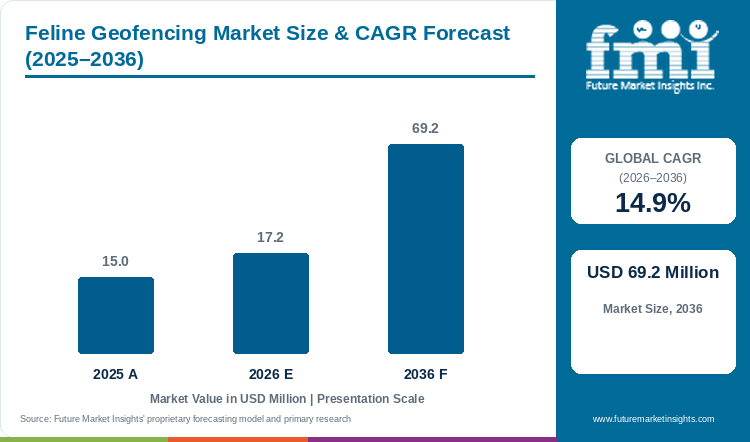
The feline geofencing market is valued at USD 17.2 million in 2026, compared with USD 15.0 million in 2025.
FMI values the market at USD 17.2 million in 2026 and forecasts it to reach USD 69.2 million by 2036 at a 14.9% CAGR. The market stood at USD 15.0 million in 2025. Demand for feline geofencing is supported by the need to reduce the time between a cat leaving its usual area and the owner starting a search. Faster alerts can improve the chance of locating the animal before it moves farther away. This gives boundary notifications a clear advantage over products that only show location after the owner begins looking.
Tractive and Kippy both document virtual fences that send a phone notification after the animal leaves a safe area. This shifts the product from a recovery tool toward an early-warning system. Owners therefore gain more value when geofencing is combined with live location rather than offered as a separate feature. [2] [3]
Product development is also widening the reason to keep a tracker in regular use. Tractive launched CAT 6 Mini on April 8 2026 as its first collar-integrated GPS and health tracker for cats. Combining territory data with health monitoring can increase everyday use and reduce dependence on escape events alone. This places feline geofencing within the wider smart pet collars market as suppliers compete on both safety and routine monitoring. [1]
Growth is still limited by the trade-off between tracking performance and wearable design. More frequent location updates increase the need for power and network access while smaller cat devices have less room for batteries. This links the market with broader GPS tracking devices, but feline products face tighter limits on weight and attachment size. Suppliers that improve battery use without weakening alert speed can address one of the main barriers to continued adoption.
Key Takeaways
- By Product Type, Collars are projected to account for 75.0% of market revenue in 2026.
- By Application, Boundary Monitoring is estimated to account for 42.0% of market revenue in 2026.
- By End User, Single-cat Households are estimated to account for 62.0% of market revenue in 2026.
- By Sales Channel, Brand Websites are estimated to account for 44.0% of market revenue in 2026.
- The USA is expected to record the fastest profiled country CAGR at 16.6% from 2026 to 2036.
- Tractive, Kippy and Weenect are the main profiled GPS geofencing platforms. Tabcat and Catlog remain adjacent recovery or monitoring alternatives.
Analyst Perspective
“Demand in feline geofencing will depend on whether owners receive useful alerts consistently during normal use. Poor collar fit can reduce wear time, frequent charging can create monitoring gaps and weak mobile coverage can delay notifications. Suppliers that improve battery life, reduce setup complexity and maintain reliable alerts are more likely to support longer subscription use and repeat hardware purchases.”
- Rahul Pandita, Principal Consultant, Future Market Insights
How is the Feline Geofencing Market Segmented?
FMI segments the feline geofencing market by Product Type, Application, End User, Sales Channel and Country.
By Product Type, the market is segmented into Collars and Implants. Application covers Boundary Monitoring, Escape Recovery & Live Tracking, Territory & Roaming Monitoring and Integrated Safety & Health Monitoring. End User covers Single-cat Households, Multi-cat Households, Shelters & Rescue Organizations and Breeders & Foster Networks. Sales Channel covers Brand Websites, E-commerce Marketplaces, Pet Specialty Retail and Insurance/Veterinary Partnerships. Country analysis covers the USA, Germany, Spain, the UK, Italy, the Netherlands, Australia and Canada.
Why do Collars lead demand within the Product Type category?
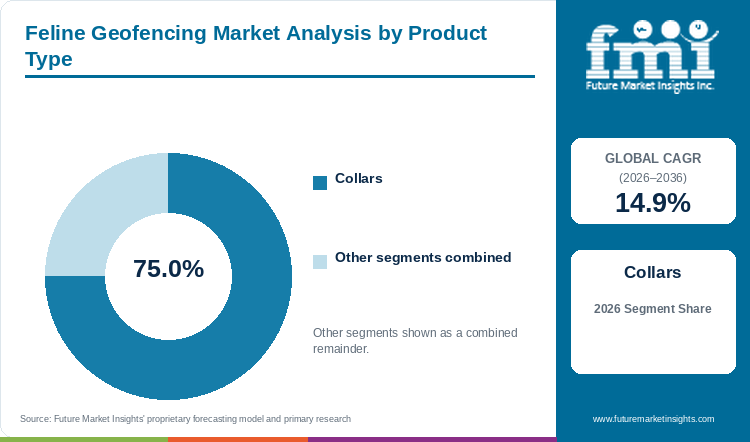
Collars are projected to account for 75.0% of Product Type revenue in 2026.
Collars are projected to dominate Product Type revenue because they combine lower adoption friction with a faster replacement and upgrade cycle. Owners can add or replace a collar-based tracker without a veterinary procedure, while suppliers can introduce smaller batteries, improved antennas or new health features without changing the basic usage model. Tractive CAT 6 Mini illustrates this direction through a safety-release collar designed for cats weighing 3 to 8 kg. In commercial terms, this supports broader addressable demand and gives suppliers more opportunities for hardware upgrades over the life of the customer relationship.
The main constraint is service continuity. Charging periods and attachment loss reduce the number of hours in which the device can provide location or boundary alerts. This directly affects the value of the subscription because owners are paying for continuing access to tracking rather than for the hardware alone. Suppliers that extend battery life and improve collar retention can therefore reduce usage gaps and support stronger renewal economics.
- By Product Type, Collars are projected to account for 75.0% of market revenue in 2026.
- Implants account for the remaining 25.0% of Product Type revenue. Their growth is constrained by the need for active power and communication capability, while passive identification chips do not provide continuous location tracking. [9]
Why does Boundary Monitoring lead demand within the Application category?
Boundary Monitoring is estimated to account for 42.0% of Application revenue in 2026.
Boundary Monitoring is estimated to lead Application revenue. The commercial value is based on shortening the time between boundary exit and owner response. Tractive and Kippy both connect virtual-fence alerts with phone notifications and live location tools, which allows companies to position geofencing as an active monitoring service rather than a recovery-only product. This supports more frequent app engagement and gives subscription-based platforms a stronger reason to remain active between escape events. [2] [3]
The segment also benefits from a clear gap between active tracking and passive identification. Passive microchips address identification after recovery, while geofencing addresses the period before recovery begins. This difference supports demand for active tracking among owners who place greater value on faster notification and earlier search initiation. [9]
- By Application, Boundary Monitoring is estimated to account for 42.0% of market revenue in 2026.
- Escape Recovery & Live Tracking follows because a boundary alert often becomes the trigger for the owner to begin an active search.
Why do Single-cat Households lead demand within the End User category?
Single-cat Households are estimated to account for 62.0% of End User revenue in 2026.
Single-cat households lead because the purchase involves one device and one recurring service plan. This keeps both upfront spending and subscription cost lower than in a multi-cat household. Multi-cat households offer higher unit potential but face a higher total cost of ownership. Each additional cat generally requires another active tracker and may add recurring service cost. Family-account features can simplify monitoring, but they do not remove the need for separate hardware on each animal. This limits penetration as the number of tracked cats increases. [29]
- By End User, Single-cat Households are estimated to account for 62.0% of market revenue in 2026.
- Multi-cat Households form the next major group but adoption depends on whether owners accept the higher per-household hardware and subscription cost.
Why do Brand Websites lead demand within the Sales Channel category?
Brand Websites are estimated to account for 44.0% of Sales Channel revenue in 2026.
Brand websites lead because feline geofencing is sold as a hardware-and-service package rather than as a standalone device. Buyers need to understand network coverage and subscription terms before activation. Direct sales allow suppliers to control this process from product selection through plan enrollment, which reduces the risk of a device being purchased without a suitable service option. Tractive supports direct online purchasing and also lists authorized retail channels by market. [30]
Direct channels also give suppliers more control over subscription renewal and customer onboarding. This is commercially important because recurring service revenue continues after the initial hardware sale. Marketplaces remain useful for product comparison and customer acquisition, but they provide less control over activation and plan selection. A similar channel structure is visible across connected pet gadgets that combine hardware with app-based services.
- By Sales Channel, Brand Websites are estimated to account for 44.0% of market revenue in 2026.
- E-commerce Marketplaces are estimated to hold 29.0% as they remain important for price comparison and product discovery.
What are the Drivers, Restraints, and Opportunities in the Feline Geofencing Market?
Driver: escape alerts give owners earlier warning. Restraint: battery and coverage can interrupt tracking. Opportunity: lighter cat-specific devices can combine location and health features.
- Driver: Demand is supported by the shift from post-loss recovery to earlier owner intervention. Virtual fences notify owners when a cat leaves a defined area and can trigger live tracking before the animal travels farther. [2] [13]
- Restraint: Adoption is limited by the trade-off between tracking intensity and service continuity. More frequent location updates consume battery faster while weak GPS or cellular coverage can delay tracking. These constraints reduce the value of the service when owners cannot rely on continuous alerts. [14] [24]
- Opportunity: Brands can widen usage by combining location safety with health and territory monitoring. For instance, Tractive CAT 6 Mini adds health tracking to the same device used for GPS safety. This can increase the number of situations in which owners keep the device active and strengthen the value of the subscription beyond escape events. [1]
The main operating challenge is alert reliability. Kippy states that live updates can slow when GPS or GSM signals are unavailable and its geofence requires a minimum zone size. This means product performance depends partly on the environment in which the tracker is used. Larger outdoor areas may be easier to monitor than small boundaries where location error becomes more important. [3]
Battery management creates a second commercial constraint. Weenect advises users to reduce location frequency when longer battery life is required while Tractive uses power-saving zones to cut unnecessary updates. Better power management can reduce charging gaps and improve the amount of time a tracker remains active. [14] [17]
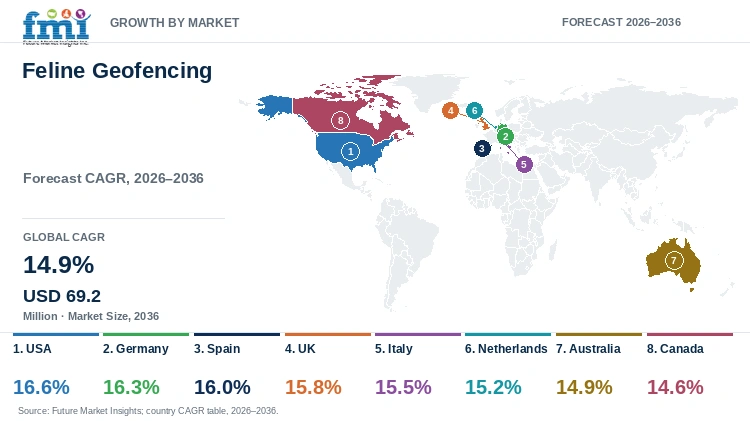
Which country CAGRs are profiled in the Feline Geofencing Market?
| Country | CAGR |
|---|---|
| USA | 16.6% |
| Germany | 16.3% |
| Spain | 16.0% |
| UK | 15.8% |
| Italy | 15.5% |
| Netherlands | 15.2% |
| Australia | 14.9% |
| Canada | 14.6% |
Country-wise Analysis
The market can be classified broadly into three groups. Germany and the Netherlands benefit from very strong mobile infrastructure that supports continuous outdoor tracking. The USA, UK and Canada combine large addressable markets with mature mobile networks but still face differences in coverage outside dense areas. Spain, Italy and Australia have credible growth potential where direct supplier presence or high mobile usage lowers adoption friction, although network quality and recurring cost remain important constraints.
- USA: The market benefits from a large connected-pet base and broad mobile coverage. Service quality can still vary outside dense areas, which affects GPS tracking performance. Tractive’s acquisition of Whistle improves its US distribution and customer reach. [4]
- Germany: Around 98% of the country had 4G or 5G mobile broadband coverage in October 2025. This supports continuous outdoor tracking across most areas. Uelzener also reimburses eligible Tractive subscription costs, which can reduce the recurring cost for some customers. [23]
- Spain: Strong digital infrastructure supports app-based GPS tracking and connected-device use. Musky also offers an insurance-linked route that can reimburse eligible Tractive subscription costs. [26]
- UK: The country has broad tracker availability and more than 9 million pet cats were covered when mandatory microchipping took effect in England in 2024. Microchips help identify a recovered cat, while GPS trackers provide active location and boundary alerts. [12] [24]
- Italy: Kippy provides a domestic cat-tracking product with live location and embedded SIM connectivity. This gives buyers a local option that combines hardware and ongoing tracking service. [21] [28]
- Netherlands: Strong mobile coverage supports continuous location tracking. Figo also offers reimbursement for eligible Tractive subscriptions, which can lower the cost of ongoing service. [24] [27]
- Australia: Mobile internet use is high and trackers are available through several retail channels. Coverage is less consistent outside major population centers, so performance can vary by location. [30]
- Canada: Mobile coverage is broad and 5G reaches most of the population. Rural and remote areas still have weaker coverage, which can affect continuous GPS tracking. [24] [30]
Who are the Notable Companies in the Feline Geofencing Market?
Tractive, Kippy and Weenect are notable direct geofencing platforms. Tabcat and Catlog are adjacent recovery and monitoring alternatives.
Tractive, Kippy and Weenect compete directly in feline geofencing through GPS tracking and boundary alerts. Tractive focuses on cat-specific hardware and app-based virtual fences. Kippy combines GPS location with geofence alerts and a subscription service. Weenect also offers safety-zone notifications and live tracking. [2] [3] [13]
Competition depends on product fit and service reliability. A lighter device can improve regular wear while longer battery life reduces tracking gaps. Mobile coverage and subscription cost also affect continued use because the value of the product depends on reliable alerts over time.
- GPS Geofencing Platforms: Tractive, Kippy and Weenect combine virtual-boundary alerts with live location tracking.
- Adjacent Recovery and Monitoring: Tabcat uses local RF homing while Catlog focuses on behavior monitoring and assisted search. These products address recovery or monitoring needs but do not provide the same continuous geofencing function. [6] [7] [8]
Competitive Benchmarking
| Company / Platform | Boundary Alerts | Cat-specific Fit | Service Continuity | Geographic Reach |
|---|---|---|---|---|
| Tractive | High | High | High | High |
| Kippy | High | High | Medium | Medium |
| Weenect | High | High | Medium | Medium |
| Tabcat | Low | High | High | Medium |
| Catlog (RABO) | Low | High | Medium | Low |
High indicates broad documented capability or reach. Medium indicates a credible but narrower role. Low indicates limited participation in the stated criterion. Ratings do not represent product quality or market share.
Key Developments in the Feline Geofencing Market
- In July 2025, Tractive acquired Whistle from Mars Petcare and added its US customer base and technology assets. [4]
- In February 2026, Tractive partnered with Spot Pet Insurance in the USA and offered eligible customers a complimentary device. [22]
- In March 2026, Uelzener became the first German insurer to reimburse eligible Tractive subscription costs. [23]
- In April 2026, Tractive launched CAT 6 Mini as its first collar-integrated GPS and health tracker designed specifically for cats. [1]
Key Players
GPS Geofencing Platforms
- Tractive, including acquired Whistle assets; owned by Bending Spoons
- Kippy
- Weenect
Adjacent Recovery and Monitoring Platforms
- Tabcat
- Catlog from RABO
Report Scope and Methodology
| Coverage field | Report scope |
|---|---|
| Market breakdown | Product Type; Application; End User; Sales Channel; Country |
| Quantitative units | USD Million; revenue shares in percent; CAGR for 2026 to 2036 |
| Market definition | Revenue from active feline location devices with a virtual-boundary alert function. Collar-integrated and collar-mounted formats are included. Active-location implants form the second Product Type category. Passive ID chips and local RF homing without geofencing are excluded from market revenue. |
| Countries covered | USA; Germany; Spain; UK; Italy; Netherlands; Australia; Canada |
| Key companies profiled | Tractive; Kippy; Weenect. Adjacent comparators: Tabcat and Catlog from RABO. |
| Forecast period | 2026 to 2036; historical comparison 2025 |
Research Methodology
| Method | Approach |
|---|---|
| Primary and desk research | FMI combines market inputs with manufacturer product documentation and official policy sources. Research covers location alerts, product fit, subscription structure and documented country availability. |
| Market sizing and forecasting | Market sizing starts from USD 15.0 million in 2025 and USD 17.2 million in 2026. FMI forecasts USD 69.2 million by 2036 at a 14.9% CAGR. |
| Segment estimation | Product Type forecasting uses a 75.0% Collar and 25.0% Implant split. Application, End User and Sales Channel shares are FMI analyst estimates based on product use and current supplier routes. |
| Country forecasting | Country CAGRs are FMI analyst estimates based on product availability, recurring-service access, supplier activity and current commercial partnerships. |
| Data validation | Direct geofencing suppliers are separated from passive identification and local recovery tools. Parent and acquired businesses are consolidated to avoid duplicate company treatment. |
Feline Geofencing Market by Segments
Feline Geofencing Market Segmented by Product Type
- Collars
- Implants
Feline Geofencing Market Segmented by Application
- Boundary Monitoring
- Escape Recovery & Live Tracking
- Territory & Roaming Monitoring
- Integrated Safety & Health Monitoring
Feline Geofencing Market Segmented by End User
- Single-cat Households
- Multi-cat Households
- Shelters & Rescue Organizations
- Breeders & Foster Networks
Feline Geofencing Market Segmented by Sales Channel
- Brand Websites
- E-commerce Marketplaces
- Pet Specialty Retail
- Insurance/Veterinary Partnerships
Feline Geofencing Market by Region
- North America
- United States
- Canada
- Latin America
- Brazil
- Mexico
- Argentina
- Chile
- Western Europe
- Germany
- France
- United Kingdom
- Italy
- Spain
- Benelux
- Nordics
- Eastern Europe
- Poland
- Czech Republic
- Romania
- Hungary
- East Asia
- China
- Japan
- South Korea
- South Asia and Pacific
- India
- ASEAN
- Australia and New Zealand
- Middle East and Africa
- GCC Countries
- South Africa
- Türkiye
- Israel
Research Sources and Bibliography
- [1] Tractive (April 8, 2026). Tractive Launches Next-Generation Health Intelligence for Pets.
- [2] Tractive (accessed October 5, 2026). How to use Tractive Virtual Fences.
- [3] Kippy (accessed October 5, 2026). Kippy EVO GPS for Dogs and Cats: App Functions.
- [4] Tractive (July 28, 2025). Tractive Acquires Whistle from Mars Petcare.
- [5] Tractive and Bending Spoons (May 18, 2026). Bending Spoons Closes Acquisition of Tractive.
- [6] Tabcat (accessed October 4, 2026). Cat Tracker FAQs and Support.
- [7] RABO (accessed October 4, 2026). Catlog Frequently Asked Questions.
- [8] RABO (accessed October 4, 2026). About the Missing Cat Search Feature.
- [9] American Veterinary Medical Association (accessed October 4, 2026). Microchipping FAQs for Pet Owners.
- [10] Council of the European Union (May 22, 2026). Council Approves a Deal on Strengthening the Welfare and Traceability of Cats and Dogs.
- [11] European Parliament (April 28, 2026). First EU Rules to Protect Cats and Dogs from Abuses.
- [12] Defra (June 10, 2024). Cat Microchipping Now Mandatory.
- [13] Weenect (accessed October 4, 2026). The Weenect App.
- [14] Weenect (August 27, 2025). How to Configure Your Weenect Tracker According to Your Usage.
- [15] Weenect (accessed October 4, 2026). Weenect XS Mini GPS Cat Collar.
- [16] Tractive (accessed October 4, 2026). CAT 6 Mini GPS Cat Tracker Specifications.
- [17] Tractive (accessed October 4, 2026). GPS Tracker Battery and Power Saving Zones.
- [18] United Corporation (February 21, 2025). Investment in RABO Inc Provider of Catlog and Catlog Board.
- [19] Tabcat (accessed October 4, 2026). Tabcat US Radio Frequency Cat Tracker.
- [20] Kippy (accessed October 4, 2026). Kippy CAT GPS and Activity Monitor User Manual.
- [21] Kippy (accessed October 4, 2026). Kippy CAT GPS Tracking and Activity Monitoring.
- [22] Tractive (February 6, 2026). Tractive Partners with Spot Pet Insurance to Enhance Pet Safety and Care.
- [23] Tractive (March 17, 2026). Uelzener Becomes First in German Insurance to Reimburse Tractive Subscriptions.
- [24] Tractive (accessed October 5, 2026). Where does Tractive work?
- [25] Kippy (September 15, 2026). How to Set Up a Safe Area (Virtual Fence / Geofence).
- [26] Tractive (February 6, 2026). Musky Becomes First Pet Insurer to Offer Tractive Devices and Subscription Reimbursement.
- [27] Tractive (accessed October 5, 2026). Will my insurance reimburse my Tractive subscription?
- [28] Kippy (accessed October 5, 2026). Kippy CAT GPS Tracker for Cats.
- [29] Tractive (accessed October 5, 2026). Family Sharing permissions and features.
- [30] Tractive (accessed October 5, 2026). Where can I buy Tractive smart pet trackers?
This bibliography is provided for reader reference. The full report contains the complete reference list and supporting research.
This Report Answers
- What is the Feline Geofencing Market size in 2026?
- What value is forecast for the Feline Geofencing Market by 2036?
- Which Product Type holds the leading 2026 share?
- Which Application holds the leading 2026 share?
- Which End User group holds the leading 2026 share?
- Which Sales Channel holds the leading 2026 share?
- Which country has the fastest profiled growth outlook through 2036?
- Which companies are notable in feline geofencing today?
Frequently Asked Questions
How big is the Feline Geofencing Market in 2026?
FMI values the feline geofencing market at USD 17.2 million in 2026 compared with USD 15.0 million in 2025. Sales are forecast to reach USD 69.2 million by 2036.
What is the CAGR of the Feline Geofencing Market from 2026 to 2036?
The market is forecast to expand at a 14.9% CAGR between 2026 and 2036.
Which Product Type holds the largest share of the Feline Geofencing Market?
By Product Type, Collars are projected to account for 75.0% of market revenue in 2026. Implants account for the remaining 25.0%.
Which Application leads the Feline Geofencing Market?
FMI estimates Boundary Monitoring to account for 42.0% of Application revenue in 2026. The use case centers on alerts when a cat crosses a chosen safe or no-go boundary.
Which country has the strongest growth outlook in the Feline Geofencing Market?
FMI estimates the USA to record a 16.6% CAGR from 2026 to 2036. Platform consolidation and insurance partnerships are improving access to active GPS tracking.
Which are the key companies in the Feline Geofencing Market?
Tractive, Kippy and Weenect are the main profiled GPS geofencing platforms. Tabcat and Catlog are adjacent recovery or monitoring alternatives.
Preview the report firsthand - request a free sample
Get SampleGet the brochure for pricing and purchase details.
Get PDFTable of Content
- Key Takeaways
- Market Size and CAGR
- Top Growth Driver
- Fastest Growing Segment
- Leading Region
- Key Companies
- Emerging Opportunities
- Executive Summary
- Global Market Outlook
- Demand-side Trends
- Supply-side Trends
- Technology Roadmap Analysis
- Analysis and Recommendations
- Analyst Perspective (What is happening? Why now? What should investors know?)
- Key Questions Answered
- How large is the market?
- What is the CAGR?
- What are key trends?
- Which region dominates?
- Who are the leaders?
- Market Overview
- Market Coverage / Taxonomy
- Market Definition / Scope / Limitations
- Research Methodology
- Chapter Orientation
- Analytical Lens and Working Hypotheses
- Market Structure, Signals, and Trend Drivers
- Benchmarking and Cross-market Comparability
- Market Sizing, Forecasting, and Opportunity Mapping
- Research Design and Evidence Framework
- Desk Research Programme (Secondary Evidence)
- Expert Input and Fieldwork (Primary Evidence)
- Tooling, Models, and Reference Databases
- Data Engineering and Model Build
- Quality Assurance and Audit Trail
- Market Background
- Market Dynamics (Drivers, Restraints, Opportunity, Trends)
- Scenario Forecast (Optimistic, Likely, Conservative)
- Impact Analysis
- AI Impact
- Sustainability Impact
- Regulatory Impact
- Technology Impact
- Consumer / Buyer Analysis
- Purchase Drivers
- Adoption Barriers
- Buyer Journey
- Opportunity Map Analysis
- Product Life Cycle Analysis
- Supply Chain Analysis
- Investment Feasibility Matrix
- Value Chain Analysis
- PESTLE and Porter's Analysis
- Regulatory Landscape
- Regional Parent Market Outlook
- Production and Consumption Statistics
- Import and Export Statistics
- Global Market Analysis and Forecast, 2021 to 2036
- Historical Market Size Value (USD Million) Analysis, 2021 to 2025
- Current and Future Market Size Value (USD Million) Projections, 2026 to 2036
- Y-o-Y Growth Trend Analysis
- Absolute $ Opportunity Analysis
- Global Market Pricing Analysis, 2021 to 2036
- Global Market Analysis and Forecast, By Product Type, 2021 to 2036
- Introduction / Key Findings
- Historical Market Size Value (USD Million) Analysis By Product Type, 2021 to 2025
- Current and Future Market Size Value (USD Million) Analysis and Forecast By Product Type, 2026 to 2036
- Collars
- Implants
- Y-o-Y Growth Trend Analysis By Product Type, 2021 to 2025
- Absolute $ Opportunity Analysis By Product Type, 2026 to 2036
- Global Market Analysis and Forecast, By Application, 2021 to 2036
- Introduction / Key Findings
- Historical Market Size Value (USD Million) Analysis By Application, 2021 to 2025
- Current and Future Market Size Value (USD Million) Analysis and Forecast By Application, 2026 to 2036
- Boundary Monitoring
- Escape Recovery & Live Tracking
- Territory & Roaming Monitoring
- Integrated Safety & Health Monitoring
- Y-o-Y Growth Trend Analysis By Application, 2021 to 2025
- Absolute $ Opportunity Analysis By Application, 2026 to 2036
- Global Market Analysis and Forecast, By End User, 2021 to 2036
- Introduction / Key Findings
- Historical Market Size Value (USD Million) Analysis By End User, 2021 to 2025
- Current and Future Market Size Value (USD Million) Analysis and Forecast By End User, 2026 to 2036
- Single-cat Households
- Multi-cat Households
- Shelters & Rescue Organizations
- Breeders & Foster Networks
- Y-o-Y Growth Trend Analysis By End User, 2021 to 2025
- Absolute $ Opportunity Analysis By End User, 2026 to 2036
- Global Market Analysis and Forecast, By Sales Channel, 2021 to 2036
- Introduction / Key Findings
- Historical Market Size Value (USD Million) Analysis By Sales Channel, 2021 to 2025
- Current and Future Market Size Value (USD Million) Analysis and Forecast By Sales Channel, 2026 to 2036
- Brand Websites
- E-commerce Marketplaces
- Pet Specialty Retail
- Insurance/Veterinary Partnerships
- Y-o-Y Growth Trend Analysis By Sales Channel, 2021 to 2025
- Absolute $ Opportunity Analysis By Sales Channel, 2026 to 2036
- Global Market Analysis and Forecast, By Region, 2021 to 2036
- Introduction
- Historical Market Size Value (USD Million) Analysis By Region, 2021 to 2025
- Current Market Size Value (USD Million) Analysis and Forecast By Region, 2026 to 2036
- North America
- Latin America
- Western Europe
- Eastern Europe
- East Asia
- South Asia and Pacific
- Middle East and Africa
- Market Attractiveness Analysis By Region
- North America Market Analysis and Forecast, By Country, 2021 to 2036
- Historical Market Size Value (USD Million) Trend Analysis By Market Taxonomy, 2021 to 2025
- Market Size Value (USD Million) Forecast By Market Taxonomy, 2026 to 2036
- By Country
- United States
- Canada
- By Product Type
- By Application
- By End User
- By Sales Channel
- By Country
- Market Attractiveness Analysis
- By Country
- By Product Type
- By Application
- By End User
- By Sales Channel
- Key Takeaways
- Latin America Market Analysis and Forecast, By Country
- Historical Market Size Value (USD Million) Trend Analysis By Market Taxonomy, 2021 to 2025
- Market Size Value (USD Million) Forecast By Market Taxonomy, 2026 to 2036
- By Country
- Brazil
- Mexico
- Argentina
- Chile
- By Product Type
- By Application
- By End User
- By Sales Channel
- By Country
- Market Attractiveness Analysis
- By Country
- By Product Type
- By Application
- By End User
- By Sales Channel
- Key Takeaways
- Western Europe Market Analysis and Forecast, By Country
- Historical Market Size Value (USD Million) Trend Analysis By Market Taxonomy, 2021 to 2025
- Market Size Value (USD Million) Forecast By Market Taxonomy, 2026 to 2036
- By Country
- Germany
- France
- United Kingdom
- Italy
- Spain
- Benelux
- Nordics
- By Product Type
- By Application
- By End User
- By Sales Channel
- By Country
- Market Attractiveness Analysis
- By Country
- By Product Type
- By Application
- By End User
- By Sales Channel
- Key Takeaways
- Eastern Europe Market Analysis and Forecast, By Country
- Historical Market Size Value (USD Million) Trend Analysis By Market Taxonomy, 2021 to 2025
- Market Size Value (USD Million) Forecast By Market Taxonomy, 2026 to 2036
- By Country
- Poland
- Czech Republic
- Romania
- Hungary
- By Product Type
- By Application
- By End User
- By Sales Channel
- By Country
- Market Attractiveness Analysis
- By Country
- By Product Type
- By Application
- By End User
- By Sales Channel
- Key Takeaways
- East Asia Market Analysis and Forecast, By Country
- Historical Market Size Value (USD Million) Trend Analysis By Market Taxonomy, 2021 to 2025
- Market Size Value (USD Million) Forecast By Market Taxonomy, 2026 to 2036
- By Country
- China
- Japan
- South Korea
- By Product Type
- By Application
- By End User
- By Sales Channel
- By Country
- Market Attractiveness Analysis
- By Country
- By Product Type
- By Application
- By End User
- By Sales Channel
- Key Takeaways
- South Asia and Pacific Market Analysis and Forecast, By Country
- Historical Market Size Value (USD Million) Trend Analysis By Market Taxonomy, 2021 to 2025
- Market Size Value (USD Million) Forecast By Market Taxonomy, 2026 to 2036
- By Country
- India
- ASEAN
- Australia and New Zealand
- By Product Type
- By Application
- By End User
- By Sales Channel
- By Country
- Market Attractiveness Analysis
- By Country
- By Product Type
- By Application
- By End User
- By Sales Channel
- Key Takeaways
- Middle East and Africa Market Analysis and Forecast, By Country
- Historical Market Size Value (USD Million) Trend Analysis By Market Taxonomy, 2021 to 2025
- Market Size Value (USD Million) Forecast By Market Taxonomy, 2026 to 2036
- By Country
- GCC Countries
- South Africa
- Türkiye
- Israel
- By Product Type
- By Application
- By End User
- By Sales Channel
- By Country
- Market Attractiveness Analysis
- By Country
- By Product Type
- By Application
- By End User
- By Sales Channel
- Key Takeaways
- Key Countries Market Analysis
- United States
- Pricing Analysis
- Market Share Analysis, 2025
- By Product Type
- By Application
- By End User
- By Sales Channel
- Canada
- Pricing Analysis
- Market Share Analysis, 2025
- By Product Type
- By Application
- By End User
- By Sales Channel
- Mexico
- Pricing Analysis
- Market Share Analysis, 2025
- By Product Type
- By Application
- By End User
- By Sales Channel
- Brazil
- Pricing Analysis
- Market Share Analysis, 2025
- By Product Type
- By Application
- By End User
- By Sales Channel
- Chile
- Pricing Analysis
- Market Share Analysis, 2025
- By Product Type
- By Application
- By End User
- By Sales Channel
- Germany
- Pricing Analysis
- Market Share Analysis, 2025
- By Product Type
- By Application
- By End User
- By Sales Channel
- United Kingdom
- Pricing Analysis
- Market Share Analysis, 2025
- By Product Type
- By Application
- By End User
- By Sales Channel
- Italy
- Pricing Analysis
- Market Share Analysis, 2025
- By Product Type
- By Application
- By End User
- By Sales Channel
- Spain
- Pricing Analysis
- Market Share Analysis, 2025
- By Product Type
- By Application
- By End User
- By Sales Channel
- France
- Pricing Analysis
- Market Share Analysis, 2025
- By Product Type
- By Application
- By End User
- By Sales Channel
- India
- Pricing Analysis
- Market Share Analysis, 2025
- By Product Type
- By Application
- By End User
- By Sales Channel
- ASEAN
- Pricing Analysis
- Market Share Analysis, 2025
- By Product Type
- By Application
- By End User
- By Sales Channel
- Australia and New Zealand
- Pricing Analysis
- Market Share Analysis, 2025
- By Product Type
- By Application
- By End User
- By Sales Channel
- China
- Pricing Analysis
- Market Share Analysis, 2025
- By Product Type
- By Application
- By End User
- By Sales Channel
- Japan
- Pricing Analysis
- Market Share Analysis, 2025
- By Product Type
- By Application
- By End User
- By Sales Channel
- South Korea
- Pricing Analysis
- Market Share Analysis, 2025
- By Product Type
- By Application
- By End User
- By Sales Channel
- Poland
- Pricing Analysis
- Market Share Analysis, 2025
- By Product Type
- By Application
- By End User
- By Sales Channel
- Hungary
- Pricing Analysis
- Market Share Analysis, 2025
- By Product Type
- By Application
- By End User
- By Sales Channel
- Türkiye
- Pricing Analysis
- Market Share Analysis, 2025
- By Product Type
- By Application
- By End User
- By Sales Channel
- South Africa
- Pricing Analysis
- Market Share Analysis, 2025
- By Product Type
- By Application
- By End User
- By Sales Channel
- Netherlands
- Pricing Analysis
- Market Share Analysis, 2025
- By Product Type
- By Application
- By End User
- By Sales Channel
- Australia
- Pricing Analysis
- Market Share Analysis, 2025
- By Product Type
- By Application
- By End User
- By Sales Channel
- United States
- Market Structure Analysis
- Competition Dashboard
- Competition Benchmarking
- Market Share Analysis of Top Players
- By Regional
- By Product Type
- By Application
- By End User
- By Sales Channel
- Emerging Startups
- Innovation Benchmarking
- Competition Analysis
- Competition Deep Dive
- Tractive
- Overview
- Product Portfolio
- Profitability by Market Segments
- Sales Footprint
- Strategy Overview
- Marketing Strategy
- Product Strategy
- Channel Strategy
- Kippy
- Weenect
- Tabcat
- Catlog (RABO)
- Tractive, including acquired Whistle assets; owned by Bending Spoons
- Catlog from RABO
- Tractive
- Case Studies
- Success Stories
- Recent Developments
- Competition Deep Dive
- Assumptions & Acronyms Used


