

- Market Size (2026)
- USD 668.3 Mn
- Forecast (2036)
- USD 1610.0 Mn
- CAGR (2026 to 2036)
- 9.2%
How big is Fiber-Based Beverage Multipack Carriers Market size?
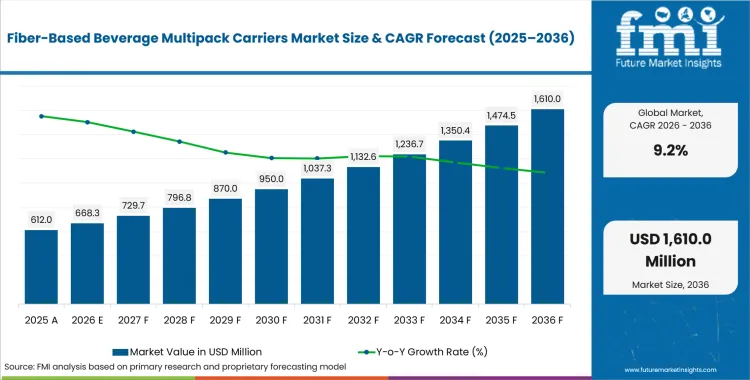
USD 668.3 million in 2026 and USD 1,610.0 million by 2036 at a 9.2% CAGR.
Demand for fiber-based beverage multipack carriers is projected to expand at 9.2% CAGR between 2026 and 2036, increasing valuation from USD 668.3 million in 2026 to USD 1,610.0 million by 2036. Beverage producers are increasingly using fiber-based carriers to replace plastic rings and shrink film, allowing them to eliminate plastic without losing package stability. Packaging manufacturers have several flexible options to fit different bottle and metal can shapes led by using paperboard clips and molded pulp designs. European Union Regulation 2025/40 sets a 5% packaging-waste reduction target by 2030, to help drive this sustainability push. Such strict rule directly encourages beverage companies to minimize their packaging materials and design packs that are easily recyclable.
International buyers evaluate these eco-friendly multipack carriers based on distinct regional priorities. Buyers in South Korea and China favor carrier designs being easily compatible with local bottling assembly lines and strict recycled-material rules. Beverage companies in Japan and Germany emphasize strong wet-strength performance and documented proof of responsible fiber sourcing. Stora Enso reported 750,000 tonnes of annual capacity for its Oulu consumer-board line in March 2025, leading established packaging suppliers are actively expanding to meet this growing demand. Such extensive expansion increases the supply of packaging board for beverage multipack programs across Europe and North America. These different regional demands reward suppliers being easily able to adapt their board grades and carrier shapes without requiring beverage plants to rebuild their machine settings for every new package design.
Key Takeaways for the Fiber-Based Beverage Multipack Carriers Market
- Demand for fiber-based beverage multipack carriers is supported by plastic substitution and retailer pressure for recyclable secondary packaging.
- Food is set to represent 58.0% share of end use in 2026, guided by frequent beverage launches and high-volume multipack distribution.
- Paper is likely to hold 46.0% share of material in 2026, backed by printability and established paper-recovery systems.
- Moisture exposure and inconsistent board performance may weaken handle strength during chilled distribution.
- Competition focuses on Graphic Packaging International, Smurfit Westrock, Mondi, International Paper, Metsä Board, Stora Enso, MM Packaging, and KHS Group, with suppliers differentiating based on beverage application evidence and line-integration support.
Analyst Perspective
“Fiber-based beverage carriers earn repeat orders due to dependable pack strength and line compatibility. Beverage teams examine wet performance and opening experience during technical review. Commercial acceptance improves as converters connect material reduction with tested transport performance and clear recycling instructions.”
- Nandini Roy Choudhury, Principal Consultant for Packaging at Future Market Insights
How is Fiber-Based Beverage Multipack Carriers Market segmented?
The fiber-based beverage multipack carriers sector is segmented by material, format, barrier or feature, end use, and region.
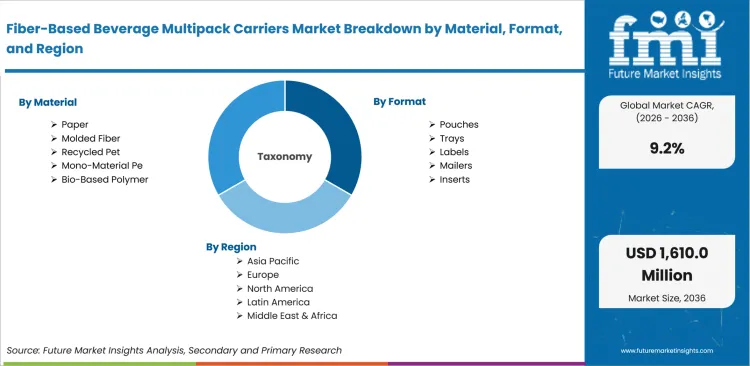
The fiber-based beverage multipack carriers industry is segmented by material, format, barrier or feature, end use, and region. Material coverage includes Paper and Molded Fiber. Recycled PET and Mono-material PE extend material coverage, followed by Bio-based Polymer. Format coverage includes Pouches, Trays, Labels, Mailers, and Inserts. Barrier or Feature coverage comprises Grease Resistant, High Barrier, Tamper Evident, Traceable, and Freshness Indicating. End Use coverage spans Food, Pharmaceutical, E-commerce, Personal Care, and Cold Chain.
Why does paper lead material demand?
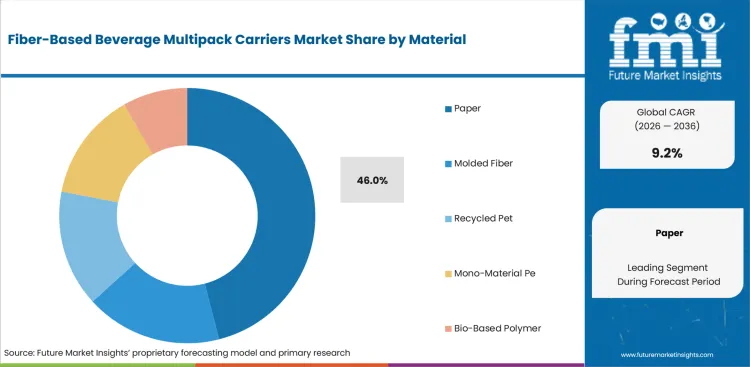
Paper supports die-cut clips and fully enclosed cartons through familiar converting processes. Beverage brands are likely to combine structural retention with printed product information inside one fiber structure. Familiar die-cutting and folding methods support carrier standardization across nearby beverage configurations without requiring plastic film. European Paper Recycling Council reported an 83.1% recycling rate for paper packaging in July 2025, strengthening disposal evidence used during paper-carrier approval.
- Paper is projected to represent 46.0% share of material in 2026, backed by established converting capacity and compatibility with paper packaging. Brand owners assess tear resistance and moisture response during pack approval.
- Mono-material PE and bio-based polymer address different performance needs. Material selection changes according to container weight and available packing equipment.
Why does pouches remain central to format demand?
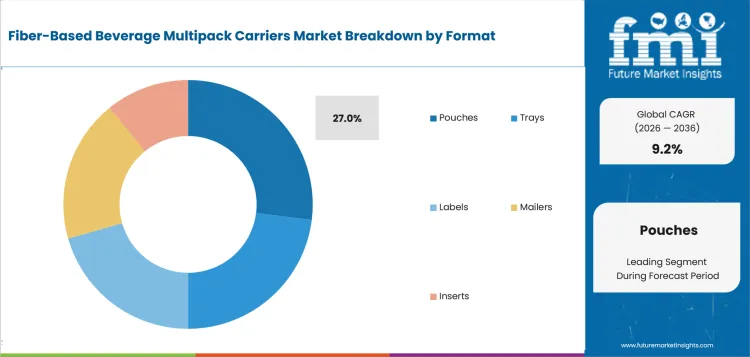
Ahlstrom reported LamiBak Flex uses 100% responsibly sourced wood pulp in March 2025, supporting paper-rich pouch structures with certified European recyclability. Pouches provide a flexible carrier route for smaller beverage assortments and mixed-product groupings. Printed surfaces support product communication, and lightweight construction limits secondary material use. Closure design needs careful testing since unsupported loads place stress near handles and seals. Converter review therefore focuses on puncture resistance and load distribution across filled packs.
- Based on format, pouches are anticipated to account for 27.0% share in 2026 since being aided by low pack weight and adaptable printed surfaces. Seal placement and handle reinforcement influence acceptance across beverage sizes.
- Mailers and Inserts support carrier protection or product grouping through different structures. Buyers compare stacking behavior and recovery instructions during format selection.
How does grease resistant lead barrier or feature demand?
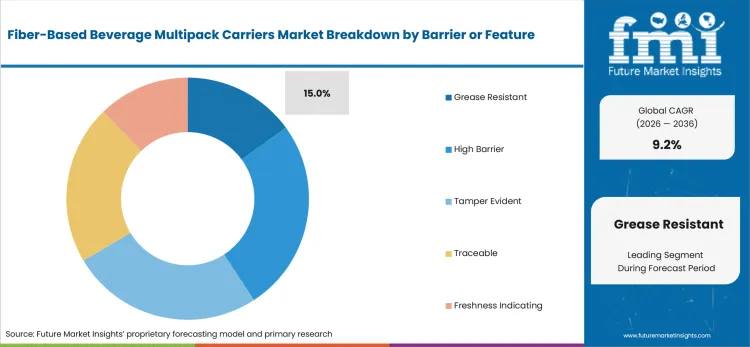
Grease resistant structures protect printed fiber surfaces from oils transferred during filling or retail handling. Barrier performance helps preserve appearance and prevents local fiber weakening around folds or grip points. Coating selection requires balance since excessive layers complicate repulping. Pack developers therefore examine barrier coverage together with recovery compatibility. USA Food and Drug Administration determined 35 PFAS-related food-contact notifications were no longer effective in January 2025, directing coating development toward alternative grease barriers.
- Grease resistant is expected to secure 15.0% share in 2026, guided by surface protection across mixed beverage and foodservice settings. Converter teams review coating uniformity and fold integrity under humid conditions.
- Tamper evident and freshness Indicating features address protection and information needs beyond basic carrying. Feature adoption follows product sensitivity and disposal guidance.
Why does food lead end use demand?
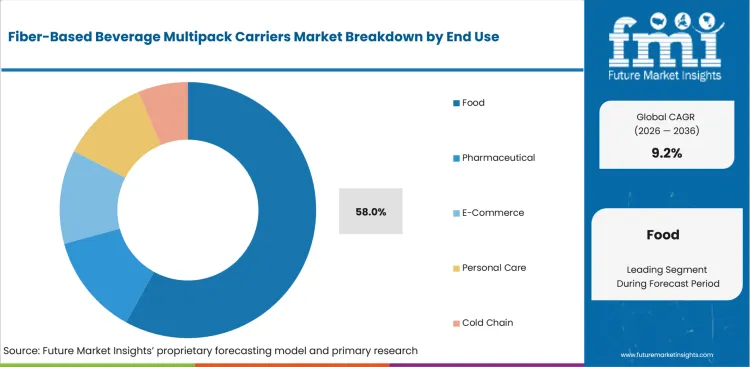
Food combines frequent beverage purchasing with established retail multipack routines. Brand owners need carriers capable of tolerating chilled storage and consumer transport. Brewers Association reported 23.1 million barrels of craft beer production during 2024 in its April 2025 release, sustaining recurring carton and carrier design work. Fiber formats support food packaging programs seeking plastic reduction without losing brand presentation. Regular product rotation encourages repeat design work across flavors and seasonal assortments.
- By end use, food is predicted to hold 58.0% share in 2026 owing to repeated multipack use across soft drinks and dairy beverages. Suppliers gain advantage based on dependable testing and rapid artwork changes.
- Personal care and cold chain applications require stronger controls around protection or distribution. Packaging teams assess cushioning performance and handling stability during carrier approval.
What are drivers, restraints, and opportunities in Fiber-Based Beverage Multipack Carriers Market?
Plastic replacement supports carrier conversion, and lightweight fiber engineering creates expansion potential. Moisture exposure and inconsistent board performance restrain adoption across chilled beverage programs.
- Driver: Beverage producers seek secondary packs reducing plastic use without weakening container retention during distribution. Fiber carriers support sustainability targets while preserving handling performance across retail and transport activities.
- Restraint: Moisture exposure and variable board properties complicate dependable strength across chilled beverage programs. Suppliers require repeated testing to confirm fold integrity and handle performance under humid conditions.
- Opportunity: Lightweight structures may reduce material use while preserving print area and consumer handling. Advanced paperboard engineering supports thinner carrier designs without compromising pack stability during transportation.
Beverage producers evaluate fiber carriers as replacements for shrink film or plastic rings across established packing lines. KHS reported 85% lower material consumption for Nature MultiPack versus conventional setups in November 2024, showing how secondary-pack redesign are projected to lower material input while retaining grouped-container handling. Direct material savings strengthen conversion discussions among brands with plastic-reduction commitments. Equipment compatibility remains essential during commercial approval.
Barrier layers and composite structures create a restraint if recovery performance fails to match material claims. German Environment Agency recorded beverage-carton recycling at 8.7 percentage points below its required quota in January 2025, demonstrating how complex fiber composites are likely to miss recovery expectations. Beverage carrier suppliers need coating choices protecting pack strength without obstructing paper-stream processing. Clear disposal instructions support buyer confidence.
Lightweight paperboard engineering offers an opportunity to lower pack impact without sacrificing stiffness. Metsä Board’s verified comparison in March 2025 found a switch to its folding boxboard reduced a food-packaging carbon footprint by over 60%. Beverage carriers use different structures. Strength-to-weight improvements are anticipated to support thinner board specifications and lower transport mass. Application testing remains necessary for container retention and moisture exposure.
How are country CAGRs aligned in Fiber-Based Beverage Multipack Carriers Market?

| Country or Market | CAGR |
|---|---|
| South Korea | 12.4% |
| China | 11.5% |
| India | 10.6% |
| United States | 9.7% |
| Japan | 8.7% |
| Germany | 7.8% |
Source: Future Market Insights analysis, 2026.
How do country-level CAGRs compare in the Fiber-Based Beverage Multipack Carriers Market?
The country comparison spans 4.6 percentage points across the fiber-based beverage multipack carriers market. South Korea records the highest CAGR at 12.4%, followed by China at 11.5%, India at 10.6%, the United States at 9.7%, Japan at 8.7% and Germany at 7.8%. The ranking reflects different rates of adoption for fiber-based packaging across beverage manufacturing and distribution.
- South Korea leads with a CAGR of 12.4%. Beverage companies are expanding the use of fiber-based multipack carriers as paper-based packaging becomes more common for bundled cans and bottles.
- China follows at 11.5%, 0.9 percentage points below South Korea. Packaging manufacturers continue increasing production capacity for fiber-based carrier formats serving beverage applications.
- India records a CAGR of 10.6%, another 0.9 percentage points lower than China. Beverage producers are introducing fiber-based carrier solutions across a wider range of retail packaging formats.
- The United States reaches 9.7%, 0.9 percentage points behind India. Market activity reflects continued adoption of paper-based multipack carriers within beverage packaging portfolios.
- Japan posts a CAGR of 8.7%, 1.0 percentage point below the United States. Manufacturers are evaluating carrier designs that improve handling efficiency and packaging consistency.
- Germany records a CAGR of 7.8%, 0.9 percentage points behind Japan. Adoption is influenced by packaging specifications, manufacturing practices and material selection across beverage production.
Differences in packaging infrastructure, production capacity and investment priorities influence deployment patterns across these markets.
Country-wise Analysis
- Fiber-based beverage multipack carrier demand in South Korea is projected to rise at 12.4% CAGR from 2026 to 2036, led by recycled-material rules affecting beverage packaging decisions. Ministry of Environment’s February 2025 release projected participating bottled-water and beverage companies would use approximately 20,000 tons of recycled materials annually, creating more interaction between primary-container changes and carrier design. Bottle surface and neck geometry need coordinated validation as recycled-content adoption advances. Local converters able to support rapid testing may shorten brand approval cycles.
- National Bureau of Statistics of China recorded 4.3% year-on-year expansion in liquor, beverage, and refined-tea manufacturing during January-February 2026, increasing production activity across lines using secondary multipack formats. Greater beverage output expands carrier trials across metal containers and PET bottles. Industry in China is anticipated to scale at 11.5% CAGR by 2036, supported by domestic converting depth and high-volume packaging operations. Suppliers need localized board grades and machine settings for plant-specific operating conditions.
- Indian brand owners face detailed extended producer responsibility records across packaging programs. Sales in India are expected to increase at 10.6% CAGR between 2026 and 2036, reflecting plastic-substitution work and expanding local conversion capacity. Press Information Bureau reported 44,659 registered producers, importers, and brand owners for plastic packaging in December 2024, showing a large compliance base reviewing material choices. Fiber carrier proposals benefit from clear recyclability evidence and consistent technical documentation.
- American Forest & Paper Association reported around 46 million tons of paper recycled nationwide during 2024, supporting an established recovery base for paper-based secondary packaging. The market in United States is projected to record 9.7% CAGR during the study period, aided by retailer acceptance and high-speed beverage packing infrastructure. Carrier suppliers need evidence covering line efficiency and distribution performance. Proven commercial deployments improve confidence during national rollouts.
- Beverage companies in Japan often combine container redesign with tightly controlled recovery initiatives. Kirin’s May 2025 release identified nine companies joining a PET chemical-recycling initiative, illustrating coordinated material work across beverage supply chains. Fiber-based beverage multipack carrier sales in Japan are forecast to grow at 8.7% CAGR during the assessment period, helped by packaging redesign and detailed quality expectations. Carrier geometry needs to accommodate changes in bottle composition without weakening retail handling.
- Buyers in Germany emphasize recycling evidence and material separation throughout packaging review. Sector in Germany is predicted to increase at 7.8% CAGR between 2026 and 2036, aided by established paper recovery and exacting pack-performance requirements. German Environment Agency’s January 2026 release recorded approximately 5.5 million tonnes of packaging waste recycled through dual systems during 2024, reinforcing scrutiny of carrier recovery claims. Suppliers benefit from simple fiber structures and documented coating choices.
Who are notable companies in Fiber-Based Beverage Multipack Carriers Market?
Graphic Packaging International, Smurfit Westrock, Mondi, International Paper, Metsä Board, Stora Enso, MM Packaging, and KHS Group are key companies serving fiber-based beverage multipack carrier demand.
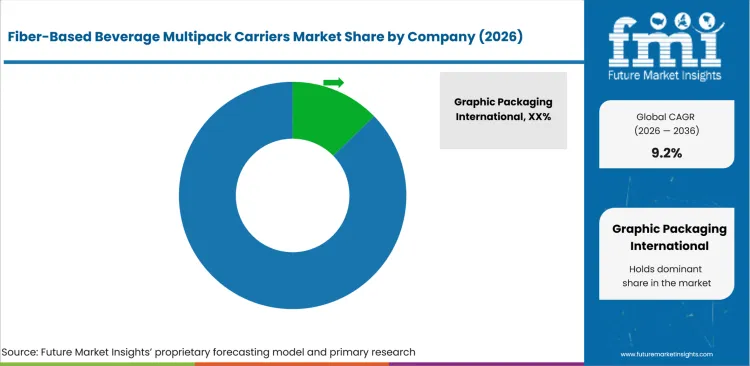
The competitive outlook combines integrated paperboard suppliers with equipment specialists supporting beverage multipack conversion across regional production sites. Carrier developers compete through structural strength and repeatable container retention across cans and bottles exposed to chilled distribution. Paperboard producers compete based on coating performance and converting assistance within each packaging program. Equipment groups compete through line integration and operating reliability across beverage filling plants. Beverage packaging market analysis provides a useful comparison for service responsibility and performance terms within integrated packing operations. Commercial success requires clear ownership of pack failures since one weak locking point may erase gains created by a lighter carrier.
- Graphic Packaging International and Smurfit Westrock compete based on collar and wrap designs suited to high-volume beverage packs. Buyers compare container retention and installed-line compatibility during technical review.
- Mondi and International Paper bring corrugated and paperboard engineering across bottle or metal-container groupings. Account decisions examine material reduction and regional converting support.
- Metsä Board and MM Packaging compete depending on board stiffness and print performance. Converter teams assess caliper consistency and fiber sourcing documentation.
- KHS Group competes due to equipment-led carrier application and line integration. Beverage plants examine changeover effort and pack integrity across container configurations.
Competitive Benchmarking: Fiber-Based Beverage Multipack Carriers Market
| Company | Fiber Engineering | Line Integration Support | Beverage Application Evidence | Service Reach |
|---|---|---|---|---|
| Graphic Packaging International | High | High | High | Global |
| Smurfit Westrock | High | High | High | Global |
| Mondi | High | Medium | High | Global |
| International Paper | High | Medium | High | Global |
| Metsä Board | High | Medium | Medium | Global |
| Stora Enso | High | Medium | Medium | Global |
| MM Packaging | High | Medium | High | Regional and international |
| KHS Group | Medium | High | High | Global |
Scoring basis: High indicates documented capability with active beverage multipack application. Medium indicates supporting capability with partial carrier-system evidence.
Source: Company disclosures and Future Market Insights competitive analysis.
Key Developments in Fiber-Based Beverage Multipack Carriers Market
- In September 2025, Graphic Packaging International introduced two beverage multipack systems at drinktec. One wrap design reduced paperboard volume by approximately 25% compared with wraps using a separate advertising panel, improving material efficiency without compromising speed or requiring new machinery.
- In September 2025, Metsä Board documented Olutmylly's V6-engine corrugated board six-pack carrier for six beverage cans. Reusable and recyclable construction combined retail display with practical carrying and room for cooler-pack inserts.
- In November 2025, Mondi launched an extended food-packaging portfolio covering beverage multipacks, wraparounds, trays, and PET-bottle clips. The expansion followed Mondi's acquisition of Schumacher Packaging, which added solid-board solutions, digital printing capabilities, and additional production sites across Europe.
Key Players in Fiber-Based Beverage Multipack Carriers Market
Integrated Beverage Carrier Producers
- Graphic Packaging International
- Smurfit Westrock
- Mondi
- International Paper
Paperboard and Carton Specialists
- Metsä Board
- Stora Enso
- MM Packaging
Equipment and Application Systems
- KHS Group
Fiber-Based Beverage Multipack Carriers Market Report Scope
| Coverage field | Report scope |
|---|---|
| Market breakdown | Fiber-based beverage multipack carriers market breakdown includes material, format, barrier or feature, end use, and region |
| Quantitative Units | Revenue in USD million and CAGR in percent. |
| Market Definition | Fiber-based beverage multipack carriers group beverage containers through paper, paperboard, molded fiber, or related low-plastic structures. Clips, collars, wraps, trays, pouches, and enclosed cartons fall inside defined coverage. Primary bottles and metal containers are excluded. |
| Regions Covered | North America, Latin America, Western Europe, Eastern Europe, East Asia, South Asia and Pacific, Middle East and Africa. |
| Countries Covered | South Korea, China, India, United States, Japan, Germany, and more than 30 additional countries complete full report coverage. |
| Key Companies Profiled | Graphic Packaging International, Smurfit Westrock, Mondi, International Paper, Metsä Board, Stora Enso, MM Packaging, and KHS Group. |
| Forecast Period | 2026 to 2036 |
| Approach | Hybrid bottom-up and top-down methodology uses segment shares and country CAGRs. Company activity and buyer adoption support final reconciliation. |
Source: Future Market Insights analysis, 2026.
Fiber-Based Beverage Multipack Carriers Market - Research Methodology
| Method | Approach |
|---|---|
| Primary Research | FMI analysts gathered input from manufacturers, service providers, technology developers, distributors, end users, procurement teams, and subject-matter experts. Interviews examined purchasing decisions, product or service evaluation, adoption barriers, approval requirements, pricing considerations, and expectations for technical or commercial support. Respondents were also asked what evidence is required before a trial, pilot, or initial order develops into regular purchasing. |
| Desk Research | Desk research covered government statistics, regulatory publications, trade data, industry associations, technical literature, standards, company filings, product information, and official corporate announcements. Sources were reviewed for relevance, publication date, geographic coverage, and consistency with the defined market scope. Claims relating to performance, applications, approvals, capacity, investment, and commercial activity were retained only when supported by credible public evidence. |
| Market Sizing and Forecasting | The market model combined the baseline value with historical performance, segment structure, pricing and volume indicators, adoption levels, company participation, and country-level demand conditions. Forecast assumptions considered economic activity, investment trends, regulatory developments, technology adoption, purchasing cycles, supply availability, and barriers to wider market use. Segment and regional estimates were reconciled before the final market total was calculated. |
| Data Validation | Estimates were checked against multiple independent indicators, including public data, company activity, trade patterns, industry developments, and findings from primary interviews. Validation also tested whether products, services, applications, and company revenues fell within the defined market boundaries. Adjacent categories, unsupported claims, overlapping revenues, and activities without direct market relevance were excluded to reduce double counting and maintain consistency across segments and countries. |
Source: Future Market Insights analysis, 2026.
Fiber-Based Beverage Multipack Carriers Market by Segments
Fiber-Based Beverage Multipack Carriers Market segmented by Material:
- Paper
- Molded Fiber
- Recycled PET
- Mono-material PE
- Bio-based Polymer
Fiber-Based Beverage Multipack Carriers Market segmented by Format:
- Pouches
- Trays
- Labels
- Mailers
- Inserts
Fiber-Based Beverage Multipack Carriers Market segmented by Barrier or Feature:
- Grease Resistant
- High Barrier
- Tamper Evident
- Traceable
- Freshness Indicating
Fiber-Based Beverage Multipack Carriers Market segmented by End Use:
- Food
- Pharmaceutical
- E-commerce
- Personal Care
- Cold Chain
Fiber-Based Beverage Multipack Carriers Market segmented by Region:
- North America
- United States
- Canada
- Latin America
- Brazil
- Mexico
- Argentina
- Chile
- Western Europe
- Germany
- France
- United Kingdom
- Italy
- Spain
- Benelux
- Nordics
- Eastern Europe
- Poland
- Czech Republic
- Romania
- Hungary
- East Asia
- China
- Japan
- South Korea
- South Asia and Pacific
- India
- ASEAN
- Australia and New Zealand
- Middle East and Africa
- GCC Countries
- South Africa
- Türkiye
- Israel
Research Sources and Bibliography
- European Parliament & Council of the European Union. (2025, January 22). Regulation (EU) 2025/40 of the European Parliament and of the Council of 19 December 2024 on packaging and packaging waste, amending Regulation (EU) 2019/1020 and Directive (EU) 2019/904, and repealing Directive 94/62/EC.
- Stora Enso. (2025, March 19). Stora Enso’s new consumer board line at the Oulu site in Finland has started operations.
- European Paper Recycling Council. (2025, July 11). Press release: European Paper Recycling Council Reports Strong Recycling Rates for 2024.
- Ahlstrom. (2025, March 17). Ahlstrom expands LamiBak™ portfolio with a new base paper for flexible food packaging.
- USA Food and Drug Administration. (2025, January 3). FDA Determines Authorization for 35 Food Contact Notifications Related to PFAS Are No Longer Effective.
- Brewers Association. (2025, April 15). Brewers Association Reports 2024 USA Craft Brewing Industry Figures.
- KHS Group. (2024, November 28). Even cleverer: Nature MultiPack from KHS with a carrying handle made of kraft paper.
- German Environment Agency. (2025, January 21). Packaging recycling only works with correct waste separation.
- Metsä Board. (2025, March 18). Verified case study for teabag packaging shows that Metsä Board paperboard can reduce the carbon footprint by over 60% compared to paperboard made of white-lined chipboard representing European market.
- Ministry of Environment, Republic of Korea. (2025, February 20). Full-scale Use of Recycled Materials in Bottled Water and Beverage PET Bottles.
- National Bureau of Statistics of China. (2026, March 17). Industrial Production Operation from January to February 2026.
- Ministry of Environment, Forest and Climate Change. (2024, December 2). PARLIAMENT QUESTION: EPR Guidelines.
- American Forest & Paper Association. (2025, August 12). How Much Paper Was Recycled in 2024?
- Kirin Holdings Company, Limited. (2025, May 7). Cross-industry collaboration in PET chemical recycling to expand sourcing of feedstocks for non-food contact materials.
- German Environment Agency. (2026, January 27). Facts against myths: Packaging waste recycling in Germany is working.
- Smurfit Westrock. (2024, October 25). Smurfit Westrock Earns Top Awards for Sustainable and Innovative Design.
- International Paper. (2025, November 17). International Paper’s Transformational Journey.
- MM Packaging. (2025, September 10). MM Packaging’s multi-pack cartonboard solution protects Kingsland Drinks’ range of canned beverages.
- Graphic Packaging International. (2025, September 10). Graphic Packaging Debuts Duo of Beverage Multipack Innovations at drinktec 2025.
- Metsä Board. (2025, September 29). V6-engine six-pack: Olutmylly’s tasting pack co-created with Metsä Board.
- Mondi. (2025, November 18). Mondi launches extended corrugated and solid board portfolio for the food packaging industry.
This bibliography is provided for reader reference and is not exhaustive. The full report contains the complete reference list and detailed citations.
This Report Answers
- How do material choices influence carrier strength and recovery compatibility?
- Why do food and paper hold leading segment positions during 2026?
- How do format options change load distribution and retail handling?
- What barrier or feature choices protect fiber without complicating recovery?
- Why do country CAGRs differ across disclosed national markets?
- What technical records support carrier approval on beverage packing lines?
- How do moisture exposure and chilled storage affect structural performance?
- What companies compete through carrier design and equipment support?
- How are forecasts validated through bottom-up and top-down assessment?
- What risks limit conversion from plastic rings or shrink film?
Frequently Asked Questions
What supports demand in fiber-based beverage multipack carriers market?
Demand is likely to receive support from beverage brands reducing plastic use across secondary packaging programs. Packaging teams are expected to favor fiber carriers preserving container retention and retail handling during distribution.
Who are key players in fiber-based beverage multipack carriers market?
Key companies are anticipated to include Graphic Packaging International and Smurfit Westrock among others. Competition is likely to reflect fiber engineering and line-integration support across established beverage packaging programs.
What restraint affects fiber-based beverage multipack carriers market?
Moisture exposure restrains adoption across chilled beverage programs and humid distribution conditions. Commercial confidence weakens if board properties or locking features produce inconsistent pack strength.
Why do executives track fiber-based beverage multipack carriers market?
Executives are expected to track carrier conversion as secondary packaging influences plastic-reduction targets and operating efficiency. Pack ownership creates testing and line-compatibility duties across packaging and production functions.
What business problem does fiber-based beverage multipack carriers market address?
Fiber-based beverage multipack carriers group cans and bottles without relying on conventional plastic rings or shrink film. Carrier structures help teams combine handling performance with printed information and retail presentation.
What do beverage companies evaluate prior to selecting companies?
Beverage companies are likely to evaluate board strength and moisture resistance during supplier review. Container retention and packing-line compatibility are expected to influence final company approval.
What limits return on investment for purchasing teams?
Return weakens with plants spending extensive effort on equipment changes or repeated board adjustments. Material savings create limited value without dependable pack performance and stable production speed.
How do companies build long-term customer confidence?
Companies build confidence based on repeatable carrier strength and responsive line support across beverage programs. Stable material supply and documented transport testing support recurring use across approved customer projects.
Preview the report firsthand - request a free sample
Get SampleGet the brochure for pricing and purchase details.
Get PDFTable of Content
- Key Takeaways
- Market Size and CAGR
- Top Growth Driver
- Fastest Growing Segment
- Leading Region
- Key Companies
- Emerging Opportunities
- Executive Summary
- Global Market Outlook
- Demand-side Trends
- Supply-side Trends
- Technology Roadmap Analysis
- Analysis and Recommendations
- Analyst Perspective (What is happening? Why now? What should investors know?)
- Key Questions Answered
- How large is the market?
- What is the CAGR?
- What are key trends?
- Which region dominates?
- Who are the leaders?
- Market Overview
- Market Coverage / Taxonomy
- Market Definition / Scope / Limitations
- Research Methodology
- Chapter Orientation
- Analytical Lens and Working Hypotheses
- Market Structure, Signals, and Trend Drivers
- Benchmarking and Cross-market Comparability
- Market Sizing, Forecasting, and Opportunity Mapping
- Research Design and Evidence Framework
- Desk Research Programme (Secondary Evidence)
- Expert Input and Fieldwork (Primary Evidence)
- Tooling, Models, and Reference Databases
- Data Engineering and Model Build
- Quality Assurance and Audit Trail
- Market Background
- Market Dynamics (Drivers, Restraints, Opportunity, Trends)
- Scenario Forecast (Optimistic, Likely, Conservative)
- Impact Analysis
- AI Impact
- Sustainability Impact
- Regulatory Impact
- Technology Impact
- Consumer / Buyer Analysis
- Purchase Drivers
- Adoption Barriers
- Buyer Journey
- Opportunity Map Analysis
- Product Life Cycle Analysis
- Supply Chain Analysis
- Investment Feasibility Matrix
- Value Chain Analysis
- PESTLE and Porter's Analysis
- Regulatory Landscape
- Regional Parent Market Outlook
- Production and Consumption Statistics
- Import and Export Statistics
- Global Market Analysis and Forecast, 2021 to 2036
- Historical Market Size Value (USD Million) Analysis, 2021 to 2025
- Current and Future Market Size Value (USD Million) Projections, 2026 to 2036
- Y-o-Y Growth Trend Analysis
- Absolute $ Opportunity Analysis
- Global Market Pricing Analysis, 2021 to 2036
- Global Market Analysis and Forecast, By Material, 2021 to 2036
- Introduction / Key Findings
- Historical Market Size Value (USD Million) Analysis By Material, 2021 to 2025
- Current and Future Market Size Value (USD Million) Analysis and Forecast By Material, 2026 to 2036
- Paper
- Molded Fiber
- Recycled Pet
- Mono-Material Pe
- Bio-Based Polymer
- Paper
- Y-o-Y Growth Trend Analysis By Material, 2021 to 2025
- Absolute $ Opportunity Analysis By Material, 2026 to 2036
- Global Market Analysis and Forecast, By Format, 2021 to 2036
- Introduction / Key Findings
- Historical Market Size Value (USD Million) Analysis By Format, 2021 to 2025
- Current and Future Market Size Value (USD Million) Analysis and Forecast By Format, 2026 to 2036
- Pouches
- Trays
- Labels
- Mailers
- Inserts
- Pouches
- Y-o-Y Growth Trend Analysis By Format, 2021 to 2025
- Absolute $ Opportunity Analysis By Format, 2026 to 2036
- Global Market Analysis and Forecast, By Barrier or Feature, 2021 to 2036
- Introduction / Key Findings
- Historical Market Size Value (USD Million) Analysis By Barrier or Feature, 2021 to 2025
- Current and Future Market Size Value (USD Million) Analysis and Forecast By Barrier or Feature, 2026 to 2036
- Grease Resistant
- High Barrier
- Tamper Evident
- Traceable
- Freshness Indicating
- Grease Resistant
- Y-o-Y Growth Trend Analysis By Barrier or Feature, 2021 to 2025
- Absolute $ Opportunity Analysis By Barrier or Feature, 2026 to 2036
- Global Market Analysis and Forecast, By End Use, 2021 to 2036
- Introduction / Key Findings
- Historical Market Size Value (USD Million) Analysis By End Use, 2021 to 2025
- Current and Future Market Size Value (USD Million) Analysis and Forecast By End Use, 2026 to 2036
- Food
- Pharmaceutical
- E-Commerce
- Personal Care
- Cold Chain
- Food
- Y-o-Y Growth Trend Analysis By End Use, 2021 to 2025
- Absolute $ Opportunity Analysis By End Use, 2026 to 2036
- Global Market Analysis and Forecast, By Region, 2021 to 2036
- Introduction
- Historical Market Size Value (USD Million) Analysis By Region, 2021 to 2025
- Current Market Size Value (USD Million) Analysis and Forecast By Region, 2026 to 2036
- North America
- Latin America
- Western Europe
- Eastern Europe
- East Asia
- South Asia and Pacific
- Middle East & Africa
- Market Attractiveness Analysis By Region
- North America Market Analysis and Forecast, By Country, 2021 to 2036
- Historical Market Size Value (USD Million) Trend Analysis By Market Taxonomy, 2021 to 2025
- Market Size Value (USD Million) Forecast By Market Taxonomy, 2026 to 2036
- By Country
- USA
- Canada
- By Material
- By Format
- By Barrier or Feature
- By End Use
- By Country
- Market Attractiveness Analysis
- By Country
- By Material
- By Format
- By Barrier or Feature
- By End Use
- Key Takeaways
- Latin America Market Analysis and Forecast, By Country
- Historical Market Size Value (USD Million) Trend Analysis By Market Taxonomy, 2021 to 2025
- Market Size Value (USD Million) Forecast By Market Taxonomy, 2026 to 2036
- By Country
- Brazil
- Mexico
- Chile
- Rest of Latin America
- By Material
- By Format
- By Barrier or Feature
- By End Use
- By Country
- Market Attractiveness Analysis
- By Country
- By Material
- By Format
- By Barrier or Feature
- By End Use
- Key Takeaways
- Western Europe Market Analysis and Forecast, By Country
- Historical Market Size Value (USD Million) Trend Analysis By Market Taxonomy, 2021 to 2025
- Market Size Value (USD Million) Forecast By Market Taxonomy, 2026 to 2036
- By Country
- Germany
- UK
- Italy
- Spain
- France
- Nordic
- BENELUX
- Rest of Western Europe
- By Material
- By Format
- By Barrier or Feature
- By End Use
- By Country
- Market Attractiveness Analysis
- By Country
- By Material
- By Format
- By Barrier or Feature
- By End Use
- Key Takeaways
- Eastern Europe Market Analysis and Forecast, By Country
- Historical Market Size Value (USD Million) Trend Analysis By Market Taxonomy, 2021 to 2025
- Market Size Value (USD Million) Forecast By Market Taxonomy, 2026 to 2036
- By Country
- Russia
- Poland
- Hungary
- Balkan & Baltic
- Rest of Eastern Europe
- By Material
- By Format
- By Barrier or Feature
- By End Use
- By Country
- Market Attractiveness Analysis
- By Country
- By Material
- By Format
- By Barrier or Feature
- By End Use
- Key Takeaways
- East Asia Market Analysis and Forecast, By Country
- Historical Market Size Value (USD Million) Trend Analysis By Market Taxonomy, 2021 to 2025
- Market Size Value (USD Million) Forecast By Market Taxonomy, 2026 to 2036
- By Country
- China
- Japan
- South Korea
- By Material
- By Format
- By Barrier or Feature
- By End Use
- By Country
- Market Attractiveness Analysis
- By Country
- By Material
- By Format
- By Barrier or Feature
- By End Use
- Key Takeaways
- South Asia and Pacific Market Analysis and Forecast, By Country
- Historical Market Size Value (USD Million) Trend Analysis By Market Taxonomy, 2021 to 2025
- Market Size Value (USD Million) Forecast By Market Taxonomy, 2026 to 2036
- By Country
- India
- ASEAN
- Australia & New Zealand
- Rest of South Asia and Pacific
- By Material
- By Format
- By Barrier or Feature
- By End Use
- By Country
- Market Attractiveness Analysis
- By Country
- By Material
- By Format
- By Barrier or Feature
- By End Use
- Key Takeaways
- Middle East & Africa Market Analysis and Forecast, By Country
- Historical Market Size Value (USD Million) Trend Analysis By Market Taxonomy, 2021 to 2025
- Market Size Value (USD Million) Forecast By Market Taxonomy, 2026 to 2036
- By Country
- Kingdom of Saudi Arabia
- Other GCC Countries
- Türkiye
- South Africa
- Other African Union
- Rest of Middle East & Africa
- By Material
- By Format
- By Barrier or Feature
- By End Use
- By Country
- Market Attractiveness Analysis
- By Country
- By Material
- By Format
- By Barrier or Feature
- By End Use
- Key Takeaways
- Key Countries Market Analysis
- USA
- Pricing Analysis
- Market Share Analysis, 2025
- By Material
- By Format
- By Barrier or Feature
- By End Use
- Canada
- Pricing Analysis
- Market Share Analysis, 2025
- By Material
- By Format
- By Barrier or Feature
- By End Use
- Mexico
- Pricing Analysis
- Market Share Analysis, 2025
- By Material
- By Format
- By Barrier or Feature
- By End Use
- Brazil
- Pricing Analysis
- Market Share Analysis, 2025
- By Material
- By Format
- By Barrier or Feature
- By End Use
- Chile
- Pricing Analysis
- Market Share Analysis, 2025
- By Material
- By Format
- By Barrier or Feature
- By End Use
- Germany
- Pricing Analysis
- Market Share Analysis, 2025
- By Material
- By Format
- By Barrier or Feature
- By End Use
- UK
- Pricing Analysis
- Market Share Analysis, 2025
- By Material
- By Format
- By Barrier or Feature
- By End Use
- Italy
- Pricing Analysis
- Market Share Analysis, 2025
- By Material
- By Format
- By Barrier or Feature
- By End Use
- Spain
- Pricing Analysis
- Market Share Analysis, 2025
- By Material
- By Format
- By Barrier or Feature
- By End Use
- France
- Pricing Analysis
- Market Share Analysis, 2025
- By Material
- By Format
- By Barrier or Feature
- By End Use
- India
- Pricing Analysis
- Market Share Analysis, 2025
- By Material
- By Format
- By Barrier or Feature
- By End Use
- ASEAN
- Pricing Analysis
- Market Share Analysis, 2025
- By Material
- By Format
- By Barrier or Feature
- By End Use
- Australia & New Zealand
- Pricing Analysis
- Market Share Analysis, 2025
- By Material
- By Format
- By Barrier or Feature
- By End Use
- China
- Pricing Analysis
- Market Share Analysis, 2025
- By Material
- By Format
- By Barrier or Feature
- By End Use
- Japan
- Pricing Analysis
- Market Share Analysis, 2025
- By Material
- By Format
- By Barrier or Feature
- By End Use
- South Korea
- Pricing Analysis
- Market Share Analysis, 2025
- By Material
- By Format
- By Barrier or Feature
- By End Use
- Russia
- Pricing Analysis
- Market Share Analysis, 2025
- By Material
- By Format
- By Barrier or Feature
- By End Use
- Poland
- Pricing Analysis
- Market Share Analysis, 2025
- By Material
- By Format
- By Barrier or Feature
- By End Use
- Hungary
- Pricing Analysis
- Market Share Analysis, 2025
- By Material
- By Format
- By Barrier or Feature
- By End Use
- Kingdom of Saudi Arabia
- Pricing Analysis
- Market Share Analysis, 2025
- By Material
- By Format
- By Barrier or Feature
- By End Use
- Türkiye
- Pricing Analysis
- Market Share Analysis, 2025
- By Material
- By Format
- By Barrier or Feature
- By End Use
- South Africa
- Pricing Analysis
- Market Share Analysis, 2025
- By Material
- By Format
- By Barrier or Feature
- By End Use
- USA
- Market Structure Analysis
- Competition Dashboard
- Competition Benchmarking
- Market Share Analysis of Top Players
- By Regional
- By Material
- By Format
- By Barrier or Feature
- By End Use
- Emerging Startups
- Innovation Benchmarking
- Competition Analysis
- Competition Deep Dive
- Graphic Packaging International
- Overview
- Product Portfolio
- Profitability by Market Segments
- Sales Footprint
- Strategy Overview
- Marketing Strategy
- Product Strategy
- Channel Strategy
- Smurfit Westrock
- International Paper
- DS Smith
- Huhtamaki
- PakTech
- Mondi
- KHS
- Graphic Packaging International
- Case Studies
- Success Stories
- Recent Developments
- Competition Deep Dive
- Assumptions & Acronyms Used


