

- Market Size (2026)
- USD 98.0 Mn
- Forecast (2036)
- USD 215.6 Mn
- CAGR (2026 to 2036)
- 8.2%
How big is the Fiber Modular Nutrition Market in 2026?
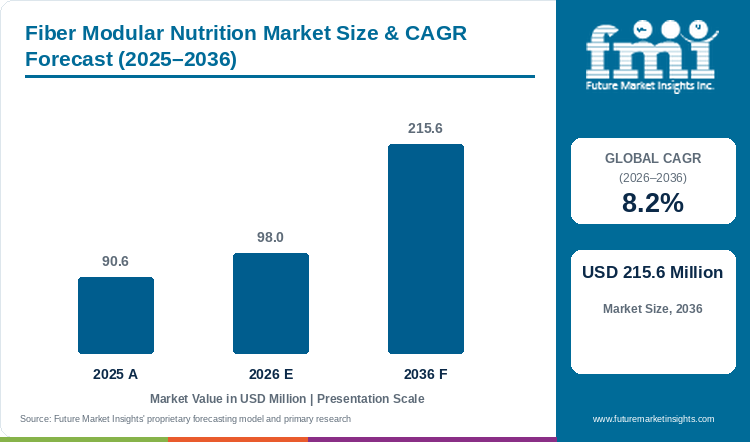
USD 98.0 Million in 2026 and USD 215.6 Million by 2036 at an 8.2% CAGR.
The fiber modular nutrition market stands at USD 98.0 Million in 2026 and is projected to reach USD 215.6 Million by 2036, growing at an 8.2% CAGR. The fiber modular nutrition market was valued at approximately USD 90.6 Million in 2025. The commercial rationale for these products is strongest when a targeted fiber module solves a recurring bowel-management issue without forcing a change to the patient's base nutrition formula. A meta-analysis of 16 randomized trials demonstrated that fiber supplementation reduced diarrhea during enteral nutrition by 36%, with subgroup analyses showing statistically significant benefits specifically for partially hydrolyzed guar gum (PHGG) and mixed fibers. This clinical reality heavily favors product selection based on specific fiber chemistry and care workflow compatibility rather than generic gram quantities.[1]
Country-specific conditions heavily dictate how this clinical rationale translates into actual purchasing. In the USA, strict Medicare enteral-nutrition rules make rigorous documentation essential when specialty nutrition is deployed, while institutional formularies tightly control product access. The UK blends medically supervised enteral pathways with community-based care models. Meanwhile, Germany, Japan, and South Korea possess large or rapidly aging populations that drastically increase exposure to long-term nutrition management. Consequently, the purchasing threshold is highly practical as well as clinical: a module must be well-tolerated, simple to administer, and highly credible within the buyer’s specific pharmacy or nutrition-support workflow.[5][10][7][8][9]
Market Size and Forecast
Table 1: Market Size and Forecast for the Fiber Modular Nutrition Market (USD Million), 2025 to 2036
| Metric | Value |
|---|---|
| Estimated Market Size in 2025 | USD 90.6 Million |
| Estimated Market Size in 2026 | USD 98.0 Million |
| Projected Market Size by 2036 | USD 215.6 Million |
| CAGR, 2026 to 2036 | 8.2% |
Key Takeaways
- Recurring bowel-management needs in enterally fed and frail patients create highly predictable repeat demand, provided the fiber module can be added without replacing the underlying nutritional regimen.
- Partially Hydrolyzed Guar Gum leads Fiber Type with a 47.0% share in 2026 because PHGG uniquely combines excellent soluble-fiber handling with comparatively strong clinical evidence for reducing enteral diarrhea.
- Bowel Management (Tube-Fed Patients) leads the Indication segment at 38.7% in 2026, as stool consistency remains a daily operational challenge in enteral care, and selected fiber interventions offer proven, targeted relief.
- Powder Sachets dominate Product Form with a 54.6% share in 2026, as unit-dose packaging perfectly supports storage, precise portion control, and repeat preparation across both institutional and home settings.
- Market adoption is actively constrained when diarrhea is caused by medications or infections rather than the feeding regimen itself. Furthermore, strict documentation, hydration requirements, and administration compatibility checks can delay routine use.
- Profiled companies: Nestle Health Science (OptiFibre), Danone Nutricia (Stimulance), Abbott, Procter & Gamble (Metamucil), Haleon (Benefiber), Medtrition, Global Health Products, and Victus.
Analyst Perspective
Realized revenue depends entirely on whether a fiber module clears the care-setting test for indication, tolerability, preparation, and procurement. Clinical plausibility alone is never enough to secure repeat purchasing in a highly regulated environment.
- Anurag Sharma, Future Market Insights
How is the fiber modular nutrition market segmented?
The market is segmented by Fiber Type, Indication, Product Form, End User and Sales Channel.
Fiber Type includes Partially Hydrolyzed Guar Gum, Psyllium, Inulin / FOS Blends, Mixed-Fiber Complexes, and Others. Indication covers Bowel Management (Tube-Fed Patients), Constipation (Clinical), Diarrhea Management, Microbiome Support, and Others. Product Form comprises Powder Sachets, Tubs, and Others. End User includes Long-Term Care, Homecare, Hospitals, and Others. Sales Channel encompasses Hospital Pharmacy, Retail Pharmacy, Online, Institutional Tender, and Others.
Why does Partially Hydrolyzed Guar Gum lead the Fiber Type category?
Partially Hydrolyzed Guar Gum holds 47.0% of Fiber Type in 2026.
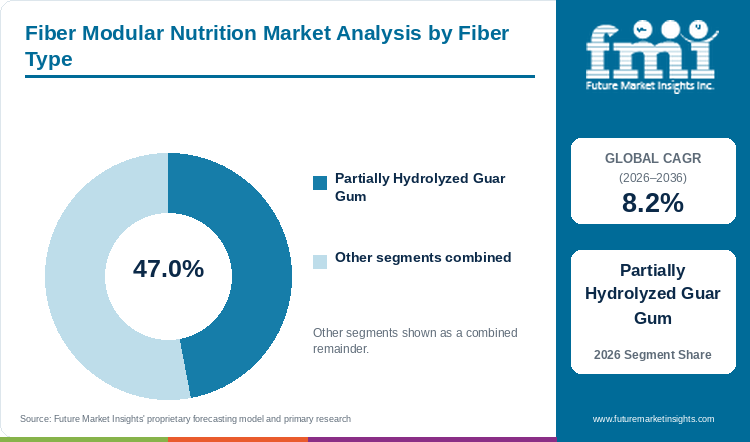
PHGG dominates because it solves a specific clinical problem: integrating soluble fiber into an enteral regimen without altering the base formula's viscosity or tolerance profile. The clinical distinction matters immensely because not all fibers yield the same enteral outcomes. A 2022 randomized-trial meta-analysis found a significant diarrhea reduction for PHGG, while several other fiber types yielded unclear subgroup results. Nestlé Health Science capitalizes on this by marketing OptiFibre as a neutral, easily mixable soluble-fiber powder specifically designed for gastrointestinal symptom management. Partially Hydrolyzed Guar Gum holds 47.0% of the Fiber Type segment in 2026, reflecting the powerful combination of superior handling and differentiated clinical evidence.[1][11]
- Partially Hydrolyzed Guar Gum accounts for 47.0% of Fiber Type in 2026.
- Evidence-Led Formulary Selection: The leading market position is driven by robust clinical data, including a 2022 sensitivity analysis reporting a pooled risk ratio of 0.47 for diarrhea with PHGG, prompting clinical buyers to select based on proven chemistry rather than treating all fibers as interchangeable.[1]
- Seamless Enteral Integration: Unlike bulkier or highly viscous fibers, PHGG dissolves clearly and maintains low viscosity, allowing it to be added directly to existing enteral feeding lines or oral beverages when prepared and administered according to product instructions.[11]
What makes Bowel Management (Tube-Fed Patients) central to the Indication category?
Bowel Management (Tube-Fed Patients) holds 38.7% of Indication in 2026.
Enteral feeding can be accompanied by changes in bowel function, requiring clinicians to constantly differentiate between formula intolerance, medication side effects, and underlying infections. Fiber modules provide a targeted intervention to normalize stool consistency without scrapping the entire nutritional prescription. This makes bowel management a highly recurring, operational necessity in hospitals and long-term care facilities where repeated administration and stool monitoring are daily realities. A December 2023 meta-analysis of 13 randomized trials involving 847 non-critically ill tube-fed adults confirmed that fiber-supplemented feeds significantly lower diarrhea incidence, cementing this indication as the primary commercial driver. Bowel Management accounts for 38.7% of the Indication segment in 2026.[2]
- Bowel Management (Tube-Fed Patients) accounts for 38.7% of Indication in 2026.
- Targeted Clinical Intervention: The segment leads because fiber modules allow dietitians to adjust the bowel-management component of a patient's care plan independently, preserving the core, often highly specialized, enteral feeding prescription.
- Operational Necessity in Care Facilities: Managing enteral-associated diarrhea is a major resource drain in clinical settings; proven fiber interventions reduce nursing time spent on cleanup and skin-care management, driving consistent institutional procurement.
What are the drivers, restraints and opportunities in the fiber modular nutrition market?
Demand is driven by recurring bowel-management needs in enterally fed and older patients, while misattribution of diarrhea and documentation burdens restrain routine use, and easier-to-administer formats create an opportunity to expand use across long-term care and homecare.
- Driver: Robust clinical evidence demonstrating that selected fibers can significantly reduce enteral-feeding diarrhea supports targeted, protocol-driven use in bowel management.
- Restraint: Diarrhea often stems from medications or infections rather than the feeding formula itself, meaning inappropriate fiber use can only be avoided through rigorous clinical review and documentation.
- Opportunity: Low-volume, unit-dose, and tube-compatible modules can drastically reduce preparation friction as more complex nutrition care shifts between institutional and home settings.
The primary demand driver is the urgent need to manage bowel function without disrupting complete nutrition therapy. A 2022 meta-analysis of hospitalized adults receiving enteral nutrition found a 36% reduction in diarrhea with fiber overall, with the strongest subgroup signals coming from PHGG and mixed fibers. A separate 2023 meta-analysis in non-critically ill tube-fed adults corroborated these findings. For clinical buyers, these data points make specific product composition and clear indications far more important than generic fiber claims. Suppliers that can directly connect their fiber type to an understandable, evidence-based administration protocol are vastly better positioned to secure repeat clinical use.[1][2]
The principal restraint is both diagnostic and operational. A 2021 study of 83 tube-fed hospitalized patients found that while diarrhea occurred in 37.3% of cases, medication-associated diarrhea accounted for a massive 61.3% of those instances, while enteral-nutrition-associated diarrhea accounted for only 6.5%. The authors strongly recommended reviewing medication lists before altering the feeding plan. This reality severely limits indiscriminate fiber-module use and elevates the value of strict clinical oversight. Furthermore, reimbursement and formulary rules add another layer of friction; a product may perfectly fit the nutrition plan yet still require extensive documentation, hydration guidance, or tube-compatibility checks before routine purchasing is authorized.[3]
The clearest opportunity lies in making targeted fiber significantly easier to use outside highly controlled hospital routines. Medtrition’s Banatrol TF attaches directly to ENFit tubes, and its HyFiber can be administered through a feeding tube after simple dilution. Global Health Products positions FiberCel as a low-viscosity, highly enteral-friendly soluble fiber. These examples demonstrate how intelligent administration design can completely eliminate mixing and volume friction. The exact same logic applies to unit-dose powder sachets designed for homecare and long-term care. However, suppliers must still provide crystal-clear dosing, tolerability, and medical-supervision guidance. Convenience only generates revenue when it preserves the strict clinical distinction between a modular fiber and a complete nutrition product.[20][21][22]
Which country CAGRs are profiled in the fiber modular nutrition market?
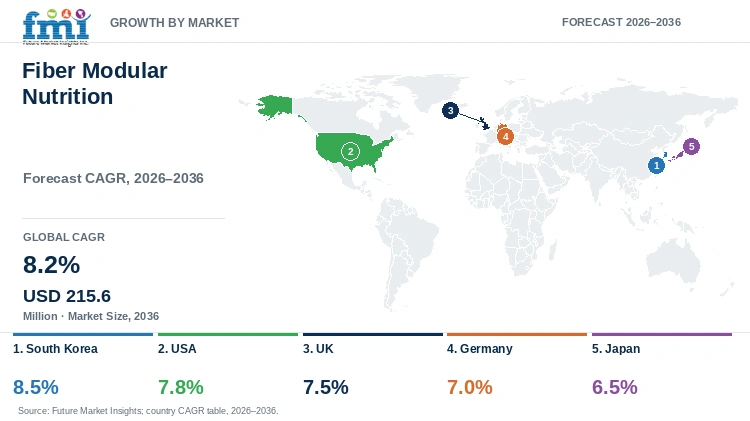
The following country CAGRs cover 2026 to 2036.
Table 2: Country CAGRs for the Fiber Modular Nutrition Market (CAGR, %), 2026 to 2036
| Country | CAGR |
|---|---|
| South Korea | 8.5% |
| USA | 7.8% |
| UK | 7.5% |
| Germany | 7.0% |
| Japan | 6.5% |
Country-wise Analysis
- South Korea: South Korea carries the fastest profiled rate at 8.5% from 2026 to 2036. Population aging provides the clearest structural demand signal. Statistics Korea reported in 2025 that people aged 65 and older represented 20.3% of the population, projecting that share to exceed 30% by 2036. This demographic shift creates a rapidly expanding pool of individuals exposed to chronic disease, care dependency, and complex nutrition support. The commercial opportunity for fiber modules is strongest where products can fit seamlessly into institutional and homecare routines with minimal preparation. However, growth still depends heavily on clear clinical indications and reliable channel access.[9]
- USA: In the USA, purchasing discipline is a defining market condition, resulting in a profiled CAGR of 7.8% from 2026 to 2036. The Medicare enteral-nutrition LCD explicitly states that special formulas require documented medical necessity when a standard formula fails to meet the beneficiary’s needs. ASPEN also describes institution-level enteral formularies and lists specific fiber modular products used in enteral care. This environment heavily favors suppliers that present a clear indication, a reliable administration method, and a precise product code pathway. While consumer brands create broad retail familiarity with fiber, clinical revenue is vastly more defensible when the module solves a heavily documented bowel-management need rather than serving as a general wellness add-on.[4][5]
- UK: The UK is profiled at a 7.5% CAGR from 2026 to 2036. NICE guidance firmly places enteral tube feeding within medically monitored nutrition support when oral intake is inadequate or unsafe but the gastrointestinal tract remains functional. Nutricia’s UK information for finished products like Nutrison Multi Fibre highlights the presence of ACBS-approved and FP10-prescribable medical nutrition pathways. That pathway illustrates the highly regulated purchasing environment surrounding enteral care. Furthermore, the ONS reported 4.3 million people aged 65 and older living alone in 2024. Consequently, home administration convenience and professional dietetic guidance remain critical conditions for modular-fiber adoption.[6][10][16]
- Germany: Germany’s profiled CAGR is 7.0% from 2026 to 2036, and its massive long-term-care base provides a highly visible demand context. Destatis reported about 5.7 million people in need of care at the end of 2023. Crucially, around 86% were cared for at home, while about 800,000 resided in full-time residential facilities. This split matters immensely for fiber modules because the exact same bowel-management need must be served through vastly different purchasing and administration routes. Institutional care favors standardized protocols and automated repeat ordering, while home settings heavily reward products that are intuitive to measure and mix. Suppliers must successfully support both routes without blurring the line between modular fiber and complete medical nutrition.[7]
- Japan: Japan has the lowest profiled growth rate among the five countries at 6.5% from 2026 to 2036. However, the demand base is structurally mature, as the Statistics Bureau of Japan reported that people aged 65 and older represented a staggering 29.4% of the population in September 2025. A high existing older-age share easily supports recurring nutrition-management needs even when the forecast growth rate is more moderate. Commercial success in Japan therefore depends far less on demographic acceleration and far more on perfect product fit within deeply established care routines. Suppliers must provide highly credible dosing and tolerability data, alongside formats that work flawlessly for assisted living, hospitals, and homecare without adding unnecessary complexity.[8]
Who are the notable companies in the fiber modular nutrition market?
Nestle Health Science (OptiFibre), Danone Nutricia (Stimulance), Abbott, Procter & Gamble (Metamucil), Haleon (Benefiber), Medtrition, Global Health Products and Victus are the notable companies profiled in this market.
Competition in this space spans three distinct business models. Nestle Health Science (OptiFibre), Danone Nutricia (Stimulance), Medtrition, and Global Health Products operate closest to dedicated modular nutrition or clinically oriented fiber use. Procter & Gamble (Metamucil) and Haleon (Benefiber) compete heavily through broad consumer digestive-health channels utilizing highly recognizable fiber formats. Abbott and Victus bring massive, wider medical or specialized-nutrition portfolios that include fiber-containing products. Consequently, buyers compare far more than just brand reach; they rigorously evaluate fiber chemistry and medical-supervision requirements. Dose format, mixing or tube compatibility, and the replenishment route are equally critical to the purchasing decision.[11][15][18][19][20][22][23][24]
- Clinical fiber modules and enteral workflow solutions: Nestle Health Science (OptiFibre), Danone Nutricia (Stimulance), Medtrition, and Global Health Products.
- Consumer digestive-fiber platforms: Procter & Gamble (Metamucil) and Haleon (Benefiber).
- Broad medical nutrition portfolios with fiber capability: Abbott and Victus.
Competitive Benchmarking: Fiber Modular Nutrition Market
Table 3: Competitive Benchmarking for the Fiber Modular Nutrition Market
| Company | Dedicated Fiber Module | Enteral Administration Fit | Bowel-Management Positioning | Geographic Reach |
|---|---|---|---|---|
| Nestle Health Science (OptiFibre) | High | Medium | High | Europe and selected international markets; broader Nestlé Health Science presence |
| Danone Nutricia (Stimulance) | High | Medium | High | Europe and Australia; broader Nutricia medical-nutrition network |
| Abbott | Not specified | Medium | Not specified | Broad international medical-nutrition presence |
| Procter & Gamble (Metamucil) | High | Not specified | High | United States and other consumer-health markets |
| Haleon (Benefiber) | High | Not specified | Medium | United States and other consumer-health markets |
| Medtrition | High | High | High | United States; institutional and direct channels |
| Global Health Products | High | High | High | United States |
| Victus | Not specified | Not specified | Not specified | United States direct channel |
Scoring basis: Dedicated Fiber Module is High when a standalone fiber product is clearly documented and Medium when evidence is narrower. Enteral Administration Fit is High when tube-feeding use or direct tube administration is documented and Medium when the company has relevant enteral capability without equivalent modular evidence. Bowel-Management Positioning is High when the product is explicitly positioned for bowel or diarrhea management and Medium when positioning is broader digestive support.
Key Developments in the Fiber Modular Nutrition Market
- In July 2025, Danone completed its acquisition of a majority stake in Kate Farms, combining the business with its wider U.S. medical-nutrition operations. The transaction vastly expands the channel infrastructure surrounding specialized nutrition.[13]
- In April 2024, Nestlé India and Dr. Reddy’s announced a joint venture to combine Nestlé Health Science nutrition solutions with Dr. Reddy’s commercial capabilities in India. This is highly relevant to route-to-market, as dedicated products like OptiFibre rely heavily on specialist nutrition distribution and healthcare-professional access.[12]
Key Players in the Fiber Modular Nutrition Market
- Clinical Fiber Modules and Enteral Workflow Solutions
- Nestle Health Science (OptiFibre)
- Danone Nutricia (Stimulance)
- Medtrition
- Global Health Products
- Consumer Digestive-Fiber Platforms
- Procter & Gamble (Metamucil)
- Haleon (Benefiber)
- Broad Medical Nutrition Portfolios with Fiber Capability
- Abbott
- Victus
Fiber Modular Nutrition Market - Report Scope
Table 4: Report scope for the Fiber Modular Nutrition Market (USD Million), 2026 to 2036
| Coverage field | Report scope |
|---|---|
| Market breakdown | Fiber Type; Indication; Product Form; End User; Sales Channel |
| Quantitative Units | USD Million |
| Market Definition | Revenue from standalone fiber modular nutrition products sold within the stated segmentation universe. The scope includes PHGG, psyllium, inulin / FOS blends, mixed-fiber complexes and other fiber modules. It excludes the full selling price of complete tube feeds, oral nutrition beverages, meal replacements, unrelated modular nutrients and adjacent products. Fiber contained only within a downstream finished formula is excluded. |
| Regions Covered | North America; Latin America; Western Europe; Eastern Europe; East Asia; South Asia and Pacific; Middle East and Africa |
| Countries Covered | USA; UK; Germany; Japan; South Korea |
| Key Companies Profiled | Nestle Health Science (OptiFibre); Danone Nutricia (Stimulance); Abbott; Procter & Gamble (Metamucil); Haleon (Benefiber); Medtrition; Global Health Products; Victus |
| Forecast Period | 2026 to 2036 |
| Approach | Primary and secondary research with market triangulation. |
Fiber Modular Nutrition Market - Research Methodology
Table 5: Research methodology for the Fiber Modular Nutrition Market (USD Million), 2026 to 2036
| Method | Approach |
|---|---|
| Primary Research | FMI analysts gathered input from manufacturers, service providers, technology developers, distributors, end users, procurement teams and subject-matter experts. Interviews examined purchasing decisions, adoption barriers, approval requirements, pricing considerations and expectations for technical support. |
| Desk Research | Desk research covered government statistics, regulatory publications, trade data, industry associations, technical literature, standards, company filings and official corporate announcements. Claims relating to performance, applications, approvals and commercial activity were retained only when supported by credible public evidence. |
| Market Sizing and Forecasting | The market model combined the baseline value with historical performance, segment structure, pricing and volume indicators, adoption levels, company participation and country-level demand conditions. Forecast assumptions considered economic activity, regulatory developments, technology adoption and purchasing cycles. |
| Data Validation | Estimates were checked against multiple independent indicators, including public data, company activity, trade patterns and findings from primary interviews. Adjacent categories, unsupported claims and overlapping revenues were excluded to reduce double counting and maintain consistency. |
Fiber Modular Nutrition Market by Segments
Fiber Modular Nutrition Market segmented by Fiber Type:
- Partially Hydrolyzed Guar Gum
- Psyllium
- Inulin / FOS Blends
- Mixed-Fiber Complexes
- Others
Fiber Modular Nutrition Market segmented by Indication:
- Bowel Management (Tube-Fed Patients)
- Constipation (Clinical)
- Diarrhea Management
- Microbiome Support
- Others
Fiber Modular Nutrition Market segmented by Product Form:
- Powder Sachets
- Tubs
- Others
Fiber Modular Nutrition Market segmented by End User:
- Long-Term Care
- Homecare
- Hospitals
- Others
Fiber Modular Nutrition Market segmented by Sales Channel:
- Hospital Pharmacy
- Retail Pharmacy
- Online
- Institutional Tender
- Others
Fiber Modular Nutrition Market by Region:
- North America
- United States
- Canada
- Latin America
- Brazil
- Mexico
- Argentina
- Chile
- Western Europe
- Germany
- France
- United Kingdom
- Italy
- Spain
- Benelux
- Nordics
- Eastern Europe
- Poland
- Czech Republic
- Romania
- Hungary
- East Asia
- China
- Japan
- South Korea
- South Asia and Pacific
- India
- ASEAN
- Australia and New Zealand
- Middle East and Africa
- GCC Countries
- South Africa
- Türkiye
- Israel
Research Sources and Bibliography
- [1] Kaewdech, A., et al. (2022, November 25). The effect of fiber supplementation on the prevention of diarrhea in hospitalized patients receiving enteral nutrition: A meta-analysis. https://pmc.ncbi.nlm.nih.gov/articles/PMC9733536/
- [2] Tay, V. X. P., et al. (2023, December 28). Effects of fibre-supplemented enteral feeds on bowel function of non-critically ill tube-fed adults: a meta-analysis.
- [3] Sripongpun, P., et al. (2021, March 20). Diarrhea in tube-fed hospitalized patients: Feeding formula is not the most common cause.
- [4] American Society for Parenteral and Enteral Nutrition (n.d.). Enteral Nutrition Formula Guide.
- [5] Centers for Medicare & Medicaid Services (2024, January 1). LCD - Enteral Nutrition (L38955). https://www.cms.gov/medicare-coverage-database/view/lcd.aspx?lcdid=38955
- [6] Office for National Statistics (2025, July 23). Families and households in the UK: 2024.
- [7] Statistisches Bundesamt (Destatis) (2024, December 18). 5,7 Millionen Pflegebedürftige zum Jahresende 2023.
- [8] Statistics Bureau of Japan (2025, September 14). Statistical Topics No. 146: Statistics on the Elderly in Japan.
- [9] Statistics Korea (2025, September 29). 2025 Elderly Statistics.
- [10] National Institute for Health and Care Excellence (n.d.). Nutrition support for adults: Recommendations.
- [11] Nestlé Health Science (n.d.). OptiFibre.
- [12] Nestlé India (2024, April 25). Nestlé India and Dr. Reddy’s to form joint venture.
- [13] Danone (2025, July 1). Danone completes the acquisition of Kate Farms. https://www.danone.com/newsroom/press-releases/kate-farms-acquisition.html
- [14] Danone (2023, November 6). Danone enters new adult medical nutrition category in China.
- [15] Nutricia (n.d.). Stimulance.
- [16] Nutricia UK (n.d.). Nutrison Multi Fibre.
- [17] Procter & Gamble (2026, January 26). Accelerating Innovation: Wonderbelly Joins the P&G Portfolio. https://us.pg.com/blogs/wonderbelly-joins-pg-personal-health-care-portfolio/
- [18] DailyMed (2024, October 11). METAMUCIL THERAPY FOR REGULARITY - psyllium husk powder.
- [19] Haleon Huddle (2025, March 4). Garden of the Gut: Introducing Benefiber Supergreens & Superfruits.
- [20] Medtrition (n.d.). NutriConnect Banatrol TF Liquid Modular Fiber.
- [21] Medtrition (2026, February 3). Getting the Most Out of Banatrol Plus.
- [22] Global Health Products (n.d.). FiberCel Fiber Powder.
- [23] Abbott (2025, November 13). Abbott Launches New and Advanced Ensure Diabetes Care.
- [24] Victus (n.d.). Enterex Diabetic Ready-to-Mix Nutritionally Complete Powder.
This Report Answers
- How large is the Fiber Modular Nutrition Market in 2026 and what value is forecast for 2036?
- Which clinical and care-delivery pressures support demand for fiber modular nutrition?
- Why does Partially Hydrolyzed Guar Gum lead the Fiber Type category?
- Why does Bowel Management (Tube-Fed Patients) lead the Indication category?
- How do growth rates differ across the five profiled countries?
- Which profiled companies supply dedicated fiber modules, digestive-fiber products or adjacent medical-nutrition capabilities?
- What limits adoption, repeat use or supplier switching in clinical and home settings?
- What should buyers evaluate before purchasing a fiber modular nutrition product?
Frequently Asked Questions
How big is the Fiber Modular Nutrition Market in 2026, and what is forecast for 2036?
The market is valued at USD 98.0 Million in 2026 and is forecast to reach USD 215.6 Million by 2036. The forecast reflects expanding use across clinical bowel management, long-term care, and homecare.
What is the CAGR for the Fiber Modular Nutrition Market from 2026 to 2036?
The market is forecast to grow at an 8.2% CAGR from 2026 to 2036. The rate reflects growth in modular fiber use.
Which Fiber Type leads the Fiber Modular Nutrition Market?
Partially Hydrolyzed Guar Gum leads Fiber Type with a 47.0% share in 2026. Its position is heavily supported by superior soluble-fiber handling and clinical evidence that distinctly separates PHGG from several other fiber types in enteral diarrhea management.
Which Indication leads the Fiber Modular Nutrition Market?
Bowel Management (Tube-Fed Patients) leads Indication with a 38.7% share in 2026. The segment benefits directly from recurring, highly visible stool-management needs within established enteral feeding workflows.
Which profiled countries have the highest growth rates in the Fiber Modular Nutrition Market?
South Korea has the highest profiled CAGR at 8.5%, followed by the USA at 7.8% and the UK at 7.5% from 2026 to 2036.
Which companies are active in the Fiber Modular Nutrition Market?
Profiled market participants are Nestle Health Science (OptiFibre), Danone Nutricia (Stimulance), Abbott, Procter & Gamble (Metamucil), Haleon (Benefiber), Medtrition, Global Health Products, and Victus. Their documented roles range from dedicated clinical fiber modules to consumer digestive platforms and broader medical-nutrition portfolios.
Preview the report firsthand - request a free sample
Get SampleGet the brochure for pricing and purchase details.
Get PDFTable of Content
- Key Takeaways
- Market Size and CAGR
- Top Growth Driver
- Fastest Growing Segment
- Leading Region
- Key Companies
- Emerging Opportunities
- Executive Summary
- Global Market Outlook
- Demand-side Trends
- Supply-side Trends
- Technology Roadmap Analysis
- Analysis and Recommendations
- Analyst Perspective (What is happening? Why now? What should investors know?)
- Key Questions Answered
- How large is the market?
- What is the CAGR?
- What are key trends?
- Which region dominates?
- Who are the leaders?
- Market Overview
- Market Coverage / Taxonomy
- Market Definition / Scope / Limitations
- Research Methodology
- Chapter Orientation
- Analytical Lens and Working Hypotheses
- Market Structure, Signals, and Trend Drivers
- Benchmarking and Cross-market Comparability
- Market Sizing, Forecasting, and Opportunity Mapping
- Research Design and Evidence Framework
- Desk Research Programme (Secondary Evidence)
- Expert Input and Fieldwork (Primary Evidence)
- Tooling, Models, and Reference Databases
- Data Engineering and Model Build
- Quality Assurance and Audit Trail
- Market Background
- Market Dynamics (Drivers, Restraints, Opportunity, Trends)
- Scenario Forecast (Optimistic, Likely, Conservative)
- Impact Analysis
- AI Impact
- Sustainability Impact
- Regulatory Impact
- Technology Impact
- Consumer / Buyer Analysis
- Purchase Drivers
- Adoption Barriers
- Buyer Journey
- Opportunity Map Analysis
- Product Life Cycle Analysis
- Supply Chain Analysis
- Investment Feasibility Matrix
- Value Chain Analysis
- PESTLE and Porter's Analysis
- Regulatory Landscape
- Regional Parent Market Outlook
- Production and Consumption Statistics
- Import and Export Statistics
- Global Market Analysis and Forecast, 2021 to 2036
- Historical Market Size Value (USD Million) Analysis, 2021 to 2025
- Current and Future Market Size Value (USD Million) Projections, 2026 to 2036
- Y-o-Y Growth Trend Analysis
- Absolute $ Opportunity Analysis
- Global Market Pricing Analysis, 2021 to 2036
- Global Market Analysis and Forecast, By Fiber Type, 2021 to 2036
- Introduction / Key Findings
- Historical Market Size Value (USD Million) Analysis By Fiber Type, 2021 to 2025
- Current and Future Market Size Value (USD Million) Analysis and Forecast By Fiber Type, 2026 to 2036
- Partially Hydrolyzed Guar Gum
- Psyllium
- Inulin / FOS Blends
- Mixed-Fiber Complexes
- Others
- Y-o-Y Growth Trend Analysis By Fiber Type, 2021 to 2025
- Absolute $ Opportunity Analysis By Fiber Type, 2026 to 2036
- Global Market Analysis and Forecast, By Indication, 2021 to 2036
- Introduction / Key Findings
- Historical Market Size Value (USD Million) Analysis By Indication, 2021 to 2025
- Current and Future Market Size Value (USD Million) Analysis and Forecast By Indication, 2026 to 2036
- Bowel Management (Tube-Fed Patients)
- Constipation (Clinical)
- Diarrhea Management
- Microbiome Support
- Others
- Y-o-Y Growth Trend Analysis By Indication, 2021 to 2025
- Absolute $ Opportunity Analysis By Indication, 2026 to 2036
- Global Market Analysis and Forecast, By Product Form, 2021 to 2036
- Introduction / Key Findings
- Historical Market Size Value (USD Million) Analysis By Product Form, 2021 to 2025
- Current and Future Market Size Value (USD Million) Analysis and Forecast By Product Form, 2026 to 2036
- Powder Sachets
- Tubs
- Others
- Y-o-Y Growth Trend Analysis By Product Form, 2021 to 2025
- Absolute $ Opportunity Analysis By Product Form, 2026 to 2036
- Global Market Analysis and Forecast, By End User, 2021 to 2036
- Introduction / Key Findings
- Historical Market Size Value (USD Million) Analysis By End User, 2021 to 2025
- Current and Future Market Size Value (USD Million) Analysis and Forecast By End User, 2026 to 2036
- Long-Term Care
- Homecare
- Hospitals
- Others
- Y-o-Y Growth Trend Analysis By End User, 2021 to 2025
- Absolute $ Opportunity Analysis By End User, 2026 to 2036
- Global Market Analysis and Forecast, By Sales Channel, 2021 to 2036
- Introduction / Key Findings
- Historical Market Size Value (USD Million) Analysis By Sales Channel, 2021 to 2025
- Current and Future Market Size Value (USD Million) Analysis and Forecast By Sales Channel, 2026 to 2036
- Hospital Pharmacy
- Retail Pharmacy
- Online
- Institutional Tender
- Others
- Y-o-Y Growth Trend Analysis By Sales Channel, 2021 to 2025
- Absolute $ Opportunity Analysis By Sales Channel, 2026 to 2036
- Global Market Analysis and Forecast, By Region, 2021 to 2036
- Introduction
- Historical Market Size Value (USD Million) Analysis By Region, 2021 to 2025
- Current Market Size Value (USD Million) Analysis and Forecast By Region, 2026 to 2036
- North America
- Latin America
- Western Europe
- Eastern Europe
- East Asia
- South Asia and Pacific
- Middle East and Africa
- Market Attractiveness Analysis By Region
- North America Market Analysis and Forecast, By Country, 2021 to 2036
- Historical Market Size Value (USD Million) Trend Analysis By Market Taxonomy, 2021 to 2025
- Market Size Value (USD Million) Forecast By Market Taxonomy, 2026 to 2036
- By Country
- United States
- Canada
- By Fiber Type
- By Indication
- By Product Form
- By End User
- By Sales Channel
- By Country
- Market Attractiveness Analysis
- By Country
- By Fiber Type
- By Indication
- By Product Form
- By End User
- By Sales Channel
- Key Takeaways
- Latin America Market Analysis and Forecast, By Country
- Historical Market Size Value (USD Million) Trend Analysis By Market Taxonomy, 2021 to 2025
- Market Size Value (USD Million) Forecast By Market Taxonomy, 2026 to 2036
- By Country
- Brazil
- Mexico
- Argentina
- Chile
- By Fiber Type
- By Indication
- By Product Form
- By End User
- By Sales Channel
- By Country
- Market Attractiveness Analysis
- By Country
- By Fiber Type
- By Indication
- By Product Form
- By End User
- By Sales Channel
- Key Takeaways
- Western Europe Market Analysis and Forecast, By Country
- Historical Market Size Value (USD Million) Trend Analysis By Market Taxonomy, 2021 to 2025
- Market Size Value (USD Million) Forecast By Market Taxonomy, 2026 to 2036
- By Country
- Germany
- France
- United Kingdom
- Italy
- Spain
- Benelux
- Nordics
- By Fiber Type
- By Indication
- By Product Form
- By End User
- By Sales Channel
- By Country
- Market Attractiveness Analysis
- By Country
- By Fiber Type
- By Indication
- By Product Form
- By End User
- By Sales Channel
- Key Takeaways
- Eastern Europe Market Analysis and Forecast, By Country
- Historical Market Size Value (USD Million) Trend Analysis By Market Taxonomy, 2021 to 2025
- Market Size Value (USD Million) Forecast By Market Taxonomy, 2026 to 2036
- By Country
- Poland
- Czech Republic
- Romania
- Hungary
- By Fiber Type
- By Indication
- By Product Form
- By End User
- By Sales Channel
- By Country
- Market Attractiveness Analysis
- By Country
- By Fiber Type
- By Indication
- By Product Form
- By End User
- By Sales Channel
- Key Takeaways
- East Asia Market Analysis and Forecast, By Country
- Historical Market Size Value (USD Million) Trend Analysis By Market Taxonomy, 2021 to 2025
- Market Size Value (USD Million) Forecast By Market Taxonomy, 2026 to 2036
- By Country
- China
- Japan
- South Korea
- By Fiber Type
- By Indication
- By Product Form
- By End User
- By Sales Channel
- By Country
- Market Attractiveness Analysis
- By Country
- By Fiber Type
- By Indication
- By Product Form
- By End User
- By Sales Channel
- Key Takeaways
- South Asia and Pacific Market Analysis and Forecast, By Country
- Historical Market Size Value (USD Million) Trend Analysis By Market Taxonomy, 2021 to 2025
- Market Size Value (USD Million) Forecast By Market Taxonomy, 2026 to 2036
- By Country
- India
- ASEAN
- Australia and New Zealand
- By Fiber Type
- By Indication
- By Product Form
- By End User
- By Sales Channel
- By Country
- Market Attractiveness Analysis
- By Country
- By Fiber Type
- By Indication
- By Product Form
- By End User
- By Sales Channel
- Key Takeaways
- Middle East and Africa Market Analysis and Forecast, By Country
- Historical Market Size Value (USD Million) Trend Analysis By Market Taxonomy, 2021 to 2025
- Market Size Value (USD Million) Forecast By Market Taxonomy, 2026 to 2036
- By Country
- GCC Countries
- South Africa
- Türkiye
- Israel
- By Fiber Type
- By Indication
- By Product Form
- By End User
- By Sales Channel
- By Country
- Market Attractiveness Analysis
- By Country
- By Fiber Type
- By Indication
- By Product Form
- By End User
- By Sales Channel
- Key Takeaways
- Key Countries Market Analysis
- United States
- Pricing Analysis
- Market Share Analysis, 2025
- By Fiber Type
- By Indication
- By Product Form
- By End User
- By Sales Channel
- Canada
- Pricing Analysis
- Market Share Analysis, 2025
- By Fiber Type
- By Indication
- By Product Form
- By End User
- By Sales Channel
- Mexico
- Pricing Analysis
- Market Share Analysis, 2025
- By Fiber Type
- By Indication
- By Product Form
- By End User
- By Sales Channel
- Brazil
- Pricing Analysis
- Market Share Analysis, 2025
- By Fiber Type
- By Indication
- By Product Form
- By End User
- By Sales Channel
- Chile
- Pricing Analysis
- Market Share Analysis, 2025
- By Fiber Type
- By Indication
- By Product Form
- By End User
- By Sales Channel
- Germany
- Pricing Analysis
- Market Share Analysis, 2025
- By Fiber Type
- By Indication
- By Product Form
- By End User
- By Sales Channel
- United Kingdom
- Pricing Analysis
- Market Share Analysis, 2025
- By Fiber Type
- By Indication
- By Product Form
- By End User
- By Sales Channel
- Italy
- Pricing Analysis
- Market Share Analysis, 2025
- By Fiber Type
- By Indication
- By Product Form
- By End User
- By Sales Channel
- Spain
- Pricing Analysis
- Market Share Analysis, 2025
- By Fiber Type
- By Indication
- By Product Form
- By End User
- By Sales Channel
- France
- Pricing Analysis
- Market Share Analysis, 2025
- By Fiber Type
- By Indication
- By Product Form
- By End User
- By Sales Channel
- India
- Pricing Analysis
- Market Share Analysis, 2025
- By Fiber Type
- By Indication
- By Product Form
- By End User
- By Sales Channel
- ASEAN
- Pricing Analysis
- Market Share Analysis, 2025
- By Fiber Type
- By Indication
- By Product Form
- By End User
- By Sales Channel
- Australia and New Zealand
- Pricing Analysis
- Market Share Analysis, 2025
- By Fiber Type
- By Indication
- By Product Form
- By End User
- By Sales Channel
- China
- Pricing Analysis
- Market Share Analysis, 2025
- By Fiber Type
- By Indication
- By Product Form
- By End User
- By Sales Channel
- Japan
- Pricing Analysis
- Market Share Analysis, 2025
- By Fiber Type
- By Indication
- By Product Form
- By End User
- By Sales Channel
- South Korea
- Pricing Analysis
- Market Share Analysis, 2025
- By Fiber Type
- By Indication
- By Product Form
- By End User
- By Sales Channel
- Poland
- Pricing Analysis
- Market Share Analysis, 2025
- By Fiber Type
- By Indication
- By Product Form
- By End User
- By Sales Channel
- Hungary
- Pricing Analysis
- Market Share Analysis, 2025
- By Fiber Type
- By Indication
- By Product Form
- By End User
- By Sales Channel
- Türkiye
- Pricing Analysis
- Market Share Analysis, 2025
- By Fiber Type
- By Indication
- By Product Form
- By End User
- By Sales Channel
- South Africa
- Pricing Analysis
- Market Share Analysis, 2025
- By Fiber Type
- By Indication
- By Product Form
- By End User
- By Sales Channel
- United States
- Market Structure Analysis
- Competition Dashboard
- Competition Benchmarking
- Market Share Analysis of Top Players
- By Regional
- By Fiber Type
- By Indication
- By Product Form
- By End User
- By Sales Channel
- Emerging Startups
- Innovation Benchmarking
- Competition Analysis
- Competition Deep Dive
- Nestle Health Science (OptiFibre)
- Overview
- Product Portfolio
- Profitability by Market Segments
- Sales Footprint
- Strategy Overview
- Marketing Strategy
- Product Strategy
- Channel Strategy
- Danone Nutricia (Stimulance)
- Abbott
- Procter & Gamble (Metamucil)
- Haleon (Benefiber)
- Medtrition
- Global Health Products
- Victus
- Clinical Fiber Modules and Enteral Workflow Solutions
- Consumer Digestive-Fiber Platforms
- Broad Medical Nutrition Portfolios with Fiber Capability
- Nestle Health Science (OptiFibre)
- Case Studies
- Success Stories
- Recent Developments
- Competition Deep Dive
- Assumptions & Acronyms Used


