

- Market Size (2026)
- USD 195.1 Mn
- Forecast (2036)
- USD 441.1 Mn
- CAGR (2026 to 2036)
- 8.5%
How big is NICU Modular Nutrition Market in 2026?
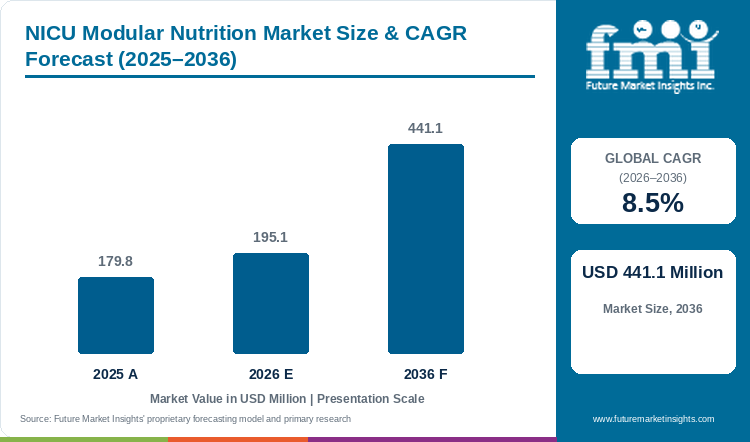
Demand for NICU modular nutrition is projected to expand at 8.5% CAGR between 2026 and 2036. Industry value grows from USD 179.8 million in 2025 to USD 195.1 million in 2026 and is projected to reach USD 441.1 million by 2036.
The global NICU modular nutrition market was valued at USD 179.8 million in 2025 and is projected to rise from USD 195.1 million in 2026 to USD 441.1 million by 2036, at 8.5% CAGR. Protein modules hold the leading 38.0% share in 2026, since neonatal teams can increase protein without adding another complete nutrient dose. The American Academy of Pediatrics identifies appropriately fortified mother’s milk as optimal nutrition for hospitalized VLBW infants weighing 1,500 grams or less.[1] The United States recorded 3,606,400 births in 2025 and a preterm birth rate of 10.41%, keeping a large infant population inside clinical nutrition pathways.[2] South Korea also connects more than 70 hospitals through its national neonatal network and records over 80% of domestic VLBW births every year.[3] Owing to this clinical base, regular use of fortifiers and separate nutrient modules is expected to support the market growth.
Key Market Trends & Insights
- By module type, protein modules led the market with a share of 38.0% in 2026, supported by separate protein adjustment.
- By base feed, fortified human milk accounted for 50.8% of revenue in 2026, aligned with AAP guidance for hospitalized VLBW infants.
- By gestational age, infants below 28 weeks represented 42.6% in 2026, as nutrient requirements remain high while tolerated feeding volume stays limited.
- By end user, level III-IV NICUs held 48.7% in 2026, supported by specialist teams managing fortification and growth monitoring.
- By sales channel, hospital pharmacy generated 46.1% in 2026, as acute NICU use requires controlled ordering, storage and replenishment.
Regional Highlights
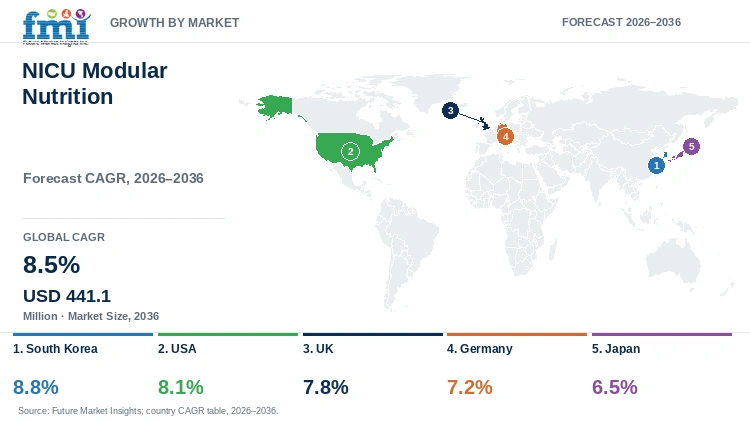
- Fastest-growing profiled country: South Korea (8.8% CAGR, 2026 to 2036).
- By country: USA (8.1%) and UK (7.8%) follow, while Japan records the lowest profiled CAGR at 6.5%.
Market Size & Forecast
Table 1: Market Size and Forecast for the NICU Modular Nutrition Market (USD million and percentage), 2025 to 2036
| Metric | Value |
|---|---|
| 2025 Market Size | USD 179.8 million |
| Estimated Market Size in 2026 | USD 195.1 million |
| Projected Market Size by 2036 | USD 441.1 million |
| CAGR, 2026 to 2036 | 8.5% |
| Added Revenue, 2026 to 2036 | USD 246.0 million |
| Market Expansion Multiple | 2.3x |
NICU modular nutrition demand depends on the feeding gap remaining after human milk or preterm formula is selected. Protein, energy and minerals have to be increased without giving a feed volume the infant cannot tolerate. The JASMINE trial across 11 Japanese NICUs reported weight gain of 14.30 grams per kilogram per day with early human milk-based fortification, compared with 11.96 grams under standard feeding.[4] Full feeds were reached in 20.0 days instead of 25.9 days, which shows how fortification can change feeding progression. Japan approved PreemieFort Enteral Solution as a prescription medicine in February 2026, giving human milk-based fortification a controlled hospital route.[5] These factors keep the addressable market concentrated among VLBW infants and other vulnerable newborns receiving supervised enteral nutrition support.
Clinical Need and Fortification Readiness
NICU modular nutrition demand is influenced by the number of vulnerable infants, continued use of human milk and readiness of hospitals to introduce fortification. The indicators below connect the patient base, neonatal network and measured feeding results with the market outlook.
Table 2: Clinical Need and Fortification Readiness Indicators for the NICU Modular Nutrition Market (births, percentages, hospitals, days, and growth rates), mixed reporting years from 2025 to 2026
| Indicator | Data Point | Why It Matters | Source |
|---|---|---|---|
| USA birth base | 3,606,400 births in 2025 | Provides a large national base from which preterm and VLBW care demand develops. | [2] |
| USA preterm rate | 10.41% in 2025 | Shows the continuing population entering different levels of neonatal care. | [2] |
| Korean neonatal network | More than 70 hospitals; over 80% of VLBW births | Supports shared feeding practice and quality-improvement activity. | [3] |
| JASMINE growth result | 14.30 vs. 11.96 g/kg/day | Shows measurable growth improvement with early human milk-based fortification. | [4] |
| JASMINE full-feeding result | 20.0 vs. 25.9 days | Indicates earlier feeding progression under the studied fortification protocol. | [4] |
| Japan treatment route | Prescription approval in February 2026 | Places the product inside a defined regulated hospital pathway. | [5] |
Analyst Perspective
“I expect fortified human milk to remain the main feeding base as hospitals avoid replacing mother’s milk. Protein and calorie modules will gain preference where precise dosing improves growth without raising tolerated feed volume.”
- Anurag Sharma, Principal Consultant, Future Market Insights.
How is the NICU modular nutrition market segmented?
NICU modular nutrition market is segmented by module type, base feed, gestational age, end user, sales channel and region. Protein modules are projected at 38.0%, fortified human milk at 50.8%, infants below 28 weeks at 42.6%, level III-IV NICUs at 48.7%, and hospital pharmacy at 46.1% in 2026.
By module type: protein modules, carbohydrate modules, lipid modules, multi-nutrient modules, and other modules.
By base feed: fortified human milk, preterm formula, and other base feeds.
By gestational age: below 28 weeks, 28-32 weeks, 32-37 weeks, and other gestational ages.
By end user: level III-IV NICUs, level II nurseries, post-discharge homecare, and other end users.
By sales channel: hospital pharmacy, retail pharmacy, online, institutional tender, and other channels.
By region: North America, Latin America, Western Europe, Eastern Europe, East Asia, South Asia and Pacific, and Middle East and Africa.
Why do protein modules retain a notable module type share?
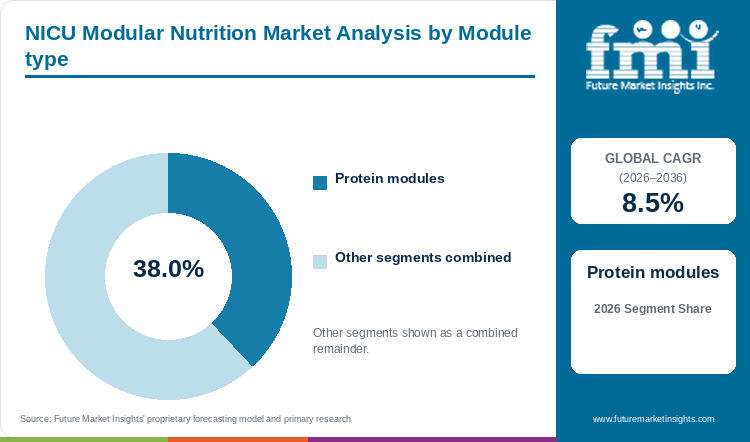
Protein modules are projected to account for 38.0% of module type revenue in 2026, supported by separate, targeted protein dosing.
Table 3: Module Type Share for the NICU Modular Nutrition Market (percentage share), 2026
| Module Type | Share (2026) |
|---|---|
| Protein Modules | 38.0% |
| Other Segments Combined | 62.0%* |
| Total | 100.0% |
*Calculated as the balance remaining after deducting the leading segment's reported share from 100.0%.
Table 4: Module Type Leadership and Market Growth for the NICU Modular Nutrition Market (segment and CAGR percentage), 2026 to 2036
| Metric | Value |
|---|---|
| Global CAGR (2026 to 2036) | 8.5% |
| Leading Segment | Protein Modules |
Protein modules are used where calories are sufficient but protein intake remains lower than the required level. The product increases one macronutrient without supplying another complete dose of minerals and vitamins. Owing to this characteristic, protein modules are added with fortified human milk and infant formula products. Separate protein adjustment is expected to support the protein modules segment growth.
- FMI research indicates protein modules account for 38.0% of module type revenue in 2026, attributed to separate protein adjustment without another complete nutrient dose.
- In July 2025, Danone Nutricia retained the Nutriprem Protein Supplement while changing the UK Nutriprem range to Aptamil Nutriprem.[6] Continued availability of a protein-only hospital product is expected to support the protein modules segment growth.
What supports fortified human milk as the preferred base feed?
Fortified human milk is estimated to represent 50.8% of base feed demand in 2026, reflecting widespread adoption of human-milk-first hospital feeding protocols.
Fortified human milk is mother’s milk or donor milk having additional nutrients required by premature infants. Human milk remains the feeding base, while human milk fortifiers provide protein, energy, minerals and vitamins. Hospitals can preserve human milk instead of shifting the infant to another complete feed. Human-milk-first feeding practice is anticipated to support demand for specialized nutrition products.
- Fortified human milk is estimated at 50.8% of base feed revenue in 2026, owing to its use as the preferred VLBW feeding base.
- The January 2026 AAP clinical report identifies appropriately fortified mother’s own milk as optimal nutrition for hospitalized VLBW infants. This recommendation is expected to support the fortified human milk segment growth.
How do infants below 28 weeks shape gestational age demand?
Infants below 28 weeks are projected to capture 42.6% of gestational age revenue in 2026, driven by elevated nutrient requirements at restricted feed volumes.
Infants born before 28 weeks generally requires higher nutrient intake while the tube feeding volume remains limited. Early fortification and individual nutrient modules increase nutrition without adding more feed volume. These infants also require regular growth monitoring throughout NICU care. Higher nutrition requirement among extremely premature infants is expected to drive this gestational age segment.
- Infants below 28 weeks represent 42.6% in 2026, due to higher nutrition requirement at lower tolerated feeding volume.
- Early fortification from feeding day two improved linear growth among infants born before 28 weeks in the trial cited by AAP. Increasing focus on early feeding is likely to fuel demand for neonatal fortifiers and individual nutrient modules.
Why are level III-IV NICUs central to end-user demand?
With an estimated 48.7% share in 2026, level III-IV NICUs lead the end user category, underpinned by specialized milk preparation and intensive clinical monitoring.
Level III-IV NICUs provide care to very premature and low birth weight infants requiring staged fortification and continuous growth monitoring. Neonatologists, dietitians, pharmacy teams and milk-room staff prepare individual parenteral nutrition orders inside these units. Presence of specialist neonatal care is supporting wider use of modular nutrition products. Expansion of advanced NICU care is expected to support the end user segment growth.
- Level III-IV NICUs account for 48.7% of end user revenue in 2026, supported by concentration of complex feeding in specialist hospitals.
- Specialized perinatal centers remain the main care setting for infants requiring intensive nutrition, supported by multidisciplinary neonatal feeding protocols. Presence of these centers is anticipated to support the level III-IV NICUs segment growth.
What keeps hospital pharmacy ahead in the sales channel?
Hospital pharmacy is anticipated to contribute 46.1% of sales channel revenue in 2026, owing to centralized formulary ordering, secure cold-chain storage, and clinical dispensing.
Hospital pharmacy supplies NICU modules as specialized medical food options under approved hospital formularies. Storage, traceability and repeated replenishment are managed within the hospital, due to which retail and online channels have lower use in acute NICU care. Liquid fortifiers also move through controlled hospital routes. Institutional ordering is expected to drive hospital pharmacy demand during the forecast period.
- Hospital pharmacy contributes 46.1% of sales channel revenue in 2026, influenced by controlled ordering, storage and product supply.
- Health Canada retained Enfamil Liquid Human Milk Fortifier High Protein and Standard Protein in its July 2026 transition-product list.[7] Continued availability of these liquid fortifiers is expected to support hospital pharmacy demand.
What are the drivers, restraints, and opportunities in the NICU modular nutrition market?
In the NICU modular nutrition market, higher nutrient requirement is the key driver, preparation complexity is the key restraint, and individualized fortification is the key opportunity.
- Driver: Higher protein, energy and mineral requirement among VLBW infants is increasing demand for fortified human milk and nutrient modules.
- Restraint: Different dosing, storage, sterility and feed compatibility requirement can limit standard use of modular products in hospitals.
- Opportunity: Increasing use of milk analysis can create growth opportunities for individual protein and calorie fortification.
Nutrient Gaps Sustain Hospital Demand
Very low birth weight infants requires more protein, energy, minerals and micronutrients than unfortified human milk can provide at usual feeding volume. Standard fortifier provides the basic nutrient increase, whereas a protein or calorie module is added when another gap remains. Growth monitoring and advancements across specialized oral clinical nutritional supplement regimens enable neonatal teams to change the nutrient level during feeding. A larger number of infants receiving fortified human milk is expected to drive the NICU modular nutrition market growth.
Preparation Burden Slows Standardization
Preparation of NICU modular nutrition requires the correct dose, storage, sterility and compatibility with the selected feed. Powder and liquid products requires different preparation steps, due to which one product cannot be placed in every hospital medical nutrition protocol. Additional mixing also raises staff training requirement inside milk rooms. High preparation burden and varied hospital practice may limiting the wider adoption of modular nutrition products.
Individualized Fortification Opens New Use
Human milk composition varies between mothers and through the lactation period, which creates demand for individual fortification. Abbott Liquid Protein Fortifier can be mixed with human milk, fortified human milk or formula and provides a separate milk protein addition.[8] Milk analysis helps identify when the feeding base requires further protein or calorie increase. Availability of measured milk composition is expected to create new growth opportunities in NICU modular nutrition market.
Which country CAGRs are profiled in the NICU modular nutrition market?
Table 5: Country CAGR Comparison for the NICU Modular Nutrition Market (CAGR percentage), 2026 to 2036
| Country | CAGR, 2026 to 2036 |
|---|---|
| South Korea | 8.8% |
| USA | 8.1% |
| UK | 7.8% |
| Germany | 7.2% |
| Japan | 6.5% |
How do country-level CAGRs compare in the NICU modular nutrition market?
As per the analysis from FMI, country outlook remains positive where hospitals have established neonatal networks and human milk fortification practice. South Korea and the USA are projected to record comparatively higher growth, whereas Japan expands at a measured rate through its prescription product route.
Availability of VLBW infants, specialist NICUs, hospital pharmacy and approved fortifier products will influence country demand through 2036.
- South Korea has a national VLBW registry and quality improvement programs which connects more than 70 hospitals.
- USA demand is supported by a large preterm birth population and hospital formulary use.
- UK adoption is supported by established neonatal feeding practice and continuity of care after discharge.
- Germany provides complex neonatal care through specialist perinatal centers having formal quality systems.
- Japan uses a prescription medicine route for the newly approved human milk-based fortifier.
Full report country CAGRs cover: North America; Latin America; Western Europe; Eastern Europe; East Asia; South Asia and Pacific; Middle East and Africa.
Country-wise Analysis
- As noted by FMI, South Korea is estimated to post 8.8% CAGR through 2036, owing to presence of a national neonatal network. The Korea National Institute of Health reported in September 2026 that more than 70 hospitals participate in the VLBW registry. The registry includes over 80% of domestic VLBW births every year and had enrolled around 28,000 infants by March 2026. Quality improvement programs also cover breastfeeding, infection control and neonatal intensive care. A common hospital network can support wider use of standardized feeding practices, which is anticipated to fuel the South Korea market growth.
- NICU modular nutrition demand is forecast to expand at 8.1% CAGR through 2036, attributed to a large premature infant population. The National Center for Health Statistics reported 3,606,400 births in 2025 and a preterm birth rate of 10.41%. Early preterm births declined by 1%, whereas infants requiring hospital nutrition remains considerable. Human milk fortifiers and separate specialty food ingredients are purchased through hospital formularies, while liquid products receive preference for controlled preparation. Presence of a large hospital system is expected to support repeat demand for NICU modular nutrition products.
- Adoption of NICU modular nutrition is estimated to grow at 7.8% CAGR through 2036, supported by established neonatal feeding practice. The Office for National Statistics reported 585,396 live births in England and Wales during 2025.[9] Around 91.0% occurred between 37 and 41 weeks, leaving another population requiring different levels of neonatal care. Live births declined by 1.6% from 2024, due to which growth will depend on higher fortification use among eligible infants. Small-dose products and clear discharge instruction is likely to support modular nutrition use after hospital care.
- The Germany NICU modular nutrition sector is projected to register 7.2% CAGR through 2036, owing to specialist perinatal centers. The Federal Statistical Office reported 654,241 births in 2025, which was the lowest post-war level.[10] The fertility rate also declined to 1.32 children per woman. Lower birth number does not remove the nutritional requirement of very premature and VLBW infants. German hospitals prefer products having clear preparation instruction and compatibility with center-specific human milk handling. Demand from specialist neonatal centers is anticipated to support the Germany market growth.
- Sales of NICU modular nutrition are forecast to expand at 6.5% CAGR through 2036, aided by approval of a human milk-based fortifier. Japan approved PreemieFort Enteral Solution 6, 8 and CF as prescription medicines in February 2026 for VLBW and other vulnerable infants. The products were supported by the JASMINE phase III program across Japanese NICUs. Prescription status provides a defined hospital route, but it also raises evidence and distribution requirement. Human milk-based fortification is expected to receive gradual use through hospital protocol review in Japan.
Who are the notable companies in the NICU modular nutrition market?
Abbott, Prolacta Bioscience, Danone Nutricia, Mead Johnson / Reckitt, Nestle S.A., and Medolac Laboratories are notable companies profiled in this market.
FMI data suggests the market remains moderately concentrated, with a limited number of companies offering direct neonatal fortifiers and nutrient modules. Abbott and Danone Nutricia provides bovine-based fortification and protein products, while Prolacta Bioscience and Medolac Laboratories focus on human milk-based nutrition. Mead Johnson / Reckitt and Nestle S.A. participate through wider infant nutrition portfolios and hospital distribution. Product availability, country approval and access to hospital pharmacy is expected to influence company growth in NICU modular nutrition market.
- Dedicated neonatal fortification: Abbott, Prolacta Bioscience, and Danone Nutricia offers products for preterm nutrient adjustment and human milk fortification.
- Integrated infant nutrition: Mead Johnson / Reckitt and Nestle S.A. provides human milk fortifiers through wider infant nutrition portfolios.
- Human milk specialization: Medolac Laboratories is focusing on human milk-based fortification for NICU use.
Competitive Benchmarking: NICU Modular Nutrition Market
Table 6: Competitive Benchmarking for the NICU Modular Nutrition Market (qualitative capability ratings), 2026
| Company | Modular depth | Human-milk fit | Formulary readiness | Geographic reach |
|---|---|---|---|---|
| Abbott | High | High | High | High |
| Prolacta Bioscience | High | High | High | Medium |
| Danone Nutricia | High | High | High | High |
| Mead Johnson / Reckitt | Medium | High | High | High |
| Nestle S.A. | Medium | High | High | High |
| Medolac Laboratories | Medium | High | Medium | Low |
Scoring basis: High indicates wider product portfolio, institutional activity and geographic reach. Medium indicates a narrower current position and Low indicates limited public evidence. The rating does not indicate product quality, market share or company rank.
Key Developments in the NICU Modular Nutrition Market
- In July 2026, Mead Johnson / Reckitt retained standard-protein and high-protein liquid human milk fortifiers under the Health Canada transition strategy. Continued product access is expected to support hospital supply in Canada.
- In April 2026, Prolacta Bioscience reported JASMINE trial results from 11 Japanese NICUs. Higher growth and earlier achievement of full feeds can support hospital protocol review in Japan.
- In February 2026, Prolacta Bioscience announced approval of PreemieFort Enteral Solution in Japan as a prescription medicine. The approval provides regulated hospital route for human milk-based fortification among vulnerable infants.
- In July 2025, Danone Nutricia started changing the UK Cow & Gate Nutriprem range to Aptamil Nutriprem. Product composition remained unchanged, which supported continuity among neonatal units during the branding change.
Key players in the NICU Modular Nutrition Market
Dedicated NICU Fortification Platforms
- Abbott
- Prolacta Bioscience
- Danone Nutricia
Integrated Infant Nutrition Formularies
- Mead Johnson / Reckitt
- Nestle S.A.
Human Milk Specialty Platform
- Medolac Laboratories
NICU Modular Nutrition Market - Report Scope
Table 7: Report Scope for the NICU Modular Nutrition Market (coverage fields and definitions), 2026 to 2036
| Coverage field | Report scope |
|---|---|
| Market breakdown | Module type; base feed; gestational age; end user; sales channel; region |
| Quantitative units | USD million |
| Market definition | First-sale revenue from enteral modular nutrition products used in NICU, preterm, low-birthweight, or supervised neonatal feeding. Base human milk, donor milk, complete formula, parenteral nutrition, and standard infant formula are excluded. |
| Regions covered | North America; Latin America; Western Europe; Eastern Europe; East Asia; South Asia and Pacific; Middle East and Africa |
| Countries profiled | South Korea; USA; UK; Germany; Japan |
| Forecast period | 2026 to 2036 |
NICU Modular Nutrition Market - Research Methodology
Table 8: Research Methodology for the NICU Modular Nutrition Market (research methods and approach), 2026 edition
| Method | Approach |
|---|---|
| Primary Research | Primary research includes interviews with manufacturers, distributors, neonatal nutrition specialists, hospital procurement teams and industry experts. Interviews covers product selection, pricing, adoption barriers, preparation requirement and factors which support regular hospital purchasing. |
| Desk Research | Desk research covers government statistics, regulatory publications, clinical guidance, company filings, product information and official company announcements. Sources are used when the information is relevant to neonatal modular nutrition and falls within the defined market scope. |
| Market Sizing and Forecasting | Market sizing combines the baseline value, historical performance, segment structure, product pricing, adoption level, company participation and country demand. Forecasting considers product availability, hospital use, regulatory development and barriers affecting wider adoption. |
| Data Validation | Market estimates are checked with public data, company activity, regulatory records and primary research findings. Complete feeds, parenteral nutrition, base human milk and overlapping revenue are excluded in order to maintain the defined market boundary. |
NICU Modular Nutrition Market by Segments
NICU Modular Nutrition Market segmented by Module type:
- Protein modules
- Carbohydrate modules
- Lipid modules
- Multi-nutrient modules
- Other modules
NICU Modular Nutrition Market segmented by Base feed:
- Fortified human milk
- Preterm formula
- Other base feeds
NICU Modular Nutrition Market segmented by Gestational age:
- Below 28 weeks
- 28-32 weeks
- 32-37 weeks
- Other gestational ages
NICU Modular Nutrition Market segmented by End user:
- Level III-IV NICUs
- Level II nurseries
- Post-discharge homecare
- Other end users
NICU Modular Nutrition Market segmented by Sales channel:
- Hospital pharmacy
- Retail pharmacy
- Online
- Institutional tender
- Other channels
NICU Modular Nutrition Market by Region
- North America
- United States
- Canada
- Latin America
- Brazil
- Mexico
- Argentina
- Chile
- Western Europe
- Germany
- France
- United Kingdom
- Italy
- Spain
- Benelux
- Nordics
- Eastern Europe
- Poland
- Czech Republic
- Romania
- Hungary
- East Asia
- Japan
- South Korea
- South Asia and Pacific
- ASEAN
- Australia and New Zealand
- Middle East and Africa
- GCC Countries
- South Africa
- Türkiye
- Israel
Research Sources and Bibliography
- [1] American Academy of Pediatrics. (2026, January 12). Promoting human milk and breastfeeding for the very low birth weight infant: Clinical report.
- [2] National Center for Health Statistics. (2026, April 9). Births: Provisional data for 2025.
- [3] Korea National Institute of Health. (2026, September 1). Korean Neonatal Network: Very low birth weight infant registry.
- [4] Prolacta Bioscience. (2026, April 30). JASMINE trial demonstrates growth findings in premature infants.
- [5] Prolacta Bioscience. (2026, February 18). Japan approves human milk-based fortifiers as a prescription drug.
- [6] Danone Nutricia UK. (2025, July). Nutriprem range and packaging update.
- [7] Health Canada. (2025, December 17; updated 2026, July). List of transition strategy products.
- [8] Abbott Nutrition. (2026). Liquid protein fortifier.
- [9] Office for National Statistics. (2026, September 8). Births in England and Wales: 2025 final rates.
- [10] Federal Statistical Office of Germany. (2026, July 1). Total fertility rate drops to 1.32 children per woman in 2025.
This bibliography is provided for reader reference. The full report contains the complete reference list and detailed citations.
This Report Answers
- How large is the NICU modular nutrition market during 2026?
- What market value is projected for NICU modular nutrition by 2036?
- Which three segments hold notable shares in the NICU market?
- Which countries have a notable NICU modular nutrition growth outlook?
- Which companies are notable in the NICU modular nutrition market?
- What products and revenues fall inside the defined report scope?
Frequently Asked Questions
How large is the NICU modular nutrition market in 2026?
Future Market Insights estimates that the NICU modular nutrition market will reach USD 195.1 million in 2026. Hospital use is projected to support market value of USD 441.1 million by 2036.
What CAGR is projected for NICU modular nutrition through 2036?
As per FMI, the NICU modular nutrition market is projected to grow at 8.5% CAGR between 2026 and 2036. Higher nutrition requirement among VLBW infants having limited feeding volume is supporting the market growth.
Which module type holds a notable share during 2026?
Protein modules are projected to account for 38.0% of module type revenue in 2026. Separate protein adjustment without another complete nutrient dose is supporting the segment demand.
Which base feed holds a notable share during 2026?
Fortified human milk is expected to hold 50.8% of base feed revenue in 2026. Human-milk-first feeding practice and additional nutrient requirement is driving fortification demand.
Which country has a notable expansion outlook through 2036?
South Korea is projected to grow at 8.8% CAGR through 2036. A national VLBW registry and neonatal hospital network is expected to support wider feeding practice.
Who are the notable NICU modular nutrition market companies?
Key companies include Abbott, Prolacta Bioscience, Danone Nutricia, Mead Johnson / Reckitt, Nestle S.A., and Medolac Laboratories. These companies are focusing on neonatal fortification products, hospital supply and country approvals.
Preview the report firsthand - request a free sample
Get SampleGet the brochure for pricing and purchase details.
Get PDFTable of Content
- Key Takeaways
- Market Size and CAGR
- Top Growth Driver
- Fastest Growing Segment
- Leading Region
- Key Companies
- Emerging Opportunities
- Executive Summary
- Global Market Outlook
- Demand-side Trends
- Supply-side Trends
- Technology Roadmap Analysis
- Analysis and Recommendations
- Analyst Perspective (What is happening? Why now? What should investors know?)
- Key Questions Answered
- How large is the market?
- What is the CAGR?
- What are key trends?
- Which region dominates?
- Who are the leaders?
- Market Overview
- Market Coverage / Taxonomy
- Market Definition / Scope / Limitations
- Research Methodology
- Chapter Orientation
- Analytical Lens and Working Hypotheses
- Market Structure, Signals, and Trend Drivers
- Benchmarking and Cross-market Comparability
- Market Sizing, Forecasting, and Opportunity Mapping
- Research Design and Evidence Framework
- Desk Research Programme (Secondary Evidence)
- Expert Input and Fieldwork (Primary Evidence)
- Tooling, Models, and Reference Databases
- Data Engineering and Model Build
- Quality Assurance and Audit Trail
- Market Background
- Market Dynamics (Drivers, Restraints, Opportunity, Trends)
- Scenario Forecast (Optimistic, Likely, Conservative)
- Impact Analysis
- AI Impact
- Sustainability Impact
- Regulatory Impact
- Technology Impact
- Consumer / Buyer Analysis
- Purchase Drivers
- Adoption Barriers
- Buyer Journey
- Opportunity Map Analysis
- Product Life Cycle Analysis
- Supply Chain Analysis
- Investment Feasibility Matrix
- Value Chain Analysis
- PESTLE and Porter's Analysis
- Regulatory Landscape
- Regional Parent Market Outlook
- Production and Consumption Statistics
- Import and Export Statistics
- Global Market Analysis and Forecast, 2021 to 2036
- Historical Market Size Value (USD Million) Analysis, 2021 to 2025
- Current and Future Market Size Value (USD Million) Projections, 2026 to 2036
- Y-o-Y Growth Trend Analysis
- Absolute $ Opportunity Analysis
- Global Market Pricing Analysis, 2021 to 2036
- Global Market Analysis and Forecast, By Module type, 2021 to 2036
- Introduction / Key Findings
- Historical Market Size Value (USD Million) Analysis By Module type, 2021 to 2025
- Current and Future Market Size Value (USD Million) Analysis and Forecast By Module type, 2026 to 2036
- Protein modules
- Carbohydrate modules
- Lipid modules
- Multi-nutrient modules
- Other modules
- Y-o-Y Growth Trend Analysis By Module type, 2021 to 2025
- Absolute $ Opportunity Analysis By Module type, 2026 to 2036
- Global Market Analysis and Forecast, By Base feed, 2021 to 2036
- Introduction / Key Findings
- Historical Market Size Value (USD Million) Analysis By Base feed, 2021 to 2025
- Current and Future Market Size Value (USD Million) Analysis and Forecast By Base feed, 2026 to 2036
- Fortified human milk
- Preterm formula
- Other base feeds
- Y-o-Y Growth Trend Analysis By Base feed, 2021 to 2025
- Absolute $ Opportunity Analysis By Base feed, 2026 to 2036
- Global Market Analysis and Forecast, By Gestational age, 2021 to 2036
- Introduction / Key Findings
- Historical Market Size Value (USD Million) Analysis By Gestational age, 2021 to 2025
- Current and Future Market Size Value (USD Million) Analysis and Forecast By Gestational age, 2026 to 2036
- Below 28 weeks
- 28-32 weeks
- 32-37 weeks
- Other gestational ages
- Y-o-Y Growth Trend Analysis By Gestational age, 2021 to 2025
- Absolute $ Opportunity Analysis By Gestational age, 2026 to 2036
- Global Market Analysis and Forecast, By End user, 2021 to 2036
- Introduction / Key Findings
- Historical Market Size Value (USD Million) Analysis By End user, 2021 to 2025
- Current and Future Market Size Value (USD Million) Analysis and Forecast By End user, 2026 to 2036
- Level III-IV NICUs
- Level II nurseries
- Post-discharge homecare
- Other end users
- Y-o-Y Growth Trend Analysis By End user, 2021 to 2025
- Absolute $ Opportunity Analysis By End user, 2026 to 2036
- Global Market Analysis and Forecast, By Sales channel, 2021 to 2036
- Introduction / Key Findings
- Historical Market Size Value (USD Million) Analysis By Sales channel, 2021 to 2025
- Current and Future Market Size Value (USD Million) Analysis and Forecast By Sales channel, 2026 to 2036
- Hospital pharmacy
- Retail pharmacy
- Online
- Institutional tender
- Other channels
- Y-o-Y Growth Trend Analysis By Sales channel, 2021 to 2025
- Absolute $ Opportunity Analysis By Sales channel, 2026 to 2036
- Global Market Analysis and Forecast, By Region, 2021 to 2036
- Introduction
- Historical Market Size Value (USD Million) Analysis By Region, 2021 to 2025
- Current Market Size Value (USD Million) Analysis and Forecast By Region, 2026 to 2036
- North America
- Latin America
- Western Europe
- Eastern Europe
- East Asia
- South Asia and Pacific
- Middle East and Africa
- Market Attractiveness Analysis By Region
- North America Market Analysis and Forecast, By Country, 2021 to 2036
- Historical Market Size Value (USD Million) Trend Analysis By Market Taxonomy, 2021 to 2025
- Market Size Value (USD Million) Forecast By Market Taxonomy, 2026 to 2036
- By Country
- United States
- Canada
- By Module type
- By Base feed
- By Gestational age
- By End user
- By Sales channel
- By Country
- Market Attractiveness Analysis
- By Country
- By Module type
- By Base feed
- By Gestational age
- By End user
- By Sales channel
- Key Takeaways
- Latin America Market Analysis and Forecast, By Country
- Historical Market Size Value (USD Million) Trend Analysis By Market Taxonomy, 2021 to 2025
- Market Size Value (USD Million) Forecast By Market Taxonomy, 2026 to 2036
- By Country
- Brazil
- Mexico
- Argentina
- Chile
- By Module type
- By Base feed
- By Gestational age
- By End user
- By Sales channel
- By Country
- Market Attractiveness Analysis
- By Country
- By Module type
- By Base feed
- By Gestational age
- By End user
- By Sales channel
- Key Takeaways
- Western Europe Market Analysis and Forecast, By Country
- Historical Market Size Value (USD Million) Trend Analysis By Market Taxonomy, 2021 to 2025
- Market Size Value (USD Million) Forecast By Market Taxonomy, 2026 to 2036
- By Country
- Germany
- France
- United Kingdom
- Italy
- Spain
- Benelux
- Nordics
- By Module type
- By Base feed
- By Gestational age
- By End user
- By Sales channel
- By Country
- Market Attractiveness Analysis
- By Country
- By Module type
- By Base feed
- By Gestational age
- By End user
- By Sales channel
- Key Takeaways
- Eastern Europe Market Analysis and Forecast, By Country
- Historical Market Size Value (USD Million) Trend Analysis By Market Taxonomy, 2021 to 2025
- Market Size Value (USD Million) Forecast By Market Taxonomy, 2026 to 2036
- By Country
- Poland
- Czech Republic
- Romania
- Hungary
- By Module type
- By Base feed
- By Gestational age
- By End user
- By Sales channel
- By Country
- Market Attractiveness Analysis
- By Country
- By Module type
- By Base feed
- By Gestational age
- By End user
- By Sales channel
- Key Takeaways
- East Asia Market Analysis and Forecast, By Country
- Historical Market Size Value (USD Million) Trend Analysis By Market Taxonomy, 2021 to 2025
- Market Size Value (USD Million) Forecast By Market Taxonomy, 2026 to 2036
- By Country
- Japan
- South Korea
- By Module type
- By Base feed
- By Gestational age
- By End user
- By Sales channel
- By Country
- Market Attractiveness Analysis
- By Country
- By Module type
- By Base feed
- By Gestational age
- By End user
- By Sales channel
- Key Takeaways
- South Asia and Pacific Market Analysis and Forecast, By Country
- Historical Market Size Value (USD Million) Trend Analysis By Market Taxonomy, 2021 to 2025
- Market Size Value (USD Million) Forecast By Market Taxonomy, 2026 to 2036
- By Country
- ASEAN
- Australia and New Zealand
- By Module type
- By Base feed
- By Gestational age
- By End user
- By Sales channel
- By Country
- Market Attractiveness Analysis
- By Country
- By Module type
- By Base feed
- By Gestational age
- By End user
- By Sales channel
- Key Takeaways
- Middle East and Africa Market Analysis and Forecast, By Country
- Historical Market Size Value (USD Million) Trend Analysis By Market Taxonomy, 2021 to 2025
- Market Size Value (USD Million) Forecast By Market Taxonomy, 2026 to 2036
- By Country
- GCC Countries
- South Africa
- Türkiye
- Israel
- By Module type
- By Base feed
- By Gestational age
- By End user
- By Sales channel
- By Country
- Market Attractiveness Analysis
- By Country
- By Module type
- By Base feed
- By Gestational age
- By End user
- By Sales channel
- Key Takeaways
- Key Countries Market Analysis
- United States
- Pricing Analysis
- Market Share Analysis, 2025
- By Module type
- By Base feed
- By Gestational age
- By End user
- By Sales channel
- Canada
- Pricing Analysis
- Market Share Analysis, 2025
- By Module type
- By Base feed
- By Gestational age
- By End user
- By Sales channel
- Mexico
- Pricing Analysis
- Market Share Analysis, 2025
- By Module type
- By Base feed
- By Gestational age
- By End user
- By Sales channel
- Brazil
- Pricing Analysis
- Market Share Analysis, 2025
- By Module type
- By Base feed
- By Gestational age
- By End user
- By Sales channel
- Chile
- Pricing Analysis
- Market Share Analysis, 2025
- By Module type
- By Base feed
- By Gestational age
- By End user
- By Sales channel
- Germany
- Pricing Analysis
- Market Share Analysis, 2025
- By Module type
- By Base feed
- By Gestational age
- By End user
- By Sales channel
- United Kingdom
- Pricing Analysis
- Market Share Analysis, 2025
- By Module type
- By Base feed
- By Gestational age
- By End user
- By Sales channel
- Italy
- Pricing Analysis
- Market Share Analysis, 2025
- By Module type
- By Base feed
- By Gestational age
- By End user
- By Sales channel
- Spain
- Pricing Analysis
- Market Share Analysis, 2025
- By Module type
- By Base feed
- By Gestational age
- By End user
- By Sales channel
- France
- Pricing Analysis
- Market Share Analysis, 2025
- By Module type
- By Base feed
- By Gestational age
- By End user
- By Sales channel
- ASEAN
- Pricing Analysis
- Market Share Analysis, 2025
- By Module type
- By Base feed
- By Gestational age
- By End user
- By Sales channel
- Australia and New Zealand
- Pricing Analysis
- Market Share Analysis, 2025
- By Module type
- By Base feed
- By Gestational age
- By End user
- By Sales channel
- Japan
- Pricing Analysis
- Market Share Analysis, 2025
- By Module type
- By Base feed
- By Gestational age
- By End user
- By Sales channel
- South Korea
- Pricing Analysis
- Market Share Analysis, 2025
- By Module type
- By Base feed
- By Gestational age
- By End user
- By Sales channel
- Poland
- Pricing Analysis
- Market Share Analysis, 2025
- By Module type
- By Base feed
- By Gestational age
- By End user
- By Sales channel
- Hungary
- Pricing Analysis
- Market Share Analysis, 2025
- By Module type
- By Base feed
- By Gestational age
- By End user
- By Sales channel
- Türkiye
- Pricing Analysis
- Market Share Analysis, 2025
- By Module type
- By Base feed
- By Gestational age
- By End user
- By Sales channel
- South Africa
- Pricing Analysis
- Market Share Analysis, 2025
- By Module type
- By Base feed
- By Gestational age
- By End user
- By Sales channel
- United States
- Market Structure Analysis
- Competition Dashboard
- Competition Benchmarking
- Market Share Analysis of Top Players
- By Regional
- By Module type
- By Base feed
- By Gestational age
- By End user
- By Sales channel
- Emerging Startups
- Innovation Benchmarking
- Competition Analysis
- Competition Deep Dive
- Abbott
- Overview
- Product Portfolio
- Profitability by Market Segments
- Sales Footprint
- Strategy Overview
- Marketing Strategy
- Product Strategy
- Channel Strategy
- Prolacta Bioscience
- Danone Nutricia
- Mead Johnson / Reckitt
- Nestle S.A.
- Medolac Laboratories
- Abbott
- Case Studies
- Success Stories
- Recent Developments
- Competition Deep Dive
- Assumptions & Acronyms Used


