

- Market Size (2026)
- USD 115.8 Bn
- Forecast (2036)
- USD 232.0 Bn
- CAGR (2026 to 2036)
- 7.2%
Specialized Nutrition Market Size, Market Forecast and Outlook By FMI
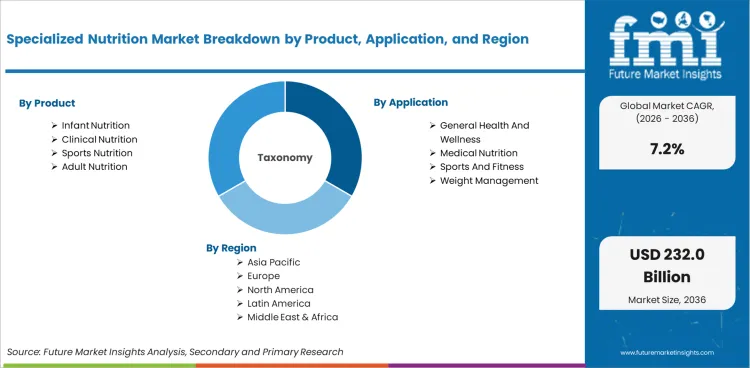
The specialized nutrition market was valued at USD 108.0 billion in 2025. The market is set to reach USD 115.8 billion by 2026-end and grow at a CAGR of 7.2% between 2026-2036 to reach USD 232.0 billion by 2036. Infant Nutrition will dominate with a 40.0% share, while General Health And Wellness will lead with a 45.0% share.
Summary of the Specialized Nutrition Market
- Demand and Growth Drivers
- Infant nutrition remains the largest and most resilient product segment, with birth rates in developing markets and premiumization in mature markets sustaining demand for formula products across standard and specialty grades.
- Sports nutrition is the fastest-growing segment, with fitness culture expansion and protein supplementation normalization converting niche athletic products into mainstream consumer health categories.
- Aging population demographics in developed markets are expanding demand for elderly-specific nutrition products addressing sarcopenia, bone health, cognitive decline, and general nutritional insufficiency.
- Product and Segment View
- Infant Nutrition is likely to remain the leading product segment at 40% share, supported by established demand and procurement patterns.
- General Health And Wellness is likely to account for 45% of the application segment, reflecting buyer preference and usage patterns.
- Adults is likely to lead the end use segment at 50% share during the forecast period.
- Geography and Competitive Outlook
- China is likely to remain a key market at 9.72% CAGR, supported by strong demand fundamentals and expanding adoption.
- India is likely to sustain growth at 9% CAGR owing to rising spending and expanding infrastructure.
- Companies with broad product portfolios and multi-channel distribution are likely to gain traction during the forecast period.
- Analyst Opinion
- The specialized nutrition market is evolving into a more defined commercial category with clear segment leaders and established distribution patterns.
- Adoption is increasing due to rising awareness, expanding distribution, and growing influence of health and wellness trends on purchasing behavior.
- Demand is further supported by premiumization, where buyers trade up to higher-quality products with validated health or functional benefits.
- Companies that can improve cost competitiveness while delivering consistent quality are likely to strengthen their position over the forecast period.
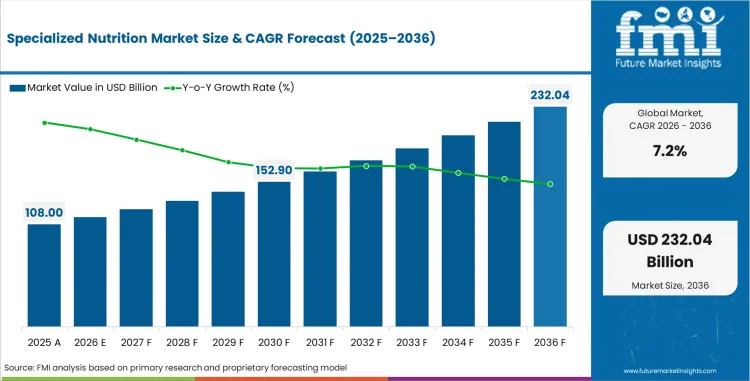
Key Takeaways, Market Size, and Forecast
- The specialized nutrition market was valued at USD 108.0 billion in 2025.
- By 2036, the Specialized Nutrition Market is expected to be worth USD 232.0 billion.
- From 2026 to 2036, the market is projected to expand at a CAGR of 7.2%.
- The market is projected to create an incremental opportunity of USD 116.27 billion between 2026 and 2036.
- In 2026, infant nutrition is expected to account for 40% of the product segment, driven by demand for infant formula products providing complete nutritional support for newborns and infants where breastfeeding is supplemented or replaced.
- China (9.72%) and India (9%) are two of the fastest growing markets in the world.
Specialized Nutrition Market Definition
The specialized nutrition market encompasses commercially traded nutritional products designed for specific life-stage, health condition, or performance requirements. Product categories include infant nutrition, sports nutrition, medical nutrition, and weight management products in powder, liquid, and bar formulations.
Specialized Nutrition Market Inclusions
Market scope covers all commercially traded specialized nutrition products categorized by product (infant nutrition, sports nutrition, medical nutrition, weight management), application (general health and wellness, clinical nutrition, athletic performance, age-specific nutrition), end use (adults, infants and children, elderly), distribution channel (offline retail, online retail), formulation (powder formulations, liquid formulations, bar and solid formulations), and pricing tier (mid range, economy, premium). The revenue range spans from 2026 to 2036.
Specialized Nutrition Market Exclusions
The scope does not include general grocery food products without specialized nutritional positioning, standard dairy products, or pharmaceutical drugs for disease treatment.
Specialized Nutrition Market Research Methodology
- Primary Research: FMI analysts spoke with specialty nutrition manufacturers, pediatric nutritionists, sports dietitians and pharmacy retail managers in key markets.
- Desk Research: Data gathered from nutrition industry associations, infant feeding databases, sports nutrition market analytics, and clinical nutrition procurement data.
- Market sizing and forecasting: bottom-up aggregation by product categories and life stage segments, with regional adoption curves modulated by birth rates, sports participation and aging demographics.
- Data validation: Quarterly validation against nutrition product retail data and manufacturer revenue disclosures.
Why is the Specialized Nutrition Market Growing?
- Infant nutrition continues to be the largest and most resilient product segment, with demand for formula products across standard and specialty grades being supported by birth rates in developing markets and premiumization in mature markets.
- The fastest growing segment is sports nutrition - the growth of fitness culture and acceptance of protein supplementation is turning what was once a niche athletic product into a mainstream consumer health category.
- Developed market aging population demographics fuel demand for elderly-specific nutrition products with a focus on sarcopenia, bone health.
The niche nutrition market is growing as consumers and clinicians recognize the nutritional requirements specific to life stages. Infant nutrition accounts for 40.0% of the product segment, with standard and premium formula products for the newborn through toddler age groups. General health and wellness accounts for 45.0% of total demand in application demand, and daily nutritional supplementation is becoming a mainstream consumer behavior.
Adults account for 50.0% of end-user demand. Sports nutrition and weight management products are the largest adult consumer segments. Offline retail holds a share of 60.0% in distribution, with pharmacies, supermarkets and specialty nutrition stores as the main purchase points. Powder formulations dominate with 55.0%, providing dosing flexibility, shelf stability and cost efficiency for infant, sports and medical nutrition applications.
Market Segmentation Analysis
- Infant Nutrition accounts for 40% of the product segment, reflecting established demand patterns.
- Adults leads the end use segment at 50% share.
The specialized nutrition market is segmented by product, application, end use, distribution channel, formulation, pricing tier.
Insights into the Infant Nutrition Product Segment
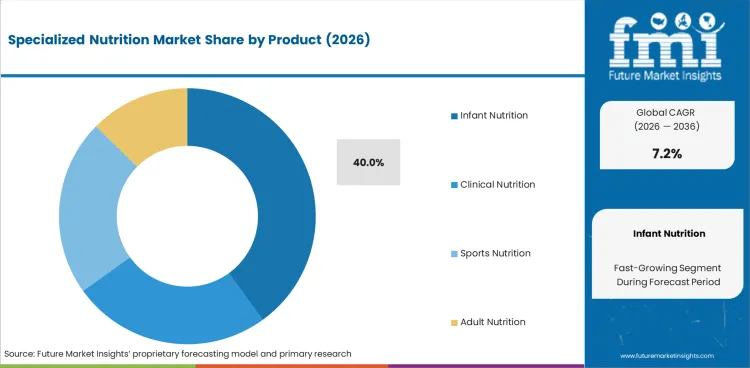
In 2026, infant nutrition is expected to account for 40.0% of the product segment. Standard infant formula, follow-on formula, and growing-up milk products serve newborn through toddler nutrition requirements. Premiumization is driven by ingredient innovation including HMO, DHA, and probiotics. Strict regulatory requirements across all markets ensure product safety and nutritional adequacy standards.
Insights into the Offline Retail Distribution Channel
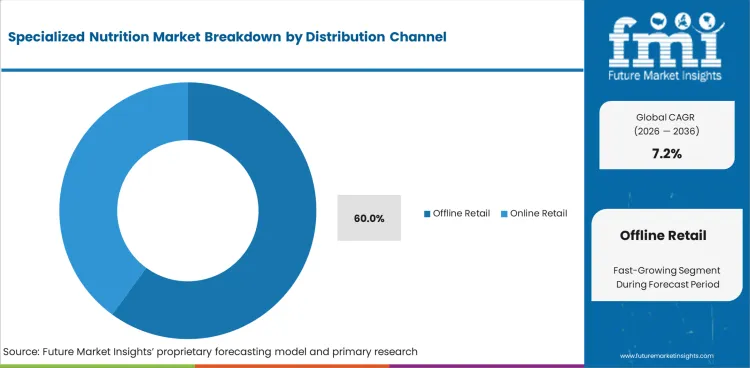
Offline retail accounts for 60.0% of distribution. Pharmacies serve as trusted purchase points for infant nutrition and medical nutrition products. Supermarkets provide broad accessibility for sports nutrition, weight management, and general wellness products. Specialty nutrition stores and fitness retail outlets serve performance-focused consumer segments. Online retail is growing through subscription models and direct-to-consumer platforms.
Specialized Nutrition Market Drivers, Restraints, and Opportunities
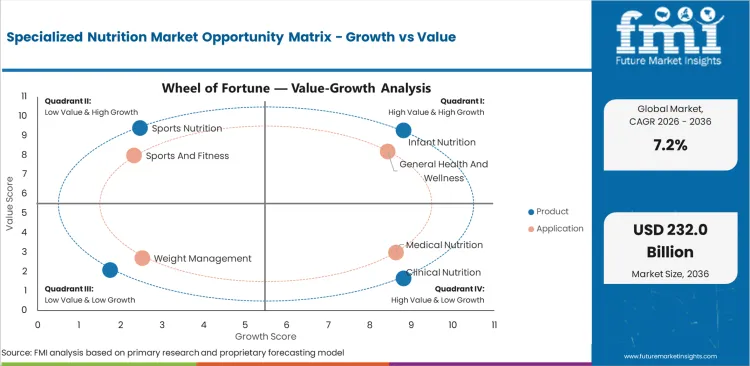
- Infant Nutrition Demand and is creating structured demand across key segments.
- Regulatory Complexity and Market is limiting adoption velocity in price-sensitive segments.
The specialized nutrition market is shaped by demand-side catalysts and supply-side constraints that vary by region and price tier.
Infant Nutrition Demand and Formula Premiumization
Birth rates in developing markets and premiumization in mature markets are driving demand. Premium formulas are priced to reflect ingredient innovation including human milk oligosaccharides (HMO), DHA and probiotics. In all markets regulatory regimes specify that strict standards of safety and nutritional adequacy are maintained.
Sports Nutrition Mainstreaming and Protein Demand
Growth is driven by the shift of sports nutrition from niche athletic products to mainstream consumer categories. The addressable market is expanded as protein powder, energy bars and performance drinks are purchased by fitness enthusiasts, casual exercisers and health-conscious consumers.
Regulatory Complexity and Market Access Barriers
Complex regulatory frameworks for infant nutrition and medical nutrition products pose barriers to adoption in new markets. Country-specific registration, labelling and compositional requirements create market access barriers and compliance costs for manufacturers.
Aging Population and Elderly Nutrition Demand
Demographic trends in developed markets, including an aging population, are expected to drive demand for nutrition products to combat sarcopenia, bone density loss, cognitive health, and general nutritional insu?ciency. Elderly nutrition is an emerging segment with good growth potential.
Analysis of Specialized Nutrition Market By Key Countries
.webp "Top Country Growth Comparison Specialized Nutrition Market Cagr (2026 2036)")
| Country | CAGR |
|---|---|
| China | 9.72% |
| India | 9% |
| Germany | 8.28% |
| Brazil | 7.56% |
| USA | 6.84% |
| UK | 6.12% |
| Japan | 5.4% |
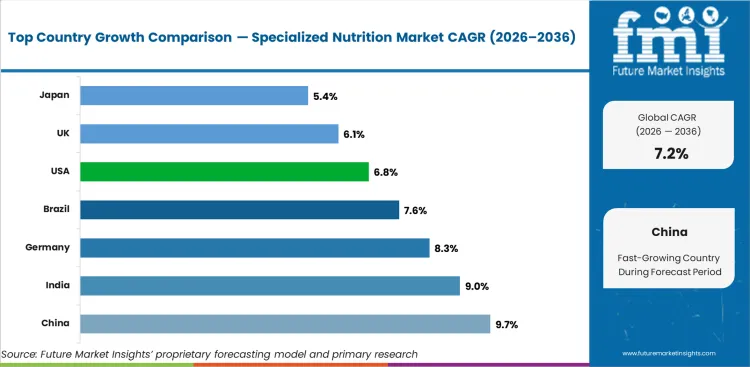
- China leads with 9.72% CAGR, the largest demand base and increasing adoption.
- India at 9% offers a robust demand environment, backed by increasing expenditure and distribution growth.
- Germany (8.28%) and Brazil (7.56%) continue to grow through developing market expansion.
The global specialized nutrition market is projected to expand at 7.2% per year from 2026 to 2036. The study covers more than 30 countries.
Sales Analysis of Specialized Nutrition Market in China
China leads at 9.72% through 2036. China's infant formula market is one of the largest globally, shaped by government regulation post-melamine crisis and consumer preference for premium imported brands. Sports nutrition is growing rapidly as fitness culture expands in urban centers.
- Infant formula market is one of the largest globally with strong premium brand preference.
- Government regulation post-melamine crisis ensures strict quality and safety standards.
- Sports nutrition growth is accelerating as urban fitness culture expands across tier-1 and tier-2 cities.
Demand Outlook for Specialized Nutrition Market in India
India is expanding at 9.0% through 2036. High birth rates sustain infant nutrition demand, while growing fitness culture and urban health awareness expand sports and adult nutrition segments. Abbott, Nestle, and Danone maintain strong positions through pharmacy and retail distribution.
- High birth rates sustain consistent infant formula and growing-up milk demand.
- Growing urban fitness culture expands sports nutrition and protein supplement consumption.
- Pharmacy-based distribution provides clinical credibility for infant and medical nutrition products.
In-depth Analysis of Specialized Nutrition Market in Germany
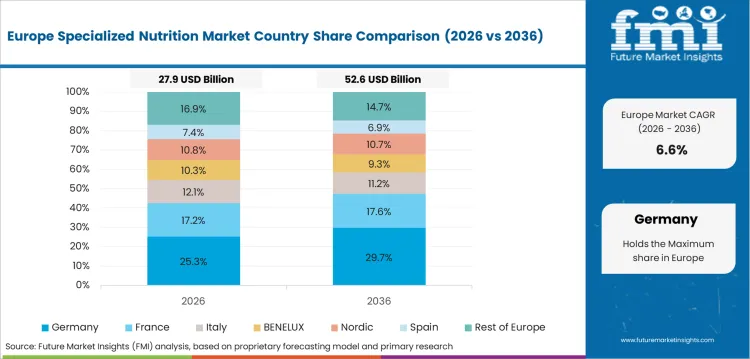
Germany is expanding at 7.5% through 2036. EU infant formula regulation and strong pharmacy distribution create a structured market. German consumers prioritize clinically validated nutrition products with transparent ingredient sourcing.
- EU infant formula regulation provides a strict quality and safety framework.
- Pharmacy distribution serves as a trusted channel for specialized nutrition products.
- Consumer preference for clinically validated products supports premium pricing.
Future Outlook for Specialized Nutrition Market in the United States
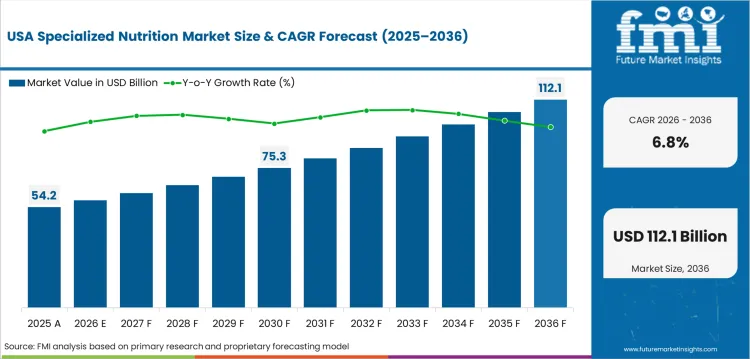
The USA is growing at 6.8% through 2036. Abbott and Nestle dominate infant nutrition, while sports nutrition brands including Herbalife and GNC serve the adult performance segment. FDA regulatory frameworks govern both infant formula and dietary supplement categories.
- Abbott and Nestle dominate infant formula through established brand trust and distribution.
- Sports nutrition is a mainstream consumer category with broad retail availability.
- FDA regulatory frameworks ensure safety standards for infant formula and dietary supplements.
In-depth Analysis of Specialized Nutrition Market in Japan
Japan is 5.8% growing through 2036. The aging population in Japan is driving demand for nutrition products for the elderly. FOSHU regulatory standards are strict and support functional nutrition claims that have been clinically validated.
- The aging population is driving up the demand for nutrition products aimed at the elderly.
- The FOSHU regulatory standards are scientific basis for specialized nutrition claims.
- Domestic manufacturers hold strong positions because of quality standards and clinical validation.
Opportunity Analysis of Specialized Nutrition Market in the United Kingdom
The UK is growing 5.5% through 2036. The NHS supports uptake of specialised nutrition and pharmacies distribute nutrition guidelines. Sports nutrition is now a mainstream grocery category in UK retail.
- Clinical positioning of specialist nutrition products based on NHS nutrition guidelines.
- Pharmacy distribution offers confidence in infant and medical nutrition products.
- Sports nutrition is now a mainstream grocery category in UK retail.
Demand Outlook for Specialized Nutrition Market in Brazil
Brazil is expanding at 6.2% through 2036. The growing urban fitness culture and high birth rates are driving both infant and sports nutrition segments. The integration of the SUS healthcare system increases access to medical nutrition among hospitalized patients.
- High birth rates continue to drive demand for infant nutrition across income segments.
- The booming culture of urban fitness is fuelling the demand for sports nutrition and protein.
- The SUS healthcare system procurement favors institutional access to medical nutrition.
Competitive Landscape and Strategic Positioning
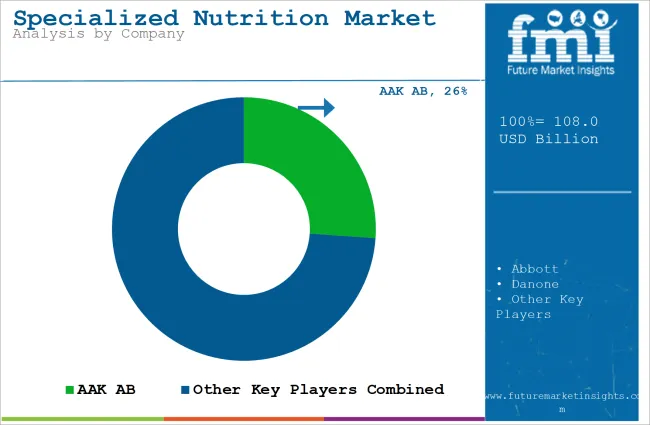
- Danone is a leader in specialized nutrition with a broad range of products including infant formula (Aptamil, Nutrilon), medical nutrition (Nutricia), and sports nutrition brands with manufacturing and pharmacy distribution around the world.
- Abbott competes against entrenched brands of infant formula (Similac, PediaSure) and medical nutrition (Ensure) that have strong clinical endorsement and hospital buying relationships.
- Nestle has multi-segment coverage with infant nutrition (NAN, Cerelac), performance nutrition (PowerBar) and health science divisions.
The competition is made up of global players with broad portfolios and regional specialists with niche capabilities.
Key Companies in the Specialized Nutrition Market
Key global companies leading the specialized nutrition market include:
- Danone (France), Abbott (USA), and Nestle (Switzerland) lead through comprehensive specialized nutrition portfolios spanning infant, medical, and performance nutrition with global manufacturing, pharmacy, and retail distribution.
- AAK AB (Sweden), Ajinomoto Co. Inc. (Japan), and GlaxoSmithKline plc (UK) serve through ingredient supply, amino acid specialization, and consumer health brands respectively.
- Otsuka Holdings Co. Ltd. (Japan), The Vitamin Company India (India), PepsiCo (USA), and Herbalife Nutrition (USA) compete through regional distribution, direct-selling models, and consumer brand portfolios in adult and sports nutrition.
Competitive Benchmarking: Specialized Nutrition Market
| Company | Infant Portfolio | Sports Portfolio | Medical Portfolio | Distribution Scale |
|---|---|---|---|---|
| Danone | Very High | Medium | Very High | Global |
| Abbott | Very High | Low | Very High | Global |
| Nestle | Very High | Medium | High | Global |
| AAK AB | Low | Low | Low | Global (B2B) |
| Ajinomoto | Low | Medium | Low | Asia, Global |
| GSK | Low | Medium | Low | Global |
| Otsuka Holdings | Low | Medium | Medium | Asia |
| Herbalife | Low | High | Low | Global |
| PepsiCo | Low | High | Low | Global |
| Vitamin Company India | Low | Medium | Low | South Asia |
Source: Future Market Insights competitive analysis, 2026.
Key Developments in Specialized Nutrition Market
- In 2025, Danone expanded its specialized early life nutrition portfolio by advancing infant formula innovations incorporating a blend of five human milk oligosaccharides (HMOs)-including 2′-fucosyllactose (2'FL), 3-fucosyllactose (3FL), lacto-N-tetraose (LNT), 3′-sialyllactose (3'SL), and 6′-sialyllactose (6'SL)-designed to support immune development, gut health, and microbiome balance in formula-fed infants during early-life development.
- In 2025, Abbott expanded its clinical nutrition portfolio with Ensure® Max Protein formulations focused on muscle health and healthy aging, combining high-protein nutrition with calcium beta-hydroxy-beta-methylbutyrate (CaHMB) to support muscle mass preservation, strength, and mobility among older adults.
Key Players in the Specialized Nutrition Market
Major Global Players
- Danone
- Abbott
- AAK AB
- Ajinomoto Co., Inc.
- GlaxoSmithKline plc (GSK)
- Nestle
Emerging Players/Startups
- Otsuka Hldings C., Ltd
- The Vitamin Company India
- PepsiCo.
- Herbalife Nutrition
Report Scope and Coverage
| Parameter | Details |
|---|---|
| Quantitative Units | USD 115.8 billion to USD 232.0 billion, at a CAGR of 7.2% |
| Market Definition | The specialized nutrition market encompasses commercially traded nutritional products designed for specific life-stage, health condition, or performance requirements. Product categories include infant nutrition, sports nutrition, medical nutrition, and weight management products in powder, liquid, and bar formulations. |
| Regions Covered | North America, Latin America, Europe, East Asia, South Asia and Pacific, Middle East and Africa |
| Countries Covered | China, India, Germany, Brazil, USA, UK, Japan, 30 plus countries |
| Key Companies Profiled | Danone, Abbott, AAK AB, Ajinomoto Co., Inc., GlaxoSmithKline plc (GSK), Nestle, Otsuka Hldings C., Ltd, The Vitamin Company India, PepsiCo. |
| Forecast Period | 2026 to 2036 |
| Approach | Hybrid bottom-up and top-down methodology starting with verified transaction data, projecting adoption velocity across segments and regions. |
Market Segmentation Analysis
Specialized Nutrition Market Segmented by Product:
- Infant Nutrition
- Infant Formula
- Standard Formula
- Follow On Formula
- Baby Food
- Purees
- Cereals
- Toddler Nutrition
- Growing Up Milk
- Toddler Snacks
- Infant Formula
- Clinical Nutrition
- Enteral Nutrition
- Tube Feeding Formulas
- Oral Nutritional Supplements
- Parenteral Nutrition
- Intravenous Nutrition
- Hospital Grade Solutions
- Enteral Nutrition
- Sports Nutrition
- Protein Supplements
- Whey Protein
- Plant Protein
- Performance Nutrition
- Energy Drinks
- Recovery Supplements
- Protein Supplements
- Adult Nutrition
- Meal Replacements
- Nutritional Shakes
- Balanced Nutrition Drinks
- Functional Foods
- Fortified Foods
- Diet Specific Nutrition
- Meal Replacements
Specialized Nutrition Market Segmented by Application:
- General Health And Wellness
- Daily Nutrition
- Balanced Diet Support
- Immunity Support
- Daily Nutrition
- Medical Nutrition
- Disease Management
- Diabetes Nutrition
- Cancer Nutrition
- Recovery Nutrition
- Post Surgery Recovery
- Critical Care Nutrition
- Disease Management
- Sports And Fitness
- Muscle Development
- Strength Training
- Bodybuilding
- Endurance Support
- Energy Enhancement
- Recovery Support
- Muscle Development
- Weight Management
- Weight Loss
- Calorie Control
- Fat Reduction
- Weight Gain
- Mass Gain Nutrition
- High Calorie Diets
- Weight Loss
Specialized Nutrition Market Segmented by End Use:
- Adults
- Working Professionals
- Urban Consumers
- Busy Lifestyle Users
- Health Conscious Consumers
- Fitness Enthusiasts
- Preventive Health Users
- Working Professionals
- Infants And Toddlers
- Newborns
- 0 To 6 Months
- 6 To 12 Months
- Toddlers
- 1 To 3 Years
- 3 To 5 Years
- Newborns
- Geriatric Population
- Elderly Nutrition
- Bone Health Support
- Muscle Maintenance
- Elderly Nutrition
- Clinical Patients
- Hospital Patients
- Acute Care
- Chronic Care
- Hospital Patients
Specialized Nutrition Market Segmented by Distribution Channel:
- Offline Retail
- Pharmacy And Drug Stores
- Chain Pharmacies
- Hospital Pharmacies
- Supermarkets And Hypermarkets
- Large Format Stores
- Retail Chains
- Specialty Nutrition Stores
- Health Stores
- Baby Care Stores
- Pharmacy And Drug Stores
- Online Retail
- E Commerce Platforms
- Marketplace Platforms
- Brand Owned Websites
- Subscription Services
- Auto Replenishment Plans
- Personalized Nutrition Plans
- E Commerce Platforms
Specialized Nutrition Market Segmented by Formulation:
- Powder Formulations
- Dry Powder
- Milk Powder
- Protein Powder
- Instant Powder
- Ready To Mix
- Single Serve Sachets
- Dry Powder
- Liquid Formulations
- Ready To Drink
- Nutritional Beverages
- Meal Replacement Drinks
- Liquid Concentrates
- Drops
- Syrups
- Ready To Drink
- Solid Formulations
- Tablets And Capsules
- Nutritional Tablets
- Softgels
- Bars And Snacks
- Protein Bars
- Nutritional Snacks
- Tablets And Capsules
Specialized Nutrition Market Segmented by Pricing Tier:
- Mid Range
- Branded Nutrition Products
- Standard Quality Offerings
- Branded Nutrition Products
- Economy
- Mass Market Products
- Basic Nutrition Products
- Mass Market Products
- Premium
- Clinically Proven Nutrition
- Medical Grade Products
- Personalized Nutrition Solutions
- Clinically Proven Nutrition
Specialized Nutrition Market by Region:
- North America
- USA
- Canada
- Mexico
- Latin America
- Brazil
- Chile
- Rest of Latin America
- Western Europe
- Germany
- UK
- Italy
- Spain
- France
- Nordic
- BENELUX
- Rest of Western Europe
- Eastern Europe
- Russia
- Poland
- Hungary
- Balkan & Baltic
- Rest of Eastern Europe
- East Asia
- China
- Japan
- South Korea
- South Asia and Pacific
- India
- ASEAN
- Australia & New Zealand
- Rest of South Asia and Pacific
- Middle East & Africa
- Kingdom of Saudi Arabia
- Other GCC Countries
- Turkiye
- South Africa
- Other African Union
- Rest of Middle East & Africa
Research Sources and Bibliography
- 1. World Health Organization. (2025). WHO Infant and Young Child Feeding Guidelines. WHO.
- 2. Codex Alimentarius Commission. (2024). Codex Standard for Infant Formula and Special Dietary Foods. WHO/FAO.
- 3. European Food Safety Authority. (2024). EFSA Scientific Opinion on Infant Formula Composition. EFSA.
- 4. International Olympic Committee. (2025). IOC Consensus Statement on Sports Nutrition. IOC.
- 5. United Nations Population Division. (2024). World Population Prospects: Age Structure and Nutrition Demand. UN.
This bibliography is provided for reader reference.
This Report Answers
- Estimating the market size and revenue generation from 2026 to 2036.
- Segmenting by product, application, end use, distribution channel, formulation, and pricing tier.
- Providing regional insights across more than 30 markets.
- Analyzing infant nutrition regulation and premiumization dynamics.
- Assessing the competitive landscape across infant, sports, and medical nutrition.
- Identifying investment opportunities in elderly nutrition and sports performance.
- Tracking regulatory evolution and ingredient innovation trends.
- Delivering data in PDF and Excel formats.
Frequently Asked Questions
How big is the specialized nutrition market in 2026?
The global specialized nutrition market is estimated to be valued at USD 115.8 billion in 2026.
What will be the size of specialized nutrition market in 2036?
The market size for the specialized nutrition market is projected to reach USD 232.0 billion by 2036.
How much will be the specialized nutrition market growth between 2026 and 2036?
The specialized nutrition market is expected to grow at a 7.2% CAGR between 2026 and 2036.
What are the key product types in the specialized nutrition market?
The key product types in specialized nutrition market are infant nutrition, clinical nutrition, sports nutrition and adult nutrition.
Which application segment is expected to contribute significant share in the specialized nutrition market in 2026?
In terms of application, general health and wellness segment is expected to command 45.0% share in the specialized nutrition market in 2026.
Preview the report firsthand - request a free sample
Get SampleGet the brochure for pricing and purchase details.
Get PDFTable of Content
- Executive Summary
- Global Market Outlook
- Demand-side Trends
- Supply-side Trends
- Technology Roadmap Analysis
- Analysis and Recommendations
- Market Overview
- Market Coverage / Taxonomy
- Market Definition / Scope / Limitations
- Research Methodology
- Chapter Orientation
- Analytical Lens and Working Hypotheses
- Market Structure, Signals, and Trend Drivers
- Benchmarking and Cross-market Comparability
- Market Sizing, Forecasting, and Opportunity Mapping
- Research Design and Evidence Framework
- Desk Research Programme (Secondary Evidence)
- Company Annual and Sustainability Reports
- Peer-reviewed Journals and Academic Literature
- Corporate Websites, Product Literature, and Technical Notes
- Earnings Decks and Investor Briefings
- Statutory Filings and Regulatory Disclosures
- Technical White Papers and Standards Notes
- Trade Journals, Industry Magazines, and Analyst Briefs
- Conference Proceedings, Webinars, and Seminar Materials
- Government Statistics Portals and Public Data Releases
- Press Releases and Reputable Media Coverage
- Specialist Newsletters and Curated Briefings
- Sector Databases and Reference Repositories
- FMI Internal Proprietary Databases and Historical Market Datasets
- Subscription Datasets and Paid Sources
- Social Channels, Communities, and Digital Listening Inputs
- Additional Desk Sources
- Expert Input and Fieldwork (Primary Evidence)
- Primary Modes
- Qualitative Interviews and Expert Elicitation
- Quantitative Surveys and Structured Data Capture
- Blended Approach
- Why Primary Evidence is Used
- Field Techniques
- Interviews
- Surveys
- Focus Groups
- Observational and In-context Research
- Social and Community Interactions
- Stakeholder Universe Engaged
- C-suite Leaders
- Board Members
- Presidents and Vice Presidents
- R&D and Innovation Heads
- Technical Specialists
- Domain Subject-matter Experts
- Scientists
- Physicians and Other Healthcare Professionals
- Governance, Ethics, and Data Stewardship
- Research Ethics
- Data Integrity and Handling
- Primary Modes
- Tooling, Models, and Reference Databases
- Desk Research Programme (Secondary Evidence)
- Data Engineering and Model Build
- Data Acquisition and Ingestion
- Cleaning, Normalisation, and Verification
- Synthesis, Triangulation, and Analysis
- Quality Assurance and Audit Trail
- Market Background
- Market Dynamics
- Drivers
- Restraints
- Opportunity
- Trends
- Scenario Forecast
- Demand in Optimistic Scenario
- Demand in Likely Scenario
- Demand in Conservative Scenario
- Opportunity Map Analysis
- Product Life Cycle Analysis
- Supply Chain Analysis
- Investment Feasibility Matrix
- Value Chain Analysis
- PESTLE and Porter’s Analysis
- Regulatory Landscape
- Regional Parent Market Outlook
- Production and Consumption Statistics
- Import and Export Statistics
- Market Dynamics
- Global Market Analysis 2021 to 2025 and Forecast, 2026 to 2036
- Historical Market Size Value (USD Million) Analysis, 2021 to 2025
- Current and Future Market Size Value (USD Million) Projections, 2026 to 2036
- Y-o-Y Growth Trend Analysis
- Absolute $ Opportunity Analysis
- Global Market Pricing Analysis 2021 to 2025 and Forecast 2026 to 2036
- Global Market Analysis 2021 to 2025 and Forecast 2026 to 2036, By Product
- Introduction / Key Findings
- Historical Market Size Value (USD Million) Analysis By Product , 2021 to 2025
- Current and Future Market Size Value (USD Million) Analysis and Forecast By Product , 2026 to 2036
- Infant Nutrition
- Infant Formula
- Standard Formula
- Follow On Formula
- Baby Food
- Purees
- Cereals
- Toddler Nutrition
- Growing Up Milk
- Toddler Snacks
- Clinical Nutrition
- Enteral Nutrition
- Tube Feeding Formulas
- Oral Nutritional Supplements
- Parenteral Nutrition
- Intravenous Nutrition
- Sports Nutrition
- Protein Supplements
- Whey Protein
- Plant Protein
- Performance Nutrition
- Energy Drinks
- Adult Nutrition
- Meal Replacements
- Nutritional Shakes
- Balanced Nutrition Drinks
- Functional Foods
- Fortified Foods
- Y-o-Y Growth Trend Analysis By Product , 2021 to 2025
- Absolute $ Opportunity Analysis By Product , 2026 to 2036
- Infant Nutrition
- Global Market Analysis 2021 to 2025 and Forecast 2026 to 2036, By Application
- Introduction / Key Findings
- Historical Market Size Value (USD Million) Analysis By Application, 2021 to 2025
- Current and Future Market Size Value (USD Million) Analysis and Forecast By Application, 2026 to 2036
- General Health And Wellness
- Daily Nutrition
- Balanced Diet Support
- Immunity Support
- Medical Nutrition
- Disease Management
- Diabetes Nutrition
- Cancer Nutrition
- Recovery Nutrition
- Post Surgery Recovery
- Sports And Fitness
- Muscle Development
- Strength Training
- Bodybuilding
- Endurance Support
- Energy Enhancement
- Weight Management
- Weight Loss
- Calorie Control
- Fat Reduction
- Weight Gain
- Mass Gain Nutrition
- General Health And Wellness
- Y-o-Y Growth Trend Analysis By Application, 2021 to 2025
- Absolute $ Opportunity Analysis By Application, 2026 to 2036
- Global Market Analysis 2021 to 2025 and Forecast 2026 to 2036, By End Use
- Introduction / Key Findings
- Historical Market Size Value (USD Million) Analysis By End Use, 2021 to 2025
- Current and Future Market Size Value (USD Million) Analysis and Forecast By End Use, 2026 to 2036
- Adults
- Working Professionals
- Urban Consumers
- Busy Lifestyle Users
- Health Conscious Consumers
- Fitness Enthusiasts
- Preventive Health Users
- Infants And Toddlers
- Newborns
- 0 To 6 Months
- 6 To 12 Months
- Toddlers
- 1 To 3 Years
- Geriatric Population
- Elderly Nutrition
- Bone Health Support
- Muscle Maintenance
- Clinical Patients
- Hospital Patients
- Acute Care
- Chronic Care
- Adults
- Y-o-Y Growth Trend Analysis By End Use, 2021 to 2025
- Absolute $ Opportunity Analysis By End Use, 2026 to 2036
- Global Market Analysis 2021 to 2025 and Forecast 2026 to 2036, By Distribution Channel
- Introduction / Key Findings
- Historical Market Size Value (USD Million) Analysis By Distribution Channel, 2021 to 2025
- Current and Future Market Size Value (USD Million) Analysis and Forecast By Distribution Channel, 2026 to 2036
- Offline Retail
- Pharmacy And Drug Stores
- Chain Pharmacies
- Hospital Pharmacies
- Supermarkets And Hypermarkets
- Large Format Stores
- Retail Chains
- Specialty Nutrition Stores
- Health Stores
- Baby Care Stores
- Online Retail
- E Commerce Platforms
- Marketplace Platforms
- Brand Owned Websites
- Subscription Services
- Auto Replenishment Plans
- Offline Retail
- Y-o-Y Growth Trend Analysis By Distribution Channel, 2021 to 2025
- Absolute $ Opportunity Analysis By Distribution Channel, 2026 to 2036
- Global Market Analysis 2021 to 2025 and Forecast 2026 to 2036, By Formulation
- Introduction / Key Findings
- Historical Market Size Value (USD Million) Analysis By Formulation, 2021 to 2025
- Current and Future Market Size Value (USD Million) Analysis and Forecast By Formulation, 2026 to 2036
- Powder Formulations
- Dry Powder
- Milk Powder
- Protein Powder
- Instant Powder
- Ready To Mix
- Single Serve Sachets
- Liquid Formulations
- Ready To Drink
- Nutritional Beverages
- Meal Replacement Drinks
- Liquid Concentrates
- Drops
- Solid Formulations
- Tablets And Capsules
- Nutritional Tablets
- Softgels
- Bars And Snacks
- Protein Bars
- Powder Formulations
- Y-o-Y Growth Trend Analysis By Formulation, 2021 to 2025
- Absolute $ Opportunity Analysis By Formulation, 2026 to 2036
- Global Market Analysis 2021 to 2025 and Forecast 2026 to 2036, By Pricing Tier
- Introduction / Key Findings
- Historical Market Size Value (USD Million) Analysis By Pricing Tier, 2021 to 2025
- Current and Future Market Size Value (USD Million) Analysis and Forecast By Pricing Tier, 2026 to 2036
- Mid Range
- Branded Nutrition Products
- Standard Quality Offerings
- Economy
- Mass Market Products
- Basic Nutrition Products
- Premium
- Clinically Proven Nutrition
- Medical Grade Products
- Personalized Nutrition Solutions
- Mid Range
- Y-o-Y Growth Trend Analysis By Pricing Tier, 2021 to 2025
- Absolute $ Opportunity Analysis By Pricing Tier, 2026 to 2036
- Global Market Analysis 2021 to 2025 and Forecast 2026 to 2036, By Region
- Introduction
- Historical Market Size Value (USD Million) Analysis By Region, 2021 to 2025
- Current Market Size Value (USD Million) Analysis and Forecast By Region, 2026 to 2036
- North America
- Latin America
- Western Europe
- Eastern Europe
- East Asia
- South Asia and Pacific
- Middle East & Africa
- Market Attractiveness Analysis By Region
- North America Market Analysis 2021 to 2025 and Forecast 2026 to 2036, By Country
- Historical Market Size Value (USD Million) Trend Analysis By Market Taxonomy, 2021 to 2025
- Market Size Value (USD Million) Forecast By Market Taxonomy, 2026 to 2036
- By Country
- USA
- Canada
- Mexico
- By Product
- By Application
- By End Use
- By Distribution Channel
- By Formulation
- By Pricing Tier
- By Country
- Market Attractiveness Analysis
- By Country
- By Product
- By Application
- By End Use
- By Distribution Channel
- By Formulation
- By Pricing Tier
- Key Takeaways
- Latin America Market Analysis 2021 to 2025 and Forecast 2026 to 2036, By Country
- Historical Market Size Value (USD Million) Trend Analysis By Market Taxonomy, 2021 to 2025
- Market Size Value (USD Million) Forecast By Market Taxonomy, 2026 to 2036
- By Country
- Brazil
- Chile
- Rest of Latin America
- By Product
- By Application
- By End Use
- By Distribution Channel
- By Formulation
- By Pricing Tier
- By Country
- Market Attractiveness Analysis
- By Country
- By Product
- By Application
- By End Use
- By Distribution Channel
- By Formulation
- By Pricing Tier
- Key Takeaways
- Western Europe Market Analysis 2021 to 2025 and Forecast 2026 to 2036, By Country
- Historical Market Size Value (USD Million) Trend Analysis By Market Taxonomy, 2021 to 2025
- Market Size Value (USD Million) Forecast By Market Taxonomy, 2026 to 2036
- By Country
- Germany
- UK
- Italy
- Spain
- France
- Nordic
- BENELUX
- Rest of Western Europe
- By Product
- By Application
- By End Use
- By Distribution Channel
- By Formulation
- By Pricing Tier
- By Country
- Market Attractiveness Analysis
- By Country
- By Product
- By Application
- By End Use
- By Distribution Channel
- By Formulation
- By Pricing Tier
- Key Takeaways
- Eastern Europe Market Analysis 2021 to 2025 and Forecast 2026 to 2036, By Country
- Historical Market Size Value (USD Million) Trend Analysis By Market Taxonomy, 2021 to 2025
- Market Size Value (USD Million) Forecast By Market Taxonomy, 2026 to 2036
- By Country
- Russia
- Poland
- Hungary
- Balkan & Baltic
- Rest of Eastern Europe
- By Product
- By Application
- By End Use
- By Distribution Channel
- By Formulation
- By Pricing Tier
- By Country
- Market Attractiveness Analysis
- By Country
- By Product
- By Application
- By End Use
- By Distribution Channel
- By Formulation
- By Pricing Tier
- Key Takeaways
- East Asia Market Analysis 2021 to 2025 and Forecast 2026 to 2036, By Country
- Historical Market Size Value (USD Million) Trend Analysis By Market Taxonomy, 2021 to 2025
- Market Size Value (USD Million) Forecast By Market Taxonomy, 2026 to 2036
- By Country
- China
- Japan
- South Korea
- By Product
- By Application
- By End Use
- By Distribution Channel
- By Formulation
- By Pricing Tier
- By Country
- Market Attractiveness Analysis
- By Country
- By Product
- By Application
- By End Use
- By Distribution Channel
- By Formulation
- By Pricing Tier
- Key Takeaways
- South Asia and Pacific Market Analysis 2021 to 2025 and Forecast 2026 to 2036, By Country
- Historical Market Size Value (USD Million) Trend Analysis By Market Taxonomy, 2021 to 2025
- Market Size Value (USD Million) Forecast By Market Taxonomy, 2026 to 2036
- By Country
- India
- ASEAN
- Australia & New Zealand
- Rest of South Asia and Pacific
- By Product
- By Application
- By End Use
- By Distribution Channel
- By Formulation
- By Pricing Tier
- By Country
- Market Attractiveness Analysis
- By Country
- By Product
- By Application
- By End Use
- By Distribution Channel
- By Formulation
- By Pricing Tier
- Key Takeaways
- Middle East & Africa Market Analysis 2021 to 2025 and Forecast 2026 to 2036, By Country
- Historical Market Size Value (USD Million) Trend Analysis By Market Taxonomy, 2021 to 2025
- Market Size Value (USD Million) Forecast By Market Taxonomy, 2026 to 2036
- By Country
- Kingdom of Saudi Arabia
- Other GCC Countries
- Turkiye
- South Africa
- Other African Union
- Rest of Middle East & Africa
- By Product
- By Application
- By End Use
- By Distribution Channel
- By Formulation
- By Pricing Tier
- By Country
- Market Attractiveness Analysis
- By Country
- By Product
- By Application
- By End Use
- By Distribution Channel
- By Formulation
- By Pricing Tier
- Key Takeaways
- Key Countries Market Analysis
- USA
- Pricing Analysis
- Market Share Analysis, 2025
- By Product
- By Application
- By End Use
- By Distribution Channel
- By Formulation
- By Pricing Tier
- Canada
- Pricing Analysis
- Market Share Analysis, 2025
- By Product
- By Application
- By End Use
- By Distribution Channel
- By Formulation
- By Pricing Tier
- Mexico
- Pricing Analysis
- Market Share Analysis, 2025
- By Product
- By Application
- By End Use
- By Distribution Channel
- By Formulation
- By Pricing Tier
- Brazil
- Pricing Analysis
- Market Share Analysis, 2025
- By Product
- By Application
- By End Use
- By Distribution Channel
- By Formulation
- By Pricing Tier
- Chile
- Pricing Analysis
- Market Share Analysis, 2025
- By Product
- By Application
- By End Use
- By Distribution Channel
- By Formulation
- By Pricing Tier
- Germany
- Pricing Analysis
- Market Share Analysis, 2025
- By Product
- By Application
- By End Use
- By Distribution Channel
- By Formulation
- By Pricing Tier
- UK
- Pricing Analysis
- Market Share Analysis, 2025
- By Product
- By Application
- By End Use
- By Distribution Channel
- By Formulation
- By Pricing Tier
- Italy
- Pricing Analysis
- Market Share Analysis, 2025
- By Product
- By Application
- By End Use
- By Distribution Channel
- By Formulation
- By Pricing Tier
- Spain
- Pricing Analysis
- Market Share Analysis, 2025
- By Product
- By Application
- By End Use
- By Distribution Channel
- By Formulation
- By Pricing Tier
- France
- Pricing Analysis
- Market Share Analysis, 2025
- By Product
- By Application
- By End Use
- By Distribution Channel
- By Formulation
- By Pricing Tier
- India
- Pricing Analysis
- Market Share Analysis, 2025
- By Product
- By Application
- By End Use
- By Distribution Channel
- By Formulation
- By Pricing Tier
- ASEAN
- Pricing Analysis
- Market Share Analysis, 2025
- By Product
- By Application
- By End Use
- By Distribution Channel
- By Formulation
- By Pricing Tier
- Australia & New Zealand
- Pricing Analysis
- Market Share Analysis, 2025
- By Product
- By Application
- By End Use
- By Distribution Channel
- By Formulation
- By Pricing Tier
- China
- Pricing Analysis
- Market Share Analysis, 2025
- By Product
- By Application
- By End Use
- By Distribution Channel
- By Formulation
- By Pricing Tier
- Japan
- Pricing Analysis
- Market Share Analysis, 2025
- By Product
- By Application
- By End Use
- By Distribution Channel
- By Formulation
- By Pricing Tier
- South Korea
- Pricing Analysis
- Market Share Analysis, 2025
- By Product
- By Application
- By End Use
- By Distribution Channel
- By Formulation
- By Pricing Tier
- Russia
- Pricing Analysis
- Market Share Analysis, 2025
- By Product
- By Application
- By End Use
- By Distribution Channel
- By Formulation
- By Pricing Tier
- Poland
- Pricing Analysis
- Market Share Analysis, 2025
- By Product
- By Application
- By End Use
- By Distribution Channel
- By Formulation
- By Pricing Tier
- Hungary
- Pricing Analysis
- Market Share Analysis, 2025
- By Product
- By Application
- By End Use
- By Distribution Channel
- By Formulation
- By Pricing Tier
- Kingdom of Saudi Arabia
- Pricing Analysis
- Market Share Analysis, 2025
- By Product
- By Application
- By End Use
- By Distribution Channel
- By Formulation
- By Pricing Tier
- Turkiye
- Pricing Analysis
- Market Share Analysis, 2025
- By Product
- By Application
- By End Use
- By Distribution Channel
- By Formulation
- By Pricing Tier
- South Africa
- Pricing Analysis
- Market Share Analysis, 2025
- By Product
- By Application
- By End Use
- By Distribution Channel
- By Formulation
- By Pricing Tier
- USA
- Market Structure Analysis
- Competition Dashboard
- Competition Benchmarking
- Market Share Analysis of Top Players
- By Regional
- By Product
- By Application
- By End Use
- By Distribution Channel
- By Formulation
- By Pricing Tier
- Competition Analysis
- Competition Deep Dive
- Danone
- Overview
- Product Portfolio
- Profitability by Market Segments (Product/Age /Sales Channel/Region)
- Sales Footprint
- Strategy Overview
- Marketing Strategy
- Product Strategy
- Channel Strategy
- Abbott
- AAK AB
- Ajinomoto Co., Inc.
- GlaxSmithKline plc (GSK)
- Nestle
- Otsuka Hldings C., Ltd
- The Vitamin Company India
- PepsiCo.
- Herbalife Nutrition
- Danone
- Competition Deep Dive
- Assumptions & Acronyms Used


