

- Market Size (2026)
- USD 2.34 Bn
- Forecast (2036)
- USD 5.31 Bn
- CAGR (2026 to 2036)
- 8.5%
Modular Stackable Jobsite Storage Systems Market Size, Market Forecast and Outlook By FMI
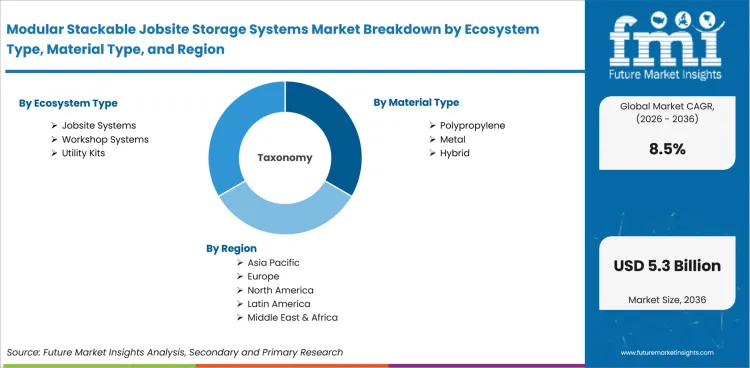
USD 2.34 billion in 2026 and USD 5.31 billion by 2036 at an 8.5% CAGR.
The modular stackable jobsite storage systems industry value is forecast to grow from USD 2.15 billion in 2025 to USD 5.31 billion by 2036 at 8.5% CAGR as contractors standardize storage fleets and add drawers after buying wheeled bases. Jobsite Systems are forecast to represent 52.0% share in 2026 because full-stack compatibility reduces daily handling time. Polypropylene is expected to secure 61.0% share in 2026 owing to weight control and molded latch geometry.
Summary of the Modular Stackable Jobsite Storage Systems Market
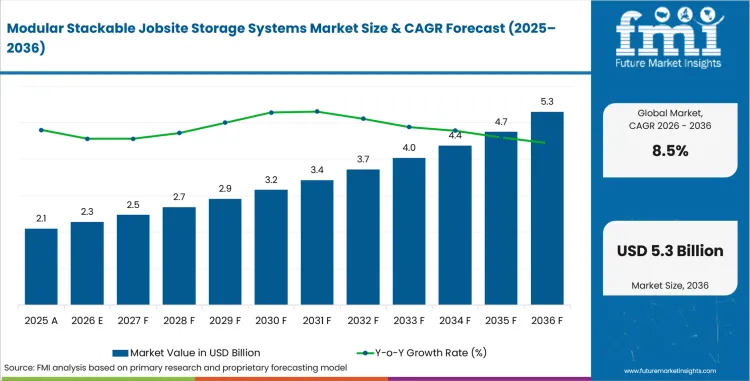
Modular Stackable Jobsite Storage Systems Market Overview: Size and Forecast
- 2026 Market Size: USD 2.34 billion
- 2036 Market Size: USD 5.31 billion
- Forecast CAGR: 8.5% from 2026 to 2036
- Leading Ecosystem Type: Jobsite Systems
- Jobsite Systems Share in 2026: 52.0%
- Leading Material Type: Polypropylene
- Polypropylene Share in 2026: 61.0%
- Fastest-growing Country: India
- India CAGR: 9.4% by 2036
The modular stackable jobsite storage systems market is expected to grow through 2036 as contractors move from loose boxes to locked and repeatable storage ecosystems. Demand is supported by drawer access, van-fit design and platform loyalty around power tools.
- Demand and Growth Drivers
- Contractors are shifting toward wheeled bases and drawers that keep tools accessible during daily site movement.
- Dealer retail is giving more shelf space to systems that let buyers compare latches, wheels and drawer slides.
- Brand owners are extending cordless tool platforms through stackable boxes and accessories.
- Product and Segment View
- Jobsite Systems are forecast to represent 52.0% share in 2026, led by contractors using one storage ecosystem across vans and sites.
- Polypropylene is projected to hold 61.0% share in 2026, influenced by weight control and sealed molded design.
- Wheeled Towers are expected to secure 46.0% share in 2026, supported by mobile bases that anchor repeat module purchases.
- Geography and Competitive Outlook
- India is projected to record 9.4% CAGR by 2036, backed by public works and contractor formalization.
- The United States is expected to expand at 8.8% CAGR by 2036 through pro retail depth and cordless tool penetration.
- Milwaukee Tool and DeWalt compete through broad modular ecosystems and professional retail reach.
- Bosch, Makita, Hilti and Klein Tools focus on vehicle fit, trade-specific storage and durable locking interfaces.
- Analyst Opinion
- Nikhil Kaitwade, Principal Consultant at FMI, observes, “This category is less about tool storage and more about contractor ecosystem control. A crew that buys one rolling base often adds drawers, crates and organizers later. Suppliers with durable latches, drawer access and vehicle-fit design should protect repeat purchases better than brands selling only low-price boxes.”
Product design is moving beyond basic tool boxes toward mobile ecosystems that lock into vans and carts. DeWalt stated in September 2024 that TOUGHSYSTEM 2.0 DXL covers four 30-inch products with truck-ready configuration. Bosch stated in January 2026 that its L-BOXX Contractor System includes wheeled options, racks, drawers and a backpack. Milwaukee stated in July 2025 that its PACKOUT Rolling Drawer connects to all PACKOUT storage and allows access when other modules are stacked on top. These product moves show why contractor storage is now a platform purchase rather than a one-time box replacement.
Which factors support expansion in the modular stackable jobsite storage systems market?
Repeat module revenue and contractor workflow needs support market value across professional channels.
- Market value is supported by repeat purchases after contractors buy the first rolling base.
- Supplier pricing reflects drawer slides, reinforced wheels and molded latch geometry before accessory sales add margin.
- Revenue improves as crews standardize storage by trade and vehicle type.
- Retail trust rises when displays let buyers test latch fit and drawer movement before purchase.
Why is the modular stackable jobsite storage systems market growing?
Contractors are moving toward modular storage systems that reduce tool search time and make transport more predictable.
Contractor work is becoming more mobile and tool-heavy across repair and installation activity. The USA Census Bureau estimated April 2026 construction spending at a seasonally adjusted annual rate of USD 2,172.4 billion. This large work pool creates repeated movement of power tools and accessories across sites. Jobsite storage demand is also tied to housekeeping and safety. The USA Bureau of Labor Statistics recorded 5,070 fatal work injuries in 2024. Modular storage does not remove site risk by itself. It gives crews a clearer way to contain small tools and loose accessories.
How is the modular stackable jobsite storage systems market segmented?
The modular stackable jobsite storage systems industry is segmented by ecosystem type, material type, mobility format, end user and sales channel.
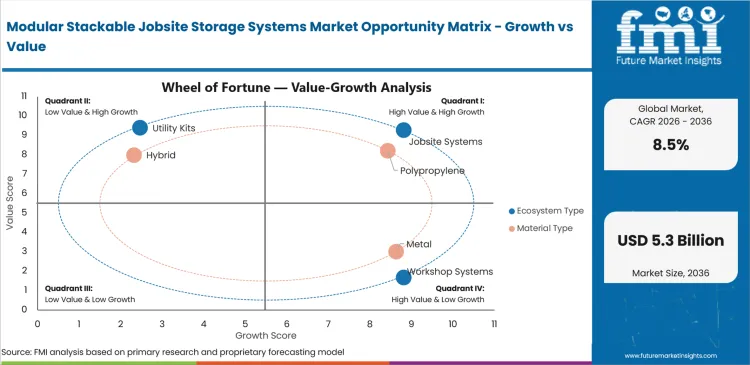
- Jobsite Systems are projected to secure 52.0% share in 2026, led by full tower compatibility across rolling bases and drawers.
- Polypropylene formats are anticipated to hold 61.0% share in 2026 since molded shells reduce handling weight while supporting sealed latches.
- Wheeled Towers are expected to capture 46.0% share in 2026 due to site-to-van transport needs.
- Contractors are forecast to represent 64.0% share in 2026, guided by daily tool movement between jobsites.
- Dealer Retail is projected to account for 38.0% share in 2026, reflected by pro buyers testing build quality in stores.
Why do Jobsite Systems lead the modular stackable jobsite storage systems market?
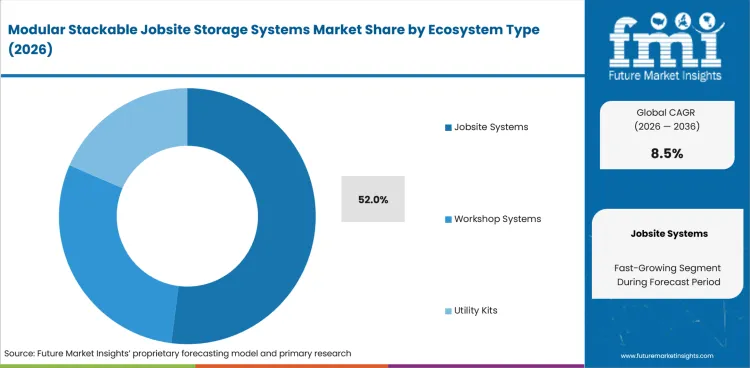
- Jobsite Systems are projected to account for 52.0% share in 2026, influenced by full-stack compatibility and repeat module buying.
- Workshop Systems gain value where contractors connect vehicle racks with static shop storage.
Which material type leads the modular stackable jobsite storage systems market?
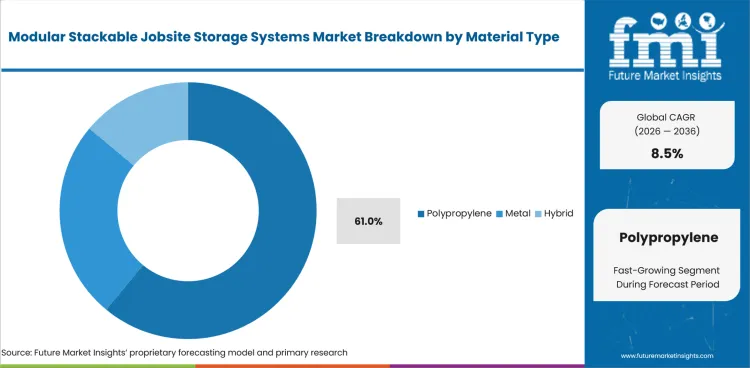
- Polypropylene is anticipated to hold 61.0% share in 2026 through lower weight and molded latch design.
- Metal formats remain relevant for security chests and static racks where weight is less limiting.
Which mobility format leads the modular stackable jobsite storage systems market?
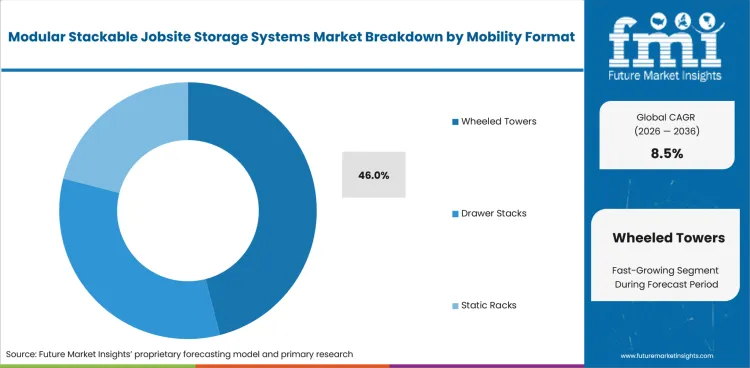
- Wheeled Towers are forecast to secure 46.0% share in 2026, shaped by rolling bases that anchor future stack purchases.
- Drawer Stacks gain use as technicians need tool access without unstacking every box.
Which end user leads the modular stackable jobsite storage systems market?
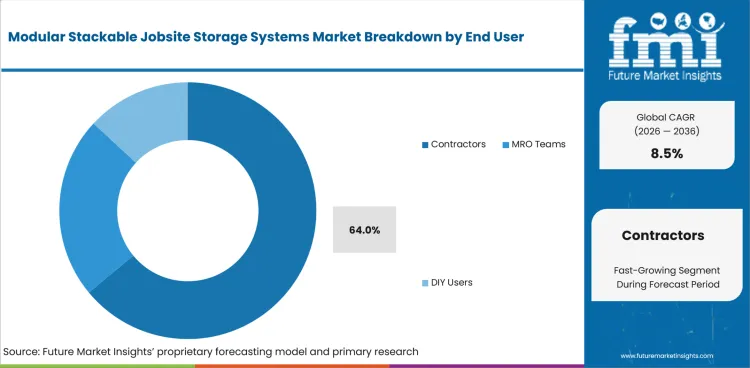
- Contractors are projected to account for 64.0% share in 2026, led by daily van-to-site tool movement.
- MRO teams create additional demand where service calls require repeatable tool layouts.
Which sales channel leads the modular stackable jobsite storage systems market?
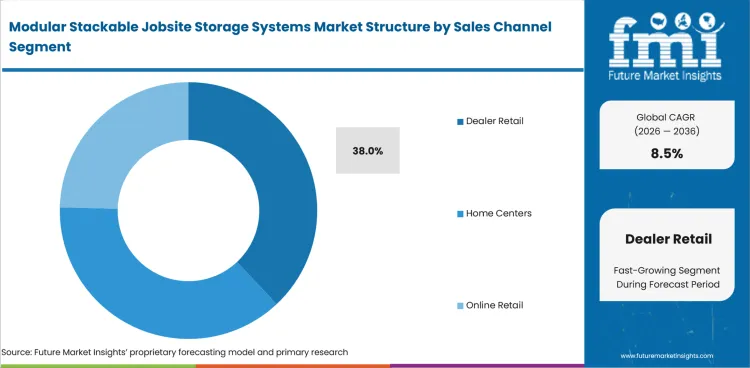
- Dealer Retail is expected to represent 38.0% share in 2026, shaped by in-store comparison of handles and slides.
- Home Centers gain importance where large retail displays show complete system configurations.
What are the driver, restraints, and opportunities in the modular stackable jobsite storage systems market?
Drawer access and platform lock-in support growth while full-system cost slows faster adoption among smaller contractors.
- Driver: Drawer access is expected to raise repeat purchases because users can reach tools without breaking down a full stack.
- Restraint: Full modular systems cost more than single boxes, limiting adoption among occasional users and smaller crews.
- Opportunity: Recycled resin and take-back programs can improve enterprise acceptance for resin-heavy storage platforms.
Modular Stackable Jobsite Storage Systems Market Demand Outlook
Demand outlook is moving toward storage ecosystems that combine wheeled transport with drawer access and vehicle fit. DeWalt’s September 2024 launch placed the category around a 30-inch workstation and truck-ready drawers. Makita’s October 2024 MAKTRAK launch emphasized dual-hinging lids and horizontal access. Bosch’s January 2026 L-BOXX Contractor System kept legacy fit while adding wheeled options and drawers. Buyers are expected to reward systems that solve access problems without forcing a complete platform reset.
Contractor Purchase Behavior and Decision-driver Analysis
Purchase decisions are shaped by latch feel, wheel durability, drawer access and compatibility with tools already owned by the crew. Milwaukee’s July 2025 PACKOUT Rolling Drawer supports access when other PACKOUT units are stacked on top. Hilti states that its redesigned tool case incorporates 20.0% recycled content and cuts 500 tons of CO2 emissions annually. Supplier advantage is expected to come from durable slides, vehicle fit and replacement part availability rather than box capacity alone.
Which countries are growing fastest in the modular stackable jobsite storage systems market?
India 9.4% CAGR, United States 8.8% CAGR, China 8.1% CAGR, Germany 7.7% CAGR, United Kingdom 7.4% CAGR, France 7.2% CAGR, South Korea 7.0% CAGR and Japan 6.9% CAGR through 2036.
.webp "Top Country Growth Comparison Modular Stackable Jobsite Storage Systems Market Cagr (2026 2036)")
| Country | CAGR |
|---|---|
| United States | 8.8% |
| United Kingdom | 7.4% |
| Germany | 7.7% |
| France | 7.2% |
| Japan | 6.9% |
| China | 8.1% |
| South Korea | 7.0% |
| India | 9.4% |
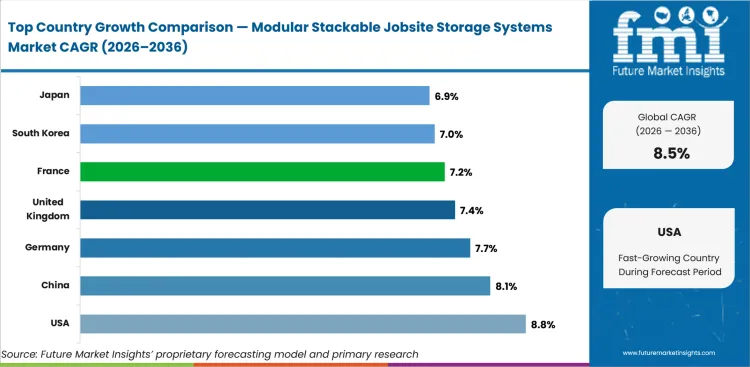
Source: Future Market Insights, 2026.
How do country-level CAGRs compare in the modular stackable jobsite storage systems market?
India leads country growth while Japan records the most cautious expansion outlook among profiled markets.
- United States is forecast to record 8.8% CAGR by 2036 through contractor mobility, dealer reach and construction activity.
- United Kingdom is forecast to record 7.4% CAGR by 2036 through contractor mobility, dealer reach and construction activity.
- Germany is forecast to record 7.7% CAGR by 2036 through contractor mobility, dealer reach and construction activity.
- France is forecast to record 7.2% CAGR by 2036 through contractor mobility, dealer reach and construction activity.
- Japan is forecast to record 6.9% CAGR by 2036 through contractor mobility, dealer reach and construction activity.
- China is forecast to record 8.1% CAGR by 2036 through contractor mobility, dealer reach and construction activity.
- South Korea is forecast to record 7.0% CAGR by 2036 through contractor mobility, dealer reach and construction activity.
- India is forecast to record 9.4% CAGR by 2036 through contractor mobility, dealer reach and construction activity.
How fast is the modular stackable jobsite storage systems market growing in the United States?
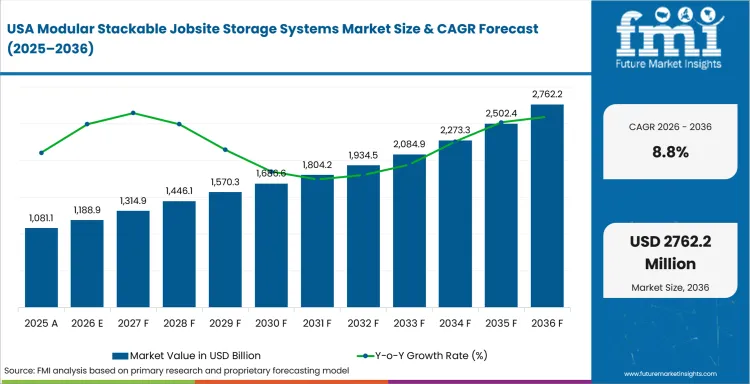
A 8.8% CAGR through 2036 reflects contractor mobility needs and professional channel expansion in United States.
Country Market Snapshot Table
| Parameter | Value |
|---|---|
| Market Size in 2025 (Value) | USD 477.9 million |
| Market Size in 2026 (Value) | USD 520.0 million |
| Market Forecast in 2036 (Value) | USD 1208.6 million |
| CAGR (2026 to 2036) | 8.8% |
| Years Considered | 2021 to 2036 |
| Base Year | 2025 |
| Forecast Period | 2026 to 2036 |
| Units Considered | Value (USD million) |
| Leading Sub-Region | Sun Belt and national pro retail corridors |
United States Modular Stackable Jobsite Storage Systems Market Outlook
The United States is a platform-first jobsite storage market. Contractors often start with a wheeled base before adding drawers and organizers as crews expand. Pro retail displays make latch strength and drawer access easy to compare before purchase.
Key Growth Drivers
- USA construction spending gives storage brands a large work base. The USA Census Bureau estimated April 2026 construction spending at USD 2,172.4 billion at a seasonally adjusted annual rate.
- Safety-led housekeeping supports organized storage. OSHA stated that falls caused 389 of 1,034 construction fatalities recorded in 2024.
- Battery platform loyalty is expected to support branded storage attachment as contractors keep tools and boxes inside one ecosystem.
- Home center displays are expected to reduce trial risk because pro buyers can test wheels and drawer slides before purchase.
Key Restraints
- Housing starts can restrain smaller contractor upgrades. Census reported privately owned housing starts at 1,177,000 in May 2026 which was 15.4% below April.
- Full drawer towers can be difficult to fit inside compact service vans when crews carry larger saws and battery kits.
- Price gaps are expected to push occasional users toward single boxes rather than full modular stacks.
What makes United States unique
The United States is the clearest platform battleground because large retail reach and cordless tool ownership meet broad product launch activity.
Key Companies
- Milwaukee Tool
- DeWalt
- Klein Tools
- Makita USAA.
- ToughBuilt
- Hilti North America
- Bosch Power Tools
Sales & Marketing Channels
- Dealer retail
- Home centers
- Online retail
- Direct fleet sales
- Industrial distributors
- Trade demonstrations
Country Segment Breakdown Table
| Segment | Sub-Segments |
|---|---|
| By Ecosystem Type | Jobsite Systems · Workshop Systems · Utility Kits · OEM Cases |
| By Material Type | Polypropylene · Metal · Hybrid · Fabric |
| By Mobility Format | Wheeled Towers · Drawer Stacks · Static Racks · Vehicle Rails |
| By End User | Contractors · MRO Teams · DIY Users · Rental Fleets |
| By Sales Channel | Dealer Retail · Home Centers · Online Retail · Direct Fleet |
| Key Sub-Regions Covered, Trade and Industrial Clusters | South Atlantic · Texas · Midwest · California · Northeast · Pacific Northwest |
Market Taxonomy and Sub-Regions Covered
Frequently Asked Questions
How fast is United States modular stackable jobsite storage systems market growing?
Sales in United States are projected to expand at 8.8% CAGR from 2026 to 2036.
Who leads United States modular stackable jobsite storage systems market?
Milwaukee Tool, DeWalt, Klein Tools, Makita USAA. compete through professional tool channels and modular storage portfolios.
What is driving adoption in United States modular stackable jobsite storage systems market?
Pro retail depth and cordless tool ecosystems are moving contractors toward full modular storage platforms.
How is the modular stackable jobsite storage systems market performing in the United Kingdom?
A 7.4% CAGR through 2036 reflects contractor mobility needs and professional channel expansion in United Kingdom.
Country Market Snapshot Table
| Parameter | Value |
|---|---|
| Market Size in 2025 (Value) | USD 153.6 million |
| Market Size in 2026 (Value) | USD 165.0 million |
| Market Forecast in 2036 (Value) | USD 336.9 million |
| CAGR (2026 to 2036) | 7.4% |
| Years Considered | 2021 to 2036 |
| Base Year | 2025 |
| Forecast Period | 2026 to 2036 |
| Units Considered | Value (USD million) |
| Leading Sub-Region | London and Midlands trade-counter corridors |
United Kingdom Modular Stackable Jobsite Storage Systems Market Outlook
The United Kingdom is shaped by repair work and van-based trades. Contractors need compact towers that load quickly in urban routes. Trade counters remain important because buyers replace boxes and latches during active jobs.
Key Growth Drivers
- Repair-heavy work supports mobile kits. ONS reported total construction output grew 1.6% in the three months to April 2026 and repair and maintenance grew 3.4%.
- Forward demand is supported by construction forecasts. GOV.UK reported total construction output was projected to grow 2.8% in 2026.
- Trade counters are expected to support replacement purchases because contractors can compare handles and drawer action in person.
- Van-fit layouts are expected to remain central as smaller vehicles make compact stacking more useful than wide jobsite chests.
Key Restraints
- Injury exposure can delay full tower use on smaller sites. HSE reported 680,000 self-reported non-fatal workplace injuries in 2024/25.
- Price-sensitive sole traders are expected to delay full tower purchases when repair pipelines become uneven.
- Narrow van space can limit extra-wide modular formats even when buyers want drawer access.
What makes United Kingdom unique
The United Kingdom is unusually shaped by van space and theft concern rather than only site scale.
Key Companies
- Milwaukee Tool UK
- DeWalt UK
- Bosch Professional UK
- Festool UK
- Makita UK
- Hilti Great Britain
- ToughBuilt UK
Sales & Marketing Channels
- Dealer retail
- Home centers
- Online retail
- Direct fleet sales
- Industrial distributors
- Trade demonstrations
Country Segment Breakdown Table
| Segment | Sub-Segments |
|---|---|
| By Ecosystem Type | Jobsite Systems · Workshop Systems · Utility Kits · OEM Cases |
| By Material Type | Polypropylene · Metal · Hybrid · Fabric |
| By Mobility Format | Wheeled Towers · Drawer Stacks · Static Racks · Vehicle Rails |
| By End User | Contractors · MRO Teams · DIY Users · Rental Fleets |
| By Sales Channel | Dealer Retail · Home Centers · Online Retail · Direct Fleet |
| Key Sub-Regions Covered, Trade and Industrial Clusters | London · Manchester · Birmingham · Leeds · Glasgow · Bristol |
Market Taxonomy and Sub-Regions Covered
Frequently Asked Questions
How fast is United Kingdom modular stackable jobsite storage systems market growing?
Sales in United Kingdom are projected to expand at 7.4% CAGR from 2026 to 2036.
Who leads United Kingdom modular stackable jobsite storage systems market?
Milwaukee Tool UK, DeWalt UK, Bosch Professional UK, Festool UK compete through professional tool channels and modular storage portfolios.
What is driving adoption in United Kingdom modular stackable jobsite storage systems market?
Repair and maintenance work with trade-counter access is supporting demand for compact stackable systems.
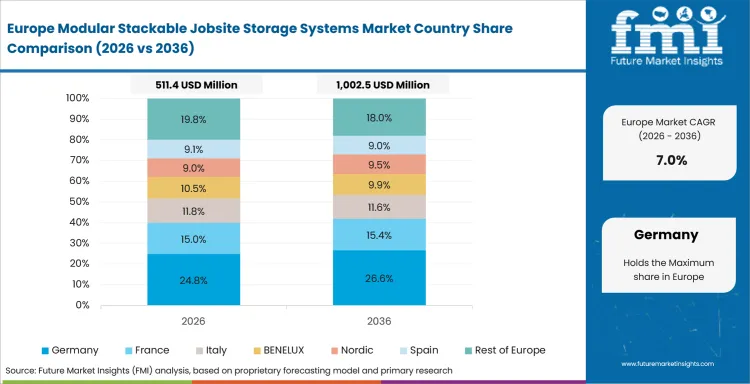
What is the modular stackable jobsite storage systems market outlook in Germany?
A 7.7% CAGR through 2036 reflects contractor mobility needs and professional channel expansion in Germany.
Country Market Snapshot Table
| Parameter | Value |
|---|---|
| Market Size in 2025 (Value) | USD 176.4 million |
| Market Size in 2026 (Value) | USD 190.0 million |
| Market Forecast in 2036 (Value) | USD 398.9 million |
| CAGR (2026 to 2036) | 7.7% |
| Years Considered | 2021 to 2036 |
| Base Year | 2025 |
| Forecast Period | 2026 to 2036 |
| Units Considered | Value (USD million) |
| Leading Sub-Region | North Rhine-Westphalia and southern workshop clusters |
Germany Modular Stackable Jobsite Storage Systems Market Outlook
Germany connects workshop order with vehicle transport. Buyers value standardized dimensions and dealer guidance. Bosch L-BOXX and Systainer formats keep compatibility high across workshop and van workflows.
Key Growth Drivers
- Building-permit recovery supports trade planning. Destatis reported building permits for dwellings increased from 215,289 in 2024 to 238,063 in 2025.
- Industrial demand supports premium fit. Destatis reported manufacturing represented 22.9% of Germany gross value added in 2025.
- Van-racking culture is expected to support modular systems with standardized footprints and secure locking interfaces.
- Specialist trade dealers are expected to support premium system education because buyers compare compatibility before purchase.
Key Restraints
- Packaging rules can raise compliance work. The European Commission states all packaging on the EU market must be recyclable by 2030.
- Premium European systems are expected to face price competition from imported boxes with similar visual layouts.
- Housing weakness can slow discretionary upgrades when smaller contractors stretch the life of existing cases.
What makes Germany unique
Germany is the strongest market for systems that connect workshop order with van racking.
Key Companies
- Bosch Power Tools
- TANOS GmbH
- Festool GmbH
- Sortimo International
- Hilti Deutschland
- Milwaukee Tool Germany
- Makita Werkzeug GmbH
Sales & Marketing Channels
- Dealer retail
- Home centers
- Online retail
- Direct fleet sales
- Industrial distributors
- Trade demonstrations
Country Segment Breakdown Table
| Segment | Sub-Segments |
|---|---|
| By Ecosystem Type | Jobsite Systems · Workshop Systems · Utility Kits · OEM Cases |
| By Material Type | Polypropylene · Metal · Hybrid · Fabric |
| By Mobility Format | Wheeled Towers · Drawer Stacks · Static Racks · Vehicle Rails |
| By End User | Contractors · MRO Teams · DIY Users · Rental Fleets |
| By Sales Channel | Dealer Retail · Home Centers · Online Retail · Direct Fleet |
| Key Sub-Regions Covered, Trade and Industrial Clusters | North Rhine-Westphalia · Bavaria · Baden-Württemberg · Berlin · Hamburg · Hesse |
Market Taxonomy and Sub-Regions Covered
Frequently Asked Questions
How fast is Germany modular stackable jobsite storage systems market growing?
Sales in Germany are projected to expand at 7.7% CAGR from 2026 to 2036.
Who leads Germany modular stackable jobsite storage systems market?
Bosch Power Tools, TANOS GmbH, Festool GmbH, Sortimo International compete through professional tool channels and modular storage portfolios.
What is driving adoption in Germany modular stackable jobsite storage systems market?
Vehicle racking culture and German system formats are supporting premium modular storage adoption.
How fast is the modular stackable jobsite storage systems market growing in France?
A 7.2% CAGR through 2036 reflects contractor mobility needs and professional channel expansion in France.
Country Market Snapshot Table
| Parameter | Value |
|---|---|
| Market Size in 2025 (Value) | USD 135.3 million |
| Market Size in 2026 (Value) | USD 145.0 million |
| Market Forecast in 2036 (Value) | USD 290.6 million |
| CAGR (2026 to 2036) | 7.2% |
| Years Considered | 2021 to 2036 |
| Base Year | 2025 |
| Forecast Period | 2026 to 2036 |
| Units Considered | Value (USD million) |
| Leading Sub-Region | Ile-de-France and Auvergne-Rhone-Alpes trade corridors |
France Modular Stackable Jobsite Storage Systems Market Outlook
France has a two-speed demand pattern. Renovation trades favor compact stacks for apartments and vans. Commercial sites support larger rolling towers where crews move more tools between work areas.
Key Growth Drivers
- Renovation and permitting activity give suppliers a broad addressable base. SDES reported 28,979 housing authorizations in April 2026.
- Builder sentiment improved slightly. INSEE reported the construction business climate indicator rose to 97 in May 2026.
- Builders merchants are expected to support comparison purchases because multi-brand displays make stack fit and drawer access visible.
- Compact kits are expected to gain share in apartment renovation where narrow access and stair movement matter.
Key Restraints
- Housing volatility can delay replacement purchases. SDES reported April 2026 housing authorizations fell 29.5% from March on a seasonally adjusted basis.
- Private-label pressure is expected to narrow margins for suppliers selling higher-cost drawer systems.
- Packaging and product documentation needs can raise supplier work for imported resin-based systems.
What makes France unique
France balances renovation-driven compact kits with commercial-site storage demand.
Key Companies
- Bosch Professional France
- DeWalt France
- Milwaukee Tool France
- Makita France
- Festool France
- Hilti France
- ToughBuilt France
Sales & Marketing Channels
- Dealer retail
- Home centers
- Online retail
- Direct fleet sales
- Industrial distributors
- Trade demonstrations
Country Segment Breakdown Table
| Segment | Sub-Segments |
|---|---|
| By Ecosystem Type | Jobsite Systems · Workshop Systems · Utility Kits · OEM Cases |
| By Material Type | Polypropylene · Metal · Hybrid · Fabric |
| By Mobility Format | Wheeled Towers · Drawer Stacks · Static Racks · Vehicle Rails |
| By End User | Contractors · MRO Teams · DIY Users · Rental Fleets |
| By Sales Channel | Dealer Retail · Home Centers · Online Retail · Direct Fleet |
| Key Sub-Regions Covered, Trade and Industrial Clusters | Ile-de-France · Lyon · Marseille · Lille · Toulouse · Nantes |
Market Taxonomy and Sub-Regions Covered
Frequently Asked Questions
How fast is France modular stackable jobsite storage systems market growing?
Sales in France are projected to expand at 7.2% CAGR from 2026 to 2036.
Who leads France modular stackable jobsite storage systems market?
Bosch Professional France, DeWalt France, Milwaukee Tool France, Makita France compete through professional tool channels and modular storage portfolios.
What is driving adoption in France modular stackable jobsite storage systems market?
Renovation work and multi-brand dealer channels are moving trades toward compact modular kits.
What is the modular stackable jobsite storage systems market forecast for Japan?
A 6.9% CAGR through 2036 reflects contractor mobility needs and professional channel expansion in Japan.
Country Market Snapshot Table
| Parameter | Value |
|---|---|
| Market Size in 2025 (Value) | USD 112.3 million |
| Market Size in 2026 (Value) | USD 120.0 million |
| Market Forecast in 2036 (Value) | USD 233.9 million |
| CAGR (2026 to 2036) | 6.9% |
| Years Considered | 2021 to 2036 |
| Base Year | 2025 |
| Forecast Period | 2026 to 2036 |
| Units Considered | Value (USD million) |
| Leading Sub-Region | Tokyo and Kansai compact jobsite corridors |
Japan Modular Stackable Jobsite Storage Systems Market Outlook
Japan is a compact-format market. Storage systems need to fit small vehicles and dense interiors. Buyers value precise construction and clean transport over maximum volume.
Key Growth Drivers
- Housing activity supports compact storage planning. MLIT reported 62,569 housing starts in April 2026 through its construction statistics release.
- Trade workforce structure supports professional-channel targeting. Statistics Japan reported construction and mining workers remained among the most male-concentrated occupations in 2024.
- Makita brand strength is expected to support trial because domestic tool users already recognize the company in pro channels.
- Specialist dealers are expected to favor compact modules that fit vehicle and workshop storage without adding excess bulk.
Key Restraints
- New housing weakness can slow broad upgrades. MLIT reported Japan housing starts fell 26.6% year over year in April 2026.
- Small vehicle dimensions are expected to restrict oversized rolling systems in dense urban service routes.
- Slow workforce renewal can limit fast adoption of full towers among older trade users.
What makes Japan unique
Japan values precision fit and compact stacking more than maximum box volume.
Key Companies
- Makita Corporation
- Bosch Japan
- DeWalt Japan
- Milwaukee Tool Japan
- Festool Japan
- Hilti Japan
- TANOS-linked distributors
Sales & Marketing Channels
- Dealer retail
- Home centers
- Online retail
- Direct fleet sales
- Industrial distributors
- Trade demonstrations
Country Segment Breakdown Table
| Segment | Sub-Segments |
|---|---|
| By Ecosystem Type | Jobsite Systems · Workshop Systems · Utility Kits · OEM Cases |
| By Material Type | Polypropylene · Metal · Hybrid · Fabric |
| By Mobility Format | Wheeled Towers · Drawer Stacks · Static Racks · Vehicle Rails |
| By End User | Contractors · MRO Teams · DIY Users · Rental Fleets |
| By Sales Channel | Dealer Retail · Home Centers · Online Retail · Direct Fleet |
| Key Sub-Regions Covered, Trade and Industrial Clusters | Tokyo · Osaka · Yokohama · Nagoya · Fukuoka · Sapporo |
Market Taxonomy and Sub-Regions Covered
Frequently Asked Questions
How fast is Japan modular stackable jobsite storage systems market growing?
Sales in Japan are projected to expand at 6.9% CAGR from 2026 to 2036.
Who leads Japan modular stackable jobsite storage systems market?
Makita Corporation, Bosch Japan, DeWalt Japan, Milwaukee Tool Japan compete through professional tool channels and modular storage portfolios.
What is driving adoption in Japan modular stackable jobsite storage systems market?
Compact vehicles and dense work sites are supporting smaller stackable systems in professional channels.
How is the modular stackable jobsite storage systems market performing in China?
A 8.1% CAGR through 2036 reflects contractor mobility needs and professional channel expansion in China.
Country Market Snapshot Table
| Parameter | Value |
|---|---|
| Market Size in 2025 (Value) | USD 277.5 million |
| Market Size in 2026 (Value) | USD 300.0 million |
| Market Forecast in 2036 (Value) | USD 653.7 million |
| CAGR (2026 to 2036) | 8.1% |
| Years Considered | 2021 to 2036 |
| Base Year | 2025 |
| Forecast Period | 2026 to 2036 |
| Units Considered | Value (USD million) |
| Leading Sub-Region | Yangtze River Delta and Pearl River Delta tool channels |
China Modular Stackable Jobsite Storage Systems Market Outlook
China combines a large supply base with uneven domestic demand. Local molding capacity supports cost-led modular boxes. E-commerce and hardware markets widen access beyond coastal cities.
Key Growth Drivers
- Construction and infrastructure activity remain large. China reported fixed asset investment of 17,851.2 billion yuan in the first five months of 2026.
- Construction sentiment stayed cautious but active. The State Council reported China construction activity PMI at 48.8 in May 2026.
- Domestic molding capacity is expected to support lower-cost modular boxes and private-label supply.
- E-commerce channels are expected to expand access for contractors outside large coastal markets.
Key Restraints
- Property-linked demand remains a restraint because China fixed asset investment fell 4.1% in the first five months of 2026.
- Counterfeit and lookalike products are expected to weaken branded margins in price-led channels.
- Buyers often compare box volume before ecosystem depth which can limit premium drawer uptake.
What makes China unique
China is both a cost-shaping supply hub and a fast-testing domestic channel for molded modular systems.
Key Companies
- Bosch Power Tools China
- Milwaukee Tool China
- DeWalt China
- Makita China
- Hilti China
- Dongguan tool-storage OEMs
- Ningbo storage suppliers
Sales & Marketing Channels
- Dealer retail
- Home centers
- Online retail
- Direct fleet sales
- Industrial distributors
- Trade demonstrations
Country Segment Breakdown Table
| Segment | Sub-Segments |
|---|---|
| By Ecosystem Type | Jobsite Systems · Workshop Systems · Utility Kits · OEM Cases |
| By Material Type | Polypropylene · Metal · Hybrid · Fabric |
| By Mobility Format | Wheeled Towers · Drawer Stacks · Static Racks · Vehicle Rails |
| By End User | Contractors · MRO Teams · DIY Users · Rental Fleets |
| By Sales Channel | Dealer Retail · Home Centers · Online Retail · Direct Fleet |
| Key Sub-Regions Covered, Trade and Industrial Clusters | Shanghai · Guangdong · Jiangsu · Zhejiang · Beijing · Chengdu |
Market Taxonomy and Sub-Regions Covered
Frequently Asked Questions
How fast is China modular stackable jobsite storage systems market growing?
Sales in China are projected to expand at 8.1% CAGR from 2026 to 2036.
Who leads China modular stackable jobsite storage systems market?
Bosch Power Tools China, Milwaukee Tool China, DeWalt China, Makita China compete through professional tool channels and modular storage portfolios.
What is driving adoption in China modular stackable jobsite storage systems market?
Molding capacity and e-commerce access are expanding modular storage availability across contractor channels.
What is the modular stackable jobsite storage systems market outlook in South Korea?
A 7.0% CAGR through 2036 reflects contractor mobility needs and professional channel expansion in South Korea.
Country Market Snapshot Table
| Parameter | Value |
|---|---|
| Market Size in 2025 (Value) | USD 84.1 million |
| Market Size in 2026 (Value) | USD 90.0 million |
| Market Forecast in 2036 (Value) | USD 177.0 million |
| CAGR (2026 to 2036) | 7.0% |
| Years Considered | 2021 to 2036 |
| Base Year | 2025 |
| Forecast Period | 2026 to 2036 |
| Units Considered | Value (USD million) |
| Leading Sub-Region | Seoul Capital Area and semiconductor project corridors |
South Korea Modular Stackable Jobsite Storage Systems Market Outlook
South Korea is more industrial than residential in premium storage demand. Semiconductor and plant contractors need organized kits for electrical and mechanical tools. Global brands remain more visible than local modular ecosystems.
Key Growth Drivers
- Business activity scale supports professional-channel demand. The Ministry of Data and Statistics reported annual sales of surveyed enterprises at 3,371.1 trillion won in 2024.
- Online retail supports small team access. South Korea online shopping transaction value reached 24.2904 trillion won in December 2025.
- Industrial distributors are expected to support premium kits for electrical and mechanical contractors working on plant projects.
- Branded power-tool ecosystems are expected to influence storage choice because buyers align boxes with existing cordless platforms.
Key Restraints
- Construction output weakness can delay premium storage purchases. KDI projected construction investment to decline 4.2% in 2025 after a 3.0% contraction in 2024.
- Imported premium systems are expected to face price pressure when currency and retail margins shift.
- Country-specific company coverage remains limited outside major global brands and industrial distributors.
What makes South Korea unique
South Korea links premium storage demand closely to industrial job sites and semiconductor construction.
Key Companies
- Milwaukee Tool Korea
- DeWalt Korea
- Bosch Professional Korea
- Makita Korea
- Hilti Korea
- Festool Korea
- industrial tool distributors
Sales & Marketing Channels
- Dealer retail
- Home centers
- Online retail
- Direct fleet sales
- Industrial distributors
- Trade demonstrations
Country Segment Breakdown Table
| Segment | Sub-Segments |
|---|---|
| By Ecosystem Type | Jobsite Systems · Workshop Systems · Utility Kits · OEM Cases |
| By Material Type | Polypropylene · Metal · Hybrid · Fabric |
| By Mobility Format | Wheeled Towers · Drawer Stacks · Static Racks · Vehicle Rails |
| By End User | Contractors · MRO Teams · DIY Users · Rental Fleets |
| By Sales Channel | Dealer Retail · Home Centers · Online Retail · Direct Fleet |
| Key Sub-Regions Covered, Trade and Industrial Clusters | Seoul · Gyeonggi · Incheon · Busan · Daegu · Daejeon |
Market Taxonomy and Sub-Regions Covered
Frequently Asked Questions
How fast is South Korea modular stackable jobsite storage systems market growing?
Sales in South Korea are projected to expand at 7.0% CAGR from 2026 to 2036.
Who leads South Korea modular stackable jobsite storage systems market?
Milwaukee Tool Korea, DeWalt Korea, Bosch Professional Korea, Makita Korea compete through professional tool channels and modular storage portfolios.
What is driving adoption in South Korea modular stackable jobsite storage systems market?
Industrial contractor demand and online access are supporting selective premium kit adoption.
How fast is the modular stackable jobsite storage systems market growing in India?
A 9.4% CAGR through 2036 reflects contractor mobility needs and professional channel expansion in India.
Country Market Snapshot Table
| Parameter | Value |
|---|---|
| Market Size in 2025 (Value) | USD 219.4 million |
| Market Size in 2026 (Value) | USD 240.0 million |
| Market Forecast in 2036 (Value) | USD 589.4 million |
| CAGR (2026 to 2036) | 9.4% |
| Years Considered | 2021 to 2036 |
| Base Year | 2025 |
| Forecast Period | 2026 to 2036 |
| Units Considered | Value (USD million) |
| Leading Sub-Region | Delhi NCR and western industrial construction corridors |
India Modular Stackable Jobsite Storage Systems Market Outlook
India is a fast-growth market from a smaller formal pro base. Public works and metro construction are widening contractor tool ownership. Buyers remain value-focused and need mid-priced kits with strong dealer explanation.
Key Growth Drivers
- Construction and manufacturing support demand. MoSPI estimated the secondary sector would grow 7.0% in FY 2025-26.
- Recent construction momentum supports organized tools. PIB reported construction registered 7.2% growth at constant prices in Q2 FY 2025-26.
- Dealer education is expected to increase awareness of modular storage benefits among small contractors.
- E-commerce is expected to make branded systems visible beyond metro cities and industrial clusters.
Key Restraints
- Material cost pressure can delay premium storage upgrades. PIB reported manufactured-products WPI inflation at 7.48% in May 2026.
- Heat and dust raise expectations for seals and latch durability across outdoor jobsite use.
- Small-town buyers are expected to favor single boxes until full systems become affordable.
What makes India unique
India has the fastest forecast growth as formal tool ownership expands from metro contractors into smaller city channels.
Key Companies
- Bosch Power Tools India
- Stanley Black & Decker India
- Makita India
- Hilti India
- Milwaukee Tool India
- DeWalt India
- industrial tool distributors
Sales & Marketing Channels
- Dealer retail
- Home centers
- Online retail
- Direct fleet sales
- Industrial distributors
- Trade demonstrations
Country Segment Breakdown Table
| Segment | Sub-Segments |
|---|---|
| By Ecosystem Type | Jobsite Systems · Workshop Systems · Utility Kits · OEM Cases |
| By Material Type | Polypropylene · Metal · Hybrid · Fabric |
| By Mobility Format | Wheeled Towers · Drawer Stacks · Static Racks · Vehicle Rails |
| By End User | Contractors · MRO Teams · DIY Users · Rental Fleets |
| By Sales Channel | Dealer Retail · Home Centers · Online Retail · Direct Fleet |
| Key Sub-Regions Covered, Trade and Industrial Clusters | Delhi NCR · Mumbai · Pune · Bengaluru · Hyderabad · Chennai |
Market Taxonomy and Sub-Regions Covered
Frequently Asked Questions
How fast is India modular stackable jobsite storage systems market growing?
Sales in India are projected to expand at 9.4% CAGR from 2026 to 2036.
Who leads India modular stackable jobsite storage systems market?
Bosch Power Tools India, Stanley Black & Decker India, Makita India, Hilti India compete through professional tool channels and modular storage portfolios.
What is driving adoption in India modular stackable jobsite storage systems market?
Infrastructure work and contractor formalization are moving users from loose bags toward stackable boxes.
Who are the leading companies in the modular stackable jobsite storage systems market?
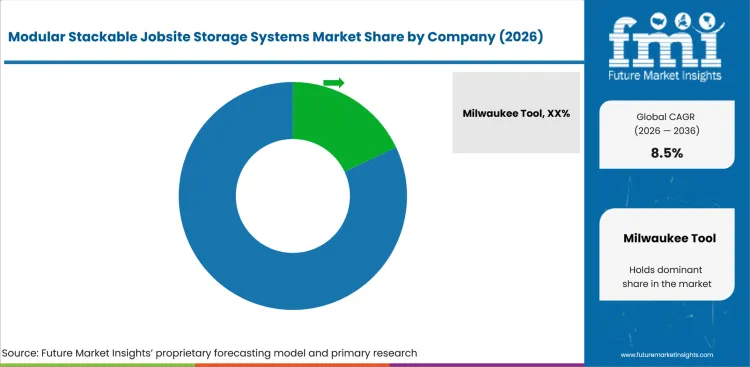
Milwaukee Tool, DeWalt, Bosch, Makita, Hilti and Klein Tools are listed with TANOS and ToughBuilt among other verified suppliers.
- Established power-tool brands hold an advantage through retail reach and cordless platform loyalty.
- System specialists gain shelf space by offering vehicle-fit storage and legacy compatibility.
- Trade-focused brands compete through drawer access, rails and accessories for specific users.
- Recycled resin and take-back programs support enterprise acceptance where material reporting matters.
Competition is defined by ecosystem depth rather than a single box. Milwaukee’s PACKOUT range spans boxes, drawers, racks and accessories. DeWalt expanded the field with TOUGHSYSTEM 2.0 DXL and a 30-inch workstation format in September 2024. Bosch added wheeled options and drawers while preserving legacy L-BOXX compatibility. Suppliers without durable latches, retail displays and accessory depth face weaker repeat purchases.
Manufacturing and material strategy are becoming competitive filters. Makita’s MAKTRAK launch emphasized horizontal dual-hinging lids and wider interior space for larger tools. Hilti links tool cases to closed-loop fleet management and recycled content. TANOS positions the Systainer3 Eco range around recycled material and lower material CO2e footprint. Brands that combine mechanical durability with material discipline should gain stronger enterprise acceptance.
How do top modular stackable jobsite storage systems companies compare?
| Company | Relevance to Market Title | Vehicle Fit Range | Drawer Access Breadth | Channel Reach | Geographic Footprint |
|---|---|---|---|---|---|
| Milwaukee Tool | Very High | Very Strong | Very Strong | Very Strong | Global |
| Stanley Black & Decker DeWalt | Very High | Very Strong | Very Strong | Very Strong | Global |
| Robert Bosch Power Tools | Very High | Very Strong | Strong | Very Strong | Global |
| TANOS and Festool | High | Very Strong | Medium | Strong | Europe and North America |
| Makita | High | Strong | Medium | Very Strong | Global |
| Hilti | High | Strong | Low to Moderate | Very Strong | Global |
| Klein Tools | High | Moderate | Strong | Strong | North America |
| ToughBuilt | High | Moderate | Strong | Moderate | North America and selected markets |
Source: Future Market Insights competitive analysis, 2026.
Who are the key players in the modular stackable jobsite storage systems market?
Milwaukee Tool, DeWalt and Bosch are listed with Makita, Hilti and Klein Tools among other suppliers.
Key global companies leading the modular stackable jobsite storage systems market include:
- Milwaukee Tool
- Stanley Black & Decker DeWalt
- Robert Bosch Power Tools
- Makita
- Hilti
- Klein Tools
- TANOS and Festool
- ToughBuilt
Key Developments in Modular Stackable Jobsite Storage Systems Market
- In September 2024, DeWalt announced the TOUGHSYSTEM 2.0 DXL storage lineup with four 30-inch products and truck-ready configuration.
- In October 2024, Makita launched MAKTRAK as its next generation modular storage system with dual-hinging lids and horizontal access.
- In July 2025, Milwaukee announced the PACKOUT Rolling Drawer in Europe with compatibility across all PACKOUT storage.
- In January 2026, Bosch introduced the L-BOXX Contractor System at World of Concrete with wheeled options, racks, drawers and a backpack.
- In 2024, TANOS introduced the Systainer3 Eco Series M 112 to M 337 using recycled material for modular storage.
Key Players in the Modular Stackable Jobsite Storage Systems Market
Platform Leaders
- Milwaukee Tool
- Stanley Black & Decker DeWalt
System Specialists
- Robert Bosch Power Tools
- TANOS and Festool
Challengers and Fleet Brands
- Makita
- Hilti
- Klein Tools
- ToughBuilt
Modular Stackable Jobsite Storage Systems Market - Report Scope
| Item | Value |
|---|---|
| Market size by 2036 | USD 5.31 billion |
| Growth rate | 8.5% CAGR from 2026 to 2036 |
| Forecast period | 2026 to 2036 |
| Base year value (2025) | USD 2.15 billion |
| By ecosystem type | Jobsite systems, workshop systems, utility kits, OEM cases |
| By material type | Polypropylene, metal, hybrid, fabric |
| By mobility format | Wheeled towers, drawer stacks, static racks, vehicle rails |
| By end user | Contractors, MRO teams, DIY users, rental fleets |
| By sales channel | Dealer retail, home centers, online retail, direct fleet |
| Regions covered | North America, Latin America, Europe, East Asia, South Asia and Pacific, Middle East and Africa |
| Countries covered | United States, United Kingdom, Germany, France, Japan, China, South Korea, India |
| Key companies profiled | Milwaukee Tool, DeWalt, Bosch, Makita, Hilti, Klein Tools, TANOS, Festool and ToughBuilt |
| Approach | Bottom-up product-boundary approach using modular SKU revenue, channel presence, construction activity and country-level contractor adoption |
Source: Future Market Insights, 2026.
Modular Stackable Jobsite Storage Systems Market - Scope & Definition
| Attribute | Detail |
|---|---|
| Market Definition | Interlocking tool boxes, rolling bases, drawers, organizers, racks and rails used to move tools and accessories across jobsites and service vehicles |
| Functions Covered | Tool protection, stack locking, drawer access, mobile transport, van fit, workshop organization and fleet kit standardization |
| Applications Covered | Jobsite transport, contractor storage, workshop-to-vehicle movement, MRO service kits, rental fleet kits and trade-specific organizers |
| End-Use Industries | Construction, maintenance and repair, utilities, industrial services, rental fleets and professional DIY channels |
| Materials Covered | Polypropylene, metal, hybrid material systems and fabric-supported modular formats |
| Inclusions | Commercially sold modular jobsite storage systems across ecosystem type, material type, mobility format, end user and sales channel |
| Exclusions | Fixed warehouse shelving, consumer closet storage, single non-stackable boxes, disposable packaging, tool belts and soft pouches without locking modules |
Modular Stackable Jobsite Storage Systems Market - Research Methodology
| Method | Description |
|---|---|
| Primary Research | FMI analyst interviews with contractor buyers, dealer managers, tool rental operators, fleet buyers and jobsite supervisors across key markets |
| Desk Research | Review of national construction statistics, official company launches, product pages, safety releases and trade-channel evidence related to modular storage systems |
| Market Sizing & Forecasting | Bottom-up model using modular SKU revenue, average module price, professional tool ownership, construction output and country-level channel maturity |
| Data Validation | Cross-verification using construction activity, retail channel checks, company product evidence and comparison with the broader tool-box universe |
Modular Stackable Jobsite Storage Systems Market Breakdown by Ecosystem Type, Material Type, Mobility Format, End User, Sales Channel, and Region
Modular Stackable Jobsite Storage Systems Market Segmented by Ecosystem Type
- Jobsite Systems
- Workshop Systems
- Utility Kits
- OEM Cases
Modular Stackable Jobsite Storage Systems Market Segmented by Material Type
- Polypropylene
- Metal
- Hybrid
- Fabric
Modular Stackable Jobsite Storage Systems Market Segmented by Mobility Format
- Wheeled Towers
- Drawer Stacks
- Static Racks
- Vehicle Rails
Modular Stackable Jobsite Storage Systems Market Segmented by End User
- Contractors
- MRO Teams
- DIY Users
- Rental Fleets
Modular Stackable Jobsite Storage Systems Market Segmented by Sales Channel
- Dealer Retail
- Home Centers
- Online Retail
- Direct Fleet
Modular Stackable Jobsite Storage Systems Market by Region
- North America
- Latin America
- Europe
- East Asia
- South Asia and Pacific
- Middle East and Africa
Research Sources and Bibliography
This Report Answers
- Market size estimates for 2026 and forecasts through 2036 for the modular stackable jobsite storage systems market.
- Insights across more than 30 regional and country-level markets.
- Analysis of demand drivers, contractor adoption patterns and purchasing behavior.
- Evaluation of ecosystem type, material type, mobility format, end user and sales channel dynamics.
- Assessment of construction activity and professional channel impacts on market development.
- Identification of growth opportunities across drawer systems, wheeled towers and vehicle-fit rails.
- Evaluation of supply chain dynamics, product launches and distribution channel structures.
- Country-level growth analysis covering the United States, United Kingdom, Germany, France, Japan, China, South Korea and India.
- Assessment of the competitive landscape, including leading modular storage system manufacturers and other suppliers.
- Analysis of buyer preferences, platform lock-in and dealer retail opportunities.
- Regional outlooks across North America, Europe, East Asia and South Asia and Pacific.
- Delivery of market data, forecasts and supporting analysis in PDF and Excel formats.
Frequently Asked Questions
What is the modular stackable jobsite storage systems market size in 2026?
The modular stackable jobsite storage systems market size is anticipated to cross USD 2.34 billion in 2026.
What is the modular stackable jobsite storage systems market forecast for 2036?
The modular stackable jobsite storage systems industry revenue is predicted to reach USD 5.31 billion by 2036 as drawer and wheeled systems gain share.
What is the modular stackable jobsite storage systems market CAGR?
The modular stackable jobsite storage systems sector is projected to expand at 8.5% CAGR from 2026 to 2036.
What segment leads the modular stackable jobsite storage systems market?
Jobsite Systems are likely to capture 52.0% share in 2026 due to full-stack compatibility and repeat module purchases.
What country grows fastest in the modular stackable jobsite storage systems market?
India is set to record 9.4% CAGR by 2036, driven by contractor formalization and infrastructure-linked tool ownership.
What products are included in this market?
The market includes interlocking boxes, rolling bases, drawer units, organizers, racks and vehicle rails built for professional jobsite use.
Which companies lead the modular stackable jobsite storage systems market?
Milwaukee Tool, DeWalt, Bosch, Makita, Hilti and Klein Tools are among the most relevant suppliers in this category.
What is the difference between a tool box and a modular storage system?
A tool box stores tools as one unit. A modular system locks multiple boxes, drawers, organizers and carts into one stack.
What are the main disadvantages of modular jobsite storage systems?
The main disadvantages are higher upfront cost, added weight in full stacks, vehicle fit limits and lock-in to one brand ecosystem.
Preview the report firsthand - request a free sample
Get SampleGet the brochure for pricing and purchase details.
Get PDFTable of Content
- Executive Summary
- Global Market Outlook
- Demand to side Trends
- Supply to side Trends
- Technology Roadmap Analysis
- Analysis and Recommendations
- Market Overview
- Market Coverage / Taxonomy
- Market Definition / Scope / Limitations
- Research Methodology
- Chapter Orientation
- Analytical Lens and Working Hypotheses
- Market Structure, Signals, and Trend Drivers
- Benchmarking and Cross-market Comparability
- Market Sizing, Forecasting, and Opportunity Mapping
- Research Design and Evidence Framework
- Desk Research Programme (Secondary Evidence)
- Company Annual and Sustainability Reports
- Peer-reviewed Journals and Academic Literature
- Corporate Websites, Product Literature, and Technical Notes
- Earnings Decks and Investor Briefings
- Statutory Filings and Regulatory Disclosures
- Technical White Papers and Standards Notes
- Trade Journals, Industry Magazines, and Analyst Briefs
- Conference Proceedings, Webinars, and Seminar Materials
- Government Statistics Portals and Public Data Releases
- Press Releases and Reputable Media Coverage
- Specialist Newsletters and Curated Briefings
- Sector Databases and Reference Repositories
- FMI Internal Proprietary Databases and Historical Market Datasets
- Subscription Datasets and Paid Sources
- Social Channels, Communities, and Digital Listening Inputs
- Additional Desk Sources
- Expert Input and Fieldwork (Primary Evidence)
- Primary Modes
- Qualitative Interviews and Expert Elicitation
- Quantitative Surveys and Structured Data Capture
- Blended Approach
- Why Primary Evidence is Used
- Field Techniques
- Interviews
- Surveys
- Focus Groups
- Observational and In-context Research
- Social and Community Interactions
- Stakeholder Universe Engaged
- C-suite Leaders
- Board Members
- Presidents and Vice Presidents
- R&D and Innovation Heads
- Technical Specialists
- Domain Subject-matter Experts
- Scientists
- Physicians and Other Healthcare Professionals
- Governance, Ethics, and Data Stewardship
- Research Ethics
- Data Integrity and Handling
- Primary Modes
- Tooling, Models, and Reference Databases
- Desk Research Programme (Secondary Evidence)
- Data Engineering and Model Build
- Data Acquisition and Ingestion
- Cleaning, Normalisation, and Verification
- Synthesis, Triangulation, and Analysis
- Quality Assurance and Audit Trail
- Market Background
- Market Dynamics
- Drivers
- Restraints
- Opportunity
- Trends
- Scenario Forecast
- Demand in Optimistic Scenario
- Demand in Likely Scenario
- Demand in Conservative Scenario
- Opportunity Map Analysis
- Product Life Cycle Analysis
- Supply Chain Analysis
- Investment Feasibility Matrix
- Value Chain Analysis
- PESTLE and Porter’s Analysis
- Regulatory Landscape
- Regional Parent Market Outlook
- Production and Consumption Statistics
- Import and Export Statistics
- Market Dynamics
- Global Market Analysis 2021 to 2025 and Forecast, 2026 to 2036
- Historical Market Size Value (USD Million) Analysis, 2021 to 2025
- Current and Future Market Size Value (USD Million) Projections, 2026 to 2036
- Y to o to Y Growth Trend Analysis
- Absolute $ Opportunity Analysis
- Global Market Pricing Analysis 2021 to 2025 and Forecast 2026 to 2036
- Global Market Analysis 2021 to 2025 and Forecast 2026 to 2036, By Ecosystem Type
- Introduction / Key Findings
- Historical Market Size Value (USD Million) Analysis By Ecosystem Type , 2021 to 2025
- Current and Future Market Size Value (USD Million) Analysis and Forecast By Ecosystem Type , 2026 to 2036
- Jobsite Systems
- Workshop Systems
- Utility Kits
- Jobsite Systems
- Y to o to Y Growth Trend Analysis By Ecosystem Type , 2021 to 2025
- Absolute $ Opportunity Analysis By Ecosystem Type , 2026 to 2036
- Global Market Analysis 2021 to 2025 and Forecast 2026 to 2036, By Material Type
- Introduction / Key Findings
- Historical Market Size Value (USD Million) Analysis By Material Type, 2021 to 2025
- Current and Future Market Size Value (USD Million) Analysis and Forecast By Material Type, 2026 to 2036
- Polypropylene
- Metal
- Hybrid
- Polypropylene
- Y to o to Y Growth Trend Analysis By Material Type, 2021 to 2025
- Absolute $ Opportunity Analysis By Material Type, 2026 to 2036
- Global Market Analysis 2021 to 2025 and Forecast 2026 to 2036, By Mobility Format
- Introduction / Key Findings
- Historical Market Size Value (USD Million) Analysis By Mobility Format, 2021 to 2025
- Current and Future Market Size Value (USD Million) Analysis and Forecast By Mobility Format, 2026 to 2036
- Wheeled Towers
- Drawer Stacks
- Static Racks
- Wheeled Towers
- Y to o to Y Growth Trend Analysis By Mobility Format, 2021 to 2025
- Absolute $ Opportunity Analysis By Mobility Format, 2026 to 2036
- Global Market Analysis 2021 to 2025 and Forecast 2026 to 2036, By End User
- Introduction / Key Findings
- Historical Market Size Value (USD Million) Analysis By End User, 2021 to 2025
- Current and Future Market Size Value (USD Million) Analysis and Forecast By End User, 2026 to 2036
- Contractors
- MRO Teams
- DIY Users
- Contractors
- Y to o to Y Growth Trend Analysis By End User, 2021 to 2025
- Absolute $ Opportunity Analysis By End User, 2026 to 2036
- Global Market Analysis 2021 to 2025 and Forecast 2026 to 2036, By Sales Channel
- Introduction / Key Findings
- Historical Market Size Value (USD Million) Analysis By Sales Channel, 2021 to 2025
- Current and Future Market Size Value (USD Million) Analysis and Forecast By Sales Channel, 2026 to 2036
- Dealer Retail
- Home Centers
- Online Retail
- Dealer Retail
- Y to o to Y Growth Trend Analysis By Sales Channel, 2021 to 2025
- Absolute $ Opportunity Analysis By Sales Channel, 2026 to 2036
- Global Market Analysis 2021 to 2025 and Forecast 2026 to 2036, By Region
- Introduction
- Historical Market Size Value (USD Million) Analysis By Region, 2021 to 2025
- Current Market Size Value (USD Million) Analysis and Forecast By Region, 2026 to 2036
- North America
- Latin America
- Western Europe
- Eastern Europe
- East Asia
- South Asia and Pacific
- Middle East & Africa
- Market Attractiveness Analysis By Region
- North America Market Analysis 2021 to 2025 and Forecast 2026 to 2036, By Country
- Historical Market Size Value (USD Million) Trend Analysis By Market Taxonomy, 2021 to 2025
- Market Size Value (USD Million) Forecast By Market Taxonomy, 2026 to 2036
- By Country
- USA
- Canada
- Mexico
- By Ecosystem Type
- By Material Type
- By Mobility Format
- By End User
- By Sales Channel
- By Country
- Market Attractiveness Analysis
- By Country
- By Ecosystem Type
- By Material Type
- By Mobility Format
- By End User
- By Sales Channel
- Key Takeaways
- Latin America Market Analysis 2021 to 2025 and Forecast 2026 to 2036, By Country
- Historical Market Size Value (USD Million) Trend Analysis By Market Taxonomy, 2021 to 2025
- Market Size Value (USD Million) Forecast By Market Taxonomy, 2026 to 2036
- By Country
- Brazil
- Chile
- Rest of Latin America
- By Ecosystem Type
- By Material Type
- By Mobility Format
- By End User
- By Sales Channel
- By Country
- Market Attractiveness Analysis
- By Country
- By Ecosystem Type
- By Material Type
- By Mobility Format
- By End User
- By Sales Channel
- Key Takeaways
- Western Europe Market Analysis 2021 to 2025 and Forecast 2026 to 2036, By Country
- Historical Market Size Value (USD Million) Trend Analysis By Market Taxonomy, 2021 to 2025
- Market Size Value (USD Million) Forecast By Market Taxonomy, 2026 to 2036
- By Country
- Germany
- UK
- Italy
- Spain
- France
- Nordic
- BENELUX
- Rest of Western Europe
- By Ecosystem Type
- By Material Type
- By Mobility Format
- By End User
- By Sales Channel
- By Country
- Market Attractiveness Analysis
- By Country
- By Ecosystem Type
- By Material Type
- By Mobility Format
- By End User
- By Sales Channel
- Key Takeaways
- Eastern Europe Market Analysis 2021 to 2025 and Forecast 2026 to 2036, By Country
- Historical Market Size Value (USD Million) Trend Analysis By Market Taxonomy, 2021 to 2025
- Market Size Value (USD Million) Forecast By Market Taxonomy, 2026 to 2036
- By Country
- Russia
- Poland
- Hungary
- Balkan & Baltic
- Rest of Eastern Europe
- By Ecosystem Type
- By Material Type
- By Mobility Format
- By End User
- By Sales Channel
- By Country
- Market Attractiveness Analysis
- By Country
- By Ecosystem Type
- By Material Type
- By Mobility Format
- By End User
- By Sales Channel
- Key Takeaways
- East Asia Market Analysis 2021 to 2025 and Forecast 2026 to 2036, By Country
- Historical Market Size Value (USD Million) Trend Analysis By Market Taxonomy, 2021 to 2025
- Market Size Value (USD Million) Forecast By Market Taxonomy, 2026 to 2036
- By Country
- China
- Japan
- South Korea
- By Ecosystem Type
- By Material Type
- By Mobility Format
- By End User
- By Sales Channel
- By Country
- Market Attractiveness Analysis
- By Country
- By Ecosystem Type
- By Material Type
- By Mobility Format
- By End User
- By Sales Channel
- Key Takeaways
- South Asia and Pacific Market Analysis 2021 to 2025 and Forecast 2026 to 2036, By Country
- Historical Market Size Value (USD Million) Trend Analysis By Market Taxonomy, 2021 to 2025
- Market Size Value (USD Million) Forecast By Market Taxonomy, 2026 to 2036
- By Country
- India
- ASEAN
- Australia & New Zealand
- Rest of South Asia and Pacific
- By Ecosystem Type
- By Material Type
- By Mobility Format
- By End User
- By Sales Channel
- By Country
- Market Attractiveness Analysis
- By Country
- By Ecosystem Type
- By Material Type
- By Mobility Format
- By End User
- By Sales Channel
- Key Takeaways
- Middle East & Africa Market Analysis 2021 to 2025 and Forecast 2026 to 2036, By Country
- Historical Market Size Value (USD Million) Trend Analysis By Market Taxonomy, 2021 to 2025
- Market Size Value (USD Million) Forecast By Market Taxonomy, 2026 to 2036
- By Country
- Kingdom of Saudi Arabia
- Other GCC Countries
- Turkiye
- South Africa
- Other African Union
- Rest of Middle East & Africa
- By Ecosystem Type
- By Material Type
- By Mobility Format
- By End User
- By Sales Channel
- By Country
- Market Attractiveness Analysis
- By Country
- By Ecosystem Type
- By Material Type
- By Mobility Format
- By End User
- By Sales Channel
- Key Takeaways
- Key Countries Market Analysis
- USA
- Pricing Analysis
- Market Share Analysis, 2025
- By Ecosystem Type
- By Material Type
- By Mobility Format
- By End User
- By Sales Channel
- Canada
- Pricing Analysis
- Market Share Analysis, 2025
- By Ecosystem Type
- By Material Type
- By Mobility Format
- By End User
- By Sales Channel
- Mexico
- Pricing Analysis
- Market Share Analysis, 2025
- By Ecosystem Type
- By Material Type
- By Mobility Format
- By End User
- By Sales Channel
- Brazil
- Pricing Analysis
- Market Share Analysis, 2025
- By Ecosystem Type
- By Material Type
- By Mobility Format
- By End User
- By Sales Channel
- Chile
- Pricing Analysis
- Market Share Analysis, 2025
- By Ecosystem Type
- By Material Type
- By Mobility Format
- By End User
- By Sales Channel
- Germany
- Pricing Analysis
- Market Share Analysis, 2025
- By Ecosystem Type
- By Material Type
- By Mobility Format
- By End User
- By Sales Channel
- UK
- Pricing Analysis
- Market Share Analysis, 2025
- By Ecosystem Type
- By Material Type
- By Mobility Format
- By End User
- By Sales Channel
- Italy
- Pricing Analysis
- Market Share Analysis, 2025
- By Ecosystem Type
- By Material Type
- By Mobility Format
- By End User
- By Sales Channel
- Spain
- Pricing Analysis
- Market Share Analysis, 2025
- By Ecosystem Type
- By Material Type
- By Mobility Format
- By End User
- By Sales Channel
- France
- Pricing Analysis
- Market Share Analysis, 2025
- By Ecosystem Type
- By Material Type
- By Mobility Format
- By End User
- By Sales Channel
- India
- Pricing Analysis
- Market Share Analysis, 2025
- By Ecosystem Type
- By Material Type
- By Mobility Format
- By End User
- By Sales Channel
- ASEAN
- Pricing Analysis
- Market Share Analysis, 2025
- By Ecosystem Type
- By Material Type
- By Mobility Format
- By End User
- By Sales Channel
- Australia & New Zealand
- Pricing Analysis
- Market Share Analysis, 2025
- By Ecosystem Type
- By Material Type
- By Mobility Format
- By End User
- By Sales Channel
- China
- Pricing Analysis
- Market Share Analysis, 2025
- By Ecosystem Type
- By Material Type
- By Mobility Format
- By End User
- By Sales Channel
- Japan
- Pricing Analysis
- Market Share Analysis, 2025
- By Ecosystem Type
- By Material Type
- By Mobility Format
- By End User
- By Sales Channel
- South Korea
- Pricing Analysis
- Market Share Analysis, 2025
- By Ecosystem Type
- By Material Type
- By Mobility Format
- By End User
- By Sales Channel
- Russia
- Pricing Analysis
- Market Share Analysis, 2025
- By Ecosystem Type
- By Material Type
- By Mobility Format
- By End User
- By Sales Channel
- Poland
- Pricing Analysis
- Market Share Analysis, 2025
- By Ecosystem Type
- By Material Type
- By Mobility Format
- By End User
- By Sales Channel
- Hungary
- Pricing Analysis
- Market Share Analysis, 2025
- By Ecosystem Type
- By Material Type
- By Mobility Format
- By End User
- By Sales Channel
- Kingdom of Saudi Arabia
- Pricing Analysis
- Market Share Analysis, 2025
- By Ecosystem Type
- By Material Type
- By Mobility Format
- By End User
- By Sales Channel
- Turkiye
- Pricing Analysis
- Market Share Analysis, 2025
- By Ecosystem Type
- By Material Type
- By Mobility Format
- By End User
- By Sales Channel
- South Africa
- Pricing Analysis
- Market Share Analysis, 2025
- By Ecosystem Type
- By Material Type
- By Mobility Format
- By End User
- By Sales Channel
- USA
- Market Structure Analysis
- Competition Dashboard
- Competition Benchmarking
- Market Share Analysis of Top Players
- By Regional
- By Ecosystem Type
- By Material Type
- By Mobility Format
- By End User
- By Sales Channel
- Competition Analysis
- Competition Deep Dive
- Milwaukee Tool
- Overview
- Product Portfolio
- Profitability by Market Segments (Product/Age /Sales Channel/Region)
- Sales Footprint
- Strategy Overview
- Marketing Strategy
- Product Strategy
- Channel Strategy
- Stanley Black & Decker DeWalt
- Robert Bosch Power Tools
- TANOS and Festool
- Makita
- Milwaukee Tool
- Competition Deep Dive
- Assumptions & Acronyms Used


