

- Market Size (2026)
- USD 520.7 Mn
- Forecast (2036)
- USD 906.4 Mn
- CAGR (2026 to 2036)
- 5.7%
How big is the free standing spring market in 2026?
USD 520.7 million in 2026 and USD 906.4 million by 2036 at a 5.7% CAGR.
Demand for free standing springs is projected to expand at 5.7% CAGR between 2026 and 2036, increasing valuation from USD 520.7 million in 2026 to USD 906.4 million by 2036. OEM engineers are expected to buy more tightly specified compression and torsion parts because equipment layouts leave less room for late fit changes. The USA Bureau of Labor Statistics placed the spring manufacturing producer price index at 237.180 in May 2026, which keeps cost checks close to tolerance reviews. The pricing pressure is expected to support specification-led sourcing beside automotive spring demand as part numbers move from prototype carts into repeat purchase files.
Regional purchasing behavior varies according to manufacturing priorities and supply-chain needs. In India and China, proximity to production facilities often favors local spring manufacturers that can support rapid prototyping and frequent design iterations. In the United States and Germany, supplier selection is more commonly influenced by testing documentation and alloy traceability requirements.
Automotive manufacturing remains a key demand generator for free standing springs. Global vehicle production reached 96.4 million units in 2025, supporting steady demand for springs used in seat mechanisms and other high-cycle components. The same performance requirements extend to factory automation controls and industrial machinery applications, where components are expected to withstand repeated loading over long operating periods.
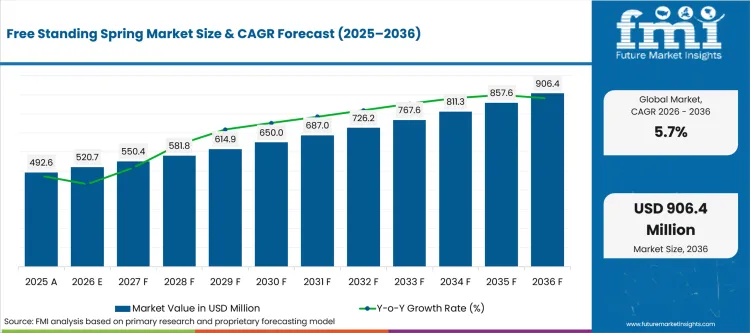
| Metric | Value |
|---|---|
| 2025 Market Size | USD 492.6 million |
| 2026 Market Size | USD 520.7 million |
| 2036 Market Size | USD 906.4 million |
| Forecast CAGR (2026-2036) | 5.7% |
| Leading Sales Channel | Direct OEM |
| Direct OEM Share (2026) | 55.0% |
| Leading Manufacturing Method | Cold Coiled |
| Cold Coiled Share (2026) | 46.0% |
| Leading Spring Type | Compression Springs |
| Compression Springs Share (2026) | 38.0% |
Summary of the Free Standing Spring Market
| Market Signal | Commercial Impact |
|---|---|
| Demand and Growth Drivers | Demand is expected to follow the work done by OEM engineers before production release. Springs are small parts, but late fit failure is costly because one wrong load curve stops a wider assembly review.
|
| Product and Segment View | Direct OEM, cold coiled, compression springs and carbon steel are projected to frame the main selection routes in 2026. Automotive components add a separate screen because platforms keep approved parts under longer review.
|
| Geography and Growth Outlook | India and China are expected to show broader expansion because local assembly volume raises the value of short lead times. The United States and Japan are projected to expand under documentation-led sourcing.
|
| Competitive Landscape | Competition is expected to be shaped by catalog reach and engineered support. Vendors with stock programs cover urgent orders, while custom spring houses win when drawings require tolerance changes.
|
| Analyst Perspective | The approval pinch point is not the spring drawing alone. It is repeat load behavior after the part enters a real assembly.
|
Source: FMI's proprietary forecasting model and primary research
How is the free standing spring market segmented?
The free standing spring industry is segmented by spring type, material, application, manufacturing method, sales channel, and region.
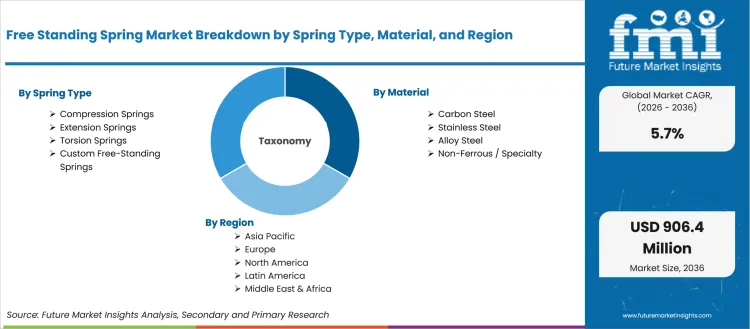
The free standing springs market is segmented by spring type, material, application, manufacturing method, sales channel, and region. By spring type, the market covers compression springs, extension springs, torsion springs, and custom free-standing springs. By material, it covers carbon steel, stainless steel, alloy steel, and non-ferrous or specialty materials. By application, it covers machinery, automotive components, furniture or consumer products, and aerospace or medical uses. By manufacturing method, it covers cold coiled, hot coiled, and precision CNC coiled designs. By sales channel, it covers direct OEM, industrial distributors, and custom spring shops. Regional coverage includes North America, Latin America, Europe, East Asia, South Asia Pacific, Middle East and Africa beside compression gas spring use.
How does direct OEM shape demand within the sales channel category?
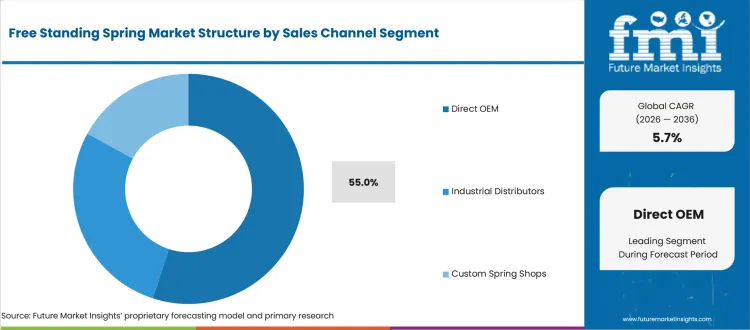
Direct OEM ordering starts when an engineer wants the spring maker inside the drawing conversation. Lee Spring's February 2026 company page states that it carries more than 25,000 stock springs and produces custom parts to specification. That catalog base gives design teams a starting point before a drawing moves into release control. Direct access helps plant teams settle spring rate, end finish and packaging details before parts enter a launch build.
- Based on sales channel, direct OEM is projected to account for 55.0% in 2026 due to specification ownership and service response. Lee Spring India achieved AS9100D certification in December 2025, which supports direct programs where aerospace or defense customers ask for stronger document control before orders scale during trial builds.
- Direct OEM is drawing demand from equipment OEMs because drawing changes and load checks travel faster through one accountable supplier route. Procurement teams are expected to use direct programs when production crews need the same spring behavior across reorder batches. Adjacent valve spring applications add a similar approval screen for load repeatability.
What supports demand for cold coiled springs within the manufacturing method category?
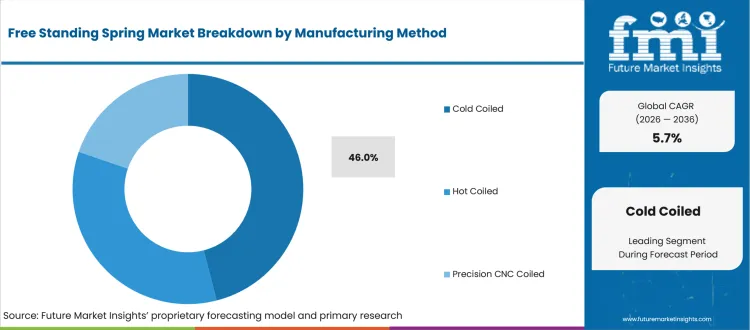
Cold coiling fits springs made from wire at room temperature, so the method suits repeat production and catalog parts with controlled dimensions. MW Components' July 2026 company page says its spring offering includes coiled, flat and machined springs through more than 20 manufacturing facilities. The method is useful when design engineers need quick pitch or wire changes without moving into heavier hot coiled equipment.
- By manufacturing method, cold coiled springs are estimated to hold 46.0% in 2026 due to repeat forming and broad wire choices. The producer price index for spring and wire product manufacturing reached 300.458 in May 2026, so cost review stays close to forming choice and wire selection during quote approval.
- Demand for cold coiled designs is expected to grow among custom spring shops due to shorter setup routes for compression and torsion parts. These shops compare wire grade, pitch control and finish before quoting repeat work. Adjacent leaf spring assemblies create a useful comparison because material choice still shapes fatigue proof.
How are compression springs positioned within the spring type category?
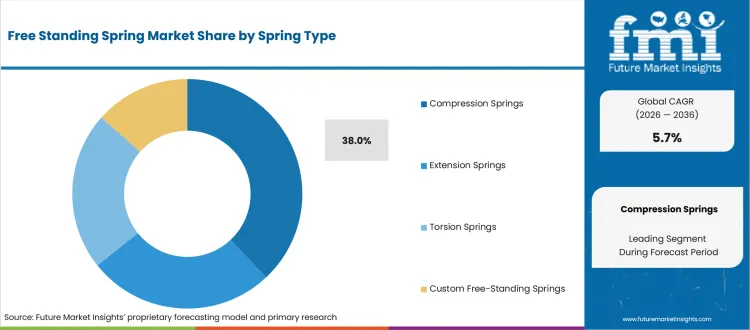
Compression springs carry force along their axis, which makes them common in return mechanisms and fixtures. Associated Spring Raymond lists compression, extension and torsion springs beside die springs and gas struts. The catalog spread helps engineers compare a familiar part form against load, travel and space limits before replacing a specified spring in a machine or vehicle assembly.
- In 2026, compression springs are expected to lead spring type with 38.0% share due to their use in return force and load control. Associated Spring Raymond presents compression springs as pre-engineered catalog products, which supports design reviews that need known spring rates before release and quick replacement choices during maintenance planning.
- Plant maintenance teams are expected to purchase more compression springs led by repeat replacement needs in machinery, furniture frames and automotive interiors. Demand is projected to stay tied to parts that restore force without changing the surrounding assembly envelope. Engineers still verify solid height and end finish before approving substitutes.
What makes carbon steel central to the material category?
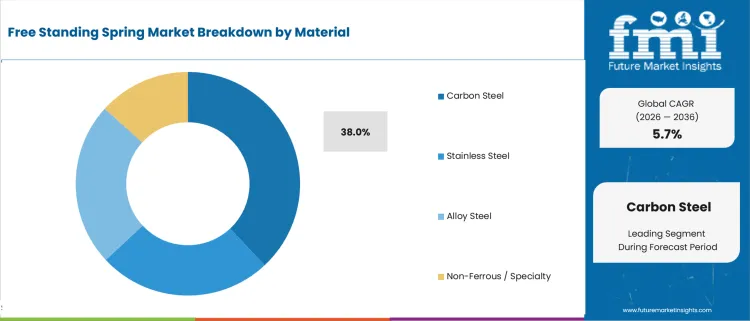
Carbon steel remains the practical starting point where the spring sees moderate corrosion exposure and cost pressure. Century Spring's catalog covers compression and extension springs that engineers use for quick selection. Material files still need fatigue and finish review because a low-cost spring becomes expensive if its load curve changes after repeat cycling.
- By material, carbon steel is forecast to represent 38.0% in 2026 driven by its cost and known fatigue behavior. BLS reported final demand goods prices rose 2.8% in May 2026, which keeps material-price checks close to spring quoting for carbon steel wire and finished parts during contract renewals.
- Purchase activity for carbon steel springs is anticipated to rise in machinery accounts supported by simple forming and broad availability. Engineers still check plating and lubrication needs before they accept the material for service near moisture or heat. That review is expected to separate routine parts from higher-risk assemblies.
How do automotive components influence purchasing within the application category?
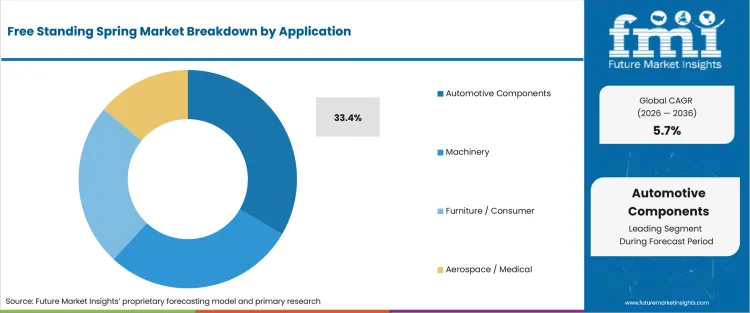
Automotive components use springs in seats, pedals and closure hardware. Suspension subassemblies also push spring changes through platform checks. In August 2025, VDA reported 864,000 electric cars produced in Germany during the first half of 2025. The production shift keeps automotive spring programs close to weight and packaging reviews, especially where the same spring must hold force across many build cycles.
- The automotive components application is anticipated to capture 33.4% share in 2026 due to repeat spring use in seats and closure hardware. Mubea's July 2026 coil spring system page says its MLR coil spring system reduces weight by up to 15 percent compared with standard applications, which keeps spring design inside vehicle packaging reviews and supplier cost checks.
- Sales of automotive component springs are forecast to gain traction in platform refresh programs supported by load consistency and warranty exposure. Spring makers tied to composite leaf spring programs are expected to face closer questions on weight and fatigue evidence before approval. Seat and closure teams also compare noise behavior before approval.
What are the drivers, restraints, and opportunities in the free standing spring market?
Near-term purchases are projected to be shaped by OEM drawing control, qualification time, and local spring-service routes outlined below.
- Driver: OEM engineers are expected to expand direct spring sourcing when drawing control reduces rework during equipment and vehicle builds.
- Restraint: adoption is anticipated to slow where price pressure and qualification time make vendor switching harder.
- Opportunity: custom spring shops are forecast to gain work when localized service shortens prototype reviews.
Equipment builders are expected to keep springs close to drawing control because a small part change often delays a machine release. In June 2026, the USA Census Bureau reported durable goods orders of USD 332.1 billion for May. The order base supports demand for catalog and custom springs used in fabricated metal products and machinery. Direct OEM routes are projected to benefit when engineers want load proof before orders scale.
Procurement teams are expected to resist switching if a spring has already passed a plant trial. The BLS final demand producer price index rose 1.1% in May 2026, so metal component quotes remain under scrutiny. Unit cost is only one hurdle because engineers still ask for wire grade, heat treatment and finish records. Smaller vendors are anticipated to lose time when those files arrive late and plant teams ask for repeat-load evidence.
Localized service is expected to turn the restraint into a route for smaller programs. UNIDO reported in March 2026 that global manufacturing production increased 1.2% in the fourth quarter of 2025, which keeps short-run component orders moving through plant-level review. The production setting is relevant because spring trials often need quick feedback from machine shops and plant engineers. Vendors that combine local inspection with motion control systems are projected to protect repeat orders.
Which country CAGRs are profiled in the free standing spring market?
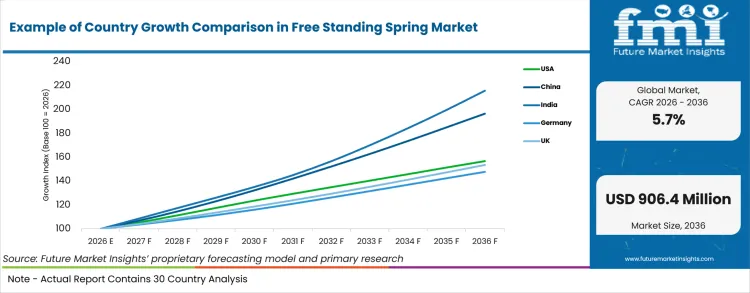
| Country | CAGR |
|---|---|
| United States | 4.58% |
| China | 6.98% |
| India | 7.98% |
| Germany | 3.98% |
| United Kingdom | 4.38% |
| Japan | 3.78% |
| South Korea | 5.18% |
| Rest of World | 6.38% |
Source: FMI's proprietary forecasting model and primary research
How do country-level CAGRs compare in the free standing spring market?
Country-level expansion is expected to split between high-volume assembly economies and proof-heavy industrial bases. India and China are projected to gain at a higher pace because local machinery and vehicle programs need shorter loops between trial parts and plant feedback. The United States, Germany and Japan are estimated to expand more steadily because approved spring families stay inside longer qualification files. South Korea is anticipated to bridge those models due to compact automotive groups and quick engineering feedback. World Steel Association reported crude steel production of 157.9 million tonnes in May 2026, so wire-cost checks remain visible. Rest of World demand is forecast to lean on local distributor coverage and aftermarket ordering routes where OEM service remains thin.
- USA spring sourcing often starts with price and compliance files before engineers touch the sample bin. The United States is projected to grow at 4.58% CAGR by 2036 due to steady replacement needs in machinery and vehicle parts. Federal Reserve reported that durable goods production rose 0.8% in May 2026. The gain keeps Lee Spring, Century Spring and MW Components close to factories that need catalog parts and quick custom turns. Procurement teams still ask for domestic certificates, drawing revision control and stock proof before adding a spring maker.
- China's spring demand is shaped by scale because one approved spring often moves across a broad vehicle or machinery program. Free standing spring demand in China is forecast to rise at 6.98% CAGR over the forecast period due to local assembly depth. In January 2026, the State Council Information Office reported auto output of 34.531 million units in 2025. The output keeps local spring shops tied to SAIC, BYD and broader tier networks that need quick tooling feedback. Procurement teams are expected to press for price discipline and local stock.
- India's spring orders often show up during final fit changes on machinery or vehicle lines. The India outlook is anticipated to advance at 7.98% CAGR over the assessment period due to localized assembly and tighter vendor records. In February 2026, Press Information Bureau reported passenger vehicle production of 5.38 million units during January to December 2025. The volume gives Lee Spring India and IIS a larger base for plant-level service. Cost remains a hard gate for direct OEM conversions. Pune and Chennai accounts also ask for nearby inspection when drawings change near launch. Suppliers are expected to recieve repeat orders when inspection support reaches Pune, Mumbai and Chennai accounts without long response gaps.
- German accounts often treat a spring change as a documentation event before it becomes a parts order. In May 2026, Destatis reported manufacturing new orders rose 5.0% in March 2026 after seasonal and calendar adjustment. The Germany free standing spring sector is projected to record 3.98% CAGR during the assessment period due to detailed approval routines. Mubea and Lesjofors are expected to compete on engineering support. Baden-Wuerttemberg and Bavaria accounts usually ask for fatigue records before alternative parts enter trial batches and vehicle platforms move into formal release.
- The United Kingdom spring channel is export-aware because many vehicle programs still depend on overseas shipment routes. In June 2026, SMMT reported more than 717,000 cars built in the United Kingdom in 2025. United Kingdom sales are forecast to expand at 4.38% CAGR by 2036 influenced by service accountability and export-linked automotive builds. Lee Spring UK and industrial distributors are expected to hold attention where short delivery and certificates arrive together. Midlands engineering accounts also ask for quick spring swaps when vehicle or equipment builds change near release. Channel dependability is expected to decide more orders than catalog range alone.
- Japan's spring reviews are usually quiet but exacting because platform teams keep approved parts for long periods. JAMA reported 2024 motor vehicle production at 8.23 million units in its September 2025 industry report. Adoption of free standing springs in Japan is estimated to expand at 3.78% CAGR through 2036 because quality screens remain tight. The production base supports NHK Spring and local tier groups that tie springs to seats, suspensions and precision equipment. Procurement teams are expected to favor steady suppliers that document load behavior across repeat orders.
- South Korea's spring demand runs through compact automotive groups that move feedback quickly between design and purchasing. In April 2026, MOTIR reported March 2026 automobile exports of USD 6.4 billion. In South Korea, free standing spring demand is anticipated to advance at 5.18% CAGR through 2036 because local automotive programs keep rapid supplier loops. Hyundai, Kia and nearby component makers are expected to keep stable spring supply close to export programs. Local tooling houses are also expected to support spring changes when seat or closure designs move between trial rounds. Vendors are expected to compete on response speed and precise drawings.
Who are the notable companies in the free standing spring market?
Lee Spring, Century Spring, Associated Spring Raymond, MW Components, Mubea, Lesjofors, NHK Spring, and Stabilus are the notable companies shaping this market.
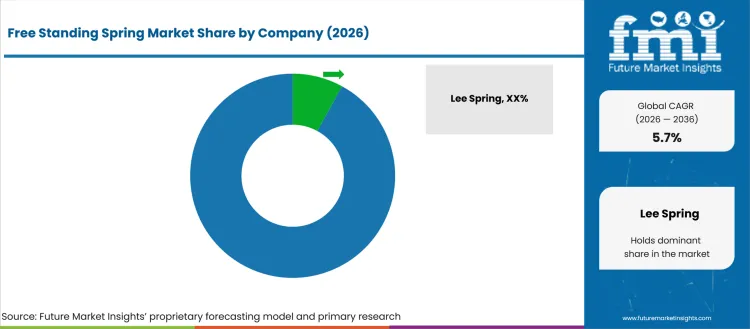
The competitive field is expected to remain split between catalog spring suppliers and engineered component groups. Stock-focused vendors compete on range, delivery speed and drawing support. Automotive spring groups compete on platform history and materials knowledge. Motion-control providers add value when gas springs or dampers sit beside metal springs in the same customer review. FMI's automated handling systems research provides a useful adjacent lens because those users also rank repeatability and field support during component selection.
- Catalog suppliers are expected to defend routine orders through selection depth and fast quoting. Lee Spring and Century Spring belong together because both support engineers who need compression, extension and torsion options before a custom drawing is final. Their advantage is clearer when a plant needs stock parts without losing basic load documentation.
- Custom programs are projected to bring Associated Spring Raymond and MW Components into earlier engineering reviews. Associated Spring Raymond offers catalog and engineered spring designs, while MW Components supports precision spring work across multiple production sites. The shared fit is build-to-print work where drawings and service response decide repeat orders.
- Automotive programs are anticipated to keep Mubea and NHK Spring close to platform-level discussions. Mubea brings coil spring systems and weight-reduction work, while NHK Spring remains tied to vehicle spring and seating systems. These accounts often ask for fatigue evidence before price comparison moves far.
- Service reach is expected to help Lesjofors and Stabilus when customers compare regional support. Lesjofors brings spring catalog depth across Europe and Asia, while Stabilus combines spring-related motion products with automation brands. The same route helps account for the order springs through performance part replacement channels after launch.
Competitive Benchmarking: Free Standing Spring Market
| Company | Catalog Spring Fit | Custom Engineering | Automotive Fit | Service Reach |
|---|---|---|---|---|
| Lee Spring | High | High | Medium | Global |
| Century Spring | High | Medium | Medium | Regional; North America |
| Associated Spring Raymond | High | High | Medium | Global |
| MW Components | High | High | Medium | Country-specific |
| Mubea | Medium | High | High | Global |
| Lesjofors | High | High | High | Global |
| NHK Spring | Medium | High | High | Global |
| Stabilus | Medium | High | High | Global |
Source: Future Market Insights competitive analysis, 2026. Ratings reflect relative portfolio relevance and workflow fit. Service capability and geographic reach shape the remaining comparison.
Key Developments in the Free Standing Spring Market
- In February 2026, Lee Spring acquired Thomas Spring, a Connecticut-based precision spring manufacturer. The company said Thomas Spring was established in 1961 and was known for flat spring engineering across multiple industries. The acquisition is expected to broaden Lee Spring's custom spring work because Thomas Spring employees and operations stay based in Connecticut while Lee Spring adds deeper support for prototype and repeat production orders.
- In February 2025, Lesjofors signed an agreement to acquire International Industrial Springs in India. The target operated six production plants across the Mumbai region and added disc springs and washers. General springs and hot coiling capability gave Lesjofors a wider Indian production base.
- In November 2025, NHK Spring decided to invest in India to expand its motor core business. The company said it planned to renovate NHK Automotive Components India in Chhatrapati Sambhajinagar with an initial investment.
- In September 2025, Stabilus introduced the Stabilus4Automation portfolio for industrial automation users. The portfolio combines Stabilus and ACE with Destaco, Fabreeka and Hahn Gasfedern around gripping and positioning tasks.
Key Players in the Free Standing Spring Market
Catalog and Custom Spring Suppliers
- Lee Spring
- Century Spring
- Associated Spring Raymond
- MW Components
Automotive Spring and Component Groups
- Mubea
- Lesjofors
- NHK Spring
Motion-Control Suppliers
- Stabilus
Free Standing Spring Market - Report Scope
| Coverage field | Report scope |
|---|---|
| Market breakdown | Free Standing Spring Market breakdown by spring type, material, application, manufacturing method, sales channel, and region |
| Quantitative Units | Revenue in USD Million, CAGR in %, and share in % |
| Market Definition | Commercial demand for stand-alone mechanical springs used to store and return force in machinery, automotive components, furniture, aerospace and medical assemblies. |
| Regions Covered | North America, Latin America, Europe, East Asia, South Asia Pacific, Middle East and Africa |
| Countries Covered | United States, United Kingdom, Germany, France, Japan, China, South Korea, India, and 30+ countries |
| Key Companies Profiled | Lee Spring, Century Spring, Associated Spring Raymond, MW Components, Mubea, Lesjofors, NHK Spring, and Stabilus |
| Forecast Period | 2026 to 2036 |
| Approach | Hybrid bottom-up and top-down methodology using country demand, segment share checks, company evidence and primary interviews with OEM engineers. |
Source: Future Market Insights - analysis driven by proprietary forecasting models and primary research
Free Standing Spring Market - Research Methodology
| Method | Approach |
|---|---|
| Primary Research | FMI analysts discussed spring use with OEM engineers, plant procurement teams, custom spring shops and industrial distributors. Interviews tested how drawing control, free length, load-at-height proof and stocking support affect adoption. The primary checks also reviewed direct OEM ordering, distributor support and switching hurdles across automotive, machinery and furniture applications. |
| Desk Research | Desk research used official price, manufacturing and vehicle production sources from BLS/FRED, Census, Federal Reserve, PIB, VDA, SMMT, JAMA, MOTIR and ACEA. Company sources from Lee Spring, Lesjofors, NHK Spring, Stabilus, MW Components, Mubea, Century Spring and ASRaymond were used to validate activities and relevance. |
| Market Sizing and Forecasting | Market sizing used a hybrid methodology that combined the 2026 value base with segment shares, country CAGRs and 2036 revenue checks. The model reconciled direct OEM, cold coiled, compression spring, carbon steel and automotive application assumptions against supplier interviews. Forecast values were reviewed against the CAGR for internal consistency. |
| Data Validation | Data validation compared external statistics with the market mechanism they supported. Country evidence was checked against local automotive or manufacturing conditions before use. Segment logic was reviewed against spring type, material, application, manufacturing method and sales channel scope. Company relevance was cross-checked using official sources and active product portfolios. |
Source: Future Market Insights (FMI) analysis, based on proprietary forecasting model and primary research
Free Standing Spring Market by Segments
Free Standing Spring Market segmented by Spring Type:
- Compression Springs
- Extension Springs
- Torsion Springs
- Custom Free-Standing Springs
Free Standing Spring Market segmented by Material:
- Carbon Steel
- Stainless Steel
- Alloy Steel
- Non-Ferrous / Specialty
Free Standing Spring Market segmented by Application:
- Machinery
- Automotive Components
- Furniture / Consumer
- Aerospace / Medical
Free Standing Spring Market segmented by Manufacturing Method:
- Cold Coiled
- Hot Coiled
- Precision CNC Coiled
Free Standing Spring Market segmented by Sales Channel:
- Direct OEM
- Industrial Distributors
- Custom Spring Shops
Free Standing Spring Market by Region:
- North America
- United States
- Canada
- Latin America
- Brazil
- Mexico
- Argentina
- Europe
- Germany
- United Kingdom
- France
- Italy
- Spain
- East Asia
- China
- Japan
- South Korea
- South Asia Pacific
- India
- ASEAN
- Australia and New Zealand
- Middle East and Africa
- GCC Countries
- South Africa
- Türkiye
Research Sources and Bibliography
- USA Bureau of Labor Statistics. (2026, June). Producer Price Index by Industry: Spring Manufacturing. USA Bureau of Labor Statistics.
- USA Bureau of Labor Statistics. (2026, June). Producer Price Index by Industry: Spring and Wire Product Manufacturing. USA Bureau of Labor Statistics.
- USA Bureau of Labor Statistics. (2026, June). Producer Price Indexes - May 2026. USA Bureau of Labor Statistics.
- USA Census Bureau. (2026, June). Monthly Advance Report on Durable Goods Manufacturers' Shipments Inventories and Orders. USA Census Bureau.
- Board of Governors of the Federal Reserve System. (2026, June). Industrial Production and Capacity Utilization. Federal Reserve.
- International Organization of Motor Vehicle Manufacturers. (2026, April). Auto industry growth shifted east in 2025 amid global repositioning. International Organization of Motor Vehicle Manufacturers.
- State Council Information Office of the People's Republic of China. (2026, January). China's auto output, sales reach new highs in 2025. State Council Information Office.
- Press Information Bureau. (2026, February). Status of Heavy Industries Sector. Ministry of Heavy Industries.
- Statistisches Bundesamt. (2026, May). New orders in manufacturing in March 2026: +5.0% on the previous month. Destatis.
- Verband der Automobilindustrie. (2025, August). Production and Market in July 2025. Verband der Automobilindustrie.
- Society of Motor Manufacturers and Traders. (2026, June). UK Car Manufacturing and Production Data. Society of Motor Manufacturers and Traders.
- Japan Automobile Manufacturers Association. (2025, September). The Motor Industry of Japan 2025. Japan Automobile Manufacturers Association.
- Ministry of Trade, Industry and Resources. (2026, April). March 2026 Automobile Exports Reach $6.4 Billion. Ministry of Trade, Industry and Resources.
- European Automobile Manufacturers Association. (2026, April). Economic and Market Report: Global and EU auto industry, full-year 2025. European Automobile Manufacturers Association.
- United Nations Industrial Development Organization. (2026, March). World Manufacturing Production and Trade - Quarterly Report Q4 2025. United Nations Industrial Development Organization.
- World Steel Association. (2026, June). May 2026 crude steel production. World Steel Association.
- Lee Spring. (2026, February). Lee Spring Continues Strategic Expansion with Thomas Spring Acquisition. Lee Spring.
- Lee Spring. (2025, December). Lee Spring India Achieves AS9100D Certification, Reinforcing Commitment to Quality Excellence Across Industries. Lee Spring.
- Lesjofors. (2025, February). Acquisition of International Industrial Springs in India. Lesjofors.
- NHK Spring. (2025, November). NHK SPRING Decides to Invest in India to Expand Its Motor Core Business. NHK Spring.
- Stabilus Group. (2025, September). Stabilus4Automation changes the game in industrial automation with integrated solutions. Stabilus Group.
- Century Spring. (2026, July). Century Spring Catalog. Century Spring.
- Associated Spring Raymond. (2026, July). ASRaymond Smart Solutions. Built to Perform. Associated Spring Raymond.
- MW Components. (2026, July). Precision Components, Springs and Fasteners. MW Components.
- Mubea. (2026, July). Coil Spring Systems. Mubea.
This bibliography is provided for reader reference and uses primary official sources, including government bodies and company pages.
This Report Answers
- What value is forecast for the Free Standing Spring Market in 2026 and by 2036?
- What CAGR is forecast for the Free Standing Spring Market from 2026 to 2036?
- Which spring type and material segments shape demand alongside application, manufacturing method and sales channel segments?
- Which OEM drawing, cost, and service pressures support adoption or purchase activity?
- How do country CAGRs differ across the profiled markets?
- Which companies compete across catalog reach and custom engineering alongside automotive fit and service reach?
- How does FMI validate forecasts using hybrid bottom-up and top-down methodology?
- What factors should OEM engineers address before broader account expansion or sourcing commitment?
- How do test records, drawing control, and certification needs affect vendor selection?
Frequently Asked Questions
What is driving growth in the Free Standing Spring Market?
Growth is expected to be driven by OEM drawing control and replacement demand in machinery and vehicle components. Localized engineering support and direct sourcing relationships are also helping increase adoption.
Who are the key players in the Free Standing Spring Market?
Key players include Lee Spring, Century Spring, Associated Spring Raymond, MW Components, Mubea, Lesjofors, NHK Spring, and Stabilus. These companies compete through catalog depth, engineering expertise, automotive program participation, and service reach.
What is a significant restraint in the Free Standing Spring Market?
A significant restraint is the lengthy qualification process required before spring suppliers can be approved. Market adoption can slow when load validation requirements and drawing revisions increase sourcing complexity.
Why should executives track the Free Standing Spring Market?
Executives should track the market because OEMs are increasingly demanding precision-engineered springs that support reliability in automotive and industrial applications. Growth is being supported by rising machinery production and continued vehicle manufacturing activity across major markets.
What business problem does the Free Standing Spring Market address?
The market addresses the need for reliable force control and motion management components in mechanical assemblies. Free standing springs help manufacturers maintain performance consistency while reducing the risk of equipment failure and assembly issues.
What should procurement leaders evaluate before selecting suppliers?
Procurement leaders should evaluate load consistency, material quality, and manufacturing precision. They should also assess drawing control, certification support, and supplier responsiveness for custom requirements.
What can limit return on investment for buyers?
Return on investment can be limited by poor spring performance and inconsistent quality across production batches. Lengthy qualification processes and weak technical documentation can also increase sourcing costs and delays.
How can suppliers build executive confidence?
Suppliers can build confidence by providing validated load-testing data and comprehensive quality records. Strong engineering support and dependable delivery performance can further strengthen long-term customer relationships.
Preview the report firsthand - request a free sample
Get SampleGet the brochure for pricing and purchase details.
Get PDFTable of Content
- Key Takeaways
- Market Size and CAGR
- Top Growth Driver
- Fastest Growing Segment
- Leading Region
- Key Companies
- Emerging Opportunities
- Executive Summary
- Global Market Outlook
- Demand-side Trends
- Supply-side Trends
- Technology Roadmap Analysis
- Analysis and Recommendations
- Analyst Perspective (What is happening? Why now? What should investors know?)
- Key Questions Answered
- How large is the market?
- What is the CAGR?
- What are key trends?
- Which region dominates?
- Who are the leaders?
- Market Overview
- Market Coverage / Taxonomy
- Market Definition / Scope / Limitations
- Research Methodology
- Chapter Orientation
- Analytical Lens and Working Hypotheses
- Market Structure, Signals, and Trend Drivers
- Benchmarking and Cross-market Comparability
- Market Sizing, Forecasting, and Opportunity Mapping
- Research Design and Evidence Framework
- Desk Research Programme (Secondary Evidence)
- Expert Input and Fieldwork (Primary Evidence)
- Tooling, Models, and Reference Databases
- Data Engineering and Model Build
- Quality Assurance and Audit Trail
- Market Background
- Market Dynamics (Drivers, Restraints, Opportunity, Trends)
- Scenario Forecast (Optimistic, Likely, Conservative)
- Impact Analysis
- AI Impact
- Sustainability Impact
- Regulatory Impact
- Technology Impact
- Consumer / Buyer Analysis
- Purchase Drivers
- Adoption Barriers
- Buyer Journey
- Opportunity Map Analysis
- Product Life Cycle Analysis
- Supply Chain Analysis
- Investment Feasibility Matrix
- Value Chain Analysis
- PESTLE and Porter's Analysis
- Regulatory Landscape
- Regional Parent Market Outlook
- Production and Consumption Statistics
- Import and Export Statistics
- Global Market Analysis and Forecast, 2021 to 2036
- Historical Market Size Value (USD Million) Analysis, 2021 to 2025
- Current and Future Market Size Value (USD Million) Projections, 2026 to 2036
- Y-o-Y Growth Trend Analysis
- Absolute $ Opportunity Analysis
- Global Market Pricing Analysis, 2021 to 2036
- Global Market Analysis and Forecast, By Spring Type, 2021 to 2036
- Introduction / Key Findings
- Historical Market Size Value (USD Million) Analysis By Spring Type, 2021 to 2025
- Current and Future Market Size Value (USD Million) Analysis and Forecast By Spring Type, 2026 to 2036
- Compression Springs
- Extension Springs
- Torsion Springs
- Custom Free-Standing Springs
- Compression Springs
- Y-o-Y Growth Trend Analysis By Spring Type, 2021 to 2025
- Absolute $ Opportunity Analysis By Spring Type, 2026 to 2036
- Global Market Analysis and Forecast, By Material, 2021 to 2036
- Introduction / Key Findings
- Historical Market Size Value (USD Million) Analysis By Material, 2021 to 2025
- Current and Future Market Size Value (USD Million) Analysis and Forecast By Material, 2026 to 2036
- Carbon Steel
- Stainless Steel
- Alloy Steel
- Non-Ferrous / Specialty
- Carbon Steel
- Y-o-Y Growth Trend Analysis By Material, 2021 to 2025
- Absolute $ Opportunity Analysis By Material, 2026 to 2036
- Global Market Analysis and Forecast, By Application, 2021 to 2036
- Introduction / Key Findings
- Historical Market Size Value (USD Million) Analysis By Application, 2021 to 2025
- Current and Future Market Size Value (USD Million) Analysis and Forecast By Application, 2026 to 2036
- Automotive Components
- Machinery
- Furniture / Consumer
- Aerospace / Medical
- Automotive Components
- Y-o-Y Growth Trend Analysis By Application, 2021 to 2025
- Absolute $ Opportunity Analysis By Application, 2026 to 2036
- Global Market Analysis and Forecast, By Manufacturing Method, 2021 to 2036
- Introduction / Key Findings
- Historical Market Size Value (USD Million) Analysis By Manufacturing Method, 2021 to 2025
- Current and Future Market Size Value (USD Million) Analysis and Forecast By Manufacturing Method, 2026 to 2036
- Cold Coiled
- Hot Coiled
- Precision CNC Coiled
- Cold Coiled
- Y-o-Y Growth Trend Analysis By Manufacturing Method, 2021 to 2025
- Absolute $ Opportunity Analysis By Manufacturing Method, 2026 to 2036
- Global Market Analysis and Forecast, By Sales Channel, 2021 to 2036
- Introduction / Key Findings
- Historical Market Size Value (USD Million) Analysis By Sales Channel, 2021 to 2025
- Current and Future Market Size Value (USD Million) Analysis and Forecast By Sales Channel, 2026 to 2036
- Direct OEM
- Industrial Distributors
- Custom Spring Shops
- Direct OEM
- Y-o-Y Growth Trend Analysis By Sales Channel, 2021 to 2025
- Absolute $ Opportunity Analysis By Sales Channel, 2026 to 2036
- Global Market Analysis and Forecast, By Region, 2021 to 2036
- Introduction
- Historical Market Size Value (USD Million) Analysis By Region, 2021 to 2025
- Current Market Size Value (USD Million) Analysis and Forecast By Region, 2026 to 2036
- North America
- Latin America
- Western Europe
- Eastern Europe
- East Asia
- South Asia and Pacific
- Middle East & Africa
- Market Attractiveness Analysis By Region
- North America Market Analysis and Forecast, By Country, 2021 to 2036
- Historical Market Size Value (USD Million) Trend Analysis By Market Taxonomy, 2021 to 2025
- Market Size Value (USD Million) Forecast By Market Taxonomy, 2026 to 2036
- By Country
- USA
- Canada
- By Spring Type
- By Material
- By Application
- By Manufacturing Method
- By Sales Channel
- By Country
- Market Attractiveness Analysis
- By Country
- By Spring Type
- By Material
- By Application
- By Manufacturing Method
- By Sales Channel
- Key Takeaways
- Latin America Market Analysis and Forecast, By Country
- Historical Market Size Value (USD Million) Trend Analysis By Market Taxonomy, 2021 to 2025
- Market Size Value (USD Million) Forecast By Market Taxonomy, 2026 to 2036
- By Country
- Brazil
- Mexico
- Chile
- Rest of Latin America
- By Spring Type
- By Material
- By Application
- By Manufacturing Method
- By Sales Channel
- By Country
- Market Attractiveness Analysis
- By Country
- By Spring Type
- By Material
- By Application
- By Manufacturing Method
- By Sales Channel
- Key Takeaways
- Western Europe Market Analysis and Forecast, By Country
- Historical Market Size Value (USD Million) Trend Analysis By Market Taxonomy, 2021 to 2025
- Market Size Value (USD Million) Forecast By Market Taxonomy, 2026 to 2036
- By Country
- Germany
- UK
- Italy
- Spain
- France
- Nordic
- BENELUX
- Rest of Western Europe
- By Spring Type
- By Material
- By Application
- By Manufacturing Method
- By Sales Channel
- By Country
- Market Attractiveness Analysis
- By Country
- By Spring Type
- By Material
- By Application
- By Manufacturing Method
- By Sales Channel
- Key Takeaways
- Eastern Europe Market Analysis and Forecast, By Country
- Historical Market Size Value (USD Million) Trend Analysis By Market Taxonomy, 2021 to 2025
- Market Size Value (USD Million) Forecast By Market Taxonomy, 2026 to 2036
- By Country
- Russia
- Poland
- Hungary
- Balkan & Baltic
- Rest of Eastern Europe
- By Spring Type
- By Material
- By Application
- By Manufacturing Method
- By Sales Channel
- By Country
- Market Attractiveness Analysis
- By Country
- By Spring Type
- By Material
- By Application
- By Manufacturing Method
- By Sales Channel
- Key Takeaways
- East Asia Market Analysis and Forecast, By Country
- Historical Market Size Value (USD Million) Trend Analysis By Market Taxonomy, 2021 to 2025
- Market Size Value (USD Million) Forecast By Market Taxonomy, 2026 to 2036
- By Country
- China
- Japan
- South Korea
- By Spring Type
- By Material
- By Application
- By Manufacturing Method
- By Sales Channel
- By Country
- Market Attractiveness Analysis
- By Country
- By Spring Type
- By Material
- By Application
- By Manufacturing Method
- By Sales Channel
- Key Takeaways
- South Asia and Pacific Market Analysis and Forecast, By Country
- Historical Market Size Value (USD Million) Trend Analysis By Market Taxonomy, 2021 to 2025
- Market Size Value (USD Million) Forecast By Market Taxonomy, 2026 to 2036
- By Country
- India
- ASEAN
- Australia & New Zealand
- Rest of South Asia and Pacific
- By Spring Type
- By Material
- By Application
- By Manufacturing Method
- By Sales Channel
- By Country
- Market Attractiveness Analysis
- By Country
- By Spring Type
- By Material
- By Application
- By Manufacturing Method
- By Sales Channel
- Key Takeaways
- Middle East & Africa Market Analysis and Forecast, By Country
- Historical Market Size Value (USD Million) Trend Analysis By Market Taxonomy, 2021 to 2025
- Market Size Value (USD Million) Forecast By Market Taxonomy, 2026 to 2036
- By Country
- Kingdom of Saudi Arabia
- Other GCC Countries
- Türkiye
- South Africa
- Other African Union
- Rest of Middle East & Africa
- By Spring Type
- By Material
- By Application
- By Manufacturing Method
- By Sales Channel
- By Country
- Market Attractiveness Analysis
- By Country
- By Spring Type
- By Material
- By Application
- By Manufacturing Method
- By Sales Channel
- Key Takeaways
- Key Countries Market Analysis
- USA
- Pricing Analysis
- Market Share Analysis, 2025
- By Spring Type
- By Material
- By Application
- By Manufacturing Method
- By Sales Channel
- Canada
- Pricing Analysis
- Market Share Analysis, 2025
- By Spring Type
- By Material
- By Application
- By Manufacturing Method
- By Sales Channel
- Mexico
- Pricing Analysis
- Market Share Analysis, 2025
- By Spring Type
- By Material
- By Application
- By Manufacturing Method
- By Sales Channel
- Brazil
- Pricing Analysis
- Market Share Analysis, 2025
- By Spring Type
- By Material
- By Application
- By Manufacturing Method
- By Sales Channel
- Chile
- Pricing Analysis
- Market Share Analysis, 2025
- By Spring Type
- By Material
- By Application
- By Manufacturing Method
- By Sales Channel
- Germany
- Pricing Analysis
- Market Share Analysis, 2025
- By Spring Type
- By Material
- By Application
- By Manufacturing Method
- By Sales Channel
- UK
- Pricing Analysis
- Market Share Analysis, 2025
- By Spring Type
- By Material
- By Application
- By Manufacturing Method
- By Sales Channel
- Italy
- Pricing Analysis
- Market Share Analysis, 2025
- By Spring Type
- By Material
- By Application
- By Manufacturing Method
- By Sales Channel
- Spain
- Pricing Analysis
- Market Share Analysis, 2025
- By Spring Type
- By Material
- By Application
- By Manufacturing Method
- By Sales Channel
- France
- Pricing Analysis
- Market Share Analysis, 2025
- By Spring Type
- By Material
- By Application
- By Manufacturing Method
- By Sales Channel
- India
- Pricing Analysis
- Market Share Analysis, 2025
- By Spring Type
- By Material
- By Application
- By Manufacturing Method
- By Sales Channel
- ASEAN
- Pricing Analysis
- Market Share Analysis, 2025
- By Spring Type
- By Material
- By Application
- By Manufacturing Method
- By Sales Channel
- Australia & New Zealand
- Pricing Analysis
- Market Share Analysis, 2025
- By Spring Type
- By Material
- By Application
- By Manufacturing Method
- By Sales Channel
- China
- Pricing Analysis
- Market Share Analysis, 2025
- By Spring Type
- By Material
- By Application
- By Manufacturing Method
- By Sales Channel
- Japan
- Pricing Analysis
- Market Share Analysis, 2025
- By Spring Type
- By Material
- By Application
- By Manufacturing Method
- By Sales Channel
- South Korea
- Pricing Analysis
- Market Share Analysis, 2025
- By Spring Type
- By Material
- By Application
- By Manufacturing Method
- By Sales Channel
- Russia
- Pricing Analysis
- Market Share Analysis, 2025
- By Spring Type
- By Material
- By Application
- By Manufacturing Method
- By Sales Channel
- Poland
- Pricing Analysis
- Market Share Analysis, 2025
- By Spring Type
- By Material
- By Application
- By Manufacturing Method
- By Sales Channel
- Hungary
- Pricing Analysis
- Market Share Analysis, 2025
- By Spring Type
- By Material
- By Application
- By Manufacturing Method
- By Sales Channel
- Kingdom of Saudi Arabia
- Pricing Analysis
- Market Share Analysis, 2025
- By Spring Type
- By Material
- By Application
- By Manufacturing Method
- By Sales Channel
- Türkiye
- Pricing Analysis
- Market Share Analysis, 2025
- By Spring Type
- By Material
- By Application
- By Manufacturing Method
- By Sales Channel
- South Africa
- Pricing Analysis
- Market Share Analysis, 2025
- By Spring Type
- By Material
- By Application
- By Manufacturing Method
- By Sales Channel
- USA
- Market Structure Analysis
- Competition Dashboard
- Competition Benchmarking
- Market Share Analysis of Top Players
- By Regional
- By Spring Type
- By Material
- By Application
- By Manufacturing Method
- By Sales Channel
- Emerging Startups
- Innovation Benchmarking
- Competition Analysis
- Competition Deep Dive
- Lee Spring
- Overview
- Product Portfolio
- Profitability by Market Segments
- Sales Footprint
- Strategy Overview
- Marketing Strategy
- Product Strategy
- Channel Strategy
- Century Spring
- Associated Spring Raymond
- MW Components
- Mubea
- Lesjofors
- NHK Spring
- Stabilus
- Lee Spring
- Case Studies
- Success Stories
- Recent Developments
- Competition Deep Dive
- Assumptions & Acronyms Used


