

- Market Size (2026)
- USD 2.5 Bn
- Forecast (2036)
- USD 4.8 Bn
- CAGR (2026 to 2036)
- 6.8%
How big is Fiber Patch Panels Market in 2026?
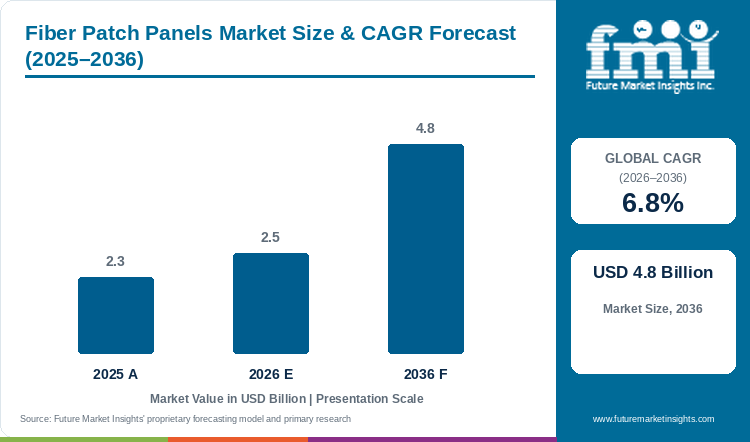
Demand for fiber patch panels is projected to expand at 6.8% CAGR between 2026 and 2036. Industry value is likely to grow from USD 2.3 billion in 2025 to USD 2.5 billion in 2026 and is projected to reach USD 4.8 billion by 2036.
Spending on fiber patch panels reached USD 2.3 Billion in 2025 and is estimated at USD 2.5 Billion in 2026, as per FMI. Revenue is projected to reach USD 4.8 Billion by 2036 at a 6.8% CAGR, opening USD 2.3 Billion of new sales for optical-connectivity suppliers. The Ethernet Alliance’s March 2026 demonstration program spans 400G, 800G and 1.6T Ethernet, highlighting the faster links that panels must organize within limited rack space [1].
As the data center market adds optical connections, technicians need to reach one link without disturbing the fibers beside it. Port density therefore has value only when installation and servicing remain manageable. Modular housings and pre-terminated assemblies can shorten repeat work across a campus, while broadband activation creates a separate stream of cabinet and distribution-point demand. Suppliers will win repeat orders by making expansion predictable for the installer.
Analysts at FMI see installation time as a stronger purchasing argument than port count alone. CommScope introduced Rapid Fiber Connect at NVIDIA GTC in March 2026, while Panduit announced a Gen 7 SN connectivity solution in January 2026 [2] [3]. These developments put the panel inside a wider optical system. Manufacturers that supply compatible assemblies and clear migration paths can retain the customer as networks move to the next speed.
Key Takeaways
- More fiber connections inside AI data center racks and broadband networks will increase the need for patch panels that keep cables organized and easy to manage.
- Rack-mount panels are projected to account for 31.0% of panel type demand in 2026. They fit standard 19-inch racks and give technicians easier access to fiber connections during installation and maintenance.
- Single-mode is estimated to hold 58.0% of fiber mode demand in 2026. It is widely used for backbone and interconnect links where longer distances and lower signal loss matter.
- The 24-48 port range is expected to lead port count with a 34.0% share in 2026. It gives operators useful capacity without making the panel too crowded to work on.
- High-density panels can be harder to service. Cleaning connectors, checking polarity and testing optical loss can take more time when many connections are packed into a small space.
- The profiled companies include CommScope, Corning, Panduit, Legrand, Belden, AFL, Siemon, FS.com, R&M and Hubbell Premise Wiring.
Analyst Perspective
“Fiber patch panels will remain important as operators add more connections while still needing easy access, faster installation and reliable optical performance.”
- Sudip Saha, Principal Consultant, FMI.
How is the fiber patch panels market segmented?
Fiber patch panels market is segmented by five primary commercial axes and region: panel type, fiber mode, port count, end use, sales channel, and region.
- By panel type: Rack-mount Panels, Wall-mount Panels, High-density Panels, Modular Patch Panels, and Pre-terminated Panels.
- By fiber mode: Single-mode, Multimode, and Hybrid Fiber Panels.
- By port count: 24-48 Ports, Below 24 Ports, 48-96 Ports, and Above 96 Ports.
- By end use: Data Centers, Telecom Networks, Enterprise Buildings, Industrial Networks, and FTTx / Broadband.
- By sales channel: Network Equipment Distributors, Data Center Integrators, Telecom Contractors, and E-commerce / Catalog.
- By region: North America, Latin America, Western Europe, Eastern Europe, East Asia, South Asia and Pacific, and Middle East and Africa.
Why does Rack-mount lead the Panel Type category?
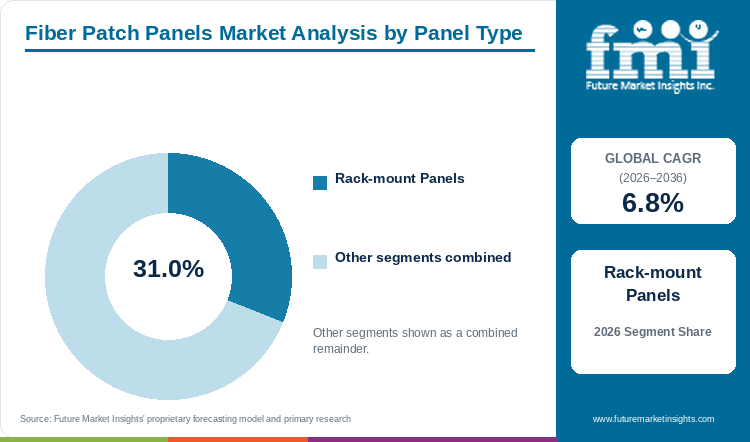
Based on panel type, rack-mount panels are projected to account for 31.0% in 2026.
Most data centers and telecom rooms already use standard 19-inch racks for switches and other network equipment. Rack-mount patch panels fit directly into this setup and keep fiber connections in the same cabinet as the equipment they serve. They are also easier to access when technicians need to add a connection, replace a patch cord or inspect a connector. This makes rack-mount designs practical for both new installations and upgrades to existing racks.
- Rack-mount panels are projected to account for 31.0% of panel type demand in 2026.
- They also keep fiber connections accessible when technicians need to make changes or carry out maintenance.
What supports Single-mode as a preferred Fiber Mode choice?
By fiber mode, single-mode is estimated to hold 58.0% in 2026 because it is widely used for longer network links.
Single-mode fiber optic cables are commonly used where data has to travel over longer distances with low optical loss. This includes telecom networks, building backbones and links between data center equipment. Using single-mode across these connections also allows operators to keep a common fiber type as networks expand. Patch panels designed for single-mode fiber therefore serve a large part of the backbone and interconnect infrastructure.
- Single-mode represents 58.0% of fiber mode demand in 2026 owing to their use in longer network links.
- Its use across telecom backbones and data center interconnects creates steady demand for compatible patch panels.
How does 24-48 ports meet changing needs in the Port Count category?
In 2026, 24-48 ports are expected to lead port count with 34.0% share because this range offers enough capacity for many installations without making the panel difficult to handle.
Very small panels can run out of capacity quickly. Very dense panels can make labeling, cleaning and cable changes more difficult. The 24-48 port range sits between these two extremes and suits many enterprise, telecom and smaller data center installations. It also gives operators some room to add connections as the network grows.
- 24-48 ports are expected to account for 34.0% of port count demand in 2026.
- The range gives operators useful capacity while keeping individual connections reasonably easy to identify and service.
Why are buyers selecting Data Centers for dense optical termination?
By end use, data centers are projected to represent 32.0% in 2026.
Servers and switches inside a data center exchange large amounts of data over optical links. AI systems increase this further because many accelerators need fast connections with each other and with network switches. As the number of links rises, operators need a clear place to terminate and organize the fiber. Patch panels help separate these connections from active equipment and make individual fibers easier to trace when work is required.
- Data centers are projected to account for 32.0% of end use demand in 2026 as the number of fiber connections inside racks continues to increase.
- Patch panels help operators organize these connections so that individual fibers can be identified and serviced without disturbing the entire rack.
Which conditions keep Network Equipment Distributors relevant in the Sales Channel?
Network equipment distributors are set to lead the sales channel with 36.0% share in 2026 because patch-panel installations usually require several compatible parts.
Contractors rarely purchase only a patch panel. An installation can also require cassettes, adapter plates, trunks, patch cords and other accessories that must work together. Distributors make it easier to source these parts from one place and can keep commonly used configurations in local stock. This is particularly useful when contractors are working to a fixed installation schedule and need replacement or additional parts quickly.
- Network equipment distributors account for 36.0% of sales channel demand in 2026 because they can supply several compatible fiber components together.
- Local stock also helps contractors replace missing parts or add equipment without delaying installation.
What are the drivers, restraints and opportunities in the fiber patch panels market?
More fiber inside AI racks and broadband networks increases demand for organized termination. Dense connector fields make testing and maintenance harder. Pre-terminated panels can reduce field work.
- Driver: AI data centers and broadband networks are adding more optical paths. Each new group of links needs termination that technicians can label and reach during network changes.
- Restraint: Dense connector fields leave less room for hands and cleaning tools. Polarity mistakes or contaminated connectors can also push links outside the loss budget.
- Opportunity: Pre-terminated panels move more work into factory assembly. Installers can connect known interfaces on site instead of terminating every fiber in the field.
AI Data Centers Expand Optical Termination Density
AI racks need more optical paths as accelerator clusters scale. The June 2026 LBNL data center update links U.S. electricity use growth to planned IT equipment shipments and more AI hardware.[4] More network ports mean more fibers that must be terminated and labeled inside a fixed rack footprint. Patch panels become more important when operators need to add or change links without disturbing nearby connections.
Dense Connector Fields Make Testing Harder
High-density panels leave less room around each connector. That makes cleaning and polarity checks harder during installation or retrofit. R&M test results published in August 2026 cover insertion loss and return loss for MPO-class fiber optic connectors.[5] A panel may need rework if those checks fail. This adds time to high-density upgrades.
Pre-termination Supports Faster Deployment
Pre-terminated panels shift connector assembly and testing away from the live site. CommScope designed Rapid Fiber Connect platform so it can be configured away from the rack and connected during roll-in.[2] That can reduce field termination work during a tight data center build. Markets with mature fiber coverage are more likely to spend on higher-density upgrades. Areas still extending coverage will continue to need standard rack-mount and distribution hardware.
Which country CAGRs are profiled in the fiber patch panels market?
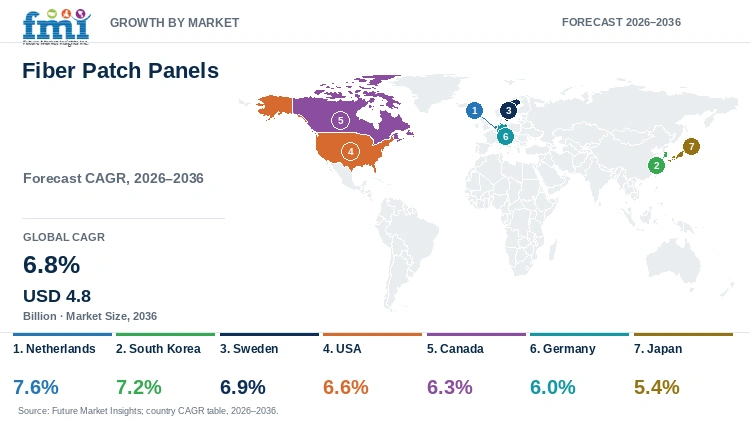
| Country | CAGR |
|---|---|
| Netherlands | 7.6% |
| South Korea | 7.2% |
| Sweden | 6.9% |
| USA | 6.6% |
| Canada | 6.3% |
| Germany | 6.0% |
| Japan | 5.4% |
Country-wise Analysis
- The Netherlands is moving from fiber coverage into active use, with a 7.6% CAGR forecast through 2036, the fastest pace in the profiled group. ACM reported 3.27 million fiber subscriptions in the first quarter of 2025, overtaking cable [6]. More active lines mean additional termination work inside cabinets and distribution points. Suppliers that make fiber to the home connections easy to label, expand and service can capture repeat orders from access-network operators.
- Large AI facilities shape South Korea’s opportunity, where patch-panel revenue is forecast to rise at a 7.2% CAGR through 2036. MSIT’s June 2025 Ulsan announcement described a roughly 100 MW AI data center, with 103 MW planned by February 2029 [7]. Dense optical links across these halls favor panels that combine high port counts with accessible cable routing, giving pre-terminated systems a practical role in phased construction.
- Sweden’s next gains depend heavily on using infrastructure already within reach, supporting a 6.9% CAGR through 2036. PTS’s 2025 survey found that about 98% of households and businesses had fiber or the possibility of a fixed connection supporting at least 1 Gbit/s [8]. Activation and cabinet upgrades will therefore matter alongside new coverage. Patch-panel suppliers can compete through service access and compatibility with installed networks.
- Public broadband deployment and AI campuses give the USA two distinct routes to growth, at a 6.6% CAGR through 2036. NTIA’s May 2026 BEAD dashboard recorded final proposals from all 56 eligible entities and signed award agreements for 50 [9]. Contractors serving repeated sites need dependable delivery and consistent installation methods. Pre-terminated panel packages can reduce field assembly where project schedules and technician availability are tight.
- Canada’s remaining connectivity gaps sustain access-network work, and the market is forecast at a 6.3% CAGR through 2036. In June 2025, CRTC committed more than CAD 17 million to about 330 km of transport fiber serving 18 rural communities [10]. Each rollout needs fiber to be organized and maintained after the initial build. Suppliers pairing suitable enclosures with distributor support can reach contractors working across geographically dispersed communities.
- Copper-to-fiber migration will shape Germany’s orders as well as new network coverage, with a 6.0% CAGR forecast through 2036. Bundesnetzagentur published a regulatory concept for that migration in January 2026 [11]. Moving subscribers requires reliable termination and clear separation of active links during network changes. Panel vendors that support staged cutovers and orderly documentation can reduce the operational burden on access-network teams.
- Japan’s new data-center locations will depend on coordinated electricity and telecom planning, and patch-panel sales are forecast to expand at a 5.4% CAGR through 2036. METI’s 2025 Energy White Paper describes watt-bit coordination as part of that planning [12]. New facilities will need dense fiber termination from their first operating phase. Suppliers with local installation support and modular expansion options can serve those projects as capacity is added.
Who are the notable companies in the fiber patch panels market?
CommScope, Corning and Panduit are among the notable companies in the market. Legrand and Belden also have a strong presence. Other profiled companies include AFL, Siemon, FS.com, R&M and Hubbell Premise Wiring.
The companies approach the market from different parts of fiber infrastructure. CommScope and Corning cover a broad range of optical connectivity products. Panduit and Legrand combine fiber patching with wider structured cabling market offerings used across data centers and enterprise networks.
Belden, AFL, Siemon and R&M have a stronger focus on cabling and network connectivity. Their products are used where fiber needs to be terminated and managed inside data centers or enterprise networks. AFL offers rack-mounted LightLink termination panels while Siemon includes fiber enclosures within its LightVerse range.[13][14]
FS.com serves buyers through a broad direct catalog of networking hardware. Its range includes configurable rack-mount fiber enclosures.[15] Hubbell Premise Wiring is more closely associated with enterprise and premises connectivity. These suppliers compete for projects where standard configurations and easy product availability matter.
Higher fiber counts are pushing suppliers toward denser panel designs and smaller connector formats. Pre-terminated systems are also becoming more common because they reduce the amount of fiber work that has to be completed during installation.
- CommScope, Corning, Panduit and Legrand provide broad fiber connectivity systems.
- Belden, AFL, Siemon and R&M have a stronger focus on cabling and network connectivity.
- FS.com and Hubbell Premise Wiring serve more standardized networking and premises applications.
Competitive Benchmarking: Fiber Patch Panels Market
| Company | Panel Architecture Breadth | High-Density Connectivity | Pre-Terminated Deployment | Geographic Reach |
|---|---|---|---|---|
| CommScope | High | High | High | Global |
| Corning | High | High | High | Global |
| Panduit | High | High | High | Global |
| Legrand | High | High | High | Global |
| Belden | High | High | Medium | Global |
| AFL | High | High | High | North America and international markets |
| Siemon | High | High | High | Global |
| FS.com | High | High | High | Multi-region e-commerce and direct sales |
| R&M | High | High | High | 40+ country market organizations |
| Hubbell Premise Wiring | Medium | High | High | North America-focused |
Scoring basis: Panel Architecture Breadth covers rack and wall formats plus modular and high-density panels. High-Density Connectivity covers LC and MPO solutions as well as smaller-form-factor connectors used in dense fiber fields. Pre-Terminated Deployment covers factory-cabled modules and cassettes plus trunks or preconnectorized systems that reduce field termination. High means wider documented capability. Medium means narrower capability. Low means limited documented capability. These ratings do not indicate product quality or market share.
Key Developments in the Fiber Patch Panels Market
- In March 2026, CommScope launched the globally available Rapid Fiber Connect platform at NVIDIA GTC.[2] The system combines GPU panels and switch panels with high-fiber-count trunk cables for AI data center racks. It is designed for offsite configuration and faster rack turn-up.
- In January 2026, Panduit launched the Gen 7 SN Connectivity Solution for high-density Fibre Channel deployments.[3] The design uses VSFF SN connectors and a jumbo cassette to support dense port groups with one-to-one port replication.
- In June 2026, a Corning agreement with Amazon covered optical fiber and connectivity for expanding U.S. data center infrastructure.[16] The agreement also supports manufacturing expansion in North Carolina.
Key Players in the Fiber Patch Panels Market
Integrated Fiber Infrastructure Platforms
- CommScope
- Corning
- Panduit
- Legrand
Data Center and Network Cabling Specialists
- Belden
- AFL
- Siemon
- R&M
Catalog and Premises Connectivity Providers
- FS.com
- Hubbell Premise Wiring
Fiber Patch Panels Market - Report Scope
| Coverage field | Report scope |
|---|---|
| Market breakdown | Panel Type; Fiber Mode; Port Count; End Use; Sales Channel |
| Quantitative Units | USD Billion |
| Market Definition | Revenue includes fiber patch panel hardware and configured panel assemblies used to terminate, organize, protect, cross-connect and patch optical fibers within the defined segmentation universe. It excludes active network equipment, transceivers, fiber cable or patch cords sold separately, racks or cabinets sold separately, adjacent distribution products and downstream finished-system revenue. |
| Regions Covered | North America; Latin America; Western Europe; Eastern Europe; East Asia; South Asia and Pacific; Middle East and Africa |
| Countries Covered | Netherlands, USA, Japan, South Korea, Germany, Sweden, Canada, and more than twenty-five additional countries in the full report |
| Key Companies Profiled | CommScope; Corning; Panduit; Legrand; Belden; AFL; Siemon; FS.com; R&M; Hubbell Premise Wiring |
| Forecast Period | 2026 to 2036 |
Fiber Patch Panels Market - Research Methodology
| Method | Approach |
|---|---|
| Primary Research | FMI engages fiber connectivity manufacturers and network equipment distributors. Data center integrators and telecom contractors are also consulted with enterprise network practitioners and procurement specialists. Discussions cover product mix and pricing as well as channel behavior. Project timing and replacement demand are also reviewed. |
| Desk Research | FMI reviews national telecom statistics and public broadband programs. Energy and digital infrastructure policy is reviewed with company filings and first-party technical documents. Standards references and dated supplier announcements are used when they explain demand or operating constraints. |
| Market Sizing and Forecasting | Market sizing compares supplier-side revenue information with panel shipment and installation proxies. It also considers end-use infrastructure activity and channel structure. Country deployment indicators help show the direction of demand. Forecasts consider data center buildouts and telecom or FTTx investment. Enterprise replacement cycles and panel density trends are also considered with fiber-mode mix and pre-terminated deployment. |
| Data Validation | Findings are cross-checked across independent source types and reviewed for scope consistency. Active equipment and transceivers are excluded. Standalone fiber cable and patch cords are also excluded. Racks and adjacent distribution categories are excluded with downstream system revenue and duplicate channel resales. |
Fiber Patch Panels Market by Segments
Fiber Patch Panels Market Segmented by Panel Type:
- Rack-mount Panels
- Wall-mount Panels
- High-density Panels
- Modular Patch Panels
- Pre-terminated Panels
Fiber Patch Panels Market Segmented by Fiber Mode:
- Single-mode
- Multimode
- Hybrid Fiber Panels
Fiber Patch Panels Market Segmented by Port Count:
- 24-48 Ports
- Below 24 Ports
- 48-96 Ports
- Above 96 Ports
Fiber Patch Panels Market Segmented by End Use:
- Data Centers
- Telecom Networks
- Enterprise Buildings
- Industrial Networks
- FTTx / Broadband
Fiber Patch Panels Market Segmented by Sales Channel:
- Network Equipment Distributors
- Data Center Integrators
- Telecom Contractors
- E-commerce / Catalog
Fiber Patch Panels Market by Region:
- North America
- United States
- Canada
- Latin America
- Brazil
- Mexico
- Argentina
- Chile
- Western Europe
- Germany
- France
- United Kingdom
- Italy
- Spain
- Benelux
- Nordics
- Eastern Europe
- Poland
- Czech Republic
- Romania
- Hungary
- East Asia
- China
- Japan
- South Korea
- South Asia and Pacific
- India
- ASEAN
- Australia and New Zealand
- Middle East and Africa
- GCC Countries
- South Africa
- Türkiye
- Israel
Research Sources and Bibliography
- [1] Ethernet Alliance. (2026, March 3). AI-Scale Ethernet at the Heart of Ethernet Alliance’s OFC 2026 Demo. Ethernet Alliance
- [2] CommScope. (2026, March 24). CommScope Launches the Rapid Fiber Connect Platform at NVIDIA GTC 2026. CommScope announcement
- [3] Panduit. (2026, January 21). Panduit Introduces Gen 7 SN Connectivity Solution to Transform High-Density Fibre Channel Deployments. Panduit announcement
- [4] Lawrence Berkeley National Laboratory. (2026, June). United States Data Center Energy Usage Report: 2025 Update. Lawrence Berkeley National Laboratory
- [5] R&M. (2026, August 18). Multiple Fiber Connectors for Fiber Optic Networks Retested. R&M product news
- [6] Netherlands Authority for Consumers and Markets (ACM). (2025, July 8). ACM Telecom Monitor Q1 2025: Majority of households uses fiber-optic to go online. ACM Telecom Monitor
- [7] Ministry of Science and ICT, Republic of Korea. (2025, June 20). Ulsan AI Data Center Launch Sparks Dialogue on Advancing Korea into a Top-Three Global AI Power. Ministry of Science and ICT
- [8] Swedish Post and Telecom Authority (2026, May 13). Widespread access to fast broadband in Sweden: 2025 coverage survey.
- [9] National Telecommunications and Information Administration (NTIA). (2026, May 4). BEAD Progress Dashboard. National Telecommunications and Information Administration
- [10] Canadian Radio-television and Telecommunications Commission (2025, June 19). CRTC takes action to help bring high-speed Internet to 18 communities across Canada.
- [11] Bundesnetzagentur (2026, January 19). Regulatory concept for copper-to-fibre migration.
- [12] METI Agency for Natural Resources and Energy. (2025). Energy White Paper 2025, Part 1 Chapter 2 Section 2. Energy White Paper 2025
- [13] AFL. (2025, September 23). LightLink LANSystem 5RU Fiber Termination Patch Panel, Revision 10. AFL specification sheet
- [14] Siemon. (2025). LightVerse Fiber Optic Cabling System: LightVerse Enclosures. Siemon LightVerse source
- [15] FS.com. (2026). FHD-1UFMT-S Rack Mount Fiber Enclosure Datasheet. FS.com enclosure datasheet
- [16] Corning Incorporated. (8 June 2026). Amazon Announces Agreement with Corning to Boost U.S. Fiber Optics Manufacturing, Creating 1,000 Advanced Manufacturing Jobs in North Carolina. Corning Incorporated
This bibliography is provided for reader reference. The full report contains the complete reference list and detailed citations.
This Report Answers
- What is the Fiber Patch Panels Market worth during 2026?
- What value is the Fiber Patch Panels Market projected by 2036?
- Which panel type holds notable Fiber Patch Panels Market share in 2026?
- Which fiber mode holds notable Fiber Patch Panels Market share in 2026?
- Which countries have notable Fiber Patch Panels Market growth?
- Which companies are notable in Fiber Patch Panels Market today?
Frequently Asked Questions
How large is the Fiber Patch Panels Market expected to be in 2026?
Future Market Insights estimates the fiber patch panels market at USD 2.5 billion in 2026. It is projected to reach USD 4.8 billion by 2036 as AI data centers and broadband networks add more fiber termination points.
What CAGR is forecast for the Fiber Patch Panels Market through 2036?
The fiber patch panels market is projected to grow at 6.8% CAGR from 2026 to 2036. Growth comes from AI data center fabrics and broadband buildouts that add more optical termination points.
Which panel type holds a notable fiber patch panels demand share in 2026?
Future Market Insights projects rack-mount panels to account for 31.0% of panel type demand in 2026. Standard 19-inch frame compatibility keeps them easy to place near active network equipment.
Which fiber mode segment holds a notable fiber patch panels share in 2026?
FMI estimates single-mode at 58.0% of fiber mode demand in 2026. Longer-reach links and backbone networks support this share.
Which country has a notable fiber patch panels expansion outlook during the forecast period?
The Netherlands is projected to grow at 7.6% CAGR from 2026 to 2036. A large active fiber base is shifting more work toward activation and upgrades inside existing distribution points.
Which companies are active in the Fiber Patch Panels Market during 2026?
Notable companies include CommScope and Corning. Panduit and Legrand are also active alongside Belden and AFL. Siemon, FS.com and R&M are included with Hubbell Premise Wiring. Their product work covers panel density and pre-terminated deployment with serviceable cable management.
Preview the report firsthand - request a free sample
Get SampleGet the brochure for pricing and purchase details.
Get PDFTable of Content
- Key Takeaways
- Market Size and CAGR
- Top Growth Driver
- Fastest Growing Segment
- Leading Region
- Key Companies
- Emerging Opportunities
- Executive Summary
- Global Market Outlook
- Demand-side Trends
- Supply-side Trends
- Technology Roadmap Analysis
- Analysis and Recommendations
- Analyst Perspective (What is happening? Why now? What should investors know?)
- Key Questions Answered
- How large is the market?
- What is the CAGR?
- What are key trends?
- Which region dominates?
- Who are the leaders?
- Market Overview
- Market Coverage / Taxonomy
- Market Definition / Scope / Limitations
- Research Methodology
- Chapter Orientation
- Analytical Lens and Working Hypotheses
- Market Structure, Signals, and Trend Drivers
- Benchmarking and Cross-market Comparability
- Market Sizing, Forecasting, and Opportunity Mapping
- Research Design and Evidence Framework
- Desk Research Programme (Secondary Evidence)
- Expert Input and Fieldwork (Primary Evidence)
- Tooling, Models, and Reference Databases
- Data Engineering and Model Build
- Quality Assurance and Audit Trail
- Market Background
- Market Dynamics (Drivers, Restraints, Opportunity, Trends)
- Scenario Forecast (Optimistic, Likely, Conservative)
- Impact Analysis
- AI Impact
- Sustainability Impact
- Regulatory Impact
- Technology Impact
- Consumer / Buyer Analysis
- Purchase Drivers
- Adoption Barriers
- Buyer Journey
- Opportunity Map Analysis
- Product Life Cycle Analysis
- Supply Chain Analysis
- Investment Feasibility Matrix
- Value Chain Analysis
- PESTLE and Porter's Analysis
- Regulatory Landscape
- Regional Parent Market Outlook
- Production and Consumption Statistics
- Import and Export Statistics
- Global Market Analysis and Forecast, 2021 to 2036
- Historical Market Size Value (USD Billion) Analysis, 2021 to 2025
- Current and Future Market Size Value (USD Billion) Projections, 2026 to 2036
- Y-o-Y Growth Trend Analysis
- Absolute $ Opportunity Analysis
- Global Market Pricing Analysis, 2021 to 2036
- Global Market Analysis and Forecast, By Panel Type, 2021 to 2036
- Introduction / Key Findings
- Historical Market Size Value (USD Billion) Analysis By Panel Type, 2021 to 2025
- Current and Future Market Size Value (USD Billion) Analysis and Forecast By Panel Type, 2026 to 2036
- Rack-mount Panels
- Wall-mount Panels
- High-density Panels
- Modular Patch Panels
- Pre-terminated Panels
- Y-o-Y Growth Trend Analysis By Panel Type, 2021 to 2025
- Absolute $ Opportunity Analysis By Panel Type, 2026 to 2036
- Global Market Analysis and Forecast, By Fiber Mode, 2021 to 2036
- Introduction / Key Findings
- Historical Market Size Value (USD Billion) Analysis By Fiber Mode, 2021 to 2025
- Current and Future Market Size Value (USD Billion) Analysis and Forecast By Fiber Mode, 2026 to 2036
- Single-mode
- Multimode
- Hybrid Fiber Panels
- Y-o-Y Growth Trend Analysis By Fiber Mode, 2021 to 2025
- Absolute $ Opportunity Analysis By Fiber Mode, 2026 to 2036
- Global Market Analysis and Forecast, By Port Count, 2021 to 2036
- Introduction / Key Findings
- Historical Market Size Value (USD Billion) Analysis By Port Count, 2021 to 2025
- Current and Future Market Size Value (USD Billion) Analysis and Forecast By Port Count, 2026 to 2036
- 24-48 Ports
- Below 24 Ports
- 48-96 Ports
- Above 96 Ports
- Y-o-Y Growth Trend Analysis By Port Count, 2021 to 2025
- Absolute $ Opportunity Analysis By Port Count, 2026 to 2036
- Global Market Analysis and Forecast, By End Use, 2021 to 2036
- Introduction / Key Findings
- Historical Market Size Value (USD Billion) Analysis By End Use, 2021 to 2025
- Current and Future Market Size Value (USD Billion) Analysis and Forecast By End Use, 2026 to 2036
- Data Centers
- Telecom Networks
- Enterprise Buildings
- Industrial Networks
- FTTx / Broadband
- Y-o-Y Growth Trend Analysis By End Use, 2021 to 2025
- Absolute $ Opportunity Analysis By End Use, 2026 to 2036
- Global Market Analysis and Forecast, By Sales Channel, 2021 to 2036
- Introduction / Key Findings
- Historical Market Size Value (USD Billion) Analysis By Sales Channel, 2021 to 2025
- Current and Future Market Size Value (USD Billion) Analysis and Forecast By Sales Channel, 2026 to 2036
- Network Equipment Distributors
- Data Center Integrators
- Telecom Contractors
- E-commerce / Catalog
- Y-o-Y Growth Trend Analysis By Sales Channel, 2021 to 2025
- Absolute $ Opportunity Analysis By Sales Channel, 2026 to 2036
- Global Market Analysis and Forecast, By Region, 2021 to 2036
- Introduction
- Historical Market Size Value (USD Billion) Analysis By Region, 2021 to 2025
- Current Market Size Value (USD Billion) Analysis and Forecast By Region, 2026 to 2036
- North America
- Latin America
- Western Europe
- Eastern Europe
- East Asia
- South Asia and Pacific
- Middle East and Africa
- Market Attractiveness Analysis By Region
- North America Market Analysis and Forecast, By Country, 2021 to 2036
- Historical Market Size Value (USD Billion) Trend Analysis By Market Taxonomy, 2021 to 2025
- Market Size Value (USD Billion) Forecast By Market Taxonomy, 2026 to 2036
- By Country
- United States
- Canada
- By Panel Type
- By Fiber Mode
- By Port Count
- By End Use
- By Sales Channel
- By Country
- Market Attractiveness Analysis
- By Country
- By Panel Type
- By Fiber Mode
- By Port Count
- By End Use
- By Sales Channel
- Key Takeaways
- Latin America Market Analysis and Forecast, By Country
- Historical Market Size Value (USD Billion) Trend Analysis By Market Taxonomy, 2021 to 2025
- Market Size Value (USD Billion) Forecast By Market Taxonomy, 2026 to 2036
- By Country
- Brazil
- Mexico
- Argentina
- Chile
- By Panel Type
- By Fiber Mode
- By Port Count
- By End Use
- By Sales Channel
- By Country
- Market Attractiveness Analysis
- By Country
- By Panel Type
- By Fiber Mode
- By Port Count
- By End Use
- By Sales Channel
- Key Takeaways
- Western Europe Market Analysis and Forecast, By Country
- Historical Market Size Value (USD Billion) Trend Analysis By Market Taxonomy, 2021 to 2025
- Market Size Value (USD Billion) Forecast By Market Taxonomy, 2026 to 2036
- By Country
- Germany
- France
- United Kingdom
- Italy
- Spain
- Benelux
- Nordics
- By Panel Type
- By Fiber Mode
- By Port Count
- By End Use
- By Sales Channel
- By Country
- Market Attractiveness Analysis
- By Country
- By Panel Type
- By Fiber Mode
- By Port Count
- By End Use
- By Sales Channel
- Key Takeaways
- Eastern Europe Market Analysis and Forecast, By Country
- Historical Market Size Value (USD Billion) Trend Analysis By Market Taxonomy, 2021 to 2025
- Market Size Value (USD Billion) Forecast By Market Taxonomy, 2026 to 2036
- By Country
- Poland
- Czech Republic
- Romania
- Hungary
- By Panel Type
- By Fiber Mode
- By Port Count
- By End Use
- By Sales Channel
- By Country
- Market Attractiveness Analysis
- By Country
- By Panel Type
- By Fiber Mode
- By Port Count
- By End Use
- By Sales Channel
- Key Takeaways
- East Asia Market Analysis and Forecast, By Country
- Historical Market Size Value (USD Billion) Trend Analysis By Market Taxonomy, 2021 to 2025
- Market Size Value (USD Billion) Forecast By Market Taxonomy, 2026 to 2036
- By Country
- China
- Japan
- South Korea
- By Panel Type
- By Fiber Mode
- By Port Count
- By End Use
- By Sales Channel
- By Country
- Market Attractiveness Analysis
- By Country
- By Panel Type
- By Fiber Mode
- By Port Count
- By End Use
- By Sales Channel
- Key Takeaways
- South Asia and Pacific Market Analysis and Forecast, By Country
- Historical Market Size Value (USD Billion) Trend Analysis By Market Taxonomy, 2021 to 2025
- Market Size Value (USD Billion) Forecast By Market Taxonomy, 2026 to 2036
- By Country
- India
- ASEAN
- Australia and New Zealand
- By Panel Type
- By Fiber Mode
- By Port Count
- By End Use
- By Sales Channel
- By Country
- Market Attractiveness Analysis
- By Country
- By Panel Type
- By Fiber Mode
- By Port Count
- By End Use
- By Sales Channel
- Key Takeaways
- Middle East and Africa Market Analysis and Forecast, By Country
- Historical Market Size Value (USD Billion) Trend Analysis By Market Taxonomy, 2021 to 2025
- Market Size Value (USD Billion) Forecast By Market Taxonomy, 2026 to 2036
- By Country
- GCC Countries
- South Africa
- Türkiye
- Israel
- By Panel Type
- By Fiber Mode
- By Port Count
- By End Use
- By Sales Channel
- By Country
- Market Attractiveness Analysis
- By Country
- By Panel Type
- By Fiber Mode
- By Port Count
- By End Use
- By Sales Channel
- Key Takeaways
- Key Countries Market Analysis
- United States
- Pricing Analysis
- Market Share Analysis, 2025
- By Panel Type
- By Fiber Mode
- By Port Count
- By End Use
- By Sales Channel
- Canada
- Pricing Analysis
- Market Share Analysis, 2025
- By Panel Type
- By Fiber Mode
- By Port Count
- By End Use
- By Sales Channel
- Mexico
- Pricing Analysis
- Market Share Analysis, 2025
- By Panel Type
- By Fiber Mode
- By Port Count
- By End Use
- By Sales Channel
- Brazil
- Pricing Analysis
- Market Share Analysis, 2025
- By Panel Type
- By Fiber Mode
- By Port Count
- By End Use
- By Sales Channel
- Chile
- Pricing Analysis
- Market Share Analysis, 2025
- By Panel Type
- By Fiber Mode
- By Port Count
- By End Use
- By Sales Channel
- Germany
- Pricing Analysis
- Market Share Analysis, 2025
- By Panel Type
- By Fiber Mode
- By Port Count
- By End Use
- By Sales Channel
- United Kingdom
- Pricing Analysis
- Market Share Analysis, 2025
- By Panel Type
- By Fiber Mode
- By Port Count
- By End Use
- By Sales Channel
- Italy
- Pricing Analysis
- Market Share Analysis, 2025
- By Panel Type
- By Fiber Mode
- By Port Count
- By End Use
- By Sales Channel
- Spain
- Pricing Analysis
- Market Share Analysis, 2025
- By Panel Type
- By Fiber Mode
- By Port Count
- By End Use
- By Sales Channel
- France
- Pricing Analysis
- Market Share Analysis, 2025
- By Panel Type
- By Fiber Mode
- By Port Count
- By End Use
- By Sales Channel
- India
- Pricing Analysis
- Market Share Analysis, 2025
- By Panel Type
- By Fiber Mode
- By Port Count
- By End Use
- By Sales Channel
- ASEAN
- Pricing Analysis
- Market Share Analysis, 2025
- By Panel Type
- By Fiber Mode
- By Port Count
- By End Use
- By Sales Channel
- Australia and New Zealand
- Pricing Analysis
- Market Share Analysis, 2025
- By Panel Type
- By Fiber Mode
- By Port Count
- By End Use
- By Sales Channel
- China
- Pricing Analysis
- Market Share Analysis, 2025
- By Panel Type
- By Fiber Mode
- By Port Count
- By End Use
- By Sales Channel
- Japan
- Pricing Analysis
- Market Share Analysis, 2025
- By Panel Type
- By Fiber Mode
- By Port Count
- By End Use
- By Sales Channel
- South Korea
- Pricing Analysis
- Market Share Analysis, 2025
- By Panel Type
- By Fiber Mode
- By Port Count
- By End Use
- By Sales Channel
- Poland
- Pricing Analysis
- Market Share Analysis, 2025
- By Panel Type
- By Fiber Mode
- By Port Count
- By End Use
- By Sales Channel
- Hungary
- Pricing Analysis
- Market Share Analysis, 2025
- By Panel Type
- By Fiber Mode
- By Port Count
- By End Use
- By Sales Channel
- Türkiye
- Pricing Analysis
- Market Share Analysis, 2025
- By Panel Type
- By Fiber Mode
- By Port Count
- By End Use
- By Sales Channel
- South Africa
- Pricing Analysis
- Market Share Analysis, 2025
- By Panel Type
- By Fiber Mode
- By Port Count
- By End Use
- By Sales Channel
- Netherlands
- Pricing Analysis
- Market Share Analysis, 2025
- By Panel Type
- By Fiber Mode
- By Port Count
- By End Use
- By Sales Channel
- Sweden
- Pricing Analysis
- Market Share Analysis, 2025
- By Panel Type
- By Fiber Mode
- By Port Count
- By End Use
- By Sales Channel
- United States
- Market Structure Analysis
- Competition Dashboard
- Competition Benchmarking
- Market Share Analysis of Top Players
- By Regional
- By Panel Type
- By Fiber Mode
- By Port Count
- By End Use
- By Sales Channel
- Emerging Startups
- Innovation Benchmarking
- Competition Analysis
- Competition Deep Dive
- CommScope
- Overview
- Product Portfolio
- Profitability by Market Segments
- Sales Footprint
- Strategy Overview
- Marketing Strategy
- Product Strategy
- Channel Strategy
- Corning
- Panduit
- Legrand
- Belden
- AFL
- Siemon
- FS.com
- R&M
- Hubbell Premise Wiring
- CommScope
- Case Studies
- Success Stories
- Recent Developments
- Competition Deep Dive
- Assumptions & Acronyms Used


