

- Market Size (2026)
- USD 1513.7 Mn
- Forecast (2036)
- USD 2868.2 Mn
- CAGR (2026 to 2036)
- 6.6%
How big is Fiber-Based Frozen Food Packaging Market in 2026?
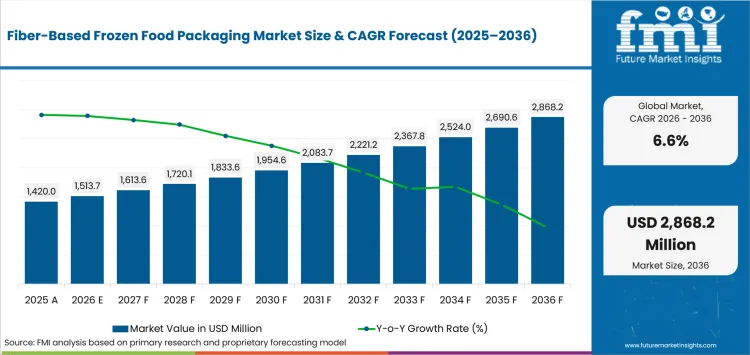
USD 1513.7 million in 2026 and USD 2868.2 million by 2036 at a 6.6% CAGR.
Sales of fiber-based frozen food packaging are estimated to rise at 6.6% CAGR through 2036, increasing valuation from USD 1513.7 million in 2026 to USD 2868.2 million by 2036. Packaging specifications are increasingly influenced by recyclability requirements alongside traditional performance criteria. The European Commission reported in February 2025 that the Packaging and Packaging Waste Regulation entered into force, placing recyclability and material composition inside current food packaging qualification decisions. Frozen-food processors therefore need barrier structures that survive freezing without complicating the recovery route claimed for the finished package.
The United Kingdom places producer fees directly into pack economics while Germany emphasizes recovery documentation under a mature recycling system. UK guidance updated in April 2026 set a 77% recycling obligation for paper, board and fiber-based composite packaging during 2026. The 77% obligation gives paper and paperboard packaging a defined recovery pathway although freezer barriers must preserve seal integrity and moisture resistance during distribution.
Key Takeaways of Fiber-Based Frozen Food Packaging Market
- Frozen-food processors are increasing fiber qualification as packaging rules place greater weight on recoverability without relaxing freezer-performance requirements.
- In 2026, molded fiber trays and bowls are expected to lead product type with 30.0% share as rigid geometry supports portioned frozen foods.
- By material, virgin fiber is forecast to represent 38.0% in 2026 driven by predictable stiffness during repeat food-contact conversion.
- Dispersion coating is likely to capture 36.0% share in 2026 attributable to moisture control within a relatively simple fiber structure.
- Freeze-thaw exposure can weaken fiber or seals, so commercial conversion depends on proving barrier continuity across forming and frozen distribution.
- Huhtamäki Oyj, Graphic Packaging Holding Company, Sabert Corporation, Stora Enso Oyj, Metsä Board Corporation, Mondi plc, Smurfit Westrock plc, and Rayonier Advanced Materials Inc. are some key players in the sector.
Analyst Perspective
“Frozen-food processors should compare fiber formats by seal retention following freeze-thaw exposure and by barrier continuity at formed corners. The stronger offer couples those tests with line trials and documented recovery routes that support tooling approval and recurring volume.”
- Nandini Roy Choudhury, Principal Consultant, Future Market Insights
How is the Fiber-Based Frozen Food Packaging Market segmented?
The fiber-based frozen food packaging market is segmented by product type, material, barrier technology, application, end use, sales channel, and region.
Product type covers molded fiber trays and bowls, fiber-based cartons, pressed fiber sleeves, fiber cups and containers, and others. Materials include virgin fiber, recycled fiber, bagasse or agri-fiber, bamboo, and others. Barrier technology covers dispersion coating, PLA lining, uncoated formats, and PE-lined transition grades. Applications include frozen ready meals, desserts and ice cream, meat and seafood, fruits and vegetables, and others. End use covers food processors, grocery private label, foodservice, and others. Sales channels include direct OEM supply, packaging distributors, others, and online e-commerce.
What supports demand for frozen ready meals within the application category?
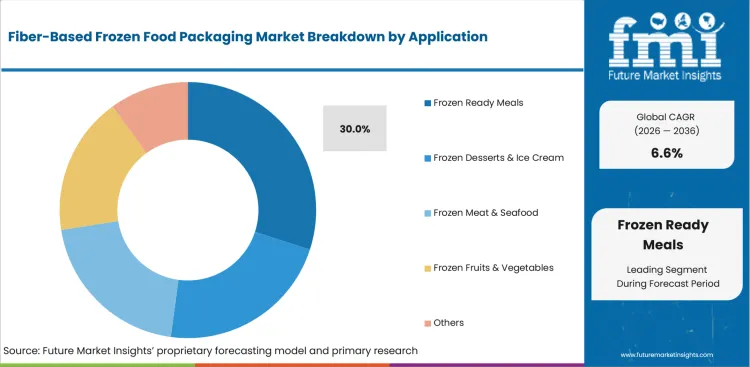
Frozen ready meals place storage and serving requirements inside one primary pack and raise the cost of failed line trials. Packaging engineers therefore compare rigidity and seal performance against actual filling and freezing conditions for frozen ready meals during national qualification.
- Based on application, frozen ready meals are projected to account for 30.0% in 2026 due to formats that combine portion control with cold-storage protection.
- Sabert reported in November 2025 that Pulp Ultra supports frozen and refrigerated meals with extended freezing capability. The development gives paper packaging teams commercial evidence for molded fiber engineered around cold storage instead of general material substitution.
What makes molded fiber trays and bowls central to the product type category?
Molded fiber trays and bowls provide rigid cavities for portioned frozen foods and protect pack geometry during stacked distribution. Molded fiber pulp packaging also gives processors familiar nested-tray geometry for filling and lidding trials on existing lines.
- Molded fiber trays and bowls are projected to hold 30.0% share in 2026 owing to their fit with portion control and lidding.
- Graphic Packaging reported in March 2026 that its paperboard portfolio serves frozen and microwavable prepared foods with tray production and customer equipment support. Graphic Packaging’s operating model gives molded pulp packaging programs a relevant benchmark for coordinating pack geometry with commercial line qualification.
How do food-packaging teams evaluate virgin fiber within the material category?
Virgin fiber gives food-contact structures predictable stiffness at sealing flanges and a clean surface for branded printing. Consistent virgin furnish also helps paperboard packaging hold dimensions during die-cutting and repeated commercial conversion runs.
- Virgin fiber is set to lead the material category with 38.0% share in 2026 due to consistent forming behavior across demanding frozen-food packs.
- Metsä Board launched Pro FBB Go in March 2026 with hard sizing for frozen applications and rapid sheet delivery across Europe. Faster availability gives food-grade packaging manufacturers more flexibility during trials without changing the material performance expected from each production run.
How does dispersion coating influence selection within the barrier technology category?
Dispersion coating places a thin functional layer on fiber to resist moisture and grease without requiring a heavy laminate. Stora Enso launched Performa Natura Aqua in April 2026 for selected frozen uses with the dispersion barrier integrated into folding boxboard.
- By barrier technology, dispersion coating is estimated to hold 36.0% in 2026 owing to adjustable resistance within a comparatively simple material structure.
- Condensation can expose weak coating coverage at folds and formed corners, so frozen-food packaging teams evaluate barrier coatings across formed geometry. A continuous structure can reduce extra lamination steps and simplify recovery testing for barrier packaging.
What are the drivers, restraints and opportunities in the Fiber-Based Frozen Food Packaging Market?
Producer-responsibility rules increase qualification work as recovery fees penalize complex structures and lower-plastic barriers improve conversion economics.
- Driver: Freezer-ready fiber formats are entering commercial portfolios with documented cold-chain performance for frozen meals and deep-freeze distribution.
- Restraint: Freezer barriers must protect seals without shifting the finished pack into a costlier or harder-to-recover material category.
- Opportunity: Coating and tooling specialists can win replacement programs by proving lower-plastic barriers on existing filling and sealing lines.
Frozen-Food Portfolios Add Fiber Supply
Processors are gaining access to a broader range of fiber-based formats suitable for frozen-food applications. Mondi expanded its corrugated and solid-board food-packaging portfolio in November 2025 with solid-board boxes designed for deep-freeze use. The addition increases qualification options for frozen-food manufacturers evaluating alternatives to conventional plastic packaging. Wider material availability can support packaging conversions where low-temperature durability and retail presentation remain important requirements.
Recovery Classification Adds a Commercial Constraint
Material classification can influence packaging economics as much as technical performance. PackUK set 2025 base fees at GBP 196 per tonne for paper and card compared with GBP 461 for fiber-based composite packaging. The difference creates an incentive to maintain paper-based classification during package design. Frozen-food processors therefore need recovery documentation alongside performance testing before confirming material conversions.
Freezer-Safe Plant Fiber Expands Ready-Meal Options
Ready-meal producers are evaluating fiber-based packaging that can perform across multiple temperature conditions. Preferred Packaging introduced GreenStream fiber trays in July 2025 for freezer, microwave and oven applications. The PFAS-free design combines plant-fiber construction with a familiar tray format for food manufacturers. Producers can test lower-plastic packaging alternatives without fundamentally changing existing filling and preparation workflows.
Which country CAGRs are profiled in the Fiber-Based Frozen Food Packaging Market?
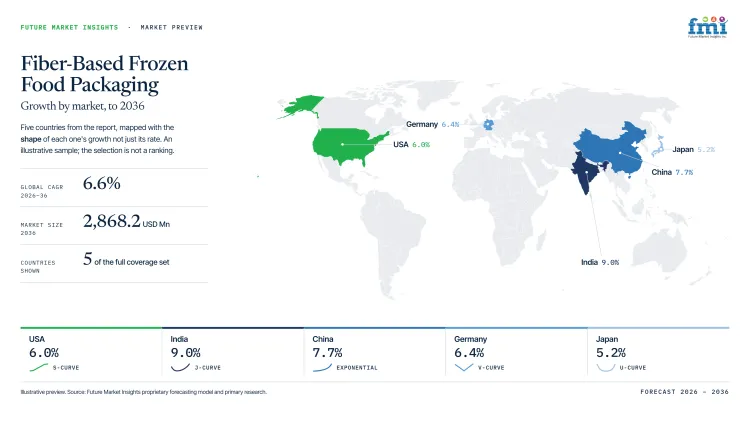
| Country | CAGR |
|---|---|
| Brazil | 7.0% |
| United Kingdom | 6.5% |
| Germany | 6.4% |
| United States | 6.0% |
| Japan | 5.2% |
How do country-level CAGRs compare in the Fiber-Based Frozen Food Packaging Market?
Brazil forms the upper-growth position while the United Kingdom and Germany create a tight middle cluster across the country outlook. The United States bridges that cluster with Japan at the lower end. Growth spacing reflects different recycling rules and qualification economics without measuring present revenue scale or installed packaging volume.
- Brazil pairs plastic-recovery duties with long routes that reward moisture-resistant fiber packs.
- United Kingdom EPR fees make material classification part of recurring frozen-pack economics nationally.
- Germany requires stronger recovery documentation for moisture-protected fiber structures during commercial qualification.
- United States paper recovery aids conversion trials despite different state packaging rules nationwide.
- Japan’s uneven municipal collection coverage increases the need for disposal guidance during rollouts.
Similar growth rates therefore produce different service and documentation requirements for market entry. The full report provides country-level CAGR analysis across North America, Latin America, Europe, East Asia, South Asia, Oceania and the Middle East and Africa.
Country-wise Analysis
- Brazilian frozen-food programs cross long distribution routes and humid handling environments across wider tropical supply networks, so fiber packs must consistently retain stiffness and moisture resistance from processor lines to regional retail outlets nationwide. Fiber-based frozen food packaging demand in Brazil is forecast to rise at 7.0% CAGR over the forecast period supported by local conversion and mounting pressure to reduce plastic exposure in primary packs. Brazil’s October 2025 plastic-packaging decree set a 32.0% national recovery target for 2026, strengthening substitution pressure but requiring fiber-packaging manufacturers to balance freezer performance with regional collection conditions and dependable local technical service capacity.
- United Kingdom food-packaging specifications now carry direct disposal-cost consequences across major national grocery programs, and PackUK reported in December 2025 that 32% of fiber-based composite tonnage received a red recyclability rating during year-two modelling. Fiber-based frozen food packaging sales in the United Kingdom are forecast to expand at 6.5% CAGR by 2036 driven by processor efforts to avoid higher-cost composite classifications during national portfolio conversion programs. Food manufacturers therefore need verified recovery evidence beside moisture and seal testing to approve recurring frozen-food volumes across major retail programs that require consistent disposal labels and accurate final material classifications for national reporting.
- German food-packaging programs place measurable recovery performance beside barrier testing as manufacturers qualify coated fiber structures for frozen meals across national retail and foodservice distribution networks serving grocery groups and national catering operators. Germany’s mature collection system gives processors a clear recovery route, yet each barrier structure needs evidence that moisture protection preserves consistently recoverable fiber during commercial qualification and retailer approval at full line speed. Umweltbundesamt reported in May 2026 that 69.4% of German packaging was recycled in 2023, and fiber-based frozen food packaging is projected to record 6.4% CAGR during the assessment period as recovery evidence shapes qualification.
- United States paper recovery provides a large domestic recycling base for national frozen-food packaging programs and retailer launches across diverse states, giving processors familiar recovery routes for fiber conversion trials across major manufacturing regions. By 2036, the United States is projected to grow at 6.0% CAGR supported by repeated commercial line trials that combine freezer performance with familiar paper-recovery compatibility across dependable regional supply networks nationwide. AF&PA reported in August 2025 that 60% to 64% of paper available for recovery was recycled during 2024, yet different state packaging rules require portable technical documentation for consistent multi-state frozen-food retail rollouts nationwide.
- Japanese food companies operate inside municipal sorting systems that vary by container category across different prefectures, so coated fiber packs need clear disposal instructions alongside consistent print and sealing performance during controlled retail trials. The Ministry of the Environment reported in March 2026 that paper-container collection reached 38.1% of municipalities during fiscal 2024, limiting how uniformly recovery claims translate across local collection systems for consumer packaging. Japan’s fiber-based frozen food packaging outlook is anticipated to advance at 5.2% CAGR over the assessment period supported by repeatable cold-chain performance and pack-specific recovery guidance across nationwide commercial retail distribution programs at scale.
Who are the notable companies in the Fiber-Based Frozen Food Packaging Market?
Huhtamäki Oyj, Graphic Packaging Holding Company, Sabert Corporation, Stora Enso Oyj, Metsä Board Corporation, Mondi plc, Smurfit Westrock plc, and Rayonier Advanced Materials Inc.
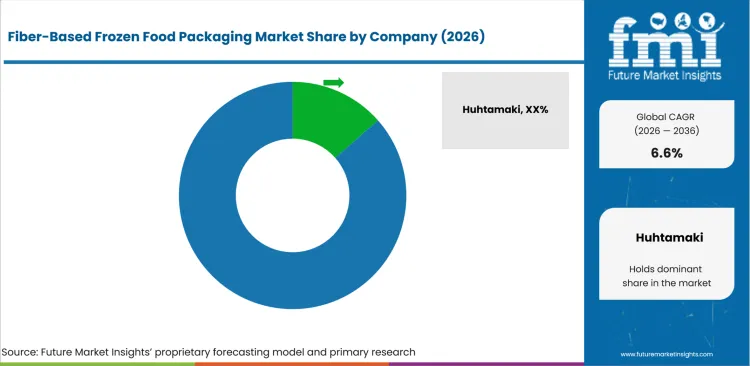
Competition separates formed-fiber specialists from paperboard platforms and integrated packaging groups that support food-contact qualification across frozen applications. Entry barriers center on pack geometry, freezer-stable barriers and commercial line validation. Processors require repeatable performance for tooling approval and recurring frozen-food volume orders.
- Huhtamäki Oyj, Sabert Corporation and Graphic Packaging Holding Company compete with formed or pressed food-packaging formats backed by barrier and conversion expertise.
- Stora Enso Oyj, Metsä Board Corporation and Rayonier Advanced Materials Inc. compete mainly with freezer-grade paperboards engineered for cold-chain converting requirements.
- Mondi plc and Smurfit Westrock plc add broader paper-based supply networks and regional conversion support for frozen-food packaging accounts.
Competitive Benchmarking: Fiber-Based Frozen Food Packaging Market
| Company | Frozen-Food Application Breadth | Barrier & Temperature Evidence | Commercial Footprint | Geographic Reach |
|---|---|---|---|---|
| Huhtamäki Oyj | Medium | Medium | High | Global |
| Graphic Packaging Holding Company | High | High | High | Americas, Europe and Asia Pacific |
| Sabert Corporation | Medium | High | Medium | North America |
| Stora Enso Oyj | Medium | High | Medium | Europe and international markets |
| Metsä Board Corporation | Medium | High | Medium | Europe and international sales |
| Mondi plc | Medium | Medium | High | Europe and global operations |
| Smurfit Westrock plc | Medium | Medium | Medium | Europe and other global markets |
| Rayonier Advanced Materials Inc. | Medium | High | High | North America and Europe |
Key Developments in the Fiber-Based Frozen Food Packaging Market
- In July 2026, Metsä Board Corporation opened a Milan design studio for joint customer testing and earlier packaging validation.
- In July 2025, Huhtamäki Oyj launched recyclable and compostable ice cream cups made from certified paperboard with a bio-based coating below 10% plastic.
- In May 2025, Smurfit Westrock plc documented a Sivafrost closed-loop program recycling about 75 tons of paper and cardboard monthly.
Key Players in the Fiber-Based Frozen Food Packaging Market
Formed-Fiber and Pressed-Tray Platforms
- Huhtamäki Oyj
- Graphic Packaging Holding Company
- Sabert Corporation
Freezer-Grade Paperboard Platforms
- Stora Enso Oyj
- Metsä Board Corporation
- Rayonier Advanced Materials Inc.
Integrated Paper Conversion Platforms
- Mondi plc
- Smurfit Westrock plc
Fiber-Based Frozen Food Packaging Market - Report Scope
| Coverage field | Report scope |
|---|---|
| Market breakdown | Product type, material, barrier technology, application, end use, sales channel, and region |
| Quantitative Units | Revenue in USD Million and CAGR in %. |
| Market Definition | Revenue from fiber-based trays, bowls, cartons, sleeves, cups, and containers sold as primary packaging for frozen food. The scope includes food-contact barrier treatment applied to those packs. It excludes frozen-food revenue and substitute plastic, metal, or foil formats. It also excludes unrelated transport packaging. |
| Regions Covered | North America, Latin America, Europe, East Asia, South Asia and Pacific, and Middle East and Africa. |
| Countries Covered | Brazil, United Kingdom, Germany, United States, Japan, and 20+ countries included in the full report. |
| Key Companies Profiled | Huhtamäki Oyj, Graphic Packaging Holding Company, Sabert Corporation, Stora Enso Oyj, Metsä Board Corporation, Mondi plc, Smurfit Westrock plc, Rayonier Advanced Materials Inc. |
| Forecast Period | 2026 to 2036. |
| Approach | Primary and secondary research with market triangulation. |
Fiber-Based Frozen Food Packaging Market - Research Methodology
| Method | Approach |
|---|---|
| Primary Research | FMI analysts gathered input from manufacturers, service providers, technology developers, distributors, end users, procurement teams, and subject-matter experts. Interviews examined purchasing decisions, product or service evaluation, adoption barriers, approval requirements, pricing considerations, and expectations for technical or commercial support. Respondents were also asked what evidence is required before a trial, pilot, or initial order develops into regular purchasing. |
| Desk Research | Desk research covered government statistics, regulatory publications, trade data, industry associations, technical literature, standards, company filings, product information, and official corporate announcements. Sources were reviewed for relevance, publication date, geographic coverage, and consistency with the defined market scope. Claims relating to performance, applications, approvals, capacity, investment, and commercial activity were retained only when supported by credible public evidence. |
| Market Sizing and Forecasting | The market model combined the baseline value with historical performance, segment structure, pricing and volume indicators, adoption levels, company participation, and country-level demand conditions. Forecast assumptions considered economic activity, investment trends, regulatory developments, technology adoption, purchasing cycles, supply availability, and barriers to wider market use. Segment and regional estimates were reconciled before the final market total was calculated. |
| Data Validation | Estimates were checked against multiple independent indicators, including public data, company activity, trade patterns, industry developments, and findings from primary interviews. Validation also tested whether products, services, applications, and company revenues fell within the defined market boundaries. Adjacent categories, unsupported claims, overlapping revenues, and activities without direct market relevance were excluded to reduce double counting and maintain consistency across segments and countries. |
Fiber-Based Frozen Food Packaging Market by Segments
Fiber-Based Frozen Food Packaging Market segmented by Product Type:
- Molded Fiber Trays & Bowls
- Fiber-Based Cartons
- Pressed Fiber Sleeves
- Fiber Cups & Containers
- Others
Fiber-Based Frozen Food Packaging Market segmented by Material:
- Virgin Fiber
- Recycled Fiber
- Bagasse - Agri-Fiber
- Bamboo
- Others
Fiber-Based Frozen Food Packaging Market segmented by Barrier Technology:
- Dispersion Coating
- PLA Lining
- Uncoated
- PE-Lined Transition Grades
Fiber-Based Frozen Food Packaging Market segmented by Application:
- Frozen Ready Meals
- Frozen Desserts & Ice Cream
- Frozen Meat & Seafood
- Frozen Fruits & Vegetables
- Others
Fiber-Based Frozen Food Packaging Market segmented by End Use:
- Food Processors
- Grocery Private Label
- Foodservice
- Others
Fiber-Based Frozen Food Packaging Market segmented by Sales Channel:
- Direct - OEM Supply
- Packaging Distributors
- Others
- Online - E-commerce
Fiber-Based Frozen Food Packaging Market by Region:
- North America
- United States
- Canada
- Latin America
- Brazil
- Mexico
- Chile
- Rest of Latin America
- Western Europe
- Germany
- United Kingdom
- Italy
- Spain
- France
- Nordics
- Benelux
- Rest of Western Europe
- Eastern Europe
- Russia
- Poland
- Hungary
- Balkan and Baltic States
- Rest of Eastern Europe
- East Asia
- China
- Japan
- South Korea
- South Asia and Pacific
- India
- ASEAN
- Australia and New Zealand
- Rest of South Asia and Pacific
- Middle East and Africa
- Kingdom of Saudi Arabia
- Other GCC Countries
- Türkiye
- South Africa
- Other African Union Countries
- Rest of Middle East and Africa
Research Sources and Bibliography
- European Commission, Directorate-General for Environment. (2025, February 11). New rules enter into force for a more sustainable and competitive packaging economy.
- Department for Environment, Food & Rural Affairs and Environment Agency. (2026, April 7). Extended producer responsibility for packaging: recycling obligations and waste disposal fees.
- Graphic Packaging Holding Company. (2026, March 2). 10-K: Annual report [Section 13 and 15(d), not S-K Item 405].
- Metsä Board Corporation. (2026, March 3). Metsä Board introduces a new product and service concept for fast moving brand packaging in Europe.
- Stora Enso Oyj. (2026, April 30). Stora Enso launches Performa Natura Aqua, a dispersion-coated board for foodservice and bakery packaging.
- Sabert Corporation. (2025, November 19). Sabert Corporation’s Pulp Ultra® Wins 2025 USA Plastics Pact Packaging Innovation Award for Compostability.
- Mondi plc. (2025, November 18). Mondi launches extended corrugated and solid board portfolio for the food packaging industry.
- PackUK and Department for Environment, Food & Rural Affairs. (2025, June 27). Extended Producer Responsibility for Packaging: 2025 base fees.
- C-P Flexible Packaging. (2025, July 17). Preferred Packaging Launches GreenStream™ Fiber Trays: A New Standard in Sustainable Meal Packaging.
- Presidência da República, Casa Civil. (2025, October 21). Decreto nº 12.688, de 21 de outubro de 2025.
- PackUK and Department for Environment, Food & Rural Affairs. (2025, December 19). Year 2 illustrative waste disposal fees: Extended producer responsibility for packaging.
- Umweltbundesamt. (2026, May 13). Verpackungsverbrauch 2023 gesunken, Recyclingquote gestiegen.
- American Forest & Paper Association. (2025, August 12). Paper Industry Announces 2024 USA Paper Recycling Rates.
- Ministry of the Environment, Japan. (2026, March 31). 令和6年度容器包装リサイクル法に基づく市町村の分別収集等の実績について.
- Rayonier Advanced Materials Inc. (2026, March 5). 10-K: Annual report [Section 13 and 15(d), not S-K Item 405].
- Metsä Board Corporation. (2026, July 2). Brands face growing demands on packaging - Metsä Board rethinks packaging development with a new design studio in Milan.
- Huhtamäki Oyj. (2025, July 16). Huhtamaki launches new compostable ice cream cups.
- Smurfit Westrock plc. (2025, May 26). Closing the loop: Smurfit Westrock and Sivafrost build a sustainable future.
This bibliography is provided for reader reference and is not exhaustive. The full report contains the complete reference list and detailed citations
This Report Answers
- How large is fiber-based frozen food packaging in 2026 and 2036?
- What shapes processor adoption of qualified frozen-food fiber packs?
- Why do molded fiber trays and bowls lead product type in 2026?
- How do virgin fiber and dispersion coatings affect qualification?
- Which technical and recovery constraints slow plastic-to-fiber conversion?
- How do country growth rates shape market-entry conditions?
- Which local rules shape frozen-packaging conversion across profiled countries?
- How do verified companies differ by frozen-food packaging role?
Frequently Asked Questions
How big is the fiber-based frozen food packaging market in 2026?
The fiber-based frozen food packaging market is valued at USD 1,513.7 million in 2026 and is projected to reach USD 2,868.2 million by 2036. Growth is driven by increasing adoption of fiber-based packaging solutions that provide frozen-food protection while supporting recyclability and plastic-reduction goals.
What is the CAGR of the fiber-based frozen food packaging market from 2026 to 2036?
The fiber-based frozen food packaging market is projected to grow at a CAGR of 6.6% between 2026 and 2036. Expansion is supported by evolving packaging regulations and increasing investment in sustainable frozen-food packaging formats.
Which product type is projected to account for 30.0% of the fiber-based frozen food packaging market?
Molded fiber trays and bowls are projected to account for 30.0% of the market in 2026. Their leading share is supported by rigid construction, portion-control benefits, and compatibility with frozen-food packaging lines.
How much incremental revenue is projected for the fiber-based frozen food packaging market from 2026 to 2036?
The fiber-based frozen food packaging market is expected to add USD 1,354.5 million in value between 2026 and 2036. Growth reflects expanding use of qualified fiber-based packaging formats across a wide range of frozen-food applications.
Which companies are active in the fiber-based frozen food packaging market?
Key companies operating in the market include Huhtamäki Oyj, Graphic Packaging Holding Company, Sabert Corporation, Stora Enso Oyj, Metsä Board Corporation, Mondi plc, Smurfit Westrock plc, and Rayonier Advanced Materials Inc. These companies compete through molded fiber technologies, freezer-grade paperboard solutions, and integrated packaging platforms.
Preview the report firsthand - request a free sample
Get SampleGet the brochure for pricing and purchase details.
Get PDFTable of Content
- Key Takeaways
- Market Size and CAGR
- Top Growth Driver
- Fastest Growing Segment
- Leading Region
- Key Companies
- Emerging Opportunities
- Executive Summary
- Global Market Outlook
- Demand-side Trends
- Supply-side Trends
- Technology Roadmap Analysis
- Analysis and Recommendations
- Analyst Perspective (What is happening? Why now? What should investors know?)
- Key Questions Answered
- How large is the market?
- What is the CAGR?
- What are key trends?
- Which region dominates?
- Who are the leaders?
- Market Overview
- Market Coverage / Taxonomy
- Market Definition / Scope / Limitations
- Research Methodology
- Chapter Orientation
- Analytical Lens and Working Hypotheses
- Market Structure, Signals, and Trend Drivers
- Benchmarking and Cross-market Comparability
- Market Sizing, Forecasting, and Opportunity Mapping
- Research Design and Evidence Framework
- Desk Research Programme (Secondary Evidence)
- Expert Input and Fieldwork (Primary Evidence)
- Tooling, Models, and Reference Databases
- Data Engineering and Model Build
- Quality Assurance and Audit Trail
- Market Background
- Market Dynamics (Drivers, Restraints, Opportunity, Trends)
- Scenario Forecast (Optimistic, Likely, Conservative)
- Impact Analysis
- AI Impact
- Sustainability Impact
- Regulatory Impact
- Technology Impact
- Consumer / Buyer Analysis
- Purchase Drivers
- Adoption Barriers
- Buyer Journey
- Opportunity Map Analysis
- Product Life Cycle Analysis
- Supply Chain Analysis
- Investment Feasibility Matrix
- Value Chain Analysis
- PESTLE and Porter's Analysis
- Regulatory Landscape
- Regional Parent Market Outlook
- Production and Consumption Statistics
- Import and Export Statistics
- Global Market Analysis and Forecast, 2021 to 2036
- Historical Market Size Value (USD Million) Analysis, 2021 to 2025
- Current and Future Market Size Value (USD Million) Projections, 2026 to 2036
- Y-o-Y Growth Trend Analysis
- Absolute $ Opportunity Analysis
- Global Market Pricing Analysis, 2021 to 2036
- Global Market Analysis and Forecast, By Product Type, 2021 to 2036
- Introduction / Key Findings
- Historical Market Size Value (USD Million) Analysis By Product Type, 2021 to 2025
- Current and Future Market Size Value (USD Million) Analysis and Forecast By Product Type, 2026 to 2036
- Molded Fiber Trays & Bowls
- Fiber-Based Cartons
- Pressed Fiber Sleeves
- Fiber Cups & Containers
- Others
- Molded Fiber Trays & Bowls
- Y-o-Y Growth Trend Analysis By Product Type, 2021 to 2025
- Absolute $ Opportunity Analysis By Product Type, 2026 to 2036
- Global Market Analysis and Forecast, By Material, 2021 to 2036
- Introduction / Key Findings
- Historical Market Size Value (USD Million) Analysis By Material, 2021 to 2025
- Current and Future Market Size Value (USD Million) Analysis and Forecast By Material, 2026 to 2036
- Virgin Fiber
- Recycled Fiber
- Bagasse - Agri-Fiber
- Bamboo
- Others
- Virgin Fiber
- Y-o-Y Growth Trend Analysis By Material, 2021 to 2025
- Absolute $ Opportunity Analysis By Material, 2026 to 2036
- Global Market Analysis and Forecast, By Barrier Technology, 2021 to 2036
- Introduction / Key Findings
- Historical Market Size Value (USD Million) Analysis By Barrier Technology, 2021 to 2025
- Current and Future Market Size Value (USD Million) Analysis and Forecast By Barrier Technology, 2026 to 2036
- Dispersion Coating
- PLA Lining
- Uncoated
- PE-Lined Transition Grades
- Dispersion Coating
- Y-o-Y Growth Trend Analysis By Barrier Technology, 2021 to 2025
- Absolute $ Opportunity Analysis By Barrier Technology, 2026 to 2036
- Global Market Analysis and Forecast, By Application, 2021 to 2036
- Introduction / Key Findings
- Historical Market Size Value (USD Million) Analysis By Application, 2021 to 2025
- Current and Future Market Size Value (USD Million) Analysis and Forecast By Application, 2026 to 2036
- Frozen Ready Meals
- Frozen Desserts & Ice Cream
- Frozen Meat & Seafood
- Frozen Fruits & Vegetables
- Others
- Frozen Ready Meals
- Y-o-Y Growth Trend Analysis By Application, 2021 to 2025
- Absolute $ Opportunity Analysis By Application, 2026 to 2036
- Global Market Analysis and Forecast, By End Use, 2021 to 2036
- Introduction / Key Findings
- Historical Market Size Value (USD Million) Analysis By End Use, 2021 to 2025
- Current and Future Market Size Value (USD Million) Analysis and Forecast By End Use, 2026 to 2036
- Food Processors
- Grocery Private Label
- Foodservice
- Others
- Food Processors
- Y-o-Y Growth Trend Analysis By End Use, 2021 to 2025
- Absolute $ Opportunity Analysis By End Use, 2026 to 2036
- Global Market Analysis and Forecast, By Sales Channel
- Introduction / Key Findings
- Historical Market Size Value (USD Million) Analysis By Sales Channel, 2021 to 2025
- Current and Future Market Size Value (USD Million) Analysis and Forecast By Sales Channel, 2026 to 2036
- Direct - OEM Supply
- Packaging Distributors
- Others
- Online - E-commerce
- Direct - OEM Supply
- Y-o-Y Growth Trend Analysis By Sales Channel, 2021 to 2025
- Absolute $ Opportunity Analysis By Sales Channel, 2026 to 2036
- Global Market Analysis and Forecast, By Region, 2021 to 2036
- Introduction
- Historical Market Size Value (USD Million) Analysis By Region, 2021 to 2025
- Current Market Size Value (USD Million) Analysis and Forecast By Region, 2026 to 2036
- North America
- Latin America
- Western Europe
- Eastern Europe
- East Asia
- South Asia and Pacific
- Middle East & Africa
- Market Attractiveness Analysis By Region
- North America Market Analysis and Forecast, By Country, 2021 to 2036
- Historical Market Size Value (USD Million) Trend Analysis By Market Taxonomy, 2021 to 2025
- Market Size Value (USD Million) Forecast By Market Taxonomy, 2026 to 2036
- By Country
- USA
- Canada
- By Product Type
- By Material
- By Barrier Technology
- By Application
- By End Use
- By Sales Channel
- By Country
- Market Attractiveness Analysis
- By Country
- By Product Type
- By Material
- By Barrier Technology
- By Application
- By End Use
- By Sales Channel
- Key Takeaways
- Latin America Market Analysis and Forecast, By Country
- Historical Market Size Value (USD Million) Trend Analysis By Market Taxonomy, 2021 to 2025
- Market Size Value (USD Million) Forecast By Market Taxonomy, 2026 to 2036
- By Country
- Brazil
- Mexico
- Chile
- Rest of Latin America
- By Product Type
- By Material
- By Barrier Technology
- By Application
- By End Use
- By Sales Channel
- By Country
- Market Attractiveness Analysis
- By Country
- By Product Type
- By Material
- By Barrier Technology
- By Application
- By End Use
- By Sales Channel
- Key Takeaways
- Western Europe Market Analysis and Forecast, By Country
- Historical Market Size Value (USD Million) Trend Analysis By Market Taxonomy, 2021 to 2025
- Market Size Value (USD Million) Forecast By Market Taxonomy, 2026 to 2036
- By Country
- Germany
- UK
- Italy
- Spain
- France
- Nordic
- BENELUX
- Rest of Western Europe
- By Product Type
- By Material
- By Barrier Technology
- By Application
- By End Use
- By Sales Channel
- By Country
- Market Attractiveness Analysis
- By Country
- By Product Type
- By Material
- By Barrier Technology
- By Application
- By End Use
- By Sales Channel
- Key Takeaways
- Eastern Europe Market Analysis and Forecast, By Country
- Historical Market Size Value (USD Million) Trend Analysis By Market Taxonomy, 2021 to 2025
- Market Size Value (USD Million) Forecast By Market Taxonomy, 2026 to 2036
- By Country
- Russia
- Poland
- Hungary
- Balkan & Baltic
- Rest of Eastern Europe
- By Product Type
- By Material
- By Barrier Technology
- By Application
- By End Use
- By Sales Channel
- By Country
- Market Attractiveness Analysis
- By Country
- By Product Type
- By Material
- By Barrier Technology
- By Application
- By End Use
- By Sales Channel
- Key Takeaways
- East Asia Market Analysis and Forecast, By Country
- Historical Market Size Value (USD Million) Trend Analysis By Market Taxonomy, 2021 to 2025
- Market Size Value (USD Million) Forecast By Market Taxonomy, 2026 to 2036
- By Country
- China
- Japan
- South Korea
- By Product Type
- By Material
- By Barrier Technology
- By Application
- By End Use
- By Sales Channel
- By Country
- Market Attractiveness Analysis
- By Country
- By Product Type
- By Material
- By Barrier Technology
- By Application
- By End Use
- By Sales Channel
- Key Takeaways
- South Asia and Pacific Market Analysis and Forecast, By Country
- Historical Market Size Value (USD Million) Trend Analysis By Market Taxonomy, 2021 to 2025
- Market Size Value (USD Million) Forecast By Market Taxonomy, 2026 to 2036
- By Country
- India
- ASEAN
- Australia & New Zealand
- Rest of South Asia and Pacific
- By Product Type
- By Material
- By Barrier Technology
- By Application
- By End Use
- By Sales Channel
- By Country
- Market Attractiveness Analysis
- By Country
- By Product Type
- By Material
- By Barrier Technology
- By Application
- By End Use
- By Sales Channel
- Key Takeaways
- Middle East & Africa Market Analysis and Forecast, By Country
- Historical Market Size Value (USD Million) Trend Analysis By Market Taxonomy, 2021 to 2025
- Market Size Value (USD Million) Forecast By Market Taxonomy, 2026 to 2036
- By Country
- Kingdom of Saudi Arabia
- Other GCC Countries
- Türkiye
- South Africa
- Other African Union
- Rest of Middle East & Africa
- By Product Type
- By Material
- By Barrier Technology
- By Application
- By End Use
- By Sales Channel
- By Country
- Market Attractiveness Analysis
- By Country
- By Product Type
- By Material
- By Barrier Technology
- By Application
- By End Use
- By Sales Channel
- Key Takeaways
- Key Countries Market Analysis
- USA
- Pricing Analysis
- Market Share Analysis, 2025
- By Product Type
- By Material
- By Barrier Technology
- By Application
- By End Use
- By Sales Channel
- Canada
- Pricing Analysis
- Market Share Analysis, 2025
- By Product Type
- By Material
- By Barrier Technology
- By Application
- By End Use
- By Sales Channel
- Mexico
- Pricing Analysis
- Market Share Analysis, 2025
- By Product Type
- By Material
- By Barrier Technology
- By Application
- By End Use
- By Sales Channel
- Brazil
- Pricing Analysis
- Market Share Analysis, 2025
- By Product Type
- By Material
- By Barrier Technology
- By Application
- By End Use
- By Sales Channel
- Chile
- Pricing Analysis
- Market Share Analysis, 2025
- By Product Type
- By Material
- By Barrier Technology
- By Application
- By End Use
- By Sales Channel
- Germany
- Pricing Analysis
- Market Share Analysis, 2025
- By Product Type
- By Material
- By Barrier Technology
- By Application
- By End Use
- By Sales Channel
- UK
- Pricing Analysis
- Market Share Analysis, 2025
- By Product Type
- By Material
- By Barrier Technology
- By Application
- By End Use
- By Sales Channel
- Italy
- Pricing Analysis
- Market Share Analysis, 2025
- By Product Type
- By Material
- By Barrier Technology
- By Application
- By End Use
- By Sales Channel
- Spain
- Pricing Analysis
- Market Share Analysis, 2025
- By Product Type
- By Material
- By Barrier Technology
- By Application
- By End Use
- By Sales Channel
- France
- Pricing Analysis
- Market Share Analysis, 2025
- By Product Type
- By Material
- By Barrier Technology
- By Application
- By End Use
- By Sales Channel
- India
- Pricing Analysis
- Market Share Analysis, 2025
- By Product Type
- By Material
- By Barrier Technology
- By Application
- By End Use
- By Sales Channel
- ASEAN
- Pricing Analysis
- Market Share Analysis, 2025
- By Product Type
- By Material
- By Barrier Technology
- By Application
- By End Use
- By Sales Channel
- Australia & New Zealand
- Pricing Analysis
- Market Share Analysis, 2025
- By Product Type
- By Material
- By Barrier Technology
- By Application
- By End Use
- By Sales Channel
- China
- Pricing Analysis
- Market Share Analysis, 2025
- By Product Type
- By Material
- By Barrier Technology
- By Application
- By End Use
- By Sales Channel
- Japan
- Pricing Analysis
- Market Share Analysis, 2025
- By Product Type
- By Material
- By Barrier Technology
- By Application
- By End Use
- By Sales Channel
- South Korea
- Pricing Analysis
- Market Share Analysis, 2025
- By Product Type
- By Material
- By Barrier Technology
- By Application
- By End Use
- By Sales Channel
- Russia
- Pricing Analysis
- Market Share Analysis, 2025
- By Product Type
- By Material
- By Barrier Technology
- By Application
- By End Use
- By Sales Channel
- Poland
- Pricing Analysis
- Market Share Analysis, 2025
- By Product Type
- By Material
- By Barrier Technology
- By Application
- By End Use
- By Sales Channel
- Hungary
- Pricing Analysis
- Market Share Analysis, 2025
- By Product Type
- By Material
- By Barrier Technology
- By Application
- By End Use
- By Sales Channel
- Kingdom of Saudi Arabia
- Pricing Analysis
- Market Share Analysis, 2025
- By Product Type
- By Material
- By Barrier Technology
- By Application
- By End Use
- By Sales Channel
- Türkiye
- Pricing Analysis
- Market Share Analysis, 2025
- By Product Type
- By Material
- By Barrier Technology
- By Application
- By End Use
- By Sales Channel
- South Africa
- Pricing Analysis
- Market Share Analysis, 2025
- By Product Type
- By Material
- By Barrier Technology
- By Application
- By End Use
- By Sales Channel
- USA
- Market Structure Analysis
- Competition Dashboard
- Competition Benchmarking
- Market Share Analysis of Top Players
- By Regional
- By Product Type
- By Material
- By Barrier Technology
- By Application
- By End Use
- By Sales Channel
- Emerging Startups
- Innovation Benchmarking
- Competition Analysis
- Competition Deep Dive
- Huhtamaki
- Overview
- Product Portfolio
- Profitability by Market Segments
- Sales Footprint
- Strategy Overview
- Marketing Strategy
- Product Strategy
- Channel Strategy
- Graphic Packaging
- Smurfit Westrock
- Brodrene Hartmann
- Sonoco
- International Paper
- Cascades
- Sabert
- UFP Technologies
- Georgia-Pacific
- Huhtamaki
- Case Studies
- Success Stories
- Recent Developments
- Competition Deep Dive
- Assumptions & Acronyms Used


