

- Market Size (2026)
- USD 29.1 Bn
- Forecast (2036)
- USD 78.2 Bn
- CAGR (2026 to 2036)
- 10.4%
Fingerprint Biometrics Market Size, Market Forecast and Outlook By FMI
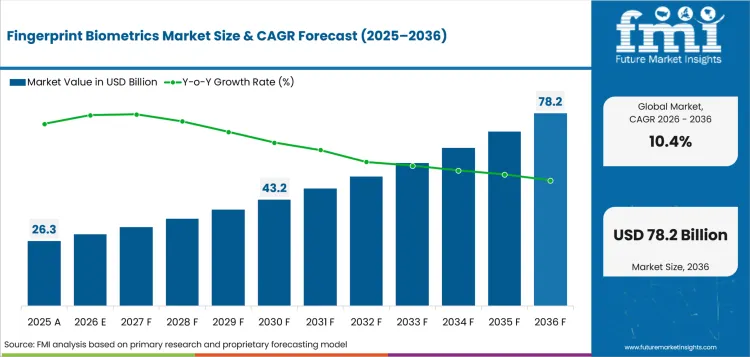
The fingerprint biometrics market was valued at USD 26.3 billion in 2025. The market is set to reach USD 29.1 billion by 2026-end and grow at a CAGR of 10.4% between 2026-2036 to reach USD 78.2 billion by 2036. Single-factor Authentication will dominate with a 63.0% share, while Fixed will lead with a 58.0% share.
Key Takeaways, Market Size, and Forecast
- The fingerprint biometrics market was valued at USD 26.32 billion in 2025.
- By 2036, the Fingerprint Biometrics Market is expected to be worth USD 78.15 billion.
- From 2026 to 2036, the market is projected to expand at a CAGR of 10.4%.
- The market is projected to create an incremental opportunity of USD 49.09 billion between 2026 and 2036.
- In 2026, fixed is expected to account for 58.0% of the mobility segment, driven by demand for fixed applications.
- India (13.9%) and China (12.6%) are two of the fastest growing markets in the world.
Summary of the Fingerprint Biometrics Market
- Demand and Growth Drivers
- Government identity management programs and national ID infrastructure deployment are creating large scale procurement cycles for fingerprint biometric systems across identity verification and access control applications.
- Single factor authentication leads at 63.0% product share, reflecting cost effective deployment in high volume identity verification scenarios where fingerprint serves as the primary authentication modality.
- India (13.9%) and China (12.6%) lead country level growth, supported by national digital identity programs, financial inclusion mandates, and public sector biometric infrastructure investment.
- Product and Segment View
- Single-factor Authentication is expected to lead the product segment with 63.0% share in 2026.
- Fixed accounts for 58.0% of the mobility segment.
- Government leads the industry segment at 29.0% share.
- Geography and Competitive Outlook
- India is expected to lead at 13.9% CAGR through 2036.
- China follows at 12.6% CAGR, reflecting expanding procurement.
- Companies with established capabilities and distributor relationships are positioned to capture incremental demand.
- Analyst Opinion
- The fingerprint biometrics market is evolving toward specification driven procurement where capability and supply reliability determine competitive positioning.
- Adoption is increasing due to end user demand for performance validated inputs and regulatory requirements.
- Companies combining cost competitiveness with consistent quality are positioned to strengthen market position.
- Demand is further supported by procurement stability in established end use sectors and emerging categories.
Fingerprint Biometrics Market Definition
The fingerprint biometrics market includes single factor and multi factor fingerprint authentication systems deployed in fixed and mobile configurations for government identity management, financial services, healthcare, enterprise access control, and consumer device applications.
Fingerprint Biometrics Market Inclusions
Market scope covers all commercially traded fingerprint biometric products categorized by product (single factor authentication, multi factor authentication), mobility (fixed, mobile), and industry (government, financial services, healthcare, enterprise, consumer). Revenue estimates span from 2026 to 2036.
Fingerprint Biometrics Market Exclusions
The scope does not include facial recognition, iris scanning, voice biometrics, or behavioral biometric systems without fingerprint functionality. Biometric data storage and management software sold independently of fingerprint hardware is excluded.
Fingerprint Biometrics Market Research Methodology
- Primary Research: FMI analysts conducted interviews with manufacturers, distributors, and end users across key markets.
- Desk Research: Combined data from industry associations, regulatory filings, trade databases, and manufacturer disclosures.
- Market Sizing and Forecasting: Bottom up aggregation across segments, triangulated with top down validation.
- Data Validation: Cross checked quarterly against production statistics, trade data, and manufacturer figures.
Why is the Fingerprint Biometrics Market Growing?
- Government identity management programs and national ID infrastructure deployment are creating large scale procurement cycles for fingerprint biometric systems across identity verification and access control applications.
- Single factor authentication leads at 63.0% product share, reflecting cost effective deployment in high volume identity verification scenarios where fingerprint serves as the primary authentication modality.
- India (13.9%) and China (12.6%) lead country level growth, supported by national digital identity programs, financial inclusion mandates, and public sector biometric infrastructure investment.
The fingerprint biometrics market is expanding as government, financial services, and enterprise sectors invest in identity verification infrastructure. Single factor authentication maintains 63.0% product share, reflecting dominant deployment in national ID systems, voter registration, and workforce attendance applications where fingerprint serves as the primary identity credential.
Government applications account for 29.0% of industry demand, with national identity programs, border control, law enforcement, and social benefit distribution driving large scale procurement. Financial services, healthcare, and enterprise access control add institutional demand layers. Fixed deployment holds 58.0% of mobility share, reflecting installed base of desktop and kiosk based fingerprint readers in institutional settings.
The market is transitioning toward multi modal biometric systems that combine fingerprint with facial recognition, iris scanning, and behavioral biometrics. This transition creates both upgrade opportunities and competitive pressure as solution providers expand beyond single modality platforms.
Market Segmentation Analysis
- The fingerprint biometrics market is segmented by product, mobility, industry, with single-factor authentication leading at 63.0% share.
- Fixed accounts for 58.0% of the mobility segment.
The fingerprint biometrics market is organized across multiple dimensions reflecting product differentiation and procurement preferences.
Insights into the Single-factor Authentication Product Segment
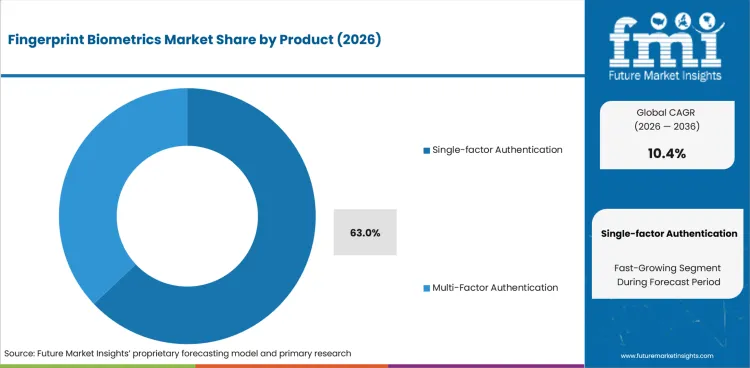
In 2026, single-factor authentication is expected to account for 63.0% of the product segment, reflecting established procurement patterns.
Sub segments including Password Based Authentication, PIN Based Authentication, OTP Based Authentication represent primary specification categories.
Insights into the Fixed Mobility Segment
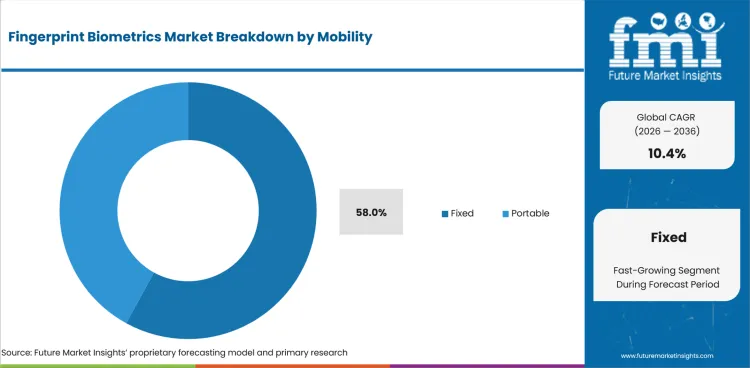
In 2026, fixed is expected to account for 58.0% of the mobility segment, reflecting established procurement patterns.
Sub segments including On Premise Systems, Stationary Authentication Systems, Mobile Authentication Devices represent primary specification categories.
Fingerprint Biometrics Market Drivers, Restraints, and Opportunities
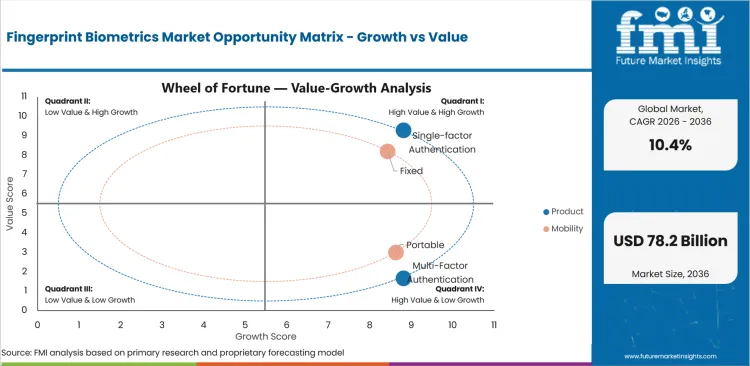
- Demand is shaped by government investment in national digital identity systems that use fingerprint biometrics as a foundational i.
- Adoption is constrained by evolving biometric data protection regulations including GDPR in Europe, BIPA in Illinois, and emerging.
- Growth is supported by smartphone embedded fingerprint sensors that normalize consumer fingerprint authentication behavior. Mobile.
The fingerprint biometrics market is shaped by demand side drivers, supply side constraints, and regulatory influences varying by region.
National Digital Identity Infrastructure
Demand is shaped by government investment in national digital identity systems that use fingerprint biometrics as a foundational identity credential. India's Aadhaar program, China's national ID system, and similar programs across Africa and Southeast Asia create multi year procurement cycles.
Financial Inclusion and KYC Requirements
Growth reflects banking and financial services sector adoption of fingerprint biometrics for customer identity verification (KYC), transaction authentication, and account access control. Financial inclusion mandates in emerging markets require biometric identity for banking access.
Privacy Regulation and Data Protection Concerns
Adoption is constrained by evolving biometric data protection regulations including GDPR in Europe, BIPA in Illinois, and emerging privacy frameworks across Asia. Compliance requirements increase implementation costs and create legal uncertainty for cross border deployments.
Mobile Device Embedded Fingerprint Integration
Growth is supported by smartphone embedded fingerprint sensors that normalize consumer fingerprint authentication behavior. Mobile biometric familiarity reduces resistance to institutional fingerprint deployment and expands the addressable use case base.
Analysis of Fingerprint Biometrics Market By Key Countries
.webp "Top Country Growth Comparison Fingerprint Biometrics Market Cagr (2026 2036)")
| Country | CAGR |
|---|---|
| India | 13.9% |
| China | 12.6% |
| Japan | 11.0% |
| USA | 9.8% |
| Germany | 8.1% |
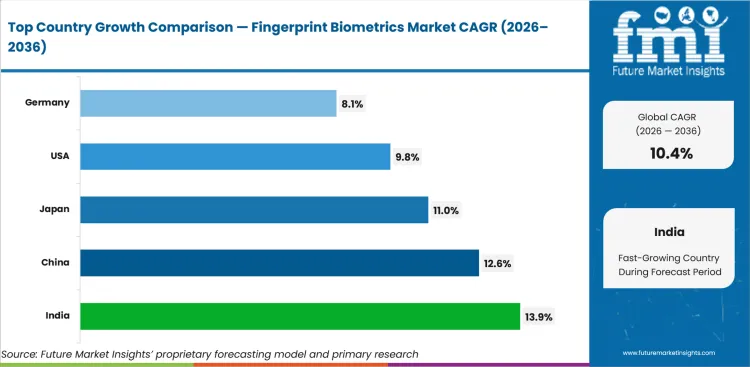
- India at 13.9% CAGR through 2036 reflects strong demand fundamentals.
- China at 12.6% CAGR through 2036 reflects strong demand fundamentals.
- Japan at 11.0% CAGR through 2036 reflects strong demand fundamentals.
The global fingerprint biometrics market is projected to grow at 10.4% CAGR from 2026 to 2036, covering more than 30 countries.
Demand Outlook for Fingerprint Biometrics Market in India
India is projected to grow at 13.9% through 2036. Aadhaar biometric identity infrastructure, the world's largest digital ID program, anchors India's position as the highest growth market. Financial inclusion mandates requiring biometric KYC for banking access create sustained procurement demand across rural and urban deployments.
- Aadhaar program creates the world's largest single biometric identity infrastructure procurement base.
- Financial inclusion mandates require biometric KYC verification for banking and government benefit access.
- Digital payments infrastructure expansion integrates fingerprint authentication for transaction security.
Future Outlook for Fingerprint Biometrics Market in China
China is projected to grow at 12.6% through 2036. The scale of China's government identity infrastructure and technology ecosystem sustains concentrated procurement. Domestic biometric technology companies maintain competitive positions through government procurement programs and export to Belt and Road partner countries.
- National identity system infrastructure sustains large scale fingerprint biometric hardware and software procurement.
- Domestic technology companies maintain cost competitive biometric solutions for government and enterprise deployment.
- Smart city and public safety programs integrate fingerprint biometrics into urban security infrastructure.
Opportunity Analysis of Fingerprint Biometrics Market in Japan
Japan is projected to grow at 11.0% through 2036. Demand reflects the country's advanced technology adoption capacity and financial sector authentication requirements. Japanese enterprises prioritize system reliability, data security, and integration with existing IT infrastructure.
- Financial sector authentication requirements sustain procurement of enterprise grade fingerprint biometric systems.
- Technology adoption capacity enables deployment of advanced multi modal biometric platforms.
- Workforce management and access control applications create institutional demand across manufacturing and services.
In-depth Analysis of Fingerprint Biometrics Market in the United States
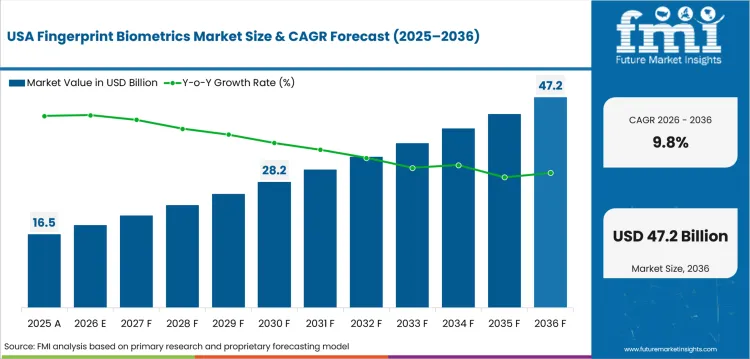
USA is projected to grow at 9.8% through 2036. Federal government identity programs and TSA PreCheck biometric enrollment sustain institutional demand. State level biometric privacy laws including Illinois BIPA create compliance requirements that shape deployment strategies.
- Federal government identity and security programs sustain institutional fingerprint biometric procurement.
- State biometric privacy regulations create compliance frameworks that influence deployment architecture.
- Enterprise access control and workforce management drive private sector fingerprint biometric adoption.
Sales Analysis of Fingerprint Biometrics Market in Germany
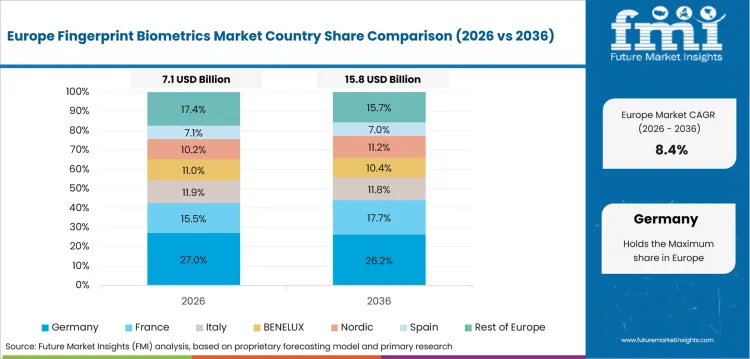
Germany is projected to grow at 8.1% through 2036. GDPR compliance requirements and EU biometric data protection standards shape deployment and procurement. German enterprises prioritize data sovereignty and privacy compliance in biometric system selection.
- GDPR biometric data protection requirements influence system architecture and vendor selection criteria.
- Border control and identity verification programs sustain government sector procurement demand.
- Enterprise access control across manufacturing and financial services sectors drives institutional adoption.
Competitive Landscape and Strategic Positioning
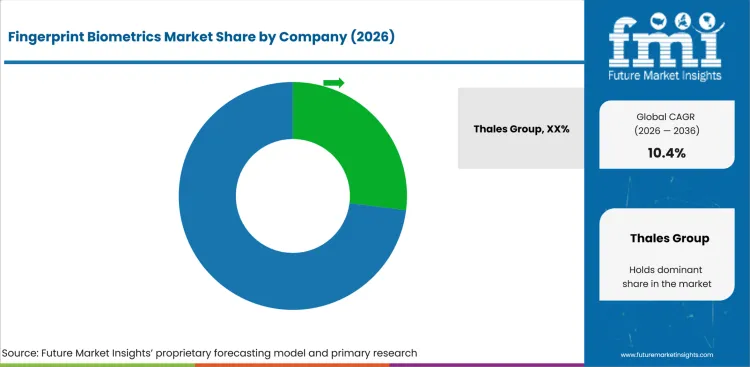
- Thales Group leads with established capabilities and market presence.
- IDEMIA and NEC Corporation maintain competitive positions.
- Emerging players target specialized segments where differentiation creates entry opportunities.
Thales Group maintains strong position through integrated capabilities.
Barriers include established supply relationships, regulatory compliance costs, and capital intensity.
Key Companies in the Fingerprint Biometrics Market
Key global companies leading the fingerprint biometrics market include:
- Thales Group, IDEMIA, NEC Corporation maintain leading positions.
- HID Global, Fingerprint Cards AB, Other Companies have established segment specific positions.
Competitive Benchmarking: Fingerprint Biometrics Market
| Company | Product Breadth | Manufacturing Scale | Distribution Reach | Geographic Footprint |
|---|---|---|---|---|
| Thales Group | High | Strong | Strong | Global |
| IDEMIA | High | Medium | Strong | Global |
| NEC Corporation | Medium | High | Moderate | Regional |
| HID Global | Medium | Medium | Moderate | Regional |
| Fingerprint Cards AB | Low | Medium | Low | Regional |
Source: Future Market Insights competitive analysis, 2026.
Key Developments in Fingerprint Biometrics Market
- In 2025, Thales Group expanded product portfolio and distribution for single-factor authentication products.
- In 2025, IDEMIA introduced new solutions targeting emerging application segments.
Key Players in the Fingerprint Biometrics Market
Major Global Players
- Thales Group
- IDEMIA
- NEC Corporation
- HID Global
- Fingerprint Cards AB
Emerging Players/Startups
- Other Companies
Report Scope and Coverage
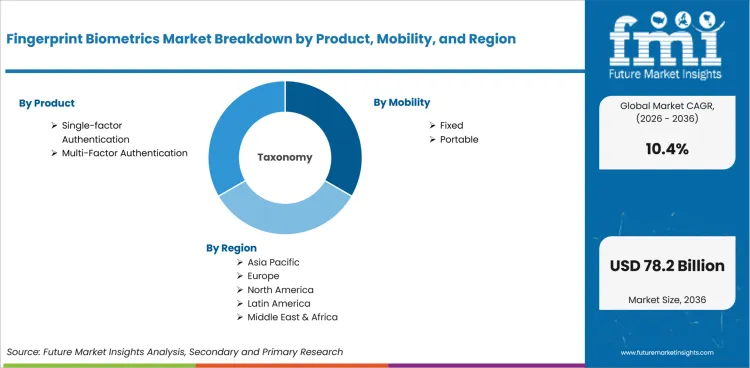
| Parameter | Details |
|---|---|
| Quantitative Units | USD 29.06 billion to USD 78.15 billion, at a CAGR of 10.4% |
| Market Definition | The fingerprint biometrics market includes single factor and multi factor fingerprint authentication systems deployed in fixed and mobile configurations for government identity management, financial services, healthcare, enterprise access control, and consumer device applications. |
| Regions Covered | North America, Latin America, Europe, East Asia, South Asia and Pacific, Middle East and Africa |
| Countries Covered | India, China, Japan, USA, Germany, 30 plus countries |
| Key Companies Profiled | Thales Group, IDEMIA, NEC Corporation, HID Global, Fingerprint Cards AB, Other Companies |
| Forecast Period | 2026 to 2036 |
| Approach | Hybrid bottom up and top down methodology starting with verified transaction data, projecting adoption velocity across segments and regions. |
Segmentation
Fingerprint Biometrics Market Segmented by Product:
- Single-factor Authentication
- Password Based Authentication
- PIN Based Authentication
- Multi-Factor Authentication
- OTP Based Authentication
- Biometric Based Authentication
Fingerprint Biometrics Market Segmented by Mobility:
- Fixed
- On Premise Systems
- Stationary Authentication Systems
- Portable
- Mobile Authentication Devices
- Handheld Authentication Devices
Fingerprint Biometrics Market Segmented by Industry:
- Government
- National ID Systems
- E Governance Platforms
- Banking and Finance
- Online Banking Security
- Payment Authentication Systems
- Healthcare
- Patient Data Security
- Hospital Access Control
- Military and Defense
- Border Security Systems
- Secure Communication Systems
- Consumer Electronics
- Device Login Security
- Smart Device Authentication
- Travel and Immigration
- Passport Verification Systems
- Airport Security Systems
- Automotive
- Vehicle Access Control
- Smart Key Systems
- Security
- Surveillance Systems
- Access Control Systems
- Others
- Enterprise IT Security
- Education Sector Systems
Fingerprint Biometrics Market by Region:
- North America
- USA
- Canada
- Mexico
- Latin America
- Brazil
- Chile
- Rest of Latin America
- Western Europe
- Germany
- UK
- Italy
- Spain
- France
- Nordic
- BENELUX
- Rest of Western Europe
- Eastern Europe
- Russia
- Poland
- Hungary
- Balkan & Baltic
- Rest of Eastern Europe
- East Asia
- China
- Japan
- South Korea
- South Asia and Pacific
- India
- ASEAN
- Australia & New Zealand
- Rest of South Asia and Pacific
- Middle East & Africa
- Kingdom of Saudi Arabia
- Other GCC Countries
- Turkiye
- South Africa
- Other African Union
- Rest of Middle East & Africa
Research Sources and Bibliography
- 1. National Institute of Standards and Technology. (2025). NIST Biometric Standards and Testing Framework. NIST.
- 2. European Commission. (2024). EU Artificial Intelligence Act: Biometric System Regulatory Requirements. EC.
- 3. World Bank. (2025). World Bank ID4D: Digital Identity and Biometric Infrastructure Development Report. World Bank.
- 4. International Organization for Standardization. (2025). ISO/IEC Biometric Data Interchange Standards. ISO.
- 5. Unique Identification Authority of India. (2025). UIDAI Aadhaar Biometric Authentication Statistics. UIDAI.
This bibliography is provided for reader reference. The full Future Market Insights report contains the complete reference list with publication dates, URLs, and supporting data for all cited works.
This Report Answers
- Estimating the size of the market and revenue from 2026 to 2036.
- Segmentation by product, mobility, industry.
- Insights about more than 30 markets by region.
- Analysis of key demand drivers, restraints, and growth opportunities.
- Assessment of the competitive landscape.
- Identification of investment opportunities across key segments and regions.
- Supply chain and procurement pattern analysis.
- Delivery of data in PDF and Excel formats.
Frequently Asked Questions
How big is the fingerprint biometrics market in 2026?
The global fingerprint biometrics market is estimated to be valued at USD 29.1 billion in 2026.
What will be the size of fingerprint biometrics market in 2036?
The market size for the fingerprint biometrics market is projected to reach USD 78.2 billion by 2036.
How much will be the fingerprint biometrics market growth between 2026 and 2036?
The fingerprint biometrics market is expected to grow at a 10.4% CAGR between 2026 and 2036.
What are the key product types in the fingerprint biometrics market?
The key product types in fingerprint biometrics market are single-factor authentication, multi-factor authentication.
Which mobility segment is expected to contribute significant share in the fingerprint biometrics market in 2026?
In terms of mobility, fixed segment is expected to command 58.0% share in the fingerprint biometrics market in 2026.
Preview the report firsthand - request a free sample
Get SampleGet the brochure for pricing and purchase details.
Get PDFTable of Content
- Executive Summary
- Global Market Outlook
- Supply-side Trends
- Technology Roadmap Analysis
- Analysis and Recommendations
- Market Overview
- Market Coverage / Taxonomy
- Market Definition / Scope / Limitations
- Research Methodology
- Chapter Orientation
- Analytical Lens and Working Hypotheses
- Market Structure, Signals, and Trend Drivers
- Benchmarking and Cross-market Comparability
- Desk Research Programme (Secondary Evidence)
- Company Annual and Sustainability Reports
- Peer-reviewed Journals and Academic Literature
- Corporate Websites, Product Literature, and Technical Notes
- Earnings Decks and Investor Briefings
- Statutory Filings and Regulatory Disclosures
- Technical White Papers and Standards Notes
- Trade Journals, Industry Magazines, and Analyst Briefs
- Conference Proceedings, Webinars, and Seminar Materials
- Government Statistics Portals and Public Data Releases
- Press Releases and Reputable Media Coverage
- Specialist Newsletters and Curated Briefings
- Sector Databases and Reference Repositories
- FMI Internal Proprietary Databases and Historical Market Datasets
- Subscription Datasets and Paid Sources
- Social Channels, Communities, and Digital Listening Inputs
- Additional Desk Sources
- Expert Input and Fieldwork (Primary Evidence)
- Primary Modes
- Qualitative Interviews and Expert Elicitation
- Quantitative Surveys and Structured Data Capture
- Blended Approach
- Why Primary Evidence is Used
- Field Techniques
- Interviews
- Surveys
- Focus Groups
- Observational and In-context Research
- Social and Community Interactions
- Stakeholder Universe Engaged
- C-suite Leaders
- Demand in Optimistic Scenario
- Demand in Likely Scenario
- Demand in Conservative Scenario
- Opportunity Map Analysis
- Product Life Cycle Analysis
- Supply Chain Analysis
- Investment Feasibility Matrix
- Value Chain Analysis
- PESTLE and Porter’s Analysis
- Regulatory Landscape
- Regional Parent Market Outlook
- Production and Consumption Statistics
- Import and Export Statistics
- Primary Modes
- Global Market Analysis 2021 to 2025 and Forecast, 2026 to 2036
- Historical Market Size Value (USD Million) Analysis, 2021 to 2025
- Current and Future Market Size Value (USD Million) Projections, 2026 to 2036
- Y-o-Y Growth Trend Analysis
- Absolute $ Opportunity Analysis
- Global Market Pricing Analysis 2021 to 2025 and Forecast 2026 to 2036
- Global Market Analysis 2021 to 2025 and Forecast 2026 to 2036, By Product
- Introduction / Key Findings
- Historical Market Size Value (USD Million) Analysis By Product , 2021 to 2025
- Current and Future Market Size Value (USD Million) Analysis and Forecast By Product , 2026 to 2036
- Single-factor Authentication
- Password Based Authentication
- PIN Based Authentication
- Multi-Factor Authentication
- OTP Based Authentication
- Biometric Based Authentication
- Single-factor Authentication
- Y-o-Y Growth Trend Analysis By Product , 2021 to 2025
- Absolute $ Opportunity Analysis By Product , 2026 to 2036
- Global Market Analysis 2021 to 2025 and Forecast 2026 to 2036, By Mobility
- Introduction / Key Findings
- Historical Market Size Value (USD Million) Analysis By Mobility, 2021 to 2025
- Current and Future Market Size Value (USD Million) Analysis and Forecast By Mobility, 2026 to 2036
- Fixed
- On Premise Systems
- Stationary Authentication Systems
- Portable
- Mobile Authentication Devices
- Handheld Authentication Devices
- Fixed
- Y-o-Y Growth Trend Analysis By Mobility, 2021 to 2025
- Absolute $ Opportunity Analysis By Mobility, 2026 to 2036
- Global Market Analysis 2021 to 2025 and Forecast 2026 to 2036, By Industry
- Introduction / Key Findings
- Historical Market Size Value (USD Million) Analysis By Industry, 2021 to 2025
- Current and Future Market Size Value (USD Million) Analysis and Forecast By Industry, 2026 to 2036
- Government
- National ID Systems
- E Governance Platforms
- Banking and Finance
- Online Banking Security
- Payment Authentication Systems
- Healthcare
- Patient Data Security
- Hospital Access Control
- Military and Defense
- Border Security Systems
- Secure Communication Systems
- Consumer Electronics
- Device Login Security
- Smart Device Authentication
- Travel and Immigration
- Passport Verification Systems
- Airport Security Systems
- Automotive
- Vehicle Access Control
- Smart Key Systems
- Security
- Surveillance Systems
- Access Control Systems
- Others
- Enterprise IT Security
- Education Sector Systems
- Government
- Y-o-Y Growth Trend Analysis By Industry, 2021 to 2025
- Absolute $ Opportunity Analysis By Industry, 2026 to 2036
- Global Market Analysis 2021 to 2025 and Forecast 2026 to 2036, By Region
- Introduction
- Historical Market Size Value (USD Million) Analysis By Region, 2021 to 2025
- Current Market Size Value (USD Million) Analysis and Forecast By Region, 2026 to 2036
- North America
- Latin America
- Western Europe
- Eastern Europe
- East Asia
- South Asia and Pacific
- Middle East & Africa
- Market Attractiveness Analysis By Region
- North America Market Analysis 2021 to 2025 and Forecast 2026 to 2036, By Country
- Historical Market Size Value (USD Million) Trend Analysis By Market Taxonomy, 2021 to 2025
- Market Size Value (USD Million) Forecast By Market Taxonomy, 2026 to 2036
- By Country
- USA
- Canada
- Mexico
- By Product
- By Mobility
- By Industry
- By Country
- Market Attractiveness Analysis
- By Country
- By Product
- By Mobility
- By Industry
- Key Takeaways
- Latin America Market Analysis 2021 to 2025 and Forecast 2026 to 2036, By Country
- Historical Market Size Value (USD Million) Trend Analysis By Market Taxonomy, 2021 to 2025
- Market Size Value (USD Million) Forecast By Market Taxonomy, 2026 to 2036
- By Country
- Brazil
- Chile
- Rest of Latin America
- By Product
- By Mobility
- By Industry
- By Country
- Market Attractiveness Analysis
- By Country
- By Product
- By Mobility
- By Industry
- Key Takeaways
- Western Europe Market Analysis 2021 to 2025 and Forecast 2026 to 2036, By Country
- Historical Market Size Value (USD Million) Trend Analysis By Market Taxonomy, 2021 to 2025
- Market Size Value (USD Million) Forecast By Market Taxonomy, 2026 to 2036
- By Country
- Germany
- UK
- Italy
- Spain
- France
- Nordic
- BENELUX
- Rest of Western Europe
- By Product
- By Mobility
- By Industry
- By Country
- Market Attractiveness Analysis
- By Country
- By Product
- By Mobility
- By Industry
- Key Takeaways
- Eastern Europe Market Analysis 2021 to 2025 and Forecast 2026 to 2036, By Country
- Historical Market Size Value (USD Million) Trend Analysis By Market Taxonomy, 2021 to 2025
- Market Size Value (USD Million) Forecast By Market Taxonomy, 2026 to 2036
- By Country
- Russia
- Poland
- Hungary
- Balkan & Baltic
- Rest of Eastern Europe
- By Product
- By Mobility
- By Industry
- By Country
- Market Attractiveness Analysis
- By Country
- By Product
- By Mobility
- By Industry
- Key Takeaways
- East Asia Market Analysis 2021 to 2025 and Forecast 2026 to 2036, By Country
- Historical Market Size Value (USD Million) Trend Analysis By Market Taxonomy, 2021 to 2025
- Market Size Value (USD Million) Forecast By Market Taxonomy, 2026 to 2036
- By Country
- China
- Japan
- South Korea
- By Product
- By Mobility
- By Industry
- By Country
- Market Attractiveness Analysis
- By Country
- By Product
- By Mobility
- By Industry
- Key Takeaways
- South Asia and Pacific Market Analysis 2021 to 2025 and Forecast 2026 to 2036, By Country
- Historical Market Size Value (USD Million) Trend Analysis By Market Taxonomy, 2021 to 2025
- Market Size Value (USD Million) Forecast By Market Taxonomy, 2026 to 2036
- By Country
- India
- ASEAN
- Australia & New Zealand
- Rest of South Asia and Pacific
- By Product
- By Mobility
- By Industry
- By Country
- Market Attractiveness Analysis
- By Country
- By Product
- By Mobility
- By Industry
- Key Takeaways
- Middle East & Africa Market Analysis 2021 to 2025 and Forecast 2026 to 2036, By Country
- Historical Market Size Value (USD Million) Trend Analysis By Market Taxonomy, 2021 to 2025
- Market Size Value (USD Million) Forecast By Market Taxonomy, 2026 to 2036
- By Country
- Kingdom of Saudi Arabia
- Other GCC Countries
- Turkiye
- South Africa
- Other African Union
- Rest of Middle East & Africa
- By Product
- By Mobility
- By Industry
- By Country
- Market Attractiveness Analysis
- By Country
- By Product
- By Mobility
- By Industry
- Key Takeaways
- Key Countries Market Analysis
- USA
- Pricing Analysis
- Market Share Analysis, 2025
- By Product
- By Mobility
- By Industry
- Canada
- Pricing Analysis
- Market Share Analysis, 2025
- By Product
- By Mobility
- By Industry
- Mexico
- Pricing Analysis
- Market Share Analysis, 2025
- By Product
- By Mobility
- By Industry
- Brazil
- Pricing Analysis
- Market Share Analysis, 2025
- By Product
- By Mobility
- By Industry
- Chile
- Pricing Analysis
- Market Share Analysis, 2025
- By Product
- By Mobility
- By Industry
- Germany
- Pricing Analysis
- Market Share Analysis, 2025
- By Product
- By Mobility
- By Industry
- UK
- Pricing Analysis
- Market Share Analysis, 2025
- By Product
- By Mobility
- By Industry
- Italy
- Pricing Analysis
- Market Share Analysis, 2025
- By Product
- By Mobility
- By Industry
- Spain
- Pricing Analysis
- Market Share Analysis, 2025
- By Product
- By Mobility
- By Industry
- France
- Pricing Analysis
- Market Share Analysis, 2025
- By Product
- By Mobility
- By Industry
- India
- Pricing Analysis
- Market Share Analysis, 2025
- By Product
- By Mobility
- By Industry
- ASEAN
- Pricing Analysis
- Market Share Analysis, 2025
- By Product
- By Mobility
- By Industry
- Australia & New Zealand
- Pricing Analysis
- Market Share Analysis, 2025
- By Product
- By Mobility
- By Industry
- China
- Pricing Analysis
- Market Share Analysis, 2025
- By Product
- By Mobility
- By Industry
- Japan
- Pricing Analysis
- Market Share Analysis, 2025
- By Product
- By Mobility
- By Industry
- South Korea
- Pricing Analysis
- Market Share Analysis, 2025
- By Product
- By Mobility
- By Industry
- Russia
- Pricing Analysis
- Market Share Analysis, 2025
- By Product
- By Mobility
- By Industry
- Poland
- Pricing Analysis
- Market Share Analysis, 2025
- By Product
- By Mobility
- By Industry
- Hungary
- Pricing Analysis
- Market Share Analysis, 2025
- By Product
- By Mobility
- By Industry
- Kingdom of Saudi Arabia
- Pricing Analysis
- Market Share Analysis, 2025
- By Product
- By Mobility
- By Industry
- Turkiye
- Pricing Analysis
- Market Share Analysis, 2025
- By Product
- By Mobility
- By Industry
- South Africa
- Pricing Analysis
- Market Share Analysis, 2025
- By Product
- By Mobility
- By Industry
- USA
- Market Structure Analysis
- Competition Dashboard
- Competition Benchmarking
- Market Share Analysis of Top Players
- By Regional
- By Product
- By Mobility
- By Industry
- Competition Analysis
- Competition Deep Dive
- Thales Group
- Overview
- Product Portfolio
- Profitability by Market Segments (Product/Age /Sales Channel/Region)
- Sales Footprint
- Strategy Overview
- Marketing Strategy
- Product Strategy
- Channel Strategy
- IDEMIA
- NEC Corporation
- HID Global
- Fingerprint Cards AB
- Other Companies
- Thales Group
- Competition Deep Dive
- Assumptions & Acronyms Used


