

- Market Size (2026)
- USD 4410.2 Mn
- Forecast (2036)
- USD 7048.1 Mn
- CAGR (2026 to 2036)
- 4.8%
How big is Fire Extinguisher Market in 2026?
FMI estimates USD 4,410.2 million in 2026 and USD 7,048.1 million in 2036, with a CAGR of 4.8%. The market was valued at USD 4,208.21 million in 2025.
The global fire extinguisher market covers equipment installed across residential, commercial, industrial and public premises, with demand from initial fit-outs and continuing replacement. Estimated at USD 4,208.21 million in 2025, the market is valued at USD 4,410.2 million in 2026 and projected to reach USD 7,048.1 million by 2036, at a CAGR of 4.8% from 2026 to 2036. Water extinguishers account for around 25.0% of product-type demand in 2026, supported by their use for ordinary solid combustibles. Class A leads the separate fire-type comparison with an estimated 33.2% share.
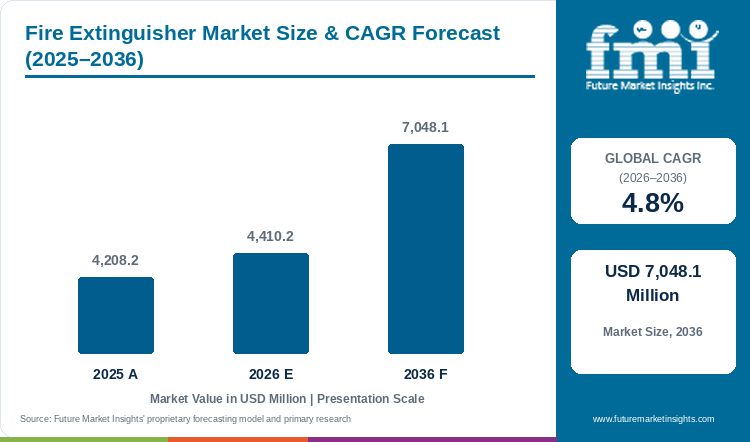
Demand combines new-building requirements with inspection, servicing and replacement of the installed base. Product conformity and changes in extinguishing agents influence this work. India's BIS issued its IS 15683:2018 amendment implementation circular in February 2025, while Suffolk's fire service called for checks on specified older foam units in July 2025. [1][2] EU Regulation 2025/1988 sets conditions and transition dates for specified PFAS firefighting-foam uses. [4] Annual maintenance also sustains the service channel, as illustrated by an OSHA citation issued in January 2026 following a 2025 inspection. [3]
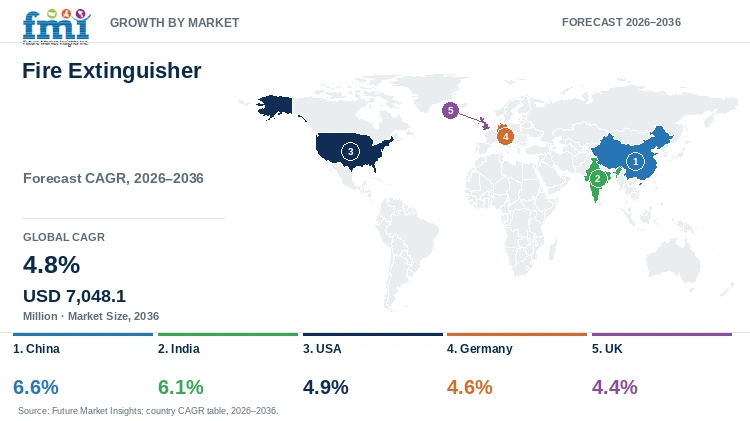
China and India lead the selected country forecasts at 6.6% and 6.1% CAGR, respectively, for 2026 to 2036. The USA follows at 4.9%, with Germany at 4.6% and the UK at 4.4% over the same period. National demand includes distinct conformity and service requirements, from Indian product documentation to the assessment of older foam equipment in UK premises and applicable European agent transitions.
Hochiki Corporation, NAFFCO FZCO, AMEREX CORPORATION, DESAUTEL SAS and Kidde form the representative competitive roster. Competition links the suitability of the rated product with access to inspection, maintenance and replacement services. Suppliers can differentiate through accurate equipment records, dependable local support and a defined process for handling removed units. Those capabilities support recurring customer relationships as building hazards, equipment condition and agent requirements change.
Key Market Trends & Insights
- Inspection and maintenance create demand beyond the initial fit-out; a January 2026 OSHA citation provides a specific example of missed annual maintenance. [3]
- Agent-transition work requires a product inventory rather than an assumption that all foam extinguishers have the same composition. [2]
- EU Regulation 2025/1988 provides separate conditions and transition dates for specified PFAS firefighting-foam uses. [4]
Regional Highlights
- China and India have the highest selected country growth estimates, at 6.6% and 6.1% for 2026 to 2036.
- The USA, Germany and UK profiles are 4.9%, 4.6% and 4.4% for the same period.
- Indian product certification and European agent-transition measures address different purchasing requirements; neither is a universal global rule. [1][4]
Market Size & Forecast
Table 1: Market Size and Forecast for Fire Extinguisher Market (USD million and percentage), 2025 to 2036
| Metric | Value |
|---|---|
| 2025 reference value | USD 4,208.21 million |
| Published 2026 market estimate | USD 4,410.2 million |
| Published 2036 market forecast | USD 7,048.1 million |
| CAGR, 2026 to 2036 | 4.8% |
| Revenue increase, 2026 to 2036 | USD 2,637.9 million |
| Market expansion, 2026 to 2036 | 1.60 times |
The 2025 figure is an estimate. Sales come through new premises, changed hazard assessments and the service needs of installed equipment. Those channels can have different buying cycles. A fit-out contractor may order several product types together, while a site manager replacing a small number of units needs continuity of protection and a service record. A supplier's commercial scope therefore extends beyond delivering cylinders to a loading bay.
The Firefighting Robots Market covers a different emergency-response equipment channel, where the procurement task extends beyond portable extinguisher placement.
An agent change starts with knowing what is already installed
An extinguisher inventory gives the owner a basis for deciding which units need service, replacement or a closer review of their contents. Product age alone is not a complete specification, but it can help identify equipment whose agent requires investigation. The Suffolk fire-service notice is a specific example involving older foam units. A separate European regulation sets conditions for PFAS firefighting foams, with different placement and use transitions. [2][4] The purchasing implication is to connect product selection with the premises' fire-risk assessment and the applicable jurisdiction, then arrange the replacement work without leaving the site unprotected.
Table 2: Industry evidence relevant to the fire extinguisher market
| Indicator | Data point or observation | Market relevance | Source |
|---|---|---|---|
| Indian conformity amendment | BIS issued its implementation circular on 18 February 2025, with a 22 March 2025 implementation deadline. | The amendment affects specified filling and test provisions under IS 15683:2018. | [1] |
| Legacy foam checks | Suffolk issued its notice on 17 July 2025, highlighting certain older or refilled foam units. | Site inventories and agent identification inform the replacement assessment. | [2] |
| Recurring maintenance | OSHA's January 2026 citation records missed annual maintenance observed in 2025. | A single enforcement record illustrates maintenance obligations; it is not an industry prevalence survey. | [3] |
Analyst Perspective
“The installed base creates a continuing purchasing task because suitability and readiness can change after the first fit-out. A useful supplier offer links the hazard assessment, product selection and service record, with a clear route for replacing a unit when its agent or condition requires attention.”
- Nikhil Kaitwade, Future Market Insights
The customer needs to know who will identify affected equipment, maintain protection during the work and record the replacement.
How is the Fire Extinguisher Market segmented?
The market is segmented by Product Type, Fire Type, End Use, and Region.
Product type identifies the extinguishing medium or construction, while fire type identifies the hazard category used in the market comparison. A water-product share is consequently not the same as the share of all equipment used for Class A risks. Selection for a premises needs the actual hazard, product rating and local requirements assessed by the responsible parties. The two chart benchmarks retain their 2026 reference year. Portable products also sit within a wider fire-protection plan, so their presence does not establish that every risk at a site has been addressed.
What keeps water extinguishers prominent in product demand?
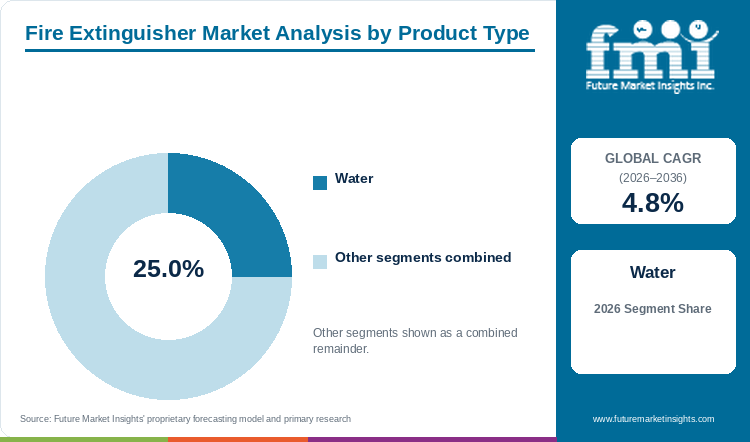
Table 3: Product Type Share for Fire Extinguisher Market (percentage share), 2026
| Product Type | Estimated share (2026) |
|---|---|
| Water | 25.0% |
| Other product types | 75.0% |
| Total | 100.0% |
Table 4: Segment Position and Market Growth for Fire Extinguisher Market, 2026 to 2036
| Metric | Value |
|---|---|
| Global CAGR (2026 to 2036) | 4.8% |
| Profiled product type segment | Water |
Water extinguishers represent around 25.0% of product demand in the 2026 market benchmark. Their role in ordinary solid-combustible risks gives them a recurring place in building equipment schedules, but the category should not be treated as a universal choice for every hazard. A purchaser needs the product rating, location and intended users assessed as part of the premises' protection plan. The service arrangement also matters: equipment must remain identifiable, accessible and maintained after installation. A procurement specification can therefore include marking, mounting arrangements and the inspection record as well as the cylinder itself. For suppliers, the useful commercial comparison concerns an equivalent rated product and continuing service scope, rather than a broad water-product label that leaves the operating context unspecified.
The Water segment is estimated to account for 25.0% of product type demand in 2026.
- Water extinguishers account for around 25.0% of product demand in 2026; other product types together represent around 75.0%.
- Product suitability, location and service requirements need to fit the premises and its assessed hazards.
Why does Class A lead the fire-type comparison?
Table 5: Fire Type Share for Fire Extinguisher Market (percentage share), 2026
| Fire Type | Estimated share (2026) |
|---|---|
| Class A | 33.2% |
| Other fire types | 66.8% |
| Total | 100.0% |
Class A accounts for an estimated 33.2% of fire-type demand in 2026. Buildings and workplaces contain ordinary solid combustibles, but the complete hazard assessment may also identify other risks requiring a different product or protection arrangement. Purchasers should therefore distinguish the leading market category from the specification for an individual area. Replacement work also needs to preserve the approved arrangement rather than substitute a cheaper product with a similar cylinder size. The OSHA enforcement record illustrates why continuing maintenance belongs in the procurement assessment, although one cited establishment cannot establish the prevalence of failures across the market. [3] Suppliers can support buyers by making rating, service history and replacement responsibilities easy to compare before the owner commits to a maintenance contract.
The Class A segment is estimated to account for 33.2% of fire type demand in 2026.
- Class A represents an estimated 33.2% of fire-type demand in 2026; other fire types together represent 66.8%.
- A building can contain several hazard types, so the leading market category does not determine every installed product.
- The Fire Hydrant System Market provides adjacent coverage of fixed water-supply infrastructure within wider site protection planning.
What are the drivers, restraints, and opportunities in the Fire Extinguisher Market?
New installations and recurring service support purchases; hazard suitability and agent requirements constrain substitution; inventory-led replacement and documented maintenance strengthen customer support.
Driver
New premises create initial equipment requirements, while occupied buildings generate inspection, service and replacement work. The latter channel can continue even when construction slows because an installed extinguisher remains part of the site's fire-protection arrangements. An OSHA citation issued in January 2026 documents a specific failure to complete annual maintenance, showing the kind of service obligation involved. [3] Product conformity creates another purchasing consideration. BIS's 2025 amendment implementation circular addresses a defined Indian standard and its test and filling provisions. [1] For a supplier, these different demand channels require both appropriate products and a service process that the site owner can use after the initial installation.
Restraint
Substitution is constrained by the hazard and product requirements. A unit that looks similar can have a different agent, rating or service procedure, so cylinder price alone cannot settle the purchase. Agent transitions add another assessment task: owners need to identify existing contents, applicable dates and disposal arrangements before replacing equipment. The European 2025 foam regulation distinguishes several substances, uses and transitional conditions. [4] A blanket statement that every foam unit is immediately prohibited would obscure those differences. The purchasing programme needs a jurisdiction-specific review and a plan to maintain the intended protection while affected products are being removed or replaced.
Opportunity
Suppliers and service firms can make agent-transition work easier by connecting the site inventory with the product and service records. Suffolk's July 2025 notice asked owners to check specified older foam equipment rather than assume all units were equivalent. [2] That creates a practical role for inspection, identification and an agreed replacement schedule. A bid can also define how removed units and their contents will be handled, within the applicable requirements. The wider opportunity is recurring support: a customer needs reliable access to suitable replacement products, clear documentation and a record of completed work, rather than a one-off shipment whose maintenance responsibilities remain unclear.
Building owners may also procure fixed suppression systems. The Fire Sprinkler System Market covers that related equipment setting, with a different installation and maintenance scope.
Which country CAGRs are profiled in the Fire Extinguisher Market?
Table 6: Country CAGR Comparison for Fire Extinguisher Market (CAGR percentage), 2026 to 2036
| Country | CAGR |
|---|---|
| China | 6.6% |
| India | 6.1% |
| USA | 4.9% |
| Germany | 4.6% |
| UK | 4.4% |
Country-wise Analysis
China Fire Extinguisher Market Outlook (2026 to 2036)
A large new-building order and a maintenance contract for existing premises create different sales opportunities. China's FMI fire extinguisher profile carries a CAGR of 6.6% for 2026 to 2036, the highest of the selected country estimates. New installations need a product schedule suited to the building's assessed risks, while service orders begin with the units already in place and their records. A supplier can make both channels more useful by keeping product identification, spare parts and service responsibilities clear. The country forecast does not establish a single agent mix across all premises. Purchasers still need equivalent ratings and a workable inspection arrangement when comparing offers, especially where a contractor supplies equipment but another firm will maintain it after handover.
India Fire Extinguisher Market Outlook (2026 to 2036)
Product conformity is a concrete purchasing issue in India. BIS's February 2025 implementation circular revised provisions associated with IS 15683:2018, including filling and test requirements for the products within its scope. [1] A buyer needs the supplied model and relevant documentation assessed against the applicable requirements, alongside the premises' hazard and service arrangements. That work differs from simply choosing the lowest price in a product category. A supplier can support acceptance by identifying the exact product, its rating and the documents accompanying the shipment. Maintenance access then affects the continuing relationship, because a compliant initial supply still needs a suitable process for inspection, repair or replacement at the operating site.
USA Fire Extinguisher Market Outlook (2026 to 2036)
The US demand discussion includes continuing service as well as new installations. A January 2026 OSHA citation documented missed annual extinguisher maintenance observed during a 2025 inspection. [3] It is a specific enforcement example, not a survey of all workplaces. FMI's USA growth estimate is 4.9% for 2026 to 2036. Buyers can use such operating requirements to define a maintenance contract with clear records, responsibilities and response arrangements. They also need the product selection to fit the assessed hazards rather than assume one extinguisher type covers every area. Suppliers competing for recurring contracts therefore need both suitable equipment and a service organisation capable of completing the agreed work. The equipment quote and the later inspection scope should be assessed together before the owner awards the package.
Germany Fire Extinguisher Market Outlook (2026 to 2036)
Agent-transition planning adds a distinct task for purchasers in Germany. EU Regulation 2025/1988 sets conditions for specified PFAS firefighting-foam uses, with separate transitional arrangements for placement on the market and continuing use. [4] That framework requires a careful assessment of the product and relevant application rather than a blanket assumption about every foam extinguisher. FMI's country forecast is 4.6% for 2026 to 2036. Owners planning replacements need the existing agent identified and an appropriate alternative selected within the wider fire-protection assessment. A service offer becomes more useful when it covers the records, replacement schedule and handling of removed equipment. This allows the customer to budget the complete transition work while keeping the intended protection available throughout the programme.
UK Fire Extinguisher Market Outlook (2026 to 2036)
Suffolk's fire service called for checks on certain older foam extinguishers in July 2025, drawing attention to PFOA-containing equipment and units manufactured or refilled before 2016. [2] The notice provides a specific UK service context, while FMI's national market outlook assigns a CAGR of 4.4% for 2026 to 2036. Building owners need to establish what is installed before deciding the replacement scope. A supplier that can inspect the inventory, identify the relevant contents and document the new product gives the customer a clearer purchasing route. The replacement also needs to suit the assessed hazard and existing protection plan. Recurring maintenance remains a separate responsibility after the transition, so a low equipment price should be compared with the service and record-keeping included in the complete offer.
Who are the notable companies in the Fire Extinguisher Market?
Hochiki Corporation; NAFFCO FZCO; AMEREX CORPORATION; DESAUTEL SAS; Kidde
The market coverage includes Hochiki, NAFFCO, AMEREX, DESAUTEL and Kidde among representative participants. A company name does not establish that every product in its portfolio is suitable for the same fire risk or jurisdiction. Buyers need the proposed model, rating and service scope identified before comparing price. The table therefore distinguishes representative product areas from the questions a purchaser needs to resolve. The comparison assesses the specified product and the service responsibilities relevant to the purchaser.
Competitive Benchmarking: Fire Extinguisher Market
Table 7: Competitive positioning for the fire extinguisher market
| Company | Positioning | Buyer comparison focus |
|---|---|---|
| Hochiki Corporation | Fire-safety equipment | Confirm the extinguisher model and local service support within the offer. |
| NAFFCO FZCO | Fire-protection equipment | Compare rated products and the maintenance responsibilities included in the supply. |
| AMEREX CORPORATION | Portable fire extinguishers | Match agent, rating and service requirements with the assessed hazard. |
| DESAUTEL SAS | Fire-protection equipment and services | Clarify installation, inspection and replacement work in the proposed service package. |
| Kidde | Fire-safety equipment | Check the exact product rating, marking and continuing maintenance route. |
Key Developments in the Fire Extinguisher Market
- BIS issued its IS 15683:2018 amendment implementation circular in February 2025. [1]
- Suffolk published its older-foam-extinguisher check notice in July 2025. [2]
- The European Commission adopted Regulation 2025/1988 on 2 October 2025. [4]
Key Players in the Fire Extinguisher Market
Fire-safety equipment
- Hochiki Corporation
- Kidde
Fire-protection equipment
- NAFFCO FZCO
Portable fire extinguishers
- AMEREX CORPORATION
Fire-protection equipment and services
- DESAUTEL SAS
Fire Extinguisher Market Report Scope
Table 8: Report Scope for Fire Extinguisher Market, 2026 to 2036
| Coverage field | Report scope |
|---|---|
| Market definition | Fire extinguishers purchased for installation, replacement and relevant service requirements. |
| Units | USD million; percentage |
| Forecast | Published 2026 and 2036 values; 4.8% CAGR for 2026 to 2036. |
| 2025 reference | Reference value using the published annual growth assumption. |
| Charted shares | Water product type and Class A fire type, both 2026. |
| Country profiles | China; India; USA; Germany; UK, 2026 to 2036. |
| Representative companies | Hochiki Corporation; NAFFCO FZCO; AMEREX CORPORATION; DESAUTEL SAS; Kidde |
Fire Extinguisher Market Research Methodology
Table 9: Research Methodology for Fire Extinguisher Market, 2026 edition
| Method | Approach |
|---|---|
| Market forecast | Published FMI 2026/2036 values and CAGR provide the revenue outlook. |
| Reference estimate | The 2025 reference uses the 2026 value and the same annual growth assumption. |
| Share benchmarks | Product and fire type are independent 2026 breakdowns. |
| Country forecasts | Five published country rates retain 2026 to 2036. |
| Public evidence | Indian standards implementation, UK fire-service advice, US enforcement and EU regulation inform purchasing analysis. |
| Company assessment | Model suitability and service responsibilities provide the company comparison criteria. |
Fire Extinguisher Market by Segments
Fire Extinguisher Market segmented by Product Type:
- Water
- Foam
- Wet Chemical
- Dry Powder
- Carbon Dioxide
- Dry Chemical
- Other
Fire Extinguisher Market segmented by Fire Type:
- Class A
- Class B
- Class C
- Class D
- and Class K
Fire Extinguisher Market segmented by End Use:
- Residential
- Commercial
- Industrial
- Public Areas
- Others
Fire Extinguisher Market by Region
- North America
- United States
- Canada
- Mexico
- Latin America
- Brazil
- Argentina
- Western Europe
- Germany
- Italy
- France
- United Kingdom
- Spain
- BENELUX
- Nordic countries
- Eastern Europe
- Poland
- Hungary
- Romania
- Czech Republic
- East Asia
- China
- Japan
- South Korea
- South Asia and Pacific
- India
- ASEAN
- Australia
- New Zealand
- Middle East and Africa
- Saudi Arabia
- United Arab Emirates
- Turkiye
- Israel
Research Sources and Bibliography
- [1] Bureau of Indian Standards. 18 February 2025. Guidelines for implementation of Amendment No. 1 to IS 15683:2018
- [2] Suffolk County Council / Suffolk Fire and Rescue Service. 17 July 2025. Suffolk Fire and Rescue Service calls for urgent fire extinguisher checks in non-domestic and higher-risk premises
- [3] US Occupational Safety and Health Administration. 7 January 2026 citation; 2025 inspection. Inspection 1841330.015, citation 01001: portable fire-extinguisher maintenance
- [4] European Commission / Official Journal of the European Union. 3 October 2025. Commission restricts the use of forever chemicals in firefighting foams
This Report Answers
- What is the 2026 fire extinguisher market estimate?
- What is the 2036 market forecast?
- How does the installed base affect purchases?
- Which product category leads?
- Which fire type leads?
- Which selected country has the highest growth forecast?
Frequently Asked Questions
What is the 2026 fire extinguisher market estimate?
FMI estimates USD 4,410.2 million in 2026.
What is the 2036 market forecast?
FMI projects USD 7,048.1 million in 2036, with 4.8% CAGR for 2026 to 2036.
How does the installed base affect purchases?
Installed equipment creates continuing inspection, maintenance and replacement requirements alongside demand from new premises.
Which product category leads?
Water extinguishers represent around 25.0% of product demand in 2026.
Which fire type leads?
Class A accounts for an estimated 33.2% of fire-type demand in 2026.
Which selected country has the highest growth forecast?
China has the highest selected rate, at 6.6% for 2026 to 2036.
Preview the report firsthand - request a free sample
Get SampleGet the brochure for pricing and purchase details.
Get PDFTable of Content
- Key Takeaways
- Market Size and CAGR
- Top Growth Driver
- Fastest Growing Segment
- Leading Region
- Key Companies
- Emerging Opportunities
- Executive Summary
- Global Market Outlook
- Demand-side Trends
- Supply-side Trends
- Technology Roadmap Analysis
- Analysis and Recommendations
- Analyst Perspective (What is happening? Why now? What should investors know?)
- Key Questions Answered
- How large is the market?
- What is the CAGR?
- What are key trends?
- Which region dominates?
- Who are the leaders?
- Market Overview
- Market Coverage / Taxonomy
- Market Definition / Scope / Limitations
- Research Methodology
- Chapter Orientation
- Analytical Lens and Working Hypotheses
- Market Structure, Signals, and Trend Drivers
- Benchmarking and Cross-market Comparability
- Market Sizing, Forecasting, and Opportunity Mapping
- Research Design and Evidence Framework
- Desk Research Programme (Secondary Evidence)
- Expert Input and Fieldwork (Primary Evidence)
- Tooling, Models, and Reference Databases
- Data Engineering and Model Build
- Quality Assurance and Audit Trail
- Market Background
- Market Dynamics (Drivers, Restraints, Opportunity, Trends)
- Scenario Forecast (Optimistic, Likely, Conservative)
- Impact Analysis
- AI Impact
- Sustainability Impact
- Regulatory Impact
- Technology Impact
- Consumer / Buyer Analysis
- Purchase Drivers
- Adoption Barriers
- Buyer Journey
- Opportunity Map Analysis
- Product Life Cycle Analysis
- Supply Chain Analysis
- Investment Feasibility Matrix
- Value Chain Analysis
- PESTLE and Porter's Analysis
- Regulatory Landscape
- Regional Parent Market Outlook
- Production and Consumption Statistics
- Import and Export Statistics
- Global Market Analysis and Forecast, 2021 to 2036
- Historical Market Size Value (USD Million) Analysis, 2021 to 2025
- Current and Future Market Size Value (USD Million) Projections, 2026 to 2036
- Y-o-Y Growth Trend Analysis
- Absolute $ Opportunity Analysis
- Global Market Pricing Analysis, 2021 to 2036
- Global Market Analysis and Forecast, By Product Type, 2021 to 2036
- Introduction / Key Findings
- Historical Market Size Value (USD Million) Analysis By Product Type, 2021 to 2025
- Current and Future Market Size Value (USD Million) Analysis and Forecast By Product Type, 2026 to 2036
- Water
- Foam
- Wet Chemical
- Dry Powder
- Carbon Dioxide
- Dry Chemical
- Other
- Y-o-Y Growth Trend Analysis By Product Type, 2021 to 2025
- Absolute $ Opportunity Analysis By Product Type, 2026 to 2036
- Global Market Analysis and Forecast, By Fire Type, 2021 to 2036
- Introduction / Key Findings
- Historical Market Size Value (USD Million) Analysis By Fire Type, 2021 to 2025
- Current and Future Market Size Value (USD Million) Analysis and Forecast By Fire Type, 2026 to 2036
- Class A
- Class B
- Class C
- Class D
- and Class K
- Y-o-Y Growth Trend Analysis By Fire Type, 2021 to 2025
- Absolute $ Opportunity Analysis By Fire Type, 2026 to 2036
- Global Market Analysis and Forecast, By End Use, 2021 to 2036
- Introduction / Key Findings
- Historical Market Size Value (USD Million) Analysis By End Use, 2021 to 2025
- Current and Future Market Size Value (USD Million) Analysis and Forecast By End Use, 2026 to 2036
- Residential
- Commercial
- Industrial
- Public Areas
- Others
- Y-o-Y Growth Trend Analysis By End Use, 2021 to 2025
- Absolute $ Opportunity Analysis By End Use, 2026 to 2036
- Global Market Analysis and Forecast, By Region, 2021 to 2036
- Introduction
- Historical Market Size Value (USD Million) Analysis By Region, 2021 to 2025
- Current Market Size Value (USD Million) Analysis and Forecast By Region, 2026 to 2036
- North America
- Latin America
- Western Europe
- Eastern Europe
- East Asia
- South Asia and Pacific
- Middle East and Africa
- Market Attractiveness Analysis By Region
- North America Market Analysis and Forecast, By Country, 2021 to 2036
- Historical Market Size Value (USD Million) Trend Analysis By Market Taxonomy, 2021 to 2025
- Market Size Value (USD Million) Forecast By Market Taxonomy, 2026 to 2036
- By Country
- United States
- Canada
- Mexico
- By Product Type
- By Fire Type
- By End Use
- By Country
- Market Attractiveness Analysis
- By Country
- By Product Type
- By Fire Type
- By End Use
- Key Takeaways
- Latin America Market Analysis and Forecast, By Country
- Historical Market Size Value (USD Million) Trend Analysis By Market Taxonomy, 2021 to 2025
- Market Size Value (USD Million) Forecast By Market Taxonomy, 2026 to 2036
- By Country
- Brazil
- Argentina
- By Product Type
- By Fire Type
- By End Use
- By Country
- Market Attractiveness Analysis
- By Country
- By Product Type
- By Fire Type
- By End Use
- Key Takeaways
- Western Europe Market Analysis and Forecast, By Country
- Historical Market Size Value (USD Million) Trend Analysis By Market Taxonomy, 2021 to 2025
- Market Size Value (USD Million) Forecast By Market Taxonomy, 2026 to 2036
- By Country
- Germany
- Italy
- France
- United Kingdom
- Spain
- BENELUX
- Nordic countries
- By Product Type
- By Fire Type
- By End Use
- By Country
- Market Attractiveness Analysis
- By Country
- By Product Type
- By Fire Type
- By End Use
- Key Takeaways
- Eastern Europe Market Analysis and Forecast, By Country
- Historical Market Size Value (USD Million) Trend Analysis By Market Taxonomy, 2021 to 2025
- Market Size Value (USD Million) Forecast By Market Taxonomy, 2026 to 2036
- By Country
- Poland
- Hungary
- Romania
- Czech Republic
- By Product Type
- By Fire Type
- By End Use
- By Country
- Market Attractiveness Analysis
- By Country
- By Product Type
- By Fire Type
- By End Use
- Key Takeaways
- East Asia Market Analysis and Forecast, By Country
- Historical Market Size Value (USD Million) Trend Analysis By Market Taxonomy, 2021 to 2025
- Market Size Value (USD Million) Forecast By Market Taxonomy, 2026 to 2036
- By Country
- China
- Japan
- South Korea
- By Product Type
- By Fire Type
- By End Use
- By Country
- Market Attractiveness Analysis
- By Country
- By Product Type
- By Fire Type
- By End Use
- Key Takeaways
- South Asia and Pacific Market Analysis and Forecast, By Country
- Historical Market Size Value (USD Million) Trend Analysis By Market Taxonomy, 2021 to 2025
- Market Size Value (USD Million) Forecast By Market Taxonomy, 2026 to 2036
- By Country
- India
- ASEAN
- Australia
- New Zealand
- By Product Type
- By Fire Type
- By End Use
- By Country
- Market Attractiveness Analysis
- By Country
- By Product Type
- By Fire Type
- By End Use
- Key Takeaways
- Middle East and Africa Market Analysis and Forecast, By Country
- Historical Market Size Value (USD Million) Trend Analysis By Market Taxonomy, 2021 to 2025
- Market Size Value (USD Million) Forecast By Market Taxonomy, 2026 to 2036
- By Country
- Saudi Arabia
- United Arab Emirates
- Turkiye
- Israel
- By Product Type
- By Fire Type
- By End Use
- By Country
- Market Attractiveness Analysis
- By Country
- By Product Type
- By Fire Type
- By End Use
- Key Takeaways
- Key Countries Market Analysis
- United States
- Pricing Analysis
- Market Share Analysis, 2025
- By Product Type
- By Fire Type
- By End Use
- Canada
- Pricing Analysis
- Market Share Analysis, 2025
- By Product Type
- By Fire Type
- By End Use
- Mexico
- Pricing Analysis
- Market Share Analysis, 2025
- By Product Type
- By Fire Type
- By End Use
- Brazil
- Pricing Analysis
- Market Share Analysis, 2025
- By Product Type
- By Fire Type
- By End Use
- Germany
- Pricing Analysis
- Market Share Analysis, 2025
- By Product Type
- By Fire Type
- By End Use
- United Kingdom
- Pricing Analysis
- Market Share Analysis, 2025
- By Product Type
- By Fire Type
- By End Use
- Italy
- Pricing Analysis
- Market Share Analysis, 2025
- By Product Type
- By Fire Type
- By End Use
- Spain
- Pricing Analysis
- Market Share Analysis, 2025
- By Product Type
- By Fire Type
- By End Use
- France
- Pricing Analysis
- Market Share Analysis, 2025
- By Product Type
- By Fire Type
- By End Use
- India
- Pricing Analysis
- Market Share Analysis, 2025
- By Product Type
- By Fire Type
- By End Use
- ASEAN
- Pricing Analysis
- Market Share Analysis, 2025
- By Product Type
- By Fire Type
- By End Use
- China
- Pricing Analysis
- Market Share Analysis, 2025
- By Product Type
- By Fire Type
- By End Use
- Japan
- Pricing Analysis
- Market Share Analysis, 2025
- By Product Type
- By Fire Type
- By End Use
- South Korea
- Pricing Analysis
- Market Share Analysis, 2025
- By Product Type
- By Fire Type
- By End Use
- Poland
- Pricing Analysis
- Market Share Analysis, 2025
- By Product Type
- By Fire Type
- By End Use
- Hungary
- Pricing Analysis
- Market Share Analysis, 2025
- By Product Type
- By Fire Type
- By End Use
- United States
- Market Structure Analysis
- Competition Dashboard
- Competition Benchmarking
- Market Share Analysis of Top Players
- By Regional
- By Product Type
- By Fire Type
- By End Use
- Emerging Startups
- Innovation Benchmarking
- Competition Analysis
- Competition Deep Dive
- Hochiki Corporation
- Overview
- Product Portfolio
- Profitability by Market Segments
- Sales Footprint
- Strategy Overview
- Marketing Strategy
- Product Strategy
- Channel Strategy
- NAFFCO FZCO
- AMEREX CORPORATION
- DESAUTEL SAS
- Kidde
- Hochiki Corporation
- Case Studies
- Success Stories
- Recent Developments
- Competition Deep Dive
- Assumptions & Acronyms Used


