

- Industry Size (2025)
- USD 2.1 Bn
- Forecast (2035)
- USD 2.7 Bn
- CAGR (2025 to 2035)
- 2.5%
Flex Pack Coating Market Outlook from 2025 to 2035
The Flex Pack Coating market is witnessing steady growth driven by increasing demand for protective and functional coatings in the packaging industry, particularly in food and beverages. The future outlook for this market is shaped by ongoing innovations in coating formulations that enhance barrier properties, durability, and safety while ensuring compliance with regulatory standards. Rising consumer awareness regarding product freshness, safety, and shelf life is encouraging the adoption of advanced coatings that prevent contamination and extend product longevity.
Additionally, the shift towards flexible packaging solutions in both developed and emerging markets is fueling the demand for coatings that provide superior adhesion and compatibility with diverse substrates. Continuous investments in research and development for eco-friendly and sustainable coating solutions further support market expansion.
The growing importance of brand protection and aesthetic appeal in consumer goods packaging also contributes to the adoption of functional coatings As packaging requirements evolve with changing consumer preferences and regulatory mandates, the Flex Pack Coating market is expected to sustain strong growth in the coming years.
Quick Stats for Flex Pack Coating Market
- Flex Pack Coating Market Industry Value (2025): USD 2.1 billion
- Flex Pack Coating Market Forecast Value (2035): USD 2.7 billion
- Flex Pack Coating Market Forecast CAGR: 2.5%
- Leading Segment in Flex Pack Coating Market in 2025: Epoxy Coatings (25.0%)
- Key Growth Region in Flex Pack Coating Market: North America, Asia-Pacific, Europe
- Top Key Players in Flex Pack Coating Market: Uflex Ltd, FPS Pty Ltd, Innovative FlexPak LLC, Flex Film Ltd, LEIPA Georg Leinfelder GmbH, Balmer Lawrie & Co. Ltd, Amcor Plc, Sigma Plastics Group, Sealed Air Corp, Berry Plastics Corp., DuPont Co., Winpak Ltd
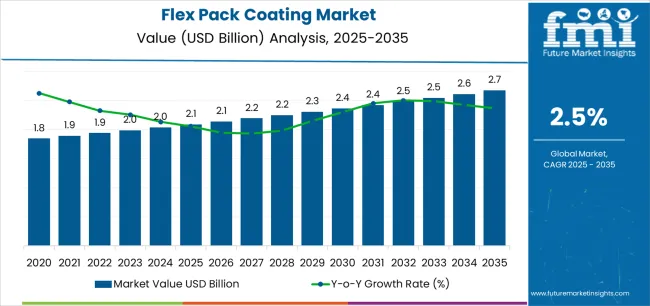
| Metric | Value |
|---|---|
| Flex Pack Coating Market Estimated Value in (2025 E) | USD 2.1 billion |
| Flex Pack Coating Market Forecast Value in (2035 F) | USD 2.7 billion |
| Forecast CAGR (2025 to 2035) | 2.5% |
Segmental Analysis
The market is segmented by Coating Type, Substrate, and End Use and region. By Coating Type, the market is divided into Epoxy Coatings, Acrylic Coatings, Urethane And Polyurethane Coatings, Lacquer Coatings, Plasma Coatings, Polyesters Coatings, Phenolic Coatings, and Others. In terms of Substrate, the market is classified into Polyethylene (PE), Polypropylene (PP), Polyethylene Terephthalate (PET), Polyamide (PA), Poly Vinyl Chloride (PVC), and Polystyrene (PS). Based on End Use, the market is segmented into Food And Beverages, Pharmaceuticals, Cosmetic And Personal Care, Chemicals, Electrical And Electronics, Automotive, and Other Industries. Regionally, the market is classified into North America, Latin America, Western Europe, Eastern Europe, Balkan & Baltic Countries, Russia & Belarus, Central Asia, East Asia, South Asia & Pacific, and the Middle East & Africa.
Insights into the Epoxy Coatings Segment
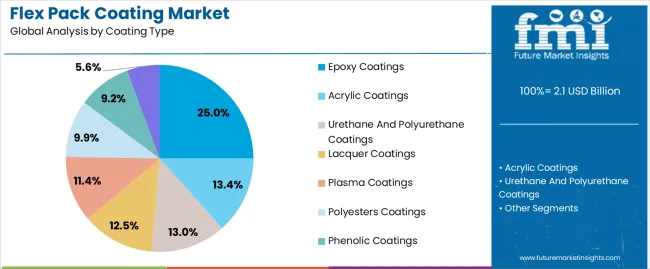
The epoxy coatings segment is projected to hold 25.0% of the Flex Pack Coating market revenue share in 2025, positioning it as the leading coating type. The growth of this segment is driven by the excellent chemical resistance, adhesion, and durability offered by epoxy formulations, making them highly suitable for high-performance packaging applications. The ability of epoxy coatings to withstand moisture, heat, and mechanical stress ensures protection of packaged goods throughout the supply chain.
Additionally, their compatibility with different substrates allows for broad adoption across various packaging formats. Ongoing advancements in epoxy formulations have improved application efficiency and performance, further strengthening their market position.
Increasing demand from industries prioritizing food safety, shelf life extension, and product protection has reinforced the adoption of epoxy coatings The combination of performance, versatility, and regulatory compliance continues to drive the dominance of epoxy coatings in the Flex Pack Coating market.
Insights into the Polyethylene Substrate Segment
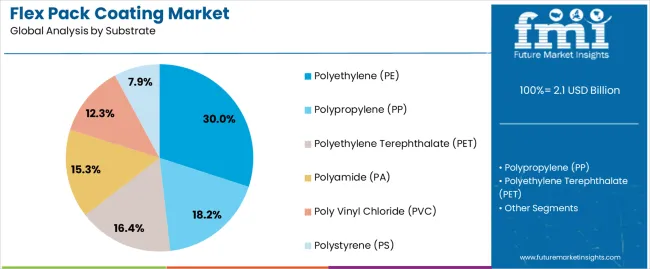
The polyethylene substrate segment is expected to account for 30.0% of the Flex Pack Coating market revenue share in 2025, establishing it as the leading substrate type. This segment has been driven by the widespread use of polyethylene in flexible packaging due to its lightweight, cost-effectiveness, and moisture barrier properties. The compatibility of polyethylene with various coating formulations, including epoxy coatings, enhances its functional performance in protecting packaged products.
The growing preference for flexible and recyclable packaging solutions has further fueled the adoption of polyethylene substrates. Additionally, advancements in surface treatment and coating technologies have improved adhesion and barrier performance, supporting the continued growth of this segment.
Increasing demand from the food and beverage industry, coupled with rising consumer expectations for product quality and safety, has reinforced polyethylene’s dominant position in the market The versatility and reliability of polyethylene make it a preferred choice for manufacturers seeking high-performance coated packaging solutions.
Insights into the Food and Beverages End-Use Segment
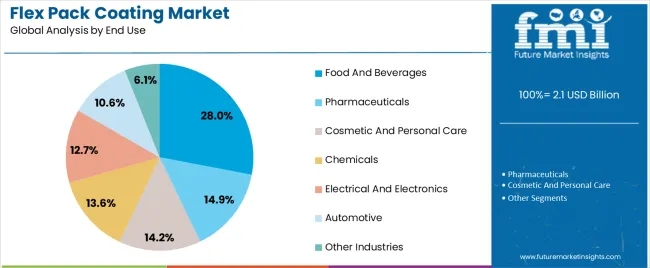
The food and beverages end-use segment is anticipated to account for 28.0% of the Flex Pack Coating market revenue in 2025, making it the leading end-use industry. The growth of this segment is driven by the critical need for packaging solutions that maintain product freshness, safety, and shelf life. Coatings applied to packaging materials help prevent contamination, provide barrier protection against moisture and oxygen, and enhance the overall durability of packaging.
Increasing consumer awareness about food safety and the rising demand for convenience and ready-to-eat products have contributed to higher adoption of coated flexible packaging. The segment’s growth is further supported by regulatory emphasis on food-grade materials and sustainable packaging practices.
Additionally, the ability of coated flexible packaging to preserve flavor, aroma, and quality while supporting branding and aesthetic appeal has reinforced its market share As food and beverage producers continue to prioritize product integrity and compliance, the demand for advanced flex pack coatings in this sector is expected to remain strong.
Semi Annual Market Update
The demand for flex coatings is predicted to fluctuate at a CAGR based on multiple semi-annual periods from 2025 to 2035 in the following table. The industry is estimated to grow at a CAGR of 2.6% in the first half (H1) of the decade from 2025 to 2035, and 2.3% in the second half (H2) of the same decade, reflecting a lean degradation.
| Particular | Value CAGR |
|---|---|
| H1 | 2.6% (2025 to 2035) |
| H2 | 2.3% (2025 to 2035) |
| H1 | 2.8% (2025 to 2035) |
| H2 | 2.3% (2025 to 2035) |
Over the subsequent decade, the growth trajectory of the flex pack coating industry is anticipated to alter slightly. It is predicted that in the first half (H1) of the term, the CAGR will upsurge somewhat from 2.3% to 2.8%. After that, a forfeiture is expected to occur in the second half (H2) at a CAGR of 2.3%.
According to this industry trend, the CAGR will drop by 50 basis points in H2 after dropping by 30 basis points in H1. Industry analysts credit a number of causes for the change, including the expensive costing of the packaging process to have historical packaging in H1, which might have affected demand. On the other hand, modifications to the H2 industry or improvements to flex coating might propel the market.
Key Industry Highlights
Enlargements in Advanced Coatings Swell Growth in the Industry
On account of continuous barrier coating innovations that improve the performance parameters of flexible packaging paper, the demand for flex pack coverings is seeing notable growth. The shelf life of packaged items has been extended by these developments because they have enhanced capacity to tolerate moisture, oxygen, and other environmental forces.
Companies are getting a competitive edge by providing packaging solutions that satisfy the strict quality control and preservation criteria demanded by diverse sectors by employing the state-of-the-art flex coatings. Which meets the rising customer demand for premium, long-lasting packaging while also securing the preservation of product integrity. Hence, for companies trying to stand out from the competition and provide better products, the flex pack coatings industry is becoming more and more important.
With the continuous evolution of barrier technologies, the market is poised for further growth, driving innovation and setting new benchmarks in packaging performance.
Adoption of Biodegradable and Compostable Materials Rises the Sales
Significant industry developments are being triggered by the growing popularity of compostable and biodegradable materials in the flex pack coatings market. Businesses are extensively spending on research and development to create novel packaging solutions that disintegrate biologically to fulfill the growing customer demand for eco-friendly products.
Businesses may position themselves as pioneers in sustainability and comply with changing legislative requirements by including these sustainable materials in their flex pack coatings. Customers who care about the environment and like to buy from businesses that show a commitment to green practices are expected to be more loyal to the brand as a result of such calculated action.
The industry focus is on biodegradable and compostable options that minimize environmental impact even as product performance remains high. An anticipated result of such a shift will be the dictation of future trends in green packaging, thereby setting new benchmarks for sustainability within the market itself.
Ban on Plastic Packing Is Likely To Hamper the Demand
The environmental effects of plastic waste produced by the extensive use of flex pack coatings are alarming regulatory authorities throughout the globe, which poses a serious threat to the flex pack coverings industry. Furthermore, demand may decline due to flexible packaging's inferior capacity to protect goods from physical hazards as compared to rigid packaging.
Furthermore, the demand for flex pack coatings may be restricted in its growth by the possible interactions of flex pack varnish materials, especially with reactive goods. Manufacturers are anticipated to develop novel improvements in packaging operations such as utilization of sustainable materials. The ban on plastic materials is estimated to plummet the flex coating sector in the forthcoming decade.
Flex Pack Coating Demand Analysis 2020 to 2024 and Forecast 2025 to 2035
The global demand for flex pack layering is projected to register a CAGR of 1.9% between 2020 and 2025, reaching a total of USD 1,969.8 million in 2025.
With more emphasis being placed on retrofitting buildings and updating insulation systems to meet energy efficiency regulations, the customer base for flex coatings is anticipated to augment in the projected period. The novel accumulation in different sectors is estimated to result in considerable demand for flexible insulation materials for smooth installation and retrofitting.
The use of these sophisticated materials is further propelled by government initiatives and programs that support energy saving and minimize greenhouse gas emissions.
Governments promote a broad usage of flexible insulation materials by providing incentives, subsidies, and refunds for energy-efficient building modifications and insulation installations. It is anticipated that the packaging sector will depend heavily on the flex coatings market to meet its sustainability and energy efficiency targets.
Companies investing in innovative flex pack coatings for insulation are not only capitalizing on these growth opportunities but also contributing to a greener, more energy-efficient future.
The novel trends are propelling the flex pack coating market towards a projected CAGR of 2.5% from 2025 to 2035. The shift translates to an incremental opportunity of USD 2,607.2 million over the subsequent decade. Future developments in design, functionality, and material science are anticipated as the industry develops to secure flex layering' place as a vital initial protective packing.
Market Concentration
Tier 1 firms in the packaging sector include Amcor plc, Sealed Air Corp., Berry Global Inc., and DuPont Co. They are industry leaders known for their considerable market presence and widespread awareness. A small number of these firms are leaders in providing creative and dependable sustainable packaging solutions with a global reach, while a smaller number focus on producing high-quality plastic packaging goods that serve a variety of industries.
Packaging industry Tier 2 firms, such as Uflex Ltd., Winpak Ltd., Sigma Plastics Group, and LEIPA Georg Leinfelder GmbH, are becoming more important due to their innovative, customized products and low pricing. To satisfy changing customer needs, the companies are utilizing sustainable practices and cutting-edge technology. Their ability to effectively compete with larger organizations, along with their dedication to quality and strong regional presence, has allowed them to extend their revenue share and impact.
Tier 3 packaging companies, including FPS Pty Ltd, Innovative FlexPak LLC, Flex Film Ltd, and Balmer Lawrie & Co. Ltd, specialize in particular aspects of the business by offering specialized and unique packaging solutions. They place a strong emphasis on creative design, flexibility, and personalized customer care to differentiate themselves. They are gaining traction and building a loyal customer base by meeting the needs of certain sectors and small enterprises.
Country-wise Insights
The market study for flex pack coating in each of the several countries may be found in the section that follows. With a projected 2.5% CAGR until 2035, Spain is going to stay to lead the European industry. In the Asia Pacific area, India is envisioned to post a CAGR of 4.6% by 2035, while China's economy is anticipated to show a CAGR of 4.2%.
| Countries | Value CAGR (2025 to 2035) |
|---|---|
| United States | 1.3% |
| Canada | 1.0% |
| France | 2.0% |
| Spain | 2.5% |
| India | 4.6% |
| China | 4.2% |
Demand for Flex Coating Paves the Way for Sustainable Packaging in Spain
The demand for flex pack coatings in Spain is dynamic as it is characterized by innovation and sustainability. As part of the broader European industry, Spain contributes significantly, capturing a lion's share in 2025. By 2035, the demand is anticipated to exhibit a CAGR of 2.5%.
The coatings are paramount in enhancing flexible packaging paper performance and ensuring product integrity during transportation and storage. By creating barriers against moisture, gas, and UV light, flex pack coatings extend shelf life. In Spain, demand is influenced by sectors including electronics, food & beverage, pharmaceutical, and cosmetics.
The outlook for flex pack coatings in Spain is changing because of consumer demand for eco-friendly packaging and longer delivery cycles. Providing businesses that put quality, preservation, and environmental responsibility first a competitive edge.
China’s Emerging E-commerce Sector Hits the Roof with Flex Coating
The demand for flex pack coatings in China, a pivotal player in the global packaging sector, exhibits robust dynamics. By 2035, the market is projected to report a CAGR of 4.2%.
The rise in e-commerce, compelled by consumer demand for convenience and speed, has increased the need for robust flex pack coatings. The shift towards eco-friendly packaging solutions aligns with global sustainability trends and regulatory pressures, especially for lightweight items.
The growth of the e-commerce operation in the packaging industry in China is helmed by a commitment to innovation and sustainability, with flex pack coatings playing an integral role in ensuring quality and sustainability in the industry.
India Skyrockets the Demand for Flex Packing for Food and Beverages
Between 2025 and 2035, the eating trends in India are projected to display CAGR of 4.6%. Time devoted to preparing meals is estimated reduced while individuals become more inclined towards ready-made cooked products, packaging and snacking. Such a trend is anticipated to significantly contribute to the prevalent demand growth in India.
Considering that it is all about being on the go, it is no wonder that an increase in demand for food consumption has translated into the booming business of flexible packaging in India. Notable suppliers such as Berry Global Inc., and DuPont Co., are noted for their innovative strategies focusing mainly on enhancing functionality and performance of different products.
The rise of the flexible packaging sector in India is predicted to result from such advances, which are expected to encourage firms to embrace flexible packaging.
Category-wise Insights
Details on the top industrial categories are provided in the section that follows. According to estimates, the coating such as epoxy coating is predicted to generate 31.2% of the revenue in 2025. Manufacturers are foreseen to opt for polyethylene in 2025, accounting for 32.7% of the market.
Epoxy Coatings Covers Up an Esteem Share of Revenue
| Coating Type | Epoxy Coatings |
|---|---|
| Value Share (2025) | 31.2% |
The demand for flexible packaging coatings is anticipated to catch a peak in the use of functional coatings, such as heat-sealable, anti-static, and anti-microbial coatings. With a 31.2% revenue share, epoxy coatings are envisioned to control the market in 2025.
To maintain sanitary standards and improve the functioning of flexible packaging, epoxy coatings are essential in the pharmaceutical and medical sectors. By providing a robust barrier against impurities, they guarantee product safety and adherence to health requirements, thereby improving product functioning.
Epoxy coatings protect contents against moisture, chemicals, and physical damage, increasing package lifetime and durability in the consumer products industry. They increase customer attractiveness and prolong the shelf life of products. Because epoxy coatings assure structural integrity and tight sealing, they also increase packaging efficiency.
Epoxy coatings are paramount in meeting the diverse needs of various industries, ensuring product quality, safety, and convenience, and supporting the upgradation of flexible packaging solutions.
For the Subtle Packaging, Polyethylene (PE) Substrates Acquire a Distinct Share
| Substrate | Polyethylene (PE) |
|---|---|
| Value Share (2025) | 32.7% |
Packaging featuring polyethylene substrate is anticipated to be vital for transporting products safely and securely, protecting them from moisture, temperature, and external conditions. Polyethylene substrate packaging is suitable for various products, including high-value items like electricals, electronics, glass, smartphones, pharmaceuticals, and cosmetics.
Substrate packing is important in the flex pack coating market, where it is anticipated that polyethylene (PE) substrate will account for 32.7% of demand in 2025.
Attacks by microorganisms, water, acid, oil, and chemicals cannot penetrate the PE coatings. The rising need for pre-packaged and ready-to-eat food products is predicted to fuel the expansion of polyethylene packaging, offering the food and beverage sector an appealing alternative.
Competitive Landscape
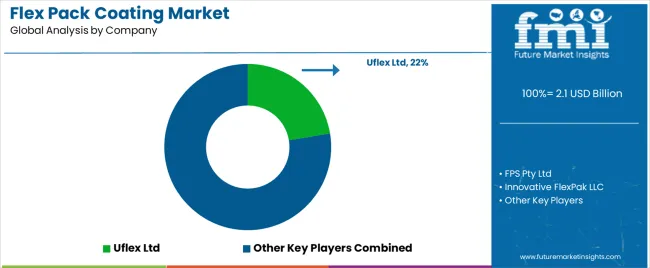
The increasing need for flexible packaging solutions in sectors like as consumer products, medicines, and food and beverage has LED to a notable surge in the flex pack coating industry in recent times. These coatings are specialist materials that are applied to flexible substrates to improve their printability, aesthetics, and barrier protection. They are essential for satisfying regulatory standards, increasing the shelf life of products, and enhancing their aesthetic appeal.
As customers become more environmentally sensitive, market participants are anticipated to change to sustainable and convenient packaging options. Flex coatings preserve the freshness and integrity of products while providing lightweight, recyclable, and biodegradable alternatives. Businesses are entering the healthcare industry through specialized areas such as industrial applications and medical packaging.
The need for coatings that improve print quality and longevity on flexible substrates has increased due to the growing use of digital printing technology. As companies look for cutting-edge packaging solutions that strike a balance between sustainability, functionality, and legal compliance, the market is predicted to grow further in the forthcoming decade.
Recent Industry Developments in Flex Pack Coating Market
- In February 2025, UFlex introduced innovative packaging films in Q3 2025, winning multiple awards and securing patents. These films are designed for various packaging needs, including dry beverages, chips, snacks, and health and beauty care products. They offer superior oxygen and moisture barriers, excellent seal integrity, and high-performance properties.
- In September 2025, Labelexpo Europe 2025 featured a 'Flex Pack Trail', showcasing digital and conventional press technologies, flex pack material constructions, coating, laminating, ink and curing requirements, and in-line and near-line decoration options.
- In August 2025, Sappi and Xeikon developed Titon, a dry toner for paper-based flexible packaging. The toner combines food-safe and odorless properties with UV ink's resistance to chemicals and mechanical abrasion. It can print directly onto paper-based packaging materials without varnishing or lamination and has passed the Nestlé Standard on Printing Inks for Food Packaging.
- In August 2025, UFlex Limited's research and development teams continued to innovate across business verticals, winning several awards and patents in Q1 FY24. The company's High Barrier Alox (F-PSX) Film, a high-barrier transparent BOPET film, is known for its excellent moisture and oxygen barrier properties, higher yield, environmental friendliness, high clarity, and product visibility, making it suitable for various applications.
- In April 2025, Fujifilm collaborated with Nordmeccanica for its Jet Press FP790 digital inkjet flexible packaging technology, following alliances with Hybrid Software and Henkel Adhesive Technologies. Test production trials assess compatibility with Simplex laminating machines.
Key Players of Flex Pack Coating Industry
- FPS Pty Ltd
- Innovative FlexPak LLC
- Flex Film Ltd
- LEIPA Georg Leinfelder GmbH
- Balmer Lawrie & Co. Ltd
- Uflex Ltd
- Amcor Plc
- Sigma Plastics Group
- Sealed Air Corp
- Berry Global Inc.
- DuPont Co.
- Winpak Ltd
Key Segments of Flex Pack Coating Industry
By Coating Type:
Based on the coating types, the industry is divided into epoxy coatings, acrylic coatings, urethane and polyurethane coatings, lacquer coatings, plasma coatings, polyesters coatings, phenolic coatings, and others such as silicon and hybrid.
By Substrate:
In terms of substrate, the industry is segregated as polyethylene (PE), polypropylene (PP), polyethylene terephthalate (PET), polyamide (PA), poly vinyl chloride (PVC), and polystyrene (PS).
By End Use:
Based on the End Use Industries of the coatings, the demand is categorized into food and beverages, pharmaceuticals, cosmetic and personal care, chemicals, electrical and electronics, automotive, and other industries.
By Region:
Key countries of North America, Latin America, Europe, East Asia, South Asia & Pacific, Middle East and Africa (MEA), have been covered in the report.
Frequently Asked Questions
How big is the flex pack coating market in 2025?
The global flex pack coating market is estimated to be valued at USD 2.1 billion in 2025.
What will be the size of flex pack coating market in 2035?
The market size for the flex pack coating market is projected to reach USD 2.7 billion by 2035.
How much will be the flex pack coating market growth between 2025 and 2035?
The flex pack coating market is expected to grow at a 2.5% CAGR between 2025 and 2035.
What are the key product types in the flex pack coating market?
The key product types in flex pack coating market are epoxy coatings, acrylic coatings, urethane and polyurethane coatings, lacquer coatings, plasma coatings, polyesters coatings, phenolic coatings and others.
Which substrate segment to contribute significant share in the flex pack coating market in 2025?
In terms of substrate, polyethylene (pe) segment to command 30.0% share in the flex pack coating market in 2025.
Preview the report firsthand - request a free sample
Get SampleGet the brochure for pricing and purchase details.
Get PDFTable of Content
- Executive Summary
- Global Market Outlook
- Demand-side Trends
- Supply-side Trends
- Technology Roadmap Analysis
- Analysis and Recommendations
- Market Overview
- Market Coverage / Taxonomy
- Market Definition / Scope / Limitations
- Market Background
- Market Dynamics
- Drivers
- Restraints
- Opportunity
- Trends
- Scenario Forecast
- Demand in Optimistic Scenario
- Demand in Likely Scenario
- Demand in Conservative Scenario
- Opportunity Map Analysis
- Product Life Cycle Analysis
- Supply Chain Analysis
- Investment Feasibility Matrix
- Value Chain Analysis
- PESTLE and Porter’s Analysis
- Regulatory Landscape
- Regional Parent Market Outlook
- Production and Consumption Statistics
- Import and Export Statistics
- Market Dynamics
- Global Market Analysis 2020 to 2025 and Forecast, 2025 to 2035
- Historical Market Size Value (USD Million) Analysis, 2020 to 2025
- Current and Future Market Size Value (USD Million) Projections, 2025 to 2035
- Y-o-Y Growth Trend Analysis
- Absolute $ Opportunity Analysis
- Global Market Pricing Analysis 2020 to 2025 and Forecast 2025 to 2035
- Global Market Analysis 2020 to 2025 and Forecast 2025 to 2035, By Coating Type
- Introduction / Key Findings
- Historical Market Size Value (USD Million) Analysis By Coating Type , 2020 to 2025
- Current and Future Market Size Value (USD Million) Analysis and Forecast By Coating Type , 2025 to 2035
- Epoxy Coatings
- Acrylic Coatings
- Urethane And Polyurethane Coatings
- Lacquer Coatings
- Plasma Coatings
- Polyesters Coatings
- Phenolic Coatings
- Others
- Y-o-Y Growth Trend Analysis By Coating Type , 2020 to 2025
- Absolute $ Opportunity Analysis By Coating Type , 2025 to 2035
- Global Market Analysis 2020 to 2025 and Forecast 2025 to 2035, By Substrate
- Introduction / Key Findings
- Historical Market Size Value (USD Million) Analysis By Substrate, 2020 to 2025
- Current and Future Market Size Value (USD Million) Analysis and Forecast By Substrate, 2025 to 2035
- Polyethylene (PE)
- Polypropylene (PP)
- Polyethylene Terephthalate (PET)
- Polyamide (PA)
- Poly Vinyl Chloride (PVC)
- Polystyrene (PS)
- Y-o-Y Growth Trend Analysis By Substrate, 2020 to 2025
- Absolute $ Opportunity Analysis By Substrate, 2025 to 2035
- Global Market Analysis 2020 to 2025 and Forecast 2025 to 2035, By End Use
- Introduction / Key Findings
- Historical Market Size Value (USD Million) Analysis By End Use, 2020 to 2025
- Current and Future Market Size Value (USD Million) Analysis and Forecast By End Use, 2025 to 2035
- Food And Beverages
- Pharmaceuticals
- Cosmetic And Personal Care
- Chemicals
- Electrical And Electronics
- Automotive
- Other Industries
- Y-o-Y Growth Trend Analysis By End Use, 2020 to 2025
- Absolute $ Opportunity Analysis By End Use, 2025 to 2035
- Global Market Analysis 2020 to 2025 and Forecast 2025 to 2035, By Region
- Introduction
- Historical Market Size Value (USD Million) Analysis By Region, 2020 to 2025
- Current Market Size Value (USD Million) Analysis and Forecast By Region, 2025 to 2035
- North America
- Latin America
- Western Europe
- Eastern Europe
- East Asia
- South Asia and Pacific
- Middle East & Africa
- Market Attractiveness Analysis By Region
- North America Market Analysis 2020 to 2025 and Forecast 2025 to 2035, By Country
- Historical Market Size Value (USD Million) Trend Analysis By Market Taxonomy, 2020 to 2025
- Market Size Value (USD Million) Forecast By Market Taxonomy, 2025 to 2035
- By Country
- USA
- Canada
- Mexico
- By Coating Type
- By Substrate
- By End Use
- By Country
- Market Attractiveness Analysis
- By Country
- By Coating Type
- By Substrate
- By End Use
- Key Takeaways
- Latin America Market Analysis 2020 to 2025 and Forecast 2025 to 2035, By Country
- Historical Market Size Value (USD Million) Trend Analysis By Market Taxonomy, 2020 to 2025
- Market Size Value (USD Million) Forecast By Market Taxonomy, 2025 to 2035
- By Country
- Brazil
- Chile
- Rest of Latin America
- By Coating Type
- By Substrate
- By End Use
- By Country
- Market Attractiveness Analysis
- By Country
- By Coating Type
- By Substrate
- By End Use
- Key Takeaways
- Western Europe Market Analysis 2020 to 2025 and Forecast 2025 to 2035, By Country
- Historical Market Size Value (USD Million) Trend Analysis By Market Taxonomy, 2020 to 2025
- Market Size Value (USD Million) Forecast By Market Taxonomy, 2025 to 2035
- By Country
- Germany
- UK
- Italy
- Spain
- France
- Nordic
- BENELUX
- Rest of Western Europe
- By Coating Type
- By Substrate
- By End Use
- By Country
- Market Attractiveness Analysis
- By Country
- By Coating Type
- By Substrate
- By End Use
- Key Takeaways
- Eastern Europe Market Analysis 2020 to 2025 and Forecast 2025 to 2035, By Country
- Historical Market Size Value (USD Million) Trend Analysis By Market Taxonomy, 2020 to 2025
- Market Size Value (USD Million) Forecast By Market Taxonomy, 2025 to 2035
- By Country
- Russia
- Poland
- Hungary
- Balkan & Baltic
- Rest of Eastern Europe
- By Coating Type
- By Substrate
- By End Use
- By Country
- Market Attractiveness Analysis
- By Country
- By Coating Type
- By Substrate
- By End Use
- Key Takeaways
- East Asia Market Analysis 2020 to 2025 and Forecast 2025 to 2035, By Country
- Historical Market Size Value (USD Million) Trend Analysis By Market Taxonomy, 2020 to 2025
- Market Size Value (USD Million) Forecast By Market Taxonomy, 2025 to 2035
- By Country
- China
- Japan
- South Korea
- By Coating Type
- By Substrate
- By End Use
- By Country
- Market Attractiveness Analysis
- By Country
- By Coating Type
- By Substrate
- By End Use
- Key Takeaways
- South Asia and Pacific Market Analysis 2020 to 2025 and Forecast 2025 to 2035, By Country
- Historical Market Size Value (USD Million) Trend Analysis By Market Taxonomy, 2020 to 2025
- Market Size Value (USD Million) Forecast By Market Taxonomy, 2025 to 2035
- By Country
- India
- ASEAN
- Australia & New Zealand
- Rest of South Asia and Pacific
- By Coating Type
- By Substrate
- By End Use
- By Country
- Market Attractiveness Analysis
- By Country
- By Coating Type
- By Substrate
- By End Use
- Key Takeaways
- Middle East & Africa Market Analysis 2020 to 2025 and Forecast 2025 to 2035, By Country
- Historical Market Size Value (USD Million) Trend Analysis By Market Taxonomy, 2020 to 2025
- Market Size Value (USD Million) Forecast By Market Taxonomy, 2025 to 2035
- By Country
- Kingdom of Saudi Arabia
- Other GCC Countries
- Turkiye
- South Africa
- Other African Union
- Rest of Middle East & Africa
- By Coating Type
- By Substrate
- By End Use
- By Country
- Market Attractiveness Analysis
- By Country
- By Coating Type
- By Substrate
- By End Use
- Key Takeaways
- Key Countries Market Analysis
- USA
- Pricing Analysis
- Market Share Analysis, 2025
- By Coating Type
- By Substrate
- By End Use
- Canada
- Pricing Analysis
- Market Share Analysis, 2025
- By Coating Type
- By Substrate
- By End Use
- Mexico
- Pricing Analysis
- Market Share Analysis, 2025
- By Coating Type
- By Substrate
- By End Use
- Brazil
- Pricing Analysis
- Market Share Analysis, 2025
- By Coating Type
- By Substrate
- By End Use
- Chile
- Pricing Analysis
- Market Share Analysis, 2025
- By Coating Type
- By Substrate
- By End Use
- Germany
- Pricing Analysis
- Market Share Analysis, 2025
- By Coating Type
- By Substrate
- By End Use
- UK
- Pricing Analysis
- Market Share Analysis, 2025
- By Coating Type
- By Substrate
- By End Use
- Italy
- Pricing Analysis
- Market Share Analysis, 2025
- By Coating Type
- By Substrate
- By End Use
- Spain
- Pricing Analysis
- Market Share Analysis, 2025
- By Coating Type
- By Substrate
- By End Use
- France
- Pricing Analysis
- Market Share Analysis, 2025
- By Coating Type
- By Substrate
- By End Use
- India
- Pricing Analysis
- Market Share Analysis, 2025
- By Coating Type
- By Substrate
- By End Use
- ASEAN
- Pricing Analysis
- Market Share Analysis, 2025
- By Coating Type
- By Substrate
- By End Use
- Australia & New Zealand
- Pricing Analysis
- Market Share Analysis, 2025
- By Coating Type
- By Substrate
- By End Use
- China
- Pricing Analysis
- Market Share Analysis, 2025
- By Coating Type
- By Substrate
- By End Use
- Japan
- Pricing Analysis
- Market Share Analysis, 2025
- By Coating Type
- By Substrate
- By End Use
- South Korea
- Pricing Analysis
- Market Share Analysis, 2025
- By Coating Type
- By Substrate
- By End Use
- Russia
- Pricing Analysis
- Market Share Analysis, 2025
- By Coating Type
- By Substrate
- By End Use
- Poland
- Pricing Analysis
- Market Share Analysis, 2025
- By Coating Type
- By Substrate
- By End Use
- Hungary
- Pricing Analysis
- Market Share Analysis, 2025
- By Coating Type
- By Substrate
- By End Use
- Kingdom of Saudi Arabia
- Pricing Analysis
- Market Share Analysis, 2025
- By Coating Type
- By Substrate
- By End Use
- Turkiye
- Pricing Analysis
- Market Share Analysis, 2025
- By Coating Type
- By Substrate
- By End Use
- South Africa
- Pricing Analysis
- Market Share Analysis, 2025
- By Coating Type
- By Substrate
- By End Use
- USA
- Market Structure Analysis
- Competition Dashboard
- Competition Benchmarking
- Market Share Analysis of Top Players
- By Regional
- By Coating Type
- By Substrate
- By End Use
- Competition Analysis
- Competition Deep Dive
- Uflex Ltd
- Overview
- Product Portfolio
- Profitability by Market Segments (Product/Age /Sales Channel/Region)
- Sales Footprint
- Strategy Overview
- Marketing Strategy
- Product Strategy
- Channel Strategy
- FPS Pty Ltd
- Innovative FlexPak LLC
- Flex Film Ltd
- LEIPA Georg Leinfelder GmbH
- Balmer Lawrie & Co. Ltd
- Amcor Plc
- Sigma Plastics Group
- Sealed Air Corp
- Berry Plastics Corp.
- DuPont Co.
- Winpak Ltd
- Uflex Ltd
- Competition Deep Dive
- Assumptions & Acronyms Used
- Research Methodology


