

- Industry Size (2026)
- USD 1780.0 Mn
- Forecast (2036)
- USD 3534.4 Mn
- CAGR (2026 to 2036)
- 7.1%
Floor Mounted Bollards Market Forecast and Outlook 2026 to 2036
The floor mounted bollards market is likely to be valued at USD 1,780.0 million in 2026 and is forecasted to reach USD 3,534.4 million by 2036 at a CAGR of 7.1%. Value formation is anchored in regulatory enforcement of vehicle mitigation, pedestrian protection, and perimeter control across public and private sites. Specification is tied to compliance with crash ratings, setback rules, and access management standards rather than discretionary design preference.
Project budgets absorb bollards as mandatory line items within streetscape, transport, and facility approvals. Demand intensity tracks permitting activity, retrofit mandates, and certification thresholds that govern installation density and material selection. Capital spending reflects compliance timing and inspection cycles, creating predictable but administratively paced expansion.
Quick Stats for Floor Mounted Bollards Market
- Floor Mounted Bollards Market Value (2026): USD 1,780.0 million
- Floor Mounted Bollards Market Forecast Value (2036): USD 3,534.4 million
- Floor Mounted Bollards Market Forecast CAGR 2026 to 2036: 7.1%
- Leading Bollard Type by Demand Share: Automatic Retractable Bollards
- Fastest-Growing Countries: India, Saudi Arabia, UAE, Indonesia, Vietnam
- Top Players in Global Demand: ATG Access, Delta Scientific, Avon Barrier, CAME, FAAC, Hörmann, Pilomat, Tymetal, Automatic Systems, BFT
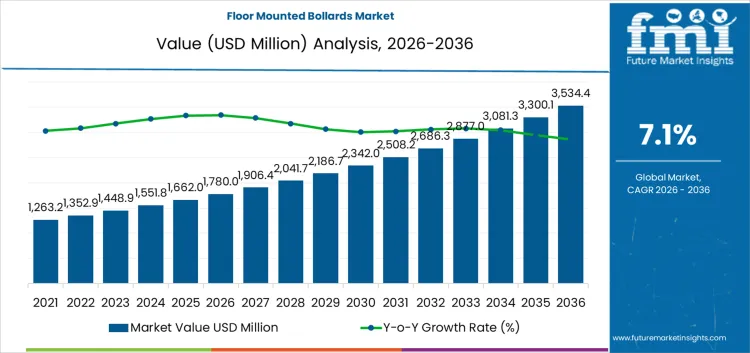
Installation economics constrain scalability through foundation depth, underground utilities, and surface restoration requirements. Site specific engineering limits interchangeability and favors custom fabrication over standardized volume supply. Automated or retractable units add power, drainage, and maintenance obligations that raise lifetime cost profiles. Replacement demand emerges from corrosion exposure, impact events, and standard revisions rather than routine wear. Urban densification sustains placement frequency, while public procurement cycles moderate release of capital. Competitive pricing pressure persists because certification parity reduces differentiation, keeping value growth dependent on project count and deployment scope.
Floor Mounted Bollards Market Key Takeaways
| Metric | Value |
|---|---|
| Market Value (2026) | USD 1,780.0 million |
| Market Forecast Value (2036) | USD 3,534.4 million |
| Forecast CAGR 2026 to 2036 | 7.1% |
Why is the Demand for Floor Mounted Bollards Growing?
Demand for floor mounted bollards is increasing as urban planners, commercial property owners, and facility security teams require physical barriers that enhance perimeter protection and pedestrian safety without compromising accessibility. Floor mounted bollards are specified in high-traffic zones such as building entrances, sidewalks, parking structures, and transit hubs to prevent unauthorized vehicle encroachment, guide traffic flow, and delineate restricted areas. Designers and engineers evaluate material strength, impact resistance ratings, and anchoring systems to ensure bollards meet defined security criteria and load-bearing expectations. Procurement teams assess finish durability, corrosion protection, and compliance with local codes to support long-term performance in outdoor environments exposed to weather extremes and heavy use. Adoption is particularly strong in urban revitalization projects and commercial developments where risk mitigation and aesthetic integration are equally critical.
Growth in emphasis on public space security and vehicle collision prevention reinforces uptake of floor mounted bollards in municipal and corporate environments. Transportation planners integrate bollard placement with pedestrian circulation plans to reduce conflict between vehicles and foot traffic while maintaining clear access for emergency responders. Advances in materials such as steel, concrete-filled designs, and modular sleeve systems improve installation flexibility and serviceability. Coordination between architects, contractors, and safety consultants ensures bollard solutions align with site-specific threat assessments and protective objectives. These market-specific drivers are contributing to sustained demand for floor mounted bollards across evolving infrastructure and security contexts.
How Are the Segments Classified in the Floor Mounted Bollards Market?
Demand for floor mounted bollards is shaped by perimeter protection needs, vehicle impact mitigation, and access control requirements across public and private spaces. Installations support pedestrian safety, asset protection, and controlled vehicle movement. Adoption aligns with urbanization, security planning for critical sites, and streetscape management. Product selection prioritizes impact resistance, operational reliability, and material durability. Segment classification reflects differentiation by bollard operating type, application context, and material composition, influencing deployment density, integration complexity, and lifecycle performance expectations.
Which Bollard Type Represents the Largest Share of Demand?
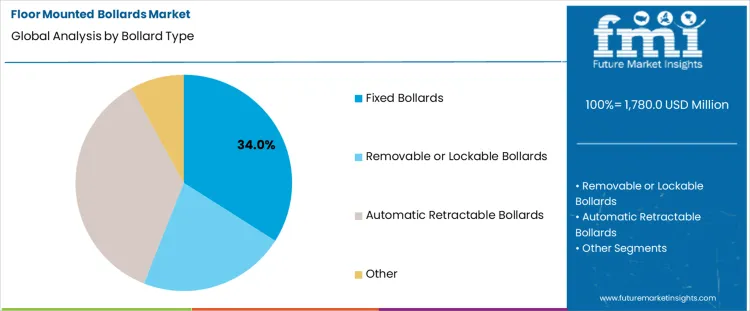
Automatic retractable bollards hold 36.0%, representing the largest share among bollard types due to controlled access requirements. These systems enable dynamic vehicle entry management for authorized traffic while maintaining physical barriers when closed. Integration with access control systems supports timed entry and security protocols. Retractable designs balance safety with traffic flow in mixed-use environments. Fixed bollards provide constant protection with lower complexity and cost. Removable or lockable bollards support flexible access with manual intervention. Bollard type segmentation reflects preference for automated control where security needs intersect with operational access requirements.
Key Points
- Retractable systems enable controlled vehicle access.
- Automation supports integration with security protocols.
- Other types provide static or manually managed protection.
Which Application Accounts for the Highest Share of Demand?
Commercial buildings hold 30.0%, representing the largest share among application areas due to mixed security and accessibility needs. Office complexes, retail-adjacent buildings, and business parks require protection without restricting daily operations. Bollards manage curbside access, loading zones, and pedestrian interfaces. Aesthetic considerations influence specification alongside performance. Government and critical infrastructure sites prioritize higher security with controlled entry. Transportation hubs manage traffic separation and pedestrian safety at scale. Public spaces and retail areas emphasize crowd protection. Application segmentation reflects concentration where balanced security, accessibility, and urban design requirements converge.
Key Points
- Commercial sites balance access control and daily operations.
- Bollards manage vehicle and pedestrian interfaces.
- Other applications emphasize higher security or crowd protection.
Which Material Accounts for the Highest Share of Demand?
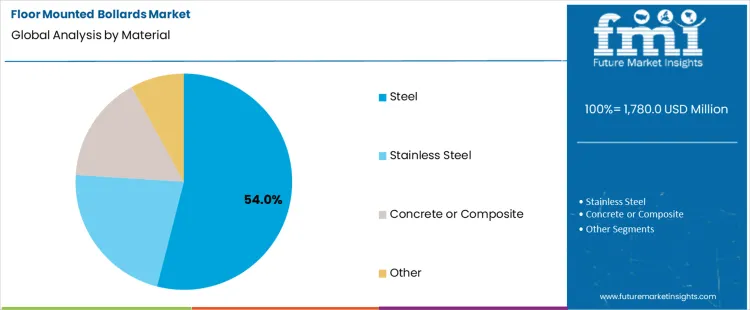
Steel holds 54.0%, representing the largest share among materials used for floor mounted bollards due to strength and impact resistance. Steel construction supports vehicle mitigation requirements and durability under repeated stress. Fabrication flexibility enables varied designs and mounting configurations. Surface treatments enhance corrosion resistance for outdoor exposure. Stainless steel offers corrosion resistance with higher material cost. Concrete or composite materials provide mass-based resistance with design limitations. Material segmentation reflects preference for robust metals where structural performance, longevity, and adaptability remain critical for protective installations.
Key Points
- Steel delivers high impact resistance and durability.
- Fabrication versatility supports diverse installation needs.
- Other materials address corrosion or mass-based protection.
What are the Key Dynamics in the Floor Mounted Bollards Market?
Demand for floor mounted bollards reflects physical access control and impact protection requirements in urban infrastructure, commercial premises, and industrial facilities. Adoption concentrates in pedestrian zones, building perimeters, parking areas, logistics hubs, and critical infrastructure sites. Global scope aligns with security compliance, traffic segregation, and asset protection needs. Usage centers on fixed, removable, and retractable bollards engineered for load resistance, anchoring reliability, and environmental durability.
How do perimeter security requirements and site-specific risk profiles shape adoption?
Facilities deploy floor mounted bollards to prevent unauthorized vehicle access and mitigate accidental or deliberate impact risk. Demand increases in urban streetscapes where pedestrian safety requires separation from vehicular traffic. Commercial buildings use bollards to protect entrances, glazing, and utility equipment from low-speed collisions. Industrial sites rely on high-impact-rated bollards to shield machinery, loading docks, and storage zones from forklift and truck movement. Selection depends on impact rating, spacing, and anchoring depth relative to expected vehicle mass and speed. Removable and retractable variants support controlled access for emergency and service vehicles. Adoption reflects site-specific risk mitigation rather than decorative boundary definition.
How do installation complexity, compliance standards, and cost pressure influence market scalability?
Bollard performance depends on foundation depth, substrate condition, and anchoring method, increasing installation variability. Demand sensitivity rises where retrofit projects require excavation, concrete cutting, or underground utility relocation. Compliance with crash testing and security standards increases certification and engineering cost. Corrosion resistance requirements elevate material and coating expense in coastal or industrial environments. Urban permitting and streetscape regulations affect deployment timelines. Maintenance exposure varies for retractable systems due to mechanical components. Aesthetic customization limits standardization. Project-based procurement and site-specific engineering constrain scalable, high-volume deployment across uniform applications.
How Is Demand for Floor Mounted Bollards Evolving Globally?
Demand for floor mounted bollards is expanding globally due to urban safety requirements, perimeter protection needs, and infrastructure security investments. Adoption aligns with pedestrian safety management, vehicle access control, and asset protection across public spaces and commercial facilities. Urban densification and mixed-use development increase specification of fixed and removable bollards. Government-led security standards and private property risk mitigation support consistent procurement. Growth rates in India at 9.4%, Saudi Arabia at 8.9%, UAE at 8.4%, Indonesia at 8.1%, and Vietnam at 7.8% indicate strong expansion driven by urban infrastructure build-out, security compliance, and public realm modernization.
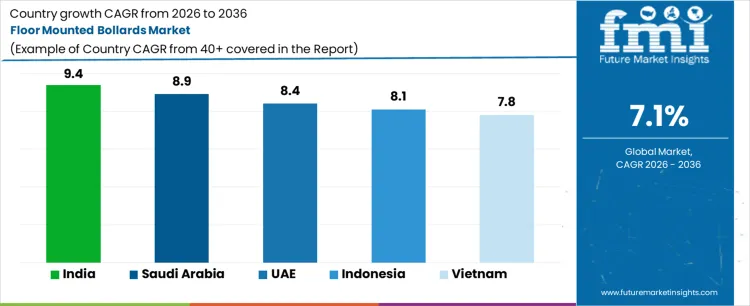
| Country | CAGR (%) |
|---|---|
| India | 9.4% |
| Saudi Arabia | 8.9% |
| UAE | 8.4% |
| Indonesia | 8.1% |
| Vietnam | 7.8% |
What Is Driving Rapid Growth of Floor Mounted Bollard Demand in India?
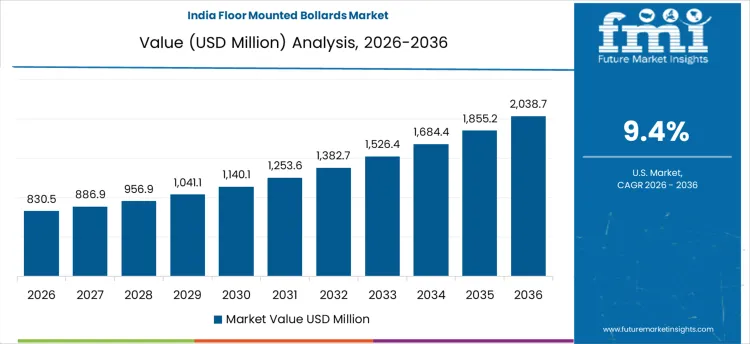
Floor mounted bollard demand in India is growing at a CAGR of 9.4%, supported by urban infrastructure expansion and public safety enforcement. Smart city projects specify bollards for pedestrian segregation and traffic calming. Government buildings, metro stations, and airports require perimeter control against vehicle intrusion. Commercial complexes adopt bollards to manage parking and curbside access. Rapid urbanization increases pedestrian-vehicle interaction risk, raising safety infrastructure needs. Demand growth reflects regulatory enforcement and urban design priorities rather than discretionary aesthetic installations.
- Smart city pedestrian safety infrastructure projects
- Security requirements at transport and government facilities
- Commercial property access and parking control
- Rising urban pedestrian traffic density
Why Is Saudi Arabia Experiencing Strong Expansion in Floor Mounted Bollard Demand?
Saudi Arabia is expanding at a CAGR of 8.9%, driven by large-scale public infrastructure and security standardization. Government complexes, public venues, and religious sites require vehicle mitigation measures. Urban redevelopment programs integrate bollards into streetscape planning. Commercial districts specify fixed and retractable bollards for controlled access. National security frameworks influence material strength and impact rating requirements. Demand growth reflects institutional security planning and infrastructure investment rather than retail-driven adoption.
- Security planning for public and religious facilities
- Urban redevelopment and streetscape projects
- Controlled access requirements in commercial districts
- National standards for vehicle impact mitigation
How Is the UAE Shaping Demand for Floor Mounted Bollards?
Floor mounted bollard demand in United Arab Emirates is growing at a CAGR of 8.4%, influenced by premium urban development and security-focused design. Airports, hotels, and government buildings specify bollards to protect pedestrian zones. Tourism infrastructure prioritizes discreet yet high-strength perimeter protection. Smart infrastructure initiatives integrate bollards with access control systems. High vehicle density in urban cores increases separation requirements. Demand growth reflects design-integrated security and public safety standards rather than emergency-driven deployment.
- Pedestrian protection in tourism and hospitality zones
- Security integration in airports and government buildings
- Smart access control and infrastructure integration
- High urban vehicle density management
What Factors Are Supporting Floor Mounted Bollard Demand in Indonesia?
Floor mounted bollard demand in Indonesia is expanding at a CAGR of 8.1%, shaped by urban congestion management and public facility development. City centers deploy bollards to protect sidewalks and manage informal parking. Transport hubs and municipal buildings adopt perimeter barriers to regulate vehicle access. Flood-prone areas require durable, corrosion-resistant installations. Infrastructure upgrades across metropolitan regions sustain steady procurement. Demand growth reflects urban order enforcement and pedestrian safety needs rather than high-security threat mitigation.
- Sidewalk protection and parking control measures
- Perimeter regulation at municipal facilities
- Durability needs in flood-prone urban areas
- Metropolitan infrastructure upgrade programs
Why Is Vietnam Showing Steady Growth in Floor Mounted Bollard Demand?
Vietnam is growing at a CAGR of 7.8%, supported by urban planning reforms and commercial development. City authorities implement pedestrian protection measures along busy corridors. Retail centers and office complexes use bollards to separate vehicular and pedestrian flows. Transport infrastructure projects integrate safety barriers into design specifications. Manufacturing zones adopt bollards for access management. Growth reflects structured urban development and safety standard adoption rather than reactive security installation.
- Pedestrian safety measures in urban corridors
- Commercial property vehicle flow separation
- Integration within transport infrastructure projects
- Access management in industrial and office zones
What is the competitive landscape of demand for the floor mounted bollards market globally?
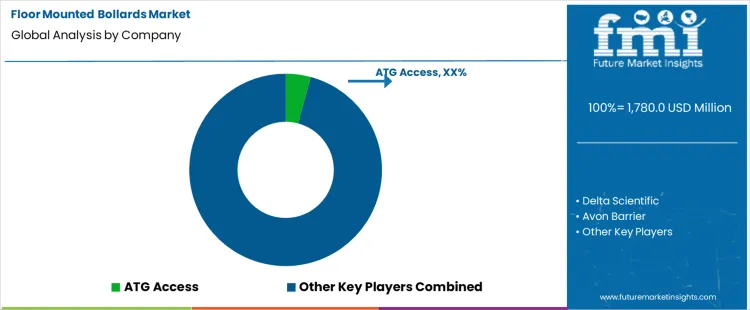
Demand for floor mounted bollards is driven by heightened requirements for perimeter security, vehicle access control, urban infrastructure protection, and traffic management across commercial, government, and critical infrastructure sites. Buyers evaluate impact resistance ratings, installation flexibility, material durability, corrosion protection, integration with access control systems, and compliance with anti-ram standards (e.g., ASTM, PAS68). Procurement teams prioritize suppliers with certified performance data, global installation support, robust product portfolios, and service networks capable of supporting both new construction and retrofit projects. Trend in the global market reflects increased adoption of automated and removable bollards, integration with intelligent security systems, and emphasis on urban safety that balances aesthetic design with functional protection.
ATG Access holds leading positioning through high-security bollard systems tested to stringent impact standards and supported by global specification support and installation services. Delta Scientific supports demand with heavy-duty crash-rated floor mounted bollards used in government, transportation, and high-risk commercial environments. Avon Barrier participates with a range of security bollards and access control solutions engineered for high impact and anti-ram performance. CAME contributes automated bollard systems and integrated control solutions tailored to urban and commercial security needs. FAAC, part of the access automation segment, supplies floor mounted bollard systems that integrate with broader vehicle access management platforms. Competitive differentiation depends on certified impact performance, integration with security and access control systems, corrosion and environmental durability, and ability to meet project-specific design requirements.
Key Players in the Floor Mounted Bollards Market
- ATG Access
- Delta Scientific
- Avon Barrier
- CAME
- FAAC
- Hörmann
- Pilomat
- Tymetal
- Automatic Systems
- BFT (Somfy Group)
Scope of the Report
| Items | Values |
|---|---|
| Quantitative Units | USD million |
| Bollard Type | Fixed Bollards; Removable or Lockable Bollards; Automatic Retractable Bollards; Other |
| Application | Commercial Buildings; Government & Critical Infrastructure; Transportation Hubs; Public Spaces & Retail |
| Material | Steel; Stainless Steel; Concrete or Composite; Other |
| Sales Channel | Security Integrators; Construction or EPC; Direct Manufacturer Sales; Other |
| Regions Covered | Asia Pacific, Europe, North America, Latin America, Middle East & Africa |
| Countries Covered | India, Saudi Arabia, UAE, Indonesia, Vietnam, and 40+ countries |
| Key Companies Profiled | ATG Access; Delta Scientific; Avon Barrier; CAME; FAAC; Hörmann; Pilomat; Tymetal; Automatic Systems; BFT |
| Additional Attributes | Dollar sales by bollard type, material, and application; crash-rating standards compliance and impact energy absorption performance; actuation speed, duty cycle, and fail-safe operation for automatic retractable systems; corrosion resistance and environmental durability in coastal and desert climates; integration with access control, ANPR, and security management platforms; procurement patterns led by EPC and security integrators for public infrastructure projects and direct manufacturer sales for critical facilities. |
Floor Mounted Bollards Market by Segment
Bollard Type:
- Fixed Bollards
- Removable or Lockable Bollards
- Automatic Retractable Bollards
- Other
Application:
- Commercial Buildings
- Government & Critical Infrastructure
- Transportation Hubs
- Public Spaces & Retail
Material:
- Steel
- Stainless Steel
- Concrete or Composite
- Other
Sales Channel:
- Security Integrators
- Construction or EPC
- Direct Manufacturer Sales
- Other
Region:
- Asia Pacific
- China
- Japan
- South Korea
- India
- Australia & New Zealand
- ASEAN
- Rest of Asia Pacific
- Europe
- Germany
- United Kingdom
- France
- Italy
- Spain
- Nordic
- BENELUX
- Rest of Europe
- North America
- United States
- Canada
- Mexico
- Latin America
- Brazil
- Chile
- Rest of Latin America
- Middle East & Africa
- Kingdom of Saudi Arabia
- Other GCC Countries
- Turkey
- South Africa
- Other African Union
- Rest of Middle East & Africa
Bibliography
- American Society for Testing and Materials. (2023). ASTM F2656/F2656M-23: Standard test method for vehicle crash testing of perimeter barriers. ASTM International.
- International Organization for Standardization. (2023). ISO 22341: Security and resilience-Protective security-Guidelines for vehicle impact mitigation. ISO.
- International Organization for Standardization. (2024). ISO 22343: Security and resilience-Protective security-Security by design for built environments. ISO.
- USA Department of Homeland Security. (2023). Vehicle ramming mitigation guidance for public spaces. Cybersecurity and Infrastructure Security Agency (CISA).
- Organisation for Economic Co-operation and Development. (2023). Urban safety, public space protection, and traffic separation strategies. OECD Publishing.
Frequently Asked Questions
How big is the floor mounted bollards market in 2026?
The global floor mounted bollards market is estimated to be valued at USD 1,780.0 million in 2026.
What will be the size of floor mounted bollards market in 2036?
The market size for the floor mounted bollards market is projected to reach USD 3,534.4 million by 2036.
How much will be the floor mounted bollards market growth between 2026 and 2036?
The floor mounted bollards market is expected to grow at a 7.1% CAGR between 2026 and 2036.
What are the key product types in the floor mounted bollards market?
The key product types in floor mounted bollards market are fixed bollards, removable or lockable bollards, automatic retractable bollards and other.
Which application segment to contribute significant share in the floor mounted bollards market in 2026?
In terms of application, commercial buildings segment to command 30.0% share in the floor mounted bollards market in 2026.
Preview the report firsthand - request a free sample
Get SampleGet the brochure for pricing and purchase details.
Get PDFTable of Content
- Executive Summary
- Global Market Outlook
- Demand-side Trends
- Supply-side Trends
- Technology Roadmap Analysis
- Analysis and Recommendations
- Market Overview
- Market Coverage / Taxonomy
- Market Definition / Scope / Limitations
- Market Background
- Market Dynamics
- Drivers
- Restraints
- Opportunity
- Trends
- Scenario Forecast
- Demand in Optimistic Scenario
- Demand in Likely Scenario
- Demand in Conservative Scenario
- Opportunity Map Analysis
- Product Life Cycle Analysis
- Supply Chain Analysis
- Investment Feasibility Matrix
- Value Chain Analysis
- PESTLE and Porter’s Analysis
- Regulatory Landscape
- Regional Parent Market Outlook
- Production and Consumption Statistics
- Import and Export Statistics
- Market Dynamics
- Global Market Analysis 2021 to 2025 and Forecast, 2026 to 2036
- Historical Market Size Value (USD Million) Analysis, 2021 to 2025
- Current and Future Market Size Value (USD Million) Projections, 2026 to 2036
- Y-o-Y Growth Trend Analysis
- Absolute $ Opportunity Analysis
- Global Market Pricing Analysis 2021 to 2025 and Forecast 2026 to 2036
- Global Market Analysis 2021 to 2025 and Forecast 2026 to 2036, By Bollard Type
- Introduction / Key Findings
- Historical Market Size Value (USD Million) Analysis By Bollard Type , 2021 to 2025
- Current and Future Market Size Value (USD Million) Analysis and Forecast By Bollard Type , 2026 to 2036
- Fixed Bollards
- Removable or Lockable Bollards
- Automatic Retractable Bollards
- Other
- Fixed Bollards
- Y-o-Y Growth Trend Analysis By Bollard Type , 2021 to 2025
- Absolute $ Opportunity Analysis By Bollard Type , 2026 to 2036
- Global Market Analysis 2021 to 2025 and Forecast 2026 to 2036, By Application
- Introduction / Key Findings
- Historical Market Size Value (USD Million) Analysis By Application, 2021 to 2025
- Current and Future Market Size Value (USD Million) Analysis and Forecast By Application, 2026 to 2036
- Commercial Buildings
- Government & Critical Infrastructure
- Transportation Hubs
- Public Spaces & Retail
- Commercial Buildings
- Y-o-Y Growth Trend Analysis By Application, 2021 to 2025
- Absolute $ Opportunity Analysis By Application, 2026 to 2036
- Global Market Analysis 2021 to 2025 and Forecast 2026 to 2036, By Material
- Introduction / Key Findings
- Historical Market Size Value (USD Million) Analysis By Material, 2021 to 2025
- Current and Future Market Size Value (USD Million) Analysis and Forecast By Material, 2026 to 2036
- Steel
- Stainless Steel
- Concrete or Composite
- Other
- Steel
- Y-o-Y Growth Trend Analysis By Material, 2021 to 2025
- Absolute $ Opportunity Analysis By Material, 2026 to 2036
- Global Market Analysis 2021 to 2025 and Forecast 2026 to 2036, By Sales Channel
- Introduction / Key Findings
- Historical Market Size Value (USD Million) Analysis By Sales Channel, 2021 to 2025
- Current and Future Market Size Value (USD Million) Analysis and Forecast By Sales Channel, 2026 to 2036
- Security Integrators
- Construction or EPC
- Direct Manufacturer Sales
- Other
- Security Integrators
- Y-o-Y Growth Trend Analysis By Sales Channel, 2021 to 2025
- Absolute $ Opportunity Analysis By Sales Channel, 2026 to 2036
- Global Market Analysis 2021 to 2025 and Forecast 2026 to 2036, By Region
- Introduction
- Historical Market Size Value (USD Million) Analysis By Region, 2021 to 2025
- Current Market Size Value (USD Million) Analysis and Forecast By Region, 2026 to 2036
- North America
- Latin America
- Western Europe
- Eastern Europe
- East Asia
- South Asia and Pacific
- Middle East & Africa
- Market Attractiveness Analysis By Region
- North America Market Analysis 2021 to 2025 and Forecast 2026 to 2036, By Country
- Historical Market Size Value (USD Million) Trend Analysis By Market Taxonomy, 2021 to 2025
- Market Size Value (USD Million) Forecast By Market Taxonomy, 2026 to 2036
- By Country
- USA
- Canada
- Mexico
- By Bollard Type
- By Application
- By Material
- By Sales Channel
- By Country
- Market Attractiveness Analysis
- By Country
- By Bollard Type
- By Application
- By Material
- By Sales Channel
- Key Takeaways
- Latin America Market Analysis 2021 to 2025 and Forecast 2026 to 2036, By Country
- Historical Market Size Value (USD Million) Trend Analysis By Market Taxonomy, 2021 to 2025
- Market Size Value (USD Million) Forecast By Market Taxonomy, 2026 to 2036
- By Country
- Brazil
- Chile
- Rest of Latin America
- By Bollard Type
- By Application
- By Material
- By Sales Channel
- By Country
- Market Attractiveness Analysis
- By Country
- By Bollard Type
- By Application
- By Material
- By Sales Channel
- Key Takeaways
- Western Europe Market Analysis 2021 to 2025 and Forecast 2026 to 2036, By Country
- Historical Market Size Value (USD Million) Trend Analysis By Market Taxonomy, 2021 to 2025
- Market Size Value (USD Million) Forecast By Market Taxonomy, 2026 to 2036
- By Country
- Germany
- UK
- Italy
- Spain
- France
- Nordic
- BENELUX
- Rest of Western Europe
- By Bollard Type
- By Application
- By Material
- By Sales Channel
- By Country
- Market Attractiveness Analysis
- By Country
- By Bollard Type
- By Application
- By Material
- By Sales Channel
- Key Takeaways
- Eastern Europe Market Analysis 2021 to 2025 and Forecast 2026 to 2036, By Country
- Historical Market Size Value (USD Million) Trend Analysis By Market Taxonomy, 2021 to 2025
- Market Size Value (USD Million) Forecast By Market Taxonomy, 2026 to 2036
- By Country
- Russia
- Poland
- Hungary
- Balkan & Baltic
- Rest of Eastern Europe
- By Bollard Type
- By Application
- By Material
- By Sales Channel
- By Country
- Market Attractiveness Analysis
- By Country
- By Bollard Type
- By Application
- By Material
- By Sales Channel
- Key Takeaways
- East Asia Market Analysis 2021 to 2025 and Forecast 2026 to 2036, By Country
- Historical Market Size Value (USD Million) Trend Analysis By Market Taxonomy, 2021 to 2025
- Market Size Value (USD Million) Forecast By Market Taxonomy, 2026 to 2036
- By Country
- China
- Japan
- South Korea
- By Bollard Type
- By Application
- By Material
- By Sales Channel
- By Country
- Market Attractiveness Analysis
- By Country
- By Bollard Type
- By Application
- By Material
- By Sales Channel
- Key Takeaways
- South Asia and Pacific Market Analysis 2021 to 2025 and Forecast 2026 to 2036, By Country
- Historical Market Size Value (USD Million) Trend Analysis By Market Taxonomy, 2021 to 2025
- Market Size Value (USD Million) Forecast By Market Taxonomy, 2026 to 2036
- By Country
- India
- ASEAN
- Australia & New Zealand
- Rest of South Asia and Pacific
- By Bollard Type
- By Application
- By Material
- By Sales Channel
- By Country
- Market Attractiveness Analysis
- By Country
- By Bollard Type
- By Application
- By Material
- By Sales Channel
- Key Takeaways
- Middle East & Africa Market Analysis 2021 to 2025 and Forecast 2026 to 2036, By Country
- Historical Market Size Value (USD Million) Trend Analysis By Market Taxonomy, 2021 to 2025
- Market Size Value (USD Million) Forecast By Market Taxonomy, 2026 to 2036
- By Country
- Kingdom of Saudi Arabia
- Other GCC Countries
- Turkiye
- South Africa
- Other African Union
- Rest of Middle East & Africa
- By Bollard Type
- By Application
- By Material
- By Sales Channel
- By Country
- Market Attractiveness Analysis
- By Country
- By Bollard Type
- By Application
- By Material
- By Sales Channel
- Key Takeaways
- Key Countries Market Analysis
- USA
- Pricing Analysis
- Market Share Analysis, 2025
- By Bollard Type
- By Application
- By Material
- By Sales Channel
- Canada
- Pricing Analysis
- Market Share Analysis, 2025
- By Bollard Type
- By Application
- By Material
- By Sales Channel
- Mexico
- Pricing Analysis
- Market Share Analysis, 2025
- By Bollard Type
- By Application
- By Material
- By Sales Channel
- Brazil
- Pricing Analysis
- Market Share Analysis, 2025
- By Bollard Type
- By Application
- By Material
- By Sales Channel
- Chile
- Pricing Analysis
- Market Share Analysis, 2025
- By Bollard Type
- By Application
- By Material
- By Sales Channel
- Germany
- Pricing Analysis
- Market Share Analysis, 2025
- By Bollard Type
- By Application
- By Material
- By Sales Channel
- UK
- Pricing Analysis
- Market Share Analysis, 2025
- By Bollard Type
- By Application
- By Material
- By Sales Channel
- Italy
- Pricing Analysis
- Market Share Analysis, 2025
- By Bollard Type
- By Application
- By Material
- By Sales Channel
- Spain
- Pricing Analysis
- Market Share Analysis, 2025
- By Bollard Type
- By Application
- By Material
- By Sales Channel
- France
- Pricing Analysis
- Market Share Analysis, 2025
- By Bollard Type
- By Application
- By Material
- By Sales Channel
- India
- Pricing Analysis
- Market Share Analysis, 2025
- By Bollard Type
- By Application
- By Material
- By Sales Channel
- ASEAN
- Pricing Analysis
- Market Share Analysis, 2025
- By Bollard Type
- By Application
- By Material
- By Sales Channel
- Australia & New Zealand
- Pricing Analysis
- Market Share Analysis, 2025
- By Bollard Type
- By Application
- By Material
- By Sales Channel
- China
- Pricing Analysis
- Market Share Analysis, 2025
- By Bollard Type
- By Application
- By Material
- By Sales Channel
- Japan
- Pricing Analysis
- Market Share Analysis, 2025
- By Bollard Type
- By Application
- By Material
- By Sales Channel
- South Korea
- Pricing Analysis
- Market Share Analysis, 2025
- By Bollard Type
- By Application
- By Material
- By Sales Channel
- Russia
- Pricing Analysis
- Market Share Analysis, 2025
- By Bollard Type
- By Application
- By Material
- By Sales Channel
- Poland
- Pricing Analysis
- Market Share Analysis, 2025
- By Bollard Type
- By Application
- By Material
- By Sales Channel
- Hungary
- Pricing Analysis
- Market Share Analysis, 2025
- By Bollard Type
- By Application
- By Material
- By Sales Channel
- Kingdom of Saudi Arabia
- Pricing Analysis
- Market Share Analysis, 2025
- By Bollard Type
- By Application
- By Material
- By Sales Channel
- Turkiye
- Pricing Analysis
- Market Share Analysis, 2025
- By Bollard Type
- By Application
- By Material
- By Sales Channel
- South Africa
- Pricing Analysis
- Market Share Analysis, 2025
- By Bollard Type
- By Application
- By Material
- By Sales Channel
- USA
- Market Structure Analysis
- Competition Dashboard
- Competition Benchmarking
- Market Share Analysis of Top Players
- By Regional
- By Bollard Type
- By Application
- By Material
- By Sales Channel
- Competition Analysis
- Competition Deep Dive
- ATG Access
- Overview
- Product Portfolio
- Profitability by Market Segments (Product/Age /Sales Channel/Region)
- Sales Footprint
- Strategy Overview
- Marketing Strategy
- Product Strategy
- Channel Strategy
- Delta Scientific
- Avon Barrier
- CAME
- FAAC
- Hörmann
- Pilomat
- Tymetal
- Automatic Systems
- BFT (Somfy Group)
- ATG Access
- Competition Deep Dive
- Assumptions & Acronyms Used
- Research Methodology


