

- Industry Size (2026):
- USD 515 Mn
- Forecast (2036):
- USD 1013.1 Mn
- CAGR (2026 to 2036)
- 7.0%
Scene Investigation Lights Market Forecast and Outlook 2026 to 2036
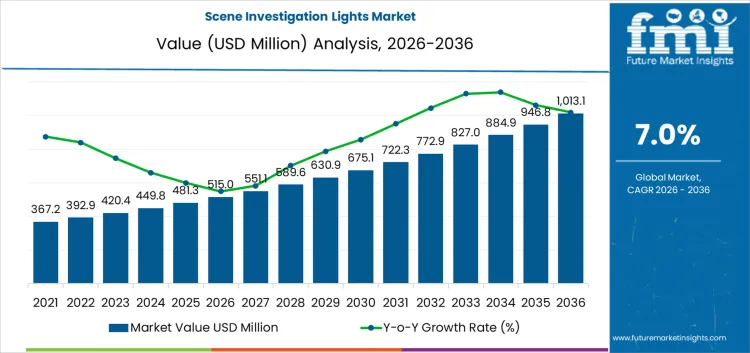
The scene investigation lights market is valued at USD 515 million in 2026 and is projected to reach USD 1,013.1 million by 2036, at a CAGR of 7.0% over the forecast period. Demand quality in this market is defined by consistency, procedural necessity, and long-term institutional commitment rather than short-term purchasing cycles. Scene investigation lights are embedded within standard operating procedures of law enforcement agencies, forensic laboratories, and emergency response units, creating structurally stable demand. Purchases are driven by replacement needs, equipment standardization, and upgrades aligned with evidentiary and documentation requirements. Repeat usage is inherent, as lighting systems are deployed across multiple investigations and subjected to wear, environmental exposure, and battery degradation. Buyer commitment remains high due to compliance with forensic protocols, chain-of-custody standards, and judicial scrutiny of evidence quality. Budget allocations are typically recurrent, supported by public safety funding rather than discretionary spending.
Quick Stats for Scene Investigation Lights Market
- Scene Investigation Lights Market Value (2026): USD 515 Million
- Scene Investigation Lights Market Forecast Value (2036): USD 1,013.1 Million
- Scene Investigation Lights Market Forecast CAGR 2026 to 2036: 7.0%
- Leading Product Type in Scene Investigation Lights Market: Portable Lights (45% share)
- Leading Application in Scene Investigation Lights Market: Law Enforcement (60% share)
- Key Growth Regions in Scene Investigation Lights Market: Asia Pacific, North America, Europe, Latin America, Middle East & Africa
- Top Key Players in Scene Investigation Lights Market: Foster + Freeman, Fox Fury, Sirchie, Horiba, Lumatec
Scene Investigation Lights Market Key Takeaways
| Metric | Value |
|---|---|
| Scene Investigation Lights Market Value (2026) | USD 515 Million |
| Scene Investigation Lights Market Forecast Value (2036) | USD 1,013.1 Million |
| Scene Investigation Lights Market Forecast CAGR 2026 to 2036 | 7.0% |
Why Is the Scene Investigation Lights Market Growing Across Law Enforcement and Forensic Applications?
The scene investigation lights market is expanding due to rising demand for specialized illumination in law enforcement, forensic analysis, and crime scene investigation. Accurate and portable lighting solutions are critical for detecting trace evidence, documenting crime scenes, and supporting investigations. Agencies increasingly rely on scene investigation lights to enhance visibility, improve accuracy, and reduce procedural errors in evidence collection.
Technological advancements are boosting adoption in the scene investigation lights market. Manufacturers are introducing LED-based, battery-powered, and portable lighting systems with adjustable intensity and color temperature. Features such as UV and infrared illumination, long battery life, and rugged designs improve usability and reliability in diverse environmental conditions. Integration with digital imaging and mobile devices enhances operational efficiency and documentation quality.
Increasing law enforcement budgets, rising crime detection initiatives, and growing forensic research are reinforcing growth in the scene investigation lights market. Police departments, forensic labs, and private investigation agencies are upgrading their equipment to meet modern standards. Training programs and adoption in forensic education also expand market reach. Combined, enhanced product capabilities, sectoral demand, and procedural requirements are supporting steady market growth over the forecast period.
What Does The Segment Overview Indicate About The Scene Investigation Lights Market?
The scene investigation lights market is segmented by product type and application, highlighting equipment design and usage specialization across investigation scenarios. Portable lights lead the product type segment with approximately 45% share, driven by field usability and flexibility across varied crime scenes. Fixed scene lights, handheld forensic models, and specialized light sources are used in controlled or laboratory-based investigations. On the application side, law enforcement dominates with nearly 60% share, reflecting large-scale adoption by police units for initial scene assessment, evidence location, and search operations. Forensic labs and crime scene investigation teams represent focused but critical end-use segments based on precision and spectral requirements.
Why Do Portable Lights Hold The Leading Product Type Share In The Scene Investigation Lights Market?
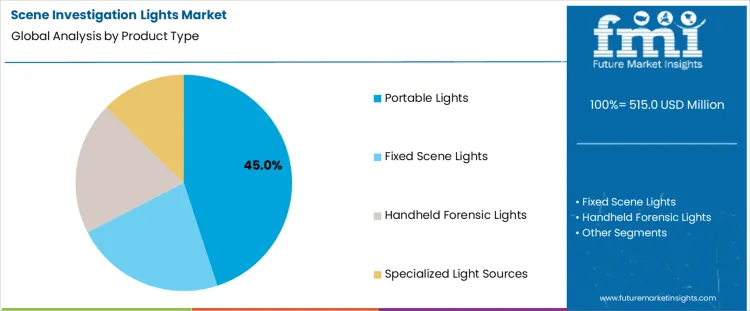
Portable lights hold the leading 45% share in the scene investigation lights market due to their operational flexibility, ease of transport, and adaptability to various lighting conditions. These battery-powered or rechargeable units are designed for first responders, patrol officers, and forensic technicians conducting fieldwork in low-light or remote settings. Features such as adjustable intensity, modular filters, and wide-beam optics make them suitable for identifying latent prints, fluids, and trace evidence. Their lightweight form factor allows quick setup during emergencies or rapid entry operations. Demand variation exists based on beam reach, battery life, and compatibility with forensic camera systems. The rise in mobile forensic response units and decentralized investigation protocols continues to drive preference for portable lighting solutions.
How Does Law Enforcement Drive Application Demand In The Scene Investigation Lights Market?
Law enforcement agencies account for the dominant 60% share in the scene investigation lights market due to their frontline role in securing, scanning, and documenting crime scenes under time-sensitive conditions. Detection lights are deployed by police departments for outdoor and indoor incident response, enabling clear visibility of evidence under varied lighting and weather conditions. These tools assist in locating fibers, bodily fluids, footprints, and tampering marks. Standard kits often include multiple lighting options white light, UV, IR, and narrow-band filters to support layered investigation. Demand is shaped by department size, urban deployment patterns, and training protocols. As policing agencies invest in modern forensic tools and mobile evidence collection systems, high-performance lighting equipment becomes an essential part of their operational toolkit.
What Field Requirements Are Shaping Demand in the Scene Investigation Lights Market?
The scene investigation lights market is expanding as law enforcement, forensic teams, and emergency responders seek portable, high-intensity illumination to support on-site evidence collection. These lights are designed to reveal blood traces, fingerprints, fibers, and chemical residues under varied lighting conditions. Multi-wavelength options, including UV and IR, are gaining preference for latent evidence visualization. Growth is driven by rising crime documentation standards and procedural expectations for night-time or indoor crime scenes. Portable formats with telescopic stands, rechargeable batteries, and waterproof casings are increasingly used. Demand is especially strong from agencies focused on rapid deployment and compliance with chain-of-custody protocols in low-visibility environments.
Why Are Law Enforcement Agencies Preferring Specialized Lighting Equipment?
Law enforcement agencies are adopting purpose-built systems from the scene investigation lights market to improve field documentation accuracy and reduce missed evidence. Unlike generic floodlights or flashlights, forensic lighting systems offer focused beam control, wavelength-specific enhancement, and compatibility with evidence detection aids such as contrast dyes and filters. UV, blue, green, and IR bands help differentiate biological fluids, bruising patterns, and trace materials. Agencies value integrated tripods, battery indicators, and compact carry cases for quick setup and mobility. As body-worn and dash cameras become standard, lighting quality at the crime scene directly affects digital evidence clarity, influencing purchase decisions.
What Limitations Are Slowing Broader Use of Scene Investigation Lighting Systems?
Cost and training requirements are key constraints in the scene investigation lights market, especially for smaller agencies or rural forensic teams. Multi-wavelength units with interchangeable filters and advanced optics remain expensive and are not universally budgeted. Some units require user training to avoid overexposure, glare, or improper angle setup, which may compromise photographic evidence. Durability under field conditions and battery run-time are also concerns for extended investigations. In multi-agency jurisdictions, inconsistent equipment standards complicate evidence-sharing protocols. While general-purpose tactical lights are still in use, they lack the spectrum control and optical precision needed for forensic-grade evidence capture.
What is the Country-Wise Growth Outlook for the Scene Investigation Lights Market?
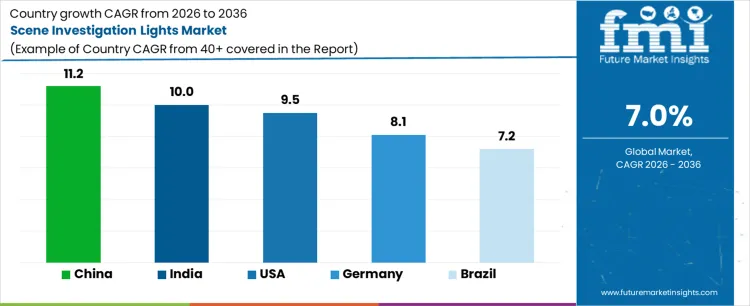
The scene investigation lights market is gaining traction as forensic, disaster response, and law enforcement agencies prioritize portable illumination tools with high CRI, UV modes, and battery resilience. China leads with a CAGR of 11.2% due to growing demand from provincial police units and industrial safety departments. India follows with 10.0% CAGR as state-level forensic modernization accelerates. The USA posts a CAGR of 9.5%, supported by advanced crime scene response systems and tactical illumination needs. Germany shows an 8.1% CAGR amid stricter scene documentation standards. Brazil records 7.2% CAGR as fire, civil defense, and police teams adopt LED-based modular systems.
| Country | CAGR |
|---|---|
| China | 11.2% |
| India | 10.0% |
| USA | 9.5% |
| Germany | 8.1% |
| Brazil | 7.2% |
Why Is China Leading in the Scene Investigation Lights Market?
Demand for the scene investigation lights in China is increasing at a CAGR of 11.2%, backed by procurement modernization across law enforcement agencies and emergency response departments. Police units in Tier I and Tier II cities are deploying portable light systems with high color rendering and adjustable intensity for crime scene processing. Industrial safety regulators and hazmat teams are incorporating forensic-grade lighting for nighttime response and workplace accident documentation. Chinese manufacturers are developing cost-effective, ruggedized LED lights with UV and IR modes for fluid detection and surface analysis. Public security bureaus require compliant lighting tools that operate across high humidity and low-light field environments. Integration with handheld cameras, scene documentation kits, and tripods is boosting demand in urban forensic divisions. Export-oriented suppliers also meet domestic needs, supported by favorable procurement cycles in provincial crime labs.
What Is Driving Growth in India’s Scene Investigation Lights Market?
Sales for the scene investigation lights in India are rising at a CAGR of 10.0%, as modernization of state and central forensic services accelerates. India’s law enforcement bodies are equipping field units with crime scene lighting tools that support multi-spectrum analysis, mobile deployment, and battery-efficient runtime. Increasing demand from forensic science laboratories, disaster response teams, and fire departments is driving standardized adoption of UV/blue light systems. Government funding under police modernization schemes supports equipment upgrades in state-level forensic labs across Maharashtra, Tamil Nadu, and Uttar Pradesh. Domestic manufacturers are introducing lightweight, heat-resistant light systems tailored for field documentation. Integration with evidence tracking systems and compact forensic kits has improved operational efficiency. Rural deployment of these tools is growing through mobile forensic vans and district crime scene units. Technical training programs and state-level R&D labs are also creating specialized lighting standards for criminal investigations.
Why Is the USA Expanding Its Use of Scene Investigation Lighting?

Demand for the scene investigation lights in the USA is advancing at a CAGR of 9.5%, supported by continuous upgrades in tactical lighting systems used by police, forensic technicians, and fire departments. USA crime scene units require high-lumen LED lighting with adjustable color temperatures, rechargeable packs, and spectrum-specific settings for biological and chemical trace detection. Federal funding for evidence handling and documentation is encouraging deployment of scene lighting systems that comply with NIJ and OSHA standards. Manufacturers are offering modular systems that combine floodlighting, angle-adjustable mounts, and tripod-ready formats. Law enforcement officers increasingly use UV and IR light settings for detecting bloodstains, fingerprints, and gunshot residue. Portable forensic lighting is also adopted by Homeland Security and disaster response units during field investigations. Demand is driven by accuracy requirements for photographic evidence and real-time assessment of trace patterns. American manufacturers focus on ruggedization, drop resistance, and field recharging to meet operational needs.
What Is Supporting Growth in Germany’s Scene Investigation Lights Market?
Sales for the scene investigation lights in Germany are growing at a CAGR of 8.1%, driven by enhanced forensic protocols and equipment standardization in regional police agencies. Crime scene investigators and emergency response units are deploying light systems with calibrated color temperatures, glare control, and spectrum fidelity to meet evidentiary standards. German manufacturers emphasize durability, lithium battery integration, and compliance with EN standards for forensic equipment. Demand is strongest in urban states with active forensic labs such as North Rhine-Westphalia, Bavaria, and Hesse. LED scene lights are used for both outdoor investigations and controlled indoor environments like autopsy rooms and lab documentation spaces. Modular tripods, adjustable heads, and multi-angle lighting kits are preferred for long-duration scene documentation. The use of dual-spectral tools for luminescence analysis and surface scanning is growing across specialized units.
Why Is Brazil Increasing Adoption of Scene Investigation Lights?
Demand for the scene investigation lights in Brazil is increasing at a CAGR of 7.2%, supported by improved forensic capability in major cities and investments in disaster response lighting. Law enforcement agencies across São Paulo, Minas Gerais, and Rio de Janeiro are acquiring modular light systems for outdoor and indoor scene processing. Brazilian police units require rechargeable LED lights with waterproof casing, glare-free output, and support for alternate light sources like UV and blue spectrum. Forensic science centers and fire departments deploy these tools for post-incident analysis of structural collapse, homicide, and arson cases. Importers and domestic distributors supply compliant products suited to humid and tropical conditions. National programs on forensic infrastructure development are increasing awareness of scene preservation and evidence visibility. Portable lights are also being used in forensic labs to reduce shadow casting and improve digital capture of evidence.
How Are Leading Companies Competing And Differentiating In The Scene Investigation Lights Market?

Competition in the scene investigation lights market is being shaped by illumination intensity, spectral range, and portability. Foster + Freeman is being positioned around forensic and crime scene applications, with product brochures emphasizing uniform UV and LED lighting, ergonomic handling, and rapid deployment. Products are being marketed for their ability to reveal trace evidence quickly while minimizing operator fatigue. FoxFury is being differentiated through rugged, battery-powered LED panels with wide-area coverage, highlighting weather resistance, modular design, and adaptability to both indoor and outdoor scenes. Portability and durable construction are being framed as key factors for field investigators requiring reliable illumination under varied conditions.
Precision and spectral versatility are being leveraged by Sirchie and Horiba. Sirchie promotes compact, multi-wavelength lights that enable detection of biological, chemical, and physical evidence, emphasizing ease of transport and rapid setup in field operations. Horiba is being positioned around high-resolution light systems with adjustable wavelengths, targeting laboratory and analytical applications, highlighting consistency, accuracy, and reproducibility. Both companies frame technical performance as central to efficient evidence identification and documentation.
A different competitive approach is being applied by Lumatec. Its positioning emphasizes customizable spectral outputs and uniform illumination across wide areas, with products designed for forensic, industrial, and research use. Brochures highlight specialized solutions for complex scene investigations where precision and coverage are critical. Across the market, differentiation is being driven by light intensity, wavelength control, and operational flexibility. Product materials translate technical specifications into reliable field performance, reinforcing confidence among forensic investigators, laboratory personnel, and law enforcement professionals in evidence detection and documentation.
Key Players in Scene Investigation Lights Market
- Foster + Freeman
- FoxFury
- Sirchie
- Horiba
- Lumatec
Scope of Report
| Attributes | Description |
|---|---|
| Quantitative Unit | USD Million |
| Product Types | Portable Lights, Fixed Scene Lights, Handheld Forensic Lights, Specialized Light Sources |
| Applications | Law Enforcement, Crime Scene Investigation, Forensic Laboratories, Other Investigative Use |
| Regions Covered | Asia Pacific, Europe, North America, Latin America, Middle East & Africa |
| Countries Covered | China, Japan, South Korea, India, Australia & New Zealand, ASEAN, Rest of Asia Pacific, Germany, United Kingdom, France, Italy, Spain, Nordic, BENELUX, Rest of Europe, United States, Canada, Mexico, Brazil, Chile, Rest of Latin America, Kingdom of Saudi Arabia, Other GCC Countries, Turkey, South Africa, Other African Union, Rest of Middle East & Africa |
| Key Companies Profiled | Foster + Freeman, FoxFury, Sirchie, Horiba, Lumatec |
| Additional Attributes | Market revenue split by product type and application; regional adoption trends; emerging forensic light technologies; adoption patterns in law enforcement and forensic labs; supply chain overview; competitive strategies of key players; advancements in portable and specialized scene lights; demand from crime scene investigation and forensic science sectors. |
Scene Investigation Lights Market by Key Segments
Product Type:
- Portable Lights
- Fixed Scene Lights
- Handheld Forensic Lights
- Specialized Light Sources
Application:
- Law Enforcement
- Crime Scene Investigation
- Forensic Laboratories
- Other Investigative Use
Region:
- Asia Pacific
- China
- Japan
- South Korea
- India
- Australia & New Zealand
- ASEAN
- Rest of Asia Pacific
- Europe
- Germany
- United Kingdom
- France
- Italy
- Spain
- Nordic
- BENELUX
- Rest of Europe
- North America
- United States
- Canada
- Mexico
- Latin America
- Brazil
- Chile
- Rest of Latin America
- Middle East & Africa
- Kingdom of Saudi Arabia
- Other GCC Countries
- Turkey
- South Africa
- Other African Union
- Rest of Middle East & Africa
Bibliography
- International Electrotechnical Commission. (2024). IEC 62471-2: Photobiological safety of lamps and lamp systems — Guidance on safety requirements for portable LED lighting products. IEC.
- International Organization for Standardization. (2024). ISO 60061-1: Lamp caps and holders together with gauges for the control of interchangeability and safety. ISO.
- European Committee for Standardization. (2024). EN 60598-2-17: Luminaires — Part 2-17: Particular requirements — Lighting for stage and studio use including forensic and investigative applications. CEN.
Frequently Asked Questions
How big is the scene investigation lights market in 2026?
The global scene investigation lights market is estimated to be valued at USD 515.0 million in 2026.
What will be the size of scene investigation lights market in 2036?
The market size for the scene investigation lights market is projected to reach USD 1,013.1 million by 2036.
How much will be the scene investigation lights market growth between 2026 and 2036?
The scene investigation lights market is expected to grow at a 7.0% CAGR between 2026 and 2036.
What are the key product types in the scene investigation lights market?
The key product types in scene investigation lights market are portable lights, fixed scene lights, handheld forensic lights and specialized light sources.
Which application segment to contribute significant share in the scene investigation lights market in 2026?
In terms of application, law enforcement segment to command 60.0% share in the scene investigation lights market in 2026.
Preview the report firsthand - request a free sample
Get SampleGet the brochure for pricing and purchase details.
Get PDFTable of Content
- Executive Summary
- Global Market Outlook
- Demand-side Trends
- Supply-side Trends
- Technology Roadmap Analysis
- Analysis and Recommendations
- Market Overview
- Market Coverage / Taxonomy
- Market Definition / Scope / Limitations
- Market Background
- Market Dynamics
- Drivers
- Restraints
- Opportunity
- Trends
- Scenario Forecast
- Demand in Optimistic Scenario
- Demand in Likely Scenario
- Demand in Conservative Scenario
- Opportunity Map Analysis
- Product Life Cycle Analysis
- Supply Chain Analysis
- Investment Feasibility Matrix
- Value Chain Analysis
- PESTLE and Porter’s Analysis
- Regulatory Landscape
- Regional Parent Market Outlook
- Production and Consumption Statistics
- Import and Export Statistics
- Market Dynamics
- Global Market Analysis 2021 to 2025 and Forecast, 2026 to 2036
- Historical Market Size Value (USD Million) Analysis, 2021 to 2025
- Current and Future Market Size Value (USD Million) Projections, 2026 to 2036
- Y-o-Y Growth Trend Analysis
- Absolute $ Opportunity Analysis
- Global Market Pricing Analysis 2021 to 2025 and Forecast 2026 to 2036
- Global Market Analysis 2021 to 2025 and Forecast 2026 to 2036, By Product Type
- Introduction / Key Findings
- Historical Market Size Value (USD Million) Analysis By Product Type, 2021 to 2025
- Current and Future Market Size Value (USD Million) Analysis and Forecast By Product Type, 2026 to 2036
- Portable Lights
- Fixed Scene Lights
- Handheld Forensic Lights
- Specialized Light Sources
- Portable Lights
- Y-o-Y Growth Trend Analysis By Product Type, 2021 to 2025
- Absolute $ Opportunity Analysis By Product Type, 2026 to 2036
- Global Market Analysis 2021 to 2025 and Forecast 2026 to 2036, By Application
- Introduction / Key Findings
- Historical Market Size Value (USD Million) Analysis By Application, 2021 to 2025
- Current and Future Market Size Value (USD Million) Analysis and Forecast By Application, 2026 to 2036
- Law Enforcement
- Crime Scene Investigation
- Forensic Laboratories
- Other Investigative Use
- Law Enforcement
- Y-o-Y Growth Trend Analysis By Application, 2021 to 2025
- Absolute $ Opportunity Analysis By Application, 2026 to 2036
- Global Market Analysis 2021 to 2025 and Forecast 2026 to 2036, By Region
- Introduction
- Historical Market Size Value (USD Million) Analysis By Region, 2021 to 2025
- Current Market Size Value (USD Million) Analysis and Forecast By Region, 2026 to 2036
- North America
- Latin America
- Western Europe
- Eastern Europe
- East Asia
- South Asia and Pacific
- Middle East & Africa
- Market Attractiveness Analysis By Region
- North America Market Analysis 2021 to 2025 and Forecast 2026 to 2036, By Country
- Historical Market Size Value (USD Million) Trend Analysis By Market Taxonomy, 2021 to 2025
- Market Size Value (USD Million) Forecast By Market Taxonomy, 2026 to 2036
- By Country
- USA
- Canada
- Mexico
- By Product Type
- By Application
- By Country
- Market Attractiveness Analysis
- By Country
- By Product Type
- By Application
- Key Takeaways
- Latin America Market Analysis 2021 to 2025 and Forecast 2026 to 2036, By Country
- Historical Market Size Value (USD Million) Trend Analysis By Market Taxonomy, 2021 to 2025
- Market Size Value (USD Million) Forecast By Market Taxonomy, 2026 to 2036
- By Country
- Brazil
- Chile
- Rest of Latin America
- By Product Type
- By Application
- By Country
- Market Attractiveness Analysis
- By Country
- By Product Type
- By Application
- Key Takeaways
- Western Europe Market Analysis 2021 to 2025 and Forecast 2026 to 2036, By Country
- Historical Market Size Value (USD Million) Trend Analysis By Market Taxonomy, 2021 to 2025
- Market Size Value (USD Million) Forecast By Market Taxonomy, 2026 to 2036
- By Country
- Germany
- UK
- Italy
- Spain
- France
- Nordic
- BENELUX
- Rest of Western Europe
- By Product Type
- By Application
- By Country
- Market Attractiveness Analysis
- By Country
- By Product Type
- By Application
- Key Takeaways
- Eastern Europe Market Analysis 2021 to 2025 and Forecast 2026 to 2036, By Country
- Historical Market Size Value (USD Million) Trend Analysis By Market Taxonomy, 2021 to 2025
- Market Size Value (USD Million) Forecast By Market Taxonomy, 2026 to 2036
- By Country
- Russia
- Poland
- Hungary
- Balkan & Baltic
- Rest of Eastern Europe
- By Product Type
- By Application
- By Country
- Market Attractiveness Analysis
- By Country
- By Product Type
- By Application
- Key Takeaways
- East Asia Market Analysis 2021 to 2025 and Forecast 2026 to 2036, By Country
- Historical Market Size Value (USD Million) Trend Analysis By Market Taxonomy, 2021 to 2025
- Market Size Value (USD Million) Forecast By Market Taxonomy, 2026 to 2036
- By Country
- China
- Japan
- South Korea
- By Product Type
- By Application
- By Country
- Market Attractiveness Analysis
- By Country
- By Product Type
- By Application
- Key Takeaways
- South Asia and Pacific Market Analysis 2021 to 2025 and Forecast 2026 to 2036, By Country
- Historical Market Size Value (USD Million) Trend Analysis By Market Taxonomy, 2021 to 2025
- Market Size Value (USD Million) Forecast By Market Taxonomy, 2026 to 2036
- By Country
- India
- ASEAN
- Australia & New Zealand
- Rest of South Asia and Pacific
- By Product Type
- By Application
- By Country
- Market Attractiveness Analysis
- By Country
- By Product Type
- By Application
- Key Takeaways
- Middle East & Africa Market Analysis 2021 to 2025 and Forecast 2026 to 2036, By Country
- Historical Market Size Value (USD Million) Trend Analysis By Market Taxonomy, 2021 to 2025
- Market Size Value (USD Million) Forecast By Market Taxonomy, 2026 to 2036
- By Country
- Kingdom of Saudi Arabia
- Other GCC Countries
- Turkiye
- South Africa
- Other African Union
- Rest of Middle East & Africa
- By Product Type
- By Application
- By Country
- Market Attractiveness Analysis
- By Country
- By Product Type
- By Application
- Key Takeaways
- Key Countries Market Analysis
- USA
- Pricing Analysis
- Market Share Analysis, 2025
- By Product Type
- By Application
- Canada
- Pricing Analysis
- Market Share Analysis, 2025
- By Product Type
- By Application
- Mexico
- Pricing Analysis
- Market Share Analysis, 2025
- By Product Type
- By Application
- Brazil
- Pricing Analysis
- Market Share Analysis, 2025
- By Product Type
- By Application
- Chile
- Pricing Analysis
- Market Share Analysis, 2025
- By Product Type
- By Application
- Germany
- Pricing Analysis
- Market Share Analysis, 2025
- By Product Type
- By Application
- UK
- Pricing Analysis
- Market Share Analysis, 2025
- By Product Type
- By Application
- Italy
- Pricing Analysis
- Market Share Analysis, 2025
- By Product Type
- By Application
- Spain
- Pricing Analysis
- Market Share Analysis, 2025
- By Product Type
- By Application
- France
- Pricing Analysis
- Market Share Analysis, 2025
- By Product Type
- By Application
- India
- Pricing Analysis
- Market Share Analysis, 2025
- By Product Type
- By Application
- ASEAN
- Pricing Analysis
- Market Share Analysis, 2025
- By Product Type
- By Application
- Australia & New Zealand
- Pricing Analysis
- Market Share Analysis, 2025
- By Product Type
- By Application
- China
- Pricing Analysis
- Market Share Analysis, 2025
- By Product Type
- By Application
- Japan
- Pricing Analysis
- Market Share Analysis, 2025
- By Product Type
- By Application
- South Korea
- Pricing Analysis
- Market Share Analysis, 2025
- By Product Type
- By Application
- Russia
- Pricing Analysis
- Market Share Analysis, 2025
- By Product Type
- By Application
- Poland
- Pricing Analysis
- Market Share Analysis, 2025
- By Product Type
- By Application
- Hungary
- Pricing Analysis
- Market Share Analysis, 2025
- By Product Type
- By Application
- Kingdom of Saudi Arabia
- Pricing Analysis
- Market Share Analysis, 2025
- By Product Type
- By Application
- Turkiye
- Pricing Analysis
- Market Share Analysis, 2025
- By Product Type
- By Application
- South Africa
- Pricing Analysis
- Market Share Analysis, 2025
- By Product Type
- By Application
- USA
- Market Structure Analysis
- Competition Dashboard
- Competition Benchmarking
- Market Share Analysis of Top Players
- By Regional
- By Product Type
- By Application
- Competition Analysis
- Competition Deep Dive
- Foster + Freeman
- Overview
- Product Portfolio
- Profitability by Market Segments (Product/Age /Sales Channel/Region)
- Sales Footprint
- Strategy Overview
- Marketing Strategy
- Product Strategy
- Channel Strategy
- FoxFury
- Sirchie
- Horiba
- Lumatec
- Foster + Freeman
- Competition Deep Dive
- Assumptions & Acronyms Used
- Research Methodology


