

- Market Size (2026)
- USD 620.6 Mn
- Forecast (2036)
- USD 1090.6 Mn
- CAGR (2026 to 2036)
- 5.8%
How big is the ice rescue equipment market in 2026?
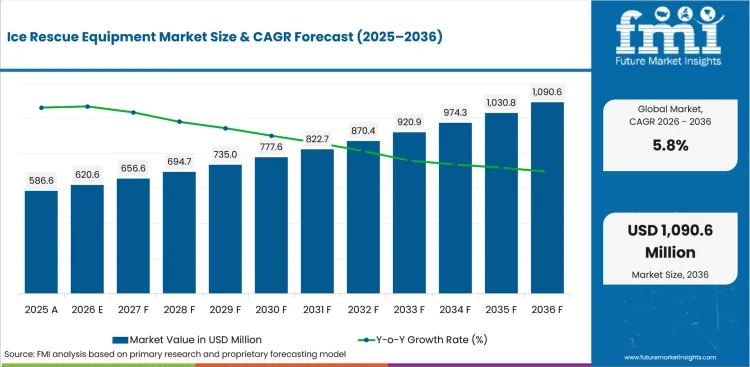
USD 620.6 million in 2026 and USD 1,090.6 million by 2036 at a 5.8% CAGR.
The ice rescue equipment market is expected to rise from USD 586.6 million in 2025 to USD 1,090.6 million by 2036 at a 5.8% CAGR. Replacement demand starts with suit inspection needs and cold-water training. Ice rescue suits are projected to hold 34.0% share in 2026. Hypalon / TPU is expected to represent 42.0% share as agencies favor patchable coated fabrics for inflatable platforms and sled contact points.
Rescue equipment market needs visible agency users before the products become part of annual budgets. The USA Fire Administration listed 27,117 registered fire departments in June 2026. GOV.UK reported in April 2026 that English fire and rescue services attended 17,470 flooding and water rescue incidents in the year ending December 2025. Northern Diver stated in 2026 that its water rescue PPE framework began with 10 UK services. Lincolnshire Fire & Rescue then ordered 430 made-to-measure drysuits under the same framework. This shows why staged ice rescue kits are gaining traction with search and rescue equipment in agency budget reviews.
| Metric | Value |
|---|---|
| 2026 Market Size | USD 620.6 million |
| 2036 Market Size | USD 1,090.6 million |
| Forecast CAGR (2026-2036) | 5.8% |
| Leading Equipment Type | Ice Rescue Suits |
| Ice Rescue Suits Share (2026) | 34.0% |
| Leading Material | Hypalon / TPU |
| Hypalon / TPU Share (2026) | 42.0% |
| Fastest-growing Country | China |
| China CAGR by 2036 | 6.4% |
Summary of the Ice Rescue Equipment Market
| Market Signal | Commercial Impact |
|---|---|
| Demand and Growth Drivers | Demand for ice rescue equipment is expected to expand steadily through 2036 as emergency preparedness programs, municipal rescue services, and training initiatives continue to strengthen public safety capabilities.
|
| Product and Segment View | Ice rescue suits, fire and rescue organizations, Hypalon/TPU materials, direct public safety sales, and seasonal ice regions continue to lead their respective market segments.
|
| Geography and Growth Outlook | North America and Asia continue to drive market expansion through emergency preparedness investments and winter rescue capabilities.
|
| Competitive Landscape | Competition increasingly focuses on equipment reliability, training support, and long-term service capabilities.
|
| Analyst Perspective | Ice rescue equipment is increasingly viewed as an essential emergency preparedness investment where equipment performance, training compatibility, and service support determine long-term procurement decisions.
- Rahul Pandita, Principal Analyst at Future Market Insights |
Which factors support expansion in the ice rescue equipment market?
Public rescue readiness and cold-water incident exposure support market value across municipal and industrial channels.
- Rescue suits create the first value layer due to agency need to protect entry crews before victim movement starts.
- Supplier pricing is shaped by material durability and repair access before accessory bundles affect repeat orders.
- Revenue improves as agencies move from single-item buying to complete cold-water rescue kits.
- Buyer confidence rises after training providers demonstrate gear that crews can use during drills and live calls.
Why is the ice rescue equipment market growing?
Cold-water response demand is growing due to staged readiness.
Cold-water response planning begins with incident exposure rather than everyday use. The USA Coast Guard reported in July 2025 that recreational boating incidents reached 3,887 in 2024. The same dataset recorded 2,170 injuries. These figures explain why agencies need gear that protects crews before contact and reaches victims before entry. Demand for rescue boats remains adjacent to ice rescue equipment planning as many teams combine boat assets and shore kits in the same response plan.
How is the ice rescue equipment market segmented?
The ice rescue equipment industry is segmented by equipment type, end use, material, sales channel, region climate use
- Ice rescue suits are projected to secure 34.0% share in 2026 owing to agency priority for rescuer immersion protection before sleds and platforms.
- Fire & Rescue is anticipated to hold 46.0% share in 2026 driven by municipal response ownership that keeps agency buying centered on this end use.
- Hypalon / TPU is expected to capture 42.0% share in 2026 supported by patchable coated fabric use in inflatable platforms and sled contact points.
- Direct Public Safety Sales are forecast to represent 51.0% share in 2026 due to approved vendor controls that keep tenders central to buying.
- Seasonal Ice Regions are estimated to account for 44.0% share in 2026 attributable to unstable ice that raises drill frequency and kit inspection needs.
Which equipment type category holds a notable share in the ice rescue equipment market?
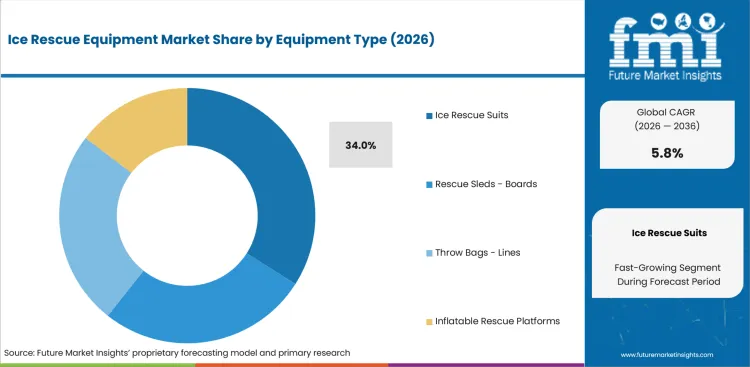
- Ice rescue suits are projected to account for 34.0% share in 2026 owing to department preference for waterproof entry protection before sleds or platforms.
- Rescue sleds and boards gain relevance in departments that want victim movement before full rescuer entry becomes necessary.
How does the end-use segment perform in the ice rescue equipment market?
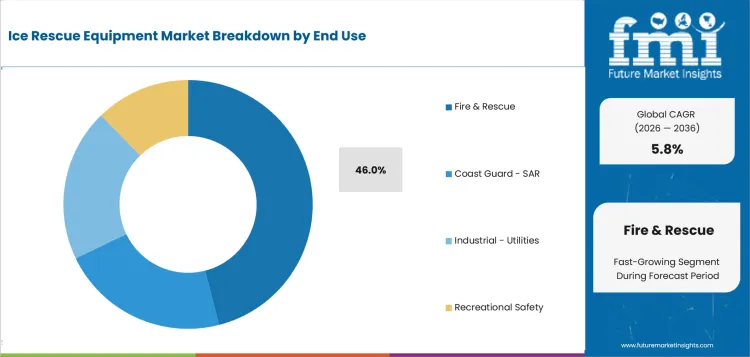
- Fire & Rescue is expected to represent 46.0% share in 2026 led by local dispatch responsibility for frozen ponds.
- Coast Guard / SAR demand is shaped by higher-spec suit buying for cold-water recovery and shoreline response tasks.
What drives buyer selection across material options in the ice rescue equipment market?
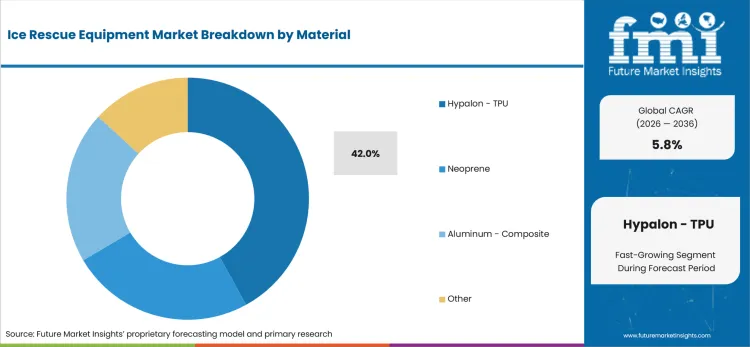
- Hypalon / TPU is anticipated to hold 42.0% share in 2026 supported by sealed fabric use in inflatable systems.
- Neoprene keeps relevance in suit layers owing to insulation needs during drills and entry work.
Which sales channel shows a prominent position in the ice rescue equipment market?
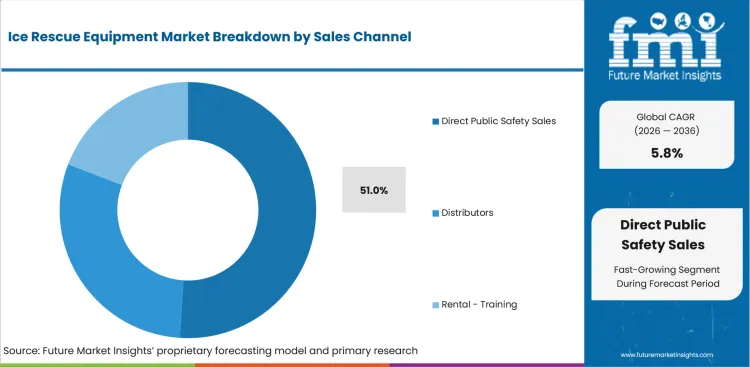
- Direct Public Safety Sales are projected to reach 51.0% share in 2026 due to tender documentation requirements that keep agency accounts in this route.
- Distributors remain useful for smaller departments that need accessories and replacement items between budget cycles.
How are buyers selecting across region climate use options in the ice rescue equipment market?
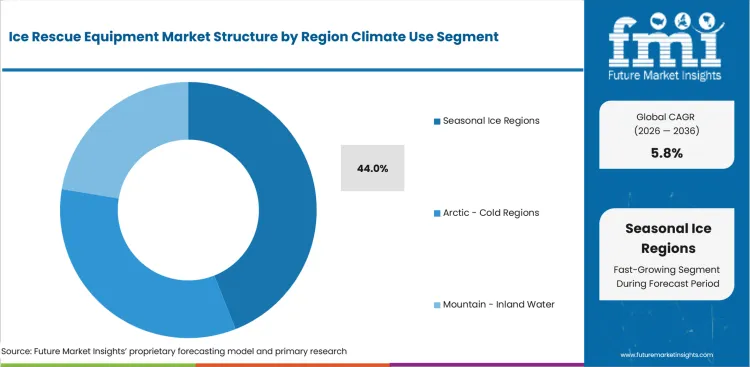
- Seasonal Ice Regions are expected to account for 44.0% share in 2026 owing to freeze-thaw cycles that increase uncertainty around ice thickness.
- Arctic / Cold Regions keep higher kit standards driven by repeated exposure and longer response distances.
What are the driver, restraints, and opportunities in the ice rescue equipment market?
Rescuer protection and victim reach support demand while local budget fragmentation limits faster kit replacement.
- Driver: Suit-led readiness is expected to raise demand for entry kits in agencies that prioritize rescuer protection before victim movement.
- Restraint: Budget fragmentation is expected to slow kit replacement in smaller departments that split funds across fire PPE and rescue gear.
- Opportunity: Training-linked rental is projected to widen adoption among agencies that need practice access before full kit ownership.
Ice Rescue Suit Readiness Outlook
Suit-led buying is expected to remain central because the rescuer must be protected before any victim movement begins. The USA Fire Administration listed 27,117 registered fire departments in June 2026. That large buyer base is also fragmented. Simple inspection steps and repair access help smaller departments treat rescue suits as serviceable equipment instead of one-time kit purchases.
Sled Distance Control Analysis
Sled and board demand is projected to improve because departments need victim contact before full rescuer entry becomes necessary. WHO stated in May 2026 that drowning causes about 300,000 deaths worldwide each year. The figure does not measure ice rescues directly. It still gives agencies a clear public-safety reason to favor reach systems that limit rescuer exposure. MARSARS adds a product-level example through its sled-led rescue line.
Training and Kit Access Outlook
Training-linked access is expected to expand because smaller agencies often learn the rescue sequence before they own a full kit. Northern Diver stated in 2026 that its national water rescue PPE framework began with 10 UK services. That structure gives departments a shared route for PPE selection and service support. It also makes training purchases easier to connect with later suit and accessory orders.
Which countries are growing fastest in the ice rescue equipment market?
China 6.4% CAGR, United States 6.1% CAGR, India 6.0% CAGR, South Korea 5.7% CAGR, Japan 5.6% CAGR, United Kingdom 5.4% CAGR, Germany 5.3% CAGR, and France 5.1% CAGR by 2036.
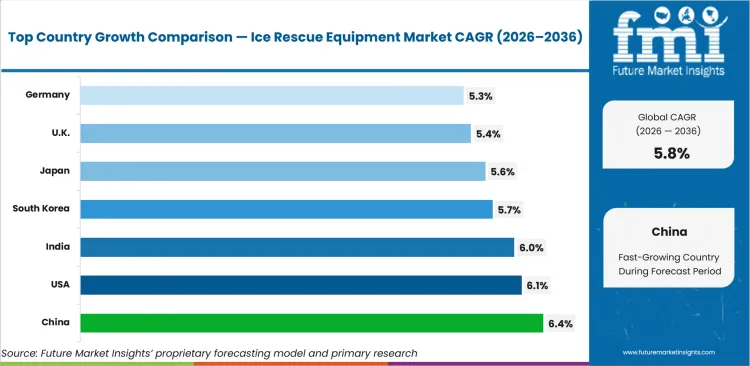
| Country | CAGR |
|---|---|
| China | 6.4% |
| United States | 6.1% |
| India | 6.0% |
| South Korea | 5.7% |
| Japan | 5.6% |
| United Kingdom | 5.4% |
| Germany | 5.3% |
| France | 5.1% |
Source: Future Market Insights, 2026.
How do country-level CAGRs compare in the ice rescue equipment market?
China records the most material CAGR outlook while France shows a more measured expansion profile among profiled markets.
- China is forecast to record 6.4% CAGR by 2036 supported by emergency capability upgrades and winter tourism activity.
- The United States is expected to expand at 6.1% CAGR by 2036 due to fire department coverage depth that supports recurring kit replacement.
- India is projected to grow at 6.0% CAGR by 2036 owing to disaster-response modernization in northern regions.
- South Korea is estimated to rise at 5.7% CAGR by 2036 attributable to water safety agencies keeping drowning prevention under review.
- Japan is expected to advance at 5.6% CAGR over the forecast period led by Hokkaido and northern Honshu exposure.
- The United Kingdom is forecast to grow at 5.4% CAGR by 2036 supported by fire services retaining water rescue capability under non-fire response duties.
- Germany is projected to post 5.3% CAGR by 2036 driven by lake rescue needs and DLRG training reach.
- France is anticipated to record 5.1% CAGR by 2036 owing to summer drowning prevention and alpine water exposure.
What supports ice rescue equipment growth in China?
A 6.4% CAGR by 2036 reflects emergency response investment and winter recreation growth in northern provinces.
Country Market Snapshot Table
| Parameter | Value |
|---|---|
| Market Size in 2025 (Value) | USD 82.7 million |
| Market Size in 2026 (Value) | USD 88.0 million |
| Market Forecast in 2036 (Value) | USD 163.6 million |
| CAGR (2026 to 2036) | 6.4% |
| Years Considered | 2021 to 2036 |
| Base Year | 2025 |
| Forecast Period | 2026 to 2036 |
| Units Considered | Value (USD million) |
| Leading Sub-Region | Heilongjiang and northern winter tourism provinces |
China Ice Rescue Equipment Market Outlook
China demand is shaped by public rescue capability upgrades in cold northern provinces. Winter recreation around lakes and snow destinations gives agencies a clearer reason to stage suits and shore-based rescue kits.
Procurement is likely to favor public safety tenders and regional distributors. Buyers need suits and sleds from the same supply route. Inflatable platforms then add kit depth for larger water-response teams.
Key Growth Drivers
- Emergency response upgrades create a clearer base for tendered ice rescue kits. In July 2024 the Ministry of Emergency Management sent more than 800 fire and rescue personnel to the Dongting Lake response. Large mobilizations of this kind explain why agencies need suits and throw-line systems that can move between flood and winter water operations.
- Rescue logistics make boat and platform bundles relevant beyond ordinary water response. The Ministry of Emergency Management also sent 82 boats to the Hunan rescue scene in July 2024. That operating model supports inflatable platforms and sled systems that help crews reach people from unstable edges.
- Winter tourism activity gives northern authorities a stronger reason to stage shore rescue kits near frozen lakes and parks.
- Local distributors can support lower-cost replenishment for ropes and bags owing to inspection accessories creating repeat demand after training use.
Key Restraints
- Procurement fragmentation across provinces and municipal agencies can slow national specification alignment for rescue kits.
- Imported suit brands can face pricing pressure if local agencies prioritize basic readiness over premium materials.
- Training consistency remains uneven outside large urban rescue teams due to smaller agencies delaying suit replacement until budget cycles reopen.
What makes China unique
China is distinct for its mix of winter recreation growth and large-scale emergency response mobilization.
Key Companies
- VIKING Life-Saving Equipment
- Survitec
- Hifei Marine
- Qingdao Lian Ya Boat
- Weihai Hifei Marine
Sales & Marketing Channels
- Government tenders
- Emergency equipment distributors
- Marine safety suppliers
- Training providers
- Direct agency sales
Country Segment Breakdown Table
| Segment | Sub-Segments |
|---|---|
| By Equipment Type | Rescue Sleds / Boards · Ice Rescue Suits · Throw Bags / Lines · Inflatable Rescue Platforms |
| By End Use | Fire & Rescue · Coast Guard / SAR · Industrial / Utilities · Recreational Safety |
| By Material | Hypalon / TPU · Neoprene · Aluminum / Composite · Other |
| By Sales Channel | Direct Public Safety Sales · Distributors · Rental / Training |
| By Region Climate Use | Arctic / Cold Regions · Seasonal Ice Regions · Mountain / Inland Water |
| Key Sub-Regions Covered, Operational Corridors | Heilongjiang · Jilin · Liaoning · Beijing-Tianjin corridor · Inner Mongolia |
Frequently Asked Questions
How fast is China ice rescue equipment market growing?
China is forecast to grow at 6.4% CAGR from 2026 to 2036.
Who leads China ice rescue equipment market?
VIKING and Survitec serve marine safety channels in China. Hifei Marine and Qingdao Lian Ya Boat support local rescue supply. Weihai Hifei Marine adds regional boat access for emergency buyers.
What is driving adoption in China ice rescue equipment market?
Emergency response investment and winter recreation exposure are moving agencies toward kit-based rescue readiness.
How fast is the ice rescue equipment market growing in the United States?
A 6.1% CAGR by 2036 reflects deep fire department coverage and cold-water rescue training demand.
Country Market Snapshot Table
| Parameter | Value |
|---|---|
| Market Size in 2025 (Value) | USD 162.1 million |
| Market Size in 2026 (Value) | USD 172.0 million |
| Market Forecast in 2036 (Value) | USD 310.9 million |
| CAGR (2026 to 2036) | 6.1% |
| Years Considered | 2021 to 2036 |
| Base Year | 2025 |
| Forecast Period | 2026 to 2036 |
| Units Considered | Value (USD million) |
| Leading Sub-Region | Great Lakes and Northeast corridors |
United States Ice Rescue Equipment Market Outlook
United States industry is driven by municipal fire departments and specialist water rescue distributors. Great Lakes states and Northeast communities provide a steady base for ice rescue suits and throw-line kits.
Channel activity is expected to remain distributor-led for accessories and direct for department-level suit packages. Training schools keep product selection tied to field procedures instead of catalog breadth.
Key Growth Drivers
- Boating incidents keep water rescue readiness visible in local budgets. The USA Coast Guard reported in July 2025 that recreational boating incidents reached 3,887 in 2024. These calls do not represent ice rescues alone. They still reinforce the need for staged water-rescue gear in departments that cover lakes and rivers.
- Fire department depth gives suppliers a broad but fragmented buyer base. The USA Fire Administration listed 27,117 registered fire departments in June 2026. That scale supports repeat demand for suits and throw bags because departments replace worn gear after drills and seasonal checks.
- Great Lakes communities need staged rescue gear for shoreline ice and inland water exposure.
- Specialist distributors support repeat sales by bundling dry suits and throw bags with sleds and training products.
Key Restraints
- Drowning prevention keeps rescue readiness inside public-safety planning. CDC reported in May 2024 that more than 4,500 people died from drowning each year during 2020 to 2022. That loss profile keeps agencies focused on faster reach and safer retrieval even before ice-specific incidents occur.
- Municipal procurement can delay replacement if departments must choose between structural fire PPE and rescue gear.
- Premium suits face resistance from small volunteer departments that need basic kit coverage before duplicate sets.
What makes United States unique
The United States is distinct for its large fire department base and specialist rescue distribution network.
Key Companies
- Mustang Survival
- MARSARS Water Rescue Systems
- CMC Rescue
- NRS
- Dive Rescue International
- Rescue 3 International
- Lifesaving Resources
Sales & Marketing Channels
- Fire equipment dealers
- Public safety tenders
- Training schools
- Online rescue gear stores
- Direct manufacturer sales
Country Segment Breakdown Table
| Segment | Sub-Segments |
|---|---|
| By Equipment Type | Rescue Sleds / Boards · Ice Rescue Suits · Throw Bags / Lines · Inflatable Rescue Platforms |
| By End Use | Fire & Rescue · Coast Guard / SAR · Industrial / Utilities · Recreational Safety |
| By Material | Hypalon / TPU · Neoprene · Aluminum / Composite · Other |
| By Sales Channel | Direct Public Safety Sales · Distributors · Rental / Training |
| By Region Climate Use | Arctic / Cold Regions · Seasonal Ice Regions · Mountain / Inland Water |
| Key Sub-Regions Covered, Operational Corridors | Great Lakes · New England · Upper Midwest · Mountain states · Alaska |
Frequently Asked Questions
How fast is United States ice rescue equipment market growing?
The United States is forecast to grow at 6.1% CAGR from 2026 to 2036.
Who leads United States ice rescue equipment market?
Mustang Survival and MARSARS are visible in suit and sled channels. CMC Rescue and NRS support rope and drysuit access. Dive Rescue International extends the training link for public safety teams.
What is driving adoption in United States ice rescue equipment market?
Fire department readiness and cold-water training needs are supporting kit replacement.
How is India performing in the ice rescue equipment market?
A 6.0% CAGR by 2036 reflects disaster-response modernization and niche cold-region requirements.
Country Market Snapshot Table
| Parameter | Value |
|---|---|
| Market Size in 2025 (Value) | USD 26.4 million |
| Market Size in 2026 (Value) | USD 28.0 million |
| Market Forecast in 2036 (Value) | USD 50.1 million |
| CAGR (2026 to 2036) | 6.0% |
| Years Considered | 2021 to 2036 |
| Base Year | 2025 |
| Forecast Period | 2026 to 2036 |
| Units Considered | Value (USD million) |
| Leading Sub-Region | Himalayan and northern disaster response zones |
India Ice Rescue Equipment Market Outlook
Sector in India is concentrated in Himalayan states and specialist disaster-response units instead of ordinary municipal buying. Cold lakes and high-altitude rivers shape kit needs differently. Flood-prone areas add a broader disaster-response setting that can support multipurpose water rescue gear.
Procurement is expected to favor NDRF-linked training and regional emergency suppliers. International brands can compete when they provide documented product use and local service support.
Key Growth Drivers
- Disaster-response operations create a route for specialized water rescue kits in India. The NDRF reported in March 2025 that it conducted 1,038 operations in 2024. Ice rescue remains selective, but the same response system can support cold-region suits and throw-line kits.
- Evacuation scale makes multipurpose rescue gear relevant for training-led procurement. The same March 2025 NDRF update noted that the force evacuated more than 63,000 people in 2024. That operating base helps agencies justify staged water rescue gear before they add more ice-specific platforms.
- Himalayan tourism and high-altitude water exposure support selective demand for cold-water rescue suits.
- Public training programs can expand use of throw bags and staged rescue methods among state disaster teams.
Key Restraints
- Ice rescue remains a narrow requirement compared with flood response and heat-season water rescue. This keeps broad municipal stockholding limited outside northern and high-altitude areas.
- Imported technical suits can face procurement delays due to budget approvals and service access concerns.
- Remote terrain can make suit and zipper maintenance harder because follow-up service for ropes and inflatable platforms is limited in cold mountain areas.
What makes India unique
India is distinct for concentrated cold-region demand inside a broader disaster-response and flood-rescue environment.
Key Companies
- VIKING Life-Saving Equipment
- Survitec
- NRS
- CMC Rescue
- Rescue 3 International
Sales & Marketing Channels
- Government procurement
- Disaster response tenders
- Marine safety distributors
- Training providers
- Public safety dealers
Country Segment Breakdown Table
| Segment | Sub-Segments |
|---|---|
| By Equipment Type | Rescue Sleds / Boards · Ice Rescue Suits · Throw Bags / Lines · Inflatable Rescue Platforms |
| By End Use | Fire & Rescue · Coast Guard / SAR · Industrial / Utilities · Recreational Safety |
| By Material | Hypalon / TPU · Neoprene · Aluminum / Composite · Other |
| By Sales Channel | Direct Public Safety Sales · Distributors · Rental / Training |
| By Region Climate Use | Arctic / Cold Regions · Seasonal Ice Regions · Mountain / Inland Water |
| Key Sub-Regions Covered, Operational Corridors | Ladakh · Himachal Pradesh · Uttarakhand · Jammu and Kashmir · Sikkim |
Frequently Asked Questions
How fast is India ice rescue equipment market growing?
India is forecast to grow at 6.0% CAGR from 2026 to 2036.
Who leads India ice rescue equipment market?
VIKING and Survitec are used in regional safety channels. NRS and CMC Rescue support technical rescue supply. Rescue 3 International extends training access for agency buyers.
What is driving adoption in India ice rescue equipment market?
Disaster-response training and high-altitude water exposure are supporting selective kit buying.
What is shaping ice rescue equipment demand in South Korea?
A 5.7% CAGR by 2036 reflects drowning prevention focus and cold-region response needs.
Country Market Snapshot Table
| Parameter | Value |
|---|---|
| Market Size in 2025 (Value) | USD 20.8 million |
| Market Size in 2026 (Value) | USD 22.0 million |
| Market Forecast in 2036 (Value) | USD 38.3 million |
| CAGR (2026 to 2036) | 5.7% |
| Years Considered | 2021 to 2036 |
| Base Year | 2025 |
| Forecast Period | 2026 to 2036 |
| Units Considered | Value (USD million) |
| Leading Sub-Region | Gangwon and inland river corridors |
South Korea Ice Rescue Equipment Market Outlook
South Korea is influenced by water safety programs and cold inland regions. Gangwon and northern reservoirs create a narrower base for suits and staged rescue equipment.
Channel demand is expected to rely on fire service procurement and regional marine safety suppliers. Product selection favors compact kits that fit rescue vehicles and training centers.
Key Growth Drivers
- Water safety planning gives cold-water rescue equipment a clearer public health link. KDCA reported in July 2025 that emergency drowning cases from 2018 to 2022 had a 21.2% death proportion. That severity finding supports training emphasis on quicker retrieval and safer approach methods.
- Older adult risk makes shore-based reach and quick retrieval more important in water safety planning. KDCA also reported a 40.3% death proportion among cases aged 70 years and above. That profile supports clearer rescue preparation for reservoirs and winter recreation areas used by older residents.
- Gangwon winter recreation and inland reservoirs create localized demand for cold-water entry equipment.
- Training centers can support repeat buying for throw bags and rescue suits used in drills.
Key Restraints
- Dedicated ice kit replacement can slow due to demand remaining narrower than general flood and water rescue equipment.
- Local buyers may prefer multipurpose water rescue PPE before ice-specific sleds and platforms.
- Imported technical products need distributor support for sizing and repair due to agency users requiring inspection training.
What makes South Korea unique
South Korea is distinct for concentrated winter-region demand and public health attention on drowning outcomes.
Key Companies
- VIKING Life-Saving Equipment
- Survitec
- NRS
- CMC Rescue
- Rescue 3 International
Sales & Marketing Channels
- Fire service procurement
- Marine safety distributors
- Public rescue tenders
- Training providers
- Specialist safety dealers
Country Segment Breakdown Table
| Segment | Sub-Segments |
|---|---|
| By Equipment Type | Rescue Sleds / Boards · Ice Rescue Suits · Throw Bags / Lines · Inflatable Rescue Platforms |
| By End Use | Fire & Rescue · Coast Guard / SAR · Industrial / Utilities · Recreational Safety |
| By Material | Hypalon / TPU · Neoprene · Aluminum / Composite · Other |
| By Sales Channel | Direct Public Safety Sales · Distributors · Rental / Training |
| By Region Climate Use | Arctic / Cold Regions · Seasonal Ice Regions · Mountain / Inland Water |
| Key Sub-Regions Covered, Operational Corridors | Gangwon · Seoul metropolitan reservoirs · North Gyeongsang · Chungcheong inland waters |
Frequently Asked Questions
How fast is South Korea ice rescue equipment market growing?
South Korea is forecast to grow at 5.7% CAGR from 2026 to 2036.
Who leads South Korea ice rescue equipment market?
VIKING and Survitec are active in regional rescue supply channels. NRS and CMC Rescue support technical product access. Rescue 3 International extends the training link for agency users.
What is driving adoption in South Korea ice rescue equipment market?
Water safety policy attention and winter-region training needs support ice rescue kit selection.
How is the ice rescue equipment forecast developing in Japan?
A 5.6% CAGR by 2036 reflects northern climate exposure and tourism-linked safety planning.
Country Market Snapshot Table
| Parameter | Value |
|---|---|
| Market Size in 2025 (Value) | USD 33.1 million |
| Market Size in 2026 (Value) | USD 35.0 million |
| Market Forecast in 2036 (Value) | USD 60.4 million |
| CAGR (2026 to 2036) | 5.6% |
| Years Considered | 2021 to 2036 |
| Base Year | 2025 |
| Forecast Period | 2026 to 2036 |
| Units Considered | Value (USD million) |
| Leading Sub-Region | Hokkaido and northern Honshu |
Japan Ice Rescue Equipment Market Outlook
Sector in Japan is concentrated in Hokkaido and northern Honshu. Winter recreation and inland water exposure support rescue suits and throw-line stations near cold tourism zones. This geography makes cold-water response more selective than nationwide marine safety buying.
Procurement is expected to favor marine safety channels and public rescue buyers that need dependable documentation. Imported suits can compete if local service access is clear.
Key Growth Drivers
- Winter tourism raises local safety planning needs around snow and lake destinations. JNTO reported in January 2026 that Japan received 42.7 million international visitors in 2025. Visitor flows do not equal ice incidents. They still increase pressure on tourism areas to stage visible rescue gear near cold-water attractions.
- Formal safety planning gives Japanese agencies a reason to keep marine and cold-water rescue procedures documented. Japan's Cabinet Office stated in June 2025 that ship accidents around Japan reached 1,817 in 2024. That operating backdrop supports rescue gear planning in northern prefectures that face winter water exposure.
- Hokkaido and northern Honshu create demand for cold-weather rescue training and staged shore gear.
- Public safety buyers often favor compact kits that fit station storage and vehicle deployment limits.
Key Restraints
- Ice rescue remains regionally concentrated due to nationwide marine rescue demand being broader than cold-weather rescue demand.
- Language and certification documentation can slow imported product adoption among local agencies.
- Seasonal demand can make inventory planning harder for distributors outside northern prefectures.
What makes Japan unique
Japan is distinct for concentrated northern climate exposure and winter tourism activity around cold-water destinations.
Key Companies
- Survitec
- VIKING Life-Saving Equipment
- NRS
- Mustang Survival
- CMC Rescue
Sales & Marketing Channels
- Marine safety distributors
- Fire agency procurement
- Specialist rescue suppliers
- Training providers
- Online public safety stores
Country Segment Breakdown Table
| Segment | Sub-Segments |
|---|---|
| By Equipment Type | Rescue Sleds / Boards · Ice Rescue Suits · Throw Bags / Lines · Inflatable Rescue Platforms |
| By End Use | Fire & Rescue · Coast Guard / SAR · Industrial / Utilities · Recreational Safety |
| By Material | Hypalon / TPU · Neoprene · Aluminum / Composite · Other |
| By Sales Channel | Direct Public Safety Sales · Distributors · Rental / Training |
| By Region Climate Use | Arctic / Cold Regions · Seasonal Ice Regions · Mountain / Inland Water |
| Key Sub-Regions Covered, Operational Corridors | Hokkaido · Aomori · Nagano · Niigata · Tohoku inland waters |
Frequently Asked Questions
How fast is Japan ice rescue equipment market growing?
Japan is forecast to grow at 5.6% CAGR from 2026 to 2036.
Who leads Japan ice rescue equipment market?
Survitec and VIKING serve marine safety channels in Japan. NRS and Mustang Survival support rescue equipment access. CMC Rescue adds rope and throw-line supply for technical teams.
What is driving adoption in Japan ice rescue equipment market?
Northern climate exposure and tourism-linked water safety planning are supporting kit demand.
What is the ice rescue equipment outlook in the United Kingdom?
A 5.4% CAGR by 2036 reflects fire service water rescue capability and cold-water training needs.
Country Market Snapshot Table
| Parameter | Value |
|---|---|
| Market Size in 2025 (Value) | USD 53.1 million |
| Market Size in 2026 (Value) | USD 56.0 million |
| Market Forecast in 2036 (Value) | USD 94.8 million |
| CAGR (2026 to 2036) | 5.4% |
| Years Considered | 2021 to 2036 |
| Base Year | 2025 |
| Forecast Period | 2026 to 2036 |
| Units Considered | Value (USD million) |
| Leading Sub-Region | England and Scotland cold-water corridors |
United Kingdom Ice Rescue Equipment Market Outlook
United Kingdom demand is expected to driven by fire and rescue services that handle flooding and river rescues. Cold-water calls add a second use case for the same teams. Scotland and northern England create added winter exposure.
Channel activity is shaped by national frameworks and specialist PPE suppliers. Agencies value drysuits and helmets from approved routes. Throw bags and compatible accessories support drills after suit purchases.
Key Growth Drivers
- Water rescue incident volume keeps equipment under service planning in the United Kingdom. GOV.UK reported in April 2026 that fire and rescue services attended 1,883 rescue or evacuation from water incidents in the year ending September 2025. That activity gives drysuits and throw-line kits a role beyond rare ice calls.
- Specialist rescue capability supports higher-spec PPE demand in urban services. London Fire Brigade states that five Fire Rescue Units provide water rescue capability. That structure shows why approved drysuits and compatible accessories matter for teams that need repeatable rescue procedures.
- National framework buying can improve standardization across fire and rescue authorities.
- Training-linked channels support accessories owing to repeated crew drills before live rescue work.
Key Restraints
- Workforce pressure can make specialist training harder to schedule across fire services. GOV.UK reported in December 2025 that England had 30,601 FTE firefighters in March 2025. Limited staffing depth can delay refresher courses for equipment that needs regular practice.
- Framework procurement may narrow supplier access for smaller brands lacking approved listings.
- Budget competition against flood response and structural PPE can delay dedicated ice rescue upgrades.
What makes United Kingdom unique
The United Kingdom is distinct for framework-led water rescue PPE buying and specialist rescue unit coverage.
Key Companies
- Northern Diver Rescue
- Survitec
- Crewsaver
- SAR Products
- Safequip
Sales & Marketing Channels
- National framework contracts
- Fire service procurement
- Specialist PPE distributors
- Training providers
- Direct manufacturer sales
Country Segment Breakdown Table
| Segment | Sub-Segments |
|---|---|
| By Equipment Type | Rescue Sleds / Boards · Ice Rescue Suits · Throw Bags / Lines · Inflatable Rescue Platforms |
| By End Use | Fire & Rescue · Coast Guard / SAR · Industrial / Utilities · Recreational Safety |
| By Material | Hypalon / TPU · Neoprene · Aluminum / Composite · Other |
| By Sales Channel | Direct Public Safety Sales · Distributors · Rental / Training |
| By Region Climate Use | Arctic / Cold Regions · Seasonal Ice Regions · Mountain / Inland Water |
| Key Sub-Regions Covered, Operational Corridors | Scotland · Northern England · Midlands reservoirs · Wales · East Anglia waterways |
Frequently Asked Questions
How fast is United Kingdom ice rescue equipment market growing?
The United Kingdom is forecast to grow at 5.4% CAGR from 2026 to 2036.
Who leads United Kingdom ice rescue equipment market?
Northern Diver Rescue and Survitec serve water rescue PPE channels. Crewsaver and SAR Products add specialist supply while Safequip supports public safety distribution.
What is driving adoption in United Kingdom ice rescue equipment market?
Fire service water rescue capability and framework-led PPE buying support adoption.
How does Germany compare in the ice rescue equipment market?
A 5.3% CAGR by 2036 reflects lake rescue needs and volunteer rescue organization reach.
Country Market Snapshot Table
| Parameter | Value |
|---|---|
| Market Size in 2025 (Value) | USD 45.6 million |
| Market Size in 2026 (Value) | USD 48.0 million |
| Market Forecast in 2036 (Value) | USD 80.3 million |
| CAGR (2026 to 2036) | 5.3% |
| Years Considered | 2021 to 2036 |
| Base Year | 2025 |
| Forecast Period | 2026 to 2036 |
| Units Considered | Value (USD million) |
| Leading Sub-Region | Bavaria and northern lake regions |
Germany Ice Rescue Equipment Market Outlook
Germany outlook is expected to be shaped by DLRG activity and local fire brigades. Lake-heavy regions provide a practical buyer base for rescue suits. Bavaria and northern inland water areas support throw-line and staged rescue stations.
Procurement is likely to remain split between public agencies and rescue associations. Distributors that offer training-compatible kits can support repeat accessory demand.
Key Growth Drivers
- Water rescue risk keeps German rescue associations active in local preparedness. DLRG reported in March 2026 that Germany recorded 393 drowning deaths in 2025. The figure supports continued attention to throw-line stations and rescue suits around lakes and rivers.
- Germany's federal structure leaves procurement spread across regional agencies and associations. The European Union identified Germany in 2026 as a federal republic composed of 16 states. This structure can keep rescue equipment specifications local and slow national standardization.
- Lake and river rescue activity supports ongoing demand for throw bags and staged rescue stations.
- Training programs create replacement needs for ropes and gloves owing to suit seal wear after repeated drills.
Key Restraints
- Annual replenishment can remain uneven due to seasonal demand and winter severity.
- Volunteer organization purchasing can be price sensitive during tight donation and local budget cycles.
- Imported brands need distributor support for German documentation and sizing due to service follow-up requirements.
What makes Germany unique
Germany is distinct for rescue association participation and decentralized public safety purchasing.
Key Companies
- VIKING Life-Saving Equipment
- Hansen Protection
- SECUMAR
- rescue-tec GmbH
- DLRG Materialstelle
Sales & Marketing Channels
- Rescue association procurement
- Fire service tenders
- Specialist safety distributors
- Training providers
- Marine safety suppliers
Country Segment Breakdown Table
| Segment | Sub-Segments |
|---|---|
| By Equipment Type | Rescue Sleds / Boards · Ice Rescue Suits · Throw Bags / Lines · Inflatable Rescue Platforms |
| By End Use | Fire & Rescue · Coast Guard / SAR · Industrial / Utilities · Recreational Safety |
| By Material | Hypalon / TPU · Neoprene · Aluminum / Composite · Other |
| By Sales Channel | Direct Public Safety Sales · Distributors · Rental / Training |
| By Region Climate Use | Arctic / Cold Regions · Seasonal Ice Regions · Mountain / Inland Water |
| Key Sub-Regions Covered, Operational Corridors | Bavaria · Baden-Wurttemberg · Schleswig-Holstein · Lower Saxony · Mecklenburg lake region |
Frequently Asked Questions
How fast is Germany ice rescue equipment market growing?
Germany is forecast to grow at 5.3% CAGR from 2026 to 2036.
Who leads Germany ice rescue equipment market?
VIKING and Hansen Protection support cold-water PPE access. SECUMAR and rescue-tec serve the local rescue equipment channel. DLRG Materialstelle supports association procurement for training-linked needs.
What is driving adoption in Germany ice rescue equipment market?
Lake rescue exposure and volunteer rescue organization activity are supporting kit replacement.
What supports ice rescue equipment demand in France?
A 5.1% CAGR by 2036 reflects drowning prevention needs and alpine water rescue exposure.
Country Market Snapshot Table
| Parameter | Value |
|---|---|
| Market Size in 2025 (Value) | USD 40.0 million |
| Market Size in 2026 (Value) | USD 42.0 million |
| Market Forecast in 2036 (Value) | USD 69.1 million |
| CAGR (2026 to 2036) | 5.1% |
| Years Considered | 2021 to 2036 |
| Base Year | 2025 |
| Forecast Period | 2026 to 2036 |
| Units Considered | Value (USD million) |
| Leading Sub-Region | Alpine and eastern lake departments |
France Ice Rescue Equipment Market Outlook
France industry is expected to be influenced by public health attention on drowning and local rescue coverage in lake and alpine departments. Cold-water rescue equipment remains more selective than general aquatic safety products.
Channel activity is likely to depend on fire service procurement and rescue schools. Marine safety distributors add product access while French suppliers defend accounts with PPE credibility and public safety relationships.
Key Growth Drivers
- Drowning surveillance keeps water rescue readiness visible for French public agencies. Santé publique France reported in May 2026 that 1,418 drowning incidents were recorded in summer 2025. This surveillance base supports selective rescue kit buying near lakes and alpine water sites.
- Fire service intervention scale gives France a broad public rescue platform. French civil security statistics recorded 4.75 million firefighter interventions in 2024. That operating scale helps explain why rescue equipment buyers value dependable suppliers and clear service documentation.
- Alpine lakes and eastern regions create practical use cases for cold-water suits and throw lines.
- Local suppliers can support repeat purchases during faster accessory replenishment cycles.
Key Restraints
- Nationwide stockholding remains limited due to ice rescue demand being concentrated outside alpine and northern settings.
- Seasonal tourism can raise short-term risk due to annual procurement cycles limiting faster response purchases.
- Imported technical suits face service and documentation expectations in public tenders.
What makes France unique
France is distinct for the link between public drowning surveillance and alpine water rescue needs.
Key Companies
- Survitec
- VIKING Life-Saving Equipment
- Guy Cotten
- Plastimo
- Dimatex
Sales & Marketing Channels
- Fire service procurement
- Marine safety distributors
- Public safety dealers
- Training providers
- Direct supplier tenders
Country Segment Breakdown Table
| Segment | Sub-Segments |
|---|---|
| By Equipment Type | Rescue Sleds / Boards · Ice Rescue Suits · Throw Bags / Lines · Inflatable Rescue Platforms |
| By End Use | Fire & Rescue · Coast Guard / SAR · Industrial / Utilities · Recreational Safety |
| By Material | Hypalon / TPU · Neoprene · Aluminum / Composite · Other |
| By Sales Channel | Direct Public Safety Sales · Distributors · Rental / Training |
| By Region Climate Use | Arctic / Cold Regions · Seasonal Ice Regions · Mountain / Inland Water |
| Key Sub-Regions Covered, Operational Corridors | Alps · Jura · Grand Est · Auvergne-Rhone-Alpes · Brittany coastal training centers |
Frequently Asked Questions
How fast is France ice rescue equipment market growing?
France is forecast to grow at 5.1% CAGR from 2026 to 2036.
Who leads France ice rescue equipment market?
Survitec and VIKING are used in marine safety channels. Guy Cotten and Plastimo add local marine PPE access. Dimatex supports public safety supply for emergency teams.
What is driving adoption in France ice rescue equipment market?
Drowning surveillance and alpine water exposure support selective rescue kit buying.
How do cold-region kits connect with adjacent emergency equipment?
Cold-region agencies can add foldable inflatable boats to support shore response and near-shore movement in seasonal ice settings.
Who are the leading companies in the ice rescue equipment market?
Mustang Survival, Survitec, MARSARS, VIKING Life-Saving Equipment, Hansen Protection, NRS, CMC Rescue, Northern Diver Rescue, Rescue 3 International
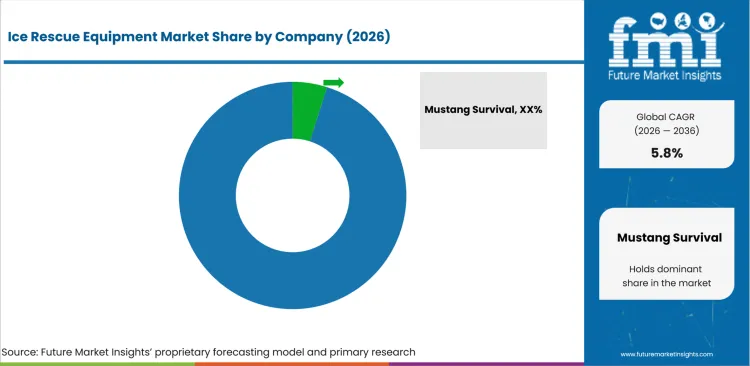
- Competition is shaped by suit repairability and donning speed supported by public safety references that help agencies compare suppliers.
- Sled suppliers compete on safer victim reach and training compatibility.
- Rope and throw-bag suppliers gain accounts by meeting rescue standards and distributor availability.
- Training providers influence equipment selection after agencies buy gear used during certification courses.
The competitive landscape includes suit manufacturers, rescue sled specialists and rope system suppliers, with marine safety organizations adding depth to distribution channels. Training‑linked distributors play a key role in final supplier selection, as public agencies tend to procure equipment aligned with what teams train on. Competition is shaped by thermal protection performance which influences buyer confidence.
Manufacturing capability and channel reach become more important once training exercises and drills create recurring replacement demand among public agencies. VIKING and Survitec leverage broad maritime safety networks, while Mustang Survival and Northern Diver maintain credibility through specialization in public safety applications.
Suppliers offering repairable suits and distributor support are better positioned for repeat orders following field use. MARSARS retains a differentiated position through its sled‑focused offering, while CMC and NRS support demand across rope systems and drysuit accessories.
How do top ice rescue equipment companies compare?
Companies differ by product focus and channel access. Account reach and service depth also shape comparison.
| Company | Relevance | Portfolio / Focus | Account Access | Footprint / Service Reach |
|---|---|---|---|---|
| Mustang Survival | High | Ice rescue suits and water rescue PPE | Public safety distributors | North America and export channels |
| Survitec | High | Imperial IR1500 and maritime safety PPE | Direct and distributor channels | Global safety network |
| MARSARS | Focused | Ice rescue sled systems | Public safety and rescue dealers | United States-led specialist reach |
| VIKING Life-Saving Equipment | High | Immersion suits and marine safety systems | Maritime and agency accounts | Global branches and service stations |
| Hansen Protection | Medium | Cold-water and SAR suits | Marine and rescue customers | Nordic and European reach |
| CMC Rescue | Medium | Throwline bags and rescue rope gear | Rescue equipment distributors | North America and international channels |
Source: Future Market Insights, 2026.
Who are the key players in the ice rescue equipment market?
Global companies in the market include suit and sled suppliers. Rope suppliers and training providers complete the group alongside marine safety suppliers.
Key global companies leading the ice rescue equipment market include:
- Mustang Survival
- Survitec
- MARSARS Water Rescue Systems
- VIKING Life-Saving Equipment
- Hansen Protection
- NRS
- CMC Rescue
- Northern Diver Rescue
- Crewsaver
- Rescue 3 International
- Dive Rescue International
Key Developments in Ice Rescue Equipment Market
- In April 2025, Mustang Survival reinforced its professional cold-water equipment portfolio through updated operational guidance for Sentinel Series dry suits. The development supported rescue and public-safety users by emphasizing proper wear, maintenance and long-term dry-suit performance.
- In September 2024, Northern Diver Rescue announced its national framework contract for water rescue PPE. Lincolnshire Fire & Rescue became an early adopter with an order for 430 made-to-measure drysuits through the framework.
Key Players in the Ice Rescue Equipment Market
Suit and PPE suppliers
- Mustang Survival
- Survitec
- VIKING Life-Saving Equipment
- Hansen Protection
- Northern Diver Rescue
- Crewsaver
- Guy Cotten
Sled and rescue platform suppliers
- MARSARS Water Rescue Systems
- Hifei Marine
- Qingdao Lian Ya Boat
- Weihai Hifei Marine
Rope and throw-line suppliers
- CMC Rescue
- NRS
- Rescue 3 International
- Dive Rescue International
- Lifesaving Resources
- SAR Products
- Safequip
Ice Rescue Equipment Market - Report Scope
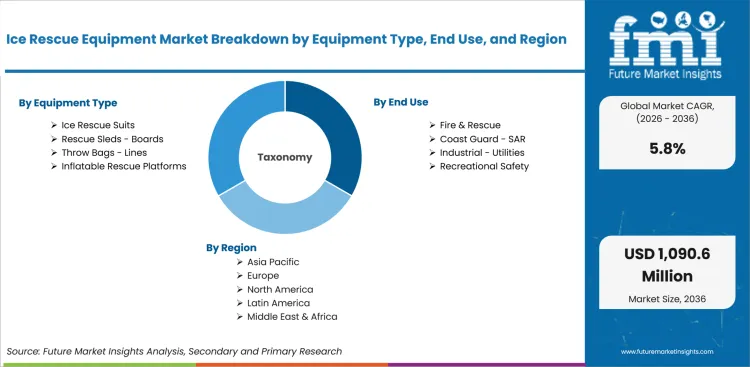
| Attribute | Details |
|---|---|
| Forecast period | 2026 to 2036 |
| Historical period | 2021 to 2025 |
| Quantitative unit | Value in USD million |
| Equipment Type | Rescue Sleds / Boards · Ice Rescue Suits · Throw Bags / Lines · Inflatable Rescue Platforms |
| End Use | Fire & Rescue · Coast Guard / SAR · Industrial / Utilities · Recreational Safety |
| Material | Hypalon / TPU · Neoprene · Aluminum / Composite · Other |
| Sales Channel | Direct Public Safety Sales · Distributors · Rental / Training |
| Region Climate Use | Arctic / Cold Regions · Seasonal Ice Regions · Mountain / Inland Water |
| Regions covered | North America · Latin America · Europe · East Asia · South Asia · Oceania · Middle East and Africa |
| Countries covered | United States · United Kingdom · Germany · France · Japan · China · South Korea · India |
| Key companies profiled | Mustang Survival · Survitec · MARSARS · VIKING · Hansen Protection · NRS · CMC Rescue · Northern Diver Rescue |
| Approach | Top-down and bottom-up forecasting supported by public safety statistics and company validation |
Source: Future Market Insights, 2026.
Ice Rescue Equipment Market - Scope & Definition
| Scope Item | Definition |
|---|---|
| Market Definition | Professional products used to reach, protect, recover, and move people from ice-covered or near-freezing water. |
| Functions Covered | Rescuer immersion protection, victim reach, shore-based recovery, flotation support, and training readiness. |
| Applications Covered | Frozen ponds, inland lakes, reservoirs, harbors, canals, rivers, and cold-water response zones. |
| End-Use Industries | Fire & Rescue, Coast Guard / SAR, Industrial / Utilities, and Recreational Safety. |
| Materials Covered | Hypalon / TPU, neoprene, aluminum / composite, and other specialist materials. |
| Inclusions | Rescue sleds, boards, ice rescue suits, throw bags, rescue lines, and inflatable rescue platforms. |
| Exclusions | General boating accessories, ordinary wetsuits, liferafts, lifeboats, snowmobiles, and rescue boats not sold as ice rescue systems. |
Ice Rescue Equipment Market - Research Methodology
| Method | Details |
|---|---|
| Primary Research | FMI analysts reviewed procurement behavior across fire departments, SAR units, industrial safety teams, training schools, and rescue distributors. |
| Desk Research | The review used public safety statistics, incident data, company product pages, standards references, and official emergency response sources. |
| Market Sizing & Forecasting | The model combined rescue kit pricing, replacement intervals, country-level cold exposure, public agency readiness, and channel mix. |
| Data Validation | Forecasts were checked against public rescue evidence, company portfolios, distributor availability, and locked market anchors. |
Ice Rescue Equipment Market Breakdown by Equipment Type, End Use, Material, Sales Channel, Region Climate Use, and Region
Ice Rescue Equipment Market Segmented by Equipment Type
- Rescue Sleds / Boards
- Ice Rescue Suits
- Throw Bags / Lines
- Inflatable Rescue Platforms
Ice Rescue Equipment Market Segmented by End Use
- Fire & Rescue
- Coast Guard / SAR
- Industrial / Utilities
- Recreational Safety
Ice Rescue Equipment Market Segmented by Material
- Hypalon / TPU
- Neoprene
- Aluminum / Composite
- Other
Ice Rescue Equipment Market Segmented by Sales Channel
- Direct Public Safety Sales
- Distributors
- Rental / Training
Ice Rescue Equipment Market Segmented by Region Climate Use
- Arctic / Cold Regions
- Seasonal Ice Regions
- Mountain / Inland Water
Ice Rescue Equipment Market by Region
- North America
- Latin America
- Europe
- East Asia
- South Asia
- Oceania
- Middle East and Africa
Research Sources and Bibliography
- USA Coast Guard. (2025, July). 2024 recreational boating statistics. USA Department of Homeland Security.
- USA Fire Administration. (2026, June). National fire department registry quick facts. Federal Emergency Management Agency.
- Centers for Disease Control and Prevention. (2024, May). Drowning deaths rise in the United States. CDC.
- World Health Organization. (2026, May). Drowning. World Health Organization.
-
Mustang Survival. (2025, April 7). Sentinel™ dry suits: Wear, repair & care.
-
Northern Diver Rescue. (2024, September 30). Northern Diver awarded national framework contract for water rescue PPE.
- Ministry of Housing, Communities and Local Government. (2026, April). Fire and rescue incident statistics, year ending December 2025. GOV.UK.
- Ministry of Housing, Communities and Local Government. (2025, December). Fire and rescue workforce and pensions statistics, England, year ending March 2025. GOV.UK.
- London Fire Brigade. (2026). Respond to fires and other emergencies. London Fire Brigade.
- Deutsche Lebens-Rettungs-Gesellschaft. (2026, March). Statistik Ertrinken 2025. DLRG.
- European Union. (2026). Germany country profile. European Union.
- Santé publique France. (2026, May). Drownings in France, summer 2025 monitoring report. Santé publique France.
- Direction générale de la sécurité civile et de la gestion des crises. (2025, December). Statistiques 2024. Ministère de l Intérieur.
- Japan National Tourism Organization. (2026, January). Japan-bound statistics. JNTO.
- Cabinet Office, Government of Japan. (2025, June). White paper on traffic safety in Japan 2025. Cabinet Office.
- Ministry of Emergency Management. (2024, July). Team deployed to aid rescue after dike breach in China Hunan. State Council of the People Republic of China.
- Korea Disease Control and Prevention Agency. (2025, July). Staying safe guide for seniors and children on summer season water accidents. KDCA.
- National Disaster Response Force. (2025, March). National Disaster Response Force Raising Day 2025. Ministry of Home Affairs, Government of India.
- Mustang Survival. (2026). Ice Commander rescue suit. Mustang Survival.
- Survitec. (2026). Imperial Ice Rescuer 1500 ice rescue suit. Survitec Group.
- MARSARS Water Rescue Systems. (2026). Ice Rescue Safety Sled. MARSARS.
- CMC Rescue. (2026). NFPA Throwline Bag Set. CMC Rescue.
- VIKING Life-Saving Equipment. (2026). Company profile and global service network. VIKING Life-Saving Equipment.
- Northern Diver Rescue. (2026). National framework contract for water rescue PPE. Northern Diver.
- Hansen Protection. (2026). Cold-water suits and SAR protection portfolio. Hansen Protection.
- NRS. (2026). Rescue dry suits. NRS.
This bibliography is provided for reader reference and is not exhaustive. The full report contains the complete reference list and detailed citations.
This Report Answers
- The report explains how ice rescue equipment demand is expected to develop from 2026 to 2036.
- The report identifies which equipment type and material hold notable shares in 2026 and explains end use and sales channel positions.
- The report compares country-level CAGR outlooks across eight profiled countries from China to France.
- The report reviews how public safety procurement and training programs affect supplier selection.
- The report profiles companies relevant to ice rescue suits and sleds while reviewing throw-line systems and rescue training channels.
Frequently Asked Questions
What is driving growth in the Ice Rescue Equipment Market?
Growth is being driven by cold-water rescue preparedness, increasing training activity, equipment replacement demand, and the need to protect rescuers before victim retrieval. Adoption of rescue suits, sleds, and complete cold-water rescue kits is supporting market expansion.
Who are the key players in the Ice Rescue Equipment Market?
Key players include Mustang Survival, Survitec, MARSARS Water Rescue Systems, VIKING Life-Saving Equipment, Hansen Protection, NRS, CMC Rescue, Northern Diver Rescue, Crewsaver, Rescue 3 International, and Dive Rescue International. These companies compete through rescue suits, sled systems, rope equipment, training support, and public-safety channel access.
What is a significant restraint in the Ice Rescue Equipment Market?
A significant restraint is budget fragmentation across public-safety organizations, particularly smaller departments that must allocate resources between rescue equipment, structural firefighting gear, and other operational priorities. This can slow equipment upgrades and replacement cycles.
Why should executives track the Ice Rescue Equipment Market?
Executives should track the market because public safety agencies are increasing investments in cold-water rescue readiness, training, and equipment replacement programs. Demand is being supported by fire departments, search-and-rescue teams, and municipal agencies that require reliable rescue gear for frozen-water emergencies.
What business problem does the Ice Rescue Equipment Market address?
The market addresses the challenge of safely reaching and recovering victims from ice-covered or near-freezing water while protecting rescuers from cold-water exposure. Ice rescue equipment improves victim access, rescuer safety, and operational readiness during emergency response situations.
What should procurement leaders evaluate before selecting suppliers?
Procurement leaders should evaluate equipment durability, repairability, inspection support, and training compatibility. They should also assess material performance, service support, compliance documentation, and supplier ability to support recurring maintenance and replacement needs.
What can limit return on investment for buyers?
Return on investment can be limited by fragmented public-safety budgets that delay equipment replacement and reduce access to complete rescue kits. Smaller agencies may also face challenges funding rescue gear alongside other critical safety equipment.
How can suppliers build executive confidence?
Suppliers can build confidence by offering repair services, inspection support, documented performance records, and access to instructor-led training programs. Strong service networks and ongoing technical support can help generate repeat orders and long-term customer relationships.
Preview the report firsthand - request a free sample
Get SampleGet the brochure for pricing and purchase details.
Get PDFTable of Content
- Key Takeaways
- Market Size and CAGR
- Top Growth Driver
- Fastest Growing Segment
- Leading Region
- Key Companies
- Emerging Opportunities
- Executive Summary
- Global Market Outlook
- Demand-side Trends
- Supply-side Trends
- Technology Roadmap Analysis
- Analysis and Recommendations
- Analyst Perspective (What is happening? Why now? What should investors know?)
- Key Questions Answered
- How large is the market?
- What is the CAGR?
- What are key trends?
- Which region dominates?
- Who are the leaders?
- Market Overview
- Market Coverage / Taxonomy
- Market Definition / Scope / Limitations
- Research Methodology
- Chapter Orientation
- Analytical Lens and Working Hypotheses
- Market Structure, Signals, and Trend Drivers
- Benchmarking and Cross-market Comparability
- Market Sizing, Forecasting, and Opportunity Mapping
- Research Design and Evidence Framework
- Desk Research Programme (Secondary Evidence)
- Expert Input and Fieldwork (Primary Evidence)
- Tooling, Models, and Reference Databases
- Data Engineering and Model Build
- Quality Assurance and Audit Trail
- Market Background
- Market Dynamics (Drivers, Restraints, Opportunity, Trends)
- Scenario Forecast (Optimistic, Likely, Conservative)
- Impact Analysis
- AI Impact
- Sustainability Impact
- Regulatory Impact
- Technology Impact
- Consumer / Buyer Analysis
- Purchase Drivers
- Adoption Barriers
- Buyer Journey
- Opportunity Map Analysis
- Product Life Cycle Analysis
- Supply Chain Analysis
- Investment Feasibility Matrix
- Value Chain Analysis
- PESTLE and Porter's Analysis
- Regulatory Landscape
- Regional Parent Market Outlook
- Production and Consumption Statistics
- Import and Export Statistics
- Global Market Analysis and Forecast, 2021 to 2036
- Historical Market Size Value (USD Million) & Volume (Unit) Analysis, 2021 to 2025
- Current and Future Market Size Value (USD Million) & Volume (Unit) Projections, 2026 to 2036
- Y-o-Y Growth Trend Analysis
- Absolute $ Opportunity Analysis
- Global Market Pricing Analysis, 2021 to 2036
- Global Market Analysis and Forecast, By Equipment Type, 2021 to 2036
- Introduction / Key Findings
- Historical Market Size Value (USD Million) & Volume (Unit) Analysis By Equipment Type, 2021 to 2025
- Current and Future Market Size Value (USD Million) & Volume (Unit) Analysis and Forecast By Equipment Type, 2026 to 2036
- Ice Rescue Suits
- Rescue Sleds - Boards
- Throw Bags - Lines
- Inflatable Rescue Platforms
- Ice Rescue Suits
- Y-o-Y Growth Trend Analysis By Equipment Type, 2021 to 2025
- Absolute $ Opportunity Analysis By Equipment Type, 2026 to 2036
- Global Market Analysis and Forecast, By End Use, 2021 to 2036
- Introduction / Key Findings
- Historical Market Size Value (USD Million) & Volume (Unit) Analysis By End Use, 2021 to 2025
- Current and Future Market Size Value (USD Million) & Volume (Unit) Analysis and Forecast By End Use, 2026 to 2036
- Fire & Rescue
- Coast Guard - SAR
- Industrial - Utilities
- Recreational Safety
- Fire & Rescue
- Y-o-Y Growth Trend Analysis By End Use, 2021 to 2025
- Absolute $ Opportunity Analysis By End Use, 2026 to 2036
- Global Market Analysis and Forecast, By Material, 2021 to 2036
- Introduction / Key Findings
- Historical Market Size Value (USD Million) & Volume (Unit) Analysis By Material, 2021 to 2025
- Current and Future Market Size Value (USD Million) & Volume (Unit) Analysis and Forecast By Material, 2026 to 2036
- Hypalon - TPU
- Neoprene
- Aluminum - Composite
- Other
- Hypalon - TPU
- Y-o-Y Growth Trend Analysis By Material, 2021 to 2025
- Absolute $ Opportunity Analysis By Material, 2026 to 2036
- Global Market Analysis and Forecast, By Sales Channel, 2021 to 2036
- Introduction / Key Findings
- Historical Market Size Value (USD Million) & Volume (Unit) Analysis By Sales Channel, 2021 to 2025
- Current and Future Market Size Value (USD Million) & Volume (Unit) Analysis and Forecast By Sales Channel, 2026 to 2036
- Direct Public Safety Sales
- Distributors
- Rental - Training
- Direct Public Safety Sales
- Y-o-Y Growth Trend Analysis By Sales Channel, 2021 to 2025
- Absolute $ Opportunity Analysis By Sales Channel, 2026 to 2036
- Global Market Analysis and Forecast, By Region Climate Use, 2021 to 2036
- Introduction / Key Findings
- Historical Market Size Value (USD Million) & Volume (Unit) Analysis By Region Climate Use, 2021 to 2025
- Current and Future Market Size Value (USD Million) & Volume (Unit) Analysis and Forecast By Region Climate Use, 2026 to 2036
- Seasonal Ice Regions
- Arctic - Cold Regions
- Mountain - Inland Water
- Seasonal Ice Regions
- Y-o-Y Growth Trend Analysis By Region Climate Use, 2021 to 2025
- Absolute $ Opportunity Analysis By Region Climate Use, 2026 to 2036
- Global Market Analysis and Forecast, By Region, 2021 to 2036
- Introduction
- Historical Market Size Value (USD Million) & Volume (Unit) Analysis By Region, 2021 to 2025
- Current Market Size Value (USD Million) & Volume (Unit) Analysis and Forecast By Region, 2026 to 2036
- North America
- Latin America
- Western Europe
- Eastern Europe
- East Asia
- South Asia and Pacific
- Middle East & Africa
- Market Attractiveness Analysis By Region
- North America Market Analysis and Forecast, By Country, 2021 to 2036
- Historical Market Size Value (USD Million) & Volume (Unit) Trend Analysis By Market Taxonomy, 2021 to 2025
- Market Size Value (USD Million) & Volume (Unit) Forecast By Market Taxonomy, 2026 to 2036
- By Country
- USA
- Canada
- Mexico
- By Equipment Type
- By End Use
- By Material
- By Sales Channel
- By Region Climate Use
- By Country
- Market Attractiveness Analysis
- By Country
- By Equipment Type
- By End Use
- By Material
- By Sales Channel
- By Region Climate Use
- Key Takeaways
- Latin America Market Analysis and Forecast, By Country
- Historical Market Size Value (USD Million) & Volume (Unit) Trend Analysis By Market Taxonomy, 2021 to 2025
- Market Size Value (USD Million) & Volume (Unit) Forecast By Market Taxonomy, 2026 to 2036
- By Country
- Brazil
- Chile
- Rest of Latin America
- By Equipment Type
- By End Use
- By Material
- By Sales Channel
- By Region Climate Use
- By Country
- Market Attractiveness Analysis
- By Country
- By Equipment Type
- By End Use
- By Material
- By Sales Channel
- By Region Climate Use
- Key Takeaways
- Western Europe Market Analysis and Forecast, By Country
- Historical Market Size Value (USD Million) & Volume (Unit) Trend Analysis By Market Taxonomy, 2021 to 2025
- Market Size Value (USD Million) & Volume (Unit) Forecast By Market Taxonomy, 2026 to 2036
- By Country
- Germany
- UK
- Italy
- Spain
- France
- Nordic
- BENELUX
- Rest of Western Europe
- By Equipment Type
- By End Use
- By Material
- By Sales Channel
- By Region Climate Use
- By Country
- Market Attractiveness Analysis
- By Country
- By Equipment Type
- By End Use
- By Material
- By Sales Channel
- By Region Climate Use
- Key Takeaways
- Eastern Europe Market Analysis and Forecast, By Country
- Historical Market Size Value (USD Million) & Volume (Unit) Trend Analysis By Market Taxonomy, 2021 to 2025
- Market Size Value (USD Million) & Volume (Unit) Forecast By Market Taxonomy, 2026 to 2036
- By Country
- Russia
- Poland
- Hungary
- Balkan & Baltic
- Rest of Eastern Europe
- By Equipment Type
- By End Use
- By Material
- By Sales Channel
- By Region Climate Use
- By Country
- Market Attractiveness Analysis
- By Country
- By Equipment Type
- By End Use
- By Material
- By Sales Channel
- By Region Climate Use
- Key Takeaways
- East Asia Market Analysis and Forecast, By Country
- Historical Market Size Value (USD Million) & Volume (Unit) Trend Analysis By Market Taxonomy, 2021 to 2025
- Market Size Value (USD Million) & Volume (Unit) Forecast By Market Taxonomy, 2026 to 2036
- By Country
- China
- Japan
- South Korea
- By Equipment Type
- By End Use
- By Material
- By Sales Channel
- By Region Climate Use
- By Country
- Market Attractiveness Analysis
- By Country
- By Equipment Type
- By End Use
- By Material
- By Sales Channel
- By Region Climate Use
- Key Takeaways
- South Asia and Pacific Market Analysis and Forecast, By Country
- Historical Market Size Value (USD Million) & Volume (Unit) Trend Analysis By Market Taxonomy, 2021 to 2025
- Market Size Value (USD Million) & Volume (Unit) Forecast By Market Taxonomy, 2026 to 2036
- By Country
- India
- ASEAN
- Australia & New Zealand
- Rest of South Asia and Pacific
- By Equipment Type
- By End Use
- By Material
- By Sales Channel
- By Region Climate Use
- By Country
- Market Attractiveness Analysis
- By Country
- By Equipment Type
- By End Use
- By Material
- By Sales Channel
- By Region Climate Use
- Key Takeaways
- Middle East & Africa Market Analysis and Forecast, By Country
- Historical Market Size Value (USD Million) & Volume (Unit) Trend Analysis By Market Taxonomy, 2021 to 2025
- Market Size Value (USD Million) & Volume (Unit) Forecast By Market Taxonomy, 2026 to 2036
- By Country
- Kingdom of Saudi Arabia
- Other GCC Countries
- Türkiye
- South Africa
- Other African Union
- Rest of Middle East & Africa
- By Equipment Type
- By End Use
- By Material
- By Sales Channel
- By Region Climate Use
- By Country
- Market Attractiveness Analysis
- By Country
- By Equipment Type
- By End Use
- By Material
- By Sales Channel
- By Region Climate Use
- Key Takeaways
- Key Countries Market Analysis
- USA
- Pricing Analysis
- Market Share Analysis, 2025
- By Equipment Type
- By End Use
- By Material
- By Sales Channel
- By Region Climate Use
- Canada
- Pricing Analysis
- Market Share Analysis, 2025
- By Equipment Type
- By End Use
- By Material
- By Sales Channel
- By Region Climate Use
- Mexico
- Pricing Analysis
- Market Share Analysis, 2025
- By Equipment Type
- By End Use
- By Material
- By Sales Channel
- By Region Climate Use
- Brazil
- Pricing Analysis
- Market Share Analysis, 2025
- By Equipment Type
- By End Use
- By Material
- By Sales Channel
- By Region Climate Use
- Chile
- Pricing Analysis
- Market Share Analysis, 2025
- By Equipment Type
- By End Use
- By Material
- By Sales Channel
- By Region Climate Use
- Germany
- Pricing Analysis
- Market Share Analysis, 2025
- By Equipment Type
- By End Use
- By Material
- By Sales Channel
- By Region Climate Use
- UK
- Pricing Analysis
- Market Share Analysis, 2025
- By Equipment Type
- By End Use
- By Material
- By Sales Channel
- By Region Climate Use
- Italy
- Pricing Analysis
- Market Share Analysis, 2025
- By Equipment Type
- By End Use
- By Material
- By Sales Channel
- By Region Climate Use
- Spain
- Pricing Analysis
- Market Share Analysis, 2025
- By Equipment Type
- By End Use
- By Material
- By Sales Channel
- By Region Climate Use
- France
- Pricing Analysis
- Market Share Analysis, 2025
- By Equipment Type
- By End Use
- By Material
- By Sales Channel
- By Region Climate Use
- India
- Pricing Analysis
- Market Share Analysis, 2025
- By Equipment Type
- By End Use
- By Material
- By Sales Channel
- By Region Climate Use
- ASEAN
- Pricing Analysis
- Market Share Analysis, 2025
- By Equipment Type
- By End Use
- By Material
- By Sales Channel
- By Region Climate Use
- Australia & New Zealand
- Pricing Analysis
- Market Share Analysis, 2025
- By Equipment Type
- By End Use
- By Material
- By Sales Channel
- By Region Climate Use
- China
- Pricing Analysis
- Market Share Analysis, 2025
- By Equipment Type
- By End Use
- By Material
- By Sales Channel
- By Region Climate Use
- Japan
- Pricing Analysis
- Market Share Analysis, 2025
- By Equipment Type
- By End Use
- By Material
- By Sales Channel
- By Region Climate Use
- South Korea
- Pricing Analysis
- Market Share Analysis, 2025
- By Equipment Type
- By End Use
- By Material
- By Sales Channel
- By Region Climate Use
- Russia
- Pricing Analysis
- Market Share Analysis, 2025
- By Equipment Type
- By End Use
- By Material
- By Sales Channel
- By Region Climate Use
- Poland
- Pricing Analysis
- Market Share Analysis, 2025
- By Equipment Type
- By End Use
- By Material
- By Sales Channel
- By Region Climate Use
- Hungary
- Pricing Analysis
- Market Share Analysis, 2025
- By Equipment Type
- By End Use
- By Material
- By Sales Channel
- By Region Climate Use
- Kingdom of Saudi Arabia
- Pricing Analysis
- Market Share Analysis, 2025
- By Equipment Type
- By End Use
- By Material
- By Sales Channel
- By Region Climate Use
- Türkiye
- Pricing Analysis
- Market Share Analysis, 2025
- By Equipment Type
- By End Use
- By Material
- By Sales Channel
- By Region Climate Use
- South Africa
- Pricing Analysis
- Market Share Analysis, 2025
- By Equipment Type
- By End Use
- By Material
- By Sales Channel
- By Region Climate Use
- USA
- Market Structure Analysis
- Competition Dashboard
- Competition Benchmarking
- Market Share Analysis of Top Players
- By Regional
- By Equipment Type
- By End Use
- By Material
- By Sales Channel
- By Region Climate Use
- Emerging Startups
- Innovation Benchmarking
- Competition Analysis
- Competition Deep Dive
- Mustang Survival
- Overview
- Product Portfolio
- Profitability by Market Segments (Product/Region/Sales Channel)
- Sales Footprint
- Strategy Overview
- Marketing Strategy
- Product Strategy
- Channel Strategy
- Survitec
- MARSARS
- VIKING
- Hansen Protection
- NRS
- CMC Rescue
- Northern Diver Rescue
- Mustang Survival
- Case Studies
- Success Stories
- Recent Developments
- Competition Deep Dive
- Assumptions & Acronyms Used


