

Hunting Equipment Market Size and Share Analysis Forecast Outlook 2035
The hunting gear and accessory industry within the United States is becoming increasingly high-tech, environmentally friendly, and consumer-pleasing. Growing interest in outdoor recreation, conservation, and high technology advance in hunting gear forms the major reasons for the growth of this industry.
Consumers are now seeking hunting gear that is not only able to perform well but also more durable and environmentally friendly so that it complements hunting activities while ensuring ethical hunting practices.
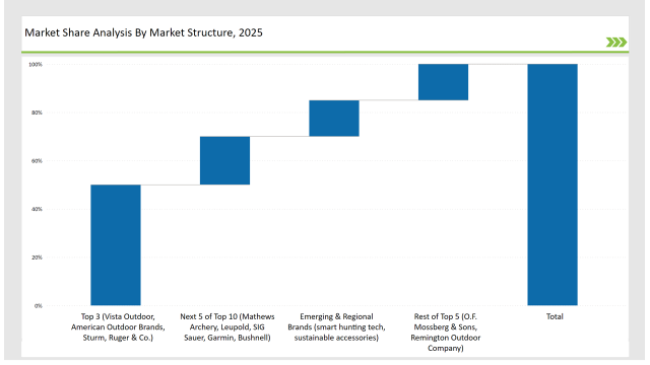
The leading players, including Vista Outdoor, American Outdoor Brands, and Sturm, Ruger & Co. account for the market share of 50% just because of strong brand recognition, product innovation, and strategic partnerships at the retail end.
Independent and regional manufacturers of hunting gear account for 30%, responding to specialized needs with localized, individually personalized equipment. Finally, new entrants such as 'smart hunting technology' and sustainable hunting accessories are estimated to occupy about 20% of the market.
Market Share by Key Players in the Hunting Equipment Market
| Market Segment | Industry Share (%) |
|---|---|
| Top 3 (Vista Outdoor, American Outdoor Brands, Sturm, Ruger & Co.) | 50% |
| Rest of Top 5 (O.F. Mossberg & Sons, Remington Outdoor Company) | 15% |
| Next 5 of Top 10 (Mathews Archery, Leupold, SIG Sauer, Garmin, Bushnell) | 20% |
| Emerging & Regional Brands (smart hunting tech, sustainable accessories) | 15% |
Market Concentration 2025
The hunting equipment market in 2025 is fragmented, with the top players accounting for 25% to 50% of the total market share. Leading brands such as Vista Outdoor, American Outdoor Brands, Sturm, and Ruger & Co. dominate the segment, while specialty retailers and niche hunting gear manufacturers add competitive diversity. This market structure reflects strong brand influence while allowing space for eco-friendly hunting gear and advancements in tracking technologies.
Segment Analysis
Sales Channels
Outdoor & Sporting Goods Retailers drive the market, with 50% of sales, because consumers want to go into the store to see and test their hunting gear. E-commerce & Direct-to-Consumer Sales have reached 30%, as this is convenient and often priced lower than in other channels, in addition to being able to read reviews from others. Hunting & Conservation Clubs drive 10%, as club memberships often provide access to high-end hunting equipment. Finally, Specialty Firearms & Ammunition Stores drive 10%, for those hunters looking for customized arms and ammunition.
Product Type
Firearms & Ammunition are the leader at 45%, for hunting. The Optics & Scopes take 20% of the pie, with advanced thermal imaging and night vision hunting efficiency. Hunting Apparel & Footwear accounts for 20%, which keeps one dry in rain, neutralizes scent, and has camouflaged looks. Lastly, Calls, Decoys & Trail Cameras represents 15%, as Smart hunting technology, and AI-based tracking devices became more popular in the year.
Who Shaped the Year
The hunting equipment market changed as new entrants and market leaders adopted strategic choices based on the changing preferences of customers.
- Vista Outdoor: Increased its product portfolio to comprise eco-friendly ammunition and intelligent hunting accessories.
- American Outdoor Brands: Affiliated with all-weather, durable hunting gear with high-tech integrations.
- Sturm, Ruger & Co: Invested in lightweight firearm technology, enhancing portability and accuracy.
- Garmin: The company invented GPS-enabled hunting watches and real-time tracking devices for hunters.
- New Brands: Companies like HuntSmart and WildTech brought AI-powered trail cameras and digital scent tracking systems into the market.
Key Highlights from the Forecast
- Smart Hunting Gear & Technology: GPS-enabled hunting equipment and AI-powered trail cameras.
- Sustainable & Non-Toxic Ammunition: Lead-free and biodegradable bullets.
- Increased Proportion of Female & Younger Hunters: Brands that are creating dedicated women's and youth-focused products.
- Personalization & Customization: Takers for customized firearms, optics, and apparel.
- Stricter Hunting Regulations & Compliance: Adaptation by manufacturers to new federal and state hunting legislations.
Tier-Wise Brand Classification 2025
| Tier Type | Tier 1 |
|---|---|
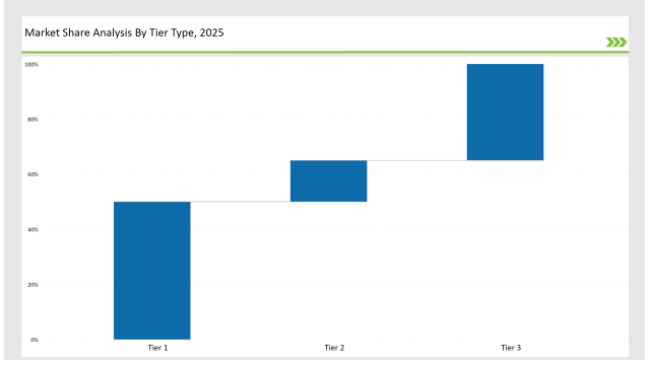
| Example of Key Players | Vista Outdoor, American Outdoor Brands, Sturm, Ruger & Co. |
| Market Share (%) | 50% |
| Tier Type | Tier 2 |
|---|---|
| Example of Key Players | O.F. Mossberg & Sons, Remington Outdoor Company |
| Market Share (%) | 15% |
| Tier Type | Tier 3 |
|---|---|
| Example of Key Players | Mathews Archery, Leupold, SIG Sauer, Garmin, Bushnell |
| Market Share (%) | 35% |
Key Brand Initiatives
| Brand | Key Focus Areas |
|---|---|
| Vista Outdoor | Eco-friendly ammunition & smart hunting accessories |
| American Outdoor Brands | High-performance, all-weather hunting gear |
| Sturm, Ruger & Co. | Lightweight firearm technology & improved accuracy |
| Garmin | GPS-enabled hunting tools & real-time tracking |
| Emerging Brands | AI-driven trail cameras & digital scent tracking |
Recommendations for Brands
- Invest in Smart Hunting Technology: AI and GPS-enabling tracking tools are becoming the new norm for modern-day hunting.
- Full line of sustainable products: Lead-free ammunition, biodegradable materials- the "green" customer
- Female and youth hunter markets: New energy, form, and feel to products: lightweight, user-friendly gear targeted to new demographics
- Improve e-commerce retail models: Online, direct to consumer
- Enhance compliance and safety standards: Meeting changing federal and state requirements
Future Roadmap
Advances in smart hunting technology, renewed attention to environmental protection, and the evolution of consumers are contributing factors for uninterrupted growth in hunting equipment and accessory market. Key growth will continue from digital innovators that cater for personalization needs while offering product compliance towards newer, tougher standards set under regulations governing this hunting equipment segment. Hunting is headed towards the techno-future- environment-friendly and diversified one.
Top Segments Studied in the Hunting Equipment Market Outlook
By Sales Channels:
- Outdoor & Sporting Goods Retailers
- E-commerce & Direct-to-Consumer
- Hunting & Conservation Clubs
- Specialty Firearms & Ammunition Stores
By Product Types:
- Firearms & Ammunition
- Optics & Scopes
- Hunting Apparel & Footwear
- Calls, Decoys & Trail Cameras
Frequently Asked Questions
Which companies hold the largest market share in the hunting equipment industry?
Leading players such as Vista Outdoor, American Outdoor Brands, and Sturm, Ruger & Co. collectively hold around 50% of the market.
What is the market share of regional hunting equipment manufacturers?
Independent and regional brands contribute approximately 15% of the market, focusing on specialized hunting gear.
How much market share do smart hunting technology startups hold?
Startups specializing in AI-powered trail cameras and digital hunting accessories hold about 10% of the market.
What percentage of the market is controlled by e-commerce and direct-to-consumer sales?
Online sales represent around 30% of the market, as more hunters prefer digital shopping experiences.
How is market concentration assessed in the hunting equipment industry for 2025?
High for companies controlling 50%+, medium for 30-50%, and low for those under 30%.
Preview the report firsthand - request a free sample
Get SampleGet the brochure for pricing and purchase details.
Get PDFTable of Content
- Executive Summary
- Market Overview
- Competitive Analysis Outlook for 2025
- Segment Analysis
- Who Shaped the Year
- Key Highlights from the Forecast
- Tier-Wise Brand Classification
- Key Brand Initiatives
- Recommendations for Brands
- Future


