

- Market Size (2026)
- USD 1128.0 Mn
- Forecast (2036)
- USD 1809.8 Mn
- CAGR (2026 to 2036)
- 4.8%
How big is the Food Processing Defoamers Market in 2026?
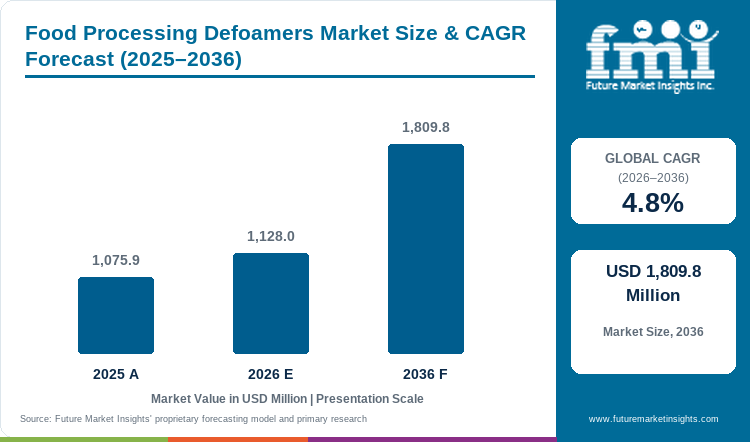
USD 1,128.0 Million in 2026 and USD 1809.8 Million by 2036, expanding at 4.8% CAGR.
Sales of food processing defoamers are estimated to rise at 4.8% CAGR through 2036, increasing valuation from USD 1075.9 Million in 2025 to USD 1,128.0 Million in 2026, and reaching USD 1809.8 Million by 2036. Foam occupies usable vessel space and can carry ingredients into vents during fermentation, heating or transfer. An effective defoamer helps control these losses, but its value depends on the recipe and dose. Agriculture and Agri-Food Canada reported about 8,800 processing establishments with employees in July 2025, with 92% employing fewer than 100 people. This dispersed customer base creates demand for accessible dosing support as well as product supply. In the USA, 21 CFR 173.340 specifies permitted substances and use conditions for defoaming agents.
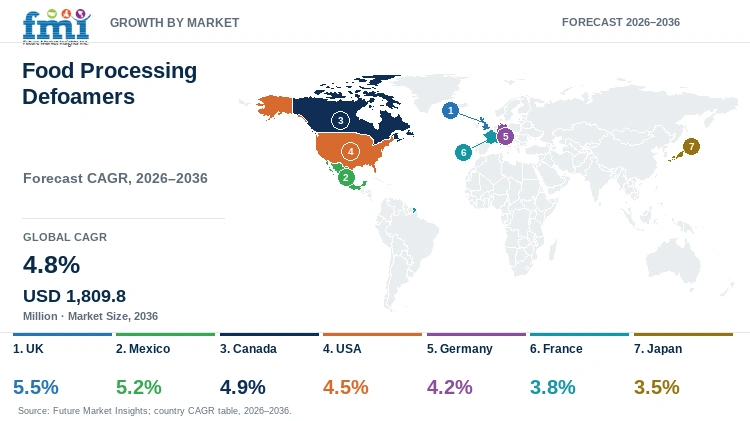
The UK is forecast to grow at 5.5% CAGR, compared with Mexico at 5.2%, Canada at 4.9%, the USA at 4.5% and Japan at 3.5%. A plant’s purchasing decision is more specific than its country growth rate: a fermentation line may need persistent foam suppression, while a protein-drink producer must also protect flavor and appearance. These differences determine the formulation, trial design and distribution support needed to win repeat orders.
Key Takeaways of Food Processing Defoamers Market
- Food and beverage processors are buying defoamers because foam reduces usable vessel volume during aeration, heating, transfer and filling, making overflow, ingredient loss and extra cleaning more expensive.
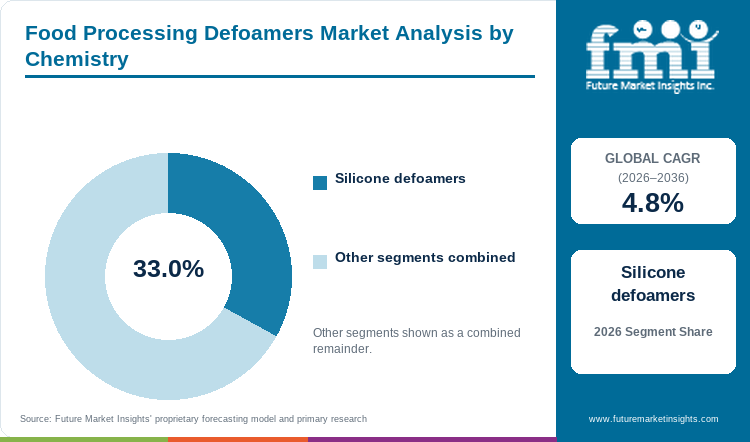
- By chemistry, silicone defoamers are estimated to hold 33.0% share in 2026, supported by strong knockdown activity and broad process compatibility.
- By application, fermentation is projected to account for 26.0% share in 2026, influenced by the intensity of foam generation during active processing.
- By end use, food manufacturing is forecast to represent 33.0% share in 2026, attributable to recurring batch cycles across multiple production lines.
- Food-contact compliant products lead Regulatory Fit with 48.0% share, while food ingredient suppliers lead Sales Channel with 38.0% share in 2026, as approval status and channel access shape which grade becomes the standardized purchase.
- Some of the key players in this market include Dow, Momentive, Wacker Chemie, KCC Basildon, Elkem Silicones, Evonik, BASF, Munzing, Ashland, and Accepta.
Analyst Perspective
Foam control earns its place in a recipe through plant trials. The useful measure is recovered throughput at a permitted dose, with acceptable residue and sensory results. A grade that works in one fermenter may behave differently when the medium, aeration or cleaning sequence changes.
- Nandini Roy Choudhury, Future Market Insights
How is the Food Processing Defoamers market segmented?
The food processing defoamers market is segmented by Chemistry, Application, End Use, Regulatory Fit, and Sales Channel.
Chemistry covers silicone, non-silicone, vegetable oil-based, polyether and emulsion defoamers. Applications include fermentation, beverage processing, sugar/starch processing, dairy processing, and sauces and prepared foods. End Use distinguishes food manufacturing, beverage plants, dairy processors, bioethanol/fermentation and ingredients processing. Regulatory Fit covers food-contact compliant, kosher/halal compatible, low-residue and organic-compatible products. Sales channels include food ingredient suppliers, chemical distributors, direct plant supply and process service providers.
What makes silicone defoamers central to the Chemistry category?
Silicone defoamers disrupt foam at low treatment rates, with emulsions, compounds and powders suited to different ways of adding the active material. Dow’s food-grade portfolio covers fermentation, beverage, dairy and vegetable-processing uses. Dispersion and persistence still need to match the process: rapid knockdown during transfer is a different task from suppressing foam throughout an aerated batch.
- Based on chemistry, silicone defoamers are projected to account for 33.0% share in 2026, supported by low-dose activity and broad formulation formats.
- The selected format must disperse at the point of addition and remain effective at the permitted dose. Changing chemistry or application can require a new trial.
Why does Fermentation lead the Application category?
Aeration and biological media generate foam repeatedly during fermentation. The antifoam must control that load without disrupting the process or downstream separation. Momentive supplies silicone, non-silicone and hybrid products for food and beverage processing. Selection depends on the medium, temperature and dosing system as well as foam knockdown.
- By application, fermentation is estimated to hold 26.0% in 2026, influenced by biological media and aeration that generate repeated foam loads across each production batch.
- A change in feedstock or aeration can alter foam behavior, so operators monitor the dose and response throughout the batch.
How does food manufacturing shape demand within the end use category?
Foam can arise at several points in food production, from washing and extraction to evaporation and filling. France’s Ministry of Agriculture reported more than 19,000 food-industry companies and nearly 465,000 employees in October 2024. The variety of production processes creates demand for several formulations rather than a universal grade that fits every line.
- In 2026, food manufacturing is expected to lead end use with 33.0% share, shaped by foam control across multiple unit operations and repeat production cycles.
- Recipe composition and the stage of addition determine whether a defoamer can be used across lines or needs separate qualification.
What supports food-contact compliant products within the Regulatory Fit category?
Permitted composition and use conditions are the starting point for a food-processing defoamer. In the USA, 21 CFR 173.340 sets substance-specific conditions and limits. Kosher, halal or organic-compatible positioning adds separate requirements; it does not replace the applicable food-use rules. A plant must assess the finished formulation at the intended dose and process stage.
- By regulatory fit, food-contact compliant products are forecast to represent 48.0% in 2026, supported by documented eligibility required before plant validation and recurring purchase.
- A compliance statement must match the actual product and use. Residue, carryover and declaration requirements remain relevant when a grade moves to another recipe.
How do food ingredient suppliers influence selection within the sales channel category?
Ingredient suppliers combine local access with samples, declarations and application support. That service is useful to smaller plants without a dedicated foam-control specialist. In July 2025, TER Group announced distribution of Momentive’s food and beverage foam-control portfolio across 14 European countries, effective July 1. The agreement gives processors a regional route to silicone, non-silicone and hybrid products.
- Food ingredient suppliers are likely to capture 38.0% share in 2026, supported by combined local access with documentation, samples and application support.
- Large plants may buy directly when consumption supports a dedicated supply agreement and regular technical visits.
What are the drivers, restraints and opportunities in the Food Processing Defoamers Market?
Lost vessel capacity supports spending on foam control. Qualification depends on recipe-specific performance and permitted use, while specialty formats address processes where flavor, clarity or dietary requirements limit the available choices.
- Driver: Foam-related capacity loss increases the cost of vessel downtime and extra cleaning when process steps remain unaddressed.
- Restraint: Permitted chemistry, dose, carryover and sensory reviews extend qualification in recipes that cannot absorb reformulation risk.
- Opportunity: Silicone-free, powder and organic-compatible grades let suppliers address one specialty line before expanding across a customer's broader portfolio.
Foam control can recover usable vessel capacity
A foam layer occupies headspace without adding saleable output. Overflow and entrainment can also increase cleaning and ingredient loss. DEFRA’s July 2026 report recorded a 5.9% rise in UK food and drink manufacturing GVA in 2024 alongside a 0.5% fall in manufacturing total factor productivity. Plant trials can establish whether foam control improves a particular process by measuring usable batch volume, cleaning time and treatment cost.
Recipe qualification can delay a formulation change
A successful foam-knockdown test is only one part of approval. The formulation must meet the applicable use conditions, and the plant must assess carryover, flavor, appearance and cleaning behavior. These checks can extend a switch from an established grade, particularly where the defoamer remains in the finished food.
Powder antifoams address protein-drink requirements
Munzing introduced MAGRABAR MD-4965 in April 2024 for protein drinks. The silicone-free powder is designed for rapid foam knockdown while maintaining low turbidity and a neutral flavor profile, with kosher and halal certification. A dry format can fit a protein blend directly, creating a different route to market from a liquid antifoam metered into a processing vessel.
Which country CAGRs are profiled in the food processing defoamers market?
| Country | CAGR |
|---|---|
| UK | 5.5% |
| Mexico | 5.2% |
| Canada | 4.9% |
| USA | 4.5% |
| Germany | 4.2% |
| France | 3.8% |
| Japan | 3.5% |
How do country-level CAGRs compare in the food processing defoamers market?
The UK leads at 5.5%, followed by Mexico at 5.2% and Canada at 4.9%. The USA is forecast at 4.5%, Germany at 4.2%, France at 3.8% and Japan at 3.5%. The 2.0-percentage-point range describes growth rates, while application mix and the scale of the installed processing base determine actual purchasing volumes.
- The UK and Mexico differ by 0.3 percentage points. Smaller UK manufacturers often need ingredient-channel support; Mexico’s mix of local and export-oriented processors requires application and regulatory support suited to the destination market.
- Canada is 0.3 percentage points below Mexico. Serving its dispersed processing base requires reliable distribution and pack sizes suited to smaller plants.
- The USA is 0.3 percentage points above Germany. U.S. recipe approvals turn on permitted use, while German beverage operations under volume pressure need a clear cost-per-batch case for changing a process aid.
- France is 0.3 percentage points above Japan. French regional processors create a distribution challenge; Japanese applications place particular weight on traceability and detailed formulation review.
Fermentation, beverage and dairy plants consume defoamers under different conditions. A country with moderate growth can still offer substantial repeat demand when its processing base is large. The full report covers more than thirty countries and compares their processing activity, application mix and distribution requirements.
Country-wise Analysis
- The UK market is forecast to expand at 5.5% CAGR from 2026 to 2036. DEFRA reported about 24,880 small and medium-sized food and drink manufacturers in 2025. Its July 2026 report also recorded a 5.9% rise in sector GVA during 2024 and a 0.5% decline in manufacturing productivity. Smaller plants benefit from trial quantities and dosing advice that let them assess foam-related losses without committing to a large supply contract.
- Mexico’s forecast is 5.2% CAGR from 2026 to 2036. Export-oriented processors and local manufacturers can require different documentation and service levels. INEGI’s July 2025 definitive Economic Censuses results describe the country’s establishment base and 2023 operating activity. For defoamer suppliers, the relevant application questions are the production process, destination-market requirements and the plant’s ability to control dosing.
- Canada is forecast to grow at 4.9% CAGR from 2026 to 2036. Agriculture and Agri-Food Canada reported C$173.4 billion in 2024 industry sales across about 8,800 establishments, with 92% employing fewer than 100 people. Distribution therefore matters alongside chemistry: smaller sites need quantities they can store and use, with practical guidance for dosing and recipe changes.
- The USA market is forecast at 4.5% CAGR from 2026 to 2036. Under 21 CFR 173.340, permitted composition and use conditions shape the products a processor can trial. Once that requirement is met, operators compare knockdown, persistence and the effect on cleaning or downstream processing. An incumbent grade has an advantage when its behavior across the plant’s recipes is already understood.
- Germany’s forecast CAGR is 4.2% from 2026 to 2036. Destatis reported roughly 7.8 billion liters of beer sales in 2025, down 6.0% from the previous year. Lower output makes cost-in-use especially relevant to beverage processors. A replacement defoamer must justify its dose and performance without introducing taste, residue or filtration problems.
- France is forecast to grow at 3.8% CAGR from 2026 to 2036. The Ministry of Agriculture’s October 2024 figures identify more than 19,000 food-industry companies, nearly 465,000 employees and processing of 70% of French agricultural production. This varied customer base needs formulations suited to individual unit operations, supported by regional distributors able to supply samples and explain use conditions.
- Japanese demand is forecast at 3.5% CAGR from 2026 to 2036. Traceability and formulation review are important when a process aid enters a controlled recipe. Organic applications add a further requirement: only certified businesses may use the Organic JAS logo, and revised standards for organic processed foods took effect on July 31, 2024. A defoamer’s general food-use eligibility does not by itself establish suitability for an organic product.
Who are the notable companies in the food processing defoamers market?
Dow, Momentive, Wacker Chemie, Evonik, BASF, Munzing, KCC Basildon, Elkem Silicones, Ashland, and Accepta are the notable companies profiled in this market.
Dow, Momentive, Wacker Chemie, KCC Basildon and Elkem supply silicone-based technologies. Evonik, BASF, Munzing and Ashland offer specialty additive portfolios, while Accepta combines products with process-application support. Within these groups, the decisive comparison is the grade available for a particular recipe: its permitted use, dosing format, persistence and effect on the finished product.
- Dow, Momentive, Wacker Chemie, KCC Basildon and Elkem Silicones supply silicone technologies and formulated foam-control products.
- Evonik, BASF, Munzing and Ashland serve specialty additive applications with different chemistry and formulation options.
- Accepta supplies antifoams and application guidance for processes including fermentation, sugar, starch and vegetable handling.
Competitive Benchmarking: Food Processing Defoamers Market
| Company | Food-Process Formulation Breadth | Regulatory and Specialty Fit | Fermentation and Plant Support | Geographic Reach |
|---|---|---|---|---|
| Dow | High | High | High | Global |
| Momentive | High | High | High | Global supplier network |
| Wacker Chemie | Medium | Low | Medium | Primarily Europe with global chemical operations |
| Evonik | Medium | Medium | Medium | Global corporate reach |
| BASF | Medium | Medium | Medium | Global corporate reach |
| Munzing | High | High | Medium | Americas, EMEA, Asia and Oceania |
| KCC Basildon | Medium | Low | Medium | United Kingdom |
| Elkem Silicones | High | Medium | Medium | Global silicone production and sales network |
| Ashland | Medium | Medium | Medium | Global corporate reach |
| Accepta | High | Medium | High | United Kingdom with export-oriented supply |
Scoring basis: Food-Process Formulation Breadth compares the range of formats and applications. High indicates broad coverage, Medium a narrower range and Low a focused offering.
- Regulatory and Specialty Fit compares food-use documentation and dietary or low-residue attributes. Fermentation and Plant Support compares application guidance and process coverage. Geographic Reach describes the supplier network and does not imply that every grade is available or permitted in every country.
Key Developments in the Food Processing Defoamers Market
- In April 2024, Munzing launched MAGRABAR MD-4965 powder antifoam for protein drinks, presented as silicone-free, kosher and halal with low turbidity across whey protein isolates.
- In July 2025, Momentive and TER Group expanded their distribution partnership to route silicone, non-silicone and hybrid foam-control solutions through TER Ingredients across 14 European countries.
- In March 2024, Momentive announced KCC Corporation’s agreement to acquire the remaining minority interest held by SJL Partners and become its sole shareholder.
- In May 2025, Wacker Chemie commissioned a new specialty-silicone production complex in Zhangjiagang, China, for silicone fluids, emulsions and elastomer gels.
Key Players in the Food Processing Defoamers Market
Integrated Silicone and Global Foam-Control Platforms
- Dow
- Momentive
- Wacker Chemie
- KCC Basildon
- Elkem Silicones
Multi-Chemistry Specialty Additive Formulators
- Evonik
- BASF
- Munzing
- Ashland
Application-Led Process Service Suppliers
- Accepta
Food Processing Defoamers Market - Report Scope
| Coverage field | Report scope |
|---|---|
| Market breakdown | Chemistry, Application, End Use, Regulatory Fit and Sales Channel |
| Quantitative Units | USD Million |
| Market Definition | Includes revenue from formulated antifoams and defoamers sold for food, beverage, ingredient and fermentation processing within the stated segmentation. Excludes downstream finished-product revenue, process equipment, release coatings and industrial foam-control products not sold for food processing. |
| Regions Covered | North America; Latin America; Western Europe; Eastern Europe; East Asia; South Asia and Pacific; Middle East and Africa |
| Countries Covered | USA, UK, Germany, Japan, Canada, France, Mexico, and more than twenty-five additional countries in the full report |
| Key Companies Profiled | Dow, Momentive, Wacker Chemie, Evonik, BASF, Munzing, KCC Basildon, Elkem Silicones, Ashland and Accepta |
| Forecast Period | 2026 to 2036 |
| Approach | The study uses a hybrid bottom-up and top-down approach that reconciles supplier revenue, process consumption, pricing, application mix and country-level operating conditions. |
Food Processing Defoamers Market - Research Methodology
| Method | Approach |
|---|---|
| Primary Research | FMI conducts structured discussions with defoamer manufacturers, formulators, distributors, food ingredient suppliers, plant technologists, procurement teams and quality specialists. Topics include chemistry selection, dosing, residue, qualification, switching, channel service and repeat use. |
| Desk Research | Regulations, official manufacturing statistics, company filings, product literature, trade information and standards material are reviewed. Sources must relate to food, beverage, ingredient or fermentation use within the defined revenue boundary. |
| Market Sizing and Forecasting | Supplier revenues, product volumes, pricing, chemistry and application mix, plant consumption, installed processing base and country conditions are reconciled. Forecast assumptions consider production activity, compliance, channel development and substitution among eligible chemistries. |
| Data Validation | Bottom-up and top-down results are cross-checked against company disclosures and operating indicators. Downstream food revenue, duplicate distribution layers, process equipment, unrelated industrial antifoams and unsupported claims are excluded. |
Food Processing Defoamers Market by Segments
Food Processing Defoamers Market segmented by Chemistry:
- Silicone defoamers
- Non-silicone defoamers
- Vegetable oil-based defoamers
- Polyether defoamers
- Emulsion defoamers
Food Processing Defoamers Market segmented by Application:
- Fermentation
- Beverage processing
- Sugar/starch processing
- Dairy processing
- Sauces and prepared foods
Food Processing Defoamers Market segmented by End Use:
- Food manufacturing
- Beverage plants
- Dairy processors
- Bioethanol/fermentation
- Ingredients processing
Food Processing Defoamers Market segmented by Regulatory Fit:
- Food-contact compliant
- Kosher/halal compatible
- Low-residue grade
- Organic-compatible
Food Processing Defoamers Market segmented by Sales Channel:
- Food ingredient suppliers
- Chemical distributors
- Direct plant supply
- Process service providers
Food Processing Defoamers Market by Region:
- North America
- United States
- Canada
- Latin America
- Brazil
- Mexico
- Argentina
- Chile
- Western Europe
- Germany
- France
- United Kingdom
- Italy
- Spain
- Benelux
- Nordics
- Eastern Europe
- Poland
- Czech Republic
- Romania
- Hungary
- East Asia
- China
- Japan
- South Korea
- South Asia and Pacific
- India
- ASEAN
- Australia and New Zealand
- Middle East and Africa
- GCC Countries
- South Africa
- Türkiye
- Israel
Research Sources and Bibliography
- Electronic Code of Federal Regulations (2026, September 4). 21 CFR § 173.340-Defoaming agents.
- Department for Environment, Food & Rural Affairs (2026, July 29). Food statistics in your pocket.
- German Federal Statistical Office (2026, February 2). Beer sales down in 2025.
- Agriculture and Agri-Food Canada (2025, July 18). Overview of the food and beverage processing industry. French Ministry of Agriculture, Food and Food Sovereignty (2024, October 18). Le panorama des industries agroalimentaires 2024.
- Ministry of Agriculture, Forestry and Fisheries of Japan (n.d.; accessed 2026, September 4). Organic JAS. National Institute of Statistics and Geography (2025, July 24). Economic Censuses 2024-Definitive figures.
- Dow (n.d.; accessed 2026, September 4). Food Grade Antifoams and Defoamers. Momentive (n.d.; accessed 2026, September 4). Food and Beverage Foam Control
- Munzing (2024, April 30). Fast knockdown defoaming of protein drinks
- TER Group (2025, July 14). TER Group and Momentive Expand Partnership to Include Food & Beverage Foam Control Solutions Across 14 European Countries
- Momentive (2024, March 28). KCC Corporation Enters into Agreement to Fully Acquire Momentive Performance Materials Group.
- Wacker Chemie AG (2025, May 21). WACKER commissions new plants for specialty silicones in China.
- Elkem (n.d.; accessed 2026, September 4). Silicone antifoam solutions for food processing and packaging. Accepta (n.d.; accessed 2026, September 4). Antifoams & Defoamers: Process and Food Applications. https://accepta.com/water-treatment-chemicals/antifoams-defoamers-foam-control-agents
This bibliography is provided for reader reference and is not exhaustive. The full report contains the complete reference list and detailed citations.
This Report Answers
- What is the Food Processing Defoamers Market size in 2026 and what value is forecast for 2036?
- Which operating pressures in food, beverage and fermentation plants support demand?
- Why do Silicone defoamers hold the leading Chemistry position?
- How does Fermentation influence recurring defoamer demand?
- Why does Food manufacturing lead the End Use category?
- How do country growth rates differ across USA, UK, Germany, Japan, Canada, France and Mexico?
- Which companies provide silicone platforms, specialty additives or process-led supply?
- How do regulatory qualification, residue and sensory concerns limit switching?
- What should plant technologists, quality teams and procurement leaders evaluate before purchase?
Frequently Asked Questions
What is driving growth in the Food Processing Defoamers Market?
Food and beverage plants use defoamers to recover vessel capacity, stabilize transfer and reduce foam-related cleaning across repeated batches. Growth is strongest where suppliers connect low-dose performance with documented food-use eligibility and measurable cost-in-use.
Who are the key players in the Food Processing Defoamers Market?
Dow, Momentive, Wacker Chemie, Evonik, BASF, Munzing, KCC Basildon, Elkem Silicones, Ashland and Accepta form the profiled company set. They compete through silicone platforms, diversified chemistries, ingredient channels or application-led process support across major processing regions.
What notable restraint affects the Food Processing Defoamers Market?
Qualification is the main restraint because a plant must verify permitted composition and dose for its specific process. Carryover as well as sensory and cleaning reviews can extend switching cycles even when a new grade shows stronger foam knockdown.
Why should executives track the Food Processing Defoamers Market?
Executives should track this market because a modest process aid can affect throughput, yield, downtime and ingredient loss across high-frequency production. The commercial decision is less about unit price than validated cost-in-use and supply reliability.
What business problem does the Food Processing Defoamers Market address?
The market addresses unwanted foam generated by aeration or fermentation and by heating or material transfer. Effective products preserve usable equipment volume, line stability and ingredient yield while meeting the regulatory and product-quality conditions required for food production.
What should plant technologists and procurement teams evaluate in the Food Processing Defoamers Market?
They should compare knockdown speed and persistence at the required dose under actual process conditions. They should then review dispersion and thermal behavior; residue risk and sensory effect; and documentation, local availability and approval effort.
What limits return on investment in the Food Processing Defoamers Market?
Return on investment weakens when a product needs excessive dose, causes carryover, complicates cleaning or fails during recipe changes and scale-up. Delayed qualification and poor technical support can also erase savings from a lower purchase price.
What supports long-term commercial confidence in the Food Processing Defoamers Market?
Long-term confidence rests on recurring consumption across established food-processing operations and on regulatory frameworks that define eligible use. Demand also benefits from new formats that address protein beverages, fermentation, dietary compatibility and low-residue requirements.
Preview the report firsthand - request a free sample
Get SampleGet the brochure for pricing and purchase details.
Get PDFTable of Content
- Key Takeaways
- Market Size and CAGR
- Top Growth Driver
- Fastest Growing Segment
- Leading Region
- Key Companies
- Emerging Opportunities
- Executive Summary
- Global Market Outlook
- Demand-side Trends
- Supply-side Trends
- Technology Roadmap Analysis
- Analysis and Recommendations
- Analyst Perspective (What is happening? Why now? What should investors know?)
- Key Questions Answered
- How large is the market?
- What is the CAGR?
- What are key trends?
- Which region dominates?
- Who are the leaders?
- Market Overview
- Market Coverage / Taxonomy
- Market Definition / Scope / Limitations
- Research Methodology
- Chapter Orientation
- Analytical Lens and Working Hypotheses
- Market Structure, Signals, and Trend Drivers
- Benchmarking and Cross-market Comparability
- Market Sizing, Forecasting, and Opportunity Mapping
- Research Design and Evidence Framework
- Desk Research Programme (Secondary Evidence)
- Expert Input and Fieldwork (Primary Evidence)
- Tooling, Models, and Reference Databases
- Data Engineering and Model Build
- Quality Assurance and Audit Trail
- Market Background
- Market Dynamics (Drivers, Restraints, Opportunity, Trends)
- Scenario Forecast (Optimistic, Likely, Conservative)
- Impact Analysis
- AI Impact
- Sustainability Impact
- Regulatory Impact
- Technology Impact
- Consumer / Buyer Analysis
- Purchase Drivers
- Adoption Barriers
- Buyer Journey
- Opportunity Map Analysis
- Product Life Cycle Analysis
- Supply Chain Analysis
- Investment Feasibility Matrix
- Value Chain Analysis
- PESTLE and Porter's Analysis
- Regulatory Landscape
- Regional Parent Market Outlook
- Production and Consumption Statistics
- Import and Export Statistics
- Global Market Analysis and Forecast, 2021 to 2036
- Historical Market Size Value (USD Million) Analysis, 2021 to 2025
- Current and Future Market Size Value (USD Million) Projections, 2026 to 2036
- Y-o-Y Growth Trend Analysis
- Absolute $ Opportunity Analysis
- Global Market Pricing Analysis, 2021 to 2036
- Global Market Analysis and Forecast, By Chemistry, 2021 to 2036
- Introduction / Key Findings
- Historical Market Size Value (USD Million) Analysis By Chemistry, 2021 to 2025
- Current and Future Market Size Value (USD Million) Analysis and Forecast By Chemistry, 2026 to 2036
- Silicone defoamers
- Non-silicone defoamers
- Vegetable oil-based defoamers
- Polyether defoamers
- Emulsion defoamers
- Y-o-Y Growth Trend Analysis By Chemistry, 2021 to 2025
- Absolute $ Opportunity Analysis By Chemistry, 2026 to 2036
- Global Market Analysis and Forecast, By Application, 2021 to 2036
- Introduction / Key Findings
- Historical Market Size Value (USD Million) Analysis By Application, 2021 to 2025
- Current and Future Market Size Value (USD Million) Analysis and Forecast By Application, 2026 to 2036
- Fermentation
- Beverage processing
- Sugar/starch processing
- Dairy processing
- Sauces and prepared foods
- Y-o-Y Growth Trend Analysis By Application, 2021 to 2025
- Absolute $ Opportunity Analysis By Application, 2026 to 2036
- Global Market Analysis and Forecast, By End Use, 2021 to 2036
- Introduction / Key Findings
- Historical Market Size Value (USD Million) Analysis By End Use, 2021 to 2025
- Current and Future Market Size Value (USD Million) Analysis and Forecast By End Use, 2026 to 2036
- Food manufacturing
- Beverage plants
- Dairy processors
- Bioethanol/fermentation
- Ingredients processing
- Y-o-Y Growth Trend Analysis By End Use, 2021 to 2025
- Absolute $ Opportunity Analysis By End Use, 2026 to 2036
- Global Market Analysis and Forecast, By Regulatory Fit, 2021 to 2036
- Introduction / Key Findings
- Historical Market Size Value (USD Million) Analysis By Regulatory Fit, 2021 to 2025
- Current and Future Market Size Value (USD Million) Analysis and Forecast By Regulatory Fit, 2026 to 2036
- Food-contact compliant
- Kosher/halal compatible
- Low-residue grade
- Organic-compatible
- Y-o-Y Growth Trend Analysis By Regulatory Fit, 2021 to 2025
- Absolute $ Opportunity Analysis By Regulatory Fit, 2026 to 2036
- Global Market Analysis and Forecast, By Sales Channel, 2021 to 2036
- Introduction / Key Findings
- Historical Market Size Value (USD Million) Analysis By Sales Channel, 2021 to 2025
- Current and Future Market Size Value (USD Million) Analysis and Forecast By Sales Channel, 2026 to 2036
- Food ingredient suppliers
- Chemical distributors
- Direct plant supply
- Process service providers
- Y-o-Y Growth Trend Analysis By Sales Channel, 2021 to 2025
- Absolute $ Opportunity Analysis By Sales Channel, 2026 to 2036
- Global Market Analysis and Forecast, By Region, 2021 to 2036
- Introduction
- Historical Market Size Value (USD Million) Analysis By Region, 2021 to 2025
- Current Market Size Value (USD Million) Analysis and Forecast By Region, 2026 to 2036
- North America
- Latin America
- Western Europe
- Eastern Europe
- East Asia
- South Asia and Pacific
- Middle East and Africa
- Market Attractiveness Analysis By Region
- North America Market Analysis and Forecast, By Country, 2021 to 2036
- Historical Market Size Value (USD Million) Trend Analysis By Market Taxonomy, 2021 to 2025
- Market Size Value (USD Million) Forecast By Market Taxonomy, 2026 to 2036
- By Country
- United States
- Canada
- By Chemistry
- By Application
- By End Use
- By Regulatory Fit
- By Sales Channel
- By Country
- Market Attractiveness Analysis
- By Country
- By Chemistry
- By Application
- By End Use
- By Regulatory Fit
- By Sales Channel
- Key Takeaways
- Latin America Market Analysis and Forecast, By Country
- Historical Market Size Value (USD Million) Trend Analysis By Market Taxonomy, 2021 to 2025
- Market Size Value (USD Million) Forecast By Market Taxonomy, 2026 to 2036
- By Country
- Brazil
- Mexico
- Argentina
- Chile
- By Chemistry
- By Application
- By End Use
- By Regulatory Fit
- By Sales Channel
- By Country
- Market Attractiveness Analysis
- By Country
- By Chemistry
- By Application
- By End Use
- By Regulatory Fit
- By Sales Channel
- Key Takeaways
- Western Europe Market Analysis and Forecast, By Country
- Historical Market Size Value (USD Million) Trend Analysis By Market Taxonomy, 2021 to 2025
- Market Size Value (USD Million) Forecast By Market Taxonomy, 2026 to 2036
- By Country
- Germany
- France
- United Kingdom
- Italy
- Spain
- Benelux
- Nordics
- By Chemistry
- By Application
- By End Use
- By Regulatory Fit
- By Sales Channel
- By Country
- Market Attractiveness Analysis
- By Country
- By Chemistry
- By Application
- By End Use
- By Regulatory Fit
- By Sales Channel
- Key Takeaways
- Eastern Europe Market Analysis and Forecast, By Country
- Historical Market Size Value (USD Million) Trend Analysis By Market Taxonomy, 2021 to 2025
- Market Size Value (USD Million) Forecast By Market Taxonomy, 2026 to 2036
- By Country
- Poland
- Czech Republic
- Romania
- Hungary
- By Chemistry
- By Application
- By End Use
- By Regulatory Fit
- By Sales Channel
- By Country
- Market Attractiveness Analysis
- By Country
- By Chemistry
- By Application
- By End Use
- By Regulatory Fit
- By Sales Channel
- Key Takeaways
- East Asia Market Analysis and Forecast, By Country
- Historical Market Size Value (USD Million) Trend Analysis By Market Taxonomy, 2021 to 2025
- Market Size Value (USD Million) Forecast By Market Taxonomy, 2026 to 2036
- By Country
- China
- Japan
- South Korea
- By Chemistry
- By Application
- By End Use
- By Regulatory Fit
- By Sales Channel
- By Country
- Market Attractiveness Analysis
- By Country
- By Chemistry
- By Application
- By End Use
- By Regulatory Fit
- By Sales Channel
- Key Takeaways
- South Asia and Pacific Market Analysis and Forecast, By Country
- Historical Market Size Value (USD Million) Trend Analysis By Market Taxonomy, 2021 to 2025
- Market Size Value (USD Million) Forecast By Market Taxonomy, 2026 to 2036
- By Country
- India
- ASEAN
- Australia and New Zealand
- By Chemistry
- By Application
- By End Use
- By Regulatory Fit
- By Sales Channel
- By Country
- Market Attractiveness Analysis
- By Country
- By Chemistry
- By Application
- By End Use
- By Regulatory Fit
- By Sales Channel
- Key Takeaways
- Middle East and Africa Market Analysis and Forecast, By Country
- Historical Market Size Value (USD Million) Trend Analysis By Market Taxonomy, 2021 to 2025
- Market Size Value (USD Million) Forecast By Market Taxonomy, 2026 to 2036
- By Country
- GCC Countries
- South Africa
- Türkiye
- Israel
- By Chemistry
- By Application
- By End Use
- By Regulatory Fit
- By Sales Channel
- By Country
- Market Attractiveness Analysis
- By Country
- By Chemistry
- By Application
- By End Use
- By Regulatory Fit
- By Sales Channel
- Key Takeaways
- Key Countries Market Analysis
- United States
- Pricing Analysis
- Market Share Analysis, 2025
- By Chemistry
- By Application
- By End Use
- By Regulatory Fit
- By Sales Channel
- Canada
- Pricing Analysis
- Market Share Analysis, 2025
- By Chemistry
- By Application
- By End Use
- By Regulatory Fit
- By Sales Channel
- Mexico
- Pricing Analysis
- Market Share Analysis, 2025
- By Chemistry
- By Application
- By End Use
- By Regulatory Fit
- By Sales Channel
- Brazil
- Pricing Analysis
- Market Share Analysis, 2025
- By Chemistry
- By Application
- By End Use
- By Regulatory Fit
- By Sales Channel
- Chile
- Pricing Analysis
- Market Share Analysis, 2025
- By Chemistry
- By Application
- By End Use
- By Regulatory Fit
- By Sales Channel
- Germany
- Pricing Analysis
- Market Share Analysis, 2025
- By Chemistry
- By Application
- By End Use
- By Regulatory Fit
- By Sales Channel
- United Kingdom
- Pricing Analysis
- Market Share Analysis, 2025
- By Chemistry
- By Application
- By End Use
- By Regulatory Fit
- By Sales Channel
- Italy
- Pricing Analysis
- Market Share Analysis, 2025
- By Chemistry
- By Application
- By End Use
- By Regulatory Fit
- By Sales Channel
- Spain
- Pricing Analysis
- Market Share Analysis, 2025
- By Chemistry
- By Application
- By End Use
- By Regulatory Fit
- By Sales Channel
- France
- Pricing Analysis
- Market Share Analysis, 2025
- By Chemistry
- By Application
- By End Use
- By Regulatory Fit
- By Sales Channel
- India
- Pricing Analysis
- Market Share Analysis, 2025
- By Chemistry
- By Application
- By End Use
- By Regulatory Fit
- By Sales Channel
- ASEAN
- Pricing Analysis
- Market Share Analysis, 2025
- By Chemistry
- By Application
- By End Use
- By Regulatory Fit
- By Sales Channel
- Australia and New Zealand
- Pricing Analysis
- Market Share Analysis, 2025
- By Chemistry
- By Application
- By End Use
- By Regulatory Fit
- By Sales Channel
- China
- Pricing Analysis
- Market Share Analysis, 2025
- By Chemistry
- By Application
- By End Use
- By Regulatory Fit
- By Sales Channel
- Japan
- Pricing Analysis
- Market Share Analysis, 2025
- By Chemistry
- By Application
- By End Use
- By Regulatory Fit
- By Sales Channel
- South Korea
- Pricing Analysis
- Market Share Analysis, 2025
- By Chemistry
- By Application
- By End Use
- By Regulatory Fit
- By Sales Channel
- Poland
- Pricing Analysis
- Market Share Analysis, 2025
- By Chemistry
- By Application
- By End Use
- By Regulatory Fit
- By Sales Channel
- Hungary
- Pricing Analysis
- Market Share Analysis, 2025
- By Chemistry
- By Application
- By End Use
- By Regulatory Fit
- By Sales Channel
- Türkiye
- Pricing Analysis
- Market Share Analysis, 2025
- By Chemistry
- By Application
- By End Use
- By Regulatory Fit
- By Sales Channel
- South Africa
- Pricing Analysis
- Market Share Analysis, 2025
- By Chemistry
- By Application
- By End Use
- By Regulatory Fit
- By Sales Channel
- United States
- Market Structure Analysis
- Competition Dashboard
- Competition Benchmarking
- Market Share Analysis of Top Players
- By Regional
- By Chemistry
- By Application
- By End Use
- By Regulatory Fit
- By Sales Channel
- Emerging Startups
- Innovation Benchmarking
- Competition Analysis
- Competition Deep Dive
- Dow
- Overview
- Product Portfolio
- Profitability by Market Segments
- Sales Footprint
- Strategy Overview
- Marketing Strategy
- Product Strategy
- Channel Strategy
- Momentive
- Wacker Chemie
- Evonik
- BASF
- Munzing
- KCC Basildon
- Elkem Silicones
- Ashland
- Accepta
- Dow
- Case Studies
- Success Stories
- Recent Developments
- Competition Deep Dive
- Assumptions & Acronyms Used


