

- Market Size (2026)
- USD 713.9 Mn
- Forecast (2036)
- USD 1196.5 Mn
- CAGR (2026 to 2036)
- 5.3%
How big is Fragrance-Free Skincare Market in 2026?
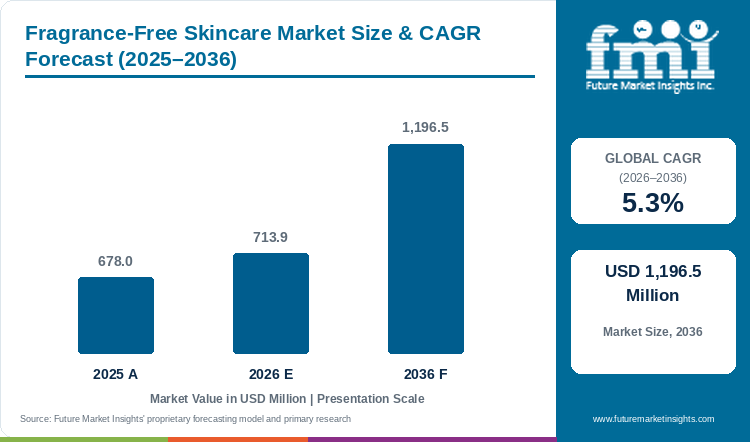
Sales of Fragrance-Free Skincare will expand at a 5.3% CAGR between 2026 and 2036. Market value is estimated at USD 713.9 Million in 2026 and will reach USD 1,196.5 Million by 2036.
FMI values the fragrance-free skincare market at USD 713.9 Million in 2026. The market was valued at USD 678.0 Million in 2025 and is forecast to reach USD 1,196.5 Million by 2036 at a 5.3% CAGR. Dermatologists advise people with atopic dermatitis to choose fragrance-free creams or ointments rather than unscented products [1]. Once a daily cleanser or moisturizer proves comfortable the buyer has a clear reason to keep repurchasing it. The same need appears in sensitive-skin solutions where barrier care is already a major purchase reason. The market is driven by unique conditions across the globe. UAE is likely to grow at a CAGR at 6.9% while Saudi Arabia follows at 6.6%. Saudi Arabia updated cosmetic product listing guidance in September 2024 [6]. Germany and France rely heavily on pharmacy-led skincare while Japan and South Korea place more emphasis on precise ingredient and benefit claims. Brands therefore need local compliance as well as a formula that buyers are willing to use every day.
Key Takeaways
- Fragrance-free skincare is becoming a regular choice for people who want to reduce irritation risk in daily routines.
- Core / classic lines are projected to account for 36.0% of Product Type demand in 2026.
- Conventional products are expected to represent 53.0% of Nature demand in 2026.
- Cream & balm is projected to hold 25.0% of Format demand in 2026.
- Claim rules and fragrance-allergen labeling can slow launches when brands use the same wording across several countries.
- Profiled companies include Kao Corporation and L'Oreal. Procter & Gamble and Amorepacific are also included. Coty and Unilever are profiled with e.l.f. Beauty. Shiseido and Estee Lauder Companies are included with Beiersdorf.
Analyst Perspective
“Over the next few years fragrance-free skincare will spread further into mass and premium routines. Barrier care and sensitive-skin products will remain the main areas of growth. Brands will need clear claims and formulas that are comfortable enough for daily use. Pharmacy and specialty retail will remain important for trust while online channels will support repeat purchase.”
- Rahul Pandita, Principal Consultant, Future Market Insights
How is the fragrance-free skincare market segmented?
The market is segmented by Product Type, Nature, Format, Price Positioning, Sales Channel, and Region.
By Product Type, the market includes Core / classic lines, Targeted treatment lines, Sensitive & gentle lines, Premium & clinical lines, and Kits & sets.
Nature covers Conventional, Vegan & cruelty-free, Natural & organic, Dermocosmetic / clinical, and Fragrance-free & sensitive products.
Format includes Cream & balm, Liquid & serum, Stick & solid, Spray & mist, Sheet & patch, and Powder.
Price Positioning is divided into Mass, Masstige, Premium, and Professional.
Sales Channel covers Specialty beauty retail, E-commerce & DTC, Pharmacies & drugstores, Supermarkets & hypermarkets, and Salons & spas.
Region covers North America, Latin America, Western Europe, Eastern Europe, East Asia, South Asia and Pacific, and Middle East and Africa.
Why do Core / classic lines lead demand within the Product Type category?
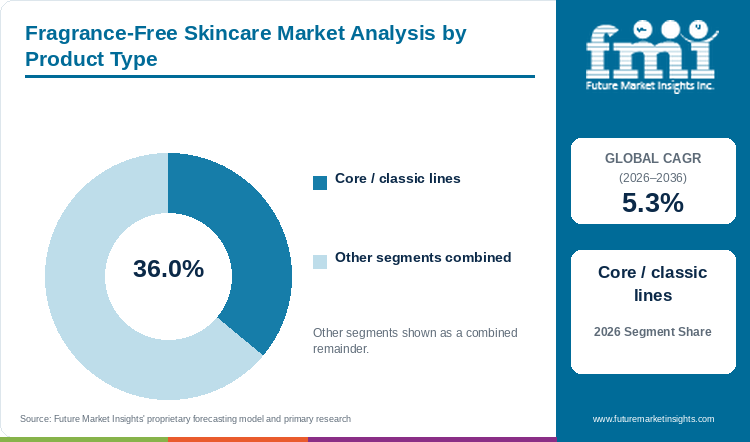
Core / classic lines are projected to account for 36.0% of Product Type demand in 2026.
Core / classic lines lead because fragrance-free demand is strongest in products used every day. Moisturizers and cleansers are replaced often and buyers tend to stay with a formula that does not irritate the skin. Kao announced new Curél serum and cleanser products for dry sensitive skin in 2025. Both were fragrance-free and were planned for rollout beyond Japan [10].
- Core / classic lines are projected to account for 36.0% of Product Type demand in 2026.
- Targeted treatment lines can grow where buyers want fragrance-free products for a more specific skin concern.
Why does Conventional lead demand within the Nature category?
Conventional is projected to account for 53.0% of Nature demand in 2026.
Conventional products lead because removing fragrance does not require a natural or organic formula. Manufacturers can keep established emulsifiers and preservation systems while removing added fragrance. The American Academy of Dermatology recommends fragrance-free products for atopic dermatitis without linking that advice to a natural standard [1]. This gives conventional products a wide range of price and texture options.
- Conventional is projected to account for 53.0% of Nature demand in 2026.
- Natural and vegan products can gain demand but they have to meet additional ingredient or certification preferences.
Why does Cream & balm lead demand within the Format category?
Cream & balm is projected to account for 25.0% of Format demand in 2026.
Cream and balm formats lead because many fragrance-free buyers are trying to manage dryness or skin sensitivity. The American Academy of Dermatology recommends fragrance-free cream or ointment for atopic dermatitis [1]. Richer textures therefore fit the same daily use case. Similar demand appears in ceramide skincare where hydration and barrier support are common reasons for purchase.
- Cream & balm is projected to account for 25.0% of Format demand in 2026.
- Serums and lighter formats can gain demand when buyers want targeted treatment without a heavy finish.
Why does Mass lead demand within the Price Positioning category?
Mass is projected to account for 37.0% of Price Positioning demand in 2026.
Mass products lead because fragrance-free skincare is usually used every day. Buyers who replace cleanser or moisturizer regularly pay attention to refill cost. Procter & Gamble introduced Olay Complete+ Daily Facial Moisturizer SPF 40 as a fragrance-free sensitive-skin option in January 2026 [14]. Products at accessible prices make it easier to shift an entire routine away from fragranced alternatives.
- Mass is projected to account for 37.0% of Price Positioning demand in 2026.
- Premium products can support higher prices when fragrance-free positioning comes with stronger barrier or treatment benefits.
Why does Specialty beauty retail lead demand within the Sales Channel category?
Specialty beauty retail is projected to account for 23.0% of Sales Channel demand in 2026.
Specialty beauty stores give buyers a place to compare ingredients and texture before changing a skincare routine. They are also useful when shoppers want to understand the difference between fragrance-free and unscented. e.l.f. Beauty announced in May 2025 that rhode would enter Sephora stores in North America and the UK [12]. That move gives a barrier-focused skincare brand a wider physical discovery channel.
- Specialty beauty retail is projected to account for 23.0% of Sales Channel demand in 2026.
- E-commerce remains important for repeat purchase after the buyer has settled on a product.
What are the drivers, restraints and opportunities in the Fragrance-Free Skincare Market?
Sensitive-skin demand supports the market. Claim rules can slow launches. Barrier-focused formulas give brands the clearest area for expansion.
- Driver: Dermatology guidance is making fragrance avoidance part of daily skincare selection.
- Restraint: Brands have to support free-from claims and adjust labeling for different markets.
- Opportunity: Barrier-focused products can combine fragrance-free positioning with a clear skin benefit.
Fragrance avoidance is becoming part of daily skincare
Fragrance-free demand is strongest when buyers are trying to avoid irritation in products used every day. The American Academy of Dermatology says fragrance can cause atopic dermatitis to flare and advises fragrance-free products rather than unscented ones [1]. A buyer can replace a fragranced cleanser or moisturizer without changing the basic routine. The same behavior is visible in anti-allergenic skincare where buyers screen products for irritation risk.
Claim rules can slow a launch
France shows why wording matters. DGCCRF guidance published in October 2025 says free-from cosmetic claims must meet clear criteria and must not mislead consumers [5]. EU fragrance-allergen rules add further labeling requirements. Brands selling the same product in several countries may therefore need extra formula review and artwork work before launch.
Barrier care creates the next opportunity
The next opportunity is to pair fragrance-free positioning with a benefit buyers already understand. Barrier care is the clearest example because many sensitive-skin users are also trying to manage dryness or discomfort. e.l.f. Beauty's 2025 agreement to acquire rhode added a barrier-focused fragrance-free skincare range and planned Sephora expansion [12]. This also connects with skin-barrier repair lipids as brands use ceramides and related lipids in sensitive-skin formulas.
Which country CAGRs are profiled in the Fragrance-Free Skincare Market?
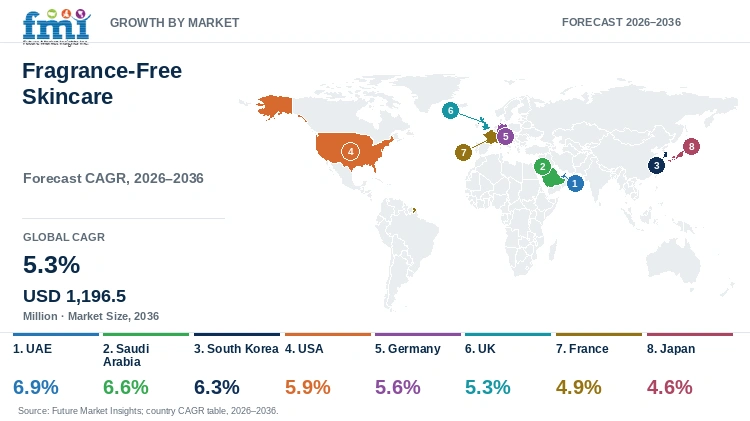
| Country | CAGR |
|---|---|
| UAE | 6.9% |
| Saudi Arabia | 6.6% |
| South Korea | 6.3% |
| USA | 5.9% |
| Germany | 5.6% |
| UK | 5.3% |
| France | 4.9% |
| Japan | 4.6% |
How do country-level CAGRs compare in the Fragrance-Free Skincare Market?
UAE has the highest profiled CAGR at 6.9% through 2036 while Japan is at 4.6%. Saudi Arabia follows UAE at 6.6% and South Korea is at 6.3%. The rates show expected growth rather than current market size.
Germany and the UK sit in the middle of the group at 5.6% and 5.3%. France is at 4.9%. Growth conditions differ because pharmacy access and claim rules are not the same in each country.
Country-wise Analysis
- USA: The USA is expected to grow at a 5.9% CAGR through 2036. FDA said in March 2025 that MoCRA requires facility registration and cosmetic product listings that include ingredients [2]. Fragrance-free brands therefore have broad retail access but still need precise claims and complete product records. Repeat purchase will depend on whether the formula stays comfortable in daily use.
- Germany: Germany is projected to grow at a 5.6% CAGR through 2036. Kao said in June 2026 that Curél entered Germany in 2025 and that pharmacies are an important channel [11]. EU fragrance-allergen labeling rules also apply [3]. Pharmacy credibility can help the category but brands still need clear ingredient information.
- France: France is expected to grow at a 4.9% CAGR through 2036. DGCCRF guidance from October 2025 says free-from cosmetic claims must meet clear criteria [5]. This makes wording especially important for fragrance-free products. Pharmacy distribution can support trust but the label still has to say exactly what the formula can support.
- UK: The UK is forecast to grow at a 5.3% CAGR through 2036. Cosmetics sold in Great Britain require a safety assessment and notification before sale [4]. Curél has also used drugstore distribution in the UK. Brands need local compliance in place before they expand the same fragrance-free range across stores and online channels.
- Saudi Arabia: Saudi Arabia is forecast to grow at a 6.6% CAGR through 2036. SFDA updated its guide for cosmetic product listing requirements in September 2024 [6]. Imported brands therefore need complete product files before wider distribution. Growth will favor suppliers that prepare registration and product communication before launch.
- UAE: UAE is expected to record the highest profiled CAGR at 6.9% through 2036. Dubai Municipality said in October 2025 that it oversees product evaluation and registration through systems including Montaji+ [7]. Specialty beauty and pharmacy channels give brands several routes to buyers. Registration still needs to be ready before wider distribution.
- Japan: Japan is forecast to grow at a 4.6% CAGR through 2036. Japan revised guidance in March 2025 on highlighting specific cosmetic ingredients [8]. Brands need objective support when they describe the purpose of an ingredient. Fragrance-free products therefore need careful claims as well as a texture that fits established skincare routines.
- South Korea: South Korea is expected to grow at a 6.3% CAGR through 2036. Cosmetics exports reached a record USD 11.4 billion in 2025 according to MFDS [9]. The size of the local beauty industry means fragrance-free products face frequent launches and strong competition. Brands need clear barrier or sensitive-skin benefits if they want the product to stay relevant after launch.
Who are the notable companies in the Fragrance-Free Skincare Market?
Notable companies include Kao Corporation, L'Oreal, Procter & Gamble, Amorepacific, Coty, Unilever, e.l.f. Beauty, Shiseido, Estee Lauder Companies, and Beiersdorf.
Kao Corporation and L'Oreal have strong sensitive-skin and dermatology-oriented portfolios. Amorepacific and Beiersdorf also have established barrier-care ranges. These companies are closest to buyers who already look for fragrance-free or low-irritation skincare.
Procter & Gamble and Unilever have broad mass-market skincare businesses. e.l.f. Beauty added a stronger barrier-focused position through its rhode acquisition. Their scale gives them several routes to reach buyers who want fragrance-free products at accessible prices.
Shiseido and Estee Lauder Companies are stronger in prestige skincare. Coty has a broader beauty portfolio with a smaller direct role in fragrance-free skincare. These companies are more likely to compete through premium formulas and selected skincare ranges.
- Sensitive-skin and barrier care: Kao Corporation and L'Oreal. Amorepacific and Beiersdorf are also in this group.
- Mass skincare: Procter & Gamble, Unilever, and e.l.f. Beauty.
- Prestige skincare: Shiseido, Estee Lauder Companies, and Coty.
Competitive Benchmarking: Fragrance-Free Skincare Market
| Company | Fragrance-Free Portfolio Breadth | Sensitive-Skin / Barrier Science | Omnichannel Skincare Access | Geographic Reach |
|---|---|---|---|---|
| Kao Corporation | High | High | High | Japan, Europe, Asia, and North America |
| L'Oreal | High | High | High | North America, Europe, Asia, Middle East, and other global markets |
| Procter & Gamble | High | Medium | High | North America, Europe, Asia, Middle East, and other global markets |
| Amorepacific | Medium | High | High | South Korea, North America, Asia, and selected European channels |
| Coty | Low | Medium | Medium | North America, Europe, Asia, and selected global prestige markets |
| Unilever | Medium | Medium | High | North America, Europe, Asia, Middle East, and other global markets |
| e.l.f. Beauty | High | Medium | High | North America, UK, selected Europe, and expanding prestige channels |
| Shiseido | Medium | High | High | Japan, Asia, North America, and Europe |
| Estee Lauder Companies | Medium | Medium | High | North America, Europe, Asia-Pacific, and Middle East |
| Beiersdorf | High | High | High | Europe, North America, Asia, Middle East, and other global markets |
Scoring basis: Fragrance-Free Portfolio Breadth looks at the range of fragrance-free skincare formats. Sensitive-Skin / Barrier Science looks at product or research depth around irritation avoidance and barrier support. Omnichannel Skincare Access looks at reach across major retail and digital channels. High indicates broad capability while Medium indicates a narrower position and Low indicates limited current strength in that area.
Key Developments in the Fragrance-Free Skincare Market
- In June 2025 Kao Corporation announced two new Curél products for dry sensitive skin [10]. The Carbonated Foam Serum and Carbonated Foam Gel Cleanser were fragrance-free and were scheduled for a September 2025 launch in Japan before wider rollout across Asia and Europe.
- In May 2025 e.l.f. Beauty agreed to acquire rhode in a transaction valued at up to USD 1 billion [12]. The deal added a fragrance-free barrier-focused skincare range and included plans for rhode to enter Sephora stores in North America and the UK.
- In January 2026 Procter & Gamble introduced Olay Complete+ Daily Facial Moisturizer SPF 40 as a fragrance-free option for sensitive skin [14]. The product combines moisturizer and broad-spectrum sun protection in a daily mass-market format.
- In August 2025 Shiseido reported a sensitive-skin microbiome research milestone with the University of Tokyo [15]. The work identified a Cutibacterium acnes strain associated with sensitive skin and added another research route for sensitive-skin product development.
Key Players in the Fragrance-Free Skincare Market
Dermocosmetic and Barrier-Science Portfolios
- Kao Corporation
- L'Oreal
- Amorepacific
- Beiersdorf
Scaled Mass and Sensitive-Skin Platforms
- Procter & Gamble
- Unilever
- e.l.f. Beauty
Prestige and Ingredient-Led Skincare Ecosystems
- Shiseido
- Estee Lauder Companies
- Coty
Fragrance-Free Skincare Market - Report Scope
| Coverage field | Report scope |
|---|---|
| Market breakdown | Product Type, Nature, Format, Price Positioning, Sales Channel, and Region |
| Quantitative Units | USD Million |
| Market Definition | Revenue includes finished skincare products marketed and substantiated as fragrance-free or without added fragrance within the defined product, nature, format, price, and channel universe. It excludes fragranced variants, perfumes, color cosmetics, hair care, deodorants, prescription therapies, raw ingredients, downstream services, and adjacent substitute categories. |
| Regions Covered | North America; Latin America; Western Europe; Eastern Europe; East Asia; South Asia and Pacific; Middle East and Africa |
| Countries Covered | USA, Germany, France, UK, Saudi Arabia, UAE, Japan, South Korea, and more than twenty-five additional countries in the full report |
| Key Companies Profiled | Kao Corporation, L'Oreal, Procter & Gamble, Amorepacific, Coty, Unilever, e.l.f. Beauty, Shiseido, Estee Lauder Companies, Beiersdorf |
| Forecast Period | 2026 to 2036 |
| Approach | FMI uses a hybrid bottom-up and top-down sizing framework that reconciles product-level indications, channel structure, country conditions, pricing, and adoption assumptions within the stated revenue boundary. |
Fragrance-Free Skincare Market - Research Methodology
| Method | Approach |
|---|---|
| Primary Research | FMI uses structured discussions with brand owners, formulators, distributors, specialty beauty retailers, pharmacy-channel participants, dermatology-adjacent experts, and end users to test purchase triggers, price thresholds, channel behavior, and claim acceptance. |
| Desk Research | Regulatory texts, government guidance, company filings and newsrooms, product documentation, dermatology guidance, and trade or statistics sources are reviewed for scope relevance and dated factual support. |
| Market Sizing and Forecasting | A hybrid bottom-up and top-down framework reconciles company and category indications, channel structure, country conditions, price positioning, and adoption assumptions across 2026 to 2036. |
| Data Validation | The validation step checks the market definition and consistency of figures across the report. |
Fragrance-Free Skincare Market by Segments
Fragrance-Free Skincare Market segmented by Product Type
- Core / classic lines
- Targeted treatment lines
- Sensitive & gentle lines
- Premium & clinical lines
- Kits & sets
Fragrance-Free Skincare Market segmented by Nature
- Conventional
- Vegan & cruelty-free
- Natural & organic
- Dermocosmetic / clinical
- Fragrance-free & sensitive
Fragrance-Free Skincare Market segmented by Format
- Cream & balm
- Liquid & serum
- Stick & solid
- Spray & mist
- Sheet & patch
- Powder
Fragrance-Free Skincare Market segmented by Price Positioning
- Mass
- Masstige
- Premium
- Professional
Fragrance-Free Skincare Market segmented by Sales Channel
- Specialty beauty retail
- E-commerce & DTC
- Pharmacies & drugstores
- Supermarkets & hypermarkets
- Salons & spas
Fragrance-Free Skincare Market by Region
- North America
- United States
- Canada
- Latin America
- Brazil
- Mexico
- Argentina
- Chile
- Western Europe
- Germany
- France
- United Kingdom
- Italy
- Spain
- Benelux
- Nordics
- Eastern Europe
- Poland
- Czech Republic
- Romania
- Hungary
- East Asia
- China
- Japan
- South Korea
- South Asia and Pacific
- India
- ASEAN
- Australia and New Zealand
- Middle East and Africa
- GCC Countries
- South Africa
- Türkiye
- Israel
Research Sources and Bibliography
- [1] American Academy of Dermatology Association. (2023, October 10). Atopic dermatitis skin care.
- [2] U.S. Food and Drug Administration. (2025, March 13). FDA registration summary.
- [3] European Commission. (2023, July 26). EU fragrance allergen regulation.
- [4] Office for Product Safety and Standards. (2025, July 10). Consumer products: cosmetics.
- [5] Direction générale de la concurrence, de la consommation et de la répression des fraudes. (2025, October 1). Allégations "sans" dans les produits cosmétiques : précisions des autorités de contrôle. https://www.economie.gouv.fr/dgccrf/les-fiches-pratiques/allegations-sans-dans-les-produits-cosmetiques-precisions-des-autorites-de-controle
- [6] Saudi Food and Drug Authority. (2024, September 24). Update on services and guidance for cosmetic product listing requirements. https://www.sfda.gov.sa/ar/news/17324
- [7] Dubai Municipality. (2025, October 27). Product safety at Beautyworld Middle East 2025. https://www.dm.gov.ae/product-safety-at-beautyworld-middle-east-2025/
- [8] Ministry of Health, Labour and Welfare, Japan. (2025, March 10). Notice on highlighting specific ingredients in cosmetics. https://www.mhlw.go.jp/web/t_doc?dataId=00tc9762&dataType=1&pageNo=1
- [9] Ministry of Food and Drug Safety, South Korea. (2026, January 9). 2025 K-beauty exports reach a record USD 11.4 billion. https://www.mfds.go.kr/brd/m_99/view.do?seq=49621
- [10] Kao Corporation. (2025, July 7). Kao Unveils Innovative Curél Products Featuring Carbonated Foam Technology to Combat Dryness-Induced Dullness. https://www.kao.com/global/en/newsroom/news/release/2025/20250707-001/
- [11] Kao Corporation. (2026, June 2). Kao Accelerates Skin Care Growth in EMEA with Launch of Curél in the Netherlands. https://www.kao.com/global/en/newsroom/news/release/2026/20260602-001/
- [12] e.l.f. Beauty. (2025, May 28). e.l.f. Beauty Announces Definitive Agreement to Acquire rhode in $1 Billion Deal. https://investor.elfbeauty.com/stock-and-financial/press-releases/landing-news/2025/05-28-2025-210536607
- [13] rhode. (n.d.; accessed 2026, September 2). Frequently asked questions. https://www.rhodeskin.com/pages/faq
- [14] Procter & Gamble / Olay. (2026, January 30). The Power of Olay Complete+: Moisturizer and Sunscreen Combined. https://www.olay.com/blogs/olay-today/the-power-of-olay-complete-moisturizer-and-sunscreen-combined
- [15] Shiseido Company, Limited. (2025, August 20). Shiseido Discovers through Microbiome Research that Sensitive Skin Contains High Levels of Specific Strain of Cutibacterium acnes. https://corp.shiseido.com/en/news/detail.html?n=00000000004049
This bibliography is provided for reader reference and is not exhaustive. The full report contains the complete reference list and detailed citations.
This Report Answers
- What is the Fragrance-Free Skincare Market size in 2026 and what value is forecast by 2036?
- Which sensitive-skin, labeling, and buyer pressures support demand for fragrance-free skincare?
- Why do Core / classic lines hold the leading position within Product Type?
- How does Conventional formulation influence fragrance-free skincare availability and pricing?
- Why does Cream & balm hold the leading position within Format?
- How do growth rates differ across the eight profiled countries?
- How do the profiled companies compete across sensitive-skin, mass and prestige skincare?
- How do claim substantiation and local cosmetic labeling rules limit market entry or slow launch execution?
- What should brand owners, retailers, and portfolio managers evaluate before expanding fragrance-free skincare assortments?
Frequently Asked Questions
What is driving growth in the Fragrance-Free Skincare Market?
Growth is driven by routine avoidance of fragrance among consumers with sensitive or irritation-prone skin. Dermatology guidance and stronger allergen-labeling scrutiny make fragrance-free positioning easier to understand as a daily purchase criterion.
Who are the key players in the Fragrance-Free Skincare Market?
The profiled companies include Kao Corporation and L'Oreal. Procter & Gamble and Amorepacific are also included. Coty and Unilever are profiled with e.l.f. Beauty. Shiseido and Estee Lauder Companies are included with Beiersdorf. Their positions differ across barrier care and mass or prestige skincare.
What notable restraint affects the Fragrance-Free Skincare Market?
The main restraint is the cost of substantiating and communicating absence claims consistently across jurisdictions. Brands must also manage ingredient disclosure and avoid broader safety or allergen claims that regulators could consider misleading.
Why should executives track the Fragrance-Free Skincare Market?
Fragrance-free demand now appears across mass and pharmacy skincare. Specialty beauty and premium skincare also carry the claim. Executives can use the category to test whether product design and channel education match sensitive-skin buying behavior.
What business problem does the Fragrance-Free Skincare Market address?
The market helps consumers maintain cleansing and moisturization routines while reducing exposure to added fragrance that may be unwanted or irritating. It also gives retailers and brands a clearer assortment signal for sensitive-skin and barrier-focused demand.
What should skincare portfolio managers evaluate in the Fragrance-Free Skincare Market?
Portfolio managers should assess fragrance-free claim substantiation and skin-comfort evidence alongside format fit and price, then test whether the chosen channel can explain the product clearly. They should also separate fragrance-free from unscented language and review local cosmetic labeling requirements before launch.
What limits return on investment in the Fragrance-Free Skincare Market?
Return is limited when brands pay for reformulation and compliance but fail to create a clear reason for repeat purchase. Weak channel education, inconsistent claims, or poor sensory performance can prevent fragrance avoidance from becoming a durable routine.
What supports long-term commercial confidence in the Fragrance-Free Skincare Market?
Long-term confidence comes from repeat-use skincare behavior and sustained clinical advice to avoid fragrance in sensitive-skin routines. Regulatory attention to fragrance allergens and free-from claims should keep formulation transparency and claim precision commercially relevant through the forecast period.
Preview the report firsthand - request a free sample
Get SampleGet the brochure for pricing and purchase details.
Get PDFTable of Content
- Key Takeaways
- Market Size and CAGR
- Top Growth Driver
- Fastest Growing Segment
- Leading Region
- Key Companies
- Emerging Opportunities
- Executive Summary
- Global Market Outlook
- Demand-side Trends
- Supply-side Trends
- Technology Roadmap Analysis
- Analysis and Recommendations
- Analyst Perspective (What is happening? Why now? What should investors know?)
- Key Questions Answered
- How large is the market?
- What is the CAGR?
- What are key trends?
- Which region dominates?
- Who are the leaders?
- Market Overview
- Market Coverage / Taxonomy
- Market Definition / Scope / Limitations
- Research Methodology
- Chapter Orientation
- Analytical Lens and Working Hypotheses
- Market Structure, Signals, and Trend Drivers
- Benchmarking and Cross-market Comparability
- Market Sizing, Forecasting, and Opportunity Mapping
- Research Design and Evidence Framework
- Desk Research Programme (Secondary Evidence)
- Expert Input and Fieldwork (Primary Evidence)
- Tooling, Models, and Reference Databases
- Data Engineering and Model Build
- Quality Assurance and Audit Trail
- Market Background
- Market Dynamics (Drivers, Restraints, Opportunity, Trends)
- Scenario Forecast (Optimistic, Likely, Conservative)
- Impact Analysis
- AI Impact
- Sustainability Impact
- Regulatory Impact
- Technology Impact
- Consumer / Buyer Analysis
- Purchase Drivers
- Adoption Barriers
- Buyer Journey
- Opportunity Map Analysis
- Product Life Cycle Analysis
- Supply Chain Analysis
- Investment Feasibility Matrix
- Value Chain Analysis
- PESTLE and Porter's Analysis
- Regulatory Landscape
- Regional Parent Market Outlook
- Production and Consumption Statistics
- Import and Export Statistics
- Global Market Analysis and Forecast, 2021 to 2036
- Historical Market Size Value (USD Million) Analysis, 2021 to 2025
- Current and Future Market Size Value (USD Million) Projections, 2026 to 2036
- Y-o-Y Growth Trend Analysis
- Absolute $ Opportunity Analysis
- Global Market Pricing Analysis, 2021 to 2036
- Global Market Analysis and Forecast, By Product Type, 2021 to 2036
- Introduction / Key Findings
- Historical Market Size Value (USD Million) Analysis By Product Type, 2021 to 2025
- Current and Future Market Size Value (USD Million) Analysis and Forecast By Product Type, 2026 to 2036
- Core / classic lines
- Targeted treatment lines
- Sensitive & gentle lines
- Premium & clinical lines
- Kits & sets
- Y-o-Y Growth Trend Analysis By Product Type, 2021 to 2025
- Absolute $ Opportunity Analysis By Product Type, 2026 to 2036
- Global Market Analysis and Forecast, By Nature, 2021 to 2036
- Introduction / Key Findings
- Historical Market Size Value (USD Million) Analysis By Nature, 2021 to 2025
- Current and Future Market Size Value (USD Million) Analysis and Forecast By Nature, 2026 to 2036
- Conventional
- Vegan & cruelty-free
- Natural & organic
- Dermocosmetic / clinical
- Fragrance-free & sensitive
- Y-o-Y Growth Trend Analysis By Nature, 2021 to 2025
- Absolute $ Opportunity Analysis By Nature, 2026 to 2036
- Global Market Analysis and Forecast, By Format, 2021 to 2036
- Introduction / Key Findings
- Historical Market Size Value (USD Million) Analysis By Format, 2021 to 2025
- Current and Future Market Size Value (USD Million) Analysis and Forecast By Format, 2026 to 2036
- Cream & balm
- Liquid & serum
- Stick & solid
- Spray & mist
- Sheet & patch
- Powder
- Y-o-Y Growth Trend Analysis By Format, 2021 to 2025
- Absolute $ Opportunity Analysis By Format, 2026 to 2036
- Global Market Analysis and Forecast, By Price Positioning, 2021 to 2036
- Introduction / Key Findings
- Historical Market Size Value (USD Million) Analysis By Price Positioning, 2021 to 2025
- Current and Future Market Size Value (USD Million) Analysis and Forecast By Price Positioning, 2026 to 2036
- Mass
- Masstige
- Premium
- Professional
- Y-o-Y Growth Trend Analysis By Price Positioning, 2021 to 2025
- Absolute $ Opportunity Analysis By Price Positioning, 2026 to 2036
- Global Market Analysis and Forecast, By Sales Channel, 2021 to 2036
- Introduction / Key Findings
- Historical Market Size Value (USD Million) Analysis By Sales Channel, 2021 to 2025
- Current and Future Market Size Value (USD Million) Analysis and Forecast By Sales Channel, 2026 to 2036
- Specialty beauty retail
- E-commerce & DTC
- Pharmacies & drugstores
- Supermarkets & hypermarkets
- Salons & spas
- Y-o-Y Growth Trend Analysis By Sales Channel, 2021 to 2025
- Absolute $ Opportunity Analysis By Sales Channel, 2026 to 2036
- Global Market Analysis and Forecast, By Region, 2021 to 2036
- Introduction
- Historical Market Size Value (USD Million) Analysis By Region, 2021 to 2025
- Current Market Size Value (USD Million) Analysis and Forecast By Region, 2026 to 2036
- North America
- Latin America
- Western Europe
- Eastern Europe
- East Asia
- South Asia and Pacific
- Middle East and Africa
- Market Attractiveness Analysis By Region
- North America Market Analysis and Forecast, By Country, 2021 to 2036
- Historical Market Size Value (USD Million) Trend Analysis By Market Taxonomy, 2021 to 2025
- Market Size Value (USD Million) Forecast By Market Taxonomy, 2026 to 2036
- By Country
- United States
- Canada
- By Product Type
- By Nature
- By Format
- By Price Positioning
- By Sales Channel
- By Country
- Market Attractiveness Analysis
- By Country
- By Product Type
- By Nature
- By Format
- By Price Positioning
- By Sales Channel
- Key Takeaways
- Latin America Market Analysis and Forecast, By Country
- Historical Market Size Value (USD Million) Trend Analysis By Market Taxonomy, 2021 to 2025
- Market Size Value (USD Million) Forecast By Market Taxonomy, 2026 to 2036
- By Country
- Brazil
- Mexico
- Argentina
- Chile
- By Product Type
- By Nature
- By Format
- By Price Positioning
- By Sales Channel
- By Country
- Market Attractiveness Analysis
- By Country
- By Product Type
- By Nature
- By Format
- By Price Positioning
- By Sales Channel
- Key Takeaways
- Western Europe Market Analysis and Forecast, By Country
- Historical Market Size Value (USD Million) Trend Analysis By Market Taxonomy, 2021 to 2025
- Market Size Value (USD Million) Forecast By Market Taxonomy, 2026 to 2036
- By Country
- Germany
- France
- United Kingdom
- Italy
- Spain
- Benelux
- Nordics
- By Product Type
- By Nature
- By Format
- By Price Positioning
- By Sales Channel
- By Country
- Market Attractiveness Analysis
- By Country
- By Product Type
- By Nature
- By Format
- By Price Positioning
- By Sales Channel
- Key Takeaways
- Eastern Europe Market Analysis and Forecast, By Country
- Historical Market Size Value (USD Million) Trend Analysis By Market Taxonomy, 2021 to 2025
- Market Size Value (USD Million) Forecast By Market Taxonomy, 2026 to 2036
- By Country
- Poland
- Czech Republic
- Romania
- Hungary
- By Product Type
- By Nature
- By Format
- By Price Positioning
- By Sales Channel
- By Country
- Market Attractiveness Analysis
- By Country
- By Product Type
- By Nature
- By Format
- By Price Positioning
- By Sales Channel
- Key Takeaways
- East Asia Market Analysis and Forecast, By Country
- Historical Market Size Value (USD Million) Trend Analysis By Market Taxonomy, 2021 to 2025
- Market Size Value (USD Million) Forecast By Market Taxonomy, 2026 to 2036
- By Country
- China
- Japan
- South Korea
- By Product Type
- By Nature
- By Format
- By Price Positioning
- By Sales Channel
- By Country
- Market Attractiveness Analysis
- By Country
- By Product Type
- By Nature
- By Format
- By Price Positioning
- By Sales Channel
- Key Takeaways
- South Asia and Pacific Market Analysis and Forecast, By Country
- Historical Market Size Value (USD Million) Trend Analysis By Market Taxonomy, 2021 to 2025
- Market Size Value (USD Million) Forecast By Market Taxonomy, 2026 to 2036
- By Country
- India
- ASEAN
- Australia and New Zealand
- By Product Type
- By Nature
- By Format
- By Price Positioning
- By Sales Channel
- By Country
- Market Attractiveness Analysis
- By Country
- By Product Type
- By Nature
- By Format
- By Price Positioning
- By Sales Channel
- Key Takeaways
- Middle East and Africa Market Analysis and Forecast, By Country
- Historical Market Size Value (USD Million) Trend Analysis By Market Taxonomy, 2021 to 2025
- Market Size Value (USD Million) Forecast By Market Taxonomy, 2026 to 2036
- By Country
- GCC Countries
- South Africa
- Türkiye
- Israel
- By Product Type
- By Nature
- By Format
- By Price Positioning
- By Sales Channel
- By Country
- Market Attractiveness Analysis
- By Country
- By Product Type
- By Nature
- By Format
- By Price Positioning
- By Sales Channel
- Key Takeaways
- Key Countries Market Analysis
- United States
- Pricing Analysis
- Market Share Analysis, 2025
- By Product Type
- By Nature
- By Format
- By Price Positioning
- By Sales Channel
- Canada
- Pricing Analysis
- Market Share Analysis, 2025
- By Product Type
- By Nature
- By Format
- By Price Positioning
- By Sales Channel
- Mexico
- Pricing Analysis
- Market Share Analysis, 2025
- By Product Type
- By Nature
- By Format
- By Price Positioning
- By Sales Channel
- Brazil
- Pricing Analysis
- Market Share Analysis, 2025
- By Product Type
- By Nature
- By Format
- By Price Positioning
- By Sales Channel
- Chile
- Pricing Analysis
- Market Share Analysis, 2025
- By Product Type
- By Nature
- By Format
- By Price Positioning
- By Sales Channel
- Germany
- Pricing Analysis
- Market Share Analysis, 2025
- By Product Type
- By Nature
- By Format
- By Price Positioning
- By Sales Channel
- United Kingdom
- Pricing Analysis
- Market Share Analysis, 2025
- By Product Type
- By Nature
- By Format
- By Price Positioning
- By Sales Channel
- Italy
- Pricing Analysis
- Market Share Analysis, 2025
- By Product Type
- By Nature
- By Format
- By Price Positioning
- By Sales Channel
- Spain
- Pricing Analysis
- Market Share Analysis, 2025
- By Product Type
- By Nature
- By Format
- By Price Positioning
- By Sales Channel
- France
- Pricing Analysis
- Market Share Analysis, 2025
- By Product Type
- By Nature
- By Format
- By Price Positioning
- By Sales Channel
- India
- Pricing Analysis
- Market Share Analysis, 2025
- By Product Type
- By Nature
- By Format
- By Price Positioning
- By Sales Channel
- ASEAN
- Pricing Analysis
- Market Share Analysis, 2025
- By Product Type
- By Nature
- By Format
- By Price Positioning
- By Sales Channel
- Australia and New Zealand
- Pricing Analysis
- Market Share Analysis, 2025
- By Product Type
- By Nature
- By Format
- By Price Positioning
- By Sales Channel
- China
- Pricing Analysis
- Market Share Analysis, 2025
- By Product Type
- By Nature
- By Format
- By Price Positioning
- By Sales Channel
- Japan
- Pricing Analysis
- Market Share Analysis, 2025
- By Product Type
- By Nature
- By Format
- By Price Positioning
- By Sales Channel
- South Korea
- Pricing Analysis
- Market Share Analysis, 2025
- By Product Type
- By Nature
- By Format
- By Price Positioning
- By Sales Channel
- Poland
- Pricing Analysis
- Market Share Analysis, 2025
- By Product Type
- By Nature
- By Format
- By Price Positioning
- By Sales Channel
- Hungary
- Pricing Analysis
- Market Share Analysis, 2025
- By Product Type
- By Nature
- By Format
- By Price Positioning
- By Sales Channel
- Türkiye
- Pricing Analysis
- Market Share Analysis, 2025
- By Product Type
- By Nature
- By Format
- By Price Positioning
- By Sales Channel
- South Africa
- Pricing Analysis
- Market Share Analysis, 2025
- By Product Type
- By Nature
- By Format
- By Price Positioning
- By Sales Channel
- UAE
- Pricing Analysis
- Market Share Analysis, 2025
- By Product Type
- By Nature
- By Format
- By Price Positioning
- By Sales Channel
- Saudi Arabia
- Pricing Analysis
- Market Share Analysis, 2025
- By Product Type
- By Nature
- By Format
- By Price Positioning
- By Sales Channel
- United States
- Market Structure Analysis
- Competition Dashboard
- Competition Benchmarking
- Market Share Analysis of Top Players
- By Regional
- By Product Type
- By Nature
- By Format
- By Price Positioning
- By Sales Channel
- Emerging Startups
- Innovation Benchmarking
- Competition Analysis
- Competition Deep Dive
- Kao Corporation
- Overview
- Product Portfolio
- Profitability by Market Segments
- Sales Footprint
- Strategy Overview
- Marketing Strategy
- Product Strategy
- Channel Strategy
- L'Oreal
- Procter & Gamble
- Amorepacific
- Coty
- Unilever
- e.l.f. Beauty
- Shiseido
- Estee Lauder Companies
- Beiersdorf
- Kao Corporation
- Case Studies
- Success Stories
- Recent Developments
- Competition Deep Dive
- Assumptions & Acronyms Used


