

- Market Size (2026)
- USD 887.3 Mn
- Forecast (2036)
- USD 1251.7 Mn
- CAGR (2026 to 2036)
- 3.5%
How big is the Gasoline Generator Market in 2026?
USD 887.3 million in 2026, reaching USD 1,251.7 million by 2036 at a 3.5% CAGR
The gasoline generator market was valued at USD 857.3 million in 2025. The market is set to reach USD 887.3 million by 2026-end and grow at a CAGR of 3.5% between 2026-2036 to reach USD 1,251.7 million by 2036. 1.0 To 3.0 KW will dominate with a 38.0% share, while Portable Generator will lead with a 67.0% share.
Gasoline generator procurement is shaped by grid reliability concerns, weather event frequency, and residential backup power expectations. Demand is concentrated in portable generator purchases for standby home backup and commercial temporary power. Buyers include homeowners, contractors, agricultural operators, and facility managers evaluating fuel efficiency, noise output, and starting mechanism convenience.
Growth reflects sustained grid vulnerability in weather-exposed regions and continued residential demand for portable backup power. The U.S. Energy Information Administration reported in 2025 that power outage frequency remained elevated across storm-prone states. That grid disruption pattern supports replacement and new purchase cycles for portable gasoline generators in the 1.0 to 3.0 KW range.
What separates suppliers here is engine fuel efficiency, noise reduction, inverter output quality, and retail distribution reach. Honda and Yamaha compete on inverter generator portfolios with low-noise operation, and Generac and Briggs & Stratton gain preference where residential standby power and home center retail distribution drive purchasing.
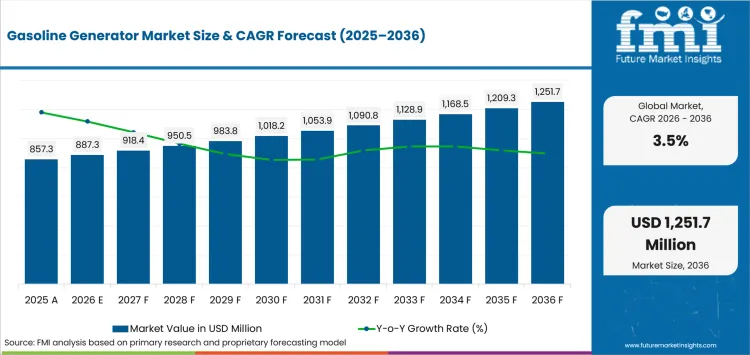
Key Takeaways of Gasoline Generator Market
- Grid reliability concerns and weather event frequency are expected to sustain portable generator procurement for residential standby backup.
- 1.0 To 3.0 KW is expected to account for 38.0% of power output demand in 2026 because mid-range portable generators meet residential backup and light commercial power needs.
- Portable Generator is projected to hold 67.0% of product type demand in 2026, driven by consumer preference for transportable backup power across residential and jobsite applications.
- Standby Backup Power is anticipated to represent 62.0% of application demand in 2026, supported by grid outage frequency and residential preparedness spending.
- China leads with a 4.7% CAGR through 2036 as manufacturing export volumes and domestic construction demand sustain generator procurement.
- Honda and Yamaha are expected to compete through inverter generator portfolios with low-noise operation and fuel efficiency.
Analyst Perspective
"Buyers are expected to judge 0 kw on performance and total cost of ownership rather than headline price. Gasoline generator adoption is expected to depend on grid reliability trends and residential buyer willingness to invest in portable backup power. Suppliers that combine fuel efficiency with electric start convenience and retail distribution reach are likely to capture residential replacement cycles. Market success is projected to depend on meeting noise reduction expectations while maintaining power output reliability across residential and commercial applications."
- Nikhil Kaitwade, Principal Consultant at Future Market Insights
Why is the Gasoline Generator Market growing?
Rising 0 KW and Portable Generator demand across industrial end users
- Gasoline-generator demand follows backup-power needs and grid-reliability gaps across residential, commercial, and industrial users rather than speculative buying.
- China leads growth at 4.7% CAGR as manufacturing export volumes and domestic construction demand sustain generator procurement.
- Portable Generator holds 67.0% of product type revenue, indicating where standardization is concentrating buyer spend.
Because generators are chosen on reliability and runtime, spend concentrates with makers offering inverter efficiency, certification, and dependable dealer and service networks.
How is the Gasoline Generator Market segmented?
The gasoline generator industry is segmented by power output, product type, application, end use, fuel tank capacity, starting mechanism, and region.
The gasoline generator market is segmented by power output, product type, application, end use, fuel tank capacity, starting mechanism, and region. By power output, the market covers 1.0 to 3.0 KW, less than 1.0 KW, 3.0 to 5.0 KW, and more than 5.0 KW. By product type, the market covers portable generator and stationary generator. By application, the market covers standby backup power and continuous power. By end use, the market covers residential, commercial, industrial, agricultural, and others (construction etc.). By fuel tank capacity, the market covers 10 to 20 liters, less than 10 liters, and more than 20 liters. By starting mechanism, the market covers electric start generators, recoil start generators, and hybrid start systems. Regions include North America, Latin America, Western Europe, Eastern Europe, East Asia, South Asia and Pacific, and the Middle East and Africa.
How does the 1.0 to 3.0 KW range shape demand within the power output category?
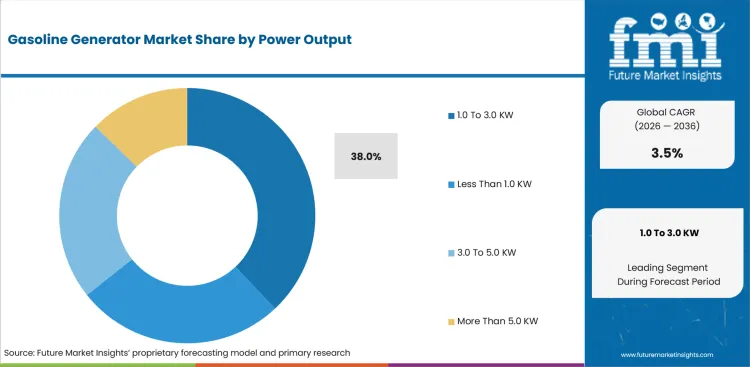
Power output selection determines application suitability and buyer price sensitivity. The 1.0 to 3.0 KW range balances residential backup capability with portability and cost.
- 1.0 To 3.0 KW is expected to account for 38.0% of power output demand in 2026, driven by residential standby and light commercial applications.
- Portable Generator is projected to hold 67.0% of product type demand in 2026 as transportable units dominate consumer and contractor purchases.
What supports demand for standby backup power within the application category?
Application selection is shaped by grid reliability, weather event frequency, and buyer preparedness spending. Standby backup power drives the largest procurement category because homeowners and businesses invest in outage protection.
- Standby Backup Power is anticipated to represent 62.0% of application demand in 2026.
- Residential is forecast to hold 40.0% of end-use demand in 2026 as homeowners in storm-prone areas maintain portable generator readiness.
- Commercial and agricultural end uses represent complementary categories.
How do fuel tank capacity and starting mechanism shape purchasing?
Segment choice here determines system economics, installation scope, and compliance requirements. Demand concentrates here because mid-range tanks balance runtime with portability.
- 10 To 20 Liters is expected to account for 45.0% of fuel tank capacity demand in 2026 because mid-range tanks balance runtime with portability.
- Electric Start Generators is forecast to hold 47.0% of starting mechanism demand in 2026 as residential buyers prioritize push-button convenience over recoil pull start.
- Hybrid start systems are gaining share in premium portable models.
What are the drivers, restraints, and opportunities in the Gasoline Generator Market?
Near-term procurement is shaped by grid reliability concerns, residential backup spending, and fuel efficiency expectations.
- Driver: Grid vulnerability and weather event frequency are expected to push residential buyers toward portable generator procurement for standby home backup power.
- Restraint: Adoption is likely to slow due to noise restrictions in residential areas, emission regulations in urban settings, and competition from battery-based portable power stations.
- Opportunity: Dual-fuel and inverter generator technology is expected to open supplier access if fuel flexibility and clean power output meet residential and sensitive-equipment requirements.
Grid disruption frequency is expected to increase portable generator procurement among homeowners and small businesses. The USA Energy Information Administration reported in 2025 that major weather events continued to cause extended power outages across storm-prone regions, supporting residential backup generator replacement cycles.
Noise restrictions are expected to limit adoption if municipal ordinances and homeowner association rules constrain portable generator operation in residential neighborhoods. EPA reported in 2025 that emission standards for small spark-ignition engines remained active, affecting compliance costs for gasoline generator manufacturers.
Inverter generator technology creates a practical route around the restraint by reducing noise output and improving power quality for sensitive electronics. Honda reported in 2025 that its EU series inverter generators maintained market position among residential buyers seeking quiet operation and clean power output for home electronics.
Which country CAGRs are profiled in the Gasoline Generator Market?
China 4.7%, India 4.3%, USA 3.7%, South Korea 3.6%, UK 3.4% through 2036
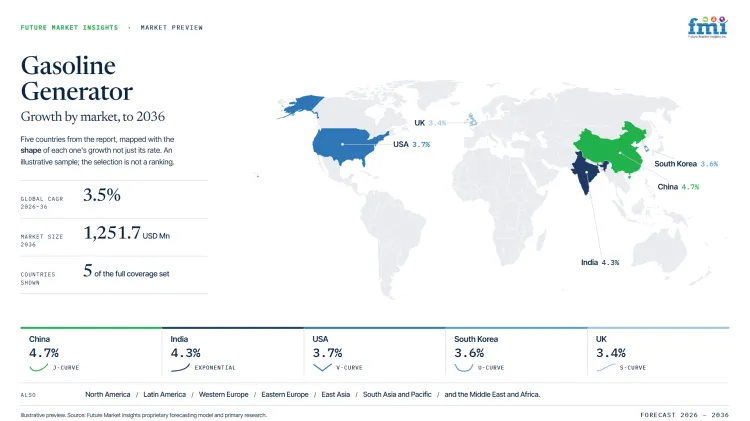
| Country | CAGR (2026 to 2036) |
|---|---|
| China | 4.7% |
| India | 4.3% |
| USA | 3.7% |
| South Korea | 3.6% |
| UK | 3.4% |
Source: FMI's proprietary forecasting model and primary research. 5 of the countries covered in the full report are shown here as a representative subset.
How do country-level CAGRs compare in the Gasoline Generator Market?
The country comparison spans 1.3 percentage points and reveals three distinct growth groups across the gasoline generator market. China and India form the upper tier with a 0.4-point difference, while the USA and South Korea create a closely aligned middle group separated by 0.1 percentage point. The UK remains at the lower end with a 0.2-point gap from South Korea.
- China leads the comparison at a 4.7% CAGR through 2036, supported by distributed-generation build-out, sustained grid investment and a deep domestic component manufacturing base, despite strong price competition.
- India follows at a 4.3% CAGR, remaining 0.4 percentage points below China. Renewable capacity additions, backup power reliance and rural electrification programs support broad-based gasoline generator demand.
- The USA records a 3.7% CAGR, creating a 0.6-percentage-point gap from India. Distributed-energy adoption, state-level incentive variation and replacement of aging equipment support regionally varied demand.
- South Korea grows at a 3.6% CAGR, only 0.1 percentage point below the USA. Government-backed energy programs and dense urban deployment conditions support steady, standards-driven equipment demand.
- The UK records a 3.4% CAGR, remaining 0.2 percentage points below South Korea. Grid decarbonization programs and replacement demand across older installations support steady gasoline generator purchasing.
Comparable CAGRs can still produce different market conditions. Differences in grid reliability, outage frequency, backup-power requirements, renewable capacity additions, equipment replacement cycles and adoption of inverter and dual-fuel systems influence gasoline generator demand across countries. The full report provides country-level CAGR analysis across major regions and individual markets within the gasoline generator market.
Country-wise Analysis
- China's distributed-generation build-out and sustained industrial demand anchor gasoline generators deployment. Demand in China is forecast to rise at a 4.7% CAGR over the forecast period, supported by gasoline generators distributed-generation build-out and grid investment. Portable generators lead product-type demand in 2026, concentrating spend on inverter and dual-fuel units. Severe price competition from China's domestic engine and generator base compresses margins despite volume growth. Makers of gasoline generators win with cost-competitive local production and certification for domestic grid and safety requirements.
- India's renewable additions, backup-power reliance, and rural electrification widen gasoline generators demand. Demand draws on grid vulnerability and weather event frequency. Adoption in India is estimated to expand at a 4.3% CAGR through 2036, supported by gasoline generators renewable additions, backup-power reliance, and rural electrification. Tight financing and buyer price sensitivity slow how fast latent gasoline generators demand converts. Makers of gasoline generators convert demand with cost-competitive products, financing-aligned channels, and rural distribution.
- US gasoline generators deployment varies by state incentives, producing regionally uneven build-out. In the United States, demand is predicted to advance at a 3.7% CAGR through 2036, supported by distributed energy adoption and replacement of aging equipment. Incentive rules that differ by state splinter gasoline generators product and channel strategy. Makers of gasoline generators win with state-specific channel strategies and code-compliant product variants.
- Korean gasoline generators deployment follows government-backed energy programs in dense urban settings. The Gasoline Generator Market in South Korea is projected to record a 3.6% CAGR during the assessment period, supported by government-backed energy programs and dense urban deployment. Tight urban siting and national certification rules narrow gasoline generators product fit. Makers of gasoline generators hold positions with compact formats and certification aligned to national programs.
- UK gasoline generators demand follows grid-decarbonization programs and replacement across older building stock. Sales in the United Kingdom are forecast to expand at a 3.4% CAGR by 2036, supported by grid decarbonization programs and replacement demand. Shifting grant schemes redirect household budgets and push out planned gasoline generators buys. Makers of gasoline generators win with certification for local grid requirements and installer-network support.
Who are the notable companies in the Gasoline Generator Market?
Honda Motor Co., Ltd., Generac Power Systems, Yamaha Motor Co., Ltd., Briggs & Stratton, LLC, Kohler Co., Cummins Inc., Champion Power Equipment, and Westinghouse Electric Corporation are the notable companies shaping this market.
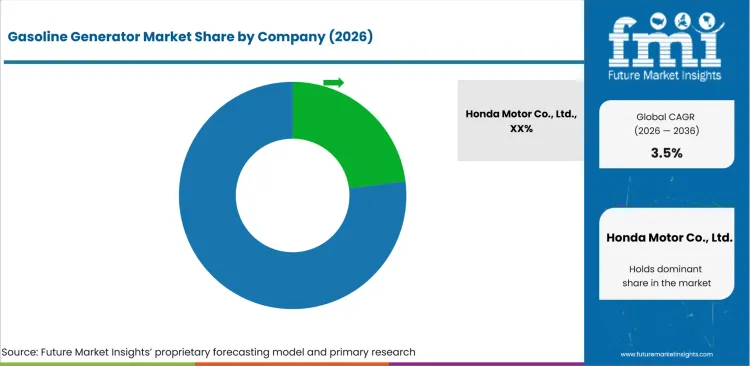
The field concentrates around power-equipment makers that pair engine and inverter engineering with certification and dealer networks. Global power equipment and engine manufacturers compete across Portable inverter generators, Portable power equipment and Commercial and industrial power throughout established accounts. Residential and commercial generator specialists emphasize Residential standby generators and Portable dual-fuel generators, while diversified power and electrical equipment companies serve regional demand through Residential generators. A workable entry is a portable-inverter or residential-standby niche, or a regional dealer-and-service position for a user segment. Growth then depends on certification, dealer coverage, and parts availability across each launch market. Breadth pays off through teams that engineer generators across power ranges and support installed units through dealer networks.
- Honda Motor Co., Ltd. and Yamaha Motor Co., Ltd. combine Portable inverter generators and Portable power equipment across multiple national markets. Cummins Inc. adds Commercial and industrial power through established account relationships, while Kohler Co. contributes Standby and commercial generators. Their edge comes from portable, standby, and inverter-generator breadth with dealer-network depth.
- Generac Power Systems, Briggs & Stratton, LLC and Champion Power Equipment follow focused routes across Residential standby generators and Portable dual-fuel generators. Their commercial edge comes from dual-fuel and residential-standby niches rather than one standardized generator line.
- Westinghouse Electric Corporation provides regional coverage through Residential generators. These firms compete on focused generator strengths, though distribution reach trails the global power-equipment majors.
Competitive Benchmarking: Gasoline Generator Market
| Company | Portfolio Relevance | Generator Focus | Account Access | Service Reach |
|---|---|---|---|---|
| Honda Motor Co., Ltd. | High | Portable inverter generators | Strong | Global |
| Generac Power Systems | High | Residential standby generators | Strong | Regional |
| Yamaha Motor Co., Ltd. | High | Portable power equipment | Strong | Global |
| Briggs & Stratton, LLC | Medium | Outdoor power generators | Strong | Regional |
| Kohler Co. | High | Standby and commercial generators | Strong | Global |
| Cummins Inc. | Medium | Commercial and industrial power | Strong | Global |
| Champion Power Equipment | Medium | Portable dual-fuel generators | Moderate | Regional |
| Westinghouse Electric Corporation | Medium | Residential generators | Moderate | Regional |
Source: Future Market Insights competitive analysis, 2026. Ratings reflect relative portfolio relevance, workflow or project fit, service capability, and geographic reach.
Key Developments in the Gasoline Generator Market
In April 2025, Honda confirmed its EU3200i and EU7000iS Super Quiet Series generators met EPA Phase 3 emissions standards and CARB Tier 4 certification, expanding sales of the Super Quiet Series in California.
In January 2025, Generac Power Systems reported expansion of its home standby generator product line with updated transfer switch integration for residential backup power applications.
Key Players in the Gasoline Generator Market
Global power equipment and engine manufacturers
- Honda Motor Co., Ltd.
- Yamaha Motor Co., Ltd.
- Cummins Inc.
- Kohler Co.
Residential and commercial generator specialists
- Generac Power Systems
- Briggs & Stratton, LLC
- Champion Power Equipment
Diversified power and electrical equipment companies
- Westinghouse Electric Corporation
Gasoline Generator Market: Report Scope
| Coverage field | Report scope |
|---|---|
| Market breakdown | Power output, product type, application, end use, fuel tank capacity, starting mechanism, and region. |
| Market Definition | Gasoline generators include portable and stationary power equipment using gasoline-fueled small engines to provide standby backup and continuous electrical power across residential, commercial, industrial, and agricultural applications. |
| Regions Covered | North America, Latin America, Western Europe, Eastern Europe, East Asia, South Asia and Pacific, and the Middle East and Africa. |
| Key Companies Profiled | Honda Motor Co., Ltd., Generac Power Systems, Yamaha Motor Co., Ltd., Briggs & Stratton, LLC, Kohler Co., Cummins Inc., Champion Power Equipment, Westinghouse Electric Corporation. |
| Forecast Period | 2026 to 2036. |
| Approach | FMI used primary interviews, source validation, company authentication, and proprietary demand modeling to estimate market size, segment shares, country CAGRs, and competitive positioning. |
Source: Future Market Insights, analysis driven by proprietary forecasting models and primary research
Gasoline Generator Market: Research Methodology
| Method | Approach |
|---|---|
| Primary Research | FMI interviewed gasoline generator suppliers, institutional and retail buyers, distributors, and procurement leads. Inputs tested adoption triggers, product preferences, and replacement cycle patterns across segments and countries. |
| Desk Research | Desk research used government releases, regulator updates, standards-body references, company filings, and official product pages. Evidence was restricted to public sources supporting adoption or company capability claims. |
| Market Sizing and Forecasting | The forecast model linked 2026 revenue anchors to demand drivers, distribution reach, penetration rates, and country-specific conditions. Segment shares were cross-checked against product, application, and end-user procurement patterns. |
| Data Validation | Data validation reconciled every external statistic against its source title, date, and reported figure. Forecast values were checked against the ten-year CAGR formula and reviewed for section-level consistency. |
Source: Future Market Insights (FMI) analysis, based on proprietary forecasting model and primary research
Market Segmentation Analysis
Gasoline Generator Market Segmented by Power Output:
- 1.0 To 3.0 KW
- Mid Range Residential Generators
- Home Backup Power Supply
- Essential Appliance Operation
- Portable Utility Generators
- Small Business Power Support
- Enhanced Fuel Efficiency
- Mid Range Residential Generators
- Less Than 1.0 KW
- Compact Portable Generators
- Low Power Emergency Backup
- Camping And Outdoor Applications
- Household Mini Generators
- Small Appliance Support
- Lightweight Portable Design
- Compact Portable Generators
- 3.0 To 5.0 KW
- High Capacity Portable Generators
- Commercial Backup Applications
- Construction Site Power Supply
- Heavy Duty Residential Generators
- Multiple Appliance Connectivity
- Reliable Continuous Performance
- High Capacity Portable Generators
- More Than 5.0 KW
- Industrial Grade Generators
- High Load Power Generation
- Large Facility Backup Support
- Stationary High Output Systems
- Continuous Commercial Operations
- Long Duration Power Reliability
- Industrial Grade Generators
Gasoline Generator Market Segmented by Product Type:
- Portable Generator
- Inverter Portable Generators
- Low Noise Power Generation
- Fuel Efficient Performance
- Open Frame Portable Generators
- High Power Output Support
- Outdoor Industrial Applications
- Inverter Portable Generators
- Stationary Generator
- Standby Stationary Systems
- Automatic Backup Activation
- Reliable Long Term Operation
- Industrial Stationary Generators
- Large Scale Power Supply
- Continuous Operational Support
- Standby Stationary Systems
Gasoline Generator Market Segmented by Application:
- Standby Backup Power
- Home Emergency Backup
- Power Outage Protection
- Continuous Appliance Operation
- Commercial Backup Systems
- Business Continuity Support
- Critical Equipment Protection
- Home Emergency Backup
- Continuous Power
- Industrial Continuous Power Supply
- Long Duration Operational Support
- High Reliability Performance
- Remote Area Power Generation
- Off Grid Electricity Supply
- Construction And Field Applications
- Industrial Continuous Power Supply
Gasoline Generator Market Segmented by End Use:
- Residential
- Household Emergency Power
- Essential Appliance Backup
- Improved Home Safety
- Recreational And Outdoor Usage
- Portable Energy Convenience
- Low Noise Operation
- Household Emergency Power
- Commercial
- Retail And Small Business Applications
- Reliable Backup Electricity Supply
- Reduced Operational Downtime
- Hospitality Sector Usage
- Continuous Customer Service Support
- Enhanced Power Stability
- Retail And Small Business Applications
- Industrial
- Manufacturing Facility Power Support
- Continuous Equipment Operation
- Heavy Duty Energy Supply
- Warehouse And Industrial Sites
- Reliable High Load Performance
- Reduced Production Interruptions
- Manufacturing Facility Power Support
- Agricultural
- Farm Equipment Power Supply
- Irrigation System Support
- Remote Field Applications
- Livestock Facility Backup Power
- Reliable Rural Electricity Access
- Enhanced Agricultural Productivity
- Farm Equipment Power Supply
- Others (Construction Etc.)
- Construction Site Applications
- Portable Tool Power Supply
- Remote Project Support
- Event And Outdoor Applications
- Temporary Power Generation
- Flexible Energy Deployment
- Construction Site Applications
Gasoline Generator Market Segmented by Fuel Tank Capacity:
- 10 To 20 Liters
- Mid Capacity Fuel Systems
- Extended Residential Backup
- Improved Runtime Performance
- Commercial Portable Generators
- Balanced Fuel Efficiency
- Reliable Emergency Operations
- Mid Capacity Fuel Systems
- Less Than 10 Liters
- Compact Fuel Tank Generators
- Lightweight Portable Usage
- Short Duration Backup Support
- Home Utility Generators
- Easy Fuel Management
- Convenient Outdoor Applications
- Compact Fuel Tank Generators
- More Than 20 Liters
- High Capacity Fuel Tank Generators
- Long Duration Power Supply
- Industrial Application Support
- Heavy Duty Generator Systems
- Continuous Commercial Operations
- Reduced Refueling Frequency
- High Capacity Fuel Tank Generators
Gasoline Generator Market Segmented by Starting Mechanism:
- Electric Start Generators
- Battery Assisted Start Systems
- Quick Generator Activation
- Enhanced User Convenience
- Remote Electric Start Models
- Automatic Backup Integration
- Improved Operational Efficiency
- Battery Assisted Start Systems
- Recoil Start Generators
- Manual Pull Start Systems
- Simple Operational Design
- Cost Effective Power Solutions
- Portable Utility Generators
- Reliable Mechanical Starting
- Low Maintenance Requirements
- Manual Pull Start Systems
- Hybrid Start Systems
- Dual Start Mechanism Generators
- Manual And Electric Start Support
- Enhanced Reliability Performance
- Smart Ignition Systems
- Improved Cold Weather Starting
- Advanced Generator Functionality
- Dual Start Mechanism Generators
Gasoline Generator Market by Region:
- North America
- USA
- Canada
- Mexico
- Latin America
- Brazil
- Chile
- Rest of Latin America
- Western Europe
- Germany
- UK
- Italy
- Spain
- France
- Nordic
- BENELUX
- Rest of Western Europe
- Eastern Europe
- Russia
- Poland
- Hungary
- Balkan & Baltic
- Rest of Eastern Europe
- East Asia
- China
- Japan
- South Korea
- South Asia and Pacific
- India
- ASEAN
- Australia & New Zealand
- Rest of South Asia and Pacific
- Middle East & Africa
- Kingdom of Saudi Arabia
- Other GCC Countries
- Türkiye
- South Africa
- Other African Union
- Rest of Middle East & Africa
Research Sources and Bibliography
- U.S. Energy Information Administration. (2025). Electric Power Annual: Power Outage and Reliability Data.
- Environmental Protection Agency. (2025). Emission Standards for Small Spark-Ignition Engines.
- Generac Power Systems. (2025). Home Standby Generator Product Line Update.
- International Energy Agency. (2025). World Energy Outlook: Power Reliability Trends.
- Central Electricity Authority India. (2025). State-Level Power Supply Position Report.
- Ministry of Economy, Trade and Industry Japan. (2025). Power Equipment Safety and Compliance Standards.
- Korea Energy Agency. (2025). Backup Power Equipment Market Assessment.
- China Machinery Engineering Corporation. (2025). Small Engine and Generator Production Statistics.
- National Disaster Management Authority India. (2025). Disaster Preparedness Equipment Guidelines.
This bibliography is provided for reader reference and uses primary government sources plus standards-body sources. Company sources are included.
This Report Answers
- What is the estimated 2026 value of the gasoline generator market?
- What market value is projected for gasoline generator by 2036?
- What CAGR is forecast for gasoline generator from 2026 to 2036?
- Which power output range is expected to account for a notable 2026 share?
- Which countries are profiled for CAGR comparison?
- Which companies are notable in the competitive landscape?
Frequently Asked Questions
How big is the Gasoline Generator Market in 2026?
The Gasoline Generator Market is valued at USD 887.3 million in 2026 and is forecast to reach USD 1251.7 million by 2036, expanding at a 3.5% CAGR. The Gasoline Generator Market grew from USD 857.3 million in 2025, with 1.0 To 3.0 KW holding 38.0% of power output demand in 2026.
What is the CAGR of the Gasoline Generator Market from 2026 to 2036?
The Gasoline Generator Market is projected to grow at a CAGR of 3.5% between 2026 and 2036, supported by sustained grid vulnerability in weather-exposed regions and continued residential demand for portable backup power. 1.0 To 3.0 KW holds 38.0% of Gasoline Generator Market power output demand in 2026, while Portable Generator leads product type with 67.0% in 2026.
Which power output leads the Gasoline Generator Market?
1.0 To 3.0 KW accounts for 38.0% of the Gasoline Generator Market by power output in 2026, driven by residential standby and light commercial applications. The Gasoline Generator Market is valued at USD 887.3 million in 2026 and grows at a 3.5% CAGR through 2036, while Portable Generator leads product type with 67.0% in 2026.
How much will the Gasoline Generator Market add between 2026 and 2036?
The Gasoline Generator Market is set to add USD 364.4 million between 2026 and 2036, growing from USD 887.3 million to USD 1251.7 million at a 3.5% CAGR. Portable Generator leads product type with 67.0% of Gasoline Generator Market revenue in 2026, anchoring that incremental demand.
Who are the leading companies in the Gasoline Generator Market?
The Gasoline Generator Market profiles 8 key companies in 2026, led by Honda Motor Co., Ltd., Generac Power Systems, Yamaha Motor Co., Ltd., Briggs & Stratton Corporation, and Kohler Co. These suppliers compete across power output, where 1.0 To 3.0 KW holds 38.0% of Gasoline Generator Market demand in 2026.
Preview the report firsthand - request a free sample
Get SampleGet the brochure for pricing and purchase details.
Get PDFTable of Content
- Key Takeaways
- Market Size and CAGR
- Top Growth Driver
- Fastest Growing Segment
- Leading Region
- Key Companies
- Emerging Opportunities
- Executive Summary
- Global Market Outlook
- Demand-side Trends
- Supply-side Trends
- Technology Roadmap Analysis
- Analysis and Recommendations
- Analyst Perspective (What is happening? Why now? What should investors know?)
- Key Questions Answered
- How large is the market?
- What is the CAGR?
- What are key trends?
- Which region dominates?
- Who are the leaders?
- Market Overview
- Market Coverage / Taxonomy
- Market Definition / Scope / Limitations
- Research Methodology
- Chapter Orientation
- Analytical Lens and Working Hypotheses
- Market Structure, Signals, and Trend Drivers
- Benchmarking and Cross-market Comparability
- Market Sizing, Forecasting, and Opportunity Mapping
- Research Design and Evidence Framework
- Desk Research Programme (Secondary Evidence)
- Expert Input and Fieldwork (Primary Evidence)
- Tooling, Models, and Reference Databases
- Data Engineering and Model Build
- Quality Assurance and Audit Trail
- Market Background
- Market Dynamics (Drivers, Restraints, Opportunity, Trends)
- Scenario Forecast (Optimistic, Likely, Conservative)
- Impact Analysis
- AI Impact
- Sustainability Impact
- Regulatory Impact
- Technology Impact
- Consumer / Buyer Analysis
- Purchase Drivers
- Adoption Barriers
- Buyer Journey
- Opportunity Map Analysis
- Product Life Cycle Analysis
- Supply Chain Analysis
- Investment Feasibility Matrix
- Value Chain Analysis
- PESTLE and Porter's Analysis
- Regulatory Landscape
- Regional Parent Market Outlook
- Production and Consumption Statistics
- Import and Export Statistics
- Global Market Analysis and Forecast, 2021 to 2036
- Historical Market Size Value (USD Million) Analysis, 2021 to 2025
- Current and Future Market Size Value (USD Million) Projections, 2026 to 2036
- Y-o-Y Growth Trend Analysis
- Absolute $ Opportunity Analysis
- Global Market Pricing Analysis, 2021 to 2036
- Global Market Analysis and Forecast, By Power Output, 2021 to 2036
- Introduction / Key Findings
- Historical Market Size Value (USD Million) Analysis By Power Output, 2021 to 2025
- Current and Future Market Size Value (USD Million) Analysis and Forecast By Power Output, 2026 to 2036
- 1.0 To 3.0 KW
- Mid Range Residential Generators
- Portable Utility Generators
- Less Than 1.0 KW
- Compact Portable Generators
- Household Mini Generators
- 3.0 To 5.0 KW
- High Capacity Portable Generators
- Heavy Duty Residential Generators
- More Than 5.0 KW
- Industrial Grade Generators
- Stationary High Output Systems
- 1.0 To 3.0 KW
- Y-o-Y Growth Trend Analysis By Power Output, 2021 to 2025
- Absolute $ Opportunity Analysis By Power Output, 2026 to 2036
- Global Market Analysis and Forecast, By Product Type, 2021 to 2036
- Introduction / Key Findings
- Historical Market Size Value (USD Million) Analysis By Product Type, 2021 to 2025
- Current and Future Market Size Value (USD Million) Analysis and Forecast By Product Type, 2026 to 2036
- Portable Generator
- Inverter Portable Generators
- Open Frame Portable Generators
- Stationary Generator
- Standby Stationary Systems
- Industrial Stationary Generators
- Portable Generator
- Y-o-Y Growth Trend Analysis By Product Type, 2021 to 2025
- Absolute $ Opportunity Analysis By Product Type, 2026 to 2036
- Global Market Analysis and Forecast, By Application, 2021 to 2036
- Introduction / Key Findings
- Historical Market Size Value (USD Million) Analysis By Application, 2021 to 2025
- Current and Future Market Size Value (USD Million) Analysis and Forecast By Application, 2026 to 2036
- Standby Backup Power
- Home Emergency Backup
- Commercial Backup Systems
- Continuous Power
- Industrial Continuous Power Supply
- Remote Area Power Generation
- Standby Backup Power
- Y-o-Y Growth Trend Analysis By Application, 2021 to 2025
- Absolute $ Opportunity Analysis By Application, 2026 to 2036
- Global Market Analysis and Forecast, By End Use, 2021 to 2036
- Introduction / Key Findings
- Historical Market Size Value (USD Million) Analysis By End Use, 2021 to 2025
- Current and Future Market Size Value (USD Million) Analysis and Forecast By End Use, 2026 to 2036
- Residential
- Household Emergency Power
- Recreational And Outdoor Usage
- Commercial
- Retail And Small Business Applications
- Hospitality Sector Usage
- Industrial
- Manufacturing Facility Power Support
- Warehouse And Industrial Sites
- Agricultural
- Farm Equipment Power Supply
- Livestock Facility Backup Power
- Others (Construction Etc.)
- Construction Site Applications
- Event And Outdoor Applications
- Residential
- Y-o-Y Growth Trend Analysis By End Use, 2021 to 2025
- Absolute $ Opportunity Analysis By End Use, 2026 to 2036
- Global Market Analysis and Forecast, By Fuel Tank Capacity, 2021 to 2036
- Introduction / Key Findings
- Historical Market Size Value (USD Million) Analysis By Fuel Tank Capacity, 2021 to 2025
- Current and Future Market Size Value (USD Million) Analysis and Forecast By Fuel Tank Capacity, 2026 to 2036
- 10 To 20 Liters
- Mid Capacity Fuel Systems
- Commercial Portable Generators
- Less Than 10 Liters
- Compact Fuel Tank Generators
- Home Utility Generators
- More Than 20 Liters
- High Capacity Fuel Tank Generators
- Heavy Duty Generator Systems
- 10 To 20 Liters
- Y-o-Y Growth Trend Analysis By Fuel Tank Capacity, 2021 to 2025
- Absolute $ Opportunity Analysis By Fuel Tank Capacity, 2026 to 2036
- Global Market Analysis and Forecast, By Starting Mechanism
- Introduction / Key Findings
- Historical Market Size Value (USD Million) Analysis By Starting Mechanism, 2021 to 2025
- Current and Future Market Size Value (USD Million) Analysis and Forecast By Starting Mechanism, 2026 to 2036
- Electric Start Generators
- Battery Assisted Start Systems
- Remote Electric Start Models
- Recoil Start Generators
- Manual Pull Start Systems
- Portable Utility Generators
- Hybrid Start Systems
- Dual Start Mechanism Generators
- Smart Ignition Systems
- Electric Start Generators
- Y-o-Y Growth Trend Analysis By Starting Mechanism, 2021 to 2025
- Absolute $ Opportunity Analysis By Starting Mechanism, 2026 to 2036
- Global Market Analysis and Forecast, By Region, 2021 to 2036
- Introduction
- Historical Market Size Value (USD Million) Analysis By Region, 2021 to 2025
- Current Market Size Value (USD Million) Analysis and Forecast By Region, 2026 to 2036
- North America
- Latin America
- Western Europe
- Eastern Europe
- East Asia
- South Asia and Pacific
- Middle East & Africa
- Market Attractiveness Analysis By Region
- North America Market Analysis and Forecast, By Country, 2021 to 2036
- Historical Market Size Value (USD Million) Trend Analysis By Market Taxonomy, 2021 to 2025
- Market Size Value (USD Million) Forecast By Market Taxonomy, 2026 to 2036
- By Country
- USA
- Canada
- By Power Output
- By Product Type
- By Application
- By End Use
- By Fuel Tank Capacity
- By Starting Mechanism
- By Country
- Market Attractiveness Analysis
- By Country
- By Power Output
- By Product Type
- By Application
- By End Use
- By Fuel Tank Capacity
- By Starting Mechanism
- Key Takeaways
- Latin America Market Analysis and Forecast, By Country
- Historical Market Size Value (USD Million) Trend Analysis By Market Taxonomy, 2021 to 2025
- Market Size Value (USD Million) Forecast By Market Taxonomy, 2026 to 2036
- By Country
- Brazil
- Mexico
- Chile
- Rest of Latin America
- By Power Output
- By Product Type
- By Application
- By End Use
- By Fuel Tank Capacity
- By Starting Mechanism
- By Country
- Market Attractiveness Analysis
- By Country
- By Power Output
- By Product Type
- By Application
- By End Use
- By Fuel Tank Capacity
- By Starting Mechanism
- Key Takeaways
- Western Europe Market Analysis and Forecast, By Country
- Historical Market Size Value (USD Million) Trend Analysis By Market Taxonomy, 2021 to 2025
- Market Size Value (USD Million) Forecast By Market Taxonomy, 2026 to 2036
- By Country
- Germany
- UK
- Italy
- Spain
- France
- Nordic
- BENELUX
- Rest of Western Europe
- By Power Output
- By Product Type
- By Application
- By End Use
- By Fuel Tank Capacity
- By Starting Mechanism
- By Country
- Market Attractiveness Analysis
- By Country
- By Power Output
- By Product Type
- By Application
- By End Use
- By Fuel Tank Capacity
- By Starting Mechanism
- Key Takeaways
- Eastern Europe Market Analysis and Forecast, By Country
- Historical Market Size Value (USD Million) Trend Analysis By Market Taxonomy, 2021 to 2025
- Market Size Value (USD Million) Forecast By Market Taxonomy, 2026 to 2036
- By Country
- Russia
- Poland
- Hungary
- Balkan & Baltic
- Rest of Eastern Europe
- By Power Output
- By Product Type
- By Application
- By End Use
- By Fuel Tank Capacity
- By Starting Mechanism
- By Country
- Market Attractiveness Analysis
- By Country
- By Power Output
- By Product Type
- By Application
- By End Use
- By Fuel Tank Capacity
- By Starting Mechanism
- Key Takeaways
- East Asia Market Analysis and Forecast, By Country
- Historical Market Size Value (USD Million) Trend Analysis By Market Taxonomy, 2021 to 2025
- Market Size Value (USD Million) Forecast By Market Taxonomy, 2026 to 2036
- By Country
- China
- Japan
- South Korea
- By Power Output
- By Product Type
- By Application
- By End Use
- By Fuel Tank Capacity
- By Starting Mechanism
- By Country
- Market Attractiveness Analysis
- By Country
- By Power Output
- By Product Type
- By Application
- By End Use
- By Fuel Tank Capacity
- By Starting Mechanism
- Key Takeaways
- South Asia and Pacific Market Analysis and Forecast, By Country
- Historical Market Size Value (USD Million) Trend Analysis By Market Taxonomy, 2021 to 2025
- Market Size Value (USD Million) Forecast By Market Taxonomy, 2026 to 2036
- By Country
- India
- ASEAN
- Australia & New Zealand
- Rest of South Asia and Pacific
- By Power Output
- By Product Type
- By Application
- By End Use
- By Fuel Tank Capacity
- By Starting Mechanism
- By Country
- Market Attractiveness Analysis
- By Country
- By Power Output
- By Product Type
- By Application
- By End Use
- By Fuel Tank Capacity
- By Starting Mechanism
- Key Takeaways
- Middle East & Africa Market Analysis and Forecast, By Country
- Historical Market Size Value (USD Million) Trend Analysis By Market Taxonomy, 2021 to 2025
- Market Size Value (USD Million) Forecast By Market Taxonomy, 2026 to 2036
- By Country
- Kingdom of Saudi Arabia
- Other GCC Countries
- Türkiye
- South Africa
- Other African Union
- Rest of Middle East & Africa
- By Power Output
- By Product Type
- By Application
- By End Use
- By Fuel Tank Capacity
- By Starting Mechanism
- By Country
- Market Attractiveness Analysis
- By Country
- By Power Output
- By Product Type
- By Application
- By End Use
- By Fuel Tank Capacity
- By Starting Mechanism
- Key Takeaways
- Key Countries Market Analysis
- USA
- Pricing Analysis
- Market Share Analysis, 2025
- By Power Output
- By Product Type
- By Application
- By End Use
- By Fuel Tank Capacity
- By Starting Mechanism
- Canada
- Pricing Analysis
- Market Share Analysis, 2025
- By Power Output
- By Product Type
- By Application
- By End Use
- By Fuel Tank Capacity
- By Starting Mechanism
- Mexico
- Pricing Analysis
- Market Share Analysis, 2025
- By Power Output
- By Product Type
- By Application
- By End Use
- By Fuel Tank Capacity
- By Starting Mechanism
- Brazil
- Pricing Analysis
- Market Share Analysis, 2025
- By Power Output
- By Product Type
- By Application
- By End Use
- By Fuel Tank Capacity
- By Starting Mechanism
- Chile
- Pricing Analysis
- Market Share Analysis, 2025
- By Power Output
- By Product Type
- By Application
- By End Use
- By Fuel Tank Capacity
- By Starting Mechanism
- Germany
- Pricing Analysis
- Market Share Analysis, 2025
- By Power Output
- By Product Type
- By Application
- By End Use
- By Fuel Tank Capacity
- By Starting Mechanism
- UK
- Pricing Analysis
- Market Share Analysis, 2025
- By Power Output
- By Product Type
- By Application
- By End Use
- By Fuel Tank Capacity
- By Starting Mechanism
- Italy
- Pricing Analysis
- Market Share Analysis, 2025
- By Power Output
- By Product Type
- By Application
- By End Use
- By Fuel Tank Capacity
- By Starting Mechanism
- Spain
- Pricing Analysis
- Market Share Analysis, 2025
- By Power Output
- By Product Type
- By Application
- By End Use
- By Fuel Tank Capacity
- By Starting Mechanism
- France
- Pricing Analysis
- Market Share Analysis, 2025
- By Power Output
- By Product Type
- By Application
- By End Use
- By Fuel Tank Capacity
- By Starting Mechanism
- India
- Pricing Analysis
- Market Share Analysis, 2025
- By Power Output
- By Product Type
- By Application
- By End Use
- By Fuel Tank Capacity
- By Starting Mechanism
- ASEAN
- Pricing Analysis
- Market Share Analysis, 2025
- By Power Output
- By Product Type
- By Application
- By End Use
- By Fuel Tank Capacity
- By Starting Mechanism
- Australia & New Zealand
- Pricing Analysis
- Market Share Analysis, 2025
- By Power Output
- By Product Type
- By Application
- By End Use
- By Fuel Tank Capacity
- By Starting Mechanism
- China
- Pricing Analysis
- Market Share Analysis, 2025
- By Power Output
- By Product Type
- By Application
- By End Use
- By Fuel Tank Capacity
- By Starting Mechanism
- Japan
- Pricing Analysis
- Market Share Analysis, 2025
- By Power Output
- By Product Type
- By Application
- By End Use
- By Fuel Tank Capacity
- By Starting Mechanism
- South Korea
- Pricing Analysis
- Market Share Analysis, 2025
- By Power Output
- By Product Type
- By Application
- By End Use
- By Fuel Tank Capacity
- By Starting Mechanism
- Russia
- Pricing Analysis
- Market Share Analysis, 2025
- By Power Output
- By Product Type
- By Application
- By End Use
- By Fuel Tank Capacity
- By Starting Mechanism
- Poland
- Pricing Analysis
- Market Share Analysis, 2025
- By Power Output
- By Product Type
- By Application
- By End Use
- By Fuel Tank Capacity
- By Starting Mechanism
- Hungary
- Pricing Analysis
- Market Share Analysis, 2025
- By Power Output
- By Product Type
- By Application
- By End Use
- By Fuel Tank Capacity
- By Starting Mechanism
- Kingdom of Saudi Arabia
- Pricing Analysis
- Market Share Analysis, 2025
- By Power Output
- By Product Type
- By Application
- By End Use
- By Fuel Tank Capacity
- By Starting Mechanism
- Türkiye
- Pricing Analysis
- Market Share Analysis, 2025
- By Power Output
- By Product Type
- By Application
- By End Use
- By Fuel Tank Capacity
- By Starting Mechanism
- South Africa
- Pricing Analysis
- Market Share Analysis, 2025
- By Power Output
- By Product Type
- By Application
- By End Use
- By Fuel Tank Capacity
- By Starting Mechanism
- USA
- Market Structure Analysis
- Competition Dashboard
- Competition Benchmarking
- Market Share Analysis of Top Players
- By Regional
- By Power Output
- By Product Type
- By Application
- By End Use
- By Fuel Tank Capacity
- By Starting Mechanism
- Emerging Startups
- Innovation Benchmarking
- Competition Analysis
- Competition Deep Dive
- Honda Motor Co., Ltd.
- Overview
- Product Portfolio
- Profitability by Market Segments
- Sales Footprint
- Strategy Overview
- Marketing Strategy
- Product Strategy
- Channel Strategy
- Generac Power Systems
- Yamaha Motor Co., Ltd.
- Briggs & Stratton, LLC
- Kohler Co.
- Cummins Inc.
- Champion Power Equipment
- Westinghouse Electric Corporation
- Honda Motor Co., Ltd.
- Case Studies
- Success Stories
- Recent Developments
- Competition Deep Dive
- Assumptions & Acronyms Used


