

- Market Size (2026)
- USD 85.8 Mn
- Forecast (2036)
- USD 132.6 Mn
- CAGR (2026 to 2036)
- 4.5%
How big is Glass Container Mold Swabbing Compounds Market in 2026?
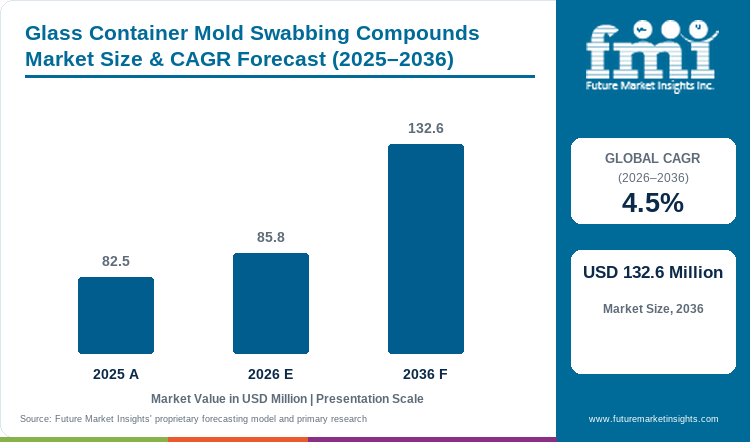
The glass container mold swabbing compounds market is valued at USD 85.8 million in 2026 and is projected to reach USD 132.6 million by 2036, expanding at a CAGR of 4.5% over the 2026-2036 period.
The market was valued at USD 82.5 million in 2025 and is projected to reach USD 85.8 million in 2026 and USD 132.6 million by 2036, expanding at a 4.5% CAGR over the forecast period. The scope encompasses graphite and graphite-free release compounds applied to blank molds, blow molds, and neck rings; general machine lubrication oils and shear sprays are explicitly excluded from the market definition.
Demand for these compounds naturally follows the broader glass bottles market, which FMI values at USD 67.4 billion in 2026. At the plant level, compound consumption scales directly with hot-end container output. The actual volume a facility runs through, however, comes down to two practical variables: how often operators need to swab the molds, and how far along the plant is in upgrading from manual swabbing to automated, robot-dosed application systems.
Key Takeaways
- The market is valued at USD 85.8 million in 2026 and is projected to reach USD 132.6 million by 2036.
- Graphite-based formulations are expected to capture 46.0% of base chemistry demand in 2026, supported by their proven thermal stability and reliable release properties across high-temperature blank and blow molds.
- Paste and grease formulations are likely to account for 52.0% of product form demand in 2026, favored on the plant floor for controlled swab pickup and durable adhesion on operating mold steel.
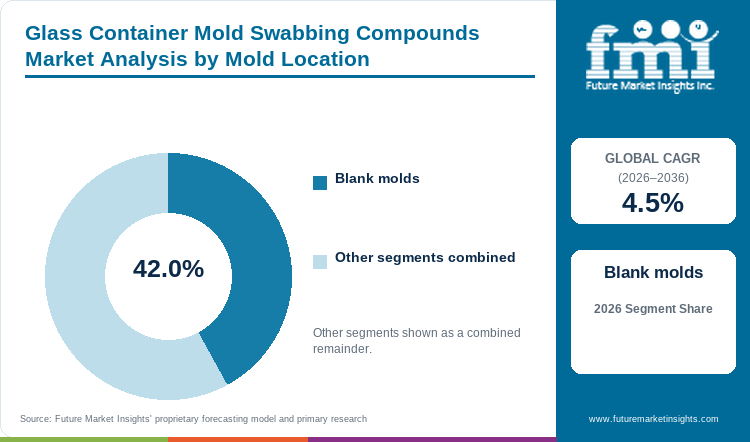
- Blank molds represent 42.0% of mold location demand in 2026, as uniform initial release during parison formation directly dictates final bottle wall distribution and surface quality.
- Extending swab intervals helps minimize production interruptions, but excessive compound buildup leaves carbon residues on the glass and accelerates offline mold-cleaning cycles.
- Key commercial suppliers operating across this sector include CONDAT, FUCHS, Interglass, Graphoidal Developments, BECHEM, PETROFER, IRMCO, Klüber Lubrication, TotalEnergies Lubrifiants, and Q8Oils.
Analyst Perspective
“The useful measure is not the compound price per kilogram. It is how many accepted bottles can be produced between swabs without mold staining or unstable gob loading.”
- Nandini Roy Choudhury, Principal Consultant, Future Market Insights
How is the glass container mold swabbing compounds market segmented?
The glass container mold swabbing compounds market is segmented six ways: by base chemistry, product form, mold location, container type, application method, and region. Graphite-based compounds lead the base chemistry category with 46.0% of 2026 revenue.
Base chemistry covers graphite-bearing, graphite-free and sulfur-free formulations. Product form includes grease, paste and sprayable delivery. Mold location refers to the blank, blow and neck-ring surfaces that receive the compound. Container type and application method complete the commercial view.
Why do blank molds account for the leading mold-location share?
The blank station receives molten glass gobs directly from the delivery scoops to form the initial parison shape before mechanical invert. Any sticking, improper boundary cooling, or irregular release at this initial stage introduces parison distortions, check marks, and surface blemishes that carry straight through to the finished bottle.
- Blank molds are expected to represent 42.0% of mold-location revenue in 2026, as parison release uniformity dictates final glass wall thickness and container surface integrity.
- High-temperature forming patents document recurring, short-interval swabbing cycles on blank and neck-ring molds as necessary to prevent glass-to-metal sticking during parison loading.
Why do graphite-based compounds lead the base chemistry category?
Graphite provides superior boundary lubrication and thermal load-bearing performance under the extreme temperatures of operating mold cavities. It deposits a reliable, low-friction parting film that forming line crews understand well. Formulators must balance solids loading carefully, however, as excessive graphite deposition leaves carbon loading marks on hot containers and fouls surrounding individual section (IS) machine tooling.
- Graphite-based formulations are projected to capture 46.0% of base chemistry demand in 2026, supported by their entrenched performance and dependable release characteristics across high-temperature blank and blow mold stations.
- Specialty lubricant manufacturers such as Interglass publish dedicated GLASSMOLD formulations with specified graphite concentrations engineered for high-speed blow-blow container production.
What supports paste and grease compounds in the product form category?
High-viscosity petroleum or synthetic carriers hold solid release agents in suspension directly on the swab tool, preventing unwanted drippage onto adjacent machine hardware. This consistency allows hot-end operators to manipulate film thickness and localized coverage directly based on container geometry and operating cadence.
- Paste and grease formulations are estimated to account for 52.0% of product form demand in 2026 because they ensure predictable swab retention and adhere reliably to hot mold cavities.
- Lubricant suppliers such as CONDAT classify primary swabbing compounds as high-performance graphite release greases formulated specifically for blank molds, blow cavities, and neck rings.
How do beverage bottles shape the container-type category?
High-speed container lines packaging beer, wine, spirits, and soft drinks run extended, continuous campaigns where minute defect spikes compound into massive pack-to-melt cullet losses. Release films must maintain clean separation without transferring carbon smudge or haze onto flint or colored glass bodies.
- Beverage bottles are forecast to command 58.0% of container-type demand in 2026, driven by high-volume production schedules and zero-tolerance visual defect thresholds.
- Data from the European Container Glass Federation (FEVE) confirms that member facilities delivered 76.5 billion food and beverage glass containers in 2024, highlighting the production scale that depends on stable hot-end mold release.
Why does manual swabbing remain central to the application-method category?
Manual application allows skilled hot-end operators to target specific mold cavities, compensate for localized temperature hot spots, and adjust lubricant delivery during job changes. The operational downside remains operator-to-operator inconsistency in lubricant dosage and cycle timing, which causes brief surface finish variations and increases worker exposure to hot tooling.
- Manual swabbing is projected to account for 63.0% of application-method demand in 2026 because the legacy installed base of IS machines continues to rely on operator-managed mold maintenance.
- Formulators like CONDAT offer automated sprayable compounds alongside traditional manual greases, highlighting an industry in transition where manual routines still dominate installed plant operations.
What are the drivers, restraints and opportunities in the Glass Container Mold Swabbing Compounds Market?
In the glass container mold swabbing compounds market, the key driver is operating container-glass lines that require release compound through repeated mold maintenance cycles, the key restraint is residue, smoke and inconsistent swab quantity that can create defects or shorten mold-cleaning intervals, and the key opportunity is graphite-free and sulfur-free compounds for premium bottles and operator-exposure goals.
- Driver: Operating glass-container lines require release compound through repeated mold maintenance cycles.
- Restraint: Residue, smoke and inconsistent swab quantity can create defects or shorten mold-cleaning intervals.
- Opportunity: Graphite-free and sulfur-free compounds can address premium bottles plus operator-exposure goals.
The glass packaging market provides the production base for recurring swabbing demand. FEVE recorded 21 million tonnes of food and beverage container sales by its members in 2024, so even stable glass output supports repeated purchases of this consumable.
A compound can successfully release the parison and still fail plant qualification if it discolors the container or leaves carbonaceous buildup across hot mold cavities. Bronze alloy molds, commonly deployed for cosmetic and appearance-critical beverage containers, are especially prone to sulfur staining from chemically incompatible carrier packages. Consequently, compound adoption is governed by rigorous, line-specific qualification rather than routine lubricant substitution.
Demand within the broader beverage packaging market increasingly prioritizes pristine mold face conditions, as premium labeling, high-definition embossing, and shelf aesthetics penalize visible surface defects. To mitigate transfer marks, plants are actively qualifying graphite-free synthetic chemistries, while automated sprayable formulations enhance dose control and eliminate operator application variance when paired with properly enclosed IS machine guarding.
Which country CAGRs are profiled in the Glass Container Mold Swabbing Compounds Market?
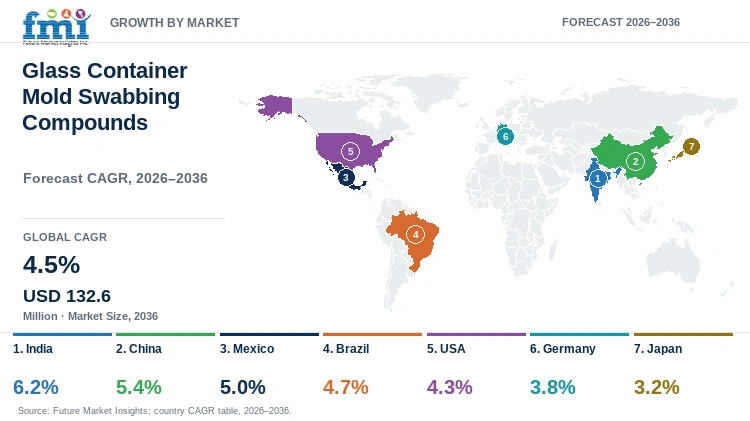
| Country | CAGR |
|---|---|
| India | 6.2% |
| China | 5.4% |
| Mexico | 5.0% |
| Brazil | 4.7% |
| USA | 4.3% |
| Germany | 3.8% |
| Japan | 3.2% |
How do country-level CAGRs compare in the Glass Container Mold Swabbing Compounds Market?
India and China form the higher-growth group as forming capacity expands. Mexico and Brazil follow through beverage-bottle utilization. USA demand is driven mainly by replacement, while Germany and Japan focus on cleaner operation within mature production networks.
- India: Construction of new container-glass melting furnaces directly expands the operational footprint of multi-section individual section (IS) forming lines, scaling base requirements for qualified mold lubricants.
- China: Extensive domestic bottle output and continuous furnace campaigns generate steady, high-volume recurring procurement for hot-end swabbing consumables.
- Mexico: Sustained beer, spirits, and beverage export volumes keep container production lines operating at high capacity utilization, maintaining continuous mold cycle demands.
- Brazil: High market penetration of returnable, refillable glass beverage bottles drives intensive production runs that subject blank and blow molds to severe thermal fatigue and accelerated swabbing cycles.
- USA: Glass container plant investment centers on high-yield manufacturing, prioritizing advanced formulations that lower carbon residue, reduce smoke generation, and limit operator exposure on hot-end platforms.
- Germany: Advanced circular economy infrastructure and high recycled cullet ratios sustain an established manufacturing footprint, where procurement evaluates release efficiency alongside plant emissions and mold cleanliness.
- Japan: A packaging market focused on strict container aesthetics and zero-defect optical quality drives demand for certified, long-interval compounds that eliminate mold transfer marks and carbon pitting.
Across the key countries in this market, these rates measure revenue within the defined product boundary and do not represent growth of the wider parent industry.
Country-wise Analysis
- India is projected to record a 6.2% CAGR through 2036. Ongoing capital expenditure across food and beverage packaging is expanding the active inventory of individual section (IS) machine cavities requiring regular lubrication. Baseline price sensitivity directs standard volume toward regional blending houses, whereas export-oriented and premium liquor container plants readily fund higher-grade chemistries that deliver extended swabbing intervals.
- China is forecast to expand at a 5.4% CAGR through 2036. High-volume runs across food and beverage lines mean even minor reductions in mold-related defects directly improve net pack-to-melt margins. Domestic compounding suppliers compete aggressively on unit price, but international lubricant specialists hold ground in regional glass manufacturing hubs where they provide direct on-site technical service.
- Mexico is expected to deliver a 5.0% CAGR through 2036. High capacity utilization driven by domestic and export beer and spirits demand keeps swabbing volume tied to sustained, uninterrupted production runs. Plant management prioritizes release packages that prevent mold pitting and preserve container clarity under continuous high-speed operating conditions.
- Brazil is set to advance at a 4.7% CAGR through 2036. Broad market demand for glass-packaged beer and soft drinks generates predictable, recurring consumption of hot-end release media. Ongoing foreign exchange volatility often directs procurement teams toward domestically manufactured formulations, provided those alternatives match imported performance benchmarks for release ease and mold buildup.
- The United States is projected to grow at a 4.3% CAGR through 2036. Operators in this mature manufacturing footprint justify premium lubricant costs through reduced smoke generation, lower carbon scrap rates, and longer intervals between swab cycles. In addition, plant trials focused on robotic hot-end automation are expanding commercial demand for tight-tolerance, sprayable liquid formulations.
- Germany is forecast to register a 3.8% CAGR through 2036. Established container-deposit infrastructure ensures steady closed-loop cullet volumes, while continuing lightweighting initiatives demand tighter thermal and physical forming control at the blank mold. Lubricant vendors must verify low-emission credentials, clean thermal burn-off, and full compliance with strict industrial workplace safety standards.
- Japan is expected to deliver a 3.2% CAGR through 2036. Revenue gains stem primarily from the displacement of legacy compounds by ultra-clean, synthetic grades tailored for premium cosmetics and specialty beverage bottles. Plant conversion cycles remain extended, as technical teams enforce rigorous qualification protocols to protect exacting surface finish tolerances.
Who are the notable companies in the Glass Container Mold Swabbing Compounds Market?
CONDAT, FUCHS, Interglass, Graphoidal Developments, BECHEM, PETROFER, IRMCO, Klüber Lubrication, TotalEnergies Lubrifiants, Q8Oils are the notable companies profiled in this market.
- Direct mold swabbing specialists include CONDAT, FUCHS, Interglass and Graphoidal Developments.
- Glass and high-temperature lubricant suppliers include BECHEM, PETROFER and Klüber Lubrication.
- Adjacent process-fluid platforms include IRMCO, TotalEnergies Lubrifiants and Q8Oils.
Competitive Benchmarking: Glass Container Mold Swabbing Compounds Market
| Company | Direct Swab Evidence | Low-Residue Options | Glass Technical Support | Geographic Reach |
|---|---|---|---|---|
| CONDAT | High | High | High | Global |
| FUCHS | High | Medium | High | Global |
| Interglass | High | High | Medium | Americas, Europe |
| Graphoidal Developments | High | Medium | Medium | Europe, export markets |
| BECHEM | Medium | Medium | High | Global |
| PETROFER | Medium | Medium | High | Global |
| IRMCO | Low | High | Medium | Global |
| Klüber Lubrication | Low | Medium | High | Global |
| TotalEnergies Lubrifiants | Low | Medium | High | Global |
| Q8Oils | Low | Medium | Medium | Europe, Asia |
High direct evidence requires a named container-glass swabbing range. Medium indicates glass-forming lubricant coverage without the same product detail. Low identifies adjacent process-fluid capability that requires confirmation for mold swabbing.
Key Developments in the Glass Container Mold Swabbing Compounds Market
- In March 2026, FEVE published its 2025 decarbonisation blueprint covering more than 150 container-glass projects. Furnace and line investment expands the equipment base that depends on hot-end consumables.
- In October 2025, FEVE reported that its members sold 21 million tonnes and 76.5 billion units of food and beverage glass containers in 2024. The data provides a current production anchor for consumable demand.
- In February 2025, Regulation (EU) 2025/40 on packaging and packaging waste entered into force, reinforcing the policy focus on circular packaging and efficient container production.
Key Players in the Glass Container Mold Swabbing Compounds Market
Direct Mold Swabbing Specialists
- CONDAT
- FUCHS
- Interglass
- Graphoidal Developments
Glass and High-Temperature Lubricant Suppliers
- BECHEM
- PETROFER
- Klüber Lubrication
Adjacent Process-Fluid Platforms
- IRMCO
- TotalEnergies Lubrifiants
- Q8Oils
Glass Container Mold Swabbing Compounds Market - Report Scope
| Coverage field | Report scope |
|---|---|
| Market Size | USD 85.8 million in 2026 and USD 132.6 million by 2036 at 4.5% CAGR. |
| Market Definition | Graphite-based, graphite-free and related release compounds applied to hot blank, blow or neck molds during glass-container forming. |
| Segmentation | Base chemistry, product form, mold location, container type, application method and region. |
| Regional Coverage | North America, Latin America, Western Europe, Eastern Europe, East Asia, South Asia and Pacific, and Middle East and Africa. |
| Countries Covered | India, China, Mexico, Brazil, USA, Germany, Japan and more than 20 countries included in the full report. |
| Key Companies Profiled | CONDAT, FUCHS, Interglass, Graphoidal Developments, BECHEM, PETROFER, IRMCO, Klüber Lubrication, TotalEnergies Lubrifiants, Q8Oils. |
| Forecast Period | 2026 to 2036. |
| Approach | Bottom-up model using operating container-glass lines, mold-section counts, swab frequency, compound use and regional bottle output. |
Glass Container Mold Swabbing Compounds Market - Research Methodology
| Method | Approach |
|---|---|
| Primary Research | FMI analysts gathered input from manufacturers, system integrators, distributors, plant engineers, procurement teams and application specialists. Interviews tested purchasing criteria, replacement cycles, qualification work and technical-service requirements. |
| Desk Research | Desk research covered government statistics, standards, industry associations, technical literature, patents, official product information and corporate announcements. Evidence was screened for scope, date and direct relevance. |
| Market Sizing and Forecasting | Bottom-up model using operating container-glass lines, mold-section counts, swab frequency, compound use and regional bottle output. |
| Data Validation | Estimates were checked against parent-market activity, installed-base indicators, product specifications and supplier participation. Adjacent products without the defined function were excluded. |
Glass Container Mold Swabbing Compounds Market by Segments
Glass Container Mold Swabbing Compounds Market segmented by Base Chemistry:
- Graphite-based compounds
- Graphite-free compounds
- Sulfur-free graphite compounds
- Hybrid solid-lubricant systems
Glass Container Mold Swabbing Compounds Market segmented by Product Form:
- Paste and grease compounds
- Sprayable compounds
- Liquid concentrates
- Solid lubricant coatings
Glass Container Mold Swabbing Compounds Market segmented by Mold Location:
- Blank molds
- Blow molds
- Neck-ring molds
- Baffle and bottom-plate surfaces
Glass Container Mold Swabbing Compounds Market segmented by Container Type:
- Beverage bottles
- Food jars
- Pharmaceutical containers
- Cosmetic and fragrance bottles
- Other hollow glass
Glass Container Mold Swabbing Compounds Market segmented by Application Method:
- Manual swabbing
- Automatic swabbing
- Spray-assisted application
- Pre-coated mold treatment
Glass Container Mold Swabbing Compounds Market by Region:
- North America
- United States
- Canada
- Latin America
- Brazil
- Mexico
- Argentina
- Chile
- Western Europe
- Germany
- France
- United Kingdom
- Italy
- Spain
- Benelux
- Nordics
- Eastern Europe
- Poland
- Czech Republic
- Romania
- Hungary
- East Asia
- China
- Japan
- South Korea
- South Asia and Pacific
- India
- ASEAN
- Australia and New Zealand
- Middle East and Africa
- GCC Countries
- South Africa
- Türkiye
- Israel
Research Sources and Bibliography
- FEVE. (2025). Annual Report 2024: Executive Summary.
- FEVE. (2026, March 2). Container Glass Industry Decarbonisation Blueprint.
- European Union. (2025). Regulation (EU) 2025/40 on packaging and packaging waste.
- Close the Glass Loop. (2023). Performance of Packaging Glass Recycling in Europe.
- CONDAT. (n.d.; accessed September 23, 2026). Swabbing mold compounds for container glass.
- CONDAT. (n.d.; accessed September 23, 2026). Graphite-free swabbing for container glass.
- CONDAT. (2018, December 21). Sulfur-free swabbing.
- FUCHS. (n.d.; accessed September 23, 2026). Glass industry lubrication solutions.
- Interglass. (2024). Swabbing Compounds product catalog.
- United States Patent and Trademark Office. (1978). High-temperature release and lubricating compositions for glass-forming molds.
- Future Market Insights. (2026). Glass Bottles Market.
- Future Market Insights. (2025). Glass Packaging Market.
This bibliography is provided for reader reference and is not exhaustive. The full report contains the complete reference list and detailed citations.
This Report Answers
- How large is the glass container mold swabbing compounds market in 2026 and 2036?
- Which product specification leads demand in 2026?
- What operating condition converts technical need into a purchase?
- Which constraint can delay qualification or replacement?
- How do country growth rates compare across the profiled markets?
- Which companies provide direct or adjacent market capability?
Frequently Asked Questions
How big is the glass container mold swabbing compounds market in 2026?
The glass container mold swabbing compounds market is valued at USD 85.8 million in 2026 and is projected to reach USD 132.6 million by 2036. The estimate covers revenue within the stated market definition and excludes adjacent equipment or chemicals sold without the required function.
What is the CAGR of the glass container mold swabbing compounds market from 2026 to 2036?
The market is projected to grow at 4.5% CAGR between 2026 and 2036. Expansion depends on end-market output together with the rate at which plants adopt higher-specification products.
Which base chemistry leads the glass container mold swabbing compounds market?
Graphite-based compounds is expected to hold 46.0% share in 2026 because their release film remains familiar across high-temperature blank and blow molds. Plants retain graphite where long swab intervals outweigh the cleaning penalty.
Which countries are projected to record higher growth?
India is projected at 6.2% CAGR, followed by China at 5.4% and Mexico at 5.0% through 2036. The comparison reflects local production investment and the timing of replacement or qualification cycles.
Which companies are active in the glass container mold swabbing compounds market?
The profiled group includes CONDAT, FUCHS, Interglass, Graphoidal Developments, BECHEM, PETROFER, IRMCO, Klüber Lubrication, TotalEnergies Lubrifiants, Q8Oils. Capability differs by product range and application evidence.
Preview the report firsthand - request a free sample
Get SampleGet the brochure for pricing and purchase details.
Get PDFTable of Content
- Key Takeaways
- Market Size and CAGR
- Top Growth Driver
- Fastest Growing Segment
- Leading Region
- Key Companies
- Emerging Opportunities
- Executive Summary
- Global Market Outlook
- Demand-side Trends
- Supply-side Trends
- Technology Roadmap Analysis
- Analysis and Recommendations
- Analyst Perspective (What is happening? Why now? What should investors know?)
- Key Questions Answered
- How large is the market?
- What is the CAGR?
- What are key trends?
- Which region dominates?
- Who are the leaders?
- Market Overview
- Market Coverage / Taxonomy
- Market Definition / Scope / Limitations
- Research Methodology
- Chapter Orientation
- Analytical Lens and Working Hypotheses
- Market Structure, Signals, and Trend Drivers
- Benchmarking and Cross-market Comparability
- Market Sizing, Forecasting, and Opportunity Mapping
- Research Design and Evidence Framework
- Desk Research Programme (Secondary Evidence)
- Expert Input and Fieldwork (Primary Evidence)
- Tooling, Models, and Reference Databases
- Data Engineering and Model Build
- Quality Assurance and Audit Trail
- Market Background
- Market Dynamics (Drivers, Restraints, Opportunity, Trends)
- Scenario Forecast (Optimistic, Likely, Conservative)
- Impact Analysis
- AI Impact
- Sustainability Impact
- Regulatory Impact
- Technology Impact
- Consumer / Buyer Analysis
- Purchase Drivers
- Adoption Barriers
- Buyer Journey
- Opportunity Map Analysis
- Product Life Cycle Analysis
- Supply Chain Analysis
- Investment Feasibility Matrix
- Value Chain Analysis
- PESTLE and Porter's Analysis
- Regulatory Landscape
- Regional Parent Market Outlook
- Production and Consumption Statistics
- Import and Export Statistics
- Global Market Analysis and Forecast, 2021 to 2036
- Historical Market Size Value (USD Million) Analysis, 2021 to 2025
- Current and Future Market Size Value (USD Million) Projections, 2026 to 2036
- Y-o-Y Growth Trend Analysis
- Absolute $ Opportunity Analysis
- Global Market Pricing Analysis, 2021 to 2036
- Global Market Analysis and Forecast, By Base Chemistry, 2021 to 2036
- Introduction / Key Findings
- Historical Market Size Value (USD Million) Analysis By Base Chemistry, 2021 to 2025
- Current and Future Market Size Value (USD Million) Analysis and Forecast By Base Chemistry, 2026 to 2036
- Graphite-based compounds
- Graphite-free compounds
- Sulfur-free graphite compounds
- Hybrid solid-lubricant systems
- Y-o-Y Growth Trend Analysis By Base Chemistry, 2021 to 2025
- Absolute $ Opportunity Analysis By Base Chemistry, 2026 to 2036
- Global Market Analysis and Forecast, By Product Form, 2021 to 2036
- Introduction / Key Findings
- Historical Market Size Value (USD Million) Analysis By Product Form, 2021 to 2025
- Current and Future Market Size Value (USD Million) Analysis and Forecast By Product Form, 2026 to 2036
- Paste and grease compounds
- Sprayable compounds
- Liquid concentrates
- Solid lubricant coatings
- Y-o-Y Growth Trend Analysis By Product Form, 2021 to 2025
- Absolute $ Opportunity Analysis By Product Form, 2026 to 2036
- Global Market Analysis and Forecast, By Mold Location, 2021 to 2036
- Introduction / Key Findings
- Historical Market Size Value (USD Million) Analysis By Mold Location, 2021 to 2025
- Current and Future Market Size Value (USD Million) Analysis and Forecast By Mold Location, 2026 to 2036
- Blank molds
- Blow molds
- Neck-ring molds
- Baffle and bottom-plate surfaces
- Y-o-Y Growth Trend Analysis By Mold Location, 2021 to 2025
- Absolute $ Opportunity Analysis By Mold Location, 2026 to 2036
- Global Market Analysis and Forecast, By Container Type, 2021 to 2036
- Introduction / Key Findings
- Historical Market Size Value (USD Million) Analysis By Container Type, 2021 to 2025
- Current and Future Market Size Value (USD Million) Analysis and Forecast By Container Type, 2026 to 2036
- Beverage bottles
- Food jars
- Pharmaceutical containers
- Cosmetic and fragrance bottles
- Other hollow glass
- Y-o-Y Growth Trend Analysis By Container Type, 2021 to 2025
- Absolute $ Opportunity Analysis By Container Type, 2026 to 2036
- Global Market Analysis and Forecast, By Application Method, 2021 to 2036
- Introduction / Key Findings
- Historical Market Size Value (USD Million) Analysis By Application Method, 2021 to 2025
- Current and Future Market Size Value (USD Million) Analysis and Forecast By Application Method, 2026 to 2036
- Manual swabbing
- Automatic swabbing
- Spray-assisted application
- Pre-coated mold treatment
- Y-o-Y Growth Trend Analysis By Application Method, 2021 to 2025
- Absolute $ Opportunity Analysis By Application Method, 2026 to 2036
- Global Market Analysis and Forecast, By Region, 2021 to 2036
- Introduction
- Historical Market Size Value (USD Million) Analysis By Region, 2021 to 2025
- Current Market Size Value (USD Million) Analysis and Forecast By Region, 2026 to 2036
- North America
- Latin America
- Western Europe
- Eastern Europe
- East Asia
- South Asia and Pacific
- Middle East and Africa
- Market Attractiveness Analysis By Region
- North America Market Analysis and Forecast, By Country, 2021 to 2036
- Historical Market Size Value (USD Million) Trend Analysis By Market Taxonomy, 2021 to 2025
- Market Size Value (USD Million) Forecast By Market Taxonomy, 2026 to 2036
- By Country
- United States
- Canada
- By Base Chemistry
- By Product Form
- By Mold Location
- By Container Type
- By Application Method
- By Country
- Market Attractiveness Analysis
- By Country
- By Base Chemistry
- By Product Form
- By Mold Location
- By Container Type
- By Application Method
- Key Takeaways
- Latin America Market Analysis and Forecast, By Country
- Historical Market Size Value (USD Million) Trend Analysis By Market Taxonomy, 2021 to 2025
- Market Size Value (USD Million) Forecast By Market Taxonomy, 2026 to 2036
- By Country
- Brazil
- Mexico
- Argentina
- Chile
- By Base Chemistry
- By Product Form
- By Mold Location
- By Container Type
- By Application Method
- By Country
- Market Attractiveness Analysis
- By Country
- By Base Chemistry
- By Product Form
- By Mold Location
- By Container Type
- By Application Method
- Key Takeaways
- Western Europe Market Analysis and Forecast, By Country
- Historical Market Size Value (USD Million) Trend Analysis By Market Taxonomy, 2021 to 2025
- Market Size Value (USD Million) Forecast By Market Taxonomy, 2026 to 2036
- By Country
- Germany
- France
- United Kingdom
- Italy
- Spain
- Benelux
- Nordics
- By Base Chemistry
- By Product Form
- By Mold Location
- By Container Type
- By Application Method
- By Country
- Market Attractiveness Analysis
- By Country
- By Base Chemistry
- By Product Form
- By Mold Location
- By Container Type
- By Application Method
- Key Takeaways
- Eastern Europe Market Analysis and Forecast, By Country
- Historical Market Size Value (USD Million) Trend Analysis By Market Taxonomy, 2021 to 2025
- Market Size Value (USD Million) Forecast By Market Taxonomy, 2026 to 2036
- By Country
- Poland
- Czech Republic
- Romania
- Hungary
- By Base Chemistry
- By Product Form
- By Mold Location
- By Container Type
- By Application Method
- By Country
- Market Attractiveness Analysis
- By Country
- By Base Chemistry
- By Product Form
- By Mold Location
- By Container Type
- By Application Method
- Key Takeaways
- East Asia Market Analysis and Forecast, By Country
- Historical Market Size Value (USD Million) Trend Analysis By Market Taxonomy, 2021 to 2025
- Market Size Value (USD Million) Forecast By Market Taxonomy, 2026 to 2036
- By Country
- China
- Japan
- South Korea
- By Base Chemistry
- By Product Form
- By Mold Location
- By Container Type
- By Application Method
- By Country
- Market Attractiveness Analysis
- By Country
- By Base Chemistry
- By Product Form
- By Mold Location
- By Container Type
- By Application Method
- Key Takeaways
- South Asia and Pacific Market Analysis and Forecast, By Country
- Historical Market Size Value (USD Million) Trend Analysis By Market Taxonomy, 2021 to 2025
- Market Size Value (USD Million) Forecast By Market Taxonomy, 2026 to 2036
- By Country
- India
- ASEAN
- Australia and New Zealand
- By Base Chemistry
- By Product Form
- By Mold Location
- By Container Type
- By Application Method
- By Country
- Market Attractiveness Analysis
- By Country
- By Base Chemistry
- By Product Form
- By Mold Location
- By Container Type
- By Application Method
- Key Takeaways
- Middle East and Africa Market Analysis and Forecast, By Country
- Historical Market Size Value (USD Million) Trend Analysis By Market Taxonomy, 2021 to 2025
- Market Size Value (USD Million) Forecast By Market Taxonomy, 2026 to 2036
- By Country
- GCC Countries
- South Africa
- Türkiye
- Israel
- By Base Chemistry
- By Product Form
- By Mold Location
- By Container Type
- By Application Method
- By Country
- Market Attractiveness Analysis
- By Country
- By Base Chemistry
- By Product Form
- By Mold Location
- By Container Type
- By Application Method
- Key Takeaways
- Key Countries Market Analysis
- United States
- Pricing Analysis
- Market Share Analysis, 2025
- By Base Chemistry
- By Product Form
- By Mold Location
- By Container Type
- By Application Method
- Canada
- Pricing Analysis
- Market Share Analysis, 2025
- By Base Chemistry
- By Product Form
- By Mold Location
- By Container Type
- By Application Method
- Mexico
- Pricing Analysis
- Market Share Analysis, 2025
- By Base Chemistry
- By Product Form
- By Mold Location
- By Container Type
- By Application Method
- Brazil
- Pricing Analysis
- Market Share Analysis, 2025
- By Base Chemistry
- By Product Form
- By Mold Location
- By Container Type
- By Application Method
- Chile
- Pricing Analysis
- Market Share Analysis, 2025
- By Base Chemistry
- By Product Form
- By Mold Location
- By Container Type
- By Application Method
- Germany
- Pricing Analysis
- Market Share Analysis, 2025
- By Base Chemistry
- By Product Form
- By Mold Location
- By Container Type
- By Application Method
- United Kingdom
- Pricing Analysis
- Market Share Analysis, 2025
- By Base Chemistry
- By Product Form
- By Mold Location
- By Container Type
- By Application Method
- Italy
- Pricing Analysis
- Market Share Analysis, 2025
- By Base Chemistry
- By Product Form
- By Mold Location
- By Container Type
- By Application Method
- Spain
- Pricing Analysis
- Market Share Analysis, 2025
- By Base Chemistry
- By Product Form
- By Mold Location
- By Container Type
- By Application Method
- France
- Pricing Analysis
- Market Share Analysis, 2025
- By Base Chemistry
- By Product Form
- By Mold Location
- By Container Type
- By Application Method
- India
- Pricing Analysis
- Market Share Analysis, 2025
- By Base Chemistry
- By Product Form
- By Mold Location
- By Container Type
- By Application Method
- ASEAN
- Pricing Analysis
- Market Share Analysis, 2025
- By Base Chemistry
- By Product Form
- By Mold Location
- By Container Type
- By Application Method
- Australia and New Zealand
- Pricing Analysis
- Market Share Analysis, 2025
- By Base Chemistry
- By Product Form
- By Mold Location
- By Container Type
- By Application Method
- China
- Pricing Analysis
- Market Share Analysis, 2025
- By Base Chemistry
- By Product Form
- By Mold Location
- By Container Type
- By Application Method
- Japan
- Pricing Analysis
- Market Share Analysis, 2025
- By Base Chemistry
- By Product Form
- By Mold Location
- By Container Type
- By Application Method
- South Korea
- Pricing Analysis
- Market Share Analysis, 2025
- By Base Chemistry
- By Product Form
- By Mold Location
- By Container Type
- By Application Method
- Poland
- Pricing Analysis
- Market Share Analysis, 2025
- By Base Chemistry
- By Product Form
- By Mold Location
- By Container Type
- By Application Method
- Hungary
- Pricing Analysis
- Market Share Analysis, 2025
- By Base Chemistry
- By Product Form
- By Mold Location
- By Container Type
- By Application Method
- Türkiye
- Pricing Analysis
- Market Share Analysis, 2025
- By Base Chemistry
- By Product Form
- By Mold Location
- By Container Type
- By Application Method
- South Africa
- Pricing Analysis
- Market Share Analysis, 2025
- By Base Chemistry
- By Product Form
- By Mold Location
- By Container Type
- By Application Method
- United States
- Market Structure Analysis
- Competition Dashboard
- Competition Benchmarking
- Market Share Analysis of Top Players
- By Regional
- By Base Chemistry
- By Product Form
- By Mold Location
- By Container Type
- By Application Method
- Emerging Startups
- Innovation Benchmarking
- Competition Analysis
- Competition Deep Dive
- CONDAT
- Overview
- Product Portfolio
- Profitability by Market Segments
- Sales Footprint
- Strategy Overview
- Marketing Strategy
- Product Strategy
- Channel Strategy
- FUCHS
- Interglass
- Graphoidal Developments
- BECHEM
- PETROFER
- IRMCO
- Klüber Lubrication
- TotalEnergies Lubrifiants
- Q8Oils
- CONDAT
- Case Studies
- Success Stories
- Recent Developments
- Competition Deep Dive
- Assumptions & Acronyms Used


