

- Market Size (2026)
- USD 2.41 Bn
- Forecast (2036)
- USD 3.86 Bn
- CAGR (2026 to 2036)
- 4.8%
Golf Cart Market Size, Market Forecast and Outlook By FMI
Summary of the Golf Cart Market
- Demand and Growth Drivers
- Golf clubs are replacing older fleets with electric carts that reduce noise and daily maintenance for course operators.
- Hotels and resorts are using carts for guest movement across large properties and beachside corridors.
- Private communities are adding street-legal carts for short trips inside planned residential areas.
- Battery service and charger compatibility are becoming stronger buying filters for large fleet orders.
- Product and Segment View
- Electric golf carts are projected to lead product demand with 95.0% share in 2026.
- Lead acid batteries are estimated to hold 58.0% share in 2026 due to replacement cost and dealer familiarity.
- Golf clubs are expected to lead end-use demand with 46.0% share in 2026.
- Standard design is projected to account for 64.0% share in 2026 as fleet buyers prefer proven configurations.
- Geography and Competitive Outlook
- India is projected to record 8.3% CAGR through 2036 as resort use and campus mobility expand from a smaller base.
- China is expected to expand at 6.2% CAGR through 2036 as tourism sites and industrial parks widen cart use.
- Germany and Japan are forecast above the global pace due to organized golf participation and premium fleet replacement.
- Club Car, Yamaha Golf-Car and E-Z-GO hold stronger positions through dealer networks and golf course relationships.
- Analyst Opinion
- Nikhil Kaitwade, Principal Analyst for Industrial Automation at FMI, observes, "Golf carts should be seen as a fleet service, not just a vehicle purchase. Buyers focus first on charging reliability and easy access to parts, not design features. Lead‑acid batteries will continue to be used in cost‑focused fleets, while lithium is gaining adoption where resorts need longer range and faster charging. Growth opportunities are shifting toward India and China as demand expands beyond golf courses to campuses, hotels, and gated communities through 2036."
- Golf Cart Market Value Analysis
- The golf cart market is moving from course-only fleet supply into a broader low-speed mobility equipment category.
- Fleet owners are giving higher weight to battery upkeep and dealer service before finalizing replacement orders.
- Electric golf carts are benefiting from quieter operation across courses and hospitality properties.
- The forecast uses course activity, leisure property mobility and low-speed vehicle rules as the main sizing anchors.
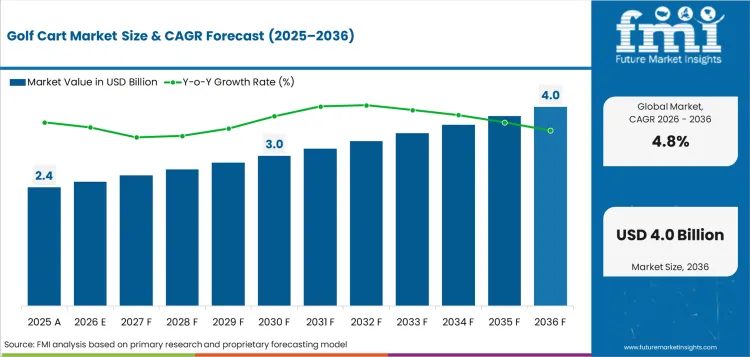
Key Takeaways, Market Size, and Forecast
| Metric | Value |
|---|---|
| Market Size (2025) | USD 2.30 Billion |
| Incremental Opportunity (2026–2036) | USD 1.45 Billion |
| CAGR (2026–2036) | 4.8% |
| Leading Vehicle Type (2026) | Electric Golf Carts |
| Electric Golf Carts Share (2026) | 95.0% |
| Leading Configuration (2026) | 2 Seaters |
| 2 Seaters Share (2026) | 40.0% |
| Fastest-Growing Country | India |
| India CAGR | 8.3% |
| 2nd Fastest-Growing Country | China |
| China CAGR | 6.2% |
| Key Players | Club car is estimated to hold the leading supplier position in 2026 due to course fleet access and product breadth |
Golf carts are becoming easier to run and more useful outside the golf course. Club Car stated in January 2024 that lithium-ion carts charge up to 40% faster than lead-acid carts. This helps courses keep more carts ready during busy hours. Safety features are also becoming part of fleet buying. Club Car’s March 2025 Tempo update added Automatic Park Brake and StopSmart Technology. These features are expected to reduce driver mistakes on slopes and crowded paths. Comfort is also shaping product design. Yamaha says Independent Rear Suspension is standard on selected Drive models. This supports smoother rides in resorts and gated communities where carts are used for daily short trips.
Golf Cart Market Definition
The sector covers small motorized vehicles used for golf course transport and low-speed movement across private or controlled sites. Included products cover electric, gasoline and hybrid carts used by golf clubs, resorts, airports and private communities. The scope includes complete carts and factory-built configurations sold through direct supply, dealers and online platforms. Closely related utility vehicles are reviewed only when they overlap with small passenger or maintenance transport.
Golf Cart Market Inclusions
The study includes electric golf carts, gasoline golf carts, hybrid fuel carts, two-seat carts, four-seat carts, passenger carts, utility carts, direct sales, retail sales, online sales, golf clubs, hotels and resorts, housing projects, airports, private communities, lead acid batteries, lithium ion batteries, standard design carts, luxury carts and off-road carts.
Golf Cart Market Exclusions
The study excludes full-size passenger cars, all-terrain vehicles, heavy utility trucks, scooters, bicycles, electric motorcycles, construction site buggies outside low-speed transport and aftermarket accessories sold without a complete golf cart vehicle.
Golf Cart Market Research Methodology
- Primary Research: FMI analysts reviewed golf course operators, resort transport managers and vehicle dealers handling fleet replacement orders. Interviews focused on battery choice, service uptime and fleet renewal cycles.
- Desk Research: The desk review used golf participation reports and vehicle safety rules to define the addressable use base. Company product pages and official launch releases were checked for current vehicle evidence.
- Market Sizing and Forecasting: The forecast combined the 2026 FMI golf cart value with country course signals and low-speed mobility adoption. Segment shares were checked against product mix and buyer use cases.
- Data Validation: Final values were tested against course participation, fleet replacement behavior and company portfolio checks. The CAGR sits within the normal range for established equipment demand.
Why is the Golf Cart Market Growing?
- Golf clubs are replacing older carts as course rounds and member expectations require reliable fleet uptime.
- Hotels and resorts are using carts to move guests across large sites without adding full-size vehicle traffic.
- Private communities are adopting street-legal low-speed vehicles for short trips inside local road networks.
- Battery improvements are shifting premium orders toward lithium packs that reduce charging time and watering work.
Golf activity gives the cart sector a stable core use case before adjacent mobility expands. The R&A reported in June 2025 that 43.3 million people played golf on 9-hole or 18-hole courses worldwide in 2024. That participation base supports fleet renewal at courses that need carts for player movement and course operations. Cart makers gain stronger order visibility when clubs plan replacement cycles around season peaks. This makes course fleet demand more predictable than many leisure equipment categories.
Battery and charging trends are changing how fleet managers choose vehicles. The International Energy Agency said in May 2025 that global public charging points rose by more than 1.3 million in 2024. This broader charging buildout does not directly serve every course fleet. It does improve buyer comfort with electric mobility and battery service networks. Suppliers selling lithium-ion battery packs gain stronger traction when they explain range, charger fit and replacement cost in plain operating terms.
Market Segmentation Analysis
- Electric Golf Carts are projected to account for 95.0% share in 2026 due to course noise limits and lower daily upkeep.
- 2 Seaters are estimated to represent 40.0% share in 2026 as compact carts match standard player movement needs.
- Golf Carts are expected to lead type demand with 52.0% share in 2026 as course transport remains the anchor use.
- Direct Sales are projected to hold 55.0% share in 2026 as fleet buyers prefer manufacturer-backed support.
- Golf Clubs are estimated to account for 46.0% share in 2026 due to recurring replacement cycles.
- Lead Acid Batteries are expected to hold 58.0% share in 2026 due to lower upfront replacement cost.
- Standard Design is projected to lead vehicle design with 64.0% share in 2026 due to easy maintenance and fleet fit.
The golf cart market is segmented by product, seating capacity and vehicle type alongside sales channel, end use, battery type and vehicle design. Product scope covers electric golf carts and fuel-based alternatives with electric units holding the clearest lead. Seating capacity divides standard two-seat units from group transport formats. End-use demand spans golf clubs and hospitality properties with private communities supporting local mobility. Battery type is becoming a stronger decision point as golf cart batteries shape range, maintenance work and replacement cost.
Golf Cart Market Analysis by Product
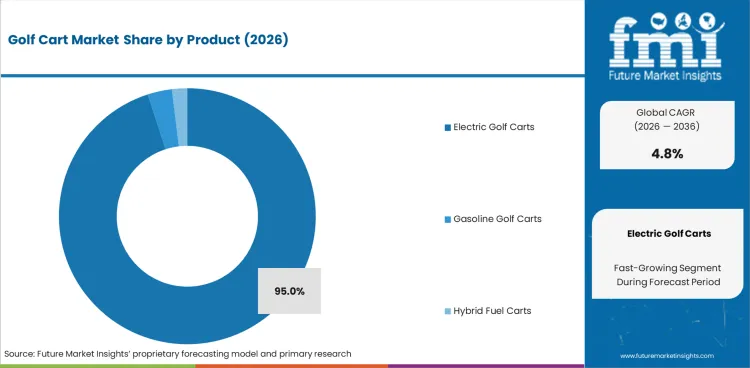
- Electric golf carts are projected to account for 95.0% share in 2026 as course fleets favor quiet operation and lower daily maintenance.
- Gasoline golf carts keep a limited role in remote sites where fuel access is easier than managed charging.
Insights into Seating Capacity Segment
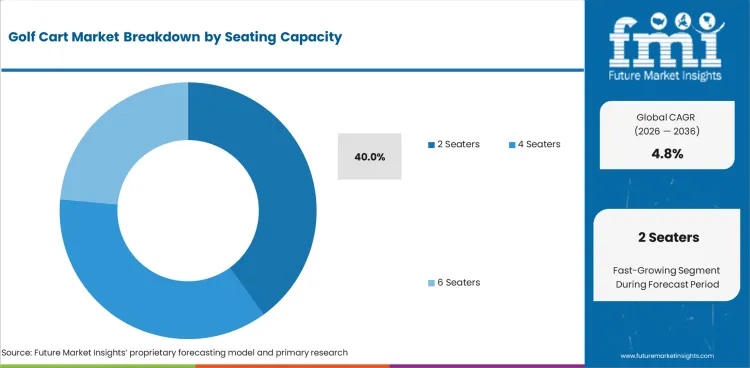
- 2 Seaters are expected to hold 40.0% share in 2026 as standard pair movement remains the common golf course use.
- Six-seat and eight-seat carts gain more use in resorts and airports that need small-group transport.
Insights into Golf Cart Type Segment
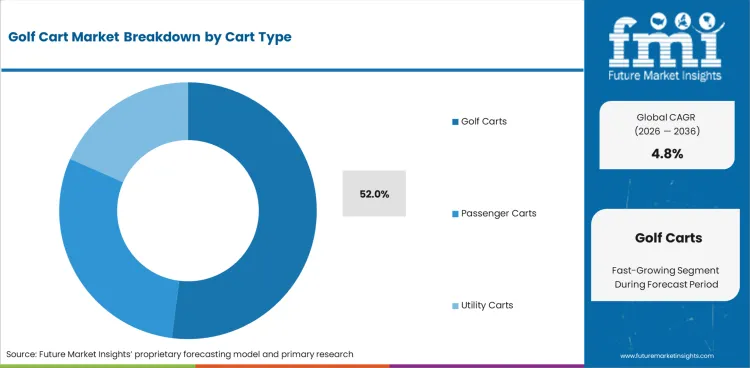
- Golf Carts are estimated to capture 52.0% share in 2026 due to direct course fleet replacement and player movement.
- Passenger carts are advancing in hospitality corridors where guest shuttle comfort matters more than cargo capacity.
Insights into Sales Channel Segment
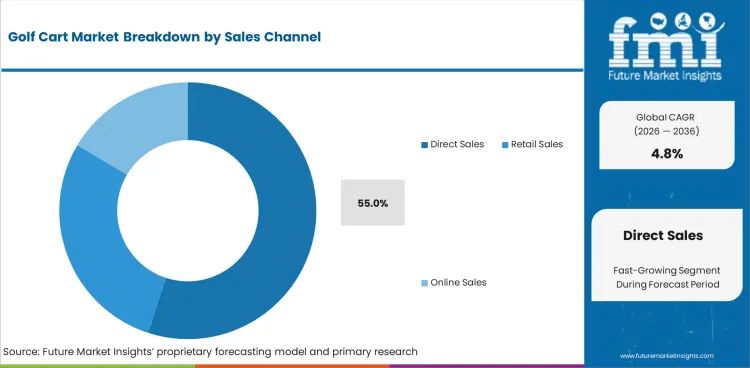
- Direct Sales are projected to secure 55.0% share in 2026 as fleet accounts prefer factory-backed pricing and service planning.
- Retail channels stay relevant for private users and small properties that buy single units through nearby dealers.
Insights into End Use Segment
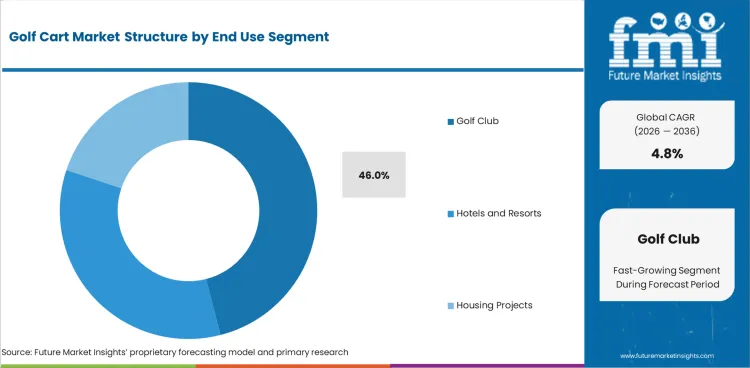
- Golf Clubs are estimated to account for 46.0% share in 2026 as player transport and course work require repeat fleet renewal.
- Hotels and resorts favor premium carts when guest transport must match property image and quiet operation needs.
Insights into Battery Type Segment
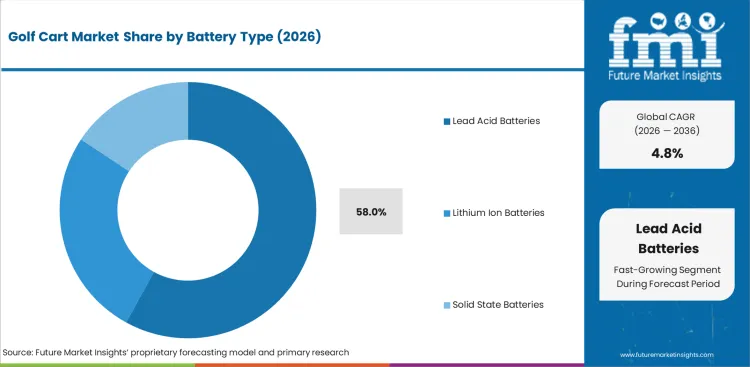
- Lead Acid Batteries are expected to hold 58.0% share in 2026 due to low replacement cost and dealer familiarity.
- Lithium systems gain in premium fleets as buyers compare charge time with the higher upfront pack price.
Insights into Vehicle Design Segment
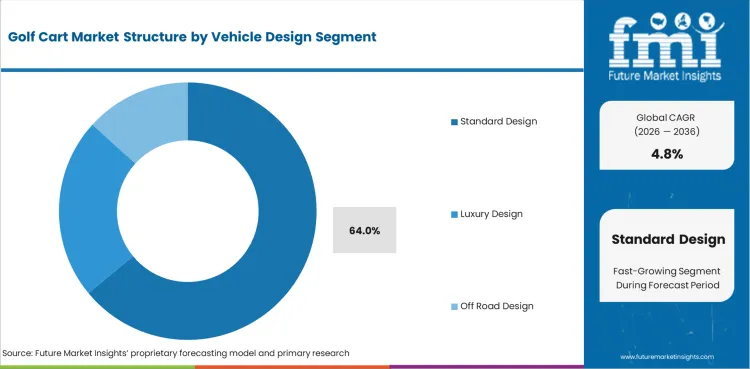
- Standard Design is projected to represent 64.0% share in 2026 as course fleets value simple upkeep and parts availability.
- Luxury Design gains traction in resort and private community sales where comfort and appearance influence buyer choice.
Golf Cart Market Drivers, Restraints, and Opportunities
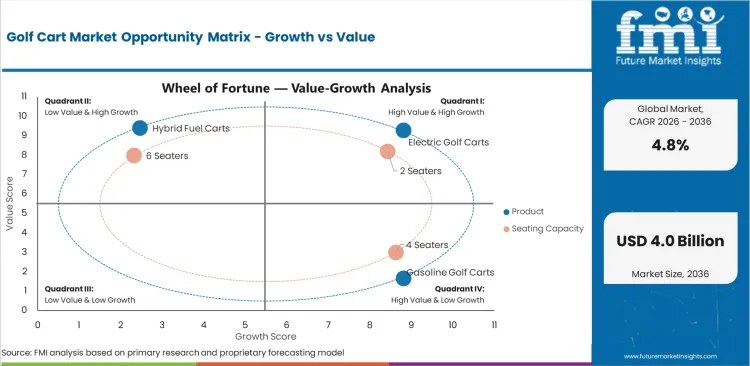
- Course fleet replacement will support steady demand as golf clubs renew older carts over planned operating cycles.
- Battery replacement cost will keep lead acid demand stable even as lithium share rises in premium accounts.
- Street-legal low-speed vehicle use will create new openings in private communities and resort mobility.
Course Fleet Renewal
Fleet renewal remains the clearest driver as golf courses need carts ready for daily play. The USGA reported in January 2026 that more than 3.68 million USA golfers with a Handicap Index posted 82 million scores in 2025. High playing activity increases pressure on fleet uptime and battery reliability. This supports replacement orders from clubs that cannot risk carts being unavailable during peak tee times.
Battery Service Burden
Battery cost keeps buyer choices split between lead acid and lithium systems. The International Energy Agency reported in May 2025 that EV battery demand was about 1 TWh in 2024 and is expected to reach more than 3 TWh in 2030. Scale in electric vehicle batteries should improve supplier options for cells and power electronics. Golf cart buyers will still need clear payback proof before replacing lead acid fleets.
Community Mobility Expansion
Low-speed local travel is widening the market beyond fairways. The USA National Highway Traffic Safety Administration defines a low-speed vehicle as a four-wheeled motor vehicle above 20 mph and not above 25 mph on a paved level surface. That rule supports street-legal carts when local laws allow operation. Suppliers using battery formation and testing standards can make stronger safety and performance claims in community sales.
Analysis of Golf Cart Market by Key Countries
.webp "Top Country Growth Comparison Golf Cart Market Cagr (2026 2036)")
| Country | CAGR 2026 to 2036 |
|---|---|
| India | 8.3% |
| China | 6.2% |
| Germany | 5.5% |
| Japan | 5.3% |
| Brazil | 5.0% |
| United States | 4.7% |
| France | 3.7% |
Source: Future Market Insights analysis based on golf participation, low-speed mobility rules and company product checks in 2026.
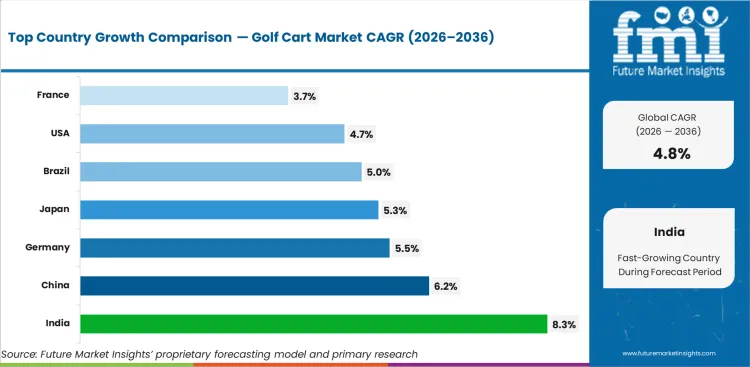
- India is projected to record 8.3% CAGR through 2036 as resort transport and campus mobility expand from a smaller core.
- China is expected to expand at 6.2% CAGR through 2036 as tourism sites and industrial parks widen cart use.
- Germany is forecast to grow at 5.5% CAGR through 2036 due to high golf participation and premium fleet replacement.
- Japan is expected to advance at 5.3% CAGR through 2036 as mature course fleets replace older carts with quieter units.
- Brazil is projected to rise at 5.0% CAGR through 2036 as resort and gated community use expands from a smaller base.
- United States is forecast at 4.7% CAGR through 2036 due to large installed fleets and steady community vehicle demand.
- France is expected to post 3.7% CAGR through 2036 as mature golf demand limits faster expansion.
Country growth differs by course density and adjacent low-speed transport use. India and China grow above the global pace as resorts, campuses and townships add cart-based movement. Germany and Japan expand faster than the global average due to organized golf participation and premium equipment replacement. Brazil grows from a smaller base with tourism exposure. United States demand is steadier as large fleets already exist. France is observing demand below the global rate while nearby United Kingdom electric golf cart expansion offers a useful comparison for mature European replacement cycles.
Demand Outlook for Golf Carts in India
India is projected to record 8.3% CAGR through 2036 as golf clubs, resorts and campus mobility programs expand from a smaller operating base. The R&A recorded 185,500 people playing 9-hole or 18-hole golf in India in 2024 across 289 courses. This course base is modest but gives suppliers a clear entry route through fleet replacement and resort orders. Bengaluru campuses and Goa resorts add use cases outside golf.
- Bengaluru technology campuses support cart use for internal staff mobility across large corporate parks.
- Goa resort corridors create orders for quiet guest movement between villas and beach access points.
- Delhi NCR gated townships favor two-seat and four-seat carts for short trips inside private roads.
Sales Analysis of Golf Carts in China
China is expected to expand at 6.2% CAGR through 2036 as tourism properties and industrial parks widen small electric vehicle use. The R&A listed 1.0 million people playing 9-hole or 18-hole golf in China in 2024 across 601 courses. That course count gives local suppliers a broad golf access point. Hainan resort projects and Guangdong manufacturing links support wider cart applications. Shanghai area clubs create premium demand for comfort and reliable battery range.
- Hainan resort properties need carts for guest movement across large leisure sites.
- Guangdong factories support local sourcing of electric carts and battery components.
- Shanghai clubs favor premium fleet formats where range and appearance influence renewal decisions.
Industry Outlook for Golf Carts in Germany
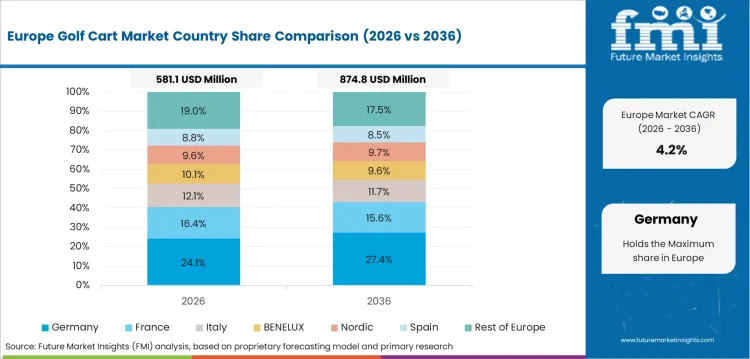
Germany is forecast to grow at 5.5% CAGR through 2036 due to high course participation and interest in premium electric fleets. The R&A counted 2.31 million people playing 9-hole or 18-hole golf in Germany in 2024. Operators served that participation across 726 courses. German fleet buyers tend to examine battery warranty and dealer support before changing suppliers. Bavaria and North Rhine-Westphalia provide large golf use pockets. Charging growth around German public networks raises buyer comfort with electric vehicle maintenance.
- Bavaria resort courses support premium electric carts with weather protection and longer service plans.
- North Rhine-Westphalia clubs create replacement demand through dense member activity.
- Demand for electric golf cart in Germany offers suppliers a benchmark for mature course fleet replacement in Europe.
Demand Analysis of Golf Carts in Japan
Japan is expected to advance at 5.3% CAGR through 2036 as mature course fleets replace older vehicles with quieter carts. Fleet renewal is supported by domestic supplier familiarity and high course usage. The R&A reported 10.78 million people playing 9-hole or 18-hole golf in Japan in 2024 across 2,176 courses. That large course network keeps replacement demand active even when new course construction is limited. Chiba and Shizuoka courses favor reliable compact carts. Hokkaido resorts create seasonal demand for premium fleet service.
- Chiba golf corridors support frequent fleet renewal near Tokyo area leisure demand.
- Shizuoka resort courses need carts that can handle sloped terrain and high visitor turnover.
- Hokkaido seasonal resorts value service support before long winter storage periods.
Sales Outlook for Golf Carts in Brazil
Brazil is projected to rise at 5.0% CAGR through 2036 as resort transport and private communities create a wider buyer pool. The market is smaller than North America and Europe, but premium leisure sites support selective orders. São Paulo clubs remain the main golf access point for fleet suppliers. Rio de Janeiro resorts create passenger cart demand for guest shuttle use. The R&A counted 15,500 people playing 9-hole or 18-hole golf in Brazil in 2024 across 101 courses. That means growth depends on non-course mobility as much as golf replacement.
- São Paulo clubs support the clearest golf fleet replacement route for global suppliers.
- Rio de Janeiro hotels use carts for beachfront guest movement and site operations.
- Santa Catarina gated communities create demand for compact electric mobility in controlled roads.
Industry Analysis of Golf Carts in the United States
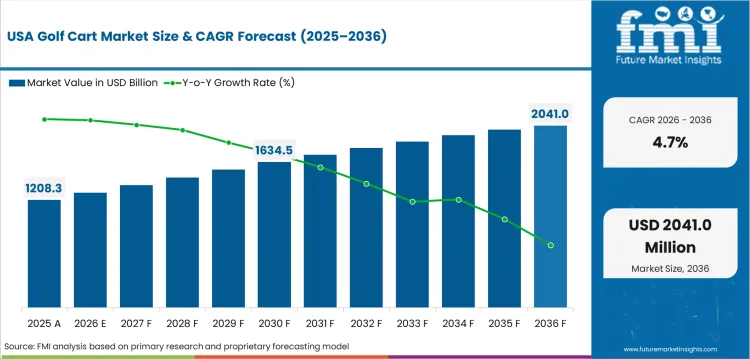
United States is forecast at 4.7% CAGR through 2036 due to large fleet replacement and established low-speed vehicle use. The USGA reported more than 82 million domestic scores posted in 2025. Strong playing activity keeps carts central to course operations across many states. Florida retirement communities and Georgia golf corridors widen non-course use. The South Carolina Department of Commerce said Columbia Vehicle Group selected Aiken County for a USD 12.2 million operation in May 2024. That local production signal supports regional fleet service and parts availability.
- Florida retirement communities support street-legal carts for short trips inside planned neighborhoods.
- Augusta and broader Georgia golf corridors reinforce brand visibility for Club Car and E-Z-GO fleets.
- Aiken County investment strengthens USA production depth for small electric vehicles.
United States electric golf cart activity remains a core signal for fleet replacement and neighborhood mobility.
Demand Forecast for Golf Carts in France
France is expected to post 3.7% CAGR through 2036 as mature golf demand supports steady replacement instead of fast new adoption. Course operators focus on fleet reliability and battery upkeep. The R&A recorded 1.68 million people playing 9-hole or 18-hole golf in France in 2024 across 687 courses. That mature course base creates replacement demand without the scale jump seen in India. Île-de-France clubs and Provence resorts support premium cart orders. French buyers watch cold-climate EV battery systems as off-season storage shapes battery care.
- Île-de-France clubs need reliable two-seat carts for high-frequency member play near Paris.
- Provence resort courses support luxury carts for hospitality-linked guest movement.
- French course buyers can compare winter battery needs with cold-climate EV battery systems.
Competitive Landscape and Strategic Supplier Strength
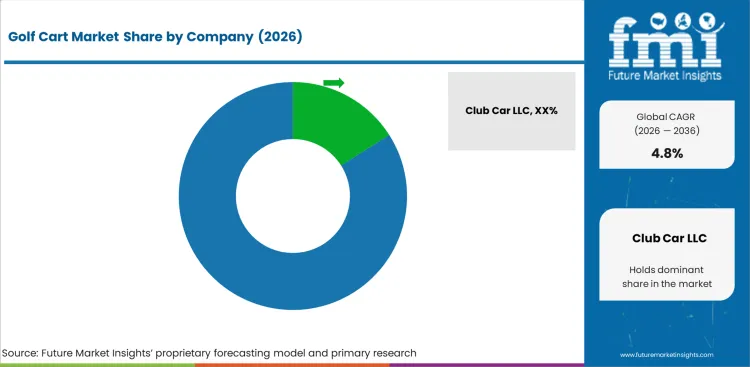
- Competition is centered on golf fleet access, dealer reach and battery service capability.
- Club Car holds the clearest position through course fleet relationships and a broad personal vehicle lineup.
- Yamaha Golf-Car and E-Z-GO compete through proven course fleets and long dealer presence.
- Regional players compete on price, but large accounts ask for parts availability and service response.
Large suppliers protect key accounts through strong dealer networks and regular product upgrades. In March 2025, Club Car introduced its next‑generation Tempo, featuring an automatic park brake, StopSmart braking, and both lithium and lead‑acid battery options. Yamaha marked 50 years of golf car production the same month, showcasing its EFFI‑Vision camera system. Textron’s E‑Z‑GO strengthened brand visibility by supplying 50 golf cars and Cushman utility vehicles for the 150th Preakness in May 2025. Together, these actions highlight how leading brands reinforce buyer relationships through proven product enhancements and high‑profile event presence.
Competition is also shaped by adjacent small‑vehicle categories. Resort and community buyers often compare golf carts with utility terrain vehicles as cargo needs increase, and with electric UTVs when terrain or payload demands are more challenging. Golf cart manufacturers remain competitive by offering superior comfort, dependable warranties, and simpler battery service, advantages that are often more appealing than heavier off‑road alternatives.
Key Companies in the Golf Cart Market
Competition spans global golf fleet suppliers, regional electric vehicle makers and luxury cart specialists. Each group competes through course relationships, battery support and customization depth.
- Golf fleet leaders: Club Car, Yamaha Golf-Car and Textron Specialized Vehicles compete through course relationships and dealer service.
- Regional electric cart suppliers: Columbia Vehicle Group, Maini Materials Movement and Xiamen Dalle compete through price and local customization.
- Luxury and specialty players: Garia and Cruise Car serve premium resort, private community and custom-built cart demand.
Competitive Benchmarking: Golf Cart Market
| Company | Course Fleet Access | Battery Service Depth | Dealer Reach | Footprint |
|---|---|---|---|---|
| Club Car LLC | High | High | Large | Global |
| Yamaha Golf-Car Company | High | Moderate | Large | Global |
| Textron Specialized Vehicles | High | Moderate | Large | Global |
| Columbia Vehicle Group | Moderate | Moderate | Moderate | North America |
| Garia A/S | Moderate | High | Limited | Europe and North America |
| Maini Materials Movement | Moderate | Moderate | Moderate | India |
| Xiamen Dalle Electric Car | Moderate | Moderate | Moderate | China |
Source: Future Market Insights competitive analysis based on company product evidence and country narratives in 2026.
Key Developments in Golf Carts and Low-Speed Mobility
- In May 2025, E-Z-GO became official golf car of the 150th Preakness Stakes and supplied 50 golf cars and utility vehicles.
- In July 2025, Club Car launched a lithium option for CRU with faster charging and longer travel than the lead acid configuration.
- In October 2025, Club Car launched a redesigned website with improved dealer locator and full lineup access.
Key Players in the Golf Cart Market
Global Golf Fleet Suppliers
- Club Car LLC
- Yamaha Golf-Car Company
- Textron Specialized Vehicles Inc.
- Columbia Vehicle Group Inc.
Regional Electric Vehicle Participants
- Xiamen Dalle Electric Car Co. Ltd.
- Maini Materials Movement Pvt. Ltd.
- Marshell Green Power Co. Ltd.
- Cruise Car Inc.
Luxury and Component Participants
- Club Car LLC
- Yamaha Golf-Car Company
- Textron Specialized Vehicles
- Columbia Vehicle Group
- Garia A/S
- Polaris Inc.
- Maini Materials Movement
- Xiamen Dalle Electric Car
Report Scope and Coverage
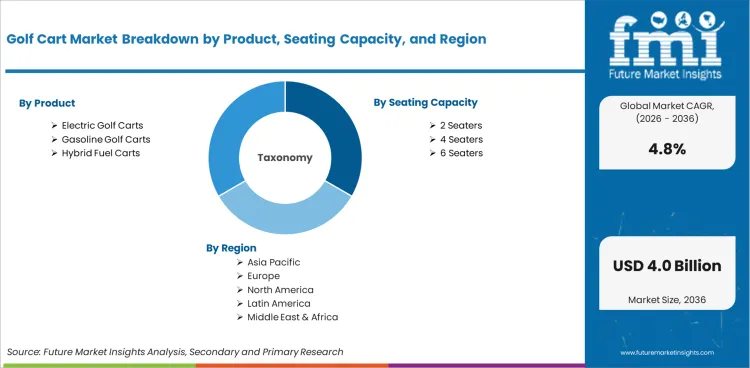
| Item | Value |
|---|---|
| Market value in 2025 | USD 2.30 billion |
| Market value in 2026 | USD 2.41 billion |
| Market value in 2036 | USD 3.86 billion |
| CAGR from 2026 to 2036 | 4.8% |
| Quantitative units | USD billion |
| Market definition | Small motorized carts used for golf course transport and low-speed movement across controlled sites |
| By product | Electric Golf Carts, Gasoline Golf Carts, Hybrid Fuel Carts |
| By seating capacity | 2 Seaters, 4 Seaters, 6 Seaters, 8 Seaters |
| By golf cart type | Golf Carts, Passenger Carts, Utility Carts |
| By sales channel | Direct Sales, Retail Sales, Online Sales |
| By end use | Golf Clubs, Hotels and Resorts, Housing Projects, Airports, Recreational Industries, Private Communities, Others |
| By battery type | Lead Acid Batteries, Lithium Ion Batteries, Solid State Batteries |
| By vehicle design | Standard Design, Luxury Design, Off Road Design |
| Regions covered | North America, Latin America, Europe, East Asia, South Asia and Pacific, Middle East and Africa |
| Countries covered | India, China, Germany, Japan, Brazil, United States, France |
| Key companies profiled | Club Car, Yamaha Golf-Car, E-Z-GO, Columbia Vehicle Group, Garia, Maini Materials Movement, Xiamen Dalle |
| Forecast period | 2026 to 2036 |
| Approach | FMI public demand model aligned with golf participation, battery signals and company product checks |
Golf Cart Market Breakdown by Product, Seating Capacity, Golf Cart Type, Sales Channel, End Use, Battery Type, Vehicle Design, and Region
Golf Cart Market Segmented by Product
- Electric Golf Carts
- Gasoline Golf Carts
- Hybrid Fuel Carts
Golf Cart Market Segmented by Seating Capacity
- 2 Seaters
- 4 Seaters
- 6 Seaters
- 8 Seaters
Golf Cart Market Segmented by Golf Cart Type
- Golf Carts
- Passenger Carts
- Utility Carts
Golf Cart Market Segmented by Sales Channel
- Direct Sales
- Retail Sales
- Online Sales
Golf Cart Market Segmented by End Use
- Golf Clubs
- Hotels and Resorts
- Housing Projects
- Airports
- Recreational Industries
- Private Communities
- Others
Golf Cart Market Segmented by Battery Type
- Lead Acid Batteries
- Lithium Ion Batteries
- Solid State Batteries
Golf Cart Market Segmented by Vehicle Design
- Standard Design
- Luxury Design
- Off Road Design
Golf Cart Market by Region
- North America
- United States
- Canada
- Latin America
- Brazil
- Mexico
- Europe
- Germany
- France
- United Kingdom
- Italy
- Spain
- East Asia
- China
- Japan
- South Korea
- South Asia and Pacific
- India
- ASEAN
- Australia and New Zealand
- Middle East and Africa
- Saudi Arabia
- United Arab Emirates
- South Africa
Research Sources and Bibliography
- The R&A. (2025, June). Global Golf Participation 2024.
- USGA. (2026, January 20). Golf Participation Boomed in 2025; More Than 82 Million Rounds Posted Domestically.
- National Golf Foundation. (2025). Golf Participation in the USA - 2025.
- National Highway Traffic Safety Administration. (2024). Interpretation ID: wagar.ztv.
- International Energy Agency. (2025, May 14). Global EV Outlook 2025.
- International Energy Agency. (2025, May). Electric vehicle charging. Global EV Outlook 2025.
- South Carolina Department of Commerce. (2024, May 7). Columbia Vehicle Group selects Aiken County to establish first South Carolina operation.
- Club Car. (2025, March 20). Club Car launches next-generation Tempo golf car.
- Club Car. (2025, July 10). Club Car launches CRU lithium option.
- Yamaha Motor Co., Ltd. (2025, March 25). 50 years of Yamaha golf cars.
- Textron Inc. (2025, May 13). E-Z-GO named official golf car of the 150th Preakness Stakes.
- Club Car. (2025, October 17). Club Car unveils all-new website featuring golf carts, utility and electric vehicles.
The bibliography is provided for reader reference and direct source checking.
This Report Answers
- How large the golf cart sector is in 2026 and how far it can rise by 2036?
- Which product, seating capacity and battery type hold the strongest projected share positions in 2026?
- Why electric golf carts and two-seat carts hold the clearest leading positions in current use?
- Why India and China lead the country forecast set through 2036?
- How golf clubs and resort operators shape fleet replacement and battery choice?
- Which supplier capabilities help companies defend position in golf fleet access and battery service?
- What golf participation and vehicle rule signals support the forecast method used in this study?
Frequently Asked Questions
How large is the golf cart market in 2026?
The golf cart market is projected at USD 2.41 billion in 2026 with electric fleet replacement shaping most near-term demand.
What will the golf cart market be worth by 2036?
The sector is forecast to reach USD 3.86 billion by 2036 as golf clubs and private communities expand low-speed mobility use.
What CAGR is projected for the golf cart market from 2026 to 2036?
The sector is expected to expand at 4.8% CAGR from 2026 to 2036 across course fleets and controlled local transport.
Which product leads the golf cart market?
Electric Golf Carts are projected to account for 95.0% share in 2026 due to quiet operation and lower daily upkeep.
Which country grows fastest in the golf cart market?
India is projected to record 8.3% CAGR through 2036 as resorts, campuses and private communities expand cart-based mobility.
Which golf cart is best for golf course fleets?
Electric two-seat carts are usually best for golf course fleets since they match player movement, reduce noise and simplify daily course operations.
How much does a golf cart cost?
A golf cart cost depends on battery type, seating and trim. Lead acid fleet carts cost less upfront, while lithium carts usually cost more but reduce maintenance work.
What is the difference between electric and gasoline golf carts?
Electric carts run quietly on batteries and need charging. Gasoline carts use fuel engines and can suit remote sites with limited charging support.
How long does a golf cart last?
A golf cart can operate for many years when batteries, tires and brakes are maintained. Battery life depends heavily on chemistry and charging habits.
Are lithium golf carts better than lead acid golf carts?
Lithium golf carts offer lower maintenance and faster charging. Lead acid carts remain cheaper upfront and suit buyers focused on replacement cost.
Preview the report firsthand - request a free sample
Get SampleGet the brochure for pricing and purchase details.
Get PDFTable of Content
- Executive Summary
- Global Market Outlook
- Demand-side Trends
- Supply-side Trends
- Technology Roadmap Analysis
- Analysis and Recommendations
- Market Overview
- Market Coverage / Taxonomy
- Market Definition / Scope / Limitations
- Research Methodology
- Chapter Orientation
- Analytical Lens and Working Hypotheses
- Market Structure, Signals, and Trend Drivers
- Benchmarking and Cross-market Comparability
- Market Sizing, Forecasting, and Opportunity Mapping
- Research Design and Evidence Framework
- Desk Research Programme (Secondary Evidence)
- Company Annual and Sustainability Reports
- Peer-reviewed Journals and Academic Literature
- Corporate Websites, Product Literature, and Technical Notes
- Earnings Decks and Investor Briefings
- Statutory Filings and Regulatory Disclosures
- Technical White Papers and Standards Notes
- Trade Journals, Industry Magazines, and Analyst Briefs
- Conference Proceedings, Webinars, and Seminar Materials
- Government Statistics Portals and Public Data Releases
- Press Releases and Reputable Media Coverage
- Specialist Newsletters and Curated Briefings
- Sector Databases and Reference Repositories
- FMI Internal Proprietary Databases and Historical Market Datasets
- Subscription Datasets and Paid Sources
- Social Channels, Communities, and Digital Listening Inputs
- Additional Desk Sources
- Expert Input and Fieldwork (Primary Evidence)
- Primary Modes
- Qualitative Interviews and Expert Elicitation
- Quantitative Surveys and Structured Data Capture
- Blended Approach
- Why Primary Evidence is Used
- Field Techniques
- Interviews
- Surveys
- Focus Groups
- Observational and In-context Research
- Social and Community Interactions
- Stakeholder Universe Engaged
- C-suite Leaders
- Board Members
- Presidents and Vice Presidents
- R&D and Innovation Heads
- Technical Specialists
- Domain Subject-matter Experts
- Scientists
- Physicians and Other Healthcare Professionals
- Governance, Ethics, and Data Stewardship
- Research Ethics
- Data Integrity and Handling
- Primary Modes
- Tooling, Models, and Reference Databases
- Desk Research Programme (Secondary Evidence)
- Data Engineering and Model Build
- Data Acquisition and Ingestion
- Cleaning, Normalisation, and Verification
- Synthesis, Triangulation, and Analysis
- Quality Assurance and Audit Trail
- Market Background
- Market Dynamics
- Drivers
- Restraints
- Opportunity
- Trends
- Scenario Forecast
- Demand in Optimistic Scenario
- Demand in Likely Scenario
- Demand in Conservative Scenario
- Opportunity Map Analysis
- Product Life Cycle Analysis
- Supply Chain Analysis
- Investment Feasibility Matrix
- Value Chain Analysis
- PESTLE and Porter’s Analysis
- Regulatory Landscape
- Regional Parent Market Outlook
- Production and Consumption Statistics
- Import and Export Statistics
- Market Dynamics
- Global Market Analysis 2021 to 2025 and Forecast, 2026 to 2036
- Historical Market Size Value (USD Million) Analysis, 2021 to 2025
- Current and Future Market Size Value (USD Million) Projections, 2026 to 2036
- Y-o-Y Growth Trend Analysis
- Absolute $ Opportunity Analysis
- Global Market Pricing Analysis 2021 to 2025 and Forecast 2026 to 2036
- Global Market Analysis 2021 to 2025 and Forecast 2026 to 2036, By Product
- Introduction / Key Findings
- Historical Market Size Value (USD Million) Analysis By Product , 2021 to 2025
- Current and Future Market Size Value (USD Million) Analysis and Forecast By Product , 2026 to 2036
- Electric Golf Carts
- Gasoline Golf Carts
- Hybrid Fuel Carts
- Electric Golf Carts
- Y-o-Y Growth Trend Analysis By Product , 2021 to 2025
- Absolute $ Opportunity Analysis By Product , 2026 to 2036
- Global Market Analysis 2021 to 2025 and Forecast 2026 to 2036, By Seating Capacity
- Introduction / Key Findings
- Historical Market Size Value (USD Million) Analysis By Seating Capacity, 2021 to 2025
- Current and Future Market Size Value (USD Million) Analysis and Forecast By Seating Capacity, 2026 to 2036
- 2 Seaters
- 4 Seaters
- 6 Seaters
- 8 Seaters
- 2 Seaters
- Y-o-Y Growth Trend Analysis By Seating Capacity, 2021 to 2025
- Absolute $ Opportunity Analysis By Seating Capacity, 2026 to 2036
- Global Market Analysis 2021 to 2025 and Forecast 2026 to 2036, By Cart Type
- Introduction / Key Findings
- Historical Market Size Value (USD Million) Analysis By Cart Type, 2021 to 2025
- Current and Future Market Size Value (USD Million) Analysis and Forecast By Cart Type, 2026 to 2036
- Golf Carts
- Passenger Carts
- Utility Carts
- Golf Carts
- Y-o-Y Growth Trend Analysis By Cart Type, 2021 to 2025
- Absolute $ Opportunity Analysis By Cart Type, 2026 to 2036
- Global Market Analysis 2021 to 2025 and Forecast 2026 to 2036, By Sales Channel
- Introduction / Key Findings
- Historical Market Size Value (USD Million) Analysis By Sales Channel, 2021 to 2025
- Current and Future Market Size Value (USD Million) Analysis and Forecast By Sales Channel, 2026 to 2036
- Direct Sales
- Retail Sales
- Online Sales
- Direct Sales
- Y-o-Y Growth Trend Analysis By Sales Channel, 2021 to 2025
- Absolute $ Opportunity Analysis By Sales Channel, 2026 to 2036
- Global Market Analysis 2021 to 2025 and Forecast 2026 to 2036, By End Use
- Introduction / Key Findings
- Historical Market Size Value (USD Million) Analysis By End Use, 2021 to 2025
- Current and Future Market Size Value (USD Million) Analysis and Forecast By End Use, 2026 to 2036
- Golf Club
- Hotels and Resorts
- Housing Projects
- Golf Club
- Y-o-Y Growth Trend Analysis By End Use, 2021 to 2025
- Absolute $ Opportunity Analysis By End Use, 2026 to 2036
- Global Market Analysis 2021 to 2025 and Forecast 2026 to 2036, By Battery Type
- Introduction / Key Findings
- Historical Market Size Value (USD Million) Analysis By Battery Type, 2021 to 2025
- Current and Future Market Size Value (USD Million) Analysis and Forecast By Battery Type, 2026 to 2036
- Lead Acid Batteries
- Lithium Ion Batteries
- Solid State Batteries
- Lead Acid Batteries
- Y-o-Y Growth Trend Analysis By Battery Type, 2021 to 2025
- Absolute $ Opportunity Analysis By Battery Type, 2026 to 2036
- Global Market Analysis 2021 to 2025 and Forecast 2026 to 2036, By Vehicle Design
- Introduction / Key Findings
- Historical Market Size Value (USD Million) Analysis By Vehicle Design, 2021 to 2025
- Current and Future Market Size Value (USD Million) Analysis and Forecast By Vehicle Design, 2026 to 2036
- Standard Design
- Luxury Design
- Off Road Design
- Standard Design
- Y-o-Y Growth Trend Analysis By Vehicle Design, 2021 to 2025
- Absolute $ Opportunity Analysis By Vehicle Design, 2026 to 2036
- Global Market Analysis 2021 to 2025 and Forecast 2026 to 2036, By Region
- Introduction
- Historical Market Size Value (USD Million) Analysis By Region, 2021 to 2025
- Current Market Size Value (USD Million) Analysis and Forecast By Region, 2026 to 2036
- North America
- Latin America
- Western Europe
- Eastern Europe
- East Asia
- South Asia and Pacific
- Middle East & Africa
- Market Attractiveness Analysis By Region
- North America Market Analysis 2021 to 2025 and Forecast 2026 to 2036, By Country
- Historical Market Size Value (USD Million) Trend Analysis By Market Taxonomy, 2021 to 2025
- Market Size Value (USD Million) Forecast By Market Taxonomy, 2026 to 2036
- By Country
- USA
- Canada
- Mexico
- By Product
- By Seating Capacity
- By Cart Type
- By Sales Channel
- By End Use
- By Battery Type
- By Vehicle Design
- By Country
- Market Attractiveness Analysis
- By Country
- By Product
- By Seating Capacity
- By Cart Type
- By Sales Channel
- By End Use
- By Battery Type
- By Vehicle Design
- Key Takeaways
- Latin America Market Analysis 2021 to 2025 and Forecast 2026 to 2036, By Country
- Historical Market Size Value (USD Million) Trend Analysis By Market Taxonomy, 2021 to 2025
- Market Size Value (USD Million) Forecast By Market Taxonomy, 2026 to 2036
- By Country
- Brazil
- Chile
- Rest of Latin America
- By Product
- By Seating Capacity
- By Cart Type
- By Sales Channel
- By End Use
- By Battery Type
- By Vehicle Design
- By Country
- Market Attractiveness Analysis
- By Country
- By Product
- By Seating Capacity
- By Cart Type
- By Sales Channel
- By End Use
- By Battery Type
- By Vehicle Design
- Key Takeaways
- Western Europe Market Analysis 2021 to 2025 and Forecast 2026 to 2036, By Country
- Historical Market Size Value (USD Million) Trend Analysis By Market Taxonomy, 2021 to 2025
- Market Size Value (USD Million) Forecast By Market Taxonomy, 2026 to 2036
- By Country
- Germany
- UK
- Italy
- Spain
- France
- Nordic
- BENELUX
- Rest of Western Europe
- By Product
- By Seating Capacity
- By Cart Type
- By Sales Channel
- By End Use
- By Battery Type
- By Vehicle Design
- By Country
- Market Attractiveness Analysis
- By Country
- By Product
- By Seating Capacity
- By Cart Type
- By Sales Channel
- By End Use
- By Battery Type
- By Vehicle Design
- Key Takeaways
- Eastern Europe Market Analysis 2021 to 2025 and Forecast 2026 to 2036, By Country
- Historical Market Size Value (USD Million) Trend Analysis By Market Taxonomy, 2021 to 2025
- Market Size Value (USD Million) Forecast By Market Taxonomy, 2026 to 2036
- By Country
- Russia
- Poland
- Hungary
- Balkan & Baltic
- Rest of Eastern Europe
- By Product
- By Seating Capacity
- By Cart Type
- By Sales Channel
- By End Use
- By Battery Type
- By Vehicle Design
- By Country
- Market Attractiveness Analysis
- By Country
- By Product
- By Seating Capacity
- By Cart Type
- By Sales Channel
- By End Use
- By Battery Type
- By Vehicle Design
- Key Takeaways
- East Asia Market Analysis 2021 to 2025 and Forecast 2026 to 2036, By Country
- Historical Market Size Value (USD Million) Trend Analysis By Market Taxonomy, 2021 to 2025
- Market Size Value (USD Million) Forecast By Market Taxonomy, 2026 to 2036
- By Country
- China
- Japan
- South Korea
- By Product
- By Seating Capacity
- By Cart Type
- By Sales Channel
- By End Use
- By Battery Type
- By Vehicle Design
- By Country
- Market Attractiveness Analysis
- By Country
- By Product
- By Seating Capacity
- By Cart Type
- By Sales Channel
- By End Use
- By Battery Type
- By Vehicle Design
- Key Takeaways
- South Asia and Pacific Market Analysis 2021 to 2025 and Forecast 2026 to 2036, By Country
- Historical Market Size Value (USD Million) Trend Analysis By Market Taxonomy, 2021 to 2025
- Market Size Value (USD Million) Forecast By Market Taxonomy, 2026 to 2036
- By Country
- India
- ASEAN
- Australia & New Zealand
- Rest of South Asia and Pacific
- By Product
- By Seating Capacity
- By Cart Type
- By Sales Channel
- By End Use
- By Battery Type
- By Vehicle Design
- By Country
- Market Attractiveness Analysis
- By Country
- By Product
- By Seating Capacity
- By Cart Type
- By Sales Channel
- By End Use
- By Battery Type
- By Vehicle Design
- Key Takeaways
- Middle East & Africa Market Analysis 2021 to 2025 and Forecast 2026 to 2036, By Country
- Historical Market Size Value (USD Million) Trend Analysis By Market Taxonomy, 2021 to 2025
- Market Size Value (USD Million) Forecast By Market Taxonomy, 2026 to 2036
- By Country
- Kingdom of Saudi Arabia
- Other GCC Countries
- Turkiye
- South Africa
- Other African Union
- Rest of Middle East & Africa
- By Product
- By Seating Capacity
- By Cart Type
- By Sales Channel
- By End Use
- By Battery Type
- By Vehicle Design
- By Country
- Market Attractiveness Analysis
- By Country
- By Product
- By Seating Capacity
- By Cart Type
- By Sales Channel
- By End Use
- By Battery Type
- By Vehicle Design
- Key Takeaways
- Key Countries Market Analysis
- USA
- Pricing Analysis
- Market Share Analysis, 2025
- By Product
- By Seating Capacity
- By Cart Type
- By Sales Channel
- By End Use
- By Battery Type
- By Vehicle Design
- Canada
- Pricing Analysis
- Market Share Analysis, 2025
- By Product
- By Seating Capacity
- By Cart Type
- By Sales Channel
- By End Use
- By Battery Type
- By Vehicle Design
- Mexico
- Pricing Analysis
- Market Share Analysis, 2025
- By Product
- By Seating Capacity
- By Cart Type
- By Sales Channel
- By End Use
- By Battery Type
- By Vehicle Design
- Brazil
- Pricing Analysis
- Market Share Analysis, 2025
- By Product
- By Seating Capacity
- By Cart Type
- By Sales Channel
- By End Use
- By Battery Type
- By Vehicle Design
- Chile
- Pricing Analysis
- Market Share Analysis, 2025
- By Product
- By Seating Capacity
- By Cart Type
- By Sales Channel
- By End Use
- By Battery Type
- By Vehicle Design
- Germany
- Pricing Analysis
- Market Share Analysis, 2025
- By Product
- By Seating Capacity
- By Cart Type
- By Sales Channel
- By End Use
- By Battery Type
- By Vehicle Design
- UK
- Pricing Analysis
- Market Share Analysis, 2025
- By Product
- By Seating Capacity
- By Cart Type
- By Sales Channel
- By End Use
- By Battery Type
- By Vehicle Design
- Italy
- Pricing Analysis
- Market Share Analysis, 2025
- By Product
- By Seating Capacity
- By Cart Type
- By Sales Channel
- By End Use
- By Battery Type
- By Vehicle Design
- Spain
- Pricing Analysis
- Market Share Analysis, 2025
- By Product
- By Seating Capacity
- By Cart Type
- By Sales Channel
- By End Use
- By Battery Type
- By Vehicle Design
- France
- Pricing Analysis
- Market Share Analysis, 2025
- By Product
- By Seating Capacity
- By Cart Type
- By Sales Channel
- By End Use
- By Battery Type
- By Vehicle Design
- India
- Pricing Analysis
- Market Share Analysis, 2025
- By Product
- By Seating Capacity
- By Cart Type
- By Sales Channel
- By End Use
- By Battery Type
- By Vehicle Design
- ASEAN
- Pricing Analysis
- Market Share Analysis, 2025
- By Product
- By Seating Capacity
- By Cart Type
- By Sales Channel
- By End Use
- By Battery Type
- By Vehicle Design
- Australia & New Zealand
- Pricing Analysis
- Market Share Analysis, 2025
- By Product
- By Seating Capacity
- By Cart Type
- By Sales Channel
- By End Use
- By Battery Type
- By Vehicle Design
- China
- Pricing Analysis
- Market Share Analysis, 2025
- By Product
- By Seating Capacity
- By Cart Type
- By Sales Channel
- By End Use
- By Battery Type
- By Vehicle Design
- Japan
- Pricing Analysis
- Market Share Analysis, 2025
- By Product
- By Seating Capacity
- By Cart Type
- By Sales Channel
- By End Use
- By Battery Type
- By Vehicle Design
- South Korea
- Pricing Analysis
- Market Share Analysis, 2025
- By Product
- By Seating Capacity
- By Cart Type
- By Sales Channel
- By End Use
- By Battery Type
- By Vehicle Design
- Russia
- Pricing Analysis
- Market Share Analysis, 2025
- By Product
- By Seating Capacity
- By Cart Type
- By Sales Channel
- By End Use
- By Battery Type
- By Vehicle Design
- Poland
- Pricing Analysis
- Market Share Analysis, 2025
- By Product
- By Seating Capacity
- By Cart Type
- By Sales Channel
- By End Use
- By Battery Type
- By Vehicle Design
- Hungary
- Pricing Analysis
- Market Share Analysis, 2025
- By Product
- By Seating Capacity
- By Cart Type
- By Sales Channel
- By End Use
- By Battery Type
- By Vehicle Design
- Kingdom of Saudi Arabia
- Pricing Analysis
- Market Share Analysis, 2025
- By Product
- By Seating Capacity
- By Cart Type
- By Sales Channel
- By End Use
- By Battery Type
- By Vehicle Design
- Turkiye
- Pricing Analysis
- Market Share Analysis, 2025
- By Product
- By Seating Capacity
- By Cart Type
- By Sales Channel
- By End Use
- By Battery Type
- By Vehicle Design
- South Africa
- Pricing Analysis
- Market Share Analysis, 2025
- By Product
- By Seating Capacity
- By Cart Type
- By Sales Channel
- By End Use
- By Battery Type
- By Vehicle Design
- USA
- Market Structure Analysis
- Competition Dashboard
- Competition Benchmarking
- Market Share Analysis of Top Players
- By Regional
- By Product
- By Seating Capacity
- By Cart Type
- By Sales Channel
- By End Use
- By Battery Type
- By Vehicle Design
- Competition Analysis
- Competition Deep Dive
- Club Car LLC
- Overview
- Product Portfolio
- Profitability by Market Segments (Product/Age /Sales Channel/Region)
- Sales Footprint
- Strategy Overview
- Marketing Strategy
- Product Strategy
- Channel Strategy
- Yamaha Golf-Car Company
- Textron Specialized Vehicles Inc.
- Columbia Vehicle Group Inc.
- Garia A/S
- Club Car LLC
- Competition Deep Dive
- Assumptions & Acronyms Used


