

- Industry Size (2025)
- USD 11.3 Mn
- Forecast (2035)
- USD 22.2 Mn
- CAGR (2025 to 2035)
- 7.0%
HDI Trimethylol Hexyllactone Crosspolymer Market Forecast and Outlook 2025 to 2035
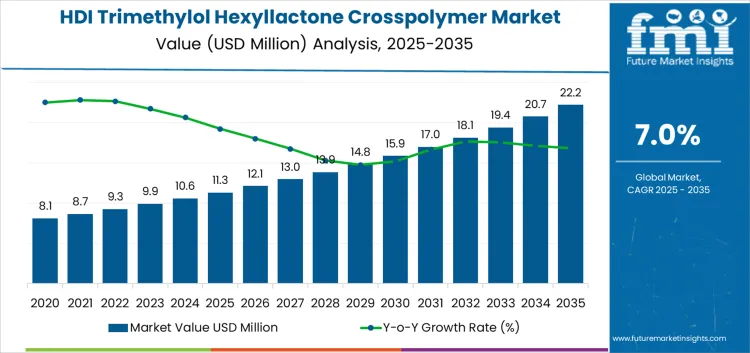
The HDI trimethylol hexyllactone crosspolymer market is estimated at USD 11.3 million in 2025, with revenues projected to reach USD 22.2 million by 2035 at a CAGR of 7.0%. Demand remains tightly concentrated in color cosmetics and skin care, where this crosspolymer is used to blur, mattify, and control sebum in primers, foundations, and setting powders. Emulsions, powders, and dispersions dominate commercial formats due to compatibility with silicone and water-based systems. Asia Pacific leads formulation volume through China, South Korea, and Japan, while the United States, Germany, and France anchor premium cosmetic consumption. Supply is structured around specialty chemical producers such as Lubrizol, Ashland, and select formulation-focused manufacturers serving global beauty brands.
As blur-effect and long-wear performance become baseline expectations in face makeup, the crosspolymer shifts from a differentiating additive to a functional requirement in premium segments. Growth therefore slows in mass cosmetics but continues at a higher intensity in professional makeup, dermocosmetics, and hybrid skin care–makeup products. East Asia drives export-oriented production of advanced base formulations, while Europe shapes usage through ingredient safety and performance validation.
Quick Stats of the HDI Trimethylol Hexyllactone Crosspolymer Market:
- HDI Trimethylol Hexyllactone Crosspolymer Market Value (2025): USD 11.3 million
- HDI Trimethylol Hexyllactone Crosspolymer Market Forecast Value (2035): USD 22.2 million
- HDI Trimethylol Hexyllactone Crosspolymer Market Forecast CAGR (2025 to 2035): 7.0%
- Leading Product Form in HDI Crosspolymer Market: Powder (~14.8%)
- Key Growth Regions in HDI Crosspolymer Market: India, China, Japan, UK, Germany, USA
- Top Players in HDI Crosspolymer Market: BASF SE; Croda International; Evonik Industries; Symrise (incl. IFF/Givaudan actives); Dow / Dow Inc.; Ashland; Clariant; Seppic
What is the Growth Forecast for the HDI Trimethylol Hexyllactone Crosspolymer Market through 2035?
The global HDI Trimethylol Hexyllactone Crosspolymer market grows from USD 11.3 million in 2025 to USD 14.8 million by 2030, reflecting an absolute increase of USD 3.5 million in the first half of the forecast period. This phase is defined by its expanding role as a texture enhancer, oil-control agent, and sensory modifier in color cosmetics, skincare primers, and long-wear formulations. Annual value additions rise from about USD 0.8 million to slightly above USD 0.9 million, indicating steady but formulation-specific scaling. Growth remains closely tied to premium makeup launches, hybrid skincare-makeup formats, and soft-focus cosmetic systems where this crosspolymer contributes to blurring effects, sebum absorption, and non-greasy skin feel.
From 2030 to 2035, the market advances from USD 14.8 million to USD 22.2 million, adding a larger USD 7.4 million in the second half of the decade. Annual value gains widen from roughly USD 1.1 million to over USD 1.5 million by the final years, reflecting stronger late-stage acceleration. This back-weighted expansion is driven by deeper adoption in transfer-resistant foundations, advanced primer systems, oil-free sunscreens, and digital-ready makeup products where skin-smoothing performance directly influences consumer preference. As cosmetic brands push for higher sensorial differentiation and multi-functional performance per formulation, HDI Trimethylol Hexyllactone Crosspolymer transitions from a niche rheology modifier into a structurally embedded performance polymer, strengthening long-term global market value growth through 2035.
HDI Trimethylol Hexyllactone Crosspolymer Industry Key Takeaways
| Metric | Value |
|---|---|
| Industry Value (2025) | USD 11.3 million |
| Forecast Value (2035) | USD 22.2 million |
| Forecast CAGR (2025 to 2035) | 7.0% |
How Is Texture Engineering Demand Shaping the HDI Trimethylol Hexyllactone Crosspolymer Market Across Advanced Cosmetic Formulations?
The HDI trimethylol hexyllactone crosspolymer market is shaped by rising demand for sensory driven texture control in modern skincare, sun care, and color cosmetics. This crosslinked polymer functions as a film former, viscosity builder, and sensory modifier that creates soft, powdery, and non greasy finishes without heavy waxes or oils. Early adoption expanded through primers, sunscreens, and long wear foundations where slip, spreadability, and matte control are central to performance. Its ability to stabilize emulsions while improving skin feel positioned it as a structural component in lightweight gels, serums, and hybrid skincare makeup products. As formulation design shifted toward breathable, long lasting textures, demand strengthened across both premium and mass market beauty categories.
Future growth of the HDI trimethylol hexyllactone crosspolymer market will be shaped by continued premiumization of skin feel, expansion of multifunctional cosmetics, and demand for long wear, transfer resistant products. Growth is expected in oil free sunscreens, water based foundations, and barrier friendly skincare where light film formation enhances durability without occlusion. Barriers include regulatory scrutiny around synthetic crosspolymers, substitution risk from bio based texture agents, and cost sensitivity in value oriented formulations. Long term market expansion will depend on how effectively this crosspolymer retains its position as a benchmark for sensory optimization, stability control, and performance driven texture engineering in evolving cosmetic product architectures.
How Do Film Forming Behavior and Structural Format Organize HDI Crosspolymer Demand?
HDI Trimethylol Hexyllactone Crosspolymer demand is organized by end use application and product form based on how texture refinement, oil absorption, and film integrity are engineered into finished products. By application, usage spans skin care, body care, hair care, sun care, color cosmetics, men grooming, baby and kids care, and dermocosmetic or professional care. By physical format, supply moves through powder, granules or agglomerates, flakes, pellets or prills, liquid solution, concentrate, dispersion or suspension, emulsion, paste, gel, wax or solid block, and oil. These divisions reflect differences in pore blurring performance, sweat resistance requirements, dispersion sequencing, and formulation stability control across long wear skin care, matte finish cosmetics, and professional complexion systems.
Why Do Surface Smoothing Functions Secure HDI Crosspolymer Use in Skin Care?
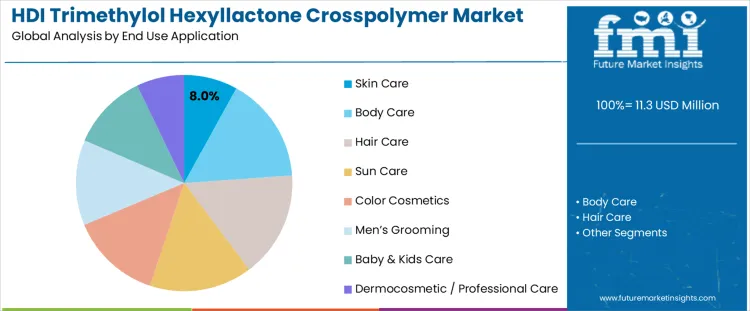
The skin care segment represents 8.0% of total HDI Trimethylol Hexyllactone Crosspolymer demand in 2025, reflecting its role within surface leveling and oil control formulations. Consumption per unit output is defined by micro powder loading ranges used in pore refining primers, mattifying creams, long wear sunscreens, and soft focus skin care products. Usage remains stable across seasons because texture correction and oil regulation are tied to daily facial routines rather than periodic cosmetic use. Procurement is anchored in long term contracts to preserve polymer particle structure consistency across production cycles. Price sensitivity remains moderate since product feel and finish directly influence brand positioning. Specification control is strict due to particle size limits, solvent residue thresholds, and oil uptake consistency. Process integration occurs during dispersion and premix preparation, supporting both batch compounding and continuous emulsification across large scale skin care manufacturing systems.
Skin care contributes steady incremental HDI crosspolymer growth through continued expansion of matte finish and long wear daily care products. Repeat purchase frequency remains high due to short shelf lives and continuous consumer replenishment cycles. Buyers favor bulk procurement to stabilize sensory performance and limit formulation drift. Margin structure remains tight under sustained pricing pressure from private label and mass retail brands. Certification dependence increases for baby care and sensitive skin positioning, extending documentation requirements. Import reliance persists for specialty cosmetic grade polymers. Lead time exposure is managed through buffer inventories near blending operations. Competitive pressure from modified silicas and starch based blur agents remains present, though HDI crosspolymers retain preference for durability and uniform film formation.
What Manufacturing Drivers Keep Powder as the Core HDI Crosspolymer Format?
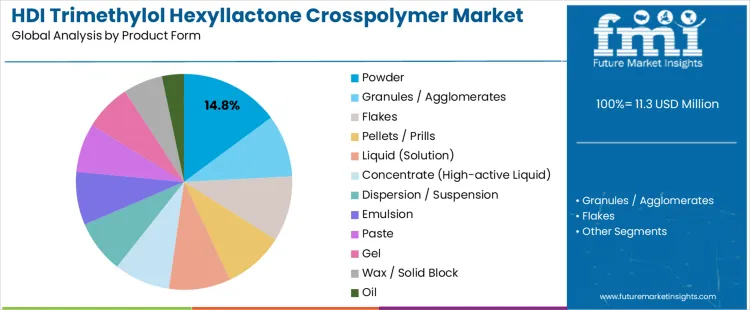
The powder format accounts for 14.8% of total HDI Trimethylol Hexyllactone Crosspolymer demand in 2025, reflecting its combined volume concentration and revenue contribution across delivery forms. Consumption per unit output aligns with dry premix preparation for primers, matte foundations, long wear sunscreens, and oil control powders. Dosage accuracy is maintained through volumetric and gravimetric feeding systems that regulate absorption and film formation intensity. Procurement favors long term bulk supply contracts to limit freight volatility and moisture related agglomeration risk. Price elasticity remains low because polymer substitution requires full sensory, stability, and wear time requalification. Quality sensitivity centers on particle morphology, solvent uptake behavior, and flow stability. Process compatibility favors early stage blending into dry bases or pre dispersions prior to emulsification, supporting high conversion efficiency across automated production environments.
The powder segment supports incremental growth through repeat usage across decorative and hybrid complexion care portfolios rather than narrow seasonal demand cycles. Buyer switching tendency remains low due to performance validation and dispersion behavior locked into approved formulations. Margin spread remains narrow under indexed annual supply agreements. Cost pass through is achievable only within scheduled contract adjustment windows. Impurity tolerance remains tight because trace solvent residues affect film integrity and wear performance. Equipment dependence centers on sealed feeders, screening systems, and humidity controlled storage rooms. Asia led consumption reflects large scale cosmetic manufacturing and export oriented packaging hubs. Competitive exposure from low cost polymer producers persists, though qualification timelines restrict rapid entry into regulated cosmetic crosspolymer supply chains.
How Is HDI Trimethylol Hexyllactone Crosspolymer Shaping Film Structure, Wear Resistance, and Sensory Control in Advanced Formulations?
HDI Trimethylol Hexyllactone Crosspolymer functions as a three-dimensional film-forming network designed to control wear, adhesion, and surface durability in cosmetic, coating, and specialty formulation systems. Its crosslinked polyurethane architecture creates flexible yet mechanically stable films that resist cracking, transfer, and moisture disruption. In color cosmetics, it supports long-wear performance, payoff control, and smudge resistance. In coatings and specialty inks, it contributes to abrasion resistance and surface integrity. Demand is driven by performance durability, not bulk volume, positioning this material as a structural performance modifier across high-value formulation environments.
How Is Long-Wear Performance Engineering Driving the Core Market Trend?
The defining trend for HDI Trimethylol Hexyllactone Crosspolymer is its growing use as a structural film former in long-wear cosmetic and surface protection systems. Color cosmetics such as eyeliners, mascaras, lip products, and transfer-resistant foundations rely on its crosslinked network to maintain adhesion under oil, sweat, and mechanical stress. Unlike linear film formers, it forms elastic yet durable matrices that preserve flexibility without film rupture. This trend reflects a shift from simple resin-based fixation toward engineered polymer networks designed for controlled wear, durability tuning, and surface resilience in high-performance daily-use products.
Why Is Premium Color Cosmetics and Surface Protection Creating a Growth Opportunity?
Growth opportunity for HDI Trimethylol Hexyllactone Crosspolymer is anchored in rising demand for premium long-wear color cosmetics and technically advanced surface coatings. Consumers increasingly expect extended wear without dryness, cracking, or heavy film feel. This drives formulators toward crosslinked polymers that provide stability with sensory refinement. In industrial coatings and specialty inks, demand rises for flexible yet abrasion-resistant films on plastics, packaging, and decorative surfaces. These segments tolerate higher raw material cost in exchange for measurable performance gains. Opportunity is therefore concentrated in high-value applications where durability, feel, and adhesion directly drive product differentiation.
How Do Synthesis Complexity, Cost Structure, and Regulatory Scrutiny Act as Market Restraints?
HDI Trimethylol Hexyllactone Crosspolymer production involves multi-step polyurethane chemistry requiring strict control of residual monomers, crosslink density, and solvent compatibility. This raises manufacturing cost and limits the number of qualified suppliers. Regulatory scrutiny around isocyanate-derived systems adds additional compliance and documentation burden, particularly for cosmetic use. From a formulation perspective, overuse can stiffen films or compromise comfort, demanding careful dosage control. These factors restrict use in low-cost mass formulations and concentrate demand in premium and technically managed systems, making synthesis complexity and cost structure persistent structural restraints on broader market expansion.
What Is the Global Growth Outlook for the HDI Trimethylol Hexyllactone Crosspolymer Industry by Country?
| Country | CAGR (%) |
|---|---|
| India | 9.4 |
| China | 8.7 |
| Japan | 8.0 |
| UK | 7.3 |
| Germany | 6.6 |
| USA | 5.9 |
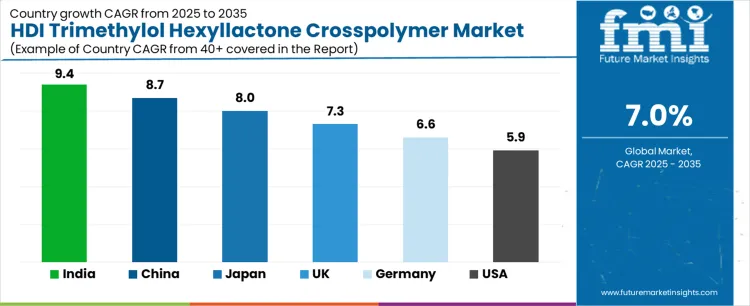
The HDI trimethylol hexyllactone crosspolymer industry is expanding steadily across global personal care and cosmetic formulation markets, with India leading at a 9.4% CAGR. Growth in India is supported by rising production of long wear makeup, sunscreens, and advanced skincare products that rely on film forming and texture enhancing polymers. China follows at 8.7%, driven by large scale cosmetic manufacturing, export oriented formulation activity, and growing use of performance polymers in decorative cosmetics. Japan at 8.0% reflects stable adoption in premium skincare, regulated sunscreen formulations, and hybrid cosmetic products. The UK and Germany record 7.3% and 6.6% growth, supported by steady demand for sensory enhancement ingredients in dermocosmetic and color cosmetic products. The USA at 5.9% reflects a mature but steadily advancing market driven by premium beauty brands and formulation upgrades.
What Is Driving HDI Trimethylol Hexyllactone Crosspolymer Growth in India Long Wear Cosmetics and Matte Formulations?
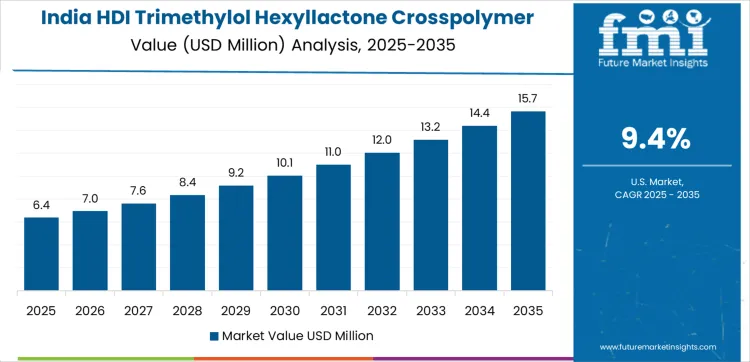
Growth in India is advancing at a CAGR of 9.4% through 2035 for HDI trimethylol hexyllactone crosspolymer demand, driven by rapid expansion of long wear makeup, matte skin products, and oil control formulations across mass premium beauty brands. India contrasts with Germany through faster retail adoption rather than pharmacy led formulation validation. The polymer is used as a texture enhancer in foundations, primers, sunscreens, and pressed powders. Domestic synthesis remains limited, which sustains high import reliance for cosmetic grade material. BASF, Nouryon, and Ashland distributors serve as the leading suppliers to Indian formulators.
- Long wear makeup drives primary polymer demand
- Oil control products support high repeat usage
- Import dependence remains high across all grades
- BASF and Ashland supply leading cosmetic brands
How Is China Scaling HDI Trimethylol Hexyllactone Crosspolymer Usage Across Export Oriented Beauty Manufacturing?
Expansion in China reflects a CAGR of 8.7% through 2035 for HDI trimethylol hexyllactone crosspolymer utilization, supported by large scale color cosmetics production, private label skincare manufacturing, and export oriented beauty supply chains. China contrasts with India through stronger ODM dominance and higher formulation throughput. The polymer appears in BB creams, matte lip products, primers, sunscreens, and oil absorbing skincare gels shipped across Asia and Europe. Domestic formulation capacity is extensive while the polymer remains largely imported. BASF China, Lubrizol distribution partners, and Nouryon channels dominate regulated sourcing.
- Export driven cosmetic production supports bulk polymer demand
- Matte primers and sunscreens sustain daily product usage
- Contract manufacturing strengthens formulation scalability
- BASF China supports regulated polymer sourcing
Why Does Japan Maintain Controlled Adoption of HDI Trimethylol Hexyllactone Crosspolymer in Precision Makeup Systems?
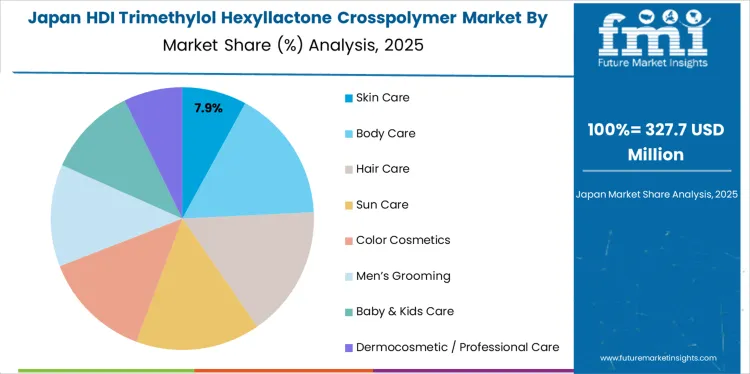
Demand in Japan is increasing at a CAGR of 8.0% through 2035 for HDI trimethylol hexyllactone crosspolymer usage, supported by premium foundation systems, fine texture face powders, and long wear base makeup. Japan contrasts with China by prioritizing dispersion uniformity, sensory feel consistency, and oil control stability over cost efficiency. The polymer is applied in cushion foundations, pressed powders, UV emulsions, and pore blurring primers. Imports dominate supply under strict quality screening. BASF Japan, Ashland Japan, and specialty polymer distributors act as the primary regulated suppliers.
- Cushion foundations drive premium texture demand
- Oil control stability defines formulation selection
- Sensory performance standards differentiate Japan from China
- BASF Japan and Ashland lead regulated supply
What Is Supporting Consistent HDI Trimethylol Hexyllactone Crosspolymer Growth in the United Kingdom?
Growth in the UK is advancing at a CAGR of 7.3% through 2035 for HDI trimethylol hexyllactone crosspolymer demand, supported by clean makeup launches, long wear foundations, and dermatology influenced cosmetic retail. The UK contrasts with Germany through faster brand driven adoption rather than pharmacy controlled validation. The polymer appears in matte foundations, SPF primers, concealers, and shine control skincare. Imports dominate supply from European and U.S. polymer producers. BASF, Lubrizol, and Ashland remain the primary suppliers to national and private label cosmetic formulators.
- Clean makeup brands support rising polymer usage
- Matte foundations anchor recurring volume demand
- Import dependence remains higher than Germany
- BASF and Lubrizol supply major beauty brands
How Is Germany Applying HDI Trimethylol Hexyllactone Crosspolymer Under Regulated Dermocosmetic Systems?
Growth in Germany reflects a CAGR of 6.6% through 2035 for HDI trimethylol hexyllactone crosspolymer consumption, driven by pharmacy grade makeup, dermocosmetic base products, and certified oil control formulations. Germany contrasts with the UK and India through stricter product validation and regulated ingredient disclosure. The polymer is used in dermatology approved foundations, concealers, and facial primers positioned for acne prone and sensitive skin. European supply chains reduce reliance on offshore imports. BASF Europe and Evonik cosmetic polymer programs serve regulated brand portfolios.
- Pharmacy grade cosmetics anchor regulated demand
- Oil control formulations support medical skincare usage
- EU sourcing lowers long distance import exposure
- BASF and Evonik dominate regulated polymer supply
What Is Driving Measured HDI Trimethylol Hexyllactone Crosspolymer Growth in the United States Professional Makeup Channel?
Expansion in the United States is progressing at a CAGR of 5.9% through 2035 for HDI trimethylol hexyllactone crosspolymer demand, supported by professional makeup brands, long wear film forming systems, and controlled oil absorbing skincare products. The United States contrasts with India and China through slower growth due to mature beauty markets and high existing polymer penetration. The polymer appears in stage makeup, dermatology aligned foundations, SPF primers, and oil free concealers. Ashland, BASF North America, and Lubrizol lead commercial polymer supply.
- Professional makeup supports consistent polymer demand
- Film forming systems anchor technical formulation usage
- Mature cosmetics markets moderate overall growth pace
- Ashland and BASF control national supply
Which Companies Shape Polymer Qualification and Sensory Performance in the HDI Trimethylol Hexyllactone Crosspolymer Industry?
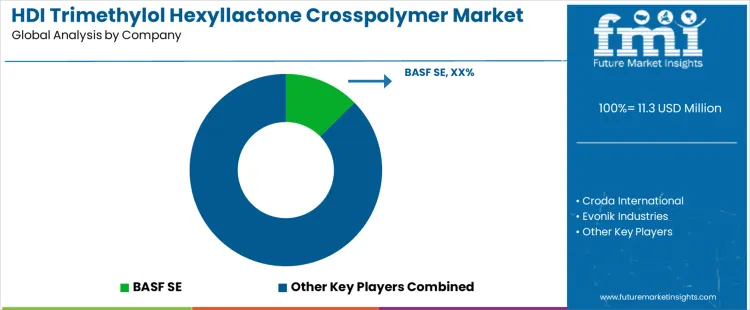
BASF SE anchors large scale production of HDI Trimethylol Hexyllactone Crosspolymer through advanced polyurethane chemistry and multi region manufacturing infrastructure. The material is positioned for use in skin feel modification oil control and texture enhancement across color cosmetics and skin care formulations. Croda International participates through delivery systems that integrate this crosspolymer into sensory driven personal care applications. Evonik Industries supports demand through precision polymer grades used in regulated dermatology and long wear cosmetic products. Symrise with actives platforms associated with IFF and Givaudan incorporates this crosspolymer into decorative cosmetic and skin care systems where slip control matting performance and film behavior govern formulation acceptance. Qualification focuses on rheology control optical diffusion and compatibility with volatile solvents.
Dow and Ashland participate through surrounding formulation systems that stabilize crosspolymer performance in emulsions anhydrous systems and hybrid textures. Clariant supports regional penetration across Europe Southeast Asia and the Middle East through formulation led customer programs and distributor aligned access. Seppic operates within regulated dermatology and premium cosmetic formulation environments where polymer documentation and batch reproducibility define supplier approval. Other suppliers serve contract formulators through smaller scale polymerization and toll manufacturing models. Competitive differentiation centers on polymer particle architecture solvent compatibility matting efficiency and long term stability under thermal cycling rather than volume pricing. Market access depends on consistent polymer morphology validated safety files and repeatable performance across diverse skin care and color cosmetic matrices.
Key Players in the HDI Trimethylol Hexyllactone Crosspolymer Market
- BASF SE
- Croda International
- Evonik Industries
- Symrise (incl. IFF/Givaudan actives)
- Dow / Dow Inc.
- Ashland
- Clariant
- Seppic
- Others
Scope of the report
| Items | Values |
|---|---|
| Quantitative Units (2025) | USD million |
| End-Use Applications | Skin Care, Body Care, Hair Care, Sun Care, Color Cosmetics, Men’s Grooming, Baby & Kids Care, Dermocosmetic / Professional Care |
| Product Forms | Powder, Granules/Agglomerates, Flakes, Pellets/Prills, Liquid (Solution), Concentrate (High-active Liquid), Dispersion/Suspension, Emulsion, Paste, Gel, Wax / Solid Block, Oil |
| Regions Covered | Asia Pacific, Europe, North America, Latin America, Middle East & Africa |
| Countries Covered | China, Japan, South Korea, India, Australia & New Zealand, ASEAN, Germany, United Kingdom, France, Italy, Spain, Nordic, BENELUX, USA, Canada, Mexico, Brazil, Chile, Saudi Arabia, Turkey, South Africa, plus 40+ additional countries globally |
| Key Companies Profiled | BASF SE, Croda International, Evonik Industries, Symrise (incl. IFF/Givaudan actives), Dow Inc., Ashland, Clariant, Seppic, Lubrizol, Lonza, Inolex |
| Additional Attributes | Dollar by sales breakdown by region, country, end-use, and product form; global growth projections; multi-sector adoption (cosmetic, nutraceutical, functional food); extract bioactivity profiling; iodine and polyphenol standardization; contract harvesting; vertical integration; supply chain stability; regulatory compliance; sensory and bioavailability performance |
HDI Trimethylol Hexyllactone Crosspolymer Market Segmentation
End Use Application:
- Skin Care
- Body Care
- Hair Care
- Sun Care
- Color Cosmetics
- Men’s Grooming
- Baby & Kids Care
- Dermocosmetic / Professional Care
Product Form:
- Powder
- Granules / Agglomerates
- Flakes
- Pellets / Prills
- Liquid (Solution)
- Concentrate (High-active Liquid)
- Dispersion / Suspension
- Emulsion
- Paste
- Gel
- Wax / Solid Block
- Oil
Region
- Asia Pacific
- China
- Japan
- South Korea
- India
- Australia & New Zealand
- ASEAN
- Rest of Asia Pacific
- Europe
- Germany
- United Kingdom
- France
- Italy
- Spain
- Nordic
- BENELUX
- Rest of Europe
- North America
- United States
- Canada
- Mexico
- Latin America
- Brazil
- Chile
- Rest of Latin America
- Middle East & Africa
- Kingdom of Saudi Arabia
- Other GCC Countries
- Turkey
- South Africa
- Other African Union
- Rest of Middle East & Africa
Frequently Asked Questions
How big is the HDI trimethylol hexyllactone crosspolymer market in 2025?
The global HDI trimethylol hexyllactone crosspolymer market is estimated to be valued at USD 11.3 million in 2025.
What will be the size of HDI trimethylol hexyllactone crosspolymer market in 2035?
The market size for the HDI trimethylol hexyllactone crosspolymer market is projected to reach USD 22.2 million by 2035.
How much will be the HDI trimethylol hexyllactone crosspolymer market growth between 2025 and 2035?
The HDI trimethylol hexyllactone crosspolymer market is expected to grow at a 7.0% CAGR between 2025 and 2035.
What are the key product types in the HDI trimethylol hexyllactone crosspolymer market?
The key product types in HDI trimethylol hexyllactone crosspolymer market are skin care, body care, hair care, sun care, color cosmetics, men’s grooming, baby & kids care and dermocosmetic / professional care.
Which product form segment to contribute significant share in the HDI trimethylol hexyllactone crosspolymer market in 2025?
In terms of product form , powder segment to command 14.8% share in the HDI trimethylol hexyllactone crosspolymer market in 2025.
Preview the report firsthand - request a free sample
Get SampleGet the brochure for pricing and purchase details.
Get PDFTable of Content
- Executive Summary
- Global Market Outlook
- Demand-side Trends
- Supply-side Trends
- Technology Roadmap Analysis
- Analysis and Recommendations
- Market Overview
- Market Coverage / Taxonomy
- Market Definition / Scope / Limitations
- Market Background
- Market Dynamics
- Drivers
- Restraints
- Opportunity
- Trends
- Scenario Forecast
- Demand in Optimistic Scenario
- Demand in Likely Scenario
- Demand in Conservative Scenario
- Opportunity Map Analysis
- Product Life Cycle Analysis
- Supply Chain Analysis
- Investment Feasibility Matrix
- Value Chain Analysis
- PESTLE and Porter’s Analysis
- Regulatory Landscape
- Regional Parent Market Outlook
- Production and Consumption Statistics
- Import and Export Statistics
- Market Dynamics
- Global Market Analysis 2020 to 2024 and Forecast, 2025 to 2035
- Historical Market Size Value (USD Million) Analysis, 2020 to 2024
- Current and Future Market Size Value (USD Million) Projections, 2025 to 2035
- Y-o-Y Growth Trend Analysis
- Absolute $ Opportunity Analysis
- Global Market Pricing Analysis 2020 to 2024 and Forecast 2025 to 2035
- Global Market Analysis 2020 to 2024 and Forecast 2025 to 2035, By End Use Application
- Introduction / Key Findings
- Historical Market Size Value (USD Million) Analysis By End Use Application , 2020 to 2024
- Current and Future Market Size Value (USD Million) Analysis and Forecast By End Use Application , 2025 to 2035
- Skin Care
- Body Care
- Hair Care
- Sun Care
- Color Cosmetics
- Men’s Grooming
- Baby & Kids Care
- Dermocosmetic / Professional Care
- Y-o-Y Growth Trend Analysis By End Use Application , 2020 to 2024
- Absolute $ Opportunity Analysis By End Use Application , 2025 to 2035
- Global Market Analysis 2020 to 2024 and Forecast 2025 to 2035, By Product Form
- Introduction / Key Findings
- Historical Market Size Value (USD Million) Analysis By Product Form, 2020 to 2024
- Current and Future Market Size Value (USD Million) Analysis and Forecast By Product Form, 2025 to 2035
- Powder
- Granules / Agglomerates
- Flakes
- Pellets / Prills
- Liquid (Solution)
- Concentrate (High-active Liquid)
- Dispersion / Suspension
- Emulsion
- Paste
- Gel
- Wax / Solid Block
- Y-o-Y Growth Trend Analysis By Product Form, 2020 to 2024
- Absolute $ Opportunity Analysis By Product Form, 2025 to 2035
- Global Market Analysis 2020 to 2024 and Forecast 2025 to 2035, By Region
- Introduction
- Historical Market Size Value (USD Million) Analysis By Region, 2020 to 2024
- Current Market Size Value (USD Million) Analysis and Forecast By Region, 2025 to 2035
- North America
- Latin America
- Western Europe
- Eastern Europe
- East Asia
- South Asia and Pacific
- Middle East & Africa
- Market Attractiveness Analysis By Region
- North America Market Analysis 2020 to 2024 and Forecast 2025 to 2035, By Country
- Historical Market Size Value (USD Million) Trend Analysis By Market Taxonomy, 2020 to 2024
- Market Size Value (USD Million) Forecast By Market Taxonomy, 2025 to 2035
- By Country
- USA
- Canada
- Mexico
- By End Use Application
- By Product Form
- By Country
- Market Attractiveness Analysis
- By Country
- By End Use Application
- By Product Form
- Key Takeaways
- Latin America Market Analysis 2020 to 2024 and Forecast 2025 to 2035, By Country
- Historical Market Size Value (USD Million) Trend Analysis By Market Taxonomy, 2020 to 2024
- Market Size Value (USD Million) Forecast By Market Taxonomy, 2025 to 2035
- By Country
- Brazil
- Chile
- Rest of Latin America
- By End Use Application
- By Product Form
- By Country
- Market Attractiveness Analysis
- By Country
- By End Use Application
- By Product Form
- Key Takeaways
- Western Europe Market Analysis 2020 to 2024 and Forecast 2025 to 2035, By Country
- Historical Market Size Value (USD Million) Trend Analysis By Market Taxonomy, 2020 to 2024
- Market Size Value (USD Million) Forecast By Market Taxonomy, 2025 to 2035
- By Country
- Germany
- UK
- Italy
- Spain
- France
- Nordic
- BENELUX
- Rest of Western Europe
- By End Use Application
- By Product Form
- By Country
- Market Attractiveness Analysis
- By Country
- By End Use Application
- By Product Form
- Key Takeaways
- Eastern Europe Market Analysis 2020 to 2024 and Forecast 2025 to 2035, By Country
- Historical Market Size Value (USD Million) Trend Analysis By Market Taxonomy, 2020 to 2024
- Market Size Value (USD Million) Forecast By Market Taxonomy, 2025 to 2035
- By Country
- Russia
- Poland
- Hungary
- Balkan & Baltic
- Rest of Eastern Europe
- By End Use Application
- By Product Form
- By Country
- Market Attractiveness Analysis
- By Country
- By End Use Application
- By Product Form
- Key Takeaways
- East Asia Market Analysis 2020 to 2024 and Forecast 2025 to 2035, By Country
- Historical Market Size Value (USD Million) Trend Analysis By Market Taxonomy, 2020 to 2024
- Market Size Value (USD Million) Forecast By Market Taxonomy, 2025 to 2035
- By Country
- China
- Japan
- South Korea
- By End Use Application
- By Product Form
- By Country
- Market Attractiveness Analysis
- By Country
- By End Use Application
- By Product Form
- Key Takeaways
- South Asia and Pacific Market Analysis 2020 to 2024 and Forecast 2025 to 2035, By Country
- Historical Market Size Value (USD Million) Trend Analysis By Market Taxonomy, 2020 to 2024
- Market Size Value (USD Million) Forecast By Market Taxonomy, 2025 to 2035
- By Country
- India
- ASEAN
- Australia & New Zealand
- Rest of South Asia and Pacific
- By End Use Application
- By Product Form
- By Country
- Market Attractiveness Analysis
- By Country
- By End Use Application
- By Product Form
- Key Takeaways
- Middle East & Africa Market Analysis 2020 to 2024 and Forecast 2025 to 2035, By Country
- Historical Market Size Value (USD Million) Trend Analysis By Market Taxonomy, 2020 to 2024
- Market Size Value (USD Million) Forecast By Market Taxonomy, 2025 to 2035
- By Country
- Kingdom of Saudi Arabia
- Other GCC Countries
- Turkiye
- South Africa
- Other African Union
- Rest of Middle East & Africa
- By End Use Application
- By Product Form
- By Country
- Market Attractiveness Analysis
- By Country
- By End Use Application
- By Product Form
- Key Takeaways
- Key Countries Market Analysis
- USA
- Pricing Analysis
- Market Share Analysis, 2024
- By End Use Application
- By Product Form
- Canada
- Pricing Analysis
- Market Share Analysis, 2024
- By End Use Application
- By Product Form
- Mexico
- Pricing Analysis
- Market Share Analysis, 2024
- By End Use Application
- By Product Form
- Brazil
- Pricing Analysis
- Market Share Analysis, 2024
- By End Use Application
- By Product Form
- Chile
- Pricing Analysis
- Market Share Analysis, 2024
- By End Use Application
- By Product Form
- Germany
- Pricing Analysis
- Market Share Analysis, 2024
- By End Use Application
- By Product Form
- UK
- Pricing Analysis
- Market Share Analysis, 2024
- By End Use Application
- By Product Form
- Italy
- Pricing Analysis
- Market Share Analysis, 2024
- By End Use Application
- By Product Form
- Spain
- Pricing Analysis
- Market Share Analysis, 2024
- By End Use Application
- By Product Form
- France
- Pricing Analysis
- Market Share Analysis, 2024
- By End Use Application
- By Product Form
- India
- Pricing Analysis
- Market Share Analysis, 2024
- By End Use Application
- By Product Form
- ASEAN
- Pricing Analysis
- Market Share Analysis, 2024
- By End Use Application
- By Product Form
- Australia & New Zealand
- Pricing Analysis
- Market Share Analysis, 2024
- By End Use Application
- By Product Form
- China
- Pricing Analysis
- Market Share Analysis, 2024
- By End Use Application
- By Product Form
- Japan
- Pricing Analysis
- Market Share Analysis, 2024
- By End Use Application
- By Product Form
- South Korea
- Pricing Analysis
- Market Share Analysis, 2024
- By End Use Application
- By Product Form
- Russia
- Pricing Analysis
- Market Share Analysis, 2024
- By End Use Application
- By Product Form
- Poland
- Pricing Analysis
- Market Share Analysis, 2024
- By End Use Application
- By Product Form
- Hungary
- Pricing Analysis
- Market Share Analysis, 2024
- By End Use Application
- By Product Form
- Kingdom of Saudi Arabia
- Pricing Analysis
- Market Share Analysis, 2024
- By End Use Application
- By Product Form
- Turkiye
- Pricing Analysis
- Market Share Analysis, 2024
- By End Use Application
- By Product Form
- South Africa
- Pricing Analysis
- Market Share Analysis, 2024
- By End Use Application
- By Product Form
- USA
- Market Structure Analysis
- Competition Dashboard
- Competition Benchmarking
- Market Share Analysis of Top Players
- By Regional
- By End Use Application
- By Product Form
- Competition Analysis
- Competition Deep Dive
- BASF SE
- Overview
- Product Portfolio
- Profitability by Market Segments (Product/Age /Sales Channel/Region)
- Sales Footprint
- Strategy Overview
- Marketing Strategy
- Product Strategy
- Channel Strategy
- Croda International
- Evonik Industries
- Symrise (incl. IFF/Givaudan actives)
- Dow / Dow Inc.
- Ashland
- Clariant
- Seppic
- Others
- BASF SE
- Competition Deep Dive
- Assumptions & Acronyms Used
- Research Methodology


