

- Industry Size (2026)
- USD 586.4 Mn
- Forecast (2036)
- USD 1338.2 Mn
- CAGR (2026 to 2036)
- 8.6%
Heavy Metal Chelation Chemicals Market Forecast and Outlook 2026 to 2036
The heavy metal chelation chemicals market is valued at USD 586.4 million in 2026 and is forecasted to reach USD 1,338.2 million by 2036, expanding at a CAGR of 8.6%. Growth is driven by rising industrial discharge controls, stricter limits on toxic metals in effluents, and increased remediation activity across manufacturing and resource-processing sectors. Mining, electroplating, battery production, and chemical processing facilities rely on chelation chemicals to bind and mobilize metal ions for effective separation and compliance with environmental standards.
Quick Stats for Heavy Metal Chelation Chemicals Market
- Heavy Metal Chelation Chemicals Market Value (2026): USD 586.4 million
- Heavy Metal Chelation Chemicals Market Forecast Value (2036): USD 1,338.2 million
- Heavy Metal Chelation Chemicals Market Forecast CAGR (2026 to 2036): 8.6%
- Leading Chelating Agent Type in Global Demand: EDTA & EDTA Derivatives
- Fastest-Growing Countries: China, India, USA, Germany, Brazil
- Top Players in Global Demand: BASF SE, Nouryon, Dow Inc., Mitsubishi Chemical Group, Arkema Group

EDTA and EDTA derivatives represent leading chelating agent demand due to strong metal-binding capacity, stability across wide pH ranges, and proven performance against lead, cadmium, chromium, and nickel. These agents support consistent removal efficiency in complex industrial wastewater streams and are compatible with precipitation, filtration, and membrane-based treatment processes. Preference for EDTA-based systems reflects reliability, cost-effective, and established regulatory acceptance. Segment structure highlights continued reliance on broad-spectrum chelators, alongside gradual adoption of biodegradable alternatives in sensitive applications.
Industrial wastewater and effluent treatment represents leading end-use demand, reflecting high metal loadings and regulatory scrutiny. China, India, USA, Germany, and Brazil emerge as fastest-growing countries, supported by industrial expansion and enforcement intensity. Competitive landscape includes BASF SE, Nouryon, Dow Inc., Mitsubishi Chemical Group, and Arkema Group, focusing on chelant performance optimization, formulation stability, and integration with advanced effluent treatment systems.
Heavy Metal Chelation Chemicals Market Key Takeaways
| Metric | Value |
|---|---|
| Market Value (2026) | USD 586.4 million |
| Market Forecast Value (2036) | USD 1,338.2 million |
| Forecast CAGR (2026-2036) | 8.6% |
Why is the Demand for Heavy Metal Chelation Chemicals Market Growing?
Demand for heavy metal chelation chemicals is growing globally due to increasing concerns over toxic metal contamination in water, soil, and industrial processes. Heavy metals such as lead, mercury, cadmium, and arsenic enter the environment through mining, battery manufacturing, electroplating, and agricultural runoff, which raises public health and ecosystem protection priorities. Water and wastewater treatment facilities adopt chelating agents to bind and mobilize metal ions, enabling their removal through precipitation, adsorption, or membrane separation. Regulatory frameworks across multiple regions impose stringent limits on heavy metal concentrations in potable water, effluent discharges, and agricultural irrigation supplies, which supports adoption of targeted chelation strategies.
Industrial sectors, including metal finishing, electronics, and energy production, implement chelation chemicals within internal treatment systems to minimize corrosion, scale formation, and toxic discharge. Growth in remediation activity at contaminated sites, brownfields, and industrial legacy zones increases procurement of chelation reagents for soil and groundwater cleanup. Research and innovation improve selectivity, biodegradability, and cost efficiency of chelation formulations, which enhances applicability under varied environmental conditions. Utilities and industrial operators integrate chelation into multi-barrier treatment trains to meet compliance and sustainability objectives worldwide.
How Are the Segments Classified in the Heavy Metal Chelation Chemicals Market?
Demand for heavy metal chelation chemicals globally is shaped by stricter discharge limits, remediation of legacy contamination, and industrial wastewater compliance requirements. Treatment operators evaluate chelation strength, metal selectivity, biodegradability, and stability across variable pH and load conditions. Adoption patterns reflect broad use across industrial effluent treatment, municipal systems, and remediation projects targeting toxic and persistent metal pollutants.
Which Chelating Agent Type Holds the Largest Share of Global Demand?
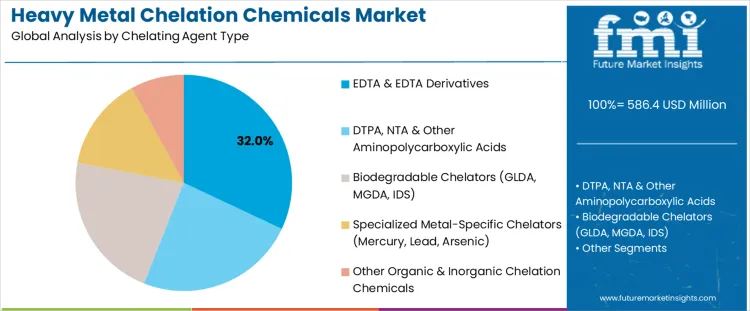
EDTA and EDTA derivatives hold 32.0%, representing the largest share of global demand. These chelators offer strong binding affinity and broad-spectrum effectiveness across multiple heavy metals. DTPA, NTA, and other aminopolycarboxylic acids account for 24.0%, supporting higher stability constants under challenging treatment conditions. Biodegradable chelators hold 22.0%, reflecting regulatory preference for reduced environmental persistence. Specialized metal-specific chelators account for 14.0%, addressing targeted removal of mercury, lead, and arsenic. Other organic and inorganic chelation chemicals hold 8.0%. Distribution reflects reliance on proven broad-spectrum chelation with growing transition toward biodegradable alternatives.
Key Points
- EDTA-based chelators lead due to strong and reliable metal binding.
- Aminopolycarboxylic acids support complex treatment environments.
- Biodegradable chelators gain relevance under environmental regulations.
Which End-Use Industry Accounts for the Highest Share of Global Adoption?

Industrial wastewater and effluent treatment holds 38.0%, accounting for the highest share of global adoption. Manufacturing facilities require chelation to meet discharge standards for regulated metals. Municipal water and sewage treatment accounts for 24.0%, addressing metal contamination in public infrastructure. Mining and metallurgy hold 18.0%, supporting ore processing and tailings management. Soil and groundwater remediation accounts for 12.0%, targeting contaminated sites. Other industrial and environmental uses hold 8.0%. End-use distribution reflects concentration of heavy metal management responsibilities within industrial operations.
Key Points
- Industrial effluent treatment dominates due to regulatory enforcement.
- Municipal systems manage diffuse and legacy metal contamination.
- Mining applications address high metal load streams.
Which Metal Target Group Represents the Largest Share of Global Demand?
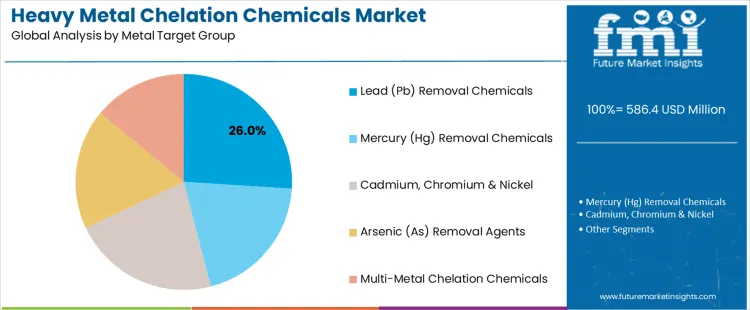
Lead removal chemicals hold 26.0%, representing the largest share of global demand. Lead contamination remains prevalent in industrial effluents, soils, and legacy infrastructure. Cadmium, chromium, and nickel account for 22.0%, reflecting widespread industrial usage and toxicity concerns. Mercury removal chemicals hold 20.0%, addressing high-risk environmental and health impacts. Arsenic removal agents account for 18.0%, particularly relevant for groundwater treatment. Multi-metal chelation chemicals hold 14.0%, supporting treatment of mixed-contaminant streams. Metal-target distribution reflects prevalence of lead and mixed-metal contamination globally.
Key Points
- Lead removal dominates due to widespread legacy contamination.
- Multi-metal systems address complex effluent compositions.
- Mercury and arsenic treatments target high-toxicity pollutants.
What are the Key Dynamics in the Heavy Metal Chelation Chemicals Market?
Global demand rises as water and wastewater treatment facilities, industrial processors, and environmental remediation programs adopt heavy metal chelation chemicals to control toxic metal ions. These reagents form stable complexes with metals such as lead, mercury, cadmium, and arsenic to facilitate removal through precipitation, adsorption, or membrane separation. Adoption aligns with tightening discharge limits, ecosystem protection priorities, and investment in advanced treatment infrastructure. Usage spans municipal utilities, mining operations, electroplating and metal finishing plants, and chemical manufacturers targeting compliance with quality standards for effluent and drinking water across regions.
How do regulatory focus and environmental health priorities shape global demand?
Governments and environmental agencies in North America, Europe, Asia-Pacific, and other regions enforce stringent limits on heavy metal concentrations in water bodies and potable water sources due to concerns over public health and aquatic toxicity. Utilities integrate chelation chemicals into treatment trains ahead of clarification and filtration steps to reduce soluble metal loads that challenge conventional processes. Industrial sectors deploy chelation agents within wastewater treatment to meet permit conditions and avoid penalties tied to toxic discharges. Research and pilot programs validate performance under variable source water matrices. Public awareness of heavy metal risks reinforces selection of effective chelants within broader water management strategies.
How do cost pressures, treatment complexity, and source variability influence market scalability?
Chelation performance depends on water chemistry factors such as pH, competing ions, and organic load, requiring site-specific optimization. Chemical costs influence operating budgets for utilities and industrial users confronted with recurring reagent consumption. Integration with physical and biological treatment processes increases operational complexity and requires monitoring to avoid secondary impacts on sludge handling and downstream systems. Availability and cost of raw materials for advanced chelants vary by region, affecting pricing stability. Differences in regulatory frameworks and acceptable performance criteria create variability in adoption urgency. Global growth depends on development of cost-effective, robust chelation solutions and integrated treatment frameworks that deliver reliable metal removal across diverse contexts.
How Is Demand for Heavy Metal Chelation Chemicals Evolving?
Demand for heavy metal chelation chemicals is increasing globally due to industrial effluent regulation, remediation of contaminated sites, and stricter drinking water standards. China leads with a 10.0% CAGR, supported by industrial wastewater treatment expansion and soil remediation programs. India follows at 9.4%, driven by mining activity, industrial discharge control, and urban wastewater upgrades. USA records a 7.6% CAGR, reflecting regulatory compliance in water treatment and hazardous waste management. Germany posts 7.2%, shaped by precautionary environmental regulation and remediation efficiency requirements. Brazil records 7.0%, supported by mining sector oversight and municipal wastewater treatment expansion. Growth reflects sustained focus on binding and removing toxic metals worldwide.

| Country | CAGR (%) |
|---|---|
| China | 10.0% |
| India | 9.4% |
| USA | 7.6% |
| Germany | 7.2% |
| Brazil | 7.0% |
What factors are driving strong demand growth for chelation chemicals in China?

China demand is driven by large-scale industrial wastewater treatment, mining activities, and remediation of contaminated land. CAGR of 10.0% reflects increased use of chelating agents to remove heavy metals such as lead, cadmium, and chromium. Industrial parks integrate chelation steps to meet discharge limits. Soil remediation projects deploy chelants to mobilize and extract metals. Centralized planning enables standardized procurement and dosing. Continuous monitoring sustains consistent chemical usage. Growth remains scale-driven and regulation-aligned, supported by national pollution control and environmental restoration initiatives.
- Industrial wastewater and mining remediation demand
- Removal of lead, cadmium, and chromium
- Standardized procurement and dosing practices
- National pollution control programs
How is India sustaining high growth in heavy metal chelation chemical usage?
India demand reflects industrial expansion, mining operations, and stricter effluent standards. CAGR of 9.4% is supported by adoption of chelation chemicals in electroplating, tanning, and chemical manufacturing wastewater. Municipal plants integrate chelants to address mixed industrial discharges. River cleanup programs increase treatment requirements. Regulatory enforcement strengthens compliance across states. Growth remains infrastructure-led and compliance-focused, aligned with improving surface water quality and reducing human exposure to toxic metals.
- Industrial effluent treatment in plating and tanning
- River and surface water cleanup initiatives
- Municipal handling of mixed industrial wastewater
- Strengthening regulatory enforcement
What regulatory drivers shape demand growth in the USA?
USA demand is shaped by federal and state regulations governing heavy metals in drinking water, wastewater, and hazardous waste. CAGR of 7.6% reflects consistent use of chelation chemicals to meet limits for arsenic, mercury, and lead. Utilities deploy chelants to supplement precipitation and filtration. Legacy site remediation sustains demand. Aging infrastructure favors chemical optimization over capital-intensive upgrades. Growth remains regulation-driven and risk-focused, aligned with public health protection and compliance obligations.
- Federal and state heavy metal limits
- Supplementing precipitation and filtration processes
- Legacy site remediation activity
- Infrastructure-compatible treatment solutions
Why does Germany show steady but controlled demand growth?
Germany demand reflects precautionary environmental regulation and emphasis on efficient remediation. CAGR of 7.2% is supported by targeted use of chelation chemicals within optimized treatment frameworks. Utilities prioritize precise dosing and minimization of secondary pollution. Strong source control policies reduce excessive metal loading. Documentation and validation requirements guide application. Growth remains efficiency-led and stability-focused, aligned with established environmental protection and water management practices.
- Precautionary regulation of heavy metals
- Optimized and precise chelant dosing
- Strong source control measures
- Emphasis on documentation and validation
What supports gradual demand expansion in Brazil?
Brazil demand is driven by mining activity oversight, industrial wastewater treatment, and urban infrastructure expansion. CAGR of 7.0% reflects increased use of chelation chemicals to manage metal-laden effluents. Municipal systems address industrial contributions to wastewater streams. Environmental monitoring programs expand treatment requirements. Public investment supports remediation and treatment upgrades. Growth remains application-driven and infrastructure-aligned, supported by improving environmental compliance and water quality objectives.
- Mining sector effluent management
- Industrial contribution to municipal wastewater
- Expansion of environmental monitoring programs
- Public investment in remediation and treatment
What is the competitive landscape of demand for heavy metal chelation chemicals?
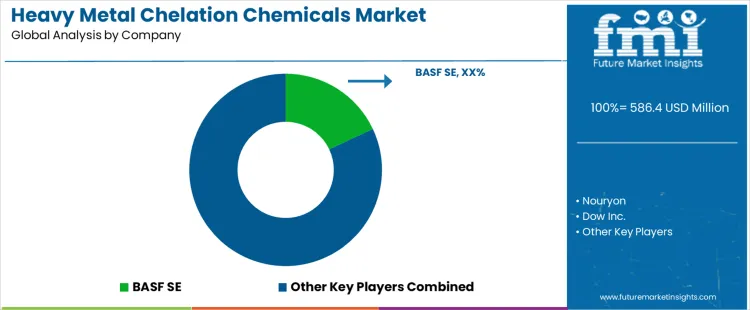
Demand for heavy metal chelation chemicals is driven by industrial wastewater treatment, soil remediation, pulp and paper processing, and metal-intensive manufacturing activities. Applications focus on binding and removing metals such as lead, mercury, cadmium, chromium, and nickel to meet discharge limits and environmental safety standards. Buyers evaluate chelation strength, selectivity for target metals, biodegradability, and stability under variable pH and temperature conditions. Procurement teams prioritize chemicals that integrate smoothly with existing treatment processes, minimize secondary pollution risks, and comply with tightening global environmental regulations. Trend in the global market reflects increased remediation activity, stricter industrial effluent standards, and gradual transition toward biodegradable and low-toxicity chelating agents.
BASF SE maintains strong positioning through a diversified portfolio of aminopolycarboxylate and specialty chelating agents used across water treatment and industrial applications. Nouryon supplies chelation chemistries with focus on performance consistency and environmental compliance across global markets. Dow Inc. contributes chelating solutions integrated within broader water and process chemical offerings for industrial operators. Mitsubishi Chemical Group supports demand through specialty chemicals applied in electronics, materials processing, and environmental remediation. Arkema Group participates with functional additives and chelation-related chemistries aligned with industrial and environmental use cases. Competitive differentiation depends on chelation efficiency, regulatory readiness, biodegradability profile, and technical support capability across varied end-use sectors.
Key Players in the Heavy Metal Chelation Chemicals Market
- BASF SE
- Nouryon
- Dow Inc.
- Mitsubishi Chemical Group
- Arkema Group
Scope of the Report
| Items | Values |
|---|---|
| Quantitative Units | USD million |
| Chelating Agent Type | EDTA & EDTA Derivatives; DTPA, NTA & Other Aminopolycarboxylic Acids; Biodegradable Chelators (GLDA, MGDA, IDS); Specialized Metal-Specific Chelators (Mercury, Lead, Arsenic); Other Organic & Inorganic Chelation Chemicals |
| End-Use Industry | Industrial Wastewater & Effluent Treatment; Municipal Water & Sewage Treatment; Mining & Metallurgy; Soil & Groundwater Remediation; Other Industrial & Environmental Uses |
| Metal Target Group | Lead (Pb) Removal Chemicals; Mercury (Hg) Removal Chemicals; Cadmium, Chromium & Nickel; Arsenic (As) Removal Agents; Multi-Metal Chelation Chemicals |
| Regions Covered | Asia Pacific, Europe, North America, Latin America, Middle East & Africa |
| Countries Covered | China, India, USA, Germany, Brazil, and 40+ countries |
| Key Companies Profiled | BASF SE; Nouryon; Dow Inc.; Mitsubishi Chemical Group; Arkema Group |
| Additional Attributes | Dollar sales by chelating agent type and metal target group; adoption trends for biodegradable and low-toxicity chelators; chelation efficiency metrics across lead, mercury, arsenic, and multi-metal systems; compatibility with wastewater, soil, and groundwater remediation processes; regulatory limits on heavy metal discharge influencing chelant selection; advances in metal-specific and environmentally benign chelation chemistries. |
Heavy Metal Chelation Chemicals Market by Segment
Chelating Agent Type:
- EDTA & EDTA Derivatives
- DTPA, NTA & Other Aminopolycarboxylic Acids
- Biodegradable Chelators (GLDA, MGDA, IDS)
- Specialized Metal-Specific Chelators (Mercury, Lead, Arsenic)
- Other Organic & Inorganic Chelation Chemicals
End-Use Industry:
- Industrial Wastewater & Effluent Treatment
- Municipal Water & Sewage Treatment
- Mining & Metallurgy
- Soil & Groundwater Remediation
- Other Industrial & Environmental Uses
Metal Target Group:
- Lead (Pb) Removal Chemicals
- Mercury (Hg) Removal Chemicals
- Cadmium, Chromium & Nickel
- Arsenic (As) Removal Agents
- Multi-Metal Chelation Chemicals
Region:
- Asia Pacific
- China
- Japan
- South Korea
- India
- Australia & New Zealand
- ASEAN
- Rest of Asia Pacific
- Europe
- Germany
- United Kingdom
- France
- Italy
- Spain
- Nordic
- BENELUX
- Rest of Europe
- North America
- United States
- Canada
- Mexico
- Latin America
- Brazil
- Chile
- Rest of Latin America
- Middle East & Africa
- Kingdom of Saudi Arabia
- Other GCC Countries
- Turkey
- South Africa
- Other African Union
- Rest of Middle East & Africa
Frequently Asked Questions
How big is the heavy metal chelation chemicals market in 2026?
The global heavy metal chelation chemicals market is estimated to be valued at USD 586.4 million in 2026.
What will be the size of heavy metal chelation chemicals market in 2036?
The market size for the heavy metal chelation chemicals market is projected to reach USD 1,338.1 million by 2036.
How much will be the heavy metal chelation chemicals market growth between 2026 and 2036?
The heavy metal chelation chemicals market is expected to grow at a 8.6% CAGR between 2026 and 2036.
What are the key product types in the heavy metal chelation chemicals market?
The key product types in heavy metal chelation chemicals market are edta & edta derivatives, dtpa, nta & other aminopolycarboxylic acids, biodegradable chelators (glda, mgda, ids), specialized metal-specific chelators (mercury, lead, arsenic) and other organic & inorganic chelation chemicals.
Which end-use industry segment to contribute significant share in the heavy metal chelation chemicals market in 2026?
In terms of end-use industry, industrial wastewater & effluent treatment segment to command 38.0% share in the heavy metal chelation chemicals market in 2026.
Preview the report firsthand - request a free sample
Get SampleGet the brochure for pricing and purchase details.
Get PDFTable of Content
- Executive Summary
- Global Market Outlook
- Demand-side Trends
- Supply-side Trends
- Technology Roadmap Analysis
- Analysis and Recommendations
- Market Overview
- Market Coverage / Taxonomy
- Market Definition / Scope / Limitations
- Market Background
- Market Dynamics
- Drivers
- Restraints
- Opportunity
- Trends
- Scenario Forecast
- Demand in Optimistic Scenario
- Demand in Likely Scenario
- Demand in Conservative Scenario
- Opportunity Map Analysis
- Product Life Cycle Analysis
- Supply Chain Analysis
- Investment Feasibility Matrix
- Value Chain Analysis
- PESTLE and Porter’s Analysis
- Regulatory Landscape
- Regional Parent Market Outlook
- Production and Consumption Statistics
- Import and Export Statistics
- Market Dynamics
- Global Market Analysis 2021 to 2025 and Forecast, 2026 to 2036
- Historical Market Size Value (USD Million) Analysis, 2021 to 2025
- Current and Future Market Size Value (USD Million) Projections, 2026 to 2036
- Y-o-Y Growth Trend Analysis
- Absolute $ Opportunity Analysis
- Global Market Pricing Analysis 2021 to 2025 and Forecast 2026 to 2036
- Global Market Analysis 2021 to 2025 and Forecast 2026 to 2036, By Chelating Agent Type
- Introduction / Key Findings
- Historical Market Size Value (USD Million) Analysis By Chelating Agent Type , 2021 to 2025
- Current and Future Market Size Value (USD Million) Analysis and Forecast By Chelating Agent Type , 2026 to 2036
- EDTA & EDTA Derivatives
- DTPA, NTA & Other Aminopolycarboxylic Acids
- Biodegradable Chelators (GLDA, MGDA, IDS)
- Specialized Metal-Specific Chelators (Mercury, Lead, Arsenic)
- Other Organic & Inorganic Chelation Chemicals
- EDTA & EDTA Derivatives
- Y-o-Y Growth Trend Analysis By Chelating Agent Type , 2021 to 2025
- Absolute $ Opportunity Analysis By Chelating Agent Type , 2026 to 2036
- Global Market Analysis 2021 to 2025 and Forecast 2026 to 2036, By End-Use Industry
- Introduction / Key Findings
- Historical Market Size Value (USD Million) Analysis By End-Use Industry, 2021 to 2025
- Current and Future Market Size Value (USD Million) Analysis and Forecast By End-Use Industry, 2026 to 2036
- Industrial Wastewater & Effluent Treatment
- Municipal Water & Sewage Treatment
- Mining & Metallurgy
- Soil & Groundwater Remediation
- Other Industrial & Environmental Uses
- Industrial Wastewater & Effluent Treatment
- Y-o-Y Growth Trend Analysis By End-Use Industry, 2021 to 2025
- Absolute $ Opportunity Analysis By End-Use Industry, 2026 to 2036
- Global Market Analysis 2021 to 2025 and Forecast 2026 to 2036, By Metal Target Group
- Introduction / Key Findings
- Historical Market Size Value (USD Million) Analysis By Metal Target Group, 2021 to 2025
- Current and Future Market Size Value (USD Million) Analysis and Forecast By Metal Target Group, 2026 to 2036
- Lead (Pb) Removal Chemicals
- Mercury (Hg) Removal Chemicals
- Cadmium, Chromium & Nickel
- Arsenic (As) Removal Agents
- Multi-Metal Chelation Chemicals
- Lead (Pb) Removal Chemicals
- Y-o-Y Growth Trend Analysis By Metal Target Group, 2021 to 2025
- Absolute $ Opportunity Analysis By Metal Target Group, 2026 to 2036
- Global Market Analysis 2021 to 2025 and Forecast 2026 to 2036, By Region
- Introduction
- Historical Market Size Value (USD Million) Analysis By Region, 2021 to 2025
- Current Market Size Value (USD Million) Analysis and Forecast By Region, 2026 to 2036
- North America
- Latin America
- Western Europe
- Eastern Europe
- East Asia
- South Asia and Pacific
- Middle East & Africa
- Market Attractiveness Analysis By Region
- North America Market Analysis 2021 to 2025 and Forecast 2026 to 2036, By Country
- Historical Market Size Value (USD Million) Trend Analysis By Market Taxonomy, 2021 to 2025
- Market Size Value (USD Million) Forecast By Market Taxonomy, 2026 to 2036
- By Country
- USA
- Canada
- Mexico
- By Chelating Agent Type
- By End-Use Industry
- By Metal Target Group
- By Country
- Market Attractiveness Analysis
- By Country
- By Chelating Agent Type
- By End-Use Industry
- By Metal Target Group
- Key Takeaways
- Latin America Market Analysis 2021 to 2025 and Forecast 2026 to 2036, By Country
- Historical Market Size Value (USD Million) Trend Analysis By Market Taxonomy, 2021 to 2025
- Market Size Value (USD Million) Forecast By Market Taxonomy, 2026 to 2036
- By Country
- Brazil
- Chile
- Rest of Latin America
- By Chelating Agent Type
- By End-Use Industry
- By Metal Target Group
- By Country
- Market Attractiveness Analysis
- By Country
- By Chelating Agent Type
- By End-Use Industry
- By Metal Target Group
- Key Takeaways
- Western Europe Market Analysis 2021 to 2025 and Forecast 2026 to 2036, By Country
- Historical Market Size Value (USD Million) Trend Analysis By Market Taxonomy, 2021 to 2025
- Market Size Value (USD Million) Forecast By Market Taxonomy, 2026 to 2036
- By Country
- Germany
- UK
- Italy
- Spain
- France
- Nordic
- BENELUX
- Rest of Western Europe
- By Chelating Agent Type
- By End-Use Industry
- By Metal Target Group
- By Country
- Market Attractiveness Analysis
- By Country
- By Chelating Agent Type
- By End-Use Industry
- By Metal Target Group
- Key Takeaways
- Eastern Europe Market Analysis 2021 to 2025 and Forecast 2026 to 2036, By Country
- Historical Market Size Value (USD Million) Trend Analysis By Market Taxonomy, 2021 to 2025
- Market Size Value (USD Million) Forecast By Market Taxonomy, 2026 to 2036
- By Country
- Russia
- Poland
- Hungary
- Balkan & Baltic
- Rest of Eastern Europe
- By Chelating Agent Type
- By End-Use Industry
- By Metal Target Group
- By Country
- Market Attractiveness Analysis
- By Country
- By Chelating Agent Type
- By End-Use Industry
- By Metal Target Group
- Key Takeaways
- East Asia Market Analysis 2021 to 2025 and Forecast 2026 to 2036, By Country
- Historical Market Size Value (USD Million) Trend Analysis By Market Taxonomy, 2021 to 2025
- Market Size Value (USD Million) Forecast By Market Taxonomy, 2026 to 2036
- By Country
- China
- Japan
- South Korea
- By Chelating Agent Type
- By End-Use Industry
- By Metal Target Group
- By Country
- Market Attractiveness Analysis
- By Country
- By Chelating Agent Type
- By End-Use Industry
- By Metal Target Group
- Key Takeaways
- South Asia and Pacific Market Analysis 2021 to 2025 and Forecast 2026 to 2036, By Country
- Historical Market Size Value (USD Million) Trend Analysis By Market Taxonomy, 2021 to 2025
- Market Size Value (USD Million) Forecast By Market Taxonomy, 2026 to 2036
- By Country
- India
- ASEAN
- Australia & New Zealand
- Rest of South Asia and Pacific
- By Chelating Agent Type
- By End-Use Industry
- By Metal Target Group
- By Country
- Market Attractiveness Analysis
- By Country
- By Chelating Agent Type
- By End-Use Industry
- By Metal Target Group
- Key Takeaways
- Middle East & Africa Market Analysis 2021 to 2025 and Forecast 2026 to 2036, By Country
- Historical Market Size Value (USD Million) Trend Analysis By Market Taxonomy, 2021 to 2025
- Market Size Value (USD Million) Forecast By Market Taxonomy, 2026 to 2036
- By Country
- Kingdom of Saudi Arabia
- Other GCC Countries
- Turkiye
- South Africa
- Other African Union
- Rest of Middle East & Africa
- By Chelating Agent Type
- By End-Use Industry
- By Metal Target Group
- By Country
- Market Attractiveness Analysis
- By Country
- By Chelating Agent Type
- By End-Use Industry
- By Metal Target Group
- Key Takeaways
- Key Countries Market Analysis
- USA
- Pricing Analysis
- Market Share Analysis, 2025
- By Chelating Agent Type
- By End-Use Industry
- By Metal Target Group
- Canada
- Pricing Analysis
- Market Share Analysis, 2025
- By Chelating Agent Type
- By End-Use Industry
- By Metal Target Group
- Mexico
- Pricing Analysis
- Market Share Analysis, 2025
- By Chelating Agent Type
- By End-Use Industry
- By Metal Target Group
- Brazil
- Pricing Analysis
- Market Share Analysis, 2025
- By Chelating Agent Type
- By End-Use Industry
- By Metal Target Group
- Chile
- Pricing Analysis
- Market Share Analysis, 2025
- By Chelating Agent Type
- By End-Use Industry
- By Metal Target Group
- Germany
- Pricing Analysis
- Market Share Analysis, 2025
- By Chelating Agent Type
- By End-Use Industry
- By Metal Target Group
- UK
- Pricing Analysis
- Market Share Analysis, 2025
- By Chelating Agent Type
- By End-Use Industry
- By Metal Target Group
- Italy
- Pricing Analysis
- Market Share Analysis, 2025
- By Chelating Agent Type
- By End-Use Industry
- By Metal Target Group
- Spain
- Pricing Analysis
- Market Share Analysis, 2025
- By Chelating Agent Type
- By End-Use Industry
- By Metal Target Group
- France
- Pricing Analysis
- Market Share Analysis, 2025
- By Chelating Agent Type
- By End-Use Industry
- By Metal Target Group
- India
- Pricing Analysis
- Market Share Analysis, 2025
- By Chelating Agent Type
- By End-Use Industry
- By Metal Target Group
- ASEAN
- Pricing Analysis
- Market Share Analysis, 2025
- By Chelating Agent Type
- By End-Use Industry
- By Metal Target Group
- Australia & New Zealand
- Pricing Analysis
- Market Share Analysis, 2025
- By Chelating Agent Type
- By End-Use Industry
- By Metal Target Group
- China
- Pricing Analysis
- Market Share Analysis, 2025
- By Chelating Agent Type
- By End-Use Industry
- By Metal Target Group
- Japan
- Pricing Analysis
- Market Share Analysis, 2025
- By Chelating Agent Type
- By End-Use Industry
- By Metal Target Group
- South Korea
- Pricing Analysis
- Market Share Analysis, 2025
- By Chelating Agent Type
- By End-Use Industry
- By Metal Target Group
- Russia
- Pricing Analysis
- Market Share Analysis, 2025
- By Chelating Agent Type
- By End-Use Industry
- By Metal Target Group
- Poland
- Pricing Analysis
- Market Share Analysis, 2025
- By Chelating Agent Type
- By End-Use Industry
- By Metal Target Group
- Hungary
- Pricing Analysis
- Market Share Analysis, 2025
- By Chelating Agent Type
- By End-Use Industry
- By Metal Target Group
- Kingdom of Saudi Arabia
- Pricing Analysis
- Market Share Analysis, 2025
- By Chelating Agent Type
- By End-Use Industry
- By Metal Target Group
- Turkiye
- Pricing Analysis
- Market Share Analysis, 2025
- By Chelating Agent Type
- By End-Use Industry
- By Metal Target Group
- South Africa
- Pricing Analysis
- Market Share Analysis, 2025
- By Chelating Agent Type
- By End-Use Industry
- By Metal Target Group
- USA
- Market Structure Analysis
- Competition Dashboard
- Competition Benchmarking
- Market Share Analysis of Top Players
- By Regional
- By Chelating Agent Type
- By End-Use Industry
- By Metal Target Group
- Competition Analysis
- Competition Deep Dive
- BASF SE
- Overview
- Product Portfolio
- Profitability by Market Segments (Product/Age /Sales Channel/Region)
- Sales Footprint
- Strategy Overview
- Marketing Strategy
- Product Strategy
- Channel Strategy
- Nouryon
- Dow Inc.
- Mitsubishi Chemical Group
- Arkema Group
- BASF SE
- Competition Deep Dive
- Assumptions & Acronyms Used
- Research Methodology


