

- Industry Size (2025)
- USD 2.0 Bn
- Forecast (2035)
- USD 3.9 Bn
- CAGR (2025 to 2035)
- 7.1%
Hemoglobin Analyzer Market Size and Share Forecast Outlook 2025 to 2035
The Hemoglobin Analyzer Market is estimated to be valued at USD 2.0 billion in 2025 and is projected to reach USD 3.9 billion by 2035, registering a compound annual growth rate (CAGR) of 7.1% over the forecast period.
Quick Stats for Hemoglobin Analyzer Market
- Hemoglobin Analyzer Market Value (2025): USD 2.0 billion
- Hemoglobin Analyzer Market Forecast Value (2035): USD 3.9 billion
- Hemoglobin Analyzer Market Forecast CAGR: 7.1%
- Leading Segment in Hemoglobin Analyzer Market in 2025: Bench-Top (55.0%)
- Key Growth Regions in Hemoglobin Analyzer Market: North America, Asia-Pacific, Europe
- Top Key Players in Hemoglobin Analyzer Market: Mindray Medical International Limited, Sysmex Corporation, Beckman Coulter, Inc., Abbott Laboratories, Roche Diagnostics, Bio-Rad Laboratories, Inc., Nihon Kohden Corporation, Siemens Healthineers

Hemoglobin Analyzer Market Key Takeaways
| Metric | Value |
|---|---|
| Hemoglobin Analyzer Market Estimated Value in (2025 E) | USD 2.0 billion |
| Hemoglobin Analyzer Market Forecast Value in (2035 F) | USD 3.9 billion |
| Forecast CAGR (2025 to 2035) | 7.1% |
Why is the Hemoglobin Analyzer Market Growing?
The Hemoglobin Analyzer market is experiencing steady growth due to the increasing demand for accurate and rapid blood analysis in clinical settings. Rising prevalence of anemia and other blood disorders has driven healthcare providers to adopt advanced diagnostic tools to improve patient outcomes. The market is being shaped by the shift toward automation, point-of-care testing, and integration of analyzers into hospital workflows to enhance efficiency.
Investments in healthcare infrastructure and increasing awareness about early disease detection have supported adoption across hospitals, clinics, and diagnostic centers. Technological advancements in analyzer design, including improved precision, reduced sample volumes, and faster turnaround times, are enabling more reliable monitoring and diagnosis.
Furthermore, the need to streamline laboratory operations while maintaining high standards of quality has prompted institutions to prefer analyzers that offer both operational efficiency and consistent performance As patient volume continues to rise and diagnostic demands expand, Hemoglobin Analyzers are expected to remain central to hematology testing, with opportunities for growth in automated and bench-top systems across global healthcare networks.
Segmental Analysis
The hemoglobin analyzer market is segmented by product type, operating type, end user, and geographic regions. By product type, hemoglobin analyzer market is divided into Bench-Top and Handheld. In terms of operating type, hemoglobin analyzer market is classified into Automatic and Semi-Automatic. Based on end user, hemoglobin analyzer market is segmented into Hospital, Home, and Others. Regionally, the hemoglobin analyzer industry is classified into North America, Latin America, Western Europe, Eastern Europe, Balkan & Baltic Countries, Russia & Belarus, Central Asia, East Asia, South Asia & Pacific, and the Middle East & Africa.
Insights into the Bench-Top Segment
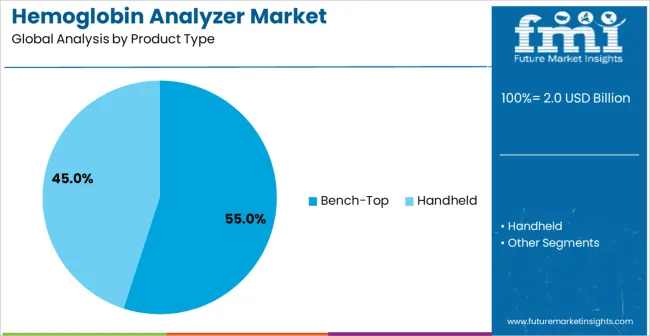
The Bench-Top product type is projected to hold 55.00% of the Hemoglobin Analyzer market revenue share in 2025, making it the leading product type. This segment’s growth is driven by its ability to provide high accuracy and reliability in controlled laboratory environments. Bench-top analyzers are widely preferred in hospitals and diagnostic laboratories where high throughput and consistent performance are required for large patient volumes.
The adoption of bench-top systems has been supported by their capacity to handle multiple samples efficiently and their integration with laboratory information management systems, which streamlines workflow. Additionally, their robust design allows for long-term usage without frequent maintenance, making them cost-effective over the instrument lifecycle.
The modular nature of bench-top analyzers allows for software upgrades and calibration adjustments, further enhancing their operational efficiency The segment benefits from healthcare providers’ preference for stable, high-performance platforms that support critical hematology testing, ensuring its dominant position in the market.
Insights into the Automatic Segment
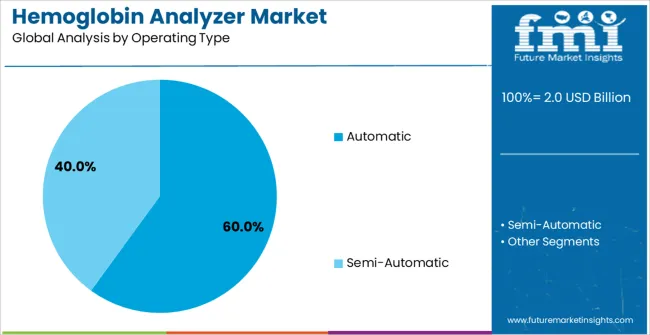
The Automatic operating type segment is expected to capture 60.00% of the total Hemoglobin Analyzer market revenue in 2025, establishing it as the leading operating mode. Growth in this segment is driven by the increasing demand for hands-free, high-throughput analysis that minimizes human error and ensures consistent accuracy.
Automatic analyzers allow laboratories and hospitals to standardize testing procedures while reducing labor requirements and operational complexity. The segment has benefited from technological enhancements, such as integrated sample handling, real-time data processing, and connectivity with hospital networks, enabling seamless reporting and record management.
The preference for automated systems has been particularly pronounced in high-volume hospital laboratories, where rapid turnaround time is critical for patient care and decision-making By providing enhanced efficiency, accuracy, and ease of use, automatic hemoglobin analyzers have become the preferred choice for institutions prioritizing workflow optimization and consistent test quality, supporting their market leadership.
Insights into the Hospital Segment
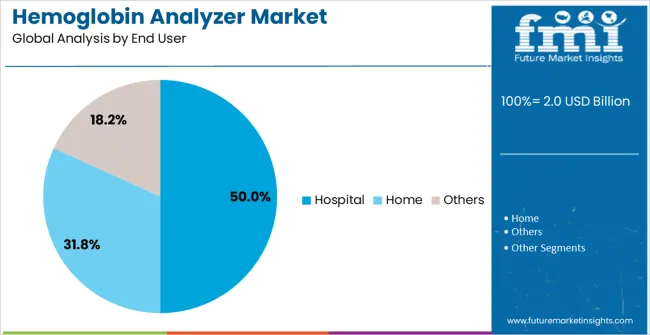
The Hospital end-user segment is projected to hold 50.00% of the Hemoglobin Analyzer market revenue share in 2025, making it the largest end-use segment. This leadership is driven by the high patient volumes and the need for accurate and timely blood analysis in clinical decision-making. Hospitals are increasingly investing in hemoglobin analyzers to ensure rapid detection and management of anemia and other hematological conditions.
The adoption is supported by the integration of analyzers with hospital information systems, which enhances workflow efficiency and data management. Hospitals also prioritize analyzers that offer high precision, reproducibility, and reliability, as these factors directly impact patient care quality.
Furthermore, the demand for automated and bench-top systems is being reinforced by the need to optimize laboratory operations and reduce turnaround times As healthcare facilities continue to expand and modernize, hospitals are expected to remain the primary consumers of hemoglobin analyzers, driving continued growth and innovation in the market.
Market Overview
Hemoglobin Analyzer Market: Overview
The increasing need for testing hemoglobin content in blood at the time of providing various medical treatments to the patents is one of the prime factors driving the hemoglobin analyzer market. The hemoglobin analyzer is used for determining the hemoglobin and hematocrit present in the blood sample.
The demand for hemoglobin analyzer is expected to increase over forecast period due to their ability to provide quick and accurate results which helps doctors and healthcare professionals to deliver treatment to the patients. Moreover, increasing awareness about blood testing in areas such as blood banks, malnutrition, and HIV programs is creating a need for using devices such as hemoglobin analyzer.
Also, high or low count of hemoglobin in blood reflects the presence of blood disorder in human being due to which the frequent hemoglobin checking is advised by doctors. Such factors are creating increasing demand for hemoglobin analyzer and ultimately fuelling the market growth.
Analysis of Hemoglobin Analyzer Market By Key Countries

| Country | CAGR |
|---|---|
| China | 9.6% |
| India | 8.9% |
| Germany | 8.2% |
| Brazil | 7.5% |
| USA | 6.7% |
| UK | 6.0% |
| Japan | 5.3% |
Country-wise Analysis
The Hemoglobin Analyzer Market is expected to register a CAGR of 7.1% during the forecast period, exhibiting varied country level momentum. China leads with the highest CAGR of 9.6%, followed by India at 8.9%. Developed markets such as Germany, France, and the UK continue to expand steadily, while the USA is likely to grow at consistent rates. Japan posts the lowest CAGR at 5.3%, yet still underscores a broadly positive trajectory for the global Hemoglobin Analyzer Market. In 2024, Germany held a dominant revenue in the Western Europe market and is expected to grow with a CAGR of 8.2%. The USA Hemoglobin Analyzer Market is estimated to be valued at USD 738.6 million in 2025 and is anticipated to reach a valuation of USD 738.6 million by 2035. Sales are projected to rise at a CAGR of 0.0% over the forecast period between 2025 and 2035. While Japan and South Korea markets are estimated to be valued at USD 101.4 million and USD 68.6 million respectively in 2025.
Key Players in the Hemoglobin Analyzer Market

- Mindray Medical International Limited
- Sysmex Corporation
- Beckman Coulter, Inc.
- Abbott Laboratories
- Roche Diagnostics
- Bio-Rad Laboratories, Inc.
- Nihon Kohden Corporation
- Siemens Healthineers
Scope of the Report
| Item | Value |
|---|---|
| Quantitative Units | USD 2.0 Billion |
| Product Type | Bench-Top and Handheld |
| Operating Type | Automatic and Semi-Automatic |
| End User | Hospital, Home, and Others |
| Regions Covered | North America, Europe, Asia-Pacific, Latin America, Middle East & Africa |
| Country Covered | United States, Canada, Germany, France, United Kingdom, China, Japan, India, Brazil, South Africa |
| Key Companies Profiled | Mindray Medical International Limited, Sysmex Corporation, Beckman Coulter, Inc., Abbott Laboratories, Roche Diagnostics, Bio-Rad Laboratories, Inc., Nihon Kohden Corporation, and Siemens Healthineers |
Hemoglobin Analyzer Market by Segments
Product Type:
- Bench-Top
- Handheld
Operating Type:
- Automatic
- Semi-Automatic
End User:
- Hospital
- Home
- Others
Region:
- North America
- USA
- Canada
- Mexico
- Latin America
- Brazil
- Chile
- Rest of Latin America
- Western Europe
- Germany
- UK
- Italy
- Spain
- France
- Nordic
- BENELUX
- Rest of Western Europe
- Eastern Europe
- Russia
- Poland
- Hungary
- Balkan & Baltic
- Rest of Eastern Europe
- East Asia
- China
- Japan
- South Korea
- South Asia and Pacific
- India
- ASEAN
- Australia & New Zealand
- Rest of South Asia and Pacific
- Middle East & Africa
- Kingdom of Saudi Arabia
- Other GCC Countries
- Turkiye
- South Africa
- Other African Union
- Rest of Middle East & Africa
Frequently Asked Questions
How big is the hemoglobin analyzer market in 2025?
The global hemoglobin analyzer market is estimated to be valued at USD 2.0 billion in 2025.
What will be the size of hemoglobin analyzer market in 2035?
The market size for the hemoglobin analyzer market is projected to reach USD 3.9 billion by 2035.
How much will be the hemoglobin analyzer market growth between 2025 and 2035?
The hemoglobin analyzer market is expected to grow at a 7.1% CAGR between 2025 and 2035.
What are the key product types in the hemoglobin analyzer market?
The key product types in hemoglobin analyzer market are bench-top and handheld.
Which operating type segment to contribute significant share in the hemoglobin analyzer market in 2025?
In terms of operating type, automatic segment to command 60.0% share in the hemoglobin analyzer market in 2025.
Preview the report firsthand - request a free sample
Get SampleGet the brochure for pricing and purchase details.
Get PDFTable of Content
- Executive Summary
- Global Market Outlook
- Demand-side Trends
- Supply-side Trends
- Technology Roadmap Analysis
- Analysis and Recommendations
- Market Overview
- Market Coverage / Taxonomy
- Market Definition / Scope / Limitations
- Market Background
- Market Dynamics
- Drivers
- Restraints
- Opportunity
- Trends
- Scenario Forecast
- Demand in Optimistic Scenario
- Demand in Likely Scenario
- Demand in Conservative Scenario
- Opportunity Map Analysis
- Product Life Cycle Analysis
- Supply Chain Analysis
- Investment Feasibility Matrix
- Value Chain Analysis
- PESTLE and Porter’s Analysis
- Regulatory Landscape
- Regional Parent Market Outlook
- Production and Consumption Statistics
- Import and Export Statistics
- Market Dynamics
- Global Market Analysis 2020 to 2024 and Forecast, 2025 to 2035
- Historical Market Size Value (USD Million) Analysis, 2020 to 2024
- Current and Future Market Size Value (USD Million) Projections, 2025 to 2035
- Y-o-Y Growth Trend Analysis
- Absolute $ Opportunity Analysis
- Global Market Pricing Analysis 2020 to 2024 and Forecast 2025 to 2035
- Global Market Analysis 2020 to 2024 and Forecast 2025 to 2035, By Product Type
- Introduction / Key Findings
- Historical Market Size Value (USD Million) Analysis By Product Type , 2020 to 2024
- Current and Future Market Size Value (USD Million) Analysis and Forecast By Product Type , 2025 to 2035
- Bench-Top
- Handheld
- Y-o-Y Growth Trend Analysis By Product Type , 2020 to 2024
- Absolute $ Opportunity Analysis By Product Type , 2025 to 2035
- Global Market Analysis 2020 to 2024 and Forecast 2025 to 2035, By Operating Type
- Introduction / Key Findings
- Historical Market Size Value (USD Million) Analysis By Operating Type, 2020 to 2024
- Current and Future Market Size Value (USD Million) Analysis and Forecast By Operating Type, 2025 to 2035
- Automatic
- Semi-Automatic
- Y-o-Y Growth Trend Analysis By Operating Type, 2020 to 2024
- Absolute $ Opportunity Analysis By Operating Type, 2025 to 2035
- Global Market Analysis 2020 to 2024 and Forecast 2025 to 2035, By End User
- Introduction / Key Findings
- Historical Market Size Value (USD Million) Analysis By End User, 2020 to 2024
- Current and Future Market Size Value (USD Million) Analysis and Forecast By End User, 2025 to 2035
- Hospital
- Home
- Others
- Y-o-Y Growth Trend Analysis By End User, 2020 to 2024
- Absolute $ Opportunity Analysis By End User, 2025 to 2035
- Global Market Analysis 2020 to 2024 and Forecast 2025 to 2035, By Region
- Introduction
- Historical Market Size Value (USD Million) Analysis By Region, 2020 to 2024
- Current Market Size Value (USD Million) Analysis and Forecast By Region, 2025 to 2035
- North America
- Latin America
- Western Europe
- Eastern Europe
- East Asia
- South Asia and Pacific
- Middle East & Africa
- Market Attractiveness Analysis By Region
- North America Market Analysis 2020 to 2024 and Forecast 2025 to 2035, By Country
- Historical Market Size Value (USD Million) Trend Analysis By Market Taxonomy, 2020 to 2024
- Market Size Value (USD Million) Forecast By Market Taxonomy, 2025 to 2035
- By Country
- USA
- Canada
- Mexico
- By Product Type
- By Operating Type
- By End User
- By Country
- Market Attractiveness Analysis
- By Country
- By Product Type
- By Operating Type
- By End User
- Key Takeaways
- Latin America Market Analysis 2020 to 2024 and Forecast 2025 to 2035, By Country
- Historical Market Size Value (USD Million) Trend Analysis By Market Taxonomy, 2020 to 2024
- Market Size Value (USD Million) Forecast By Market Taxonomy, 2025 to 2035
- By Country
- Brazil
- Chile
- Rest of Latin America
- By Product Type
- By Operating Type
- By End User
- By Country
- Market Attractiveness Analysis
- By Country
- By Product Type
- By Operating Type
- By End User
- Key Takeaways
- Western Europe Market Analysis 2020 to 2024 and Forecast 2025 to 2035, By Country
- Historical Market Size Value (USD Million) Trend Analysis By Market Taxonomy, 2020 to 2024
- Market Size Value (USD Million) Forecast By Market Taxonomy, 2025 to 2035
- By Country
- Germany
- UK
- Italy
- Spain
- France
- Nordic
- BENELUX
- Rest of Western Europe
- By Product Type
- By Operating Type
- By End User
- By Country
- Market Attractiveness Analysis
- By Country
- By Product Type
- By Operating Type
- By End User
- Key Takeaways
- Eastern Europe Market Analysis 2020 to 2024 and Forecast 2025 to 2035, By Country
- Historical Market Size Value (USD Million) Trend Analysis By Market Taxonomy, 2020 to 2024
- Market Size Value (USD Million) Forecast By Market Taxonomy, 2025 to 2035
- By Country
- Russia
- Poland
- Hungary
- Balkan & Baltic
- Rest of Eastern Europe
- By Product Type
- By Operating Type
- By End User
- By Country
- Market Attractiveness Analysis
- By Country
- By Product Type
- By Operating Type
- By End User
- Key Takeaways
- East Asia Market Analysis 2020 to 2024 and Forecast 2025 to 2035, By Country
- Historical Market Size Value (USD Million) Trend Analysis By Market Taxonomy, 2020 to 2024
- Market Size Value (USD Million) Forecast By Market Taxonomy, 2025 to 2035
- By Country
- China
- Japan
- South Korea
- By Product Type
- By Operating Type
- By End User
- By Country
- Market Attractiveness Analysis
- By Country
- By Product Type
- By Operating Type
- By End User
- Key Takeaways
- South Asia and Pacific Market Analysis 2020 to 2024 and Forecast 2025 to 2035, By Country
- Historical Market Size Value (USD Million) Trend Analysis By Market Taxonomy, 2020 to 2024
- Market Size Value (USD Million) Forecast By Market Taxonomy, 2025 to 2035
- By Country
- India
- ASEAN
- Australia & New Zealand
- Rest of South Asia and Pacific
- By Product Type
- By Operating Type
- By End User
- By Country
- Market Attractiveness Analysis
- By Country
- By Product Type
- By Operating Type
- By End User
- Key Takeaways
- Middle East & Africa Market Analysis 2020 to 2024 and Forecast 2025 to 2035, By Country
- Historical Market Size Value (USD Million) Trend Analysis By Market Taxonomy, 2020 to 2024
- Market Size Value (USD Million) Forecast By Market Taxonomy, 2025 to 2035
- By Country
- Kingdom of Saudi Arabia
- Other GCC Countries
- Turkiye
- South Africa
- Other African Union
- Rest of Middle East & Africa
- By Product Type
- By Operating Type
- By End User
- By Country
- Market Attractiveness Analysis
- By Country
- By Product Type
- By Operating Type
- By End User
- Key Takeaways
- Key Countries Market Analysis
- USA
- Pricing Analysis
- Market Share Analysis, 2024
- By Product Type
- By Operating Type
- By End User
- Canada
- Pricing Analysis
- Market Share Analysis, 2024
- By Product Type
- By Operating Type
- By End User
- Mexico
- Pricing Analysis
- Market Share Analysis, 2024
- By Product Type
- By Operating Type
- By End User
- Brazil
- Pricing Analysis
- Market Share Analysis, 2024
- By Product Type
- By Operating Type
- By End User
- Chile
- Pricing Analysis
- Market Share Analysis, 2024
- By Product Type
- By Operating Type
- By End User
- Germany
- Pricing Analysis
- Market Share Analysis, 2024
- By Product Type
- By Operating Type
- By End User
- UK
- Pricing Analysis
- Market Share Analysis, 2024
- By Product Type
- By Operating Type
- By End User
- Italy
- Pricing Analysis
- Market Share Analysis, 2024
- By Product Type
- By Operating Type
- By End User
- Spain
- Pricing Analysis
- Market Share Analysis, 2024
- By Product Type
- By Operating Type
- By End User
- France
- Pricing Analysis
- Market Share Analysis, 2024
- By Product Type
- By Operating Type
- By End User
- India
- Pricing Analysis
- Market Share Analysis, 2024
- By Product Type
- By Operating Type
- By End User
- ASEAN
- Pricing Analysis
- Market Share Analysis, 2024
- By Product Type
- By Operating Type
- By End User
- Australia & New Zealand
- Pricing Analysis
- Market Share Analysis, 2024
- By Product Type
- By Operating Type
- By End User
- China
- Pricing Analysis
- Market Share Analysis, 2024
- By Product Type
- By Operating Type
- By End User
- Japan
- Pricing Analysis
- Market Share Analysis, 2024
- By Product Type
- By Operating Type
- By End User
- South Korea
- Pricing Analysis
- Market Share Analysis, 2024
- By Product Type
- By Operating Type
- By End User
- Russia
- Pricing Analysis
- Market Share Analysis, 2024
- By Product Type
- By Operating Type
- By End User
- Poland
- Pricing Analysis
- Market Share Analysis, 2024
- By Product Type
- By Operating Type
- By End User
- Hungary
- Pricing Analysis
- Market Share Analysis, 2024
- By Product Type
- By Operating Type
- By End User
- Kingdom of Saudi Arabia
- Pricing Analysis
- Market Share Analysis, 2024
- By Product Type
- By Operating Type
- By End User
- Turkiye
- Pricing Analysis
- Market Share Analysis, 2024
- By Product Type
- By Operating Type
- By End User
- South Africa
- Pricing Analysis
- Market Share Analysis, 2024
- By Product Type
- By Operating Type
- By End User
- USA
- Market Structure Analysis
- Competition Dashboard
- Competition Benchmarking
- Market Share Analysis of Top Players
- By Regional
- By Product Type
- By Operating Type
- By End User
- Competition Analysis
- Competition Deep Dive
- Mindray Medical International Limited
- Overview
- Product Portfolio
- Profitability by Market Segments (Product/Age /Sales Channel/Region)
- Sales Footprint
- Strategy Overview
- Marketing Strategy
- Product Strategy
- Channel Strategy
- Sysmex Corporation
- Beckman Coulter, Inc.
- Abbott Laboratories
- Roche Diagnostics
- Bio-Rad Laboratories, Inc.
- Nihon Kohden Corporation
- Siemens Healthineers
- Mindray Medical International Limited
- Competition Deep Dive
- Assumptions & Acronyms Used
- Research Methodology


