

- Industry Size (2026)
- USD 17.2 Bn
- Forecast (2036)
- USD 46.8 Bn
- CAGR: 10.5%
- (2026 to 2036)
India Faith Based Tourism Market Size, Market Forecast and Outlook By FMI
The India faith based tourism market is expected to reach USD 17.2 billion in 2026 and USD 46.8 billion by 2036. The market is anticipated to register a 10.5% CAGR during the forecast period. Organized pilgrimage packages are expected to remain a leading product type, while Hindu pilgrimage circuits are likely to stay central due to major temple corridors and high-volume spiritual travel.
Summary of the India Faith Based Tourism Market
- Demand and Growth Drivers
- Government pilgrimage infrastructure spending is expected to increase organized travel across major religious corridors.
- Digital devotional platforms are likely to convert online puja users into physical temple visitors.
- Branded hospitality investment is anticipated to improve visitor experience in tier-2 and tier-3 spiritual cities.
- Product and Segment View
- Organized pilgrimage packages are expected to gain wider use as travelers seek planned transport and stay options.
- Temple and shrine accommodation is likely to stay important as high-volume pilgrim cities face lodging pressure.
- Digital devotional services are anticipated to expand as e-darshan and online puja platforms become mainstream.
- Geography and Competitive Outlook
- Northern India is expected to lead regional expansion due to the Varanasi-Ayodhya-Prayagraj corridor and Char Dham travel.
- Southern India is likely to record strong gains due to Tirupati, Rameswaram, and spiritual wellness destinations.
- Operators with curated circuits and temple-city hotel capacity are anticipated to gain stronger traveler capture.
- Analyst Opinion
- Ronak Shah, Principal Consultant for Travel and Tourism at FMI, suggests, “The India faith based tourism market is shifting toward structured pilgrimage experiences supported by infrastructure, hospitality, and digital planning. Operators that combine route knowledge, reliable accommodation, and pilgrim-focused services are likely to gain stronger relevance across major spiritual corridors.”
- India Faith Based Tourism Market Value Analysis
- The India faith based tourism market is moving from unorganized pilgrimage travel toward structured spiritual tourism.
- Spending is likely to rise as pilgrims use branded hotels, organized packages, and digital devotional services.
- Organized pilgrimage packages are expected to gain relevance as travelers seek safer and easier religious journeys.
- Northern India demand is anticipated to stay strong as major temple corridors attract large domestic pilgrim volumes.
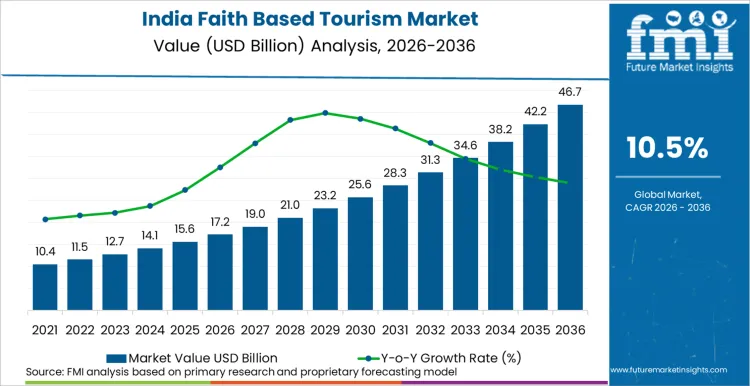
Key Takeaways, Market Size, and Forecast
- The India faith based tourism market is expected to reach USD 17.2 billion in 2026.
- By 2036, the India faith based tourism market is projected to reach USD 46.8 billion.
- From 2026 to 2036, the market is anticipated to expand at a 10.5% CAGR.
- Organized pilgrimage packages are expected to remain a leading product type through the forecast period.
- Hindu pilgrimage circuits are likely to remain the primary material type due to high pilgrim footfall.
- Northern India is projected to record the fastest regional expansion at 16.2% CAGR by 2036.
Summary of India Faith Based Tourism Market
What Is Growth Outlook for India Faith Based Tourism Market as per Future Market Insights Projection?
Future Market Insights projects the India faith based tourism market to expand at a CAGR of 10.5% from 2026 to 2036, increasing from USD 17.2 Billion in 2026 to USD 46.8 Billion by 2036.
FMI Research Approach: FMI proprietary forecasting model based on pilgrim footfall data, government infrastructure spending, and organized travel penetration rates.
How Do FMI Analysts Perceive India Faith Based Tourism Market to Evolve?
FMI analysts perceive the market evolving toward a digitally enabled, infrastructure-backed pilgrimage economy where AI-powered crowd management, branded hospitality at temple cities, and digital devotional platforms convert unorganized spiritual travel into structured tourism revenue.
FMI Research Approach: PRASHAD scheme allocation tracking and temple trust visitor data analysis.
Which Country Holds Largest Share in Global India Faith Based Tourism Market?
India is the sole country in this market scope, with Uttar Pradesh, Andhra Pradesh, Uttarakhand, and Tamil Nadu leading by pilgrim volume and associated tourism revenue.
FMI Research Approach: FMI state-level revenue modeling by temple footfall and accommodation spend per pilgrim.
How Large Will India Faith Based Tourism Market Be by 2036?
The India faith based tourism market is projected to reach USD 46.8 Billion by 2036.
FMI Research Approach: FMI long-term revenue forecast derived from government pilgrimage infrastructure investment multipliers and organized travel penetration projections.
What Is Definition of India Faith Based Tourism Market?
The India faith based tourism market includes revenue from pilgrimages, religious circuit tourism, temple visits, spiritual retreats, and associated hospitality, transport, and devotional services across Hindu, Buddhist, Sikh, Jain, Islamic, and Christian sacred sites in India.
FMI Research Approach: FMI market taxonomy and inclusion-exclusion framework.
What Are Globally Unique Trends Shaping India Faith Based Tourism Market?
Globally unique trends include the PRASHAD scheme's expanded funding for pilgrimage rejuvenation, the deployment of AI-powered crowd management at high-volume temples, and the entry of international hotel brands into tier-2 and tier-3 spiritual cities.
FMI Research Approach: Union Budget 2026-27 PRASHAD allocation data and Radisson Hotel Group expansion announcements.
India Faith Based Tourism Market Key Takeaways
| Metric | Details |
|---|---|
| Industry Size (2026) | USD 17.2 Billion |
| Industry Value (2036) | USD 46.8 Billion |
| CAGR (2026 to 2036) | 10.5% |
Source: Future Market Insights (FMI) analysis, based on proprietary forecasting model and primary research
Challenges and Opportunities
Challenges
Infrastructure Development and Managing Pilgrim Influx
Growth of India Faith Based Tourism Industry The Indian Tourism sector across cities and pilgrimage spots is expected to expand by the end of 2030, and this growth will introduce practical challenges pertaining to pilgrimage infrastructure development and managing the retention and influx of pilgrims visiting the country. The Father of the Nation wanted pilgrims to have a pleasant experience while visiting the most revered religious destinations in India, whether it is Varanasi, Tirupati, Golden Temple or any temple in India but it was not a sprouting innovation India standing any where from transportation availability, bathroom hygiene, accommodation availability and crowd management issues. There are also operational challenges due to differing regional policies, environmental concerns around sacred sites, and unregulated tourism services. Tourism organizations can act as facilitators in this scenario, giving insight to susceptible groups of pilgrims and encouraging sustainable tourism practices that follows proper health standards.
Opportunity
Growth in Pilgrimage Tourism and Spiritual Retreats
The segments of spiritual travel, heritage pilgrimage, and wellness tourism are gaining increasing traction and provide considerable scope for the growth of this India Faith-Based Tourism Market. Millions of pilgrims also visit domestically and internationally for religious and cultural tourism, such as Char Dham Yatra, Kumbh Mela and Sufi shrines. Keen to shake things up, the industry is being transformed by the rise of spiritual retreats, temple-based accommodations and guided faith tourism packages. Also, collaborations between tour operators, religious bodies, and hospitality providers are making pilgrim convenience smarter. The key area of growth will be in structured faith-based tourism, building sustainable pilgrimage infrastructure and providing personalized spiritual experiences.
Shifts in the India Faith-Based Tourism Market from 2021 to 2025 and Future Trends 2026 to 2036
The India Faith-Based Tourism Market remained steady between 2021 to 2025 on account of rising domestic religious journeys, enhanced pilgrimage infrastructure and government-backed initiatives to promote spiritual tourism. There was huge investment in connectivity, accommodations and pilgrim services in places like Ayodhya, Bodh Gaya and Shirdi. However, issues like concurrent crowd, variable travel comfort, and absence of organized tour system prevented the absolute strength of the segment. In response, businesses began to offer guided pilgrimage experiences, organized tour packages, and improved hospitality services in the vicinity of major religious sites.
When we look to the future, specifically the time frame between 2026 to 2036, market transformations will be seen through the development of faith-based travel circuits, heritage conservation programs, and eco-friendly pilgrim tours. The new era of the industry will be marked by the implementation of well-structured itineraries for religious tourism, projects dedicated to temple restoration, and accessibility solutions for senior citizens and differently-abled devotees. Moreover, the subsequent increase of wellness tourism associated with spiritual customs (like Ayurveda retreats and meditation hubs) would go well with conventional pilgrimage travel. The India Faith-Based Tourism Market will be driven by sustainable tourism companies, infrastructure modernization, and immersive spiritual experiences.
Market Shifts: A Comparative Analysis 2021 to 2025 vs. 2026 to 2036
| Market Shift | 2021 to 2025 Trends |
|---|---|
| Regulatory Landscape | Compliance with religious site management regulations and local tourism policies |
| Faith-Based Tourism Growth | Growth in domestic pilgrimage tourism and religious site refurbishments |
| Industry Adoption | Increased demand for guided temple tours, Sufi trail experiences, and monastery visits |
| Supply Chain and Sourcing | Dependence on traditional hospitality services and local transportation |
| Market Competition | Presence of local tour operators and religious institutions offering pilgrimage services |
| Market Growth Drivers | Demand for spiritual experiences, cultural heritage visits, and temple tourism |
| Sustainability and Energy Efficiency | Initial adoption of eco-conscious pilgrimage practices and green temple initiatives |
| Integration of Cultural Storytelling | Limited focus on historical narratives of religious sites |
| Advancements in Faith Tourism | Use of traditional pilgrimage routes, temple visits, and religious site tours |
| Market Shift | 2026 to 2036 Projections |
|---|---|
| Regulatory Landscape | Expansion of structured pilgrimage routes, enhanced site preservation laws, and sustainable faith-based tourism policies. |
| Faith-Based Tourism Growth | Expansion into international pilgrimage tourism, structured faith-tour circuits, and enhanced heritage site experiences. |
| Industry Adoption | Growth in personalized spiritual retreats, eco-friendly pilgrimage stays, and multi-faith tourism initiatives. |
| Supply Chain and Sourcing | Shift toward temple-run accommodations, sustainable lodging, and structured pilgrim travel services. |
| Market Competition | Expansion of faith-based travel agencies, customized pilgrimage tour providers, and wellness-integrated spiritual travel experiences. |
| Market Growth Drivers | Increased investment in structured pilgrimage circuits, heritage conservation programs, and government-backed religious tourism initiatives. |
| Sustainability and Energy Efficiency | Large-scale implementation of sustainable pilgrimage routes, solar-powered religious accommodations, and carbon-neutral travel options. |
| Integration of Cultural Storytelling | Increased emphasis on faith-based storytelling, heritage site documentation, and immersive pilgrimage experiences. |
| Advancements in Faith Tourism | Evolution of structured multi-faith travel, wellness-spiritual tourism, and heritage conservation-led religious tourism. |
Region-wise Outlook
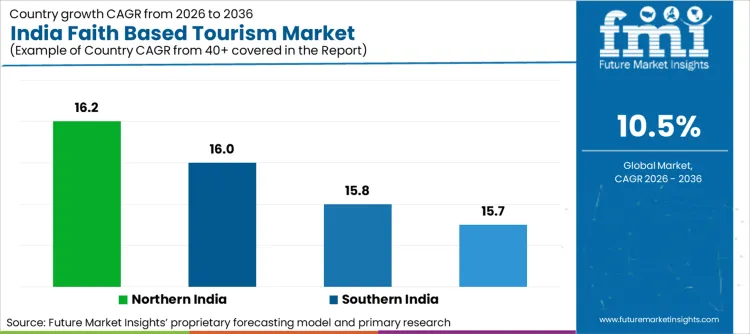
Northern India
North India is home to most of the faith-based tourism in India and attracts millions of pilgrims and spiritual seekers every year. It comprises sacred Hindu, Sikh, Buddhist, and Jain sites such as Varanasi, Haridwar, Rishikesh, Mathura, Amritsar and Ayodhya. In fact, one of the world's largest religious congregation that is Kumbh Mela, executes in India and is attended by millions of devotees, which gets heightened tourism activity and spiritual experience.Revival of pilgrimage routes and infrastructure projects like Ayodhya Ram Temple and Char Dham connectivity have never been as rewarding or buoyant for faith-based tourism. Moreover, of yoga retreats in Rishikesh and spiritual wellness tourism of Uttarakhands making this market wide also.
| Region | CAGR (2026 to 2036) |
|---|---|
| Northern India | 16.2% |
Western India
Religious tourism in western India is a steadily expanding sector, with major pilgrimage sites dedicated to Hinduism, Jainism, as well as Islam. Every year, millions of devotees visit the Sai Baba shrine, Shirdi, Somnath, Dwarka, Dilwara Temples at Mount Abu and Ajmer Sharif Dargah, among several other places in the region. With temple and heritage tourism, and the popularity of spiritual retreats, religious tourism is having a heyday in Maharashtra. The emerging trend of sustainable pilgrimage tours, along with heritage trails and temple restoration initiatives, is also driving growth in the market.
| Region | CAGR (2026 to 2036) |
|---|---|
| Western India | 15.8% |
Southern India
Temple tourism - which includes ancient Dravidian temple architecture, Christian pilgrimage destinations and Ayurveda-fortified spiritual retreats -is the southern half of the country’s glue. The region attracts millions of Hindu devotees to Tirupati Balaji, Madurai Meenakshi Temple and Rameswaram and draws Christian pilgrims to Velankanni and St. Thomas Basilca in Chennai. These food tourism, spiritual wellness programs and eco-friendly pilgrimage routes are gaining momentum and providing a thrust upwards to the faith-based tourism in the region. Kerala’s ashrams and Ayurvedic healing centers also have started attracting foreign tourists in the edit of spiritual detox-type experiences, or wishing to meditate.
| Region | CAGR (2026 to 2036) |
|---|---|
| Southern India | 16.0% |
Eastern and North-eastern India
The growing citation in Buddhism, Hinduism and tribalism make Eastern and North-Eastern state an emerging regional Hub for Spiritual-based Tourism, Despite being rich in culture and tradition, there are those endemic problems and the region also has Bodh Gaya, Puri Jagannath Temple, Kamakhya Temple, Gangasagar and a plethora of others that attract tourism and religious sentiments from all over the country and the world. Bihar, West Bengal and Sikkim are also boosting Sri Lanka, Japan and Thailand footfalls with restoration of Buddhist parikrama marg. North-Eastern India is overwhelmingly under-recognized for its Shakti Peeth temples, natural spiritual tradition and now growing niche tourism including monastic tourism.
| Region | CAGR (2026 to 2036) |
|---|---|
| Eastern and North-eastern India | 15.7% |
Segmentation Outlook -ndia Faith-Based Tourism Market
Pilgrimages and Religious & Heritage Tours Drive Market Growth as India Strengthens Its Position as a Global Spiritual Destination
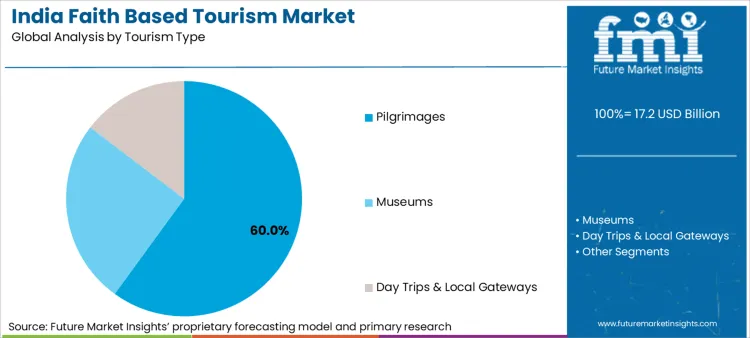
Religious & heritage tours & pilgrimage is the biggest segment of India's faith tourism, with local and foreign visitors in pursuit of religious, cultural, and spiritual experience within India's vast geography of sacred places. Religious travel activities are assigned the responsibility of developing local economies, maintaining spiritual heritage, and marketing India as worldwide leader among faith tourism destinations, and are thus strategically significant to tour operators, hospitality, and faith communities.
Pilgrims fuel business growth as religious pilgrimage to Hindu temples in India
Pilgrims have been the most frequent religious tourism industry segment, providing pilgrims the facility to draw near to divine temples, mosques, churches, and religion shrines to believers, faith tourists, and culture tourists. Pilgrim differs from the religious tourist as he/she never disrespects his/her religion because pilgrimage tourism greatly depends on religiosity, faith, and spirituality. Pilgrimage tourism is one of the strongest segments of Indian tourism industry visits.
Growing demands for the head pilgrimage centers, such as Vaishno Devi of Jammu & Kashmir, Tirupati Balaji of Andhra Pradesh, Shirdi of Maharashtra, Kashi Vishwanath Temple of Varanasi, and Ajmer Sharif Dargah of Rajasthan, have raised market acceptance with millions of pilgrims looking for blessings, spiritual enlightenment, and religious satisfaction each year. Over 60% of Indian domestic travelers undertake religious or spiritual pilgrimages at least once a year, thus generating sustainable demand for the industry. Senior citizen holiday tours, chartered pilgrim tours, and spiritual pilgrimages have emerged pilgrim tourism forms fueling market growth, thus creating market demand, providing convenience and comfort to pilgrims.
Introduction of digital pilgrimage platforms, temple darshan online booking, and pilgrim itineraries optimized on AI, and digital queue management at temples has also resulted in faster adoption, with improved user experience and automated processing of pilgrimage.
Launch of eco-spiritual and sustainable pilgrimage travel, zero-waste religious travel, river preservation pilgrimage routes (e.g., the Ganga route), and eco-temple retreats has pushed market development to a zenith in terms of direction toward global trends in sustainable travel.
Usage of multi-faith pilgrimage routes like Hindu Char Dham Yatra, Buddhist pilgrimage routes (Sarnath and Bodh Gaya), Sikh heritage tours (Amritsar Golden Temple and Hemkund Sahib), and Christian pilgrimage routes (Velankanni and St. Thomas Church in Kerala) has been the major market growth driver with assured patronage by the respective religious groups.
Though a major contributor to India's economic development, religious heritage, and tradition contribution, the pilgrimage tourism sector is plagued by religio-central saturation, infrastructural bottlenecks, and seasonally behaviorally unpredictable demand patterns. More recent AI-driven innovations of crowd management, blockchain-attached donation trail registration, and adaptive planning in the case of temple pilgrims are introducing higher efficiency, greater ease of access, and holiday convenience to the tourist population for the pilgrimage tourism industry in India, increasing all the larger in size.
Cultural and Historical Faith-Based Travel is becoming more popular as Religious & Heritage Tours are Piling Up
Religious & heritage tours were world bestsellers in the market for the most part among history enthusiasts, overseas travelers, and culture tourists because India is still in a position to preserve and market its centuries-old religious and historical heritage through the channels of organized tourism. Religious & heritage tours also differ from complete pilgrimage tourism in that they are more focused on history, architecture, and religion of sacred sites and give tourists rich stories to absorb.
Increased demand for UNESCO heritage religious destinations such as Mahabodhi Temple at Bodh Gaya, Sun Temple at Konark, Meenakshi Temple at Madurai, and Basilica of Bom Jesus at Goa has fueled religious & heritage tour demand with internationally mobile travelers seeking historically and spiritually suitable places. It is realized by research that more than 45% of global tourists who come to India incorporate it into their package for visiting some sacred or heritage spot so that demand is enormous in this segment.
Escorted heritage tour with divine tale, walk at historical places tour, and inquiry-based engagement at temple designs has increased the demand in the market, giving a boost to local as well as global tourists' involvement.
The intersection of tour customization and AI, temple tours by sound, history apps by AI, and virtual reality reconstruction of ancient religious places has facilitated adoption, and this has pushed heritage travelers to require more user experience and immersion on their end.
Creation of interfaith heritage pilgrim circuits like Buddhist pilgrim pilgrimages in Uttar Pradesh and Bihar, Jain heritage pilgrimages in Rajasthan and Gujarat, and Sufi shrine discovery pilgrimages in Delhi and Hyderabad has achieved its highest level of market development in a pluralistic and inclusive faith tourism strategy.
Culture art phobias marketed as religious tourism, such as medieval fresco finds at Kerala temples, Indo-Islamic architectural holidays in the Delhi region, and Ladakh monastery holidays, have seen growth in the market with increased participation by cultural and brain tourists.
Though well-positioned in inter-faith tolerance, heritage conservation, and cultural sensitivity, religious & heritage tours is susceptible to biased tourist infrastructure, financial limitations of protection of age-old monuments, and risks to safety of historical monuments. Yet, new-age upcoming technology for online monitoring of tourists, AI-enabled security patrol, and government-funded heritage restoration schemes is fueling religious & heritage tours even more in India's religion tourism sector.
Online and In-Person Booking Drive Market Growth as Digital and Experiential Faith-Based Travel Planning Becomes Mainstream
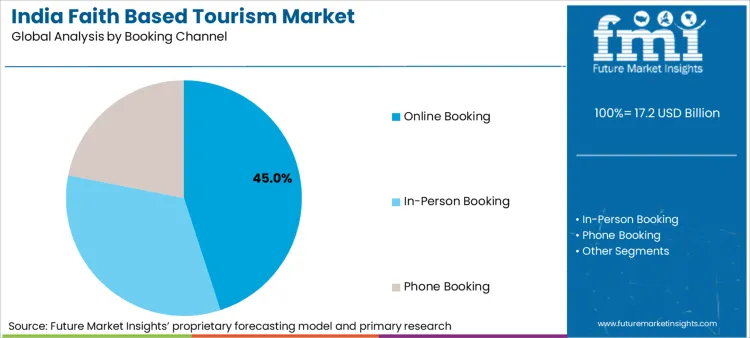
The in-person booking and online booking segments are two of the prime market drivers since religious travelers are now seamlessly incorporating digital pilgrimage planning into their travel arrangements, alongside on-the-ground experiential decision-making.
Online Booking Segment Dominates Market Demand with AI-Fuelled Personalisation and Digital Pilgrimage Planning Making It Easier
The web-based reservation segment has emerged as the most popular platform for religious travel reservations, allowing passengers the convenience of advance bookings for temple tours, guided heritage visits, and religion retreat accommodations in digital space, OTAs, and mobile websites. Compared with phone-based booking, online reservation allows instant verification of availability, immediate confirmation, and AI-led customized religious pilgrimage itineraries.
The growing need for mobile-first pilgrimage planning with app-based temple darshan bookings, AI-optimized travel routes, and digital donation services has driven the adoption of online booking, as pilgrims and faith tourists favour digital ease and planned spiritual experiences. Research shows that more than 65% of religious tourists in India now prefer digital bookings for their sacred travels, assuring robust demand for this segment.
With all its strengths in ease of accessibility, real-time confirmations, and AI-powered personalization, the online booking sector has limitations in terms of cybersecurity threats, poor digital literacy among senior pilgrims, and inconsistent booking availability during peak holy seasons. These, however, are being enhanced by upcoming trends in block chain-supported pilgrimage booking protection, multilingual travel planning platforms, and AI-powered predictive demand management, promoting security, ease of access, and smooth booking processes, for further market growth in online religious travel bookings.
In-Person Booking Grows as Spontaneous and Experience-Driven Faith Travelers Trust Local Recommendations
The in-person booking segment has experienced robust market uptake, especially among walk-in pilgrims, local temple-goers, and last-minute spiritual travellers, as religion-based tourists increasingly turn to real-time decision-making and local advice to inform their religious travel. In contrast to pre-booked digital reservations, in-person bookings enable travellers to investigate spontaneous spiritual opportunities on the basis of word-of-mouth recommendations, community-organized religious events, and local information.
The increasing need for flexible, on-the-ground religious experiences, including walk-in temple visits, impromptu spiritual retreats, and heritage site explorations, has fuelled in-person booking adoption, as faith travellers look for immersive and culturally relevant experiences.
With all its strengths in spontaneity, community experience, and flexibility, the face-to-face booking segment has had issues of invariable pricing, extensive wait periods during high pilgrim season, and scarcity of space for well-booked temple visits. That said, novel technologies in AI-based real-time queue monitoring, virtual temple access maps, and multilingual guide tour support are enhancing efficiency, accessibility, and tourist convenience to promote further growth for face-to-face booking within India's religion-tourism value chain.
Competitive Outlook
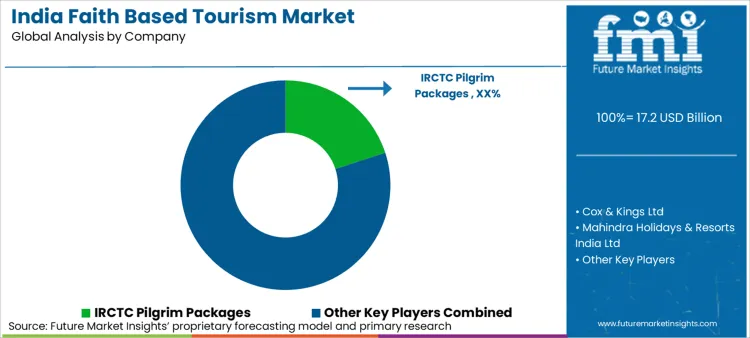
Growing trend in pilgrimage travel, religious heritage exploration, and spiritual tourism is driving growth in the India faith-based tourism market. Pilgrimage planners, temples, AI companies, and tourism operators are capitalizing on this trend offering AI-based pilgrimage planning, smart temple tourism, and digital religious travel platforms that help pilgrims be smarter, safer, and more culturally aware. Tourism boards, pilgrimage travel agencies, hotel suppliers, and religious organizations make up the market, paving the way for technological progress in digital pilgrimage booking, artificial intelligence-driven crowd management, and virtual temple engagement experiences.
Market Share Analysis by Key Players & Pilgrimage Travel Facilitators
| Company/Organization Name | Estimated Market Share (%) |
|---|---|
| IRCTC (Indian Railway Catering & Tourism Corporation) Pilgrim Packages | 20-25% |
| Yatra.com (Religious Tour Packages & Pilgrimage Booking) | 12-16% |
| Thomas Cook India (Faith-Based Travel Division) | 10-14% |
| SOTC Travel (India Religious Tourism Packages) | 8-12% |
| State Tourism Boards (UP, Uttarakhand, Tamil Nadu, Andhra Pradesh) | 5-9% |
| Other Travel Operators & Religious Trusts (combined) | 30-40% |
Recent Developments
- In November 2024, IRCTC announced the development of the Maha Kumbh Gram at Prayagraj for Mahakumbh 2025, featuring a luxury tent city with deluxe camps, Wi-Fi, 24/7 medical support, and eco-friendly battery-operated carts.
- In September 2025, TTD launched India's first AI-integrated command and control center for pilgrims, using over 6,000 AI-powered cameras for crowd flow monitoring, queue management, and predictive analytics.
- In June 2024, EaseMyTrip through its EasyDarshan vertical partnered with the Ayodhya Development Authority to launch the Theerth Yatri Sewa Booth, providing pilgrims with guided services and hotel booking assistance.
Market Definition
The India faith based tourism market represents revenue generated from religious and spiritual travel within India, including pilgrimage, religious circuit tourism, temple visits, spiritual retreats, and associated support services. The market measures the value of organized pilgrimage packages, accommodation at spiritual destinations, transport services, devotional product purchases, and digital devotional platform subscriptions.
Inclusions cover organized pilgrimage tour packages (Char Dham, Varanasi, Tirupati, Amarnath), hotel and dharamshala accommodation revenue at spiritual destinations, temple trust managed guest house revenue, digital devotional platforms (online puja, e-darshan), pilgrimage transport services (rail, road, air charter), and spiritual retreat and yoga ashram programs. Revenue from religious event tourism (Kumbh Mela, Rath Yatra) is also included.
Exclusions include general hotel revenue at cities that happen to contain temples but where the stay is not motivated by pilgrimage, routine local temple visit spending by resident populations, construction and engineering revenue from temple and corridor infrastructure projects, and government budgetary allocations that are inputs rather than market revenue. Religious goods manufacturing revenue not sold at pilgrimage points of sale is outside the scope.
Scope of Report
| Items | Values |
|---|---|
| Quantitative Units (2026) | USD 17.2 Billion |
| Product Type | Organized Pilgrimage Packages, Temple Accommodation, Spiritual Retreats, Digital Devotional Platforms, Pilgrimage Transport |
| Material Type | Hindu Pilgrimage, Buddhist Circuit Tourism, Sikh Pilgrimage, Jain Pilgrimage, Islamic and Christian Heritage Tourism |
| End-Use / Channel | Tour Operators (Thomas Cook, SOTC), Digital Platforms (EaseMyTrip, MakeMyTrip), Temple Trust Services, IRCTC Packages |
| Regions Covered | North India, South India, West India, East India, Northeast India |
| Countries Covered | India (Uttar Pradesh, Andhra Pradesh, Uttarakhand, Tamil Nadu, Punjab, Madhya Pradesh, and 28+ states) |
| Key Companies Profiled | Thomas Cook India, SOTC Travel, EaseMyTrip (EasyDarshan), IRCTC, MakeMyTrip, Radisson Hotel Group, Lemon Tree Hotels, AppsForBharat (Sri Mandir) |
| Additional Attributes | Revenue analysis by pilgrimage circuit and faith tradition, PRASHAD scheme investment impact assessment, digital devotional platform adoption tracking, organized vs. unorganized travel penetration, and AI crowd management deployment tracking |
Top Segments Studied in the India Faith-Based Tourism Market Research Report
By Product Type:
- Organized Pilgrimage Packages
- Temple and Shrine Accommodation
- Spiritual Retreats and Yoga Ashrams
- Digital Devotional Services (Online Puja, e-Darshan)
- Pilgrimage Transport Services
By Material Type:
- Hindu Pilgrimage Circuits
- Buddhist Heritage Tourism
- Sikh Pilgrimage
- Jain Pilgrimage
- Islamic and Christian Heritage Tourism
By Region:
- North India
- South India
- West India
- East India
- Northeast India
Bibliography
- Ministry of Finance, Government of India. (2026, February). Union Budget 2026-27 PRASHAD scheme allocation. Press Information Bureau.
- Tirumala Tirupati Devasthanams (TTD). (2025, September). AI-integrated command and control center launch. TTD Official.
- Radisson Hotel Group. (2026, January). Radisson Hotel Ujjain launch announcement. Economic Times Hospitality.
- Indian Railway Catering and Tourism Corporation (IRCTC). (2024, November). Maha Kumbh Gram development announcement. IRCTC.
Frequently Asked Questions
What is the current market size for India Faith Based Tourism?
The market is valued at USD 17.2 Billion in 2026, driven by PRASHAD scheme investment and AI-powered pilgrim management infrastructure.
What is the projected Compound Annual Growth Rate (CAGR) for the market over the next 10 years?
The market is projected to grow at a CAGR of 10.5% from 2026 to 2036.
Which states are leading faith based tourism in India?
Uttar Pradesh, Andhra Pradesh, Uttarakhand, and Tamil Nadu lead by pilgrim volume, with UP's Varanasi-Ayodhya-Prayagraj corridor attracting the highest footfall.
What are the primary market drivers?
Government infrastructure investment through PRASHAD, the entry of international hotel brands into temple cities, and digital devotional platform adoption are the primary drivers.
Who are the leading operators in the industry?
Thomas Cook India, IRCTC, EaseMyTrip (EasyDarshan), and Radisson Hotel Group are key players, differentiating through curated pilgrimage circuits and premium hospitality at spiritual destinations.
Preview the report firsthand - request a free sample
Get SampleGet the brochure for pricing and purchase details.
Get PDFTable of Content
- Key Takeaways
- Market Size and CAGR
- Top Growth Driver
- Fastest Growing Segment
- Leading Region
- Key Companies
- Emerging Opportunities
- Executive Summary
- Global Market Outlook
- Demand-side Trends
- Supply-side Trends
- Technology Roadmap Analysis
- Analysis and Recommendations
- Analyst Perspective (What is happening? Why now? What should investors know?)
- Key Questions Answered
- How large is the market?
- What is the CAGR?
- What are key trends?
- Which region dominates?
- Who are the leaders?
- Market Overview
- Market Coverage / Taxonomy
- Market Definition / Scope / Limitations
- Research Methodology
- Chapter Orientation
- Analytical Lens and Working Hypotheses
- Market Structure, Signals, and Trend Drivers
- Benchmarking and Cross-market Comparability
- Market Sizing, Forecasting, and Opportunity Mapping
- Research Design and Evidence Framework
- Desk Research Programme (Secondary Evidence)
- Expert Input and Fieldwork (Primary Evidence)
- Tooling, Models, and Reference Databases
- Data Engineering and Model Build
- Quality Assurance and Audit Trail
- Market Background
- Market Dynamics (Drivers, Restraints, Opportunity, Trends)
- Scenario Forecast (Optimistic, Likely, Conservative)
- Impact Analysis
- AI Impact
- Sustainability Impact
- Regulatory Impact
- Technology Impact
- Consumer / Buyer Analysis
- Purchase Drivers
- Adoption Barriers
- Buyer Journey
- Opportunity Map Analysis
- Product Life Cycle Analysis
- Supply Chain Analysis
- Investment Feasibility Matrix
- Value Chain Analysis
- PESTLE and Porter's Analysis
- Regulatory Landscape
- Regional Parent Market Outlook
- Production and Consumption Statistics
- Import and Export Statistics
- Global Market Analysis and Forecast, 2021 to 2036
- Historical Market Size Value (USD Billion) Analysis, 2021 to 2025
- Current and Future Market Size Value (USD Billion) Projections, 2026 to 2036
- Y-o-Y Growth Trend Analysis
- Absolute $ Opportunity Analysis
- Global Market Pricing Analysis, 2021 to 2036
- Global Market Analysis and Forecast, By Tourism Type, 2021 to 2036
- Introduction / Key Findings
- Historical Market Size Value (USD Billion) Analysis By Tourism Type, 2021 to 2025
- Current and Future Market Size Value (USD Billion) Analysis and Forecast By Tourism Type, 2026 to 2036
- Pilgrimages
- Museums
- Day Trips & Local Gateways
- Pilgrimages
- Y-o-Y Growth Trend Analysis By Tourism Type, 2021 to 2025
- Absolute $ Opportunity Analysis By Tourism Type, 2026 to 2036
- Global Market Analysis and Forecast, By Booking Channel, 2021 to 2036
- Introduction / Key Findings
- Historical Market Size Value (USD Billion) Analysis By Booking Channel, 2021 to 2025
- Current and Future Market Size Value (USD Billion) Analysis and Forecast By Booking Channel, 2026 to 2036
- Online Booking
- In-Person Booking
- Phone Booking
- Online Booking
- Y-o-Y Growth Trend Analysis By Booking Channel, 2021 to 2025
- Absolute $ Opportunity Analysis By Booking Channel, 2026 to 2036
- Global Market Analysis and Forecast, By Region, 2021 to 2036
- Introduction
- Historical Market Size Value (USD Billion) Analysis By Region, 2021 to 2025
- Current Market Size Value (USD Billion) Analysis and Forecast By Region, 2026 to 2036
- North America
- Latin America
- Western Europe
- Eastern Europe
- East Asia
- South Asia and Pacific
- Middle East & Africa
- Market Attractiveness Analysis By Region
- North America Market Analysis and Forecast, By Country, 2021 to 2036
- Historical Market Size Value (USD Billion) Trend Analysis By Market Taxonomy, 2021 to 2025
- Market Size Value (USD Billion) Forecast By Market Taxonomy, 2026 to 2036
- By Country
- USA
- Canada
- By Tourism Type
- By Booking Channel
- By Country
- Market Attractiveness Analysis
- By Country
- By Tourism Type
- By Booking Channel
- Key Takeaways
- Latin America Market Analysis and Forecast, By Country
- Historical Market Size Value (USD Billion) Trend Analysis By Market Taxonomy, 2021 to 2025
- Market Size Value (USD Billion) Forecast By Market Taxonomy, 2026 to 2036
- By Country
- Brazil
- Mexico
- Chile
- Rest of Latin America
- By Tourism Type
- By Booking Channel
- By Country
- Market Attractiveness Analysis
- By Country
- By Tourism Type
- By Booking Channel
- Key Takeaways
- Western Europe Market Analysis and Forecast, By Country
- Historical Market Size Value (USD Billion) Trend Analysis By Market Taxonomy, 2021 to 2025
- Market Size Value (USD Billion) Forecast By Market Taxonomy, 2026 to 2036
- By Country
- Germany
- UK
- Italy
- Spain
- France
- Nordic
- BENELUX
- Rest of Western Europe
- By Tourism Type
- By Booking Channel
- By Country
- Market Attractiveness Analysis
- By Country
- By Tourism Type
- By Booking Channel
- Key Takeaways
- Eastern Europe Market Analysis and Forecast, By Country
- Historical Market Size Value (USD Billion) Trend Analysis By Market Taxonomy, 2021 to 2025
- Market Size Value (USD Billion) Forecast By Market Taxonomy, 2026 to 2036
- By Country
- Russia
- Poland
- Hungary
- Balkan & Baltic
- Rest of Eastern Europe
- By Tourism Type
- By Booking Channel
- By Country
- Market Attractiveness Analysis
- By Country
- By Tourism Type
- By Booking Channel
- Key Takeaways
- East Asia Market Analysis and Forecast, By Country
- Historical Market Size Value (USD Billion) Trend Analysis By Market Taxonomy, 2021 to 2025
- Market Size Value (USD Billion) Forecast By Market Taxonomy, 2026 to 2036
- By Country
- China
- Japan
- South Korea
- By Tourism Type
- By Booking Channel
- By Country
- Market Attractiveness Analysis
- By Country
- By Tourism Type
- By Booking Channel
- Key Takeaways
- South Asia and Pacific Market Analysis and Forecast, By Country
- Historical Market Size Value (USD Billion) Trend Analysis By Market Taxonomy, 2021 to 2025
- Market Size Value (USD Billion) Forecast By Market Taxonomy, 2026 to 2036
- By Country
- India
- ASEAN
- Australia & New Zealand
- Rest of South Asia and Pacific
- By Tourism Type
- By Booking Channel
- By Country
- Market Attractiveness Analysis
- By Country
- By Tourism Type
- By Booking Channel
- Key Takeaways
- Middle East & Africa Market Analysis and Forecast, By Country
- Historical Market Size Value (USD Billion) Trend Analysis By Market Taxonomy, 2021 to 2025
- Market Size Value (USD Billion) Forecast By Market Taxonomy, 2026 to 2036
- By Country
- Kingdom of Saudi Arabia
- Other GCC Countries
- Türkiye
- South Africa
- Other African Union
- Rest of Middle East & Africa
- By Tourism Type
- By Booking Channel
- By Country
- Market Attractiveness Analysis
- By Country
- By Tourism Type
- By Booking Channel
- Key Takeaways
- Key Countries Market Analysis
- USA
- Pricing Analysis
- Market Share Analysis, 2025
- By Tourism Type
- By Booking Channel
- Canada
- Pricing Analysis
- Market Share Analysis, 2025
- By Tourism Type
- By Booking Channel
- Mexico
- Pricing Analysis
- Market Share Analysis, 2025
- By Tourism Type
- By Booking Channel
- Brazil
- Pricing Analysis
- Market Share Analysis, 2025
- By Tourism Type
- By Booking Channel
- Chile
- Pricing Analysis
- Market Share Analysis, 2025
- By Tourism Type
- By Booking Channel
- Germany
- Pricing Analysis
- Market Share Analysis, 2025
- By Tourism Type
- By Booking Channel
- UK
- Pricing Analysis
- Market Share Analysis, 2025
- By Tourism Type
- By Booking Channel
- Italy
- Pricing Analysis
- Market Share Analysis, 2025
- By Tourism Type
- By Booking Channel
- Spain
- Pricing Analysis
- Market Share Analysis, 2025
- By Tourism Type
- By Booking Channel
- France
- Pricing Analysis
- Market Share Analysis, 2025
- By Tourism Type
- By Booking Channel
- India
- Pricing Analysis
- Market Share Analysis, 2025
- By Tourism Type
- By Booking Channel
- ASEAN
- Pricing Analysis
- Market Share Analysis, 2025
- By Tourism Type
- By Booking Channel
- Australia & New Zealand
- Pricing Analysis
- Market Share Analysis, 2025
- By Tourism Type
- By Booking Channel
- China
- Pricing Analysis
- Market Share Analysis, 2025
- By Tourism Type
- By Booking Channel
- Japan
- Pricing Analysis
- Market Share Analysis, 2025
- By Tourism Type
- By Booking Channel
- South Korea
- Pricing Analysis
- Market Share Analysis, 2025
- By Tourism Type
- By Booking Channel
- Russia
- Pricing Analysis
- Market Share Analysis, 2025
- By Tourism Type
- By Booking Channel
- Poland
- Pricing Analysis
- Market Share Analysis, 2025
- By Tourism Type
- By Booking Channel
- Hungary
- Pricing Analysis
- Market Share Analysis, 2025
- By Tourism Type
- By Booking Channel
- Kingdom of Saudi Arabia
- Pricing Analysis
- Market Share Analysis, 2025
- By Tourism Type
- By Booking Channel
- Türkiye
- Pricing Analysis
- Market Share Analysis, 2025
- By Tourism Type
- By Booking Channel
- South Africa
- Pricing Analysis
- Market Share Analysis, 2025
- By Tourism Type
- By Booking Channel
- USA
- Market Structure Analysis
- Competition Dashboard
- Competition Benchmarking
- Market Share Analysis of Top Players
- By Regional
- By Tourism Type
- By Booking Channel
- Emerging Startups
- Innovation Benchmarking
- Competition Analysis
- Competition Deep Dive
- IRCTC (Indian Railway Catering & Tourism Corporation) Pilgrim Packages
- Overview
- Product Portfolio
- Profitability by Market Segments
- Sales Footprint
- Strategy Overview
- Marketing Strategy
- Product Strategy
- Channel Strategy
- Yatra.com (Religious Tour Packages & Pilgrimage Booking)
- Thomas Cook India (Faith-Based Travel Division)
- SOTC Travel (India Religious Tourism Packages)
- State Tourism Boards (UP, Uttarakhand, Tamil Nadu, Andhra Pradesh)
- Other Travel Operators & Religious Trusts (combined)
- IRCTC (Indian Railway Catering & Tourism Corporation) Pilgrim Packages
- Case Studies
- Success Stories
- Recent Developments
- Competition Deep Dive
- Assumptions & Acronyms Used


