

- Market Size (2026)
- USD 0.7 Bn
- Forecast (2036)
- USD 1.4 Bn
- CAGR (2026 to 2036)
- 7.5%
How big is Industrial IR Illuminator Market in 2026?
USD 0.7 Billion in 2026 and USD 1.4 Billion by 2036 at a 7.5% CAGR.
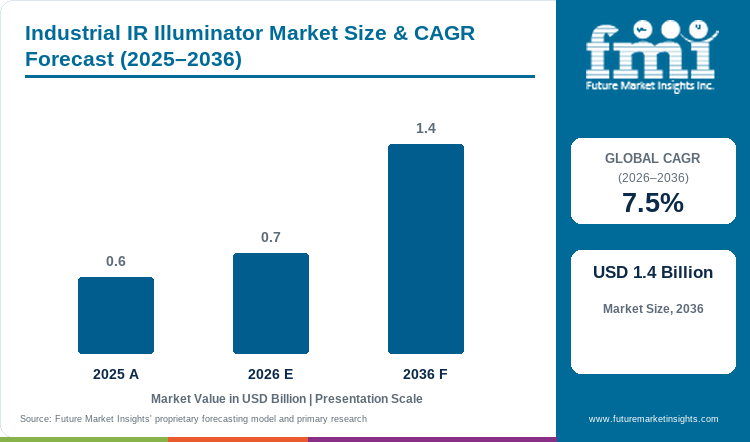
The Industrial IR Illuminator market stood at USD 0.6 Billion in 2025, is estimated at USD 0.7 Billion in 2026, and is forecast to reach USD 1.4 Billion by 2036 at a 7.5% CAGR from 2026 to 2036.
Industrial IR illumination moves with investment in automated imaging because the light source determines whether a camera receives stable contrast from the feature under inspection. The International Federation of Robotics reported in September 2025 that 542,000 industrial robots were installed worldwide in 2024.
Asia accounted for 74% of those deployments. That installed base expands the number of workcells where controlled NIR illumination can be specified. Common uses include inspection and guidance. Identification and process verification add further demand.
The purchasing decision is rarely a stand-alone choice of wavelength. Integrators usually qualify the emitter with camera sensitivity and working distance. They also test optical geometry and strobe timing. Enclosure needs form another qualification step.
As automation spreads into faster lines and less controlled environments, buyers place more value on repeatable illumination that can hold a validated image recipe across shifts and product variants.
Adoption conditions differ sharply across the profiled countries. The USA combines a large system-integrator base with renewed automation investment; industrial robot installations reached 38,000 units in 2025 according to IFR in June 2026.
Germany has a dense automation base and an engineering-led qualification culture. Japan combines mature automotive automation with a large electrical and electronics installed base.
South Korea and Taiwan place more emphasis on electronics production, semiconductor-adjacent inspection and compact high-throughput automation. These differences change the acceptable balance between a standard 850 nm light, a covert 940 nm source or a multi-wavelength and SWIR configuration.
Interest converts into purchase when the supplier can prove contrast at the target speed and geometry while meeting the site requirements for control, thermal stability, and enclosure protection.
Key Takeaways
- The market is estimated at USD 0.7 Billion in 2026 and is forecast to reach USD 1.4 Billion by 2036 at a 7.5% CAGR.
- 850 nm leads in 2026. LED IR illuminators lead in 2026.
- Machine vision leads in 2026. IP-rated outdoor housing leads in 2026. Machine vision distributors lead in 2026.
- Driver: Growth in robotic automation and automated inspection increases the installed base of camera stations that require controlled IR illumination.
- Restraint: Lighting must be qualified against surface behavior and camera response. Geometry and ambient light also matter alongside safety or enclosure requirements before deployment.
- Opportunity: NIR, SWIR and multi-wavelength illumination can enable material differentiation and hidden-feature inspection beyond conventional visible imaging. Taiwan has the highest profiled country CAGR at 8.2%, compared with Japan at 6.1%.
Analyst Perspective
The strongest suppliers reduce the cost and time of proving an image, not simply the unit price of the light. Field-adjustable optics and controllable strobing shorten iteration when parts, speeds or camera settings change.
- Sudip Saha, Principal Consultant, Future Market Insights
How is the Industrial IR Illuminator Market segmented?
The market is segmented by Wavelength, Product Type, Application, Housing, and Sales Channel.
Wavelength separates illuminators by the spectral band used to create contrast or reveal material behavior. Product Type distinguishes the emitter technology and the physical light geometry specified around a camera. Application identifies the workflow in which the light contributes to image acquisition.
Housing reflects the environmental protection and integration constraints at the installation point. Sales Channel captures whether the buyer relies on specialist distribution or direct OEM engagement. System integrators and security-focused channels provide other routes to market.
Across these axes, the commercial advantage comes from matching optical output to the camera and task instead of maximizing light intensity in isolation.
What makes 850 nm central to the Wavelength category?
850 nm sits in a practical zone for industrial near-IR imaging because many silicon-based machine-vision sensors retain useful sensitivity near this wavelength. The light is invisible enough to reduce operator distraction while still producing stronger camera response than longer near-IR options in many setups.
Raytec technical guidance notes that 850 nm is generally preferred when maximum camera performance and distance are priorities, while 940 nm trades imaging efficiency for greater covertness. This balance suits inspection cells and robotic guidance.
It also supports traffic imaging and security applications where active illumination must deliver usable contrast at controlled exposure times.
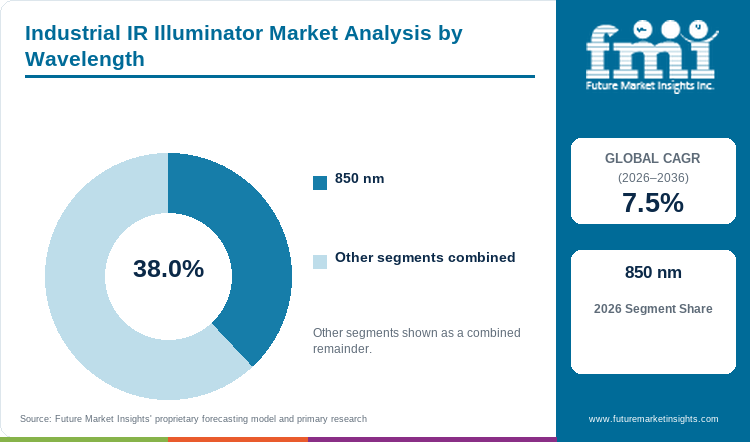
- The 850 nm band holds a 38.0% share in 2026 because it balances camera sensitivity with emitter availability and usable working distance.
- Metaphase Technologies stated in November 2025 that its TXFL platform includes near-infrared configurations at 850 nm and 940 nm alongside broader spectral options.
Why do LED IR illuminators lead the Product Type category?
LED-based illuminators fit industrial imaging because their output can be switched rapidly. The same emitter technology can be packaged as rings or bars. Area and embedded geometries extend coverage.
They also support direct intensity control and overdrive strobing without the warm-up behavior associated with older lamp technologies. For integrators, the service-life advantage matters because lighting drift or source replacement can disturb a validated image recipe.
LEDs also allow manufacturers to reuse the same mechanical platform while changing wavelength or beam angle. Diffusers and controller choices can then be configured around the application. That combination lowers redesign effort when the inspection task changes but the station architecture remains fixed.
- LED IR illuminators hold 34.0% share in 2026 because fast switching, compact packaging, and configurable optics fit automated image-acquisition cycles.
- Advanced Illumination announced in March 2025 that its AL325 modular LED bar light supports 16 wavelengths with field-swappable lenses and light-conditioning materials.
How does Machine vision anchor the Application category?
Machine vision creates direct demand for dedicated illumination because the camera can only classify or measure features that the optical setup renders consistently.
IR becomes useful when visible colors create unwanted variation, when reflections need to be suppressed, or when material absorption provides a stronger signal beyond the visible spectrum.
The Association for Advancing Automation notes that lighting geometry and wavelength can determine whether a vision system produces stable contrast. Ambient light and surface characteristics also change the result.
As inspection shifts toward higher throughput and autonomous decisions, buyers treat the illuminator as part of the measurement chain rather than a generic lamp.
- Machine vision holds 32.0% share in 2026 because industrial inspection depends on repeatable contrast and synchronized illumination at the point of image capture.
- CCS Inc. announced in September 2025 that CCS Europe and Effilux jointly opened a Munich Light Lab where customers can test machine-vision lighting with cameras and lenses.
What supports IP-rated outdoor housing within the Housing category?
Outdoor and exposed industrial installations face dust and washdown. Condensation and vibration add further stress. Wide operating conditions can also undermine optical consistency or electronics life.
An IP rating gives buyers a standardized way to screen enclosure protection before the light enters site qualification. IEC 60529 defines the classification system for protection provided by electrical enclosures against ingress. That requirement is especially relevant in traffic systems and logistics portals.
Food handling areas and exposed process inspection create similar enclosure demands. A sealed product can reduce the need for secondary housings and simplifies the mechanical integration of lights near cameras or moving equipment.
- IP-rated outdoor housing holds 38.0% share in 2026 because environmental protection reduces integration risk in exposed or washdown-prone installations.
- Metaphase Technologies reported in November 2025 that IP67-rated TXFL configurations are available for harsh environments and can be specified with IR or SWIR output.
What drives Machine vision distributors in the Sales Channel category?
Specialist distributors remain influential because an industrial IR light is usually selected with cameras and lenses. Filters and controller choices often enter the same qualification. Cabling adds another integration detail.
The distributor can therefore reduce the number of interfaces a buyer must coordinate during application testing. That role is strongest for mid-volume projects where a direct custom program is unnecessary but generic e-commerce support is insufficient.
Local stock also helps integrators replace or reconfigure lights without extending machine downtime. As spectral choices broaden into SWIR and multispectral systems, channel value shifts toward application engineering and loaner testing rather than simple product fulfillment.
- Machine vision distributors hold 37.0% share in 2026 because buyers value application support, multi-vendor integration, and local access during qualification.
- Metaphase Technologies stated in November 2025 that the TXFL Series was available immediately through its global distribution network, illustrating the continuing role of specialist channels.
What are the drivers, restraints, and opportunities in the Industrial IR Illuminator Market?
Factory automation expands the number of controlled imaging points, while application-specific qualification slows conversion and multispectral IR opens higher-value inspection use cases.
- Driver: Growth in robotic automation and automated inspection increases the installed base of camera stations that require controlled IR illumination.
- Restraint: Lighting must be qualified against surface behavior and camera response. Geometry and ambient light also matter alongside safety or enclosure requirements before deployment.
- Opportunity: NIR, SWIR, and multi-wavelength illumination can enable material differentiation and hidden-feature inspection beyond conventional visible imaging.
Automation investment is the primary demand mechanism because every new vision-guided robot or automated inspection station creates another optical design problem. IFR reported in September 2025 that global industrial robot installations reached 542,000 units in 2024.
The USA then recorded 38,000 robot installations in 2025 according to IFR in June 2026. These deployments do not translate one-for-one into IR light purchases. They expand the installed base of workcells where IR can solve reflection or color problems.
Covert illumination and material contrast create additional use cases. Suppliers benefit when they can pair standard products with enough optical and control flexibility to fit multiple automation platforms.
The main restraint appears during application qualification rather than at first interest. A3 guidance emphasizes that surface texture and reflectivity can change the resulting image. Light direction and wavelength are also critical. Ambient conditions add another source of variation.
The camera sensor and exposure timing add another dependency. IEC 62471 also establishes photobiological safety evaluation requirements for LED and other incoherent sources between 200 nm and 3000 nm.
These factors can lengthen test cycles and raise engineering cost because a light that performs on one part or station may fail after a geometry change. Buyers therefore resist broad rollouts until the image recipe is reproducible under production conditions.
The clearest opportunity is the move from simple illumination toward spectral discrimination. NIST released NIR-SORT 2.0 in March 2026 to support model validation for automated textile identification using near-infrared spectral signatures.
The program shows how reflected spectral information can become part of an industrial classification workflow instead of merely increasing image brightness. ProPhotonix launched COBRA NX MultiSpec in April 2025 with RGB-IR and RGB-SWIR configurations plus independent wavelength control.
Commercial adoption improves when suppliers lower the cost of spectral experimentation and provide stable illumination that integrates with cameras, algorithms, and line controls. Application labs and configurable platforms are well placed to convert these pilots into repeatable systems.
Which country CAGRs are profiled in the Industrial IR Illuminator Market?
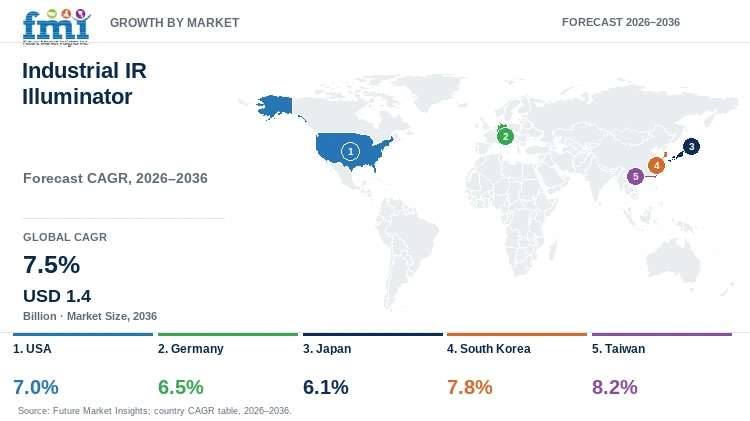
| Country | CAGR |
|---|---|
| USA | 7.0% |
| Germany | 6.5% |
| Japan | 6.1% |
| South Korea | 7.8% |
| Taiwan | 8.2% |
How do country-level CAGRs compare in the Industrial IR Illuminator Market?
The profiled CAGRs span 2.1 percentage points from Taiwan at 8.2% to Japan at 6.1% from 2026 to 2036. Taiwan and South Korea form the upper-growth band because electronics-heavy manufacturing and automation investment support faster deployment. The USA sits in the middle at 7.0%.
Germany and Japan form a mature-automation band at 6.5% and 6.1%, respectively. The pattern indicates different rates of new-system formation and retrofit activity. It does not show absolute market size. Suppliers should therefore use CAGR as a timing signal and combine it with installed automation.
Application mix and qualification burden also matter. Channel economics determine how efficiently that demand can be served.
- Taiwan exceeds South Korea by 0.4 percentage points. The small gap favors early capacity and channel investment in both markets rather than a sharply different coverage strategy.
- South Korea exceeds the USA by 0.8 percentage points. Suppliers serving Korea need faster response to electronics and semiconductor-adjacent inspection cycles, while the USA rewards broad integrator coverage.
- The USA exceeds Germany by 0.5 percentage points. The difference supports a somewhat faster new-project cadence in the USA, while German demand remains tied to engineering validation and durable factory assets.
- Germany exceeds Japan by 0.4 percentage points. Both markets favor technically mature suppliers, but Japan places particularly high value on stable integration within established automotive and electronics production systems.
CAGR alone cannot determine the most attractive country because a faster percentage rate can start from a smaller installed revenue base. The broader assessment should include manufacturing density and vision-system penetration. Channel depth and local engineering support affect conversion.
Replacement cycles and the mix of NIR versus SWIR applications shape revenue quality. The full market coverage therefore uses the profiled rates as one input within a wider regional and application view.
Country-wise Analysis
- USA: Buyers often source industrial vision components through integrators that assemble cameras and optics with lighting and controls. Demand for Industrial IR Illuminator in the USA is forecast to expand at 7.0% CAGR from 2026 to 2036. IFR reported in June 2026 that US industrial robot installations rose 11% to 38,000 units in 2025 while food-industry robot adoption increased 30%. The friction is fragmentation across automotive and food plants as well as logistics, metals and electronics. This raises the cost of proving one lighting design across sites. Suppliers can support integrators through rapid tests and standard control interfaces. Stocked 850 nm or 940 nm units help before custom spectral builds.
- Germany: Industrial buyers generally expect lighting to survive long equipment lives and to fit documented machine-vision architectures. Demand for Industrial IR Illuminator in Germany is forecast to expand at 6.5% CAGR from 2026 to 2036. Germany Trade & Invest reported in September 2025 that Germany had 449 industrial robots per 10,000 manufacturing employees and 26,982 new installations in 2024. CCS Inc. also opened a Munich Light Lab with Effilux in September 2025 for application testing. The local friction is qualification time when optical changes affect a validated inspection. Suppliers need nearby engineering support and test facilities. Durable IP-rated products can reduce redesign after commissioning.
- Japan: Buyers operate within a mature automation environment that prizes consistency and compact integration as well as long-term availability. Demand for Industrial IR Illuminator in Japan is forecast to expand at 6.1% CAGR from 2026 to 2036. IFR reported in July 2025 that Japanese automotive plants installed about 13,000 industrial robots in 2024 while electrical and electronics plants installed about 14,000. The friction is a high proof threshold in established production systems where a lighting change can affect calibration and uptime. Suppliers should emphasize stable output and precise documentation. Local channel support and drop-in configurations reduce requalification work.
- South Korea: Electronics and automotive producers use high robot density to automate repetitive handling and inspection as well as process control. Demand for Industrial IR Illuminator in South Korea is forecast to expand at 7.8% CAGR from 2026 to 2036. IFR reported in April 2026 that South Korea had the world's highest robot density at 1,220 units per 10,000 manufacturing employees with electronics and automotive identified as the two largest robot customer industries. The friction is the combination of high throughput and tight defect thresholds. This can expose lighting drift or timing errors quickly. Suppliers need high-strobe stability and compact thermal design with spectral options suited to reflective electronics materials.
- Taiwan: Precision manufacturers increasingly combine automation with digital inspection as electronics and advanced manufacturing capacity expands. Demand for Industrial IR Illuminator in Taiwan is forecast to expand at 8.2% CAGR from 2026 to 2036. Taiwan's Ministry of Economic Affairs announced three AI robotics initiatives in August 2025, including a digital-twin welding robot designed to double efficiency while halving cost. The friction is rapid technology turnover in production equipment. This can shorten the useful life of a fixed optical configuration. Suppliers can respond with compact modular lights, local application support and multi-wavelength or SWIR options that can be retuned as inspection requirements change.
Who are the notable companies in the Industrial IR Illuminator Market?
Smart Vision Lights and CCS Inc. are profiled. Advanced Illumination and Banner Engineering are also covered. Omron and Raytec are also covered. ProPhotonix and Effilux are also covered. TPL Vision and Metaphase Technologies complete the notable-company set.
Competition is fragmented by optical problem rather than by a single universal platform. Dedicated machine-vision lighting suppliers compete through broad form-factor families and wavelength choices. Diffusers and control modes create additional configuration depth.
Automation companies differentiate by linking illumination to sensors and cameras. Triggering and plant controls deepen that integration. Spectral specialists extend the addressable problem set into SWIR, multispectral imaging, and high-power line illumination.
Security-focused suppliers bring long-range IR and rugged outdoor design. The practical competitive lever is application conversion: suppliers that can demonstrate contrast on the customer part and then reproduce it in a shippable configuration reduce integration risk.
Distribution reach and local test capability therefore matter almost as much as peak optical output.
- Configurable machine-vision illumination: Smart Vision Lights and CCS Inc. compete alongside Advanced Illumination and TPL Vision. Their form-factor choices support configurable optical assemblies and application-specific testing.
- Automation-integrated industrial sensing: Banner Engineering and Omron position lighting alongside sensors, cameras, controls and broader factory-automation architectures.
- Spectral and high-performance specialists: Raytec and ProPhotonix compete alongside Effilux and Metaphase Technologies. Their offers cover long-range IR and SWIR as well as multispectral and high-power applications in harsh environments.
Competitive Benchmarking: Industrial IR Illuminator Market
| Company | IR Spectral Breadth | Industrial Enclosure Options | Lighting Control & Strobe | Geographic Reach |
|---|---|---|---|---|
| Smart Vision Lights | Medium | High | High | North America with distributor coverage in Europe and Asia-Pacific |
| CCS Inc. | High | Medium | High | Japan and North America are covered. Coverage extends to Europe and Asia-Pacific. |
| Advanced Illumination | Medium | High | High | North America with international machine-vision distribution |
| Banner Engineering | Medium | High | High | Global industrial distribution and support network |
| Omron | Medium | High | High | Global automation and machine-vision network |
| Raytec | Medium | High | High | Europe with global security and surveillance distribution |
| ProPhotonix | High | Medium | High | North America and Europe with global OEM customers |
| Effilux | High | High | High | Europe with expanded CCS Group access in global markets |
| TPL Vision | Medium | High | High | Europe and international machine-vision channels |
| Metaphase Technologies | High | High | High | North America with global distribution coverage |
Scoring basis: IR Spectral Breadth measures documented coverage from standard near-IR through SWIR or multi-wavelength configurations. Industrial Enclosure Options measures the availability of sealed or rugged formats suitable for exposed factory and outdoor conditions.
Lighting Control & Strobe measures documented triggering and intensity control. Overdrive or networked control can raise the rating. High indicates broad documented capability against the criterion, while Medium indicates credible but narrower coverage.
Low would indicate a documented limitation; unavailable public information is left low rather than converted to Low.
Key Developments in the Industrial IR Illuminator Market
- During March 2025 Advanced Illumination launched the AL325 Modular Bar Light Series for machine-vision applications. The platform uses field-swappable lenses and light-conditioning materials, offers 16 wavelength choices and supports embedded continuous or overdrive strobe control. The design reduces the need to replace a complete light when beam angle or conditioning changes. This can shorten qualification cycles for IR-capable inspection stations.
- In April 2025, ProPhotonix launched COBRA NX MultiSpec as a tunable multispectral LED line light. Standard configurations include RGB-IR at 855 nm and RGB-SWIR at 1150 nm and 1450 nm, with independent wavelength control and onboard Ethernet. The platform lowers the lighting cost of entering multispectral inspection and broadens the set of industrial sorting or web-inspection applications where spectral illumination can be justified.
- In September 2025, CCS Inc. announced that CCS Europe and Effilux jointly opened a Light Lab in Munich while relocating their German office. The facility combines machine-vision lights and controllers with cameras and lenses for customer testing. The expansion strengthens local application support in the DACH region, where faster optical validation can reduce the time between a lighting trial and an approved production configuration.
Key Players in the Industrial IR Illuminator Market
Configurable Machine-Vision Illumination Platforms
- Smart Vision Lights
- CCS Inc.
- Advanced Illumination
- TPL Vision
Automation-Integrated Industrial Sensing
- Banner Engineering
- Omron
Spectral and High-Performance Illumination Specialists
- Raytec
- ProPhotonix
- Effilux
- Metaphase Technologies
Industrial IR Illuminator Market - Report Scope
| Coverage field | Report scope |
|---|---|
| Market breakdown | Wavelength, Product Type, Application, Housing, and Sales Channel |
| Quantitative Units | USD Billion |
| Market Definition | Revenue includes industrial IR illuminator hardware sold within the listed wavelength, product type, application, housing, and sales-channel universe. Revenue excludes downstream cameras, finished vision systems, robots, security systems, traffic systems, and adjacent visible-only or UV-only illumination. |
| Regions Covered | North America; Latin America; Western Europe; Eastern Europe; East Asia; South Asia and Pacific; Middle East and Africa |
| Countries Covered | USA, Germany, Japan, South Korea, Taiwan, and more than twenty-five additional countries in the full report |
| Key Companies Profiled | Smart Vision Lights, CCS Inc., Advanced Illumination, Banner Engineering, Omron, Raytec, ProPhotonix, Effilux, TPL Vision, Metaphase Technologies |
| Forecast Period | 2026 to 2036 |
| Approach | FMI applies a hybrid bottom-up and top-down sizing approach, reconciling supplier activity, product coverage, channel evidence, end-use adoption, and macro-industrial indicators within the defined revenue boundary. |
Industrial IR Illuminator Market - Research Methodology
| Method | Approach |
|---|---|
| Primary Research | FMI consults illuminator makers and system integrators. Industrial end users explain purchase criteria and application economics. The research tests purchase criteria and adoption barriers. |
| Desk Research | FMI reviews company materials and official industrial statistics. Technical standards and product documentation support the defined scope. Sources are retained when they support the defined market boundary. |
| Market Sizing and Forecasting | FMI reconciles supplier activity with application adoption and replacement demand. Forecasts reflect automation and qualification cycles. Country conditions and channel structure are checked against the revenue boundary. |
| Data Validation | Findings are checked against independent evidence. The estimate excludes downstream finished products and adjacent substitutes. Duplicate revenue and unsupported claims are removed. |
Industrial IR Illuminator Market by Segments
Industrial IR Illuminator Market segmented by Wavelength:
- 850 nm
- 940 nm
- Short-wave IR
- Multi-wavelength
- Custom wavelength
- By Rotor Type
Industrial IR Illuminator Market segmented by Product Type:
- LED IR illuminators
- Laser IR illuminators
- Ring lights
- Bar lights
- Area / flood lights
- By Motor Type
Industrial IR Illuminator Market segmented by Application:
- Machine vision
- Security / surveillance
- Robotics guidance
- Traffic / ITS
- Process inspection
- By Die Casting Method
Industrial IR Illuminator Market segmented by Housing:
- IP-rated outdoor
- Indoor industrial
- Explosion-proof
- Compact embedded
- By End Use
Industrial IR Illuminator Market segmented by Sales Channel:
- Machine vision distributors
- Direct OEM
- System integrators
- Security channel
- By Sales Channel
- North America
- United States
- Canada
- Latin America
- Brazil
- Mexico
- Argentina
- Chile
- Western Europe
- Germany
- France
- United Kingdom
- Italy
- Spain
- Benelux
- Nordics
- Eastern Europe
- Poland
- Czech Republic
- Romania
- Hungary
- East Asia
- China
- Japan
- South Korea
- South Asia and Pacific
- India
- ASEAN
- Australia and New Zealand
- Middle East and Africa
- GCC Countries
- South Africa
- Türkiye
- Israel
Research Sources and Bibliography
- International Federation of Robotics (2026, June 18). US Robot Industry Returns to Double Digit Growth.
- International Federation of Robotics (2026, April 8). Robot Density Surges in Europe, Asia, and Americas.
- International Federation of Robotics (2025, September 25). World Robotics 2025: Top Facts Summary.
- International Federation of Robotics (2025, July 15). Japan’s Car Industry has Highest Robot Installations in Five Years.
- Germany Trade & Invest (2025, September 29). Germany is Europe’s Leading Robotics Nation.
- Ministry of Economic Affairs, R.O.C. (Taiwan) (2025, August 22). MOEA Launches Three AI Robotics Initiatives to Capture New Opportunities in Smart Healthcare and Manufacturing.
- Association for Advancing Automation (2025, December 4). A Guide to the Light Spectrum in Machine Vision.
- Association for Advancing Automation (2017, August 29). Machine Vision Lighting: A Brief Design Overview.
- National Institute of Standards and Technology (2026, March 19). NIST Releases NIR-SORT 2.0: Enhancing Model Validation for Textile Feedstock Identification.
- International Electrotechnical Commission (2006, July 26). IEC 62471:2006 Photobiological safety of lamps and lamp systems.
- International Electrotechnical Commission (2013, August 29). IEC 60529 Consolidated Version: Degrees of protection provided by enclosures (IP Code).
- Advanced Illumination (2025, March 26). New Product Release: AL325 Modular Bar Lights.
- ProPhotonix Limited (2025, April 29). ProPhotonix Launches New Cost-Effective, High-Performance Multispectral LED Line Light.
- CCS Inc. (2025, September 2). CCS Group Opens New Light Lab in Munich.
- Metaphase Lighting Technologies (2025, November 15). Metaphase Lighting Technologies Introduces New Ultra-Bright TXFL Series Bar Lights for Machine Vision Applications in Logistics and Warehouse Environments.
- Smart Vision Lights (n.d.). DoAll all-in-one light kit.
This bibliography is provided for reader reference and is not exhaustive. The full report contains the complete reference list and detailed citations.
This Report Answers
- What is the Industrial IR Illuminator Market size in 2026 and what value is forecast by 2036?
- What automation and industrial imaging pressures support demand for industrial IR illuminators?
- Why does 850 nm hold the leading position within the Wavelength category?
- How do LED IR illuminators influence downstream machine-vision and inspection demand?
- Why does Machine vision hold the leading position within the Application category?
- How do the profiled country growth rates compare for the Industrial IR Illuminator market?
- Which product, spectral, control and channel roles are addressed by the profiled companies?
- What qualification and integration frictions can slow adoption of industrial IR illumination?
Frequently Asked Questions
What is driving growth in the Industrial IR Illuminator Market?
Factory automation creates more camera stations that require stable controlled illumination for inspection, guidance and identification. IR adoption rises when visible light cannot suppress reflections, normalize color variation or expose material contrast at the required production speed.
Who are the key players in the Industrial IR Illuminator Market?
Smart Vision Lights, CCS Inc. and Advanced Illumination are among the profiled companies. Other suppliers listed under Key Players differ in spectral breadth and ruggedization. Control integration and application support shape deployment fit.
What notable restraint affects the Industrial IR Illuminator Market?
Application qualification is the main restraint because wavelength and geometry interact at the image plane. Camera response and surface behavior add further dependencies. Ambient light can destabilize the result. A configuration that works in a lab can require further testing before it remains stable at production speed and under site conditions.
Why should executives track the Industrial IR Illuminator Market?
IR illumination can determine whether automation investments achieve reliable machine-vision performance on difficult surfaces or materials. Executives should track it because illumination choices influence qualification time and equipment uptime. They also affect inspection yield and retrofit cost. Higher-value spectral imaging depends on the same optical discipline.
What business problem does the Industrial IR Illuminator Market address?
Industrial IR illuminators create controlled non-visible light so cameras can capture features that visible illumination may render poorly or inconsistently. They support inspection and robotic guidance where contrast must remain repeatable across operating conditions. Surveillance and traffic imaging add outdoor demand. Process control adds another industrial workflow.
What should machine-vision engineers evaluate in the Industrial IR Illuminator Market?
Engineers should evaluate wavelength against camera sensitivity and material response. They should then confirm geometry and working distance. Intensity uniformity and strobe timing complete the optical check. They should also verify enclosure rating and thermal behavior before freezing the design. Controller compatibility and safety requirements need separate checks. Local application support can reduce qualification time.
What limits return on investment in the Industrial IR Illuminator Market?
Return on investment falls when teams select a light before testing the complete imaging stack and later need redesign, requalification, or added shielding. Unplanned controller changes and thermal drift can increase downtime. Insufficient enclosure protection and poor channel support can also raise engineering cost.
What supports long-term commercial confidence in the Industrial IR Illuminator Market?
Long-term confidence comes from sustained automation investment and the growing use of controlled spectral information in industrial classification and inspection. The expansion of configurable NIR, SWIR, and multispectral products gives suppliers more problems to solve when they can lower validation cost.
Preview the report firsthand - request a free sample
Get SampleGet the brochure for pricing and purchase details.
Get PDFTable of Content
- Key Takeaways
- Market Size and CAGR
- Top Growth Driver
- Fastest Growing Segment
- Leading Region
- Key Companies
- Emerging Opportunities
- Executive Summary
- Global Market Outlook
- Demand-side Trends
- Supply-side Trends
- Technology Roadmap Analysis
- Analysis and Recommendations
- Analyst Perspective (What is happening? Why now? What should investors know?)
- Key Questions Answered
- How large is the market?
- What is the CAGR?
- What are key trends?
- Which region dominates?
- Who are the leaders?
- Market Overview
- Market Coverage / Taxonomy
- Market Definition / Scope / Limitations
- Research Methodology
- Chapter Orientation
- Analytical Lens and Working Hypotheses
- Market Structure, Signals, and Trend Drivers
- Benchmarking and Cross-market Comparability
- Market Sizing, Forecasting, and Opportunity Mapping
- Research Design and Evidence Framework
- Desk Research Programme (Secondary Evidence)
- Expert Input and Fieldwork (Primary Evidence)
- Tooling, Models, and Reference Databases
- Data Engineering and Model Build
- Quality Assurance and Audit Trail
- Market Background
- Market Dynamics (Drivers, Restraints, Opportunity, Trends)
- Scenario Forecast (Optimistic, Likely, Conservative)
- Impact Analysis
- AI Impact
- Sustainability Impact
- Regulatory Impact
- Technology Impact
- Consumer / Buyer Analysis
- Purchase Drivers
- Adoption Barriers
- Buyer Journey
- Opportunity Map Analysis
- Product Life Cycle Analysis
- Supply Chain Analysis
- Investment Feasibility Matrix
- Value Chain Analysis
- PESTLE and Porter's Analysis
- Regulatory Landscape
- Regional Parent Market Outlook
- Production and Consumption Statistics
- Import and Export Statistics
- Global Market Analysis and Forecast, 2021 to 2036
- Historical Market Size Value (USD Billion) Analysis, 2021 to 2025
- Current and Future Market Size Value (USD Billion) Projections, 2026 to 2036
- Y-o-Y Growth Trend Analysis
- Absolute $ Opportunity Analysis
- Global Market Pricing Analysis, 2021 to 2036
- Global Market Analysis and Forecast, By Wavelength, 2021 to 2036
- Introduction / Key Findings
- Historical Market Size Value (USD Billion) Analysis By Wavelength, 2021 to 2025
- Current and Future Market Size Value (USD Billion) Analysis and Forecast By Wavelength, 2026 to 2036
- 850 nm
- 940 nm
- Short-wave IR
- Multi-wavelength
- Custom wavelength
- By Rotor Type
- Y-o-Y Growth Trend Analysis By Wavelength, 2021 to 2025
- Absolute $ Opportunity Analysis By Wavelength, 2026 to 2036
- Global Market Analysis and Forecast, By Product Type, 2021 to 2036
- Introduction / Key Findings
- Historical Market Size Value (USD Billion) Analysis By Product Type, 2021 to 2025
- Current and Future Market Size Value (USD Billion) Analysis and Forecast By Product Type, 2026 to 2036
- LED IR illuminators
- Laser IR illuminators
- Ring lights
- Bar lights
- Area / flood lights
- By Motor Type
- Y-o-Y Growth Trend Analysis By Product Type, 2021 to 2025
- Absolute $ Opportunity Analysis By Product Type, 2026 to 2036
- Global Market Analysis and Forecast, By Application, 2021 to 2036
- Introduction / Key Findings
- Historical Market Size Value (USD Billion) Analysis By Application, 2021 to 2025
- Current and Future Market Size Value (USD Billion) Analysis and Forecast By Application, 2026 to 2036
- Machine vision
- Security / surveillance
- Robotics guidance
- Traffic / ITS
- Process inspection
- By Die Casting Method
- Y-o-Y Growth Trend Analysis By Application, 2021 to 2025
- Absolute $ Opportunity Analysis By Application, 2026 to 2036
- Global Market Analysis and Forecast, By Housing, 2021 to 2036
- Introduction / Key Findings
- Historical Market Size Value (USD Billion) Analysis By Housing, 2021 to 2025
- Current and Future Market Size Value (USD Billion) Analysis and Forecast By Housing, 2026 to 2036
- IP-rated outdoor
- Indoor industrial
- Explosion-proof
- Compact embedded
- By End Use
- Y-o-Y Growth Trend Analysis By Housing, 2021 to 2025
- Absolute $ Opportunity Analysis By Housing, 2026 to 2036
- Global Market Analysis and Forecast, By Sales Channel, 2021 to 2036
- Introduction / Key Findings
- Historical Market Size Value (USD Billion) Analysis By Sales Channel, 2021 to 2025
- Current and Future Market Size Value (USD Billion) Analysis and Forecast By Sales Channel, 2026 to 2036
- Machine vision distributors
- Direct OEM
- System integrators
- Security channel
- By Sales Channel
- Y-o-Y Growth Trend Analysis By Sales Channel, 2021 to 2025
- Absolute $ Opportunity Analysis By Sales Channel, 2026 to 2036
- Global Market Analysis and Forecast, By Region, 2021 to 2036
- Introduction
- Historical Market Size Value (USD Billion) Analysis By Region, 2021 to 2025
- Current Market Size Value (USD Billion) Analysis and Forecast By Region, 2026 to 2036
- North America
- Latin America
- Western Europe
- Eastern Europe
- East Asia
- South Asia and Pacific
- Middle East and Africa
- Market Attractiveness Analysis By Region
- North America Market Analysis and Forecast, By Country, 2021 to 2036
- Historical Market Size Value (USD Billion) Trend Analysis By Market Taxonomy, 2021 to 2025
- Market Size Value (USD Billion) Forecast By Market Taxonomy, 2026 to 2036
- By Country
- United States
- Canada
- By Wavelength
- By Product Type
- By Application
- By Housing
- By Sales Channel
- By Country
- Market Attractiveness Analysis
- By Country
- By Wavelength
- By Product Type
- By Application
- By Housing
- By Sales Channel
- Key Takeaways
- Latin America Market Analysis and Forecast, By Country
- Historical Market Size Value (USD Billion) Trend Analysis By Market Taxonomy, 2021 to 2025
- Market Size Value (USD Billion) Forecast By Market Taxonomy, 2026 to 2036
- By Country
- Brazil
- Mexico
- Argentina
- Chile
- By Wavelength
- By Product Type
- By Application
- By Housing
- By Sales Channel
- By Country
- Market Attractiveness Analysis
- By Country
- By Wavelength
- By Product Type
- By Application
- By Housing
- By Sales Channel
- Key Takeaways
- Western Europe Market Analysis and Forecast, By Country
- Historical Market Size Value (USD Billion) Trend Analysis By Market Taxonomy, 2021 to 2025
- Market Size Value (USD Billion) Forecast By Market Taxonomy, 2026 to 2036
- By Country
- Germany
- France
- United Kingdom
- Italy
- Spain
- Benelux
- Nordics
- By Wavelength
- By Product Type
- By Application
- By Housing
- By Sales Channel
- By Country
- Market Attractiveness Analysis
- By Country
- By Wavelength
- By Product Type
- By Application
- By Housing
- By Sales Channel
- Key Takeaways
- Eastern Europe Market Analysis and Forecast, By Country
- Historical Market Size Value (USD Billion) Trend Analysis By Market Taxonomy, 2021 to 2025
- Market Size Value (USD Billion) Forecast By Market Taxonomy, 2026 to 2036
- By Country
- Poland
- Czech Republic
- Romania
- Hungary
- By Wavelength
- By Product Type
- By Application
- By Housing
- By Sales Channel
- By Country
- Market Attractiveness Analysis
- By Country
- By Wavelength
- By Product Type
- By Application
- By Housing
- By Sales Channel
- Key Takeaways
- East Asia Market Analysis and Forecast, By Country
- Historical Market Size Value (USD Billion) Trend Analysis By Market Taxonomy, 2021 to 2025
- Market Size Value (USD Billion) Forecast By Market Taxonomy, 2026 to 2036
- By Country
- China
- Japan
- South Korea
- By Wavelength
- By Product Type
- By Application
- By Housing
- By Sales Channel
- By Country
- Market Attractiveness Analysis
- By Country
- By Wavelength
- By Product Type
- By Application
- By Housing
- By Sales Channel
- Key Takeaways
- South Asia and Pacific Market Analysis and Forecast, By Country
- Historical Market Size Value (USD Billion) Trend Analysis By Market Taxonomy, 2021 to 2025
- Market Size Value (USD Billion) Forecast By Market Taxonomy, 2026 to 2036
- By Country
- India
- ASEAN
- Australia and New Zealand
- By Wavelength
- By Product Type
- By Application
- By Housing
- By Sales Channel
- By Country
- Market Attractiveness Analysis
- By Country
- By Wavelength
- By Product Type
- By Application
- By Housing
- By Sales Channel
- Key Takeaways
- Middle East and Africa Market Analysis and Forecast, By Country
- Historical Market Size Value (USD Billion) Trend Analysis By Market Taxonomy, 2021 to 2025
- Market Size Value (USD Billion) Forecast By Market Taxonomy, 2026 to 2036
- By Country
- GCC Countries
- South Africa
- Türkiye
- Israel
- By Wavelength
- By Product Type
- By Application
- By Housing
- By Sales Channel
- By Country
- Market Attractiveness Analysis
- By Country
- By Wavelength
- By Product Type
- By Application
- By Housing
- By Sales Channel
- Key Takeaways
- Key Countries Market Analysis
- United States
- Pricing Analysis
- Market Share Analysis, 2025
- By Wavelength
- By Product Type
- By Application
- By Housing
- By Sales Channel
- Canada
- Pricing Analysis
- Market Share Analysis, 2025
- By Wavelength
- By Product Type
- By Application
- By Housing
- By Sales Channel
- Mexico
- Pricing Analysis
- Market Share Analysis, 2025
- By Wavelength
- By Product Type
- By Application
- By Housing
- By Sales Channel
- Brazil
- Pricing Analysis
- Market Share Analysis, 2025
- By Wavelength
- By Product Type
- By Application
- By Housing
- By Sales Channel
- Chile
- Pricing Analysis
- Market Share Analysis, 2025
- By Wavelength
- By Product Type
- By Application
- By Housing
- By Sales Channel
- Germany
- Pricing Analysis
- Market Share Analysis, 2025
- By Wavelength
- By Product Type
- By Application
- By Housing
- By Sales Channel
- United Kingdom
- Pricing Analysis
- Market Share Analysis, 2025
- By Wavelength
- By Product Type
- By Application
- By Housing
- By Sales Channel
- Italy
- Pricing Analysis
- Market Share Analysis, 2025
- By Wavelength
- By Product Type
- By Application
- By Housing
- By Sales Channel
- Spain
- Pricing Analysis
- Market Share Analysis, 2025
- By Wavelength
- By Product Type
- By Application
- By Housing
- By Sales Channel
- France
- Pricing Analysis
- Market Share Analysis, 2025
- By Wavelength
- By Product Type
- By Application
- By Housing
- By Sales Channel
- India
- Pricing Analysis
- Market Share Analysis, 2025
- By Wavelength
- By Product Type
- By Application
- By Housing
- By Sales Channel
- ASEAN
- Pricing Analysis
- Market Share Analysis, 2025
- By Wavelength
- By Product Type
- By Application
- By Housing
- By Sales Channel
- Australia and New Zealand
- Pricing Analysis
- Market Share Analysis, 2025
- By Wavelength
- By Product Type
- By Application
- By Housing
- By Sales Channel
- China
- Pricing Analysis
- Market Share Analysis, 2025
- By Wavelength
- By Product Type
- By Application
- By Housing
- By Sales Channel
- Japan
- Pricing Analysis
- Market Share Analysis, 2025
- By Wavelength
- By Product Type
- By Application
- By Housing
- By Sales Channel
- South Korea
- Pricing Analysis
- Market Share Analysis, 2025
- By Wavelength
- By Product Type
- By Application
- By Housing
- By Sales Channel
- Poland
- Pricing Analysis
- Market Share Analysis, 2025
- By Wavelength
- By Product Type
- By Application
- By Housing
- By Sales Channel
- Hungary
- Pricing Analysis
- Market Share Analysis, 2025
- By Wavelength
- By Product Type
- By Application
- By Housing
- By Sales Channel
- Türkiye
- Pricing Analysis
- Market Share Analysis, 2025
- By Wavelength
- By Product Type
- By Application
- By Housing
- By Sales Channel
- South Africa
- Pricing Analysis
- Market Share Analysis, 2025
- By Wavelength
- By Product Type
- By Application
- By Housing
- By Sales Channel
- Taiwan
- Pricing Analysis
- Market Share Analysis, 2025
- By Wavelength
- By Product Type
- By Application
- By Housing
- By Sales Channel
- United States
- Market Structure Analysis
- Competition Dashboard
- Competition Benchmarking
- Market Share Analysis of Top Players
- By Regional
- By Wavelength
- By Product Type
- By Application
- By Housing
- By Sales Channel
- Emerging Startups
- Innovation Benchmarking
- Competition Analysis
- Competition Deep Dive
- Smart Vision Lights
- Overview
- Product Portfolio
- Profitability by Market Segments
- Sales Footprint
- Strategy Overview
- Marketing Strategy
- Product Strategy
- Channel Strategy
- CCS Inc.
- Advanced Illumination
- Banner Engineering
- Omron
- Raytec
- ProPhotonix
- Effilux
- TPL Vision
- Metaphase Technologies
- Smart Vision Lights
- Case Studies
- Success Stories
- Recent Developments
- Competition Deep Dive
- Assumptions & Acronyms Used


