

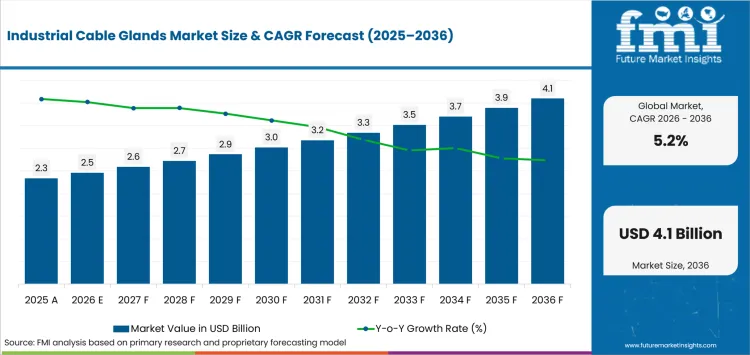
- Market Size (2026)
- USD 2.5 Bn
- Forecast (2036)
- USD 4.1 Bn
- CAGR (2026 to 2036)
- 5.2%
How big is Industrial Cable Glands Market in 2026?
USD 2.5 billion in 2026 and USD 4.1 billion by 2036 at a 5.2% CAGR.
Demand for industrial cable glands is projected to expand at a 5.2% CAGR between 2026 and 2036 from USD 2.5 billion to USD 4.1 billion. Equipment builders order glands wherever cables pass through enclosures that must preserve sealing and mechanical retention. The International Federation of Robotics recorded 542,000 industrial robot installations in 2024 and said factory deployment had more than doubled over ten years. The installed robot base increases qualified cable entries used in new machinery and subsequent replacement work.
Country demand diverges because grid investment changes the number and duty of cable entries entering service. Bundesnetzagentur stated in January 2026 that Germany approved roughly 2,000 kilometers of power lines during 2025. Those projects specify enclosure interfaces before commissioning and increase harsh-service cable-entry requirements without proving gland revenue one-for-one. Local thread practice and hazardous-area rules determine which gland configurations can enter each project.
Key Takeaways
- Industrial cable-gland demand rises as automation and electrification place more qualified cable entries inside machines, panels and infrastructure assets.
- By gland type, armored cable glands are estimated to hold 26.0% in 2026 owing to applications that require armor retention with environmental sealing.
- In 2026, brass is expected to lead material with 38.0% share because machinability supports durable threads and electrical continuity in compact gland bodies.
- Metric is set to lead the thread type category with 44.0% share in 2026 due to standardized enclosure interfaces used with IEC-oriented equipment.
- Qualification slows substitution because cable diameter, armor construction, thread form, material and required approval must all match the installed enclosure.
- Key players in the industrial cable glands market include CMP Products, Hummel, LAPP, Pflitsch, Jacob GmbH, Hawke International, Eaton Crouse-Hinds, ABB, Wiska, and Roxtec.
Analyst Perspective
"Industrial cable-gland margins improve where one certified family covers required cable diameters and thread forms specified by plant engineers. Documented families reduce emergency stock gaps and repeat qualification work without relaxing enclosure protection requirements."
- Nikhil Kaitwade, Principal Consultant, Future Market Insights
How is the industrial cable glands market segmented?
The industrial cable glands market is segmented by gland type, material, thread type, end use, sales channel and region.
Gland type includes armored, unarmored, EMC, explosion-proof, strain relief and breather glands. Material covers brass, stainless steel, nickel-plated brass, polyamide and aluminum. Thread type includes metric, NPT, PG, BSP and custom thread. End use covers industrial automation, oil and gas, power generation, rail - transport and marine - offshore. Sales channels include electrical distributors, direct OEM supply, panel builders and e-commerce - catalog channels.
What makes armored cable glands central to the gland type category?
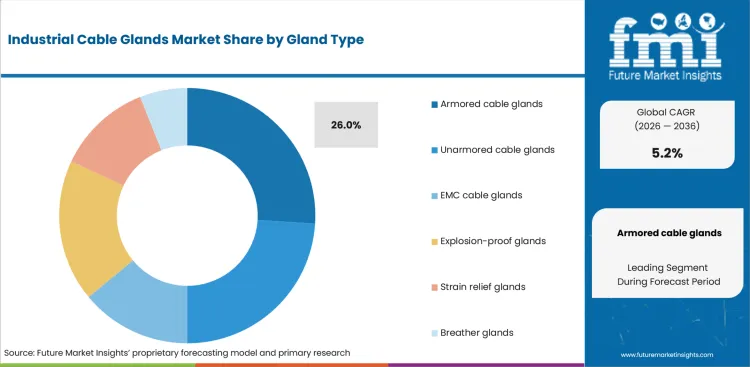
Armored cables require the gland to retain metallic armor and preserve the enclosure seal at the same termination point. Oil and gas installations place that requirement close to hazardous area equipment specifications because the cable entry may form part of the protection method for the enclosure.
- By gland type, armored cable glands are estimated to hold 26.0% in 2026 owing to projects that require controlled armor termination with environmental sealing.
- CMP Products stated in August 2026 that Electromec would present armored and unarmored explosive-atmosphere cable glands at Middle East Energy. The event keeps certified armor termination close to project engineers specifying hazardous electrical entries.
Why does brass lead the material category?
Brass gives manufacturers a machinable metal body that supports durable threads and electrical continuity in compact gland designs. Nickel plating extends surface protection for applications where wire and cable management components face frequent handling or industrial exposure.
- In 2026, brass is expected to lead material with 38.0% share because one metal platform can serve standard and shielded gland constructions.
- PFLITSCH announced in August 2026 that it would shift its brass portfolio toward lead-free alloys during 2027. The material change requires qualification without altering the cable-entry function expected from each gland.
How does metric support the thread type category?
Metric threads give enclosure designers a common dimensional basis for cable-entry holes and adapters used in IEC-oriented machinery. A common thread interface reduces avoidable mismatch between a gland and its electrical enclosure before the assembly reaches installation.
- Metric is set to lead the thread type category with 44.0% share in 2026 due to standardized entry dimensions used in industrial enclosures.
- PFLITSCH expanded its UNI Dicht TRI EMC family in April 2025 with new M12 and M32 sizes plus M40 and M50 variants so engineers could retain one shielding architecture over more metric enclosure entries.
What supports industrial automation in the end use category?
Automated equipment concentrates motors and network cables inside control architectures that must preserve strain relief and electromagnetic compatibility. Each additional machine cell can increase gland demand because industrial automation hardware requires protected passages into panels and field enclosures.
- By end use, industrial automation is forecast to represent 29.0% in 2026 driven by higher cable-entry density in machines and control panels.
- The International Federation of Robotics reported in June 2026 that United States industrial robot installations rose 11% to 38,000 units in 2025 and expanded the equipment base requiring protected power and control entries.
What supports electrical distributors in the sales channel category?
Electrical distributors hold useful inventory because cable glands are purchased in many cable-diameter and thread combinations. Maintenance teams often need a qualified replacement quickly and compare those combinations with adjacent connector sourcing requirements before releasing a repair.
- Electrical distributors are projected to hold 40.0% share in 2026 owing to local stock and application-selection support for qualified replacements.
- CMP Products appointed TEC Sales in June 2025 to represent its cable-management range in southern United States markets and placed technical support beside local warehousing and distribution.
What are the drivers, restraints and opportunities in the Industrial Cable Glands Market?
More automated assets increase qualified cable-entry points. Exact fit and certification slow substitution. Broader certified ranges can reduce selection work without weakening installation requirements.
- Driver: Machine automation and electrical infrastructure increase the number of enclosure penetrations that need mechanical retention, environmental sealing or electromagnetic control.
- Restraint: A replacement can fail approval if cable construction, thread form, material or protection marking differs from the installed design.
- Opportunity: Manufacturers can reduce engineering effort by extending certified families over more cable diameters and enclosure threads without changing installation practice.
Automation raises cable-gland demand where power or signal cables penetrate machine enclosures used by robots and controlled equipment. The International Federation of Robotics counted 23,000 European automotive robot installations during 2024 and called that volume the second-highest result in five years. More industrial robotics installations expand the population of panels requiring protected entries and manufacturers capture orders only after glands fit the specified cable and enclosure interface.
Cable-gland substitution slows because the component forms part of an enclosure protection system and must preserve approved installation conditions. PFLITSCH posted an IECEx certificate for its LevelEx gland family in June 2025 and defined the approved product scope. Comparable safety instrumentation systems use documented protection conditions in hazardous processes so cheaper alternatives can fail if certification differs from the installed design.
Manufacturers gain room to specialize within certified gland families where one cable entry must preserve sealing and electromagnetic continuity. PFLITSCH introduced blueglobe CLEAN Plus TRI in February 2025 for hygienic applications that also require shielding. Such documented EMC shielding options let machinery builders qualify hygiene requirements without changing the basic enclosure-entry architecture.
Which country CAGRs are profiled in the Industrial Cable Glands Market?
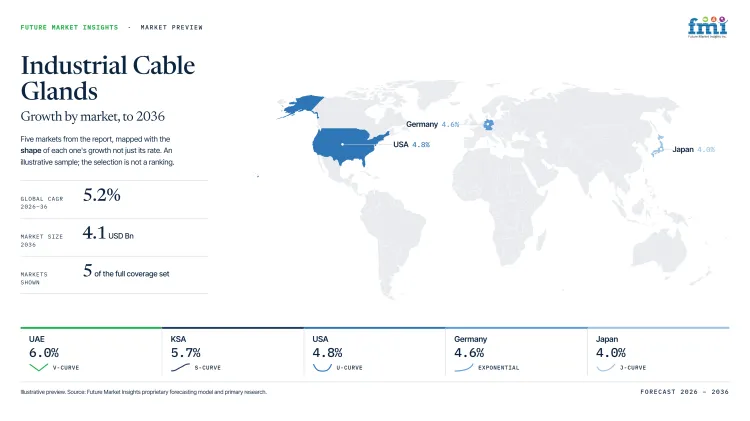
| Country | CAGR |
|---|---|
| UAE | 6.0% |
| KSA | 5.7% |
| Brazil | 5.2% |
| USA | 4.8% |
| UK | 4.7% |
| Germany | 4.6% |
| Japan | 4.0% |
How do country-level CAGRs compare in the Industrial Cable Glands Market?
Country growth is concentrated in the Gulf before converging toward mature industrial economies. UAE and KSA sit above the global rate as project activity and localization expand electrical equipment demand. Brazil aligns with the global forecast while the USA and Western European markets cluster slightly below it. Japan records the slowest profiled rate because component changes pass through longer qualification cycles.
- UAE project schedules reward companies holding metric and NPT configurations near major Gulf engineering centers.
- KSA commissioning programs concentrate orders around documented hazardous-service packages approved before field installation begins.
- Brazil's service distances favor distributors that can replenish coastal industrial sites without equipment redesign.
- USA maintenance programs often require cross-references between legacy gland families and newer enclosure hardware.
- UK rail and marine users prioritize replacement compatibility because installed assets span several equipment generations.
- German export machinery rewards component documentation that engineers can reuse in customer installations abroad.
- Japanese equipment builders preserve approved families for long production runs to avoid repeated requalification.
Comparable CAGRs therefore produce different sales routes because installed bases and project timing shape purchases. Regional taxonomy covers North America, Latin America, Western Europe, Eastern Europe, East Asia, South Asia and Pacific, and Middle East and Africa.
Country-wise Analysis
- UAE industrial contractors increasingly source cable-entry hardware from local stocking points because energy and manufacturing projects run on compressed installation schedules. Industrial cable-gland demand in UAE is forecast to rise at 6.0% CAGR through 2036 owing to localization that shortens technical support and replenishment cycles. In April 2026 the Ministry of Industry and Advanced Technology said 1,022 companies would exhibit at Make it in the Emirates 2026. Local availability does not remove qualification work because gland material and thread form must still match certified equipment used on each project. Companies with regional engineering support can respond faster to substitutions while import-dependent rivals carry longer lead times during project peaks.
- United States maintenance teams manage an installed base that mixes NPT enclosure practice with imported IEC-oriented machinery and older plant equipment. The National Institute of Standards and Technology wrote in February 2025 that small manufacturers expected greater use of robots and automated systems. United States industrial cable-gland sales are projected to grow at 4.8% CAGR through 2036 supported by automation retrofits and replacement work. Factory automation controls increase termination density but substitutions remain slow because plants must preserve cable fit and documented protection conditions. Distributors with cross-reference expertise retain an advantage when maintenance crews need an approved replacement without redesigning the surrounding enclosure.
- Japanese factories place a high cost on electrical changes that can interrupt semiconductor and precision-manufacturing lines during scheduled production runs. Engineers therefore keep approved cable-entry specifications stable until a machine revision or documented component change justifies renewed qualification. Industrial cable-gland adoption in Japan is estimated to expand at 4.0% CAGR through 2036 owing to controlled automation investment and replacement demand. In July 2025 the International Federation of Robotics reported about 13,000 automotive robot installations in Japan during 2024. Industrial Ethernet upgrades add signal connections but conservative approval practice favors companies that can document fit without forcing broader cabinet changes.
- German domestic machine builders work with mature IEC-oriented enclosure specifications that make thread compatibility and technical documentation routine parts of component selection. Industrial cable-gland demand in Germany is forecast to rise at 4.6% CAGR over the assessment period with replacement work tied to machinery and grid assets. Destatis reported in February 2026 that German machinery and equipment production fell 2.6% during 2025. The production decline limits near-term equipment pull even as transmission projects require new protected cable entries in substations and related assets. New entrants therefore face a mature specification base where service quality must compensate for modest equipment-production momentum.
- Saudi industrial projects require cable entries that suit process equipment and hazardous areas while national policy continues expanding local manufacturing activity. In March 2026 the Saudi Press Agency reported 1,660 industrial licenses issued during 2025 under the Ministry of Industry and Mineral Resources. Industrial cable-gland demand in KSA is predicted to advance at 5.7% CAGR through 2036 driven by industrial expansion and energy-project requirements. Local manufacturing is an enabler but hazardous-area approvals and imported equipment conventions can keep specification work fragmented between projects. Companies that maintain regional certification support can convert project activity into repeat orders without relying on one thread standard.
- Brazilian offshore operators need corrosion-resistant cable entries that can be serviced on production assets where maintenance access is limited and downtime is costly. Industrial cable-gland sales in Brazil are forecast to expand at 5.2% CAGR through 2036 attributable to offshore production and replacement needs. In June 2026 Brazil's ANP reported national oil production of 3.8 million barrels per day during 2025. Offshore production expands the installed equipment base but salt exposure and remote maintenance increase the cost of weak sealing or unsuitable materials. Companies with offshore-qualified ranges can defend replacement positions when field teams need compatible parts without revising the surrounding electrical assembly.
- United Kingdom cable-gland demand spans power infrastructure and industrial maintenance where new equipment must coexist with an extensive installed electrical base. The market is forecast to expand at 4.7% CAGR through 2036 supported by grid modernization and replacement activity. UK government Energy Trends published in April 2026 reported that renewable sources supplied 52.5% of national electricity generation during 2025. Higher renewable output increases the importance of transmission and connection assets but cable-gland orders still depend on project-specific enclosure and protection requirements. Companies serving the UK need broad metric and legacy compatibility because modernization does not replace installed equipment at one pace.
Who are the notable companies in the Industrial Cable Glands Market?
CMP Products, Hummel, LAPP, Pflitsch, Jacob GmbH, Hawke International, Eaton Crouse-Hinds, ABB, Wiska, and Roxtec are notable companies serving this market.
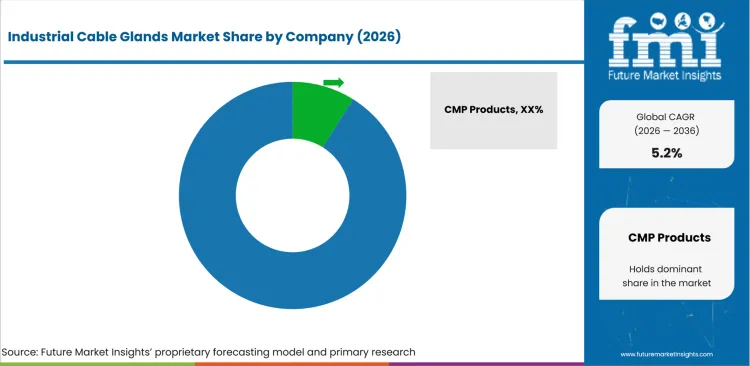
CMP Products, Hawke International and Eaton Crouse-Hinds concentrate on certified hazardous cable-gland applications used in energy and process projects. Hummel and LAPP cover machinery builders with broad connection portfolios while Pflitsch, Jacob GmbH and Wiska place more emphasis on EMC or specialized industrial entries. ABB participates through installation products while Roxtec competes with modular transit systems in selected dense-enclosure designs.
- CMP Products, Hawke International and Eaton Crouse-Hinds serve hazardous projects where armored termination and certified protection govern product selection.
- Hummel and LAPP cover industrial gland applications with varied material and thread options for machinery builders. Pflitsch and Jacob GmbH with Wiska add EMC-focused cable-entry ranges for specialized enclosure requirements.
- ABB supplies cable-gland products within its installation business while Roxtec offers modular transits that can replace discrete glands in selected designs.
Competitive Benchmarking: Industrial Cable Glands Market
| Company | Hazardous - Armored Coverage | EMC - Automation Entries | Material - Thread Breadth | Geographic Reach |
|---|---|---|---|---|
| CMP Products | High | Medium | High | Global |
| Hummel | Medium | High | High | International |
| LAPP | Medium | High | High | Global |
| Pflitsch | Medium | High | Medium | Europe and North America |
| Jacob GmbH | Medium | High | Medium | International |
| Hawke International | High | Medium | High | Global |
| Eaton Crouse-Hinds | High | Medium | High | Global |
| ABB | High | Medium | High | Global |
| Wiska | Medium | High | Medium | International |
| Roxtec | Low | Medium | Low | Global |
A High hazardous-armored rating requires multiple documented certified gland families covering armored cable in hazardous locations. A Medium rating marks narrower certified coverage while Low identifies an adjacent cable-entry architecture without comparable discrete glands. A High EMC-automation rating requires dedicated shielding families supported by industrial application evidence while Medium indicates narrower coverage. A High material-thread rating requires several documented material and thread families while Medium marks reduced breadth and Low applies to non-threaded transit systems.
Key Developments in the Industrial Cable Glands Market
- In May 2026, Wiska established WISKA Gulf FZE in Dubai to support cable-entry customers throughout the Gulf region.
- In January 2026, LAPP established a Taiwan subsidiary after assuming operational responsibility for DKSH Taiwan’s cable business.
- In November 2025, Pflitsch established a United States subsidiary to improve local support for North American cable-management customers.
Key Players in the Industrial Cable Glands Market
Hazardous and Heavy-Duty Cable-Gland Specialists
- CMP Products
- Hawke International
- Eaton Crouse-Hinds
Broad Industrial and EMC Cable-Gland Companies
- Hummel
- LAPP
- Pflitsch
- Jacob GmbH
- Wiska
Electrification and Alternative Cable-Entry Systems
- ABB
- Roxtec
Industrial Cable Glands Market - Report Scope
| Coverage field | Report scope |
|---|---|
| Market breakdown | By gland type, material, thread type, end use, sales channel and region. |
| Quantitative Units | USD billion. |
| Market Definition | Commercial complete industrial cable glands and configured gland components used to retain, seal, ground or shield cables at industrial enclosure entries. Standalone cable cleats, transit frames, entry plates, trays, conduit systems, cables, connectors and downstream equipment revenue are excluded. |
| Regions Covered | North America, Latin America, Western Europe, Eastern Europe, East Asia, South Asia and Pacific, and Middle East and Africa. |
| Countries Covered | UAE, KSA, Brazil, USA, UK, Germany, Japan, and 20+ countries included in the full report. |
| Key Companies Profiled | CMP Products, Hummel, LAPP, Pflitsch, Jacob GmbH, Hawke International, Eaton Crouse-Hinds, ABB, Wiska, Roxtec. |
| Forecast Period | 2026 to 2036. |
| Approach | Primary and secondary research with market triangulation. |
Industrial Cable Glands Market - Research Methodology
| Method | Approach |
|---|---|
| Primary Research | FMI analysts gathered input from manufacturers, service providers, technology developers, distributors, end users, procurement teams, and subject-matter experts. Interviews examined purchasing decisions, product or service evaluation, adoption barriers, approval requirements, pricing considerations, and expectations for technical or commercial support. Respondents were also asked what evidence is required before a trial, pilot, or initial order develops into regular purchasing. |
| Desk Research | Desk research covered government statistics, regulatory publications, trade data, industry associations, technical literature, standards, company filings, product information, and official corporate announcements. Sources were reviewed for relevance, publication date, geographic coverage, and consistency with the defined market scope. Claims relating to performance, applications, approvals, capacity, investment, and commercial activity were retained only when supported by credible public evidence. |
| Market Sizing and Forecasting | The market model combined the baseline value with historical performance, segment structure, pricing and volume indicators, adoption levels, company participation, and country-level demand conditions. Forecast assumptions considered economic activity, investment trends, regulatory developments, technology adoption, purchasing cycles, supply availability, and barriers to wider market use. Segment and regional estimates were reconciled before the final market total was calculated. |
| Data Validation | Estimates were checked against multiple independent indicators, including public data, company activity, trade patterns, industry developments, and findings from primary interviews. Validation also tested whether products, services, applications, and company revenues fell within the defined market boundaries. Adjacent categories, unsupported claims, overlapping revenues, and activities without direct market relevance were excluded to reduce double counting and maintain consistency across segments and countries. |
Industrial Cable Glands Market by Segments
Industrial Cable Glands Market segmented by Gland Type:
- Armored cable glands
- Unarmored cable glands
- EMC cable glands
- Explosion-proof glands
- Strain relief glands
- Breather glands
Industrial Cable Glands Market segmented by Material:
- Brass
- Stainless steel
- Nickel-plated brass
- Polyamide
- Aluminum
Industrial Cable Glands Market segmented by Thread Type:
- Metric
- NPT
- PG
- BSP
- Custom thread
Industrial Cable Glands Market segmented by End Use:
- Industrial automation
- Oil & gas
- Power generation
- Rail - transport
- Marine - offshore
Industrial Cable Glands Market segmented by Sales Channel:
- Electrical distributors
- Direct OEM supply
- Panel builders
- E-commerce - catalog
Industrial Cable Glands Market by Region:
- North America
- United States
- Canada
- Latin America
- Brazil
- Mexico
- Chile
- Rest of Latin America
- Western Europe
- Germany
- United Kingdom
- Italy
- Spain
- France
- Nordics
- Benelux
- Rest of Western Europe
- Eastern Europe
- Russia
- Poland
- Hungary
- Balkan and Baltic States
- Rest of Eastern Europe
- East Asia
- China
- Japan
- South Korea
- South Asia and Pacific
- India
- ASEAN
- Australia and New Zealand
- Rest of South Asia and Pacific
- Middle East and Africa
- Kingdom of Saudi Arabia
- Other GCC Countries
- Türkiye
- South Africa
- Other African Union Countries
- Rest of Middle East and Africa
Research Sources and Bibliography
- International Federation of Robotics. (2025, September 25). Global Robot Demand in Factories Doubles Over 10 Years.
- Bundesnetzagentur. (2026, January 2). Energy transition clears crucial hurdle - significant progress in electricity grid expansion in 2025.
- CMP Products Limited. (2026, August 18). CMP joins partner Electromec at Middle East Energy 2026.
- PFLITSCH. (2026, August 17). PFLITSCH transitions to lead-free brass.
- PFLITSCH. (2025, April 11). UNI Dicht TRI now available in additional sizes.
- International Federation of Robotics. (2026, June 18). US Robot Industry Returns to Double Digit Growth.
- CMP Products Limited. (2025, June 2). Boosting Cable Management Support in the Southern USA Through Strategic Alliance.
- International Federation of Robotics. (2025, June 17). Europe’s Auto Industry Installed 23,000 new Robots.
- PFLITSCH. (2025, June 11). IECEx IBE 24.0018X LevelEx, LevelEx TRI, LevelEx AC.
- Eaton. (2025, December). Crouse-Hinds series CGB2 and CGE2 cable glands.
- Ministry of Industry and Advanced Technology, UAE. (2026, April 9). HE Dr Sultan Al Jaber: Through the resilience of our industrial sector, we are emerging stronger.
- National Institute of Standards and Technology. (2025, February 20). What’s Coming for US Manufacturing in 2025.
- International Federation of Robotics. (2025, July 15). Japan’s Car Industry has Highest Robot Installations in Five Years.
- Federal Statistical Office of Germany. (2026, February 6). Production in 2025: -1.1% on the previous year.
- Saudi Press Agency. (2026, March 11). Saudi Arabia's Industrial and Mining Sectors Record Strong Growth in 2025.
- Agência Nacional do Petróleo, Gás Natural e Biocombustíveis. (2026, June 30). ANP divulga dados consolidados do setor regulado em 2025.
- Department for Energy Security and Net Zero. (2026, April 2). Energy Trends: UK, October to December 2025 and 2025.
- WISKA Hoppmann GmbH. (2026, May 29). WISKA opens subsidiary WISKA Gulf FZE in the United Arab Emirates.
- LAPP. (2026, January 12). LAPP Group establishes subsidiary in Taiwan.
- PFLITSCH. (2025, November 17). PFLITSCH now in the USA.
- CMP Products Limited. (2026, August 4). CMP Products Partners with Salex as Its Southern Ontario Agent.
- CMP Products Limited. (2026, August 27). CMP Strengthens British Columbia Presence with Elec-Tech Appointment.
- HUMMEL AG. (2026, July 14). Ground-breaking for factory expansion in Germany: HUMMEL invests in the future.
- LAPP. (2026, June 3). LAPP makes authorised distributors visible online.
- PFLITSCH. (2025, February 17). Maximum hygiene meets reliable EMC protection.
- Jacob GmbH. (2025, February 17). Perfect ventilation.
- IECEx. (2025, May 29). IECEx Certificate of Conformity CML 23.0002X, Issue 3.
- ABB. (2025, August 26). ABB launches new labor and space saving electrical solutions to enhance data center infrastructure.
- Roxtec. (2026, February 3). Roxtec presents the new Roxtec Cabinet Seal Platform for high cable density applications in harsh environments.
- PFLITSCH. (2026, June 19). Certificate RINA blueglobe TRI NM Cr/blueglobe Cr.
- ABB Installation Products S.A. (2026, May 22). EU Declaration of Conformity - Cable Glands.
- Roxtec. (2025, July 1). Roxtec presents new airtight cable and pipe transit for laboratories, cleanrooms and other advanced facilities.
- PFLITSCH. (2026, August 14). Autumn 2026 Trade Fairs: Discover PFLITSCH innovations first-hand.
- WISKA Hoppmann GmbH. (2025, March 23). The WISKA evolution of cable glands and junction boxes - WISKA at the HMI 2025.
- WISKA Hoppmann GmbH. (2026, July 17). Reliable connections. Clear perspectives.
This bibliography is provided for reader reference and is not exhaustive. The full report contains the complete reference list and detailed citations
This Report Answers
- What are the 2026 and 2036 values for the industrial cable glands market?
- How does automation convert into industrial cable-gland demand?
- Why do armored cable glands hold 26.0% gland type share in 2026?
- Why does brass hold 38.0% material share in 2026?
- How do metric threads affect cable-gland selection?
- How do country CAGRs differ among the seven profiled countries?
- Which qualification requirements slow cable-gland substitution?
- How do notable companies differ in technical and geographic coverage?
Frequently Asked Questions
How big is the Industrial Cable Glands Market in 2026?
The industrial cable glands market is valued at USD 2.5 billion in 2026 and is projected to reach USD 4.1 billion by 2036. Automation and infrastructure projects increase qualified cable entries used in industrial equipment.
What is the CAGR of the Industrial Cable Glands Market from 2026 to 2036?
The industrial cable glands market is projected to grow at a CAGR of 5.2% between 2026 and 2036. Expansion follows additional cable terminations in automated equipment and replacement requirements in power or hazardous-service installations.
Which gland type leads the Industrial Cable Glands Market?
The armored cable glands segment is expected to hold 26.0% of the industrial cable glands market in 2026 due to armor-retention and sealing requirements. Hazardous-service projects require documented termination geometry and compatible approvals for protected enclosure entries.
Which material leads the Industrial Cable Glands Market?
The brass segment is expected to hold 38.0% of the industrial cable glands market in 2026 because machinability supports durable threaded bodies. Electrical continuity also suits grounding and shielded constructions where the cable screen bonds to an enclosure.
Which countries record the upper country growth rates in the Industrial Cable Glands Market?
UAE is projected to grow at 6.0% CAGR and KSA at 5.7% through 2036. Brazil follows at 5.2% as offshore service activity raises requirements for corrosion-resistant and hazardous-service cable entries.
Which companies are active in the Industrial Cable Glands Market?
Key companies operating in the industrial cable glands market include CMP Products, Hummel, LAPP, Pflitsch, Jacob GmbH, Hawke International, Eaton Crouse-Hinds, ABB, Wiska, and Roxtec. Their positions differ through certification coverage and material or thread breadth plus regional technical support.
Preview the report firsthand - request a free sample
Get SampleGet the brochure for pricing and purchase details.
Get PDFTable of Content
- Key Takeaways
- Market Size and CAGR
- Top Growth Driver
- Fastest Growing Segment
- Leading Region
- Key Companies
- Emerging Opportunities
- Executive Summary
- Global Market Outlook
- Demand-side Trends
- Supply-side Trends
- Technology Roadmap Analysis
- Analysis and Recommendations
- Analyst Perspective (What is happening? Why now? What should investors know?)
- Key Questions Answered
- How large is the market?
- What is the CAGR?
- What are key trends?
- Which region dominates?
- Who are the leaders?
- Market Overview
- Market Coverage / Taxonomy
- Market Definition / Scope / Limitations
- Research Methodology
- Chapter Orientation
- Analytical Lens and Working Hypotheses
- Market Structure, Signals, and Trend Drivers
- Benchmarking and Cross-market Comparability
- Market Sizing, Forecasting, and Opportunity Mapping
- Research Design and Evidence Framework
- Desk Research Programme (Secondary Evidence)
- Expert Input and Fieldwork (Primary Evidence)
- Tooling, Models, and Reference Databases
- Data Engineering and Model Build
- Quality Assurance and Audit Trail
- Market Background
- Market Dynamics (Drivers, Restraints, Opportunity, Trends)
- Scenario Forecast (Optimistic, Likely, Conservative)
- Impact Analysis
- AI Impact
- Sustainability Impact
- Regulatory Impact
- Technology Impact
- Consumer / Buyer Analysis
- Purchase Drivers
- Adoption Barriers
- Buyer Journey
- Opportunity Map Analysis
- Product Life Cycle Analysis
- Supply Chain Analysis
- Investment Feasibility Matrix
- Value Chain Analysis
- PESTLE and Porter's Analysis
- Regulatory Landscape
- Regional Parent Market Outlook
- Production and Consumption Statistics
- Import and Export Statistics
- Global Market Analysis and Forecast, 2021 to 2036
- Historical Market Size Value (USD Billion) Analysis, 2021 to 2025
- Current and Future Market Size Value (USD Billion) Projections, 2026 to 2036
- Y-o-Y Growth Trend Analysis
- Absolute $ Opportunity Analysis
- Global Market Pricing Analysis, 2021 to 2036
- Global Market Analysis and Forecast, By Gland Type, 2021 to 2036
- Introduction / Key Findings
- Historical Market Size Value (USD Billion) Analysis By Gland Type, 2021 to 2025
- Current and Future Market Size Value (USD Billion) Analysis and Forecast By Gland Type, 2026 to 2036
- Armored cable glands
- Unarmored cable glands
- EMC cable glands
- Explosion-proof glands
- Strain relief glands
- Breather glands
- Armored cable glands
- Y-o-Y Growth Trend Analysis By Gland Type, 2021 to 2025
- Absolute $ Opportunity Analysis By Gland Type, 2026 to 2036
- Global Market Analysis and Forecast, By Material, 2021 to 2036
- Introduction / Key Findings
- Historical Market Size Value (USD Billion) Analysis By Material, 2021 to 2025
- Current and Future Market Size Value (USD Billion) Analysis and Forecast By Material, 2026 to 2036
- Brass
- Stainless steel
- Nickel-plated brass
- Polyamide
- Aluminum
- Brass
- Y-o-Y Growth Trend Analysis By Material, 2021 to 2025
- Absolute $ Opportunity Analysis By Material, 2026 to 2036
- Global Market Analysis and Forecast, By Thread Type, 2021 to 2036
- Introduction / Key Findings
- Historical Market Size Value (USD Billion) Analysis By Thread Type, 2021 to 2025
- Current and Future Market Size Value (USD Billion) Analysis and Forecast By Thread Type, 2026 to 2036
- Metric
- NPT
- PG
- BSP
- Custom thread
- Metric
- Y-o-Y Growth Trend Analysis By Thread Type, 2021 to 2025
- Absolute $ Opportunity Analysis By Thread Type, 2026 to 2036
- Global Market Analysis and Forecast, By End Use, 2021 to 2036
- Introduction / Key Findings
- Historical Market Size Value (USD Billion) Analysis By End Use, 2021 to 2025
- Current and Future Market Size Value (USD Billion) Analysis and Forecast By End Use, 2026 to 2036
- Industrial automation
- Oil & gas
- Power generation
- Rail/transport
- Marine/offshore
- Industrial automation
- Y-o-Y Growth Trend Analysis By End Use, 2021 to 2025
- Absolute $ Opportunity Analysis By End Use, 2026 to 2036
- Global Market Analysis and Forecast, By Sales Channel, 2021 to 2036
- Introduction / Key Findings
- Historical Market Size Value (USD Billion) Analysis By Sales Channel, 2021 to 2025
- Current and Future Market Size Value (USD Billion) Analysis and Forecast By Sales Channel, 2026 to 2036
- Electrical distributors
- Direct OEM supply
- Panel builders
- E-commerce/catalog
- Electrical distributors
- Y-o-Y Growth Trend Analysis By Sales Channel, 2021 to 2025
- Absolute $ Opportunity Analysis By Sales Channel, 2026 to 2036
- Global Market Analysis and Forecast, By Region, 2021 to 2036
- Introduction
- Historical Market Size Value (USD Billion) Analysis By Region, 2021 to 2025
- Current Market Size Value (USD Billion) Analysis and Forecast By Region, 2026 to 2036
- North America
- Latin America
- Western Europe
- Eastern Europe
- East Asia
- South Asia and Pacific
- Middle East & Africa
- Market Attractiveness Analysis By Region
- North America Market Analysis and Forecast, By Country, 2021 to 2036
- Historical Market Size Value (USD Billion) Trend Analysis By Market Taxonomy, 2021 to 2025
- Market Size Value (USD Billion) Forecast By Market Taxonomy, 2026 to 2036
- By Country
- USA
- Canada
- By Gland Type
- By Material
- By Thread Type
- By End Use
- By Sales Channel
- By Country
- Market Attractiveness Analysis
- By Country
- By Gland Type
- By Material
- By Thread Type
- By End Use
- By Sales Channel
- Key Takeaways
- Latin America Market Analysis and Forecast, By Country
- Historical Market Size Value (USD Billion) Trend Analysis By Market Taxonomy, 2021 to 2025
- Market Size Value (USD Billion) Forecast By Market Taxonomy, 2026 to 2036
- By Country
- Brazil
- Mexico
- Chile
- Rest of Latin America
- By Gland Type
- By Material
- By Thread Type
- By End Use
- By Sales Channel
- By Country
- Market Attractiveness Analysis
- By Country
- By Gland Type
- By Material
- By Thread Type
- By End Use
- By Sales Channel
- Key Takeaways
- Western Europe Market Analysis and Forecast, By Country
- Historical Market Size Value (USD Billion) Trend Analysis By Market Taxonomy, 2021 to 2025
- Market Size Value (USD Billion) Forecast By Market Taxonomy, 2026 to 2036
- By Country
- Germany
- UK
- Italy
- Spain
- France
- Nordic
- BENELUX
- Rest of Western Europe
- By Gland Type
- By Material
- By Thread Type
- By End Use
- By Sales Channel
- By Country
- Market Attractiveness Analysis
- By Country
- By Gland Type
- By Material
- By Thread Type
- By End Use
- By Sales Channel
- Key Takeaways
- Eastern Europe Market Analysis and Forecast, By Country
- Historical Market Size Value (USD Billion) Trend Analysis By Market Taxonomy, 2021 to 2025
- Market Size Value (USD Billion) Forecast By Market Taxonomy, 2026 to 2036
- By Country
- Russia
- Poland
- Hungary
- Balkan & Baltic
- Rest of Eastern Europe
- By Gland Type
- By Material
- By Thread Type
- By End Use
- By Sales Channel
- By Country
- Market Attractiveness Analysis
- By Country
- By Gland Type
- By Material
- By Thread Type
- By End Use
- By Sales Channel
- Key Takeaways
- East Asia Market Analysis and Forecast, By Country
- Historical Market Size Value (USD Billion) Trend Analysis By Market Taxonomy, 2021 to 2025
- Market Size Value (USD Billion) Forecast By Market Taxonomy, 2026 to 2036
- By Country
- China
- Japan
- South Korea
- By Gland Type
- By Material
- By Thread Type
- By End Use
- By Sales Channel
- By Country
- Market Attractiveness Analysis
- By Country
- By Gland Type
- By Material
- By Thread Type
- By End Use
- By Sales Channel
- Key Takeaways
- South Asia and Pacific Market Analysis and Forecast, By Country
- Historical Market Size Value (USD Billion) Trend Analysis By Market Taxonomy, 2021 to 2025
- Market Size Value (USD Billion) Forecast By Market Taxonomy, 2026 to 2036
- By Country
- India
- ASEAN
- Australia & New Zealand
- Rest of South Asia and Pacific
- By Gland Type
- By Material
- By Thread Type
- By End Use
- By Sales Channel
- By Country
- Market Attractiveness Analysis
- By Country
- By Gland Type
- By Material
- By Thread Type
- By End Use
- By Sales Channel
- Key Takeaways
- Middle East & Africa Market Analysis and Forecast, By Country
- Historical Market Size Value (USD Billion) Trend Analysis By Market Taxonomy, 2021 to 2025
- Market Size Value (USD Billion) Forecast By Market Taxonomy, 2026 to 2036
- By Country
- Kingdom of Saudi Arabia
- Other GCC Countries
- Türkiye
- South Africa
- Other African Union
- Rest of Middle East & Africa
- By Gland Type
- By Material
- By Thread Type
- By End Use
- By Sales Channel
- By Country
- Market Attractiveness Analysis
- By Country
- By Gland Type
- By Material
- By Thread Type
- By End Use
- By Sales Channel
- Key Takeaways
- Key Countries Market Analysis
- USA
- Pricing Analysis
- Market Share Analysis, 2025
- By Gland Type
- By Material
- By Thread Type
- By End Use
- By Sales Channel
- Canada
- Pricing Analysis
- Market Share Analysis, 2025
- By Gland Type
- By Material
- By Thread Type
- By End Use
- By Sales Channel
- Mexico
- Pricing Analysis
- Market Share Analysis, 2025
- By Gland Type
- By Material
- By Thread Type
- By End Use
- By Sales Channel
- Brazil
- Pricing Analysis
- Market Share Analysis, 2025
- By Gland Type
- By Material
- By Thread Type
- By End Use
- By Sales Channel
- Chile
- Pricing Analysis
- Market Share Analysis, 2025
- By Gland Type
- By Material
- By Thread Type
- By End Use
- By Sales Channel
- Germany
- Pricing Analysis
- Market Share Analysis, 2025
- By Gland Type
- By Material
- By Thread Type
- By End Use
- By Sales Channel
- UK
- Pricing Analysis
- Market Share Analysis, 2025
- By Gland Type
- By Material
- By Thread Type
- By End Use
- By Sales Channel
- Italy
- Pricing Analysis
- Market Share Analysis, 2025
- By Gland Type
- By Material
- By Thread Type
- By End Use
- By Sales Channel
- Spain
- Pricing Analysis
- Market Share Analysis, 2025
- By Gland Type
- By Material
- By Thread Type
- By End Use
- By Sales Channel
- France
- Pricing Analysis
- Market Share Analysis, 2025
- By Gland Type
- By Material
- By Thread Type
- By End Use
- By Sales Channel
- India
- Pricing Analysis
- Market Share Analysis, 2025
- By Gland Type
- By Material
- By Thread Type
- By End Use
- By Sales Channel
- ASEAN
- Pricing Analysis
- Market Share Analysis, 2025
- By Gland Type
- By Material
- By Thread Type
- By End Use
- By Sales Channel
- Australia & New Zealand
- Pricing Analysis
- Market Share Analysis, 2025
- By Gland Type
- By Material
- By Thread Type
- By End Use
- By Sales Channel
- China
- Pricing Analysis
- Market Share Analysis, 2025
- By Gland Type
- By Material
- By Thread Type
- By End Use
- By Sales Channel
- Japan
- Pricing Analysis
- Market Share Analysis, 2025
- By Gland Type
- By Material
- By Thread Type
- By End Use
- By Sales Channel
- South Korea
- Pricing Analysis
- Market Share Analysis, 2025
- By Gland Type
- By Material
- By Thread Type
- By End Use
- By Sales Channel
- Russia
- Pricing Analysis
- Market Share Analysis, 2025
- By Gland Type
- By Material
- By Thread Type
- By End Use
- By Sales Channel
- Poland
- Pricing Analysis
- Market Share Analysis, 2025
- By Gland Type
- By Material
- By Thread Type
- By End Use
- By Sales Channel
- Hungary
- Pricing Analysis
- Market Share Analysis, 2025
- By Gland Type
- By Material
- By Thread Type
- By End Use
- By Sales Channel
- Kingdom of Saudi Arabia
- Pricing Analysis
- Market Share Analysis, 2025
- By Gland Type
- By Material
- By Thread Type
- By End Use
- By Sales Channel
- Türkiye
- Pricing Analysis
- Market Share Analysis, 2025
- By Gland Type
- By Material
- By Thread Type
- By End Use
- By Sales Channel
- South Africa
- Pricing Analysis
- Market Share Analysis, 2025
- By Gland Type
- By Material
- By Thread Type
- By End Use
- By Sales Channel
- USA
- Market Structure Analysis
- Competition Dashboard
- Competition Benchmarking
- Market Share Analysis of Top Players
- By Regional
- By Gland Type
- By Material
- By Thread Type
- By End Use
- By Sales Channel
- Emerging Startups
- Innovation Benchmarking
- Competition Analysis
- Competition Deep Dive
- CMP Products
- Overview
- Product Portfolio
- Profitability by Market Segments
- Sales Footprint
- Strategy Overview
- Marketing Strategy
- Product Strategy
- Channel Strategy
- Hummel
- LAPP
- Pflitsch
- Jacob GmbH
- Hawke International
- Eaton Crouse-Hinds
- ABB
- Wiska
- Roxtec
- CMP Products
- Case Studies
- Success Stories
- Recent Developments
- Competition Deep Dive
- Assumptions & Acronyms Used


