

- Market Size (2026)
- USD 1.1 Bn
- Forecast (2036)
- USD 1.9 Bn
- CAGR (2026 to 2036)
- 5.4%
How big is Industrial Shock Absorbers Market in 2026?
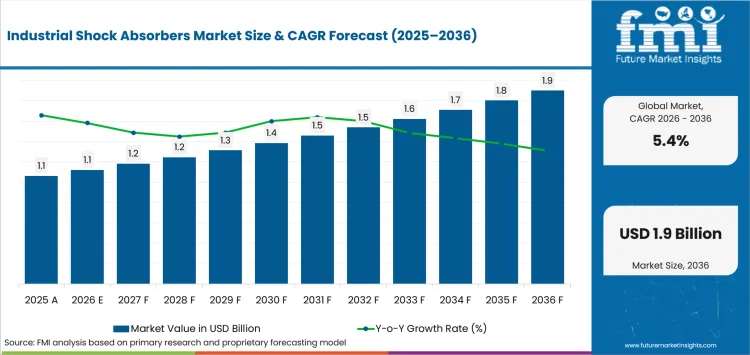
USD 1.1 billion in 2026 and USD 1.9 billion by 2036 at a 5.4% CAGR.
Demand for industrial shock absorbers is projected to expand at 5.4% CAGR between 2026 and 2036, increasing valuation from USD 1.1 billion in 2026 to USD 1.9 billion by 2036. Faster industrial automation equipment raises impact energy at slides, transfer stations and mechanical end positions, which increases the number of controlled stopping points. In September 2025, the International Federation of Robotics recorded 542,000 industrial robot installations during 2024. That installation flow enlarges the machine base where engineers specify controlled deceleration without sacrificing cycle time.
Country demand diverges as machine-building depth and replacement channels change the path from specification to repeat orders. In September 2025, the International Federation of Robotics counted 6,932 automotive industrial robots installed in Germany during 2024 versus 1,018 in France. Germany's larger factory automation base provides more design-in opportunities, whereas French projects place greater weight on retrofit economics and distributor access. Robotics activity does not measure absorber sales, but it explains why identical product families face different order timing and service requirements.
Key Takeaways
- Machine builders specify industrial shock absorbers as higher cycle speed, payload and stopping energy increase the cost of uncontrolled mechanical impact.
- By absorber type, self-compensating shock absorbers are estimated to hold 28.0% in 2026 owing to lower commissioning adjustment on repeat machine designs.
- In 2026, light-duty products are expected to lead load-capacity demand with 24.0% share because compact automation contains many low-energy stopping points.
- Threaded-body designs are projected to hold 41.0% of mounting demand in 2026 attributable to direct axial adjustment and compact replacement access.
- Application errors can delay approval because effective mass, impact velocity, stroke and cycles per hour must match the absorber's thermal and energy limits.
- Some of the key players in this market include ACE Controls, Zimmer Group, Enidine / ITT, Parker Hannifin, Weforma, Festo, SMC, Taylor Devices, Koba, and Stabilus.
Analyst Perspective
"Machine builders should release a shock absorber once effective mass, impact speed, stroke and cycles per hour match the real duty. Commercial value comes from preserving that validated selection with local stock and an interchangeable replacement path."
- Nikhil Kaitwade, Principal Consultant, Future Market Insights
How is the industrial shock absorbers market segmented?
Segmentation covers absorber type, load capacity, mounting, end use, sales channel, and region.
The industrial shock absorbers market is segmented by absorber type, load capacity, mounting, end use, sales channel, and region. Absorber types include self-compensating, adjustable, heavy-duty, miniature, and rotary damper formats. Load capacity covers light, medium, heavy, and high-cycle precision duties. Mounting includes threaded body, flange, foot, and custom formats. End uses cover packaging machinery, material handling, robotics, machine tools, and automotive assembly. Sales channels include industrial distributors, direct OEM supply, automation integrators, and catalog or e-commerce routes.
What supports packaging machinery as a leading end use?
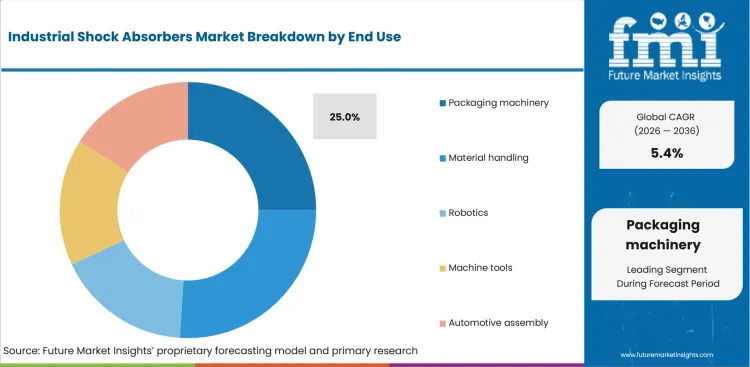
Packaging lines subject stops, transfers and handling mechanisms to repeated impacts at high cycle rates, making controlled deceleration a design requirement. UCIMA reported in April 2026 that Italian packaging machinery sales rose 2.0% year over year during the first quarter.
- Packaging machinery is estimated to hold 25.0% of end-use demand in 2026 due to repeated motion points in cartoning, filling and case-handling equipment.
- Replacement orders follow the installed machine base, especially as OEMs preserve common mounting formats through successive line generations and distant service locations in export markets.
What makes self-compensating shock absorbers central to the absorber type category?
Self-compensating designs suit repeat machine architectures whose impact conditions vary inside a known energy range. Taylor Devices' August 2026 Form 10-K identifies self-adjusting shock absorbers that adapt automatically to different impact conditions in high-cycle industrial service.
- By absorber type, self-compensating shock absorbers are estimated to hold 28.0% in 2026 owing to lower adjustment work on standardized machine designs.
- Machine builders can preserve a common absorber specification through moderate load changes, and adjustable or heavy-duty formats serve wider or less predictable energy ranges in service.
Why does light duty lead the load capacity category?
Compact slides, grippers and transfer devices generate many modest-energy impacts even if the host machine carries a larger total load. Association for Advancing Automation data published in February 2026 counted 7,212 collaborative robots in North American orders during 2025, equal to 19.6% of units.
- In 2026, light-duty products are expected to lead load-capacity demand with 24.0% share because compact automation contains several low-energy stopping points.
- Short-stroke absorbers fit limited envelopes and reduce redesign work during replacement, which suits modular cells built around smaller actuators and collaborative robots.
Why does threaded body lead the mounting category?
Threaded housings let installers set an absorber's axial position directly in the machine structure and lock the unit after commissioning. Festo's July 2025 DYEF documentation specifies a continuous mounting thread and an internal hex for position adjustment on its industrial shock absorber.
- Threaded-body designs are projected to hold 41.0% of mounting demand in 2026 attributable to one interface handling installation, position adjustment and replacement access.
- Flange and foot mounts suit broader attachment surfaces, whereas threaded bodies reduce bracket count in compact machine frames and preserve repeatable service geometry.
What are the drivers, restraints and opportunities in the Industrial Shock Absorbers Market?
Automation investment raises controlled stopping points, sizing errors slow qualification, and application-specific ranges give manufacturers a route into compact high-cycle equipment.
- Driver: New automated equipment introduces more moving axes and transfer points where uncontrolled impact shortens component life or destabilizes cycle timing.
- Restraint: Incorrect energy or duty-cycle calculations can cause bottoming, overheating or structural loads that require additional engineering review before purchase.
- Opportunity: Compact shock absorber families paired with calculation support can win design positions in packaging, robotics, intralogistics and battery-production equipment.
Automation investment enlarges the installed machine base by introducing more motion that must stop within defined distances. The International Federation of Robotics stated in June 2026 that USA factories installed 38,000 industrial robotics units in 2025 following an 11% annual increase. Industrial shock absorbers do not appear on every robot, but more automated equipment gives designers additional points where impact energy must be controlled.
Qualification becomes costly once actual moving mass or speed falls outside the assumptions used during component selection. ACE Controls updated its shock absorber calculation program on October 16, 2025 and requests application inputs before recommending a unit. The sizing step protects mounting structures, yet purchasing can slow if machine builders lack reliable load data or must validate several operating recipes.
Compact automation rewards ranges that shorten selection work without weakening duty-cycle confidence. ITT's February 2026 Form 10-K lists Enidine shock absorbers with control products for factory and warehouse automation and documents production in six countries. Distributed production shortens replenishment paths once an approved absorber becomes a maintenance item instead of a one-time design choice in material handling equipment.
Which country CAGRs are profiled in the Industrial Shock Absorbers Market?
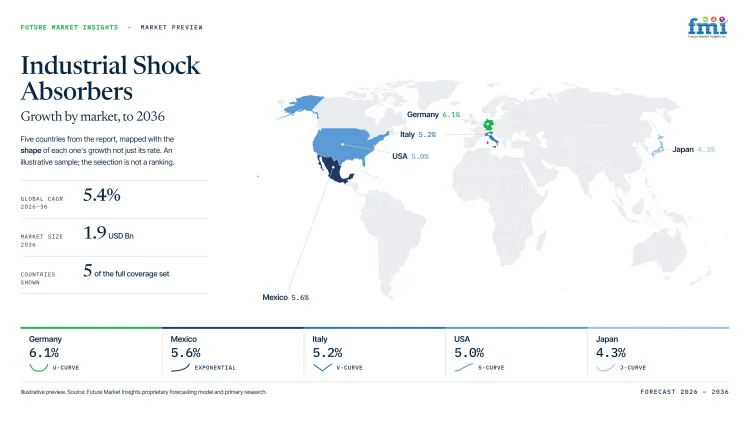
| Country | CAGR |
|---|---|
| Germany | 6.1% |
| Mexico | 5.6% |
| South Korea | 5.4% |
| Italy | 5.2% |
| USA | 5.0% |
| France | 4.8% |
| Japan | 4.3% |
How do country-level CAGRs compare in the Industrial Shock Absorbers Market?
The 1.8-point CAGR range puts Germany and Mexico above a compact middle group led by South Korea. Italy and the USA follow closely, with France and Japan lower. The narrow spread means machine-building depth, service reach and end-use concentration can influence account priorities more than small differences in forecast growth.
- Germany's export machinery base raises design-stage engineering needs.
- Mexico's automotive concentration increases the value of nearby inventory.
- South Korea's electronics plants reward space-efficient machine components.
- Italy's packaging specialization brings absorbers into OEM design programs.
- USA automation breadth widens the addressable machine mix.
- France gives retrofit economics greater weight during softer investment cycles.
- Japan's precision machinery raises expectations for stopping repeatability.
Comparable CAGRs can produce different order patterns as installed equipment changes replacement timing. The full report profiles North America, Latin America, Western Europe, Eastern Europe, East Asia, South Asia and Pacific, and the Middle East and Africa.
Country-wise Analysis
- German machine builders usually lock deceleration components into equipment drawings during design release, so application engineers influence sizing and replacement geometry for long-lived production machinery. Germany is projected to expand at 6.1% CAGR through 2036 owing to deep automation demand. VDMA's January 2025 outlook still expected German robotics and automation revenue to contract 9% during that year. Cautious capital spending increases retrofit scrutiny, and the installed machinery base still requires compatible end-stop protection. Local engineering and European inventory improve the chance that an approved specification stays serviceable once commissioned, including exported machines handled by different maintenance partners in foreign markets.
- Mexican automotive plants run against tightly sequenced production schedules, making a failed end-stop component a line-availability problem whose cost is dominated by lost production time. INEGI recorded 3,953,494 light vehicles produced during 2025, reinforcing the need for nearby stock and technical support on automated assembly lines exposed to cross-border replenishment delays. Mexico is forecast to advance at 5.6% CAGR over the assessment period because vehicle production keeps replacement tied to uptime. Customs exposure remains the main friction during production peaks, which favors local inventory and billing routes for high-volume assembly programs using imported specialist sizes during regular scheduled service windows.
- South Korean electronics and automotive factories use dense automation layouts, so compact deceleration components must tolerate frequent strokes without consuming scarce mounting space. South Korea is expected to register 5.4% CAGR through 2036 attributable to intensive automation. The International Federation of Robotics measured 1,220 industrial robots per 10,000 manufacturing employees in 2024. High equipment density gives compact high-cycle products a clear route into machine programs. New manufacturers face demanding qualification since small changes in stopping behavior can disturb precision motion or tooling alignment during production ramp-up. Local technical access also shortens approval work during line ramp-up and recipe changes.
- Italian packaging-machine builders ship equipment into many export markets, making a shock absorber's replacement format important long after the original machine leaves the factory. UCIMA's July 2026 survey reported a 7.7-month packaging-machinery order book, so OEMs need component formats that service partners can replace without changing machine geometry or repeating extensive calculations. Italy is projected to record 5.2% CAGR during the forecast period, helped by repeat specifications on high-cycle packaging platforms. Global serviceability favors interchangeable sizes and clear application records over offers built for one local service network. Exported equipment may be maintained by technicians who never saw the original build.
- USA machine builders source deceleration hardware through OEM engineers, system integrators and industrial distributors, leaving the design specification and maintenance purchase under different commercial owners. Association for Advancing Automation data published in February 2026 put North American robot orders at 36,766 units in 2025. USA demand is projected to progress at 5.0% CAGR through 2036 given broader automation investment. Distribution depth supports replacement sales, but part-number continuity decides whether a specified absorber survives handoffs from design to maintenance. Weak records can force another sizing review or an avoidable change in mounting geometry, so distributors need exact cross-reference information for field replacements.
- French industrial customers increasingly compare retrofit economics with new equipment spending, so deceleration components often compete for maintenance budgets instead of entering solely through greenfield projects. INSEE recorded a 0.8% monthly decline in manufacturing output during December 2025, which raises scrutiny on replacement projects and favors proposals that preserve existing mounts and maintenance procedures. France is expected to maintain 4.8% CAGR over the assessment period, aided by a sizable machinery base. Component manufacturers still need to prove that replacement reduces service risk without forcing costly recommissioning, which narrows opportunity to fit-preserving retrofit work through multi-year maintenance budgets and plant shutdown planning.
- Japanese automation programs impose tight limits on component envelope and stopping repeatability, raising the qualification threshold for replacement absorbers entering established precision-machine architectures. Japan's outlook is anticipated to deliver 4.3% CAGR by 2036 tied to a mature robotics base. Japan Robot Association data released in June 2026 showed domestic robot shipments fell 18.3% during 2025. Installed equipment preserves replacement potential despite softer domestic shipments. Compact self-adjusting formats and stable technical records carry more weight than price in accounts where small motion changes can trigger retesting. Local engineering support becomes especially valuable when a replacement triggers motion retesting in service.
Who are the notable companies in the Industrial Shock Absorbers Market?
ACE Controls, Zimmer Group, Enidine / ITT, Parker Hannifin, Weforma, Festo, SMC, Taylor Devices, Koba, and Stabilus are notable companies serving the industrial shock absorbers market.
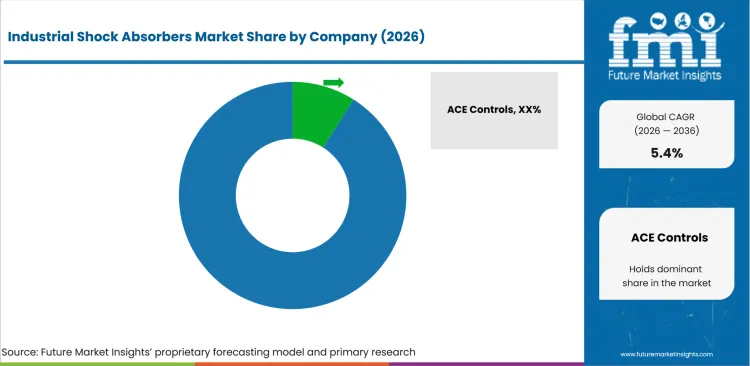
Competition spans damping specialists, diversified motion-control groups and automation manufacturers that place shock absorbers beside broader machine-component portfolios. Application engineering, product breadth and replacement support raise entry barriers because an approved component must remain available after the machine enters service.
- ACE Controls, Zimmer Group and Weforma cover broad damping ranges with application engineering for automation and machine-building duties.
- Enidine / ITT, Parker Hannifin, Festo and SMC reach machine builders through wider motion-control or factory-automation portfolios with international distribution.
- Taylor Devices and Koba address high-energy or custom duties, and Stabilus supplies the manufacturing and distribution platform behind ACE.
Competitive Benchmarking: Industrial Shock Absorbers Market
| Company | Product Range Breadth | Heavy-Duty / Custom Engineering | Automation Integration | Geographic Reach |
|---|---|---|---|---|
| ACE Controls | High | High | High | Global |
| Zimmer Group | High | High | High | Global |
| Enidine / ITT | High | High | High | Global |
| Parker Hannifin | High | High | High | Global |
| Weforma | High | High | Medium | Europe and international sales |
| Festo | Medium | Medium | High | Global |
| SMC | High | Medium | High | Global |
| Taylor Devices | Medium | High | Medium | North America and international sales |
| Koba | Medium | High | Medium | Asia and international sales |
| Stabilus | High | High | High | Global |
Scoring uses documented product and company evidence instead of corporate size alone. High product breadth requires at least three industrial damping routes, while Medium requires two documented routes. High heavy-duty or custom engineering requires dedicated high-energy products plus application engineering. Medium scores cover narrower engineered variants with documented application support for industrial machinery. High automation integration requires direct factory, warehouse or robotics fit within a broader automation platform. Medium scores cover machinery integration without the same platform depth or breadth. Low would require a documented limitation rather than missing public evidence alone.
Key Developments in the Industrial Shock Absorbers Market
- In July 2026, Zimmer Group documented Eitzenberger's use of PowerStop industrial shock absorbers in its EZ-GS0760 wafer stage to dissipate residual kinetic energy during acceleration up to 8 g.
- In May 2026, Stabilus announced that ACE would relocate industrial and small shock absorber production to Koblenz and Aichwald, moving European supply closer to machine-building customers.
- In May 2025, Weforma received renewed ISO 9001:2015 certification covering development, production and distribution of industrial and heavy-duty shock absorbers, with validity beginning June 1, 2025.
Key Players in the Industrial Shock Absorbers Market
Application-Engineered Damping Specialists
- ACE Controls
- Zimmer Group
Industrial Damping and Automation Portfolios
- Enidine / ITT
- Parker Hannifin
- Weforma
- Festo
- SMC
High-Energy and Regional Manufacturing Platforms
- Taylor Devices
- Koba
- Stabilus
Industrial Shock Absorbers Market - Report Scope
| Coverage field | Report scope |
|---|---|
| Market breakdown | By absorber type, load capacity, mounting, end use, sales channel and region. |
| Quantitative Units | USD billion. |
| Market Definition | Industrial hydraulic and related shock absorbers used to decelerate moving machine loads, protect end stops and control impact energy in industrial equipment. |
| Regions Covered | North America, Latin America, Western Europe, Eastern Europe, East Asia, South Asia and Pacific, and Middle East and Africa. |
| Countries Covered | Germany, Mexico, South Korea, Italy, USA, France, Japan, and 20+ countries included in the full report. |
| Key Companies Profiled | ACE Controls, Zimmer Group, Enidine / ITT, Parker Hannifin, Weforma, Festo, SMC, Taylor Devices, Koba, Stabilus. |
| Forecast Period | 2026 to 2036. |
| Approach | Primary and secondary research with market triangulation. |
Industrial Shock Absorbers Market - Research Methodology
| Method | Approach |
|---|---|
| Primary Research | FMI analysts gathered input from manufacturers, service providers, technology developers, distributors, end users, procurement teams, and subject-matter experts. Interviews examined purchasing decisions, product or service evaluation, adoption barriers, approval requirements, pricing considerations, and expectations for technical or commercial support. Respondents were also asked what evidence is required before a trial, pilot, or initial order develops into regular purchasing. |
| Desk Research | Desk research covered government statistics, regulatory publications, trade data, industry associations, technical literature, standards, company filings, product information, and official corporate announcements. Sources were reviewed for relevance, publication date, geographic coverage, and consistency with the defined market scope. Claims relating to performance, applications, approvals, capacity, investment, and commercial activity were retained only when supported by credible public evidence. |
| Market Sizing and Forecasting | The market model combined the baseline value with historical performance, segment structure, pricing and volume indicators, adoption levels, company participation, and country-level demand conditions. Forecast assumptions considered economic activity, investment trends, regulatory developments, technology adoption, purchasing cycles, supply availability, and barriers to wider market use. Segment and regional estimates were reconciled before the final market total was calculated. |
| Data Validation | Estimates were checked against multiple independent indicators, including public data, company activity, trade patterns, industry developments, and findings from primary interviews. Validation also tested whether products, services, applications, and company revenues fell within the defined market boundaries. Adjacent categories, unsupported claims, overlapping revenues, and activities without direct market relevance were excluded to reduce double counting and maintain consistency across segments and countries. |
Industrial Shock Absorbers Market by Segments
Industrial Shock Absorbers Market segmented by Absorber Type:
- Self-compensating shock absorbers
- Adjustable shock absorbers
- Heavy-duty shock absorbers
- Miniature shock absorbers
- Rotary dampers
Industrial Shock Absorbers Market segmented by Load Capacity:
- Light duty
- Medium duty
- Heavy duty
- High-cycle precision
Industrial Shock Absorbers Market segmented by Mounting:
- Threaded body
- Flange mount
- Foot mount
- Custom mount
Industrial Shock Absorbers Market segmented by End Use:
- Packaging machinery
- Material handling
- Robotics
- Machine tools
- Automotive assembly
Industrial Shock Absorbers Market segmented by Sales Channel:
- Industrial distributors
- Direct OEM supply
- Automation integrators
- Catalog/e-commerce
Industrial Shock Absorbers Market by Region:
- North America
- United States
- Canada
- Latin America
- Brazil
- Mexico
- Argentina
- Chile
- Western Europe
- Germany
- France
- UK
- Italy
- Spain
- Benelux
- Nordics
- Eastern Europe
- Poland
- Czech Republic
- Romania
- Hungary
- East Asia
- China
- Japan
- South Korea
- South Asia and Pacific
- India
- ASEAN
- Australia and New Zealand
- Middle East and Africa
- GCC Countries
- South Africa
- Türkiye
- Israel
Research Sources and Bibliography
- International Federation of Robotics. (2025, September 25). Global Robot Demand in Factories Doubles Over 10 Years.
- International Federation of Robotics. (2025, September 25). EU's Auto Sector Sees Sharp Drop in Robot Adoption.
- Taylor Devices, Inc. (2026, August 18). Annual Report on Form 10-K for the Fiscal Year Ended May 31, 2026.
- Association for Advancing Automation. (2026, February 6). Robot Orders Grow 6.6% in 2025 as General Industries Drive Broader Automation Adoption.
- Festo SE & Co. KG. (2025, July). Shock absorber DYEF.
- UCIMA. (2026, April 22). Macchine per il packaging: fatturato in crescita e ordini in calo nel primo trimestre 2026.
- International Federation of Robotics. (2026, June 18). US Robot Industry Returns to Double Digit Growth.
- ACE Controls Inc. (2025, October 16). ACE Shockabsorber: Free Shock Absorber Calculation Program (Windows).
- ITT Inc. (2026, February 9). Annual Report on Form 10-K for the Fiscal Year Ended December 31, 2025.
- VDMA Robotics + Automation. (2025, January 28). German robotics and automation in a downturn.
- Instituto Nacional de Estadística y Geografía. (2026, January 9). Registro administrativo de la industria automotriz de vehículos ligeros. Diciembre de 2025.
- International Federation of Robotics. (2026, April 8). Robot Density Surges in Europe, Asia, and Americas.
- UCIMA. (2026, July 23). Macchine packaging: fatturato in crescita nel I semestre 2026 ma rallentano gli ordini e salgono i costi di produzione.
- INSEE. (2026, February 5). In December 2025, manufacturing output fell back sharply (-0.8%).
- Japan Robot Association. (2026, June 1). マニピュレータ、ロボット統計 受注・生産・出荷実績 2025年.
- Zimmer Group. (2026, July 27). Vibration-Free Despite Extreme Acceleration.
- Stabilus SE. (2026, May 19). Stabilus SE is strengthening its global growth platform and investing in regional production and distribution infrastructure in the USA, China, Mexico, and Germany.
- TÜV Rheinland Cert GmbH. (2025, May 12). Certificate ISO 9001:2015 - Weforma Dämpfungstechnik GmbH.
- Parker Hannifin Corporation. (n.d.). Pneumatic Division Actuator & Cylinder Images. Retrieved September 3, 2026.
- KOBA Co., Ltd. (n.d.). Industrial Shock Absorber. Retrieved September 3, 2026.
- TÜV SÜD PSB Pte Ltd. (2025, September 29). Certificate: Festo Ltd. ISO 9001:2015.
- SMC Corporation. (2026, March 2). SMC has begun the operation of Japan Technical Center.
- Stabilus Group. (2025, September 10). Stabilus4Automation changes the game in industrial automation with integrated solutions.
- Zimmer Group. (2025, October 1). Expansion of presence in Sweden.
- ACE Controls Inc. (2025, July 7). Industrial POWERISE: ACE Controls Inc. Introduces Actuators to Industrial Applications in the Americas.
- Parker-Hannifin Corporation. (2025, September 18). Parker Completes Curtis Instruments Acquisition.
- Festo India Private Limited. (2025, March 18). Our New Manufacturing Plant at Krishnagiri District, Tamilnadu.
- Taylor Devices, Inc. (2025, July 31). Force Development Services (FDS) Ltd and Taylor Devices, Inc. sign Exclusive Agreement for UK and Europe.
- Zimmer Group. (2025, July 28). Strong impetus for sustainable mobility.
- Stabilus Group. (2025, May 20). Stabilus Group strengthens collaboration with Cultraro.
This bibliography is provided for reader reference and is not exhaustive. The full report contains the complete reference list and detailed citations
This Report Answers
- What is the industrial shock absorbers market size in 2026 and what value is forecast for 2036?
- How does factory automation increase industrial shock absorber design points?
- Why do self-compensating shock absorbers lead the absorber type category?
- Why do threaded-body designs lead the mounting category?
- How does packaging machinery translate repetitive motion into shock absorber demand?
- Why do growth rates differ among the seven profiled countries?
- Which companies compete in industrial shock absorbers and how do their roles differ?
- What sizing conditions can delay approval of an industrial shock absorber?
Frequently Asked Questions
How big is the industrial shock absorbers market in 2026?
The industrial shock absorbers market is valued at USD 1.1 billion in 2026 and is projected to reach USD 1.9 billion by 2036. Expansion follows automation investment and replacement demand at controlled machine end stops.
What is the CAGR of the industrial shock absorbers market from 2026 to 2036?
The industrial shock absorbers market is projected to grow at a CAGR of 5.4% between 2026 and 2036. Faster automated equipment and replacement work increase the number of machine stops requiring controlled deceleration.
Which absorber type leads the industrial shock absorbers market?
The self-compensating shock absorbers segment is expected to hold 28.0% of the industrial shock absorbers market in 2026, attributable to lower adjustment work on repeat machine designs. Predefined damping behavior also simplifies replacement within known operating ranges.
Which mounting type leads the industrial shock absorbers market?
The threaded-body segment is expected to hold 41.0% of the industrial shock absorbers market in 2026, supported by direct axial adjustment and compact installation. The format gives maintenance teams a repeatable replacement interface without a separate bracket.
Which countries are projected to record the highest growth in the industrial shock absorbers market?
Germany is projected to grow at 6.1% CAGR, followed by Mexico at 5.6% and South Korea at 5.4% through 2036. Their growth routes differ through machine-building depth, automotive production schedules and automation density.
Which companies are active in the industrial shock absorbers market?
Key companies operating in the industrial shock absorbers market include ACE Controls, Zimmer Group, Enidine / ITT, Parker Hannifin, Weforma, Festo, SMC, Taylor Devices, Koba, and Stabilus. Competition centers on damping breadth, application engineering, automation access and regional supply coverage.
Preview the report firsthand - request a free sample
Get SampleGet the brochure for pricing and purchase details.
Get PDFTable of Content
- Key Takeaways
- Market Size and CAGR
- Top Growth Driver
- Fastest Growing Segment
- Leading Region
- Key Companies
- Emerging Opportunities
- Executive Summary
- Global Market Outlook
- Demand-side Trends
- Supply-side Trends
- Technology Roadmap Analysis
- Analysis and Recommendations
- Analyst Perspective (What is happening? Why now? What should investors know?)
- Key Questions Answered
- How large is the market?
- What is the CAGR?
- What are key trends?
- Which region dominates?
- Who are the leaders?
- Market Overview
- Market Coverage / Taxonomy
- Market Definition / Scope / Limitations
- Research Methodology
- Chapter Orientation
- Analytical Lens and Working Hypotheses
- Market Structure, Signals, and Trend Drivers
- Benchmarking and Cross-market Comparability
- Market Sizing, Forecasting, and Opportunity Mapping
- Research Design and Evidence Framework
- Desk Research Programme (Secondary Evidence)
- Expert Input and Fieldwork (Primary Evidence)
- Tooling, Models, and Reference Databases
- Data Engineering and Model Build
- Quality Assurance and Audit Trail
- Market Background
- Market Dynamics (Drivers, Restraints, Opportunity, Trends)
- Scenario Forecast (Optimistic, Likely, Conservative)
- Impact Analysis
- AI Impact
- Sustainability Impact
- Regulatory Impact
- Technology Impact
- Consumer / Buyer Analysis
- Purchase Drivers
- Adoption Barriers
- Buyer Journey
- Opportunity Map Analysis
- Product Life Cycle Analysis
- Supply Chain Analysis
- Investment Feasibility Matrix
- Value Chain Analysis
- PESTLE and Porter's Analysis
- Regulatory Landscape
- Regional Parent Market Outlook
- Production and Consumption Statistics
- Import and Export Statistics
- Global Market Analysis and Forecast, 2021 to 2036
- Historical Market Size Value (USD Billion) Analysis, 2021 to 2025
- Current and Future Market Size Value (USD Billion) Projections, 2026 to 2036
- Y-o-Y Growth Trend Analysis
- Absolute $ Opportunity Analysis
- Global Market Pricing Analysis, 2021 to 2036
- Global Market Analysis and Forecast, By Absorber Type, 2021 to 2036
- Introduction / Key Findings
- Historical Market Size Value (USD Billion) Analysis By Absorber Type, 2021 to 2025
- Current and Future Market Size Value (USD Billion) Analysis and Forecast By Absorber Type, 2026 to 2036
- Self-compensating shock absorbers
- Adjustable shock absorbers
- Heavy-duty shock absorbers
- Miniature shock absorbers
- Rotary dampers
- Self-compensating shock absorbers
- Y-o-Y Growth Trend Analysis By Absorber Type, 2021 to 2025
- Absolute $ Opportunity Analysis By Absorber Type, 2026 to 2036
- Global Market Analysis and Forecast, By Load Capacity, 2021 to 2036
- Introduction / Key Findings
- Historical Market Size Value (USD Billion) Analysis By Load Capacity, 2021 to 2025
- Current and Future Market Size Value (USD Billion) Analysis and Forecast By Load Capacity, 2026 to 2036
- Light duty
- Medium duty
- Heavy duty
- High-cycle precision
- Light duty
- Y-o-Y Growth Trend Analysis By Load Capacity, 2021 to 2025
- Absolute $ Opportunity Analysis By Load Capacity, 2026 to 2036
- Global Market Analysis and Forecast, By Mounting, 2021 to 2036
- Introduction / Key Findings
- Historical Market Size Value (USD Billion) Analysis By Mounting, 2021 to 2025
- Current and Future Market Size Value (USD Billion) Analysis and Forecast By Mounting, 2026 to 2036
- Threaded body
- Flange mount
- Foot mount
- Custom mount
- Threaded body
- Y-o-Y Growth Trend Analysis By Mounting, 2021 to 2025
- Absolute $ Opportunity Analysis By Mounting, 2026 to 2036
- Global Market Analysis and Forecast, By End Use, 2021 to 2036
- Introduction / Key Findings
- Historical Market Size Value (USD Billion) Analysis By End Use, 2021 to 2025
- Current and Future Market Size Value (USD Billion) Analysis and Forecast By End Use, 2026 to 2036
- Packaging machinery
- Material handling
- Robotics
- Machine tools
- Automotive assembly
- Packaging machinery
- Y-o-Y Growth Trend Analysis By End Use, 2021 to 2025
- Absolute $ Opportunity Analysis By End Use, 2026 to 2036
- Global Market Analysis and Forecast, By Sales Channel, 2021 to 2036
- Introduction / Key Findings
- Historical Market Size Value (USD Billion) Analysis By Sales Channel, 2021 to 2025
- Current and Future Market Size Value (USD Billion) Analysis and Forecast By Sales Channel, 2026 to 2036
- Industrial distributors
- Direct OEM supply
- Automation integrators
- Catalog/e-commerce
- Industrial distributors
- Y-o-Y Growth Trend Analysis By Sales Channel, 2021 to 2025
- Absolute $ Opportunity Analysis By Sales Channel, 2026 to 2036
- Global Market Analysis and Forecast, By Region, 2021 to 2036
- Introduction
- Historical Market Size Value (USD Billion) Analysis By Region, 2021 to 2025
- Current Market Size Value (USD Billion) Analysis and Forecast By Region, 2026 to 2036
- North America
- Latin America
- Western Europe
- Eastern Europe
- East Asia
- South Asia and Pacific
- Middle East & Africa
- Market Attractiveness Analysis By Region
- North America Market Analysis and Forecast, By Country, 2021 to 2036
- Historical Market Size Value (USD Billion) Trend Analysis By Market Taxonomy, 2021 to 2025
- Market Size Value (USD Billion) Forecast By Market Taxonomy, 2026 to 2036
- By Country
- USA
- Canada
- By Absorber Type
- By Load Capacity
- By Mounting
- By End Use
- By Sales Channel
- By Country
- Market Attractiveness Analysis
- By Country
- By Absorber Type
- By Load Capacity
- By Mounting
- By End Use
- By Sales Channel
- Key Takeaways
- Latin America Market Analysis and Forecast, By Country
- Historical Market Size Value (USD Billion) Trend Analysis By Market Taxonomy, 2021 to 2025
- Market Size Value (USD Billion) Forecast By Market Taxonomy, 2026 to 2036
- By Country
- Brazil
- Mexico
- Chile
- Rest of Latin America
- By Absorber Type
- By Load Capacity
- By Mounting
- By End Use
- By Sales Channel
- By Country
- Market Attractiveness Analysis
- By Country
- By Absorber Type
- By Load Capacity
- By Mounting
- By End Use
- By Sales Channel
- Key Takeaways
- Western Europe Market Analysis and Forecast, By Country
- Historical Market Size Value (USD Billion) Trend Analysis By Market Taxonomy, 2021 to 2025
- Market Size Value (USD Billion) Forecast By Market Taxonomy, 2026 to 2036
- By Country
- Germany
- UK
- Italy
- Spain
- France
- Nordic
- BENELUX
- Rest of Western Europe
- By Absorber Type
- By Load Capacity
- By Mounting
- By End Use
- By Sales Channel
- By Country
- Market Attractiveness Analysis
- By Country
- By Absorber Type
- By Load Capacity
- By Mounting
- By End Use
- By Sales Channel
- Key Takeaways
- Eastern Europe Market Analysis and Forecast, By Country
- Historical Market Size Value (USD Billion) Trend Analysis By Market Taxonomy, 2021 to 2025
- Market Size Value (USD Billion) Forecast By Market Taxonomy, 2026 to 2036
- By Country
- Russia
- Poland
- Hungary
- Balkan & Baltic
- Rest of Eastern Europe
- By Absorber Type
- By Load Capacity
- By Mounting
- By End Use
- By Sales Channel
- By Country
- Market Attractiveness Analysis
- By Country
- By Absorber Type
- By Load Capacity
- By Mounting
- By End Use
- By Sales Channel
- Key Takeaways
- East Asia Market Analysis and Forecast, By Country
- Historical Market Size Value (USD Billion) Trend Analysis By Market Taxonomy, 2021 to 2025
- Market Size Value (USD Billion) Forecast By Market Taxonomy, 2026 to 2036
- By Country
- China
- Japan
- South Korea
- By Absorber Type
- By Load Capacity
- By Mounting
- By End Use
- By Sales Channel
- By Country
- Market Attractiveness Analysis
- By Country
- By Absorber Type
- By Load Capacity
- By Mounting
- By End Use
- By Sales Channel
- Key Takeaways
- South Asia and Pacific Market Analysis and Forecast, By Country
- Historical Market Size Value (USD Billion) Trend Analysis By Market Taxonomy, 2021 to 2025
- Market Size Value (USD Billion) Forecast By Market Taxonomy, 2026 to 2036
- By Country
- India
- ASEAN
- Australia & New Zealand
- Rest of South Asia and Pacific
- By Absorber Type
- By Load Capacity
- By Mounting
- By End Use
- By Sales Channel
- By Country
- Market Attractiveness Analysis
- By Country
- By Absorber Type
- By Load Capacity
- By Mounting
- By End Use
- By Sales Channel
- Key Takeaways
- Middle East & Africa Market Analysis and Forecast, By Country
- Historical Market Size Value (USD Billion) Trend Analysis By Market Taxonomy, 2021 to 2025
- Market Size Value (USD Billion) Forecast By Market Taxonomy, 2026 to 2036
- By Country
- Kingdom of Saudi Arabia
- Other GCC Countries
- Türkiye
- South Africa
- Other African Union
- Rest of Middle East & Africa
- By Absorber Type
- By Load Capacity
- By Mounting
- By End Use
- By Sales Channel
- By Country
- Market Attractiveness Analysis
- By Country
- By Absorber Type
- By Load Capacity
- By Mounting
- By End Use
- By Sales Channel
- Key Takeaways
- Key Countries Market Analysis
- USA
- Pricing Analysis
- Market Share Analysis, 2025
- By Absorber Type
- By Load Capacity
- By Mounting
- By End Use
- By Sales Channel
- Canada
- Pricing Analysis
- Market Share Analysis, 2025
- By Absorber Type
- By Load Capacity
- By Mounting
- By End Use
- By Sales Channel
- Mexico
- Pricing Analysis
- Market Share Analysis, 2025
- By Absorber Type
- By Load Capacity
- By Mounting
- By End Use
- By Sales Channel
- Brazil
- Pricing Analysis
- Market Share Analysis, 2025
- By Absorber Type
- By Load Capacity
- By Mounting
- By End Use
- By Sales Channel
- Chile
- Pricing Analysis
- Market Share Analysis, 2025
- By Absorber Type
- By Load Capacity
- By Mounting
- By End Use
- By Sales Channel
- Germany
- Pricing Analysis
- Market Share Analysis, 2025
- By Absorber Type
- By Load Capacity
- By Mounting
- By End Use
- By Sales Channel
- UK
- Pricing Analysis
- Market Share Analysis, 2025
- By Absorber Type
- By Load Capacity
- By Mounting
- By End Use
- By Sales Channel
- Italy
- Pricing Analysis
- Market Share Analysis, 2025
- By Absorber Type
- By Load Capacity
- By Mounting
- By End Use
- By Sales Channel
- Spain
- Pricing Analysis
- Market Share Analysis, 2025
- By Absorber Type
- By Load Capacity
- By Mounting
- By End Use
- By Sales Channel
- France
- Pricing Analysis
- Market Share Analysis, 2025
- By Absorber Type
- By Load Capacity
- By Mounting
- By End Use
- By Sales Channel
- India
- Pricing Analysis
- Market Share Analysis, 2025
- By Absorber Type
- By Load Capacity
- By Mounting
- By End Use
- By Sales Channel
- ASEAN
- Pricing Analysis
- Market Share Analysis, 2025
- By Absorber Type
- By Load Capacity
- By Mounting
- By End Use
- By Sales Channel
- Australia & New Zealand
- Pricing Analysis
- Market Share Analysis, 2025
- By Absorber Type
- By Load Capacity
- By Mounting
- By End Use
- By Sales Channel
- China
- Pricing Analysis
- Market Share Analysis, 2025
- By Absorber Type
- By Load Capacity
- By Mounting
- By End Use
- By Sales Channel
- Japan
- Pricing Analysis
- Market Share Analysis, 2025
- By Absorber Type
- By Load Capacity
- By Mounting
- By End Use
- By Sales Channel
- South Korea
- Pricing Analysis
- Market Share Analysis, 2025
- By Absorber Type
- By Load Capacity
- By Mounting
- By End Use
- By Sales Channel
- Russia
- Pricing Analysis
- Market Share Analysis, 2025
- By Absorber Type
- By Load Capacity
- By Mounting
- By End Use
- By Sales Channel
- Poland
- Pricing Analysis
- Market Share Analysis, 2025
- By Absorber Type
- By Load Capacity
- By Mounting
- By End Use
- By Sales Channel
- Hungary
- Pricing Analysis
- Market Share Analysis, 2025
- By Absorber Type
- By Load Capacity
- By Mounting
- By End Use
- By Sales Channel
- Kingdom of Saudi Arabia
- Pricing Analysis
- Market Share Analysis, 2025
- By Absorber Type
- By Load Capacity
- By Mounting
- By End Use
- By Sales Channel
- Türkiye
- Pricing Analysis
- Market Share Analysis, 2025
- By Absorber Type
- By Load Capacity
- By Mounting
- By End Use
- By Sales Channel
- South Africa
- Pricing Analysis
- Market Share Analysis, 2025
- By Absorber Type
- By Load Capacity
- By Mounting
- By End Use
- By Sales Channel
- USA
- Market Structure Analysis
- Competition Dashboard
- Competition Benchmarking
- Market Share Analysis of Top Players
- By Regional
- By Absorber Type
- By Load Capacity
- By Mounting
- By End Use
- By Sales Channel
- Emerging Startups
- Innovation Benchmarking
- Competition Analysis
- Competition Deep Dive
- ACE Controls
- Overview
- Product Portfolio
- Profitability by Market Segments
- Sales Footprint
- Strategy Overview
- Marketing Strategy
- Product Strategy
- Channel Strategy
- Zimmer Group
- Enidine / ITT
- Parker Hannifin
- Weforma
- Festo
- SMC
- Taylor Devices
- Koba
- Stabilus
- ACE Controls
- Case Studies
- Success Stories
- Recent Developments
- Competition Deep Dive
- Assumptions & Acronyms Used


