

- Market Size (2026)
- USD 1.9 Bn
- Forecast (2036)
- USD 3.0 Bn
- CAGR (2026 to 2036)
- 4.7%
How big is Industrial Storage Cabinets Market in 2026?
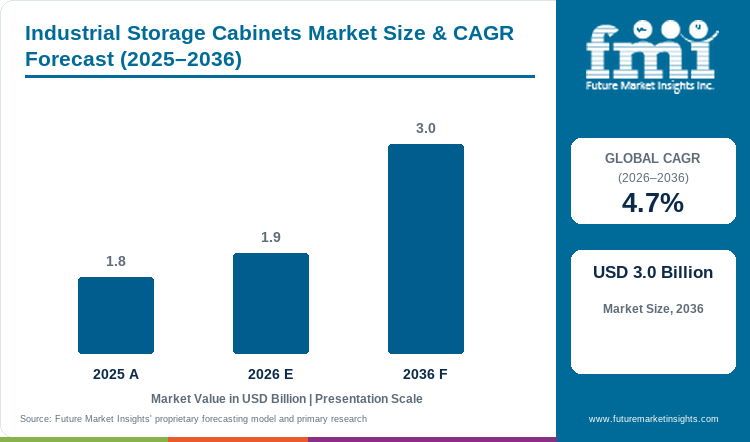
The industrial storage cabinets market is valued at USD 1.9 billion in 2026 and is projected to reach USD 3.0 billion by 2036, growing at a of 4.7% CAGR.
Industrial storage cabinet sales are expected to grow at a 4.7% CAGR through 2036. The value rises from USD 1.8 billion in 2025 to USD 1.9 billion in 2026. It is expected to reach USD 3.0 billion by 2036. OSHA sets limits on the amount of flammable liquid stored in one cabinet. OSHA also gives a compliance route for metal cabinets. That route requires at least No. 18 gauge sheet iron with double walls and a three-point door lock. These rules make safety cabinets a defined plant-control need rather than ordinary furniture.
Countries can use different rules even when a cabinet does the same basic job. Germany's TRGS 510 accepts safety cabinets for flammable liquids when they meet DIN EN 14470-1. The cabinet must also provide at least 90 minutes of fire resistance. General tool cabinets follow a different buying path based on storage density and access. High-density drawers keep tools near maintenance work without using automated storage. Buyers then ask whether a new cabinet cuts control risk or frees enough work space to replace a usable unit.
Key Takeaways of Industrial Storage Cabinets Market
- Safety rules and point-of-use organization keep enclosed cabinets in plant-control and maintenance decisions.
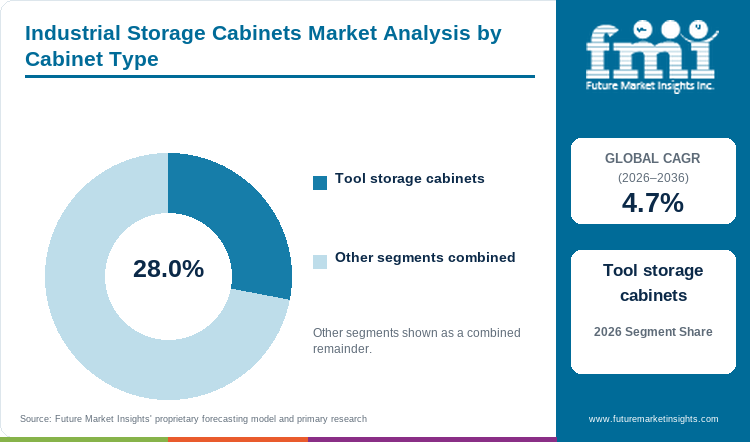
- Tool storage cabinets hold 28.0% of the cabinet-type category in 2026. Configurable drawers keep high-use tools close to maintenance work.
- Steel holds 62.0% of the material category in 2026. Welded steel supports both standard and heavy-duty cabinet designs.
- Manufacturing plants account for 31.0% of end use in 2026. They manage tools and spare parts across many departments.
- Long service life slows replacement because welded cabinets can stay useful through many layout and equipment changes.
- Key companies include Lista, Stanley Vidmar, Justrite, Rousseau Metal, Tennsco, Durham Manufacturing, Lyon Workspace, Global Industrial, Edsal, and Strong Hold.
Analyst Perspective
"Industrial storage cabinets earn replacement budget when they solve a defined control problem such as fire-safe storage or tool custody. Procurement teams should match cabinet construction and access features to the operating job and require measurable floor-space recovery before paying for configurability that the site cannot use."
- Nikhil Kaitwade, Principal Consultant, Future Market Insights
How is the industrial storage cabinets market segmented?
The industrial storage cabinets market is segmented by cabinet type, material, end use, locking, sales channel, and region.
The industrial storage cabinets market uses five segment axes with region as the geographic split.
Cabinet type covers tool storage, flammable safety, parts, mobile, and heavy-duty shop cabinets.
Material covers steel, stainless steel, plastic/polymer, wood/laminate, and aluminum.
End use covers manufacturing plants, workshops/garages, laboratories, warehouses, and automotive service.
Locking covers key, digital/electronic, padlock hasp, and central locking.
Sales channel covers industrial distributors, direct manufacturer sales, e-commerce/catalog, and dealer/installer networks.
What makes tool storage cabinets central to the cabinet type category?
Tool cabinets support daily maintenance and factory work. Different drawer heights and dividers help teams sort tools by task. This keeps mixed items off open shelves. LISTA sells steel drawer cabinets with flexible dividers and many lock choices. Strong Hold sells 14-gauge modular cabinets with 400 lb drawers and keyed or electronic access. The CNC tool storage system uses the same point-of-use idea for machining tools that need safe storage and fast access.
- Tool storage cabinets hold 28.0% of cabinet-type sales in 2026. Configurable drawers keep high-use tools close to maintenance work.
- LISTA and Strong Hold both offer configurable drawer systems for industrial tools and parts.
Why does steel lead the material category?
Steel works well for welded cabinet bodies and reinforced lock points. It also supports drawer slides and adjustable shelves in standard and heavy-duty units. Durham sells 12-gauge cabinet bodies with 400 lb drawers. Global Industrial sells 16-gauge cabinets with all-welded construction. Stainless steel helps in wet or corrosive areas. Some tool boxes use lighter materials to make moving easier. Steel still gives buyers a useful mix of load strength and cabinet security in the formats reviewed here.
- Steel holds 62.0% of material sales in 2026. Welded construction gives many cabinet types the strength needed for heavy loads.
- Durham and Global Industrial use welded steel across drawer and configurable cabinet ranges.
How do manufacturing plants anchor the end use category?
Factories keep production tools and maintenance spares at one site. They also store supplies that need tighter control. A work cell may use drawers for tools while an EHS area needs a safety cabinet. Plant changes can move high-use items closer to the work area. More factory automation controls can add parts and maintenance work around machines. Cabinets remain manual storage. They add value when workers spend less time walking between a tool crib and the job.
- Manufacturing plants hold 31.0% of end-use sales in 2026. One site can manage tools and spare parts for many teams.
- Plant use spans production support and MRO rather than one cabinet type.
What supports key lock leadership in the locking category?
Key locks control cabinet access without power or software. This simple setup works for stand-alone units and small user groups. Electronic locks help when workers need their own access code or a clear access record. Rousseau sells key and hasp locks plus digital and smart options. Strong Hold offers keyed or electronic access on modular drawer cabinets. Smart factory programs can make access records more useful when tool control joins a wider digital shop-floor process.
- Key locks hold 36.0% of the locking category in 2026. They meet routine security needs without software.
- Electronic access becomes more useful when a site needs a clear access record.
What drives industrial distributors in the sales channel category?
Cabinet orders often need product checks and freight planning at the same time. A distributor can bundle standard cabinets with other MRO items and use existing account terms. Direct sales work well for custom setups. E-commerce works when sizes and options are clear. Dealers or installers help when a project needs anchoring or layout support. Manufacturing logistics also affect delivery because bulky steel cabinets must arrive within the planned work window.
- Industrial distributors account for 41.0% of sales-channel revenue in 2026. They help buyers compare products and plan delivery for standard cabinet orders.
- Direct sales still matter for custom programs that need help from the cabinet maker.
What are the drivers, restraints and opportunities in the Industrial Storage Cabinets Market?
In the industrial storage cabinets market, the key driver is safety rules and point-of-use organization that keep enclosed cabinets in plant-control decisions, the key restraint is long-lasting welded units that slow replacement when the installed cabinet still meets the job, and the key opportunity is configurable interiors and electronic access that improve control without replacing the full storage system.
- Driver: Safety rules and point-of-use organization keep enclosed cabinets in plant-control decisions.
- Restraint: Long-lasting welded units slow replacement when the installed cabinet still meets the job.
- Opportunity: Configurable interiors and electronic access improve control without replacing the full storage system.
Safety specifications turn selected cabinets into operating controls
OSHA sets size and build rules for cabinets that store flammable liquids. Its metal-cabinet compliance route calls for at least No. 18 gauge sheet iron. The cabinet also needs double walls and a three-point lock. These rules keep safety cabinets in real workplace safety plans. General tool storage follows another path because maintenance teams need safe access near the job. Industrial safety products also affect cabinet demand when storage supports fire or chemical control. A cabinet has a clear buying case when it solves a safety or work-flow need.
Long service life makes replacement a harder capital decision
Durable steel cabinets can slow replacement because they may stay useful through many layout changes.Durham sells 12-gauge cabinets with high shelf capacity and 400 lb drawers. Those features support a purchase but can delay replacement based on age alone. Warehouse racking uses open storage instead. A cabinet often needs another reason for replacement such as a new footprint or access need. Freight and installation add cost before labor savings appear. Replacement often slows when the old cabinet still works and no new rule requires another type.
Configurable access creates an upgrade route around the installed base
Adjustable interiors let sites change cabinet use without replacing the full storage system. Global Industrial sells cabinets with drawers and electronic keypad locks. Rousseau pairs smart access with stationary 400 lb drawer cabinets. Strong Hold combines modular drawer layouts with keyed or electronic access. These features give sites an upgrade path when tools or parts need tighter control. Material handling integration can add value when sites change work flow and workstations. Adoption is expected to grow when a retrofit or modular setup solves the need without a large automation project. The business case depends on measurable gains in access control or floor space rather than novelty.
Which country CAGRs are profiled in the Industrial Storage Cabinets Market?
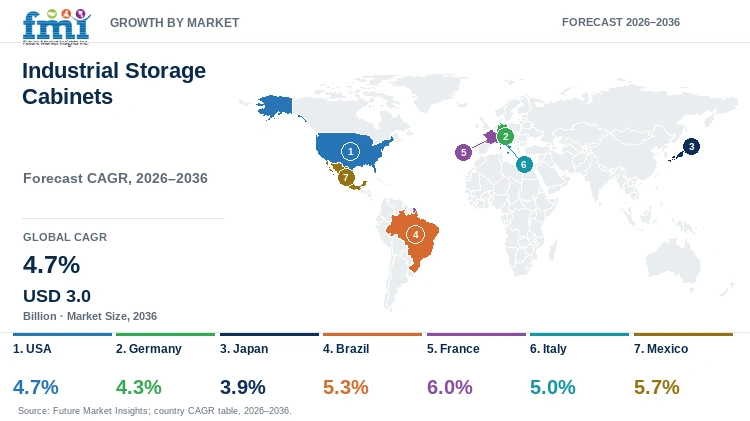
| Country | CAGR |
|---|---|
| USA | 4.7% |
| Germany | 4.3% |
| Japan | 3.9% |
| Brazil | 5.3% |
| France | 6.0% |
| Italy | 5.0% |
| Mexico | 5.7% |
How do country-level CAGRs compare in the Industrial Storage Cabinets Market?
CAGR figures across the seven profiled countries range from 6.0% in France down to 3.9% in Japan, a spread of 2.1 percentage points. Mexico at 5.7% and Brazil at 5.3% follow closely behind France, while Italy sits at 5.0%. The USA at 4.7% and Germany at 4.3% trail the group, and these rates measure projected pace rather than current market size. Safety regulation shapes commercial outcomes as much as raw demand: the USA and Germany carry mature installed bases governed by well-established safety rules, Japan ties hazardous-material storage to formal site approval, France and Italy link cabinet selection to chemical-storage regulation, and Brazil and Mexico apply national workplace rules to covered flammable or hazardous materials.
- In the USA, rack-design requirements keep the supporting structure within a defined approval and modification process.
- Germany's storage-equipment guidance places operational procedures and inspection records at the center of project documentation.
- Japan's national framework treats hazardous-material storage as a formal site-control matter rather than a furniture decision.
- Brazil's storage regulations fold load management and material-handling considerations into wider facility planning.
- France links rack and cabinet configuration to product separation and safer warehouse handling practices.
- Italy ties ventilated safety-cabinet requirements directly to the chemical agents being stored on site.
- Mexico's material-handling framework requires documented setup and maintenance procedures to support ongoing compliance.
Similar CAGRs can still produce different buying conditions once site inspections and local demand patterns are factored in.
Country-wise Analysis
- Cabinet demand in the USA is projected to grow at a 4.7% CAGR through 2036. OSHA regulates cabinets used to store flammable liquids, capping any single cabinet at 60 gallons for Category 1 through 3 liquids and 120 gallons for Category 4 liquids. OSHA's metal-cabinet compliance route also calls for double walls and a three-point door lock, and in July 2025 the agency cited a cabinet used for lacquer thinner and denatured alcohol. These industrial workplace safety rules keep dedicated safety-cabinet demand active even as general tool cabinets continue on normal replacement cycles. Buyers need to separate routine storage spend from fire-control compliance spend, since the two follow different purchasing logic entirely.
- Germany's industrial storage cabinets market is set to expand at a 4.3% CAGR through 2036. TRGS 510 governs the safety-cabinet route for flammable liquids, and BAuA's current TRGS 510 Annex 3 sets out the compliance path in detail, calling for DIN EN 14470-1 construction and at least 90 minutes of fire resistance, with narrow exceptions allowing 30 minutes under specific building conditions. This standard makes fire performance and documentation a routine part of site inspections. General drawer cabinets follow a separate buying path shaped by storage density and access needs, so German suppliers must keep safety certification distinct from standard industrial storage while presenting cabinet sizing and lock options clearly.
- Adoption of industrial storage cabinets in Japan is forecast to advance at a 3.9% CAGR through 2036, the slowest pace among the profiled countries. The Fire Service Act sets national rules for hazardous-material storage, and the Fire and Disaster Management Agency's 2025 White Paper confirms that sites exceeding set thresholds require formal approval covering location and building structure, alongside separate equipment requirements before local sign-off. Lower quantities still fall under local rules. This structure treats chemical storage as a site-control issue rather than a simple furniture purchase, while tool cabinets continue to serve a distinct need for compact, accessible storage. Suppliers benefit from drawing a clear line between general tool storage and controlled hazardous-material equipment.
- Cabinet demand in Brazil is likely to rise at a 5.3% CAGR through 2036. NR-20 covers work involving flammable and combustible materials, and Brazil's Ministry of Labor and Employment describes it as a dedicated rule for covered work and sites, most recently updated through Portaria MTE No. 60 of January 21, 2025. This national standard positions storage equipment within a broader risk-control process whenever cabinets hold covered materials. Parts and tool cabinets follow a separate purchasing path centered on strength and organization, so buyers need to distinguish safety storage from general plant furniture early, with local distributor support helping maintain that distinction through setup and delivery.
- Industrial storage cabinets demand in France is expected to scale at a 6.0% CAGR through 2036, the fastest pace in this group. Chemical-storage rules there shape both air flow and how sites physically separate products. INRS guidance updated in January 2023 states that safe storage depends on the quantity and volatility of each chemical, along with flammability and material compatibility, and calls for products that can react with one another to be kept apart, with dedicated air flow provided for flammable materials. These requirements make cabinet selection part of a facility's overall storage plan, while general cabinets continue to compete on tool density and access rather than chemical compliance. French buyers place particular weight on clear labeling and material-fit data.
- Cabinet demand in Italy is projected to progress at a 5.0% CAGR through 2036. Workplace risk regulations require ventilated safety cabinets for hazardous chemicals, and INAIL's ISI 2025 annex specifies that these cabinets need ventilation connected either to an extraction system or a self-contained exhaust system. The same annex requires cabinets used for flammable hazardous chemicals to meet UNI EN 14470/1, and the associated funding program gives buyers a defined compliance path for covered safety equipment. Tool and parts cabinets remain focused on layout efficiency rather than chemical control, so Italian projects tend to separate certified safety requirements from routine storage decisions before selecting materials and lock types.
- Sales of industrial storage cabinets in Mexico are set to advance at a 5.7% CAGR through 2036, the second-fastest rate among the profiled countries. NOM-005-STPS-1998 governs hazardous-chemical storage at work sites, and in April 2025 Mexico's Secretariat of Labor and Social Welfare confirmed that a 2024 review kept the standard in force, covering safety, hygiene, transport, and storage of hazardous chemicals. This continued status keeps safety documentation a priority wherever cabinets hold covered materials, while tool and parts cabinets follow a separate plant-storage purchasing path. Buyers benefit from clarifying intended cabinet use and lock requirements before choosing between standard steel storage and a certified safety enclosure, with distributor support easing that decision.
Who are the notable companies in the Industrial Storage Cabinets Market?
Lista, Stanley Vidmar, Justrite, Rousseau Metal, Tennsco, Durham Manufacturing, Lyon Workspace, Global Industrial, Edsal, and Strong Hold are active within the defined industrial storage cabinet boundary.
Several types of firms compete in this field. Some focus on modular drawer systems. Others focus on safety cabinets. Broad steel cabinet makers compete too. Buyers choose a cabinet by the storage job it must do. High-density systems compete on drawer layout and access control. Safety cabinets compete on tested builds and hazard features. Broad ranges compete on standard sizes and supply. The link with material handling equipment matters when one distributor supplies storage and movement gear for the same plant job.
- Lista and Stanley Vidmar sell high-density modular systems. Rousseau Metal, Lyon Workspace, and Strong Hold also sell flexible drawer storage that saves floor space.
- Justrite and Durham Manufacturing focus on safety cabinets. Edsal also documents safety or heavy-duty storage for hard industrial jobs.
- Tennsco and Global Industrial sell standard or flexible cabinet systems through broad sales channels.
Competitive Benchmarking: Industrial Storage Cabinets Market
| Company | Drawer Configurability | Heavy-Duty Construction | Access Control | Format Breadth |
|---|---|---|---|---|
| Lista | High | High | High | High |
| Stanley Vidmar | High | High | Low | High |
| Justrite | Low | Medium | Low | High |
| Rousseau Metal | High | High | High | High |
| Tennsco | Low | Medium | Low | Medium |
| Durham Manufacturing | Medium | High | Medium | High |
| Lyon Workspace | High | High | Medium | High |
| Global Industrial | High | High | High | High |
| Edsal | Low | Medium | Medium | High |
| Strong Hold | High | High | High | High |
Scoring basis: Drawer flexibility rates High when current exact-market proof shows several drawer layouts. It rates Low when a range mainly uses fixed shelves or safety interiors. Heavy-duty build rates High for 12- to 14-gauge bodies or at least 400 lb drawer capacity. Access control rates High when current proof shows electronic or smart locks. It rates Medium for several mechanical lock choices. Format breadth rates High for four or more cabinet families and Medium for two or three. Each rating uses current public product proof.
Key Developments in the Industrial Storage Cabinets Market
- In May 2026 LISTA launched its AI Sales Assistant in the product configurator. The tool supports product searches, spare part identification, and technical enquiries as part of the end-to-end digital quotation process.
- In April 2026 Justrite published a case study on a safety check at a state-licensed testing lab. The lab had improper chemical storage. The case study recommended compliant safety cabinets and other fixes.
- In March 2026 Lyon Workspace published a guide for industrial modular cabinets. The guide starts with the cabinet use and floor space. It then covers the housing and inside layout. It also covers mobility.
Key Players in the Industrial Storage Cabinets Market
Configurable High-Density Cabinet Systems
- Lista
- Stanley Vidmar
- Rousseau Metal
- Lyon Workspace
- Strong Hold
Safety and Heavy-Duty Storage Specialists
- Justrite
- Durham Manufacturing
- Edsal
Broadline Cabinet Platforms
- Tennsco
- Global Industrial
Industrial Storage Cabinets Market - Report Scope
| Coverage field | Report scope |
|---|---|
| Market breakdown | By cabinet type, material, end use, locking, sales channel, and region. |
| Quantitative Units | USD billion. |
| Market Definition | Revenue from new industrial storage cabinet units sold within the stated segmentation universe. Factory-configured drawers, shelves, mobile bases, and locks are included when sold as part of the cabinet. Open shelving, racking, stand-alone workbenches, vertical lift modules, separate bins, office or residential cabinetry, downstream contents, and unrelated project revenue are excluded. |
| Regions Covered | North America, Latin America, Western Europe, Eastern Europe, East Asia, South Asia and Pacific, and Middle East and Africa. |
| Countries Covered | USA, Germany, Japan, Brazil, France, Italy, Mexico, and 25+ additional countries in the full report. |
| Key Companies Profiled | Lista, Stanley Vidmar, Justrite, Rousseau Metal, Tennsco, Durham Manufacturing, Lyon Workspace, Global Industrial, Edsal, and Strong Hold. |
| Forecast Period | 2026 to 2036. |
| Approach | Primary and secondary research with market triangulation. |
Industrial Storage Cabinets Market - Research Methodology
| Method | Approach |
|---|---|
| Primary Research | FMI analysts gathered input from manufacturers, service providers, technology developers, distributors, end users, procurement teams, and subject-matter experts. Interviews examined purchasing decisions, product or service evaluation, adoption barriers, approval requirements, pricing considerations, and expectations for technical or commercial support. Respondents were also asked what evidence is required before a trial, pilot, or initial order develops into regular purchasing. |
| Desk Research | Desk research covered government statistics, regulatory publications, trade data, industry associations, technical literature, standards, company filings, product information, and official corporate announcements. Sources were reviewed for relevance, publication date, geographic coverage, and consistency with the defined market scope. Claims relating to performance, applications, approvals, capacity, investment, and commercial activity were retained only when supported by credible public evidence. |
| Market Sizing and Forecasting | The market model combined the baseline value with historical performance, segment structure, pricing and volume indicators, adoption levels, company participation, and country-level demand conditions. Forecast assumptions considered economic activity, investment trends, regulatory developments, technology adoption, purchasing cycles, supply availability, and barriers to wider market use. Segment and regional estimates were reconciled before the final market total was calculated. |
| Data Validation | Estimates were checked against multiple independent indicators, including public data, company activity, trade patterns, industry developments, and findings from primary interviews. Validation also tested whether products, services, applications, and company revenues fell within the defined market boundaries. Adjacent categories, unsupported claims, overlapping revenues, and activities without direct market relevance were excluded to reduce double counting and maintain consistency across segments and countries. |
Industrial Storage Cabinets Market by Segments
Industrial Storage Cabinets Market segmented by Cabinet Type:
- Tool storage cabinets
- Flammable safety cabinets
- Parts cabinets
- Mobile cabinets
- Heavy-duty shop cabinets
Industrial Storage Cabinets Market segmented by Material:
- Steel
- Stainless steel
- Plastic/polymer
- Wood/laminate
- Aluminum
Industrial Storage Cabinets Market segmented by End Use:
- Manufacturing plants
- Workshops/garages
- Laboratories
- Warehouses
- Automotive service
Industrial Storage Cabinets Market segmented by Locking:
- Key lock
- Digital/electronic lock
- Padlock hasp
- Central locking
Industrial Storage Cabinets Market segmented by Sales Channel:
- Industrial distributors
- Direct manufacturer sales
- E-commerce/catalog
- Dealer/installer network
Industrial Storage Cabinets Market by Region:
- North America
- United States
- Canada
- Latin America
- Brazil
- Mexico
- Argentina
- Chile
- Western Europe
- Germany
- France
- United Kingdom
- Italy
- Spain
- Benelux
- Nordics
- Eastern Europe
- Poland
- Czech Republic
- Romania
- Hungary
- East Asia
- China
- Japan
- South Korea
- South Asia and Pacific
- India
- ASEAN
- Australia and New Zealand
- Middle East and Africa
- GCC Countries
- South Africa
- Türkiye
- Israel
Research Sources and Bibliography
- U.S. Occupational Safety and Health Administration. (n.d.). 1910.106 - Flammable liquids. Retrieved September 20, 2026.
- U.S. Occupational Safety and Health Administration. (2025, July 9). Holland, L.P. violation detail: 29 CFR 1910.106(d)(3)(ii)(a).
- Federal Institute for Occupational Safety and Health (BAuA). (2025). TRGS 510: Storage of hazardous substances in non-stationary containers.
- Fire and Disaster Management Agency of Japan. (2025). 2025 White Paper on Fire Service: Hazardous materials regulation.
- Ministry of Labor and Employment, Brazil. (2025, January 27). Regulatory Standard No. 20: Safety and health at work with flammables and combustibles.
- Institut national de recherche et de sécurité. (2023, January 5). Preventing chemical risks: Storage of chemicals.
- Italian National Institute for Insurance against Accidents at Work. (2026). ISI 2025 Public Notice, Annex 1.1: Projects to reduce occupational disease risks.
- Secretariat of Labor and Social Welfare, Mexico. (2025, April 7). Fourth extraordinary session of the National Advisory Committee on Occupational Safety and Health Standardization.
- LISTA. (n.d.). Drawer cabinets: Overview. Retrieved September 20, 2026.
- LISTA. (2026). AI Sales Assistant for the configurator: LISTA AI Sales Assistant.
- Stanley Black & Decker Storage Solutions. (n.d.). Vidmar industrial cabinets and storage systems. Retrieved September 20, 2026.
- Justrite Safety Group. (2026, April 28). Case study: Chemical storage safety in testing labs.
- Rousseau Metal. (2026). G01-MR26 general catalog: R multi-drawer stationary cabinets.
- Tennsco. (n.d.). 66-inch welded storage cabinet. Retrieved September 20, 2026.
- Durham Manufacturing. (2025). 12 gauge cabinets with shelves and drawers [Catalog].
- Lyon Workspace. (2026, March 2). The complete industrial modular cabinet specification guide.
- Global Industrial. (n.d.). New products: Configurable cabinets. Retrieved September 20, 2026.
- Edsal Manufacturing Company. (n.d.). Heavy-duty welded steel flammable safety cabinets. Retrieved September 20, 2026.
- Strong Hold. (2026). Modular drawer storage tool carts: High-density tool storage built to move and perform.
This bibliography gives readers selected references and is not exhaustive. The full report contains the complete reference list plus detailed citations.
This Report Answers
- How large is the Industrial Storage Cabinets Market in 2026 and 2036?
- Which safety and point-of-use needs support industrial storage cabinet purchases?
- Why do tool storage cabinets account for 28.0% of cabinet-type revenue in 2026?
- Why does steel account for 62.0% of material revenue in 2026?
- Why do manufacturing plants account for 31.0% of end-use revenue in 2026?
- How do CAGRs differ across the seven profiled countries?
- Which companies serve modular and safety-focused industrial cabinet needs?
- How does long cabinet life slow replacement demand?
- How can configurable interiors and electronic access support cabinet upgrades?
Frequently Asked Questions
How big is the industrial storage cabinets market in 2026?
The industrial storage cabinets market is worth USD 1.9 billion in 2026. It is expected to reach USD 3.0 billion by 2036. Point-of-use storage and safety rules support demand.
What is the CAGR of the industrial storage cabinets market from 2026 to 2036?
The market is expected to grow at a 4.7% CAGR from 2026 to 2036. Factory changes and controlled storage needs support growth. Long cabinet life can slow replacement.
Which cabinet type accounts for 28.0% of cabinet-type revenue in 2026?
Tool storage cabinets make up 28.0% of cabinet-type sales in 2026. Configurable drawers keep high-use tools close to maintenance and production work.
Which material accounts for 62.0% of material revenue in 2026?
Steel makes up 62.0% of material sales in 2026. Welded strength and familiar fabrication support standard and heavy-duty cabinet designs.
Which end use accounts for 31.0% of end-use revenue in 2026?
Manufacturing plants make up 31.0% of end-use sales in 2026. They manage tools and spare parts for many teams at one site.
Which companies are active in the industrial storage cabinets market?
Key companies include Lista, Stanley Vidmar, Justrite, Rousseau Metal, Tennsco, Durham Manufacturing, Lyon Workspace, Global Industrial, Edsal, and Strong Hold. They compete through configurable storage and safety-focused products. Build strength and sales channels also shape competition.
Preview the report firsthand - request a free sample
Get SampleGet the brochure for pricing and purchase details.
Get PDFTable of Content
- Key Takeaways
- Market Size and CAGR
- Top Growth Driver
- Fastest Growing Segment
- Leading Region
- Key Companies
- Emerging Opportunities
- Executive Summary
- Global Market Outlook
- Demand-side Trends
- Supply-side Trends
- Technology Roadmap Analysis
- Analysis and Recommendations
- Analyst Perspective (What is happening? Why now? What should investors know?)
- Key Questions Answered
- How large is the market?
- What is the CAGR?
- What are key trends?
- Which region dominates?
- Who are the leaders?
- Market Overview
- Market Coverage / Taxonomy
- Market Definition / Scope / Limitations
- Research Methodology
- Chapter Orientation
- Analytical Lens and Working Hypotheses
- Market Structure, Signals, and Trend Drivers
- Benchmarking and Cross-market Comparability
- Market Sizing, Forecasting, and Opportunity Mapping
- Research Design and Evidence Framework
- Desk Research Programme (Secondary Evidence)
- Expert Input and Fieldwork (Primary Evidence)
- Tooling, Models, and Reference Databases
- Data Engineering and Model Build
- Quality Assurance and Audit Trail
- Market Background
- Market Dynamics (Drivers, Restraints, Opportunity, Trends)
- Scenario Forecast (Optimistic, Likely, Conservative)
- Impact Analysis
- AI Impact
- Sustainability Impact
- Regulatory Impact
- Technology Impact
- Consumer / Buyer Analysis
- Purchase Drivers
- Adoption Barriers
- Buyer Journey
- Opportunity Map Analysis
- Product Life Cycle Analysis
- Supply Chain Analysis
- Investment Feasibility Matrix
- Value Chain Analysis
- PESTLE and Porter's Analysis
- Regulatory Landscape
- Regional Parent Market Outlook
- Production and Consumption Statistics
- Import and Export Statistics
- Global Market Analysis and Forecast, 2021 to 2036
- Historical Market Size Value (USD Billion) Analysis, 2021 to 2025
- Current and Future Market Size Value (USD Billion) Projections, 2026 to 2036
- Y-o-Y Growth Trend Analysis
- Absolute $ Opportunity Analysis
- Global Market Pricing Analysis, 2021 to 2036
- Global Market Analysis and Forecast, By Cabinet Type, 2021 to 2036
- Introduction / Key Findings
- Historical Market Size Value (USD Billion) Analysis By Cabinet Type, 2021 to 2025
- Current and Future Market Size Value (USD Billion) Analysis and Forecast By Cabinet Type, 2026 to 2036
- Tool storage cabinets
- Flammable safety cabinets
- Parts cabinets
- Mobile cabinets
- Heavy-duty shop cabinets
- Y-o-Y Growth Trend Analysis By Cabinet Type, 2021 to 2025
- Absolute $ Opportunity Analysis By Cabinet Type, 2026 to 2036
- Global Market Analysis and Forecast, By Material, 2021 to 2036
- Introduction / Key Findings
- Historical Market Size Value (USD Billion) Analysis By Material, 2021 to 2025
- Current and Future Market Size Value (USD Billion) Analysis and Forecast By Material, 2026 to 2036
- Steel
- Stainless steel
- Plastic/polymer
- Wood/laminate
- Aluminum
- Y-o-Y Growth Trend Analysis By Material, 2021 to 2025
- Absolute $ Opportunity Analysis By Material, 2026 to 2036
- Global Market Analysis and Forecast, By End Use, 2021 to 2036
- Introduction / Key Findings
- Historical Market Size Value (USD Billion) Analysis By End Use, 2021 to 2025
- Current and Future Market Size Value (USD Billion) Analysis and Forecast By End Use, 2026 to 2036
- Manufacturing plants
- Workshops/garages
- Laboratories
- Warehouses
- Automotive service
- Y-o-Y Growth Trend Analysis By End Use, 2021 to 2025
- Absolute $ Opportunity Analysis By End Use, 2026 to 2036
- Global Market Analysis and Forecast, By Locking, 2021 to 2036
- Introduction / Key Findings
- Historical Market Size Value (USD Billion) Analysis By Locking, 2021 to 2025
- Current and Future Market Size Value (USD Billion) Analysis and Forecast By Locking, 2026 to 2036
- Key lock
- Digital/electronic lock
- Padlock hasp
- Central locking
- Y-o-Y Growth Trend Analysis By Locking, 2021 to 2025
- Absolute $ Opportunity Analysis By Locking, 2026 to 2036
- Global Market Analysis and Forecast, By Sales Channel, 2021 to 2036
- Introduction / Key Findings
- Historical Market Size Value (USD Billion) Analysis By Sales Channel, 2021 to 2025
- Current and Future Market Size Value (USD Billion) Analysis and Forecast By Sales Channel, 2026 to 2036
- Industrial distributors
- Direct manufacturer sales
- E-commerce/catalog
- Dealer/installer network
- Y-o-Y Growth Trend Analysis By Sales Channel, 2021 to 2025
- Absolute $ Opportunity Analysis By Sales Channel, 2026 to 2036
- Global Market Analysis and Forecast, By Region, 2021 to 2036
- Introduction
- Historical Market Size Value (USD Billion) Analysis By Region, 2021 to 2025
- Current Market Size Value (USD Billion) Analysis and Forecast By Region, 2026 to 2036
- North America
- Latin America
- Western Europe
- Eastern Europe
- East Asia
- South Asia and Pacific
- Middle East and Africa
- Market Attractiveness Analysis By Region
- North America Market Analysis and Forecast, By Country, 2021 to 2036
- Historical Market Size Value (USD Billion) Trend Analysis By Market Taxonomy, 2021 to 2025
- Market Size Value (USD Billion) Forecast By Market Taxonomy, 2026 to 2036
- By Country
- United States
- Canada
- By Cabinet Type
- By Material
- By End Use
- By Locking
- By Sales Channel
- By Country
- Market Attractiveness Analysis
- By Country
- By Cabinet Type
- By Material
- By End Use
- By Locking
- By Sales Channel
- Key Takeaways
- Latin America Market Analysis and Forecast, By Country
- Historical Market Size Value (USD Billion) Trend Analysis By Market Taxonomy, 2021 to 2025
- Market Size Value (USD Billion) Forecast By Market Taxonomy, 2026 to 2036
- By Country
- Brazil
- Mexico
- Argentina
- Chile
- By Cabinet Type
- By Material
- By End Use
- By Locking
- By Sales Channel
- By Country
- Market Attractiveness Analysis
- By Country
- By Cabinet Type
- By Material
- By End Use
- By Locking
- By Sales Channel
- Key Takeaways
- Western Europe Market Analysis and Forecast, By Country
- Historical Market Size Value (USD Billion) Trend Analysis By Market Taxonomy, 2021 to 2025
- Market Size Value (USD Billion) Forecast By Market Taxonomy, 2026 to 2036
- By Country
- Germany
- France
- United Kingdom
- Italy
- Spain
- Benelux
- Nordics
- By Cabinet Type
- By Material
- By End Use
- By Locking
- By Sales Channel
- By Country
- Market Attractiveness Analysis
- By Country
- By Cabinet Type
- By Material
- By End Use
- By Locking
- By Sales Channel
- Key Takeaways
- Eastern Europe Market Analysis and Forecast, By Country
- Historical Market Size Value (USD Billion) Trend Analysis By Market Taxonomy, 2021 to 2025
- Market Size Value (USD Billion) Forecast By Market Taxonomy, 2026 to 2036
- By Country
- Poland
- Czech Republic
- Romania
- Hungary
- By Cabinet Type
- By Material
- By End Use
- By Locking
- By Sales Channel
- By Country
- Market Attractiveness Analysis
- By Country
- By Cabinet Type
- By Material
- By End Use
- By Locking
- By Sales Channel
- Key Takeaways
- East Asia Market Analysis and Forecast, By Country
- Historical Market Size Value (USD Billion) Trend Analysis By Market Taxonomy, 2021 to 2025
- Market Size Value (USD Billion) Forecast By Market Taxonomy, 2026 to 2036
- By Country
- China
- Japan
- South Korea
- By Cabinet Type
- By Material
- By End Use
- By Locking
- By Sales Channel
- By Country
- Market Attractiveness Analysis
- By Country
- By Cabinet Type
- By Material
- By End Use
- By Locking
- By Sales Channel
- Key Takeaways
- South Asia and Pacific Market Analysis and Forecast, By Country
- Historical Market Size Value (USD Billion) Trend Analysis By Market Taxonomy, 2021 to 2025
- Market Size Value (USD Billion) Forecast By Market Taxonomy, 2026 to 2036
- By Country
- India
- ASEAN
- Australia and New Zealand
- By Cabinet Type
- By Material
- By End Use
- By Locking
- By Sales Channel
- By Country
- Market Attractiveness Analysis
- By Country
- By Cabinet Type
- By Material
- By End Use
- By Locking
- By Sales Channel
- Key Takeaways
- Middle East and Africa Market Analysis and Forecast, By Country
- Historical Market Size Value (USD Billion) Trend Analysis By Market Taxonomy, 2021 to 2025
- Market Size Value (USD Billion) Forecast By Market Taxonomy, 2026 to 2036
- By Country
- GCC Countries
- South Africa
- Türkiye
- Israel
- By Cabinet Type
- By Material
- By End Use
- By Locking
- By Sales Channel
- By Country
- Market Attractiveness Analysis
- By Country
- By Cabinet Type
- By Material
- By End Use
- By Locking
- By Sales Channel
- Key Takeaways
- Key Countries Market Analysis
- United States
- Pricing Analysis
- Market Share Analysis, 2025
- By Cabinet Type
- By Material
- By End Use
- By Locking
- By Sales Channel
- Canada
- Pricing Analysis
- Market Share Analysis, 2025
- By Cabinet Type
- By Material
- By End Use
- By Locking
- By Sales Channel
- Mexico
- Pricing Analysis
- Market Share Analysis, 2025
- By Cabinet Type
- By Material
- By End Use
- By Locking
- By Sales Channel
- Brazil
- Pricing Analysis
- Market Share Analysis, 2025
- By Cabinet Type
- By Material
- By End Use
- By Locking
- By Sales Channel
- Chile
- Pricing Analysis
- Market Share Analysis, 2025
- By Cabinet Type
- By Material
- By End Use
- By Locking
- By Sales Channel
- Germany
- Pricing Analysis
- Market Share Analysis, 2025
- By Cabinet Type
- By Material
- By End Use
- By Locking
- By Sales Channel
- United Kingdom
- Pricing Analysis
- Market Share Analysis, 2025
- By Cabinet Type
- By Material
- By End Use
- By Locking
- By Sales Channel
- Italy
- Pricing Analysis
- Market Share Analysis, 2025
- By Cabinet Type
- By Material
- By End Use
- By Locking
- By Sales Channel
- Spain
- Pricing Analysis
- Market Share Analysis, 2025
- By Cabinet Type
- By Material
- By End Use
- By Locking
- By Sales Channel
- France
- Pricing Analysis
- Market Share Analysis, 2025
- By Cabinet Type
- By Material
- By End Use
- By Locking
- By Sales Channel
- India
- Pricing Analysis
- Market Share Analysis, 2025
- By Cabinet Type
- By Material
- By End Use
- By Locking
- By Sales Channel
- ASEAN
- Pricing Analysis
- Market Share Analysis, 2025
- By Cabinet Type
- By Material
- By End Use
- By Locking
- By Sales Channel
- Australia and New Zealand
- Pricing Analysis
- Market Share Analysis, 2025
- By Cabinet Type
- By Material
- By End Use
- By Locking
- By Sales Channel
- China
- Pricing Analysis
- Market Share Analysis, 2025
- By Cabinet Type
- By Material
- By End Use
- By Locking
- By Sales Channel
- Japan
- Pricing Analysis
- Market Share Analysis, 2025
- By Cabinet Type
- By Material
- By End Use
- By Locking
- By Sales Channel
- South Korea
- Pricing Analysis
- Market Share Analysis, 2025
- By Cabinet Type
- By Material
- By End Use
- By Locking
- By Sales Channel
- Poland
- Pricing Analysis
- Market Share Analysis, 2025
- By Cabinet Type
- By Material
- By End Use
- By Locking
- By Sales Channel
- Hungary
- Pricing Analysis
- Market Share Analysis, 2025
- By Cabinet Type
- By Material
- By End Use
- By Locking
- By Sales Channel
- Türkiye
- Pricing Analysis
- Market Share Analysis, 2025
- By Cabinet Type
- By Material
- By End Use
- By Locking
- By Sales Channel
- South Africa
- Pricing Analysis
- Market Share Analysis, 2025
- By Cabinet Type
- By Material
- By End Use
- By Locking
- By Sales Channel
- United States
- Market Structure Analysis
- Competition Dashboard
- Competition Benchmarking
- Market Share Analysis of Top Players
- By Regional
- By Cabinet Type
- By Material
- By End Use
- By Locking
- By Sales Channel
- Emerging Startups
- Innovation Benchmarking
- Competition Analysis
- Competition Deep Dive
- Lista
- Overview
- Product Portfolio
- Profitability by Market Segments
- Sales Footprint
- Strategy Overview
- Marketing Strategy
- Product Strategy
- Channel Strategy
- Stanley Vidmar
- Justrite
- Rousseau Metal
- Tennsco
- Durham Manufacturing
- Lyon Workspace
- Global Industrial
- Edsal
- Strong Hold
- Lista
- Case Studies
- Success Stories
- Recent Developments
- Competition Deep Dive
- Assumptions & Acronyms Used


