

- Industry Size (2026)
- USD 3 Bn
- Forecast (2036)
- USD 4.4 Bn
- CAGR (2026 to 2036)
- 3.90%
Industrial Waste Incinerator Market Forecast and Outlook 2026 to 2036
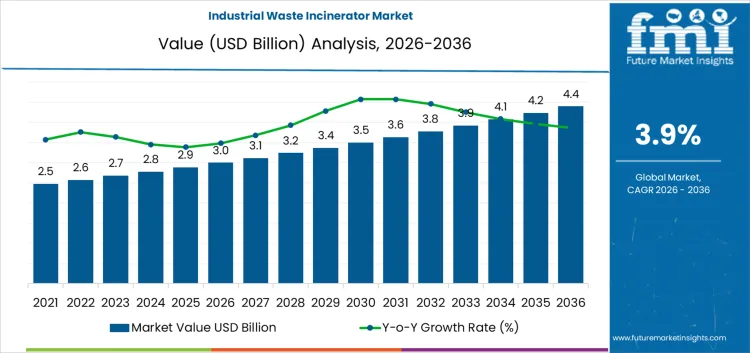
The global industrial waste incinerator market is projected to grow steadily from USD 3 billion in 2026 to USD 4.4 billion by 2036, reflecting a CAGR of 3.90%. As industrial sectors across the globe face increasing pressure to reduce waste and meet stringent environmental standards, the demand for efficient and sustainable waste management solutions continues to rise.
Industrial waste incinerators, capable of processing both hazardous and non-hazardous waste, play a critical role in reducing landfill use, preventing harmful emissions, and recovering energy from waste. With stricter government regulations on waste disposal, environmental sustainability becoming a key focus, and advancements in incineration technology, the market is well-positioned for continued growth over the next decade. The integration of energy recovery systems, enhanced filtration technologies, and improvements in incineration efficiency will further fuel demand, making these systems essential for various industries seeking to comply with global environmental policies.
Quick Stats for Industrial Waste Incinerator Market
- Industrial Waste Incinerator Market Value (2026): USD 3 Billion
- Industrial Waste Incinerator Market Forecast Value (2036): USD 4.4 Billion
- Industrial Waste Incinerator Market Forecast CAGR 2026 to 2036: 3.90%
- Leading Waste Type in Industrial Waste Incinerator Market: Industrial Hazardous Waste
- Key Growth Regions in Industrial Waste Incinerator Market: Asia Pacific, North America, Europe
- Top Key Players in Industrial Waste Incinerator Market: Veolia, SUEZ, Hitachi Zosen Inova, Babcock & Wilcox, Keppel Seghers
Industrial Waste Incinerator Market Key Takeaways
| Metric | Value |
|---|---|
| Industry Value (2026) | USD 3 Billion |
| Forecast Value (2036) | USD 4.4 Billion |
| Forecast CAGR 2026 to 2036 | 3.90% |
How is the Global Industrial Waste Incinerator Market Advancing?
The global industrial waste incinerator market is experiencing steady growth, driven by the increasing need for efficient waste management solutions across various industries. Industrial waste incinerators are used to reduce the volume of hazardous and non-hazardous waste by burning it at high temperatures, converting it into ash, gas, and heat. These systems help industries manage waste disposal in an environmentally responsible manner while complying with stringent environmental regulations. As concerns about waste disposal and environmental pollution continue to rise, the demand for effective incineration solutions is growing.
A major factor contributing to the market’s expansion is the increasing focus on sustainable waste management practices. With governments and regulatory bodies enforcing stricter environmental standards for waste disposal, industrial sectors such as manufacturing, chemical processing, and energy production are turning to waste incineration as a method for reducing landfill use and minimizing harmful emissions. Modern incinerators are equipped with advanced technologies that improve energy recovery and ensure compliance with emission standards, driving the adoption of these systems in industries worldwide.
Technological advancements in incineration systems, such as the development of more efficient combustion processes, better air pollution control devices, and the integration of energy recovery systems, are further fueling market growth. The rising demand for waste-to-energy solutions, where the heat generated from incineration is used to produce electricity or steam, is also contributing to the market's expansion. As industries continue to prioritize waste reduction and energy efficiency, the industrial waste incinerator market is expected to grow steadily in the coming years, offering a critical solution to global waste management challenges.
What Is the Segment-Wise Analysis for the Industrial Waste Incinerator Market?
The industrial waste incinerator market is segmented by waste type and end user. Industrial hazardous waste leads the waste type segment with a 34% share, followed by industrial non-hazardous waste, medical or clinical waste, and other waste types. Hazardous waste requires specialized treatment, and incineration is a common method for safely disposing of these materials. In terms of end users, the chemical & petrochemical sector dominates with a 40% share, followed by manufacturing or industrial parks, waste management firms, and other end users.
Why Does Industrial Hazardous Waste Lead the Industrial Waste Incinerator Market?
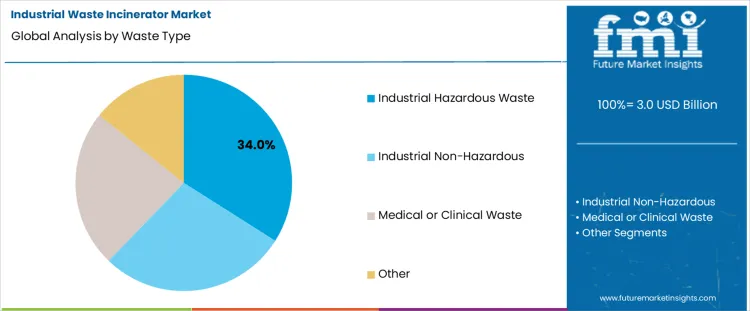
Industrial hazardous waste leads the industrial waste incinerator market with a 34% share due to the growing need for safe and compliant disposal of dangerous materials. Hazardous waste includes chemicals, solvents, and other toxic substances that pose serious environmental and health risks if not properly treated. Incineration is an effective method for reducing the volume of hazardous waste and ensuring that harmful substances are destroyed at high temperatures, preventing contamination. As industries, particularly chemical and petrochemical sectors, face increasingly strict regulations regarding waste management and disposal, the demand for industrial waste incinerators that handle hazardous waste efficiently continues to grow.
How Does the Chemical & Petrochemical Sector Contribute to the Industrial Waste Incinerator Market?
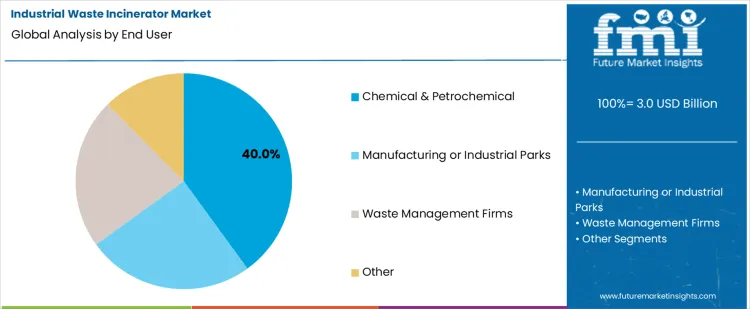
The chemical & petrochemical sector accounts for 40% of the end-user segment in the industrial waste incinerator market. This sector generates significant amounts of hazardous and non-hazardous waste, including chemicals, solvents, and other industrial by-products that require proper disposal. Incinerators are widely used in the chemical and petrochemical industries to ensure compliance with environmental regulations, reduce the environmental impact of waste, and recover energy. With the increasing emphasis on sustainability, waste management, and regulatory compliance, chemical and petrochemical companies are increasingly investing in advanced incineration systems to handle their waste disposal needs efficiently, contributing to the sector’s dominance in the market.
What Are the Key Dynamics for the Industrial Waste Incinerator Market?
The industrial waste incinerator market is driven by increasing industrialization, stricter environmental regulations, and the growing need for waste management solutions that reduce landfill usage. As industries generate large volumes of hazardous and non-hazardous waste, incinerators provide an efficient method to dispose of waste while reducing harmful emissions and recovering energy. Governments worldwide are implementing regulations to minimize environmental pollution, which encourages the adoption of advanced, energy-efficient incinerators in industries such as manufacturing, pharmaceuticals, chemicals, and municipal waste management.
How Are the Key Drivers Shaping the Industrial Waste Incinerator Market?
Key drivers for the Industrial Waste Incinerator Market include the rising need for sustainable waste management solutions in response to growing urbanization and industrial waste generation. Strict regulatory standards aimed at reducing the environmental impact of waste disposal are pushing industries to adopt incineration technologies that ensure compliance. The need for energy recovery from waste, such as heat and electricity generation, is also boosting demand for waste incinerators. Technological advancements in incineration processes, including automated control systems and emissions monitoring, are making these systems more efficient and cost-effective.
What Are the Key Trends Shaping the Industrial Waste Incinerator Market?
Key trends in the industrial waste incinerator market include the growing focus on waste-to-energy technologies, where incinerators not only dispose of waste but also generate electricity and heat. There is also increasing adoption of advanced filtration and scrubbing technologies to reduce emissions and meet stricter environmental standards. The rise of automated and smart incineration systems, which use real-time data and predictive maintenance to enhance efficiency, is gaining momentum. The trend toward more sustainable and circular waste management practices is encouraging the development of eco-friendly incinerators with minimal environmental impact.
What is the Growth Outlook for the Industrial Waste Incinerator Market by Country?
| Country | CAGR (%) |
|---|---|
| China | 5.2% |
| Brazil | 4.8% |
| USA | 3.6% |
| South Korea | 3.4% |
| Germany | 3.5% |
Source: FMI analysis based on primary research and proprietary forecasting model
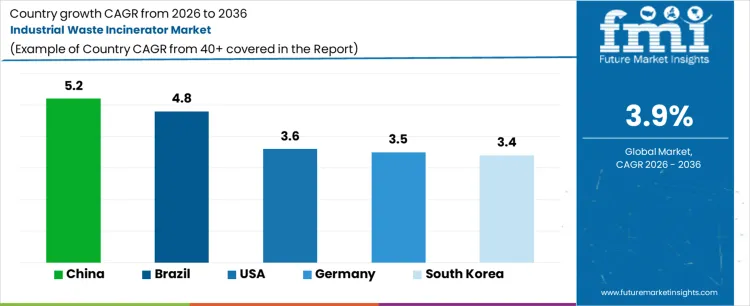
The industrial waste incinerator market is growing across key regions. China leads at 5.2%, driven by rapid industrialization, increasing waste generation, and stringent environmental regulations. Brazil follows at 4.8%, supported by expanding industries and a focus on sustainable waste management. The USA grows at 3.6%, driven by regulatory requirements and the rising need for eco-friendly waste disposal solutions. South Korea’s market expands at 3.4%, fueled by strict waste management policies and growing industrial operations. Germany, growing at 3.5%, benefits from strong environmental policies, a focus on energy recovery, and a commitment to sustainable waste management solutions.
What is Driving the Growth of the Industrial Waste Incinerator Market in China?
China’s industrial waste incinerator market is growing at 5.2%, driven by the rapid industrialization and the increasing generation of waste across its manufacturing and industrial sectors. With stringent environmental regulations in place, the need for efficient waste disposal and incineration systems to meet emission standards is rising. China’s emphasis on sustainable waste management and improving air quality is further propelling the demand for industrial waste incinerators. The country’s urbanization, growing population, and focus on environmental sustainability are driving the need for more waste management solutions. As industries modernize and seek cleaner alternatives for waste disposal, the market for industrial waste incinerators is expected to grow steadily.
How is the Industrial Waste Incinerator Market Expanding in Brazil?
Brazil’s industrial waste incinerator market is growing at 4.8%, supported by the country’s expanding industrial sector and increasing waste generation in manufacturing, agriculture, and energy industries. With the growing need for efficient and environmentally compliant waste disposal methods, industrial waste incinerators are becoming essential for managing hazardous and non-hazardous waste. Brazil’s emphasis on sustainable development and stricter waste management regulations is pushing companies to adopt incineration technologies that ensure waste is processed in an environmentally responsible manner. The country’s commitment to improving air quality and reducing landfills is driving the adoption of waste incinerators. As Brazil modernizes its industrial operations and waste management systems, demand for these incinerators will continue to rise.
How is the Industrial Waste Incinerator Market Expanding in the USA?
The industrial waste incinerator market in the USA is growing at 3.6%, driven by the increasing demand for sustainable waste management solutions and stricter environmental regulations. As industries, particularly in manufacturing, healthcare, and energy, face mounting pressure to reduce waste and minimize environmental impact, the adoption of industrial waste incinerators is rising. The USA’s strong regulatory framework, which mandates proper waste disposal and emission control, is contributing to the growing demand for efficient incineration systems. The increasing focus on reducing landfill waste, coupled with technological advancements in incinerator designs to improve energy efficiency and reduce emissions, is fueling market growth.
What is Driving the Growth of the Industrial Waste Incinerator Market in South Korea?
South Korea’s industrial waste incinerator market is growing at 3.4%, supported by the country’s commitment to sustainability and efficient waste management. South Korea has stringent environmental regulations in place to control emissions and manage industrial waste, making the demand for advanced incinerators crucial. The country’s emphasis on clean technologies, particularly in its industrial and manufacturing sectors, is pushing the adoption of waste incineration systems that meet environmental standards. South Korea’s high urbanization rate and expanding industrial base are also contributing to increased waste generation, driving the need for waste management solutions. With continued investment in green technologies, the market for industrial waste incinerators in South Korea is expected to grow steadily.
How is the Industrial Waste Incinerator Market Expanding in Germany?
Germany’s industrial waste incinerator market is growing at 3.5%, driven by its advanced industrial sector and strict environmental regulations. As one of the leaders in sustainable waste management in Europe, Germany is increasingly adopting waste incinerators to process industrial waste while ensuring compliance with emissions standards. The country’s focus on reducing landfill waste and improving energy recovery from waste is contributing to the market’s growth. Germany’s strong environmental policies and commitment to renewable energy sources also support the adoption of incinerators that convert waste into energy. As industries in Germany continue to modernize and adopt green technologies, the demand for industrial waste incinerators will continue to rise.
How Are Companies Competing in the Industrial Waste Incinerator Market?
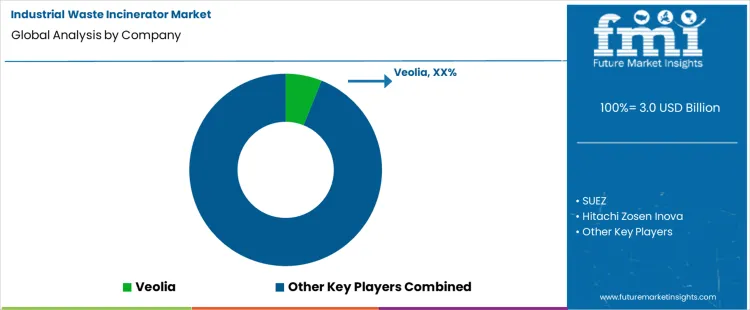
Competition in the Industrial Waste Incinerator Market is driven by thermal efficiency, emissions control performance, modular design, and compliance with evolving environmental standards. Veolia positions its incineration systems with advanced waste-to-energy integration and flue gas treatment, and its materials emphasize high combustion efficiency and robust pollutant removal that help industrial clients meet stringent air quality requirements. SUEZ competes with comprehensive waste thermal solutions that combine automation and advanced monitoring, with brochures highlighting optimized energy recovery and reliable operational uptime across diverse industrial applications.
Global engineering leaders such as Hitachi Zosen Inova and Babcock & Wilcox differentiate through proven boiler and furnace technologies tailored for high-temperature waste streams. Their documentation stresses design adaptability, long service life, and strong safety records. Keppel Seghers and Mitsubishi Heavy Industries add value with modular incinerator platforms that emphasize compact footprints and scalable capacities, appealing to clients seeking customized solutions in sectors like chemical processing and hazardous waste management.
Doosan and Martin GmbH bring specialized combustion and emissions control expertise, marketed for precision heat management and low pollutant output. CNIM and Andritz round out the competitive landscape with end-to-end system engineering and installation services, their product materials highlighting integrated flue gas treatment, digital control systems, and post-installation support. Across all vendors, literature underscores energy recovery potential, emissions performance, regulatory compliance, and lifecycle support as key differentiators that help industrial operators optimize waste processing while meeting environmental and operational goals.
Key Players in Industrial Waste Incinerator Market
- Veolia
- SUEZ
- Hitachi Zosen Inova
- Babcock & Wilcox
- Keppel Seghers
- Mitsubishi Heavy Industries
- Doosan
- Martin GmbH
- CNIM
- Andritz
Scope of Report
| Attributes | Description |
|---|---|
| Quantitative Unit (2026) | USD Million |
| Test Type | AC Load Transient Testing, DC Load Transient Testing, Hybrid AC or DC Systems, Other |
| Application | Data Center Power Systems, EV Charging & Power Electronics, Industrial UPS or Converters, Aerospace or Defense Power |
| Regions Covered | Asia Pacific, Europe, North America, Latin America, Middle East & Africa |
| Countries Covered | China, Japan, South Korea, India, Australia & New Zealand, ASEAN, Germany, United Kingdom, France, Italy, Spain, Nordic, BENELUX, United States, Canada, Mexico, Brazil, Chile, Turkey, South Africa, Other GCC Countries |
| Key Companies Profiled | Chroma ATE, Keysight, NH Research, AMETEK Programmable Power, Rohde & Schwarz, EA Elektro-Automatik, Kikusui, Tektronix, NI (Emerson), Regatron |
| Additional Attributes | Dollar sales by test type, application, and region; regional CAGR and growth outlook for the load transient test system market. |
Industrial Waste Incinerator Market by Key Segments
Waste Type
- Industrial Hazardous Waste
- Industrial Non-Hazardous
- Medical or Clinical Waste
- Other
End User
- Chemical & Petrochemical
- Manufacturing or Industrial Parks
- Waste Management Firms
- Other
Region
- Asia Pacific
- China
- Japan
- South Korea
- India
- Australia & New Zealand
- ASEAN
- Rest of Asia Pacific
- Europe
- Germany
- United Kingdom
- France
- Italy
- Spain
- Nordic
- BENELUX
- Rest of Europe
- North America
- United States
- Canada
- Mexico
- Latin America
- Brazil
- Chile
- Rest of Latin America
- Middle East & Africa
- Kingdom of Saudi Arabia
- Other GCC Countries
- Turkey
- South Africa
- Other African Union
- Rest of Middle East & Africa
Bibliography
- Veolia. (2023). Industrial waste incinerators: Advanced waste-to-energy integration and flue gas treatment solutions. Veolia North America.
- SUEZ. (2023). Thermal waste solutions with automation and energy recovery systems for industrial applications. SUEZ Environmental Services.
- Hitachi Zosen Inova. (2023). Proven boiler and furnace technologies for high-temperature waste streams. Hitachi Zosen Inova AG.
Frequently Asked Questions
How big is the industrial waste incinerator market in 2026?
The global industrial waste incinerator market is estimated to be valued at USD 3.0 billion in 2026.
What will be the size of industrial waste incinerator market in 2036?
The market size for the industrial waste incinerator market is projected to reach USD 4.4 billion by 2036.
How much will be the industrial waste incinerator market growth between 2026 and 2036?
The industrial waste incinerator market is expected to grow at a 3.9% CAGR between 2026 and 2036.
What are the key product types in the industrial waste incinerator market?
The key product types in industrial waste incinerator market are industrial hazardous waste, industrial non-hazardous, medical or clinical waste and other.
Which end user segment to contribute significant share in the industrial waste incinerator market in 2026?
In terms of end user, chemical & petrochemical segment to command 40.0% share in the industrial waste incinerator market in 2026.
Preview the report firsthand - request a free sample
Get SampleGet the brochure for pricing and purchase details.
Get PDFTable of Content
- Executive Summary
- Global Market Outlook
- Demand-side Trends
- Supply-side Trends
- Technology Roadmap Analysis
- Analysis and Recommendations
- Market Overview
- Market Coverage / Taxonomy
- Market Definition / Scope / Limitations
- Market Background
- Market Dynamics
- Drivers
- Restraints
- Opportunity
- Trends
- Scenario Forecast
- Demand in Optimistic Scenario
- Demand in Likely Scenario
- Demand in Conservative Scenario
- Opportunity Map Analysis
- Product Life Cycle Analysis
- Supply Chain Analysis
- Investment Feasibility Matrix
- Value Chain Analysis
- PESTLE and Porter’s Analysis
- Regulatory Landscape
- Regional Parent Market Outlook
- Production and Consumption Statistics
- Import and Export Statistics
- Market Dynamics
- Global Market Analysis 2021 to 2025 and Forecast, 2026 to 2036
- Historical Market Size Value (USD Million) Analysis, 2021 to 2025
- Current and Future Market Size Value (USD Million) Projections, 2026 to 2036
- Y-o-Y Growth Trend Analysis
- Absolute $ Opportunity Analysis
- Global Market Pricing Analysis 2021 to 2025 and Forecast 2026 to 2036
- Global Market Analysis 2021 to 2025 and Forecast 2026 to 2036, By Waste Type
- Introduction / Key Findings
- Historical Market Size Value (USD Million) Analysis By Waste Type , 2021 to 2025
- Current and Future Market Size Value (USD Million) Analysis and Forecast By Waste Type , 2026 to 2036
- Industrial Hazardous Waste
- Industrial Non-Hazardous
- Medical or Clinical Waste
- Other
- Industrial Hazardous Waste
- Y-o-Y Growth Trend Analysis By Waste Type , 2021 to 2025
- Absolute $ Opportunity Analysis By Waste Type , 2026 to 2036
- Global Market Analysis 2021 to 2025 and Forecast 2026 to 2036, By End User
- Introduction / Key Findings
- Historical Market Size Value (USD Million) Analysis By End User, 2021 to 2025
- Current and Future Market Size Value (USD Million) Analysis and Forecast By End User, 2026 to 2036
- Chemical & Petrochemical
- Manufacturing or Industrial Parks
- Waste Management Firms
- Other
- Chemical & Petrochemical
- Y-o-Y Growth Trend Analysis By End User, 2021 to 2025
- Absolute $ Opportunity Analysis By End User, 2026 to 2036
- Global Market Analysis 2021 to 2025 and Forecast 2026 to 2036, By Region
- Introduction
- Historical Market Size Value (USD Million) Analysis By Region, 2021 to 2025
- Current Market Size Value (USD Million) Analysis and Forecast By Region, 2026 to 2036
- North America
- Latin America
- Western Europe
- Eastern Europe
- East Asia
- South Asia and Pacific
- Middle East & Africa
- Market Attractiveness Analysis By Region
- North America Market Analysis 2021 to 2025 and Forecast 2026 to 2036, By Country
- Historical Market Size Value (USD Million) Trend Analysis By Market Taxonomy, 2021 to 2025
- Market Size Value (USD Million) Forecast By Market Taxonomy, 2026 to 2036
- By Country
- USA
- Canada
- Mexico
- By Waste Type
- By End User
- By Country
- Market Attractiveness Analysis
- By Country
- By Waste Type
- By End User
- Key Takeaways
- Latin America Market Analysis 2021 to 2025 and Forecast 2026 to 2036, By Country
- Historical Market Size Value (USD Million) Trend Analysis By Market Taxonomy, 2021 to 2025
- Market Size Value (USD Million) Forecast By Market Taxonomy, 2026 to 2036
- By Country
- Brazil
- Chile
- Rest of Latin America
- By Waste Type
- By End User
- By Country
- Market Attractiveness Analysis
- By Country
- By Waste Type
- By End User
- Key Takeaways
- Western Europe Market Analysis 2021 to 2025 and Forecast 2026 to 2036, By Country
- Historical Market Size Value (USD Million) Trend Analysis By Market Taxonomy, 2021 to 2025
- Market Size Value (USD Million) Forecast By Market Taxonomy, 2026 to 2036
- By Country
- Germany
- UK
- Italy
- Spain
- France
- Nordic
- BENELUX
- Rest of Western Europe
- By Waste Type
- By End User
- By Country
- Market Attractiveness Analysis
- By Country
- By Waste Type
- By End User
- Key Takeaways
- Eastern Europe Market Analysis 2021 to 2025 and Forecast 2026 to 2036, By Country
- Historical Market Size Value (USD Million) Trend Analysis By Market Taxonomy, 2021 to 2025
- Market Size Value (USD Million) Forecast By Market Taxonomy, 2026 to 2036
- By Country
- Russia
- Poland
- Hungary
- Balkan & Baltic
- Rest of Eastern Europe
- By Waste Type
- By End User
- By Country
- Market Attractiveness Analysis
- By Country
- By Waste Type
- By End User
- Key Takeaways
- East Asia Market Analysis 2021 to 2025 and Forecast 2026 to 2036, By Country
- Historical Market Size Value (USD Million) Trend Analysis By Market Taxonomy, 2021 to 2025
- Market Size Value (USD Million) Forecast By Market Taxonomy, 2026 to 2036
- By Country
- China
- Japan
- South Korea
- By Waste Type
- By End User
- By Country
- Market Attractiveness Analysis
- By Country
- By Waste Type
- By End User
- Key Takeaways
- South Asia and Pacific Market Analysis 2021 to 2025 and Forecast 2026 to 2036, By Country
- Historical Market Size Value (USD Million) Trend Analysis By Market Taxonomy, 2021 to 2025
- Market Size Value (USD Million) Forecast By Market Taxonomy, 2026 to 2036
- By Country
- India
- ASEAN
- Australia & New Zealand
- Rest of South Asia and Pacific
- By Waste Type
- By End User
- By Country
- Market Attractiveness Analysis
- By Country
- By Waste Type
- By End User
- Key Takeaways
- Middle East & Africa Market Analysis 2021 to 2025 and Forecast 2026 to 2036, By Country
- Historical Market Size Value (USD Million) Trend Analysis By Market Taxonomy, 2021 to 2025
- Market Size Value (USD Million) Forecast By Market Taxonomy, 2026 to 2036
- By Country
- Kingdom of Saudi Arabia
- Other GCC Countries
- Turkiye
- South Africa
- Other African Union
- Rest of Middle East & Africa
- By Waste Type
- By End User
- By Country
- Market Attractiveness Analysis
- By Country
- By Waste Type
- By End User
- Key Takeaways
- Key Countries Market Analysis
- USA
- Pricing Analysis
- Market Share Analysis, 2025
- By Waste Type
- By End User
- Canada
- Pricing Analysis
- Market Share Analysis, 2025
- By Waste Type
- By End User
- Mexico
- Pricing Analysis
- Market Share Analysis, 2025
- By Waste Type
- By End User
- Brazil
- Pricing Analysis
- Market Share Analysis, 2025
- By Waste Type
- By End User
- Chile
- Pricing Analysis
- Market Share Analysis, 2025
- By Waste Type
- By End User
- Germany
- Pricing Analysis
- Market Share Analysis, 2025
- By Waste Type
- By End User
- UK
- Pricing Analysis
- Market Share Analysis, 2025
- By Waste Type
- By End User
- Italy
- Pricing Analysis
- Market Share Analysis, 2025
- By Waste Type
- By End User
- Spain
- Pricing Analysis
- Market Share Analysis, 2025
- By Waste Type
- By End User
- France
- Pricing Analysis
- Market Share Analysis, 2025
- By Waste Type
- By End User
- India
- Pricing Analysis
- Market Share Analysis, 2025
- By Waste Type
- By End User
- ASEAN
- Pricing Analysis
- Market Share Analysis, 2025
- By Waste Type
- By End User
- Australia & New Zealand
- Pricing Analysis
- Market Share Analysis, 2025
- By Waste Type
- By End User
- China
- Pricing Analysis
- Market Share Analysis, 2025
- By Waste Type
- By End User
- Japan
- Pricing Analysis
- Market Share Analysis, 2025
- By Waste Type
- By End User
- South Korea
- Pricing Analysis
- Market Share Analysis, 2025
- By Waste Type
- By End User
- Russia
- Pricing Analysis
- Market Share Analysis, 2025
- By Waste Type
- By End User
- Poland
- Pricing Analysis
- Market Share Analysis, 2025
- By Waste Type
- By End User
- Hungary
- Pricing Analysis
- Market Share Analysis, 2025
- By Waste Type
- By End User
- Kingdom of Saudi Arabia
- Pricing Analysis
- Market Share Analysis, 2025
- By Waste Type
- By End User
- Turkiye
- Pricing Analysis
- Market Share Analysis, 2025
- By Waste Type
- By End User
- South Africa
- Pricing Analysis
- Market Share Analysis, 2025
- By Waste Type
- By End User
- USA
- Market Structure Analysis
- Competition Dashboard
- Competition Benchmarking
- Market Share Analysis of Top Players
- By Regional
- By Waste Type
- By End User
- Competition Analysis
- Competition Deep Dive
- Veolia
- Overview
- Product Portfolio
- Profitability by Market Segments (Product/Age /Sales Channel/Region)
- Sales Footprint
- Strategy Overview
- Marketing Strategy
- Product Strategy
- Channel Strategy
- SUEZ
- Hitachi Zosen Inova
- Babcock & Wilcox
- Keppel Seghers
- Mitsubishi Heavy Industries
- Doosan
- Martin GmbH
- CNIM
- Andritz
- Veolia
- Competition Deep Dive
- Assumptions & Acronyms Used
- Research Methodology


