

- Market Size (2026)
- USD 16.8 Bn
- Forecast (2036)
- USD 29.5 Bn
- CAGR (2026 to 2036)
- 5.8%
How big is Mining Waste Management Market size?
USD 16.8 billion in 2026 and USD 29.5 billion by 2036 at a 5.8% CAGR.
Demand for mining waste management is projected to expand at 5.8% CAGR between 2026 and 2036, increasing valuation from USD 16.8 billion in 2026 to USD 29.5 billion by 2036. Early mine planning incorporates waste control protocols directly since initial ore processing dictates waste-rock chemical composition and long-term closure hazards. A coalition of 3 founding organizations formed the Global Tailings Management Institute's independent auditing and certification assurance body in January 2025. Rigorous third-party evaluation drives operational demand for traceable engineering archives and corrective maintenance work across tailings sites.
Mining companies across the United States and Canada emphasize accurate effluent tracking and detailed closure documentation. Regional operators in Indonesia and Australia focus heavily on tailings dewatering technology and localized field verification. An official update published in June 2026 by Environment and Climate Change Canada revealed 4 individual project amendments enacted throughout 2025 under metal and diamond mining effluent standards. Tailored regulatory updates like these maintain sustained demand for continuous monitoring and authorized waste storage infrastructure throughout active mine sites.
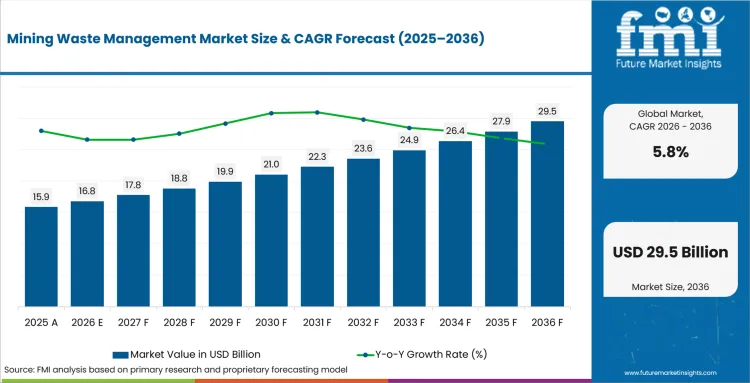
Key Takeaways for the Mining Waste Management Market
- Demand for mining waste management is driven by tailings assurance duties and funded closure planning.
- Direct service contracts are forecast to secure 45.0% share of distribution channel in 2026, helped by mine-specific accountability and continuing technical supervision.
- Metal mining companies are estimated to lead end user with 39.0% share in 2026, guided by extensive tailings and rehabilitation requirements.
- Long-duration liability and site-specific geotechnical conditions restrict contract approval and fixed-capacity commitments.
- Competition centres on Tetra Tech, WSP, Knight Piésold, Hatch, SRK Consulting, Metso, FLS, and ANDRITZ, with providers differentiated depending on engineering evidence and operating support.
Analyst Perspective
“Mining waste management earns recurring revenue based on verified control of tailings stability, seepage, water recovery, and closure obligations. Mine operators examine field evidence and long-duration liability during supplier review. Stronger conversion follows contracts linking engineering records with treatment performance and funded rehabilitation.”
- Anurag Sharma, Principal Analyst at Future Market Insights
How is Mining Waste Management Market segmented?
The mining waste management sector is segmented by waste type, application, end user, distribution channel, service type, and region.
The mining waste management industry is segmented by waste type, application, end user, distribution channel, service type, and region. Waste type coverage includes tailings, waste rock, overburden and soil, sludge and process residues, and hazardous mining waste. Application coverage addresses tailings storage management, waste treatment, water management, site rehabilitation, and waste disposal. End-user coverage spans metal mining companies, coal mining companies, industrial mineral mining, precious metal mining, and rare earth and specialty mining. Distribution channel coverage includes direct service contracts, engineering and EPC firms, environmental consultants, authorized service providers, and government and public tenders. Service type coverage includes waste collection and transportation, waste treatment, waste disposal, monitoring and environmental compliance, and mine closure and rehabilitation. Regional coverage includes North America, Latin America, Western Europe, Eastern Europe, East Asia, South Asia and Pacific, the Middle East, and Africa.
What supports tailings within waste type demand?
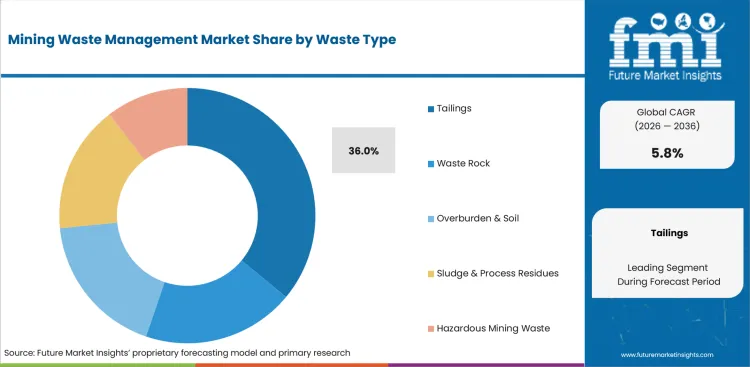
Tailings management begins with containment design and continues through emergency planning and closure. Storage performance influences permit compliance and long-term liability across operating and inactive facilities. Filtered tailings reduce retained water through mechanical dewatering, influencing demand for filtration systems and dry-stack engineering. Conventional impoundments retain demand for water treatment and periodic stability review. Rio Tinto disclosed 98 tailings facilities in August 2025, requiring facility-specific records under different consequence classifications.
- Tailings are set to garner 36.0% share of waste type in 2026, aided by continuous management needs from deposition through rehabilitation. Mine owners assess reclaim-water performance and closure provisions during service approval.
- Tailings require continuous control from initial deposition through active storage and final closure since each stage creates distinct safety and water-management duties. Storage design and water-recovery records strengthen confidence in the dominant waste type.
Why does tailings storage management lead application demand?
BHP reported 61 of 70 operated tailings storage facilities aligned with GISTM in August 2025, sustaining assurance work for facilities under improvement plans. Tailings storage management combines engineering design with operating surveillance across a facility lifecycle. Mine operators require deposition planning and independent assurance. Field records guide remedial works with movement or water-quality readings cross approved thresholds. Service continuity supports institutional knowledge across facility modifications and closure planning.
- By application, tailings storage management is anticipated to account for 34.0% share in 2026, led by continuing inspection and assurance duties. Contract value reflects instrumentation interpretation and rehabilitation planning.
- Tailings storage management requires regular surveillance throughout facility operations. Instrumentation records and emergency controls sustain demand across expansion and rehabilitation work.
What supports metal mining companies across end user demand?
Metal mining companies manage high material volumes from ore extraction and beneficiation. Copper and rare-earth operations produce different tailings mineralogy and water chemistry. Processing choices influence acid-generation risk and dewatering response. Long mine lives favour service arrangements retaining site knowledge across expansions and closure stages. Glencore reported a tenfold increase in GISTM disclosure during 2025 in its April 2026 release, reflecting expanded tailings oversight across its mining portfolio.
- Based on end user, metal mining companies is likely to hold 39.0% share in 2026 due to extensive waste-rock and tailings management duties. Supplier review covers operational monitoring and closure execution.
- Precious metal mining and rare earth & specialty mining require customized controls for distinct waste profiles. Contract design reflects rehabilitation standards and local reporting obligations.
Why do direct service contracts lead distribution channel demand?
Direct service contracts place accountability between mine owners and selected service providers. Site-specific data and risk ownership require close technical coordination. Multi-year arrangements preserve engineering knowledge across treatment campaigns and closure work. Contract renewal rests on accepted field performance and documented corrective action. Metso reported 2 multi-year filtration service agreements in June 2026, confirming direct-contract demand for maintenance and condition monitoring.
- Direct service contracts are estimated to garner 45.0% share in 2026, influenced by mine-specific risk allocation and recurring technical work. Buyers examine professional accountability and continuity of qualified personnel.
- Engineering & EPC firms and government & public tenders support project delivery through different commercial routes. Selection reflects local certification and public-remediation funding.
What supports waste collection & transportation across service type demand?
Liquid waste management connects mine areas with treatment or disposal locations. Service scope includes hazardous-waste segregation and authorized receiving facilities. Remote mines require equipment availability and dependable scheduling across long travel distances. Chemical compatibility and spill controls influence fleet configuration and handling procedures. USA Environmental Protection Agency reported a plan to move approximately 1 million cubic yards of mine waste in January 2025, supporting specialized haulage to a dedicated disposal area.
- In 2026, waste collection & transportation is expected to secure 29.0% share since being backed by recurring movement across operating sites and authorized destinations. Commercial assessment covers transfer records and emergency response arrangements.
- Monitoring & environmental compliance and mine closure & rehabilitation extend service demand beyond material movement. Buyers assess restoration performance and post-closure obligations.
What are drivers, restraints, and opportunities in Mining Waste Management Market?
Rising waste-to-ore ratios support service demand across extraction and processing operations. Long-duration liability slows approval if ownership and financial provisions remain unsettled.
- Driver: Lower ore grades increase material handled for each unit of saleable output. Added waste volumes require storage capacity and rehabilitation planning across mine lifecycles.
- Restraint: Tailings and contaminated-water obligations extend beyond active production. Uncertain closure ownership and site-specific remediation expense delay contract decisions and fixed-capacity investment.
- Opportunity: Integrated dewatering and water treatment services return process water and reduce retained liquid inside tailings facilities. Combined engineering and environmental remediation technology support provides mine owners one accountable delivery structure.
Mining operations require dependable water recovery as scarcity and discharge controls affect production continuity. BHP’s 2025 water disclosure recorded Escondida desalination supplying 54% of total BHP water withdrawals during fiscal 2025. Large-scale alternative-water use increases demand for treatment controls and tailings circuits designed around repeated water reuse.
Tailings assurance creates documented review duties across documentation and field performance. NSW Resources Regulator reported a targeted tailings storage assessment covering 10 mines from July to December 2024 in its April 2025 release. Documentary and on-site assessment raises service requirements for inspection readiness and maintained operating records.
Filtered tailings provide a direct opening for dewatering equipment and industrial water treatment integration. FLS reported an Automatic Filter Press achieving up to 95% process-water recovery for high-volume tailings dewatering during June 2026. Higher reclaim performance supports freshwater reduction and safer handling of dewatered tailings through dry-stack routes.
How are country CAGRs aligned in Mining Waste Management Market?
| Country or Market | CAGR |
|---|---|
| Indonesia | 7.0% |
| Australia | 6.7% |
| Chile | 6.3% |
| Canada | 6.0% |
| South Africa | 4.9% |
| USA | 4.4% |
| Brazil | 4.1% |
Source: Future Market Insights analysis, 2026.
How do country-level CAGRs compare in Mining Waste Management Market?
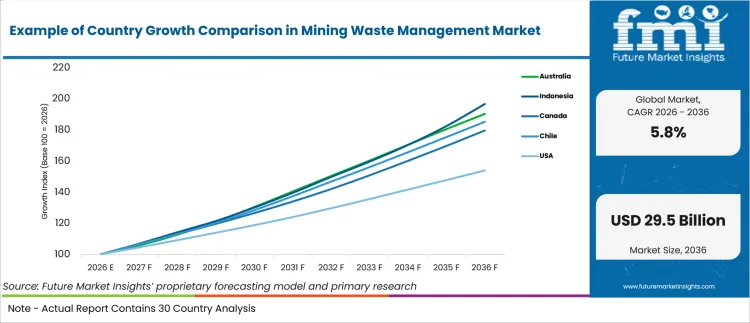
Country comparison shows a gradual step-down across profiled markets. Indonesia occupies upper forecast position, followed by Australia and Chile. Canada forms middle point across disclosed rates. South Africa along with United States and Brazil complete lower forecast band. A 2.9 percentage-point spread separates Indonesia from Brazil. National rates reflect different mine portfolios, water conditions, regulatory systems, and rehabilitation duties.
- Indonesia is anticipated to lead profiled expansion through active mineral development and closer tailings-leakage assessment.
- Australia is likely to follow Indonesia through established rehabilitation funding and extensive remote-site service requirements.
- Chile is expected to occupy next position as water recovery influences copper-mine waste planning.
- Canada is projected to form middle rate through formal tailings protocols and effluent-control requirements.
- South Africa along with United States, and Brazil are forecast to complete comparison under distinct inspection and dam-decharacterization programs.
Markets carrying similar CAGRs are expected to present different entry conditions led by mine concentration and closure security. Full report coverage includes North America, Latin America, Western Europe, Eastern Europe, East Asia, South Asia and Pacific, Middle East and Africa.
Country-wise Analysis
- Industry in Indonesia is expected to scale at 7.0% CAGR from 2026 to 2036, backed by mineral-project activity and greater attention to groundwater protection around tailings storage. Remote geography and in-pit storage favour providers offering water sampling and field monitoring within one service package. Rofikoh and Iskandar reported dissolved radon reaching 4,940 Bq m⁻³ near an inactive mine-pit tailings area in Central Kalimantan during April 2025, identifying permeable zones requiring detailed leakage assessment. Isotope and flow analysis found no tailings-water leakage, showing why defensible monitoring evidence supports operating confidence.
- Western Australia applies pooled rehabilitation funding and annual tenement review, influencing structured demand for liability records and restoration planning. Department of Mines, Petroleum and Exploration reported 2,631 tenements reviewed by its compliance team during 2024 to 2025 levy period in December 2025. Review coverage places emphasis on rehabilitation cost estimates and auditable closure information across mine portfolios. Mining waste management demand in Australia is anticipated to rise at 6.7% CAGR between 2026 and 2036, driven by remote-site logistics and formal rehabilitation obligations.
- Chilean copper operations rely on sea water and recovered process water across arid mining districts. Demand for thickening and reclaim systems reflects need to protect plant continuity and reduce freshwater exposure. Mining waste management sector in Chile is forecast to grow at 6.3% CAGR by 2036, influenced by water-constrained operating plans and tailings dewatering programs. Antofagasta’s 2025 annual-report data placed sea water at 63% of total water withdrawals, reinforcing service demand for controlled water circuits and tailings-water recovery.
- Sales in Canada are estimated to record 6.0% CAGR during the study period, guided by formal tailings systems and public assurance expectations. Mining companies require accountable facility management and repeatable surveillance across operating sites. Mining Association of Canada reported 93% of participating facilities reaching Level A or above for tailings-management policy and commitment during 2025 in its May 2026 update. High protocol coverage favours technical providers able to maintain accountability records and improvement plans.
- South African rehabilitation programs combine environmental risk reduction with closure work at derelict and ownerless sites. Department of Mineral and Petroleum Resources reported Mintek rehabilitating 4 asbestos mines across Limpopo and Northern Cape during July 2025. Public programs require contaminated-soil control and post-work verification across dispersed locations. Adoption in South Africa is projected to increase at 4.9% CAGR during the assessment period, helped by public rehabilitation needs and operating-mine tailings obligations.
- Formal enforcement and litigation exposure shape mine-waste contracting across the United States. Mining waste management activity in the United States is anticipated to rise at 4.4% CAGR during the forecast period, backed by inspection readiness and formal documentation. USA Department of Labor reported impact inspections covering 15 mines with repeated health and safety concerns during October 2024 in its December 2024 release. Focused enforcement increases demand for maintenance records and timely remediation across facilities carrying elevated compliance risk.
- Vale reported 18 upstream structures eliminated through its Brazilian dam-decharacterization program during September 2025. Continued removal programs require tailings relocation and rehabilitation across former storage areas. Local engineering capability and long-duration field oversight influence supplier selection through complex site work. Mining waste management demand in Brazil is predicted to scale at 4.1% CAGR over 2026 to 2036, reflected by upstream-structure removal and mine-closure obligations.
Who are notable companies in Mining Waste Management Market?
Tetra Tech, WSP, Knight Piésold, Hatch, SRK Consulting, Veolia, SUEZ, Metso, FLS, TAKRAF Group, and ANDRITZ are prominent companies shaping mining waste management.
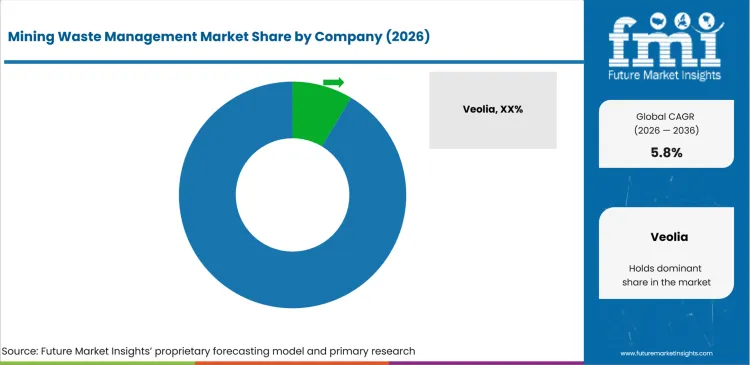
Competition for the market centres on engineering evidence and lifecycle support. Environmental-service groups manage contaminated water and site restoration. Tailings engineering specialists address storage design and closure. Equipment providers supply thickeners and lifecycle maintenance for dewatering systems. Buyer review covers qualified personnel and ownership of performance records.
- Tetra Tech and SRK Consulting compete based on environmental assessment and closure planning. Mine owners compare technical assurance and continuity across facility lifecycles.
- Veolia and SUEZ address water and waste water treatment chemical and industrial waste services. Account selection reflects treatment performance and support across operating locations.
- TAKRAF Group and ANDRITZ compete depending on tailings thickening and equipment service. Customers evaluate spare-parts support and installed-base service.
Competitive Benchmarking: Mining Waste Management Market
| Company | Waste Service Depth | Tailings Engineering | Water Recovery | Geographic Reach |
|---|---|---|---|---|
| Tetra Tech | High | High | High | Global |
| WSP | High | High | High | Global |
| Knight Piésold | Medium | High | Medium | Global |
| Hatch | High | High | High | Global |
| SRK Consulting | Medium | High | Medium | Global |
| Veolia | High | Medium | High | Global |
| SUEZ | High | Medium | High | Global |
| Metso | Medium | High | High | Global |
| FLS | Medium | High | High | Global |
| TAKRAF Group | Medium | High | High | Global |
| ANDRITZ | Medium | High | High | Global |
Source: Future Market Insights competitive analysis, 2026.
Key Developments in Mining Waste Management Market
- In May 2025, TAKRAF Group received a contract to design and supply SNIM’s first complete dry-stack tailings system in Mauritania. Project scope included one 162 m² horizontal belt filter, improving water conservation at the iron-ore operation.
- In May 2025, Metso received a repeat order for tailings filtration equipment at Huayou Group’s laterite nickel project in Indonesia. Delivery included 16 Larox FFP3512 filters, increasing high-volume dewatering capacity at the mine.
- In September 2025, ANDRITZ introduced MiningMaster ME4 for tailings dewatering across mineral-processing operations. Equipment capacity reaches 240 chambers and 60,000 litres per machine, supporting high-throughput dry-stack preparation.
Mining Waste Management Market Report Scope
| Coverage field | Report scope |
|---|---|
| Market breakdown | Mining waste management breakdown includes waste type, application, end user, distribution channel, service type, and region. |
| Quantitative Units | Revenue in USD Billion, CAGR in %. |
| Market Definition | Mining waste management covers collection, transport, storage, treatment, reuse, monitoring, and closure services for tailings, waste rock, overburden, process residues, contaminated water, and hazardous mining waste. Generic municipal-waste services without mine-site application are excluded. |
| Regions Covered | North America, Latin America, Western Europe, Eastern Europe, East Asia, South Asia and Pacific, Middle East and Africa. |
| Countries Covered | Indonesia, Australia, Chile, Canada, South Africa, USA, Brazil, and more than 25 additional countries complete full report coverage. |
| Key Companies Profiled | Tetra Tech, WSP, Knight Piésold, Hatch, SRK Consulting, Veolia, SUEZ, Metso, FLS, TAKRAF Group, and ANDRITZ. |
| Forecast Period | 2026 to 2036 |
| Approach | Hybrid bottom-up and top-down methodology uses segment shares and country CAGRs. Mine activity, regulatory evidence, company participation, and buyer adoption support final reconciliation. |
Source: Future Market Insights analysis, 2026.
Mining Waste Management Market - Research Methodology
| Method | Approach |
|---|---|
| Primary Research | FMI analysts gathered input from manufacturers, service providers, technology developers, distributors, end users, procurement teams, and subject-matter experts. Interviews examined purchasing decisions, product or service evaluation, adoption barriers, approval requirements, pricing considerations, and expectations for technical or commercial support. Respondents were also asked what evidence is required before a trial, pilot, or initial order develops into regular purchasing. |
| Desk Research | Desk research covered government statistics, regulatory publications, trade data, industry associations, technical literature, standards, company filings, product information, and official corporate announcements. Sources were reviewed for relevance, publication date, geographic coverage, and consistency with the defined market scope. Claims relating to performance, applications, approvals, capacity, investment, and commercial activity were retained only when supported by credible public evidence. |
| Market Sizing and Forecasting | The market model combined the baseline value with historical performance, segment structure, pricing and volume indicators, adoption levels, company participation, and country-level demand conditions. Forecast assumptions considered economic activity, investment trends, regulatory developments, technology adoption, purchasing cycles, supply availability, and barriers to wider market use. Segment and regional estimates were reconciled before the final market total was calculated. |
| Data Validation | Estimates were checked against multiple independent indicators, including public data, company activity, trade patterns, industry developments, and findings from primary interviews. Validation also tested whether products, services, applications, and company revenues fell within the defined market boundaries. Adjacent categories, unsupported claims, overlapping revenues, and activities without direct market relevance were excluded to reduce double counting and maintain consistency across segments and countries. |
Source: Future Market Insights analysis, 2026.
Mining Waste Management Market by Segments
Mining Waste Management Market segmented by Waste Type:
- Tailings
- Waste Rock
- Overburden & Soil
- Sludge & Process Residues
- Hazardous Mining Waste
Mining Waste Management Market segmented by Application:
- Tailings Storage Management
- Waste Treatment
- Water Management
- Site Rehabilitation
- Waste Disposal
Mining Waste Management Market segmented by End User:
- Metal Mining Companies
- Coal Mining Companies
- Industrial Mineral Mining
- Precious Metal Mining
- Rare Earth & Specialty Mining
Mining Waste Management Market segmented by Distribution Channel:
- Direct Service Contracts
- Engineering & EPC Firms
- Environmental Consultants
- Authorized Service Providers
- Government & Public Tenders
Mining Waste Management Market segmented by Service Type:
- Waste Collection & Transportation
- Waste Treatment
- Waste Disposal
- Monitoring & Environmental Compliance
- Mine Closure & Rehabilitation
Mining Waste Management Market segmented by Region:
- North America
- United States
- Canada
- Latin America
- Brazil
- Mexico
- Argentina
- Chile
- Western Europe
- Germany
- France
- United Kingdom
- Italy
- Spain
- Benelux
- Nordics
- Eastern Europe
- Poland
- Czech Republic
- Romania
- Hungary
- East Asia
- China
- Japan
- South Korea
- South Asia and Pacific
- India
- ASEAN
- Australia and New Zealand
- Middle East and Africa
- GCC Countries
- South Africa
- Türkiye
- Israel
Research Sources and Bibliography
- Global Tailings Management Institute. (2025, January 21). New Independent Institute to Drive and Assess the Implementation of the GISTM.
- Environment and Climate Change Canada. (2026, June 23). Metal and Diamond Mining Effluent Regulations.
- Rio Tinto. (2025, August 5). Rio Tinto releases new tailings facilities disclosure aligned with GISTM requirements.
- BHP. (2025, August). Tailings storage facilities.
- Glencore. (2026, April 30). Glencore publishes 2025 Sustainability Report.
- USA Environmental Protection Agency. (2025, January 7). EPA and Navajo Nation Select Cleanup Plan to Remove Waste at Quivira Mines Site.
- BHP. (2025, August 19). 2025 Annual Reporting Suite.
- NSW Resources Regulator. (2025, April 4). TAP Tailings storage facilities management July to December 2024.
- FLS. (2026, June 9). Recover more process water with the Automatic Filter Press (AFP).
- Rofikoh, S., & Iskandar, I. (2025, April 11). Utilization of 222Radon and Stable Isotope for Investigating Potential Tailing Storage Leaks: A Case Study from Azurite Gold Mine, Central Kalimantan. Indonesian Journal on Geoscience, 12(1), 65-74.
- Department of Mines, Petroleum and Exploration. (2025, December 15). Mining Rehabilitation Fund yearly report now available.
- Antofagasta plc. (2025). Annual Report 2025.
- The Mining Association of Canada. (2026, May 5). Aggregate Performance.
- Department of Mineral and Petroleum Resources. (2025, July 2). Deputy Minister Phumzile Mgcina: Mineral and Petroleum Resources Dept Budget Vote 2025/26.
- USA Department of Labor. (2024, December 5). USA Department of Labor conducted impact inspections at 15 mines with histories of repeated health, safety violations in October 2024.
- Vale. (2025, September 25). Vale has eliminated the 18th upstream structure and reached 60% progress on its Upstream Dam Decharacterization Program.
- TAKRAF Group. (2025, May 27). TAKRAF Group Awarded Iron Ore Tailings Filtration Project for SNIM in Mauritania.
- Metso. (2025, May 28). Huayou Group awards tailings filtration equipment order to Metso.
- ANDRITZ. (2025, September 23). ANDRITZ introduces advanced filter press for high-performance tailings dewatering.
- Metso. (2026, June 24). Metso secures two multi-year filtration Life Cycle Services contracts with key mining customers.
This bibliography entries support retained body claims and exclude unused sources. The full report research contains additional primary interviews and internal sizing evidence.
This Report Answers
- How do segments influence demand across waste type, application, end user, distribution channel, and service type?
- Why do country CAGRs differ across Indonesia, Australia, Chile, Canada, South Africa, USA, and Brazil?
- What criteria guide mine operators evaluating tailings engineering, waste treatment, water recovery, and closure services?
- How do direct service contracts and metal mining companies influence commercial planning?
- What evidence supports multi-site service expansion across operating and inactive mine facilities?
- Why do long-duration liability and geotechnical variation restrict contract approval?
- How are forecasts validated through bottom-up and top-down analysis using independent indicators?
- What supplier capabilities improve recurring service confidence across mine lifecycles?
- How do rehabilitation and waste management services support integrated mine plans?
Frequently Asked Questions
How big is the Mining Waste Management Market in 2026?
The mining waste management market is valued at USD 16.8 billion in 2026 and is forecast to reach USD 29.5 billion by 2036. Growth is supported by rising waste-to-ore ratios and expanding tailings assurance duties that sustain recurring demand for storage management, water recovery, and closure planning services across operating and inactive mine facilities worldwide.
What is the CAGR of the Mining Waste Management Market from 2026 to 2036?
The mining waste management market grows at a CAGR of 5.8% between 2026 and 2036, supported by mine operators adopting integrated tailings management and water treatment services once engineering records and field performance evidence are validated within direct service contracts linking rehabilitation planning with long-term closure obligations across active and transitioning mine sites.
Which waste type leads the Mining Waste Management Market?
Tailings account for 36.0% of the mining waste management market by waste type in 2026, driven by continuous management requirements that span initial deposition through active storage and final closure, where each stage creates distinct safety, seepage control, and water-management duties requiring instrumentation records and periodic independent assurance across facility lifecycles.
How much will the Mining Waste Management Market add between 2026 and 2036?
The mining waste management market is set to add USD 12.7 billion between 2026 and 2036, growing from USD 16.8 billion to USD 29.5 billion as tailings storage management, dewatering equipment, water recovery services, and mine closure programs enter funded service arrangements across a widening base of metal mining, precious metal, and rare earth operations globally.
Who are the leading companies in the Mining Waste Management Market?
Notable companies competing in the mining waste management market include Tetra Tech, WSP, Knight Piésold, Hatch, SRK Consulting, Veolia, SUEZ, Metso, FLS, TAKRAF Group, and ANDRITZ, differentiating through tailings engineering depth, water recovery capability, waste service breadth, and the geographic reach of their environmental compliance and mine closure support networks.
Preview the report firsthand - request a free sample
Get SampleGet the brochure for pricing and purchase details.
Get PDFTable of Content
- Key Takeaways
- Market Size and CAGR
- Top Growth Driver
- Fastest Growing Segment
- Leading Region
- Key Companies
- Emerging Opportunities
- Executive Summary
- Global Market Outlook
- Demand-side Trends
- Supply-side Trends
- Technology Roadmap Analysis
- Analysis and Recommendations
- Analyst Perspective (What is happening? Why now? What should investors know?)
- Key Questions Answered
- How large is the market?
- What is the CAGR?
- What are key trends?
- Which region dominates?
- Who are the leaders?
- Market Overview
- Market Coverage / Taxonomy
- Market Definition / Scope / Limitations
- Research Methodology
- Chapter Orientation
- Analytical Lens and Working Hypotheses
- Market Structure, Signals, and Trend Drivers
- Benchmarking and Cross-market Comparability
- Market Sizing, Forecasting, and Opportunity Mapping
- Research Design and Evidence Framework
- Desk Research Programme (Secondary Evidence)
- Expert Input and Fieldwork (Primary Evidence)
- Tooling, Models, and Reference Databases
- Data Engineering and Model Build
- Quality Assurance and Audit Trail
- Market Background
- Market Dynamics (Drivers, Restraints, Opportunity, Trends)
- Scenario Forecast (Optimistic, Likely, Conservative)
- Impact Analysis
- AI Impact
- Sustainability Impact
- Regulatory Impact
- Technology Impact
- Consumer / Buyer Analysis
- Purchase Drivers
- Adoption Barriers
- Buyer Journey
- Opportunity Map Analysis
- Product Life Cycle Analysis
- Supply Chain Analysis
- Investment Feasibility Matrix
- Value Chain Analysis
- PESTLE and Porter's Analysis
- Regulatory Landscape
- Regional Parent Market Outlook
- Production and Consumption Statistics
- Import and Export Statistics
- Global Market Analysis and Forecast, 2021 to 2036
- Historical Market Size Value (USD Billion) Analysis, 2021 to 2025
- Current and Future Market Size Value (USD Billion) Projections, 2026 to 2036
- Y-o-Y Growth Trend Analysis
- Absolute $ Opportunity Analysis
- Global Market Pricing Analysis, 2021 to 2036
- Global Market Analysis and Forecast, By Waste Type, 2021 to 2036
- Introduction / Key Findings
- Historical Market Size Value (USD Billion) Analysis By Waste Type, 2021 to 2025
- Current and Future Market Size Value (USD Billion) Analysis and Forecast By Waste Type, 2026 to 2036
- Tailings
- Conventional Tailings
- Filtered Tailings
- Waste Rock
- Overburden Rock
- Sulfide Waste Rock
- Overburden & Soil
- Surface Overburden
- Subsoil Materials
- Sludge & Process Residues
- Treatment Sludge
- Refinery Residues
- Hazardous Mining Waste
- Acid Mine Drainage Waste
- Chemical Contaminated Waste
- Tailings
- Y-o-Y Growth Trend Analysis By Waste Type, 2021 to 2025
- Absolute $ Opportunity Analysis By Waste Type, 2026 to 2036
- Global Market Analysis and Forecast, By Application, 2021 to 2036
- Introduction / Key Findings
- Historical Market Size Value (USD Billion) Analysis By Application, 2021 to 2025
- Current and Future Market Size Value (USD Billion) Analysis and Forecast By Application, 2026 to 2036
- Tailings Storage Management
- Tailings Dam Management
- Dry Stack Tailings
- Waste Treatment
- Chemical Treatment
- Biological Treatment
- Water Management
- Wastewater Recycling
- Acid Mine Drainage Control
- Site Rehabilitation
- Land Reclamation
- Vegetation Restoration
- Waste Disposal
- Secure Landfills
- Off-site Disposal
- Tailings Storage Management
- Y-o-Y Growth Trend Analysis By Application, 2021 to 2025
- Absolute $ Opportunity Analysis By Application, 2026 to 2036
- Global Market Analysis and Forecast, By End User, 2021 to 2036
- Introduction / Key Findings
- Historical Market Size Value (USD Billion) Analysis By End User, 2021 to 2025
- Current and Future Market Size Value (USD Billion) Analysis and Forecast By End User, 2026 to 2036
- Metal Mining Companies
- Iron Ore Mining
- Copper Mining
- Coal Mining Companies
- Thermal Coal Mining
- Metallurgical Coal Mining
- Industrial Mineral Mining
- Phosphate Mining
- Limestone Mining
- Precious Metal Mining
- Gold Mining
- Silver Mining
- Rare Earth & Specialty Mining
- Lithium Mining
- Rare Earth Element Mining
- Metal Mining Companies
- Y-o-Y Growth Trend Analysis By End User, 2021 to 2025
- Absolute $ Opportunity Analysis By End User, 2026 to 2036
- Global Market Analysis and Forecast, By Distribution Channel, 2021 to 2036
- Introduction / Key Findings
- Historical Market Size Value (USD Billion) Analysis By Distribution Channel, 2021 to 2025
- Current and Future Market Size Value (USD Billion) Analysis and Forecast By Distribution Channel, 2026 to 2036
- Direct Service Contracts
- Long-Term Mine Contracts
- Project-Based Contracts
- Engineering & EPC Firms
- Design-Build Contracts
- Integrated EPC Services
- Environmental Consultants
- Compliance Consulting
- Environmental Auditing
- Authorized Service Providers
- Regional Contractors
- Certified Waste Operators
- Government & Public Tenders
- Remediation Tenders
- Infrastructure Projects
- Direct Service Contracts
- Y-o-Y Growth Trend Analysis By Distribution Channel, 2021 to 2025
- Absolute $ Opportunity Analysis By Distribution Channel, 2026 to 2036
- Global Market Analysis and Forecast, By Service Type, 2021 to 2036
- Introduction / Key Findings
- Historical Market Size Value (USD Billion) Analysis By Service Type, 2021 to 2025
- Current and Future Market Size Value (USD Billion) Analysis and Forecast By Service Type, 2026 to 2036
- Waste Collection & Transportation
- On-Site Collection
- Hazardous Waste Transport
- Waste Treatment
- Physical Treatment
- Chemical Treatment
- Waste Disposal
- Engineered Landfills
- Deep Disposal Facilities
- Monitoring & Environmental Compliance
- Environmental Monitoring
- Regulatory Reporting
- Mine Closure & Rehabilitation
- Site Restoration
- Post-Closure Monitoring
- Waste Collection & Transportation
- Y-o-Y Growth Trend Analysis By Service Type, 2021 to 2025
- Absolute $ Opportunity Analysis By Service Type, 2026 to 2036
- Global Market Analysis and Forecast, By Region, 2021 to 2036
- Introduction
- Historical Market Size Value (USD Billion) Analysis By Region, 2021 to 2025
- Current Market Size Value (USD Billion) Analysis and Forecast By Region, 2026 to 2036
- North America
- Latin America
- Western Europe
- Eastern Europe
- East Asia
- South Asia and Pacific
- Middle East & Africa
- Market Attractiveness Analysis By Region
- North America Market Analysis and Forecast, By Country, 2021 to 2036
- Historical Market Size Value (USD Billion) Trend Analysis By Market Taxonomy, 2021 to 2025
- Market Size Value (USD Billion) Forecast By Market Taxonomy, 2026 to 2036
- By Country
- USA
- Canada
- By Waste Type
- By Application
- By End User
- By Distribution Channel
- By Service Type
- By Country
- Market Attractiveness Analysis
- By Country
- By Waste Type
- By Application
- By End User
- By Distribution Channel
- By Service Type
- Key Takeaways
- Latin America Market Analysis and Forecast, By Country
- Historical Market Size Value (USD Billion) Trend Analysis By Market Taxonomy, 2021 to 2025
- Market Size Value (USD Billion) Forecast By Market Taxonomy, 2026 to 2036
- By Country
- Brazil
- Mexico
- Chile
- Rest of Latin America
- By Waste Type
- By Application
- By End User
- By Distribution Channel
- By Service Type
- By Country
- Market Attractiveness Analysis
- By Country
- By Waste Type
- By Application
- By End User
- By Distribution Channel
- By Service Type
- Key Takeaways
- Western Europe Market Analysis and Forecast, By Country
- Historical Market Size Value (USD Billion) Trend Analysis By Market Taxonomy, 2021 to 2025
- Market Size Value (USD Billion) Forecast By Market Taxonomy, 2026 to 2036
- By Country
- Germany
- UK
- Italy
- Spain
- France
- Nordic
- BENELUX
- Rest of Western Europe
- By Waste Type
- By Application
- By End User
- By Distribution Channel
- By Service Type
- By Country
- Market Attractiveness Analysis
- By Country
- By Waste Type
- By Application
- By End User
- By Distribution Channel
- By Service Type
- Key Takeaways
- Eastern Europe Market Analysis and Forecast, By Country
- Historical Market Size Value (USD Billion) Trend Analysis By Market Taxonomy, 2021 to 2025
- Market Size Value (USD Billion) Forecast By Market Taxonomy, 2026 to 2036
- By Country
- Russia
- Poland
- Hungary
- Balkan & Baltic
- Rest of Eastern Europe
- By Waste Type
- By Application
- By End User
- By Distribution Channel
- By Service Type
- By Country
- Market Attractiveness Analysis
- By Country
- By Waste Type
- By Application
- By End User
- By Distribution Channel
- By Service Type
- Key Takeaways
- East Asia Market Analysis and Forecast, By Country
- Historical Market Size Value (USD Billion) Trend Analysis By Market Taxonomy, 2021 to 2025
- Market Size Value (USD Billion) Forecast By Market Taxonomy, 2026 to 2036
- By Country
- China
- Japan
- South Korea
- By Waste Type
- By Application
- By End User
- By Distribution Channel
- By Service Type
- By Country
- Market Attractiveness Analysis
- By Country
- By Waste Type
- By Application
- By End User
- By Distribution Channel
- By Service Type
- Key Takeaways
- South Asia and Pacific Market Analysis and Forecast, By Country
- Historical Market Size Value (USD Billion) Trend Analysis By Market Taxonomy, 2021 to 2025
- Market Size Value (USD Billion) Forecast By Market Taxonomy, 2026 to 2036
- By Country
- India
- ASEAN
- Australia & New Zealand
- Rest of South Asia and Pacific
- By Waste Type
- By Application
- By End User
- By Distribution Channel
- By Service Type
- By Country
- Market Attractiveness Analysis
- By Country
- By Waste Type
- By Application
- By End User
- By Distribution Channel
- By Service Type
- Key Takeaways
- Middle East & Africa Market Analysis and Forecast, By Country
- Historical Market Size Value (USD Billion) Trend Analysis By Market Taxonomy, 2021 to 2025
- Market Size Value (USD Billion) Forecast By Market Taxonomy, 2026 to 2036
- By Country
- Kingdom of Saudi Arabia
- Other GCC Countries
- Türkiye
- South Africa
- Other African Union
- Rest of Middle East & Africa
- By Waste Type
- By Application
- By End User
- By Distribution Channel
- By Service Type
- By Country
- Market Attractiveness Analysis
- By Country
- By Waste Type
- By Application
- By End User
- By Distribution Channel
- By Service Type
- Key Takeaways
- Key Countries Market Analysis
- USA
- Pricing Analysis
- Market Share Analysis, 2025
- By Waste Type
- By Application
- By End User
- By Distribution Channel
- By Service Type
- Canada
- Pricing Analysis
- Market Share Analysis, 2025
- By Waste Type
- By Application
- By End User
- By Distribution Channel
- By Service Type
- Mexico
- Pricing Analysis
- Market Share Analysis, 2025
- By Waste Type
- By Application
- By End User
- By Distribution Channel
- By Service Type
- Brazil
- Pricing Analysis
- Market Share Analysis, 2025
- By Waste Type
- By Application
- By End User
- By Distribution Channel
- By Service Type
- Chile
- Pricing Analysis
- Market Share Analysis, 2025
- By Waste Type
- By Application
- By End User
- By Distribution Channel
- By Service Type
- Germany
- Pricing Analysis
- Market Share Analysis, 2025
- By Waste Type
- By Application
- By End User
- By Distribution Channel
- By Service Type
- UK
- Pricing Analysis
- Market Share Analysis, 2025
- By Waste Type
- By Application
- By End User
- By Distribution Channel
- By Service Type
- Italy
- Pricing Analysis
- Market Share Analysis, 2025
- By Waste Type
- By Application
- By End User
- By Distribution Channel
- By Service Type
- Spain
- Pricing Analysis
- Market Share Analysis, 2025
- By Waste Type
- By Application
- By End User
- By Distribution Channel
- By Service Type
- France
- Pricing Analysis
- Market Share Analysis, 2025
- By Waste Type
- By Application
- By End User
- By Distribution Channel
- By Service Type
- India
- Pricing Analysis
- Market Share Analysis, 2025
- By Waste Type
- By Application
- By End User
- By Distribution Channel
- By Service Type
- ASEAN
- Pricing Analysis
- Market Share Analysis, 2025
- By Waste Type
- By Application
- By End User
- By Distribution Channel
- By Service Type
- Australia & New Zealand
- Pricing Analysis
- Market Share Analysis, 2025
- By Waste Type
- By Application
- By End User
- By Distribution Channel
- By Service Type
- China
- Pricing Analysis
- Market Share Analysis, 2025
- By Waste Type
- By Application
- By End User
- By Distribution Channel
- By Service Type
- Japan
- Pricing Analysis
- Market Share Analysis, 2025
- By Waste Type
- By Application
- By End User
- By Distribution Channel
- By Service Type
- South Korea
- Pricing Analysis
- Market Share Analysis, 2025
- By Waste Type
- By Application
- By End User
- By Distribution Channel
- By Service Type
- Russia
- Pricing Analysis
- Market Share Analysis, 2025
- By Waste Type
- By Application
- By End User
- By Distribution Channel
- By Service Type
- Poland
- Pricing Analysis
- Market Share Analysis, 2025
- By Waste Type
- By Application
- By End User
- By Distribution Channel
- By Service Type
- Hungary
- Pricing Analysis
- Market Share Analysis, 2025
- By Waste Type
- By Application
- By End User
- By Distribution Channel
- By Service Type
- Kingdom of Saudi Arabia
- Pricing Analysis
- Market Share Analysis, 2025
- By Waste Type
- By Application
- By End User
- By Distribution Channel
- By Service Type
- Türkiye
- Pricing Analysis
- Market Share Analysis, 2025
- By Waste Type
- By Application
- By End User
- By Distribution Channel
- By Service Type
- South Africa
- Pricing Analysis
- Market Share Analysis, 2025
- By Waste Type
- By Application
- By End User
- By Distribution Channel
- By Service Type
- USA
- Market Structure Analysis
- Competition Dashboard
- Competition Benchmarking
- Market Share Analysis of Top Players
- By Regional
- By Waste Type
- By Application
- By End User
- By Distribution Channel
- By Service Type
- Emerging Startups
- Innovation Benchmarking
- Competition Analysis
- Competition Deep Dive
- Veolia
- Overview
- Product Portfolio
- Profitability by Market Segments
- Sales Footprint
- Strategy Overview
- Marketing Strategy
- Product Strategy
- Channel Strategy
- SUEZ
- Waste Management Inc.
- EnviroServ
- Tetra Tech
- Cleanaway Waste Management
- Golder (WSP)
- Knight Piésold
- Hatch Ltd.
- SRK Consulting
- Others
- Veolia
- Case Studies
- Success Stories
- Recent Developments
- Competition Deep Dive
- Assumptions & Acronyms Used


