

- Market Size (2026)
- USD 1.4 Bn
- Forecast (2036)
- USD 2.9 Bn
- CAGR (2026 to 2036)
- 7.6%
How big is Intracranial Stents Total Addressable Market size?
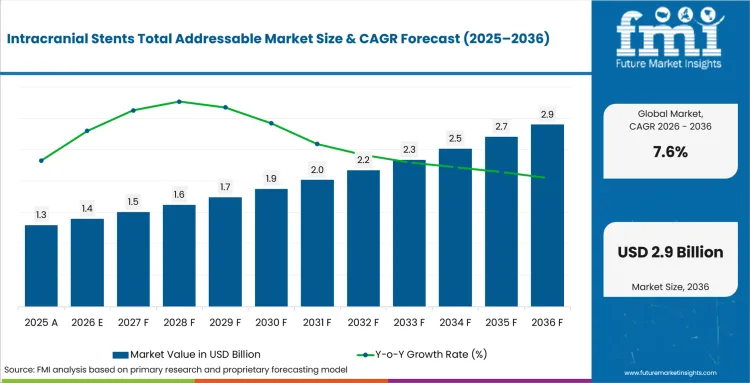
USD 1.4 billion in 2026 and USD 2.9 billion by 2036 at a 7.6% CAGR.
Sales of intracranial stents total addressable are estimated to rise at 7.6% CAGR through 2036, increasing valuation from USD 1.4 billion in 2026 to USD 2.9 billion by 2036. Neurovascular surgeons rely on intracranial stents for vital vessel support in treating brain aneurysms or restoring blood flow during emergencies. European medical centers had purchased over 12,000 LVIS EVO units from Terumo Neuro, proving how comfortable doctors have become with coil-assisted stent designs in June 2024. A surgeon's decision to adopt such specialized scaffolds depends on precise deployment control and secure vessel wall fit.
In the United States and Germany, hospital purchasing committees look for solid clinical data and dependable technical support before buying new neurovascular devices. Across Italy and Japan, medical teams focus heavily on hands-on physician training and demand stents being able to adapt accurately to complex brain anatomy. Manufacturers continue to innovate to simplify such challenging operations with Stryker having launched a specialized intracranial base catheter in June 2025, delivering both vessel access and stable support through one single instrument. Doctors are still required to carefully evaluate blood-thinning medications and unique blood vessel shapes for every patient.
Key Takeaways for the Intracranial Stents Total Addressable Market
- Demand for intracranial stents total addressable is driven by selected aneurysm and stenosis cases requiring scaffold support beyond coiling or medical therapy.
- Endovascular Stenting is forecast to garner 69.0% share of procedure in 2026, led by its use across primary, adjunctive, and emergency neurovascular interventions.
- Nitinol is estimated to lead Material with 63.0% share in 2026, backed by self-expansion and conformability across tortuous intracranial vessels.
- Procedural complications and operator skill restrict routine use across less specialized treatment centres.
- Competition focuses on Stryker Corporation, Medtronic plc, Terumo Neuro, Cerenovus, Balt, Acandis GmbH, and phenox GmbH, with suppliers differentiated by device evidence and procedural support.
Analyst Perspective
“Commercial acceptance for intracranial stents follows disciplined patient selection and reproducible deployment. Neurointerventional teams examine vessel anatomy and follow-up evidence during device review. Durable adoption develops through documented occlusion and complication outcomes across qualified treatment centres.”
- Anurag Sharma,, Principal Analyst for Healthcare at Future Market Insights
How is Intracranial Stents Total Addressable Market segmented?
The Intracranial stents total addressable industry is segmented by Product, Application, End User, Material, Procedure, and Region.
The intracranial stents total addressable market is segmented by product, application, end user, material, procedure, and region. Product coverage includes self-expanding intracranial stents, balloon-expandable intracranial stents, flow diverter stents, and stent-assisted coiling systems. Application coverage addresses intracranial aneurysm and intracranial stenosis together with acute ischemic stroke and other neurovascular disorders. End User coverage spans hospitals, ambulatory surgical centers, specialty clinics, and research institutes. Material coverage includes nitinol, cobalt chromium, and platinum-based materials. Procedure coverage includes endovascular stenting, flow diversion, and stent-assisted embolization. Regional coverage includes North America, Europe, East Asia, South Asia and Pacific, Latin America, and Middle East and Africa.
Why does intracranial aneurysm lead application demand?
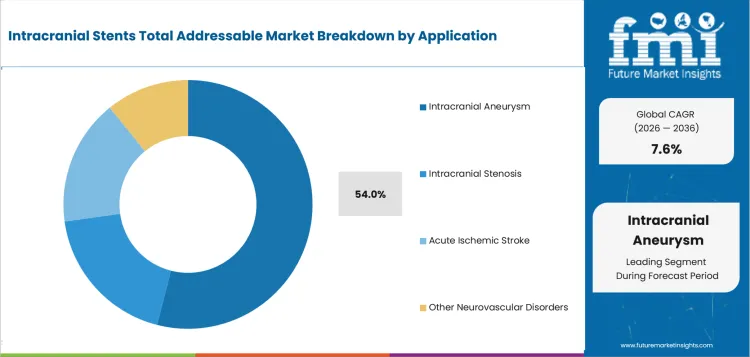
Intracranial aneurysm treatment often requires adjunctive scaffold support for wide-neck lesions presenting coil-retention challenges. Device evaluation includes aneurysm occlusion, parent-vessel preservation, retreatment, and ischemic complications. A Japanese post-marketing study released in October 2025 assessed 738 cases treated with an Enterprise vascular reconstruction device, providing extensive evidence for wide-neck aneurysm procedures. Large case coverage supports hospital review of performance across varied anatomy and patient risk profiles.
- Based on application, intracranial aneurysm is anticipated to account for 54.0% share in 2026 since it reflects stent use across wide-neck and recurrent aneurysms requiring coil support or vessel reconstruction. Treatment committees compare occlusion durability against antiplatelet exposure.
- Intracranial stenosis and acute ischemic stroke create demand for rescue support following inadequate reperfusion or recurrent narrowing. Other neurovascular disorders require narrower case selection across dissections and malformations.
Why do self-expanding intracranial stents lead product demand?
Self-expanding intracranial stents adapt to curved vessels and support controlled placement across difficult aneurysm necks or residual stenosis. Clinical review concentrates on opening behaviorand delayed neurological events. A June 2025 Food and Drug Administration decision required Neuroform Atlas follow-up through 3 years, reinforcing long-term evidence expectations for stent-assisted aneurysm treatment. Follow-up obligations shape hospital confidence and supplier support requirements across repeat procedures.
- Self-expanding intracranial stents are estimated to represent 47.0% share in 2026, influenced by conformability and controlled deployment across variable intracranial anatomy. Physician teams examine radial support and microcatheter compatibility during device selection.
- Balloon-expandable intracranial stents address lesions requiring precise expansion and stronger radial force. Flow diverter stents and stent-assisted coiling systems support different aneurysm morphologies through distinct metal coverage and embolization strategies.
What supports hospitals across end user demand?
Hospitals concentrate neurointerventional specialists and neurological monitoring needed for intracranial stent procedures. Referral networks also direct complex stroke and aneurysm cases toward centres possessing multidisciplinary care pathways. NHS England reported stroke imaging support across more than 70 hospitals in December 2025, illustrating expanding transfer coordination toward specialist stroke services. Coordinated pathways improve case identification and referral speed for patients requiring advanced endovascular assessment.
- By end user, hospitals are likely to hold 58.0% share in 2026, led by intensive imaging and post-procedure monitoring. Tertiary and university hospitals also manage complicated antiplatelet decisions through multidisciplinary teams.
- Ambulatory surgical centers and specialty clinics contribute through selected planned procedures and follow-up services. Research institutes support device evaluation and clinical evidence generation without replacing hospital-based intervention capacity.
Why does nitinol lead material selection?
Nitinol supports self-expansion and vessel conformity across curved intracranial anatomy. Laser-cut and braided configurations provide different balances of radial force and metal coverage. Material selection also affects fluoroscopic identification and surface-treatment compatibility. Cobalt chromium and platinum-based components address strength or radiopacity requirements across selected device designs.
- Nitinol is projected to capture 63.0% share of material in 2026, driven by shape memory and flexible deployment through small neurovascular delivery systems. Clinical teams assess opening consistency across tortuous vessel segments.
- Cobalt chromium supplies radial strength for selected balloon-expandable or flow-diversion designs. Platinum-based materials improve radiographic identification through marker bands and alloy components supporting placement accuracy.
What supports endovascular stenting within procedure demand?
Endovascular Stenting supports primary lesion treatment and emergency rescue following inadequate thrombectomy or angioplasty. Procedure selection reflects vessel patency needs and acceptable hemorrhagic risk under antiplatelet therapy. A multicentre study published in August 2024 evaluated 81 patients receiving rescue stenting across German and Spanish centres, documenting clinical use following mechanical thrombectomy. Multicentre evidence helps hospitals compare acute rescue pathways with conservative treatment options.
- Endovascular stenting is expected to secure 69.0% share in 2026, helped by adjunctive and emergency applications across aneurysm and stenosis cases. Device choice follows lesion anatomy and treatment sequence.
- Flow diversion and stent-assisted embolization address complex aneurysms through vessel reconstruction or combined embolic techniques. Procedure teams balance delayed occlusion and antiplatelet requirements during treatment planning.
What are drivers, restraints, and opportunities in Intracranial Stents Total Addressable Market?
Selected neurovascular cases create demand for intracranial scaffolds during treatment of complex vessel narrowing or incomplete reperfusion. Procedural complexity and prolonged antiplatelet therapy restrict intracranial stent use across patients facing elevated bleeding or restenosis risk.
- Driver: Residual stenosis following thrombectomy may leave inadequate vessel opening, prompting endovascular specialists to consider intracranial scaffold placement for restoring durable blood flow. Rescue procedures also address vessel collapse or renewed blockage during treatment, creating defined demand for devices offering stable expansion under demanding cerebral conditions.
- Restraint: Dual antiplatelet therapy raises bleeding concerns across patients carrying elevated neurological risk, extending clinical review prior to intracranial stent placement. Complications involving device malapposition or in-stent narrowing increase follow-up requirements and restrict adoption outside experienced neurointerventional centres.
- Opportunity: Lower-profile delivery systems improve access through tortuous cerebral vessels and reduce resistance during advancement toward distal lesions. Surface-modified implants may reduce acute thrombus interaction and strengthen physician confidence across selected anatomies requiring sustained vessel support.
Rescue stenting receives support from evidence linking scaffold placement with improved reperfusion in intracranial atherosclerotic disease. A 2025 registry reported successful reperfusion in 90.9% of patients receiving adjunct emergent stenting, strengthening clinical interest in carefully selected rescue cases. Commercial conversion requires hospital protocols covering lesion confirmation and antiplatelet management.
Procedural risk restricts indiscriminate device use across aneurysm treatment. A study published in July 2025 reported permanent neurological deficits in 0.9% of patients receiving stent-assisted coil embolization, reinforcing review of technique and patient suitability despite favorable aggregate outcomes. Supplier evidence needs clear event definitions and follow-up coverage during committee assessment.
Device-range expansion creates focused opportunity across parent-vessel diameters not served optimally by earlier configurations. A Food and Drug Administration decision in February 2025 approved 3 intermediate diameters for Surpass Elite, extending size selection across complex aneurysm treatment. Added sizing flexibility improves anatomical matching without removing deployment or medication controls.
How are country CAGRs aligned in Intracranial Stents Total Addressable Market?
| Country or Market | CAGR |
|---|---|
| Italy | 9.6% |
| USA | 9.2% |
| UK | 8.8% |
| France | 8.2% |
| Canada | 7.8% |
| Germany | 7.1% |
| Japan | 5.5% |
Source: Future Market Insights country analysis, 2026.
How do country-level CAGRs compare in Intracranial Stents Total Addressable Market?
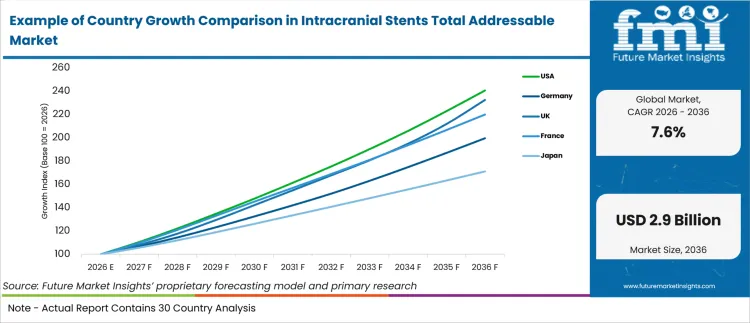
Country comparison shows a gradual step-down across the markets covered. Italy and the United States occupy the upper end of the range. United Kingdom and France form a closely grouped second tier. Canada and Germany follow with lower forecast rates. Japan completes the comparison at the lower end. A 4.1 percentage-point spread separates Italy from Japan and reflects measured differences in national market momentum.
- Italy and the United States lead the comparison and establish the principal expansion group among the markets shown.
- United Kingdom and France follow at a limited distance and form the next forecast band across established neurovascular care systems.
- Canada and Germany create the following rate group and maintain moderate separation from the middle tier.
- Japan records the lowest CAGR among the listed markets, with its forecast reflecting structured clinical review and measured device adoption.
- Profiled rates form a gradual downward slope instead of a sharp division between higher-rate and lower-rate markets.
Markets carrying similar CAGRs are likely to present different entry conditions through specialist treatment capacity and clinical evidence requirements. Full report coverage includes North America, Europe, East Asia, South Asia and Pacific, Latin America, and Middle East and Africa.
Country-wise Analysis
- Adoption in Italy is likely to scale at 9.6% CAGR between 2026 and 2036, led by specialist centres evaluating device visibility and placement accuracy. A 2024 multicentre study assessed 77 cerebral procedures across Italian facilities, demonstrating active technical evaluation across aneurysm and cerebral angiography work. Design-led assessment favors intracranial stents offering controlled deployment and dependable imaging recognition.
- The market in United States is projected to grow 9.2% CAGR by 2036, guided by extensive clinical research and device approvals. An ATLAS IDE analysis published in March 2026 covered 298 aneurysms, providing a substantial clinical base for stent-assisted coiling review. Formal evidence requirements favor suppliers maintaining trial support and post-approval follow-up across major neurovascular centres.
- National referral coordination shapes access to specialist neurovascular procedures across UK. Cambridge University Hospitals reported 26 thrombectomy centres operating nationally in October 2025, highlighting concentrated advanced stroke capacity and inter-hospital transfer requirements. Demand in the United Kingdom is expected to rise at 8.8% CAGR during the study period as qualified centres evaluate rescue stenting and aneurysm support under established clinical governance.
- Industry in France is anticipated to record 8.2% CAGR during the assessment period, reflecting substantial interventional neuroradiology capacity and institutional device assessment. A 2025 national review reported 24,126 therapeutic procedures completed during 2024, showing a sizeable base for advanced cerebral interventions. High procedural volume supports supplier training and evidence collection across selected aneurysm and stenosis cases.
- A 2025 national survey identified 27 endovascular thrombectomy-capable stroke centres, demonstrating concentrated access across a wide geography. Commercial coverage benefits from dependable clinical education and device support reaching tertiary sites across provinces. Sales in Canada are forecast to increase at 7.8% CAGR between 2026 and 2036 due to provincial stroke networks and transfer distances.
- Performance-led evaluation and certified neurovascular networks support device review across Germany. A 2025 network update recorded 2,946 aneurysm treatments, indicating substantial exposure to clipping and endovascular coiling pathways. Sector in Germany is projected to expand at 7.1% CAGR from 2026 to 2036 since hospitals compare stent evidence against flow diversion and alternative endovascular techniques.
- Structured registries guide patient selection and long-term outcome review across Japanese neurovascular practice. Intracranial stents total addressable industry is expected to progress at 5.5% CAGR through 2036, influenced by measured device adoption. A national registry disclosed in July 2024 set a target sample of 5,000 patients with intracranial artery stenosis, supporting extensive observation of disease progression and additional endovascular treatment.
Who are notable companies in Intracranial Stents Total Addressable Market?
Stryker Corporation, Medtronic plc, Terumo Neuro, Cerenovus under Johnson & Johnson MedTech, Balt, Acandis GmbH, and phenox GmbH are notable participants contributing to the market.
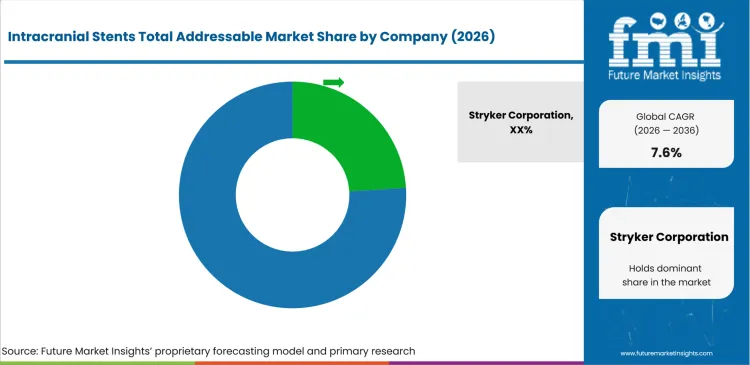
Competition in the market reflects device breadth and distribution support. Established participants combine intracranial stents with catheters and flow diverters. Specialist companies compete due to small delivery profiles and focused intracranial stenosis systems.
- Stryker Corporation and Medtronic plc compete based on extensive neurovascular portfolios and global hospital relationships. Physician education and post-approval evidence strengthen repeat device consideration.
- Terumo Neuro competes through coil-assist stents and parent-supported international distribution. MicroPort NeuroScientific Corporation adds intracranial stent and flow-diversion systems across a developing global neurovascular portfolio.
- Cerenovus and Balt address aneurysm reconstruction through established stent-assisted coiling platforms and braided intracranial designs. Clinical familiarity supports use across selected complex anatomies.
- Acandis GmbH and phenox GmbH compete depending on specialized intracranial stents and rescue-treatment systems. Focused clinical programs support access across European and selected international centres.
Competitive Benchmarking: Intracranial Stents Total Addressable Market
| Company | Intracranial Stent Portfolio | Flow Diversion Capability | Stent-Assisted Coiling | Service Reach |
|---|---|---|---|---|
| Stryker Corporation | High | High | High | Global |
| Medtronic plc | Medium | High | Medium | Global |
| Terumo Neuro | High | High | High | Global |
| Cerenovus | High | Medium | High | Global |
| Balt | High | High | High | Multi-country |
| Acandis GmbH | High | High | Medium | Multi-country |
| phenox GmbH | High | High | Medium | Multi-country |
| Terumo Corporation | High | High | High | Global |
Source: Future Market Insights competitive assessment, 2026.
Key Developments in the Intracranial Stents Total Addressable Market
- In June 2025, Acandis GmbH announced participation in the ICARUS study covering 498 patients across several European centres. Study design compares early intracranial stent implantation with continued conventional therapy for stroke associated with intracranial atherosclerosis, extending evidence for rescue treatment pathways.
- In July 2025, Stryker launched Surpass Elite across USA, South Korea, and Europe with an upgraded implant design and BioStealth surface modification. Commercial availability expands access to improved opening and vessel-wall apposition across selected complex aneurysms.
- In September 2025, the Food and Drug Administration approved reduced acute material thrombogenicity claims for the FRED X System based on in-vitro testing of its proprietary surface modification. Regulatory recognition strengthens evidence discussions concerning coated intracranial implants.
Intracranial Stents Total Addressable Market - Report Scope
| Coverage field | Report scope |
|---|---|
| Market breakdown | Intracranial stents total addressable market breakdown includes Product, Application, End User, Material, Procedure, and Region. |
| Quantitative Units | Revenue in USD billion and CAGR in %. |
| Market Definition | Self-expanding and other intracranial stents used for aneurysm support, atherosclerotic disease, and selected endovascular neurovascular procedures. Devices counted include intracranial scaffolds used through primary, adjunctive, or rescue treatment. |
| Regions Covered | North America, Europe, East Asia, South Asia and Pacific, Latin America, and Middle East and Africa. |
| Countries Covered | Italy, USA, UK, France, Canada, Germany, Japan, and additional countries covered in the full regional model. |
| Key Companies Profiled | Stryker Corporation, Medtronic plc, Terumo Neuro, Cerenovus, Balt, Acandis GmbH, and phenox GmbH. |
| Forecast Period | 2026 to 2036 |
| Approach | Hybrid bottom-up and top-down methodology uses segment shares and country CAGRs. Device evidence, treatment capacity, and company participation support final reconciliation. |
Source: Future Market Insights report framework, 2026.
Intracranial Stents Total Addressable Market - Research Methodology
| Method | Approach |
|---|---|
| Primary Research | FMI analysts gathered input from manufacturers, service providers, technology developers, distributors, end users, procurement teams, and subject-matter experts. Interviews examined purchasing decisions, product or service evaluation, adoption barriers, approval requirements, pricing considerations, and expectations for technical or commercial support. Respondents were also asked what evidence is required before a trial, pilot, or initial order develops into regular purchasing. |
| Desk Research | Desk research covered government statistics, regulatory publications, trade data, industry associations, technical literature, standards, company filings, product information, and official corporate announcements. Sources were reviewed for relevance, publication date, geographic coverage, and consistency with the defined market scope. Claims relating to performance, applications, approvals, capacity, investment, and commercial activity were retained only when supported by credible public evidence. |
| Market Sizing and Forecasting | The market model combined the baseline value with historical performance, segment structure, pricing and volume indicators, adoption levels, company participation, and country-level demand conditions. Forecast assumptions considered economic activity, investment trends, regulatory developments, technology adoption, purchasing cycles, supply availability, and barriers to wider market use. Segment and regional estimates were reconciled before the final market total was calculated. |
| Data Validation | Estimates were checked against multiple independent indicators, including public data, company activity, trade patterns, industry developments, and findings from primary interviews. Validation also tested whether products, services, applications, and company revenues fell within the defined market boundaries. Adjacent categories, unsupported claims, overlapping revenues, and activities without direct market relevance were excluded to reduce double counting and maintain consistency across segments and countries. |
Source: Future Market Insights methodology, 2026.
Intracranial Stents Total Addressable Market by Segments
Intracranial Stents Total Addressable Market segmented by Product:
- Self-expanding Intracranial Stents
- Balloon-expandable Intracranial Stents
- Flow Diverter Stents
- Stent-assisted Coiling Systems
Intracranial Stents Total Addressable Market segmented by Application:
- Intracranial Aneurysm
- Intracranial Stenosis
- Acute Ischemic Stroke
- Other Neurovascular Disorders
Intracranial Stents Total Addressable Market segmented by End User:
- Hospitals
- Ambulatory Surgical Centers
- Specialty Clinics
- Research Institutes
Intracranial Stents Total Addressable Market segmented by Material:
- Nitinol
- Cobalt Chromium
- Platinum-based Materials
Intracranial Stents Total Addressable Market segmented by Procedure:
- Endovascular Stenting
- Flow Diversion
- Stent-assisted Embolization
Intracranial Stents Total Addressable Market segmented by Region:
- North America
- United States
- Canada
- Latin America
- Brazil
- Mexico
- Argentina
- Chile
- Western Europe
- Germany
- France
- United Kingdom
- Italy
- Spain
- Benelux
- Nordics
- Eastern Europe
- Poland
- Czech Republic
- Romania
- Hungary
- East Asia
- China
- Japan
- South Korea
- South Asia and Pacific
- India
- ASEAN
- Australia and New Zealand
- Middle East and Africa
- GCC Countries
- South Africa
- Türkiye
- Israel
Research Sources and Bibliography
- Acandis GmbH. (2025, June). Press Release ICARUS Study.
- Adewusi, B., Demchuk, A. M., Stotts, G., et al. (2025, August 8). The acute stroke system of treatment across Canada: Findings from a national stroke centre survey. Canadian Journal of Neurological Sciences, 1-12.
- Al Kasab, S., Almallouhi, E., Jumaa, M., et al. (2025, February). Outcomes of adjunct emergent stenting versus mechanical thrombectomy alone: The RESCUE-ICAS Registry. Stroke, 56(2), 390-400.
- Burel, J., Agripnidis, T., Rouchaud, A., et al. (2025, May 14). Interventional neuroradiology in France in 2025: Scaling up expertise, access, and innovation. Journal of Neuroradiology, 52(4), 101350.
- Cambridge University Hospitals NHS Foundation Trust. (2025, October 24). 24/7 thrombectomy service transforms stroke care for region’s patients.
- D’Alessio, A., Strocchi, S., Dalmasso, F., et al. (2024, May 28). Effective and organ doses in patient undergoing interventional neuroradiology procedures: A multicentre study. Physica Medica, 122, 103383.
- Dorn, F., Voss, Y. L., Zidan, M., et al. (2024, August 23). A new fibrin-heparine coated self-expanding stent for the rescue treatment of intracranial stenosis-a multicentric study. Clinical Neuroradiology, 35, 43-50.
- Food and Drug Administration. (2025, February 12). Premarket Approval P170024S022: Surpass Elite Flow Diverter System.
- Food and Drug Administration. (2025, June 24). Premarket Approval P180031S006: Neuroform Atlas Stent System.
- Food and Drug Administration. (2025, September 18). Premarket Approval P180027S014: FRED X System.
- Kawamura, Y., Honda, A., Miyachi, S., et al. (2025, October 15). Vascular reconstruction device for coil embolization of wide-neck type cerebral aneurysm: Findings from a post-marketing surveillance study in Japan. Journal of Neuroendovascular Therapy, 19(1).
- National Institute of Public Health. (2024, July 1). Japanese Registry of Intracranial Artery Stenosis.
- NHS England. (2025, December 2). ‘Life-changing’ AI support helping stroke patients get a second chance.
- Phyo, W. S. Y., Shirakawa, M., Matsukawa, H., et al. (2025, July 16). The efficacy and safety of stent-assisted coil embolization with the semi-jailing technique in patients with unruptured intracranial aneurysm. Journal of Cerebrovascular and Endovascular Neurosurgery, 27(3), 219-227.
- Snyder, T., Jankowitz, B., Zaidat, O. O., et al. (2026, March 4). Neuroform Atlas stent-assisted coiling: Jailing versus re-crossing techniques. Journal of NeuroInterventional Surgery.
- Stryker Corporation. (2025, June 23). Stryker unveils new intracranial base catheter to streamline neurovascular access and therapy delivery.
- Stryker Corporation. (2025, July 22). Stryker launches Surpass Elite® Flow Diverter in the U.S., South Korea and Europe.
- Terumo Neuro. (2024, June 26). MicroVention Announces the Next Evolution in Stent Innovation: MicroVention’s LVIS™ EVO™ Intraluminal Support Device Now Available in the United States.
- Terumo Neuro. (2024, September 12). MicroVention Rebrands to Terumo Neuro - Reflects Expanded Focus and Strategic Growth.
- Wagner-Altendorf, T. A., Sieb, K., Berlis, A., et al. (2025, August 22). Interdisciplinary neurovascular networks in Germany: Update 2025. Neurological Research and Practice, 7(1), 59.
This bibliography is provided for reader reference and is not exhaustive. The full report contains the complete reference list and detailed citations.
This Report Answers
- How do product, application, end user, material, procedure, and region influence intracranial stent demand?
- What clinical evidence guides hospital review of intracranial stents for aneurysm and stenosis treatment?
- Why do country CAGRs differ across the profiled national markets?
- What companies compete through stent design and service reach?
- How are forecasts validated through bottom-up and top-down analysis using independent indicators?
- What evidence supports repeat purchasing across qualified neurointerventional centres?
- Why do vessel anatomy and antiplatelet planning influence device selection?
- How does operator dependence limit return across less specialized treatment settings?
- How do registry outcomes influence approval across clinical and hospital committees?
- What company capabilities improve long-term confidence and recurring device use?
Frequently Asked Questions
How big is the Intracranial Stents Total Addressable Market in 2026?
The intracranial stents total addressable market is valued at USD 1.4 billion in 2026 and is forecast to reach USD 2.9 billion by 2036. Growth is supported by selected aneurysm and stenosis cases that sustain recurring demand for scaffold support beyond coiling or medical therapy alone.
What is the CAGR of the Intracranial Stents Total Addressable Market from 2026 to 2036?
The intracranial stents total addressable market grows at a CAGR of 7.6% between 2026 and 2036, supported by neurointerventional teams adopting devices offering precise deployment control and secure vessel wall fit across documented occlusion and complication outcomes at qualified treatment centres.
Which procedure type leads the Intracranial Stents Total Addressable Market?
Endovascular stenting accounts for 69.0% of the intracranial stents total addressable market by procedure in 2026, driven by its use across primary, adjunctive, and emergency neurovascular interventions where device choice follows lesion anatomy and treatment sequence.
How much will the Intracranial Stents Total Addressable Market add between 2026 and 2036?
The intracranial stents total addressable market is set to add USD 1.5 billion between 2026 and 2036, growing from USD 1.4 billion to USD 2.9 billion as hospitals expand adjunctive and rescue stenting use across aneurysm, stenosis, and acute ischemic stroke cases.
Who are the leading companies in the Intracranial Stents Total Addressable Market?
Seven companies lead the intracranial stents total addressable market, including Stryker Corporation, Medtronic plc, Terumo Neuro, Cerenovus, Balt, Acandis GmbH, and phenox GmbH, competing through device evidence, procedural support, flow diversion capability, and stent-assisted coiling portfolios worldwide.
Preview the report firsthand - request a free sample
Get SampleGet the brochure for pricing and purchase details.
Get PDFTable of Content
- Key Takeaways
- Market Size and CAGR
- Top Growth Driver
- Fastest Growing Segment
- Leading Region
- Key Companies
- Emerging Opportunities
- Executive Summary
- Global Market Outlook
- Demand-side Trends
- Supply-side Trends
- Technology Roadmap Analysis
- Analysis and Recommendations
- Analyst Perspective (What is happening? Why now? What should investors know?)
- Key Questions Answered
- How large is the market?
- What is the CAGR?
- What are key trends?
- Which region dominates?
- Who are the leaders?
- Market Overview
- Market Coverage / Taxonomy
- Market Definition / Scope / Limitations
- Research Methodology
- Chapter Orientation
- Analytical Lens and Working Hypotheses
- Market Structure, Signals, and Trend Drivers
- Benchmarking and Cross-market Comparability
- Market Sizing, Forecasting, and Opportunity Mapping
- Research Design and Evidence Framework
- Desk Research Programme (Secondary Evidence)
- Expert Input and Fieldwork (Primary Evidence)
- Tooling, Models, and Reference Databases
- Data Engineering and Model Build
- Quality Assurance and Audit Trail
- Market Background
- Market Dynamics (Drivers, Restraints, Opportunity, Trends)
- Scenario Forecast (Optimistic, Likely, Conservative)
- Impact Analysis
- AI Impact
- Sustainability Impact
- Regulatory Impact
- Technology Impact
- Consumer / Buyer Analysis
- Purchase Drivers
- Adoption Barriers
- Buyer Journey
- Opportunity Map Analysis
- Product Life Cycle Analysis
- Supply Chain Analysis
- Investment Feasibility Matrix
- Value Chain Analysis
- PESTLE and Porter's Analysis
- Regulatory Landscape
- Regional Parent Market Outlook
- Production and Consumption Statistics
- Import and Export Statistics
- Global Market Analysis and Forecast, 2021 to 2036
- Historical Market Size Value (USD Billion) Analysis, 2021 to 2025
- Current and Future Market Size Value (USD Billion) Projections, 2026 to 2036
- Y-o-Y Growth Trend Analysis
- Absolute $ Opportunity Analysis
- Global Market Pricing Analysis, 2021 to 2036
- Global Market Analysis and Forecast, By Product, 2021 to 2036
- Introduction / Key Findings
- Historical Market Size Value (USD Billion) Analysis By Product, 2021 to 2025
- Current and Future Market Size Value (USD Billion) Analysis and Forecast By Product, 2026 to 2036
- Self-expanding Intracranial Stents
- Laser-cut Stents
- Braided Stents
- Hybrid Stent Designs
- Balloon-expandable Intracranial Stents
- Coronary-derived Stents
- High-radial Force Stents
- Precision-expandable Stents
- Flow Diverter Stents
- Low-profile Flow Diverters
- High-density Flow Diverters
- Surface-modified Flow Diverters
- Stent-assisted Coiling Systems
- Single-stent Coiling
- Y-stent Coiling
- Dual-stent Techniques
- Self-expanding Intracranial Stents
- Y-o-Y Growth Trend Analysis By Product, 2021 to 2025
- Absolute $ Opportunity Analysis By Product, 2026 to 2036
- Global Market Analysis and Forecast, By Application, 2021 to 2036
- Introduction / Key Findings
- Historical Market Size Value (USD Billion) Analysis By Application, 2021 to 2025
- Current and Future Market Size Value (USD Billion) Analysis and Forecast By Application, 2026 to 2036
- Intracranial Aneurysm
- Wide-neck Aneurysms
- Giant Aneurysms
- Recurrent Aneurysms
- Intracranial Stenosis
- Atherosclerotic Stenosis
- Symptomatic Stenosis
- Recurrent Stenosis
- Acute Ischemic Stroke
- Large Vessel Occlusion
- Rescue Stenting
- Bailout Procedures
- Other Neurovascular Disorders
- Arteriovenous Malformations
- Dissections
- Pseudoaneurysms
- Intracranial Aneurysm
- Y-o-Y Growth Trend Analysis By Application, 2021 to 2025
- Absolute $ Opportunity Analysis By Application, 2026 to 2036
- Global Market Analysis and Forecast, By End User, 2021 to 2036
- Introduction / Key Findings
- Historical Market Size Value (USD Billion) Analysis By End User, 2021 to 2025
- Current and Future Market Size Value (USD Billion) Analysis and Forecast By End User, 2026 to 2036
- Hospitals
- Tertiary Care Hospitals
- Specialty Neuroscience Hospitals
- University Hospitals
- Ambulatory Surgical Centers
- Neurovascular Centers
- Day Surgery Centers
- Minimally Invasive Centers
- Specialty Clinics
- Neurology Clinics
- Neurosurgery Clinics
- Endovascular Centers
- Research Institutes
- Clinical Research Centers
- Medical Universities
- Device Evaluation Centers
- Hospitals
- Y-o-Y Growth Trend Analysis By End User, 2021 to 2025
- Absolute $ Opportunity Analysis By End User, 2026 to 2036
- Global Market Analysis and Forecast, By Material, 2021 to 2036
- Introduction / Key Findings
- Historical Market Size Value (USD Billion) Analysis By Material, 2021 to 2025
- Current and Future Market Size Value (USD Billion) Analysis and Forecast By Material, 2026 to 2036
- Nitinol
- Laser-cut Nitinol
- Braided Nitinol
- Surface-coated Nitinol
- Cobalt Chromium
- High-strength Alloys
- Radiopaque Alloys
- Microcatheter-compatible Designs
- Platinum-based Materials
- Platinum Marker Bands
- Platinum Alloy Components
- High-visibility Designs
- Nitinol
- Y-o-Y Growth Trend Analysis By Material, 2021 to 2025
- Absolute $ Opportunity Analysis By Material, 2026 to 2036
- Global Market Analysis and Forecast, By Procedure, 2021 to 2036
- Introduction / Key Findings
- Historical Market Size Value (USD Billion) Analysis By Procedure, 2021 to 2025
- Current and Future Market Size Value (USD Billion) Analysis and Forecast By Procedure, 2026 to 2036
- Endovascular Stenting
- Primary Stenting
- Adjunctive Stenting
- Emergency Procedures
- Flow Diversion
- Single Flow Diverter
- Multiple Flow Diverters
- Complex Aneurysm Treatment
- Stent-assisted Embolization
- Coil-assisted Procedures
- Liquid Embolic-assisted Procedures
- Combination Neurointerventions
- Endovascular Stenting
- Y-o-Y Growth Trend Analysis By Procedure, 2021 to 2025
- Absolute $ Opportunity Analysis By Procedure, 2026 to 2036
- Global Market Analysis and Forecast, By Region, 2021 to 2036
- Introduction
- Historical Market Size Value (USD Billion) Analysis By Region, 2021 to 2025
- Current Market Size Value (USD Billion) Analysis and Forecast By Region, 2026 to 2036
- North America
- Latin America
- Western Europe
- Eastern Europe
- East Asia
- South Asia and Pacific
- Middle East & Africa
- Market Attractiveness Analysis By Region
- North America Market Analysis and Forecast, By Country, 2021 to 2036
- Historical Market Size Value (USD Billion) Trend Analysis By Market Taxonomy, 2021 to 2025
- Market Size Value (USD Billion) Forecast By Market Taxonomy, 2026 to 2036
- By Country
- USA
- Canada
- By Product
- By Application
- By End User
- By Material
- By Procedure
- By Country
- Market Attractiveness Analysis
- By Country
- By Product
- By Application
- By End User
- By Material
- By Procedure
- Key Takeaways
- Latin America Market Analysis and Forecast, By Country
- Historical Market Size Value (USD Billion) Trend Analysis By Market Taxonomy, 2021 to 2025
- Market Size Value (USD Billion) Forecast By Market Taxonomy, 2026 to 2036
- By Country
- Brazil
- Mexico
- Chile
- Rest of Latin America
- By Product
- By Application
- By End User
- By Material
- By Procedure
- By Country
- Market Attractiveness Analysis
- By Country
- By Product
- By Application
- By End User
- By Material
- By Procedure
- Key Takeaways
- Western Europe Market Analysis and Forecast, By Country
- Historical Market Size Value (USD Billion) Trend Analysis By Market Taxonomy, 2021 to 2025
- Market Size Value (USD Billion) Forecast By Market Taxonomy, 2026 to 2036
- By Country
- Germany
- UK
- Italy
- Spain
- France
- Nordic
- BENELUX
- Rest of Western Europe
- By Product
- By Application
- By End User
- By Material
- By Procedure
- By Country
- Market Attractiveness Analysis
- By Country
- By Product
- By Application
- By End User
- By Material
- By Procedure
- Key Takeaways
- Eastern Europe Market Analysis and Forecast, By Country
- Historical Market Size Value (USD Billion) Trend Analysis By Market Taxonomy, 2021 to 2025
- Market Size Value (USD Billion) Forecast By Market Taxonomy, 2026 to 2036
- By Country
- Russia
- Poland
- Hungary
- Balkan & Baltic
- Rest of Eastern Europe
- By Product
- By Application
- By End User
- By Material
- By Procedure
- By Country
- Market Attractiveness Analysis
- By Country
- By Product
- By Application
- By End User
- By Material
- By Procedure
- Key Takeaways
- East Asia Market Analysis and Forecast, By Country
- Historical Market Size Value (USD Billion) Trend Analysis By Market Taxonomy, 2021 to 2025
- Market Size Value (USD Billion) Forecast By Market Taxonomy, 2026 to 2036
- By Country
- China
- Japan
- South Korea
- By Product
- By Application
- By End User
- By Material
- By Procedure
- By Country
- Market Attractiveness Analysis
- By Country
- By Product
- By Application
- By End User
- By Material
- By Procedure
- Key Takeaways
- South Asia and Pacific Market Analysis and Forecast, By Country
- Historical Market Size Value (USD Billion) Trend Analysis By Market Taxonomy, 2021 to 2025
- Market Size Value (USD Billion) Forecast By Market Taxonomy, 2026 to 2036
- By Country
- India
- ASEAN
- Australia & New Zealand
- Rest of South Asia and Pacific
- By Product
- By Application
- By End User
- By Material
- By Procedure
- By Country
- Market Attractiveness Analysis
- By Country
- By Product
- By Application
- By End User
- By Material
- By Procedure
- Key Takeaways
- Middle East & Africa Market Analysis and Forecast, By Country
- Historical Market Size Value (USD Billion) Trend Analysis By Market Taxonomy, 2021 to 2025
- Market Size Value (USD Billion) Forecast By Market Taxonomy, 2026 to 2036
- By Country
- Kingdom of Saudi Arabia
- Other GCC Countries
- Türkiye
- South Africa
- Other African Union
- Rest of Middle East & Africa
- By Product
- By Application
- By End User
- By Material
- By Procedure
- By Country
- Market Attractiveness Analysis
- By Country
- By Product
- By Application
- By End User
- By Material
- By Procedure
- Key Takeaways
- Key Countries Market Analysis
- USA
- Pricing Analysis
- Market Share Analysis, 2025
- By Product
- By Application
- By End User
- By Material
- By Procedure
- Canada
- Pricing Analysis
- Market Share Analysis, 2025
- By Product
- By Application
- By End User
- By Material
- By Procedure
- Mexico
- Pricing Analysis
- Market Share Analysis, 2025
- By Product
- By Application
- By End User
- By Material
- By Procedure
- Brazil
- Pricing Analysis
- Market Share Analysis, 2025
- By Product
- By Application
- By End User
- By Material
- By Procedure
- Chile
- Pricing Analysis
- Market Share Analysis, 2025
- By Product
- By Application
- By End User
- By Material
- By Procedure
- Germany
- Pricing Analysis
- Market Share Analysis, 2025
- By Product
- By Application
- By End User
- By Material
- By Procedure
- UK
- Pricing Analysis
- Market Share Analysis, 2025
- By Product
- By Application
- By End User
- By Material
- By Procedure
- Italy
- Pricing Analysis
- Market Share Analysis, 2025
- By Product
- By Application
- By End User
- By Material
- By Procedure
- Spain
- Pricing Analysis
- Market Share Analysis, 2025
- By Product
- By Application
- By End User
- By Material
- By Procedure
- France
- Pricing Analysis
- Market Share Analysis, 2025
- By Product
- By Application
- By End User
- By Material
- By Procedure
- India
- Pricing Analysis
- Market Share Analysis, 2025
- By Product
- By Application
- By End User
- By Material
- By Procedure
- ASEAN
- Pricing Analysis
- Market Share Analysis, 2025
- By Product
- By Application
- By End User
- By Material
- By Procedure
- Australia & New Zealand
- Pricing Analysis
- Market Share Analysis, 2025
- By Product
- By Application
- By End User
- By Material
- By Procedure
- China
- Pricing Analysis
- Market Share Analysis, 2025
- By Product
- By Application
- By End User
- By Material
- By Procedure
- Japan
- Pricing Analysis
- Market Share Analysis, 2025
- By Product
- By Application
- By End User
- By Material
- By Procedure
- South Korea
- Pricing Analysis
- Market Share Analysis, 2025
- By Product
- By Application
- By End User
- By Material
- By Procedure
- Russia
- Pricing Analysis
- Market Share Analysis, 2025
- By Product
- By Application
- By End User
- By Material
- By Procedure
- Poland
- Pricing Analysis
- Market Share Analysis, 2025
- By Product
- By Application
- By End User
- By Material
- By Procedure
- Hungary
- Pricing Analysis
- Market Share Analysis, 2025
- By Product
- By Application
- By End User
- By Material
- By Procedure
- Kingdom of Saudi Arabia
- Pricing Analysis
- Market Share Analysis, 2025
- By Product
- By Application
- By End User
- By Material
- By Procedure
- Türkiye
- Pricing Analysis
- Market Share Analysis, 2025
- By Product
- By Application
- By End User
- By Material
- By Procedure
- South Africa
- Pricing Analysis
- Market Share Analysis, 2025
- By Product
- By Application
- By End User
- By Material
- By Procedure
- USA
- Market Structure Analysis
- Competition Dashboard
- Competition Benchmarking
- Market Share Analysis of Top Players
- By Regional
- By Product
- By Application
- By End User
- By Material
- By Procedure
- Emerging Startups
- Innovation Benchmarking
- Competition Analysis
- Competition Deep Dive
- Stryker Corporation
- Overview
- Product Portfolio
- Profitability by Market Segments
- Sales Footprint
- Strategy Overview
- Marketing Strategy
- Product Strategy
- Channel Strategy
- Medtronic plc
- MicroVention Inc.
- Terumo Corporation
- Balt Group
- Penumbra Inc.
- Acandis GmbH
- Phenox GmbH
- Meril Life Sciences
- Lepu Medical Technology
- Stryker Corporation
- Case Studies
- Success Stories
- Recent Developments
- Competition Deep Dive
- Assumptions & Acronyms Used


