

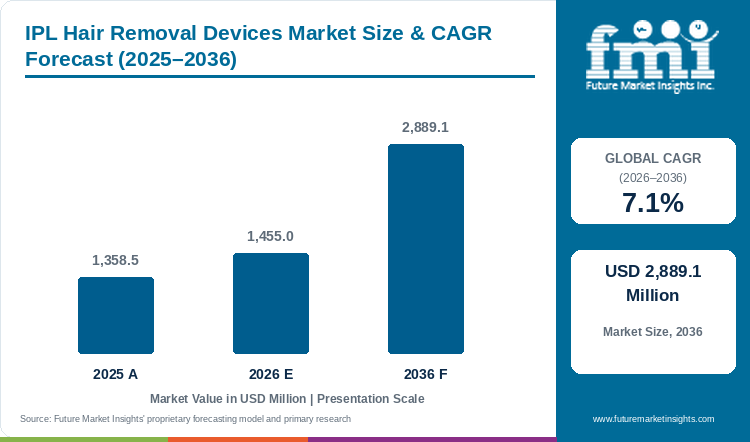
- Market Size (2026)
- USD 1455.0 Mn
- Forecast (2036)
- USD 2889.1 Mn
- CAGR (2026 to 2036)
- 7.1%
How big is IPL Hair Removal Devices Market in 2026?
USD 1,455.0 Million in 2026 and USD 2,889.1 Million by 2036 at a 7.1% CAGR.
Spending on IPL hair removal devices is estimated at USD 1,358.5 Million in 2025 and USD 1,455.0 Million in 2026, as per FMI. Revenue is projected to reach USD 2,889.1 Million by 2036 at a 7.1% CAGR, opening USD 1,434.1 Million of new sales for device suppliers. Philips brought Lumea to the US through Amazon in August 2025, giving an established home-treatment platform a new route to buyers comparing a device purchase with repeated hair-removal spending [1].
The purchase only pays off for the user who can follow a repeated treatment routine. Body-area coverage, treatment time and clear skin-and-hair compatibility guidance therefore matter as much as output specifications. Suppliers can widen demand by making eligibility easy to understand before checkout and by helping buyers keep to the device’s schedule. That reduces the gap between a promising demonstration and a product that stays in use.
Analysts at FMI see guidance and comfort as the next grounds for competition. Philips’ September 2026 Lumea 9900 Pro announcement introduced real-time audio feedback and motion guidance, while Panasonic’s January 2025 SmoothEpi update combined cooling with connected usage support [2] [3]. Brands that explain how these features help complete a routine can defend a higher price more convincingly than those relying on a longer specification list.
Key Takeaways
- Whole-body IPL leads Product Type with a 40.0% share in 2026 because a single device can cover legs, arms, underarms and other commonly treated areas without forcing multiple hardware purchases.
- At-home leads Use Setting with a 60.0% share in 2026 as users trade appointment dependence for private treatment schedules that can be repeated across the hair-growth cycle.
- Rechargeable cordless leads Power Source with a 55.0% share in 2026 because mobility reduces setup friction for repeated body-area treatment and private-use routines.
- The principal purchasing friction is eligibility and technique: skin tone, hair color, photosensitivity, treatment cadence and device positioning can all limit the realized value of a purchase.
- Profiled companies include Philips, CurrentBody, Conair, FOREO, Ya-Man, NuFACE, Dyson, SharkNinja, Panasonic and Therabody. Their documented roles range from direct IPL platforms to adjacent beauty and wellness device portfolios.
Analyst Perspective
Revenue realization will depend on whether suppliers can make correct treatment behavior easier than abandonment. Cooling, skin sensing and app-based guidance matter commercially when they reduce hesitation at the point of use rather than merely adding feature count.
- Rahul Pandita, Principal Consultant, FMI
How is the ipl hair removal devices market segmented?
The market is segmented by Product Type, Use Setting, Power Source, Price Band and Sales Channel.
Product Type comprises Whole-body IPL, Precision-head devices, Sapphire-cooled and Compact travel. Use Setting covers At-home, Professional & clinic and Hybrid prosumer. Power Source includes Rechargeable cordless, Corded and Battery. Price Band comprises Entry (below USD 100), Mid (USD 100-300) and Premium (above USD 300). Sales Channel includes E-commerce & DTC, Specialty beauty & electronics, Professional distribution and Department stores.
What keeps Whole-body IPL central to the Product Type category?
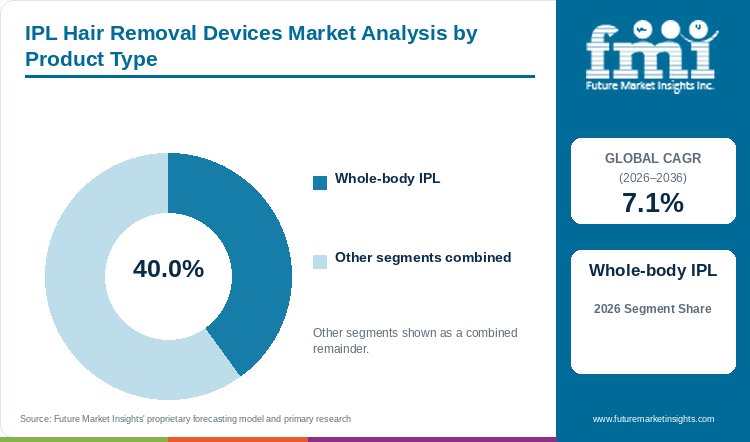
Whole-body IPL holds a 40.0% share of Product Type in 2026.
Whole-body systems combine several treatment areas in one purchase. Philips entered the US in August 2025 with a Lumea 9000 Series configuration using four attachments for the face, underarms, bikini line and legs [1]. Panasonic’s January 2025 SmoothEpi announcement also addresses face and body treatment [3]. The commercial value comes from letting the buyer use one platform across more of the routine.
- Whole-body IPL holds a 40.0% share of Product Type in 2026 as broader body-area coverage raises the number of use occasions that one device can address.
- In August 2025, Philips documented four application-specific Lumea attachments for its U.S. 9000 Series launch, illustrating how whole-body coverage can be packaged as guided specialization rather than a single generic treatment head. [1]
Why does At-home lead the Use Setting category?
At-home represents 60.0% of Use Setting in 2026.
At-home use brings a repeated treatment routine within the consumer’s own schedule. A March 2025 randomized trial comparing a specific home-use IPL device with a medical IPL system found similar effective rates after three months [4]. That result applies to the tested pair. Commercially, convenient access can support continued use when buyers understand their device’s compatibility limits and treatment schedule.
- At-home represents 60.0% of Use Setting in 2026.
- The March 19, 2025 randomized trial in Lasers in Medical Science reported comparable three-month effective rates for the studied home-use and medical IPL devices, supporting the credibility of home treatment without proving equivalence across every product. [4]
What makes Rechargeable cordless the leading Power Source?
Rechargeable cordless holds a 55.0% share of Power Source in 2026.
Cordless operation reduces dependence on outlet position when a user treats several body areas. Its value is greatest when the device remains comfortable to hold and can complete the intended session between charges. Buyers still need to compare treatment speed and power requirements across models. Portable design therefore offers a distinct convenience proposition, while corded systems can appeal to users who prioritize uninterrupted operation.
- Rechargeable cordless holds a 55.0% share of Power Source in 2026 owing to its advantage that untethered treatment lowers setup friction during recurring self-use sessions.
- Philips’ August 2025 US Lumea launch puts multi-area treatment and guided use at the centre of its consumer offer [1]. That launch illustrates why the full session experience matters when buyers compare power-source formats.
Why does Entry (below USD 100) lead the Price Band category?
Entry (below USD 100) leads Price Band with a 42.0% share in 2026.
The entry tier lowers the financial commitment required for first-time IPL adoption. That is commercially important because product fit cannot be assumed before purchase: light-based hair removal is constrained by skin tone, hair pigmentation and the user’s willingness to complete multiple sessions. Lower acquisition cost therefore reduces the penalty of trial while intensifying competition around safety controls and usable flash life. Supplier platforming can also support broad model ranges. The FDA’s July 2025 510(k) record for one IPL system lists numerous model identifiers under a single clearance, [5] which illustrates how closely related hardware can support differentiated retail offers.
- Entry (below USD 100) leads Price Band with a 42.0% share in 2026.
- In July 2025, the FDA cleared an IPL system family with multiple model identifiers under K251173. The filing shows how a common regulatory platform can support a broader model ladder, although it does not establish retail prices or the segment share. [5]
Why does E-commerce & DTC lead the Sales Channel category?
E-commerce & DTC holds a 47.0% share of Sales Channel in 2026.
Digital channels suit a considered purchase that needs explanation before checkout. Brand sites and marketplaces can place compatibility guidance, treatment schedules and demonstrations beside the transaction. Philips used an Amazon-exclusive route for its August 2025 US Lumea entry [1]. With alternatives easy to compare, the quality of product information and after-sales support can matter as much as the initial listing.
- E-commerce & DTC holds a 47.0% share of Sales Channel in 2026 owing to the fact that consumers can compare specifications and skin-fit guidance before purchasing a high-consideration personal device.
- In August 2025, Philips launched Lumea in the U.S. through Amazon. That route illustrates how a supplier can combine education, reviews and immediate purchase without first building broad department-store distribution. [1]
What are the drivers, restraints and opportunities in the ipl hair removal devices market?
Clinical support for home treatment drives adoption, while skin-fit and safety requirements restrain conversion and guided cooling plus digital support create room for differentiated devices.
- Driver: Evidence that home-use IPL can deliver meaningful hair reduction makes self-treatment a credible substitute for some clinic visits and repeated disposable methods.
- Restraint: Skin tone, hair pigmentation and photosensitivity narrow the eligible user base and make incorrect settings a material safety and satisfaction risk.
- Opportunity: Cooling, skin sensing and real-time guidance can reduce discomfort and technique uncertainty while supporting higher-value device tiers.
Driver: Product-specific clinical evidence can support confidence in self-administered treatment. The March 2025 randomized trial found comparable effective rates after three months for the tested home-use and medical IPL devices [4]. It does not establish that every consumer device performs alike. Suppliers with evidence for their own platform can make a stronger case to buyers comparing a reusable device with repeated spending on other hair-removal methods.
Restraint: A supplier must explain eligibility and product status before the buyer commits. Germany’s Federal Ministry of Health stated in February 2026 that IPL hair-removal devices without a medical purpose remain subject to European medical-device law because of comparable risk potential [6]. At the product level, skin and hair compatibility must follow the device’s instructions. Unclear screening can increase returns and disappointment even when the treatment schedule appears convenient.
Opportunity: The most defensible premium opportunity is to reduce user error and discomfort rather than simply add energy output. Philips introduced real-time audio and motion guidance in September 2026, while Ya-Man’s March 2026 Cool Power platform combines skin sensing with a cooling system. [2] [7] [8] Panasonic’s 2025 SmoothEpi update added Bluetooth-supported scheduling and usage guidance. [3] These features address the point at which interest is lost after purchase: uncertain technique and inconsistent cadence. Suppliers that connect skin-fit screening, cooling and treatment coaching can improve adherence while creating a clearer reason to trade up from basic flash devices.
Which country CAGRs are profiled in the ipl hair removal devices market?
The following profiled country CAGRs cover 2026 to 2036.
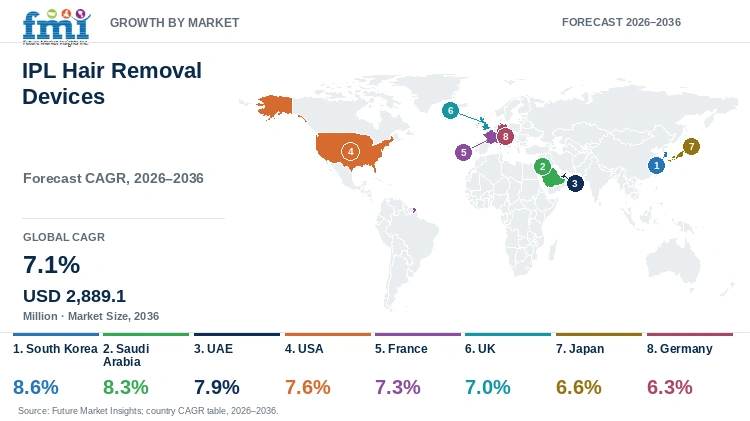
| Country | CAGR |
|---|---|
| South Korea | 8.6% |
| Saudi Arabia | 8.3% |
| UAE | 7.9% |
| USA | 7.6% |
| France | 7.3% |
| UK | 7.0% |
| Japan | 6.6% |
| Germany | 6.3% |
How do country-level CAGRs compare in the ipl hair removal devices market?
The profiled growth rates span 2.3 percentage points, from South Korea at 8.6% to Germany at 6.3%. South Korea, Saudi Arabia and the UAE form the fastest-growth band. The USA, France and UK sit in an upper-middle band, while Japan and Germany show steadier rates. These are growth-rate comparisons rather than statements about absolute country market size. Channel maturity, device regulation and local beauty-device ecosystems differ enough that the same CAGR can reflect different commercial routes.
- South Korea: Mobile commerce is deeply embedded in online buying, supporting discovery and direct purchase of compact consumer electronics.
- Saudi Arabia: Digital retail is expanding under explicit e-store compliance expectations that raise the importance of returns, privacy and seller transparency.
- UAE: High internet and smartphone penetration supports online acquisition, while Dubai maintains formal standards for laser and IPL hair-reduction services.
- USA: A defined FDA 510(k) pathway gives suppliers a visible qualification route for over-the-counter light-based hair-removal devices.
- France: Professional IPL access expanded to trained estheticians and nurses under rules that emphasize training, skin assessment and consumer information.
- UK: Online retail remains a major purchasing channel, while professional IPL treatment can face registration requirements depending on practitioner and location.
- Japan: A large B2C e-commerce market combines with established domestic beauty-device suppliers that compete on cooling and application-specific design.
- Germany: IPL hair-removal devices sit within European medical-device rules for Annex XVI non-medical-purpose products, which raises compliance discipline.
The profiles cover the eight named countries only. Relative CAGR should be read alongside channel access and qualification conditions rather than used as a proxy for market scale.
Country-wise Analysis
- South Korea offers the fastest profiled growth, at an 8.6% CAGR through 2036, with mobile channels carrying much of the buying journey. Statistics Korea recorded KRW 17.2435 trillion in mobile-shopping transactions in March 2025 [9]. IPL brands need demonstrations that explain eligibility and treatment commitment before checkout. A fast transaction helps only when the buyer understands whether the device fits their skin, hair and routine.
- Saudi Arabia’s e-store oversight makes after-sales terms part of the IPL proposition, supporting an 8.3% CAGR through 2036. The Ministry of Commerce’s August 2025 assessment covered returns, consumer rights and seller identification among ten criteria [10]. Suppliers that make those terms as visible as the device’s features can reduce uncertainty around an expensive first purchase and build confidence in replacement or upgrade orders.
- The UAE’s digital payment network gives imported beauty devices a practical direct-sales route, with a 7.9% CAGR forecast through 2036. Aani reached 12.5 million registered users in April 2026 [11]. IPL suppliers still need to distinguish home-use products from equipment intended for professional settings. Clear eligibility guidance, local warranty handling and dependable delivery can turn online discovery into a more confident purchase.
- Philips’ August 2025 Lumea launch through Amazon widened US access to established home IPL, while the market is forecast to grow at a 7.6% CAGR through 2036 [1]. The FDA also recorded clearance K251173 in July 2025 [5]. Suppliers can combine a defined regulatory position with clear retail education. Coverage and comfort must then justify the purchase against both professional appointments and familiar short-term hair-removal methods.
- Training requirements shape France’s professional channel, with a 7.3% CAGR forecast through 2036. Current DGCCRF guidance points to the February 2025 order governing training for non-therapeutic IPL and laser hair removal [12]. Equipment suppliers serving practitioners need product support that fits those operating requirements. Home-device brands face a different purchase decision and should make that distinction clear when explaining treatment settings and user suitability.
- Great Britain’s established online retail supports the UK’s 7.0% CAGR outlook through 2036. ONS recorded a 27.4% internet share of retail sales in 2025 [13]. Buyers can compare treatment windows, attachments and cooling without visiting a specialist store, which raises the importance of clear product explanations. Brands that make the recurring treatment commitment understandable can compete on routine value as well as price.
- Japan’s IPL buyers have current domestic products to compare, and sales are forecast at a 6.6% CAGR through 2036. Panasonic’s January 2025 SmoothEpi announcement combined cooling with Bluetooth-linked usage support [3]. The opportunity therefore includes upgrades as well as first purchases. Suppliers need to show how a new device changes treatment convenience or comfort, with a clear distinction between portable designs and higher-output corded systems.
- Germany’s product-qualification requirements support a more measured 6.3% CAGR through 2036. The Federal Ministry of Health’s February 2026 explanation includes IPL hair-removal devices without a medical purpose within the European medical-device framework [6]. Suppliers that can provide the required safety and labeling documentation are better placed to secure distribution. That preparation should be matched by plain eligibility guidance for the person buying the device.
Who are the notable companies in the ipl hair removal devices market?
Philips, CurrentBody, Conair, FOREO, Ya-Man, NuFACE, Dyson, SharkNinja, Panasonic and Therabody are the notable companies profiled in this market.
The competitive set divides into direct IPL platforms and adjacent consumer-device ecosystems. Philips, Conair, FOREO, Ya-Man and Panasonic have verifiable in-scope IPL offers or dated IPL activity. They compete through body-area coverage, cooling, skin sensing and guided use. CurrentBody sells an own-brand hair-removal device, but the current product is laser-based rather than IPL. [14] NuFACE focuses on microcurrent and red-light facial devices. Dyson’s public beauty catalog centers on hair-care technology. SharkNinja lists facial devices, LED masks and hair appliances, while Therabody focuses on LED, thermal and microcurrent skincare. Those adjacent platforms retain brand and channel relevance, but IPL-specific capability was not verified for them by September 12, 2026.
- Verified in-scope at-home IPL platforms: Philips, Conair, FOREO, Ya-Man and Panasonic.
- Adjacent direct-to-consumer beauty technology: CurrentBody and NuFACE. CurrentBody’s documented own-brand hair-removal offer uses laser technology, while NuFACE’s current device catalog emphasizes microcurrent and red-light applications.
- Broader beauty and wellness device platforms: Dyson, SharkNinja and Therabody. Their public catalogs demonstrate consumer-device reach, but an in-scope IPL hair-removal offer was not verified by September 12, 2026.
Competitive Benchmarking: IPL Hair Removal Devices Market
| Company | Verified IPL Portfolio | Coverage & Comfort Design | Guided Skin-Safety Support | Geographic Reach |
|---|---|---|---|---|
| Philips | High | High | High | Documented US and European Lumea activity [2] [1] |
| CurrentBody | Low | Unscored | Unscored | International DTC beauty tech; current own-brand hair-removal offer verified as laser [14] |
| Conair | Medium | Medium | Medium | North America; U.S. IPL sales and support material verified [15] |
| FOREO | High | High | High | International beauty-device platform with a 2025 PEACH 2 Pro Max announcement [16] |
| Ya-Man | High | High | High | Japan-led beauty-device platform with a current Ray Beauté portfolio [7] [8] |
| NuFACE | Unscored | Unscored | Unscored | International beauty tech; IPL-specific reach not verified [17] |
| Dyson | Unscored | Unscored | Unscored | Global beauty-device reach; IPL-specific capability not verified [18] |
| SharkNinja | Unscored | Unscored | Unscored | North American and international beauty retail; IPL-specific capability not verified [19] |
| Panasonic | High | High | High | Japan-led consumer-electronics platform with a January 2025 SmoothEpi refresh [3] |
| Therabody | Unscored | Unscored | Unscored | International wellness and skincare reach; IPL-specific capability not verified [20] |
Scoring basis: Verified IPL Portfolio measures documented in-scope IPL breadth and current or dated product evidence. Coverage & Comfort Design measures body-area versatility plus features such as cooling, precision treatment or form-factor specialization. Guided Skin-Safety Support measures documented sensing, setting guidance or app-led treatment support. High indicates broad or deep documented capability, Medium indicates credible but narrower capability and Low indicates a documented limitation against the criterion. Unavailable public information is left Unscored.
Key Developments in the IPL Hair Removal Devices Market
- In September 2026, Philips launched Lumea 9900 Pro with real-time audio feedback, motion guidance and a SmartSkin sensor. Philips also stated that the product has EU-MDR and U.S. FDA clearance. The development moves premium differentiation toward correct technique and guided coverage, which can reduce uncertainty for first-time at-home users. [2]
- In March 2026, Ya-Man announced Ray Beauté Cool Power for sequential release from March 16. Its product documentation combines cooling, double-flash output, precise-area treatment and automatic skin-sensing adjustments. The launch shows that comfort engineering is being paired with higher-output positioning rather than treated as a separate accessory feature. [7] [8]
- In January 2025, Panasonic announced two SmoothEpi models for release in early March. The ES-WG0B added a cooling mode and Bluetooth-linked usage support through the SmoothEpi app. Panasonic also cited broader male and facial-hair use, indicating that application expansion is being built into product design and routine management. [3]
Key Players in the IPL Hair Removal Devices Market
Established at-home IPL platforms
- Philips
- Conair
- FOREO
- Ya-Man
- Panasonic
Adjacent direct-to-consumer beauty technology
- CurrentBody
- NuFACE
Broader beauty and wellness device platforms
- Dyson
- SharkNinja
- Therabody
IPL Hair Removal Devices Market - Report Scope
| Coverage field | Report scope |
|---|---|
| Market breakdown | Product Type, Use Setting, Power Source, Price Band and Sales Channel. |
| Quantitative Units | USD Million |
| Market Definition | Includes revenue from IPL hair-removal devices sold within the defined Product Type, Use Setting, Power Source, Price Band and Sales Channel universe. Excludes laser hair-removal devices, razors, epilators, waxing products, clinic service revenue, downstream beauty revenue and adjacent skincare devices. Bundled revenue is included only when the IPL device is the primary product; unrelated bundle value and separately sold aftermarket items are excluded. |
| Regions Covered | North America; Latin America; Western Europe; Eastern Europe; East Asia; South Asia and Pacific; Middle East and Africa. |
| Countries Covered | USA, Germany, France, UK, Saudi Arabia, UAE, Japan and South Korea. |
| Key Companies Profiled | Philips, CurrentBody, Conair, FOREO, Ya-Man, NuFACE, Dyson, SharkNinja, Panasonic and Therabody. |
| Forecast Period | 2026 to 2036 |
| Approach | Primary and secondary research with market triangulation. |
IPL Hair Removal Devices Market - Research Methodology
| Method | Approach |
|---|---|
| Primary Research | FMI analysts gathered input from manufacturers, service providers, technology developers, distributors, end users, procurement teams and subject-matter experts. Interviews examined purchasing decisions, product or service evaluation, adoption barriers, approval requirements, pricing considerations and expectations for technical or commercial support. Respondents were also asked what evidence is required before a trial, pilot, or initial order develops into regular purchasing. |
| Desk Research | Desk research covered government statistics, regulatory publications, trade data, industry associations, technical literature, standards, company filings, product information and official corporate announcements. Sources were reviewed for relevance, publication date, geographic coverage and consistency with the defined market scope. Claims relating to performance, applications, approvals, capacity, investment and commercial activity were retained only when supported by credible public evidence. |
| Market Sizing and Forecasting | The market model combined the baseline value with historical performance, segment structure, pricing and volume indicators, adoption levels, company participation and country-level demand conditions. Forecast assumptions considered economic activity, investment trends, regulatory developments, technology adoption, purchasing cycles, supply availability and barriers to wider market use. Segment and regional estimates were reconciled before the final market total was calculated. |
| Data Validation | Estimates were checked against multiple independent indicators, including public data, company activity, trade patterns, industry developments and findings from primary interviews. Validation also tested whether products, services, applications and company revenues fell within the defined market boundaries. Adjacent categories, unsupported claims, overlapping revenues and activities without direct market relevance were excluded to reduce double counting and maintain consistency across segments and countries. |
IPL Hair Removal Devices Market by Segments
IPL Hair Removal Devices Market segmented by Product Type:
- Whole-body IPL
- Precision-head devices
- Sapphire-cooled
- Compact travel
IPL Hair Removal Devices Market segmented by Use Setting:
- At-home
- Professional & clinic
- Hybrid prosumer
IPL Hair Removal Devices Market segmented by Power Source:
- Rechargeable cordless
- Corded
- Battery
IPL Hair Removal Devices Market segmented by Price Band:
- Entry (below USD 100)
- Mid (USD 100-300)
- Premium (above USD 300)
IPL Hair Removal Devices Market segmented by Sales Channel:
- E-commerce & DTC
- Specialty beauty & electronics
- Professional distribution
- Department stores
IPL Hair Removal Devices Market by Region:
- North America
- United States
- Canada
- Latin America
- Brazil
- Mexico
- Argentina
- Chile
- Western Europe
- Germany
- France
- United Kingdom
- Italy
- Spain
- Benelux
- Nordics
- Eastern Europe
- Poland
- Czech Republic
- Romania
- Hungary
- East Asia
- China
- Japan
- South Korea
- South Asia and Pacific
- India
- ASEAN
- Australia and New Zealand
- Middle East and Africa
- GCC Countries
- South Africa
- Türkiye
- Israel
Research Sources and Bibliography
- [1] Philips (2025, August 20). It’s Not Me, It’s You: An Official Breakup Letter to My Old Hair Removal Routine.
- [2] Philips (2026, September 1). Philips launches Lumea 9900 Pro with real time audio feedback and motion guidance.
- [3] Panasonic (2025, January 22). SmoothEpi: two new light-based beauty devices announced.
- [4] Yan, Yunling et al. (2025, March 19). Comparison of the efficacy and safety of home-used intense pulsed light with medical intense pulsed light for hair removal.
- [5] U.S. Food and Drug Administration (2025, July 14). 510(k) Premarket Notification - K251173.
- [6] German Federal Ministry of Health (2026, February 27). Was sind Medizinprodukte?.
- [7] Ya-Man (2026, March 10). YA-MAN TOKYO JAPAN product news.
- [8] Ya-Man (n.d.). Ray Beauté Cool Power. Current page, accessed 6 October 2026.
- [9] Statistics Korea (2025, May 1). Online Shopping in March 2025.
- [10] Saudi Ministry of Commerce (2025, August 18). Ministry of Commerce Announces the Results of E-Commerce Store Evaluation.
- [11] Al Etihad Payments (2026, April 10). Aani reaches 12.5 million registered users.
- [12] French Directorate-General for Competition, Consumer Affairs and Fraud Control (n.d.). FAQ - Encadrement des soins esthétiques et de la coiffure. Current page, accessed 6 October 2026.
- [13] Office for National Statistics (2026, August 21). Internet sales as a percentage of total retail sales, series J4MC: 2025 annual figure.
- [14] CurrentBody (n.d.). CurrentBody Skin Laser Hair Removal Device. Current page, accessed 6 October 2026.
- [15] Conair (n.d.). IPL Treatment vs Laser Hair Removal. Current page, accessed 6 October 2026.
- [16] FOREO (2025, March 20). PEACH 2 Pro Max: professional IPL hair removal at home.
- [17] NuFACE (n.d.). NuFACE Microcurrent Facial Toning Devices. Current page, accessed 6 October 2026.
- [18] Dyson (n.d.). Dyson Hair Care. Current page, accessed 6 October 2026.
- [19] SharkNinja (n.d.). Shark Beauty. Current page, accessed 6 October 2026.
- [20] Therabody (n.d.). Clinically-Proven Skincare Treatments You Can Use at Home. Current page, accessed 6 October 2026.
This bibliography is provided for reader reference and is not exhaustive. The full report contains the complete reference list and detailed citations.
This Report Answers
- How large is the IPL Hair Removal Devices Market in 2026, and what value is forecast for 2036?
- Which industry pressures are supporting demand for IPL hair removal devices?
- Why does Whole-body IPL hold the leading position within Product Type?
- Why does At-home hold the leading position within Use Setting?
- How do the profiled country growth rates differ from 2026 to 2036?
- Which profiled companies supply IPL devices or adjacent beauty-device categories?
- What limits adoption or slows switching from familiar hair-removal methods?
- What should buyers evaluate before purchasing an IPL hair-removal device?
Frequently Asked Questions
How big is the IPL Hair Removal Devices Market in 2026, and what is forecast for 2036?
The market is valued at USD 1,455.0 Million in 2026 and is forecast to reach USD 2,889.1 Million by 2036. The increase reflects wider adoption of reusable light-based devices across home and professional settings.
What is the CAGR of the IPL Hair Removal Devices Market from 2026 to 2036?
The market is forecast to grow at a 7.1% CAGR from 2026 to 2036. The rate reflects continued conversion toward self-treatment alongside product upgrades in comfort and guidance.
Which segment leads Product Type in 2026?
Whole-body IPL leads Product Type with a 40.0% share in 2026. Its position reflects the ability to cover multiple body areas through one device platform.
Which segment leads Use Setting in 2026?
At-home leads Use Setting with a 60.0% share in 2026. The format aligns with recurring treatment schedules that users can complete without appointments.
Which profiled countries have the highest growth rates?
South Korea has the highest profiled CAGR at 8.6% from 2026 to 2036, followed by Saudi Arabia at 8.3% and the UAE at 7.9%. These rates describe growth pace and do not indicate which country has the largest absolute market.
Which companies are active in the IPL Hair Removal Devices Market?
The profiled companies are Philips, CurrentBody, Conair, FOREO, Ya-Man, NuFACE, Dyson, SharkNinja, Panasonic and Therabody. Public evidence verifies in-scope IPL activity for a subset, while several others are adjacent beauty or wellness device platforms.
Preview the report firsthand - request a free sample
Get SampleGet the brochure for pricing and purchase details.
Get PDFTable of Content
- Key Takeaways
- Market Size and CAGR
- Top Growth Driver
- Fastest Growing Segment
- Leading Region
- Key Companies
- Emerging Opportunities
- Executive Summary
- Global Market Outlook
- Demand-side Trends
- Supply-side Trends
- Technology Roadmap Analysis
- Analysis and Recommendations
- Analyst Perspective (What is happening? Why now? What should investors know?)
- Key Questions Answered
- How large is the market?
- What is the CAGR?
- What are key trends?
- Which region dominates?
- Who are the leaders?
- Market Overview
- Market Coverage / Taxonomy
- Market Definition / Scope / Limitations
- Research Methodology
- Chapter Orientation
- Analytical Lens and Working Hypotheses
- Market Structure, Signals, and Trend Drivers
- Benchmarking and Cross-market Comparability
- Market Sizing, Forecasting, and Opportunity Mapping
- Research Design and Evidence Framework
- Desk Research Programme (Secondary Evidence)
- Expert Input and Fieldwork (Primary Evidence)
- Tooling, Models, and Reference Databases
- Data Engineering and Model Build
- Quality Assurance and Audit Trail
- Market Background
- Market Dynamics (Drivers, Restraints, Opportunity, Trends)
- Scenario Forecast (Optimistic, Likely, Conservative)
- Impact Analysis
- AI Impact
- Sustainability Impact
- Regulatory Impact
- Technology Impact
- Consumer / Buyer Analysis
- Purchase Drivers
- Adoption Barriers
- Buyer Journey
- Opportunity Map Analysis
- Product Life Cycle Analysis
- Supply Chain Analysis
- Investment Feasibility Matrix
- Value Chain Analysis
- PESTLE and Porter's Analysis
- Regulatory Landscape
- Regional Parent Market Outlook
- Production and Consumption Statistics
- Import and Export Statistics
- Global Market Analysis and Forecast, 2021 to 2036
- Historical Market Size Value (USD Million) Analysis, 2021 to 2025
- Current and Future Market Size Value (USD Million) Projections, 2026 to 2036
- Y-o-Y Growth Trend Analysis
- Absolute $ Opportunity Analysis
- Global Market Pricing Analysis, 2021 to 2036
- Global Market Analysis and Forecast, By Product Type, 2021 to 2036
- Introduction / Key Findings
- Historical Market Size Value (USD Million) Analysis By Product Type, 2021 to 2025
- Current and Future Market Size Value (USD Million) Analysis and Forecast By Product Type, 2026 to 2036
- Whole-body IPL
- Precision-head devices
- Sapphire-cooled
- Compact travel
- Y-o-Y Growth Trend Analysis By Product Type, 2021 to 2025
- Absolute $ Opportunity Analysis By Product Type, 2026 to 2036
- Global Market Analysis and Forecast, By Use Setting, 2021 to 2036
- Introduction / Key Findings
- Historical Market Size Value (USD Million) Analysis By Use Setting, 2021 to 2025
- Current and Future Market Size Value (USD Million) Analysis and Forecast By Use Setting, 2026 to 2036
- At-home
- Professional & clinic
- Hybrid prosumer
- Y-o-Y Growth Trend Analysis By Use Setting, 2021 to 2025
- Absolute $ Opportunity Analysis By Use Setting, 2026 to 2036
- Global Market Analysis and Forecast, By Power Source, 2021 to 2036
- Introduction / Key Findings
- Historical Market Size Value (USD Million) Analysis By Power Source, 2021 to 2025
- Current and Future Market Size Value (USD Million) Analysis and Forecast By Power Source, 2026 to 2036
- Rechargeable cordless
- Corded
- Battery
- Y-o-Y Growth Trend Analysis By Power Source, 2021 to 2025
- Absolute $ Opportunity Analysis By Power Source, 2026 to 2036
- Global Market Analysis and Forecast, By Price Band, 2021 to 2036
- Introduction / Key Findings
- Historical Market Size Value (USD Million) Analysis By Price Band, 2021 to 2025
- Current and Future Market Size Value (USD Million) Analysis and Forecast By Price Band, 2026 to 2036
- Entry (below USD 100)
- Mid (USD 100-300)
- Premium (above USD 300)
- Y-o-Y Growth Trend Analysis By Price Band, 2021 to 2025
- Absolute $ Opportunity Analysis By Price Band, 2026 to 2036
- Global Market Analysis and Forecast, By Sales Channel, 2021 to 2036
- Introduction / Key Findings
- Historical Market Size Value (USD Million) Analysis By Sales Channel, 2021 to 2025
- Current and Future Market Size Value (USD Million) Analysis and Forecast By Sales Channel, 2026 to 2036
- E-commerce & DTC
- Specialty beauty & electronics
- Professional distribution
- Department stores
- Y-o-Y Growth Trend Analysis By Sales Channel, 2021 to 2025
- Absolute $ Opportunity Analysis By Sales Channel, 2026 to 2036
- Global Market Analysis and Forecast, By Region, 2021 to 2036
- Introduction
- Historical Market Size Value (USD Million) Analysis By Region, 2021 to 2025
- Current Market Size Value (USD Million) Analysis and Forecast By Region, 2026 to 2036
- North America
- Latin America
- Western Europe
- Eastern Europe
- East Asia
- South Asia and Pacific
- Middle East and Africa
- Market Attractiveness Analysis By Region
- North America Market Analysis and Forecast, By Country, 2021 to 2036
- Historical Market Size Value (USD Million) Trend Analysis By Market Taxonomy, 2021 to 2025
- Market Size Value (USD Million) Forecast By Market Taxonomy, 2026 to 2036
- By Country
- United States
- Canada
- By Product Type
- By Use Setting
- By Power Source
- By Price Band
- By Sales Channel
- By Country
- Market Attractiveness Analysis
- By Country
- By Product Type
- By Use Setting
- By Power Source
- By Price Band
- By Sales Channel
- Key Takeaways
- Latin America Market Analysis and Forecast, By Country
- Historical Market Size Value (USD Million) Trend Analysis By Market Taxonomy, 2021 to 2025
- Market Size Value (USD Million) Forecast By Market Taxonomy, 2026 to 2036
- By Country
- Brazil
- Mexico
- Argentina
- Chile
- By Product Type
- By Use Setting
- By Power Source
- By Price Band
- By Sales Channel
- By Country
- Market Attractiveness Analysis
- By Country
- By Product Type
- By Use Setting
- By Power Source
- By Price Band
- By Sales Channel
- Key Takeaways
- Western Europe Market Analysis and Forecast, By Country
- Historical Market Size Value (USD Million) Trend Analysis By Market Taxonomy, 2021 to 2025
- Market Size Value (USD Million) Forecast By Market Taxonomy, 2026 to 2036
- By Country
- Germany
- France
- United Kingdom
- Italy
- Spain
- Benelux
- Nordics
- By Product Type
- By Use Setting
- By Power Source
- By Price Band
- By Sales Channel
- By Country
- Market Attractiveness Analysis
- By Country
- By Product Type
- By Use Setting
- By Power Source
- By Price Band
- By Sales Channel
- Key Takeaways
- Eastern Europe Market Analysis and Forecast, By Country
- Historical Market Size Value (USD Million) Trend Analysis By Market Taxonomy, 2021 to 2025
- Market Size Value (USD Million) Forecast By Market Taxonomy, 2026 to 2036
- By Country
- Poland
- Czech Republic
- Romania
- Hungary
- By Product Type
- By Use Setting
- By Power Source
- By Price Band
- By Sales Channel
- By Country
- Market Attractiveness Analysis
- By Country
- By Product Type
- By Use Setting
- By Power Source
- By Price Band
- By Sales Channel
- Key Takeaways
- East Asia Market Analysis and Forecast, By Country
- Historical Market Size Value (USD Million) Trend Analysis By Market Taxonomy, 2021 to 2025
- Market Size Value (USD Million) Forecast By Market Taxonomy, 2026 to 2036
- By Country
- China
- Japan
- South Korea
- By Product Type
- By Use Setting
- By Power Source
- By Price Band
- By Sales Channel
- By Country
- Market Attractiveness Analysis
- By Country
- By Product Type
- By Use Setting
- By Power Source
- By Price Band
- By Sales Channel
- Key Takeaways
- South Asia and Pacific Market Analysis and Forecast, By Country
- Historical Market Size Value (USD Million) Trend Analysis By Market Taxonomy, 2021 to 2025
- Market Size Value (USD Million) Forecast By Market Taxonomy, 2026 to 2036
- By Country
- India
- ASEAN
- Australia and New Zealand
- By Product Type
- By Use Setting
- By Power Source
- By Price Band
- By Sales Channel
- By Country
- Market Attractiveness Analysis
- By Country
- By Product Type
- By Use Setting
- By Power Source
- By Price Band
- By Sales Channel
- Key Takeaways
- Middle East and Africa Market Analysis and Forecast, By Country
- Historical Market Size Value (USD Million) Trend Analysis By Market Taxonomy, 2021 to 2025
- Market Size Value (USD Million) Forecast By Market Taxonomy, 2026 to 2036
- By Country
- GCC Countries
- South Africa
- Türkiye
- Israel
- By Product Type
- By Use Setting
- By Power Source
- By Price Band
- By Sales Channel
- By Country
- Market Attractiveness Analysis
- By Country
- By Product Type
- By Use Setting
- By Power Source
- By Price Band
- By Sales Channel
- Key Takeaways
- Key Countries Market Analysis
- United States
- Pricing Analysis
- Market Share Analysis, 2025
- By Product Type
- By Use Setting
- By Power Source
- By Price Band
- By Sales Channel
- Canada
- Pricing Analysis
- Market Share Analysis, 2025
- By Product Type
- By Use Setting
- By Power Source
- By Price Band
- By Sales Channel
- Mexico
- Pricing Analysis
- Market Share Analysis, 2025
- By Product Type
- By Use Setting
- By Power Source
- By Price Band
- By Sales Channel
- Brazil
- Pricing Analysis
- Market Share Analysis, 2025
- By Product Type
- By Use Setting
- By Power Source
- By Price Band
- By Sales Channel
- Chile
- Pricing Analysis
- Market Share Analysis, 2025
- By Product Type
- By Use Setting
- By Power Source
- By Price Band
- By Sales Channel
- Germany
- Pricing Analysis
- Market Share Analysis, 2025
- By Product Type
- By Use Setting
- By Power Source
- By Price Band
- By Sales Channel
- United Kingdom
- Pricing Analysis
- Market Share Analysis, 2025
- By Product Type
- By Use Setting
- By Power Source
- By Price Band
- By Sales Channel
- Italy
- Pricing Analysis
- Market Share Analysis, 2025
- By Product Type
- By Use Setting
- By Power Source
- By Price Band
- By Sales Channel
- Spain
- Pricing Analysis
- Market Share Analysis, 2025
- By Product Type
- By Use Setting
- By Power Source
- By Price Band
- By Sales Channel
- France
- Pricing Analysis
- Market Share Analysis, 2025
- By Product Type
- By Use Setting
- By Power Source
- By Price Band
- By Sales Channel
- India
- Pricing Analysis
- Market Share Analysis, 2025
- By Product Type
- By Use Setting
- By Power Source
- By Price Band
- By Sales Channel
- ASEAN
- Pricing Analysis
- Market Share Analysis, 2025
- By Product Type
- By Use Setting
- By Power Source
- By Price Band
- By Sales Channel
- Australia and New Zealand
- Pricing Analysis
- Market Share Analysis, 2025
- By Product Type
- By Use Setting
- By Power Source
- By Price Band
- By Sales Channel
- China
- Pricing Analysis
- Market Share Analysis, 2025
- By Product Type
- By Use Setting
- By Power Source
- By Price Band
- By Sales Channel
- Japan
- Pricing Analysis
- Market Share Analysis, 2025
- By Product Type
- By Use Setting
- By Power Source
- By Price Band
- By Sales Channel
- South Korea
- Pricing Analysis
- Market Share Analysis, 2025
- By Product Type
- By Use Setting
- By Power Source
- By Price Band
- By Sales Channel
- Poland
- Pricing Analysis
- Market Share Analysis, 2025
- By Product Type
- By Use Setting
- By Power Source
- By Price Band
- By Sales Channel
- Hungary
- Pricing Analysis
- Market Share Analysis, 2025
- By Product Type
- By Use Setting
- By Power Source
- By Price Band
- By Sales Channel
- Türkiye
- Pricing Analysis
- Market Share Analysis, 2025
- By Product Type
- By Use Setting
- By Power Source
- By Price Band
- By Sales Channel
- South Africa
- Pricing Analysis
- Market Share Analysis, 2025
- By Product Type
- By Use Setting
- By Power Source
- By Price Band
- By Sales Channel
- Saudi Arabia
- Pricing Analysis
- Market Share Analysis, 2025
- By Product Type
- By Use Setting
- By Power Source
- By Price Band
- By Sales Channel
- UAE
- Pricing Analysis
- Market Share Analysis, 2025
- By Product Type
- By Use Setting
- By Power Source
- By Price Band
- By Sales Channel
- United States
- Market Structure Analysis
- Competition Dashboard
- Competition Benchmarking
- Market Share Analysis of Top Players
- By Regional
- By Product Type
- By Use Setting
- By Power Source
- By Price Band
- By Sales Channel
- Emerging Startups
- Innovation Benchmarking
- Competition Analysis
- Competition Deep Dive
- Philips
- Overview
- Product Portfolio
- Profitability by Market Segments
- Sales Footprint
- Strategy Overview
- Marketing Strategy
- Product Strategy
- Channel Strategy
- CurrentBody
- Conair
- FOREO
- Ya-Man
- NuFACE
- Dyson
- SharkNinja
- Panasonic
- Therabody
- Philips
- Case Studies
- Success Stories
- Recent Developments
- Competition Deep Dive
- Assumptions & Acronyms Used


