

- Industry Size (2026)
- USD 49.5 Mn
- Forecast (2036)
- USD 77.7 Mn
- CAGR (2026 to 2036)
- 4.6%
Demand for Aspiration & Biopsy Needles in Japan 2026 to 2036
Demand for aspiration & biopsy needles in Japan is valued at USD 49.5 million in 2026 and is forecasted to reach USD 77.7 million by 2036, reflecting a CAGR of 4.6%. Demand advances through rising diagnostic procedure volumes, expanded cancer screening programs, and wider adoption of minimally invasive tissue sampling across hospitals and specialty clinics. Aging population dynamics and growth in image-guided diagnostics support steady utilization.
Biopsy needles lead product-type usage due to high diagnostic accuracy, controlled tissue acquisition, and compatibility with ultrasound, CT, and MRI guidance. Clinicians favor refined tip geometries, consistent penetration force, and ergonomic handling to improve procedural precision and patient safety. Incremental improvements in coatings and gauge optimization enhance reliability across varied clinical settings.
Quick Stats for Demand for Aspiration & Biopsy Needles in Japan
- Japan Aspiration & Biopsy Needles Sales Value (2026): USD 49.5 million
- Japan Aspiration & Biopsy Needles Forecast Value (2036): USD 77.7 million
- Japan Aspiration & Biopsy Needles Forecast CAGR (2026 to 2036): 4.6%
- Leading Product Type in Japan: Biopsy Needles
- Key Growth Regions in Japan: Kyushu & Okinawa, Kanto, Kansai, Chubu, Tohoku
- Top Players in Japan: Terumo Corporation, Nipro Medical Corporation, Becton Dickinson Japan, Cook Japan, Merit Medical Systems Japan
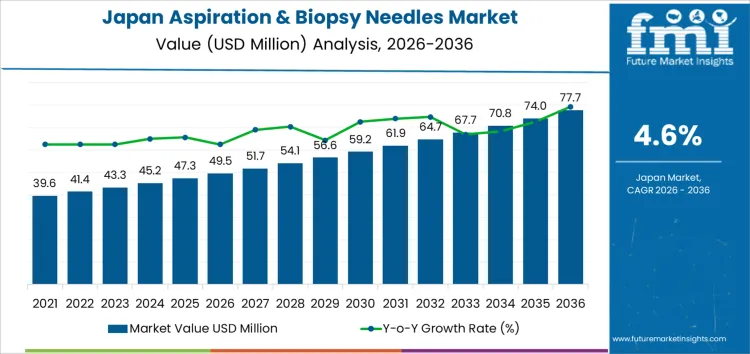
Kyushu & Okinawa, Kanto, Kansai, Chubu, and Tohoku represent key growth regions supported by dense healthcare infrastructure and regional oncology centers. Terumo Corporation, Nipro Medical Corporation, Becton Dickinson Japan, Cook Japan, and Merit Medical Systems Japan anchor competitive activity through localized manufacturing, regulatory alignment, and distribution networks tailored to Japanese clinical standards and procurement practices.
Japan Aspiration & Biopsy Needles Key Takeaways
| Metric | Value |
|---|---|
| Japan Aspiration & Biopsy Needles Sales Value (2026) | USD 49.5 million |
| Japan Aspiration & Biopsy Needles Forecast Value (2036) | USD 77.7 million |
| Japan Aspiration & Biopsy Needles Forecast CAGR (2026 to 2036) | 4.6% |
Why is the Demand for Aspiration & Biopsy Needles in Japan Growing?
Demand for aspiration and biopsy needles in Japan grows due to rising diagnostic activity linked to cancer screening, chronic disease management, and aging population trends. Japan maintains structured screening programs for breast, lung, thyroid, liver, and gastrointestinal cancers, which increases procedure volumes requiring tissue and fluid sampling. Aging demographics raise incidence of oncologic and inflammatory conditions that rely on minimally invasive diagnostics. Hospitals and specialty clinics adopt image guided procedures using ultrasound, CT, and endoscopic platforms, which depend on precise needle performance and consistent sample quality.
Preference for minimally invasive techniques supports outpatient diagnostics that reduce hospital stays and procedural burden. Advances in pathology and molecular testing increase demand for high integrity specimens suitable for cytology, histology, and biomarker analysis. Academic medical centers and regional hospitals expand interventional radiology capacity, which sustains regular procurement of aspiration and biopsy consumables. Domestic manufacturers focus on needle design improvements that enhance penetration control, sample yield, and patient comfort. Regulatory emphasis on procedural safety and standardization supports continued use of single use sterile needles across diagnostic workflows in Japan.
How Are the Segments Classified in the Demand for Aspiration and Biopsy Needles in Japan?
Demand for aspiration and biopsy needles in Japan is shaped by diagnostic accuracy expectations, minimally invasive procedure adoption, and structured clinical pathways. Hospitals and diagnostic centers evaluate needle precision, sample adequacy, procedural safety, and compatibility with imaging guidance. Adoption patterns reflect steady procedural volumes in oncology diagnostics, interventional radiology, and pathology workflows, aligned with Japan’s quality assurance standards and emphasis on early, reliable disease detection.
By Product Type, Do Biopsy Needles Account for the Largest Share of Demand in Japan?
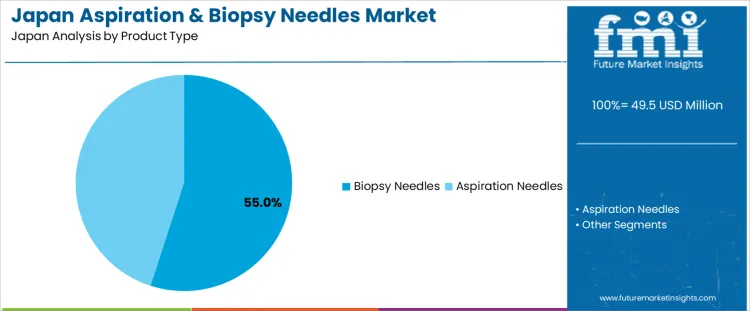
Biopsy needles hold 55.0%, making them the leading product-type segment in Japan. These needles enable core tissue sampling required for histopathological evaluation and definitive diagnosis. Clinical preference is driven by need for preserved tissue architecture, supporting accurate tumor classification and treatment planning. Usage is common in ultrasound-guided and CT-guided procedures within hospital settings. Aspiration needles hold 45.0%, supporting fine-needle aspiration for cytological assessment and rapid preliminary evaluation. These needles are selected for lower invasiveness and patient comfort during outpatient procedures. Product-type distribution reflects stronger reliance on biopsy needles due to diagnostic depth requirements within Japan’s oncology-focused clinical protocols.
Key Points:
- Biopsy needles dominate due to requirement for core tissue diagnosis.
- Imaging-guided procedures support consistent biopsy utilization.
- Aspiration needles serve rapid and minimally invasive assessments.
By Application, Do Tumour and Cancer Applications Represent the Largest Share of Demand in Japan?
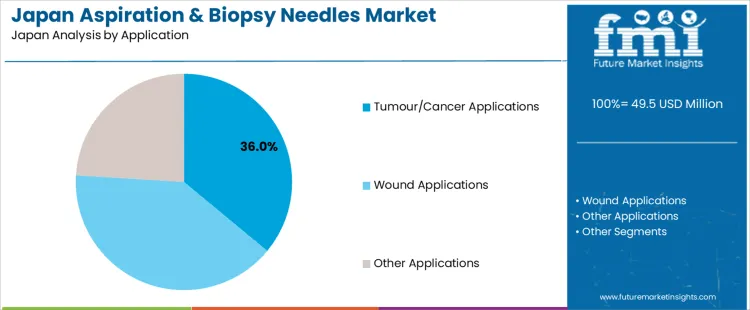
Tumour and cancer applications hold 36.0%, making them the leading application segment in Japan. Aspiration and biopsy needles are integral to cancer detection, staging, and monitoring across solid tumors. Procedures support precision diagnostics under structured screening and referral systems. Wound applications use needles for fluid aspiration, infection assessment, and localized diagnostic evaluation. Other applications include benign lesion assessment and inflammatory condition investigation. Application distribution reflects concentration of procedural demand within oncology pathways, supported by Japan’s focus on early diagnosis, imaging integration, and standardized clinical decision-making.
Key Points:
- Oncology diagnostics drive primary needle usage.
- Image-guided sampling supports accuracy and safety.
- Wound and benign evaluations represent secondary demand.
What are the Key Dynamics in the Aspiration & Biopsy Needles Industry in Japan?
Demand increases as diagnostic imaging, oncology, and minimally invasive procedures expand across hospitals and specialized clinics in Japan. Aspiration and biopsy needles support tissue sampling for cancer diagnosis, infectious disease assessment, and pathological confirmation. Usage aligns with aging demographics, high screening participation, and preference for precise, low-risk diagnostic methods. Adoption remains concentrated in regulated clinical environments with standardized protocols and strong emphasis on procedural accuracy.
How do early diagnosis practices and minimally invasive care models drive demand in Japan?
Japan maintains high participation in cancer screening programs covering gastric, colorectal, breast, lung, and prostate cancers. Hospitals rely on image-guided aspiration and biopsy needles to obtain accurate samples while minimizing patient burden. Ultrasound- and CT-guided procedures expand use in outpatient and same-day diagnostic settings. Aging population increases incidence of conditions requiring histopathological confirmation. Clinicians prefer needle systems that deliver consistent sample quality and reduce repeat procedures. Advanced pathology workflows require adequate tissue for molecular and genomic testing. University hospitals and cancer centers influence adoption through clinical standards and training, sustaining steady procedural demand across regional healthcare networks.
How do regulatory standards, procurement practices, and workforce factors influence demand stability?
Medical devices in Japan must meet PMDA approval and stringent quality management requirements, increasing compliance costs for manufacturers. Hospital procurement emphasizes reliability, clinical validation, and long-term supplier relationships over frequent product switching. Pricing pressure arises from national reimbursement controls and centralized purchasing. Clinician familiarity influences preference for established needle designs. Infection control protocols require single-use devices, supporting baseline volume demand. Workforce constraints in radiology and pathology affect procedure capacity. Emerging alternatives such as liquid biopsy prompt evaluation rather than replacement. Demand remains stable due to essential diagnostic role, shaped by regulation, reimbursement discipline, and Japan’s structured healthcare delivery system.
How Is Demand for Aspiration & Biopsy Needles in Japan Evolving by Region?
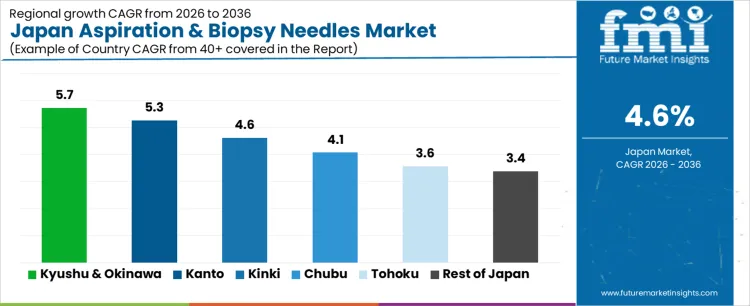
Demand for aspiration and biopsy needles in Japan is rising due to increasing cancer screening volumes, aging demographics, and preference for minimally invasive diagnostic procedures. Kyushu and Okinawa lead with a 5.7% CAGR, supported by regional oncology programs and hospital expansion. Kanto follows at 5.3%, driven by concentration of academic hospitals and advanced diagnostic imaging centers. Kansai records a 4.6% CAGR, shaped by specialty clinics and procedural standardization. Chubu posts 4.1%, reflecting manufacturing-linked healthcare infrastructure. Tohoku shows 3.6%, supported by regional medical access programs. Rest of Japan records 3.4%, reflecting stable replacement-driven procurement. Regional variation reflects diagnostic intensity, healthcare infrastructure density, and procedural adoption across Japan.
| Region | CAGR (2026-2036) |
|---|---|
| Kyushu & Okinawa | 5.7% |
| Kanto | 5.3% |
| Kansai | 4.6% |
| Chubu | 4.1% |
| Tohoku | 3.6% |
| Rest of Japan | 3.4% |
How is Kyushu and Okinawa driving demand for Aspiration and Biopsy Needles in Japan?
Kyushu and Okinawa drive demand through rising diagnostic procedure volumes and expansion of regional oncology services. Region’s CAGR of 5.7% reflects increased use of aspiration and biopsy needles in cancer screening, pulmonology, and hepatology diagnostics. Hospitals emphasize minimally invasive tissue sampling to reduce patient burden and improve diagnostic turnaround times. Adoption of ultrasound-guided and CT-guided procedures increases demand for precision-engineered needles with reliable penetration performance. Regional healthcare programs support early diagnosis initiatives. Demand favors single-use, safety-enhanced needles compatible with modern imaging systems. Growth remains procedure-led and aligned with expanding diagnostic capacity.
- Rising cancer screening and diagnostic volumes
- Adoption of image-guided biopsy procedures
- Preference for minimally invasive sampling tools
- Expansion of regional hospital capabilities
How is Kanto driving demand for Aspiration and Biopsy Needles in Japan?
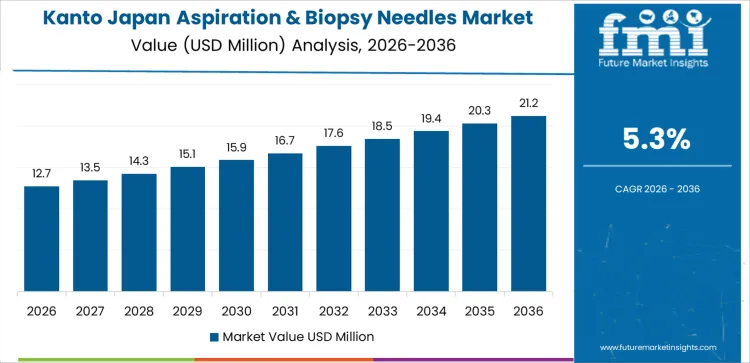
Kanto demand is shaped by concentration of academic medical centers, specialty hospitals, and advanced diagnostic infrastructure. Region’s CAGR of 5.3% reflects extensive use of aspiration and biopsy needles in oncology, interventional radiology, and research-driven diagnostics. Providers prioritize high-precision needles offering consistent tissue yield and compatibility with advanced imaging equipment. Teaching hospitals and research institutions influence adoption of specialized needle designs. Procurement emphasizes quality validation, regulatory compliance, and supplier reliability. Demand growth aligns with procedural complexity and research activity rather than expansion of patient volumes alone.
- Academic and specialty hospital diagnostic usage
- Advanced interventional and imaging-guided procedures
- Emphasis on precision and tissue yield consistency
- Strong regulatory and procurement standards
How is Kansai driving demand for Aspiration and Biopsy Needles in Japan?
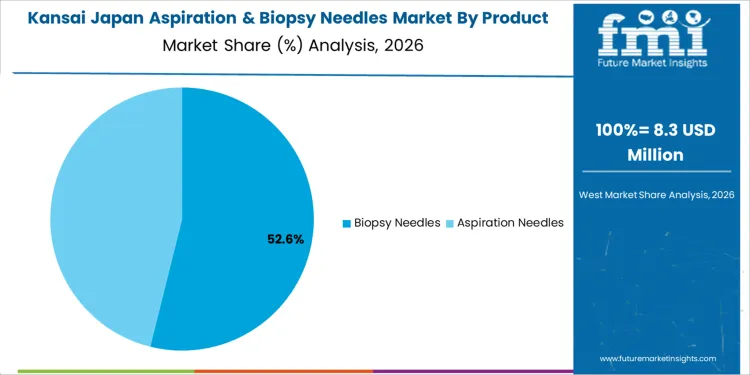
Kansai demand reflects balanced growth across hospitals, specialty clinics, and diagnostic centers. Region’s CAGR of 4.6% is supported by increasing use of biopsy needles in breast, prostate, and gastrointestinal diagnostics. Providers focus on standardized procedures to improve workflow efficiency and training consistency. Demand favors versatile needle platforms suitable for multiple applications. Procurement decisions emphasize cost control, supply continuity, and compatibility with existing procedural protocols. Growth remains steady, aligned with routine diagnostic needs and gradual expansion of specialty services.
- Specialty clinic and hospital diagnostic activity
- Standardized biopsy procedure adoption
- Cost-efficient and versatile needle selection
- Steady growth tied to routine diagnostics
How is Chubu driving demand for Aspiration and Biopsy Needles in Japan?
Chubu demand is anchored in regional hospitals and manufacturing-linked healthcare infrastructure. Region’s CAGR of 4.1% reflects use of aspiration and biopsy needles in general diagnostics, oncology screening, and occupational health programs. Providers prioritize reliability, ease of use, and compatibility with standard imaging modalities. Demand remains linked to procedural replacement cycles and incremental increases in diagnostic testing. Procurement favors proven needle designs and long-term supplier relationships. Growth stays moderate due to stable healthcare capacity and mature service coverage.
- Regional hospital diagnostic procedures
- Oncology screening and occupational health usage
- Preference for reliable and proven needle designs
- Replacement-driven procurement patterns
How is Tohoku driving demand for Aspiration and Biopsy Needles in Japan?
Tohoku demand is influenced by regional healthcare access initiatives and aging population needs. Region’s CAGR of 3.6% reflects steady use of aspiration and biopsy needles in community hospitals and regional diagnostic centers. Providers focus on early disease detection and minimally invasive diagnostics to manage healthcare resources efficiently. Demand favors easy-to-handle, standardized needles suitable for varied clinical settings. Growth remains cautious and necessity-driven, supported by public healthcare programs rather than expansion of specialty services.
- Community hospital and regional diagnostic usage
- Aging population-driven diagnostic demand
- Focus on minimally invasive procedures
- Public healthcare program support
How is Rest of Japan driving demand for Aspiration and Biopsy Needles in Japan?
Rest of Japan shows stable demand driven by routine diagnostic procedures and replacement purchasing. Region’s CAGR of 3.4% reflects use of aspiration and biopsy needles in local hospitals, clinics, and outpatient centers. Buyers prioritize affordability, consistent performance, and supply reliability. Demand remains maintenance-oriented, aligned with continuation of existing diagnostic practices rather than rapid procedural expansion. Growth stays predictable and steady.
- Routine diagnostic and outpatient usage
- Replacement-driven procurement behavior
- Cost-sensitive purchasing priorities
- Stable demand without expansion drivers
What is the competitive landscape of demand for aspiration and biopsy needles in Japan?
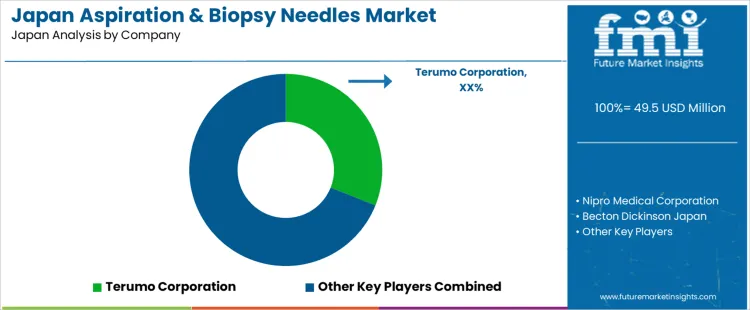
Demand for aspiration and biopsy needles in Japan is driven by growth in diagnostic imaging, oncology screening, and minimally invasive procedures conducted in hospitals and specialized clinics. Usage spans fine needle aspiration, core biopsy, and bone marrow sampling under ultrasound, CT, and MRI guidance. Buyers evaluate sharpness, gauge precision, tissue yield consistency, echogenic visibility, and compatibility with image-guided systems common in Japanese clinical practice. Procurement teams prioritize suppliers with FDA and PMDA regulatory compliance, reliable domestic distribution, and clinical training support for interventional teams. Trend in the Japan market reflects increasing routine screening protocols, early disease detection emphasis, and integration of biopsy devices into outpatient diagnostic workflows.
Terumo Corporation holds a leading position through extensive domestic manufacturing and broad adoption of aspiration and biopsy needles used in general and specialized procedures across Japan’s healthcare facilities. Nipro Medical Corporation participates with clinically validated needle systems supplied locally through established distribution channels. Becton Dickinson Japan operates with a range of aspiration and biopsy products integrated into interventional practice standards and supported by clinical education programs. Cook Japan, part of Cook Medical Group, supplies biopsy needles favored in interventional radiology and oncology units requiring precision sampling. Merit Medical Systems Japan maintains visibility with procedural needle offerings and accessories supporting hospital-based diagnostic workflows. Competitive positioning in Japan reflects regulatory compliance, clinician familiarity, distributor reach, and alignment with local practice patterns emphasizing safety and diagnostic accuracy.
Key Players in Japan Aspiration & Biopsy Needles Demand
- Terumo Corporation
- Nipro Medical Corporation
- Becton Dickinson Japan
- Cook Japan
- Merit Medical Systems Japan
Scope of the Report
| Items | Values |
|---|---|
| Quantitative Units | USD million |
| Product Type | Biopsy Needles; Aspiration Needles |
| Application | Tumour/Cancer Applications; Wound Applications; Other Applications |
| Regions Covered | Kyushu & Okinawa; Kanto; Kansai; Chubu; Tohoku; Rest of Japan |
| Key Companies Profiled | Terumo Corporation; Nipro Medical Corporation; Becton Dickinson Japan; Cook Japan; Merit Medical Systems Japan |
| Additional Attributes | Dollar sales by product type and application; regional CAGR trends led by Kanto and Kansai due to higher oncology procedure volumes; steady adoption in diagnostic and interventional radiology; preference for minimally invasive biopsy tools; procurement driven by hospitals and cancer care centers across Japan. |
Japan Aspiration & Biopsy Needles Demand by Segments
Product Type:
- Biopsy Needles
- Aspiration Needles
Application:
- Tumour/Cancer Applications
- Wound Applications
- Other Applications
Region:
- Kyushu & Okinawa
- Kanto
- Kansai
- Chubu
- Tohoku
- Rest of Japan
Frequently Asked Questions
How big is the demand for aspiration & biopsy needles in Japan in 2026?
The demand for aspiration & biopsy needles in Japan is estimated to be valued at USD 49.5 million in 2026.
What will be the size of aspiration & biopsy needles in Japan in 2036?
The market size for the aspiration & biopsy needles in Japan is projected to reach USD 77.7 million by 2036.
How much will be the demand for aspiration & biopsy needles in Japan growth between 2026 and 2036?
The demand for aspiration & biopsy needles in Japan is expected to grow at a 4.6% CAGR between 2026 and 2036.
What are the key product types in the aspiration & biopsy needles in Japan?
The key product types in aspiration & biopsy needles in Japan are biopsy needles and aspiration needles.
Which application segment is expected to contribute significant share in the aspiration & biopsy needles in Japan in 2026?
In terms of application, tumour/cancer applications segment is expected to command 36.0% share in the aspiration & biopsy needles in Japan in 2026.
Preview the report firsthand - request a free sample
Get SampleGet the brochure for pricing and purchase details.
Get PDFTable of Content
- Executive Summary
- Japan Market Outlook
- Demand-side Trends
- Supply-side Trends
- Technology Roadmap Analysis
- Analysis and Recommendations
- Market Overview
- Market Coverage / Taxonomy
- Market Definition / Scope / Limitations
- Market Background
- Market Dynamics
- Drivers
- Restraints
- Opportunity
- Trends
- Scenario Forecast
- Demand in Optimistic Scenario
- Demand in Likely Scenario
- Demand in Conservative Scenario
- Opportunity Map Analysis
- Product Life Cycle Analysis
- Supply Chain Analysis
- Investment Feasibility Matrix
- Value Chain Analysis
- PESTLE and Porter’s Analysis
- Regulatory Landscape
- Regional Parent Market Outlook
- Production and Consumption Statistics
- Import and Export Statistics
- Market Dynamics
- Japan Market Analysis 2021 to 2025 and Forecast, 2026 to 2036
- Historical Market Size Value (USD Million) Analysis, 2021 to 2025
- Current and Future Market Size Value (USD Million) Projections, 2026 to 2036
- Y-o-Y Growth Trend Analysis
- Absolute $ Opportunity Analysis
- Japan Market Pricing Analysis 2021 to 2025 and Forecast 2026 to 2036
- Japan Market Analysis 2021 to 2025 and Forecast 2026 to 2036, By Product Type
- Introduction / Key Findings
- Historical Market Size Value (USD Million) Analysis By Product Type , 2021 to 2025
- Current and Future Market Size Value (USD Million) Analysis and Forecast By Product Type , 2026 to 2036
- Biopsy Needles
- Aspiration Needles
- Biopsy Needles
- Y-o-Y Growth Trend Analysis By Product Type , 2021 to 2025
- Absolute $ Opportunity Analysis By Product Type , 2026 to 2036
- Japan Market Analysis 2021 to 2025 and Forecast 2026 to 2036, By Application
- Introduction / Key Findings
- Historical Market Size Value (USD Million) Analysis By Application, 2021 to 2025
- Current and Future Market Size Value (USD Million) Analysis and Forecast By Application, 2026 to 2036
- Tumour/Cancer Applications
- Wound Applications
- Other Applications
- Tumour/Cancer Applications
- Y-o-Y Growth Trend Analysis By Application, 2021 to 2025
- Absolute $ Opportunity Analysis By Application, 2026 to 2036
- Market Structure Analysis
- Competition Dashboard
- Competition Benchmarking
- Market Share Analysis of Top Players
- By Regional
- By Product Type
- By Application
- Competition Analysis
- Competition Deep Dive
- Terumo Corporation
- Overview
- Product Portfolio
- Profitability by Market Segments (Product/Age /Sales Channel/Region)
- Sales Footprint
- Strategy Overview
- Marketing Strategy
- Product Strategy
- Channel Strategy
- Nipro Medical Corporation
- Becton Dickinson Japan
- Cook Japan
- Merit Medical Systems Japan
- Terumo Corporation
- Competition Deep Dive
- Assumptions & Acronyms Used
- Research Methodology


