

- Industry Size (2025)
- USD 733.3 Mn
- Forecast (2035)
- USD 1300.3 Mn
- CAGR (2025 to 2035)
- 5.9%
Demand for Barrier Tube Packaging in Japan Forecast and Outlook 2025 to 2035
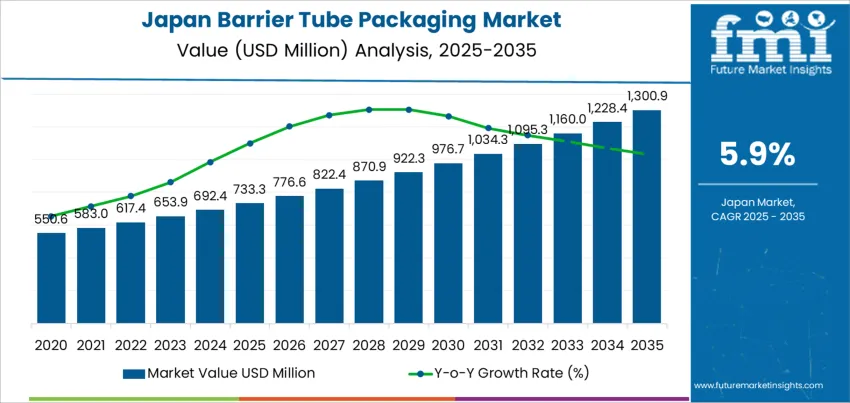
The demand for barrier tube packaging in Japan stands at USD 733.3 million in 2025 and is projected to reach USD 1,300.3 million by 2035, growing at a compound annual growth rate of 5.9%. This trajectory stems from Japan's evolving pharmaceutical distribution networks, cosmetics sector consolidation, and food preservation requirements. Manufacturing facilities across Kanto, Kinki, and Chubu regions integrate advanced barrier technologies into production lines that protect sensitive formulations from moisture, oxygen, and UV degradation. Consumer brands prioritize tube packaging solutions that extend product shelf-life while maintaining ingredient stability. These operational shifts reinforce expansion throughout the projection period.
The progression displays steady advancement from earlier baseline values of USD 623.4 million in 2020, climbing through USD 644.0 million in 2021 and USD 665.2 million in 2022 before reaching the current USD 733.3 million in 2025. Forward momentum continues with USD 757.5 million anticipated for 2026, USD 782.5 million for 2027, progressing through USD 891.0 million in 2030 and USD 1,014.6 million in 2033. This ascending pattern reflects consistent procurement cycles, enhanced barrier material specifications, and expanded application across Japan's precision manufacturing sectors. The curve demonstrates reliable growth underpinned by regulatory compliance requirements and quality assurance protocols embedded within Japanese industrial practices.
Quick Stats of the Demand for Barrier Tube Packaging in Japan
- Demand for Barrier Tube Packaging in Japan Value (2025): USD 733.3 million
- Demand for Barrier Tube Packaging in Japan Forecast Value (2035): USD 1,300.3 million
- Demand for Barrier Tube Packaging in Japan Forecast CAGR (2025 to 2035): 5.9%
- Demand for Barrier Tube Packaging in Japan Leading Packaging Format: Flexible Packaging (68%)
- Demand for Barrier Tube Packaging in Japan Key Growth Regions: Kyushu & Okinawa, Kanto, Kinki, Chubu
- Demand for Barrier Tube Packaging in Japan Top Players: Toppan Printing Co., Ltd., Dai Nipron Printing Co., Ltd., Kuraray Co., Ltd., Mitsubishi Chemical Group Corporation, Amcor Japan Ltd.
What is the Growth Forecast for Demand for Barrier Tube Packaging in Japan through 2035?
Demand in Japan for barrier tube packaging is projected to increase from USD 733.3 million in 2025 to USD 1,300.3 million by 2035, reflecting a compound annual growth rate (CAGR) of approximately 5.9%. Beginning at USD 623.4 million in 2020, values advance through USD 687.2 million in 2023, USD 709.9 million in 2024, reaching USD 733.3 million in 2025. Between 2025 and 2030, demand climbs toward USD 891.0 million, culminating at USD 1,300.3 million by 2035. Growth originates from Japan's pharmaceutical sector modernization, premium cosmetics packaging innovations, specialty food preservation technologies, and advanced barrier material adoption across domestic manufacturing networks.
Throughout the forecast horizon, the value increase from USD 733.3 million to USD 1,300.3 million generates an incremental opportunity of USD 567.0 million. Initial expansion (2025–2030) relies primarily on volume increases as manufacturers adopt ethylene vinyl alcohol (EVOH) barrier layers, aluminum oxide coatings, and multilayer structures. Later periods (2030–2035) emphasize value enhancement through sophisticated barrier technologies, smart packaging integration, recyclable barrier solutions, and premium tube formats that command higher pricing. Suppliers advancing nanotechnology barriers, bio-based materials, and precision coating applications position themselves to capture expanding demand across Japan's quality-focused industries.
Barrier Tube Packaging Industry in Japan Key Takeaways
| Metric | Value |
|---|---|
| Industry Value (2025) | USD 733.3 million |
| Forecast Value (2035) | USD 1,300.3 million |
| Forecast CAGR (2025 to 2035) | 5.9% |
What Is Driving the Demand for Barrier Tube Packaging in Japan?
The demand for barrier tube packaging in Japan has evolved through Japan's pharmaceutical industry transformation, where prescription drug manufacturing shifted toward moisture-sensitive formulations requiring enhanced protective packaging. Japanese pharmaceutical companies focused on developing oncology treatments, biologics, and precision medicines that demanded oxygen-resistant tubes to maintain active ingredient potency. Export-oriented production facilitated consistent tube procurement as Japanese pharmaceutical manufacturers supplied global healthcare networks. Consumer health awareness regarding product integrity strengthened acceptance of premium barrier packaging across over-the-counter medications and supplements. These fundamental conditions established predictable, long-term demand patterns aligned with Japan's pharmaceutical excellence and regulatory compliance standards.
Future expansion reflects Japan's transition toward recyclable packaging mandates, advanced barrier material innovations, and integration of smart packaging technologies within tube formats. Pharmaceutical manufacturers increasingly specify recyclable barrier tubes that maintain protection performance while meeting environmental objectives. Cosmetics brands demand premium tube packaging with enhanced barrier properties for anti-aging formulations, sunscreen products, and sensitive skincare ingredients. Emerging applications include nutraceutical packaging, specialty adhesives, and industrial chemical formulations requiring precise moisture and oxygen control. Japan's aging population creates sustained demand for pharmaceutical packaging that preserves medication efficacy throughout extended storage periods, reinforcing barrier tube adoption across healthcare supply chains.
What Factors Are Affecting the Demand for Barrier Tube Packaging in Japan in Terms of Packaging Format and Barrier Material?
The demand for barrier tube packaging in Japan varies according to packaging formats that determine container configuration and barrier materials that provide protection performance. Packaging formats encompass flexible packaging and rigid packaging options, each offering distinct advantages for specific applications and production requirements. Barrier materials include ethylene vinyl alcohol (EVOH), polyamide layers, polyvinylidene chloride (PVDC), aluminum oxide coatings, and silicon oxide films that deliver targeted protection against moisture, oxygen, and light exposure. As Japanese manufacturers prioritize ingredient stability and extended shelf-life across pharmaceutical, cosmetics, and specialty chemical applications, the combination of format flexibility and barrier effectiveness influences procurement decisions throughout Japan's precision manufacturing sectors.
What Drives the Leading Demand for Flexible Packaging Barrier Tubes in Japan?
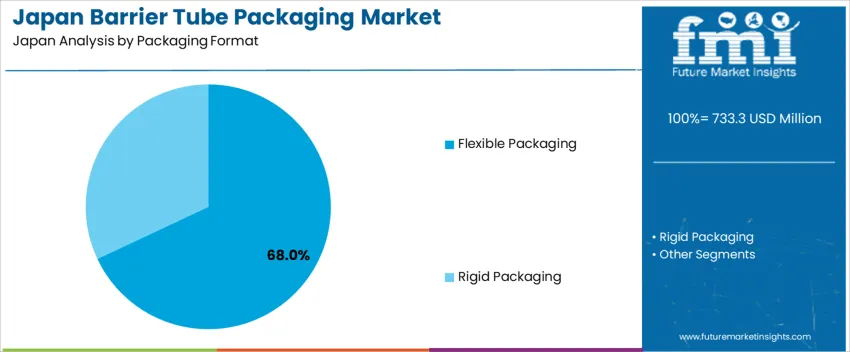
Flexible packaging accounts for 68% of total demand across packaging format categories in Japan. This dominant position reflects the format's compatibility with Japanese manufacturing efficiency principles, cost optimization strategies, and versatile application capabilities. Japanese pharmaceutical companies value flexible barrier tubes for insulin packaging, ophthalmic solutions, and topical medications that require precise dispensing control. Cosmetics manufacturers rely on flexible formats for premium skincare serums, foundation formulations, and sunscreen products where barrier protection prevents ingredient degradation. The format supports automated filling operations, reduces material waste, and enables compact storage throughout Japan's space-constrained manufacturing facilities.
Demand for flexible barrier packaging expands as Japanese companies pursue lightweight packaging solutions that reduce transportation costs and environmental impact. The format facilitates rapid prototyping for new product launches, enabling faster time-to-venture entry across competitive consumer goods segments. Japanese quality control protocols favor flexible tubes that integrate tamper-evident features, precise volume control, and consistent barrier performance. Manufacturers appreciate reduced tooling costs compared to rigid alternatives, supporting economic production runs for specialized formulations. As environmental initiatives prioritize material reduction and recyclability, flexible barrier packaging maintains adoption across Japan's environmentally conscious manufacturing base.
What Drives the Leading Demand for Ethylene Vinyl Alcohol (EVOH) Barrier Material in Japan?
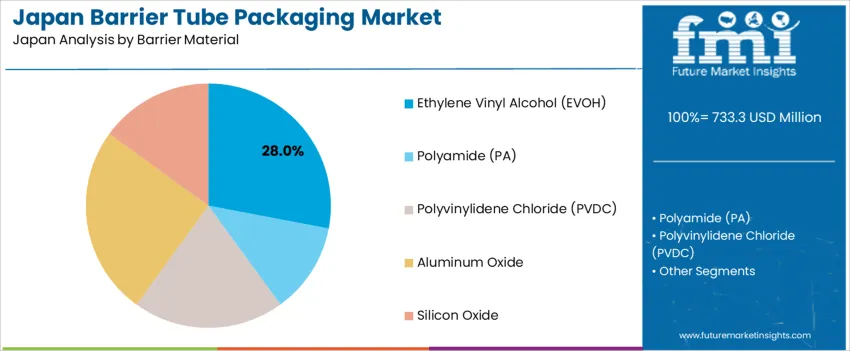
Ethylene vinyl alcohol (EVOH) accounts for 28% of total demand across barrier material categories in Japan. Its leading share stems from superior oxygen barrier properties, excellent chemical resistance, and proven compatibility with Japanese pharmaceutical manufacturing standards. Japanese pharmaceutical companies specify EVOH barriers for oxygen-sensitive medications, including cardiovascular drugs, respiratory treatments, and injectable formulations that require stringent protection protocols. The material's transparency enables visual inspection of tube contents while maintaining barrier integrity, supporting Japan's quality assurance practices. EVOH processing compatibility with existing Japanese extrusion equipment facilitates seamless integration into established production workflows.
Demand for EVOH barrier materials grows as Japanese manufacturers address increasingly sophisticated protection requirements across specialty applications. The material delivers consistent performance across temperature variations encountered during Japanese seasonal climate changes, ensuring reliable protection throughout annual storage cycles. Pharmaceutical companies value EVOH's regulatory approval status for direct contact with medications, eliminating compatibility concerns during formulation development. Cosmetics manufacturers appreciate the material's clarity for premium product presentation while maintaining protection against oxidation-sensitive ingredients. As Japanese industries pursue advanced barrier technologies, EVOH provides proven performance that meets stringent protection standards across diverse application requirements.
What Is Shaping the Current Demand for Barrier Tube Packaging in Japan?
Demand for barrier tube packaging in Japan responds to pharmaceutical industry consolidation, stringent medication stability requirements, and consumer preferences for premium packaging that ensures product integrity. Japan's pharmaceutical sector emphasizes precision manufacturing where barrier tube specifications directly impact medication efficacy and shelf-life performance. Healthcare providers require packaging solutions that maintain drug potency throughout distribution networks extending from urban hospitals to remote clinical facilities. Regulatory frameworks mandate barrier testing protocols and stability validation, positioning advanced tube packaging as essential infrastructure rather than optional enhancement. These dynamics create sustained demand patterns anchored in quality assurance and patient safety priorities.
How Are Japan's Manufacturing Excellence Standards and Healthcare Infrastructure Encouraging New Applications?
Barrier tube packaging gains adoption because Japan's manufacturing philosophy prioritizes defect prevention, process consistency, and long-term reliability over cost minimization. Pharmaceutical manufacturers integrate barrier tube testing into comprehensive quality management systems that validate protection performance across extended storage periods. Japanese cosmetics companies leverage barrier packaging to differentiate premium product lines, where packaging quality directly communicates brand positioning and ingredient protection capabilities. Industrial chemical manufacturers require precise barrier control for specialty adhesives, electronic materials, and precision fluids used in semiconductor fabrication. These applications reflect Japan's focus on technical excellence and systematic quality validation across manufacturing operations.
Where Are Strategic Growth Opportunities for Barrier Tube Packaging in Japan?
Opportunities emerge within pharmaceutical contract manufacturing, premium cosmetics export production, specialty chemical packaging, and advanced barrier material development. Japan's position as a regional pharmaceutical manufacturing hub creates demand for barrier packaging that meets international regulatory standards across diverse geographic destinations. Cosmetics manufacturers targeting premium Asian consumer segments require barrier tube packaging that maintains product integrity throughout complex distribution networks. Emerging applications include electronic material packaging, where moisture and oxygen control protect sensitive compounds used in display manufacturing and semiconductor processing. Manufacturers offering barrier solutions that combine protection performance with recyclability align with Japan's circular economy initiatives and corporate environmental commitments.
What Operational Factors Are Constraining Wider Adoption of Advanced Barrier Tube Packaging in Japan?
Constraints originate from conservative procurement practices, extensive validation requirements, and established relationships with proven barrier material suppliers. Japanese manufacturers prioritize supplier stability and long-term partnership development over immediate cost advantages, creating preference for established barrier packaging providers with demonstrated reliability. Technical validation processes require comprehensive testing protocols that extend product development timelines, particularly for pharmaceutical applications requiring regulatory approval. Integration challenges with existing filling equipment and quality control systems delay adoption of advanced barrier technologies. Additionally, cost pressures from generic pharmaceutical competition and consumer price sensitivity limit acceptance of premium barrier packaging solutions across price-competitive product segments.
What is the Demand for Barrier Tube Packaging in Japan by Region?
| Region | CAGR (%) |
|---|---|
| Kyushu & Okinawa | 4.1% |
| Kanto | 3.8% |
| Kinki | 3.3% |
| Chubu | 2.9% |
| Tohoku | 2.6% |
| Rest of Japan | 2.4% |
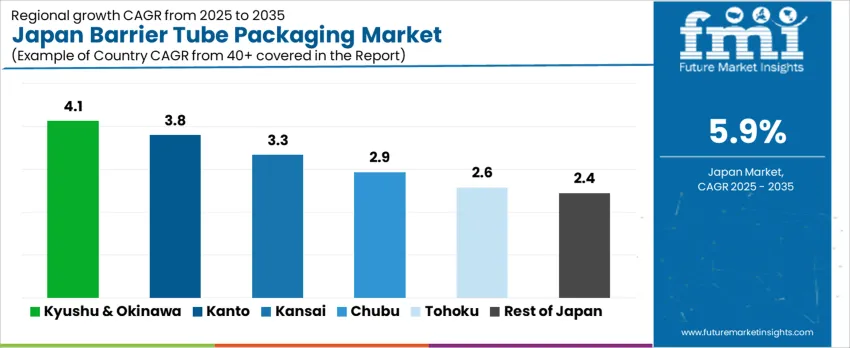
Demand for barrier tube packaging in Japan accelerates across regions, with Kyushu & Okinawa leading at 4.1%. Expansion in this region reflects concentrated pharmaceutical manufacturing operations, cosmetics production facilities, and specialty chemical companies requiring advanced barrier protection. Kanto follows at 3.8%, supported by dense pharmaceutical research networks, premium cosmetics brands, and chemical processing clusters demanding sophisticated packaging solutions. Kinki records 3.3%, driven by established manufacturing infrastructure and export-oriented production requiring international-standard barrier packaging.
Chubu advances at 2.9%, influenced by automotive chemical suppliers and industrial material manufacturers integrating barrier tube packaging into specialized applications. Tohoku achieves 2.6%, showing steady adoption across pharmaceutical and chemical manufacturing facilities. The rest of Japan posts 2.4%, reflecting broader industrial demand for barrier packaging across smaller manufacturing centers.
How Is Kyushu & Okinawa Driving Demand for Barrier Tube Packaging?
Kyushu & Okinawa is projected to advance at a CAGR of 4.1% through 2035 in demand for barrier tube packaging. Fukuoka and Kumamoto pharmaceutical manufacturing clusters increasingly specify advanced barrier tubes for generic drug production, biosimilar packaging, and contract manufacturing operations serving Asian pharmaceutical networks. Growing focus on pharmaceutical export quality, medication stability validation, and regulatory compliance drives adoption. Manufacturers provide multi-layer barrier tubes, oxygen-scavenging technologies, and moisture-resistant packaging suitable for tropical climate storage conditions. Distributors ensure availability across pharmaceutical manufacturing facilities, contract packaging operations, and specialty chemical production sites. Expansion in pharmaceutical manufacturing, cosmetics production, and chemical processing applications supports steady adoption of barrier tube packaging in Kyushu & Okinawa.
- Fukuoka pharmaceutical clusters specify barrier tubes for biosimilar packaging production.
- Medication stability and export quality requirements drive regional adoption patterns.
- Multi-layer barrier technologies and oxygen-scavenging systems suit tropical storage conditions.
- Distributors ensure access across pharmaceutical, cosmetics, and chemical manufacturing facilities.
How Is Kanto Supporting Demand for Barrier Tube Packaging?
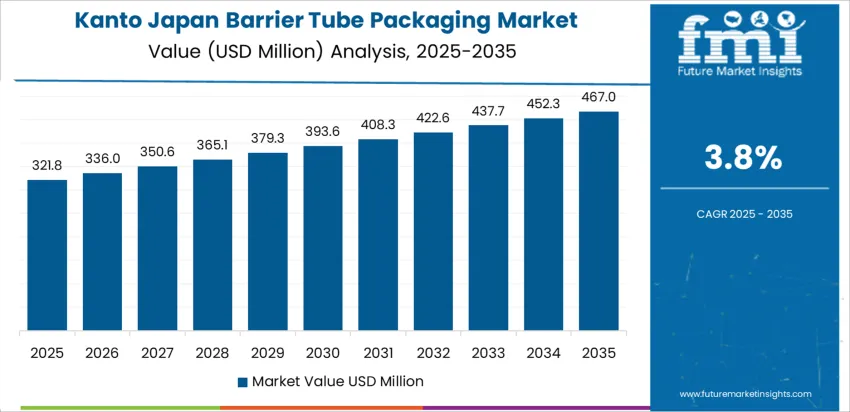
Kanto is projected to advance at a CAGR of 3.8% through 2035 in demand for barrier tube packaging. Tokyo and surrounding pharmaceutical research facilities increasingly adopt barrier packaging for clinical trial materials, specialty pharmaceuticals, and premium cosmetics targeting international distribution. Rising focus on pharmaceutical innovation, premium product packaging, and export quality standards drives adoption. Manufacturers provide high-performance barrier films, specialized coating technologies, and custom tube formats suitable for research applications and premium consumer products. Distributors ensure accessibility across pharmaceutical research facilities, cosmetics manufacturing sites, and specialty chemical companies. Growth in pharmaceutical research, premium cosmetics production, and specialty chemical applications supports steady adoption of barrier tube packaging across Kanto.
- Tokyo pharmaceutical research facilities adopt barrier packaging for clinical trial materials.
- Premium product packaging and international export standards drive regional growth.
- High-performance barrier films and custom tube formats support research applications.
- Distributors ensure access across pharmaceutical, cosmetics, and specialty chemical facilities.
How Is Kinki Contributing to Demand for Barrier Tube Packaging?
Kinki is projected to advance at a CAGR of 3.3% through 2035 in demand for barrier tube packaging. Osaka, Kyoto, and surrounding manufacturing regions increasingly integrate barrier tubes into pharmaceutical production, chemical processing, and cosmetics manufacturing serving domestic and export channels. Rising demand for pharmaceutical quality control, chemical product protection, and cosmetics packaging excellence drives adoption. Manufacturers provide ethylene vinyl alcohol barriers, aluminum oxide coatings, and precision tube forming technologies suitable for pharmaceutical and chemical applications. Distributors ensure accessibility across pharmaceutical manufacturing facilities, chemical processing plants, and cosmetics production sites. Growth in pharmaceutical manufacturing, chemical processing, and cosmetics production supports steady adoption of barrier tube packaging across Kinki.
- Osaka pharmaceutical manufacturers integrate barrier tubes into domestic and export production.
- Chemical product protection and pharmaceutical quality control drive regional adoption.
- EVOH barriers and aluminum oxide coatings support pharmaceutical and chemical applications.
- Distributors ensure access across pharmaceutical, chemical, and cosmetics manufacturing facilities.
How Is Chubu Contributing to Demand for Barrier Tube Packaging?
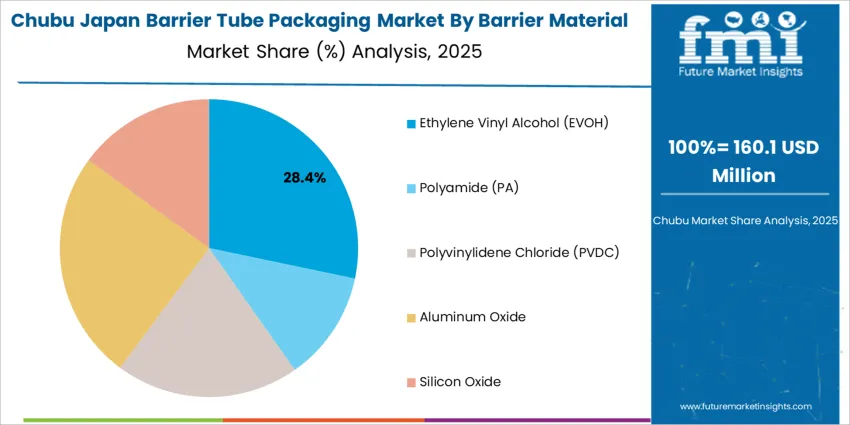
Chubu is projected to advance at a CAGR of 2.9% through 2035 in demand for barrier tube packaging. Nagoya and surrounding industrial regions increasingly adopt barrier packaging for automotive chemical products, electronic materials, and specialty adhesives requiring precise moisture and oxygen control. Rising focus on industrial material protection, automotive chemical quality, and electronic component manufacturing drives adoption. Manufacturers provide silica-based barriers, polymer coating technologies, and industrial-grade tube systems suitable for chemical processing and automotive applications. Distributors ensure availability across automotive chemical suppliers, electronic material manufacturers, and industrial adhesive producers. Expansion in automotive chemicals, electronic materials, and specialty adhesive applications supports steady adoption of barrier tube packaging across Chubu.
- Nagoya industrial regions adopt barrier packaging for automotive chemicals and electronic materials.
- Industrial material protection and automotive chemical quality drive regional growth.
- Silica-based barriers and polymer coatings support chemical processing applications.
- Distributors ensure availability across automotive, electronic, and adhesive manufacturing facilities.
How Is Tohoku Contributing to Demand for Barrier Tube Packaging?
Tohoku is projected to advance at a CAGR of 2.6% through 2035 in demand for barrier tube packaging. Sendai and surrounding manufacturing centers gradually adopt barrier tubes for pharmaceutical contract manufacturing, chemical processing, and specialized industrial applications requiring environmental protection. Rising focus on pharmaceutical outsourcing, chemical product stability, and industrial material preservation drives adoption. Manufacturers provide moisture barrier technologies, oxygen-resistant films, and temperature-stable tube systems suitable for pharmaceutical and chemical processing applications. Distributors ensure accessibility across pharmaceutical contract manufacturers, chemical processing facilities, and industrial material suppliers. Expansion in pharmaceutical outsourcing, chemical processing, and industrial applications supports steady adoption of barrier tube packaging across Tohoku.
- Sendai manufacturing centers adopt barrier tubes for pharmaceutical contract manufacturing.
- Chemical product stability and industrial material preservation drive regional adoption.
- Moisture barrier technologies and temperature-stable systems support processing applications.
- Distributors ensure access across pharmaceutical, chemical, and industrial manufacturing facilities.
How Is Rest of Japan Supporting Demand for Barrier Tube Packaging?
The Rest of Japan is projected to advance at a CAGR of 2.4% through 2035 in demand for barrier tube packaging. Smaller manufacturing centers and regional production facilities gradually adopt barrier packaging for local pharmaceutical production, chemical processing, and specialty manufacturing applications. Rising demand for pharmaceutical quality compliance, chemical product protection, and specialized packaging solutions drives adoption. Manufacturers provide standard barrier technologies, cost-effective tube systems, and reliable packaging solutions suitable for regional manufacturing operations. Distributors ensure accessibility across regional pharmaceutical companies, chemical processing facilities, and specialty manufacturers. Expansion in regional manufacturing, pharmaceutical compliance, and chemical processing supports steady adoption of barrier tube packaging across the Rest of Japan.
- Regional manufacturing centers adopt barrier packaging for pharmaceutical and chemical production.
- Pharmaceutical compliance and chemical product protection drive regional adoption patterns.
- Standard barrier technologies and cost-effective systems support regional operations.
- Distributors ensure access across regional pharmaceutical, chemical, and specialty manufacturing facilities.
What Is Driving the Demand for Barrier Tube Packaging in Japan and Who Are the Key Players Shaping the Industry?
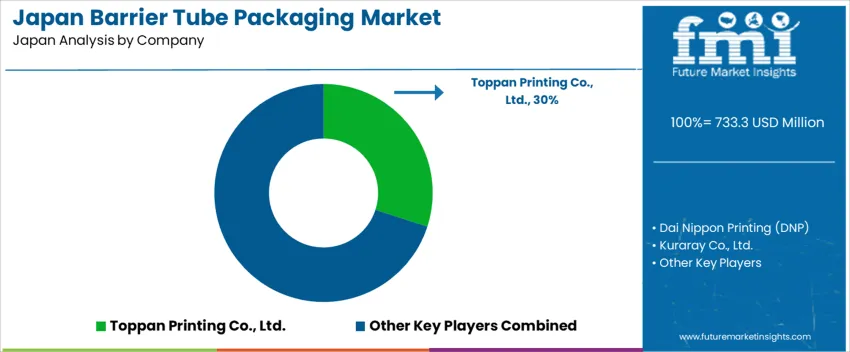
The demand for barrier tube packaging in Japan is driven by pharmaceutical industry modernization, stringent medication stability requirements, and expanding applications across cosmetics and specialty chemical sectors requiring advanced product protection. Healthcare manufacturers seek precise barrier solutions that maintain drug potency, extend shelf-life, and ensure patient safety throughout distribution networks. Premium cosmetics brands emphasize packaging excellence that preserves ingredient integrity while communicating quality positioning to consumers. Specialty chemical manufacturers require barrier packaging that protects sensitive formulations from environmental degradation. Technological advances including nanotechnology barriers, bio-based materials, and smart packaging integration enhance tube performance while supporting Japan's environmental objectives across pharmaceutical, cosmetics, and chemical manufacturing operations.
Key companies operating in Japan's barrier tube packaging sector include domestic leader Toppan Printing Co., Ltd., established manufacturer Dai Nippon Printing Co., Ltd., and material innovator Kuraray Co., Ltd. alongside chemical giant Mitsubishi Chemical Group Corporation and international supplier Amcor Japan Ltd. Toppan Printing offers advanced barrier coating technologies and precision tube manufacturing serving pharmaceutical and cosmetics applications across Japan. Dai Nippon Printing provides innovative packaging solutions combining barrier performance with material development. Kuraray contributes specialized EVOH barrier resins and advanced material technologies that enable superior protection performance. Mitsubishi Chemical Group supplies barrier films and coating technologies supporting diverse packaging applications. Amcor Japan delivers international expertise in barrier packaging design and manufacturing optimization. This combination of domestic innovation and international technology ensures Japan's barrier tube packaging advancement through local engineering excellence and global best practices.
Key Players in Barrier Tube Packaging Industry in Japan
- Toppan Printing Co., Ltd.
- Dai Nippon Printing Co., Ltd.
- Kuraray Co., Ltd.
- Mitsubishi Chemical Group Corporation
- Amcor Japan Ltd.
Report Scope for Barrier Tube Packaging Industry in Japan
| Items | Values |
|---|---|
| Quantitative Units (2025) | USD million |
| Packaging Format | Flexible Packaging, Rigid Packaging |
| Barrier Material | Ethylene Vinyl Alcohol, Polyamide, Polyvinylidene Chloride, Aluminum Oxide, Silicon Oxide |
| End Use | Cosmetics, Personal Care, Food, Pharmaceuticals, Beverages |
| Substrate | Plastic, Paper & Paperboard, Glass, Metal |
| Region | Kyushu & Okinawa, Kanto, Kinki, Chubu, Tohoku, Rest of Japan |
| Countries Covered | Japan |
| Key Companies Profiled | Toppan Printing Co., Ltd., Dai Nippon Printing Co., Ltd., Kuraray Co., Ltd., Mitsubishi Chemical Group Corporation, Amcor Japan Ltd. |
| Additional Attributes | Dollar sales by packaging format and barrier material, regional CAGR trends, and volume–value shares are assessed alongside pharma vs. cosmetics adoption, flexible vs. rigid penetration, barrier innovation, automation, validation and regulatory needs, modernization-driven growth, and domestic vs. international technology competition in Japan. |
Barrier Tube Packaging Industry in Japan Segmentation
Packaging Format:
- Flexible Packaging
- Rigid Packaging
Barrier Material:
- Ethylene Vinyl Alcohol
- Polyamide
- Polyvinylidene Chloride
- Aluminum Oxide
- Silicon Oxide
End Use:
- Cosmetics
- Personal Care
- Food
- Pharmaceuticals
- Beverages
Substrate:
- Plastic
- Paper & Paperboard
- Glass
- Metal
Region:
- Kyushu & Okinawa
- Kanto
- Kinki
- Chubu
- Tohoku
- Rest of Japan
Bibliography
- Ministry of Health, Labour and Welfare Japan. (2023). Utensils, containers, and packaging regulations for food contact materials and multilayer tube packaging. MHLW Food Safety Publications.
- Japan Packaging Institute. (2023). Tube packaging formats, barrier structures, and material performance for consumer and pharmaceutical applications. Japan Packaging Institute Technical Publications.
- Japan Industrial Standards Committee. (2023). JIS standards for packaging materials, barrier performance testing, and tube integrity evaluation. JIS Standards Publications.
- Japan Printing Ink Makers Association. (2023). Coatings, inks, and barrier layers used in tube packaging and flexible packaging substrates. JPIMA Technical Guidance Publications.
Frequently Asked Questions
How big is the demand for barrier tube packaging in Japan in 2025?
The demand for barrier tube packaging in Japan is estimated to be valued at USD 733.3 million in 2025.
What will be the size of barrier tube packaging in Japan in 2035?
The market size for the barrier tube packaging in Japan is projected to reach USD 1,300.9 million by 2035.
How much will be the demand for barrier tube packaging in Japan growth between 2025 and 2035?
The demand for barrier tube packaging in Japan is expected to grow at a 5.9% CAGR between 2025 and 2035.
What are the key product types in the barrier tube packaging in Japan?
The key product types in barrier tube packaging in Japan are flexible packaging and rigid packaging.
Which barrier material segment is expected to contribute significant share in the barrier tube packaging in Japan in 2025?
In terms of barrier material, ethylene vinyl alcohol (evoh) segment is expected to command 28.0% share in the barrier tube packaging in Japan in 2025.
Preview the report firsthand - request a free sample
Get SampleGet the brochure for pricing and purchase details.
Get PDFTable of Content
- Executive Summary
- Japan Market Outlook
- Demand-side Trends
- Supply-side Trends
- Technology Roadmap Analysis
- Analysis and Recommendations
- Market Overview
- Market Coverage / Taxonomy
- Market Definition / Scope / Limitations
- Market Background
- Market Dynamics
- Drivers
- Restraints
- Opportunity
- Trends
- Scenario Forecast
- Demand in Optimistic Scenario
- Demand in Likely Scenario
- Demand in Conservative Scenario
- Opportunity Map Analysis
- Product Life Cycle Analysis
- Supply Chain Analysis
- Investment Feasibility Matrix
- Value Chain Analysis
- PESTLE and Porter’s Analysis
- Regulatory Landscape
- Regional Parent Market Outlook
- Production and Consumption Statistics
- Import and Export Statistics
- Market Dynamics
- Japan Market Analysis 2020 to 2024 and Forecast, 2025 to 2035
- Historical Market Size Value (USD Million) Analysis, 2020 to 2024
- Current and Future Market Size Value (USD Million) Projections, 2025 to 2035
- Y-o-Y Growth Trend Analysis
- Absolute $ Opportunity Analysis
- Japan Market Pricing Analysis 2020 to 2024 and Forecast 2025 to 2035
- Japan Market Analysis 2020 to 2024 and Forecast 2025 to 2035, By Packaging Format
- Introduction / Key Findings
- Historical Market Size Value (USD Million) Analysis By Packaging Format , 2020 to 2024
- Current and Future Market Size Value (USD Million) Analysis and Forecast By Packaging Format , 2025 to 2035
- Flexible Packaging
- Rigid Packaging
- Y-o-Y Growth Trend Analysis By Packaging Format , 2020 to 2024
- Absolute $ Opportunity Analysis By Packaging Format , 2025 to 2035
- Japan Market Analysis 2020 to 2024 and Forecast 2025 to 2035, By Barrier Material
- Introduction / Key Findings
- Historical Market Size Value (USD Million) Analysis By Barrier Material, 2020 to 2024
- Current and Future Market Size Value (USD Million) Analysis and Forecast By Barrier Material, 2025 to 2035
- Ethylene Vinyl Alcohol (EVOH)
- Polyamide (PA)
- Polyvinylidene Chloride (PVDC)
- Aluminum Oxide
- Silicon Oxide
- Y-o-Y Growth Trend Analysis By Barrier Material, 2020 to 2024
- Absolute $ Opportunity Analysis By Barrier Material, 2025 to 2035
- Japan Market Analysis 2020 to 2024 and Forecast 2025 to 2035, By Substrate
- Introduction / Key Findings
- Historical Market Size Value (USD Million) Analysis By Substrate, 2020 to 2024
- Current and Future Market Size Value (USD Million) Analysis and Forecast By Substrate, 2025 to 2035
- Plastic
- Paper & Paperboard
- Glass
- Metal
- Y-o-Y Growth Trend Analysis By Substrate, 2020 to 2024
- Absolute $ Opportunity Analysis By Substrate, 2025 to 2035
- Japan Market Analysis 2020 to 2024 and Forecast 2025 to 2035, By End Use
- Introduction / Key Findings
- Historical Market Size Value (USD Million) Analysis By End Use, 2020 to 2024
- Current and Future Market Size Value (USD Million) Analysis and Forecast By End Use, 2025 to 2035
- Cosmetics
- Personal Care
- Food
- Pharmaceutical
- Beverages
- Y-o-Y Growth Trend Analysis By End Use, 2020 to 2024
- Absolute $ Opportunity Analysis By End Use, 2025 to 2035
- Market Structure Analysis
- Competition Dashboard
- Competition Benchmarking
- Market Share Analysis of Top Players
- By Regional
- By Packaging Format
- By Barrier Material
- By Substrate
- By End Use
- Competition Analysis
- Competition Deep Dive
- Toppan Printing Co., Ltd.
- Overview
- Product Portfolio
- Profitability by Market Segments (Product/Age /Sales Channel/Region)
- Sales Footprint
- Strategy Overview
- Marketing Strategy
- Product Strategy
- Channel Strategy
- Dai Nippon Printing (DNP)
- Kuraray Co., Ltd.
- Mitsubishi Chemical Group
- Amcor Japan Ltd.
- Toppan Printing Co., Ltd.
- Competition Deep Dive
- Assumptions & Acronyms Used
- Research Methodology


