

- Industry Size (2025)
- USD 1.6 Bn
- Forecast (2035)
- USD 2.4 Bn
- CAGR (2025 to 2035)
- 4.2%
Demand for Coronary Stents in Japan Forecast and Outlook 2025 to 2035
Demand for coronary stents in Japan is forecasted to grow from USD 1.6 billion in 2025 to USD 2.4 billion by 2035, reflecting a CAGR of 4.2%. In the first 5 years (2025-2030), demand shows a steady increase. Starting at USD 1.6 billion in 2025, demand reaches USD 1.7 billion in 2026, growing by 6.3%. Groowth is followed by a 5.3% growth in 2027, with demand reaching USD 1.8 billion. By 2029, demand is expected to stabilize at USD 1.8 billion, showing moderate but consistent growth through the end of this block. Growth trend is driven by improvements in stent technologies that offer enhanced performance and safety.
Quick Stats of the Demand for Coronary Stents in Japan
- Demand for Coronary Stents in Japan Value (2025): USD 1.6 billion
- Demand for Coronary Stents in Japan Forecast Value (2035): USD 2.4 billion
- Demand for Coronary Stents in Japan Forecast CAGR (2025-2035): 4.2%
- Demand for Coronary Stents in Japan Leading Product Type: Drug Eluting Stent (DES)
- Demand for Coronary Stents in Japan Key Growth Regions: Kyushu & Okinawa, Kanto, Kansai, Chubu, Tohoku, Rest of Japan
- Demand for Coronary Stents in Japan Top Players: Boston Scientific Corporation, TERUMO CORPORATION, Medtronic, Vascular Concepts, B. Braun Melsungen AG
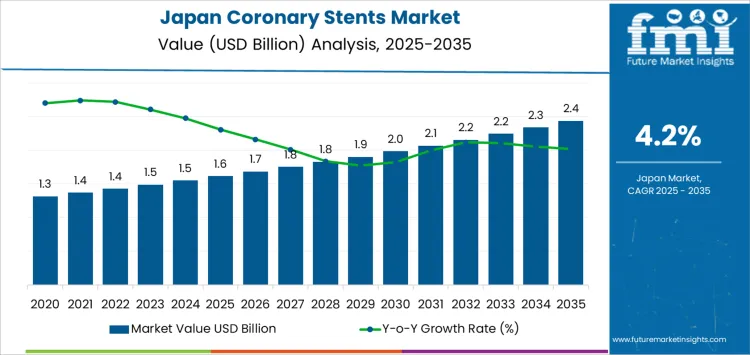
From 2030 to 2035, Demand for coronary stents in Japan is expected to accelerate further, reaching USD 2.4 billion by 2035. In 2030, the demand stands at USD 1.9 billion, and it grows steadily by 5.3% to USD 2.0 billion in 2031. In the latter half of the 5-year block, from 2032 to 2035, demand continues to rise at approximately 5.0% per year, reaching USD 2.4 billion. Factors contributing to this growth include ongoing advancements in stent technology, such as bioresorbable and drug-eluting stents, which provide better clinical outcomes. Growing acceptance of these innovations by healthcare professionals and increased investment in healthcare infrastructure are expected to drive sustained demand throughout this period.
Demand for Coronary Stents in Japan Key Takeaways
| Metric | Value |
|---|---|
| Industry Value (2025) | USD 1.6 billion |
| Industry Forecast Value (2035) | USD 2.4 billion |
| Forecast CAGR (2025-2035) | 4.2% |
Why is the Demand for Coronary Stents in Japan Growing?
Demand for coronary stents in Japan is growing as the incidence of cardiovascular diseases, particularly coronary artery disease (CAD), rises. Coronary stents are crucial in treating CAD by helping to restore blood flow to the heart. With Japan’s aging population and increasing prevalence of lifestyle-related health conditions, such as hypertension, diabetes, and obesity, there is a greater need for effective treatments to manage heart health. Stents, which prevent arteries from narrowing again after a balloon angioplasty, are critical in enhancing patient outcomes, driving the demand for these devices in the country.
Technological advancements in stent design, including the development of drug-eluting stents (DES), are contributing to industry growth. These stents are coated with medication that helps prevent the re-narrowing of blood vessels, providing long-term benefits for patients. The increasing availability of minimally invasive procedures, such as percutaneous coronary interventions (PCI), has made stent implantation more accessible to a broader patient population. As healthcare providers in Japan continue to focus on reducing the risks of heart disease, coronary stents remain a vital part of cardiovascular treatment strategies.
Challenges such as the high cost of advanced stent technology and the need for trained medical professionals to perform the procedures may limit adoption, particularly in smaller healthcare facilities. Growing prevalence of heart disease, coupled with ongoing advancements in stent technology and surgical techniques, is expected to drive sustained demand for coronary stents in Japan.
What is the Segment-Wise Analysis of Demand for Coronary Stents in Japan?
Demand for coronary stents in Japan is segmented by product type, end-user, raw material, and region. By product type, bare metal stents (BMS) lead at 34%, followed by drug-eluting stents (DES) and bioresorbable vascular stents (BVS). In terms of end-users, cardiac catheterization laboratories dominate with 36.5%, with ambulatory surgical centers and hospitals also contributing to the demand. The raw materials used in coronary stents include cobalt-chromium, stainless steel, platinum-chromium, nickel-titanium, and polymer. Regionally, demand spans across Kyushu & Okinawa, Kanto, Kansai, Chubu, Tohoku, and the rest of Japan, with varying levels of usage based on regional healthcare infrastructure and procedural preferences.
How Does Bare Metal Stent (BMS) Lead the Demand for Coronary Stents in Japan?
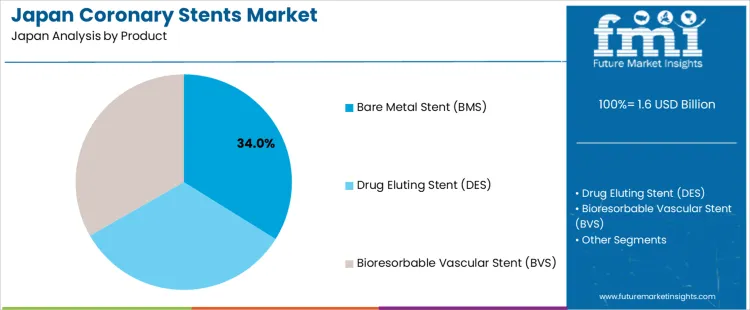
Bare metal stents (BMS) account for 34% of the demand for coronary stents in Japan, driven by their affordability and reliable performance. These stents are typically used in patients with less complex coronary artery disease or when drug-eluting stents (DES) are not required. BMS are particularly preferred in high-volume regions like Kanto and Kansai due to their cost-effectiveness and simplicity. The demand for BMS remains strong in Japan’s healthcare system, which emphasizes providing accessible yet effective treatment options. Although DES and bioresorbable vascular stents (BVS) are gaining traction, BMS continue to be a popular choice due to their proven ability to reduce restenosis in uncomplicated cases. Their straightforward design and ease of use contribute to their continued dominance, especially in less complex procedures. As a result, BMS remains a key product in coronary interventions across Japan.
Why Do Cardiac Catheterization Laboratories Lead the Demand for Coronary Stents in Japan?
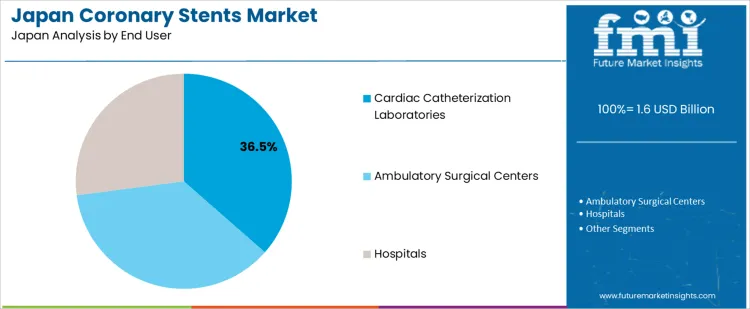
Cardiac catheterization laboratories account for 36.5% of the demand for coronary stents in Japan, reflecting their role in performing coronary interventions. These labs are crucial for treating patients with narrowed or blocked arteries through percutaneous coronary interventions (PCI). The demand for stents in catheterization laboratories is driven by the high volume of both elective and emergency procedures. These labs utilize a range of stents, including BMS, DES, and BVS, tailored to the patient's specific needs. As cardiovascular disease rates rise, the need for advanced interventions grows, driving higher demand for stents. The growth trend is most pronounced in urban regions such as Kanto and Kansai, where access to specialized care is readily available. With ongoing advances in PCI technology and the growing number of cardiovascular cases, cardiac catheterization laboratories remain the leading users of coronary stents in Japan.
What are the Key Trends, Drivers, and Restraints in Demand for Coronary Stents in Japan?
Demand for coronary stents in Japan is rising, supported by the aging population and increasing prevalence of cardiovascular diseases, such as rheumatoid arthritis and inflammatory bowel disease, driving the need for interventions like percutaneous coronary intervention (PCI). Technological advancements in stent designs, such as drug-eluting stents (DES), thinner-strut stents, and stents for small-vessel disease, have improved clinical outcomes, further encouraging adoption. Stents are seen as a more efficient alternative to traditional bypass surgeries, making them attractive for treatment. Demand is also restrained by the risks associated with stenting, such as restenosis, dual antiplatelet therapy, and the need for long-term follow-up.
Why is Demand for Coronary Stents Growing in Japan?
The demand for coronary stents in Japan is growing due to demographic shifts, with the aging population at higher risk for cardiovascular diseases. The prevalence of autoimmune disorders and lifestyle-related diseases such as hypertension and diabetes also contributes to the need for PCI and stent implantation. The clinical preference for minimally invasive treatments, like stenting, over traditional open-heart surgery supports their use. There is also growing acceptance among patients and physicians for stents due to advancements in stent technologies, particularly drug-eluting stents that reduce restenosis rates and improve long-term outcomes. Furthermore, Japan’s robust healthcare infrastructure, with a focus on modern treatments for chronic diseases, supports an expanding industry for coronary stents.
How are Technological & Industry Innovations Driving Coronary Stent Demand in Japan?
Technological innovations have been key drivers of increased demand for coronary stents in Japan. Advances in drug-eluting stents (DES) have led to better patient outcomes by reducing the incidence of restenosis, which has made them the preferred choice for coronary interventions. Newer stent designs, including thinner-strut stents and those designed for small coronary vessels, have improved the suitability of stenting for a wider range of patients, including those with complex coronary disease. Bioresorbable stents, which provide temporary support and then dissolve, have also gained attention for their potential to reduce long-term complications. These technological improvements, alongside clinical data supporting the efficacy and safety of newer stent types, have increased physician confidence in stenting, making it a viable option for a broader patient base and driving industry growth.
What are the Key Challenges and Risks That Could Limit Coronary Stent Demand in Japan?
Despite the growing demand for coronary stents, several challenges and risks could limit their adoption in Japan. One of the main issues is the long-term risk of restenosis and the need for ongoing management, such as dual antiplatelet therapy, which can lead to complications for patients. Regulatory hurdles, particularly the approval processes for new stent technologies, can delay their availability and increase costs. The high cost of advanced stent technologies, including drug-eluting and bioresorbable stents, may limit access for some patients and healthcare providers, particularly in smaller or rural hospitals. For patients with complex coronary disease or diffuse arterial lesions, bypass surgery may still be preferred, reducing the demand for stenting in those segments. These factors, along with competition from other treatment options, may slow the overall growth of the coronary stent industry.
What is the Regional Demand Outlook for Coronary Stents in Japan?
Demand for coronary stents in Japan is growing steadily across all regions, with Kyushu & Okinawa leading at a 5.3% CAGR, driven by advancements in healthcare infrastructure and the increasing prevalence of cardiovascular diseases. Kanto follows with a 4.8% CAGR, supported by its large urban population and a high rate of cardiovascular health awareness. Kansai shows a 4.2% CAGR, with demand driven by the region’s well-established healthcare sector and aging population. Chubu experiences a 3.7% CAGR, fueled by steady growth in healthcare investments and technological adoption. Tohoku and the Rest of Japan see moderate growth at 3.3% and 3.1%, respectively, as smaller regions gradually increase their adoption of coronary stents.
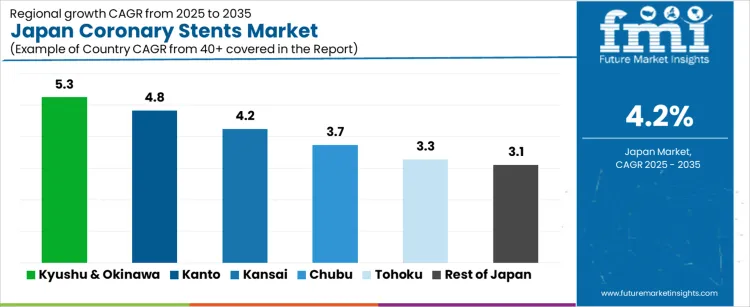
| Region | CAGR (%) |
|---|---|
| Kyushu & Okinawa | 5.3% |
| Kanto | 4.8% |
| Kansai | 4.2% |
| Chubu | 3.7% |
| Tohoku | 3.3% |
| Rest of Japan | 3.1% |
How is Demand for Coronary Stents Growing in Kyushu & Okinawa?
Kyushu & Okinawa leads the demand for coronary stents, growing at a 5.3% CAGR. The region’s healthcare sector, with its increasing emphasis on modernizing cardiac care, is a key factor driving the rise in coronary stent usage. As cardiovascular diseases continue to increase with an aging population, Kyushu & Okinawa are expanding their adoption of coronary stents as part of comprehensive cardiac care strategies. The region’s growing health infrastructure, particularly in Okinawa, where medical tourism is also rising, supports the adoption of advanced medical technologies. The focus on health and wellness, combined with the region’s efforts to provide better access to quality healthcare, ensures continued growth in the use of coronary stents. As local hospitals and clinics adopt newer, more advanced stent technologies, Kyushu & Okinawa’s demand for coronary stents is expected to remain strong, contributing to steady growth in the cardiovascular sector.
Why is Demand for Coronary Stents Rising in Kanto?
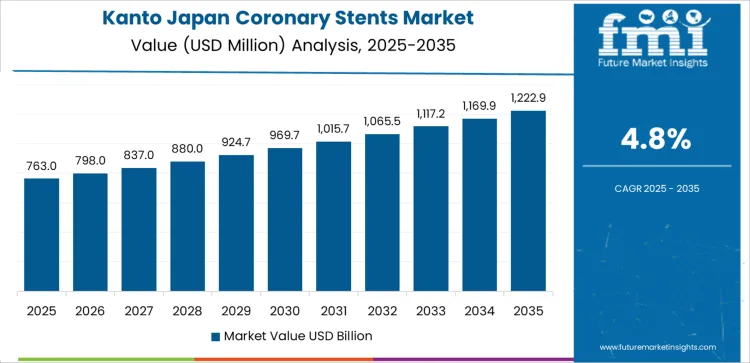
In Kanto, demand for coronary stents is rising at a 4.8% CAGR. The region’s dense urban population and high rates of cardiovascular diseases, particularly in Tokyo, contribute to the growing demand for coronary stents. Kanto’s healthcare providers are increasingly turning to advanced stent technologies to treat patients with coronary artery disease, aiming to improve patient outcomes and minimize complications. The region's large number of hospitals and specialized cardiac centers are driving adoption, as more patients seek effective, minimally invasive solutions for cardiovascular problems. The increasing awareness of heart health and early detection of cardiovascular issues are fueling demand for coronary stents. Kanto’s focus on improving healthcare infrastructure, alongside the region’s well-established medical research community, continues to drive advancements in stent technologies.
How is Demand for Coronary Stents Expanding in Kansai?
Kansai shows steady demand for coronary stents, growing at a 4.2% CAGR. The region’s well-established healthcare infrastructure, particularly in cities like Osaka, continues to contribute to the rising adoption of coronary stents for the treatment of coronary artery disease. As Kansai’s aging population grows, the need for effective treatments like stenting is becoming increasingly important. Hospitals and medical centers in Kansai are increasingly adopting newer stent technologies, which offer improved outcomes, reduced complications, and faster recovery times for patients. Kansai’s growing focus on cardiovascular health and disease prevention, coupled with the region’s commitment to providing high-quality healthcare, supports this upward trend in demand. As the public becomes more aware of the benefits of early heart disease detection and intervention, coronary stents are becoming a standard treatment for many patients in Kansai. The demand for coronary stents is expected to continue expanding steadily in the region.
Why is Demand for Coronary Stents Growing in Chubu?
Chubu is experiencing steady demand for coronary stents, growing at a 3.7% CAGR. The region’s increasing focus on healthcare modernization and the growing prevalence of cardiovascular diseases, especially among the aging population, are contributing to the rise in demand for coronary stents. Chubu’s healthcare providers are increasingly adopting advanced stent technologies, which offer greater precision and improved outcomes for patients undergoing coronary artery disease treatment. As more hospitals and cardiac care centers in Chubu invest in cutting-edge cardiovascular technologies, demand for coronary stents is expected to grow. The region’s emphasis on improving medical access and reducing healthcare disparities, along with a focus on personalized medicine, is contributing to the broader adoption of coronary stents. As Chubu’s healthcare infrastructure continues to evolve, coronary stents will become an integral part of the region’s cardiovascular care, driving steady growth in demand for these devices.
How is Demand for Coronary Stents Expanding in Tohoku?
Tohoku is seeing moderate growth in coronary stent demand, with a 3.3% CAGR. Although the region’s demand for coronary stents is smaller compared to more urbanized areas, there is a growing recognition of the need for advanced cardiovascular treatments due to the aging population and increasing rates of heart disease. Healthcare providers in Tohoku are gradually adopting coronary stents as part of their cardiac care programs, especially as access to quality healthcare improves in the region. The demand is particularly strong in urban areas like Sendai, where healthcare infrastructure is expanding and modernizing. As Tohoku’s population continues to age, the need for minimally invasive, cost-effective treatments for coronary artery disease will drive further growth in stent usage. The region’s focus on improving access to advanced medical technologies and ensuring high-quality cardiovascular care will support steady growth in demand for coronary stents.
Why is Demand for Coronary Stents Steady in the Rest of Japan?
The Rest of Japan is experiencing steady demand for coronary stents, with a 3.1% CAGR. While the adoption of coronary stents is slower compared to major urban regions, smaller cities and rural areas are gradually increasing their use of stents for treating coronary artery disease. As the healthcare sector in the Rest of Japan modernizes and improves its accessibility, more hospitals and clinics are adopting advanced stent technologies to treat cardiovascular diseases. The growing awareness of heart health, coupled with Japan’s focus on improving access to healthcare in rural areas, is contributing to the steady rise in demand for coronary stents. With an increasing elderly population, the demand for coronary stents will continue to grow. As healthcare providers continue to prioritize early detection and effective treatment of heart disease, coronary stents will become an essential tool in improving cardiovascular care across the Rest of Japan.
What is Driving the Demand for Coronary Stents in Japan and Who Are the Key Providers?
Demand for coronary stents in Japan is rising as more people face coronary artery disease (CAD) and related cardiovascular conditions, driven in part by the country’s rapidly aging population. As people get older, risks such as hypertension, diabetes, and lifestyle‑related factors contribute to the prevalence of CAD, increasing the need for interventions like stent implantation. Minimally invasive procedures such as percutaneous coronary intervention (PCI), which often use stents, are preferred as they typically result in quicker recovery and lower risks compared to open-heart surgeries-a crucial factor given the high average age of many patients.
Key providers supplying coronary stents in Japan include Boston Scientific Corporation, TERUMO CORPORATION, Medtronic, Vascular Concepts, and B. Braun Melsungen AG. Boston Scientific leads with a share of about 40.0%, offering a broad range of drug-eluting and bare-metal stents that support both standard and complex coronary interventions. These companies provide advanced stent technologies including bioresorbable and drug-coated options that help improve long-term outcomes and reduce the risk of restenosis.
Advances in stent design, materials, and implantation techniques are further boosting adoption across Japan. Newer stents are more biocompatible, flexible, and durable-making them suitable even for elderly patients with comorbidities. With increasing awareness of cardiovascular health, improved diagnostic screening, and growth in PCI-capable hospitals and cardiac centers, the use of coronary stents is expected to continue growing as a vital part of cardiovascular care in Japan.
Key Players in Japan Coronary Stents Demand
- Boston Scientific Corporation
- TERUMO CORPORATION
- Medtronic
- Vascular Concepts
- B. Braun Melsungen AG
Scope of Report
| Items | Values |
|---|---|
| Quantitative Units (2025) | USD billion |
| Product | Bare Metal Stent (BMS), Drug Eluting Stent (DES), Bioresorbable Vascular Stent (BVS) |
| Raw Material | Cobalt-Chromium, Stainless Steel, Platinum-Chromium, Nickel-Titanium, Polymer |
| End User | Cardiac Catheterization Laboratories, Ambulatory Surgical Centers, Hospitals |
| Region | Kyushu & Okinawa, Kanto, Kansai, Chubu, Tohoku, Rest of Japan |
| Countries Covered | Japan |
| Key Companies Profiled | Boston Scientific Corporation, TERUMO CORPORATION, Medtronic, Vascular Concepts, B. Braun Melsungen AG |
| Additional Attributes | Dollar sales by product type and raw material; regional CAGR and growth trends; innovations in coronary stent designs and materials; increasing demand in aging population with heart diseases and conditions |
Japan Coronary Stents Demand by Key Segments
Product
- Bare Metal Stent (BMS)
- Drug Eluting Stent (DES)
- Bioresorbable Vascular Stent (BVS)
Raw Material
- Cobalt-Chromium
- Stainless Steel
- Platinum-Chromium
- Nickel-Titanium
- Polymer
End User
- Cardiac Catheterization Laboratories
- Ambulatory Surgical Centers
- Hospitals
Region
- Kyushu & Okinawa
- Kanto
- Kansai
- Chubu
- Tohoku
- Rest of Japan
Frequently Asked Questions
How big is the demand for coronary stents in Japan in 2025?
The demand for coronary stents in Japan is estimated to be valued at USD 1.6 billion in 2025.
What will be the size of coronary stents in Japan in 2035?
The market size for the coronary stents in Japan is projected to reach USD 2.4 billion by 2035.
How much will be the demand for coronary stents in Japan growth between 2025 and 2035?
The demand for coronary stents in Japan is expected to grow at a 4.2% CAGR between 2025 and 2035.
What are the key product types in the coronary stents in Japan?
The key product types in coronary stents in Japan are bare metal stent (bms), drug eluting stent (des) and bioresorbable vascular stent (bvs).
Which raw material segment is expected to contribute significant share in the coronary stents in Japan in 2025?
In terms of raw material, cobalt-chromium segment is expected to command 35.0% share in the coronary stents in Japan in 2025.
Preview the report firsthand - request a free sample
Get SampleGet the brochure for pricing and purchase details.
Get PDFTable of Content
- Executive Summary
- Japan Market Outlook
- Demand-side Trends
- Supply-side Trends
- Technology Roadmap Analysis
- Analysis and Recommendations
- Market Overview
- Market Coverage / Taxonomy
- Market Definition / Scope / Limitations
- Market Background
- Market Dynamics
- Drivers
- Restraints
- Opportunity
- Trends
- Scenario Forecast
- Demand in Optimistic Scenario
- Demand in Likely Scenario
- Demand in Conservative Scenario
- Opportunity Map Analysis
- Product Life Cycle Analysis
- Supply Chain Analysis
- Investment Feasibility Matrix
- Value Chain Analysis
- PESTLE and Porter’s Analysis
- Regulatory Landscape
- Regional Parent Market Outlook
- Production and Consumption Statistics
- Import and Export Statistics
- Market Dynamics
- Japan Market Analysis 2020 to 2024 and Forecast, 2025 to 2035
- Historical Market Size Value (USD Million) Analysis, 2020 to 2024
- Current and Future Market Size Value (USD Million) Projections, 2025 to 2035
- Y-o-Y Growth Trend Analysis
- Absolute $ Opportunity Analysis
- Japan Market Pricing Analysis 2020 to 2024 and Forecast 2025 to 2035
- Japan Market Analysis 2020 to 2024 and Forecast 2025 to 2035, By Product
- Introduction / Key Findings
- Historical Market Size Value (USD Million) Analysis By Product , 2020 to 2024
- Current and Future Market Size Value (USD Million) Analysis and Forecast By Product , 2025 to 2035
- Bare Metal Stent (BMS)
- Drug Eluting Stent (DES)
- Bioresorbable Vascular Stent (BVS)
- Y-o-Y Growth Trend Analysis By Product , 2020 to 2024
- Absolute $ Opportunity Analysis By Product , 2025 to 2035
- Japan Market Analysis 2020 to 2024 and Forecast 2025 to 2035, By Raw Material
- Introduction / Key Findings
- Historical Market Size Value (USD Million) Analysis By Raw Material, 2020 to 2024
- Current and Future Market Size Value (USD Million) Analysis and Forecast By Raw Material, 2025 to 2035
- Cobalt-Chromium
- Stainless Steel
- Platinum-Chromium
- Nickel-Titanium
- Polymer
- Y-o-Y Growth Trend Analysis By Raw Material, 2020 to 2024
- Absolute $ Opportunity Analysis By Raw Material, 2025 to 2035
- Japan Market Analysis 2020 to 2024 and Forecast 2025 to 2035, By End User
- Introduction / Key Findings
- Historical Market Size Value (USD Million) Analysis By End User, 2020 to 2024
- Current and Future Market Size Value (USD Million) Analysis and Forecast By End User, 2025 to 2035
- Cardiac Catheterization Laboratories
- Ambulatory Surgical Centers
- Hospitals
- Y-o-Y Growth Trend Analysis By End User, 2020 to 2024
- Absolute $ Opportunity Analysis By End User, 2025 to 2035
- Market Structure Analysis
- Competition Dashboard
- Competition Benchmarking
- Market Share Analysis of Top Players
- By Regional
- By Product
- By Raw Material
- By End User
- Competition Analysis
- Competition Deep Dive
- TERUMO CORPORATION
- Overview
- Product Portfolio
- Profitability by Market Segments (Product/Age /Sales Channel/Region)
- Sales Footprint
- Strategy Overview
- Marketing Strategy
- Product Strategy
- Channel Strategy
- Medtronic
- Vascular Concepts
- B. Braun Melsungen AG
- TERUMO CORPORATION
- Competition Deep Dive
- Assumptions & Acronyms Used
- Research Methodology


