

- Industry Size (2025)
- USD 13.3 Bn
- Forecast (2035)
- USD 222.5 Bn
- CAGR (2025 to 2035)
- 5.3%
Demand for Coronary Stents in USA Forecast and Outlook 2025 to 2035
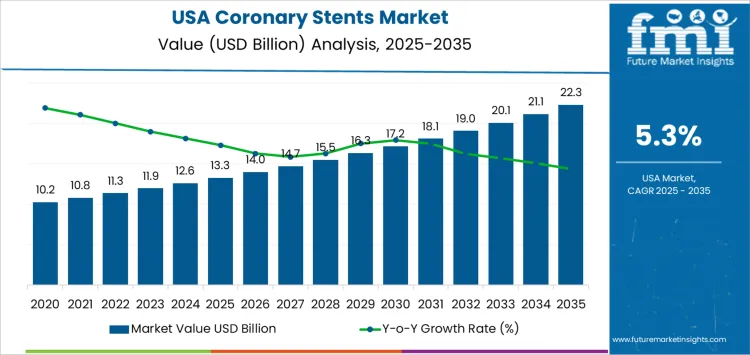
Demand for coronary stents in the USA is expected to grow from USD 13.3 billion in 2025 to USD 22.3 billion by 2035, reflecting a compound annual growth rate (CAGR) of 5.3%. Growth is driven by the rising prevalence of cardiovascular diseases, advancements in stent technology, and the increasing adoption of minimally invasive procedures. Coronary stents are critical in treating coronary artery disease by restoring blood flow to the heart, making them essential in modern cardiovascular treatments. As healthcare systems continue to focus on improving heart health, demand for coronary stents is expected to rise steadily.
Industry is also supported by innovations in stent design, such as drug-eluting stents (DES) that reduce the risk of restenosis and improve patient outcomes. An aging population, along with rising lifestyle-related risk factors such as obesity, smoking, and hypertension, is expected to contribute to the growth of coronary stent demand. Adoption of stents in a broader range of clinical settings, along with advances in healthcare infrastructure and better diagnostic tools, is expected to drive industry growth further over the next decade.
Quick Stats of the Demand for Coronary Stents in USA
- Demand for Coronary Stents in USA Value (2025): USD 13.3 billion
- Demand for Coronary Stents in USA Forecast Value (2035): USD 22.3 billion
- Demand for Coronary Stents in USA Forecast CAGR (2025-2035): 5.3%
- Demand for Coronary Stents in USA Leading Raw Material: Cobalt-Chromium (35%)
- Demand for Coronary Stents in USA Key Growth Regions: West USA, South USA, Northeast USA, Midwest USA
- Demand for Coronary Stents in USA Key Players: Boston Scientific Corporation, TERUMO CORPORATION, Medtronic, Vascular Concepts, B. Braun Melsungen AG
What is the Growth Forecast for the Coronary Stents Market through 2035?
Growth curve for coronary stents market in the USA shows a consistent upward trajectory over the forecast period, with steady increases in demand throughout. Starting at USD 13.3 billion in 2025, market increases to USD 14.0 billion in 2026 and USD 14.7 billion in 2027. Early growth period reflects ongoing adoption of coronary stents, driven by need for effective solutions in treating coronary artery disease and the benefits of minimally invasive procedures.
Industry continues to grow at a steady pace, with values of USD 15.5 billion in 2028, USD 16.3 billion in 2029, and USD 17.2 billion in 2030. Growth rate remains relatively stable, indicating a predictable and steady increase in demand as stent technologies evolve and expand into broader clinical use. By 2035, the market is projected to reach USD 22.3 billion, with the growth curve demonstrating steady and sustained demand throughout the period. Growth curve indicates an ongoing, steady rise, driven by increased healthcare access, advancements in stent technology, and the growing need for coronary interventions in an aging population.
USA Coronary Stents Industry Key Takeaways
| Metric | Value |
|---|---|
| Industry Sales Value (2025) | USD 13.3 billion |
| Industry Forecast Value (2035) | USD 222.5 billion |
| Industry Forecast CAGR (2025-2035) | 5.3% |
Why is the Demand for Coronary Stents Growing in the USA?
Demand for coronary stents in the USA is increasing because of the high and growing prevalence of coronary artery disease (CAD) among the adult population, driven by factors such as aging, lifestyle-related risks (obesity, sedentary habits, poor diet), and comorbidities like hypertension and diabetes. Roughly 18 million Americans live with CAD. Many of these patients eventually need interventions to open narrowed coronary arteries to prevent heart attacks or relieve symptoms such as angina. Stenting via percutaneous coronary intervention (PCI) offers a minimally invasive, effective way to restore blood flow, reduce the risk of a major cardiac event, and improve quality of life.
At the same time, advances in stent technology and growing preference for minimally invasive cardiovascular procedures are fueling increased adoption. Modern stents, especially drug-eluting stents, provide more durable outcomes, reduce artery re-narrowing, and shorten recovery time compared with older treatments or open-heart surgery alternatives. With improvements in stent design, materials, and procedural techniques, more physicians are recommending stenting for both acute events and chronic coronary blockages, driving demand across hospitals, cardiac centers, and cardiac intervention units nationwide.
What Are the Key Segments in Coronary Stents Market in the USA?
Coronary stents industry in the USA is segmented by product type and raw material. Drug-eluting stents (DES) lead the market, accounting for 33% of the share. In terms of raw materials, cobalt-chromium is the dominant material, representing 35% of the market. The increasing prevalence of cardiovascular diseases and the growing demand for minimally invasive procedures are driving the adoption of coronary stents in the USA.
Which Product Type Drives Coronary Stents Demand in the USA?
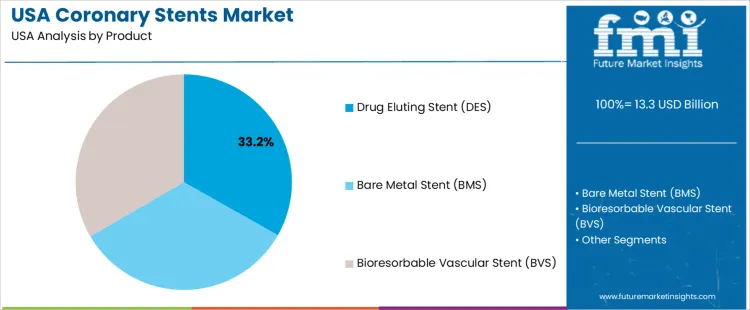
Drug eluting stents (DES) dominate the coronary stents market in the USA, holding 33% of the total market share. DES are favored due to their ability to release a drug that prevents restenosis (re-narrowing of the artery) after implantation. This reduces the need for repeat procedures and enhances the long-term success of coronary interventions. DES are particularly preferred for patients with a higher risk of restenosis, such as those with diabetes or complex coronary artery disease. Their effectiveness in reducing complications associated with stent placement has contributed to their dominant market position. While bare-metal stents (BMS) and bioresorbable vascular stents (BVS) are also present in the market, DES remain the most widely used due to their proven clinical outcomes and ability to reduce the risk of restenosis and other complications.
Which Raw Material Drives Coronary Stents Demand in the USA?
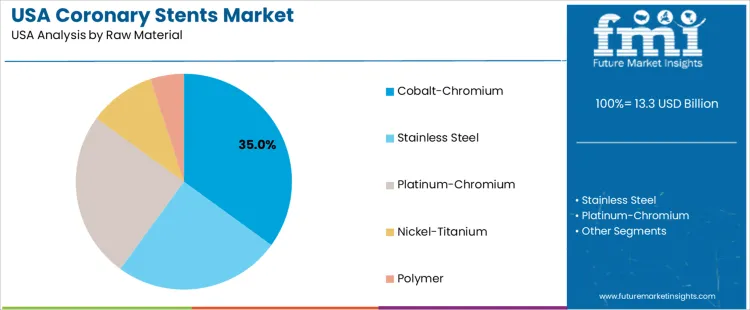
Cobalt-chromium is the most commonly used raw material in coronary stents, accounting for 35% of the market share. Cobalt-chromium alloys are preferred for their strength, durability, and radiopacity, which facilitates visibility during implantation. These materials provide necessary support for the stent while ensuring that it remains functional over time. Use of cobalt-chromium alloys helps reduce the risk of stent fracture and ensures that the stent maintains its structural integrity. While other materials, such as stainless steel, platinum-chromium, and nickel-titanium, are also used in the production of coronary stents, cobalt-chromium remains the most widely used due to its superior mechanical properties and its ability to withstand the forces within coronary arteries.
What is the Summary of Demand for Coronary Stents in USA?
Demand for coronary stents in the USA remains high due to the increasing prevalence of coronary artery disease (CAD) and the growing aging population. Coronary stents, which are small mesh-like tubes used to open narrowed or blocked arteries, are critical in the treatment of heart conditions such as angina and heart attacks. The U.S. market for coronary stents is expected to continue expanding as advancements in stent technology improve patient outcomes and as the healthcare system focuses more on treating cardiovascular diseases. The rising incidence of lifestyle-related risk factors, such as hypertension, diabetes, and smoking, further contributes to the ongoing demand for coronary stents.
What are the Drivers of Demand for Coronary Stents in USA?
Several factors are driving the demand for coronary stents in the USA. First, the increasing prevalence of coronary artery disease, driven by aging populations and lifestyle factors such as poor diet, lack of exercise, and smoking, continues to fuel the need for stent procedures. Second, advancements in stent technology, including drug-eluting stents, which reduce the risk of restenosis (re-narrowing of arteries), have improved patient outcomes, making stent procedures more effective and desirable. Third, the growing number of minimally invasive procedures and improvements in medical imaging enable more precise stent placement, driving their use in treating CAD. Fourth, increased awareness and early diagnosis of heart conditions, combined with advances in healthcare, enable more people to undergo stent procedures at earlier stages of arterial blockages. Lastly, improved healthcare access and insurance coverage for cardiovascular treatments contribute to greater adoption of coronary stents in the U.S.
What are the Restraints on Demand for Coronary Stents in USA?
Despite growing demand, several factors could limit the adoption of coronary stents in the USA. One of the primary challenges is the high cost of coronary stent procedures, which can limit accessibility for some patients, particularly those without adequate insurance coverage. Additionally, while stents have proven effective in many cases, some patients may experience complications such as restenosis or stent thrombosis, which could lead to the need for additional procedures or medical interventions. The growing preference for non-invasive or less invasive treatment options, such as lifestyle changes and medication, may also limit the demand for stent procedures, particularly in patients with mild to moderate coronary artery disease. Finally, the complexity of stent implantation procedures and the requirement for skilled cardiologists may restrict the widespread availability of stent treatments, especially in regions with fewer specialized healthcare facilities.
What are the Key Trends Influencing Demand for Coronary Stents in USA?
Several key trends are shaping the demand for coronary stents in the USA. One major trend is the growing adoption of drug-eluting stents (DES), which release medication to prevent the re-narrowing of arteries, enhancing the long-term success of stent procedures. Another trend is the increasing use of bioresorbable stents, which dissolve over time and may reduce the risk of long-term complications associated with traditional metal stents. Additionally, the trend toward personalized medicine, in which treatment plans are tailored to an individual’s genetic profile and health conditions, is influencing the types of stents used across different patient populations. The rising emphasis on preventative care, early detection of cardiovascular conditions, and improvements in diagnostic techniques are also leading to earlier interventions and greater use of coronary stents. Lastly, as healthcare systems push for more cost-effective and efficient treatments, the development of lower-cost stents and procedures may help to further expand the adoption of coronary stents in the U.S.
What is the Regional Demand Outlook for the Coronary Stents Market in the USA?
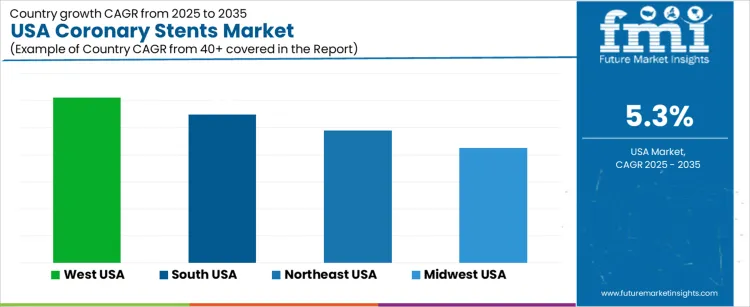
Coronary stents market in the USA is expected to experience steady growth, with the West USA leading the way at a projected CAGR of 6.1%. South USA follows closely with a growth rate of 5.5%, while the Northeast USA is expected to grow at 4.9%. The Midwest USA shows more moderate growth with a CAGR of 4.3%. Coronary stents, which are used to treat narrowed or blocked coronary arteries, are in high demand due to the increasing prevalence of cardiovascular diseases. As the healthcare industry continues to advance in the treatment of heart conditions, the market for coronary stents is expanding across the United States.
| Region | CAGR (2025-2035) |
|---|---|
| West USA | 6.1% |
| South USA | 5.5% |
| Northeast USA | 4.9% |
| Midwest USA | 4.3% |
What is Driving the Growth of Coronary Stents in the West USA?
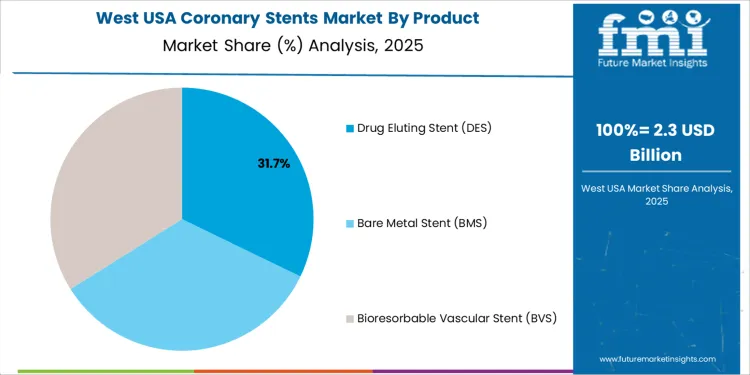
The West USA is projected to experience the highest growth in the Coronary Stents market, with a CAGR of 6.1%. The region’s large healthcare infrastructure, combined with a growing elderly population, is a key driver of demand for coronary stents. The increasing prevalence of heart disease, coupled with advancements in stent technology, is contributing to the rise in coronary stent procedures. States like California, Washington, and Oregon are seeing an increasing number of healthcare providers adopting newer, more effective stent technologies to improve patient outcomes. The West’s focus on health and wellness, combined with rising awareness about heart disease prevention and treatment, is further fueling the growth of coronary stents in this region. Additionally, the West’s strong research and development efforts in the field of cardiovascular health are driving innovation and the adoption of advanced coronary stents.
Why is the Coronary Stents Market Expanding in South USA?
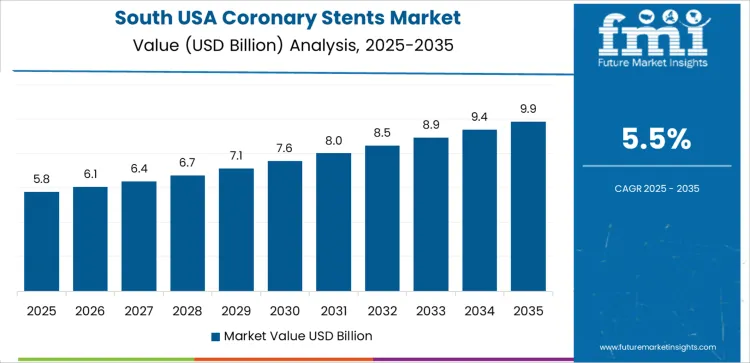
In South USA, the demand for coronary stents is projected to grow at a CAGR of 5.5%. The South’s growing elderly population, combined with an increasing prevalence of cardiovascular diseases, is contributing to the rise in coronary stent procedures. States like Texas, Florida, and Georgia are seeing rising healthcare demand as their populations age. The region’s emphasis on improving healthcare infrastructure and providing access to advanced cardiovascular treatments is driving the adoption of coronary stents. Additionally, the rising awareness of heart disease prevention and the availability of minimally invasive stent procedures are helping to accelerate the growth of the coronary stents market in the South USA. As healthcare providers in the region increasingly adopt advanced stent technologies, the market is expected to continue its expansion.
How is the Coronary Stents Market Growing in Northeast USA?
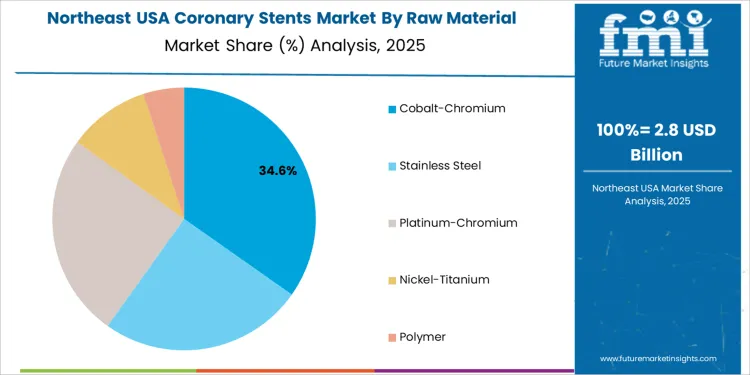
In Northeast USA, the Coronary Stents market is projected to grow at a CAGR of 4.9%. The region’s large and aging population, particularly in urban centers like New York, Boston, and Philadelphia, is contributing to the growing demand for coronary stents. Cardiovascular diseases remain one of the leading causes of death in the Northeast, driving the need for effective and accessible treatments. The region’s well-established healthcare infrastructure, combined with a focus on advanced cardiovascular procedures, is accelerating the adoption of coronary stents. As the healthcare industry continues to adopt more effective and minimally invasive treatment options, coronary stents are expected to become increasingly popular. Additionally, rising awareness about heart disease prevention and management is fueling the demand for coronary stents in the Northeast.
What is Contributing to the Growth of Coronary Stents in Midwest USA?
In Midwest USA, the Coronary Stents market is expected to grow at a CAGR of 4.3%. The Midwest, with its high rate of heart disease and a large population at risk, is seeing an increasing demand for coronary stents. States like Illinois, Michigan, and Ohio are experiencing an uptick in coronary stent procedures, driven by the rising prevalence of cardiovascular diseases and the aging population. Healthcare providers in the Midwest are increasingly adopting newer stent technologies to improve patient outcomes, and the region is seeing a rise in the availability of advanced cardiovascular treatments. As the healthcare system continues to evolve and embrace minimally invasive procedures, the market for coronary stents is expected to grow steadily. Additionally, regional initiatives aimed at improving heart disease awareness and access to treatment are helping drive demand for coronary stents in the Midwest.
What is the Competitive Landscape for Demand for Coronary Stents in the USA?
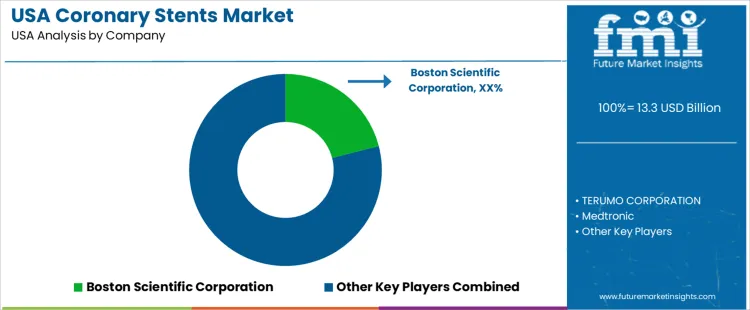
Demand for coronary stents in the USA remains strong as cardiovascular disease continues to rank among the leading health concerns. The high incidence of coronary artery disease (CAD) and a significant number of percutaneous coronary interventions (PCIs) each year drive demand for stent implantation. With approximately 1.2 million coronary stents implanted annually in the USA, the market is supported by aging demographics, lifestyle-related risk factors, and increasing demand for minimally invasive cardiac procedures. Rising rates of diabetes, obesity, and other cardiovascular risk factors contribute to continued growth in the market.
On the supply side, a few key players dominate the U.S. market. Boston Scientific Corporation leads with a substantial market share of about 21%. Other important suppliers include TERUMO CORPORATION, Medtronic, Vascular Concepts, and B. Braun Melsungen AG. These firms provide a range of products, including metallic stents, drug-eluting stents, bare-metal stents, and newer-generation devices. Competition among these suppliers is driven by product efficacy, material quality, procedural safety, and the ability to offer diverse product options to meet the needs of different patient profiles. Companies that invest in research and development, regulatory compliance, and robust distribution networks are best positioned to capture growth as the demand for coronary stents continues to rise in the USA.
Key Players of the Coronary Stents Industry in USA
- Boston Scientific Corporation
- TERUMO CORPORATION
- Medtronic
- Vascular Concepts
- B. Braun Melsungen AG
Scope of the Report
| Items | Details |
|---|---|
| Quantitative Units | USD Billion |
| Regions Covered | USA |
| Product | Drug Eluting Stent (DES), Bare Metal Stent (BMS), Bioresorbable Vascular Stent (BVS) / Bio resorbable Vascular Scaffold (BVS/BRS) |
| Raw Material | Cobalt Chromium, Stainless Steel, Platinum Chromium, Nickel Titanium (Nitinol), Polymer (for bioresorbable stents) |
| End User | Hospitals, Ambulatory Surgical Centers, Cardiac Catheterization Laboratories |
| Key Companies Profiled | Boston Scientific Corporation; TERUMO CORPORATION; Medtronic; Vascular Concepts; B. Braun Melsungen AG |
| Additional Attributes | Dollar sales by stent type and material show that DES (drug eluting) dominate demand due to lower restenosis rates compared with BMS. Metallic stents (cobalt chromium, platinum chromium, stainless steel, Nitinol) remain the mainstay, though polymeric bioresorbable stents (BVS) are growing as physicians and patients seek temporary scaffolds that dissolve after vessel healing. Hospital settings remain the primary end users due to high prevalence of percutaneous coronary interventions (PCI). |
Key Segments in the Demand for Coronary Stents in USA
Product:
- Drug Eluting Stent (DES)
- Bare Metal Stent (BMS)
- Bioresorbable Vascular Stent (BVS)
Raw Material:
- Cobalt Chromium
- Stainless Steel
- Platinum Chromium
- Nickel Titanium
- Polymer
End User:
- Hospitals
- Ambulatory Surgical Centers
- Cardiac Catheterization Laboratories
Region:
- Northeast USA
- West USA
- Midwest USA
- South USA
Frequently Asked Questions
How big is the demand for coronary stents in USA in 2025?
The demand for coronary stents in USA is estimated to be valued at USD 13.3 billion in 2025.
What will be the size of coronary stents in USA in 2035?
The market size for the coronary stents in USA is projected to reach USD 22.3 billion by 2035.
How much will be the demand for coronary stents in USA growth between 2025 and 2035?
The demand for coronary stents in USA is expected to grow at a 5.3% CAGR between 2025 and 2035.
What are the key product types in the coronary stents in USA?
The key product types in coronary stents in USA are drug eluting stent (des), bare metal stent (bms) and bioresorbable vascular stent (bvs).
Which raw material segment is expected to contribute significant share in the coronary stents in USA in 2025?
In terms of raw material, cobalt-chromium segment is expected to command 35.0% share in the coronary stents in USA in 2025.
Preview the report firsthand - request a free sample
Get SampleGet the brochure for pricing and purchase details.
Get PDFTable of Content
- Executive Summary
- USA Market Outlook
- Demand-side Trends
- Supply-side Trends
- Technology Roadmap Analysis
- Analysis and Recommendations
- Market Overview
- Market Coverage / Taxonomy
- Market Definition / Scope / Limitations
- Market Background
- Market Dynamics
- Drivers
- Restraints
- Opportunity
- Trends
- Scenario Forecast
- Demand in Optimistic Scenario
- Demand in Likely Scenario
- Demand in Conservative Scenario
- Opportunity Map Analysis
- Product Life Cycle Analysis
- Supply Chain Analysis
- Investment Feasibility Matrix
- Value Chain Analysis
- PESTLE and Porter’s Analysis
- Regulatory Landscape
- Regional Parent Market Outlook
- Production and Consumption Statistics
- Import and Export Statistics
- Market Dynamics
- USA Market Analysis 2020 to 2024 and Forecast, 2025 to 2035
- Historical Market Size Value (USD Million) Analysis, 2020 to 2024
- Current and Future Market Size Value (USD Million) Projections, 2025 to 2035
- Y-o-Y Growth Trend Analysis
- Absolute $ Opportunity Analysis
- USA Market Pricing Analysis 2020 to 2024 and Forecast 2025 to 2035
- USA Market Analysis 2020 to 2024 and Forecast 2025 to 2035, By Product
- Introduction / Key Findings
- Historical Market Size Value (USD Million) Analysis By Product , 2020 to 2024
- Current and Future Market Size Value (USD Million) Analysis and Forecast By Product , 2025 to 2035
- Drug Eluting Stent (DES)
- Bare Metal Stent (BMS)
- Bioresorbable Vascular Stent (BVS)
- Y-o-Y Growth Trend Analysis By Product , 2020 to 2024
- Absolute $ Opportunity Analysis By Product , 2025 to 2035
- USA Market Analysis 2020 to 2024 and Forecast 2025 to 2035, By Raw Material
- Introduction / Key Findings
- Historical Market Size Value (USD Million) Analysis By Raw Material, 2020 to 2024
- Current and Future Market Size Value (USD Million) Analysis and Forecast By Raw Material, 2025 to 2035
- Cobalt-Chromium
- Stainless Steel
- Platinum-Chromium
- Nickel-Titanium
- Polymer
- Y-o-Y Growth Trend Analysis By Raw Material, 2020 to 2024
- Absolute $ Opportunity Analysis By Raw Material, 2025 to 2035
- USA Market Analysis 2020 to 2024 and Forecast 2025 to 2035, By End User
- Introduction / Key Findings
- Historical Market Size Value (USD Million) Analysis By End User, 2020 to 2024
- Current and Future Market Size Value (USD Million) Analysis and Forecast By End User, 2025 to 2035
- Hospitals
- Ambulatory Surgical Centers
- Cardiac Catheterization Laboratories
- Y-o-Y Growth Trend Analysis By End User, 2020 to 2024
- Absolute $ Opportunity Analysis By End User, 2025 to 2035
- Market Structure Analysis
- Competition Dashboard
- Competition Benchmarking
- Market Share Analysis of Top Players
- By Regional
- By Product
- By Raw Material
- By End User
- Competition Analysis
- Competition Deep Dive
- Boston Scientific Corporation
- Overview
- Product Portfolio
- Profitability by Market Segments (Product/Age /Sales Channel/Region)
- Sales Footprint
- Strategy Overview
- Marketing Strategy
- Product Strategy
- Channel Strategy
- TERUMO CORPORATION
- Medtronic
- Vascular Concepts
- B. Braun Melsungen AG
- Boston Scientific Corporation
- Competition Deep Dive
- Assumptions & Acronyms Used
- Research Methodology


