

- Market Size (2026)
- USD 6.16 Bn
- Forecast (2036)
- USD 10.65 Bn
- CAGR (2026 to 2036)
- 5.6%
Coronary Heart Disease Diagnostic Imaging Market size, market forecast and outlook by analyst
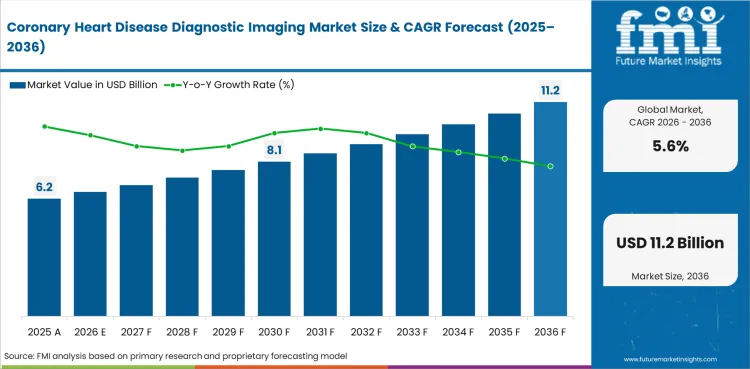
The coronary heart disease diagnostic imaging market was valued at an estimated USD 5.84 billion in 2025, is projected to reach USD 6.16 billion in 2026, and is forecast to expand to USD 10.65 billion by 2036 at a CAGR of 5.6%. Demand is being reshaped by first-line CCTA adoption, wider use of PET and perfusion MRI in complex cases, and more selective use of invasive angiography with pressure and intravascular imaging support.
Summary of Coronary Heart Disease Diagnostic Imaging Market
- The market is forecast to reach USD 10.65 billion by 2036.
- The market is expected to grow at a CAGR of 5.6% from 2026 to 2036.
- The market was estimated at USD 5.84 billion in 2025.
- The forecast period represents an incremental opportunity of USD 4.49 billion.
- Coronary computed tomography angiography accounts for 29.1% of modality revenue in 2026, reflecting its stronger position in first-line evaluation of low to moderate likelihood disease.
- Stable chest pain and chronic coronary syndrome assessment holds 38.4% of application revenue, supported by guideline-led front-end triage and follow-up demand.
- Hospital-based cardiac centers represent 62.7% of end-use revenue, indicating concentration in high-acuity multi-modality workflows.
Coronary Heart Disease Diagnostic Imaging Market key Takeaways
| Parameter | Details |
|---|---|
| Market value (2026) | USD 6.16 billion |
| Forecast value (2036) | USD 10.65 billion |
| CAGR (2026 to 2036) | 5.6% |
| Estimated market value (2025) | USD 5.84 billion |
| Incremental opportunity | USD 4.49 billion |
| Leading modality | Coronary computed tomography angiography, 29.1% of modality revenue |
| Leading application | Stable chest pain and chronic coronary syndrome assessment, 38.4% of application revenue |
| Leading end use | Hospital-based cardiac centers, 62.7% of end-use revenue |
| Key players | GE HealthCare, Siemens Healthineers, Philips, Canon Medical Systems, Abbott, Heartflow |
Source: Analyst synthesis from authoritative sources, 2026.
Key Takeaways, Market Size, and Forecast
- Coronary Heart Disease Diagnostic Imaging Market is projected to grow from USD 6.16 billion in 2026 to USD 10.65 billion by 2036, at a CAGR of 5.6%.
- The coronary heart disease diagnostic imaging market was valued at USD 5.84 billion in 2025.
- By 2036, the Coronary Heart Disease Diagnostic Imaging Market is expected to be worth USD 10.65 billion.
- During 2026 to 2036, the market is anticipated to expand at a CAGR of 5.6%.
- The market is predicted to create an incremental opportunity of USD 4.49 billion between 2026 and 2036.
- In 2026, Coronary Computed Tomography Angiography is expected to account for 29.1% of the modality segment.
- India (6.8%) and China (6.4%) are projected to be two of the fastest growing markets.
Three factors keep market growth intact. Coronary disease burden remains large, with the American Heart Association estimating 254.28 million people living with ischemic heart disease globally in 2021. The 2024 ESC chronic coronary syndrome guidelines strengthened the role of CCTA in front-end rule-out and risk estimation, which supports scanner, software, and post-processing demand. Hospitals are also moving toward more selective invasive angiography, which increases the value of physiology-guided and intravascular imaging in cases that reach the cath lab.
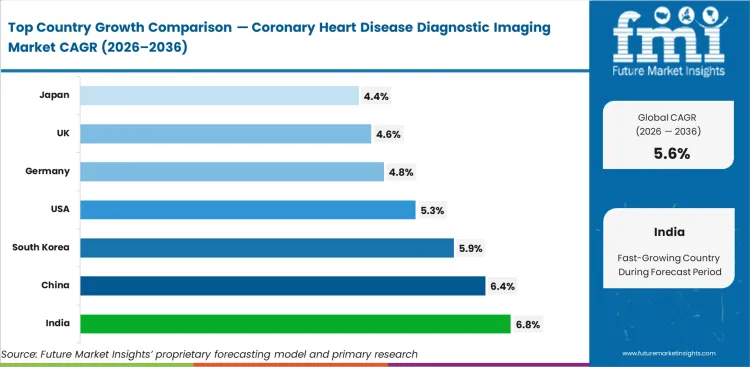
Across tracked geographies, India sets the pace at 6.8% CAGR. China follows at 6.4%. South Korea follows at 5.9%. The United States follows at 5.3%. Germany follows at 4.8%. The United Kingdom follows at 4.6%. Japan follows at 4.4%.
Coronary Heart Disease Diagnostic Imaging Market Definition
The coronary heart disease diagnostic imaging market covers revenue tied to imaging tests, software, and image-guided diagnostic workflows used to detect, characterize, risk-stratify, or confirm coronary atherosclerotic disease and ischemia. The market includes non-invasive anatomical imaging, non-invasive functional imaging, and invasive diagnostic coronary imaging used before revascularization or as part of ischemia-guided decision support.
Coronary Heart Disease Diagnostic Imaging Market Inclusions
Market scope includes coronary computed tomography angiography, coronary calcium scoring used in coronary risk workup, stress echocardiography, SPECT myocardial perfusion imaging, PET myocardial perfusion imaging, CMR perfusion imaging, invasive coronary angiography, and adjunctive intravascular imaging or coronary physiology tools used in diagnostic decision making. Revenue coverage includes scanner use, imaging episodes, radiopharmaceutical-linked imaging revenue, and advanced post-processing or AI analysis linked to coronary disease diagnosis. Segmentation spans modality, application, end use, care setting, technology layer, and geography.
Coronary Heart Disease Diagnostic Imaging Market Exclusions
The scope excludes therapeutic coronary intervention revenue, stents and structural implants, cardiac rhythm imaging unrelated to coronary disease, general chest imaging not used for coronary workup, and population screening programs not connected to diagnostic evaluation of suspected or established coronary heart disease.
Coronary Heart Disease Diagnostic Imaging Market Research Methodology
Primary Research: FMI analysts reviewed official clinical guidelines, public-health burden estimates, utilization statistics, and company disclosures from imaging vendors and cardiac workflow providers.
Desk Research: Data collection consolidated materials from the American Heart Association, ESC, OECD, NHS England, and official company disclosures covering coronary CT, PET MPI, ultrasound AI, and intravascular imaging to establish verifiable baseline parameters.
Market Sizing and Forecasting: Baseline values were derived from global ischemic heart disease burden, the share of patients entering imaging-led diagnostic pathways, modality mix by guideline position, and weighted revenue per imaging episode, and then cross-checked against disease prevalence, utilization intensity, reimbursement proxies, vendor launches, and adoption evidence from NHS and USA cardiac imaging pathways through 2036.
Data validation and update cycle: Projections were tested against prevalence trends, clinical pathway changes, utilization indicators, and disclosed vendor actions, with periodic review to keep the forecast aligned with changes in imaging practice and product positioning.
Why is the Coronary Heart Disease Diagnostic Imaging Market Growing?
Coronary disease remains the largest cardiovascular disease category by mortality and one of the largest by prevalence. That keeps the diagnostic funnel large across ambulatory cardiology, emergency assessment, and hospital-based chronic coronary syndrome management.
Clinical pathways are moving earlier toward imaging. The 2024 ESC chronic coronary syndrome guideline recommends CCTA in individuals with low or moderate likelihood of obstructive disease and recommends stress echo, SPECT or PET MPI, or CMR perfusion imaging in moderate or high-likelihood cases.
Hospitals are investing in workflow-linked cardiac imaging instead of stand-alone image acquisition. AI-based plaque analysis, integrated CCTA review, CT-guided cath lab planning, and higher-value PET MPI workflows are lifting revenue per case even when invasive angiography volumes are managed more selectively.
Demand is expanding because coronary imaging now supports more than diagnosis alone. Anatomical definition, ischemia quantification, scar assessment, plaque characterization, and procedural planning are increasingly connected within one pathway. That raises the value of modalities that can either rule out disease early or sharpen revascularization decisions later in the care sequence.
The shift toward CCTA-first pathways is a direct growth driver. ESC guidance gave CCTA a Class I recommendation in low to moderate likelihood chronic coronary syndrome. NHS England has already scaled AI-supported coronary CT pathways across 56 hospitals, and Heartflow reported real-world data from 90,553 patients at 27 NHS hospital sites. Those pathway shifts support scanners, reconstruction software, post-processing, and follow-on functional assessment.
Nuclear and MR imaging remain important because CT does not answer every question. PET MPI, SPECT MPI, and CMR perfusion are used when functional significance, myocardial blood flow, or scar characterization matter. GE HealthCare stated that about six million MPI procedures are undertaken each year in the United States alone. That installed clinical habit creates a resilient base for nuclear imaging even as CT expands.
Invasive imaging is not disappearing. It is becoming more concentrated in patients with stronger disease likelihood, severe symptoms, or lesions of uncertain functional significance. That favors high-value cath-lab diagnostics including pressure assessment and intravascular imaging. The result is a market that grows from both front-end non-invasive imaging and later-stage image-guided diagnostic refinement.
Segmental Analysis
- Coronary computed tomography angiography commands 29.1% of modality revenue in 2026. Its lead comes from stronger guideline support for initial rule-out and risk estimation in symptomatic patients with low or moderate likelihood of obstructive disease.
- Stable chest pain and chronic coronary syndrome assessment account for 38.4% of application revenue in 2026. This segment leads because most patients enter the market through outpatient or elective diagnostic pathways rather than acute intervention.
- Hospital-based cardiac centers hold 62.7% of end-use revenue in 2026. Multi-modality capability, emergency access, cath-lab integration, and advanced post-processing keep complex coronary imaging concentrated in hospitals.
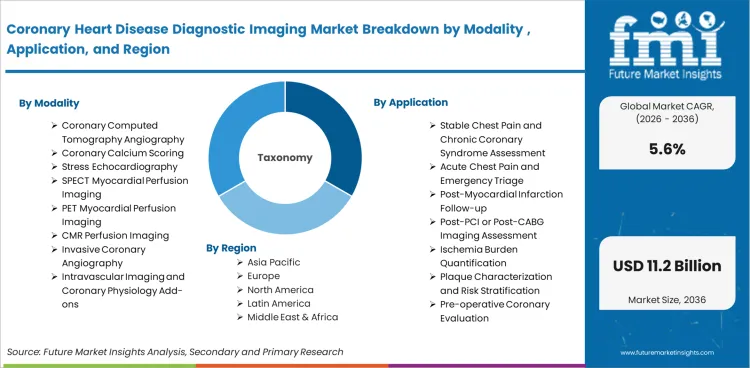
The market is segmented by modality, application, end use, care setting, technology layer, and region. By modality, the market includes coronary computed tomography angiography, stress echocardiography, SPECT myocardial perfusion imaging, PET myocardial perfusion imaging, CMR perfusion imaging, and invasive coronary angiography with adjunctive physiology or intravascular imaging. By application, the market covers stable chest pain and chronic coronary syndrome assessment, acute chest pain and emergency triage, post-myocardial infarction or post-revascularization follow-up, ischemia burden quantification, and pre-operative coronary evaluation.
Insights into the Coronary Computed Tomography Angiography Segment
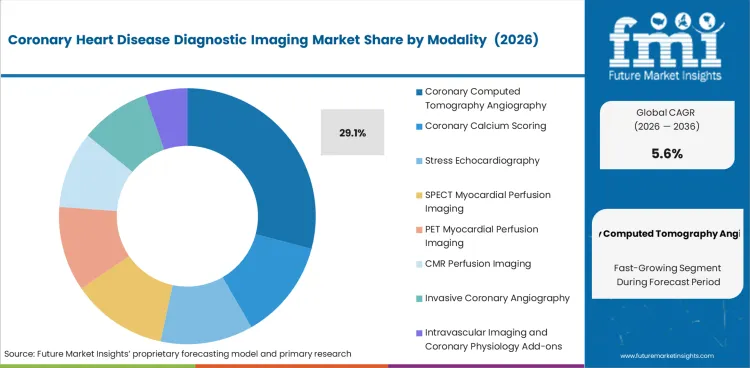
Coronary computed tomography angiography is projected to hold 29.1% of modality revenue in 2026. The segment benefits from first-line placement in current chronic coronary syndrome guidance, faster scanner cycles, better motion correction, plaque analysis software, and wider hospital interest in using CT data for procedural planning. Revenue growth also reflects higher-value software attached to the scan rather than scan volume alone.
Insights into the Stable Chest Pain and Chronic Coronary Syndrome Assessment Segment
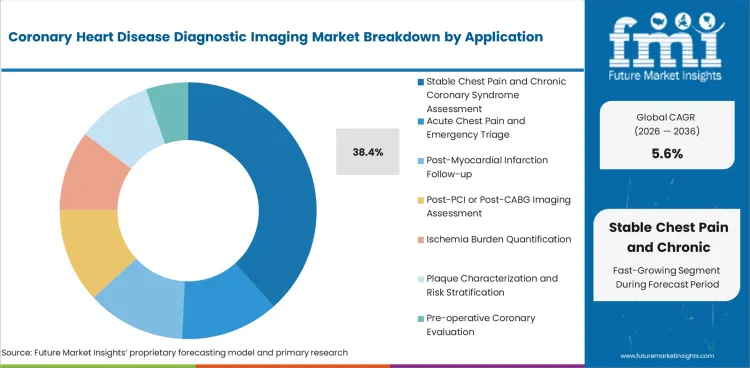
Stable chest pain and chronic coronary syndrome assessment are expected to capture 38.4% of application revenue in 2026. Most patients with suspected coronary disease enter diagnostic workup through outpatient referral, cardiology clinic evaluation, or elective chest-pain pathways. This segment draws demand across CCTA, stress echo, SPECT or PET MPI, and CMR, which gives it the broadest modality base in the market.
Insights into the Hospital-based Cardiac Centers Segment
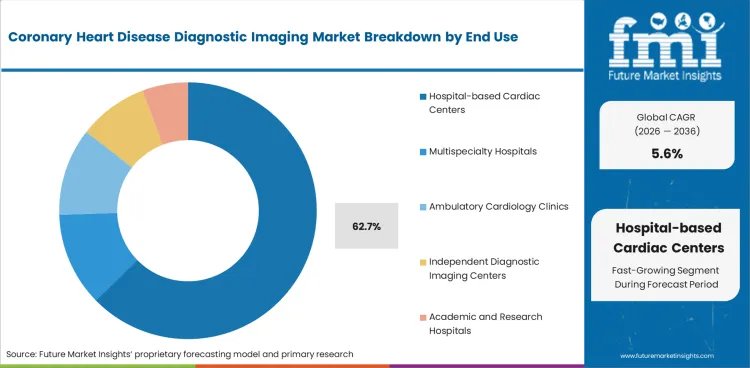
Hospital-based cardiac centers are projected to account for 62.7% of end-use revenue in 2026. Coronary imaging frequently needs contrast support, multi-modality selection, emergency backup, integrated reporting, or escalation to invasive angiography. Those requirements keep the highest-value imaging episodes in tertiary hospitals and large cardiac centers rather than stand-alone imaging sites.
What are the Drivers, Restraints, and Key Trends of the Coronary Heart Disease Diagnostic Imaging Market?
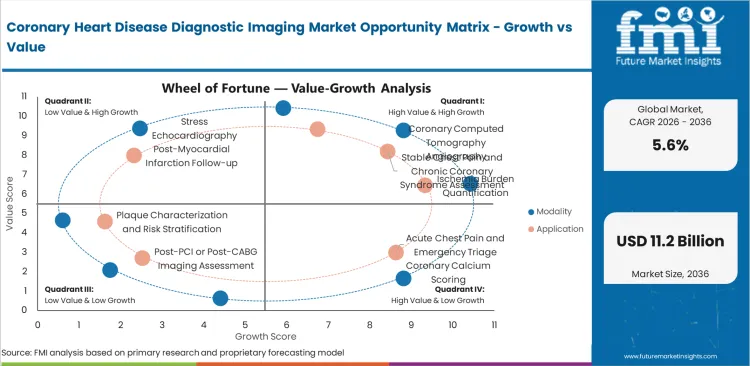
- Driver: clinical guidelines now support broader use of non-invasive coronary imaging earlier in the diagnostic pathway.
- Restraint: workforce, scanner access, and reimbursement gaps still limit advanced cardiac imaging outside large referral centers.
- Trend: software-linked interpretation, plaque analysis, and CT-to-cath-lab workflow integration are increasing the value of each imaging episode.
The market is expanding through clinical necessity and pathway redesign. CT, PET, and software-linked coronary analysis are gaining share faster. Echo and SPECT remain large because they are embedded in existing care delivery.
Guideline-led Expansion of Early Imaging
Growth reflects a measurable shift toward imaging-based rule-out and risk stratification. The ESC guideline recommends CCTA for low to moderate likelihood disease and recommends functional imaging for patients with higher likelihood or unclear functional significance. This broadens the addressable market because more patients receive structured imaging before invasive confirmation.
Access and Cost Constraints in Advanced Cardiac Imaging
The market faces friction from capital intensity and uneven expertise. High-end cardiac CT, PET, and perfusion MRI require specialized hardware, experienced readers, protocol control, and contrast or radiopharmaceutical support. OECD data show wide variation in national imaging intensity, which means growth can be slowed by capacity rather than by clinical demand.
Workflow Software and AI-linked Coronary Imaging
Workflow-linked software is becoming a major source of value in coronary imaging. NHS England is using AI-supported CT pathways for suspected coronary heart disease. Heartflow has reported national-scale evidence for CCTA plus FFRct, and large imaging vendors are linking CT, PET MPI, ultrasound AI, and cath-lab planning into connected workflows.
Analysis of Coronary Heart Disease Diagnostic Imaging Market By Key Countries
.webp "Top Country Growth Comparison Coronary Heart Disease Diagnostic Imaging Market Cagr (2026 2036)")
Asia is likely to deliver the fastest revenue growth over the forecast period because disease burden is large and imaging infrastructure is still being built out. India and China combine large symptomatic populations with rising CT, cath-lab, and tertiary cardiac-care capacity.
The United States remains the largest national revenue pool because imaging intensity is high, nuclear cardiology remains large, and coronary CT, PET, and plaque-analysis reimbursement are improving. OECD data show the United States among the highest users of CT, MRI, and PET exams per capita.
Western Europe grows more steadily. The region benefits from guideline alignment and strong tertiary care networks, but capital budgeting and public reimbursement keep growth below the fastest Asian markets.
South Korea ranks above most developed markets on growth because scanner intensity is high, cardiovascular imaging capability is strong, and hospitals have moved quickly to adopt advanced CT pathways.
| Country | CAGR |
|---|---|
| India | 6.8% |
| China | 6.4% |
| South Korea | 5.9% |
| United States | 5.3% |
| Germany | 4.8% |
| United Kingdom | 4.6% |
| Japan | 4.4% |
Demand Outlook for Coronary Heart Disease Diagnostic Imaging Market in the United States
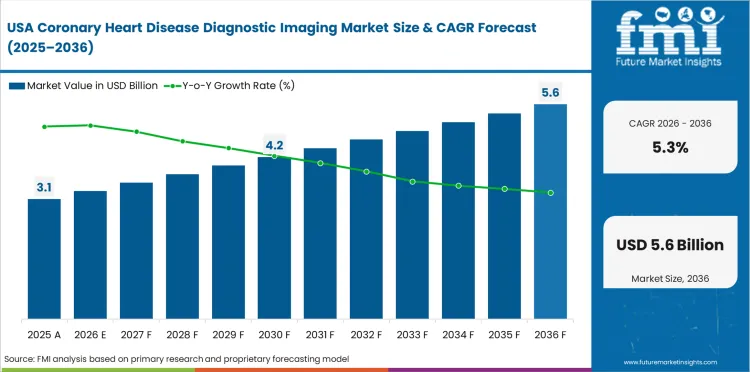
The United States is projected to grow at a CAGR of 5.3% through 2036. Growth is supported by high imaging intensity, a large nuclear cardiology base, rapid commercialization of PET MPI, and expanding use of advanced CCTA review and plaque analysis.
- Around six million MPI procedures are performed annually in the United States, which keeps nuclear imaging revenue high.
- Medicare payment support for newer coronary imaging workflows is improving access.
- High-end hospitals are adopting CT-linked planning and AI-assisted interpretation faster than most other markets.
Future Outlook for Coronary Heart Disease Diagnostic Imaging Market in the United Kingdom
The United Kingdom is projected to grow at a CAGR of 4.6% through 2036. NHS England has accelerated coronary CT adoption, but public-system budget discipline caps near-term revenue growth per site.
- NHS England reported rollout of AI-supported coronary CT pathways across 56 hospitals.
- National chest-pain pathways continue to favor CT-first diagnostic sequencing.
- Revenue growth is helped by software-linked pathway efficiency more than by fee escalation.
Opportunity Analysis of Coronary Heart Disease Diagnostic Imaging Market in Germany
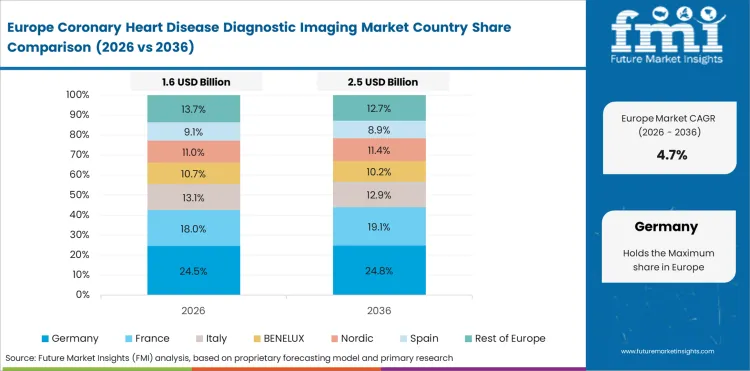
Germany is expected to grow at a CAGR of 4.8% through 2036. The market benefits from strong hospital infrastructure and broad access to high-end imaging, though replacement-driven spending is more common than greenfield capacity growth.
- Tertiary cardiac centers support multi-modality coronary imaging.
- Imaging intensity and scanner availability remain solid by European standards.
- Growth is tied to software upgrades, CT workflow improvement, and selective PET expansion.
In-depth Analysis of Coronary Heart Disease Diagnostic Imaging Market in Japan
Japan is projected to grow at a CAGR of 4.4% through 2036. The country has advanced imaging capability but slower volume expansion because the installed base is already mature and population growth is weak.
- High-quality CT and MR capability supports clinical use in complex coronary workups.
- Mature reimbursement structures favor steady rather than rapid growth.
- Demand comes from aging patients and follow-up imaging in chronic disease management.
Sales Analysis of Coronary Heart Disease Diagnostic Imaging Market in China
China is expected to grow at a CAGR of 6.4% through 2036. Coronary imaging demand is rising with hospital upgrading, broader cardiac-center buildout, and a large burden of ischemic disease and metabolic risk factors.
- Tertiary hospitals continue to expand CT, cath-lab, and advanced cardiology capacity.
- Coronary workups are moving toward more structured imaging pathways in large urban systems.
- Domestic and multinational vendors compete actively on cardiac CT and image-guided coronary workflows.
In-depth Analysis of Coronary Heart Disease Diagnostic Imaging Market in India
India is projected to grow at a CAGR of 6.8% through 2036. Growth is driven by high coronary disease burden, rapid private-hospital expansion, and increasing use of CT-led diagnosis in major urban cardiac centers.
- Private multispecialty hospitals are investing in cardiac CT and cath-lab capability.
- Outpatient cardiology demand is rising with earlier diagnosis of ischemic symptoms.
- The market still has room for capacity-led growth because advanced imaging access remains uneven outside major cities.
Competitive Landscape of Coronary Heart Disease Diagnostic Imaging Market
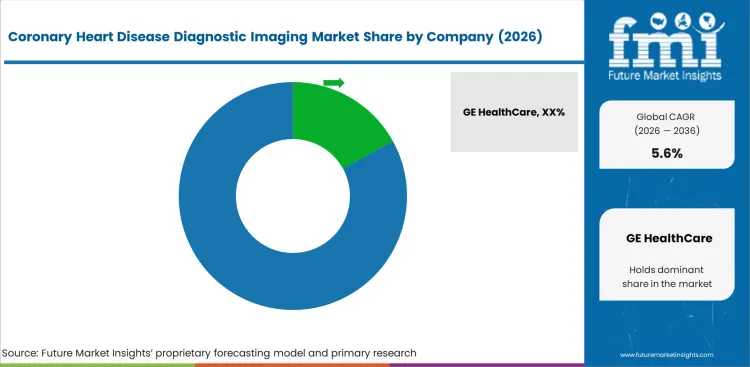
The competitive landscape is led by diversified imaging companies with strong CT, ultrasound, MRI, nuclear, or image-guided therapy portfolios. Market power depends on cardiac imaging quality, installed base, workflow software, and ability to link diagnosis to intervention planning.
GE HealthCare, Siemens Healthineers, Philips, and Canon Medical Systems compete across scanner platforms and cardiac workflow software. Their position is reinforced by long replacement cycles, service relationships, and the ability to bundle cardiology applications into broader imaging contracts.
Abbott and Philips are stronger in invasive coronary imaging and physiology-guided workflows. Heartflow and similar software-led companies compete in post-processing, FFRct, and plaque analysis rather than core hardware.
Competition increasingly centers on pathway control. Vendors that connect calcium scoring, CCTA review, perfusion analysis, plaque characterization, and cath-lab guidance are capturing more decision-making value in coronary workup pathways.
Major Industry Players
GE HealthCare and Siemens Healthineers remain the strongest large-platform competitors because they can support cardiac CT, PET-supporting workflows, enterprise imaging, and service coverage across large hospital networks.
Philips and Canon Medical Systems maintain strong positions in CT, ultrasound, and interventional workflow-linked imaging. Philips is particularly active in linking CT, ultrasound, and cath-lab guidance inside coronary care pathways.
Abbott and Heartflow hold differentiated positions in downstream coronary decision support. Abbott benefits from physiology and intravascular imaging used once patients reach invasive workup. Heartflow benefits from software that extracts more value from the existing CT scan.
Competitive Benchmarking: Coronary Heart Disease Diagnostic Imaging Market
| Company | Coronary CT Strength | Functional or Invasive Imaging Strength | Workflow Software | Geographic Reach |
|---|---|---|---|---|
| GE HealthCare | High | High | High | Strong |
| Siemens Healthineers | High | High | High | Strong |
| Philips | High | High | High | Strong |
| Canon Medical Systems | High | Medium | Medium | Moderate |
| Abbott | Low | High | Medium | Strong |
| Heartflow | Medium | Medium | High | Moderate |
Source: Analyst synthesis from authoritative sources, 2026. Ratings reflect relative positioning based on disclosed capabilities and market presence.
Key Developments in Coronary Heart Disease Diagnostic Imaging Market
- In March 2025, GE HealthCare introduced the Revolution Vibe CT system with one‑beat cardiac imaging designed to handle challenging coronary cases, including patients with atrial fibrillation and heavily calcified coronaries, at the American College of Cardiology (ACC) 2025 meeting.
- In the same month, GE HealthCare launched Flyrcado (flurpiridaz F 18) injection in the United States after prior FDA approval for use in patients with known or suspected coronary artery disease, positioning it as a higher‑efficacy PET myocardial perfusion imaging (MPI) tracer and reinforcing growth in PET‑based MPI adoption.
- In May 2025, NHS England highlighted the deployment of AI‑supported coronary CT pathways across 56 hospitals as part of a nationwide effort to accelerate diagnosis and streamline care for patients with suspected coronary heart disease.
- Also in May 2025, Heartflow publicized the results of the NHS England FISH&CHIPS study, which followed 90,553 patients across 27 sites and evaluated the use of a CCTA‑plus‑FFRct pathway, demonstrating improved outcomes, reduced unnecessary procedures, and higher prognostic value.
- In October 2025, Philips introduced a CT‑guided PCI workflow integration that synchronizes pre‑operative coronary CT with cath‑lab C‑arm movement, aiming to align anatomical imaging with real‑time interventional guidance during percutaneous coronary interventions.
Key Players in the Coronary Heart Disease Diagnostic Imaging Market:
Major Global Players:
- GE HealthCare
- Siemens Healthineers
- Philips
- Canon Medical Systems
- Abbott
- Heartflow
Emerging Players/Startups
- Cleerly
- Elucid
- Circle Cardiovascular Imaging
Scope of the report
| Metric | Value |
|---|---|
| Quantitative Units | USD 6.16 billion to USD 10.65 billion, at a CAGR of 5.6% |
| Market Definition | Revenue linked to non-invasive and invasive imaging used to detect, characterize, or confirm coronary heart disease and myocardial ischemia. |
| Segmentation | Modality: coronary computed tomography angiography, stress echocardiography, SPECT myocardial perfusion imaging, PET myocardial perfusion imaging, CMR perfusion imaging, invasive coronary angiography with adjunctive physiology or intravascular imaging. Application: stable chest pain and chronic coronary syndrome assessment, acute chest pain and emergency triage, post-myocardial infarction or post-revascularization follow-up, ischemia burden quantification, pre-operative coronary evaluation. End use: hospital-based cardiac centers, multispecialty hospitals, ambulatory cardiology clinics, diagnostic imaging centers. Care setting: outpatient elective workup, emergency department triage, inpatient diagnostics, cath-lab based diagnostic workup. Technology layer: stand-alone imaging, AI-assisted analysis, FFRct and plaque analysis, image-guided coronary planning. |
| Regions Covered | North America, Latin America, Europe, East Asia, South Asia and Pacific, Middle East and Africa |
| Countries Covered | United States, Canada, Germany, United Kingdom, France, Italy, Spain, Japan, South Korea, China, India, Australia, Brazil, GCC countries, South Africa |
| Key Companies Profiled | GE HealthCare, Siemens Healthineers, Philips, Canon Medical Systems, Abbott, Heartflow, Cleerly, Elucid |
| Forecast Period | 2026 to 2036 |
| Approach | Analyst-built hybrid top-down and bottom-up model using disease burden, clinical pathway guidance, official utilization indicators, and official vendor disclosures. |
| Historical Period | 2020 to 2025 |
Coronary Heart Disease Diagnostic Imaging Market Segments Analysis:
Coronary Heart Disease Diagnostic Imaging Market segmented as Modality:
- Coronary Computed Tomography Angiography
- Coronary Calcium Scoring
- Stress Echocardiography
- SPECT Myocardial Perfusion Imaging
- PET Myocardial Perfusion Imaging
- CMR Perfusion Imaging
- Invasive Coronary Angiography
- Intravascular Imaging and Coronary Physiology Add-ons
Coronary Heart Disease Diagnostic Imaging Market classified by Application:
- Stable Chest Pain and Chronic Coronary Syndrome Assessment
- Acute Chest Pain and Emergency Triage
- Post-Myocardial Infarction Follow-up
- Post-PCI or Post-CABG Imaging Assessment
- Ischemia Burden Quantification
- Plaque Characterization and Risk Stratification
- Pre-operative Coronary Evaluation
Coronary Heart Disease Diagnostic Imaging Market analysed by End Use:
- Hospital-based Cardiac Centers
- Multispecialty Hospitals
- Ambulatory Cardiology Clinics
- Independent Diagnostic Imaging Centers
- Academic and Research Hospitals
Coronary Heart Disease Diagnostic Imaging Market segmented as Care Setting:
- Outpatient Elective Workup
- Emergency Department Triage
- Inpatient Diagnostic Workup
- Cath-lab Based Diagnostic Assessment
Coronary Heart Disease Diagnostic Imaging Market classified by Technology Layer:
- Stand-alone Imaging Acquisition
- AI-assisted Image Interpretation
- CT-derived Functional Analysis
- Plaque Analysis and Risk Scoring
- Integrated CT-to-Cath-lab Planning
Coronary Heart Disease Diagnostic Imaging Market by Region and Country:
- North America
- United States
- Canada
- Latin America
- Brazil
- Mexico
- Rest of Latin America
- Europe
- Germany
- United Kingdom
- France
- Italy
- Spain
- Rest of Europe
- East Asia
- China
- Japan
- South Korea
- South Asia and Pacific
- India
- ASEAN
- Australia and New Zealand
- Rest of South Asia and Pacific
- Middle East and Africa
- GCC Countries
- South Africa
- Rest of Middle East and Africa
Bibliography
- 1. American Heart Association. 2026 Heart Disease and Stroke Statistics Update Fact Sheet: Global Burden of Disease and CVD.
- 2. European Society of Cardiology. 2024 ESC Guidelines for the management of chronic coronary syndromes.
- 3. OECD. Health at a Glance 2023. Diagnostic technologies chapter.
- 4. NHS England. Futuristic 3D heart scans on NHS speed up diagnosis and save millions. May 2025.
- 5. GE HealthCare. Revolution Vibe CT system with Unlimited One-Beat Cardiac imaging. March 2025.
- 6. GE HealthCare. USA launch of Flyrcado and cardiology workflow innovations. March 2025.
- 7. Philips. AI in cardiovascular ultrasound to diagnose more patients. August 2024.
- 8. Philips. CT-guided PCI integration with Azurion and Advanced Visualization Workspace. October 2025.
- 9. Philips. Acquisition announcement for SpectraWAVE. November 2025.
- 10. Heartflow. NHS England FISH&CHIPS analysis. May 2025.
This Report Addresses
- Market sizing for coronary heart disease diagnostic imaging in 2025 and 2026.
- Revenue forecast through 2036.
- Segmentation across modality, application, end use, care setting, and technology layer.
- Country-level growth outlook for major imaging markets.
- Competitive landscape across hardware, software, and invasive diagnostic workflow suppliers.
- Clinical pathway shifts from first-line CCTA to selective invasive confirmation.
- Software and AI impact on revenue mix and workflow value capture.
Frequently Asked Questions
How large is the demand for Coronary Heart Disease Diagnostic Imaging in the global market in 2026?
Demand for coronary heart disease diagnostic imaging in the global market is estimated at USD 6.16 billion in 2026.
What will be the market size by 2036?
Market size is projected to reach USD 10.65 billion by 2036.
What is the expected demand growth between 2026 and 2036?
Demand is expected to grow at a CAGR of 5.6% between 2026 and 2036.
Which modality is poised to lead by 2026?
Coronary computed tomography angiography leads the market in 2026 with a 29.1% share of modality revenue.
How are hospital-based cardiac centers driving adoption?
Hospital-based cardiac centers account for 62.7% of end-use revenue because advanced coronary workups often require multi-modality selection, contrast support, emergency backup, and escalation to invasive diagnostics when needed.
What is driving demand in the United States?
The United States is projected to grow at a CAGR of 5.3% through 2036, supported by high imaging intensity, a large nuclear cardiology base, wider PET MPI use, and stronger use of advanced CCTA analysis.
What does the market definition mean?
The market includes revenue tied to imaging tests and workflow tools used to detect, characterize, risk-stratify, or confirm coronary heart disease and myocardial ischemia.
How does the analyst validate the forecast?
The forecast is validated through a hybrid model using disease burden, clinical guidelines, official imaging utilization indicators, and official company disclosures, with cross-checks on modality mix, country adoption, and workflow value.
Preview the report firsthand - request a free sample
Get SampleGet the brochure for pricing and purchase details.
Get PDFTable of Content
- Executive Summary
- Global Market Outlook
- Demand-side Trends
- Supply-side Trends
- Technology Roadmap Analysis
- Analysis and Recommendations
- Market Overview
- Market Coverage / Taxonomy
- Market Definition / Scope / Limitations
- Research Methodology
- Chapter Orientation
- Analytical Lens and Working Hypotheses
- Market Structure, Signals, and Trend Drivers
- Benchmarking and Cross-market Comparability
- Market Sizing, Forecasting, and Opportunity Mapping
- Research Design and Evidence Framework
- Desk Research Programme (Secondary Evidence)
- Company Annual and Sustainability Reports
- Peer-reviewed Journals and Academic Literature
- Corporate Websites, Product Literature, and Technical Notes
- Earnings Decks and Investor Briefings
- Statutory Filings and Regulatory Disclosures
- Technical White Papers and Standards Notes
- Trade Journals, Industry Magazines, and Analyst Briefs
- Conference Proceedings, Webinars, and Seminar Materials
- Government Statistics Portals and Public Data Releases
- Press Releases and Reputable Media Coverage
- Specialist Newsletters and Curated Briefings
- Sector Databases and Reference Repositories
- FMI Internal Proprietary Databases and Historical Market Datasets
- Subscription Datasets and Paid Sources
- Social Channels, Communities, and Digital Listening Inputs
- Additional Desk Sources
- Expert Input and Fieldwork (Primary Evidence)
- Primary Modes
- Qualitative Interviews and Expert Elicitation
- Quantitative Surveys and Structured Data Capture
- Blended Approach
- Why Primary Evidence is Used
- Field Techniques
- Interviews
- Surveys
- Focus Groups
- Observational and In-context Research
- Social and Community Interactions
- Stakeholder Universe Engaged
- C-suite Leaders
- Board Members
- Presidents and Vice Presidents
- R&D and Innovation Heads
- Technical Specialists
- Domain Subject-matter Experts
- Scientists
- Physicians and Other Healthcare Professionals
- Governance, Ethics, and Data Stewardship
- Research Ethics
- Data Integrity and Handling
- Primary Modes
- Tooling, Models, and Reference Databases
- Desk Research Programme (Secondary Evidence)
- Data Engineering and Model Build
- Data Acquisition and Ingestion
- Cleaning, Normalisation, and Verification
- Synthesis, Triangulation, and Analysis
- Quality Assurance and Audit Trail
- Market Background
- Market Dynamics
- Drivers
- Restraints
- Opportunity
- Trends
- Scenario Forecast
- Demand in Optimistic Scenario
- Demand in Likely Scenario
- Demand in Conservative Scenario
- Opportunity Map Analysis
- Product Life Cycle Analysis
- Supply Chain Analysis
- Investment Feasibility Matrix
- Value Chain Analysis
- PESTLE and Porter’s Analysis
- Regulatory Landscape
- Regional Parent Market Outlook
- Production and Consumption Statistics
- Import and Export Statistics
- Market Dynamics
- Global Market Analysis 2021 to 2025 and Forecast, 2026 to 2036
- Historical Market Size Value (USD Million) Analysis, 2021 to 2025
- Current and Future Market Size Value (USD Million) Projections, 2026 to 2036
- Y-o-Y Growth Trend Analysis
- Absolute $ Opportunity Analysis
- Global Market Pricing Analysis 2021 to 2025 and Forecast 2026 to 2036
- Global Market Analysis 2021 to 2025 and Forecast 2026 to 2036, By Modality
- Introduction / Key Findings
- Historical Market Size Value (USD Million) Analysis By Modality , 2021 to 2025
- Current and Future Market Size Value (USD Million) Analysis and Forecast By Modality , 2026 to 2036
- Coronary Computed Tomography Angiography
- Coronary Calcium Scoring
- Stress Echocardiography
- SPECT Myocardial Perfusion Imaging
- PET Myocardial Perfusion Imaging
- CMR Perfusion Imaging
- Invasive Coronary Angiography
- Intravascular Imaging and Coronary Physiology Add-ons
- Coronary Computed Tomography Angiography
- Y-o-Y Growth Trend Analysis By Modality , 2021 to 2025
- Absolute $ Opportunity Analysis By Modality , 2026 to 2036
- Global Market Analysis 2021 to 2025 and Forecast 2026 to 2036, By Application
- Introduction / Key Findings
- Historical Market Size Value (USD Million) Analysis By Application, 2021 to 2025
- Current and Future Market Size Value (USD Million) Analysis and Forecast By Application, 2026 to 2036
- Stable Chest Pain and Chronic Coronary Syndrome Assessment
- Acute Chest Pain and Emergency Triage
- Post-Myocardial Infarction Follow-up
- Post-PCI or Post-CABG Imaging Assessment
- Ischemia Burden Quantification
- Plaque Characterization and Risk Stratification
- Pre-operative Coronary Evaluation
- Stable Chest Pain and Chronic Coronary Syndrome Assessment
- Y-o-Y Growth Trend Analysis By Application, 2021 to 2025
- Absolute $ Opportunity Analysis By Application, 2026 to 2036
- Global Market Analysis 2021 to 2025 and Forecast 2026 to 2036, By End Use
- Introduction / Key Findings
- Historical Market Size Value (USD Million) Analysis By End Use, 2021 to 2025
- Current and Future Market Size Value (USD Million) Analysis and Forecast By End Use, 2026 to 2036
- Hospital-based Cardiac Centers
- Multispecialty Hospitals
- Ambulatory Cardiology Clinics
- Independent Diagnostic Imaging Centers
- Academic and Research Hospitals
- Hospital-based Cardiac Centers
- Y-o-Y Growth Trend Analysis By End Use, 2021 to 2025
- Absolute $ Opportunity Analysis By End Use, 2026 to 2036
- Global Market Analysis 2021 to 2025 and Forecast 2026 to 2036, By Region
- Introduction
- Historical Market Size Value (USD Million) Analysis By Region, 2021 to 2025
- Current Market Size Value (USD Million) Analysis and Forecast By Region, 2026 to 2036
- North America
- Latin America
- Western Europe
- Eastern Europe
- East Asia
- South Asia and Pacific
- Middle East & Africa
- Market Attractiveness Analysis By Region
- North America Market Analysis 2021 to 2025 and Forecast 2026 to 2036, By Country
- Historical Market Size Value (USD Million) Trend Analysis By Market Taxonomy, 2021 to 2025
- Market Size Value (USD Million) Forecast By Market Taxonomy, 2026 to 2036
- By Country
- USA
- Canada
- Mexico
- By Modality
- By Application
- By End Use
- By Country
- Market Attractiveness Analysis
- By Country
- By Modality
- By Application
- By End Use
- Key Takeaways
- Latin America Market Analysis 2021 to 2025 and Forecast 2026 to 2036, By Country
- Historical Market Size Value (USD Million) Trend Analysis By Market Taxonomy, 2021 to 2025
- Market Size Value (USD Million) Forecast By Market Taxonomy, 2026 to 2036
- By Country
- Brazil
- Chile
- Rest of Latin America
- By Modality
- By Application
- By End Use
- By Country
- Market Attractiveness Analysis
- By Country
- By Modality
- By Application
- By End Use
- Key Takeaways
- Western Europe Market Analysis 2021 to 2025 and Forecast 2026 to 2036, By Country
- Historical Market Size Value (USD Million) Trend Analysis By Market Taxonomy, 2021 to 2025
- Market Size Value (USD Million) Forecast By Market Taxonomy, 2026 to 2036
- By Country
- Germany
- UK
- Italy
- Spain
- France
- Nordic
- BENELUX
- Rest of Western Europe
- By Modality
- By Application
- By End Use
- By Country
- Market Attractiveness Analysis
- By Country
- By Modality
- By Application
- By End Use
- Key Takeaways
- Eastern Europe Market Analysis 2021 to 2025 and Forecast 2026 to 2036, By Country
- Historical Market Size Value (USD Million) Trend Analysis By Market Taxonomy, 2021 to 2025
- Market Size Value (USD Million) Forecast By Market Taxonomy, 2026 to 2036
- By Country
- Russia
- Poland
- Hungary
- Balkan & Baltic
- Rest of Eastern Europe
- By Modality
- By Application
- By End Use
- By Country
- Market Attractiveness Analysis
- By Country
- By Modality
- By Application
- By End Use
- Key Takeaways
- East Asia Market Analysis 2021 to 2025 and Forecast 2026 to 2036, By Country
- Historical Market Size Value (USD Million) Trend Analysis By Market Taxonomy, 2021 to 2025
- Market Size Value (USD Million) Forecast By Market Taxonomy, 2026 to 2036
- By Country
- China
- Japan
- South Korea
- By Modality
- By Application
- By End Use
- By Country
- Market Attractiveness Analysis
- By Country
- By Modality
- By Application
- By End Use
- Key Takeaways
- South Asia and Pacific Market Analysis 2021 to 2025 and Forecast 2026 to 2036, By Country
- Historical Market Size Value (USD Million) Trend Analysis By Market Taxonomy, 2021 to 2025
- Market Size Value (USD Million) Forecast By Market Taxonomy, 2026 to 2036
- By Country
- India
- ASEAN
- Australia & New Zealand
- Rest of South Asia and Pacific
- By Modality
- By Application
- By End Use
- By Country
- Market Attractiveness Analysis
- By Country
- By Modality
- By Application
- By End Use
- Key Takeaways
- Middle East & Africa Market Analysis 2021 to 2025 and Forecast 2026 to 2036, By Country
- Historical Market Size Value (USD Million) Trend Analysis By Market Taxonomy, 2021 to 2025
- Market Size Value (USD Million) Forecast By Market Taxonomy, 2026 to 2036
- By Country
- Kingdom of Saudi Arabia
- Other GCC Countries
- Turkiye
- South Africa
- Other African Union
- Rest of Middle East & Africa
- By Modality
- By Application
- By End Use
- By Country
- Market Attractiveness Analysis
- By Country
- By Modality
- By Application
- By End Use
- Key Takeaways
- Key Countries Market Analysis
- USA
- Pricing Analysis
- Market Share Analysis, 2025
- By Modality
- By Application
- By End Use
- Canada
- Pricing Analysis
- Market Share Analysis, 2025
- By Modality
- By Application
- By End Use
- Mexico
- Pricing Analysis
- Market Share Analysis, 2025
- By Modality
- By Application
- By End Use
- Brazil
- Pricing Analysis
- Market Share Analysis, 2025
- By Modality
- By Application
- By End Use
- Chile
- Pricing Analysis
- Market Share Analysis, 2025
- By Modality
- By Application
- By End Use
- Germany
- Pricing Analysis
- Market Share Analysis, 2025
- By Modality
- By Application
- By End Use
- UK
- Pricing Analysis
- Market Share Analysis, 2025
- By Modality
- By Application
- By End Use
- Italy
- Pricing Analysis
- Market Share Analysis, 2025
- By Modality
- By Application
- By End Use
- Spain
- Pricing Analysis
- Market Share Analysis, 2025
- By Modality
- By Application
- By End Use
- France
- Pricing Analysis
- Market Share Analysis, 2025
- By Modality
- By Application
- By End Use
- India
- Pricing Analysis
- Market Share Analysis, 2025
- By Modality
- By Application
- By End Use
- ASEAN
- Pricing Analysis
- Market Share Analysis, 2025
- By Modality
- By Application
- By End Use
- Australia & New Zealand
- Pricing Analysis
- Market Share Analysis, 2025
- By Modality
- By Application
- By End Use
- China
- Pricing Analysis
- Market Share Analysis, 2025
- By Modality
- By Application
- By End Use
- Japan
- Pricing Analysis
- Market Share Analysis, 2025
- By Modality
- By Application
- By End Use
- South Korea
- Pricing Analysis
- Market Share Analysis, 2025
- By Modality
- By Application
- By End Use
- Russia
- Pricing Analysis
- Market Share Analysis, 2025
- By Modality
- By Application
- By End Use
- Poland
- Pricing Analysis
- Market Share Analysis, 2025
- By Modality
- By Application
- By End Use
- Hungary
- Pricing Analysis
- Market Share Analysis, 2025
- By Modality
- By Application
- By End Use
- Kingdom of Saudi Arabia
- Pricing Analysis
- Market Share Analysis, 2025
- By Modality
- By Application
- By End Use
- Turkiye
- Pricing Analysis
- Market Share Analysis, 2025
- By Modality
- By Application
- By End Use
- South Africa
- Pricing Analysis
- Market Share Analysis, 2025
- By Modality
- By Application
- By End Use
- USA
- Market Structure Analysis
- Competition Dashboard
- Competition Benchmarking
- Market Share Analysis of Top Players
- By Regional
- By Modality
- By Application
- By End Use
- Competition Analysis
- Competition Deep Dive
- GE HealthCare
- Overview
- Product Portfolio
- Profitability by Market Segments (Product/Age /Sales Channel/Region)
- Sales Footprint
- Strategy Overview
- Marketing Strategy
- Product Strategy
- Channel Strategy
- Siemens Healthineers
- Philips
- Canon Medical Systems
- Abbott
- Heartflow
- GE HealthCare
- Competition Deep Dive
- Assumptions & Acronyms Used


