

- Industry Size (2025)
- USD 71.3 Mn
- Forecast (2035)
- USD 104.6 Mn
- CAGR (2025 to 2035)
- 3.9%
Demand for Non-Vascular Stents in Japan Forecast and Outlook 2025 to 2035
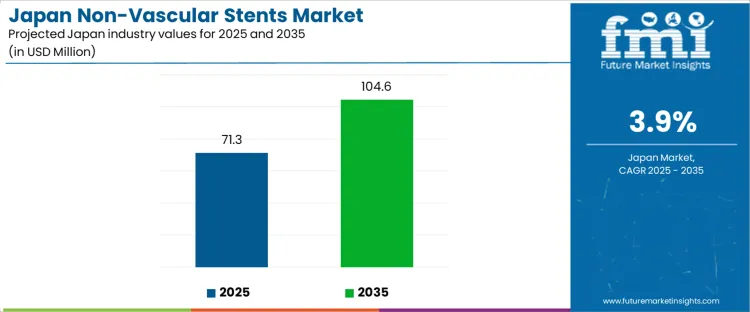
Demand for non-vascular stents in Japan is expected to grow from USD 71.3 million in 2025 to USD 104.6 million by 2035, reflecting a compound annual growth rate (CAGR) of 3.9%. Growth is driven by the increasing prevalence of chronic conditions such as gastrointestinal and biliary diseases, which require non-vascular stenting interventions. Non-vascular stents are crucial in maintaining open passageways in various parts of the body, including the esophagus, bile ducts, and airways. As the healthcare system increasingly focuses on minimally invasive treatments, the adoption of non-vascular stents is expected to rise, particularly for managing obstructive diseases and improving patient outcomes.
Growth is supported by technological advancements in stent materials and design, which enhance the safety and effectiveness of these devices. Japan’s aging population, which is more susceptible to chronic diseases requiring stent interventions, will further contribute to the growing demand for non-vascular stents. Rising healthcare investments and advancements in interventional techniques are expected to drive market expansion over the next decade.
Quick Stats of the Demand for Non-Vascular Stents in Japan
- Demand for Non-Vascular Stents in Japan Value (2025): USD 71.3 million
- Demand for Non-Vascular Stents in Japan Forecast Value (2035): USD 104.6 million
- Demand for Non-Vascular Stents in Japan Forecast CAGR (2025-2035): 3.9%
- Demand for Non-Vascular Stents in Japan Leading Material: Metal Stents (51.4%)
- Demand for Non-Vascular Stents in Japan Key Growth Regions: Kyushu & Okinawa, Kanto, Kansai, Chubu, Tohoku, Rest of Japan
- Demand for Non-Vascular Stents in Japan Key Players: Boston Scientific Corporation, Becton, Dickinson and Company (BD), Medtronic, Cook Medical, CONMED Corporation
What is the Growth Forecast for the Non-Vascular Stents Industry through 2035?
The contribution of volume vs price growth for the non-vascular stents industry in Japan shows that volume growth will play a significant role, but price growth will begin to contribute more as the market matures. Starting at USD 71.3 million in 2025, the market increases gradually in the early years, reaching USD 74.1 million in 2026 and USD 77.0 million in 2027. This early phase is primarily driven by volume growth, as the adoption of non-vascular stents expands across healthcare facilities.
As market progresses, volume growth continues to drive market demand, reaching USD 80.0 million in 2028, USD 83.1 million in 2029, and USD 86.4 million in 2030. During this phase, the adoption of stents continues to rise, with a larger patient base and increasing use of advanced stent technologies. By 2031, price growth becomes more significant, with the market reaching USD 89.7 million, driven by higher-value stents with improved features and higher pricing for advanced materials and designs.
By 2035, the industry will reach USD 104.6 million, with both volume and price growth contributing to the overall increase. The contribution of price growth becomes more prominent in the later years as more advanced and specialized non-vascular stents, such as drug-eluting and bioresorbable stents, enter the market, commanding higher prices.
Key Takeaways of Non-Vascular Stents Industry in Japan
| Metric | Value |
|---|---|
| Industry Sales Value (2025) | USD 71.3 million |
| Industry Forecast Value (2035) | USD 104.6 million |
| Industry Forecast CAGR (2025-2035) | 3.9% |
What Is Driving the Demand for Non Vascular Stents in Japan?
Increasing medical need for treatments beyond cardiovascular interventions has shaped demand for non-vascular stents in Japan. Non-vascular stents are used in passages and ducts outside the vascular system, such as gastrointestinal, biliary, urinary, or airway tracts. Demand for these stents has been rising globally due to the growing prevalence of chronic diseases that cause obstructions in various bodily passages. In Japan, an aging population and a higher incidence of conditions requiring minimally invasive treatments support the use of non-vascular stents. Japan's healthcare infrastructure and preference for less invasive procedures contribute to the adoption of stents in cases where traditional surgery would otherwise be necessary.
Future demand for non-vascular stents in Japan is expected to increase as the population ages and the prevalence of chronic conditions rises. Obstructions in the gastrointestinal, biliary, urinary, and airway systems are likely to become more common, increasing the need for non-vascular stent procedures. Innovations in stent design, such as self-expanding metal stents and drug-eluting stents, may improve patient outcomes and safety, further driving demand. As chronic disease burdens rise and demand for minimally invasive care continues to grow, Japan is expected to see further adoption of non-vascular stents across various medical specialties.
What Are the Key Segments in Non-Vascular Stents Industry in Japan?
The non-vascular stents market in Japan is segmented by product type and material. Biliary stents lead the product type segment, holding 34% of the market share. In terms of material, metal stents dominate, accounting for 51.4% of the market. The increasing prevalence of conditions such as biliary obstructions, esophageal cancer, and chronic obstructive pulmonary disease (COPD) is driving the demand for non-vascular stents in Japan.
Which Product Type Drives Non-Vascular Stents Demand in Japan?
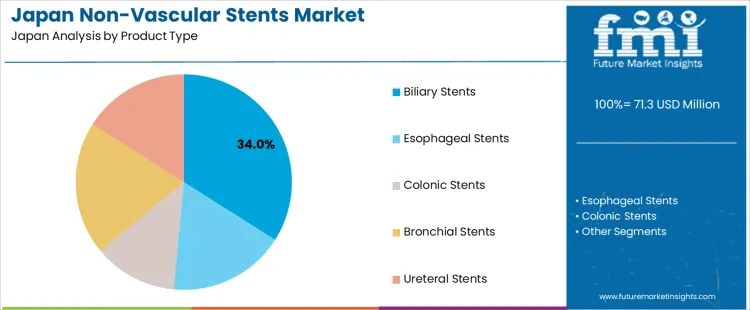
Biliary stents are the most widely used type of non-vascular stents in Japan, accounting for 34% of the market share. These stents are primarily used to treat biliary obstruction, which can occur in conditions such as gallstones, pancreatic cancer, or liver diseases. Biliary stents help maintain bile duct patency and alleviate symptoms like jaundice, improving patients' quality of life. Aging population and the rising incidence of liver and pancreatic diseases drive the demand for biliary stents in Japan. Other stent types, such as esophageal stents, colonic stents, bronchial stents, and ureteral stents, are also used but to a lesser extent. Despite the importance of other non-vascular stents, biliary stents remain the most widely used due to the frequency of biliary obstruction in Japan’s aging population.
Which Material Drives Non-Vascular Stents Demand in Japan?
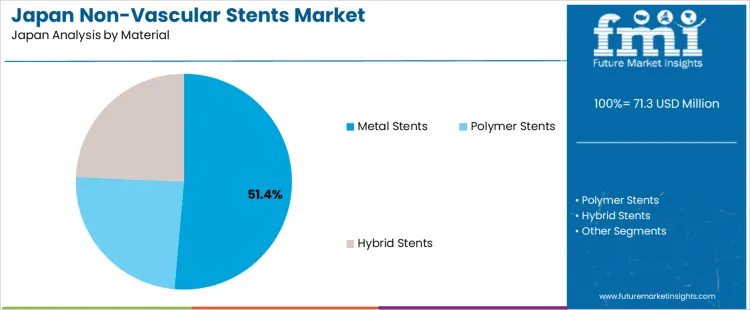
Metal stents dominate the material segment for non-vascular stents in Japan, representing 51.4% of the market share. Metal stents, made from materials such as stainless steel, nitinol, or cobalt-chromium alloys, are preferred for their strength, flexibility, and radiopacity, which is essential for visibility during the procedure. These stents are highly durable, ensuring long-term patency in patients' ducts or vessels. The use of metal in stents ensures the structural integrity needed to prevent stent fracture or collapse, which is crucial for patient safety and treatment efficacy. While polymer stents and hybrid stents also have applications in non-vascular procedures, metal stents remain the preferred choice due to their superior mechanical properties and long-term reliability in critical applications such as biliary, esophageal, and bronchial stenting.
What is the Demand for Non-Vascular Stents in Japan?
Demand for non-vascular stents in Japan is rising as these devices play a crucial role in treating various medical conditions outside of the vascular system, including the gastrointestinal tract, urinary system, and bile ducts. Non-vascular stents are primarily used to maintain the patency of tubes or passages that have become obstructed or narrowed due to disease or injury. As the prevalence of conditions such as cancer, urological diseases, and gastrointestinal disorders increases, the demand for non-vascular stents is expected to grow. Advances in stent technology and materials further contribute to their adoption in Japan's healthcare market.
What are the Drivers of Demand for Non-Vascular Stents in Japan?
Several factors are driving the demand for non-vascular stents in Japan. Rising incidence of diseases such as cancers of the esophagus, colon, liver, and bile ducts, as well as conditions like benign prostatic hyperplasia (BPH) and kidney stones, is contributing to the need for non-vascular stents. Aging population in Japan is increasing the demand for medical interventions to treat age-related conditions, including those that affect the gastrointestinal and urinary systems. Advancements in stent design, such as the development of bioresorbable and drug-eluting stents, have made these devices more effective and suitable for longer-term use. Growing preference for minimally invasive procedures, which offer quicker recovery times and reduced hospital stays, is driving the adoption of non-vascular stents in Japan.
What are the Restraints on Demand for Non-Vascular Stents in Japan?
Despite the growing demand, several factors may limit the adoption of non-vascular stents in Japan. One key restraint is the high cost of these devices, which may be a barrier for patients and healthcare providers, particularly in underfunded healthcare settings. Another challenge is the risk of complications associated with stent placement, such as infection, migration, or restenosis, which could require additional interventions. Additionally, some patients may experience discomfort or adverse reactions to the materials used in non-vascular stents, which could reduce their acceptance and use. Furthermore, the limited availability of certain types of stents or specialized devices in some regions could affect the accessibility of treatment.
What are the Key Trends Influencing Demand for Non-Vascular Stents in Japan?
Several key trends are shaping the demand for non-vascular stents in Japan. One significant trend is the growing use of bioresorbable and drug-eluting stents, which offer improved performance and lower the risk of complications compared to traditional stents. Another trend is the increasing adoption of minimally invasive procedures, which reduce recovery time, minimize patient discomfort, and make stent placement less invasive. Additionally, the rise in the number of chronic diseases, particularly among the elderly, is driving demand for non-vascular stents as these conditions often require ongoing management. The increasing focus on patient outcomes and the desire for longer-lasting solutions are also encouraging the use of advanced stent technologies in Japan's healthcare system. Integration of new materials and technologies into stent designs, such as biocompatible coatings and resorbable components, is likely to increase the adoption of non-vascular stents in the country.
What is the Regional Demand Outlook for the Non-Vascular Stents Market in Japan?
The Non-Vascular Stents market in Japan is projected to grow steadily, with Kyushu & Okinawa leading the way at a projected CAGR of 4.9%. Kanto follows closely with a growth rate of 4.5%, while Kansai is expected to grow at 3.9%. Chubu is projected to grow at a rate of 3.5%, while Tohoku and Rest of Japan show more moderate growth, with CAGRs of 3.0% and 2.9%, respectively. Non-vascular stents, used for treating conditions such as biliary obstructions, ureteral blockages, and other non-vascular diseases, are in demand due to the growing incidence of these conditions and the increasing preference for minimally invasive treatments.
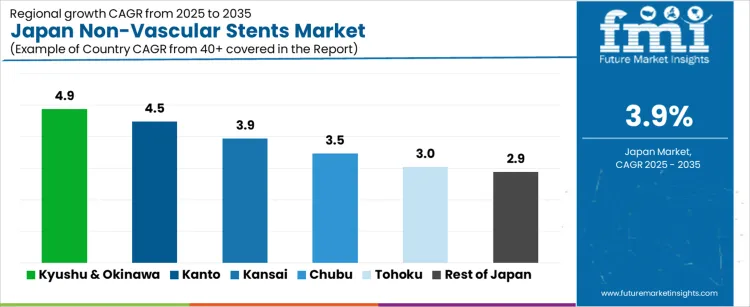
| Region | CAGR (2025-2035) |
|---|---|
| Kyushu & Okinawa | 4.9% |
| Kanto | 4.5% |
| Kansai | 3.9% |
| Chubu | 3.5% |
| Tohoku | 3% |
| Rest of Japan | 2.9% |
What is Driving the Growth of Non-Vascular Stents in Kyushu & Okinawa?
Kyushu & Okinawa is projected to experience the highest growth in the Non-Vascular Stents market, with a projected CAGR of 4.9%. The region’s increasing prevalence of non-vascular conditions requiring stent placements, particularly in the biliary and urological systems, is a key driver of this growth. Kyushu & Okinawa has a significant elderly population, which is more prone to conditions like kidney disease, bile duct obstructions, and ureteral blockages, further driving the demand for non-vascular stents. Healthcare providers in the region are increasingly adopting minimally invasive procedures, such as endoscopic stent placements, as part of their treatment offerings. Additionally, the region’s growing healthcare infrastructure and focus on improving patient care through advanced medical technologies are expected to contribute to the rising demand for non-vascular stents in the coming years.
Why is the Non-Vascular Stents Market Expanding in Kanto?
In Kanto, the demand for non-vascular stents is projected to grow at a CAGR of 4.5%. The region, home to Tokyo, is one of Japan’s most developed areas in terms of healthcare infrastructure and medical technology adoption. The large population in Kanto, coupled with a high incidence of non-vascular conditions, such as obstructed bile ducts and kidney issues, is driving the adoption of non-vascular stents. The increasing awareness of the benefits of minimally invasive treatments, which offer reduced recovery times and fewer complications compared to traditional surgical methods, is contributing to the demand for these stents. Additionally, Kanto’s focus on improving the quality of care and providing efficient treatment solutions is further fueling the market for non-vascular stents.
How is the Non-Vascular Stents Market Growing in Kansai?
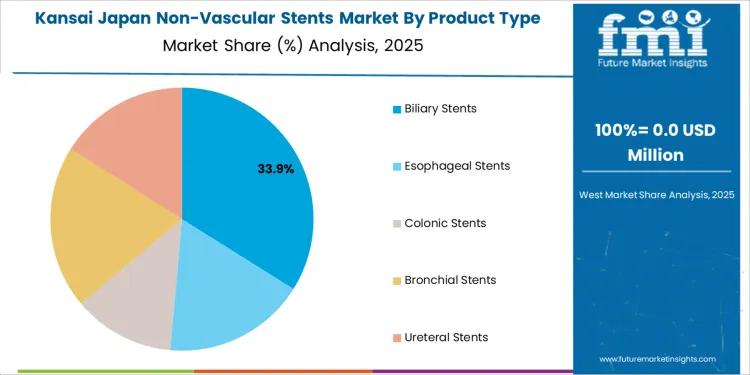
In Kansai, the Non-Vascular Stents market is projected to grow at a CAGR of 3.9%. The region, which includes major cities like Osaka and Kyoto, has a well-established healthcare system with an increasing number of medical facilities offering minimally invasive procedures. The rise in the elderly population in Kansai is contributing to the demand for non-vascular stents, particularly for treating conditions like biliary obstructions and kidney blockages. With advancements in endoscopic technologies, healthcare providers in Kansai are increasingly using stents as part of treatment plans for non-vascular conditions. The growing awareness of the benefits of these devices in reducing recovery time and improving treatment outcomes is also supporting the market’s growth. As the healthcare system in Kansai continues to prioritize patient-centered care, the demand for non-vascular stents is expected to rise steadily.
What is Contributing to the Growth of Non-Vascular Stents in Chubu?
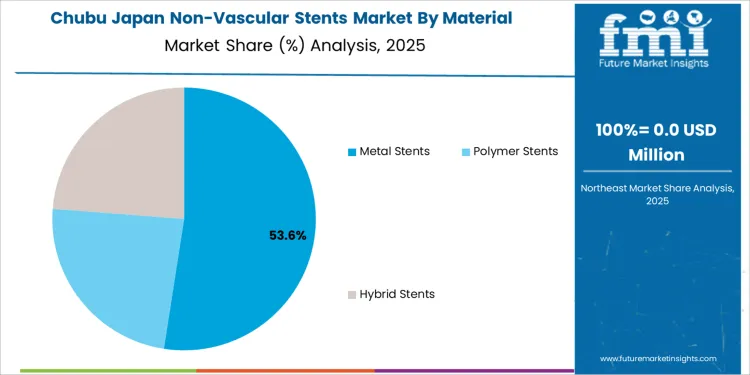
In Chubu, the Non-Vascular Stents market is expected to grow at a CAGR of 3.5%. The region, which includes cities like Nagoya, is seeing an increasing demand for non-vascular stents as healthcare providers embrace minimally invasive treatments for conditions such as bile duct obstructions, kidney blockages, and other urological diseases. Chubu’s healthcare systems are investing in advanced diagnostic and treatment technologies, which support the use of stents in treating these conditions. The region’s aging population, which is more susceptible to non-vascular diseases, is also contributing to the market growth. As awareness of the benefits of stent use increases and more patients seek minimally invasive treatment options, the market for non-vascular stents in Chubu is expected to expand.
What is Influencing the Growth of Non-Vascular Stents in Tohoku?
In Tohoku, the Non-Vascular Stents market is projected to grow at a CAGR of 3.0%. While the growth rate is slower compared to other regions, the increasing prevalence of non-vascular diseases and the adoption of minimally invasive treatments are contributing to the market’s expansion. Tohoku’s healthcare providers are increasingly adopting stents for the treatment of conditions such as bile duct obstructions and kidney issues, particularly in older populations. Additionally, the region’s focus on improving access to healthcare, especially in rural areas, is driving the use of advanced treatments like non-vascular stents. As more patients in Tohoku seek effective and less invasive treatment options, the demand for non-vascular stents is expected to grow, albeit at a slower pace compared to other parts of Japan.
What is Contributing to the Growth of Non-Vascular Stents in Rest of Japan?
In Rest of Japan, the Non-Vascular Stents market is expected to grow at a more moderate rate of 2.9%. Although the market in this region is smaller compared to major urban areas, the growing awareness of minimally invasive treatments and the rising incidence of non-vascular conditions are supporting the adoption of non-vascular stents. Healthcare providers in Rest of Japan are gradually incorporating these devices into their treatment options to improve patient outcomes and reduce recovery times. As the demand for efficient, cost-effective medical treatments increases in these regions, the market for non-vascular stents is expected to continue growing at a steady, though moderate, pace.
What is the Competitive Landscape for Demand for Non Vascular Stents in Japan?
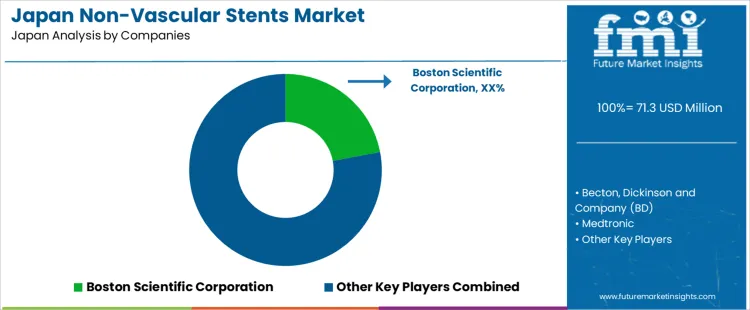
Demand for non vascular stents in Japan has been rising as a result of increasing incidence of gastrointestinal, biliary, and other non vascular disorders requiring minimally invasive interventions. Non vascular stents — used in ducts and lumens such as the esophagus, bile ducts, intestines, ureters or airways — are increasingly preferred over invasive surgery because they reduce recovery time, lower procedural risk, and offer palliative or therapeutic relief for conditions like cancers, strictures, or obstructions. Aging demographics, a higher prevalence of digestive tract diseases, and growing adoption of endoscopic and endoluminal treatments in Japanese hospitals are driving this trend. In recent years non vascular stents have been the fastest growing segment within the overall stents market in Japan.
On the supply side, a handful of global medical device firms dominate the market. According to your list, Boston Scientific Corporation holds a substantial share (around 22 %), with other major competitors including Becton, Dickinson and Company (BD), Medtronic, Cook Medical, and CONMED Corporation. These companies offer a range of non vascular stents — gastrointestinal, biliary, urological, airway — with different materials (metallic, polymer, self expandable, covered, drug coated) tailored to specific clinical needs. Competition among them is driven by product innovation (for example biocompatible coatings, self expandable designs, and advanced delivery systems), compatibility with endoscopic technologies, clinical evidence of safety and efficacy, and ability to meet Japanese regulatory standards. Firms that deliver high quality, reliable, and advanced non vascular stents with strong support and distribution in Japan are best positioned to benefit as demand continues to rise for minimally invasive treatments across GI, biliary, urology and pulmonary specialties.
Key Players of the Non-Vascular Stents Industry in Japan
- Boston Scientific Corporation
- Becton, Dickinson and Company (BD)
- Medtronic
- Cook Medical
- CONMED Corporation
Scope of the Report
| Items | Details |
|---|---|
| Quantitative Units | USD Million |
| Regions Covered | Japan |
| Product Type | Biliary Stents; Esophageal Stents; Colonic Stents; Bronchial Stents; Ureteral Stents |
| Material | Metal Stents; Polymer (Plastic) Stents; Hybrid Stents (metal + polymer / coated) |
| Application | Malignant Obstructions; Benign Obstructions; Palliative Care / Obstruction Relief / Stricture Management |
| Technology | Self Expanding Stents; Balloon Expandable Stents; Drug Eluting Stents; Biodegradable/Bioresorbable Stents; Anti Reflux / Covered Stents |
| End User | Hospitals; Specialty Clinics; Ambulatory Surgical Centers (ASCs) / Outpatient Endoscopy Clinics |
| Key Companies Profiled | Boston Scientific Corporation; Becton, Dickinson & Company (BD); Medtronic; Cook Medical; CONMED Corporation |
| Additional Attributes | Dollar sales by product type and application show that non vascular stents are the fastest growing segment in the overall Japanese stents market, reflecting rising demand for minimally invasive endoscopic and interventional procedures in GI, biliary, urology, and pulmonary tracts. Metal stents remain dominant but polymer/covered/plastic stents — especially self expanding and drug eluting types — are gaining share, driven by demand for better patient comfort, lower migration risk, and repeat procedure avoidance in benign and malignant obstructions. Growth is supported by Japan’s ageing population, rising incidence of cancers & benign strictures, and increased use of palliative interventions instead of surgery. |
Key Segments in the Demand for Non-Vascular Stents in Japan
Product Type:
- Biliary Stents
- Esophageal Stents
- Colonic Stents
- Bronchial Stents
- Ureteral Stents
Material:
- Metal Stents
- Polymer Stents
- Hybrid Stents
Application:
- Malignant Obstructions
- Benign Obstructions
- Palliative Care
Technology:
- Self Expanding Stents
- Balloon Expandable Stents
- Drug Eluting Stents
- Biodegradable / Bioresorbable Stents
- Anti Reflux Stents
End User
- Hospitals
- Specialty Clinics
- Ambulatory Surgical Centers (ASCs)
Region
- Kyushu & Okinawa
- Kanto
- Kansai
- Chubu
- Tohoku
- Rest of Japan
Frequently Asked Questions
How big is the demand for non-vascular stents in Japan in 2025?
The demand for non-vascular stents in Japan is estimated to be valued at USD 71.3 million in 2025.
What will be the size of non-vascular stents in Japan in 2035?
The market size for the non-vascular stents in Japan is projected to reach USD 104.6 million by 2035.
How much will be the demand for non-vascular stents in Japan growth between 2025 and 2035?
The demand for non-vascular stents in Japan is expected to grow at a 3.9% CAGR between 2025 and 2035.
What are the key product types in the non-vascular stents in Japan?
The key product types in non-vascular stents in Japan are biliary stents, esophageal stents, colonic stents, bronchial stents and ureteral stents.
Which material segment is expected to contribute significant share in the non-vascular stents in Japan in 2025?
In terms of material, metal stents segment is expected to command 51.4% share in the non-vascular stents in Japan in 2025.
Preview the report firsthand - request a free sample
Get SampleGet the brochure for pricing and purchase details.
Get PDFTable of Content
- Executive Summary
- Japan Market Outlook
- Demand-side Trends
- Supply-side Trends
- Technology Roadmap Analysis
- Analysis and Recommendations
- Market Overview
- Market Coverage / Taxonomy
- Market Definition / Scope / Limitations
- Market Background
- Market Dynamics
- Drivers
- Restraints
- Opportunity
- Trends
- Scenario Forecast
- Demand in Optimistic Scenario
- Demand in Likely Scenario
- Demand in Conservative Scenario
- Opportunity Map Analysis
- Product Life Cycle Analysis
- Supply Chain Analysis
- Investment Feasibility Matrix
- Value Chain Analysis
- PESTLE and Porter’s Analysis
- Regulatory Landscape
- Regional Parent Market Outlook
- Production and Consumption Statistics
- Import and Export Statistics
- Market Dynamics
- Japan Market Analysis 2020 to 2024 and Forecast, 2025 to 2035
- Historical Market Size Value (USD Million) Analysis, 2020 to 2024
- Current and Future Market Size Value (USD Million) Projections, 2025 to 2035
- Y-o-Y Growth Trend Analysis
- Absolute $ Opportunity Analysis
- Japan Market Pricing Analysis 2020 to 2024 and Forecast 2025 to 2035
- Japan Market Analysis 2020 to 2024 and Forecast 2025 to 2035, By Product Type
- Introduction / Key Findings
- Historical Market Size Value (USD Million) Analysis By Product Type , 2020 to 2024
- Current and Future Market Size Value (USD Million) Analysis and Forecast By Product Type , 2025 to 2035
- Biliary Stents
- Esophageal Stents
- Colonic Stents
- Bronchial Stents
- Ureteral Stents
- Y-o-Y Growth Trend Analysis By Product Type , 2020 to 2024
- Absolute $ Opportunity Analysis By Product Type , 2025 to 2035
- Japan Market Analysis 2020 to 2024 and Forecast 2025 to 2035, By Material
- Introduction / Key Findings
- Historical Market Size Value (USD Million) Analysis By Material, 2020 to 2024
- Current and Future Market Size Value (USD Million) Analysis and Forecast By Material, 2025 to 2035
- Metal Stents
- Polymer Stents
- Hybrid Stents
- Y-o-Y Growth Trend Analysis By Material, 2020 to 2024
- Absolute $ Opportunity Analysis By Material, 2025 to 2035
- Japan Market Analysis 2020 to 2024 and Forecast 2025 to 2035, By Application
- Introduction / Key Findings
- Historical Market Size Value (USD Million) Analysis By Application, 2020 to 2024
- Current and Future Market Size Value (USD Million) Analysis and Forecast By Application, 2025 to 2035
- Malignant Obstructions
- Benign Obstructions
- Palliative Care
- Y-o-Y Growth Trend Analysis By Application, 2020 to 2024
- Absolute $ Opportunity Analysis By Application, 2025 to 2035
- Japan Market Analysis 2020 to 2024 and Forecast 2025 to 2035, By Technology
- Introduction / Key Findings
- Historical Market Size Value (USD Million) Analysis By Technology, 2020 to 2024
- Current and Future Market Size Value (USD Million) Analysis and Forecast By Technology, 2025 to 2035
- Self-Expanding Stents
- Balloon-Expandable Stents
- Drug-Eluting Stents
- Biodegradable/Bioresorbable Stents
- Anti-Reflux Stents
- Y-o-Y Growth Trend Analysis By Technology, 2020 to 2024
- Absolute $ Opportunity Analysis By Technology, 2025 to 2035
- Japan Market Analysis 2020 to 2024 and Forecast 2025 to 2035, By End User
- Introduction / Key Findings
- Historical Market Size Value (USD Million) Analysis By End User, 2020 to 2024
- Current and Future Market Size Value (USD Million) Analysis and Forecast By End User, 2025 to 2035
- Hospitals
- Specialty Clinics
- Ambulatory Surgical Centers (ASCs)
- Y-o-Y Growth Trend Analysis By End User, 2020 to 2024
- Absolute $ Opportunity Analysis By End User, 2025 to 2035
- Market Structure Analysis
- Competition Dashboard
- Competition Benchmarking
- Market Share Analysis of Top Players
- By Regional
- By Product Type
- By Material
- By Application
- By Technology
- By End User
- Competition Analysis
- Competition Deep Dive
- Boston Scientific Corporation
- Overview
- Product Portfolio
- Profitability by Market Segments (Product/Age /Sales Channel/Region)
- Sales Footprint
- Strategy Overview
- Marketing Strategy
- Product Strategy
- Channel Strategy
- Becton, Dickinson and Company (BD)
- Medtronic
- Cook Medical
- CONMED Corporation
- Boston Scientific Corporation
- Competition Deep Dive
- Assumptions & Acronyms Used
- Research Methodology


