

- Industry Size (2026)
- USD 70.8 Mn
- Forecast (2036)
- USD 102.3 Mn
- CAGR (2026 to 2036)
- 3.8%
Demand for Egg-Free Dressing in Japan Forecast and Outlook 2026 to 2036
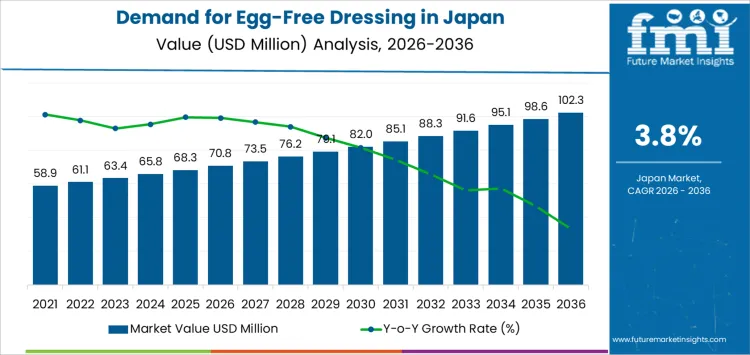
The demand for egg free dressing in Japan is valued at USD 70.8 million in 2026 and is projected to reach USD 102.3 million by 2036, reflecting a CAGR of 3.8%. The rise from USD 56.8 million in 2020 to USD 70.8 million in 2026 is supported by steady use across food service channels and a gradual increase in household purchases. Ranch and vinaigrette types hold the largest shares, while bulk formats dominate due to high institutional consumption. Early demand follows menu standardization and consistent procurement cycles.
From 2027 onward, values increase from USD 73.5 million to USD 85.1 million by 2031, then reach USD 102.3 million by 2036 through measured yearly gains. Food service remains the main driver as restaurants expand egg free options. Household demand grows gradually with wider retail availability of Caesar, blue cheese, and Thousand Island variants. Industrial buyers maintain limited but stable intake for prepared foods. B2B channels remain dominant, with online retailing contributing moderate growth. Long term movement reflects substitution patterns, procurement consistency, and incremental product diversification across Japan.
Quick Stats of the Demand for Egg Free Dressing in Japan:
- Demand for Egg Free Dressing in Japan Value (2026): USD 70.8 million
- Demand for Egg Free Dressing in Japan Forecast Value (2036): USD 102.3 million
- Demand for Egg Free Dressing in Japan Forecast CAGR (2026–2036): 3.8%
- Demand for Egg Free Dressing in Japan Leading Type: Ranch Dressing (30%)
- Demand for Egg Free Dressing in Japan Key Growth Regions: Kyushu & Okinawa, Kanto, Kansai
- Demand for Egg Free Dressing in Japan Top Players: Kewpie, Ajinomoto, Unilever, Kraft Heinz, Dr Oetker, American Garden
What is the Growth Forecast for Egg-Free Dressing in Japan through 2036?
Between 2026 and 2031, demand for egg-free dressing in Japan rises from USD 70.8 million to USD 82.0 million, showing a steady but moderate expansion pattern. Growth during this phase reflects a controlled increase in health-oriented food purchases, gradual menu diversification in retail meal solutions, and measured adoption among manufacturers seeking allergen-reduced product lines. The pace remains consistent rather than sharp, indicating a stable progression influenced primarily by incremental category expansion and consumer trial behavior.
From 2031 to 2036, demand increases from USD 82.0 million to USD 102.3 million, marking a more noticeable acceleration. Growth strengthens as product developers broaden formulation ranges, foodservice channels expand allergen-friendly offerings, and private label categories adopt egg-free variants more systematically. The expansion profile shifts from moderate to firm as distribution widens and established consumers demonstrate higher repeat purchasing. This creates a clearer upward trajectory compared to the earlier, more measured phase.
Egg Free Dressing Industry in Japan Key Takeaways
| Metric | Value |
|---|---|
| Industry Value (2026) | USD 70.8 million |
| Forecast Value (2036) | USD 102.3 million |
| Forecast CAGR (2026–2036) | 3.8% |
What Is Driving the Demand for Egg-Free Dressings in Japan from 2026 to 2036?
Demand for egg-free dressings in Japan has grown as health and dietary preferences shift toward plant-based and allergen-free foods. Consumers increasingly seek options that avoid eggs due to allergy concerns and lifestyle choices that favour plant-forward diets. Japan’s overall salad dressing market has shown rising interest in health-oriented variants such as low fat, low sodium, and alternatives to traditional egg-based products. Manufacturers and retailers are responding with formulations that replace eggs using plant proteins or emulsifiers that mimic texture and mouthfeel. This segment supports broader sales of ready-to-use condiments in supermarkets, convenience stores, and online grocery channels.
From 2026 to 2036 demand for egg-free dressings in Japan is expected to strengthen under continued consumer awareness of food allergies and growth in vegan or flexitarian eating patterns. Producers innovate with plant-based ingredients such as pulses, oil emulsions, and natural thickeners to improve flavour, stability, and shelf life. Expanded distribution through retail and foodservice channels supports broader accessibility. Demand also aligns with global trends in clean label and sustainable food products, driving incremental uptake over other condiment types. Regulatory emphasis on allergen labelling and food safety encourages clear communication about egg-free status, aiding consumer confidence. Growth will depend on how well producers balance taste, texture, and ingredient cost in formulations that meet evolving preferences nationwide.
What Is the Demand for Egg-Free Dressing in Japan by Type and Application for 2026 to 2036?
The demand for egg-free dressing in Japan from 2026 to 2036 is shaped by wider adoption of plant-based foods, allergy-sensitive menu planning, and steady growth in prepared salad offerings across retail and food service. Ranch dressing leads by type as its flavor profile aligns well with fast-service menus and packaged salads. Food service leads by application because restaurants, cafés, and ready-meal producers rely on allergen-safe dressings with consistent batch performance. Procurement is driven by condiment manufacturers, contract kitchens, and packaged food producers. Import reliance remains present for plant-based stabilizers. Demand stability is supported by expanding menu diversity and reformulated dressing lines.
Why does ranch dressing account for 30% of the demand for egg-free dressing in Japan by type from 2026 to 2036?
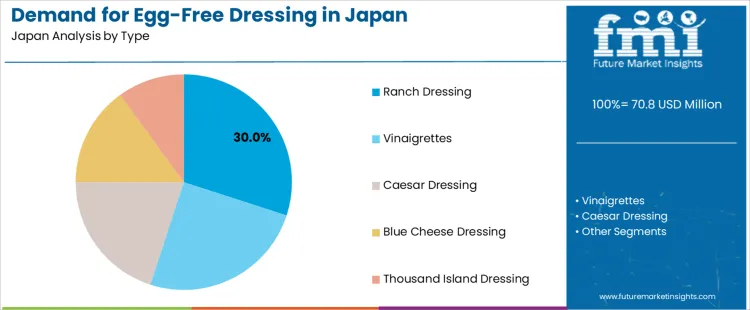
Ranch dressing accounts for 30% of the demand for egg-free dressing in Japan by type because its creamy profile remains suitable for ready salads, dipping portions, and fast-service menu combinations. Consumption intensity rises across convenience stores and prepared meal suppliers that prefer stable, allergen-friendly formulations. Usage remains steady since plant-based emulsifiers provide the texture expected in ranch formats. Procurement is led by condiment processors who maintain year-round production cycles. Price sensitivity remains moderate as dressing consistency and shelf stability remain priority factors. Specification control emphasizes viscosity, flavor uniformity, pourability, and heat-stable emulsification during distribution.
Ranch dressing maintains predictable demand across 2026 to 2036 as salad kits, deli items, and lunchbox formats continue expanding. Repeat utilization remains steady because food processors reformulate existing SKUs toward egg-free variants without altering familiar taste patterns. Buyers favor formulations compatible with automated filling lines and cold-chain logistics. Margin structure stays stable under contract manufacturing and private label supply. Regulatory exposure centers on allergen labeling and clean ingredient declarations. Import reliance persists for plant-derived thickeners and fermentation-based flavor enhancers. Substitution pressure from vinaigrettes or lighter dressings remains limited where creamy formats remain preferred in commercial food programs.
Why does food service represent 50.0% of the demand for egg-free dressing in Japan by application?
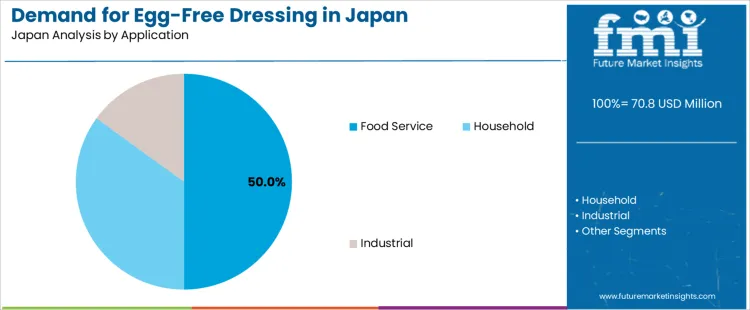
Food service represents 50.0% of the demand for egg-free dressing in Japan by application due to continued menu diversification and reliance on allergen-controlled condiments across restaurants, cafés, and catering operations. Consumption intensity is driven by high-turnover salad bars, sandwich assembly lines, and prepared meal stations that require stable dressings with long hold times. Usage remains consistent because plant-based formulations allow operators to standardize recipes across sites. Procurement is led by bulk buyers focusing on packaging sizes that support low-waste dispensing. Price sensitivity remains moderate as shelf life and handling performance guide selection. Specification control focuses on microbial stability, viscosity retention, and flavor carry-through in mixed dishes.
Food service demand remains consistent across 2026 to 2036 as operators continue adapting to dietary preferences and allergen-free menu commitments. Repeat utilization stays predictable because dressings are consumed across daily service cycles. Buyers favor products that maintain texture after refrigeration and multiple handling steps. Margin structure remains steady under distributor-driven supply networks. Regulatory exposure involves food safety controls and ingredient traceability. Import reliance persists for specialized flavor compounds and plant-based emulsifiers. Substitution pressure from household or industrial channels remains limited because food service settings depend on bulk formats tailored for high-frequency kitchen use.
What Is Driving the Demand for Egg-Free Dressing in Japan Across Retail, Foodservice, and Allergy-Conscious Households?
Demand for egg-free dressing in Japan increases through rising food allergy awareness, shifting household diets, and expanding convenience-store salad offerings. Parents look for allergen-safe options for school lunches, where strict allergy protocols require clear labeling. Restaurants and deli counters adopt egg-free formulas to reduce cross-contact risk and simplify menu management. Younger consumers explore plant-forward eating, favoring dressings with lighter mouthfeel that match vegetable-centric meals. Manufacturers highlight stable emulsification under refrigeration, which suits Japan’s chilled distribution network. Demand reflects practical allergy management, evolving meal composition, and retail emphasis on inclusive product ranges rather than global vegan trends.
How Are Schools, Hospitals, and Prepared Meal Suppliers Shaping Egg-Free Dressing Use in Japan?
Schools and hospitals across Japan maintain precise allergen control procedures, leading kitchens to prefer dressings without eggs for mixed-use salad bars and bento components. Central kitchens for convenience stores and supermarkets rely on formulations that withstand cold-chain logistics without separation. Prepared meal suppliers integrate egg-free options to unify recipes across regions with differing allergy policies. Shelf-life predictability and batch consistency remain central to procurement decisions. Demand intensifies where standardized menus reduce operational complexity and ensure broad dietary compatibility, particularly in institutions that serve large, diverse groups with limited tolerance for allergen-related disruption.
Why Are Home Consumers and Retail Brands Increasing Trials of Egg-Free Dressing in Japan?
Home consumers experiment with egg-free dressing as interest grows in lighter textures, reduced cholesterol intake, and versatile use across Japanese-style salads, cold noodles, and tofu dishes. Retailers promote small-bottle formats for trial without commitment, aligning with Japan’s preference for compact pantry items. Private-label product lines test regional flavor variations such as sesame, shiso, and citrus, each adapted to hold stable emulsification without eggs. Refrigerated aisles highlight allergen-friendly icons that simplify decision-making for parents and seniors. Demand evolves through culinary curiosity, convenience in flavor exploration, and trust in clear labeling rather than through strict adherence to plant-based identities.
What is the Demand for Egg Free Dressing in Japan by Region?
| Region | CAGR (%) |
|---|---|
| Kyushu & Okinawa | 4.7% |
| Kanto | 4.3% |
| Kansai | 3.8% |
| Chubu | 3.3% |
| Tohoku | 2.9% |
| Rest of Japan | 2.8% |
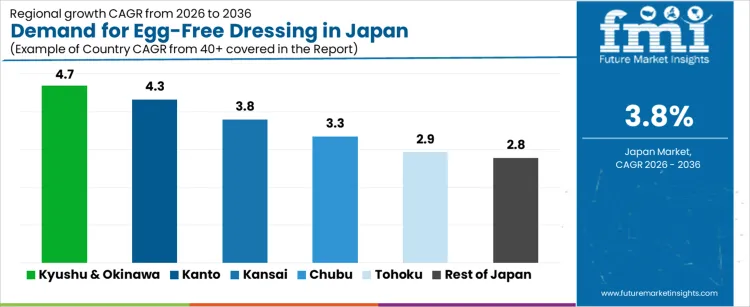
The demand for egg free dressing in Japan is increasing steadily across retail, foodservice, and packaged food manufacturing, led by Kyushu and Okinawa at a 4.7% CAGR. Growth in this region is supported by rising adoption of allergen friendly condiments, greater penetration of plant based formulations, and expanding use in quick service outlets. Kanto follows at 4.3%, driven by dense urban consumption, strong supermarket distribution, and steady incorporation of egg free options in meal kits and convenience foods. Kansai records 3.8% growth, reflecting stable foodservice demand and regional interest in healthier condiments. Chubu at 3.3% shows moderate uptake linked to local food processors and private label product lines. Tohoku and the Rest of Japan, at 2.9% and 2.8%, reflect slower growth shaped by traditional dressing preferences and lower penetration of plant based alternatives.
How Are Plant-Based Preferences Supporting Egg Free Dressing Demand in Kyushu and Okinawa?
Demand for egg free dressing in Kyushu and Okinawa is rising at a CAGR of 4.7% from 2026 to 2036 as households, foodservice operators, and processors incorporate these products into routine consumption patterns. Families adopt egg free dressing for meals that require consistent flavor and convenient handling. Restaurants add these options to salads and side dishes used across varied menu formats. Retailers maintain dependable stock movement supported by steady local purchasing behavior. Food processors integrate egg free dressing into packaged foods that rely on uniform taste profiles. Regional uptake remains firm as daily usage expands in coastal and inland communities.
- Households increase regular usage
- Foodservice adapts menus to flexible condiments
- Retailers support predictable stock rotation
What Factors Influence Egg Free Dressing Usage Trends Across Kanto?
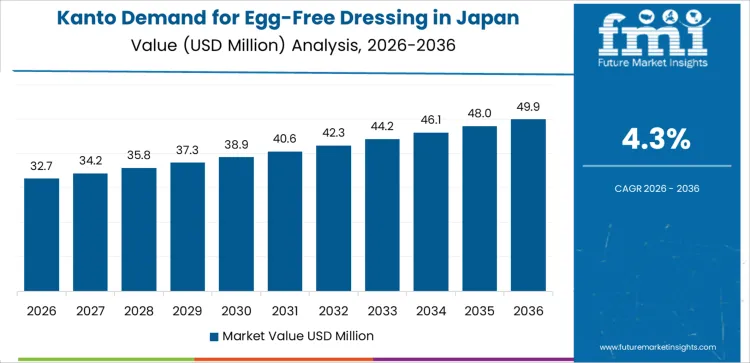
Demand for egg free dressing in Kanto is progressing at a CAGR of 4.3% from 2026 to 2036 with strong support from dense urban consumption and broad retail distribution. Families use egg free dressing in diverse meal routines that emphasize convenience and allergen aware choices. Restaurants incorporate these condiments into salads, sandwiches, and ready to serve dishes that require stable flavor qualities. Retail channels distribute frequent replenishment cycles that match metropolitan buying patterns. Food processors select egg free dressing for packaged items requiring consistent formulation. Growth reflects varied consumer profiles, active retail networks, and reliable product availability across major cities.
- Families maintain steady weekly purchases
- Restaurants integrate dressing into multiple dishes
- Retailers manage high turnover across outlets
How Is Consumer Diversity Shaping Egg Free Dressing Adoption in Kansai?
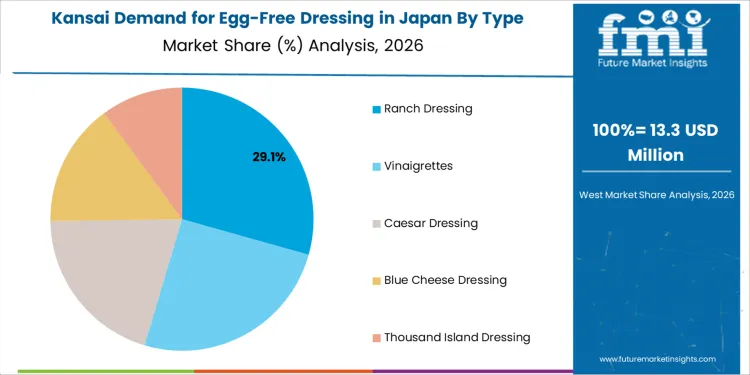
Demand for egg free dressing in Kansai is rising at a CAGR of 3.8% from 2026 to 2036, supported by balanced household use, foodservice participation, and regional purchasing habits. Families include egg free dressing in salads and simple meals that favor familiar taste and straightforward preparation. Restaurants choose egg free condiments for dishes requiring reliable consistency. Retailers sustain continuous stock movement guided by neighborhood level buying patterns. Food producers use egg free dressing for packaged foods where dependable formulation traits are needed. Growth aligns with stable culinary routines and moderate expansion of plant aligned condiments across population centers in the region.
- Families adopt dressing for routine dishes
- Restaurants apply dressing in selected menus
- Retailers sustain stable inventory flow
Which Conditions Support Egg Free Dressing Demand Across Chubu?
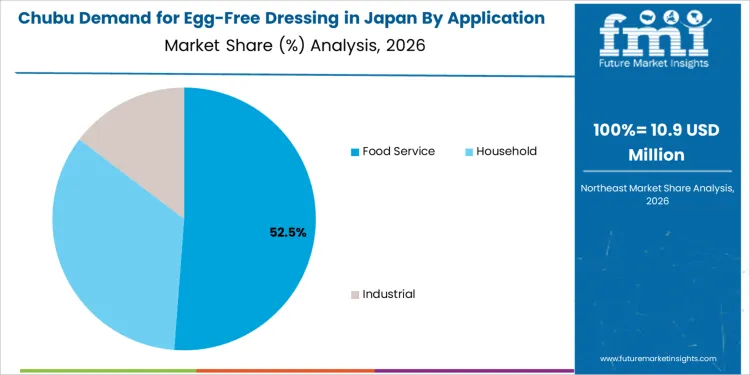
Demand for egg free dressing in Chubu is increasing at a CAGR of 3.3% from 2026 to 2036, reflecting household use, moderate foodservice needs, and selective processor activity. Families rely on egg free dressing for salads and easy to prepare meals where consistent flavor is preferred. Restaurants incorporate these condiments in controlled volumes shaped by menu styles and customer preferences. Retailers maintain measured stock replenishment tied to regional turnover. Food processors use egg free dressing in packaged foods that require steady taste profiles. Uptake remains steady as consumers integrate egg free options into daily routines without major shifts in purchasing.
- Households incorporate dressing into weekly meals
- Restaurants use dressing for targeted menu items
- Retailers handle predictable stock cycles
How Are Local Food Practices Guiding Egg Free Dressing Use in Tohoku?
Demand for egg free dressing in Tohoku is moving at a CAGR of 2.9% from 2026 to 2036, shaped by modest household consumption and selective commercial use. Families use egg free dressing in salads and side dishes that emphasize dependable flavor and simple preparation. Restaurants apply egg free condiments in limited menu items consistent with regional food habits. Retailers follow steady purchasing patterns that reflect local meal routines. Food processors adopt egg free dressing in specific packaged dishes where controlled formulation is needed. Growth remains consistent as households and commercial users maintain regular consumption supported by stable distribution networks.
- Families rely on dressing for simple dishes
- Foodservice uses dressing in limited applications
- Retailers track stable purchasing patterns
What Is Driving the Demand for Egg Free Dressing in Japan and Which Companies Shape Retail and Foodservice Supply?
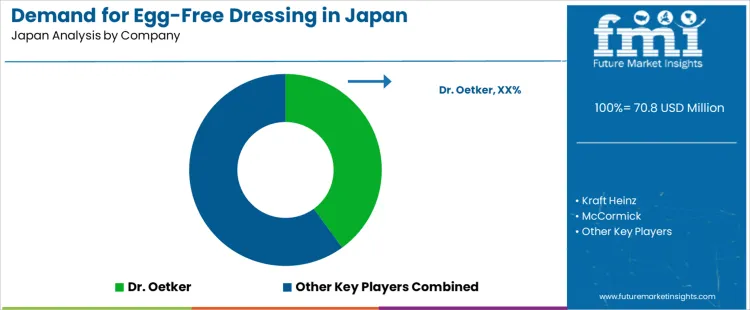
The demand for egg free dressing in Japan is shaped by rising interest in allergen safe products, growth in plant based eating, and wider adoption of stable emulsions for convenience foods. Kewpie and Ajinomoto anchor domestic supply through non egg emulsified dressings used in salads, deli items, and ready meals sold in supermarkets and convenience stores. Unilever participates through global mayonnaise alternatives positioned for consumers seeking lighter or allergen friendly options. Kraft Heinz supports demand through imported and locally adapted dressings used in sandwiches, salads, and home cooking. Dr Oetker contributes through specialty condiments supplied to retailers and selected foodservice operators. American Garden reaches Japan through distributor networks serving international food aisles and imported deli sections.
Food manufacturers rely on egg free dressings for deli salads, bento fillings, and chilled meal kits where heat stability and consistent viscosity are essential. Allergen avoidance remains important for school meal programs and family focused products. Restaurants and cafes adopt egg free options to serve mixed dietary groups, especially in urban centers with diverse consumer preferences. Product selection follows emulsification stability, clean labeling expectations, and compatibility with Japanese flavor profiles such as yuzu, shiso, and miso based variations. Demand visibility tracks growth in plant based product development, health aligned reformulation by major food brands, and steady expansion of allergen conscious purchasing across supermarkets and convenience stores.
Key Players in the Egg Free Dressing Industry in Japan
- Kewpie
- Ajinomoto
- Unilever
- Kraft Heinz
- Dr Oetker
- American Garden
Scope of the Report
| Items | Values |
|---|---|
| Quantitative Units (2026) | USD million |
| Type | Ranch; Vinaigrettes; Caesar; Blue Cheese; Thousand Island |
| Application | Food Service; Household; Industrial |
| Packaging | Bulk; Retail |
| Distribution Channel | B2B; B2C; Online Retailing |
| Regions Covered | Kyushu & Okinawa; Kanto; Kansai; Chubu; Tohoku; Rest of Japan |
| Countries Covered | Japan |
| Key Companies Profiled | Kewpie; Ajinomoto; Unilever; Kraft Heinz; Dr Oetker; American Garden |
| Additional Attributes | Dollar by sales by type and application; packaging format mix and bulk-to-retail dynamics; allergen labeling and compliance requirements; foodservice dispensing and cold-chain handling specifications; formulation stability under refrigeration and repeated handling; private label and contract manufacturing presence; import reliance for plant-based emulsifiers and specialty stabilizers; seasonality in menu-driven demand; distribution logistics tied to convenience store and deli networks. |
Egg Free Dressing Industry in Japan Segmentation
Type:
- Ranch Dressing
- Vinaigrettes
- Caesar Dressing
- Blue Cheese Dressing
- Thousand Island Dressing
Application:
- Food Service
- Household
- Industrial
Packaging:
- Bulk
- Retail
Distribution Channel:
- B2B
- B2C
- Online Retailing
Region
- Kyushu & Okinawa
- Kanto
- Kansai
- Chubu
- Tohoku
- Rest of Japan
Frequently Asked Questions
How big is the demand for egg-free dressing in Japan in 2026?
The demand for egg-free dressing in Japan is estimated to be valued at USD 70.8 million in 2026.
What will be the size of egg-free dressing in Japan in 2036?
The market size for the egg-free dressing in Japan is projected to reach USD 102.3 million by 2036.
How much will be the demand for egg-free dressing in Japan growth between 2026 and 2036?
The demand for egg-free dressing in Japan is expected to grow at a 3.8% CAGR between 2026 and 2036.
What are the key product types in the egg-free dressing in Japan?
The key product types in egg-free dressing in Japan are ranch dressing, vinaigrettes, caesar dressing, blue cheese dressing and thousand island dressing.
Which application segment is expected to contribute significant share in the egg-free dressing in Japan in 2026?
In terms of application, food service segment is expected to command 50.0% share in the egg-free dressing in Japan in 2026.
Preview the report firsthand - request a free sample
Get SampleGet the brochure for pricing and purchase details.
Get PDFTable of Content
- Executive Summary
- Japan Market Outlook
- Demand-side Trends
- Supply-side Trends
- Technology Roadmap Analysis
- Analysis and Recommendations
- Market Overview
- Market Coverage / Taxonomy
- Market Definition / Scope / Limitations
- Market Background
- Market Dynamics
- Drivers
- Restraints
- Opportunity
- Trends
- Scenario Forecast
- Demand in Optimistic Scenario
- Demand in Likely Scenario
- Demand in Conservative Scenario
- Opportunity Map Analysis
- Product Life Cycle Analysis
- Supply Chain Analysis
- Investment Feasibility Matrix
- Value Chain Analysis
- PESTLE and Porter’s Analysis
- Regulatory Landscape
- Regional Parent Market Outlook
- Production and Consumption Statistics
- Import and Export Statistics
- Market Dynamics
- Japan Market Analysis 2021 to 2026 and Forecast, 2026 to 2036
- Historical Market Size Value (USD Million) Analysis, 2021 to 2026
- Current and Future Market Size Value (USD Million) Projections, 2026 to 2036
- Y-o-Y Growth Trend Analysis
- Absolute $ Opportunity Analysis
- Japan Market Pricing Analysis 2021 to 2026 and Forecast 2026 to 2036
- Japan Market Analysis 2021 to 2026 and Forecast 2026 to 2036, By Type
- Introduction / Key Findings
- Historical Market Size Value (USD Million) Analysis By Type , 2021 to 2026
- Current and Future Market Size Value (USD Million) Analysis and Forecast By Type , 2026 to 2036
- Ranch Dressing
- Vinaigrettes
- Caesar Dressing
- Blue Cheese Dressing
- Thousand Island Dressing
- Y-o-Y Growth Trend Analysis By Type , 2021 to 2026
- Absolute $ Opportunity Analysis By Type , 2026 to 2036
- Japan Market Analysis 2021 to 2026 and Forecast 2026 to 2036, By Application
- Introduction / Key Findings
- Historical Market Size Value (USD Million) Analysis By Application, 2021 to 2026
- Current and Future Market Size Value (USD Million) Analysis and Forecast By Application, 2026 to 2036
- Food Service
- Household
- Industrial
- Y-o-Y Growth Trend Analysis By Application, 2021 to 2026
- Absolute $ Opportunity Analysis By Application, 2026 to 2036
- Japan Market Analysis 2021 to 2026 and Forecast 2026 to 2036, By Packaging
- Introduction / Key Findings
- Historical Market Size Value (USD Million) Analysis By Packaging, 2021 to 2026
- Current and Future Market Size Value (USD Million) Analysis and Forecast By Packaging, 2026 to 2036
- Bulk
- Retail
- Y-o-Y Growth Trend Analysis By Packaging, 2021 to 2026
- Absolute $ Opportunity Analysis By Packaging, 2026 to 2036
- Japan Market Analysis 2021 to 2026 and Forecast 2026 to 2036, By Distribution channel
- Introduction / Key Findings
- Historical Market Size Value (USD Million) Analysis By Distribution channel, 2021 to 2026
- Current and Future Market Size Value (USD Million) Analysis and Forecast By Distribution channel, 2026 to 2036
- B2B
- B2C
- Online Retailing
- Y-o-Y Growth Trend Analysis By Distribution channel, 2021 to 2026
- Absolute $ Opportunity Analysis By Distribution channel, 2026 to 2036
- Market Structure Analysis
- Competition Dashboard
- Competition Benchmarking
- Market Share Analysis of Top Players
- By Regional
- By Type
- By Application
- By Packaging
- By Distribution channel
- Competition Analysis
- Competition Deep Dive
- Dr. Oetker
- Overview
- Product Portfolio
- Profitability by Market Segments (Product/Age /Sales Channel/Region)
- Sales Footprint
- Strategy Overview
- Marketing Strategy
- Product Strategy
- Channel Strategy
- Kraft Heinz
- McCormick
- Unilever
- American Garden
- Dr. Oetker
- Competition Deep Dive
- Assumptions & Acronyms Used
- Research Methodology


