

- Industry Size (2026)
- USD 2.03 Bn
- Forecast (2036)
- USD 3.96 Bn
- CAGR (2026 to 2036)
- 6.9%
Demand for Home Beer Brewing Machine in Japan Size, Market Forecast and Outlook By FMI
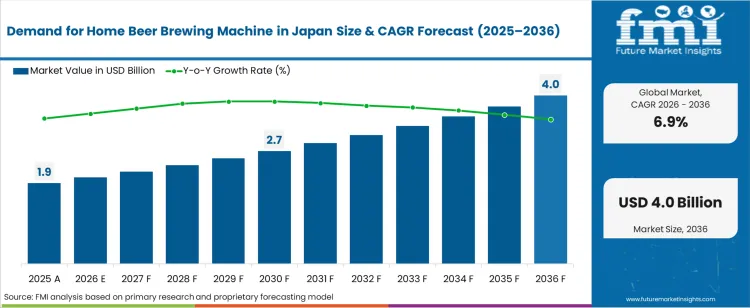
The demand for home beer brewing machine in japan was valued at USD 1.90 billion in 2025, projected to reach USD 2.03 billion in 2026, and is forecast to expand to USD 3.96 billion by 2036 at a 6.9% CAGR. Japan's craft beer culture expansion and the regulatory relaxation of home brewing restrictions are sustaining consumer interest in countertop and full-size home beer brewing machines. The convergence of premiumisation trends in domestic alcohol consumption and the growing availability of ingredient subscription kits is converting casual hobbyist interest into recurring equipment and consumable purchases. Stainless steel construction dominates buyer preferences due to durability requirements and fermentation hygiene standards.
Summary of Demand for Home Beer Brewing Machine in Japan
- Market Snapshot
- The demand for home beer brewing machine in japan is valued at USD 1.90 billion in 2025 and is projected to reach USD 3.96 billion by 2036.
- The industry is expected to grow at a 6.9% CAGR from 2026 to 2036, creating an incremental opportunity of USD 1.93 billion.
- Demand is driven by craft beer culture expansion, regulatory relaxation of home brewing provisions, and rising consumer allocation toward experiential home entertainment categories.
- Demand and Growth Drivers
- Craft beer culture expansion and regulatory relaxation of home brewing provisions are sustaining consumer equipment purchases across urban markets.
- Ingredient subscription kit availability through e-commerce channels is converting hobbyist interest into recurring equipment and consumable revenue.
- Social media platforms promoting craft brewing as a lifestyle activity are accelerating first-time buyer adoption of automated brewing appliances.
- Among tracked regions, Kyushu and Okinawa lead at 8.6% CAGR, followed by Kanto at 7.9%, Kansai at 7.0%, Chubu at 6.1%, Tohoku at 5.4%, and the Rest of Japan at 5.1%.
- Product and Segment View
- The market covers mini brewing systems, full-size brewing systems, and associated fermentation equipment in stainless steel, plastic, and other material constructions.
- Mechanisms span manual, semi-automatic, and fully automatic operation for residential and commercial end users.
- Stainless Steel leads by material with 70.0% share in 2026.
- Residential leads by end user with 55.0% share in 2026.
- The scope includes consumer and small-scale commercial brewing appliances and excludes industrial microbrewery equipment and raw brewing ingredients.
- Geography and Competitive Outlook
- Kyushu, Okinawa, and Kanto are the fastest-growing sub-national markets, driven by craft beer culture and specialty appliance retailer density.
- Kansai and Chubu reflect steady adoption through e-commerce channel expansion and food culture experimentation.
- Competition is shaped by brewing automation capability, app connectivity, and consumer brand recognition, with key players including LG Electronics (HomeBrew), Minibrew, Brewie, PicoBrew, Ss Brewtech.
Demand for Home Beer Brewing Machine in Japan Key Takeaways
| Metric | Details |
|---|---|
| Industry Size (2026) | USD 2.03 billion |
| Industry Value (2036) | USD 3.96 billion |
| CAGR (2026 to 2036) | 6.9% |
Source: Future Market Insights, 2026
The incremental opportunity between 2026 and 2036 amounts to USD 1.93 billion. FMI analysts observe that the growth trajectory reflects rising disposable income allocation toward experiential home entertainment categories and the influence of social media platforms in promoting craft brewing as a lifestyle activity. The automated brewing machine segment is gaining traction among first-time brewers who prioritise convenience over process control, while experienced hobbyists continue to invest in semi-automatic and manual systems offering greater recipe customisation. Residential demand accounts for the majority of unit sales, with commercial adoption concentrated in craft beer bars and small-batch restaurant brewing operations.
Sub-national growth patterns reflect urbanisation density and craft beer culture penetration. Kyushu & Okinawa at 8.6%, Kanto at 7.9%, Kansai at 7.0%, Chubu at 6.1%, Tohoku at 5.4%, Rest of Japan at 5.1%. Kyushu and Okinawa lead due to a strong local craft beer identity and active homebrew community networks. Kanto follows, driven by the Tokyo metropolitan area's concentration of specialty appliance retailers and early-adopter consumer demographics. Kansai benefits from Osaka's food and beverage culture supporting home brewing experimentation, while Chubu and Tohoku reflect incremental adoption through online retail channel expansion.
Demand for Home Beer Brewing Machine in Japan Definition
Home beer brewing machines are consumer and commercial appliances designed to automate or assist the beer brewing process in residential and small-scale commercial settings. The Japan market covers mini brewing systems, full-size brewing systems, and associated fermentation and dispensing equipment constructed from stainless steel, plastic, and other materials. These machines operate through manual, semi-automatic, or fully automatic mechanisms and serve residential home brewers and commercial craft beer establishments.
Demand for Home Beer Brewing Machine in Japan Inclusions
Market scope includes countertop mini brewing appliances, full-size home brewing systems, fermentation vessels, temperature control units, and ingredient dispensing modules. Brewing accessory kits, cleaning systems, and connected app-enabled brewing platforms are included.
Demand for Home Beer Brewing Machine in Japan Exclusions
Commercial microbrewery and industrial brewing equipment exceeding home-scale capacity thresholds are excluded. Beer ingredient kits, raw brewing materials (hops, malt, yeast), and standalone beverage dispensing taps are outside the analytical scope.
Demand for Home Beer Brewing Machine in Japan Research Methodology
- Primary Research: Analysts engaged with procurement managers, facility operators, and distribution channel specialists to map decision triggers, specification requirements, and adoption timelines across institutional and consumer channels.
- Desk Research: Data collection aggregated regulatory filings, public procurement records, industry association publications, and manufacturer financial disclosures to establish baseline market parameters.
- Market-Sizing and Forecasting: Baseline values derive from a bottom-up aggregation of unit shipment data and average selling prices, applying region-specific adoption curves to project forward demand trajectories.
- Data Validation and Update Cycle: Projections are cross-validated against publicly reported financial disclosures from leading manufacturers and verified against distributor sell-through records.
What Is Driving the Demand for Home Beer Brewing Machine in Japan?
The demand for home beer brewing machine in Japan is shaped by craft beer culture, space efficient appliance design, and the appeal of controlled personalization in food and beverages. Historically, beer consumption centered on mass produced lagers served in izakaya and packaged by major breweries. Interest in small batch brewing grew through craft beer bars, regional microbreweries, and seasonal festival culture, which exposed consumers to flavor variation and freshness concepts. Apartment friendly brewing machines lowered technical barriers by automating temperature control, fermentation timing, and sanitation steps within compact formats suited for urban living. Early adopters came from hobbyist communities, gift driven consumers, and households seeking experiential appliances rather than volume production.
Future demand for home beer brewing machine in Japan will be shaped by premium at home experiences, gifting culture, and rising interest in low alcohol and personalized beverage profiles. Consumers show increasing interest in flavor control, ingredient transparency, and small batch freshness aligned with wellness oriented drinking habits. Demand will grow through subscription based ingredient pods, collaborative branding with craft brewers, and seasonal limited recipe programs. Barriers include cleaning workload perception, fermentation odor concerns in small homes, and regulation sensitivity around alcohol production. Price positioning also limits mass adoption beyond hobbyist segments. Long term demand will depend on how effectively these machines balance automation reliability, compact design, and engaging user experience within the disciplined and space conscious Japanese household environment.
What Is the Demand for Home Beer Brewing Machine in Japan by Product Type and Material?
The demand for home beer brewing machine in Japan is shaped by hobby brewing culture, urban apartment living constraints, and interest in controlled small batch alcohol production. Mini brewing units lead by product type due to compact size, simplified operation, and suitability for personal consumption volumes. Stainless steel leads by material because it supports hygiene control, temperature stability, and long service life. Procurement is driven by specialty appliance retailers, online platforms, and lifestyle electronics stores. Import reliance remains present for heating elements and electronic controllers. Substitution pressure exists from ready to drink craft beer. Demand stability is supported by gift driven sales, weekend hobby use, and range limited alcohol brewing preferences.
Why does mini brewing dominate the demand for home beer brewing machine in Japan by product type?
Mini brewing accounts for 55% of the demand for home beer brewing machine in Japan by product type, reflecting preference for compact systems that fit limited residential space. Consumption intensity is driven by single household use, experimental recipe trials, and controlled alcohol volume production. Usage remains stable because mini systems support frequent short brewing cycles rather than bulk output. Procurement is led by online specialty retailers and consumer electronics chains targeting hobby users. Price sensitivity remains moderate because entry level affordability influences first time adoption. Specification control emphasizes temperature precision, fermentation vessel sealing, and ease of cleaning between batches.
Mini brewing units also generate steady repeat demand through model upgrades, accessory purchases, and replacement of wear components such as sensors and seals. Repeat utilization remains predictable as hobby users increase brewing frequency over time. Buyers favor integrated systems that combine mashing, fermentation, and dispensing in a single footprint. Margin structure remains controlled under competition from imported compact appliances. Regulatory exposure remains limited to household electrical safety and food contact material compliance. Import reliance persists for control boards and heating cartridges. Substitution pressure from full size systems remains limited due to space and volume constraints.
What drives stainless steel to lead the demand for home beer brewing machine in Japan by material?
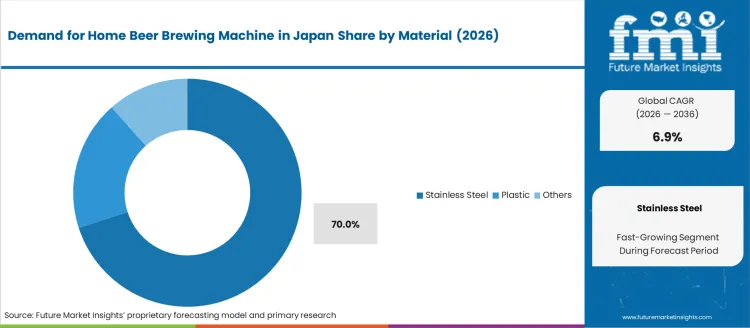
Stainless steel represents 70.0% of the demand for home beer brewing machine in Japan by material, reflecting its strength in cleanliness control and corrosion resistance. Consumption intensity is driven by repeated exposure to heat, acidic wort, and alcohol during brewing cycles. Usage remains stable because stainless surfaces resist odor retention and microbial buildup across long term use. Procurement is dominated by premium appliance suppliers and hobbyist focused retailers. Price sensitivity remains moderate because material durability influences long service life perception. Specification control emphasizes food grade alloy composition, weld integrity, surface finish smoothness, and resistance to thermal distortion.
Stainless steel based machines also generate consistent repeat demand through accessory upgrades such as fermenters, taps, and transfer fittings. Repeat utilization remains predictable as users expand home brewing setups. Buyers favor stainless platforms that allow long term expansion without compatibility limits. Margin structure remains controlled under rising metal input costs and appliance competition. Regulatory exposure centers on food contact safety certification and electrical insulation compliance. Import reliance persists for polished steel vessels and precision formed components. Substitution pressure from plastic remains limited to entry level machines where durability and hygiene tolerance are lower.
What Is Driving the Demand for Home Beer Brewing Machine in Japan Hobby Culture and Personalized Flavor Control?
Demand for home beer brewing machines in Japan reflects curiosity driven hobby culture, compact living constraints, and rising interest in personalized flavor control. Apartment friendly equipment with low noise, odor control, and small footprint gains attention among urban users. Craft beer appreciation has matured through taprooms and limited releases, which feeds experimentation at home. Gift purchases around retirement, birthdays, and seasonal celebrations support unit sales. Online demonstrations and community recipe sharing accelerate learning without formal brewing classes. Demand stays tied to controlled leisure, customization, and ingredient storytelling rather than cost savings over retail beer or pursuit of scale brewing projects.
How Do Urban Living Spaces Shape Equipment Design and Buying Behavior in Japan?
Urban housing patterns in Japan shape how brewing machines are selected and used. Many users live in compact apartments with shared ventilation and strict noise expectations. Machines that limit steam release, vibration, and fermentation odor gain acceptance within multi unit buildings. Countertop systems with sealed fermentation vessels fit narrow kitchens and storage limits. Water use control also matters in regions with metered household supply. These spatial and social constraints guide purchase decisions more strongly than batch size. Demand centers on compact engineering that respects neighbors, building rules, and daily living flow rather than experimental large volume production for most households.
Why Does Craft Beer Culture Support Home Brewing as a Learning Activity in Japan?
Japan craft beer culture supports home brewing through flavor curiosity rather than cost efficiency. Drinkers seek regional hop profiles, rice based adjuncts, and seasonal yeast character learned from taproom visits. Specialty shops supply malt kits, dry hops, and sanitization tools within urban retail districts. Online platforms offer localized recipes suited to water mineral content and climate. This access lowers entry barriers for controlled experimentation. Home brewers share tasting notes through small community groups rather than large competitions. Demand grows through sensory exploration and learning cycles tied to retail beer trends, tap takeovers, and seasonal limited releases across major metropolitan wards.
What Limits the Expansion of Home Beer Brewing in Japan Household Settings?
Home brewing in Japan operates under tight alcohol control awareness and social responsibility norms. Users remain careful about sharing, selling, or public serving of homemade beer. Ingredient cost, cleaning rigor, and fermentation time requirements narrow participation to committed hobbyists. Failed batches carry sensory disappointment and disposal effort that discourages casual trials. Summer heat adds temperature control burden during fermentation within apartments. These practical limits contain expansion beyond niche leisure adoption. Demand holds within a segment that values process learning, sanitation discipline, and flavor outcome patience rather than rapid output or high volume recreational drinking behavior among urban adult hobby circles.
What is the Demand for Home Beer Brewing Machine in Japan by Region?
.webp "Top Country Growth Comparison Demand For Home Beer Brewing Machine In Japan Cagr (2026 2036)")
| Region | CAGR (%) |
|---|---|
| Kyushu & Okinawa | 8.6% |
| Kanto | 7.9% |
| Kansai | 7.0% |
| Chubu | 6.1% |
| Tohoku | 5.4% |
| Rest of Japan | 5.1% |
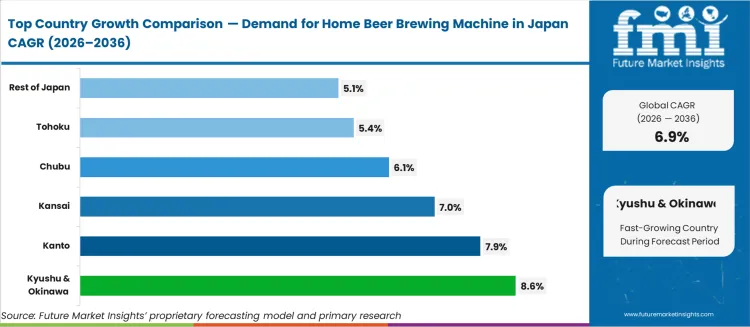
The demand for home beer brewing machines in Japan is rising steadily across consumer appliance and hobby equipment segments, led by Kyushu and Okinawa at an 8.6% CAGR. Growth in this region is supported by strong tourism driven exposure to craft beverages, higher adoption of home entertainment appliances, and expanding e commerce penetration. Kanto follows at 7.9%, driven by dense urban populations, higher disposable income levels, and strong interest in premium home lifestyle equipment. Kansai records 7.0% growth, reflecting steady uptake among hobby brewers and specialty beverage enthusiasts. Chubu at 6.1% shows moderate adoption linked to regional retail expansion. Tohoku and the Rest of Japan, at 5.4% and 5.1%, reflect slower growth shaped by lower discretionary spending and more traditional beverage consumption patterns.
How Is Craft Beverage Culture Shaping Home Brewing Machine Demand in Kyushu and Okinawa?
Demand for home beer brewing machine in Kyushu and Okinawa is advancing at a CAGR of 8.6% through 2036, supported by growing interest in craft beverages, tourism driven home entertainment spending, and rising preference for personalized drink preparation. Coastal leisure lifestyles support weekend brewing activity tied to social gatherings. Specialty kitchen appliance retailers show steady sales growth across compact fermenters and digital temperature controlled systems. Demand is linked to outdoor dining habits, rising curiosity around ingredient sourcing, and growing demand for low volume premium home brewing.
- Leisure driven social gatherings support home brewing use
- Compact fermenters dominate first time buyer preference
- Tourism spending influences premium appliance purchases
- Outdoor dining culture sustains recurring usage
Why Is Urban Hobby Adoption Driving Home Brewing Machine Growth in Kanto?
Demand for home beer brewing machine in Kanto is rising at a CAGR of 7.9% through 2036, driven by dense working population, strong hobby based appliance consumption, and rising demand for experiential home activities. Kanto records high adoption of app connected brewing systems and automated fermentation controls. Urban residents show strong interest in flavor customization and seasonal batch brewing. Growth reflects lifestyle trends linked to stay home leisure, rising acceptance of premium kitchen appliances, and wide access to brewing supplies through digital retail platforms.
- Digital brewing systems support automation driven demand
- Urban hobby culture sustains repeat equipment upgrades
- Flavor experimentation drives batch brewing frequency
- Online retail platforms strengthen equipment accessibility
What Is Supporting Balanced Home Brewing Machine Adoption Across Kansai?
Demand for home beer brewing machine in Kansai is progressing at a CAGR of 7.0% through 2036, supported by steady hobby appliance spending, strong household participation in food preparation, and rising interest in craft style beverages. Kansai records consistent sales across mid capacity brewing systems suited for family use. Demand remains guided by gift purchases, seasonal celebrations, and gradual shift toward personalization of beverages at home. Growth reflects stable household income patterns and growing interest in fermentation based culinary activities.
- Mid capacity systems suit household brewing needs
- Gift purchases support festive season equipment demand
- Home culinary culture drives fermentation interest
- Stable income supports consistent appliance upgrades
How Is Workforce Driven Leisure Spending Shaping Home Brewing Demand in Chubu?
Demand for home beer brewing machine in Chubu is advancing at a CAGR of 6.1% through 2036, supported by workforce driven discretionary income, growing interest in weekend leisure hobbies, and rising sales through electronics and appliance outlets. Chubu shows higher preference for entry level brewing kits and semi automated systems. Demand remains linked to controlled household spending and gradual hobby adoption. Growth reflects steady industrial employment, rising awareness of fermentation tools, and consistent replacement demand as entry level users upgrade capacity.
- Entry level systems dominate first purchase behavior
- Electronics stores lead physical retail distribution
- Weekend hobby culture supports steady usage
- Upgrade cycles drive recurring equipment demand
Why Is Demographic Structure Moderating Home Brewing Machine Growth in Tohoku?
Demand for home beer brewing machine in Tohoku is advancing at a CAGR of 5.4% through 2036, supported by stable household leisure spending, selective uptake among middle aged consumers, and gradual penetration of specialty kitchen appliances. Tohoku records lower impulse driven appliance buying. Brewing activity remains limited to hobby enthusiasts and small home social circles. Growth reflects measured consumer behavior, slower adoption of digital brewing tools, and continued preference for compact manually operated systems.
- Hobby focused users anchor demand base
- Manual brewing systems remain widely preferred
- Low impulse buying governs purchase cycles
- Small group social brewing shapes usage patterns
How Is Small City Appliance Retail Influencing Home Brewing Demand in Rest of Japan?
Demand for home beer brewing machine in Rest of Japan is advancing at a CAGR of 5.1% through 2036, supported by gradual expansion of home appliance assortments, steady household interest in do it yourself food preparation, and limited but stable hobby equipment adoption. These areas show lower exposure to premium digital brewing platforms. Demand remains centered on basic brewing kits and stovetop fermenters. Growth remains linked to household budget discipline, small retailer promotion activity, and slow diffusion of home crafting trends.
- Basic brewing kits dominate product mix
- Small retailers anchor regional distribution
- Household budget control shapes buying behavior
- Gradual hobby adoption sustains moderate growth
What Is Driving the Demand for Home Beer Brewing Machine in Japan and Which Brands Shape Consumer Adoption
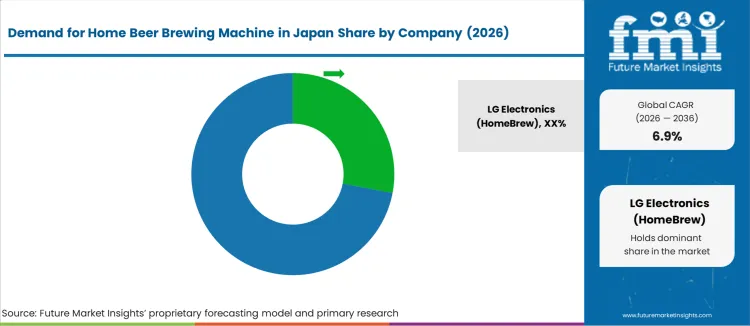
The demand for home beer brewing machines in Japan is shaped by craft beer culture growth, rising interest in personalization of beverages, and steady participation in hobby based food and drink preparation. Kirin and Asahi influence the ecosystem indirectly through exposure to diverse beer styles that stimulate home experimentation among enthusiasts. LG Electronics HomeBrew holds a visible position through capsule based automated brewing systems sold through electronics retailers and online platforms. Minibrew supports demand through compact connected brewing appliances adopted by urban consumers with limited space. Brewie and PicoBrew reach Japanese users mainly through cross border e commerce and specialty hobby retailers serving advanced home brewers.
Ss Brewtech participates through premium stainless steel brewing systems positioned for serious hobbyists and small batch experimentation communities. Product selection in Japan is governed by footprint size, temperature control accuracy, fermentation stability, noise level in apartment settings, and cleaning automation. Buyer preference favors machines that offer repeatable output, smartphone control interfaces, and compatibility with Japanese voltage standards. Demand visibility tracks growth in craft beer festivals, online brewing education participation, gifting patterns linked to year-end holidays, and rising consumer interest in experiential food culture within major urban prefectures.
Key Players in the Home Beer Brewing Machine Industry in Japan
- Brewie
- Minibrew
- LG Electronics (HomeBrew)
- PicoBrew
- Ss Brewtech
Scope of the Report
| Metric | Value |
|---|---|
| Quantitative Units | USD 2.03 to USD 3.96 billion, at a CAGR of 6.9% |
| Market Definition | Home beer brewing machines are consumer and commercial appliances designed to automate or assist the beer brewing process in residential and small-scale commercial settings. The Japan market covers mini brewing systems, full-size brewing systems, and associated fermentation and dispensing equipment constructed from stainless steel, plastic, and other materials. |
| Segmentation | Material (Stainless Steel, Plastic, Others), Product Type (Mini Brewing, Full-Size Brewing), Mechanism (Manual, Semi-Automatic, Automatic), End-User (Residential, Commercial) |
| Regions Covered | Kyushu & Okinawa, Kanto, Kansai, Chubu, Tohoku, Rest of Japan |
| Key Companies Profiled | LG Electronics (HomeBrew), Minibrew, Brewie, PicoBrew, Ss Brewtech |
| Forecast Period | 2026 to 2036 |
| Approach | Forecasting models apply a bottom-up methodology starting with unit shipment and average selling price data, cross-validated against manufacturer financial disclosures and distributor sell-through records. |
Home Beer Brewing Machine Industry in Japan Segmentation
Product Type:
- Mini Brewing
- Full-Size Brewing
Material:
- Stainless Steel
- Plastic
- Others
Mechanism:
- Manual
- Semi-Automatic
- Automatic
End-User:
- Residential
- Commercial
Region:
- Kyushu & Okinawa
- Kanto
- Kansai
- Chubu
- Tohoku
- Rest of Japan
Bibliography
- 1. National Tax Agency, Japan. (2024). Liquor Tax Law Implementation Guidelines and Home Brewing Provisions. NTA.
- 2. Japan Craft Beer Association. (2024). Annual Survey of Craft Beer Production and Consumption Trends. JCBA.
- 3. Organisation for Economic Co-operation and Development. (2024). Consumer Spending Patterns in Developed Economies. OECD.
- 4. LG Electronics. (2024). Annual Report 2024: Home Appliance Division. LG Electronics.
- 5. Ministry of Agriculture, Forestry and Fisheries, Japan. (2024). Food and Beverage Industry Statistical Yearbook. MAFF.
- 6. Japan External Trade Organization. (2024). Consumer Electronics Market Trends in Japan. JETRO.
This bibliography is provided for reader reference. The full Future Market Insights report contains the complete reference list with primary research documentation.
Frequently Asked Questions
How large is the demand for home beer brewing machine in japan in 2026?
The demand for home beer brewing machine in japan is estimated to be valued at USD 2.03 billion in 2026.
What will be the market size of demand for home beer brewing machine in japan by 2036?
Market size for demand for home beer brewing machine in japan is projected to reach USD 3.96 billion by 2036.
What is the expected growth rate between 2026 and 2036?
The demand for home beer brewing machine in japan is expected to grow at a CAGR of 6.9% between 2026 and 2036.
Which material is poised to lead by 2026?
Stainless Steel accounts for 70.0% share in 2026, driven by established procurement patterns and broad adoption.
What is the growth outlook for Kyushu & Okinawa?
Kyushu & Okinawa is projected to grow at a CAGR of 8.6% during 2026 to 2036.
What is included in the scope of this report?
Market scope includes countertop mini brewing appliances, full-size home brewing systems, fermentation vessels, temperature control units, and ingredient dispensing modules. Brewing accessory kits, cleaning systems, and connected app-enabled brewing platforms are included.
How does FMI build and validate this forecast?
Forecasting models apply a bottom-up methodology starting with unit shipment and average selling price data, cross-validated against manufacturer financial disclosures and distributor sell-through records.
Preview the report firsthand - request a free sample
Get SampleGet the brochure for pricing and purchase details.
Get PDFTable of Content
- Executive Summary
- Global Market Outlook
- Demand-side Trends
- Supply-side Trends
- Technology Roadmap Analysis
- Analysis and Recommendations
- Market Overview
- Market Coverage / Taxonomy
- Market Definition / Scope / Limitations
- Research Methodology
- Chapter Orientation
- Analytical Lens and Working Hypotheses
- Market Structure, Signals, and Trend Drivers
- Benchmarking and Cross-market Comparability
- Market Sizing, Forecasting, and Opportunity Mapping
- Research Design and Evidence Framework
- Desk Research Programme (Secondary Evidence)
- Company Annual and Sustainability Reports
- Peer-reviewed Journals and Academic Literature
- Corporate Websites, Product Literature, and Technical Notes
- Earnings Decks and Investor Briefings
- Statutory Filings and Regulatory Disclosures
- Technical White Papers and Standards Notes
- Trade Journals, Industry Magazines, and Analyst Briefs
- Conference Proceedings, Webinars, and Seminar Materials
- Government Statistics Portals and Public Data Releases
- Press Releases and Reputable Media Coverage
- Specialist Newsletters and Curated Briefings
- Sector Databases and Reference Repositories
- FMI Internal Proprietary Databases and Historical Market Datasets
- Subscription Datasets and Paid Sources
- Social Channels, Communities, and Digital Listening Inputs
- Additional Desk Sources
- Expert Input and Fieldwork (Primary Evidence)
- Primary Modes
- Qualitative Interviews and Expert Elicitation
- Quantitative Surveys and Structured Data Capture
- Blended Approach
- Why Primary Evidence is Used
- Field Techniques
- Interviews
- Surveys
- Focus Groups
- Observational and In-context Research
- Social and Community Interactions
- Stakeholder Universe Engaged
- C-suite Leaders
- Board Members
- Presidents and Vice Presidents
- R&D and Innovation Heads
- Technical Specialists
- Domain Subject-matter Experts
- Scientists
- Physicians and Other Healthcare Professionals
- Governance, Ethics, and Data Stewardship
- Research Ethics
- Data Integrity and Handling
- Primary Modes
- Tooling, Models, and Reference Databases
- Desk Research Programme (Secondary Evidence)
- Data Engineering and Model Build
- Data Acquisition and Ingestion
- Cleaning, Normalisation, and Verification
- Synthesis, Triangulation, and Analysis
- Quality Assurance and Audit Trail
- Market Background
- Market Dynamics
- Drivers
- Restraints
- Opportunity
- Trends
- Scenario Forecast
- Demand in Optimistic Scenario
- Demand in Likely Scenario
- Demand in Conservative Scenario
- Opportunity Map Analysis
- Product Life Cycle Analysis
- Supply Chain Analysis
- Investment Feasibility Matrix
- Value Chain Analysis
- PESTLE and Porter’s Analysis
- Regulatory Landscape
- Regional Parent Market Outlook
- Production and Consumption Statistics
- Import and Export Statistics
- Market Dynamics
- Global Market Analysis 2021 to 2025 and Forecast, 2026 to 2036
- Historical Market Size Value (USD Million) Analysis, 2021 to 2025
- Current and Future Market Size Value (USD Million) Projections, 2026 to 2036
- Y-o-Y Growth Trend Analysis
- Absolute $ Opportunity Analysis
- Global Market Pricing Analysis 2021 to 2025 and Forecast 2026 to 2036
- Global Market Analysis 2021 to 2025 and Forecast 2026 to 2036, By Material
- Introduction / Key Findings
- Historical Market Size Value (USD Million) Analysis By Material , 2021 to 2025
- Current and Future Market Size Value (USD Million) Analysis and Forecast By Material , 2026 to 2036
- Stainless Steel
- Plastic
- Others
- Stainless Steel
- Y-o-Y Growth Trend Analysis By Material , 2021 to 2025
- Absolute $ Opportunity Analysis By Material , 2026 to 2036
- Global Market Analysis 2021 to 2025 and Forecast 2026 to 2036, By Product Type
- Introduction / Key Findings
- Historical Market Size Value (USD Million) Analysis By Product Type, 2021 to 2025
- Current and Future Market Size Value (USD Million) Analysis and Forecast By Product Type, 2026 to 2036
- Mini Brewing
- Full-Size Brewing
- Mini Brewing
- Y-o-Y Growth Trend Analysis By Product Type, 2021 to 2025
- Absolute $ Opportunity Analysis By Product Type, 2026 to 2036
- Global Market Analysis 2021 to 2025 and Forecast 2026 to 2036, By Mechanism
- Introduction / Key Findings
- Historical Market Size Value (USD Million) Analysis By Mechanism, 2021 to 2025
- Current and Future Market Size Value (USD Million) Analysis and Forecast By Mechanism, 2026 to 2036
- Manual
- Semi-Automatic
- Automatic
- Manual
- Y-o-Y Growth Trend Analysis By Mechanism, 2021 to 2025
- Absolute $ Opportunity Analysis By Mechanism, 2026 to 2036
- Global Market Analysis 2021 to 2025 and Forecast 2026 to 2036, By End-User
- Introduction / Key Findings
- Historical Market Size Value (USD Million) Analysis By End-User, 2021 to 2025
- Current and Future Market Size Value (USD Million) Analysis and Forecast By End-User, 2026 to 2036
- Residential
- Commercial
- Residential
- Y-o-Y Growth Trend Analysis By End-User, 2021 to 2025
- Absolute $ Opportunity Analysis By End-User, 2026 to 2036
- Global Market Analysis 2021 to 2025 and Forecast 2026 to 2036, By Region
- Introduction
- Historical Market Size Value (USD Million) Analysis By Region, 2021 to 2025
- Current Market Size Value (USD Million) Analysis and Forecast By Region, 2026 to 2036
- North America
- Latin America
- Western Europe
- Eastern Europe
- East Asia
- South Asia and Pacific
- Middle East & Africa
- Market Attractiveness Analysis By Region
- North America Market Analysis 2021 to 2025 and Forecast 2026 to 2036, By Country
- Historical Market Size Value (USD Million) Trend Analysis By Market Taxonomy, 2021 to 2025
- Market Size Value (USD Million) Forecast By Market Taxonomy, 2026 to 2036
- By Country
- USA
- Canada
- Mexico
- By Material
- By Product Type
- By Mechanism
- By End-User
- By Country
- Market Attractiveness Analysis
- By Country
- By Material
- By Product Type
- By Mechanism
- By End-User
- Key Takeaways
- Latin America Market Analysis 2021 to 2025 and Forecast 2026 to 2036, By Country
- Historical Market Size Value (USD Million) Trend Analysis By Market Taxonomy, 2021 to 2025
- Market Size Value (USD Million) Forecast By Market Taxonomy, 2026 to 2036
- By Country
- Brazil
- Chile
- Rest of Latin America
- By Material
- By Product Type
- By Mechanism
- By End-User
- By Country
- Market Attractiveness Analysis
- By Country
- By Material
- By Product Type
- By Mechanism
- By End-User
- Key Takeaways
- Western Europe Market Analysis 2021 to 2025 and Forecast 2026 to 2036, By Country
- Historical Market Size Value (USD Million) Trend Analysis By Market Taxonomy, 2021 to 2025
- Market Size Value (USD Million) Forecast By Market Taxonomy, 2026 to 2036
- By Country
- Germany
- UK
- Italy
- Spain
- France
- Nordic
- BENELUX
- Rest of Western Europe
- By Material
- By Product Type
- By Mechanism
- By End-User
- By Country
- Market Attractiveness Analysis
- By Country
- By Material
- By Product Type
- By Mechanism
- By End-User
- Key Takeaways
- Eastern Europe Market Analysis 2021 to 2025 and Forecast 2026 to 2036, By Country
- Historical Market Size Value (USD Million) Trend Analysis By Market Taxonomy, 2021 to 2025
- Market Size Value (USD Million) Forecast By Market Taxonomy, 2026 to 2036
- By Country
- Russia
- Poland
- Hungary
- Balkan & Baltic
- Rest of Eastern Europe
- By Material
- By Product Type
- By Mechanism
- By End-User
- By Country
- Market Attractiveness Analysis
- By Country
- By Material
- By Product Type
- By Mechanism
- By End-User
- Key Takeaways
- East Asia Market Analysis 2021 to 2025 and Forecast 2026 to 2036, By Country
- Historical Market Size Value (USD Million) Trend Analysis By Market Taxonomy, 2021 to 2025
- Market Size Value (USD Million) Forecast By Market Taxonomy, 2026 to 2036
- By Country
- China
- Japan
- South Korea
- By Material
- By Product Type
- By Mechanism
- By End-User
- By Country
- Market Attractiveness Analysis
- By Country
- By Material
- By Product Type
- By Mechanism
- By End-User
- Key Takeaways
- South Asia and Pacific Market Analysis 2021 to 2025 and Forecast 2026 to 2036, By Country
- Historical Market Size Value (USD Million) Trend Analysis By Market Taxonomy, 2021 to 2025
- Market Size Value (USD Million) Forecast By Market Taxonomy, 2026 to 2036
- By Country
- India
- ASEAN
- Australia & New Zealand
- Rest of South Asia and Pacific
- By Material
- By Product Type
- By Mechanism
- By End-User
- By Country
- Market Attractiveness Analysis
- By Country
- By Material
- By Product Type
- By Mechanism
- By End-User
- Key Takeaways
- Middle East & Africa Market Analysis 2021 to 2025 and Forecast 2026 to 2036, By Country
- Historical Market Size Value (USD Million) Trend Analysis By Market Taxonomy, 2021 to 2025
- Market Size Value (USD Million) Forecast By Market Taxonomy, 2026 to 2036
- By Country
- Kingdom of Saudi Arabia
- Other GCC Countries
- Turkiye
- South Africa
- Other African Union
- Rest of Middle East & Africa
- By Material
- By Product Type
- By Mechanism
- By End-User
- By Country
- Market Attractiveness Analysis
- By Country
- By Material
- By Product Type
- By Mechanism
- By End-User
- Key Takeaways
- Key Countries Market Analysis
- USA
- Pricing Analysis
- Market Share Analysis, 2025
- By Material
- By Product Type
- By Mechanism
- By End-User
- Canada
- Pricing Analysis
- Market Share Analysis, 2025
- By Material
- By Product Type
- By Mechanism
- By End-User
- Mexico
- Pricing Analysis
- Market Share Analysis, 2025
- By Material
- By Product Type
- By Mechanism
- By End-User
- Brazil
- Pricing Analysis
- Market Share Analysis, 2025
- By Material
- By Product Type
- By Mechanism
- By End-User
- Chile
- Pricing Analysis
- Market Share Analysis, 2025
- By Material
- By Product Type
- By Mechanism
- By End-User
- Germany
- Pricing Analysis
- Market Share Analysis, 2025
- By Material
- By Product Type
- By Mechanism
- By End-User
- UK
- Pricing Analysis
- Market Share Analysis, 2025
- By Material
- By Product Type
- By Mechanism
- By End-User
- Italy
- Pricing Analysis
- Market Share Analysis, 2025
- By Material
- By Product Type
- By Mechanism
- By End-User
- Spain
- Pricing Analysis
- Market Share Analysis, 2025
- By Material
- By Product Type
- By Mechanism
- By End-User
- France
- Pricing Analysis
- Market Share Analysis, 2025
- By Material
- By Product Type
- By Mechanism
- By End-User
- India
- Pricing Analysis
- Market Share Analysis, 2025
- By Material
- By Product Type
- By Mechanism
- By End-User
- ASEAN
- Pricing Analysis
- Market Share Analysis, 2025
- By Material
- By Product Type
- By Mechanism
- By End-User
- Australia & New Zealand
- Pricing Analysis
- Market Share Analysis, 2025
- By Material
- By Product Type
- By Mechanism
- By End-User
- China
- Pricing Analysis
- Market Share Analysis, 2025
- By Material
- By Product Type
- By Mechanism
- By End-User
- Japan
- Pricing Analysis
- Market Share Analysis, 2025
- By Material
- By Product Type
- By Mechanism
- By End-User
- South Korea
- Pricing Analysis
- Market Share Analysis, 2025
- By Material
- By Product Type
- By Mechanism
- By End-User
- Russia
- Pricing Analysis
- Market Share Analysis, 2025
- By Material
- By Product Type
- By Mechanism
- By End-User
- Poland
- Pricing Analysis
- Market Share Analysis, 2025
- By Material
- By Product Type
- By Mechanism
- By End-User
- Hungary
- Pricing Analysis
- Market Share Analysis, 2025
- By Material
- By Product Type
- By Mechanism
- By End-User
- Kingdom of Saudi Arabia
- Pricing Analysis
- Market Share Analysis, 2025
- By Material
- By Product Type
- By Mechanism
- By End-User
- Turkiye
- Pricing Analysis
- Market Share Analysis, 2025
- By Material
- By Product Type
- By Mechanism
- By End-User
- South Africa
- Pricing Analysis
- Market Share Analysis, 2025
- By Material
- By Product Type
- By Mechanism
- By End-User
- USA
- Market Structure Analysis
- Competition Dashboard
- Competition Benchmarking
- Market Share Analysis of Top Players
- By Regional
- By Material
- By Product Type
- By Mechanism
- By End-User
- Competition Analysis
- Competition Deep Dive
- LG Electronics (HomeBrew)
- Overview
- Product Portfolio
- Profitability by Market Segments (Product/Age /Sales Channel/Region)
- Sales Footprint
- Strategy Overview
- Marketing Strategy
- Product Strategy
- Channel Strategy
- Minibrew
- Brewie
- PicoBrew
- Ss Brewtech
- LG Electronics (HomeBrew)
- Competition Deep Dive
- Assumptions & Acronyms Used


